AUTHOR’S NOTE: This week, we’re studying up on Mexican horror. That means that we’re also bringing back some of our favorite of la peliculas to share all over again one more time. This movie originally ran on January 1, 2020.
Oh René Cardona. Here you are remaking the lucha libre movie you did back in 1962, Las Luchadoras Contra el Medico Asesino, or The Wrestling Women vs. the Killer Doctor or Doctor of Doom, as it was called in the U.S.
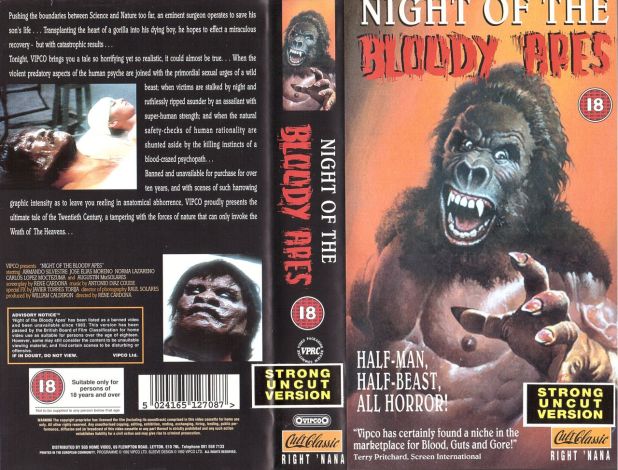
While this was made in 1969 as La Horripilante Bestia Humana, or The Horrible Man-Beast, this one didn’t play in the U.S. until 1972. With alternate titles like Horror y Sexo and Gomar – The Human Gorilla, this is a fine blend of ladies wrestling with apes and, well, human heart surgery footage.
Female masked wrestler Lucy dresses like the devil and wrestles at the arena — dare we say Arena Mexico? — every Friday, where she often knocks out other girls who dress like cat girls. She wants to retire for a life of leisure — and less stress — with her cop boyfriend.
However, Dr. Krellman (Jose Elias Moreno, who was Santa Claus in the aforementioned film where he battles Patch the demon) wants to cure his son from leukemia. So he does what doctors have always said would work — he puts him a gorilla heart inside his boy. As we all know from health class, this turns his son into a deformed and murderous man-ape with the craziness of the organ donor to boot.
You won’t be bored, what with the nudity, real open heart surgery and rampant murders. A monkey man that rips off dudes’ faces and the clothes of girls? Si, muchacho.
This made the Section 1 video nasties list, probably because its VHS cover art was had a bloody surgeon’s hands holding a scalpel with the words “Warning: this film contains scenes of extreme and explicit violence.”
Let’s talk about family tradition. The Cardona family has it. Starting with the senior Rene Cardona, we got films like the brain-melting Santa Claus, Wrestling Women vs. the Aztec Mummy and Night of the Bloody Apes. His son would continue the journey with Night of 1000 Cats, Guyana: Crime of the Century and Tintorera.
Starting with this film, Rene Cardona III would put his own spin on horror films. This movie feels like someone stayed up all night mainlining every single Amityville unconnected sequel — trust me, as I have done this — and then decided to make their own cover version before the booze wore off.
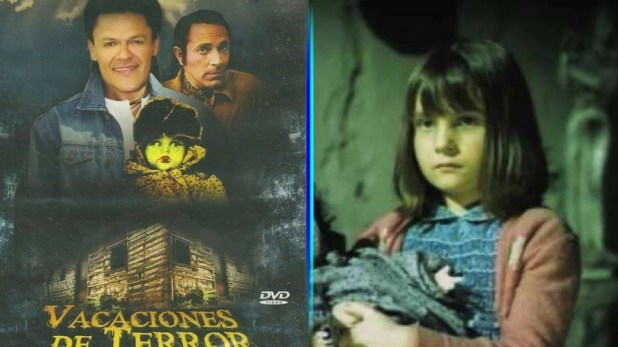
Way back in 1889, a witch had taken over a small Mexican town, but an inquisitor was able to use a sacred amulet to force her into the flames and save his village. When he tosses all of her belongings — including a cursed doll — into a well, he never dreamed that a little girl would find it a hundred years later and put her family through hell.
This movie has it all. Bleeding walls, refrigerators teeming with rats and no small amount of snakes and spiders. It also has Julio, the affable teen who hopes to save the family and the babysitter that he is in love with. He’s played by Pedro Fernandez, who is more than an actor, as he’s a TV show host and singer.
This movie has a great scene where the kids play with a toy car — which has possessed their father’s car — and try to push it into the fireplace. These are the reasons why I love movies like this, the small moments that make me realize just how little reality can intrude within.
If this ever came out on blu ray — and it totally should, because the DVD versions are out of print and are prohibitively expensive — I will add my critic byline to it: “If you thought Ghosthouse was completely inane and ridiculous, have I got an awesome movie for you!”
PS: This pairs nicely with Cathy’s Curse so you get a real North/South exploitation exorcism adventure.
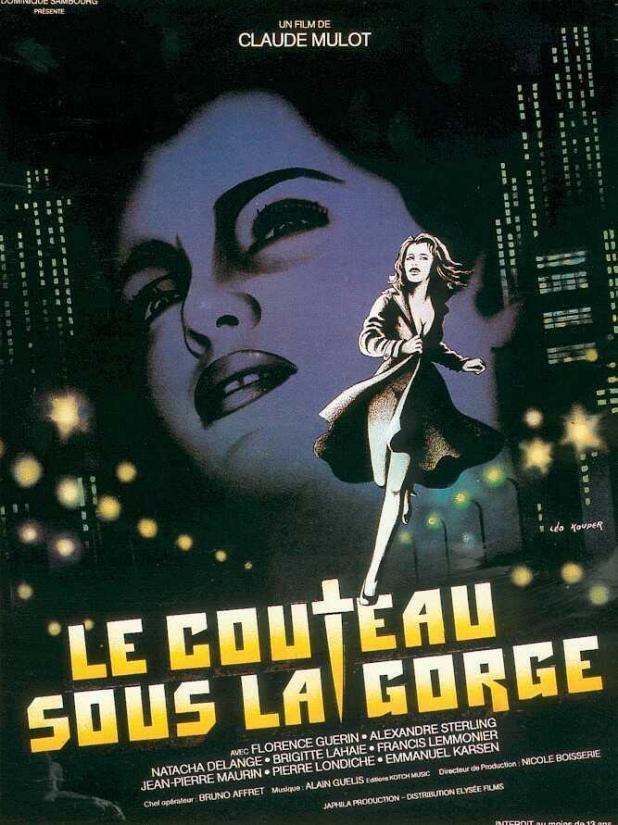
Catherine (Florence Guerin, Faceless, Too Beautiful to Die, Demons 6: De Profundis) is an adult magazine model who is being stalked over the phone. That’s not as bad as some of the other girls she works with. After all, they’re not just getting heavy breathing. They’re getting killed.
Brigitte Lahaie is in this, pretty much a perfect fit for her background. She rose from the X-rated films of France to be recognized by Jean Rollin, who cast her in his films The Grapes of Death and Fascination. This also makes sense as to why Claude Mulot directed this, as the majority of his career was also in adult films. He’d die a few years later in a drowning accident. He also made The Blood Rose, a film so close to a Jess Franco movie that Troy Howarth would say in So Deadly, So Perverse: Giallo-Style Films from Around the World Volume 3, “one would be forgiven for thinking that Franco had made it himself.”
This doesn’t do anything special or different than any other giallo. Both Guerin and Lahaie would make Franco’s Facelesssoon after, a much better film.
Editor’s Note: As this exploring feature wraps up our “Giallo Week” of reviews, we’re unpacking a lot of links of our past reviews within our analysis of the genre, as well as a listing of links for our week’s reviews. So bookmark this feature and return at your leisure for your one-stop source for Giallo films.
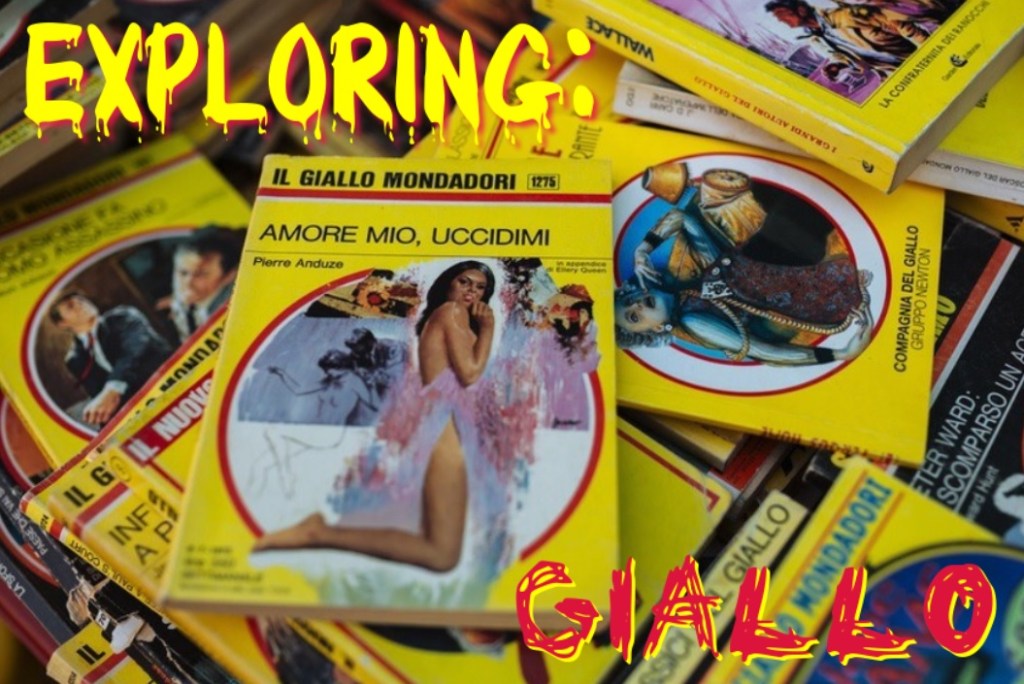
Most horror film aficionados believe the American slasher film cycle of the early eighties birthed with John Carpenter’s 1978 horror classic Halloween*. In reality: slasher films got their start in Italy with a literary format known as Giallo or “Yellow” in the Italian vernacular.
Giallo pulp novels image courtesy of Casey Broadwater/Flickrwith banner by R.D Francis/PicFont
Inspired by Robert Louis Stevenson’s 126-paged novella horror classic (The Strange Case of) Dr. Jekyll and Mr. Hyde, small literary houses in Italy churned out their Giallo variant: a cost-effective format of reading entertainment intended for male readers—considering most of the psychologically damaged antagonist’s victims were female—who eschewed cheaply-produced romance novels with splashy, sexy-gaudy covers enamored by the women in their lives. These Italian paperbacks were produced by small literary houses that kept their printing costs down by binding the books in universal, unadorned yellow covers with simple, black-lettered titles that readers could easily stuff the ironically blood red-soaked tales in their jeans’ back pocket for easy, portable reading.
While the names of Dario Argento and Mario Bava are bantered about as the fathers of Giallo, the true father—well, grandfather—is Edgar Wallace. Huh? The British-born writer who wrote the screenplay for 1933’s King Kong?
It’s true. The ex-army press corps and London’s Daily Mail scribe moved into novels and became the “King of the Thrillers” by grinding out 957 short stories, 170 novels, and 18 stage plays—many of which he riffed as a secretary dictated them. Many times, he worked on as many as three books at once.
Sadly, as with the prolific Phillip K. Dick, Wallace’s greatest fame was posthumous (he died in 1932). While alive, his first film adaptation was The Man Who Bought London (1916), and those adaptations hit fever pitch in the ‘60s with the forty-seven films of the Edgar Wallace Mysteries series.
Wallace’s new found fame—and on his way to becoming a Giallo inspiration—began when the Danish production company Rialto Film co-produced with the German film market, 1959’s Der Frosch mit der Maske (aka The Face of the Frog) which started the krimi genre (abbreviation for the German term “Kriminalfilm”). Krimis—like the later Giallo films they inspired, were hyper-noir films, replete with zooming cameras and lurid, masked supervillains. And many of Wallace’s novels sported those cheap yellow covers that gave our beloved, pre-slasher ‘80s films their name—Giallo.
Gialli offered European readers sexually-inspired gore stories that caused the fans of the suggestive, atmospheric horror films produced by Britain’s Amicus and Hammer Studios to flinch—and Stevenson, along with noted Gothic horror authors Sheridan Le Fanu, Gaston LeRoux, and Guy de Mausspaunt to roll over in their graves. (And don’t forget the inspirations of Thomas De Quincey to Italian filmmaker Dario Argento.) Gialli—filled with quaint, occasional reader-acceptable typos by way of underpaid and overworked editors and proof readers—were well-written, suspenseful and engaging tales (the “content” is the key) that Sheridan Le Fanu probably wanted to include in his influential, short-story collection In a Glass, Darkly (featuring the vampire classic “Carmella”) and realized he had to rein his imagination or be judged by a puritanical, elitist lynch mob for writing “filth.”
It was those yellow-bound books that inspired the spaghetti-horror (pasta-horror) cycle spearheaded by Mario Bava** with 1971’s Twitch of the Death Nerve (aka Bay of Blood) and Dario Argento+, who became the maestro of Italian Giallo films with 1970’s TheBird with the Crystal Plumage. (Watch Carpenter’s Halloween, Sean S. Cunningham’s Friday the 13th, and Brian DePalma’sDressed to Kill—and compare to Bava’s and Argento’s work: especially look for the similarities of Bava’s Twitch of the Death Nerve vs. Friday the 13th.)
Produced for a reported $350,000 John Carpenter’s classic grossed an estimated $80 million dollars in worldwide box office during its initial release. Initially dumped into the U.S drive-in market to make a quick buck, the fluke blockbuster status of the film inspired mainstream Hollywood to jump on the yellow-painted bandwagon with 1980’s Friday the 13th and 1984’s A Nightmare on Elm Street++.
As fate would have it, the John Carpenter-inspired slasher film cycle coincided with the introduction of a contraption known as a VCR that played something called a VHS tape—and that hunk of analog electronics transitioned the slasher film genre from America’s outdoor drive-ins and onto the shelves of the burgeoning U.S home video market. (Don’t forget: Christopher Lewis’s groundbreak Blood Cult was the first “Big Box” SOV produced exclusively for the home video market.) Slasher films—affectionately referred to as “boobs and blades” for their concentrations on well-endowed, giggly women and the shiny, sharp objects that stabbed them—were cheap and easy to produce and the worldwide film markets were hot for product. Returns on a film’s investment produced under the “boobs and blades” banner were guaranteed. The films became the number one way for a newbie actor or writer, budding director or producer to get into the film business.
Courtesy of heliosphan/Picclick.com
At the same time those direct-to-video “boobs and blades” knock offs started flying off the video store shelves, a new form of heavy metal birthed in Britain in the late seventies—dubbed by Sounds magazine as “The New Wave of British Heavy Metal” (NWOBHM). Featuring the violent, religious mania and bloody lyrics composed by the likes of Venom and Iron Maiden, complete with the requisite Satanic imagery on the album covers, slasher films and heavy metal music were a match made in hell: the music coming out of England was, in fact, Giallo musicals. This music-inspired slasher sub-genre even got its own name: metalsploitation*+, which featured other beloved so-bad-they’re-good bloody analog tales showcasing the exploitive titles of Black Roses, Shock ’em Dead, Terror on Tour, Rock ’n’ Roll Nightmare, Hard Rock Zombies, and Rocktober Blood. The genre peaked—and quickly burnt out—when the major studios took a slice of the metalsploitation pie with 1986’s big-budgeted Trick or Treat.
However, before the glut of heavy-metal horror films hit the video store shelves, Paul Williams and Brian DePalma composed a campy, 1974 rock ’n’ roll Giallo-inspired reboot of Hammer Studios’ 1962 film version of The Phantom of the Opera (based on Gaston LeRoux’s novel). Somewhat similar to 1975’s The Rocky Horror Picture Show in the camp ’n’ rock department, Phantom of the Paradise featured an emotionally damaged musician, Winslow Leech, who rains vengeance on the narrow-minded fools who stole his music and ruined his career. An emotionally damaged antagonist out for revenge who wears a mask? It’s pure Giallo. The only difference is that poor Winslow isn’t concealed behind POV black gloves.
Needless to say, the Giallo cycle was misunderstood by mainstream America, with the genre’s mixtures of murder and the supernatural rated as “style over substance” and “lacking in narrative logic.”
Well, that’s was always the point, Mr. Mainstream critic. (That and if the friggin’ puritanical U.S. distributors didn’t chop and slice the Italian and Spanish imports into incomprehensible messes.)
Italian Gialli—or any of the Spanish variants—of the ‘70s always eschewed “realism” and “substance” over what were always the main priorities of the Giallo genre: art and surrealism rooted in Impressionism and Renaissance art.
The Giallo resume of Dario Argento, the leader of the genre, is the cinematic equivalent of Salvador Dali’s melting clocks and M.C Esher’s impossible objects and staircases to nowhere. Giallo is all about the utilization of oozing color palates and oddball light sources, nonsensical supernatural red-herrings to nowhere, psychic links to killers hidden in POV, whispered poetic passages, hypersexual oddball red-herring characters, rape and murdered moms, junk science (about sunspots, Y chromosomes, eye-memories, love-chemicals), pedophile fathers, doctors and detectives riddled with kinks and ulterior motives, and a general, overall incoherency (even before U.S. distributors got their hands on ’em) set to a soundtrack of jazz-rock noodling and chanting choirs.
The whole point of Paolo Cavara’s Black Belly of the Tarantula and Sergio Martino’s The Case of the Scorpion’s Tale—and every bloody tale concerned with insects and animals—is for you, the viewer, to have a series of “WTF” moments. Giallo films are crime capers, that is, film noirs+* (see the classics A Double Life, Black Angel, Double Indemnity, Farewell, My Lovely, My Name is Julia Ross, The Possessed, So Dark the Night, Sorry, Wrong Number) with the violence in full living-dead color, along with a dash of the supernatural tossed in for good measure.
Noir/detective paperbacks image courtesy of rubysresaleofrhodeisland/eBay
In 1944’s Double Indemnity, when Fred MacMurray pops up from behind the car’s backseat and strangles the husband of Phyliss Dietrichson (Barbara Stanwyck), the camera pulls back and frames on her satisfied face as her husband gags to death off frame (and we can imagine what expression is across MacMurray’s face). That’s film noir. In a Giallo, the eye-buldging strangulation is in full frame. In film noir, the sex—via editing and cinematography—is implied. In a Giallo, it’s on camera—and, in most cases, only one person walks away unslashed from the encounter.
That “honey of an anklet” will get the colors of the dark, flowing.
Actor Tony Musante’s vacationing American writer Sam Dalmas and Michael Brandon’s rock drummer Roberto Tobias, in the respective films The Bird with the Crystal Plumage and Four Files on Grey Velvet, have everything in common with William Holden’s Joe Gillis in Sunset Blvd., Fred MacMurray’s pasty of Walter Neff in Double Indemnity, and John Garfield’s Frank Chambers in The Postman Always Rings Twice. Each are somewhat well-intentioned, yet flawed individuals. The only difference is the film noir schlubs of the latter films don’t end up in a Dario Argento what-the-fuck Giallo plot twist of an intelligent chimp wielding a straight razor and having to rescue a cute girl with psychic links to insects (Phenomena, for those of you wondering what in-the-hell am I talking about).
Of course, as Sam, the bossman at B&S About Movies pointed out, we have Mario Bava to thank with his black-and-white, 1963 neo-noir The Girl Who Knew Too Much and its introductions of Giallo conventions serving as the progenitor for the genre. Then Bava sealed the deal with his next film, the 1964 color-shot Blood and Black Lace, which introduced all the high fashion, shocking color-palate gore, and psychosexual encounters missing from the likes of the black and white film noir classics, such as Double Indemnity and Sorry, Wrong Number, which inspired Bava’s The Girl Who Knew Too Much.
Watch Federico Caddeo’s genre examination on Tubi.
But even I have to admit that no matter how much I enjoy the films of those Italian filmmakers, I am burnt out on them. But I love the era and adore the genre and I want more . . . but my yellow has turned to brown.
Thankfully, there’s a new crop of young turks keeping the genre alive, birthing a new genre: neo-Giallo—or what I like to call “Giallo impressionism.”
Granted, the frames of today’s modernized Gialli—fans will place the major studio wares of James Wan’s Malignant, Edgar Wright’s Last Night in Soho and, Peter Strickland’s more deserving Berberian Sound Studio, on the list*—may be a bit to “pretty” in contrast to the classic, cheap n’ quickly made Giallo films of yore. The budgets of 21st century Gialli are more studio-generous; as result: they’re too carefully made—to please the suits bankrolling them—and lacking in the classic schlock and the exploitative elements, which takes away from the lack-of-logic strangeness we adore of the genre. The truth is we don’t want to make sense of these films rife with heart-weeping beautiful women victimized by ultra-violence dispensed by POV black-gloved killers slashing by way of ear-bleeding Morricone and Goblin soundtracks. (*I’ll even debate Sly Stallone’s Cobra and D-Tox, as well as Charles Bronson’s 10 to Midnight, are Euro-influenced Giallo variants crossed with Poliziotteschi elements in their frames.)
So, embrace the yellow leaking out of Kevin V. Jones across the marbled floors of Morningside, ye children of the night! Fill your goblets, for tonight; we dine by the plasma’s streaming glow. And it forever glows yellow and in all the primary colors of the dark.
About the Author: You can learn more about the writings of R.D Francis on Facebook.He also writes for B&S About Movies (to a truncated listing of all his reviews).
Here’s the complete list of all the films we reviewed for our week of Giallo films fromJune 14 to June 20, 2020.
We started off the New Year in January 2021 with MORE Giallo films. You can catch up on our reviews with our three-part “Giallo Week Wrap Ups”: Recap 1, Recap 2. and Recap 3 (clickable pics, who knew!).
And even more yellow!
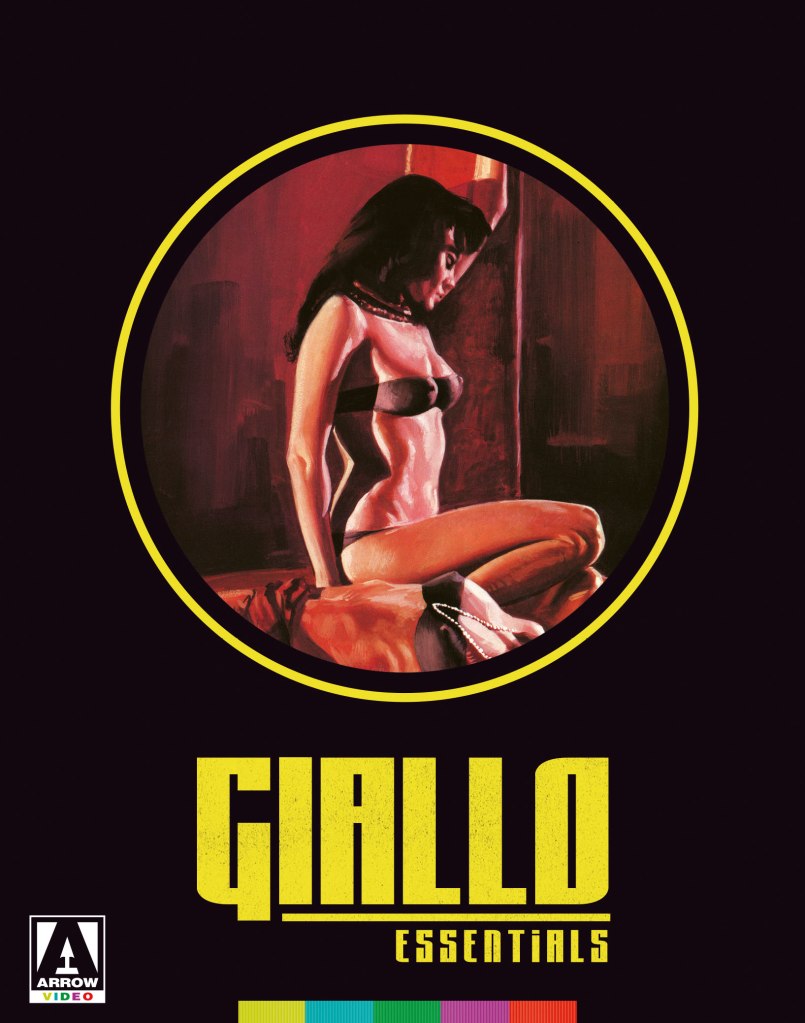
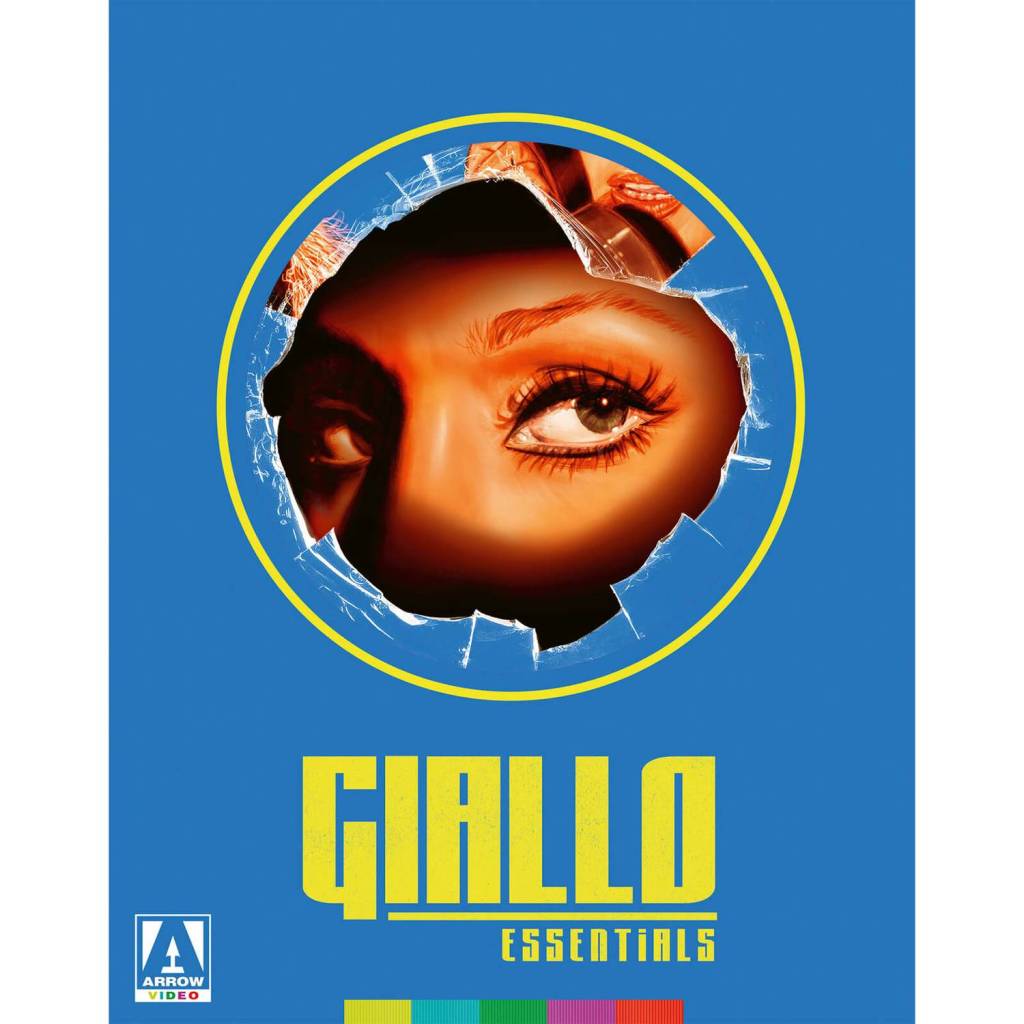
In the Summer of 2022, Arrow began their release of the four-part box set, Giallo Essentials: Red, Black, Yellow, White, and Blue, which we reviewed in full. Oh, it’s true: the films in these boxes are the ones to watch! You can learn more about the February 14. 2023, release of the White Edition (covering films from 1971 to 1975) at Blu-ray.com, which will also direct you to the technical aspects of all the sets.
Argh! More?
As you know, B&S About Movies is based in Pittsburgh, so . . . we had to do a feature of Yinzer-based Giallo flicks set in our home town.
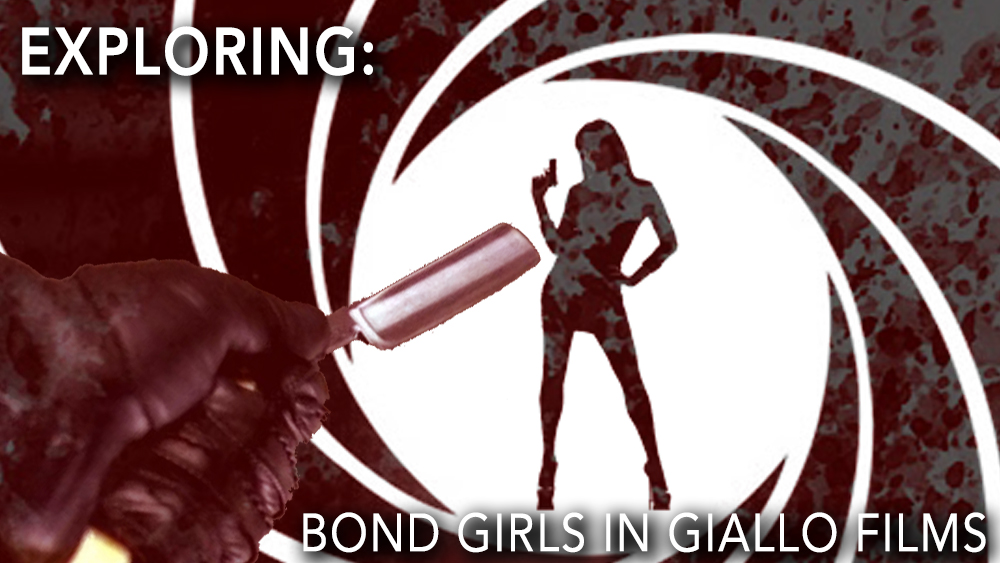
And did you know a lot of “Bond Girls” went yellow?
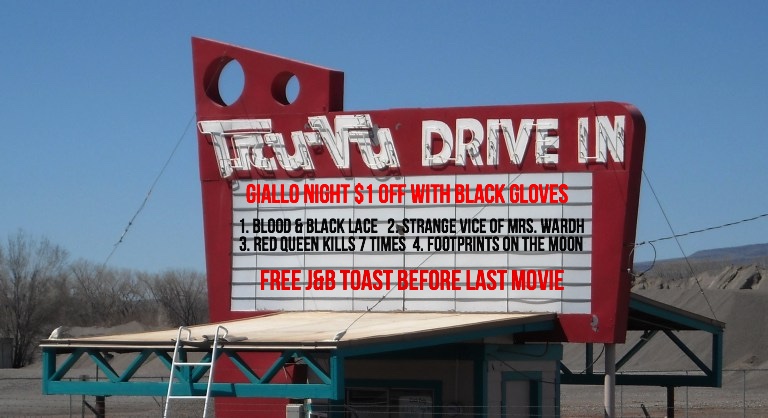
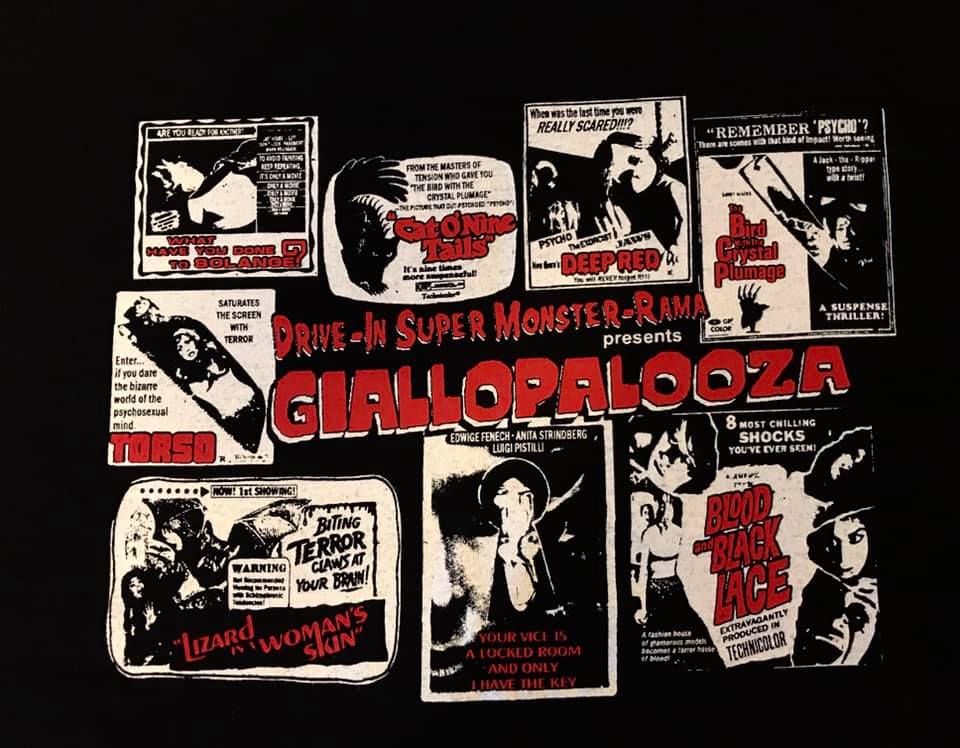
There also other “essentials” to watch by way of Drive-In Super Monster-Rama‘s September 2021 presentation of “Giallopalooza” —which was two big nights of classic, fully restored Giallo thrillers from such maestros as Dario Argento, Mario Bava, Lucio Fulci and Sergio Martino!
Noooo! No More Yellow!
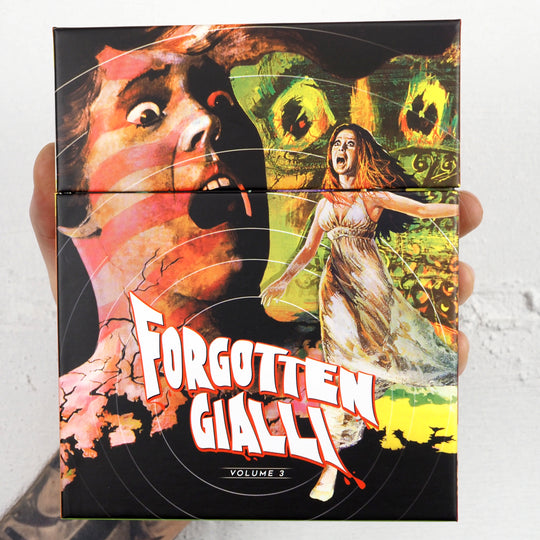
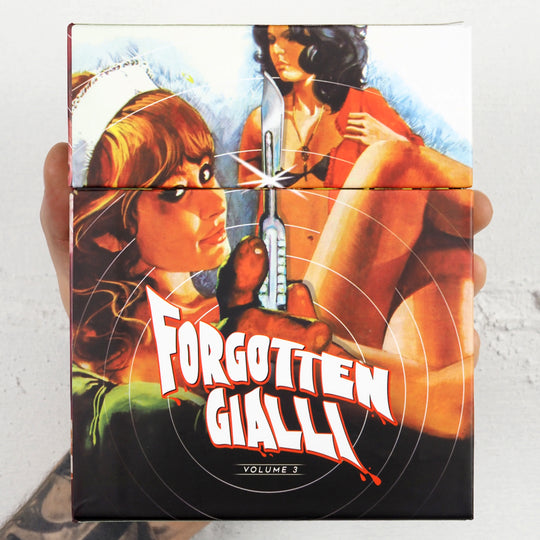
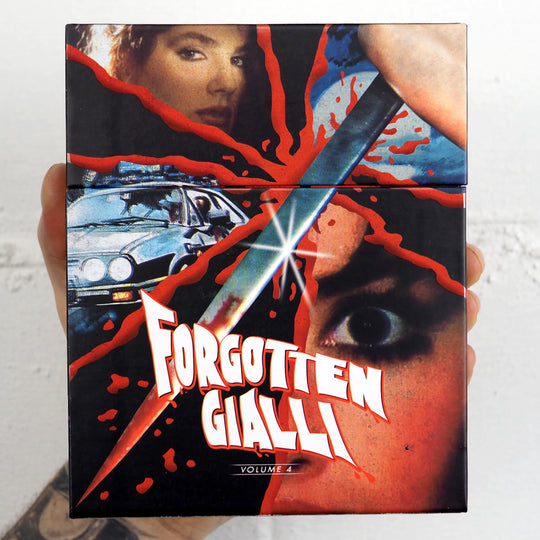
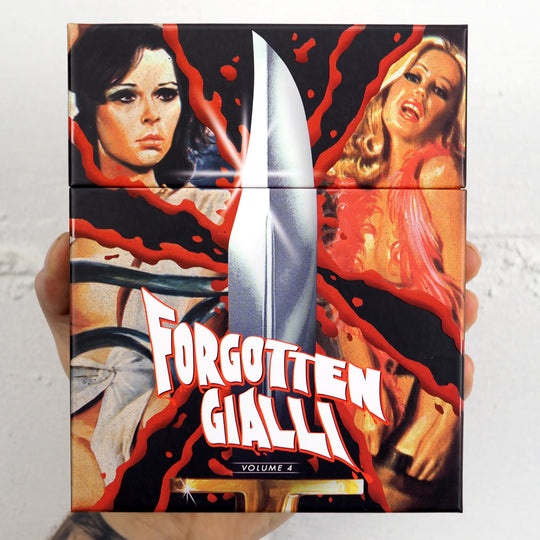
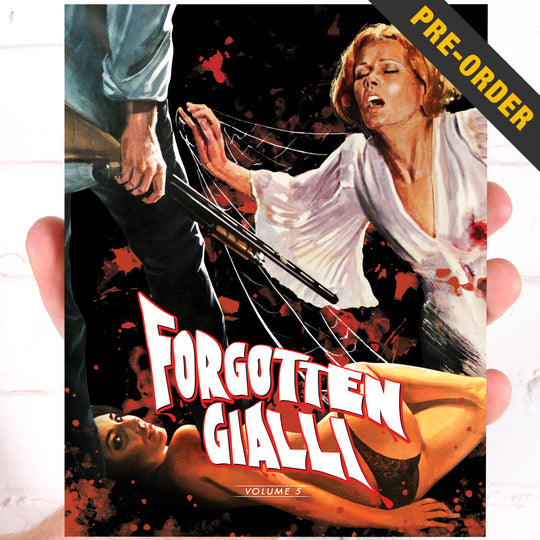
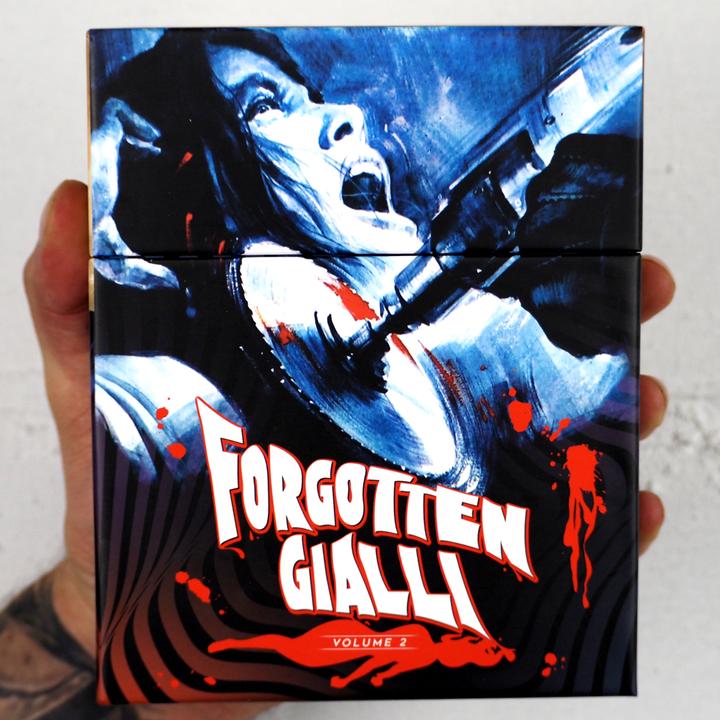
Yes! In addition to the above Arrow box sets, the fine folks at Vinegar Syndrome have their five volume Forgotten Gialli box sets to build your movie library. While we didn’t unbox it: here’s the link to Volume 1 of the set at Vinegar Syndrome; click the images to get to the rest.
a
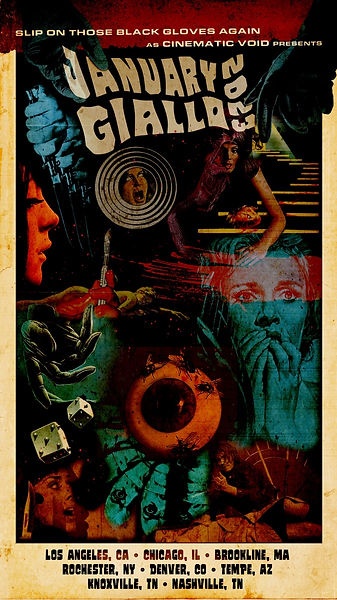
Then, in January 2023, we teamed with American Cinematheque to reviewall of the ’70s bred Gialli showings on their “Cinematic Void” schedule—most from 35mm restored prints. You can catch up with all of those films, with our announcement-post about the series. Search “Cinematic Void” to populate a listing of those reviews.
*+ Be sure to examine our “No False Metal” week of films.
+* We go a bit deeper on the film noir cycle with our recent reviews of Don Okolo’s neo-noir Lone Star Deception, along with the radio romps Dead Air and Power 98.
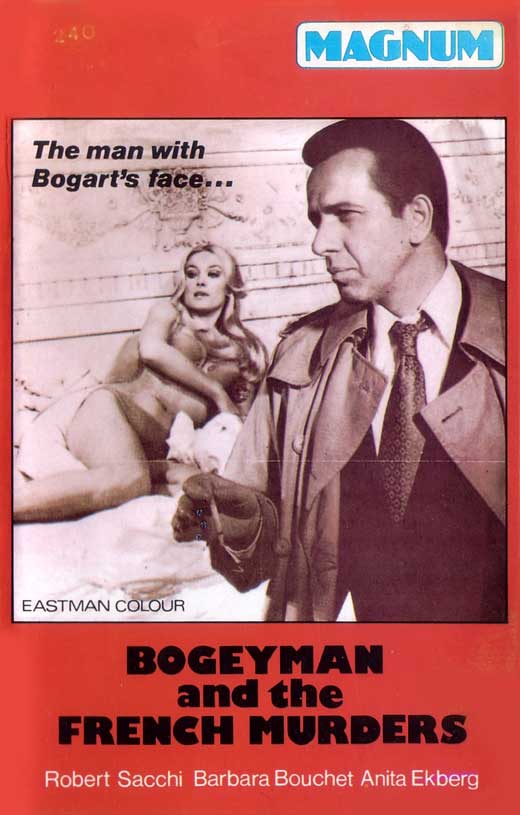
Casa d’appuntamento (The House of Rendezvous) was known as this title and as The Bogey Man and the French Murder due to it starring professional Humphrey Bogart impersonator Robert Sacchi.
After a week of giallo where I feel like I kept writing, “Why is this movie so boring and listless,” here comes this film to save me. Rosabeli Neri (Lady Frankenstein), Anita Eckberg (Screaming Mimi) and Barbara Bouchet (Don’t Torture A Duckling) all in the same film? What did I do to deserve this, giallo gods?
After Antoine is blamed for killing one of Madame Collette’s (Eckberg) high class call girls named Francine (Bouchet), he is sentenced to die via the guillotine. He swears that he will have his revenge and escapes, but a motorcycle accident takes his head clean off anyway.
Then a professor steals his head for an experiment before getting killed. Now the ladies of the night are getting killed one by one…and it just may be a headless man taking them out.
This was directed by Ferdinando Merighi, who was the AD on In the Folds of the Flesh. He used the name F. L. Morris here. Who edited this? Oh, just Bruno Mattei. It’s also the film debut of Evelyne Kraft, who would go on to star in The Mighty Peking Man and Lady Dracula.
Producer Dick Randall wrote this movie and he certainly made his share of cheap, trashy and totally wonderful films, including The Girl In Room 2A, Slaughter High, Mario Bava’s sex comedy Four Times That Night and The Wild, Wild World of Jayne Mansfield. The sleazy American writer in this movie shares his name, which was no accident.
I realize this isn’t a great film. But it’s certainly not boring, what with hooded figures running around a brothel, decapitations and falls off important French landmarks. As Italian Bogie would say, ” Ti sto guardando, ragazzo.”
You can get this for yourself at Vinegar Syndrome, as well as the first volume, which has León Klimovsky’s Trauma, Killer Is One of 13 and The Police Are Blundering in the Dark.
How can you pass up an Italian Giallo written and directed by the man whose pen ignited the spaghetti western genre with his screenplays for Clint Eastwood’s A Fistful of Dollars and For a Few Dollars More?
Fernando Di Leo’s original goal was to transition out of westerns into his preferred genre of film noir. But as the black-and-white film noir of old already gave way to the yellow blood of new, Di Leo ended up writing and directing this giallo about a cowl and caped murder stalking the wealthy female inmates of a sanitarium.
Of course, all of the women are diagnosed as nymphomaniacs (and in need of a triangle-of-death shave . . . if you know what I mean), so they’re seducing the staff—everyone from the isolated villa’s gardener to the doctors. And since we’re in a remote medieval villa converted into a hospital, the joint is well-stocked with weapons of mass giallo on the walls and along the hallways. And the heads fly by scythe, bodies are impaled by iron maiden, and nurses are hacked to pieces by axe, by mace, by bow-and-arrow, and bye-bye in quick succession.
In between the blood baths, there’s plenty o’ soft core red herrings of the lesbian interracial variety flipping and flopping; the women—as with all giallos—would turn a gay man straight and leave a straight man shriveled. Are they all attired in designer sun dresses, pant suits and chunky heels—running around in the grass? Of course they are! (Hey, Paul Naschy!) And did you know any variety of phobias can be cured with a nude massage of one’s butt cheeks? That a nurse bubble-bathing a female patient is just what the doctor ordered?
This was known in its homeland as The Beast Kills in Cold Blood, aka Cold Blooded Beast. But once the U.S distributors Hallmark Releasing and American International Pictures took their puritanical scissors to it, it was retitled as Asylum Erotica and Slaughter Hotel to play as the undercard on numerous Drive-In triple bills until the late-70s. The most explicit and obscure cut—The Dissatisfied Erotic Dolls of Dr. Hitchcock—was a bogus attempt to market it as a sequel to Riccardo Freda’s 1962 burgeoning giallo The Horrible Doctor Hitchcock—and features even more sexually explicit scenes added after the fact (as if it need more?).
If Di Leo stuck to the genre, today he’d be revered as Argento and Bava: the cinematography is lush, the shots are imaginative, and the soundtrack is acid trip, nausea-inducing top notch. And Di Leo certainly knows how to put the “sleaze” in Eurosleaze with those multiple, long and lingering triangle of death shots. And the “artsy” Richard Speck-style slaughter at the end has to be seen to be believed. Yikies.
If you want this on DVD for your collection, your best bet is to go with the uncut, Italian subtitled (or dubbed; it’s well done) version that runs at 97 minutes—and avoid the 74-minute U.S. versions at all costs. The even dirtier “Dr. Hitchcock” version is all but lost. You can watch a really clean print of the 97-minute version for free as an age-restricted stream (you’ll have to sign in) on You Tube. To say it’s X-Rated is an understatement. But the Italians made this—so it’s “art.”
About the Author: You can read the music and film reviews of R.D Francis on Medium and learn more about his work on Facebook.He also writes forB&S About Movies.
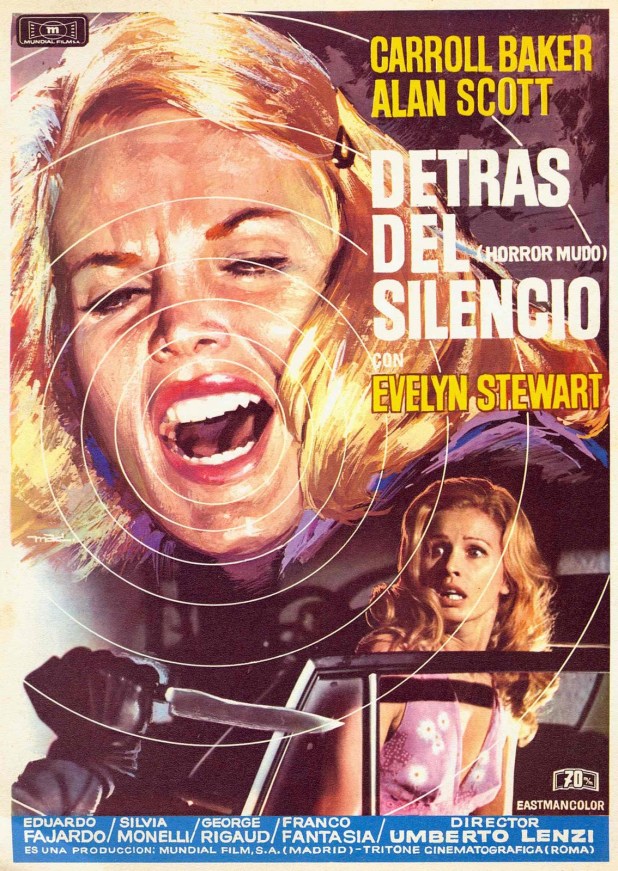
Inspired by the Poe quote about a “knife of ice which penetrates the senses down to the depth of conscience,” Lenzi and Carroll Baker would team one more time for the story of Martha Caldwell, who watched her parents die in a train accident at the tender age of thirteen. Now an adult, she’s still mute from the shock of what she had seen. Even worse, there’s a black gloved Satanic killer stalking the countryside and she seems like the next most likely victim.
Jenny Ascot (Ida Galli, The Psychic) is a famous singer in town to see her cousin Martha. However, hours after the killer stalks the two of them, she’s dispatched. Yet every time the police arrest someone, the murders continue.
This is a classy giallo compared to much of the sheer lunacy that I watch. But don’t judge it for it’s lack of sleaze. It’s a well-told film crafted by an expert at this type of movie.
You can get this as part of Severin’sThe Complete Lenzi/Baker Giallo Collection.
Franco Ferrini, who wrote Opera, Phenomena, Nothing Underneath, Dial: Help, The Church and Sleepless (as well as many more films) joined up with Gabriella Blasi and director Eros Puglielli to turn the Luca Di Fulvio novel The Empailleur into a modern giallo.
While hunting a cultured, intelligent and vicious psychopath — yes, I realize that sounds like The Silence of the Lambs — Inspector Amaldi must face the moral decline of humanity and his own dark past.
A young couple and the pervert watching them have both been killed, leading Amaldi and his partner Freese down all manner of paths with no success. At the same time, a college student is being stalked and turns to the young inspector for help.
Amaldi struggles with his temper and the need to punish the guilty while slowly realizing that he is hunting a serial killer who is taking the parts of a doll and replacing the parts of his victims that he has taken away.
Unlike so many modern giallo that attempt to simply emulate the past and not move into the future, Eyes of Crystal pushes past comparisons to Se7en to become a movie worthy of its own study. The human doll is a sinister concept, as is what happened to a doll in the past. Unlike other giallo, the cops aren’t fumbling in the dark or buffoons. They’re also dealing with perhaps just as many demons as the killers they face every day.
Bonus genre points for casting Simon Andreu (Forbidden Photos of a Lady Above Suspicion, Death Walks on High Heels) as a dying cop also haunted by his past, which he remembers as an inferno that destroyed the orphanage where he grew up, a place that has just been robbed of some very peculiar surgical instruments.
If only this movie had reignited a trend that would lead us to more Italian thrillers quite this good!
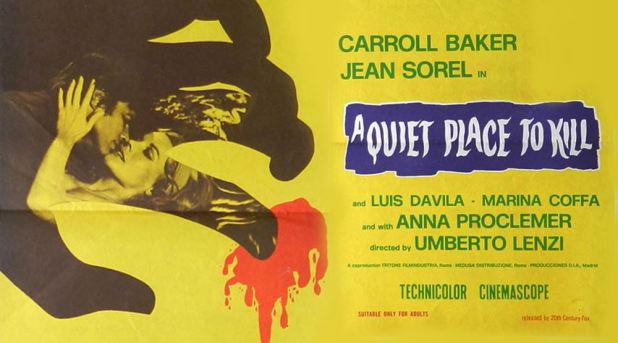
Umberto Lenzi and Carroll Baker made quite the giallo duo. Their 1969 pairing Orgasmohad been released internationally as Paranoia and this film, known as Paranoia in Italy, was retitled A Quiet Place to Kill. That’s not the end of the confusion, as this year Severin will release this on their Lenzi/Baker box set and Mondo Macabro also released An Ideal Place to Kill, another Lenzi film that you may also know as Oasis of Fear.
Would it simplify things if we used this movie’s Spanish title Una Droga Llamada Helen (A Drug Named Helen)?
Baker plays race car driving Helen, whose life is beyond a mess. How else can you explain why she’d accept an invitation from her ex-husband’s new wife Constance Sauvage to stay at their palatial home? And what if Helen and Constance soon bond over the fact that they hate Maurice (Jean Sorel, The Sweet Body of Deborah) and murder him on a sailing trip?
Of course, this being a giallo, things don’t work out that well and Constance ends up dying at sea. Her daughter shows up and that’s when things get worse for all involved. This is a classy giallo, filled with lush camerawork and a solid script from Marcello Coscia (The Living Dead at Manchester Morgue), Bruno Di Geronimo (What Have You Done to Solange?), Rafael Romero Marchent (the director of Santo vs. Dr. Death) and Marie Claire Solleville (Orgasmo).
Helping out on this film’s cinematography? None other than Aristide Massaccesi himself, the man of many names who most know as Joe D’Amato.
You can get this as part of Severin’sThe Complete Lenzi/Baker Giallo Collection. Baker and Lenzi made four movies together, but I really wish they had made many more.
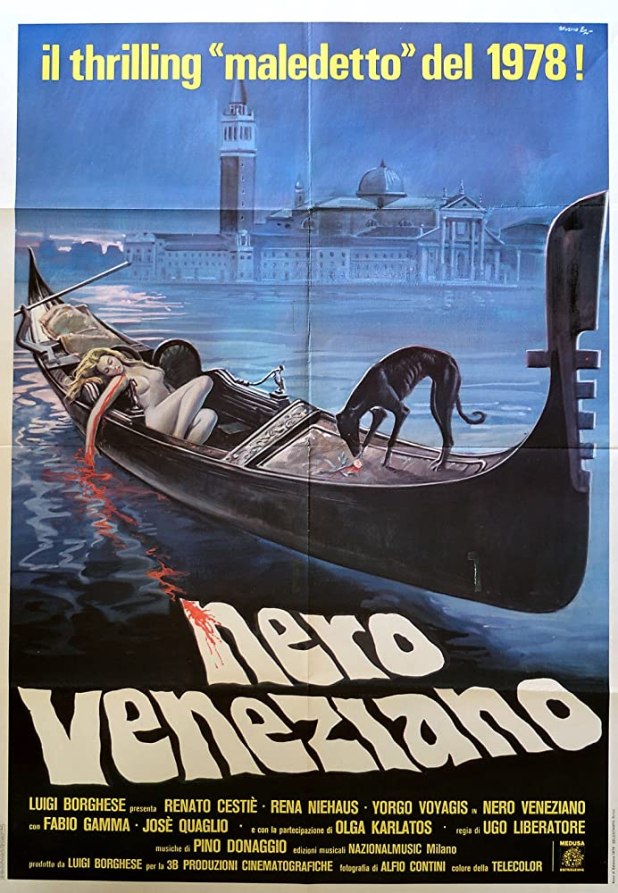
Ugo Liberatore’s Nero Veneziano (Venetian Black) is a strange movie. It’d be easy to just say it’s a ripoff of Rosemary’s Baby or The Omen, but it really is an odd demented little film unique to itself.
Mark (Renato Cestie, who other than being in Fulci’s Challenge to White Fang and Torso, made a career of playing neglected boys who die of some disease by the end of the movie) is a blind boy who is given to disturbing visions. His parents have died and now he’s stuck living with his gorgeous sister Christine (Rena Niehaus, who is in the fantastically scummy Arabella L’angelo Nero) and their strict religious grandparents. That won’t last long because Mark causes an accident that leads to the old lady spectacularly going up in flames.
Yes. The hero of the movie just set his grandmom ablaze. It gets weirder.
Mark and Christine must now go live in Venice — look for Olga Karlatos in several roles — to live with another near-death relative, this time an aunt and her suicidal husband. They soon die and Christine decides that she’s going to start a brothel when she isn’t having a virgin birth.
Some people comment on how brutal she is to her brother. If you have to put up with Mark, you’d abuse him as well. All he keeps doing is claiming she’s having the Antichrist, with the father being the mysterious boarder named Dan that no one can see.
Can Christine’s ex Giorgio save the day? How about Father Stefani? Or Mark just trapped in the predestined end of all there is? And man, how rough is that scene with the baby?
If you loved Don’t Look Now for all the canal scenes but wanted things to somehow be even more downbeat, this movie is your jam. I have no idea what the ending of this movie is all about, nor do I even know what large pieces of this movie are attempting to do. That is the wonder of near-lost Italian ripoff cinema and we should all be so lucky as to be confused at 2:17 AM by a movie just this out there.












 B&S About Movies
You must be logged in to post a comment.