I’ve often bemoaned the death of the giallo as much as I’ve worried about it’s return over the last few years. So many movies are influenced by it to the point of slavish devotion that keeps them from becoming their own unique films. Or even worse, they are more inspired by American films like Basic Instinct and look boring and lifeless when they should be neon-hued punches to the face.
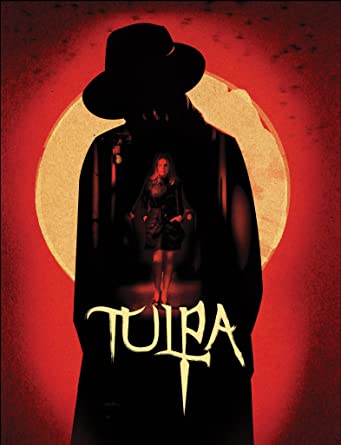
I’m pleased to report that Tulpa is the movie that I’ve been looking for.
Lisa Boeri (Claudia Gerini) is obsessed with her career, but in the evening, she visits the club Tulpa to unleash her darkest fantasies. The club, led by a Tibetian guru — well, that’s a first — allows her to indulge in all manner of aardvarking potential, but then her lovers start getting killed the day after she makes love to them.
Once those murders start uniting her day and evening hours, she decides to track down the masked killer on her own.
Tulpa was written by Giacomo Gensini and director Federico Zampaglione, whow also made the film Shadow together, along with Dardano Sacchetti, the Italian writer who wrote, well, just about any genre film worth a damn out. I’ll give you three, but he has a huge list of credits: The Beyond, Shock and The Cat o’Nine Tails. So yes, this is a movie with an eye toward the past and the future, as well as an ear. That’s because the soundtrack, by Zampaglione and Andrea Moscianesca, sounds like Goblin.
I had a blast with this film and it felt like a real discovery. And that’s why I spend so much time writing about movies, in the hopes that I can help you do the same.
ABOUT THE AUTHOR: Mitchell Hillman is a freelance writer who has spent most of his time in print writing about music, movies, art, and pop culture. He is also a professional artist, occasional pop-up chef, and suffers an addiction to curiosity and discovery. Over the last year he has watched over 300 Giallo and Giallo related movies, finding that they influence not only how he thinks about film, but also art.
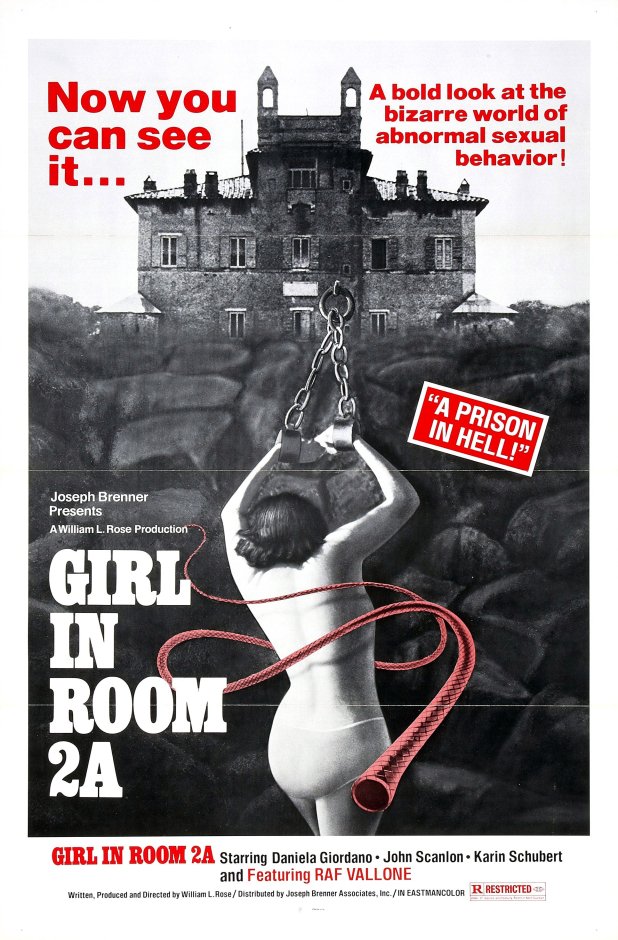
The Girl in Room 2A (1974)
‘La casa della paura’
Directed by William Rose
I promised myself that if I ever found a better transfer of this particular Giallo, I’d have to watch it again. The first time I saw it was like watching a muddied copy of a copy from VHS. I came across a much nicer transfer recently and thought I’d indulge myself. It’s got a great story going for it and it’s a completely underrated entry into the genre in my estimation. Perhaps it’s because it’s the crowning achievement in William Rose’s otherwise unremarkable catalog of films that it’s overlooked, but it has charm and mystery and something that sticks with you somehow.Of note the original Italian title translates to “House of Fear,” but there were several of those in English already, so we get The Girl in Room 2A.
It’s got a pretty brutal opening sequence, with Bruno Pisano’s soundtrack sinister intensity backing it as we see a young women leave a dark boarding house, only to be abducted off the street, thrown in a car, drugged, subsequently tortured, murdered and thrown from a cliff.It’s a harsh start that leaves you wondering, but it all comes together in the end. Next we see Margaret leaving a women’s prison, and after missing a bus and calling her social worker while being followed by a strange man, she checks into the boarding house run by the strange Mrs. Grant. Nothing is right about the house, from Mrs. Grant, to the blood red stain in her room, to the strange footsteps outside her door as she tries to nap. The creep vibe is everywhere.
Mrs. Grant invites Margaret to tea and a sedative, while explaining the death of her husband, and her loneliness in the house with her son. She then lays down a heavy speech about how justice and vengeance must prevail over forgiveness and her tone is more than a little worrisome as she talks about the felon that killed her husband. Margaret doesn’t go for any of that. Her first night is a creepy one as she envisions a red clad masked person coming into her room, but does it happen? We don’t know, she may have been dreaming, she was sedated after all.
We then cut to a villa in the countryside where the creepy son from the boarding house is hanging out with a writer named Mr. Johnson who wants to document what the group seemingly led by “Mr. Dreese” is doing. Dreese shows up and it’s the man that was following Margaret, who immediately turns on the writer with a Nietzschean speech about how “everyone must feel the pain of his own sins,” echoing Mrs. Grant’s sentiments from earlier.Frank, the creepy son is sent back home, by Dreese while Johnson is locked in the parlor. He is subsequently tortured by two other men, and the caped stranger in the red mask from Margaret’s vision. Johnson jumps to his death out the window to escape the torture and they drive his car off a cliff in a fiery cremation.
This sets the stage for all that is to come. On the one hand you have the creepy house and Margaret’s ever-escalating post-prison life trauma, and on the other a weird cult adding a folk horror flare to the whole affair.It’s a pretty detailed intense story and while it could be better acted or shot with a better budget there’s something appealing about it and something deliciously appalling about it. Whether it’s Margaret’s uncomfortable interactions with Mrs. Grant’s strange son Frank, or the stain that keeps returning to the floor, which she dutifully cleans up repeatedly, there’s always something going on that will become clear in the last act. Rosalba Neri is always a delight and here she plays the social worker who arranged the housing arrangement for Margaret.After confessing her discomfort, Neri promises to help find her new housing and loans her some money, before going out of town.
Margaret continually professes her innocence, but also seems like the only genuinely decent person here, except perhaps for the social worker.When she bumps into Jack on the street, the interaction is suspicious and brilliant, he’s looking for his sister who supposedly killed herself while staying at Mrs. Grant’s place. He ends up renting the place across the alley from her. Once Jack is introduced to the story, the movie really picks up. It turns out that a lot, or maybe all of the “troubled girls” who have stayed in 2A have died or gone mad–but what exactly is the connection to the cult that’s hell-bent on maintaining the war of “Good and Evil.” As the two become lovers, they also begin to investigate just what is going on at the Grant house in earnest.
Both times I’ve watched this I thought this would be an amazing film to reboot, there’s much more of a horror aspect to it than the usual gore laden bloodbath. It’s got a great story at the heart of it and I’d just love to see it treated to a decent budget. Everyone is creepy,it seems that only Margaret and Jack are on the level, but you can never be sure about anything.There are many elements that are just sheer fun, like Frank’s strange workshop or Mrs. Grant’s odd gatherings discussing vengeance, of course. It’s not a top tier Giallo by any means, but it probably fits inside the Top 100 or Top 150 due to its peculiar originality and rather complex story. The intertwining story between all the players is what keeps you going and the finale more than pays off in the end, and in this case, somehow, I didn’t see it coming. You might not either, which makes its 90-minute weight (and wait) worth it.
You can get this for yourself at Vinegar Syndrome, as well as the first volume, which has León Klimovsky’s Trauma, Killer Is One of 13 and The Police Are Blundering in the Dark.
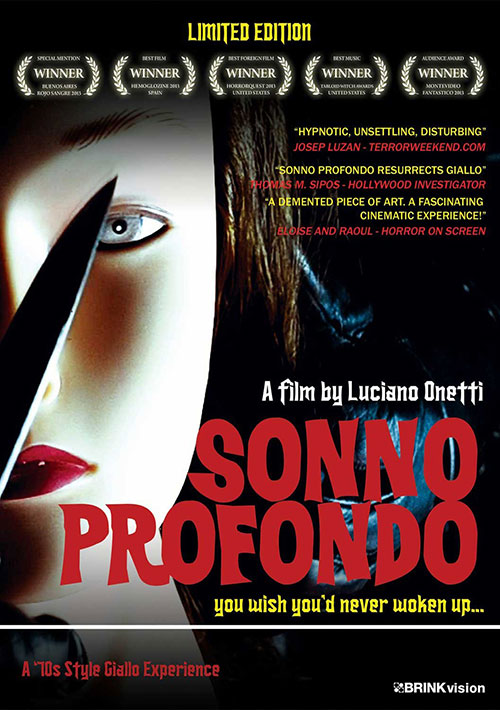
After murdering his latest female victim, a killer is blackmailed with mysterious envelopes filled with evidence of all of his kills. However, as we hear no dialogue and only see things from the killer’s point of view, we are forced to be part of his crimes.
Directed, written and scored by Luciano Onetti and produced by Nicolas Onetti, this movie is the start of their giallo tribute films. Each one has grown in ability and style, but even at the beginning, with the handcuffs of an incredibly simple story, a first person camera and a slavish devotion to Argento, this is well above any of the spate of giallo-influenced films of this century.
Even the blood looks like it came out of an Argento film. That’s how far this goes. So, you know, if you hated Deep Red, there’s no way that you’ll like this.
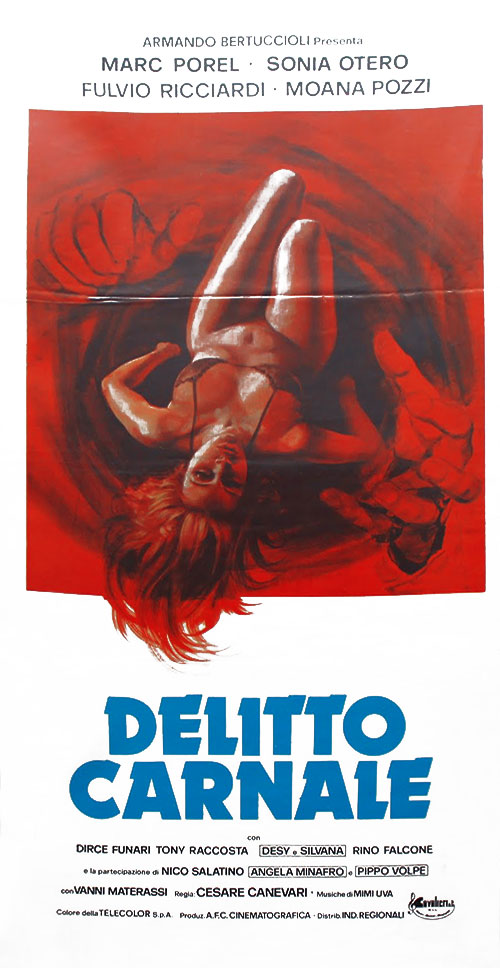
When the maker of The Gestapo’s Last Orgy makes a giallo, you just have to figure that it’s going to be sleazy. Seriously, this is Play Motel level sleaze, filled with victims who’d rather get drunk, have sex and avoid reality while they’re all getting killed off one after another. To make matters even sleazier, they’re all related to one another. Throw in some police who are about as effective as the cops always are in these films and you have, well, something.
Known in Italy as Delitto Carnale (Carnal Crime), director Cesare Canevari also made A Hyena In the Safe, a much better regarded giallo, before this movie. He also made Matalo!, The Nude Princess and A Man for Emmanuelle.
Moana Pozzi is in this before her career in adult films. She and Ilona “Cicciolina” Staller were the two biggest Italian female stars of the 1980’s and even formed their own political group, Partito dellAmore (Party of Love), before she died at the young age of 33 from liver cancer. A life of scandal had led to rumors of her being killed, but an inquest in 2005 proved that it really was cancer that felled this gorgeous actress.
This is the kind of movie that wants to be porn, but doesn’t go that far, and yet isn’t good enough of a mystery to be a giallo of any note. If you want something sleazy that’s actually a decent film, let me recommend something like Strip Nude for Your Killer.
Klaus Kinski starring in a Riccardo Freda movie: I’m all in. I picked this one up in a ravenous impulse-buying frenzy from the now defunct, and sorely missed, grey market auteur VSOM (Video Search of Miami), as it was the only way to get most of these Euro-Giallo gems.
German Krimi films, a crime thriller sub-genre of film popular in the 1960s, gets an Italian giallo makeover with Riccardo Freda (1962’s The Horrible Doctor Hitchcock and 1963’s The Ghost) directing a script by Lucio Fulci (1971’s A Lizard in a Woman’s Skin, 1972’s Don’t Torture a Duckling), which he adapted from one of several of Britain’s Edgar Wallace novels (Massimo Dallamono’s What Have You Done to Solange? and Umberto Lenzi’s Seven Blood Stained Orchids are Wallace novel adaptations). Being Euro co-production, this carried two titles: in Germany as Das Gesicht im Dunkeln, aka The Face in the Dark, and A doppia faccia, aka Double Face in Italy and the rest of Europe, with the Italian title adopted for its U.S Drive-In undercard release.
This is one of those films where everyone is sleeping with everybody else. In this case, Klaus Kinski’s rich industrialist is carrying on an affair with his secretary; meanwhile, his wife Helen (British actress Margaret Lee; they both starred in 1971’s Slaughter Hotel) openly flaunts her lesbian affair with Liz (the heart stopping Annabella Incontrera (the Matt Helm entry The Ambushers, Black Belly of the Tarantula, The Case of the Bloody Iris).
Then the ubiquitous POV black gloves tinkers with Helen’s car—and she dies in a fiery accident. And as in the Freda’s The Horrible Doctor Hitchcock: Kinksi comes to discover his wife may not be dead.
But how?
Well, his new fling, a pretty, mod-swingin’ chick (Christiane Krüger; 1969’s De Sade with Keir Dullea) takes him to porn theatre showing a film starring herself and Kinski’s dead wife—and the film was made after her death. Together they search for the answers surrounding his wife’s death—and the evidence points to Kinski’s industrialist. Did he do it?
Arrow did this film right with a Blu-ray released in June last year, which is easily available in the online marketplace.
About the Author: You can read the music and film reviews of R.D Francis on Medium and learn more about his work on Facebook.He also writes forB&S About Movies.
We’ve been featuring plenty of giallo, neo giallo and movies that may or may not be giallo all week long here. When trying to determine four movies that should play in a row, these fashionable murder movies make it hard.
After all, so many of them have near formless plots that might confuse or bore the non-initiated. Even then, so many of them have downer endings and leave you with feelings of confusion.
I’ve tried to find three movies that would please a new audience to the form — and one that would run so late that I don’t care who leaves — for your drive-in perusal. Please let me know what you think and if you have a list you’d like to share with us.
MOVIE 1: Blood and Black Lace (Mario Bava, 1964): Has death ever looked sexier and better lit? It astounds me that this movie — which pretty much ignited the genre we’ve spent all week writing about — came out in the somewhat innocent time of 1964. I can only imagine how shocking it was. After all, the film’s potent blend of near-nude women and shockingly neon-hued violence upon said females caused American International Pictures to pass on distributing this film in the U.S. This isn’t just one of my favorite giallo. It’s one of my favorite movies of all time. You can watch this on Amazon Prime.
MOVIE 2: The Strange Vice of Mrs. Wardh (Sergio Martino, 1971): Have movies ever been more perfect? Has an actress — Edwige Fenech — ever been more radiant? Has a villain — Ivan Rassimov — ever been so seductive and brutal at the same time? I don’t know many movies where a man shows a woman in champagne and broken glass and she returns the action with pure lust — actually, I do, this movie and The Editor — and this is but the first of the giallo wonders that Martino would deliver all within the span of four years. You can order this from Severin or watch it on Shudder.
MOVIE 3: The Red Queen Kills Seven Times (Emilio P. Miraglia, 1972): I was trying to decide between two of Miraglia’s films, this awesome effort and The Night Evelyn Came Out of Her Grave. I chose this one because we already had one Edwige film, so Barbara Bouchet also needs to be represented. There are moments here that approach art, as the look of the Red Queen is supremely frightening. You can watch this on Amazon Prime.
For the last film, I really debated again. Should it be something people would want to wait and see? Should it be a film that kids should totally be asleep for, like Strip Nude for Your Killer that rewards the maniacs still awake at 3:30 AM? Or how about something unlike anything else we’ve watched?
You know that I like it weird.
MOVIE 4: Footprints on the Moon (Luigi Bazzoni, 1975): Bazzoni also made The Fifth Cord, one of the best giallo I’ve ever seen. But this movie — I’m unsure it’s a giallo per se and to be honest, I’ve watched it so many times and I’m not completely certain what reality is true at the end. Florinda Balkan is a woman who believes that astronauts were kept on the moon by her father, plus there’s the ghostly Nicoletta Elm haunting her and the evil specter of Klaus Kinski floating above the entire tale. You’re going to drive home confused after this one.
To get links to every movie in the genre that we’ve covered, check out this list on Letterboxd.
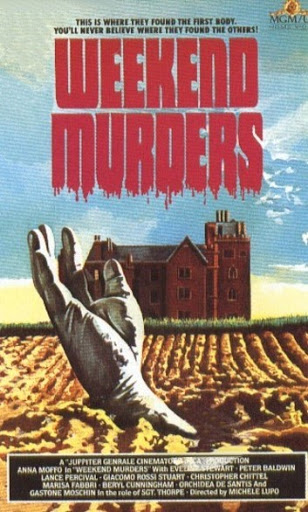
Known in Italy as Concerto per Pistola Solista (Concert for Solo Gun), this Michele Lupo (Arizona Colt) film takes place in England instead of the Italy we’ve come to depend on for our giallo adventures.
As a family comes to an estate for the reading of the will of Henry Carter, Second Earl of Vale, and get murdered one after the other. Is it because his niece Barbara got all of his money? Was the sniper who killed the butler trying to shoot her all along? Did the makers of Knives Out watch this and figure that everyone would think they were making an Agatha Christie film and not aping a giallo?
Inspector Grey, who takes the case, is played by Lance Percival, who was the voice of Paul and Ringo in Yellow Submarine. Beryl Cunningham (So Sweet, So Dead) and Marisa Fabbri (Rabid Dogs) also appear.
Chris Chittell plays George, who is pretty much the villain of this movie. You may remember him from The Wild Geese and They Call Him Cemetery. There’s a scene where he decides to sexually assault one of the maid, who tells him he could have just asked and she would have given in. They end up making love, but visions of his overbearing mother lead to more bloodshed. Ah 1970! What a time you were for things no one would try in a movie today.
This might not be my favorite giallo of all time, but it’s fine for what it is. It’s closer to a detective tale with some trapping of pre-Argento and much Christie influence. It’s not bad, but I just demand more weirdness from my murder movies.
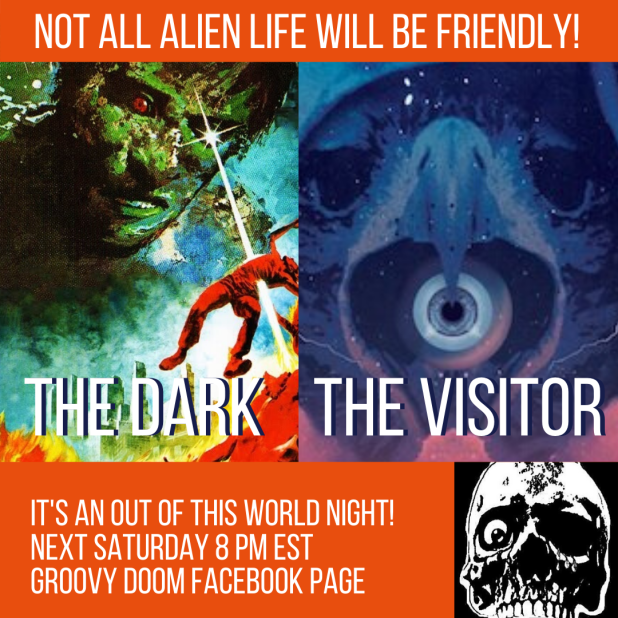
Are you ready for another late night of crazy movies? I sure am! Bill and I have put together a mix of ads for the films, drink recipes, facts and perhaps even a song about one or both of these movies!
Up first…
It’s The Dark! You’d think Film Ventures International was paying us off with all the attention we’ve been giving them. This movie was originally going to be directed by Tobe Hooper. It was also supposed to be about an autistic child. Then a werewolf. Then an alien. If you’re saying, none of this makes sense, good news. You’re in for it!
To drink along with this movie, we’ve prepared a drink called the Alien Secretion, based on this recipe.
Alien Secretion
2 ounces coconut rum
2 ounces Midori or any other melon liqueur
3 ounces pineapple juice
Ice
A cherry
Put all of the ingredients in your shaker. Blast them with your glowing laser eyes. Mix it up.
Garnish with a cherry.
The Visitor is a movie I’ve been wanting to do on our show since we started. Prepare to be confounded and blasted into sheer confusin. I love this movie so much and I still have no idea what it’s about.
We’ve searched for a cocktail that is just as strange. Get ready for…
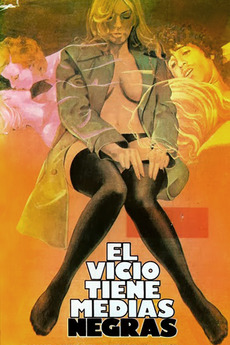
A mysterious woman, dressed all in black, is killing beautiful women. Tano Cimarosa — usually an actor — directs this film, where we soon learn that all of the women are connected to affairs that they had with another woman, which was quite shocking in 1975.
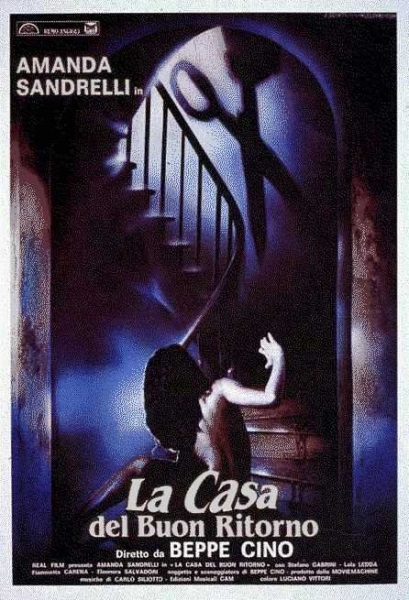
This 1986 late model Italian giallo — with a title that translates as The House of Good Returns — was written, directed and produced by Beppe Cino. It is the only horror movie he’s made.
Twenty years ago, a young girl died here. Now, Luca and his fiancee Margit have come back, reopening old memories and unleashing Ayesha, a mysterious woman, and a series of killings.
Yes, Luca killed that girl accidentally when she put on a mask to frighten him. But now, that very same Onibaba mask is being worn by a killer. Of course, that mask comes directly from the 1964 film Onibaba, but this a film that shows its influences for all to see, like large chunks taken from Deep Red. But hey — remixing is art, after all, and this movie looks great, feels like a dream sequence and is the only giallo I’ve ever seen with music that would fit better into a Woody Allen film.
While this was released on VHS in countries like Italy, Spain (The House of No Return) and Germany (The House of the BlueShadows), it was never put out on DVD until its 2020 TetroVideo reissue. It still hasn’t been dubbed into English. In a strange way, it’s Japanese look reminds me of another completely off-kilter movie that makes dream logic sense, Blood Beat.



 B&S About Movies
You must be logged in to post a comment.