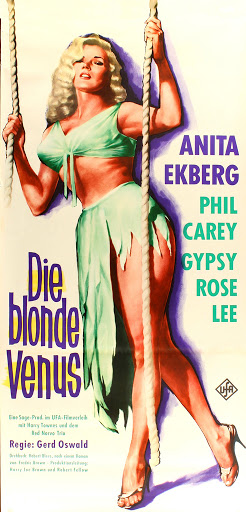
Screaming Mimi (1958)

Gerd Oswald made the noir films A Kiss Before Dying and Crime of Passion, making him the perfect director for this film. Of course, he’d also direct Agent for H.A.R.M., but let’s stick with his mysery work for now.

Virginia Wilson (Anita Ekberg, two years before La Dolce Vita and as stunning as perhaps any human being has ever or will ever be) is just trying to take a shower at the beach when an escaped mental patient stabs her dog and attacks her. Luckily, her stepbrother Charlie blows him away.

Now she’s the one inside the sanitarium, but not for long, as Dr. Greenwood convinces her to fall in love with him, fake her death and become an exotic dancer at Gypsy Rose Lee’s El Madhouse nightclub. It’d be paradise if it wasn’t for that serial killer following her.

Most of the music in this movie is recyled from On the Waterfront. The book that inspired it, written by Fredric Brown (who also wrote the original Star Trek episode “Arena”), was the inspiration for one of the best known giallo films of all time, The Bird With the Crystal Plumage. The script was written by Rober Blees, who also was the scribe for FrogsDr. Phibes Rises Again, Whoever Slew Auntie Roo? and High School Confidential! 

Red Norvo and his Red Norvo Trio, which is actually a quartet and Charlie Mingus played bass in the group before he became a composer, shows up as well. You can also see Red back up Dean Martin for “Ain’t That a Kick In the Head?” in the original Ocean’s 11. The jazz vibraphonist — along with his wife Mildred Bailey — were known as Mr. and Mrs. Swing.

This movie was exactly what I needed to watch. It’s quick, has some great musical numbers and Eckberg was already carrying herself like a star.

A Black Veil For Lisa (1968)

And it’s back to the spaghetti western lands once again, as we visit Massimo Dallamona, the cinematographer from for Clint Eastwood’s A Fistful of Dollars and For a Few Dollars More—which were scripted by Fernando Di Leo, who wrote and directed his own giallo flick, Slaughter Hotel (1971).

However, unlike Di Leo, Dallamona stuck with the genre, also bringing us Venus in Furs (1969), What Have You Done to Done to Solange? (1972), What Have They Done to Your Daughters? (1974; a poliziottesco-giallo hybrid), and The Cursed Medallion (1975; which rips The Exorcist, as well). At that point, Clint Eastwood and Charles Bronson ignited the Italy’s burgeoning poliziottesco genre, and Dallamona brought us Super Bitch (1973) and Colt 38 Special Squad (1976). His final film was the Italian-German-Spanish giallo co-production, Rings of Fear (1978), posthumously released after his 1976 death.

As with Rings of Fear, A Black Veil for Lisa was also a West German co-production (German cinema was attempting, like Spain, to get in on the giallo craze as the krimi genre was fading away; so they imported Italian directors to Hamburg). Esteemed British actor John Mills—who was far beyond his prime in the ‘30s and ‘40s and, like most older and forgotten actors, moved into giallo—was imported as well.

He’s Franz Bulon, a jealous, controlling German narcotics detective who married one of his previous collars (Va-va-voom! It’s flame-maned Luciana Paluzzi, aka SPECTRE assassin Fiona Volpe from Thunderball). When he collars Max Lindt (Robert Hoffman from 1974’s Spasmo and the 1978 “sci-fi” giallo, Eyes Behind the Stars), an assassin hired by a drug-lord behind the serial murders of rival drug dealers, instead of arresting Max, the old bastard blackmails him to kill his philandering, young wife.

Yeah, this plan’s going to work just find, Inspector Gadget.

This one has it all. It puts the “trash” in Eurotrash. It’s morbid. It’s erotic. But it’s not as graphic or sexual as we might prefer in our gialli. Thus, this is a bit more to the side of film-noir, as the giallo genre was not yet fully realized with Mario Bava’s Bay of Blood. And everyone is screwin’ everybody—figurative and literally, which we like in our gialli and film noir. And, since Dallamona came out the cinematograph realm, this film looks sharper than shard of glass, with lots of stylized, colorful angles. The acting across all fronts is excellent.

Known by Euro-audiences as La morte non ha sesso, aka Death Has No Sex, this is out in the U.S. marketplace as a legit Blu-ray/DVD via Olive Films, whose catalog deals mostly in rare and deep Euro-obscurities. Olive’s valiant efforts to retain obscure gems like this for posterity—giving us something beyond worn out VHS tapes and hazy-streaming rips made from VHS-taped UHF-TV (and severely edited, natch) showings—is greatly appreciated.

You can find the DVD and Blus at Best Buy and Walmart and a wide variety of online market outlets. But we found two, okay free VHS rips on You Tube HERE and HERE.

About the Author: You can read the music and film reviews of R.D Francis on Medium and learn more about his work on Facebook. He also writes for B&S About Movies.
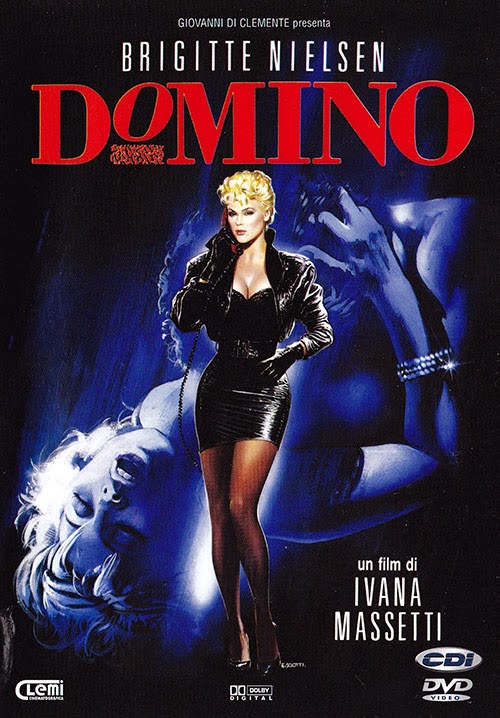
Domino (1988)

Let me tell you, when I read about this movie — about Brigitte Nielsen playing a music video director who is obsessed with finding love and making a movie about Billie Holiday while taking care of her jewel-covered turtle — I knew I had to track it down.

It’s running on our site during giallo week and it’s not particularly a giallo. But I honestly have no idea what kind of movie this is. That said, it does have Tomas Arana (The Church), David Warbeck (The Beyond) and Geretta Geretta (Demons) in it, so there’s that.

To top that off, writer and director Ivana Massetti was pretty much the same person as the lead character in this film, a female director in a time where that was quite rare. She had the idea to experiment here and make a film with hardly any dialogue. Or story, to be honest.

Domino wants love, so when she gets a phone call that promises her that romance is possible and that love can be real, she starts to see the world with much different eyes. She can certainly do better than having a mannequin for a lover, right? But what if that voice on the other end of the phone is a lie?

I guess it has some giallo feel as she’s being stalked by a man and wants to turn the tables on him. There’s also a dream where she speaks to the ghost of Holiday. Honestly, you’ll have to decide for yourself whether this movie is art or pretension, because I tend to love things that make no sense and any time I recommend them to people, I get the strangest looks.

Shh — I loved this insane, gorgeous and yet completely inane film. You can watch it on YouTube and decide for yourself.

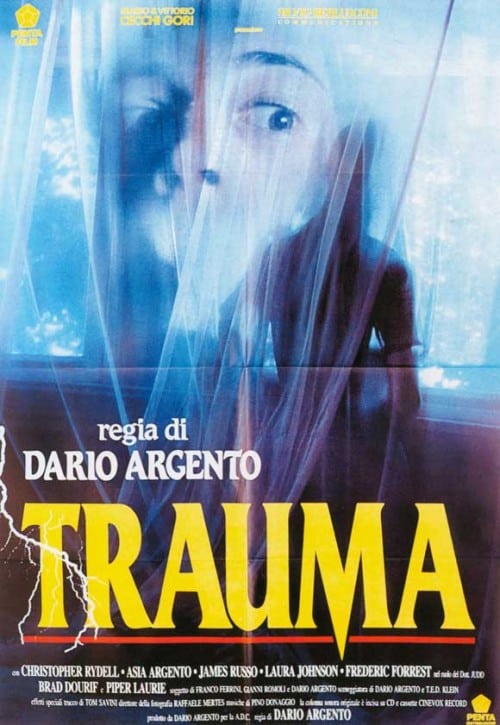
Trauma (1993)

One of two movies that Argento directed outside of Italy — Two Evil Eyes is the other — and he chose American writer T. E. D. Klein to write the script. Instead of the familiar Rome that we’ve seen in so many giallo, we’re in Minneapolis.

Tom Savini created the effects, but Argento decided to make the movie about more suspense and less blood and guys. He did invent the killer’s unique weapon, which the crew called the “Noose-o-Matic.”

Aura (Asia Argento, in a role based on her half-sister Dana, who sadly died in a scooter accident not long after this movie was made) escapes from the mental hospital where she’s under treatment for anorexia. She meets a man named David who lets her stay with him, but she’s soon taken back to the hospital. There, staff members keep getting decapitated by a killer named The Headhunter. And before you know it, her parents are killed as well, sending Aura and David after the real killers.

The actual murder plot here is pretty convoluted and that’s saying something for Argento. Props to him, though, for getting Piper Laurie in this as Aura’s psychic mother and Brad Dourif as a doctor with a past connected to the murders. He also got Frederick Forrest for this and for that, he and Laurie would sit and laugh at how bad they thought that the movie was during each day’s shoot.

Sadly, this movie is missing something. Could a score by Goblin instead of Pinal Donaggio have helped? More gore? Less recycling the past and more of a look toward the future? Or maybe a script that made more sense?

Still, it’s Argento, who has a great movie still in him. We hope for it and we look for it within every effort, hoping that this is the time that he delivers. Then again, how many directors have made at least three bonafide classic films and a few really close ones? I’ll watch everything he makes and keep that same hope.

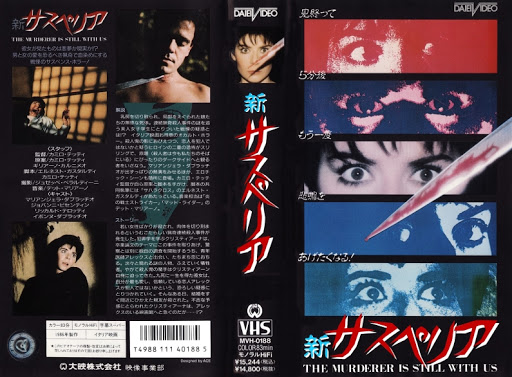
The Killer Is Still Among Us (1986)

Also known as Florence! The Killer is Still Among Us and The Killer Has Returned, you have to admire the chutzpah — or the gall — of a film to have the disclaimer “This film was made as a warning to young people and with the hope that it will be of use to law enforcement to bring these ferocious killers to justice,” after you’ve just watched 83 minutes of a killer graphically mutilating women and their most intimate of parts, as if this were some bid to outdo Giallo  In Venice or The New York Ripper.

Based on the true story of the Florence serial killer “The Monster of Florence,” this was written by Ernesto Gastaldi (The Whip and the BodyAll the Colors of the DarkMy Name Is Nobody) and Giuliano Carnimeo (who directed four of the Sartana films under the alias Anthony Ascott, as well as The Case of the Bloody Iris, Exterminators of the Year 3000 and Ratman).

Directing this movie — and helping with the script — would be Camillio Teti, who produced The Dead Are Alive and Gualtiero Jacopetti and Franco Prosperi’s attempt at a non-mondo, the ironically named Mondo Candideo.

Much like a scene out of Maniac, a couple on lover’s lane is blown away mid-aardvark by a gloved killer. What separates the uomini from the ragazzi is that the killer then uses a knife and a tree branch to do things that made me turn my head from the screen for an extended period of time.

Christiana Marelli has been studying the killer in criminology class to the displeasure of her boyfriend, the cops and her teachers. This leads to her being stalked via phone and in person by the killer. Of course, seeing as how Alex, that formerly mentioned boyfriend, is never around during these killings, you can see why she starts thinking he could be Il Mostro.

The film moves from the giallo into the supernatural as our heroine attends a seance where the medium has a vision of the killer decimating a camping couple, soon developing the same wound that the victims just received.

What does Christina do? Run to the theater to see if Alex is there or not, proving that while he is waiting for her, he certainly could still be the killer. If I were her professor, I’d have given her a zero out of thirty.

After all this, she just sits down to watch a movie with him and it ends up being the same film we’ve just been watching. That’s either a huge cop out or just how you expect a giallo to end.

Abrakadabra (2018)

Thirty years after his father The Great Dante was killed during a magic trick gone wrong, Lorenzo is now being accused of a series of murders that all have magical themes as he struggles to present the biggest show of his career.

This is the third film in the Onetti Brothers’ Giallo Trilogy, following Francesca and Sonno Profundo. For all the reviewers that bring up their Argento style, the true maniacs, the ones who put on their gloves while watching a giallo, the people like, well, me and you — we realize that their influences go beyond the touchstones every critic uses. For all of those that love Martino as much as Argento, good news. This feels like one of his films that was lost in time.

I caught the YouTube premiere of the film, which is missing most of the gore and nudity, which would be the selling point for many a fan of these films. But for the other parts of the form, such as the soundtrack, the plot that goes everywhere and nowehere at the same time, even the look of the color and film, this is a true piece of giallo in a time when I wondered if all the gold has truly been mined.

That said, you can look forward to people decrying its dubbing, acting and plot. Those people have never seen anything beyond Suspiria and have declared themselves experts. Screw it. I hope these Argentinian madmen keep making movies. I’ll pour them a whole bottle of J&B if I ever get the chance to meet them.

You can order this now from Cauldron Films.

PS: I realize that the example I picked isn’t even a giallo. Those of you that have read copy and pasted reviews of movies that reference this genre will, I hope, get the joke.

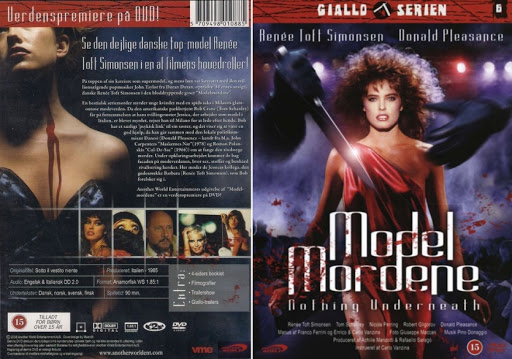
Nothing Underneath (1985)

I really like 1988’s Too Beautiful to Die, a movie that was sold as a sequel to this movie. Perhaps it’s better that I watched that first, because while I like the premise of this movie, the execution leaves something to be desired. That’s a shame, because it really sets up something great.

A serial killer roams the city of Milan, dispatching gorgeous models with the flash of his scissors. Meanwhile, Yellowstone Park ranger Bob Crane senses that his sister needs him, so he flies across the world to interact with the rich and famous. Can he save her? Will he be targeted by the killer? Will Donald Pleasence ever say no to a movie?

As I set up before, this didn’t live up to my hopes. The mid-80’s are a wasteland for giallo, with so many movies being set in the fashion industry yet having no real feel for the fashion or any pretension to art.

Seven Deaths in the Cat’s Eye (1973)

The divine Mr. Anthony M. Dawson, aka Antonio Margheriti, is back with his third giallo flick (this one’s an Italian-French-West German co-production), the others being (the previously reviewed) Nude, She Dies, and 1971’s Web of the Spider (but discriminating gialli connoisseurs will argue that’s more of a straight horror film because it’s color remake of Tony’s own film, 1964’s Castle of Blood. But that’s another review-debate for another time).

Jane Birken (be still my beating heart) (of Michelangelo Antonioni’s Blow Up, Jack Smight’s (Damnation Alley) Kaleidoscope, and the 1973 Christopher Lee-starring British horror Dark Places) stars as Corringa MacGrieff . . . in a film you’d swore was made by Dario Argento, as we’ve got a POV murderer with a straight razor, we’ve got a secluded castle in the Scottish highlands, we’ve got a dungeon, we’ve got a cat, and . . . an orangutan (it’s all about the seclusion, and the animals and insects in gialli).

(And are we plot-spoiling by telling you that seven people die . . . and the ginger cat creeping around the dank castle sees it all? Yeah, and the orangutan gets around—but Seven Death’s in the Orangutan’s Eye sounds stupid.)

So Birken is the ubiquitous bad girl expelled from another Catholic school. And she returns to Dragonstone Castle where she used to spend her summers. At the castle she reunites with her mother Alicia (Dana Ghia of Massimo Dallamona’s The Night Child) who’s doting over her sister, Corringa’s Aunt Mary, the penniless owner of Dragonstone. And like any Agatha Christie novel, we have a full house, with headshrinker Dr. Franz (Anton Diffring of The Beast Must Die and Circus of Horrors) and Father Robinson, the live-in priest (Venantino Venantini of City of the Living Dead), Suzanne, the French teacher (bisexual, natch) (Doris Kunstmann of 1997’s Austrian-made Funny Games), and Corringa’s nutty cousin Lord James MacGrieff (Hiram Keller of Fellini Satyricon) and the Lord’s pet orangutan.

Hey, shouldn’t there be a creepy gardener/groundkeeper? Yep, there is: Angus (Luciano Pigozzi of Blood and Black Lace).

Of course, the Doc is there to take care of crazy James, but also to boink Aunt Mary, and Suzanne—who, in turn, has eyes for Corringa. So while the sisters argue over the family’s money and estate, Alicia is murdered. Then there’s another murder. And the local townsfolk fear a vampire is on the loose: for when a MacGrieff kills another MacGrieff, that victim turns into a vampire—so says the “legend.”

If you’ve watched a lot of Italian horror films—and you know the frugalness of the Italian film industry, where nothing goes wasted—you’ll notice the castle exteriors are the same exteriors from Mario Bava’s Black Sunday and the lush castle interiors from The Whip and the Body. And if it all sounds plot recycling from Margheriti’s own Castle of Blood and The Virgin on Nuremberg, it probably is.

One may argue Seven Deaths in the Cat’s Eye is more British gothic than Italian giallo because it lacks spectacular kills, but the lush cinematography and stylized shots we love in our gialli, is there in spades.

You can (if you’re a member) watch a pristine, ad free and uncut stream on Shudder. The DVDs and Blus (on the Blue Underground and 88 Films labels) are all over the brick-and-mortar and online marketplace, easily picked up at your local Best Buy and Walmart. But, hey, times are tight in these virus days, so we found a two, free rips to enjoy for free on You Tube HERE and HERE. You can purchase the uncut, uncensored and fully restored film from original European vault materials at Blue Underground.

About the Author: You can read the music and film reviews of R.D Francis on Medium and learn more about his work on Facebook. He also writes for B&S About Movies.
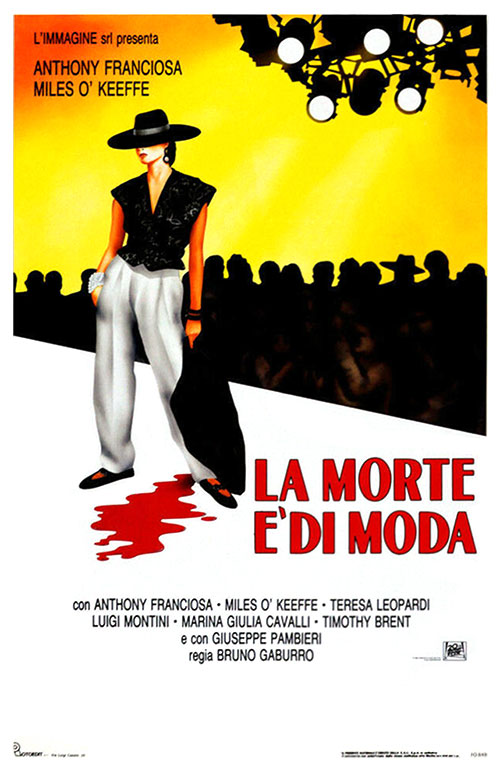
Fashion Crimes (1989)

Anthony Franciosa is a welcome presence at the start of this film, playing a detective who is able to quickly make major leaps in deductive reasoning. However, if you are expecting a film on the level of another he starred in, Argento’s Tenebre, I must sadly tell you that this is not that movie.

If you’re hoping that Fashion Crimes is a modern update of Blood and Black Lace, you’re always going to be disappointed.

Gloria is a fashion model on her way home, but she ends up watching a man kill a woman in an old villa that was once owned by a German countess. However, when the cops come the next morning, it’s been empty for twelve years. So what did she see? Was there a murder? And why is she being targeted, with other models getting killed to try to teach her a lesson?

Perhaps playboy-typed psychiatrist Gianmarco Contini (Miles O’Keeffe) can help. Seeing as how he’s one of the owners of the scene of the crime, I’m going to say that he may also be the killer.

Giancarlo Prete, Scorpion from Warriors of the Wasteland, is in this too. It also uses the music from Joe D’Amato’s Top Model, which is also known as Eleven Days, Eleven Nights, Part 2: The Sequel.

I was kind of hoping that this would be a missing 80’s giallo on the same order as Obsession: A Taste for Fear. Instead, it looks like a 1990’s made for TV movie with no flair or fashion sense.

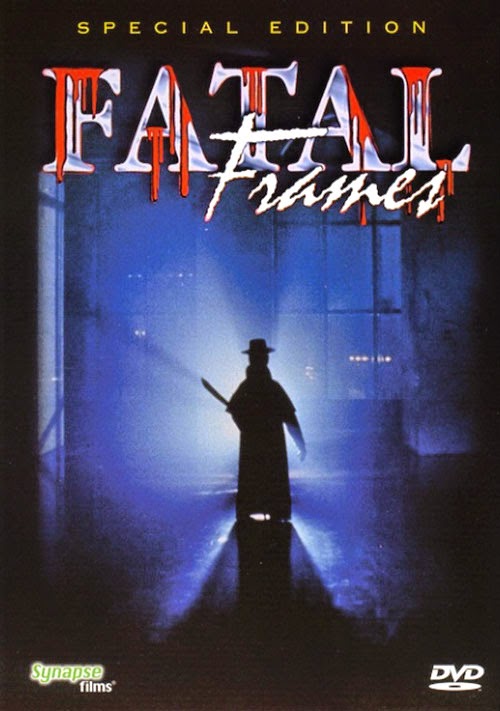
Fatal Frames (1996)

Fatal Frames feels like the most 80’s movie I’ve ever seen, yet it was made in 1996. It’s also the longer giallo I think I’ve ever seen, taking nearly two hours of meandering to get to anything worthwhile, throwing in red herring after red herring, including turns by David Warbeck as a cop, Angus Scrimm as a ghost, Linnea Quigley as a parapsychologist, Alida Valli as a Countess whose home feels like it was lit by Argento (after all, she was Miss Tanner in Suspiria) and Donald Pleasence as an FBI agent. This would be his last movie and his voice was dubbed as he wasn’t around to do any dialogue.

I’d like to say that Mr. Pleasence went out on a high note, but after a career of never saying no to anything, this would not be the movie I’d choose for my epitaph.

Alex is a music video director who has come to Rome and has perhaps brought a serial killer — The Video Killer — with him. That very same killer took out his wife and now he’s a person of interest. His only interest is getting closer to Stefania Stella, who is playing herself here. She’s a pop star — and the wife of director Al Fiesta — whose nickname is the Napoleonic Madonna.

Fiesta would also direct The Hermit and Gipsy Angel, as well as contributing music to the Claudio Fragrasso films After Death and Robowar.

This movie feels like one that has been on for weeks and not hours. It just goes on and on, looking foggy and blue lit, which are things I normally love, but this feels like when your parents caught you smoking and forced you to smoke the whole pack until you got sick.