Housekeeping note!

Hey everyone, this is Sam. In an effort to cut down the amount of time I put into this site, I’ve created a FB page and also a group page. This will enable me to autopost everything there, as well as cut down on the amount of spam that people that are just my normal, non-movie loving friends have to deal with.

Please join those groups and you’ll get to see every single post and article we create.

Thanks and I appreciate you reading the site!

2019 Scarecrow Psychotronic Challenge Day 19: Bloodsucking Freaks (1976)

DAY 19. VIDEO STORE DAY: This is the big one. Watch something physically rented or bought from a video store. If you live in a place that is unfortunate enough not to have one of thee archival treasures then watch a movie with a video store scene in it at least. #vivaphysicalmedia

I grew up in a small town about an hour north of Pittsburgh. Despite being a dying mill town of around 8,000 people, we still had three unique video stores to serve our movie needs — although eventually even the Uni-Mart and 7-11 would expand to have movies (the only ones I can remember getting from either are Death Bed and Gotcha!).

College Hill Video was a satellite store of the larger location in Beaver Falls, located on three spinner racks in a Giant Eagle grocery store. Their horror section was mostly new releases, nearly all mainstream.

Hollywood Video offered more video game rentals but didn’t have much selection. I can barely remember ever renting a movie there.

But Prime Time Video?

I haunted the horror section there, alternatively afraid of the lurid clamshell foreign horror and obsessed by their contents. They promised such foul delights! And of all the VHS boxes there, one cover promised the absolute bottom of the barrel. Somehow, in a small town where you had to verbally ask for adult films after looking through a gigantic binder of their covers, the forced embarrassment keeping you from every seeing something that filthy, this piece of sheer exploitation junk somehow ended up in my 16-year-old hands.

There’s really only one mom and pop rental place left that I can think of in Pittsburgh — Jack’s Discount Videos in Millvale — and three Family Videos which are located well out of the city in Moon Township, Lower Burrell and Greensburgh. Outside of Redboxes, we are sadly out of luck. So I’ve gone back to my childhood to look back at a movie I probably shouldn’t have been watching.

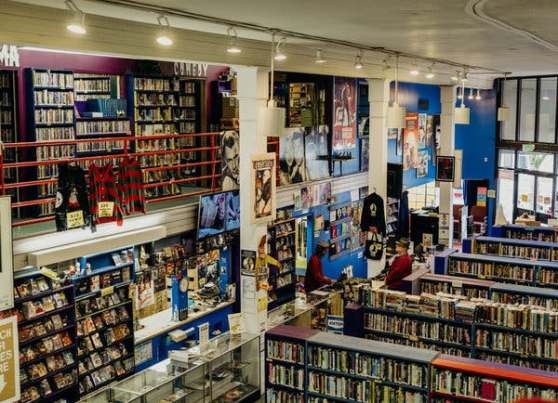
This is not the video store of my youth, only my dreams. Scarecrow Video in Seattle.

Bloodsucking Freaks is the kind of movie that — if it wasn’t so ineptly made — would make you think that anyone who watched it more than once certainly a maniac. And maybe I was back at that age, obsessed with Fangoria and heavy metal and trying to always find something heavier, louder and grosser.

Well, I found it.

This movie became the torture test for anyone that wanted to watch movies with my friends. We became fascinated with it, taking its villains into our roke playing games, drawing photos of the gore scenes and endlessly discussing how a movie like this could have ever been made.

We didn’t know that it ripped off Herschell Gordon Lewis.

We didn’t know that it was junk.

All we knew was that we had to watch it again.

While it was shot under the title Sardu: Master of the Screaming Virgins, it was retitled The Incredible Torture Show during its original run through grindhouses and drive-ins. By the time it made its way to the mom and pop video stores, it’d been purchased by Troma and retitled Bloodsucking Freaks.

We didn’t have an internet to teach us what this movie was about or spoilers to warn us of the content we were about to be barraged with. We just had ourselves.

What unspooled was a movie all about Master Sardu (Seamus O’Brien, a one and done actor who died shortly after making this movie, a victim of a burglar’s knife), who runs a Grand Guignol-style theatre with Ralphus, his demented little person. He’s played by Luis De Jesus, who was famous in Times Square for a loop he’d shot entitled The Anal Dwarf.

Yeah look — if you’re going to get offended easily, perhaps skip to our next review.

This is the kind of actor who just randomly would decide to gather all the other principals and stage an orgy. While he continued to act in adult films until the 1980’s — he’s Mr. Big in Let My Puppets Come, which Vinegar Syndrome just re-released, as well as appearing in movies like Fantasex Island, where he played Pu-Pu in an obvious send-up of Herve Villechaize’s famous role as Tattoo — he also tried to break into the mainstream, playing in Under the Rainbow and as an Ewok in Return of the Jedi. Yet in the very next year after he appeared in a Teddy Ruxpin video, he was back in adult before dying two years later.

Basically, just like Wizard of Gore, Sardu and Ralphus torture people for real on stage in front of an audience that thinks that what they are seeing is art. Then, they sell their victims into slavery.

The film unfolds in a loose collection of scenes, such as the two wiping out theater critic Creasy Silo — based on critic Clive Barnes — who made the mistake of giving them a bad review. I kind of love that the same actor who plays Creasy, Alan Dellay, also shows up as a judge in one of the junkiest mainstream films of all time, the utterly reprehensible — and fully awesome — Amityville II: The Possession.

Then, our evil duo abducts the ballerina Natasha Di Natalie and seek to break her will. She was played by Viju Krem, who is also in the aforementioned Let My Puppets Come, as well as Eros Perversion, a softcore send-up of Shakespeare, and an adult ripoff of M*A*S*H* where she appeared alongside Annie Sprinkle. Adding to the strange history of this film, she’d die young too, a victim of a hunting accident in 1983.

Football hero Tom Maverick (Niles McMaster, yes, the father from Alice, Sweet Alice) is seeking to save her before it’s too late. Speaking of that film, Alphonso DeNoble — who so memorably played the obese neighbor Mr. Alphonso in it — shows up here as a white slaver.

There are also a fair number of New York City-based adult actors of the era cast as female victims, such as Jenny Baxter, Ellen Faison (who is also in the British video nasty Dawn of the Mummy), Juliet Graham (who dated the previously mentioned Mr. Gillis) and Arlana Blue.

Basically, all of them are tortured, whether by being turned into a human dart board or being attacked with a vice, bone saws, thumb screws, meat cleavers, forced dental surgery, a drill, a guilotine and so much more. It’s still the only film I’ve ever seen where someone uses a straw to sip blood out of a person’s skull or throw darts at a naked woman’s rear.

Director Joel M. Reed — who would make Blood Bath the same year — didn’t want to make this movie. He had another script about a rock star haunted by a groupie, but he never got the money to make that one. He’d also make 1981’s Night of the Zombies, starred gonzo pioneer Jamie Gillis as CIA special agent Nick Monroe.

With good reason, this film was decried by Women Against Pornography. None of its female victims are named and they only show up to be maimed and decimated. Is there art and humor under the surface? Sure, but man, you need to crawl through an ocean of scum to get there.

I’ve always wondered how today’s internet-plugged in generation will handle life, as they’re not held back from adult materials at any time. They can basically jump right into the deep end when all we had was random issues of Playboy thrown into the woods. Then I remember that somehow, in the middle of comparatively chaste slashers, Bloodsucking Freaks was on the shelves of the mom and pop video store in my cozy and safe hometown. It made it’s way from the fecund streets of 1976 end of the world New York City to the same VCR we watched birthday parties and cartoons on. And we all watched it, over and over again.

The absurdity of it all amuses me to no end.

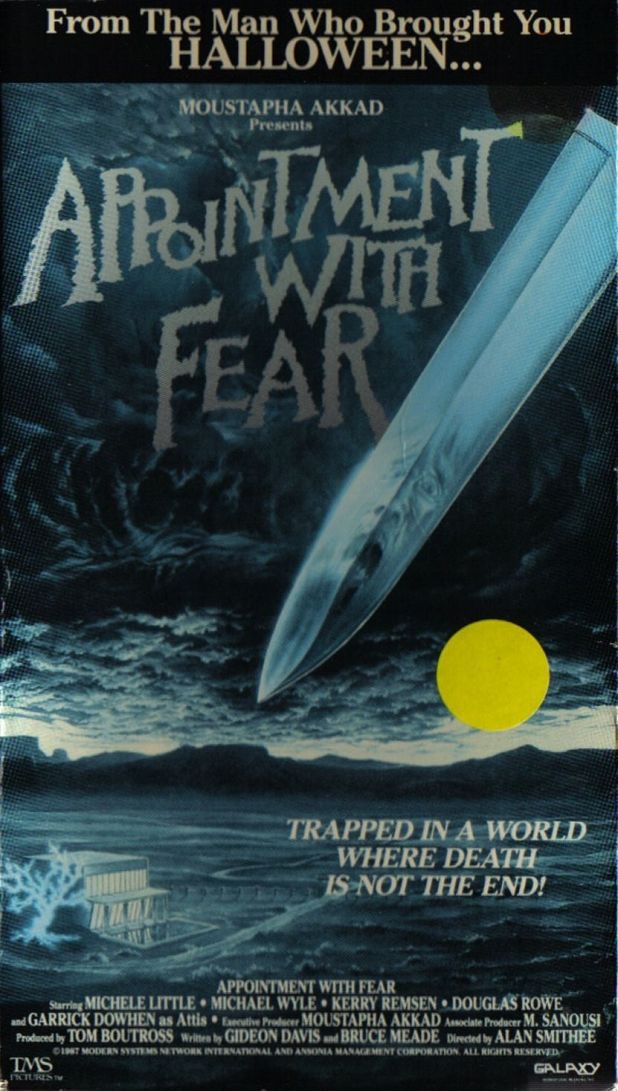
Appointment With Fear (1985)

If there’s one adage that watching slasher films teaches you, it’s to never judge a book — or VHS tape — by its cover. Any time you see the words “from the man who brought you” or “from the people behind” you may not be getting the whole story.

Appointment With Fear is “from the man who brought you Halloween…”

Dear reader, if you were anything like me in the video store days — or now, as I grab a movie and try to convince my wife to watch it — you might read that legend on the cover and think, “Well, I never heard of this John Carpenter movie!” That’s when you realize that if you want to watch these kinds of movies, you need to learn what that line means.

Here, the man is really Moustapha Akkad, the producer of every single Halloween film up until 2002’s Halloween: Resurrection. In fact, other than four other films — this would be one of those four — that’s his complete output. So one assumes that if anyone wants to be the “man who brought you” it would be Moustapha.

Before introducing the world to the man with the darkest eyes, he produced and directed the film Mohammad, Messenger of God, a movie that he hoped would bridge the gap between the Western and Muslim worlds. Seeing as how Muslims dislike any image being made of Mohammad, even making this film was near-impossible, necessitating him needing to finish it in Libya, as Muammar Gaddafi allowed him to film the final six months of the picture there. The vilified world leader would also fund Akkad’s 1980 film Lion of the Desert.

Sadly, Akkad died in 2005 along with his daughter, the victim of the 2005 Ammad bombings. Today, he has streets in Syria and downtown Beirut named after him, as well as a school in his hometown of Aleppo.

Appointment With Fear was directed by Alan Smithee, who again if you haven’t learned a lot about movies, you’d think was the worst director ever. But the name was a pseudonym created in 1968 by members of the Directors Guild of America. It was to be used whenever a director, dissatisfied with the final product, proved to the satisfaction of a guild panel that they’d lost creative control of the film. The director was also required by guild rules to never discuss their involvement with the film.

Here are a few examples of Alan Smithee’s filmography:

Student Bodies: This 1981 slasher send-up was directed by Mickey Rose and produced by Michael Ritchie, who  used the Alan Smithee name to hide his involvement.

The Twilight Zone: The Movie: Second Assistant Director Anderson House used the pseudonym for the first segment of the film, a rare example of a second unit director taking the name. He was distressed over his involvement in the scene where actor Vic Morrow and two children were killed.

Bloodsucking Pharaohs In Pittsburgh: The Alan Smithee here was Dean Tschetter, who was the art director of The Wraith and has gone on to be an illustrator for Disney films such as Mary Poppin’s Returns and The Sorcerer’s Apprentice.

The Birds II: Land’s End: Even though Rick Rosenthal asked for his name to be stricken from this film, when Showtime put it out on VHS, they left his name on the box art. Whoops. Tippi Hedren was even less lucky, as she was in the film yet doesn’t play anyone connected to her role in the original. She said of the film,  “It’s absolutely horrible. It embarrasses me horribly. I’d hate to think what he {Hitchock) would say!”

Hellraiser: Bloodline: After completing his vision of the film, original director Kevin Yagher (yes, the very same special effects expert of movies like Child’s Play and the second through fourth Freddy Krueger films, as well as the TV series) quit the movie after Miramax demanded new scenes, reshoots and a happy ending.

The Alan Smithee behind Appointment With Fear was Ramzi Thomas, who worked with Akkad on several films, including being a script consultant on Lion of the Desert and a producer on Halloween 5: The Revenge of Michael Myers. This film was originally called Deadly Presence, but after Akkad saw the first cut, he fired Thomas, re-shot a considerable amount of new footage and then re-edited the movie himself.

This is the only film Ramzi would ever direct. And strangely, this is a slasher that no one discusses. Well, get ready. 

A lot of this movie can be traced back to 1974’s Psychic Killer. Except here, the killer is a comatose man in a hospital bed who has been possessed by the Egyptian tree god Attis. You have to love a movie based on a god who was raised by a he-goat before he was set to marry the daughter of King Midas. As their wedding song was being sung, she became transcendent with power and he was so moved that he cut off his penis. Any priest that follows Attis must do the same and become a eunuch before gaining the title of Galli. And oh yeah — he’s also the Phrygian god of vegetation, as his act of cutting off his John Thomas is seen as a representation of the fruit which dies in winter, only to be reborn in spring. I’m certain he was honored, but seeing as how his disco stick never grew back, I’m not sure exactly how much.

I told you all of that for basically no reason, as none of this mythology figures into this film. But hey — at least we all learned something today.

The film begins with a man getting of his van and stabbing his wife, who gives her baby to Heather (Kerry Remsen, Pumpkinhead and Ghoulies II) a punk rock babysitter with crazy blue Jem and the Holograms makeup. Yes, I realize this movie already makes little to no sense.

Detective Kowalski is on the case, though. He discovers that the man who stabbed his wife (known only as “the man” in the credits and played by Garrick Dowhen, who is also in Land of Doom) is in a mental facility but is able to astrally project himself. He’s under an Egyptian curse which forces him to kill his baby so that he can continue being King of the Forest.

Heather’s friend Carol (Michele Little, Radioactive DreamsMy Demon Lover) is a snoop who loves her crazy parabolic microphone and records everyone and everything. She’s kind of like Negativland’s The Weatherman, who recorded nearly every single moment of his life and transformed it into bursts of music. Except, you know, her recording makes her into a detective.

The ancient spirit gets busy, blowing up the detective’s car, killing a vagrant, sending evil dreams to Heather and then killing one of their friends named Samantha (Pamela Bach, one-time wife of David Hasselhoff) in the jacuzzi.

James Avery — Uncle Phillip himself — shows up, as does Debi Sue Vorhees, who was Tina in Friday the 13th: A New Beginning, which was made the same year as this movie. In this movie, all she does is eat cheese, show a little side boob and then get killed.

The ending is nonsensical, as the killer finally gets the baby and tries to sacrifice him near a tree. Carol keeps shooting the killer to no effect before piercing him with a pole. Her boyfriend Bobby saves the baby, whose eyes soon glow green. Is the baby the killer now? Why didn’t the psychic force just go into the baby from the beginning?

I have more questions. So many questions. Why does Bobby keep a mannequin in his sidecar? Why does Heather put on mime shows for her senile grandparents? Why is there no gore? Why do Carol and Bobby play hide and seek before they have sex? Why does the homeless man live in the back of Carol’s truck? Why would he act as a servant for these kids? Why did they go to that big mansion? Why did the makers of this film stage an elaborate dancing scene just as the action was heating up?

I fear that in writing so much about this movie that I’ve made it sound like a pretty solid affair when it’s anything but. It’s a slow, plodding and boring mess that only rewards you with insane bursts of strangeness, as if it were made by aliens from another planet who had no innate knowledge of how human beings speak, act or exist with one another. It’s the kind of movie only I could fall in love with. And that’s why I won’t recommend it to you, because it’s much like the baby in this film, a strange green eyed monster that must be protected from the coma-induced no cock having Egyptian gods of the world that only want to give this movie one star on IMDB and say that it’s a horrible film.

2019 Scarecrow Psychotronic Challenge: Day 18: A Matter of Degrees (1990)

Day 18 Only on VHS: Watch something on the true psychotronic format


Editor’s Desk: Upon the news of his medical hardships, we’ve seen an uptick in our reviews of Tom Sizemore films, which is no way for anyone to discover an actor’s films. Regrettably, Tom—whose credits included the major studio films Natural Born Killers, True Romance, and Black Hawk Down—has died at the age of 61 after having been been hospitalized in a coma for two weeks as result of a brain aneurysm brought on by a stroke.

If not mentioning Tom in passing another review, we’ve reviewed many of Tom’s films, which you can easily discover at B&S About Movies.

Tom Sizemore
November 29, 1961
March 3, 2023


A Little History of Grunge . . .

By 1988, underground “college rock” bands began to bubble under the mainstream and crossed over onto mainstream AOR stations still waste deep in the likes of the hair metal bands Winger, Slaughter, and Poison. And while the audio nimrods didn’t play the newly “major label signed” Husker Du (to Warner Bros.) and The Replacements (Sire), and gave record-industry guru David Geffen of Asylum Records (home of classic rock mainstays, the Eagles) the snub when his new label, DGC, signed New York noise-merchants, Sonic Youth, those spandex bastions did begin to “experiment” with the “more commercial” likes of the Cure, Jane’s Addiction, and Love and Rockets. Yeah, they spun Alice in Chains, but were still not quite ready to pluck Soundgarden from Seattledom.

Then, slowly, while those stations still bowed to the dynasties built by Led Zeppelin and Hendrix, you began to hear less Winger and more of the “false grunge” of Candlebox, Pearl Jam and Stone Temple Pilots, and (B&S Movies’ proprietor Sam’s favorite bands) Creed and Bush. Then, instead of Slaughter ad nauseam, you heard a little trio out of Seattle ad nauseam—and overnight America became a nation of coffee houses with hep-baristas adorned in $50 JC Penny designer flannel shirts and $150 Macy’s faux Doc Martins.

1991: The Year Punk Broke (full movie/Daily Motion), indeed. Flux Capacitor me to 1985, Doc Brown. I need to be sedated, Joey.

A DJ’s Journey . . .

I started my radio career in the early breakers of the Seattle new-wave, working at a small, technically inept, stodgy and dying non-commercial FM that somehow, we, the staffers, convinced our clueless “L7” bosses to give an all-“alternative” format a try and dare rock ‘n’ roll lovers—not interested in blues babbling, folk hootenannies, jazz noodling, plunked banjos, and book reviews—to tune into our audio graveyard left of the dial. And it worked.

And thanks to an indifferent “voice of a generation” who blew his brains out a few years later, the two battling classic (ass-ic) rock stations in town became “rock alternative” outlets overnight and decided the alt-nation wanted to hear the (bane of my existence) Crash Test Dummies and Spin Doctors, and some chick named Torn Anus, I mean, Tori Amos, caterwauling like humping cats on a hot summer night about girls and corkflakes.

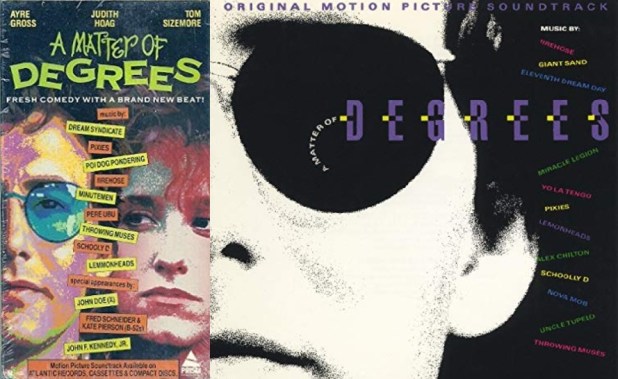
So, the tales of WXOX 90.6 Providence, Rhode Island, in the frames of A Matter of Degrees are near and dear to this DJ’s heart. The new film through 20th Century Fox’s specialty arm, Fox Lorber (Independent Magazine article), along with its accompanying soundtrack on Atlantic (the track-listing read like the playlist of one of my airshifts), was heavily promoted in all of the alt-rock mags of the day: Alternative Press, B-Side, CMJ, and Option (good reads!). It was probably even in the alt-section of the mainstream radio trades The Hard Report, FMQB, and Rockpool; it’s been so long, I can’t recall.

The staff of my radio station was stoked. The film was directed by W.T Morgan, who directed the alt-essential concert doc, X—The Unheard Music, and X’s John Doe was starring (later of the radio-connected The Red Right Hand). Fred Schneider and Kate Pierson from the B-52s had roles as DJs alongside Doe, and North Carolina’s hottest college-rock band, Fetchin’ Bones, who just got bumped up to Capitol Records, had a role.

And we were eventually crushed. What we thought was going to be a 1990 college rock radio version of the 1978 progressive rock radio chronicle FM—ended up being Friends: The College Campus Years. Then, we got alt-fucked again, by Cameron Crowe, with Friends: The First Year out of College, aka Singles (1993). Yeah, we got more “radio” with Airheads (1994)—but got more caterwauling cats in the “false grunge” screeches of 4 Non Blondes instead of Throwing Muses and the Breeders. At least Christian Slater’s alt-rock pirate in Pump Up the Volume (1990) cleaned out our Eustachian tubes. And I don’t need any Reality Bites (1994) from Lisa Loeb, either.

Well, at the time, courtesy of our Husker Du and Sonic Youth snobbishness, A Matter of Degrees seemed like a mainstream boondoggle produced by the same “suits” who decided to program songs about frolicking princes, chicks into cornflakes, and creepy, long-haired baritone Dean Martins humming stupid Canadian shite that was giving us A Flock of Seagulls when we wanted the Ramones. But as the VHS box patinas and the tape forecasts snow, I have come to love A Matter of Degrees—and its VHS and CD are a prized part of my collection because: it’s a time capsule that I wished never dissolved into the past.

The Review

A Matter of Degrees, written by Brown University alumni Jack Mason and Randall Poster, we come to find out, wasn’t about a radio station: the radio station served as a backdrop-linking device to a clever, ‘90s version The Graduate (1967), only with The Lemonheads (who ironically cut a cover of “Mrs. Robinson” for an early ‘90’s DVD reissue of the Dustin Hoffman hit) instead of Simon and Garfunkel backing the life-undecided, college campus hippiedom tales of Maxwell Glass (Ayre Gross; House II, Minority Report).

For Max, Providence, Rhode Island, isn’t a place: it’s a state of mind and that “mind” has been rattled by his being accepted into law school (he applied only to the hardest schools so he’d be rejected; he gets accepted to Columbia, the hardest of them all). Then he discovers his cherished campus radio station, which employs his friends Welles Dennard (the incredible Wendell Pierce; USA Network’s Suits, HBO’s The Wire, NBC’s Chicago P.D, Nicolas Cage’s It Could Happen to You) and Scuzz (the amazing-in-his-small-role Tom Gilroy; went onto work with R.E.M’s Michael Stipe and taught at Columbia University) is going to be torn down to make way for a research laboratory backed by a corporation that services the military. And when the station is rebuilt: the free-form format is out.

So, with an Abbie Hoffman-tenacity augmented with coursework titled “Interdisciplinary Approaches to Ethnicity,” Max is going to save the radio station—with arguments invoking the name of infamous ‘80s insider trader Ivan Boesky as a verb: Max speaks ill of the boyfriend of his feisty, Jerry and Elaine-styled best friend, Kate Blum (Judith Hoag; April O’Neill in Teenage Ninja Mutant Turtles, pick a U.S TV series), who runs the radio station: “[Roger] Ivan Boeskied it for them.” Not even their college-dropout/car mechanic roommate, Zeno Stefanos (Tom Sizemore, Zyzzyx Road), who has a propensity to lug car bumpers through the house and make sandwiches by slapping undiluted Campbell’s pea soup between two piece of white bread, can’t get Max off his disillusioned, high sparklehorse: “Remember, women and animals hold up two-thirds of the sky,” Zeno zens. (Now I had my share of Ramdan noodles and peanut butter sandwiches for dinner back in the day, but raw soup sandwiches? I’m glad I didn’t get accepted into Brown.)

“Hey, whatever happened to John Doe? I thought he was in the movie?”

Doe is Peter Downs, the founder of the station who “blew five years in San Francisco recycling the hits like a goddamned monkey” (been there, done that) and returned to his job as the program director of WXOX because, “this is paradise.” Oh, and Peter has a bitch-be-crazy girlfriend, Isabella Allen (Christina Haag), who has Max’s nose wide open. (See what I mean about the Friends-relationship dithering and not enough radio station? Get the Aniston out of here!) In the end, the station and sounds of “Peter Downs and WXOX 90.6 Providence” that Max man-love croons from a shark-toyed bubble bath to a toilet-perched Kate, serves as a plot-character linking device (just like Taj Mahal’s Dix Mayal on WKOK in Outside Ozona).

A Matter of Degrees is a case of “you had to be there.” If you never experienced college campus life and being enamored by the left-of-the-dial “hits” crackling over the airwaves of its tin-can station or a local non-com, you’ll have a lukewarm response to the film. The fun Mason and Poster-penned script reminds me of The Graduate; however, it won’t be in the same classic league as The Graduate when it bounces off your retinas. Your gray matter will populate it as a Singles rip-off—only this film came first. It is, in fact, the first Gen-X, well “grunge,” film in our $5.00 cup-of-coffee flannelled landscape (and you can visit with those films in our “Exploring: 50 Gen-X Grunge Films of the Alt-Rock ’90s” overview.).

Chalk it up to nostalgia fogging my sight; with eyes that see all of my friends from the grunge epoch as I flashback to my views from the glass booth (as I cracked open a new album called Bleach by some band called Nirvana) in the spot-on-miscreant Scuzz, the cucumber-cool Welles, and the rest of the WXOX satellites.

“Rock and roll can save you!” urges Peter Downs.

It did, Peter. More than you will ever know.

Where to get and how to hear the CD soundtrack and see the VHS movie:

While A Matter of Degrees tanked as a theatrical feature (the Sundance crowd shrugged), it blossomed on the international home video marketplace, carrying the titles of Louco Por Rock (Crazy for Rock, Brazil), A tutto rock (Too All, Rock Italy), and in Poland, Radio Maxa (Maximum Radio), or, more accurately, “Radio to the Max.”

As with most of the failed films in the pre-DVD era unceremoniously dumped to VHS, A Matter of Degrees has never been released on DVD—not officially nor as a grey market DVD-R—and there are no online VHS rips. There are no CD rips (of the non-vinyl) soundtrack, but you can listen to this re-creation of the soundtrack I patched together on You Tube. You can also see the soundtrack’s liner notes at Discogs. Multiple copies of the CD soundtrack, the even rarer cassette version, and the VHS can be found on numerous seller sites, eBay in particular. Not finding it won’t be a problem.

Caveat Emptor: John Doe’s incredible theme song for the film, “A Matter of Degrees,” which appears on his debut solo album, Meet Joe Doe (1990; DGC) and the promotional EP single, A Matter of Degrees, does not appear on the soundtrack, which is baffling, considering he’s one of the leads of the film. You can watch John Doe perform the single on the study-helper-for-the-late-night college crowd (good times): The Late Show with David Letterman (there is just something “off” seeing John Doe as a “traditional” lead singer clutching a mic-stand and not wearing a bass). Let the video play through to watch David Letterman’s 1983 clueless-awkward interview with X (really, Dave: alphabet jokes?) as they promote “Breathless,” the soundtrack single to the Richard Geer remake of Francois Truffaut’s film (1960) of the same name. X also covered the ‘60s hit “Wild Thing” for Major League (1989).

As with John Doe: Fetchin’ Bones are in the film—performing their MTV 120 Minutes hit, “Love Crushing,” for a “Save WXOX Benefit” (where John F. Kennedy, Jr. shows up and serenades a girl with an acoustic guitar)—but their song doesn’t appear on the soundtrack. Go figure. And the film is dedicated to D.Boon (backed by Doe’s title-cut song in the film only), the late guitarist-singer of the Minutemen. Why does the post-D.Boon outgrowth of the Minutemen, Firehose, appear on the CD soundtrack, and the Minutemen do not? Double go figure. And don’t bother (poi-dog) pondering how the B-52s got soundtrack skunked. Seriously, this film needed to pull a Dazed and Confused (1993) and release an “Even more . . .” Volume 2 to contain all the great “college rock” in the film. (Oh, hey Kris Erikson, Uncle Tupelo made it onto the soundtrack!)

You can also learn more about Randall Poster’s success as a music supervisor, the art behind movie soundtracks, and his longtime collaborations with director Wes Anderson (2014’s Grand Budapest Hotel) courtesy of these print interviews conducted by WIPO Radio, The AVClub and New Music Express. As it seems there will never be a DVD restoration replete with a commentary track, these interviews are the only way to gain insights on how A Matter of Degrees was and came to be made. (Jim Dunbar, who portrayed DJ Frank Dell, also amassed over 60 credits as a music supervisor, some in the company of Poster.)

In Poster’s post-1990 interview with the alternative music trade NME—New Music Express, he had this say on why he gave up on screenwriting and producing to work exclusively as a music supervisor on films (2012’s Skyfall, 2013’s The Wolf of Wall Street; he won a 2011 Grammy for “Best Compilation Soundtrack” for HBO’s Boardwalk Empire):

“I was always a big music lover, a record collector and an avid movie fan. I got through university studying English Literature, and I found myself without any professional direction. I wrote a screenplay with a friend of mine [Jack Mason] about a college radio station. We did a lot of new songs for it, and we did a record and I just felt that that was really what I wanted to focus on. I wanted to work with great directors, so I figured if I made music my focus, and that would enable me to do [work with great directors; like Wes Anderson].”

Poster also tells us that his college radio love letter was not only filmed in Providence: much of it was shot at Brown University. Poster and Mason were inspired by the college’s campus radio station, WBRU, changeover from a free-form to commercial format in 1985. They wrote the screenplay after graduation. It took them five years, but they got it made. And that’s awesome.

How beloved is A Matter of Degrees? This post at the Radio Survivor blog, written by fellow AMOD fan, Jennifer Waits, proves this cherished time capsule of ‘80s college radio has fans that want, and need, a DVD release of the movie (hint to Kino Lorber!).

Then there’s new fans—of this almost 30 year old movie—like General Manager Sharon Scott of the streaming-community station Art x FM. When she put the new, low-powered community FM (LPFM) outlet in Louisville on the air, she was granted the WXOX-LP call letters. According to Sharon, she didn’t know about A Matter of Degrees or its fictional radio station until well after the station received the call letters. Then, she spotted the movie’s promotional sticker on the door at WRFL and was taken aback that it was the same call letters she had chosen.

It looks like Louisville has found its audio salvation! “WXOX Louisville can save you!”

You can learn more about the new WXOX and Sharon Scott’s fight to save WRVU-FM, Vanderbilt College’s radio station, after students lost access to its terrestrial signal. The Radio Survivor article also provides links to learn more about the history of Brown University’s WBRU.

Peter Downs was right: “Rock ‘n’ Roll Can Save You!”

(And don’t believe the Hype! (1996; full movie/TubiTV) they’re selling!)

Editor’s Note: This review re-ran on December 21, 2020 (with updates), as part of our “John Doe Week” of reviews. You can watch the trailer for A Matter of Degrees on You Tube.

About the Author: You can read the music and film reviews of R.D Francis on Medium and learn more about his work on Facebook. He also writes for B&S Movies.

2019 Psychotronic Scarecrow Challenge: Day 18: Outside Ozona (1998)

Day 18 Only on VHS: Watch something on the true psychotronic format

Quentin Tarantino goes off into the dusty, deserted Midwest in this sharply written, existential tale that questions how we deal with regret and loneliness, fate and death at the whims of respected Chicago psychiatrist Alan Defaux, aka The Skokie Ripper (David Paymer; 1981’s This House Possessed, Rob Reiner’s An American President, Sam Raimi’s Drag Me to Hell), a multistate serial killer who celebrates his exploits over the air of a “superstation” that covers five states surrounding Oklahoma: WKOK 98.7 FM, with DJ Dix Mayal who, in a beef with station manager Floyd Bibbs (Meatloaf; 1992’s Wayne’s World, 1999’s Fight Club), flips the station from country to rhythm and blues (an Oscar-caliber portrayal by American blues icon Taj Mahal; 1972’s Sounder, 1991’s Bill and Ted’s Bogus Journey).

Writer and director J.D Cardone (Thunder Alley; a new review for the Scarecrow Challenge, see Day 16) brings us exquisite character development within a creepy-quirky, well-written dark comedy thriller threaded with multi-storylines. At its core Outside Ozona is a cop vs. criminal tale that reminds of Joel and Ethan Coen’s better-known Fargo (1996) — courtesy of the only “unknown” in the cast: Lucy Webb (1980’s Not Necessary the News sketch comedy show; wife of film co-star Kevin Pollack of Tom Cruise’s A Few Good Men). Webb shines just-as-bright as Frances McDormand’s put-upon law officer, Marge Gunderson, as the serial killing-tracking F.B.I agent Ellen Deene.

There’s not one bad performance in Outside Ozona, which also stars Robert Forester (another Oscar caliber performance; also of 1979’s The Black Hole, 1980’s Alligator, 1997’s Jackie Brown) as Odell Parks, a kind-hearted widowed trucker who’s admired afar by a truck stop waitress played by Swoosie Kurtz (U.S TV’s Mike and Molly), but adores a motor-stranded Native America woman taking her mother to the ocean off the Texas coast to die (and his rig plays a major part in the film’s climax that converges all of the storyline into a harrowing conclusion). Sherilyn Fenn (1986’s The Wraith, 1990’s Crime Zone, 2012’s Bigfoot) and her sister become Defaux’s victims (he bludgeons them with a toilet tank lid at a remote rest stop; he poses Fenn’s body, holding her heart); Kevin Pollack and Penelope Ann Miller (Al Pacino’s Carlito’s Way) are an unemployed circus clown and his exotic dancer-hooker girlfriend reduced to robbing a convenience store and giving lap dances in a dive bar to survive.

And all of their lives converge — outside of Ozona, Texas.

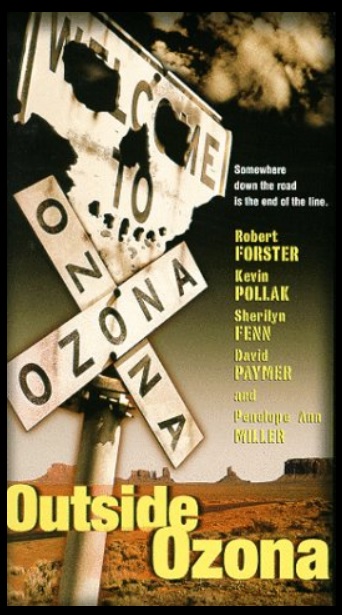
In the pungent backwash of “Tarantinoesque” films made in the wake of Pulp Fiction (B&S Movies wanted to, but never got around to, formulating a “Tarantino Copycat/Ripoff” list during our Once Upon a Time in Hollywood tribute week to his films, but Indie Wire and Uproxx beat us to it — and they go deep, but fail to mention J.S Cardone’s contribution to the Tarantino canons), Outside Ozona is the lone, sweet Texas-to-Oklahoma rose. Yeah, I know Oliver Stone brought us the western-noir that was U-Turn (1997) and Stone is god, but it pales in comparison (to my gray matter) to the film-noir leanings from the mind of J.S Cardone. So, if for only to see Taj Mahal in one of his rare acting roles (he dominates the screen as Dix), seek out Outside Ozona as a POV on Vudu and TraktTV. There’s no free VHS rips, sorry. And, while it has never been released on DVD, you can buy the cool road sign-skull poster.

Why Cardone never formulated a neo-noir buddy flick-sequel centered on Meat Loaf’s station manager and Taj’s DJ (their chemistry is magically electric) . . . what organ wouldn’t I sell to see that film?

Outside Ozona received extensive, foreign video and television distribution with the diverse titles of (most of them are great: but keep “Somewhere in America” and “Radio Station”): El crimen no conoce fronteras (Argentina; Crime Knows No Borders), Um Assassinato na Estrada (Brazil; A Murderer on the Road), Synora thanatou (Greek; Border of Death), Valahol Amerikában (Hungary; Somewhere in America), Radio Killer (Italy), Radiostacja (Poland; Radio Station), Смертельный попутчик (Russia; Death Companion), and Camino del infierno (Spain; Hell Road).

While we’re on the subject of Quentin Tarantino and have your attention: In case you missed our Tarantino week, here’s the list of all the remaining films we reviewed, so you can catch up:

Four Rooms (1995)
From Dusk Till Dawn (1996)
Grindhouse: Death Proof (2007)
Inglorious Basterds (2009)
Kill Bill Volume 1 (2003)
My Best Friend’s Birthday (1988)
Natural Born Killers (1994)
Reservoir Dogs (1992)
True Romance (1993)

And these compilation lists:

Exploring The 8 Films of Quentin Tarantino’s Rolling Thunder Pictures
Exploring: Movies that influenced Quentin Tarantino
Exploring: 37 Movies that make up Kill Bill

About the Author:You can read the music and film reviews of R.D Francis on Medium and learn more about his work on Facebook.

2019 Scarecrow Psychotronic Challenge Day 18: Beyond the Gates (2016)

DAY 18. ONLY ON VHS Day: Watch something on true psychotronic format. If you don’t have access to a VCR then watch a movie with a VCR/VHS theme in it. 

Thanks to the Found Footage Festival, so many people have gotten the chance to see a lost part of the VHS era — board games that relied on your VCR.

Nightmare was chief amongst those games. Released in 1991, the game took place on The Other Side, a place of six Harbingers who claim authority over a region while dreaming of taking over the entire dark dimension and escape into the human world. When you play, you become one of them — Baron Samedi the zombie, Gevaudan the werewolf, Hellin the poltergeist, Khufu the mummy, Anne de Chantraine the witch or Elizabeth Bathory the vampire — and follow the rules of the Gatekeeper, whose wants to ensure that you don’t escape The Other Side.

The game was part of the Atmosfear series, created in Australia by Phillip Tanner and Brett Clements. It even came back in the 2000’s with two new games released on DVD.

To win the game, each player must use their opponents’ greatest fears against them in order to collect six keys. Over multiple versions and booster tapes, the game stayed more popular in Australia then it did in America, even getting its own music video and Pepsi-branded drinks.

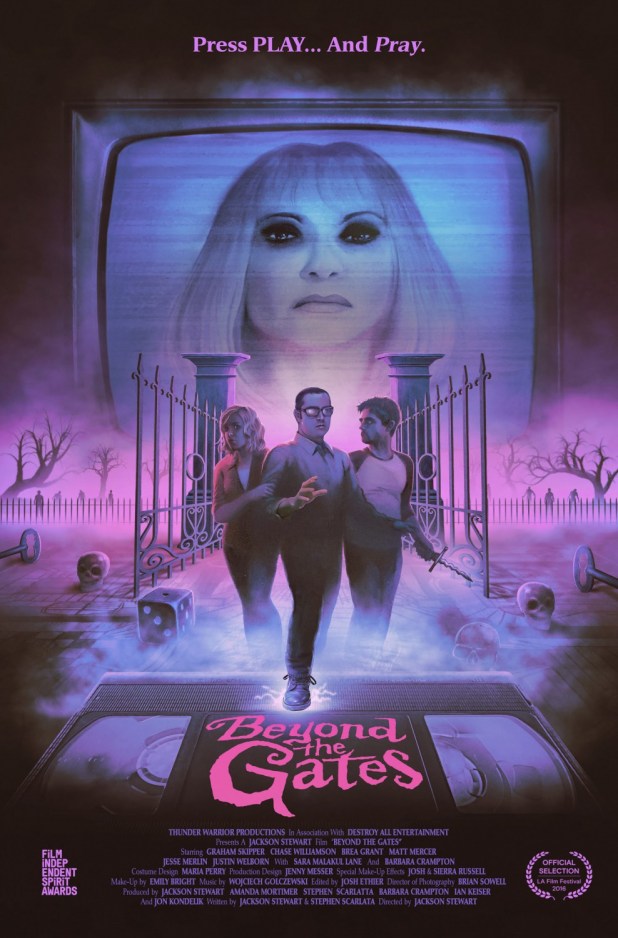
Two brothers, Gordon (Graham Skipper, who wrote and directed Sequence Break) and John Hardesty (Chase Williams, John Dies At the End) have reunited at their father’s video store, sorting through the mountains of unwatched VHS tapes as they prepare to sell it. Dad’s been missing for seven months, Gordon has left town long ago and John’s life is going nowhere.

The next day, after finding a key to their father’s office, they discover a VCR board game entitled Beyond the Gates. The tape is still in the VCR, which means it may be the last thing their father ever watched. The boys play the video and a woman’s face appears. Her name is Evelyn (Barbara Crampton, who also co-produced) and she asks if they’re willing to wager their souls. After a flash of light, the two discover that they’re lost hours of time.

Later that evening, Gordon’s girlfriend Margot (Brea Grant, Halloween II) joins the brothers for another game, which tells them that if they want to save their father, they must play the game and locate the four keys. Soon, the time 3:13 will wake each person up to a TV showing only static.

Inside the box is a receipt for an occult store run by a man named Elric He tells them that they must play the game once it starts. On their way out, John steals a dagger.

As they continue playing, actions in the game world impact real people, like their friend Hank being disemboweled by unseen forces. Even when they try to throw the game away, it soon returns. That’s because they only have two choices left: win the game or die. That said — no one has ever won before.

The game itself becomes a metaphor for the lives the brothers are living, stuck in old empotions and memories of the past. Whether or not they can use that knowledge and escape, well, you’ll have to watch the movie to discover that for yourself.

Exploring The Weapons, The Hours and The Motives of Slasher Films

This weekend, after literal months of watching slashers prepping for this October’s Slasher Month event, I started thinking about each subsequent slasher as a game of Clue. To wit: How did each person get killed? What holiday or time of year killed them? And why did they get wiped out?

Francesco Mazzei’s 1972 giallo lent this piece its title: The Weapon, The Hour, The Motive. These are central to the giallo, the deadbeat dad of the slasher genre. Whereas most giallo are refined pieces of high fashion interbred with psychosexual madness and free jazz soundtracks, the slasher has no need for high couture or dashing yet doomed leads. But the killing? The killing is much the same.

Other than the Olsen twins and the Cheech and Chong movies, this is all research.

My fascination with this subject comes from my continual reading of Blake Snyder’s Save the Cat!, which is an essential guide to the tropes and story beats of scriptwriting. Nearly all horror can be placed into the “Monster In the House” category. Within this framework, the movie is always about a powerful creature intent on destroying the cast, an enclosed community into which the beast is let loose to apply his trade and a critical third element: one of the characters — or many — must sin against the villain to cause them to gain that intent. Alien is a great example, as the greed of the corporation — which flows down the line toward even the crew — is the reason why the Xenomorph gets on board the Sulaco.

I then discovered the beats of the original Halloween. The cousin of the “Monster In the House” is the idea of the “Serial Monster,” which is an individual who is a threat to the entire cast. Unlike many movies where the cast itself is the cause of the sin — the campers of Crystal Lake, the parents of Elm Street — the sin in this film would be that the staff of Smith’s Grove underestimated both Michael’s cunning and the veracity of Loomis. Notably, that same sin motivates him through the second film — which is really just the first part continued — and even The Shape’s return in part four, where the sin becomes the hospital crew again not thinking that Michael could be a threat. Hilariously, this is the very same sin that happens all over again in the 2018 reimagining, with the addition of a doctor whose sin is wanting to be just like Meyers.

As you can tell, I obsess over movies. Instead of pushing the Saves the Cat! construct on each and every slasher, I felt that it was even more intriguing — and perhaps fun for those that don’t want to learn every piece of screenwriting — to break down the slasher form into those three vital chapters. Basically, I feel that we can tear these movies apart and discover their component reasons for being, as well as why the murders within them had to happen in three simple categories:

  • THE WHAT: The weapons used, or THE WEAPONS.
  • THE WHEN: The date most significant to the murders, or THE HOURS
  • THE REASONS: What drove someone to kill? What is their modus operandi? How is it unique, or THE MOTIVES. Location may also play a large part in this category, as well.

And it’s by no means the final word on the subject, but it’s definitely a start.

At their most basic, slasher killers rely on the most simple of weapons. Instead of the modern pistol, they favor edged cutlery such as machetes and long knives.

For example, let’s take a look at Jason Vorhees, probably the most iconic of all slashers.

Just the basics, ma’am.

While the first film doesn’t include Jason — SPOILER WARNING FOR A FORTY-YEAR-OLD MOVIE his mother is the killer in that one — the man who would become the face of slashers started things off with a simple ice pick to the brains of former final girl Alice at the start of Friday the 13th Part 2. For the first few films of the cycle, he was content with using his trademark machete and the occasional pitchfork or spear when he felt like ripping off Mario Bava’s A Bay of Blood.

Yet by the end of the series, he was using weedwhackers, party favors, his own brute strength to tear people in half and slam sleeping bags filled with sorority sisters into scarlet oaks and finally, freezing a woman’s head in liquid nitroglycerine. Give the man a break. He was in deep space.

Jason didn’t specialize. But a killer that came a few years before him began a trend of having trademark weaponry.

Do one thing. Do it well.

If you’re going to be the star of a movie entitled The Texas Chainsaw Massacre, you better be an expert at your craft. Enter one Thomas Brown Hewitt — if you’re following the remake that named him — who is better known as Leatherface.

While chainsaws would also show up in films like Motel Hell and the Evil Dead series, Leatherface would be the undisputed king of the chainsaw.

Of course, the only chainsaw movie that comes close to equaling the usage of the tool would be 1982’s Pieces, a film that somehow unites the giallo and the slasher with a tagline that promises, “It’s exactly what you think it is.” Where Tobe Hooper’s artistic vision crafted a film that’s much less explicitly gory than anyone remembers — that’s the true magic, that by suggestion the film is seen as a film awash in the red stuff when it’s anything but — Juan Piquer Simón crafted a bastard film that is pornographic in its excesses. It’s as if it’s a leering devil sitting on your shoulder, whispering “You kids wanna see something really violent?”

The bastard son of a thousand bitches. Yes, that’s what they call female dogs.

Despite holding vast powers over the Dream Dimension, Freddy Krueger is infamous for the weapon that he wears throughout every one of the A Nightmare On Elm Street films — a glove with razors on each finger that earned him the title of the Springwood Slasher.

Yet by the mid-point in the series, Freddy seems more devoted to using his near-limitless powers beyond the wall of sleep. I mean, if you had the ability to make giant hands crush people and turn teenagers into human roaches that crawl into Roach Motels®, wouldn’t you do the same? Was he just using the glove-like Guy Caballero used the wheelchair? For respect?

However, by the time Freddy finally got around to facing off with Jason, he went back to glove-based murder. Was he slowing down his game in the hopes of not making Jason look bad? Was it like the old days of pro wrestling when it was real, but people still had gentlemen’s agreements not to attack hurt body parts or damage good looking faces?

Similarly, Candyman has the ability to move in and out of even waking nightmares but has that hook so handy that he just has to use it. After all, what’s the good of saying things like, “What’s blood for if not for shedding? With my hook for a hand, I’ll split you from your groin to your gullet.” if you’re not going to follow through on your threats?
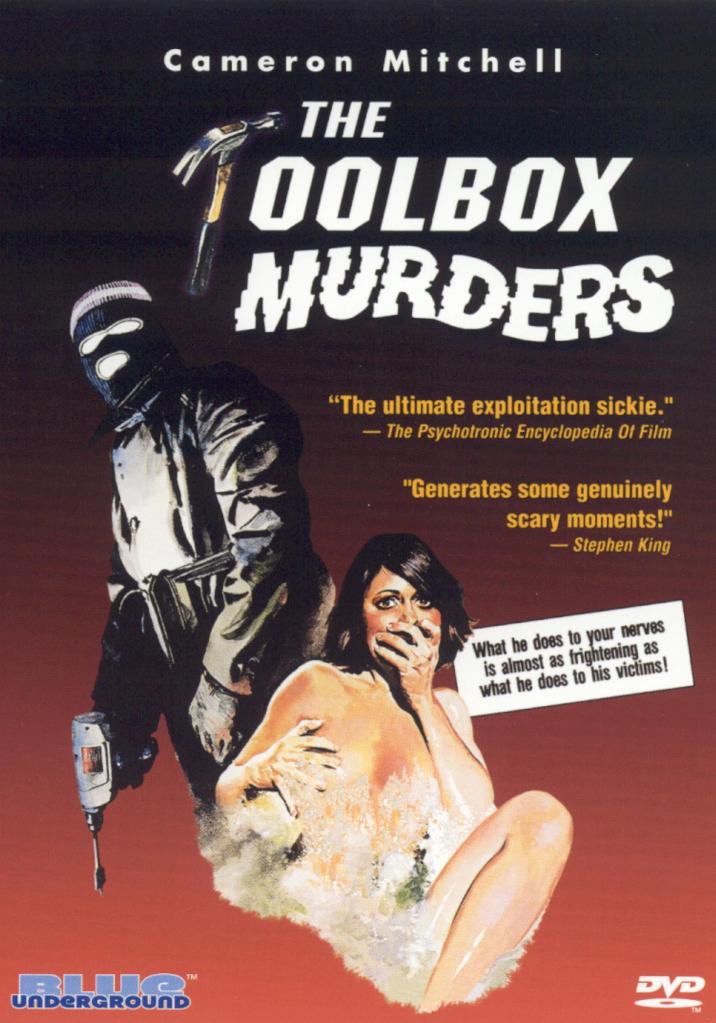
Sooner or later, it’s going to be Cameron Mitchell month.

By the time of The Toolbox Murders and Nail Gun Massacre, slashers were being named for the weapon of their killer’s choice. While some killers like The Prowler and the shears-wielding slasher in The Burning stuck to one weapon for the most part, other more inventive killers diversified.

Victor Crowley, for example, might tear your jaw the whole way back just as easily as choose to deploy a gas-powered belt sander. The killer in The Mutilator favors all manner of bladed weaponry. Just look at the film’s tagline, “By sword. By pick. By axe. Bye bye.”
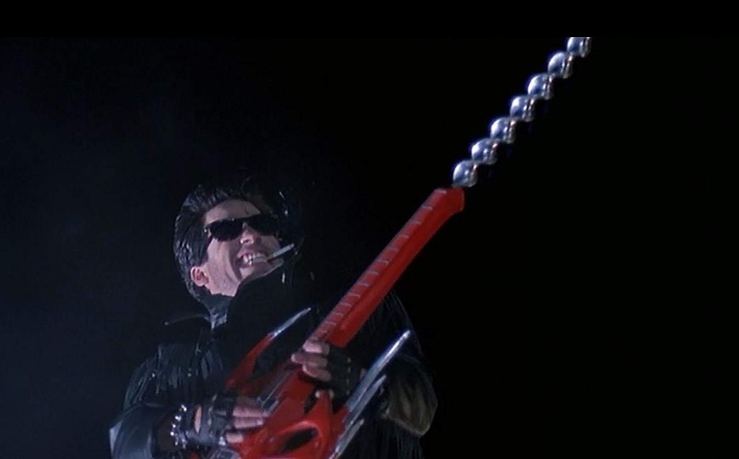
Where do you even get one of these?

Some killers went the extra mile and crafted their own unique weaponry. They probably didn’t care that this would allow the police to track them better, but hey — logic has no place in a slasher movie. A great example is Slumber Party Massacre II, where The Driller Killer goes all in on the musical direction of the proceedings by crafting a guitar drill. Maybe he was influenced by Frank Zappa’s “My Guitar Wants to Kill Your Mama.” Or perhaps what creativity he lacked in coming up with a sobriquet was made up for with this outlandish kill toy.

For just plain weird one-off weapons, here are a few of my faves:

While they aren’t slashers, there are also inventive weapons in Sleepwalkers (a corn cob to the back), Tenebre (this is a giallo, not a slasher, but it has insane kills and a final death by modern art), the wine rack in Waxwork and pretty much the entire Final Destination series.

If you’re looking for where the trend of slashers being set around a certain day of the year started, look no further than Halloween. Amazingly, the movie was originally going to be called The Babysitter Murders until producer Irwin Yablans suggested basing the story around a holiday. The rest is history.

While so many slashers take place on Halloween (Trick or Treats, Trick or TreatNight of the Demons 2, 31ClownhouseBabysitter MassacreThe CollectionDark Night of the ScarecrowThe GuestDeadly Friend (which also encompasses Thanksgiving), Terrifier, all of the Halloween sequels to name a few), other holidays have been cause for stalking and killing.

Valentine’s Day: The most well-known slashers that celebrate the Festival of Saint Valentine — which in itself is a day that looks back at a martyr who was pretty much decimated like a victim in one of these films — would be 1981’s My Bloody Valentine. Remade in 2009, it tells the tale of a mining town whose romantic dance has been cursed ever since a series of murders. But these aren’t the only slashers that take place on the holiday. There’s also:

April Fool’s Day: Of course, the movie April Fool’s Day would be the go-to film for April 1 slasher watching (or the 2008 remake). But it’s not the only one! There’s also:
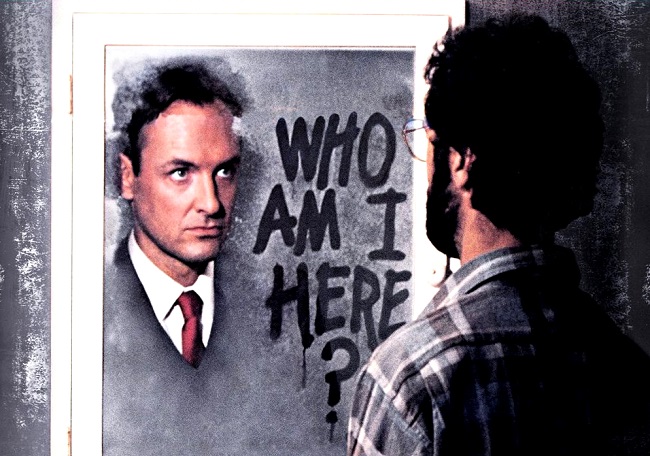
Father’s Day: While only The Stepfather 3 takes place on this day that celebrates fatherhood, paternal bonds and the influence of fathers in society, you could watch either the original, the sequel or the remake. There’s also the Astron-6 movie Father’s Day, which features a man seeking to stop the serial murderer known as the Father’s Day Killer. And the Eli Roth remake of Death Game, 2015’s Knock Knock, also takes place on dad’s big day.

PS — We know that Creepshow has an entire segment called “Father’s Day,” but this is all about slashers, dear reader!

Thanksgiving: We did an entire list full of gobblerific horror films, but if you don’t feel like clicking that link, they include:

Also — Blood Harvest is all about a girl that comes home from college to find her parents gone and her friends getting killed. While it’s never explicitly stated that it’s Thanksgiving, why else would she be home from college? Also — I just want more people to watch this insane movie, which features an astounding non-performance from Tiny Tim.
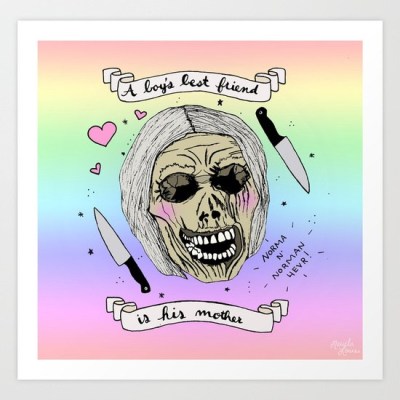
Mother’s Day: Not to be obvious, but Mother’s Day and its 2010 remake are the easiest ones to watch on mom’s big day. That’s all I can think of, although I think a tender script about a developmentally challenged boy and his hysterical mother would make a lot of money and perhaps even lead to several sequels. Don’t ask why — I just have a feeling.
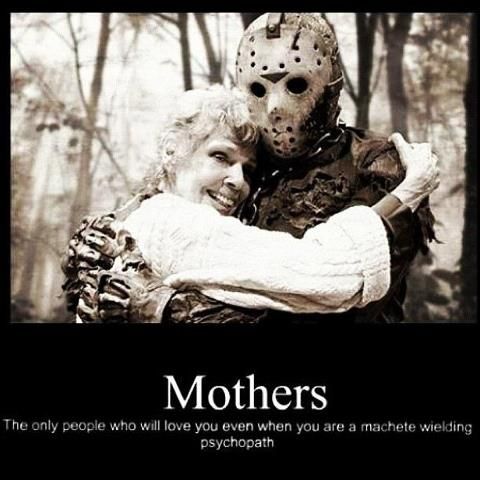
I mean, even the worst of us still have a special spot in our hearts for mom.

New Year’s Eve (and Day): Again, go with the obvious: New Year’s Evil is a late in the game slasher that will start your next 365 days off on the right — or wrong — foot. Then there’s 1933’s Mystery In the Wax Museum, which takes place over the year change-over and inspired plenty of waxy slashers like House of Wax and The Wax Mask.

But there are plenty more! How can we forget Jamie Lee Curtis’ third slasher film Terror Train, which starts at an ill-fated December 31st party and then takes us on a David Copperfield-riding train through the winter wonderland between 1980 and 1981? There’s also…

Saint Patrick’s Day: Despite all of the films starring a leprechaun, only the second Leprechaun films specifically takes place on this holiday (thanks for the heads up to Paul Andolina). But they aren’t the only movies willing to kiss the blarney stone. There’s also:

Easter: While this holiday celebrates the death and rebirth of Jesus Christ, its traditional elements — egg hunting and the Easter Bunny — are celebrated in the secular world too.

1983’s The Being was the first Easter-timed slasher I could think of, which befits its status as a truly strange movie. There’s also the 1999 serial killer movie Resurrection, which implicitly relies on the story of Christ to present a killer trying to make a new body for the Son of Man.

As of late, numerous films have infused the slasher spirit into the time of candy, bunnies and Holy Days. They are:

  • Angel of Death
  • Beaster Day: Here Comes Peter Cottonhell
  • Bunnyman
  • Easter Bunny Bloodbath
  • Easter Bunny, Kill! Kill!
  • Easter Casket
  • Easter Sunday
  • Kottentail
  • The Night Before Easter
  • On the Third Day
  • Rottentail
  • Serial Rabbit
  • Serial Rabbit 3: Splitting Hares (Obviously following the ThanksKilling naming convention of skipping the sequel)

Christmas: Take a seat. Our Letterboxd Christmas list is awash in blood and gore. And every year, it seems like more slasher Santas appear. Certainly, we’ll miss something here, but if you have to watch any of these, our top recommendations would be:

  • Black Christmas: A true classic of the slasher genre that predates even Halloween, this one is worth watching all year long. You can also check out the remake, which, of course, is getting remade again.
  • Christmas Evil: You owe it to yourself to watch this film every holiday season, if only to watch John Waters’ favorite Christmas movie.
  • Silent Night, Deadly Night: Santa takes on nuns in the only film of this series worth taking seriously.
  • Sint: The true story of Santa is that he’s a demon named Sinterklaas who must return and kill every so many holidays.
  • 3615 code Père Noël: A bizarre Home Alone before that movie was even made, where a French child and his grandfather face off with a knife-wielding maniac.

You can also watch:

Honestly, I’ve probably missed a hundred Santa-based slashers that people are going to give me grief about. Feel free to do that in the comments below. And for even more movies ready to upset the entire family on this blessed night, may we recommend our 10 Movies That Ruin Christmas list?

BIRTHDAYS: Happy Birthday To Me, anyone? Bloody Birthday? Even Happy Death Day and Happy Death Day 2 U can be considered movies where slashings occur near a birthday.

The granddaddy of all movies where birthdays are a reason for murder? Friday the 13th. Just remember Pamela Vorhees’ great line: “You see, Jason was my son, and today is his birthday.” In case you wondered, Jason’s actual birthday is June 13, 1946.

There’s also a birthday element to the magically bonkers slasher Madhouse, AKA There Was a Little Girl that echoes plenty of the ending of the aforementioned Canuxploitation film Happy Birthday To Me. However, the surprise birthday party at the end of this film isn’t one that you’d ever want to attend.

  • American Gothic: Fanny’s birthday party is a big part of this slice of homespun stalk and slash.
  • The Banana Splits Movie: A birthday party gone wrong, a TV show canceled and beloved animal characters gone murderously viral.
  • Butcher Baker Nightmare Maker: Billy’s seventeenth birthday is the catalyst for his aunt’s growing mania and increased willingness to kill.
  • Child’s Play: Chucky is was, after all, a birthday gift for Alex.
  • Drive-Thru: The demonic mascot of Hella-Burger, Horny the Clown, becomes real and hacks his way through customers. You know those people that throw fast food birthday parties for their kids? Here’s where they pay.
  • Fear No Evil: On the 18th birthday of this film’s antagonist, his evil powers finally arrive, paralyzing his mother and turning his father into a drunk.
  • Leprechaun 2: This one is all about the Leprechaun’s 1000th birthday.
  • The Mutilator: A birthday gift — cleaning dad’s guns — goes wrong, leading to the creation of the slasher in this film.
  • My Soul to Take: A serial killer comes home and stalks the seven kids who were born on the day that he died.
  • My Super Psycho Sweet 16: MTV made an entire series of these movies.
  • Red Velvet: A killer attends a birthday party.
  • Spookies: While not really a slasher, I honestly have no idea what this movie is. That’s probably why I love it so much. It also has a birthday party that goes absolutely nowhere, which means I had to include it on this list.
  • Stitches: A clown is killed at a birthday party and returns for revenge.
  • Sweet Sixteen: As Melissa Morgan’s sixteenth birthday comes closer, so does more death for everyone around her.

Of course, if we were discussing birthday parties in horror films, we’d have to get into the strange annual celebrations in The VisitorAmityville II: The Possession and — perhaps the worst birthday party of all — The Omen.
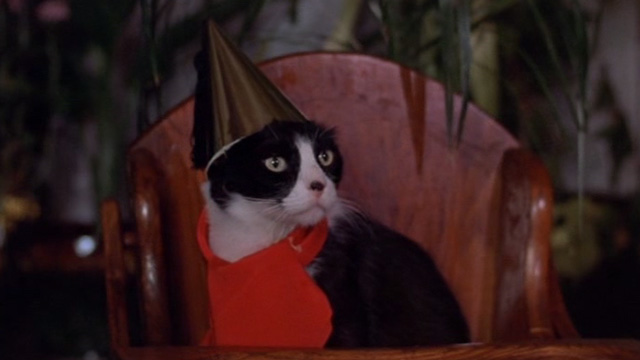
Jezebel the cat’s birthday in The Sentinel! Black and white cat! Black and white cake!

And for a bit of trivia, the top secret codename title for Friday the 13th Part VII: The New Blood was Birthday Bash.

Important Personal Anniversaries: As Large Marge would say in Pee-Wee’s Big Adventure, “On this very night, ten years ago, along this same stretch of road in a dense fog just like this…”

Plenty of slashers are based on anniversaries and things coming back to haunt people. The best example that I can think of is The Prowler, a movie whose titular killer waits for the anniversary of when a Dear John letter sent a WW II soldier into a pitchfork stabbing meltdown. This is different than just a holiday — this is a set day that has vast personal meaning to that person.

Yet at their heart, aren’t most slashers about a moment in time and in a certain place that the killer must protect or go back to? Why does the Shape come home on Halloween night? Why does Jason prowl the woods year after year? Why does a Prom Night always end with blood, murder and sometimes, fire (to say nothing of school-based slashers like Horror HighReturn to Horror High, Graduation DayDetentionThe Loved OnesStudent BodiesCutting ClassTragedy Girls…I could go on and probably will).

What are the raison d’être for these masked killing machines, these scarred men and women that can only be sated by wiping out everyone in their path? There are several reasons, reasons which may only make sense to the killers themselves.

I’ve taken the 679 slasher films — so far, we’re adding more every day — that we’ve covered so far and broken them down to some very simple motives, classified by the killer’s name. Certainly, we can’t cover them all here, but this shortlist will give you a flavor of how we can break down the motivations behind the malice.

Michael Meyers (RETURNING TO HOME, MENTAL ISSUES, POSSESSION, MURDERS BASED AROUND A CALENDAR DATE): The Shape — the man with the darkest eyes — is either a normal killer (the first movie), an unstoppable force of nature (almost all the others) or a pawn in the schemes of a cult of powerful people (the infinitely strange and somewhat fascinating sixth installment). Alternatively, he’s the guy who Buster Rhymes spin kicked, but we shall never discuss that in these parts again.

As Michael evolves across the myriad of movies and retcons in his screen career, the one thing that holds true is that he was once a normal six-year-old who was compelled to kill his teenage sister Judith. After more than a decade in Smith’s Grove Sanitarium — and despite the best efforts of Dr. Sam Loomis — he would return to his hometown of Haddonfield, Illinois to try to repeat that crime with his sister. Never mind that this wasn’t even an idea when the first film was made. That’s what makes the original so frightening — all of these weapons, hours and motives are pointless. The Shape exists merely to destroy for no reason. That’s perhaps the most frightening thing of all.

Jason Vorhees (REVENGE, PROTECTING HIS TERRITORY): While Jason’s killing spree begins as a need for revenge — both for the death of his mother and his own negligent drowning death — by the last films in the cycle, Jason is mainly a territorial slasher — much like killers in Just Before Dawn and Madman. Stay off his lawn, kids!

That said — some of Jason’s idea of protecting his land falls into killing anyone who has sex in his woods or takes any substances, whether that’s drinking or drugs, within them. You could say that this endorses a puritanical worldview, but my theory has always been that Mr. Vorhees lives in a state of suspended pre-puberty, realizing that he’ll never have a true sexual awakening or get to experience the life that these partying campers are enjoying, so he must snuff it out.

Freddy Krueger (REVENGE, SHOW OFF, I JUST LOVE TO KILL KIDS): Freddy’s original hack and slash through the Dream World began to gain revenge on the children of the parents who burned him alive for being the Springwood Slasher, ie the sin that creates this serial monster that menaces the casts of numerous films. Again, by the time the movies grew bigger and wider in scope, it seemed as if Freddy’s primary need was to gain the approval of the audience, tossing Roger Moore-like one-liners and using his dream abilities to cause all manner of increasingly ridiculous death sequences.

Leatherface (SURVIVAL, CONFUSION): Leatherface’s way of life is changing, as parts of Texas move away from the rural South and become metropolitan cities. Whereas once the meat was necessary for sustenance and even commerce — see also Farmer Vincent in Motel Hell — now this killer is slowly becoming a stranger in a strange land. Also, he’s continually at odds with his identity, using the various skin masks that he creates to show his mood to the uncaring world.

These are some of the more well-known killers in slasher films. But what if we go a little deeper and discover a character that didn’t appear in numerous films? What if they were in a proto-slasher, crafted before the genre had locked itself into rigid conventions?

Billy in Black Christmas (HATRED OF WOMEN, CHAOS): Whereas I’ve played off the misogyny inherent in slashers before, Billy’s killing is totally focused on killing women. The original remake — what a term! — may have shown us that his mother was the reason behind all of this. But the first film doesn’t have time for the why, all Billy is about is sowing chaos, from making sorority sisters disappear and sending worried fathers into the cold Canadian night to obscene phone calls that can no longer just be laughed off.

REVENGE is often the biggest motivator for a slasher villain. Mall developers destroy Eric’s home and think they kill him, but he rises from the ashes and wipes them all out in Phantom of the Mall: Eric’s RevengeIn Uncle Sam — much like Bill Lustig’s Maniac Cop films — a servant of the established order that may have taken things too far is destroyed by the very society that he has served for so long, so he must rise from his grave — nay, break right out of the coffin in the cases of Master Sergeant Sam Harper and Officer Matthew Cordell. 

I WANT YOU BACK is another intriguing slasher reason to be. For example, in the sadly neglected Bad Dreams, Harris simply wants Cynthia to have burned along with the rest of the believers in the Unity Fields cult. If he has to wipe out everyone close to her to make that happen, so be it.

There’s also the BUT I HELPED YOU trope. That’s where a hapless reject has turned to the dark side and suddenly realizes that everything has spun out of control. The best example I can think of is Sammi Curr in Trick or Treat, who returns from the dead thanks to backmasking and the occult, proving every televangelist correct. Curr helps the hero, Ragman, in his quest to defeat the bullies and get the girl, but our protagonist’s sin that releases the monster is that he relied on something much more sinister and smarter than himself to do so. For another example, Christine allows Arnie Cunningham to stand up to the nerds and win over his dream girl, Leigh. But it costs him everything to do so. It’s very similar to a pact with the devil.

I’m continually developing new slasher motives, from I HAD A MESSED UP CHILDHOOD which informs Pieces to EVERYTHING YOU KNEW WAS A LIE which translates to the fact that Santa Claus could be a killing machine, as shown to us in movies like Santa’s Slay and Sint.

There are also the motives that are in itself necessary of a spoiler warning: THE BIG BAD FAMILY SECRET and I’M NOT WHO YOU THINK I AM. 

Both of these motives directly unite the slasher with their Italian cousin, the giallo. The endings of giallo like Deep Red and The Bloodstained Shadow are the result of a long-withheld or forgotten family secret. Slashers that follow that formula include Happy Birthday to Me and Madhouse and even the original Prom Night.

When it comes to mistaken identity — including gender identity — look no further than Sleepaway Camp. It’s not a far jump from the mistaken theory of who the killer is at the open of The Bird With the Crystal Plumage, where surely the killer must be a man, to a movie where surely the killer can’t be a sweet and innocent girl — who perhaps may not even be a girl at all.

I’m constantly coming up with new names for these conventions and discovering that they tie together numerous genre films. For example, I HAVE HAD ENOUGH OF THIS covers movies as diverse as CarrieFade to BlackEvilspeak and The Toxic Avenger. They invite us to empathize with their protagonists and even become complicit in their crimes as they rise up and become monsters. This is different than the REVENGE subgenre, as we actually see the sins of the true bad guys being visited upon the hero and hope that they fight back.

A close relative of this would be YOU KIDS HAVE IT COMING. In so many slashers, this is the Scooby-Doo like reason why the killer is who they are. Again, this is a reason that spoils a movie like Nightmare Beach, as well as the original Friday the 13th.

Thanks for making it through all nearly 5,000 words of this. I find this exercise endlessly fascinating and I hope you do too. If you have some weapons, hours and motives I haven’t mentioned, send them my way in the style of Clue! I’m excited to see if folks play along, so here’s an example:

Wrestling Slasher Month at Wrestling With Film!

My friend Paul Andolina runs Wrestling With Film, a site that celebrates the crossover between professional wrestling and movies. It’s pretty great — packed with insightful thoughts on these movies as well as interviews with some of the wrestlers who starred in them. You can also check out his Facebook page, which has even more.

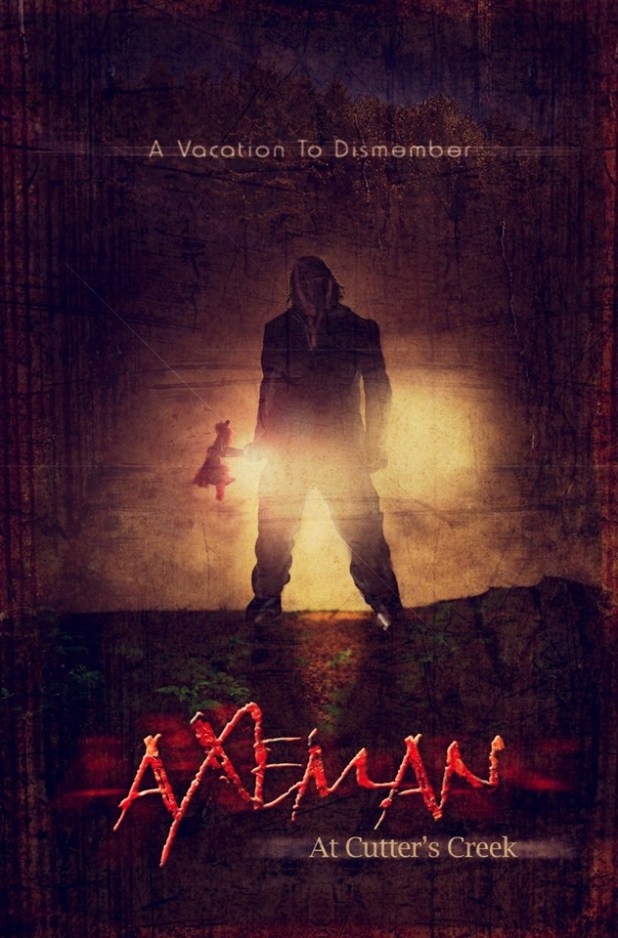
This month, Paul is doing a wrestling slasher month. Here are some of the films he’s featured (along with Axeman, which he reviewed for our site). Check them out!

  • Wrestlemassacre: Randy is an awkward groundskeeper who is obsessed with professional wrestling. Longing for a sense of belonging with grandiose dreams of becoming a wrestling superstar, Randy is only met with abject humiliation and alienation. A brutal shaming at a local wrestling school coupled with a bizarre encounter with a demonic stranger pushes Randy over the edge and lights the spark for his blood lust.
  • Hot Blood Sunday: The owner of an ice-cream shop hires five attractive women to boost sales, and the plan works until someone starts killing the lovely ladies.
  • Wrestlemaniac: A low-budget film- maker takes his cast and crew to a ghost town with a horrifying legend, a crazed former Mexican wrestler carrying out deadly pile-driving murders.
  • SleeperTwo detectives must find an escaped killer before he harms the object of his twisted affection.
  • Killer CampoutTwo youth counselors bring a group of emotionally troubled teens deep into the woods for a weekend of solitude and confrontational therapy. The trip turns deadly when they are terrorized by a cannibalistic hermit with a thirst for blood.
  • Axeman 2: Overkill: An axe-wielding urban legend who dismembers evangelicals, murderous bank robbers and vigilantes that clash with one another in the woodsy Cutter’s Creek is in turn pursued by the town’s tough female deputy.

What slashers will come next? What wrestlers will be in them? Who will Survivor Series and what will be left of them?

Axeman (2013)

About the Author: Paul Andolina is one of my favorite people to talk movies with. If you like his stuff, check out his site Wrestling with Film. He’s doing an entire month of slashers with pro wrestlers in them as we speak.

Axeman is a 2013 slasher film about a group of old college friends who go to a cabin in the woods where they are being offed by the axeman, purported to be nothing more than local legend. The axeman is played by former NBA player Scott Pollard, whose hulking stature works well as a mad man who sometimes kills with an axe. He spends much more time using a knife, though.

I really wanted to like this one but its pretty standard fare as far as lower budget slashers go. Unfortunately, almost every character in this film is annoying with very few redeeming qualities, the couple of Tammy and Liz being largely the exception. I watched this film so I could check out the sequel which stars former WWF star Adam Bomb. This film also has a connection to the wrestling world in a roundabout way as the girl who plays Tammy, Jamie Bernadette is in American Satan starring Goldberg (WWE,WCW) Sinbad War of the Furies which stars John Morrison (WWE), and apparently filmed some scenes for L.A. Slasher which were deleted. L.A. Slasher features Batista (WWE) as a drug dealer. 

This film is not completely horrible, it is well made, the kills are great but it suffers from being a bit boring. I really didn’t care about any of the characters and was really just waiting around for the next kill. Everyone is drunk, horny, or both almost the entire run time. Randy, a sicko who can’t get laid who runs around videotaping everyone is the first to get killed and I almost cheered when he was offed. If there are people who actually act like him, I consider myself blessed for having avoided them so far in life. Tammy and Liz are likable although a bit over the top at times. Everyone is playing a stereotype dialed up to maximum levels. Darren played by Joston Theney who wrote, directed, edited and produced this film and its sequel was also a likable character until he got drunk and obnoxious although I think we are all wont to do that if we have imbibed too much. Everyone else I couldn’t really wait to get knocked off.

If you are a fan of slashers and will watch any and everyone you can find, you will find some fun with this film, especially the kills. However, at a staggering 105 minutes you may find yourself just fast-forwarding to each character’s demise. This film also stars famed scream queen, Brinke Stevens, as a sheriff, and another familiar face from Snake Outta Compton. Arielle Brachfeld, has a small part as a deputy as well. You can check this film out and its sequel on Screambox.

2019 Psychotronic Scarecrow Challenge: Day 17: In the Line of Duty: The F.B.I Murders (1988)

Day 17 Evil in Broad Daylight: Scary stories aren’t just for the night time

Tracy Keenan Wynn is the gold standard in screenwriting and teleplays. Look at that resume: The Glass House (1972; TV’s Alan Alda, Vic Morrow of Message from Space and Clu Gulager of Hunter’s Blood), the platinum standard of football—and prison movies—The Longest Yard (1974; Burt Reynolds), The Quest (1976; Kurt Russell and Tim Matheson), The Drowning Pool (1975; Paul Newman), and the Peter Yates-directed ocean adventure, The Deep (1977).

And Wynn wrote a film that—if it had been shot and released as a theatrical feature film in the U.S (it was a theatrical in Europe), it would have swept the floors with Oscar nods (even wins) for David Soul, Michael Gross, and Ronnie Cox. So, do yourself a favor: beg, borrow and steal to watch director Dick Lowry kicking ass with the greatest series of continuing-storyline franchises in TV history. There isn’t a theatrical franchise that holds a candle:

  • In the Line of Duty: A Cop for the Killing (1990)
  • In the Line of Duty: Manhunt in the Dakotas (1991)
  • In the Line of Duty: Street War (1992)
  • In the Line of Duty: Ambush in Waco (1993)
  • In the Line of Duty: The Price of Vengeance (1994)
  • In the Line of Duty: Hunt for Justice (1995)
  • In the Line of Duty: Blaze of Glory (1997)

And, if you need another great football comedy from the man who knows his pigskins: Search out the TV Movie Pigs vs. Freaks (1984) fronted by the stellar character actor, Eugene Roche. Then there’s the teen drug movie Angel Dusted (1981), with the always reliable John Putch (Jaws III, 1983).

I know, “What the hell R.D? Enough with squeezin’ the Charmin over some screenwriter dude. Get back on the tracks and tell us about the movie already.”

I was living in Dade County, Florida, during the time this movie chronicles, and trust me when I tell you: we were scared shitless in broad light to the point that people were afraid to go inside banks. If you saw an armored car (which the antagonists of this film were hitting) in the front of a bank or strip mall, you kept on driving. Back in the undeveloped days of South Florida, a body turning up in The Everglades with two taps to the head or missing limbs was a once a month occurrence. Ted Bundy dumped his bodies down here. In my misguided punk adventures as a bassist, we wrote the songs “Serial Killer Alligator Alley” and “Serial Killer Express.”

Also putting bodies into the Glades were two ex-Army Rangers by the name of Bill Matix (Michael Gross; TV’s Family Ties, Tremors franchise), and Mike Platt (David Soul; TV’s Starsky and Hutch, Magnum Force). They were blatant, cruel, and just didn’t give a fuck: Matix, to get out of his Ohio-based marriage to marry his girlfriend: he murdered his wife, collected the insurance, and moved to Florida. When Platt’s “payday” of fixing and selling pinball machines goes sour, well, the guy who sold the machines regrets it. And their clueless family believes all the mystery “cash” is the spoils of their (fantasy) joint C.I.A. drug-covert ops. “We take out the dealers and the agency lets us keep the money,” Matix the wife-killer tells his love—and not nicely.

Another harrowing scene (criminally cut from the 2005 DVD reissue): When the agents get a jump on Matix and Platt in a stolen gold Monte Carlo bunkered in the Everglades, Mike Platt causally sighs: “Let’s go to work,” as he mounts up his weapon. They’re going to kill more people, and they are just causally “going to work,” like it’s a normal, sane job.

It was on April 11, 1986, when South Florida’s TV and news radio outlets broke from regular programming with a story regarding a bloody shootout in a quiet Miami neighborhood. The drug wars connected to Castro’s Mariel Boat Lift were so bad at the time; everyone assumed it was rival drug gangs.

The images on the news and in the papers the next day told a different story: Two F.B.I agents were dead. There were multiple wounded. Cars were crashed and scattered everywhere, pockmarked with bullets in a scene lifted from a Cirio H. Santiago post-apocalyptic romp. Madix and Platt were adrenaline-drunk and determined to escape the authorities and went the Bonnie and Clyde route—times 10. They would not go down. And if they did, they were taking everyone with them. Watch it for yourself (spoiler alert!).

As I said: The cast on this is Kiss-double platinum: Ronny Cox (Deliverance, 1972) as Bureau Chief Benjamin Grogan, Bruce Greenwood (Commander Christopher Pike in the Star Trek reboots) as Agent Dove, and the supporting actors portraying the rest of the squad—along with their wives—aren’t superfluous; all are fully-character arc’d and your heart sinks when the shootout goes down. And David Soul and Michael Gross—we know them most intimately from their respective TV series and they completely shed those roles and absorb themselves as, what is best described as two serial killers with a bank robbery fetish.

Yes. When it came to the golden age of “Big Three” TV Movies, NBC never disappointed. Ah, but caveat emptor movie collectors: Watch the online VHS rips of the home-taped original/first-run version of the film. The 2005 DVD from Platinum Disc is criminally edited and missing scenes. Why a reissues company would execute any cuts and shorten an already short TV movie at one hour thirty-two minutes insults Wynn’s painstaking scripting in creating sympathetic characters to heighten the impact of the film’s harrowing conclusion:

— A scene of dialogue during an F.B.I beach party that occurs before they all take a group picture with the greenhorn agents they’ve welcomed into the family: Losing this scene diminishes the impact: you know that’s the last they’ll be together.

A scene in the shooting gallery where Grogan is asked if he’s good with the gun without wearing glasses: It’s a chilling piece of foreshadowing of Grogan’s fate that we know, but he doesn’t.

A crucial, seat-gripping scene when an agent loses his revolver after drawing it from the holster during the vehicle chase and placing it between his knees. During the subsequent crash, he loses it out the door and is unable to recover it during the gun battle.

So watch the uncut VHS TV-taped rip on You Tube either HERE or HERE. The DVDs are available at Amazon and Barnes and Noble if you want a digital copy for your permanent, home movie collection. This is one time where I’ll support a grey market DVD-R rip of a VHS recording of Lowery’s original 1988 cut.

It has to be mentioned: David Soul had two #1 singles: 1976’s “Don’t Give Up on Us Baby” in the U.S and “Silver Lady” in the U.K. He’s been on the road for years throughout Europe, where’s he’s a respected, sellout solo artist. Definitely check out David in the excellent U.S TV movies (overseas theatricals) The Fifth Missile (1986; full movie/You Tube) and World War III (1982; full movie/Archive.org). If you pick up Mill Creek Entertainment’s Prime Time Crime: The Stephen J. Cannell Collection, you can watch all eight episodes of David’s excellent and criminally cancelled F.B.I procedural, Unsub (1989; the one Stephen J. Cannell produced-TV series that flopped).

About the Author: You can read the music and film reviews of R.D Francis on Medium and learn more about his work on Facebook. He also writes reviews for B&S Movies.