The People Who Own the Dark (1975)

Not only is it post-apoc month at B&S Movies, Sam’s also reviewed a few Paul Naschy movies for the Drive-In Super Monster-Rama recently held outside of Pittsburgh. And . . . Paul Naschy did a post-apoc movie. Yes, that’s right: Paul Naschy, the King of Spanish Horror, and the post-apocalypse, together, in one film.

The future is officially FUBAR’d.

A recap of the festivities!

For those of you not familiar with the (appreciated) absurdity of Spanish horror, and Paul Naschy’s oeuvre, please join me in a read of my June 2019 review (and mini-career retrospective) for his 1983 film, Panic Beats (based on the exploits of kinky French Knight Gilles de Rais, as embodied in Naschy’s Alaric de Marnac character). That review serves as a primer for my upcoming review of that film’s prequel, 1973’s Horror Rises from the Tomb, part of B&S Movies’ Halloween tribute to Mill Creek’s Pure Terror 50-film box set.

People Dark
That tombstone-credit is a hoot!

The People Who Own the Dark is Naschy’s contribution to the 2nd wave of sci-fi/apocalypse films that ignited during the 1970’s: beginning with Charlton Heston’s The Omega Man (1971; yes, we know we linked the remake) and ending with Richard Harris’s Ravagers (1979). In between, everyone from Hollywood’s A-ListYul Brynner, Bruce Dern, James Caan, Sean Connery, Jackie Cooper, Paul Newman, George Peppard, and Oliver Reedsped off into the radiated sunrise for their post-end-of-the-world romps. If his American counterparts can do it, then why not European cinema’s acting equivalent: the “Lon Chaney” of Spain? So Paul Naschy sort-of-kind-of updated that sexual scamp Alaric de Marnac for the post-apoc age to ask the question: What if the Marquis de Sade existed in the nuclear, Cold War era of the 1970s?

And that’s how we arrive at this trashy horror frolic featuring more cover-model hysterical womenthis time, instead of cobby-web horrorscampering through the first days of the post-WW III apocalypse, adorned in sensible mini-dresses and chunky-strappy sandals (don’t stub a toe, sweetie); a world where make-up never smudges or runs. Amid the absurdity, you’ll discover a thought-proving parable regarding the sociopolitical dynamic between the rich and the poor and the oppressiveness of the Francoist dictatorshipof the Luis Buñuel The Exterminating Angel (1962) subtext-variety. This is a world where elites find themselves trapped in the allegorical hell of The Eagles’ “Hotel California” (You can check out anytime time you like /But you can never leave)mixed with plentiful boobs and soupcon of gore. (Naschy’s “theme” on the corruption of wealthy libertines is also prevalent in Pier Paolo Passolini’s art-horror film statement regarding Italy’s fascist state: Salo, the 120 Days of Sodom (1975). The brutally squeamish (but not gratuitous: there’s a point to it all, really) work also drawls from the infamous exploits of the Marquis de Sade).

The People Who Own the Dark is a shrewd reworking of familiar plots and themes that spooked us before, courtesy of Vincent Price’s The Last Man on Earth (1961), George Romero’s Night of the Living Dead (1968) and, to a lesser degree, those films’ strikingly similar antecedent: John Agar’s rather dull, disembodied-moon-aliens-possess-the-dead classic, Invisible Invaders (1959). Each of these films was, in turn, influenced by the rather obscure, very talky and cheap, but proficient and well-photographed, Five (1951), which was the first post-WW II film to depict a post-atomic war survival parable. In terms of People: a more accurate, influential antecedent would be the exciting meteor-shower-blinds-and-brings-a-plague-of-man-eating-plants fable, Day of the Triffids (1963). This, actor/writer Paul Naschy and Argentine director León Klimovosky’s only “sci-fi” film, is the best of their eight engrossing collaborations (listed at the end of this article).

As with most of Naschy’s films: People appears in multiple, alternate versions: There’s the original, 1976 Spanish-language unedited “nude” and edited “clothed” versions: Ultimo Deseo (The Last Desire). Then there is the VHS-bootlegged version (I watched mine via an old. gray market mail order): Planeta Ciego / Blind Planet, which served as the film’s workingand more accurate“sci-fi” title, later nixed to exploit the film’s sexual side. Those Spanish cuts run at 94-minutes (1:34:00). The shorter American version (1980) released four years later via Cinematic on the U.S Drive-In circuit by director Sean S. Cunningham (Last House on the Left, Friday the 13th), clocks at 80-minutes (1:20:00)with the deceptive title: The People Who Own the Dark. The subsequent U.S-issued Sun Video VHS tapes run at 87-minutes, while the Star Classics VHS print run at 85-minutes. Then, courtesy of the U.S Grindhouse circuit, there are even shorter-choppier, less-pristine versions as result of celluloid wear-and-tear and breakage-splicing through a reel’s multiple shows-travels.

All of these versions became official and bootleg VHS releases in the ‘80s, then DVD-Rs, DVDs, and Blu-rays in the 2000s. The official U.S VHS versions we rented on Sun Video and Star Classics are rare and highly coveted by collectors. The preferred-original, fourteen-minute longer Spanish-language cut (no English-language dubs or subtitles are available) is the more enjoyable, coherent version. That version offers visual exposition involving (Vladmir) Lenin and (Karl) Marx, which offers an additional narrative-push of the film’s deeper meaningsa valuable subtext devoid from the film’s previously noted “influential” antecedents. (And that’s why, in most cases, horror fans proclaim: “Naschy is boring.” In an uncut state: Naschy is always fascinating and entertaining.)

The film was, of course, a critical and box office flop in America, courtesy of a title and artwork that duped film goers into believing they were paying to see an Amicus/Hammer horroresque film replete with hooded monks, Satanic rituals and graveyardsnot a post-atomic parable citing the Marquis de Sade. If only the film retained its original title, more accurate title: Blind Planet.

In this “present day” nuclear holocaust thriller (with just a smidgen of futuristic accoutrements; you’ll know it when you see it: it’s cheap, but a chilling Nazi “death train” analogy) Paul Naschy is Bourne: a debauched, narcissistic military officer (the much-needed foreshadowing of his pigeon target-shooting practice scene by-double-barrel is missing from some prints) who gathers with four other attorney, military, and medical elitist-pigs at a rural chateau doubling as a bordello for a weekend of Marquis deSade-inspired proclivities. The rich playboys descend into the villa’s basement (wearing disfigured, metaphorical monster masques) with the Madame and her five, sheer pastel negligee-clad (complete with two lesbians, natch) prostitutes for a decadent Jess Franco-styled sex romp. Then a massive, earthquake-like explosion rocks the estate. (Bye, Jess Franco. Hello, Omega Man.) They soon discover the chateau’s two maids (one a sex-kitten; the other a stately old woman) have white, glossed-over eyes. The “earthquake” was actually a blinding, nuclear bomb/war (wiping out Madrid) that killed the power and communications grids. They’re stranded in the middle of nowhere, well, stranded in hell. And they’re not so “elite” anymore.

Welcome to Def-Con 1. Cue Amando de Ossorio’s “Blind Dead” siege of Templar monks who kill-by-sound, serving a radioactive helping of Tales from the Crypt-comeuppance to these moral defectives cast in the bowels (of Hell) of the chateau’s wine cellar which, inadvertently, acted as bomb shelter. (Again: Caveat: No monks appear in this movie!)

Of course, we’re in the Naschy universe: Those who relish the Seven Deadly Sins never learn. They’ve determined the only logical thing to do is to drawl weapons and go into the small town outside the chateau—not to help the wailing and wondering blind townsfolk (so much for the Hippocratic Oath, eh, Docs?), but to steal food and loot supplies from “Narcissism are Us.” Oh, and kill a few of the blinded poor souls during the greed-spree.

Yes. The blind townsfolk want blood.

And, not only did the fallout blind them (because of the low-budget, the film could only afford two sets of white sclera lenses to depict “ocular burn”; the rest wear dark glasses or bandages on their eyes); it’s given the townspeople a heightened sense of sound. And, suddenly being thrust into a world of darkness, they’ve snapped and become homicidal.

Pour Bourne and company’s capital vices into that toxic cauldron and you’ve mixed one hell of a post-apoc recipe. The radioactive brew boils over into a nighttime siege at the boarded-up villa (now Bourne and his friends are “blind”) where one of the elites has a mental breakdown and begins his new life as a (metaphorical . . . and nude) slobbering dog. The shocking, well-deserving, downbeat demise of this virtues-void bunch is ripped from the Romero playbook, with images that harkens the disturbing imagery of The Last Man on Earth.

While the initial set-up in meeting each of the ultimately doomed is a bit arduous (but necessary), once The People Who Own the Dark goes “Def-Con,” the film serves non-stop darkness and dread, just like horror movies should: no happy endings. There’s no revelation or spiritual rebirth that makes you a better person on this Judgment Day.


The cast is a who’s who of Spanish-Italian Euro horror cinema featuring familiar members of The Naschy Company of Grand Guignol players: Teresa Gimpera (1973’s Crypt of the Living Dead; 1976’s Secuestro with Naschy), Alberto de Mendoza (1972’s Horror Express; too many gialli to mention), Maria Perschy (1973’s Vengeance of the Zombies with Naschy, 1974’s Beyond the Door, de Ossorio’s 1976 “Blind Dead” entry, The Ghost Galleon), and the lovely Julia Saly (de Ossorio’s 1975 “Blind Dead” entry, Night of the Seagulls and 1975’s Demon Witch Child, and Panic Beats with Naschy).

And it’s well worth the popcorn to seek out Paul Naschy and León Klimovsky’s seven other collaborations: The Universal tributes The Werewolf vs. the Vampire Women (1971) and Dr. Jekyll vs. The Wolfman (1972), Vengeance of the Zombies (1973), Devil’s Possessed (1974), A Dragonfly for Each Corpse (1975; giallo), and Secuestro (1976; crime drama). (You can also enjoy my review of Klimovsky’s The Vampires Night Orgy, part of Mill Creek’s Pure Terror 50-film box set, in November.)

You can watch the longer (clothed) Spanish version on You Tube (no subtitles) and the shorter, 80-minute Anglicized cut on Archive.org (a badly damaged print; a VHS rip). You can purchase Code Red’s 2012-issued DVDs and 2015-issued Blu-rays through Amazon—with many used copies on eBay. There are numerous reviews on the web that explore the various versions and their related technical aspects, ratios, print quality, etc., to assist you in purchasing the version that best suits your entertainment needs. If there was ever a film that requires mainstream distribution streaming on Pluto TV, Vudu, or TubiTV, The People Who Owned the Dark, is it.

Links and more links! You need more Paul Naschy and Lèon Klimovsky?

Then be sure to check out Sam’s reviews of all the films that screened at the recent Drive-In Super Monster-Rama held on September 20 and 21 at Pittsburgh’s Riverside Drive-In—with Naschy’s Frankenstein’s Bloody Terror (1968), Count Dracula’s Great Love (1974), and The Craving (1981), along with Klimovsky’s The Vampires Night Orgy and The Dracula Saga (both 1973). Sam’s previously posted reviews on Naschy’s Seven Murders for Scotland Yard (1971) and The Werewolf and the Yeti (1975).

And that’s all of the Paul n’ Lèon films we’ve done at B&S so far. Let’s hope we did Bill Van Ryn, who is behind the amazing Groovy Doom and Drive-In Asylum, proud. Now there’s a guy who knows his Naschy movies!

Jack Black as Paul Naschy in a Paul Naschy biopic? Hell, yes!

About the Author: You can read the music and film reviews of R.D Francis on Medium and learn more about his work on Facebook.

No Blade of Grass (1970)

. . . Cue the obligatory, budget-conscious voice over-photo montage (bellowing smokestacks, animal carcasses, muddy water, etc.) of a ravaged Earth (in the “future” of 1972; again “budget”) as we learn about a disease that devours the Asian continent and lays waste to all members of the grass-grains family, such as corn, rice, wheat, and oats. (Yep, it’s more sterile sci-fi cereal grasses, à la the 2001-inspired Interstellar.) As starvation and cannibalism rip across Africa, Europe, and South America, and encroaches China, the Chinese gas-murder 300 thousand of their citizens in a twisted effort to assure their survival.

A year later . . . 

The philosophical-talk action begins as we meet John Custance (Nigel Davenport; snooty film critics will cite the award-winners A Man for All Season and Chariots of Fire . . . we at B&S Movies prefer the serial-killer romp Peeping Tom, the crazy-ass ant movie Phase IV, A.I.P’s H.G Wells frolic The Island of Dr. Moreau, and Stallone’s Nighthawks) who flees with his family from a devastated London into the mossy-countryside on a quest to an “easily protected valley” that shelters his brother’s farmstead in northern England on the Scottish border. Along the way they battle rogue army officers, his teenaged daughter (as is the case with post-apoc films) is raped by the ubiquitous slobbering idiots who, in the face of an apocalypse, always believe the key to survival is raping women. (Lynn Frederick, star of Hammer Studios’ classic, Vampire Circus (1972), the aforementioned Phase IV, and Pete Walker’s Schizo (1976), stars in her acting debut as the daughter.)

So now, while John is on a spaghetti western quest to avenge the rape of his daughter (like Richard Harris in Ravagers), he becomes a defacto Moses as the leader of the ragamuffins they meet along the way (like Richard Harris in Ravagers). Of course, no apocalypse landscape is complete without some Toecutter-pillaging (Mad Max) mayhem courtesy of a chain-wielding motorcycle gang — complete with red-racing striped, cow-horned helmets. (Piffle. Roger Corman’s laser-blasting Death Machine and Fulci’s Kill Bike hoards would kick their grassy-asses across The English Channel and all the way into Italy for a pasta-zombie barbeque.)

Finally, this sci-fi take on the biblical story of the Exodus reaches “utopia” . . .

That is until John’s brother, David, declares John’s little Red Sea gang is too large to be supported by the valley’s riches. So John declares war on David and mounts a daring night attack to take control of the valley and rebuild . . . a society without grass.

Released early on in the ‘70s post-apocalypse riot-races, beating Charlton Heston’s The Omega Man to the big screen — and most likely put into production by MGM when news hit the trades that Warner Bros. was going into production with their Richard Matheson adaptation — No Blade of Grass, as with most apoc-films of the era (Soylent Green, Damnation Alley, Ravagers, etc.) was based on a successful novel, The Death of Grass, published by British novelist John Christopher in 1956.

The film was directed by Hungarian-born bad-ass Cornell Wilde (Gargoyles, Sharks’ Treasure) who walked away from a career in medicine after aceing his pre-med studies and earning a scholarship to Columbia University — to qualify for a spot on the 1936 Olympic Fencing Team. The dude taught Sir Laurence Olivier to fence for a Broadway production of Romeo and Juliet and, as result; he scored a film contract with Warner Bros. (I wish my life took those shocking, out-of-left-field luck turns.) Forming his own production company, Theodora, Wilde came to produce, write, and direct his pet-project adaptation of Christopher’s novel, a dream that goes back to the days of his first production: the film noir The Big Combo (1955).

“Cornell who?” the younger B&S Movies reader might be saying.

Surely you have seen Cornell Wilde in TV reruns with his notable appearances as a surgeon in the U.S television anthology series Night Gallery (“Deliveries in the Rear”) and, in the highly-rated TV horror film, Gargoyles (1972). Trash cinema lovers of the ‘80s video fringe definitely remember Wilde with his contribution to the ‘70s sharksplotation cycle inspired by Jaws (see our “Bastard Pups of Jaws” week)Shark’s Treasure (1975) — the first of the genre’s rip-offs, which Wilde produced, wrote, directed, and starred. Film buffs of old will fondly remember Wilde from The Naked Prey (1965; another Wilde produce-direct-star effort that we’ll call a pseudo “human death sportprecursor).

Shot for a paltry — well, back then it was a “big budget” — 1.5 million dollars, once again the grassless “future” looks exactly like our present, only with anarchy as the rule of the day . . . with the same ol’ cars, architecture, and weapons. And as with most — well, all — of the novel-to-film adaptations of the apoc-‘70s, the film widely deviates from its source material, in this case, excising the book’s cautionary Communism tale about awry biological warfare experiments in Red China . . . and replacing it with a yawn-inducing environmental message. At least the studio kept the “dying grass” part of the story (and that’s about all they kept).

You can watch No Blade of Grass on YouTube, Amazon Prime, and Google Play. And if it all seems a bit familiar — like Panic in the Year Zero (1962) familiar — that’s because director-actor Ray Milland’s film “borrowed” it’s overall premise and some incidents from John Christopher’s novel.

Not surprising: The uptight British shuddered at the film’s double rape scene (which, I admit, is pretty brutal; what were you thinking, Cornell?), and a rather dark, nasty birth of a stillborn baby, punctuated by lots of shootings and deaths. Thus, in order to receive an “AA” certificate for a UK release, the BBFC cut the sex and violence by 15 minutes — which was restored for us bloody, liberal Americans, sans one and a half minutes of the rape scenes. (How uptight are the Brits? Check out our “Video Nasties” explorations for the UK’s Section 1, Section, 2, and Section 3 “red flag” films. Come take my VHS nasties. I dare ya.)

As is the case with The Ultimate Warrior, Damnation Alley, and Ravagers, No Blade of Grass has wonderful production values and isn’t a total waste of time . . . it’s just that it could be so much better, as it suffers from too much of the “why we’re here and what are we gonna do now” yakity-yak. You won’t be seeing any The Simpsons’ Tree House of Horror tributes to No Blade of Grass, like you did with The Omega Man (Part 1/Part 2), anytime soon. In the end: Where’s Chuck Heston in a silver-football helmet going up against Matthias and his albino-mutants minions when you need ‘em?

And with that: I’ll let my ol’ buddies from North Carolina’s Animal Bag take us out with their grungy tribute to the “Spirits of Grass.”

Smoke ‘em if you got ‘em: we might lose our weed in the next apocalypse.

About the Author: You can read the music and film reviews of R.D Francis on Medium and learn more about his work on Facebook.
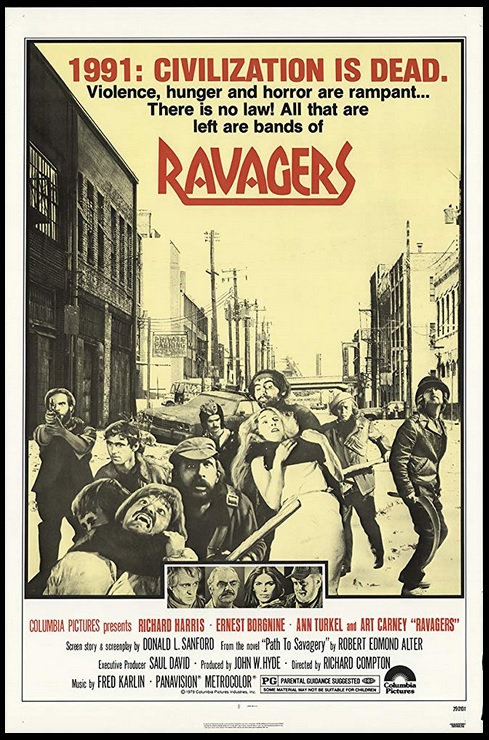
Ravagers (1979)

Editor’s Note: Once hard to find, Ravagers is now out of the vaults and airing on various Smart TV platforms.

Ravagers is the final film of the 2nd wave of post-apocalyptic films from the 1970’s (the first wave encompassed films from the ‘50s and ‘60s that began with the likes of 1955’s Day the World Ended and 1963’s The Last Man on Earth and ended with 1968’s Planet of the Apes) that began with Charlton Heston’s The Omega Man in 1971 and solidified with Heston’s next film, 1973’s Soylent Green. (The third wave of post-apoc films began with 1979’s Mad Max, then solidified with 1981’s Escape from New York; which begat the knock offs from Italy and the Philippines.)

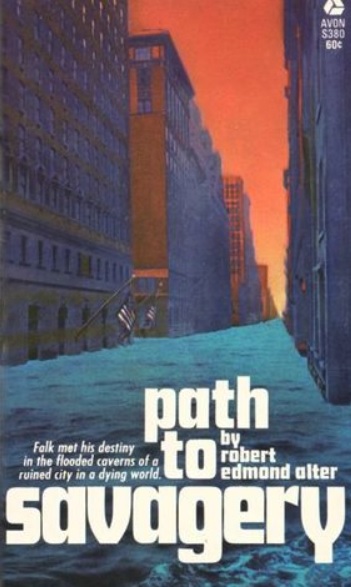
As with Planet of the Apes (based on Pierre Boulle’s 1964 Monkey Planet), The Omega Man (Richard Matheson’s 1954 I Am Legend), Soylent Green (Harry Harrison’s 1966 Make Room! Make Room!), and Damnation Alley (Roger Zelazny’s 1969 novel), Ravagers was a long-in-development film based on another best-selling, ‘60s science fiction novel: 1966’s Path to Savagery by Robert Edmond Alter.

And as with those book-to-screen adaptations — especially in the case of Damnation Alley — the final celluloid product barely resembled its popular, best-selling source material. And as with Oliver Reed’s Z.P.G, Yul Brenner’s The Ultimate Warrior, Sean Connery’s Zardoz, Jackie Cooper’s Chosen Survivors, Paul Newman’s Quintet, and George Peppard’s Damnation Alley, Ravagers was also buried by its distributor (in this case, Columbia Pictures) after its less than stellar critical and box office performance: it was hoped each film would match the success of Heston’s films. (Yep, you guess it: Ravagers was in desperate need of dump truck-bulldozer hybrids scooping up humans and Anthony Zerbe thespin’ with sclera-lenses from under a monk’s habit.)

In addition, these failed, ‘70s A-List apoc-films rarely — if at all — were redistributed as 2nd feature-undercards on the Drive-In after their initial run, and each were a rare find on television. Even during the early ‘80s cable television boom, with the “Superstations” of TBS-Atlanta, WGN-Chicago, WOR-New York, and the USA Network, and the burgeoning VHS home video market — both formats hungry for product to fill their airtime and store shelves — the films were wholly absent from the marketplace. Ravagers did see a release on Betamax and VHS in the mid- ‘80s (now highly coveted by VHS collectors; it doesn’t appear as an entry in any U.S-published VHS guides), but in the U.K and Europe only. For whatever creative or legal reasons, it seems Columbia didn’t want — or couldn’t allow — the film to be viewed by U.S audiences.

Now, with the explosion of the present day online/digital “television” platforms, Ravagers is commercially available worldwide for the first time in forty years. While there’s no free copy offered in the extensive library at TubiTV, the film is available for a nominal fee on You Tube and Vudu — with retro-prices that harkens the VHS rental fees of the ‘80s. It’s also available for rent on cable television system VOD platforms for about the same price.

Excelling at writing war-projects, screenwriter Donald Sanford made his theatrical debut, after a long career in U.S television, with Submarine X-1 (1968), and received praises for his work on Midway (1976; directed by Damnation Alley’s Jack Smight). While it’s unknown why Sanford retired from the industry—perhaps as result of its critical and box office failure — Ravagers was his final film; he transitioned to a career as an executive in the mining industry. Ravagers also became the final theatrical directing job for Richard Compton, who had box office success with the biker flick Angels Die Hard (1970) and Macon County Line (1974). He “retired” into a prolific television directing career.

Nothing like have a dog bark at your movie to induce you to retire (more on that, later).

As is the case with most apocalyptic films (unlike Blade Runner, which built its “world” from scratch), Ravagers, shot for the then major studio “low budget” price of $4 million, made use of preexisting structures (as did 1972’s Conquest of the Planet of the Apes, which also took place in “1991” via 20th Century Fox’s “Century City” complex) to create its “future.” So, again . . . we’re in another future world . . . that looks pretty much like our present day. And speaking of Planet of the Apes, and the art of economic “repurposing” in film: Astute science fiction fans will notice the matte painting that the opening titles are show over in the beginning of the film is the same matte painting seen by the ape army in Beneath the Planet of the Apes (1970).

It’s that repurposing — and perhaps Sanford’s interest and connection to the mining industry — that led to the film’s stellar production values. The film is rife with majestic, rusted processing facilities, while other scenes were shot at the infamous “Three Caves Quarry,” which is noted as one of Alabama’s first limestone quarries that, during the Cuban Missile Crisis of 1962, was slated to be used as a fallout shelter. Alabama’s Space and Rocket Center — again, repurposing preexisting architectural structures to save money — also served as a backdrop.

As with most post-apoc adventures, Ravagers is a futuristic-western featuring a peaceful protagonist out for revenge against those who upended his life: in this case, the rape and murder of Falk’s wife Miriam (Alana Hamilton, the wife of George Hamilton and, later, musician Rod Stewart; she made her debut in Evil Knievel and appeared in Roger Corman’s Night Call Nurses). Taking place in 1991 in the aftermath of a nuclear holocaust, the fallout mutated most of the world’s population into cannibalistic creatures known as “The Ravagers” (actually just homeless-looking humans with a nasty disposition) that hunt the unaffected survivors, known as “The Flockers.” (The Ravagers are led by prolific character actor Anthony James, who made a niche-career playing slimy-greasy characters in the films High Plains Drifter (1973), Burnt Offerings (1976), and Blue Thunder (1983), as well as countless U.S TV series.)

Richard Harris (A Man Called Horse, Juggernaut) is Falk; he ventures into the wastelands to dispense vigilante justice (just like in a Clint Eastwood western, such as Unforgiven (1983) — which stars Anthony James in his final film). Along the way, Falk befriends a crackpot army sergeant (Art Carney; Roadie, Harry and Tonto) and a strong and sassy scavenger (as all apoc-females are), Faina (played by Harris’s real-life wife, Ann Turkel). Together they find sanctuary in a peaceful community led by Rann (Ernest Borgnine, Escape from New York; while top-billed, he’s in the film less than 10 minutes) living on a rusted-out ship anchored off shore — that is subsequently destroyed by the Ravagers. Falk reluctantly becomes the survivors’ new leader as they embark on a quest to find a mythical safe haven: the Land of Genesis.

While visually stunning — and Anthony James, as usual, delivers the goods — the pompous judgment-diction of a woefully miscast Richard Harris makes you wonder when he’s going to pick up a skull and start evoking Shakespeare and pine for Esmeralda. And in the grand tradition of apoc-romps such as Def-Con 4 and Damnation Alley substituting action for talky-philosophical babbling of the “why we’re here and what are we gonna do now” variety, Ravagers moves like a gimp turtle being beaten by a snail.

Like with the earlier apoc-romps The Ultimate Warrior and Damnation Alley, Ravagers isn’t a total waste of time . . . it’s just that it could be so much better. Regardless of its shortcomings, I hold the film in high regard due to the memories of my late father taking me to see it at the local Drive-In (it didn’t play in theatres; and it was gone by next the weekend). My dad hated Ravagers; then again, he hated Soylent Green, Rollerball, and Damnation Alley for having “too much talking and not enough action” and, in a way, pops was right. There was a lot of yakity-yak in those films.

But my dad didn’t hate it as much as Gene Siskel of PBS-TV’s Sneak Previews. Roger Ebert’s svelte sidekick chose Ravagers as his “Dog of the Week” (well, actually Spot the Wonder Dog picked it; you can forward to 2:29 for the “ravaging” review). And Siskel’s review killed the film: For when a canine barks at your $4 million dollar gorilla, telling you it’s a “dog” . . . you quickly pull the big ape from release, cancel the rollout to additional U.S screens, cancel your overseas theatrical schedule, and quietly release the beast years after the fact to video in Europe. Why release it on U.S video, only to have reviewers dredge up Spot the Wonder Dog in reviews all over again? Nuked by a dog: now that’s an apocalypse!

. . . And that’s, my apoc-rats, is the story of Ravagers.

Oh, and if you absolutely must have more Ann Turkel (yes, please!) working alongside her then-husband Richard Harris, you can check out their first three movies together: 99 and 44/100% Dead! (1974), The Cassandra Crossing (1976), and Golden Rendezvous (itself a long-in-development novel-to-screen project optioned in 1962 and not made until 1977). But here, at B&S Movies, we love Ann for Roger Corman’s amphibian-monster Alien rip-off, Humanoids from the Deep.

Sorry, Ms. Turkel. We know you probably want to forget that one. Along with Ravagers.

About the Author: You can read the music and film reviews of R.D Francis on Medium and learn more about his work on Facebook.
Survival Zone (1983)

In the Survival Zone . . . death is a way of life.

Indeed, Mr. Tagline writer. Indeed.

Times were tough for ex-Star Trek and Stanley Kubrick actors . . . so bad that Gary Lockwood (1962’s The Magic Sword and 1977’s Smokey and the Bandit rip, Bad Georgia Road) traveled to South Africa (doubling for the “arid landscapes of 1988 Texas”) to star in a boring, post-nuke talk-fest pastiche of Death Wish and Mad Max. (And that “pitch” is really pushing the filmmaking meaning of the word in this pseudo-western romp.)

As with Def Con 4 and Battletruck, Survival Zone’s post-apoc ambitions sorely suffer from its lack of budget. So there’s no footage of devastated cities. No landscapes of burnt out buildings. No radiation-poisoned zombies. No futuristic hardware or soldiers. No Plisskens, Trashs, or Strykers for heroes. No desperately needed George Eastman-styled villains (Warriors of the Wasteland). There’s not even a Paco Querak to class up the nuclear mayhem.

Watch the trailer.

What we do get is lots of talking and talking . . . and talking . . . with an annoying mix of American and South African accents (in Texas?) spouting dialog as they bitch about kite tails and how the world ended. What we do get are “pockets of low radiation levels” that allows Gary’s family—a hard-ass wife, a bitchy-whiny daughter (who suddenly changes from shorts to jeans while riding a horse), a bratty young son (who vanishes from the film without explanation), and a cantankerous uncle (all who make the stupidest of stupid decisions and you have no sympathy for)—to happily farm their homestead in peace. Then the post-apoc shite hits the fan when a band of marauding Indians—in the form of the apoc genre’s requisite leather-clad punk rock-biker rapists—lay siege. How “bad-ass” are these guys? The lead bad guy has the word “Bigman” emblazoned on his jacket and has a severed doll head fixed to the top of his motorcycle helmet.

Whooo. I’m so scared, Bigman. Let Ankar Moor throw your ass into the Deathsport arena and see how you do. You’d piss out your leather chaps playing Battle Ball in Ground Rules, dickwad.

So if you absolutely must be a post-apocalypse completest and watch every last piece of VHS flotsam and jetsam in Snake Plissken’s wake, then proceed at your own peril . . . it’s on You Tube. You’ve been warned, my fellow apoc-rats: For when it comes to our low-budget, post-nuked rip-off future, stay the hell out of South Africa and head for the Philippines, then Italy, then Australia, in that order.

Director Percival Rubens punched out 12 films in his not-so-illustrious career and gained minor video-store street cred with the popular (and now very, very rare and sought after) VHS rental and Cameron Mitchell starrer, The Demon. If you’re a horror buff completest, then check out that amalgamated mess of a film where John Carpenter’s Halloween meets A Nightmare on Elm Street.

If you absolutely must have a Texas-set post-apoc flick in your collection, pass on Survival Zone and get yourself a copy of the George Eastman (2019: After the Fall of New York) penned and Joe D’Amato (Endgame) directed 2020: Texas Gladiators.

Not to be confused with . . .
Or with . . .

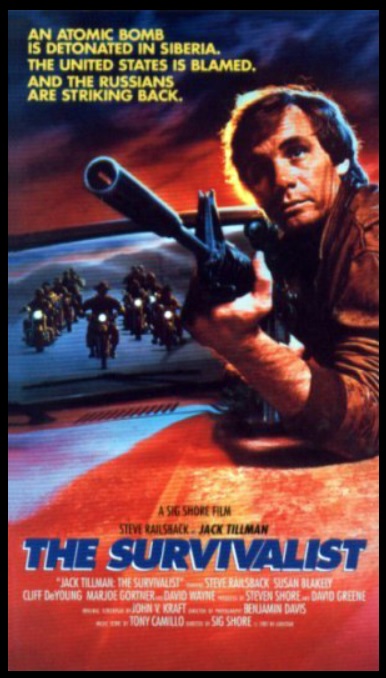
Ack! I wrote reviews on The Survivalist and Survival 1990? The things I do for B&S About Movies!

About the Author: You can read the music and film reviews of R.D Francis on Medium and learn more about his work on Facebook.

City Limits (1984)

Actor Don Opper (Black Moon Rising, Critters franchise) and director Aaron Lipstadt (prolific; too many U.S TV series to mention), the writing and directing team that brought us the very clever and entertaining Alien/Star Wars knockoff Android (1982; starring Klaus Kinski*) returned with this not so clever and entertaining post-apocalypse knock off set “15 years from now.” So, considering its year of release, it seems we’re in the year of 1999, across the continent from where Snake Plissken is dealing with Commander Hauk and hookin’ up with Season Hubley in a Chock Full o’ Nuts coffee shop.

As is the case with most-low budget apoc flicks, this means the “future” of City Limits pretty much looks like our present, except for a few techno-accoutrements to make it seem this is “the future.” And while that approach works to great success in films such as Kamikaze ’89 (1982) and Fahrenheit 451 (1967), City Limits lacks those films’ narrative focus to hold an apoc-rat’s interest.

You guessed it: As with the geographical alerts for post-apocalyptic films made in Canada and South Africa (Survival 1990, Survival Zone), this is a warning to proceed with caution with this U.S knock off of an apoc-flick . . . that’s a knock of the Italian pasta-flicks . . . that are knock offs of John Carpenter’s Escape from New York.

In this “universe” a plague has killed off most of the world’s adult population (I know that’s a plot device I’ve seen before, but I am too lazy to research those films, but I do remember Michael J. Pollard and Kim Darby starred in a ‘60s Star Trek episode with that plot) that leaves Los Angeles in the hands of two teenage biker gangs . . . who raided an Italian clothing designer’s ratty-apoc Broadway collection of costumes, complete with Skeletor-like motorcycle helmets. Can the Italian apoc-gangs the Riders and the Tigers kick their ass? Put it this way: The City Limits dweebs would be running around in pissy-pants if the rag-wearing and whitefaced Scavengers and the roller skating-metal hockey stick swinging Zombies showed up.

As with the Enzo G. Castellari apoc-universe set up in 1990: The Bronx Warriors and Escape from the Bronx, the ubiquitous “evil” corporation has moved into Los Angeles to restore civilization. The man to accomplish this goal is . . . teen idol-actor Robbie Benson (?) who, in the grand tradition of an ‘80s Adam West film (Zombie Nightmare and Omega Cop) does this from a one-room set, behind a run-of-the-mill wooden desk in an office with wood paneling . . . which is great if you’re a manager of a Walmart — not going into a post-apoc battle to restore civilization. Is Benson’s retail retaliation enough to inspire the gangs to unionize and fight back? You bet.

Considering this is a U.S production with a solid roster of U.S actors (John Stockwell of Christine, the apoc-drivel Radioactive Dreams, My Science Project; John Diehl of TV’s Miami Vice), along with a bigger budget and slicker production values than the Italian pasta-romps it aspires to be . . . there’s no Fred Williamson, Henry Silva, or Vic Morrow thespin’ against an endless barrage of fights and explosions and deaths by impalement, shotgun or, most importantly — flamethrowers. Yeah, John Stockwell is a great actor (and has become a successful director in his own right), but a movie in the apoc-genre needs a Mark Gregory discovered in a Rome shoe store, or ex-drug running merchant sailors like Michael Sopkiw running through the rubble and kicking the silver jump-suited minions of Henry Silva’s “Disinfestations Squads” to make it all work.

City Limits is a fond VHS memory of the ‘80s and it’s not a total waste of time, but it’s just that it could be so much better. You can watch it on You Tube, although the MST3K version on TubiTv makes for the more entertaining watch.

Tom Servo . . . Crooooow!

*Click through the images to check out our two Klaus Kinski tributes!

About the Author: You can read the music and film reviews of R.D Francis on Medium and learn more about his work on Facebook. He also writes for B&S Movies.
Omega Cop (1990) and Karate Cop (1991)

The bolo tie-wearing Prescott (Adam West) runs a “Special Police” force in the year 1999 from a one-room set (that he never leaves) via a couple of Commodore 64s and some 60s-era blinking props to protect the post-apocalyptic wastelands of Southern California. Keeping Adam West company in the washed-up actor’s camp are Troy Donahue (the metal epic Shock ‘em Dead) and Stewart Whitman (Guyana: Cult of the Damned, Demonoid, and Bermuda Triangle). Helping out on the stunts and working as one of the “wasteland scavengers” is the always reliable and entertaining Sean P. Donahue (of the awesome Ground Rules).

And how did we get here, you ask? Well you’ll have to listen to West’s voice over narration (that he wrote himself!) at the beginning of the film as he educates you on the ozone layer, the greenhouse effect, the rain forests, and the solar flares that plagued the world (“. . . half the world just didn’t give a shit. . . .”).

Anyway, when West catches wind of an illegal slave auction of women run by some “bad-ass” named Wraith (clad in a predictable Nazi SS uniform), he sends in the resident “Mad Max”: John Travis (Ron Marchini of the 1976 kung-fu classic and popular video rental, Death Machines). During the course of breaking up the slave ring — with his high-tech, multi-barrel shotgun — his team is killed: Travis is the last police officer on the force! So, with his high-tech ‘80s-era jeep, Travis takes the two surviving slave women to a utopia of clean air and water in Montana . . . and kicks some ass along the way. (Travis may have been double-crossed by Adam West, who really ran the slave ring . . . does it really matter?)

If you’re a post-apocalypse completest — or an Adam West fan that needs to slide a copy of Omega Cop next to Zombie Nightmare (with Jon-Mikl Thor!) and One Dark Night on your shelf — then this film is for you.

Say what you will about its production quality and shortcomings in catching some Mad Max-inspired post-apoc love, but Omega Cop isn’t boring and was popular enough on the video store circuit that Ron Marchini and writer Denny Grayson returned with a 1991 sequel: Karate Cop — costarring David Carradine (Future Force, Death Race 2000) in place of Adam West — which has something to do with people forced into gladiator-arenas by street-terrorist gangs. But get this: the director is sexploitation purveyor Alan Roberts of Young Lady Chatterley (1977) and The Happy Hooker Goes to Hollywood (1980). But don’t let his soft-porn presence deter your watch: as with any Marchini flick, Karate Cop is a fun watch.

Director Paul Kyriazi, who made his debut with the aforementioned Death Machines and vanished from the film world after Omega Cop, which served as his fifth and final film, has returned to the writing and director’s chair with the 2018 sci-fi movie, Forbidden Power. You can learn more about Kyriazi’s return and his new film courtesy of a favorable review at HorrorGeekLife.

You can watch the VHS rips of Omega Cop and Karate Cop on You Tube.

About the Author: You can read the music and film reviews of R.D Francis on Medium and learn more about his work on Facebook. He also writes for B&S Movies.

Damnation Alley (1977)

To the chagrin of the Italian film industry: we are still alive. And to my chagrin: the Italian post-apocalypse — the single greatest sci-fi film sub-genre to dominate the drive-ins and home video stores of my youth — is over.

Sure, Hollywood offered us their big-budgeted versions of our decimated future with Waterworld (1995), Escape from L.A (1996), 28 Days Later (2002), The Road (2006), I Am Legend (2007), The Book of Eli (2010), World War Z (2013), and Mad Max: Fury Road (2016) — all were honorable, but sometimes misfired, efforts. But it was the lowbrow, low-budgeted indie knock-offs coming out of Eurasia in the 1980s — spearheaded by the Italian film industry’s insatiable quest to rip-off proven American genre flicks — that revved our post-nuke engines (just as B&S Movies’ “Fucked Up Futures” and “Deadly Game Show” weeks prove).

However, prior to the Australians, Italians and Filipinos (we love you, Ciro H. Santiago!) dishing their starchy-apocalypses, there was the “Big Three” by Moses and Ben-Hur himself: Charlton Heston. Chuck’s turn in Planet of the Apes (1968) ignited the post-apocalyptic sci-fi craze within the Hollywood mainstream studio system and led to Heston’s turns in The Omega Man (1971) and Soylent Green (1973).

Once sour on the low-budget “image” of sci-fi films of the ’50s and ’60s, major studios and A-List actors quickly committed to the apocalypse genre — with Oliver Reed in Z.P.G (1971), Bruce Dern in Silent Running (1972), Yul Brynner in The Ultimate Warrior, Sean Connery in Zardoz, and Jackie Cooper in Chosen Survivors, (all 1974), James Caan in Rollerball (1975), Michael York in Logan’s Run (1976), George Peppard in Damnation Alley (1977), and Richard Harris and Paul Newman in Ravagers and Quintet (both 1979), respectively.

So while the Hollywood apoc-mainstream gave us some pretty incredible movies from 1968 to 1979, only one of those films had a bad ass apocalypse truck piloted by our favorite ‘80s TV bad-asses: Col. John “Hannibal” Smith from The A-Team and Stringfellow Hawke from Airwolf.

Sadly, Damnation Alley isn’t as bad-ass as the ‘80s Italian post-apoc flicks left in its wake. If you want a film with George Peppard going into battle with real life (unconvincing) “giant” scorpions and cockroaches blue screen-composited (pasted) into live action sequences, then this is film is for you. Just make sure the papier mâché scorpion claws don’t bite you in the ass.

Damnation Alley started out promising enough: as a popular 1967 sci-fi novella written by Roger Zelanzy. In light Pierre Boulle’s success with the 1968 Planet of the Apes adaptation of his 1964 novel La planète des singes (aka Monkey Planet), Zelanzy was urged to expand the novella into a 1969 novel to make the story more viable for a movie deal. And he got the deal. And it took eight years to develop. And what made it to the silver screen—under the direction of Jack Smight, who scored consecutive box office hits with the disaster flick Airport 1975 and the war movie Midway (1976) — barely resembled the source material.

Check out this awesome synopsis of the book:

The story opens in a post-apocalyptic Southern California, in a hellish world shattered by nuclear war decades before. Several police states have emerged in place of the former United States. Hurricane-force winds above five hundred feet prevent any sort of air travel from one state to the next, and sudden, violent and unpredictable storms make day-to-day life a mini-hell. Hell Tanner, an imprisoned killer, is offered a full pardon in exchange for taking on a suicide mission — a drive through “Damnation Alley” across a ruined America from Los Angeles to Boston — in one of three Landmaster vehicles attempting to deliver an urgently needed plague vaccine.

Police states? A Snake Plissken-like criminal? Did John Carpenter read this book? So what in the hell happened to that movie?

The first pass at the novel, which mirrored the novel-source material, was penned by Lukas Heller, himself with consecutive screenwriting hits with the war-action films The Flight of the Phoenix (1965) and The Dirty Dozen (1967). Zelanzy loved Heller’s script.

Then, for whatever reasons . . . as studios do . . . the studio executives made their “notes,” then hired Alan Sharp, who had hits with the Burt Lancaster action-western Ulzana’s Raid (1972) and the Gene Hackman police-mystery Night Moves (1975), to do a rewrite — which expunged all the elements that made Zelanzy’s book a best seller in the first place. Bye-bye, Hell Tanner, you bad-ass. Poof goes the Escape from New York-esque police states. Hello, campy storytelling. Goodbye serious-dark plotting and characters.

Sigh. Will the studios ever learn?

So, while Steven Spielberg battled perpetually-failing mechanical sharks on the set of Jaws, Jack Smight’s proposed “epic” Landmaster-motorcycle battle against full-scale 8-foot scorpions was a disaster. The giant cockroaches fared worse. However, the 12-wheeled, seven-ton Landmaster built by Dean Jeffries (also responsible for the vehicles in the apoc-satire Death Race 2000) at a cost of $350,000 (one was built; “two” appear in the film as result of photo trickery) worked better than expected. So the studio requested more shots of the Landmaster appear in the film — which is not a good sign. (And Allan Arkush being instructed to “blow up more motorcycles” in Deathsport didn’t work out either. And so it goes.)

So, 20th Century Fox labored over the film in post-production for 10 months, trying to “save” the picture by superimposing “radioactive skies,” scorpions and cockroaches. At one point, as this old Starlog article from September 1977 shows, the studio even decided to ditch the book’s unique title and retitled the film with the vanilla . . . Survival Run (which became the title of a 1979 Peter Graves hillbilly-bent The Hills Have Eyes rip-off). Meanwhile, George Lucas was toiling away on his Flash Gordon homage, and released, Star Wars. And the studio believed Damnation Alley would be the “blockbuster” . . . and Star Wars would be the flop.

And we know how that worked out.

The post-production snafus over Damnation Alley became so heated that the studio wrestled control of the film from Jack Smight and re-edited the film a second time — dumping what little plot and character development was left . . . for more of the Landmaster . . . and all that was left of Roger Zelanzy’s book was the Landmaster. At least the studio got the picture they wanted.

So, was it worth it?

This You Tube video shows the Landmaster going through its paces in the film — all seven minutes of it — for your viewing pleasure. Hey, it’s why we love the movie in the first place: Hannibal and Stringfellow driving a post-apocalyptic, amphibious heavy metal scorpion crusher is why we bought our tickets.

Thus, five months after the $20 million-budgeted Star Wars was released on May 25, 1977, the $8 million budgeted — that ballooned to $17 million — Damnation Alley finally saw the light of day on a date no one remembers: October 21, 1977. A critical failure, its box-office stalled at less than $5 million in sales. The film was eventually recut for television and premiered as a high-rated NBC Sunday Night Movie on June 12, 1983, and featured alternate and additional scenes that offered more character and plot development — but that TV cut was lost and never released on video. In fact, George Peppard has gone on record as being unhappy with the 1977 theatrical cut. Zelanzy wanted his name taken off the movie; the studio (for whatever legal snafus) refused.

Oh, so you want to know what the movie is about.

Sorry, this is one of those films where the backstory (like Stallone’s D-Tox and Cobra, for example) is better than the actual movie. Let’s put it this way: Damnation Alley is almost the same as Def Con 4 in plot . . . but even with its shortcomings, Damnation Alley is the far superior film. And for $17 million, it should be.

First Lieutenant Jake Tanner (Jan-Michael Vincent, White Line Fever) and Major Eugene “Sam” Denton (George Peppard, Battle Beyond the Stars) are on duty at an Air Force ICBM missile silo in the California desert when the Soviet Union launches a nuclear strike (film clip). Regardless of their retaliatory strike, Tanner and Denton only managed to intercept 40% of the Soviet missiles.

Two years pass. The Earth has titled off its axis, radiation has mutated what life is left, and the planet is wracked by massive aurora borealis-like hurricanes and windstorms. Then, one day, they pick up a radio transmission from Albany, New York. There are survivors! So they hop into their giant, 12-wheeled Landmasters to travel across “Damnation Alley,” with stops along the way in the Omega Man-devastated cities of Salt Lake City, Utah, Las Vegas, Nevada, and Detroit, Michigan—and pick up Jackie Earle Haley (Kelly Leak from the Bad News Bears, Rorschach in Watchmen, and Freddy Krueger in the remake of A Nightmare on Elm Street) along the way.

You can watch the movie for free on You Tube and enjoy Dean Jeffries’s fascinating discussion on the development and construction of the Landmaster on You Tube. Can you imagine if this film had been a blockbuster? We would have played with a bad-ass Landmaster and giant scorpions with moveable claws chompin’ on our George Peppard and Jan-Michael Vincent action figures. Would our Landmasters have laid waste to the Millennium Falcon and kicked Steve Austin’s one-armed plastic-engine lifting ass? You bet!

As for 20th Century Fox: They fared better with their next venture into the science fiction realm with a script making the office rounds under the title of “Star Beast.” Rushed into production to capitalize on the success of Star Wars, the film became an influential smash that inspired a series of gooey Italian space romps: 1979’s Alien (as B&S Movies’ “Ten Movies that Rip-off Alien” and “A Whole Bunch of Alien Rip-offs All at Once,” investigates; we also blow out a bunch of apocs with our two-part “Atomic Dustbin” feature).

Regardless of its shortcomings, we post-apoc rats love Damnation Alley. How loyal is our love? The members of progressive space rockers Hawkwind wrote a song about the movie! How many movies can make that claim?

Oh, and contrary to popular opinion: The Ark vehicle from Filmation’s Ark II television series that aired on CBS-TV in 1976/1977 was not the repainted and modified Landmaster from Damnation Alley, as this article from Space 1970 clarifies. Is the Ark II as bad-ass as the Landmaster? Oh, hell yeah.

We talk more about the Landmaster, the Ark II and other apoc rides!

Update: Be sure to check out McSmith’s The Books That Time Forgot blog and his review of Roger Zelazny’s Damnation Alley.

About the Author: You can read the music and film reviews of R.D Francis on Medium and learn more about his work on Facebook. He also writes for B&S Movies.

Wired to Kill (1986)

No matter how many years pass . . . and how many copies of this VHS non-starter ended up in the dumpsters behind video stores . . . copies of this film keep coming back at me. Every video store rack I’ve browsed. Every Drive-In swap shop I’ve perused. Every Goodwill and Salvation Army, every pawn shop, and every garage sale I’ve visited. Even the weirdo-halitosis tape guy with a cubicle at the local indoor festival flea market . . . there’s yet another friggin’ copy of Wired to Kill staring back at me. Next to the apoc-swill that is America 3000 and Robot Holocaust this film has to be one of the best-distributed VHS tapes of the video-fringe era. It’s like that copy of Corky Romono (and MacGruber, speaking of SNL schlock) stuck to my shoe that I can’t scrape off.

Oh, what the hell? WTF! You’ve got to be friggin’ kidding me! Noooooo!

There I was, at my public library branch’s annual used book sale . . . and there it is, again. I gave up. I plopped down two quarters. I should have went into the recreation center next door to get off on the old broads jazzercising and buy a faux Dr. Pepper (a Mr. Pibb) instead, take home my 10 cent copy of Herman Hesse’s Demian and April Wine’s Harder Faster on cassette . . . and called it a day.

In an utter lack of budget and scripting with a group of drop outs and flunk outs from the Ed Wood School of Thespian Studies starring as the marauding hoards of 1998 (another “future” that looks like our present, only with a couple of flashing-and-bleeping gadgets), this dropping of celluloid borrows (poorly) from the The Road Warrior and the cute and cuddly sci-fi romp Short Circuit, and the family favorite . . . Home Alone!

The two actors that passed Ed’s class on “Octopus Battles” — our heroes Steve and Rebecca — don’t fare much better on their road to Oscar gold as two teens who suffer at the hands of the ubiquitous punk rock rapist survivors (bossed by Merritt Butrick, who went from Star Trek II: The Wrath of Khan to this in four short years?) of the worldwide plague. Turns our little wheelchair-bound Stevie has a pet robot and is quite the computer and electronics whiz — with a knack for setting booby traps (the Home Alone part) and soups up his chair with gadgets (the Short Circuit part) to battle the crazies (the Road Warrior part).

Does a sorely needed Wez (Vernon Wells) from The Road Warrior come crashing through the wall in a cameo appearance like he did in the über cool sci-fi comedy, Weird Science? (You wish.) Does anyone “pull a Chet” and transform into a pile of poopy-goo?

No, but this tape sure does. Yep, renting from the video fringe is like a pile of poop. You never know badly the post-apoc crouch rot is gonna smell. And any film that tells us with a text scroll — accompanied by an annoying David Sanborn jazz saxophone backing track (ripped off from the jazz trumpeter shtick in 2019: After the Fall of New York) — on how we got here, is the first scent of apoc-crouch rot.

Ugh. Hands of Steel artwork ripped, yet again?

And that’s all I am going to say about that. Well, one more thing: don’t be booby trapped by this gem’s alternate VHS title: Booby Trap . . . uh, oh!

. . . Unwanted Film Trivia Alert . . . Unwanted Film Trivia Alert . . . this is not a drill . . . abort all reading . . . abort all reading . . . log off of B&S Movies . . . this is not a drill . . . too much virtual cyber ink has been giving to this film already . . . abort . . . abort . . .

Emily Longstreth, who stars as Rebecca, worked alongside Johnny Depp in 1985’s Private Resort, was Kate (?) in 1986’s Pretty in Pink (speaking of John Hughes), and appeared in (yes!) the Alien-cum-E.T knock off, Star Crystal (1986). But we lads and lassies slumming on the video fringe best remember Emily for her turn in Krishna Shah’s T&A epic, American Drive-In (1985). (Come on, now. You remember Krishna Shah . . . Hard Rock Zombies? I know! The dude was a double-graduate from Yale and UCLA . . . and he made Hard Rock Zombies!)

And I was shocked . . . SHOCKED to see . . . Kim Milford of Laserblast and Song of the Succubus, who deserved better that this mess — the dude was on Broadway in Hair, Rocky Horror, and Jesus Christ Superstar for Oscar’s sake — as one of the thugs, Rooster (check out my admiration for Kim’s music career on Medium).

As for director Francis Schaeffer: He brought us Headhunter (1988; voodoo murder mayhem in Miami starring the always hot Kay Lenz of White Line Fever, along with Wayne Crawford), Rising Storm (1989; a really dopey post-apoc dropping not worth more of a mention beyond this sentence . . . starring Zach Galligan from Gremlins, Spinal Tap’s June Chadwick from Forbidden World, and more Wayne Crawford . . . which, I dare you, Sam, I dare you, to review Rising Storm), and . . .  did you know there’s actually a film based on those ‘80s automotive-suction cup “Baby on Board” signs? Yep, Francis made it: Baby on Board (1992).

Yep. When it comes to the VHS fringes, I am wired in, baby. . . .

Hey, at least this review presented the opportunity to qwerty-in “schlock” and “shtick” as part of one of my reviews. I wonder if the guy who becomes perturbed — and lets us know — when we use the lazy-writing words of “ensues,” “trope,” and “aplomb” will let us know that he has an issue with the use of “schlock” and “shtick” to critique films? And will he ever figure out that we now use those words, and such admittedly schlocky phases such as “all hell breaks/lets loose” in reviews to annoy him? I mean, if you do not like us, why do you keep coming back?

Anyhoos (that’s annoying!), if you must complete your post-apoc shakes, Wired to Kill is on You Tube.

Two parts of all the apoc flicks you need.

About the Author: You can read the music and film reviews of R.D Francis on Medium and learn more about his work on Facebook. He also writes for B&S Movies.

Survival 1990 (1985)

Remember B&S Movies’ past geographical warnings about staying the hell out of South Africa and keeping your ass in the Philippines, Italy, and Australia for your post-apocalyptic fixes?

Well, add Canada to the list. Be warned, my fellow apoc-rats. The lands of Survival 1990 aren’t across the border from 1990: The Bronx Warriors. If ever a film needed a meeting of the Riders and Tigers, this is the movie.

Also known as Survival Earth in its VHS revival, this canuxploitation dropping that makes the Canux nuc-fest Def Con 4 look like Escape from New York occurs in 1996, ten years after “The Fall,” which refers to the collapse of the world economy and . . . hey, wait a minute . . . 10 years after 1996 is 1986 . . . so why does the title refer to the year of 1990? I know, I know. Don’t overthink the (lack of) plot . . . and math. Which brings us to questioning who made this? Yep, the mathematicians at Emmeritus Productions, the Canadian studio that also made the computer-takes-over-a-hi-tech hi-rise A.I tomfoolery, The Tower, and the inert John Carpenter-porn knock off, Blue Murder.

Duh. You’ve been warned.

Anyway, this shot on video tape for Canadian TV potboiler starts with a stock footage montage of some riots, newspaper articles, nuclear power plants, and politician infighting that fades out under an optical effect informing us the big one dropped. And that’s the end of the special effects for the movie.

The resident “Adam and Eve” survivors living in the wiles of Toronto are John and Miranda, who meander through the woods and talk, talk, talk . . . and read poetry (at least books survived “The Fall”), and goes all philosophical quoting Yeats. And when drippy John isn’t reading poetry, he talks about the good ol’ days of mowing grass, driving his ol’ Honda Civic, and about his dad’s cloning experiments (a major plot twist, don’t forget!).

In addition to a mysterious “creature” shadowing their every move, they meet up with Simon, a soldier of fortune (in run-of-the-mill camo-fatigues off the rack at Bass Pro Shops) who survived the war and becomes their ally. And thank god, because Simon at least has a rifle and a pistol to fight off the mutant-vandals (that aren’t at all “mutant” and look more like raggedy street people) who kill John. Then John’s clone—who’s been spying on them—shows up and rescues Miranda. And they read more poetry and bicker happy ever after. The end.

So if you need to explore the post-nuke wastelands of the Great White North — sans any Snakes or Trashes, or props, or special effects, or sets, or costumes, or action, or plot, or point — then this is your film. This rarity from the video ‘80s — that’s never been issued to DVD or Blu-ray (complete with trailers for the low-budget videotape pot boilers Deadly Pursuit and The Edge) — is on You Tube.

Star Nancy Cser, who played Miranda, received some video-store fame courtesy of the 1986 Canadian soft core skin flick, Perfect Timing, which had plenty of naked women for us horn dogs—and nary a plot. Not that we cared about the plot. For when you have boobies, you need no plot. Wow. We already sat through The Tower. So, sorry, Nancy: no more reviews for you. Some movies are best forgotten.

About the Author: You can read the music and film reviews of R.D Francis on Medium and learn more about his work on Facebook.

Def Con 4 (1985)

Or, as I like to call it: Escape from Nova Scotia, is another caveat emptor from the video ‘80s with another bogus post-apoc film that doesn’t live up to its flashy poster/video box art work. (They never really do, do they?) So, instead of a massive, crashed spaceship (like in the Mark Wahlberg Planet of the Apes remake) you get a dinky geosphere-pod thingy stuck in the dirt (that doesn’t look big enough to house the crew cabin we seen earlier in the film) and there are no decayed skeletons inside space suits sticking out of the arid landscape, either. And no disrespect to the late, Texas-born actor Tim Chaote (Zathrus from TV’s Babylon 5) as Howe . . . but he’s no Snake Plissken or Max Rockatansky.

Catch the trailer on You Tube, here.

If ever a film ever needed a shot of Michael Sopkiw and Mark Gregory under the lens of Sergio Martino or, even better, Cirio H. Santiago, this would be the film. At the very least we need a bubblegum chewing and ass kicking Roddy Piper saving the Canadian east coast. Even some Steve Sandor beefcake water-chasing would be welcomed. Yeah, this Nova Scotian hell needs a Frogtown.

Anyway . . . we get Dr. Sheldon Cooper, I mean, Tim Choate, as one of three astronauts, including Jordan (Kate Lynch; Meatballs, Eddie and the Cruisers II: Eddie Lives!), stationed on Nemesis, a top secret, joint Canadian-U.S military nuclear platform in Earth orbit when World War III erupts by “accident” . . . courtesy of a Libyan-stolen cache of cruise missiles shot into Russia (that we learn about via a TV transmission on the spaceship . . . yawn).

Hey, wait a minute, R.D . . . aren’t you confusing this movie with Steve Barkett’s Mad Max vanity project, The Aftermath (1982) . . . the one where an astronaut fights a biker gang led by a villain named (Toe) Cutter who rules the post-nuke wasteland? You know, the one that became a U.K Section 3 video nasty?

Dude, I wish I was . . . at least that movie had the awesome Sid Haig (Galaxy of Terror) to cut through the post-apoc crapola.

Sid Haig? No. Richard Moll from Metalstorm: The Destruction of Jared-Syn starred in The Aftermath.

No, you’re thinking of Survivor (1987) starring Chip Meyer, which has the same ol’ Mad Max-inspired astronaut returning to a slow ‘n’ boring, low-budget apoc-chatty chat world.

Well, anyway . . . in place of Haig and Moll we get our favorite Canadian-American character actor, Maury Chaykin (Jim Sting in WarGames, Sam Tipton in My Cousin Vinny), as a crazed survivalist with a captive school uniform-clad babe in the cellar (Canadian scream queen Lenore Zann of Happy Birthday to Me, Visiting Hours, American Nightmare; the voice of Rogue in X-Men: The Animated Series). But not even Chaykin’s thespian scene chewing can save us from the post-nuke no-action boredom punctuated with lots of chitty-chatter about “radiation zones” and “clean zones” and “terminals” and everyone telling us how the world ended up this way. Yawn.

The film starts off promising enough on the space station and setting up the story during its first 30 minutes . . . it has a decent spacewalk scene . . . the scenes with Howe receiving a ghostly message on the radio from his wife after the war is over and his trying to save a fellow astronaut being yanked through the sand by “something” as they dig themselves out of the wreck are especially chilling. Then the fast forward button on the VCR remote goes into overtime once Gideon (a reference to an Old Testament military leader, really? While you’re at it, why not name the rest of your characters Stryker or Hunter like all the other apoc movies do? Geeze.), the perfectly-coifed Shaun Cassidy clone (Kevin King, Iron Eagle) shows up as the requisite dickhead, ex-military school-army brat who goes all despotic on the poor slobs shuffling around the Scotian woods. Yeah, this film really needs a Sig Haig . . . or a Lee Van Cleef . . . to villain up the joint, not this snot-nose punk kid that needs his ass spanked and sent to his room without supper. Lord Humungous, we beg for your vengeance!

Anyway, it turns out Giddy-boy hacked the space platform and forced the astronauts back to Earth, since they have the technology to help find a “clean zone” to escape the contamination that will wipe out the survivors in two months. (Huh? Well, wait . . . if Giddy the Gimp has the technology to hack a military nuc-platform, then it follows he has the technology to find a way off Nova Scotia . . . oh, never mind. I’m overthinking the plot.) And with that, we get lots of boring Battletruck tomfoolery . . . and talking, talking, and talking . . . and talking, with people babbling in the woods (sans the truck or motorcycles . . . or laser crossbow weapons or Whistler Swords) that they need to get off the isle of Nova Scotia and onto the mainland before a malfunctioning warhead on the crashed platform explodes in sixty hours.

Dear Lord! Will somebody start kicking some ass around here? Snake! Max! Parsifal! Trash! Stryker! Even Paco Queruak would be welcomed! Where are you, guys! We’ll even take the headbanded Chip Meyer from Survivor (yikes, he looks like the lead singer from Canada’s Loverboy!). Someone help these dolts Escape from Nova Scotia, already!

The real pisser of this film: It was made with Canadian Government Tax dollars via what seems to have been some bogus program to encourage film production in the Great White North—at the tune of 1,750,000 Canadian . . . its worldwide gross barely broke a million dollars in box office. Granted, it eventually cleaned up on home video market, but as a Canadian tax payer, I’d be pissed the government taxed my hard earned money for Roger Corman’s benefit.

And another thing: It’s not only CNN that references the Def Con System incorrectly (in defiance of The Donald)so does this film. In fact, the correct title for this film should be Def Con 1, which means “imminent war” . . . as in the shit has already hit the proverbial apoc-fan and the Earth is about to be burnt to a cinder and ruled by the leather studded, metal-hockey masked Humongous. A Def Con 4 is a picnic in the park, as this Newsy report on the media’s perpetual Def Con faux pas tells us. You got that, kids? Def Con 1 is bad. Def Con 5 is good. And if you don’t . . . well, ‘ol Commander General Jack Beringer is just gonna kick you in the ass until you do! And for god sakes, when you’re trying to be a bad-ass, don’t say your “taking this baby up to Def Con 6,” you’ll only end up looking like a dick.

At least the interjections of Commander USA of Commander USA’s Groovy Movies make Def Con 4 more entertaining. Check it out (complete with the original commercials and promos for USA’s Saturday Nightmares airing of The Intruder Within!) on You Tube. If you’d rather watch it without the Commander USA gibberish, then check out this clean VHS rip uploaded to You Tube. You say you want a better copy for your personal library? In January 2019, Arrow Video released a 2K Restoration from the original 35MM interpostive. The Blu-ray features all new interview vignettes and a color booklet with more behind the scenes information on the film.

Do you need more apocalypse Intel? I invite you on a journey through the radiated landscapes with the Medium article, “Warriors of the Pasta-Apocalypse: Michael Sopkiw and Mark Gregory Kicking Ass in the ’80s Italian Wastelands,” which serves as a career retrospective on both actors, along with reviews of 2019: After the Fall of New York, 1990: The Bronx Warriors, and Escape from the Bronx.

You can catch up on the wide array of post-apocalyptic adventures with B&S Movies’ “Atomic Dust Bins” Part 1 and Part 2 featuring 20 mini-reviews of movies you never heard of, along with a “hit list” featuring all of the apoc-flicks we watched for September 2019’s Apoc Month.

About the Author: You can read the music and film reviews of R.D Francis on Medium and learn more about his work on Facebook.