The Beatles: Influence on Film 2

This is the second installment in our three-part series. We are discovering 33 films in the series, with 11 films each over the next three days — at 3 PM — as part of our third “Rock ‘n’ Roll Week” installment.

The films are listed by year of release.

“Rubber Soul” image with logo courtesy of 60s Girl Deviant Art/banner design by R.D Francis

Backbeat (1994)
Ian Softley (Hackers) makes his feature film writing and directing debut in this chronicle on the early days of the Beatles in Hamburg, Germany — the relationship between Stuart Sutcliffe (Stephen Dorff, S.F.W.), John Lennon (Ian Hart, again), and Sutcliffe’s German girlfriend Astrid Kirchherr (Sheryl Lee, U.S. TV’s Twin Peaks), in particular.

While the movie’s production values are stellar and the accents are spot-on (well done, Mr. Dorff) — and it’s based on interviews conducted by screenwriter Stephen Ward with Astrid Kirchherr — the real gem of the film is the Backbeat “alt-rock supergroup” on the soundtrack. The band is comprised of Dave Pirner of the Soul Asylum (as Paul McCartney), Greg Dulli of the Afghan Wigs (as John Lennon), along with Thurston Moore of Sonic Youth and Don Flemming of Gumball on guitars (Moore and Fleming also worked in a “supergroup” capacity on Velvet Goldmine), Mike Mills of R.E.M on bass, Nirvana’s Dave Grohl on drums. On lead vocals for Dorff’s Sutcliffe: Black Flag and the Rollins Band’s Henry Rollins.

Steven Dorff lip syncing Henry Rollins? Awesome.

That Thing You Do! (1995)
Okay, so the Beatles’ personas or music doesn’t show up (but they’re mentioned several times) in this writing and directing debut love letter to the Beatles and the Beatlemania-inspiring “one-hit wonder” craze of the 1960s. Our “Fab Four,” here, are Erie, Pennsylvania’s the Wonders — who shoot to the top of the charts with their ersatz-British Invasion rave-up, “That Thing You Do.” The film works its wonders (sorry) courtesy of its spot-on production design in conjunction with a brilliant soundtrack composed by bassist Adam Schlesinger of the alt-rock bands Fountains of Wayne (with their own “one hit wonder’ in 2003’s “Stacy’s Mom”) and Ivy (whose music appears in There’s Something About Mary; they also scored Shallow Hal). Mike Viola of Sony Records’ the Candy Butchers (later of Panic! at The Disco and Fall Out Boy) provides the vocals for the Wonders.

Sadly, we lost Adam Schlesinger on April 1, 2020, due to COVID compilations. Listen to this soundtrack — and anything from Fountains of Wayne — for great, goes-down-like-gumdrops tunes.

The Linda McCartney Story (2000)
Armand Mastroianni — yes, the one and the same who made his debut with the ’80s slasher He Knows You’re Alone (yep, the acting debut of Tom Hanks!) — directs this adaptation of the best-selling book Linda McCartney: The Biography that dispels of the Beatles — even Paul’s solo career — instead centering on Linda’s life with Paul.

The soundtrack, featuring the Beatles’ originals “I Wanna Hold Your Hand” and “Please Please Me,” along with the Beatles’ covers “Kansas City,” “Yeh Yeh,” and Willie Dixon’s “Back Door Man,” are interpreted by acclaimed Southern California-based Beatles tribute band, the Fab Four.

Paul Is Dead (2000)
The Google rabbit hole that opens for the “Paul Is Dead” legend is twisted and deep, so search with caution — or least do it on your day off, because you’ll be instantly hooked and surfin’ until sunset.

If you know your basic Beatles trivia: The band left “clues” in the 1968 John Lennon-composition “Glass Onion,” on the cover of Abbey Road, and in the backmasked grooves of “Revolution 9,” all which fueled the urban legend that Paul McCartney died on November 9, 1966, in car crash. To spare the public from grief, the Beatles replaced Paul with a lookalike, alternately known as William Campbell and the more widely accepted, Billy Shears. While the rumors got off and running in 1967, it really took off on Detroit radio stations in 1969 (which also birthed the “Jim Is Alive” urban legend in 1974 — and that Morrison recorded albums as “The Circuit Rider” and “The Phantom”), then spread via U.S. college newspapers.

In this German-shot/language film, Tobias, our young Beatles fan in an early 1980s German town, describes (in the scene, below) his conspiracy theory about how Paul McCartney died in the 1960s and was replaced his murderer.

The tale, while with its share of against-the-budget faux pas, is intelligently written and enjoyable, with imaginative plot twists: Paul is not only dead and replaced by Billy Shears, Shears murdered Paul; Shears — still alive — arrives in town driving a yellow, ’60s VW Beetle with the license plate “LMW 281F” — the car from the cover of Abbey Road.

While this impressive movie plays as a mystery-drama, the urban legend returns in a comedic take in 2018.

Two of Us (2000)
This Beatles “What If” comes courtesy of MTV’s softer sister station, VH-1, back in the days when the music channel produced original movies to a meandering-shrug effect. (However, their Def Leppard bioflick, Hysteria, is pretty good; Daydream Believers, their take on the Monkees, is also decent enough.) In this, the channel’s third film, the smart bet was placed on hiring Michael Lindsay-Hogg, the director of the Beatle-chronicle Let It Be (1970). What makes this all work: Jared Harris and Aiden Quinn as Lennon and McCartney are excellent in their roles — especially Harris, the son of the great Richard Harris (Ravagers). No, we do not see them sing, well, lip sync, in the film.

As with 1978’s I Wanna Hold Your Hand using the Beatles’ 1964 New York television appearance, and 1987’s Concrete Angels using the historical folklore regarding the Fab Four’s first Toronto concert appearance that same year, this time, the folklore concerns the mid-’70s public demand for a Beatles reunion show. One of those offers came from Saturday Night Live producer Lorne Michaels on April 24, 1976, who made an on-air offer of $3,000.

The script is based on a 1980 interview with John Lennon in the pages of Playboy, in which Paul McCartney, then on the road with his Wings Over America tour (promoting 1975’s Venus and Mars and 1976’s Wings at the Speed of Sound), visited with John Lennon at the Dakota when Michaels made the offer. And they almost took up the offer. . . .

VH-1 was unable to obtain the rights to the Beatles’ catalog, so none of their songs appear in the film. And the ghost of Let It Be is coming back a little later in another film.

I Am Sam (2001)
If you’re searching for a primer to help you swallow Across the Universe, the later-produced “film based on the Beatles’ songs,” and if All This and World War II wasn’t enough to send you reeling back to your VHS copies of Sgt. Pepper’s Lonely Hearts Club Band, this overwrought, saccharine hokum, is it.

Sean Penn’s performance (Tell it, Sgt. Osiris!) as a Beatles-obsessed, mentally-challenged man fighting for the custody of his bright, young daughter is outweighed by the Beatles tunes expertly covered by alt-artists such as Nick Cave, Ben Folds (of the Ben Folds Five), Heather Nova, Paul Westerberg (of the Replacements), and Pearl Jam’s Eddie Vedder. Not the same as the original verison-Beatles, but what is?

Writer-director Jessie Nelson, she, the force behind 1994’s incredible Corrina, Corrina (her daughter is Molly Gordon, of Booksmart), later produces a tale based on ’70s folk musician Steve Tilson almost meeting John Lennon. . . .

The Rutles 2: Can’t Buy Me Lunch (2002)
Is there such a thing as Rutlemania? Well, not in the U.S. where the 1978 original, All You Need Is Cash, bombed with the lowest ratings of any show on U.S. prime time television that week. However, in the U.K., the film’s intended audience, the mania led to Eric Idle and the Python troupe to embark on tours and recording full-lengths albums as their mock-Beatles.

As with Spinal Tap diluting the brilliant joke with an ABC-TV spoof concert special, The Return of Spinal Tap (1992), this Rutles sequel also dilutes the once brilliant gag — and it’s nothing more than a new edit of All You Need Is Cash, presented in the same chronological order, with a few new interviews, a couple faux celebrity insights (SNL’er Jimmy Fallon and Steve Martin show up; even Tom Hanks of That Thing You Do!), and a couple scenes cut from the first movie, as the Rutles embark on a reunion tour of America.

Across the Universe (2007)
As Robert Stigwood’s debacle based on Sgt. Pepper’s Lonely Hearts Club Band wasn’t enough . . . and with Sean Penn’s Oscar-bait still wormed in your brain . . . we get another musical drama written “around the music” of the Beatles. As with the later “alternate universe” romp, Yesterday . . . the Beatles “don’t exist” in this film’s verse: a “jukebox musical” that features 33 Beatles songs to weave the tale of two lovers, Jude and Lucy.

While it had a tumultuous studio vs. creative post-production process over the film’s length (it was intended to be longer), the film none the less won over Paul McCartney, Yoko Ono, and George Harrison’s widow Olivia.

Still no word on what Ringo thinks.

Chapter 27 (2007)
Jared Leto gives a bravo performance as Lennon assassin Mark David Chapman in this adaptation of the best-seller Let Me Take You Down (1992). While the book pinches its title from the Beatles’ “Strawberry Fields Forever,” the film’s title references J.D Salinger’s 1951 novel The Catcher in the Rye, which has 26 chapters — with the film’s title suggesting a “continuation” of the book, which was an obsessive favorite of Chapman’s. Another Lennon fan is portrayed by Lindsay Lohan — and she’s actually good, here, for you Lohan detractors.

Chapman’s psyche is also explored in 2006’s The Killing of John Lennon — but we didn’t see it U.S. theaters until after the release of Chapter 27.

Walk Hard: The Dewey Cox Story (2007)
“Spinal Tap” does not strike twice in this Judd Apatow-backed mockumentary concerning an ersatz-hybrid of Johnny Cash and Bob Dylan. The film barely cleared $20 million against is $35 million budget.

The Beatles appear in the form of Paul Rudd as John Lennon, Jack Black as Paul McCartney, Justin Long as George Harrison, and Jason Schwartzman as Ringo Starr. Sadly, their time is brief . . . and we wished the producers realized what they had, ditched John C. Reilly (an acquired taste that inspires more passes than watches), and just gave us a “What If” Beatles flick about the band moving on after the death of Paul McCartney . . . of which there is one. . . .

The Killing of John Lennon (2008)
While this was completed first, and released first in the U.K. and overseas markets in 2006, it was released in the U.S. in 2008 — after the 2007 release of the (much) better and better known, Chapter 27. Lennon, Harrison, McCartney, and Starr appear as themselves via 1960s archive news footage, but actors Richard Sherman and Tom J. Raider dually portray John Lennon against Jonas Ball’s Mark David Chapman.

Courtesy of 1000 Logos.

Join us tomorrow for our third installment with our final batch of films.

If you missed “Part 1,” you’ll find it, here.

About the Author: You can learn more about the writings of R.D Francis on Facebook. He also writes for B&S About Movies.

A Bullet for Pretty Boy (1970)

Wow! This movie has it all! It’s an American International Pictures release! Cheapjack drive-in copycat Larry Buchanan! Beach flick purveyor Maury Dexter! Still livin’ the dream ex-’60s teen idol Fabian! And a connection to Jim Morrison?

Strap on the popcorn bucket!

In 1967, Warner Bros. hit a $70 million payday on a $2.5 million investment with the Warren Beatty-produced and Arthur Penn*-directed (1969’s Alice’s Restaurant and 1970’s Little Big Man) Bonnie and Clyde. The film not only instigated a slew of “(criminal) lovers on the run” films, such as the Martin Sheen-starring Badlands (1973) and the Peter Fonda-starring Dirty Mary, Crazy Larry (1974), it also set off the production of more traditional gangster films, such as Roger Corman’s The St. Valentine’s Day Massacre (1967) — who never seen a hit film he couldn’t knockoff — and Dick Clark’s written and produced Killers Three (1968), a knockoff for — coincidentally, as was A Bullet for Pretty Boy — American International Pictures. Then there’s Roger Corman’s backed Bloody Mama (1970) (not to be confused with New World Pictures’ similar female-gangster romp from 1975, Crazy Mama) starring Shelley Winters and a young Robert De Niro and, thanks to director Martin Scorsese (on his second film), Roger Corman’s superior Boxcar Bertha (1972) starring David Carradine and Barbara Hershey. As with Scorcese, another superior (but fictional-based on a late ’30s novel) gangster flick was the Robert Aldrich-produced and directed (but a box office flop) The Grissom Gang (1971).

Of course, the notorious career of this film’s subject, Charles Arthur “Pretty Boy” Floyd, was covered in the poverty-row production Pretty Boy Floyd (1960). You know that film’s German-American actor, John Ericson, for the sci-fi cheapy The Bamboo Saucer (1969), the early Charles Band-directed hicksploitation’er Crash! (1977), and Oklahoma-shot, poverty horror anthology House of the Dead (1978). And yes, Ericson, as most ’60s and ’70s B-Movie actors at the end of their careers, worked for Cirio H. Santiago (we love you, Uncle C!) in one of our beloved Philippine war romps, Final Mission (1984).

Now, we gave you that little bit of back story on the admittedly dashing — and a pretty decent thespian, natch — on John Ericson, in that, this time, Pretty Boy Floyd is now portrayed by . . . you guessed it, teen idol Fabian, who started using his last name, Forte, on his works. He was, certainly, looking for this “grown up” gangster romp as a role that would bury the teen-memories of his lightweight beach romp Ride the Wild Surf (1964) and the process-shot racing rallies of Fireball 500 (1966), Thunder Alley (1967), and The Wild Racers (1968). Oh, and let’s not forget Fabian’s work in the James Bond-cum-beach knockoff Dr. Goldfoot and the Bikini Machine and Mario Bava’s sequel, Dr. Goldfoot and the Girl Bombs (1966).

Then the reviews for A Bullet for Pretty Boy came in.

The New York Times accused Larry Buchanan of making “a murderous gangster movie full of mostly nice guys which looks a little as if they had taken the members of the cast of, say, Beach Blanket Bingo and put them in costume and given them old cars to drive and told them to play it for real.”

The Los Angeles Times opined the film was “surprisingly free from gratuitous gore, but was still another very pale carbon of Bonnie and Clyde, in which Fabian handles himself in competent fashion amidst a host of amateurs.”

The film did, however, prove to be a box office hit, grossing over a million dollars in drive-in receipts; however, even though he was called out for the quality of his thespian turn across the board by critics, the film was not the critical and commercial breakthrough Fabian had hoped.

At that point, Fabian diddled in some guest television roles of no consequence, eventually returning to the big screen alongside Karen Black in, ironically, another based-in-fact gangster film — for Crown International Pictures, no less — Little Laura and Big John (1973) — that film concerned with the 1910s and 1920s-era Ashley gang. (The only film directed by art director Luke Moberly, it was made in 1969 as a failed/shelved Bonnie and Clyde cash-in.) Then Fabian gave us the trashy one-two punch that we so cherish here at B&S About Movies: Soul Hustler (1973) and Jukebox, aka Disco Fever (1978) — again, two “grown up” films rejected by the mainstream box office hoards. Fabian’s career then wound down (but not to the Cirio H. Santiago depths, thank god) after his working in the ’80s slasher genre with Kiss Daddy Goodbye (1981) and a bit-support role in the rock comedy Get Crazy (1983). (Hey, how did we miss his work in the George Peppard-starring airline disaster flick Crisis in Mid-Air (1979) for our “Airline Disaster TV Movie Week” feature?)

In typical A.I.P fashion, the against-the-low-budget and bargain-basement talents (the acting, outside of Fabian, is pretty abysmal) behind the film, in front of and behind the cameras, made the production a troubled one. The studio, while fronting Larry Buchanan a $350,000 budget, the largest the writer-director every worked with — and Fabian ever worked on — the studio, well, mostly studio head James H. Nicholson, grew concerned Buchanan (who gave us the likes of Mistress of the Apes and “It’s Alive!”) would fail to bring the film on budget and schedule with “some level of quality.” So A.I.P replaced Buchanan with Maury Dexter — in his final directing effort. While Dexter and the studio were ultimately impressed with what Buchanan shot, it was considered “too slow and talky.” So Dexter took a small pick-up crew, along with stunt doubles and the lead actors, to shoot action sequences to splice into the film.

Shot and produced in five months betwen June to October 1969, Buchanan’s story was inspired by Woody Guthrie’s folk-tune “The Ballad of Pretty Boy Floyd,” while TV series scribe Henry Rosenbaum (1970’s pretty cool budgeted-horror The Dunwich Horror and the aforementioned Get Crazy) whipped the concept into shape. And yes, it’s the same Henry Rosenbaum who penned Sly Stallone’s Lock Up (1989).

Needless to say, if you’re tempted to stream a Larry Buchanan-with-Maury Dexter-on-the-assist gangster flick, just know you’re not getting a gritty gangster romp on the level of the superior, John Milus-directed Dillinger (1973) starring Warren Oates: you’re getting a Roger Corman-backed New World Pictures-exploiting ’30-era gangster romp in the vein of his Big Bad Mama (1974) and The Lady in Red, aka Guns, Sin and Bathtub Gin (1979). Actually, the proceedings are closer to Buchanan’s own — long forgotten and of no consequence — take on the Bonnie and Clyde legend with The Other Side of Bonnie and Clyde (1968), which is the reason why he got the green light on his Pretty Boy Floyd project, in the first place.

Buchanan’s gangster chronicle — like the recently (some quarters) critically derided bio-flicks Bohemian Rhapsody, The Dirt, and Hidden Figures — plays it very loose with the facts. And, instead of documenting Floyd for the violent criminal that he was, Buchanan transforms the bane of Bureau of Investigations’ (the BOI was the precursor to the FBI) agent Melvin Purvis as a romanticized, misunderstood product of the Great Depression (that swept across 1930s American) by casting Floyd as a Robin Hoodesque folk-hero for the people.

Sure, Floyd gained his “hero” (well, anti-hero) status for burning mortgage documents, which effectively wiped-out people from their debts (but is not based in fact and believed to be folklore myth), but Floyd was still, first and foremost, a bank robber — who not only robbed “evil” banks, but also terrorized citizens by robbing company payrolls and committing numerous highway robberies. In reality, the newspaper-reading public who considered Floyd a “folk hero” of the downtrodden, was a multiple murder behind the killings of two police officers, one federal agent, and two, rival hood-cum rum runners who crossed his path. Then there was the Kansas City Massacre of July 1933 that resulted in the death of four law enforcement officers (though Floyd’s involvement is disputed, in some authoritative circles).

Whatever, Larry.

Charles Arthur Floyd wasn’t a hero, anti or otherwise. He was a thug who struck fear and dread in people, aka a terrorist. His exploits were so feared, officially, in July 1934, the newly formed F.B.I ranked Floyd as “Public Enemy No. 1” — and yet, the citizens of Oklahoma and Texas still helped him evade capture.

As you can see, the tale of Floyd is heavy material. And you can see why Fabian lobbied for the role.

Of course, keeping in mind Roger Corman backed the gangster romps Bloody Mama (1970) and Boxcar Bertha (1972) — themselves recycling off the A.I.P prop house from The St. Valentine’s Day Massacre (1967) — Buchanan easily pulled together a film that, while not fictionally accurate, is at least historically accurate in its set and costuming (we’ll forgive those few 1940’s model cars). And, if you know Larry Buchanan’s filmography, a resume rife with one, cheesy science fiction, inept horror, and conspiracy flick after the another, this gangster flick is one of his better, if not the best, films on his resume — thanks, in part, to Maury Dexter injecting those action set pieces.

Of particular interest in the cast department, especially to uber fan Bill Van Ryn of the Groovy Doom and Drive-In Asylum collective: Fabian’s supporting cast of Annabelle Weenick, Camilla Carr, Hugh Feagin, and Gene Ross appeared in the films of the all-too-short resume of S.F Brownrigg, he of the films Don’t Look in the Basement (1973), Don’t Hang Up (1974), Scum of the Earth (1974), and Keep My Grave Open (1977). And, why yes, Brownrigg does connect back to Larry Buchanan: Brownrigg worked as an editor and sound engineer on Buchanan’s ’60s flicks The Naked Witch, High Yellow, and the sci-fi epics Zontar: The Thing from Venus and Attack of the Eye Creatures.

Oh, and lets not forget Fabian’s co-starring moll was Jocelyn Lane, an Elvis flick vet co-star in Tickle Me (1965). An admittedly smokin’ hot, but (very) marginal actress, who certainly hoped for more from the film, as did Fabian, left the business after the crushing reviews for A Bullet for Pretty Boy. Also look for Fabian’s criminal side kick portrayed by ’60s B-Movie leading man Adam Roake (who appeared in the aforementioned Dirty Marty, Crazy Larry), and character actor extraordinaire and Buchanan stock player Bill Thurman (‘Gator Bait, Creature from Black Lake). Those who look really hard will see Morgan Fairchild (The Initiation of Sarah, Shattered Illusions) in her uncredited, feature extra debut.

You can watch the full film on You Tube.

“Hey, wait a minute, R.D! What about the ‘Jim Morrison connection,’ you teased?”

Read on, ye reader!

The Soundtrack by Richard Bowen and the Source

An August 8, 1970, Billboard Magazine advertisement for the soundtrack that served as the debut album for The Source.
Record images courtesy of Discogs.com and 45 Cat.com/soundtrack embedded below.

American International Pictures started their recording branch, American International Records, distributed by MGM Records, on March 19, 1959. Early on, AIR’s catalog was mostly 45-rpm singles, with rock and roll selections from their horror films, most notably, The Ghost of Dragstrip Hollow (1959). Later, AIR’s catalog featured long-play soundtrack releases, such as A Bullet for Pretty Boy. A decade later, in 1969, AIR and another company, Together Records (also distributed by MGM Records), went into business together — and shared the (sometimes confusing) sequence of catalog numbers on their releases. One of the label’s coveted records is “(Oooh, I’m Scared of the) Horrors of the Black Museum” b/w “The Headless Ghost” by The Nightmares (1959). (The Nightmares were fronted by Jimmie Maddin, who also appeared and performs in The Ghost of Dragstrip Hollow with the tune, “Tongue Tied.” He also cut “Roadracers” for the 1959 film of the same name.)

The soundtrack for A Bullet for Pretty Boy was produced by Harley Hatcher. B-Movie fans of all things Roger Corman know Hatcher for his scoring, penning and singing songs for the biker and rock flicks The Glory Stompers (1967), Wild in the Streets (1967), and The Hard Ride (1971). His other contributions are the Peter Fonda biker classic The Wild Angels (1966), several songs to Satan’s Sadists (1969), and Fabian’s Christsploiter, Soul Hustler (1973). Hatcher, who also served as the singing voice of actor Christopher Jones’s rock star Max Frost in Wild in the Streets, went on to become a top executive at Curb Records**. (Angel, Angel, Down We Go, another of AIR’s film soundtracks (1969), served as an A-Side album showcase for actor-singer Jordon Christopher, formerly of The Wild Ones.*˟)

Richard Bowen and the Source

And that brings us to Richard Bowen, the lead vocalist of the L.A. band the Source, who serves as the “Jim Morrison connection” teased at the beginning of this film review.

Richard Bowen and the Source never released an official album through AIR; none of the label’s artists did. Their “debut album” was the A-Side of A Bullet for Pretty Boy, in which the B-Side features Harley Hatcher’s film score. Of the six songs by the Source produced by Hatcher, he wrote three: “”It’s Me I’m Running From,” “I’m Gonna Love You (‘Til I Die),” and “Got Nowhere to Go,” with the former paired for single release with “Gone Tomorrow” penned by Richard Bowen. Bowen wrote the remaining songs “Ruby Ruby” and “Ballad of Charles Arthur Floyd.”

And we fast forward to the early ’80s.

Buchanan was fully committed to his faux-biographical drama format — mixed with his ubiquitous speculations and conspiracy theories — a format that dated to his “exposés” on the Kennedy assassination with The Trail of Lee Harvey Oswald (1964), the gangster chronicles The Other Side of Bonnie and Clyde and A Bullet for Pretty Boy, and the “romance” between billionaire Howard Hughes and actress Jean Harlow in Hughes and Harlow: Angels in Hell (1977). Buchanan twice explored the life of Marilyn Monroe with his same theories-vigor in Goodbye, Norma Jean (1976) and Goodnight, Sweet Marilyn (1989). Not even folklore dinosaurs were immune from the depths of Buchanan’s conspiracies: he made the speculative-drama The Loch Ness Horror (1982).

Then, with Jim Morrison mania sweeping the world in the wake of Jerry Hopkins and Danny Sugerman’s runaway best seller — and the first biography on the Doors’ lead vocalist, No One Here Gets Out Alive (1980) — Buchanan concocted Down on Us. Finally seeing release in 1984, it wasn’t a Jim bio-flick as Oliver Stone’s later The Doors (1991) — it was a “What If” tale about the deaths behind Jimi Hendrix, Jim Morrison, and Janis Joplin. Remembering the Morrisonesque qualities of Richard Bowen’s voice, Larry Buchanan brought Bowen on the project to be “Jim Morrison’s” vocals. So Bowen took an old 1970 tune, “Phantom in the Rain” (the image of the original 45-rpm single, seen above), that never appeared in an American International Pictures production, and retooled it as a faux-live cut for the film.

Upon the 1984 release of the Down on Us — and Bowen’s eerie Morrison qualities on the songs “Phantom in the Rain” and “Knock So Hard” (it’s unknown if the second song was an old ’70s song by the Source or a newly-penned tune for the film) — for a time, before the early-’90s rise of Internet, it was believed — amid assumptions it was Iggy Pop and the Doors, or an ad-hock group of Detroit musicians, or Capitol Records’ SRC with a new lead vocalist — that the infamous, post-death “Jim Morrison solo album” known as Phantom’s Divine Comedy: Part 1 (1974) was recorded by Richard Bowen and the Source.

Of course, when CEMA, Capitol’s digital reissues arm, released the first-ever compact disc version of the album in 1993 — and the truth, every so slowly and inaccurately, came out across blogs and music sharing sites — it was learned the faux Jim Morrison solo album was the lone release by Detroit musician Arthur Pendragon and his band, Walpurgis, a group managed by and recorded for Ed “Punch” Andrews’s Hideout Records and Palladium Productions that also oversaw the career of Bob Seger (Seger’s Gear Publishing published the album’s songs). (The 1974 studio version of Phantom’s Divine Comedy is also available on You Tube.)

Buffaloes, Grass Roots, and Eagles, Oh, My!

In addition to his catalog with American International Records, Richard Bowen penned the song “Trivial Sum” with Terry Furlong of the Grass Roots (the ’60s hits “Temptation Eyes” and “Midnight Confessions”) for the band, Blue Mountain Eagle.

Blue Mountain Eagle, hailing from Texas, was a quintet assembled in 1968 by Dewey Martin, who served as the original drummer in the Buffalo Springfield, and Randy Fuller, brother of the late Bobby Fuller of the Bobby Fuller Four (his brother Bobby, another celebrity murder mystery like TV’s Bob Crane and Iron Butterfly bassist Philip Taylor Kramer), to tour as “The New Buffalo Springfield.” When Stephen Stills and Neil Young took legal action to prevent Martin from using the “Buffalo Springfield” name, the band became Blue Mountain Eagle and recorded one album for Atco in 1970.

The group toured extensively, opening for Santana, Jimi Hendrix, Love, and Pink Floyd before their demise. Dewey Martin was eventually sacked; he formed Medicine Ball with Randy Fuller, while the rest of the band — Bob Jones, also formerly of Buffalo Springfield, along with David Johnson, formed Sweathog with the one-named sticksman Frosty from Lee Michaels (the early ’70s hit, “Do You Know What I Mean?”). Prior to the band’s formation, BME’s guitarist and vocalist, David Price, through his old Texas friend Micheal Nesmith, came to be Davy Jones’s stand-in on The Monkees TV series.

* We discussion the career of Arthur Penn’s son — and later, production partner on the Law & Order television franchise — in our review of the lost rock flick Rock ‘N’ Roll Hotel.

** You can learn more about the career of Harley Hatcher at his official website.

*˟ You can learn more about American International Records’ complete roster of releases at Both Sides Now Publications.

Oh, by the way . . . we are deep into our third “Rock ‘n’ Roll Week” blowout. Yes, we’ve done this twice before, and you can catch up with our “Rock ‘n’ Roll Week” Round-Ups 1 and 2 with their full listings of all the rock flicks we’ve watched.

All the ’90s mobsters you can handle . . . with a few more Pretty Boy Floyd portrayals.

About the Author: You can learn more about the writings of R.D Francis on Facebook. He also writes for B&S About Movies and publishes short stories and music reviews on Medium.

Angel, Angel, Down We Go (1969), aka Cult of the Damned (1970)

Poet, novelist, playwright and screenwriter Robert Thom is someone the B&S About Movies crowd knows best for Roger Corman’s quest to beat Rollerball to the theaters, with an adaptation (which Charles B. Griffith* doctored) of Ib Melchoir’s short story “The Racer” as Death Race 2000 (1975). Thom’s Hollywood (or is that Hollyweird) resume goes back a bit further, with the “teensploitation” screenplays for All the Fine Young Cannibals and an adaptation of Jack Kerouac’s The Subterraneans (both 1960). His screenwriting debut, Complusion (1959) — in which he was rewritten and not credited — was based on the infamous Leopold and Loeb murders and starred Orson Wells. (For Don Kirshner, he’d write the 1975, Kim Milford-starring Song of the Succubus.)

Thom’s next teen-oriented romp was the more “hep” counterculture-rock flick Wild in the Streets (1968), based on his short story “The Day It All Happened, Baby!”. When that American International Pictures’ $700,000-budgeted project cleared $4 million in drive-in receipts, Thom was given an opportunity to direct his first film, which he also wrote — and is the film we’re reviewing today: Angel, Angel, Down We Go.

Is it a counterculture drama . . . or a horror flick? Hey, whatever AIP – American International Pictures needs it to be to make a buck.

As with Wild in the Streets, Thom’s sole directing credit centers around a disillusioned rock star; its genesis was an unproduced stage-play of the same name written as a vehicle for his then wife, Janice Rule (better known for her ’70s guest-starring TV work than her films), who later became the wife of Ben Gazzara (The Neptune Factor, Road House).

By the time the script made it to the big screen, five-time Academy Award nominated and winning actress Jennifer Jones (won for 1944’s The Song of Bernadette) was cast as the affluent Mrs. Astrid Steele, the downtrodden wife of an airline magnate (think a gay Howard Hughes) and mother of the overweight and emotionally troubled Tara (folk musician, Broadway musical actress, and ’70s TV actress Holly Near in her feature film debut; she was Barbara Pilgrim in Slaughterhouse-Five) who becomes involved with Bogart Peter Stuyvesant, a charismatic rock star who takes advantage of the Steele family’s damaged emotional state to integrate himself and his Manson-like clique into their lives.

So, for his rock star, Thom cast . . . well, remember how Ben Affleck and Jennifer Aniston experienced a career boost based on their marriages? Such was the case of struggling Ohio-to-New York-based rock singer Jordan Christopher.

After his unsuccessful years as the leader of the doo-wop-inspired the Fascinations in the early ’60s (they recorded a few singles; here and here), Christopher came to join New York’s the Wild Ones, which replaced Joey Dee and the Starlighters¹ (of which Joe Pesci was once a member; without Pesci, they starred in Hey, Let’s Twist!) as the house band at New York’s famed Peppermint Lounge (where that movie was filmed). After that successful residency, the Wild Ones booked the same gig at the more chichi club, Arthur, operated by Richard Burton’s soon-to-be ex-wife Sybil Williams, aka Burton; Burton owned the club.

As with Ben and Jen after her, Sybil found her fame via her marriage to Richard Burton, who was a huge screen star at the time. And when Sybil came to become involved with — and within a month of the band’s residency, married — Jordan Christopher, his “star” began to rise, as well. Thanks to the pre-Internet gossip press and scandal sheets of the day, not only did Arthur transform into a “hot” club that decimated the Peppermint Lounge out of existence, Jordan Christopher’s the Wild Ones signed a record deal with United Artists Records to release the live-recorded The Arthur Sound (that’s Christopher at cover right; that’s Sybil hoisted on the band’s shoulders).

However, after that lone album, and his “image” hotter than ever, Christopher left the Wild Ones to become a “star” in Hollywood. An accomplished stage actor in minor productions back in New York, Christopher booked supporting roles in the forgotten late ’60s flicks The Fat Spy (a really awful “beach movie”; the worst of the pack, which featured the Wild Ones), Return of the Seven (the awful nobody-wanted-it bomb-sequel to western classic The Magnificent Seven), and The Tree (a kidnap drama). Angel, Angel, Down We Go, his fourth film, was Christopher’s leading man debut. In addition to recording the soundtrack to the film, UA signed Christopher as a solo artist for the album Has the Knack; without Christopher, the Wild Ones recorded the first, original version of “Wild Thing,” which was penned by Chip Taylor (brother of actor Jon Voight) specifically for the band (the Troggs version is the one you know).

The novelization/image WonderBook eBay.

So, since you probably never heard of Jordan Christopher, you have probably guessed the fame-cum-career by marriage and connection to the Richard Burton dynasty doesn’t not a solo career or a hit film make.

As with any of today’s cable TV-cum-Internet social media influencers, Jordan Christopher’s Kardashianesque fame, well . . . down, down it went, as the all-important Los Angeles Times and New York Times referred to his leading-man debut film Angel, Angel, Down We Go as “a pretentious mess” and “an unmitigated financial disaster,” respectively; the NY Times’ review was titled “The dime-store way to make a movie and money.”

Actress Holly Near, already Rubensque (think of a ’60s Ricki Lake of Hairspray; chunky-cute), put on even more weight for her debut film role, had hoped the film would transition her out of stage work, referred to the film as “it was trash.” She left film at that point and retreated into stage and limited TV guest-star work.. And it’s no loss, for Near’s no prize in the acting department; her binge eating scene at the coming-out party is still cringe-inducing; she even gorges on the scenery throughout. The gist behind party: Near’s Tara Steele turned 18 and returns from boarding school; her parents hired Bogart Peter Stuyvesant and the Rabbit Habbit to play the party . . . and Tara falls in love.

While Christopher never publicly spoke of the film, he retreated into stage work as an actor and theatre operator — not appearing on the big screen again until Star 80 and Brainstorm (both 1983). Truth be told, Christopher’s departure into theatre was no big loss to Hollywood, either; he’s simple awful in both films marking his return — and truly annoying as a childish/horny, unrealistic “scientist” in the latter. And he’s pure ham — by lack of a thespian skill set, not an acting choice — here, and you see why the undercarded Roddy McDowell, and not Christopher, had the career.

As for Robert Thom, who actually was a decent writer in the low-budget realms, came to write the ’70 gangster romps Bloody Mama and Crazy Mama for Roger Corman — but he never directed another film.

More bogus bands to be had with our “Ten Bands Made Up for Movies” featurette.

And Jennifer Jones, starring here as a former porn actress whose mainstream Hollywood “movie star” career is on the skids, playing up an overtly, sexed-up homage to Gloria Swanson’s Norma Desmond in the noir classic, Sunset Boulevard (1950), well, just what was she thinking? Jennifer couldn’t have possibly been hoping for a repeat on the lessons of social obscenity with Madame Bovary (1949), in which she starred? Doing an AIP grindhouse flick is a long, hard fall for Jones — who was long-time married to David O. Selnick, the producer who gave us the original King Kong**. Sadly, this was Jones’s first film after her much-publicized suicide attempt; then, later, her daughter committed suicide by jumping from a 20-story window.

To see an Oscar-caliber actress quoting the likes of . . . “I made thirty stag films and never faked an orgasm,” “In my heart of hearts, I’m a sexual clam,” “Do you want me, or do you want my daughter?,” and “You’re a bloody, sadistic dyke” . . . you’re sorry and embarrassed for her. So, with the one-two punch of her performance slammed by critics, and her daughter’s later suicide, one can see why Jones walked away from the biz, only to return one more time in Irwin Allen’s The Towering Inferno (1974). And, in the end, out of her mere 26 films, Angel, Angel, Down We Go is the one film of Jones’s that trash cinema lovers care about because, well, video fringe fandom is all about the trashy.

Meanwhile, American International Pictures wasn’t about to flush $2 million down the toilet. So, courtesy of Jordan Christopher’s Manson-like rocker, and with Charles Manson all over the press as result of the Tate-LaBianca Murders of August 8-9, 1969 (which fueled Quentin Tarantino’s Once Upon a Time . . . in Hollywood), AIP retitled and reissued the film as Cult of the Damned on a double bill with the first entry in Hammer Studios’ “Karnstein Trilogy,” The Vampire Lovers. And the Los Angeles Times slammed it, again, as “a terrible piece of trash.”

As the Los Angeles Times’ review stated in their negative review of this tale centered around the overweight debutante daughter of a wealthy couple who falls in with a tripped out, skydiving-addicted rock star and his reactionary clan, “. . . it can never be said to bore.” Hey, we never said bad films can’t be entertaining . . . well, except the ones with Jennifer Aniston and Jennifer Lopez, for the two-Jens — that’s just movie hell in a hand basket (and their bitching when they’re not “nominated” come awards season, doesn’t endear them to anyone; at least Holly Near has reality on her side).

The Barry Mann-produced soundtrack/image Discogs.

Valley of the Dolls (1967), the trashy, celluloid doppelganger to Angel, Angel, Down We Go, is in no way a good movie nor a classic; however, that Patty Duke-starrer is an undeniable guilty pleasure. And Angel, Angel, Down We Go so wants to be that Jacqueline Susann-adapted flick, but only ends up being even abysmal-trashier than the Roger Ebert-written and Russ Meyer-directed ripoff sequel Beyond the Valley of the Dolls (1970). And let’s not forget: Susann called the adaptation of her own book, “a piece of shit.” So that gives you a good idea on the low-grade, non-quality of Robert Thom’s sole directing effort. I’d even take the critical comparison a wee-bit lower, down to Peter Carpenter’s trashy, sexually-manipulating lounge singer in Point of Terror (1971). (If Christopher didn’t star here, Carpenter could have filled the role, admirably; hey, anything to bring back that red-fringe Elvis get-up, Peter! We recently honored Peter with a two-fer review-career blowout with Vixen! and Love Me Like I Do.)

Then again, if you’re into these counterculture LSD flicks of yore and enjoy the whacked-out realities of Skidoo (1968), The Phynx (1970), or the “fucked up future” of Gas-s-s (1970), then there’s something in the frames of this symbolism feast of the stoned senses. For lost . . . somewhere . . . in the frames is a statement on the nihilism of wealth and celebrity. But my inner being tells me even Kant and Nietzsche would reject Robert Thom’s tales as poppycock . . . once the house maid is exposed as a lesbian and the husband’s bisexuality come to light (he’s shower be-boppin’ the butler). And never in the writings of those metaphysical thinkers, did they ever dream up the Machiavellian likes of the Rabbit Habbit, a band which features Lou Rawls (in his feature film debut) and Roddy McDowall . . . with McDowall’s Santoro spewing his nihilistic sociopolitical ejaculate over his love for carrots. Yes, Cornelius is “turned on” by veggies. Read into that as you may, you dirty bird.

Jim? Is that you? Nope, that’s Bogart Peter Stuyvesant! Bogie, Bogie, Bogie. . . .

In the end, both the counterculture hippie masses, as well as the conservative masses (aka my parents, who got dressed up for dinner and a movie to see Valley of the Dolls, as parents did in the ’60s; mom loved the book, but HATED the movie), rejected Robert Thom’s attempt to graft the teachings of Kant and Nietzsche into the taboo-intellectual visuals of Pier Paolo Pasolini*˟. An allegorical work on the level of Pasolini’s underbelly tale of pimps and thieves in Accatone (1961) and his bourgeoisie-supernatural thriller Teorema (1968), Robert Thom’s lone directing effort, is not; it’s as inept as an inept high school production of a Tennessee Williams play.

The only real stand out of the film is Jordan Christopher (by singing, not acting) cloning a shirtless and leather pant Jim Morrison — with a touch of Iggy Pop — as our ersatz rocker belting the Barry Mann and Cynthia Weil-penned tunes (as part of Don Kirshner’s house of hits, they supplied tunes to the Monkees˟*) “Angel Angel Down We Go,” “The Fat Song,” “Hey Hey Hey and a Hi Ho,” “Lady Lady,” “Mother Lover,” and “Revelation,” which are actually pretty good tunes. Oddly enough, Lou Rawls — who reached his own solo career highs with the Top 40 ’70s hits “Lady Love” and “You’re Gonna Miss My Love,” doesn’t sing in the film.

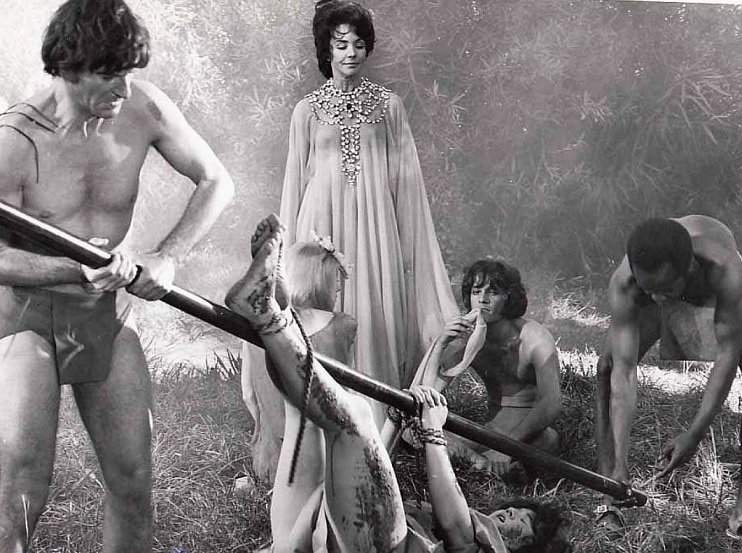
L – R: Roddy McDowall, Jennifer Jones, Davey Davison (seated/back), Holly Near (on the spit), Jordan Christopher, and Lou Rawls — bringin’ on the pretentious symbolism.

If you read our recent review for Breaking News in Yuba County, you know that on October 7, 2020, four decades after the imprint’s closure, Metro-Goldwyn-Mayer reactivated the AIP-imprint to release digital and limited theatrical releases (MGM will handle streaming while United Artists will handle the theatrical end). The studio was founded by James H. Nicholson and Samuel Z. Arkoff and all AIP releases followed the ARKOFF formula:

Action (exciting, entertaining drama)
Revolution (novel or controversial themes and ideas)
Killing (a modicum of violence)
Oratory (notable dialogue and speeches)
Fantasy (acted-out fantasies common to the audience)
Fornication (sex appeal for young adults)

So, yeah, Angel, Angel, Down We Go is a bizarre pint of an ARKOFF-crafted microbrew (bubblin’ with images of Near’s face on a guerilla, and then a lion, as part of a trip and its “message”), a libation of choice that we gulp with glee at B&S About Movies. You know us, with our celluloid schadenfreude of the Sexette (1978)˟˟ and Myna Breckenridge (1970) variety (both spiritual, washed-up actor sloppers), for that is what it’s all about, out on the video brewin’ fringes. So pair Angel, Angel, Down We Go with Robert Thom’s rock “prequel” Wild in the Streets and Mick Jagger’s decadent rock star turn in Performance (1970), toss back an ARKOFF, and pop open a bag of salty American International Psychedelic Trash Nuggets. Yum.

You can stream Angel, Angel, Down We Go on You Tube. For a cleaner, commercial-free stream, we found a PPV copy on Vudu. To get you started, we found a trailer and a copy of the 45-rpm/7″ single for the film’s title cut-theme song.


* Charles B. Griffith gave us the redneck romps Eat My Dust! and Smokey Bites the Dust; went “Jaws” with Up from the Depths and, as an actor, appeared in Hollywood Boulevard. Check out our “Top 70 Good Ol’ Boys Film List” feature with more hicksploitation-cum-redneck reviews.

** Join us for our “Kaiju Day” and “Son of Kaiju Day” review recaps as we pay homage to all manner of Kong and Godzilla movies to celebrate the release of 2021’s Kong vs. Godzilla.

*˟ We discuss Pasolini’s work in our review of the 2020 documentary Fascism on a Thread: The Strange Story of Nazisploitation Cinema.

˟* We discussion Don Kirshner’s film production career in our “Exploring: The Movies of Don Kirshner” featurette.

˟˟ Check out our “Box Office Failure” week of film reviews.

¹ Felix Cavaliere, later of the Young Rascals and the Rascals, got his start with Joey Dee & the Starlighters. He, along with Gene Conrish, have recently reactivated the Rascals (then, as with all other tours, got COVID derailed); after his stint with Joey Dee, Cavaliere formed the Young Rascals with Gene Cornish, Eddie Brigati, and Dino Danelli.

After the Rascals collapsed, they morphed into the harder rocking Bulldog, with Gene Cornish and Dino Danelli at the helm. After Bulldog’s two albums in the early ‘70s, Cornish and Danelli teamed with Wally Bryson, from the early ‘70s “power-pop” pioneers the Raspberries (also out of the same Akron, Ohio, scene as Jordan Christopher), to form Fotomaker, which issued three albums in the late, new-wave ‘70s: Fotomaker, Vis-à-vis, and Transfer Station. A Cars or Knack-like success for Fotomaker was not meant to be, even with their great, debut single, “Where Have You Been All My Life.”

While Fotomaker was going on, Felix Cavaliere — who once played with Joey Dee, mind you — formed Treasure, a harder AOR band that issued an album in 1977 — and featured Vinnie “Vincent” Cusano, later of Kiss, on lead guitar.

Dino Danelli ended up in Little Steven and the Disciples of Soul — playing alongside ex-Plasmatics bassist, Jean Beauvior. After the Raspberries, and before Fotomaker, Wally Bryson formed the hard-rock outfit Tattoo with Thom Mooney from Todd Rundgren’s the Nazz, which put out one album in 1976 on Prodigal Records (a Motown subsidiary). Thom also did time in Fuse with Rick Neilson and Tom Petersson, both later of Cheap Trick. And, the drummer in Fuse was Chip Greenman; he ended up in the Names, which doubled as faux “No False Metal” rockers the Clowns in Terror on Tour. And, of course, Cheap Trick came to be known via their first soundtrack effort, Over the Edge.

Don’t forget! We are deep into our third “Rock ‘n’ Roll Week” blowout. Yes, we’ve done this twice before, and you can catch up with our “Rock ‘n’ Roll Week” Round-Ups 1 and 2 with their full listings of all the rock flicks we’ve watched.


About the Author: You can learn more about the writings of R.D Francis on Facebook. He also writes for B&S About Movies.

The Beatles: Influence on Film 1

This is the first in a three-part series. We are discovering 33 films in the series, with 11 films each over the next three days — at 3 PM — as part of our third “Rock ‘n’ Roll Week” installment.

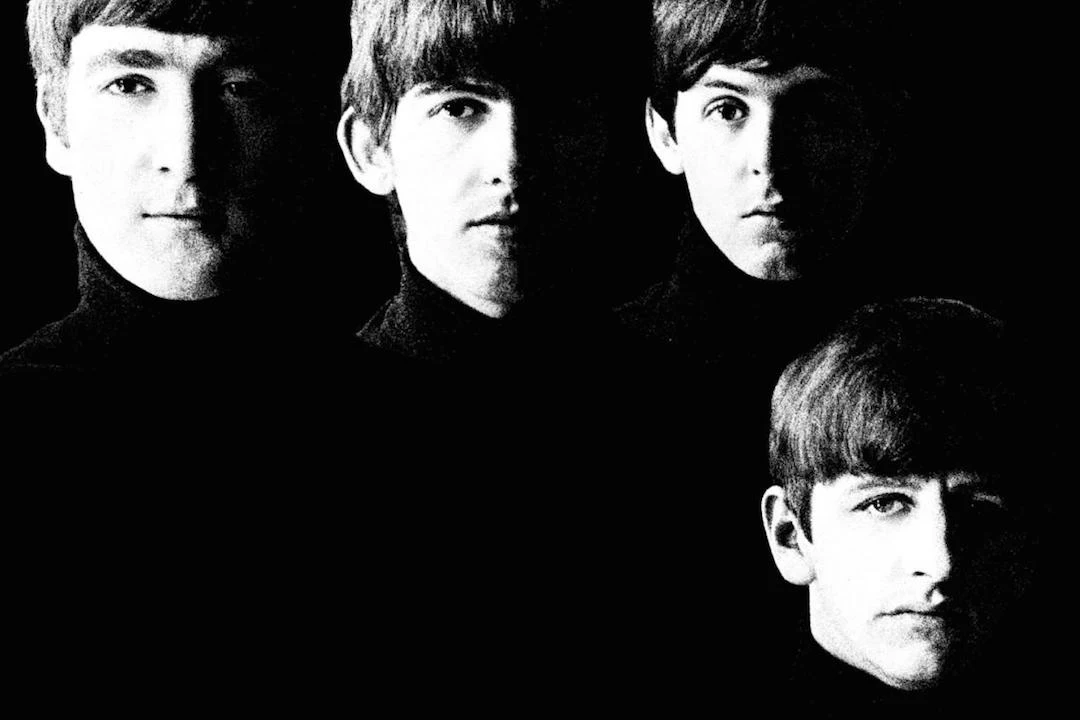
Image courtesy of Parlophone/Town Square Media via Ultimate Classic Rock/logo courtesy of 60s Girl Deviant Art/banner design by R.D Francis

As we developed this third “Rock ‘n’ Roll Week” in February, the 52nd anniversary of the Beatles’ final live performance in 1969 — shot for Let It Be (1970) — passed on January 30.

As you can tell by this article’s title, this isn’t about the Beatles’ movies, such as A Hard Day’s Night or Help! or Magical Mystery Tour or Yellow Submarine (well . . .) or Let It Be or any of the wealth of theatrical, television, and direct-to-video documentaries on the band.

And we are passing on John Lennon in Richard Lester’s How I Won the War (1967) and his work with the “supergroup” the Dirty Mac in The Rolling Stones Rock and Roll Circus (1968/1996), as well as Paul McCartney’s vanity piece, Give My Regards to Broad Street (1984).

And we are passing on chronicling the works of George Harrison’s Handmade Films, so nothing on Monty Python’s Life of Brian (1979), The Long Good Friday (1980), and Time Bandits (1981), or his production of Shanghai Surprise (1986), in which he appeared and recorded five new songs.

And we are passing on Ringo Starr’s resume with Candy (1968), The Magic Christian (1969), and Blindman (1971), as well as his co-starring roles in That’ll Be the Day (1973) and Son of Dracula (1974), his work as the Pope in Lisztomania (1975), his starring role in Caveman (1981), his appearance as Larry the Dwarf in Frank Zappa’s 200 Motels (1971), and his work on Harry Nilsson’s animated film The Point! (1971). We’re also passing on Ringo’s appearances in Martin Scorsese’s The Last Waltz, his document on the 1976 farewell concert of the Band, and the Who’s The Kids Are Alright (1979). And how can we forget, Ringo (1978), Starr’s made-for-television adaptation of The Prince and the Pauper, and Princess Daisy (1983), with wife Barbara Bach. And Ringo’s appearance in Sextette (1978), and directing debut of the T.Rex concert document, Born to Boogie (1972).

This exploration is concerned with the speculative biographical flicks, the films using the legend of the “Fab Four” as plot fodder, and the historical sidebars to their careers — both as a band and solo artists.

The films are listed by their year of release.


Yellow Submarine (1968)
We each have our fond memories of this sort of . . . and it’s not . . . but it is . . . Beatles film. Sam the Bossman remembers watching it on UHF-TV as his dad and grandad fixed the furnace. Me? My sister still doesn’t let me live down my nightmares . . . of the Blue Meanies coming to get me. What did my parents know about LSD trips? It’s those loveable moptops from A Hard Day’s Night, after all . . . and it’s a cartoon. What’s the harm . . . and I am still scarred by it, for life.

Initial press reports stated that the Beatles themselves would provide their own character voices. But all was not well at Apple Corp. and the lads weren’t enthusiastic about working on a new motion picture to fulfill their three-picture deal with United Artists, having been dissatisfied with their second feature film, Help!.

So, the Beatles bailed on project, giving the over 200 artists — who crafted the film across 11 months — all the creative space they needed. John, Paul, George, and Ringo composed and performed the songs (a mere six that comprises 22 minutes of Side One; the other half was comprised of George Martin orchestral compositions). As actors, the “real” Beatles only participated in the film’s closing scene, while their animated doppelgangers were voiced by other actors.

Obscure Beatles cover song hokum: There’s been a LOT of covers of Beatles tunes over the years . . . but one of the coolest covers of “Yellow Submarine” was done by Philadelphia, Pennsylvania’s More Fiends from their album, Toad Lickin’ (1990). Here’s the rub: The song, titled “Yellow Spades,” is actually a cover of Motorhead’s “Ace of Spades” backing Paul McCartney’s lyrics.

I wonder if Paul has ever heard it? Did Micheal?

Micheal Jackson sold Northern Songs, Ltd., the publisher of the Beatles’ catalog, in 1995; the More Fiends, it seems, escaped the Gloved One’s legal wrath. The same can not be said of New York’s SST recording artists Das Damen. On their Marshmellow Conspiracy EP (1988), they recorded “Song for Michael Jackson to $ell,” which was actually an uncredited cover of the Beatles’ “Magical Mystery Tour.” After discovering the unlicensed cover, Jackson’s lawyers assured the track was removed from future editions of the album.

Still, I wonder if Micheal would have unleashed the legal hounds of war on the More Fiends? “Yellow Spades” is still commercially available on Apple Music or Spotify. So, either no one cared or the legalese was settled.

And yes. There is a band called, Blue Meanies, a ska-core band from Illinois, U.S.A. that recorded several albums between 1988 to 2007 — with no illegal Beatles covers from Yellow Submarine.

All This and World War II (1976)
So, before the creation of the abyssal Sgt. Pepper’s Lonely Hearts Club Band, the sappy-hokey I Am Sam, and the not-much better Across the Universe — and before Robert Stigwood gave record executives a bad name by ravaging the Beatles — Russ Regan, president of both UNI Records and 20th Century Records, and vice-president of A&R at Motown, came up with the idea to document the horrors of war through newsreels. He wondered, “What if The Beatles provided the soundtrack?”

Uh-oh.

Instead of real Beatles tunes — and in a warm up for their later work with Robert Stigwood — the Bee Gees stand in for the Fab Four, initially contracted for the entire soundtrack. In the end, the Brothers Gibb recorded six songs; three ended up in the film: “Golden Slumbers/Carry That Weight,” “She Came In Through The Bathroom Window” and “Sun King”; their versions of “Lovely Rita,” “Lucy In the Sky With Diamonds,” and “She’s Leaving Home” didn’t make the cut. Elton John, Ambrosia, Rod Stewart, and a host of other chart-topping musicians take care of the rest.

All You Need is Cash, aka The Rutles: All You Need Is Cash (1978)
Eric Idle and the Monty Python troop devised rock mockumentary of skits and gags chronicling the fictional tales of Dirk, Stig, Nasty, and Barry, aka the Rutles, a band whose career mimics the Beatles’. Airing as an NBC-TV special, the movie earned the lowest ratings of any show on U.S. prime time television that week.

Are the proceedings are better than that? Yes. On equal with Spinal Tap’s exploits? No. But it’s darn close.

The ersatz Beatles tunes were written by ex-Bonzo Dog Band (friends of the Beatles appearing in Magical Mystery Tour) member Neil Innes, who portrayed John Lennon to Eric Idle’s Paul McCartney. Ex-Beach Boys drummer Rick Fataar portrayed George Harrison; Lou Reed band member John Halsey (1972’s Transformer) parodied Ringo Starr.

Yes . . . as with Spinal Tap, there is a sequel.

I Wanna Hold Your Hand (1978)
Robert Zemeckis, later of the Back to the Future franchise and awards-sweeper Forrest Gump (and Used Cars is pretty fine, too), makes his feature film writing and directing debut with this examination of the hysteria of Beatlemania. It’s seen through the eyes of four teenagers (headed by Nancy Allen and the always-great Wendy Jo Sperber) as they try to meet the Beatles during their time in New York to appear on The Ed Sullivan Show on February 8, 1964.

The Beatles show up, as well as Brian Epstein, in archive footage, while William Malone cameos in an uncredited role as George Harrison. And yes, we are taking about the writer and director behind Creature. And we get a “Ringo” in the form of Eddie Deezen’s nicknamed Richard Klaus in the film, so all is well. The soundtrack features seventeen original recordings — covers and originals — by the Beatles.

Sgt. Pepper’s Lonely Hearts Club Band (1978)
The Beatles’ cover tunes by the Bee Gees and Peter Frampton, as well as Aerosmith showing up for an “evil” rendition of “Come Together,” for this tale about Billy Shears and the “band” of the title, are quite good; it’s the celluloid wrapped around it that stigs, uh, stinks. Oh, the overwrought Frankie Howerd (as Mr. Mustard) and ham-fisted Steve Martin (murdering “Maxwell’s Silver Hammer”), why?

It’s been 43 years since seeing this in a theater — and never on cable or tape, no way; for once was enough for me. For the memory . . . the horror . . . is still burned into my cerebrum. I need a Beatles lobotomy, Joey. Where’s the Pepperland-invading Blue Meanies to stop the Bee Gees when we need ’em?

Birth of the Beatles (1979)
Dick Clark (who also made Copacabana . . . based on the Barry Manilow song) hired ex-Beatles’ drummer Pete Best as a Technical Advisor and Richard Marquand (Star Wars VI: Return of the Jedi) as his director to give us this take on the early history of the Beatles — then known as the Silver Beatles. The film is noted as the first biographical drama on the band, released nine years after the announced break-up of the Beatles themselves, and is the only Beatles biopic to be made while John Lennon was still alive. While it was released as a worldwide theatrical feature, this was issued as a TV movie on ABC-TV in the States.

Courtesy of a publishing loophole — unlike the later and similar early-days-of-the-Beatles Backbeat, which used songs the Beatles recorded as covers — the songs in Birth of the Beatles were written by the Beatles themselves, only interpreted by the Beatles tribute act, RAIN.

The “loophole” of using cover versions of Lennon-McCartney compositions, of course, backfired. As result, Birth of the Beatles has fallen out of print and will more-than-likely never be reissued to DVD or Blu-ray. But there’s a TV rip uploaded to You Tube.

Marquand, who made his made his debut directing Roger Daltry in The Legacy, also directed ’60s folkie Bob Dylan co-starring with ’80s pop singer Fiona (the 1985 Top 15 hit “Talk to Me”) in the pretty awful, Joe Esztherhas-penned flick, Hearts of Fire (1987).

Beatlemania: The Movie (1981)
A smash Broadway musical-rockumentary advertised as “Not the Beatles, but an incredible simulation” that ran for 1,006 performances from May 1977 to October 1979 is a sure bet for a theatrical film adaptation.

No, it’s not.

The show — a multimedia production consisting of backdrops and projected images of art and video footage from the Beatles-era, as well as numerous clips of the Beatles — consisted of 29, chronologically-played songs, complete with costume changes.

So — with a Broadway hit on their hands — the managerial impresarios behind the production, Steve Lever and David Krebs (known for their handling of the Rolling Stones, Joan Jett, and Aerosmith; remember “Boston’s Bad Boys” appeared in Sgt. Pepper’s Lonely Hearts Club Band), decided that — Apple Corps. lawsuits, be damned — it was time to take on the albums charts and the silver screen.

The original cast of Joe Pecorino (rhythm guitar, John), Mitch Weissman (bass guitar, Paul), Les Fradkin (lead guitar, George), and Justin McNeill (drums, Ringo), and the second cast of Randy Clark as John, Reed Kailing as Paul, P.M. Howard as George, and Bobby Taylor as Ringo, headed into the studio for a 1978 Arista The Album release — which bombed with record buyers as it scrapped into the lowest regions of the Billboard 200.

Seriously? Who wants to buy a Pickwick (Discogs) budget sound-alike of Beatles tunes?

Okay . . . well, maybe a movie would work, better.

Uh, no it won’t. Remember All This and World War II?

Production began in late 1980 — shortly before John Lennon’s December 8 murder — under the tutelage of TV director Joseph Manduke (Harry O, Hawaii Five-O, Barnaby Jones). The cast featured a mix of musicians from the Broadway production and album, with Mitch Weissman back a third time as Paul, David Leon as John, Tom Teeley as George, and Ralph Castelli as Ringo.

Released in the summer of 1981, Beatlemania: The Movie quickly became a critical and box office bomb. Apple Corps, who launched their first legal volleys regarding publicity rights and trademarks in 1979, finally won in damages in 1986.

And Ringo hated the concept, in whole.

You can learn more on the making of Beatlemania (the Broadway show) with this Chicago news station-produced TV documentary on You Tube.

John and Yoko: A Love Story (1985)
This NBC-TV effort chronicles the relationship between John Lennon and Yoko Ono. The movie was made with the co-operation of Yoko Ono, who controlled the song rights. The film begins on August 19, 1966, in the wake of a protest initiated by Lennon’s (misunderstood) comment that the Beatles “were more popular than Jesus” and end with Lennon’s murder in 1980.

In a production twist: Actor Mark Lindsay booked the role of John Lennon. When Ono discovered that was his professional name — and that his birth name was Mark Lindsay Chapman — the similarity gave her “bad karma,” so he was recast with Mark McGann.

In 2007, Mark Lindsay was cast as an “older” Lennon in Chapter 27 (2007) — the tale of Lennon’s assassin, Mark David Chapman.

Concrete Angels (1987)
Robert Zemeckis scripted his Fab Four tale, I Wanna Hold Your Hand (1978), around the Beatle’s historic February 8, 1964, appearance on CBS-TV’s Ed Sullivan Show. In that tale, a group of friends schemed to meet the band.

This time, a quartet of ne’er-do-well teens from the wrong side of Toronto’s tracks form the Concrete Angels to enter a radio station’s battle of the bands contest and win the opening act slot for the Beatles’ gig. Will they win and escape their poverty or will they fall back into their juvenile acts of crime?

The Hours and Times (1991)
Christopher Munch makes his writing and directing debut with this fictionalized account of “what might have happened” during a real holiday taken by John Lennon and (the homosexual) Beatles’ manager, Brian Epstein, in 1963. Ian Hart, who stars as John Lennon, portrays him one more time, in Backbeat. The film was restored for a 2019 DVD release.

Secrets, aka One Crazy Night (1992)
As with the previous Beatles-inspired films I Wanna Hold Your Hand (1978) and Concrete Angels (1987), this Australian production works as a coming-of-age drama — a retro ’80s John Hughes coming-age-drama — backed by Beatles folklore. Now, instead of trying to meet the Beatles at their first New York and Toronto concerts, we have five teens who sneak in, then find themselves trapped in the bowels of a Melbourne concert venue where the Beatles are set the make their June 11, 1964, Down Under debut. Saccharine soul bearing, ensues.

As with most Beatles films, you’re getting covers (most outside of the timeline of the movie) — this time from Dave Dobbyn, of New Zealand’s Th’ Dudes (their hit, “Bliss“) and DD Smash (their hit, “Outlook for Thursday“) (DD Smash would sweep the New Zealand Music Awards in 1982 and 1983, but a Men at Work or Split Enz crossover to America wasn’t meant to be). The Judd Nelson/John Bender of the bunch comes in the form of an antithesis Elvis fan stuck in the ’50s. Another looks like Wolowitz from The Big Bang Theory — only with out the nose (because he’s obsessed with George, not Ringo), who always wears Fab-inspired suits.

Impossible to find on U.S. shores as a VHS or DVD on home video shelves, we found copies on You Tube HERE and HERE.

Courtesy of 1000 Logos.

Join us tomorrow for our second installment with our next batch of films.

About the Author: You can learn more about the writings of R.D Francis on Facebook. He also writes for B&S About Movies.

Jurassic Shark 2: Aquapocalypse (2021)

“There’s bad and then there’s boring-bad and this is just bad, which is a nice thing to say.”
— Sam Panico of B&S About Movies in his review of Brett Kelly’s Jurassic Shark

Great poster . . . one day, the film will live up to the one-sheets. Nah!

In our never-ending quest to review every shark flick ever released, we just have to. . . .

Besides, when you have Mark Polonia, who we jam on over here at B&S About Movies (who treaded these waters before with the bonkers Shark Encounters of the Third Kind) making a (unofficial) sequel to Brett Kelly’s nine year old film, who we also jam on at B&S (who slopped these waters before with Ouija Shark), well, we just have to. . . .

Do we have to tell you the CGI shark is bad and that the acting — babbling about the dangers of bio-engineering — is bad? That’s there not one practical, in-camera gunshot, blood drop, or explosion effect to be had? That the wide-to-close up continuity is beyond fubar’d? Yeah, we just have to. . . .

So, anyway, if you missed the Brett Kelly instigator: The (50-foot) megalodon unleashed by an oil rig frackin’ up the ocean floor in the first film is back, still swimming around the rig . . . one of the most understaffed rigs in the history of the fossil fuels industry because, well, the budget could only afford a cast of four. Well, there’s the folks in that local fishing village, flailing about as only bad “look at me” extras can.

“Dude, is the ’90s video game-era shark even original this film?”

Eh . . . with so many of these CGI “Shark Weak” films produced, these selachimorpha romps are probably recycling at a rate that would give Roger Corman pause. At least that shark jumping out of the ocean to clamp down on a CGI’d T-Rex poking along the beach — in a 50 million year flashback — looks new to the game. Why yes, that’s Polonia and Kelly — and sometimes Brett Piper — familiar stock players Jeff Kirkendall and Titus Himmelberger in the cast. At least, as Sam pointed out in his review of Brett Kelly’s Jurassic Shark, Mark Polonia’s sequel isn’t padded by twelve minutes of credits against fifty minutes of actual movie. To that end: we’ve only got two minutes of credits against a not-to-painfully quick 68-minutes . . . not counting the two minutes of opening titles of a shapely bikini babe wading in the water . . . who then swims for a minute, before her chomping. See, you can handle a 65-minute movie. . . .

Eh, stop your snobby bitchin’, ye film critic.

As is the case with any Brett Kelly flick (I liked Countrycide), or Polonia Brothers shingle swinger (which had the balls to mesh the shark genre and Amityville franchise via Amityville Island), or Brett Piper joint (who’s a god around here*) that comes down the streaming pipeline, we had a lot of ’60s retro drive-in fun. They all studied at the Dennis Divine School of Cinema**, so we likey.

In the middle of July, we rolled out a “Shark Weak” of reviews. During the earliest days of the site, we also rolled out a “Bastard Son of Jaws Week” and “Exploring: Ten Jaws Ripoffs” featurette. Yeah, that’s a lot of digital chum to swallow, but you can do it! Click those hyperlinks! Yeah, we know that Brett Kelly’s Raiders of the Lost Shark and Mark Polonia’s Virus Shark aren’t amid those reviews. Look, we are Polonia and Kelly fans, not masochists . . . but for more Polonia-related reviews, check out our reviews of  Amityville Deathhouse, Amityville Exorcism, Empire of the Apes, Outpost Earth, and Return to Splatter Farm.

You can learn more about many of their films by visiting the Facebook page and official site of Wild Eye Releasing. Jurassic Shark 2 — as has Virus Shark — will probably end up on Tubi soon enough. But for those who can’t wait, it started streaming this week on You Tube and Amazon Prime. (Clicking either link will launch the official Wild Eye trailer.) Meanwhile, over at Asylum Studios, they’ve just released their own CGI shark fests that are Swim and Shark Season (I liked Swim; Shark Season not so much.) See, told you we are on a quest aboard the U.S.S B&S: all unofficial “Amityville” and “Jurassic” and “Shark” films will be watched!

* What? You never read our “Drive-In Friday: Brett Piper” night tribute? Bad B&S reader. Bad boy!

** What the hell, son? You never read our “Drive-In Friday: Dennis Devine” night tribute, either? You got sum hyperlinkin’ to do!

FYI: For our many European readers: Tubi is not available overseas without a U.S.-hosted proxy server. Please refer to You Tube or search on other streaming services. Wild Eye films are widely distributed, so you will surely find a streamable online copy in your country.

Disclaimer: We did not receive a review request for this film. We just like shark flick, and Polonia flicks, and what chum Wild Eye Releasing tosses into the digital streams.

About the Author: You can learn more about the writings of R.D Francis on Facebook. He also writes for B&S About Movies.
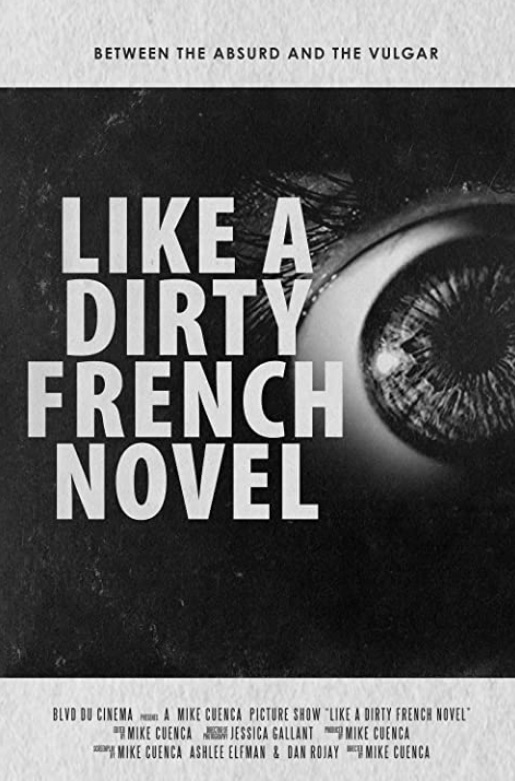
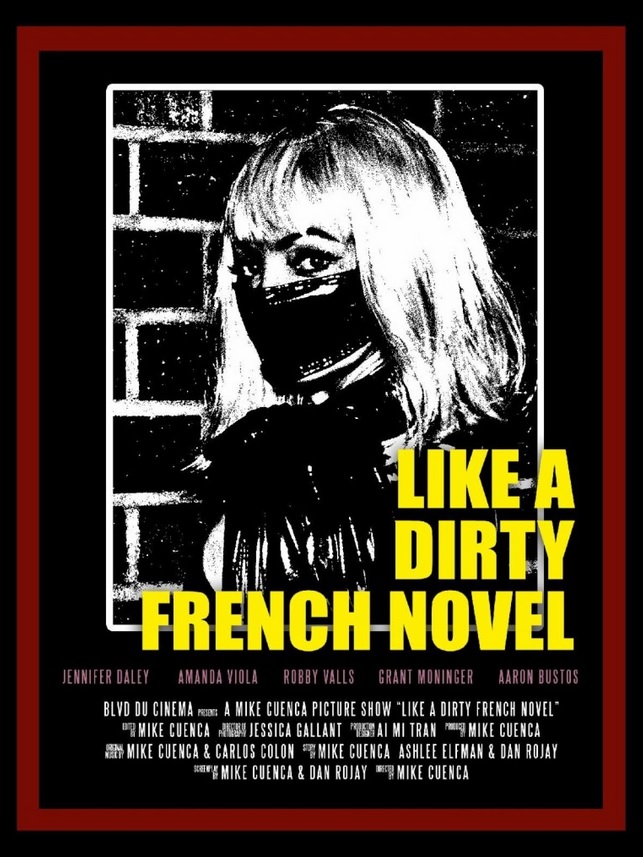
Like a Dirty French Novel (2021)

We first reviewed the writing and directing work of self-taught award-winning filmmaker Mike Cuenca with last year’s music ensemble drama I’ll Be Around. We enjoyed that eclectic-eccentric character study, so seeing Cuenca’s name on the one-sheet advanced his latest film to the top of the review stacks. Equally intriguing: Cuenca shot the film in one whirlwind week during the height of the Winter 2020 COVID lockdowns.

Note the homage of the Velvet Underground’s “Some Kinda Love” (lyrics) for the film’s title and tagline/streaming one-sheet.

If the title’s not giving it away, Mike Cuenca’s taken his same abilities at adeptly interweaving plots and characters — only in the context of a film noir, with the proceedings less James M. Cain commercial (The Postman Always Rings Twice, Double Indemnity) and more non-mainstream David Lynch (think Lost Highway). Upping the ante: Cuenca’s drafted the pandemic into the plot, which serves as the catalyst (in lieu of greed or sexual weakness) to a surrealist nightmare. While it plays, at first, as a disconnected anthology about unrelated people making due during the pandemic with a weak through line, it all comes together in a plot that’s nicely psuedo-Giallo’d along the way. While non-linear — and we know how that rubs the wrong way with some viewers — give it time: the dots connect.

What are the “dots” as it were?

A mysterious woman in the deserts surrounded by a cult-masked group. There’s two gun-toting thugs executing a kidnapping plot. A mysterious woman makes a phone call that sexually intrigues and frightens a man at once. A rare comic book is at stake. There’s a meeting in a city park with a person that may be “love,” but more wishful-illusion than reality.

Quentin Tarantino scripting meets Lou Reed’s lyrics/the festival one-sheet.

For a film shot-on-the-fly with no budget under pandemic restrictions: just wow. This film is twisty-scripted, nicely shot, Giallo-expertly lit, and the acting — which I’ll assume was done sans paychecks by the cast for the love of the craft with the need to create “something” to quell the lockdown madness — is well-concentrated, with everyone on-point with their characters.

Like a Dirty French Novel is everything you don’t expect to see in a streaming indie flick — and we love the film for it. The caveat is that I enjoy non-linear films: again, they are not for everyone. Truth be told: If not for Mike Cuenca impressing me with I’ll Be Around last year, I might have looked this one over and reviewed something else because, not all filmmakers can pull off multi-character plots and non-linear tales. Mike Cuenca, can.

If this is what he can do on the fly sans a budget, I look forward to what Mike Cuenca will do with a budget — possibly a studio shingle behind him — in a post-pandemic world.

Mike Cuenca is a writer-director to keep an eye on. He’s two-for-two in my review books.

Disclaimer: We were provided a screener copy of this film from the production’s PR firm. That has no bearing on our review.

About the Author: You can learn more about the writings of R.D Francis on Facebook. He also writes for B&S About Movies.

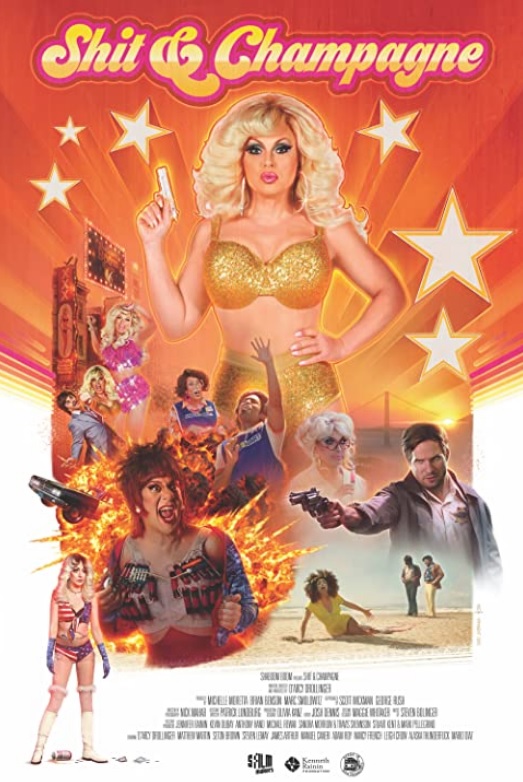
S**t & Champagne (2021)

There’s not too many films that sell me within a minute of its two minute trailer with a want, no, a need, to see the movie it shills. Oh, do I ever want to stream this movie.

Don’t worry. This p**y’s got teeth!”

If Quentin Tarantino decided to make another retro-homage to his video store memories of old — only trading out the blaxploitation-slanted Jackie Brown or grindhouse-inclined Rick Dalton with a doesn’t-take-any-guff drag queen by the name of Champagne White for a celebration of ’70s Russ Meyer sexploitation flicks — this brilliant, deliciously decadent feature debut by the creative tour de force that is D’Arcy Drollinger is that movie.

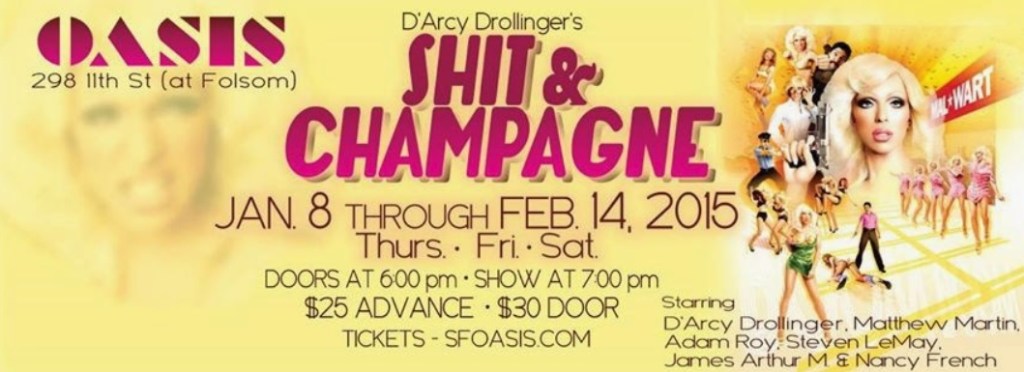
Practicing his craft with a series of campy stage productions at The Oasis, a famed San Francisco alt-lifestyle nightclub that he owns and operates, Drollinger (who’s portrayed Frank-N-Furter in productions of the Rocky Horror Show) takes those stage-steps to its ultimate, theatrical destiny as the writer, director and star of S**t & Champagne. During interviews, Dollinger describes his labor of love as “dragsploitation” and name-checks Pam Grier’s Foxy Brown and Linda Blair’s Savage Streets, along with the Zucker Brothers’ slapstick comedy films, as well as the ’70s TV series Wonder Woman and The Bionic Woman as his inspiration.

Just a caveat: Outside of a couple drag-kings and men playing men, no one is actually a playing a “drag queen” as a character: they’re all females, got it? So plant your suspension of disbelief firmly between the teeth and gums, and enjoy.

From The Oasis Nightclub showing/courtesy of Theater Eddy’s.

Champagne White, actually Champagne Horowitz Jones Dickerson White (“So, I’ve been married a few times, it’s none of your fucking business!”), is a stripper, ahem “exotic dancer,” in 1975-era San Francisco. After witnessing the murder of Rod, her walrus-stached and polyester suit-clad fiancé (Mario Diaz), then having her “adopted half-sister,” Brandy (Steven LeMay), die in her arms, by the same thugs (the chemistry-perfect Adam Roy and Manuel Caneri) who murdered Rod, the cork, as it were, pops on the whoop-ass.

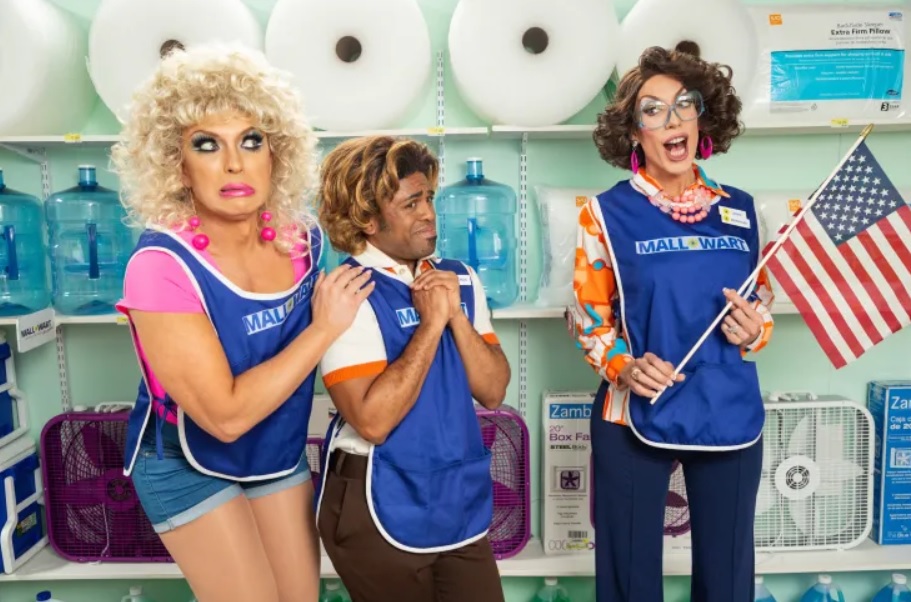
As Champagne descends into San Francisco’s sex and drugs and murder-ridden underbelly — complete with a back-to-school clothing ring stumbled upon by the retail-managing Rod — a world rife with one-liners and song and dance numbers, she comes face to face with underworld king, well, queen pin, Dixie Stampede, the corporate-owning mogul of the world-famous Mall-Wart (expertly played by Matthew Martin, who gives Dollinger a run for the award-winning thespin’ money). Along the way, Champagne finds romance with an oh-so-’70s-splotitive detective named Jack Hammer (a slicing it nice n’ thick Seton Brown) as she battles the Keystone Cops-ineptness of Dixie’s minions (I’m really diggin’ on Adam Roy’s — in his film debut — Jim Carrey-comedic vibe with his Tony character; here’s to seeing him in more roles; a Kung-fu fightin’ Manuel Caneri portrays his boss, Johnny the Gun).

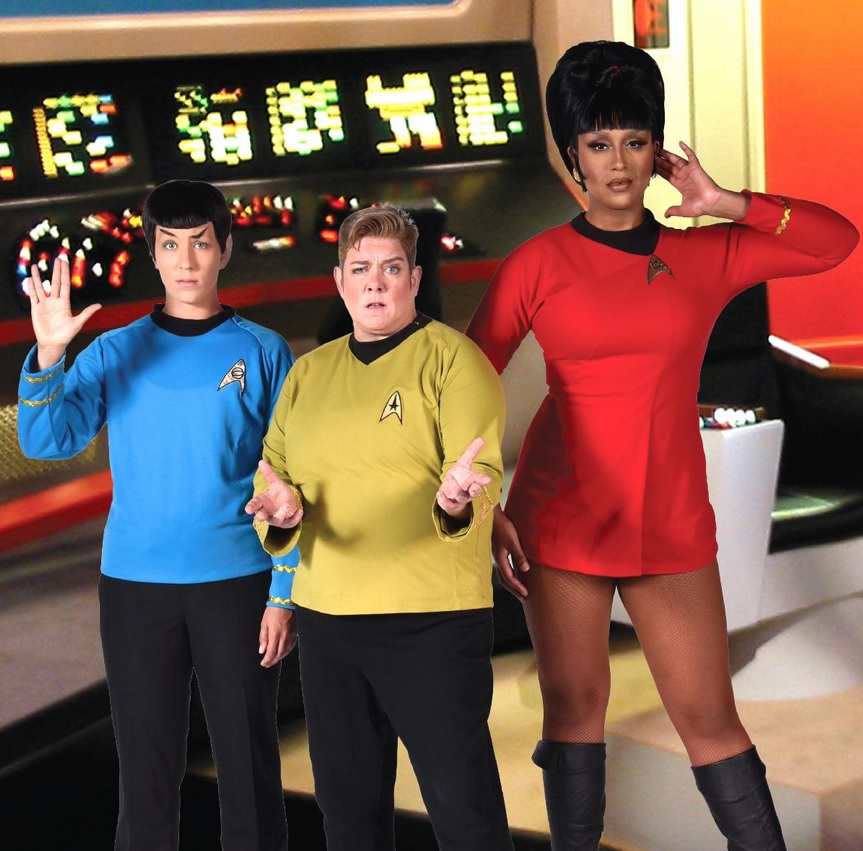
In 2016 The Oasis gang put on a drag-king version of one of the original Star Trek episodes, “Mudd’s Women,” with actress Leigh Crow (center) as Captain Kirk. Also known throughout the Bay area as a popular Elvis impersonator, Elvis Herselvis, she stars in S**t & Champagne as Al, the owner of the Shaboom Boom Room,

Yeah . . . I had a lot of fun watching this: It is quite clear the cast is cognizant of their material’s John Waters, Mel Brooks (think of a glitzier-slanted High Anxiety), Russ Meyer (one of Drollinger’s stage productions was Above and Beyond the Valley of the Ultra Showgirls, if that’s a clue), and Charlie’s Angels (even campier) roots. They’re having a lot of fun . . . more fun than any Don Edmonds flick of old starring the awesome Dyanne Thorne.

D’Arcy Drollinger has made it quite clear: his celluloid jam is the ’70s drive-in exploiters of yore, which, for many of us, were absorbed during the VHS ’80s. So, if you feel a warmth in the ol’ analog cockles for sexually-liberated bachelorettes (or multiple divorcee/widows!) who work their long blonde hair and even longer, silky legs, à la Cherie Caffaro’s James Bond’in Ginger McAllister from Ginger (1971), The Abductors (1972), and Girls Are For Loving (1973), or Joyce Jillson working it in Crown International’s Superchick (1973), as well as Francine York and Tura Satana kicking it Ted V. Mikels’s The Doll Squad (1973), and 1967 Playmate Anne Randall takin’ names in Andy Sidaris’s Stacey (1973) — each which, ironically, foretold Charlie’s Angels — then you’ll appreciate Dollringer’s over-the-top homage. Is there a tip o’ the hat to Chesty Morgan’s Doris Wishman two-fer of 1974’s Deadly Weapons and Double Agent 73? You bet!

To that “’70s” end: A special shout-out is necessary to Production Designer Olivia Kanz, Art Director Elena Nommensen (the upcoming Venom: Let There Be Carnage; the great Texas-bred horror shot, The Devil’s Passenger, and looks awesome horror-western, Ghost in the Gun), and Costume Designer Maggie Whitaker, as this film is a retro-junkie feast of the senses that looks way more expensive than its production budget probably allowed.

Drollinger, left, a stellar James Arthur as club-pal Sergio, and a just nails it RuPaul’s Drag Race All Stars’ Alaska Thunderf**k as Dixie Stampede’s retail minion, Janis.

So, what’s the deal with the title . . . and the coprophilia of plot? Well, to hear Drollinger tell it, many of those films and TV series of the ’70s always had a subplot with the bad guys shootin’ up prostitutes or those “too smart for their own good,” with heroin, then selling them into white slavery. But heroin “isn’t funny.” So he developed the “Booty Bump”: a new, fab drug raging across San Francisco that causes, well, a very bad case of diarrhea.

Considering the just-go-for-it scripting and over-the-top thespin’ of the material, I can see Drollinger’s comedic point. However, I feel the coprophilia “drug addiction” sub-plot is actually to the determent of the brilliance of the material, as not everyone thinks defecation is funny. Part of my inner critic wishes the film was simply titled Champagne White (the title of the originating stage play) and another “comedic” drug addiction, à la a Kevin Smith or Cheech and Chong joint, was developed for the story, instead of an overly-extreme Todd Phillips (think The Hangover series meets the retro Starsky and Hutch) or Judd Apatow (think The 40-Year Old Virgin meets Pineapple Express) raunch-approach.

Does that mean I am hating on the film? No, not at all.

If Dollringer sold this script to a major studio shingle, and Phillips or Apatow took hold of the production reigns, how could you not see Amy Schumer as Champagne, Eddie Izzard as the terrorist-pimp-retail mogul Dixie Stampede, John Goodman as Al, the owner the Shaboom Boom Room, Jim Carrey as Tony, Bruce Willis as Johnny the Gun, Steve Carell as Jack Hammer, and a cameoin’ Nick Cage as Rod? Sounds like a friggin’ Coen Brothers “Raising Champagne” joint, right? But, hey, I’m the smarmy critic who loved George Gallo’s ’70s retro-remake (that everyone else seems to hate) of camp-meister Harry “Tampa” Hurwitz’s The Comeback Trail (2021), so what in the hell do I know about film.

Well, I know that Drollinger’s 44-keyin’ is that good . . . and I’m already jonesin’ for D’Arcy’s next flick. I want more Champagne! Anne Randall’s Stacey Hanson was a private eye who sidelined as race car driver. Perhaps an Andy Sidaris homage: Champagne Express. Make it happen, D’Arcy!

Yeah, this is a great film, but the title — and the meaning behind it — may turn away streamers. But, to be honest, isn’t the fact that this is a “dragsploitation” movie already turning the weak of humor, away? That’s their streaming loss. S**t & Champagne isn’t a drag . . . it’s a full-on retro-celluloid hip thrust that sold me within one minute of its two-minute trailer.

Making its debut as a festival rollout from June through September, S**t & Champagne was acquired for international distribution by Utopia Media, which also brought the British rock document on Suzi Quatro, Suzi Q, to the world stage. Utopia’s other award-winning documents are Martha: A Picture Story, concerned with Martha Cooper, a New York-based, trailblazing female graffiti artist and street photographer, WITCH – We Intend to Cause Havoc, about the ’70s Zambian progressive-rock band of the title, For Madmen Only: The Stories of Del Close, regarding the influential comedy writer, and Sara Dosa’s really fine The Seer & the Unseen.

Utopia is headed by Robert Schwartzman — of the band, Rooney, and a writer and director in his own right — who made his feature film directing debut with the really fine comedy, The Argument, released last September. You can learn more about the launch of Utopia Media with this February 19, 2019, article at Deadline.com.

Release Information: You can enjoy the VOD release of S**t & Champagne exclusively on Altavod on September 7. If you’re an AppleTV subscriber or Amazon user, you’ll be able to stream it on October 12, 2021. For those who prefer a hard copy, a special edition Blu-ray of S**t & Champagne will also be available for purchase from Utopia Media exclusively at Vinegar Syndrome.

You can learn more about the film’s digital roll out at its official website and Facebook. You can also follow D’Arcy Drollinger at his official site.

Disclaimer: We were provided a screener copy of this film from the production’s PR firm. That has no bearing on our review.

About the Author: You can learn more about the writings of R.D Francis on Facebook. He also writes for B&S About Movies.
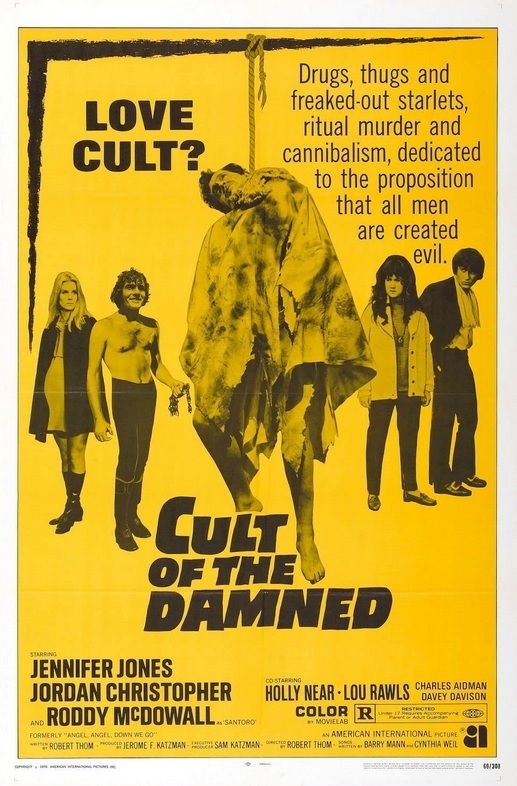
Glenn Danzig’s Death Rider in the House Of Vampires (2021)

U.S. Theatrical Premiere News

While most streamer opines weren’t kind, we dug Verotika: Glenn Danzig’s feature film debut that played with the Elizabeth Bathory legend. What can we tell ya: we adore auteur projects as much as we do movies with rock stars in them. As with his debut film, through its cognizance of Giallo-styled camera angles, Danzig displayed his knowledge of Fulci and Bava, and that class and style continues with his second feature film.

However, instead of Giallo, Danzig’s tackling the Spaghetti Western genre . . . with a Quentin Tarantino flare by introducing vampires into the frames.

The always welcomed Devon Sawa (Final Destination) is our resident “man with no name,” the “Death Rider,” who travels the deserts on horseback as he searches for Vampire Sanctuary to do battle with Count Holliday (Julian Sands), Vampire Lord of the Sanctuary, along with the likes of Carmillla Joe (Pittsburgh home girl Kim Director), and the afterworld gunslingers Drac Cassidy (Eli Roth), Bad Bathory (Glenn Danzig), Kid Vlad, and Duke VonWayne. Manning the bar is none other than Lee Ving of Fear, along with Danny Trejo, and director James Cullen Bressack (For Jennifer), in support.

Following two successful advanced screenings in Los Angeles and Las Vegas this past weekend, Death Rider in the House of Vampires will open across the U.S. at 200-plus screens in select theaters, Friday, August 27th, with most first showing at 9 and 10 PM. You can get tickets — as well as future streaming information — at deathridermovie.com. Just enter your zip code to find a theater near you.

You can learn more about the film with extended interviews from Glenn Danzig, along with actors Julian Sands and James Cullen Bressack on Glenn Danzig’s official YouTube portal.

Our Post-Premiere Review

Yes! We finally got our screener!

So, yeah, critics were not kind to Verotika and likened Danzig’s efforts to that of Tommy Wiseau . . . but I spoke in the positive of The Room, so, well, you know: What da frack do I know about film?

Those same critics weren’t onboard with Danzig’s sophomore effort, either. Me? Danzig’s grown as an against-the-budget indie filmmaker, but I’d still like to see improvement on his craft. Is it flawed: Yes. Is there a lot of passion and heart on the screen to compensate for the flaws: Yes. Should Danzig not serve as his own writer, director, and producer . . . as well as cinematographer and editor, turning the reins over for one to two disciplines to a more experienced craftsman — and let them have the last say? Probably. Danzig also scored the film — but that is the one craft he must keep to himself; in fact: I love the score and like to see Danzig compose for the films of others.

The “plot,” such as it is, well, there’s not much more to tell you beyond what we received in our promotional press kit to help launch its 200-screen U.S. theatrical debut in August 2021.

There is no mistaken our Tarantino assumptions: you’ll get the From Dusk Til Dawn shakes. Sawa’s “Death Rider” is a mysterious cowboy who arrives in town on horseback with a naked, virgin sacrifice for entrance to Sanctuary: a brothel-cum-saloon flowing with rotgut, vamped-up hookers, and blood.

As we guessed: Fulci and Bava, the latter more so, rules the frames with lots — and maybe too many — zooms from Danzig’s Gialli-love emulated in the frames. Whatever weakness you see in the film from Danzig’s end are compensated by solid performances by Devon Sawa as our Death Rider, and Julian Sands — who I haven’t seen in ages on screen (but recently in a 2000s-shot U.S. TV re-run of NBC-TV’s Law & Order) — is top notch as the warlock-ruler of Sanctuary.

All in all: I am stoked to see what Danzig comes up with for his next project.

You can get Death Rider in the House of Vampires merchandise through Cleopatra Records, which also carries the Verotika Blu-ray/DVD/CD combo pack. Death Rider is out there as a single-disc 2K Blu-ray, we think: it was announced in 2021 at Blu-ray.com, but shows that it is “not rated” and has no release date. The film’s official site also offers no update on a streaming or a hard media release date, although it’s recently listed as part of the release schedule of VMI Worldwide.

About the Author: You can read the music and film reviews of R.D Francis on Medium and learn more about his work on Facebook. He also writes for B&S About Movies.

Jurassic Hunt (2021)

Man vs. Nature Gone Wild!

If the title doesn’t give it away: Hank Braxtan, who gave us the uber silly but really fun mockbuster that is Snake Outta Compton (2018), is mixing Universal Studios’ Michael Crichton-bred dinosaurs* with Richard Connell’s later apoc-influencial The Most Dangerous Game (1932)**. However, since we’re talking ’bout movies and not books: Craig Zobel’s critically derided The Hunt (2020) is the other half of the mockequation. But since this is a more a cost-effective version: High Octane Pictures’ rip on that Blumhouse Pictures’ shingle flopper that is American Hunt (2019) is the model at task, here. But since this is B&S About Movies: we’ll always err to the side of Brian Trenchard Smith’s Turkey Shoot for our “human death sport” jonesin’.

To say we had our doubts with Snake Outta Compton is an understatement . . . and it surprised us. So, knowing Hank Braxtan’s past abilities in creating a fun and entertaining film that wears its awareness and influences on its sleeve, we requested a screener for Jurassic Hunt . . . and Braxton impressed us, once again. In fact, I’ve since gone back and watched Braxton’s Unnatural (2015), which deals with a genetically tweaked polar bear, à la William Girdler’s Grizzly, on the loose, and Dragon Soldiers (2020), which deals with a dragon on a rampage.

You know what: I’m digging on Hank Braxtan in a higher-budgeted Brett Piper*˟ kinda-way. The CGI may not be up to the major studio shingle-level that is Universal. You’re justified in your reasons to rag on the acting. However, I’m having a whole lot of fun sucking on Braxtan’s brain candy. Ain’t that the whole point?

A group of hunters, including our four leads of Parker (feature film debut for Courtney Loggins), Valentine (Tarkan Dospil, aka “Beez Neez,” from Snake Outta Compton), Torres (TV familiar and solid Ruben Pla from Dragon Soldiers), and Blackhawk (Antuone Torbert, also Dragon Soliders) are flown in, hooded, to a remote, hidden game preserve to hunt the ultimate game: a genetically-cultured dinosaur in a game known as “Jurassic Hunt” — overseen by enigmatic billionaire Lindon (a very good Joston Theney; a writer and director in his own right with Axeman (2013), and equally good in front of the camera in the aforementioned Snake Outta Compton).

The rules are simple: You’re tagged with a tracking device. Pick a weapon, be it rifles, grenades, or a good ‘ol fashioned bow and arrow, protect your preserve guides, and bag the dinosaur. Of course, watch out for the raptors (who swallow the guides and strand the gamers, natch). Oh, and one of our dinos is DNA-tweaked to spit acid. Oh, and Lindon has sent in a band of mercenaries to up the ante to hunt the hunters, because, well . . . turns out Parker is a corporate spy sent to expose the animal cruelty and take down Lindon’s empire.

Screenwriter Jeffrey Giles maybe new to the game on the ol’ 44 keys (2013’s Knight of the Dead, 2016’s David and Goliath, and 2018’s Alien Expedition, thus far), but he’s extensively skilled as a producer (via Hank Braxtan’s resume) and distributor (The Expendables and Drive Angry to name two). So he’s given us a bloody script (part practical, part CGI) that keeps the action moving at a decent pace with engaging subplots (concerning on everybody’s mind Afghanistan) moved by nicely fleshed-out and motivated characters.

Yeah, I’m dismissing the naysayers on this one.

I’m over my whining about CGI blood and have come to accept that digital effect as the new “indie normal” in the streamingverse. Corded, hardline telephones aren’t coming back and neither are squibs and blood packs, so deal. Asylum-styled films are the new normal, the new “Roger Corman” if you will, so deal.

Jurassic Hunt is well shot, the editing is solid, and the streaming-acting is better than most swirling ’round the Tubi rim of box-office hopes. So pop the popcorn, pour that Dr. Pepper, disconnect the brain, and enjoy . . . as you retrograde to your dad and grandad’s days of kaiju scalers like Sidney Pink’s Reptilicus (1962) and the James Franciscus-starring The Valley of Gwangi (1969).

You can stream Jurassic Hunt on Amazon Prime courtesy of Lionsgate, starting today, August 24. You can learn more about Lionsgate releases via their official website.

We’ve since reviewed Joston Theney’s latest writing-directing effort, Wanton Want.

* We break down the film series with our “Watch the Series” featurette. We also reviewed the mocks Jurassic Dead (2017), Jurassic Thunder (2019), and Attack of the Jurassic Shark (2021).

** We explore the influences of the novel with our review of Elio Petri’s The 10th Victim (1965).

*˟ We examined Brett Piper’s career with our “Drive-In Friday: Brett Piper” featurette.

Disclaimer: We were provided a screener copy of this film from the production’s PR firm — upon our request after discovering it on social media. That has no bearing on our review.

About the Author: You can learn more about the writings of R.D Francis on Facebook. He also writes for B&S About Movies.

Screwball Hotel (1988)

Once upon an ’80s VHS time . . . there was a Canadian exploitation tax shelter film franchise known as “Screwballs” that was created to cash-in on Porky’s and the Police Academy series. Courtesy of your HBO subscription back in the ’80s, the Screwballs films were oft-run T&A favorites on that early pay-cable service, as well as perfect programming fodder for the USA Network’s “Up All Night” weekend programming blocks.

It all began with Screwballs (1983). Then along came Loose Screws, which aka’d on HBO and the USA Network as Screwball Academy, and home video as Screwballs II (1985/1986). Then there’s this third and final entry — sometimes appended with a “3” in home video quarters — which has less to do with the first film as the second film has to do with the first film. The overall gist of the first Screwball film isn’t so much Police Academy as it is Porky’s, courtesy of the resident screwballs as a gaggle of horny, 1960s high school students trying to get laid.

AKA, Screwballs 3 . . . notice that while the legs look real, the dippy bellhop is an artist rendering? Way to go, art department!

The only real through line between the first and second films (well, there is one more connection, for all three films, but we will get to that, later) is that Rafal Zeilinski directed both screenplays written by actress/director Linda Shayne (she wrote her own directing debut Purple People Eater; Screwballs (I) served as her screenwriting debut; she also wrote Crystal Heart). The original plan for what became best known as Screwball Academy to the cable television masses was to bring back the four leads from the first film; instead, all new actors were cast in a re-write of the original story. Only now, our horny students covet their new, sexy French teacher at . . . Cockswell Academy (yes, that’s the level of comedy you’re getting); the original lads attended Taft and Adams High School and coveted the school’s “hottest, pure girl,” Purity Bush (again, comedy . . . you gotta love it).

So that’s the Screwball-back story . . . and brings us up to speed — somewhat — for Screwball Hotel, a film whose only connection to the “franchise” is that Rafal Zielinski directed all three films. And you know what: while each have their detractors, each also has their fans: ones who fondly recall either watching them on cable TV via HBO or The USA Network or as a $.49 cent Friday Night rental (I fall in that grey area-between the two of not loving but not hating them. But as you get older . . . nah, nostalgia wins, again).

The Review

Yeah, it’s the same ‘ol song and song and dance in the pants as horny ne’er-do-wells kicked out of a military academy take jobs at a dying Miami Beach hotel (while a Canadian production, this shot in Miami). To save the hotel, our lustful lads organize the “Miss Purity Pageant” — with the hotel’s prudish female guests (boilerplate-reminding of Purity Bush from the first Screwballs) as contestants. Of course, as with the first film, and despite the material’s intent, there’s no nudity or sex scenes to trip the triggers; just lots of T&A innuendos, but no actual nudity or sex. Pour Porky’s, Police Academy and the teen-flick cycle of John Hughes into your National Lampoon logo-tumbler and serve up a film that’s . . . not so much of a plot, but SNL-styled vignettes and sight-gags that run from the outrageous to the raunchy to the ugh-enduring stupid.

The character boilerplating continues with . . . remember the tubby, food-loving Larry “Fink” Finkelstein from Meatballs (1979)? Well, Screwball Hotel has a Finkelstein. Remember the “Spanish Fly in the food” scene in Screwballs? Well, we have one of those — only with cocaine. Then there’s offensive Arab stereotypes, a dominatrix trope shows up, a Australian guest into sheep-bestiality appears, along with women’s oil wrestling, more nympho women, more horny men, and hot-but-ditzy women everywhere.

If this sounds a lot like Johnny Depp’s marquee-leading man debut in Private Resort (1985), then it probably is. Adding to the six degrees of celluloid separation is the fact that actor Michael Bendetti, who replaced Johnny Depp’s replacement of Richard Grieco on FOX-TV’s 21 Jump Street, as Anthony “Mac” McCann in that series’ fifth and final season, makes his feature film debut, here (his dual acting and leading man debut), as Mike, the ne’er-do-well leader of the hospitality shenanigans. The only other actor worth mentioning is two-time Penthouse “Pet of the Month” and “Pet of the Year” Corrine Alphen Wahl, who we’ve enjoyed in BrainWaves (1982), Spring Break (1983), and Equalizer 2000 (1987). (Wait, there’s another Penthouse Pet, here, more on that later.)

The ’80s comedy déjà vu caveats: Don’t confuse any of this Cannuck tax shelter tomfoolery with Oddballs (1984), which Miklos Lente, the cinematographer of Screwballs, directed . . . and it’s pretty much a rip of Meatballs, which, if you haven’t figured out, is ripped ‘n’ pinched by Screwballs, natch. Of course, Golfballs! (1999) — which is no way connected to the Screwball franchise — is as much like Oddballs as Oddballs is like Meatballs, which is, in turn, is like Caddyshack. And the beat, well, ball, bounces on . . . to Daniel “Paco Querak” Green, who made his big screen acting debut in the same ol’ “dying hotel on Miami Beach” plot in Rosebud Beach Hotel (1988).

Thanks to Paul and his efforts at VHSCollector.com — and to Archive AusVhs for the very rare trailer.

So, this time — for Screwball Hotel — in lieu of Linda Shayne, we get the pen of Charles Wiener. After his writing and directing debut with a Canadian TV movie slasher ripoff, known as Blue Murder (1985; Starring Britney Spear’s dad? Nah. Uh, maybe?), he wrote a Canadian not-Police Academy ripoff, known as Recruits (1986), as well as writing and directing the-Police Academy-set-inside-a-fire station-ripoff, Fireballs (1989) — which was shot back-to-back with Screwball Hotel. If you’re a martial arts completionist and need a Canadian not-starring Jean-Claude Van Damme rip, there’s Wiener’s third and final directing effort, Dragon Hunt (1990), for your shelf.

Rafal Zeilinski made his directing debut with Screwballs; his fifth directing effort, Valet Girls (1987), copies the template of the Screwball movies and Recruits — but changes it up with an all-female valet car service; it’s a film as blatant in its copying Deborah Foreman’s better-remembered My Chauffeur (1986) as it is Porky’s. And Zeilinski repeated the Screwball Hotel premise one more time in Last Resort (1994), which was backed by National Lampoon and starred the “Two Coreys” Feldman and Haim (another Corey two-fer is Dream a Little Dream) . . . but don’t confuse that film with the better (but not by much) Charles Grodin-starrer Last Resort (1986). And let’s not forget Zeilinski remade it all over again with State Park (1988), which ditches the schools, academies, and hotels for, well, a state park. By the early aughts: Zeilinski moved into Christian Cinema — yes, the guy who made T&A Screwball movies made Jesus movies — with The Hangman’s Curse (2003).

The Soundtrack

We had this penciled in for our “Rock ‘n’ Roll Week III” review series at the end of August (and we master listed Screwball Hotel in our round up of that week), but we bumped it back to our one of our “free range” weeks, when we just review anything that tickles the fancy. Just because.

So, Taiwan’s Golden Horse Film Festival nominee and China’s Changchun Film Festival winner, songwriter and composer Nathan Wang made his soundtrack debut with the songs “Check In, Check It Out,” “Making Money,” and “Punk Song” on Screwball Hotel, which he also scored. You may also have heard his tune “You Are the One” in Jackie Chan’s Rumble in the Bronx. He’s since scored over 160 international films and TV series. The songs on Screwball Hotel were sung by Terrea Oster, who provides the vocals for our ersatz rocker chick of the film — portrayed by Penthouse Pet Lisa Bradford-Aiton, in her only mainstream film role. The fruitful career of Oster’s son, Canadian Douglas Smith, led to roles in Terminator Genisys (2015), as well as starring in the Bill Paxton-fronted HBO series, Big Love.

Terrea Oster, who acted under the name Foster, as well, appears in the aforementioned, original Screwballs (1983), Oddballs (1984), and Screwball Academy. In addition to providing her singing voice to their soundtracks, she also worked in both disciplines on Flesh Gordon Meets the Cosmic Cheerleaders. Her husband, British producer Maurice Smith, has a resume that goes all the way back to classic counterculture biker romps The Glory Stompers (1967), The Cycle Savages (1969), and Scream Free!, aka Free Grass (1969). Yep, in addition to backing Flesh Gordon, he gave us Linda Blair’s Grotesque (1988) — and ALL of the Screwball/Oddballs films.

So, there’s the final through line we teased earlier, as well as the music portion (and Penthouse connection) of the film — for what that’s worth in your wanting to watch Screwball Hotel. Hey, sometimes you just gotta — even if you’re not a smarmy online film critic navigating the Three Rivers of cinematic fate in Steeltown.

You can check out more snobs vs. slobs comedies with our “Drive-In Friday: Slobs vs. Snobs Comedy Night” featurette.

About the Author: You can read the music and film reviews of R.D Francis on Medium and learn more about his work on Facebook. He also writes for B&S About Movies.