The man who gave ex-pornographic actress Marilyn Chambers a vampiric armpit. The man who made us lifelong fans of Micheal Ironside (John Saxon, Part Deux!) when he exploded his head via psychic brain waves. The man who knew we couldn’t pass up a film where Oliver Reed causes Samantha Eggar to “birth” an asexual dwarf-child. The man who turned James Woods into a human VCR. The man who dared adapt William S. Burroughs. The man who gave us “Brendel-Fly,” James Spader sexually aroused by car crashes, and made us lifelong Jeremy Irons fans by splitting him into twin gynecologists.
There wasn’t a body part, bodily function, brain wave, or hunk of technology Cronenberg didn’t like — and worked into his scripts. And when you take the mad Canadian’s “body horror” oeuvre into consideration, it’s not a wild stretch to realize that, in his spare time, he loved cars, racing bikes, and machinery. In fact, over the years, Cronenberg was — following in the burn marks of Steve McQueen and Paul Newman (and Tom Cruise) — a part time race car driver.
Directing a screenplay written by Phil Savath (Big Meat Eater and Terminal City Ricochet), Cronenberg quenches his love for the scent of well-weathered leather, hot metal and oil in this tale of veteran drag racer Lonnie “Lucky Man” Johnson (William Smith). Driving for the Fast Company Oil team, Lucky deals with Phil Adamson (John Saxon), the “corrupt” team owner who’s more concerned with sponsor dollars and could care less who drives the car — provided he’s winning.
The always divine Mr. Jennings is the screenwriting androgyny-troped “hot chick with a guy’s name” (e.g., Alexandra = Alex, Charlotte = Charlie, no, not another “Frankie,” please!, etc., here, it’s Samantha = Sammy) playing up the romantic angle. The always-welcomed Nicholas Campbell (who went onto appear in Cronenberg’s The Brood, The Dead Zone, and Naked Lunch) is the ubiquitous protégé, Billy “The Kid” Brooker, who ignites a new sense of competitive spirit in Lucky to take on Adamson’s new hotshot driver, Gary “The Blacksmith” Black (iconic Canadian actor and voice artist Cedric Smith).
While this was filmed a few years earlier — around the time Cronenberg made Shivers(1975) and before he gained notice outside of his native Canada for Rabid(1977) — courtesy of Burt Reynolds’s redneck rally Smokey and the Bandit (be sure to check out our “Top 70 Good Ol’ Boys Film List: 1972 to 1986“) creatin’ a need for that good ol’ southern speed, Fast Company, made its way to receptive Drive-In audiences in 1979. And while Roger Corman’s Deathsport (1978) served as her final casting, this Cronenberg race tale served as Claudia Jennings’s final film; she perished in a car accident a few months after the film’s release.
I was funny car crazy in ’79, with centerfold tear outs of Don “The Snake” Prudhomme and Tom “The Mongoose” McEwen on my walls, right alongside magazine rips of champion motorcrosser Roger De Coster. So I got my dad to take me to see Fast Company at the local-quad Drive-In. So — as with all of my reviews for these “classics” from the bygone days of UHF-TV and VHS-shelved dust bunnies — take my nostalgia into consideration when I say that, when compared against most of the ’60s “Fast and Furious” precursors we reviewed this week, this exhaust thrower is one the better racing flicks from the lost Drive-In era.
We found a very clean, four-part upload to enjoy on Daily Motion. You can also get this on a nicely packaged Blue Underground DVD. And be sure to join us for our “Phil Savath Night” as part of our weekly Drive-In Friday featurette.
By the way: When it comes to racing — on all types of tracks — no one does it finer than the folks over at Demaras Racing. Check ’em out and keep it on the redline!
About the Author: You can learn more about the writings of R.D Francis on Facebook.He also writes for B&S About Movies.
Not to be confused (and it is) with the Wheels on Fire drag-doc made in Australia, this U.S. documentary focuses on the lives of five major drag racers of the era: Don Garlits, Don Prudhomme (Snake & Mongoose), Shirley Muldowney (Heart Like a Wheel), Richard Tharp and Billy Meyer, as they are each followed through a complete drag racing season. Yep. This is reality TV before Robert Kardashian had his first kid (I think; too lazy to check K-Dash B-Days), the very same kids who unleashed the ubiquitously-hated broadcasting format.
Don “The Snake” Prudhomme and Tom “The Mongoose” McEwen were gods to us kids in the ’70s. When the ABC Wild World of Sports held one of Prudhomme and McEwen’s drag or funny car races on a Saturday afternoon, the neighborhood streets cleared and everyone sat in front of the TV. The Snake and Mongoose were matched pnly by Richard Petty and Evel Knievel. They were the “Muhammad Ali” of racing. Everyone loved them.
As with the oft-confused Wheels on Fire, there’s no online streams of this lost, classic drag racing film. It was on You Tube in several parts, but was removed. Only this 10:00 minute clip is available, which we’re posting in lieu of an official trailer (. . . and don’t be surprised if this clip also vanishes to grey screen; yep, it’s gone). The now out-of-print DVDs are available in the online marketplace from time to time (and, as you can see, it’s impossible to find a decent theatrical one-sheet). The NHRA web platform and their upper-tier cable channel rerun it from time to time.
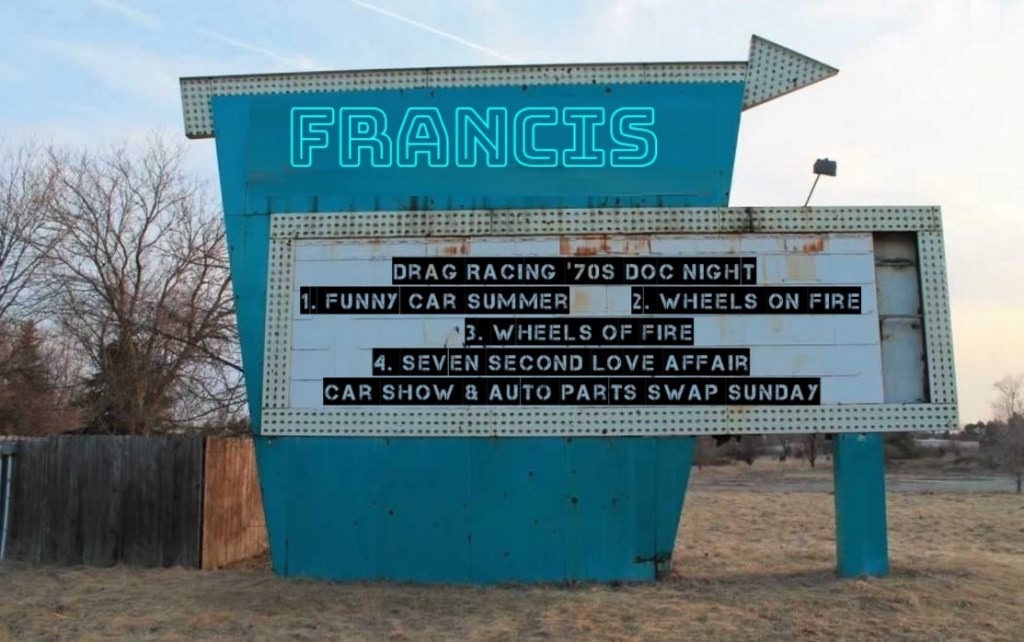
We featured this film as part of our “Drive-In Friday” tribute to drag racing documentaries.
About the Author: You can learn more about the writings of R.D Francis on Facebook. He also writes for B&S About Movies.
Editor’s Note: This review ran on December 12, 2020. We’re bringing it back for our tribute week to the funny cars and rails of drag racing of the ’60s and ’70s
“(A) versatile and underrated B-movie Renaissance man.” — IMDb, about actor-director John “Bud” Carlos.
That’s the understatement of the century, ye IMDb database scribe. Look at that short — but hit-packed director’s resume: Kingdom of the Spiders (we need to review that one!), The Dark! The Day Time Ended! Mutant! Gor II: Outlaw of Gor! (well, they’re hits for the B&S About Movies crowd). Then there’s Bud’s cable and VHS potboilers that star friggin’ Ernest Borginine, Robert Vaughn, Oliver Reed, and Herbert Lom in the same friggin’ movie: Skeleton Coast (1988), and Act of Piracy (1988) with Gary Busey and Ray Sharkey kicking ass. Then there’s Bud’s acting resume with Al Adamson and the films Hells Angels on Wheels (1967), Psych-Out (1968), The Road Hustlers (1968), The Savage Seven (1968), Killers Three (1968; starring Merle Haggard and a very young Lane Caudell of 2020’s Getaway), Blood of Dracula’s Castle (1969), Satan’s Sadists (1969), Five Bloody Graves (1969), and Hell’s Bloody Devils (1970).
After entering the annals of Bikerdom with his third acting gig in Hells Angels on Wheels (he had support roles in 1965’s Deadwood ’76 and Run Home, Slow), and paying attention on all of those Al Adamson sets and Roger Corman AIP productions, Bud Carlos transistion behind the lens for the blaxploitation-spaghetti western (Uh, oh. Here we go again with the genre mixin’: Hey! Harry Hope and Harry Tampa of Smokey and the Judge and Nocturna fame, hiya!) with The Red, White, and the Blue, aka Soul Soldier (1970).
And the burgeoning, becoming “hot” and “trendy” drag racing genre was next on Bud’s resume with the youth-oriented (as were all of the ’60s racin’ flicks that simply substituted asphalt for sand) action-drama starring John Davis Chandler?
“Who?”
Seriously? The dude is iconic in a Richard Lynch-amazing kind of way.
John Davis Chandler January 28, 1935 – February 16, 2010
Now do you know him?
Let’s not even get into his extensive ’60s and ’70s television resume . . . just look at the movies: John Frankeheimer’s The Young Savages (1961; a more violent The Blackboard Jungle, if you will) with Burt Lancaster. Sam Peckinpah’s Pat Garrett & Billy the Kid (1973) with Kris Kristofferson, James Coburn, and Richard Jaeckel. Clint Eastwood’s The Outlaw Josie Wales (1976). Across 100-plus credits, JDC was everywhere, and he was nowhere. No truer “dark man” actor was he.
Courtesy of NHRA.com
Here, John Davis Chandler stars alongside Jeremy Slate (Do we really need to get into is resume?) and beach-snow flick bunny mainstay Deborah Walley in this not-a-Frankie-Avalon-Fabian racing flick that stars Mark Slade alongside (as you can see by the drive-in flyer, above) the nation’s top drag racers. (Mark has too many ’60s and ’70s TV series to mention, but by 1967, starred for three years on The High Chaparral; before that, the McHale’s Navy rip, The Wackiest Ship in the Army; he got his start as co-star on Gomer Pyle: USMC.)
Drag Racer is simple tale: Mark Slade is a young man who dreams of tearin’ down the quarter mile with the big dogs that, while it has (it must have) romance, there very little of that dramatic yakity-yak that bogged down the likes of Red Line 7000, Thunder Alley, and The Wild Racers. As with David Cronenberg’s lone non-horror film, Fast Company, Drag Racer is about gritty realism that puts the actors into the pits to mix it up with the real racers (Bill Schultz, John Lombardo, Norm Wilcox, and Larry Dixon) at famed West Coast racetracks Irwindale Raceway, Lions Drag Strip, and Orange County Int’l Raceway.
Is the acting a bit rough in spots? Is the editing and cinematography amateurish? Sure. (It adds to the film’s realistic, documentary quality.) This is one of those films that was once embraced by UHF-TV in the early ’70s (watched it twice), temporarily embraced on VHS (watched it once), then jettisoned. Considering Bud Carlos’s pedigree, this one — is in desperate need — of a full restoration (and not just a rip n’ burn) to DVD. Hint! Kino Lorber, Arrow Video?
This is a classic must-watch for racing fans — even with a muddy, washed-out blurred print. It really is one of the best drag flicks out there. And whadda ya’ know: You Tube comes through again — and with a VHS and not a TV rip! Sweet!
About the Author: You can learn more about the writings of R.D Francis on Facebook.He also writes for B&S About Movies.
EDITOR’S NOTE: We originally reviewed this movie on March 26 of this year, but now that Arrow is releasing it on blu ray, we hope that more viewers will find it.
Based on Jill Gevargizian’s award-winning short of the same name, The Stylist reunites the director with actress Najarra Townsend. She stars as Claire, a hairstylist who becomes obsessed beyond with her clients. One of them, Olivia (Brea Grant), is a bride with has made the horrible mistake of hiring Claire for her big day.
Let me sell this movie in the best way that I can: Becca hates nearly every modern horror movie that we watch together and she liked this because of how dark and strange that it was.
Claire styles hair by day and at night, she kills and takes the scalps of her victims, becoming them for a short time. She becomes obsessed with Olivia’s perfect life as she becomes more of a friend than just a stylist and tries to hide her collection of scalps and stop killing. But can she change who she is as easily as she puts on new bloody masses of hair?
Be warned: my wife also has an incredibly strong stomach when it comes to slashers and there were moments in this film that nearly upset her. The scalping scenes are on par with Maniac for their bloodletting, which is pretty much as high as I can praise a film.
It’s astounding that a modern film can synthesize the slasher with the color theories of the giallo while not playing the story for laughs at all. It allows us to sympathize with a character that we should despise. It also has a female point of view about a woman attempting to navigating her way through the world and the issues she faces as a female by, you know, murdering nearly every woman she gets close to. It’s one of my favorite movies that I’ve watched so far this year and definitely recommend it with that caveat — there is a fair amount of blood. But hey — you need it for an ending this in your face.
Based on Junichiro Tanizaki’s story Shisei (The Tattooist), Yasuzô Masumura’s (Black Test Car) tells the story of Otsuya and Shinsuke. She’s the daughter of a rich merchant who is tempted by her father’s employee to elope before they’re caught by an inn keeper.
Now sold into prostitution, she’s given a tattoo by Seikichi, a master artist, of a human-faced spider. Her pale skin has created the perfect canvas for him, but now she’s been marked as the property of another man. As she and Shinsuke seek to escape their lives, all manner of horror follows, with the face of the spider changing — and Otsuya herself — with each act and each man who comes her way must pay.
Masumura and his muse Ayako Wakao, who plays Otsuya, made several films together, yet this film is the first of theirs I’ve seen. It’s a woman getting revenge feature. Yet while the film makes you wonder at first if it’s the tattoo or the woman doing all of the murder, by the end, the answer becomes clear.
The new Arrow Video release of this film comes with a new 4K scan of the film, new audio commentary by Japanese cinema scholar David Desser, an introduction by Japanese cinema expert Tony Rayns, a visual essay by Asian cinema scholar Daisuke Miyao and a trailer. You can get it directly from Arrow Video.
Documentarian Les Blank of Burden of Dreams fame, which chronicled the making of Werner Herzog’s and Klaus Kinski’s Fitzcarraldo, made his docu-debut with this drag chronicle — its seeds (A Rubber Tree plant, ha-ha! ugh.) planted courtesy of his first behind-the-camera gig shooting drag racers in Long Beach, California.
This one has it all: Souped-up “Blower” Mercurys and Chevys (like in Two-Lane Blacktop), rails, and funny cars. While it chronicles other racers, this one is a showcase for Rick “The Iceman” Stewart as he attempts to grab the world’s record — as Los Angeles’ Canned Heat Blues Band provides the musical backing.
Les Blank has made this easily accessible as an Amazon Prime and Vimeo VOD that’s also available for purchase at Les Blanks.com and on eBay.
We previously featured this film as part of our “Drive-In Friday” feature on drag racing documentaries.
About the Author: You can learn more about the writings of R.D Francis on Facebook.He also writes forB&S About Movies.
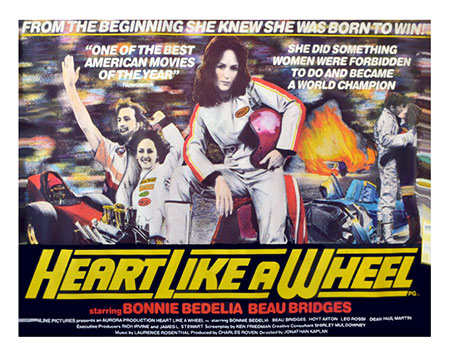
Shirley Muldowney is the First Lady of Drag Racing and the first woman to receive a license from the National Hot Rod Association (NHRA) to drive a Top Fuel dragster. After getting over that obstacle, she won the NHRA Top Fuel championship in 1977, 1980 and 1982, becoming the first person to win two and three Top Fuel titles. She’s ranked 21st on ESPN’s list of the Top 25 Drivers of All Time and fifth on the National Hot Rod Association’s 50th-Anniversary list of its Top 50 Drivers. A member of the International Motorsports Hall of Fame and Automotive Hall of Fame, she also had a song written about her by L7 and is one of the many women brought up by Le Tigre in the song “Hot Topic.”
Back in 1956, Shirley Roque (Bedelia) married auto mechanic Jack Muldowney (Leo Rossi), despite her father Tex (Hoyt Axton) wanting her to rely on herself. By the time she’s ready to race a decade later, with her husband as her mechanic, she has to get three signatures from other racers to even be considered.
She does, starting with “Big Daddy” Don Garlits (Bill McKinney) and Connie Kalitta (Beau Bridges), who has already fallen for her. The film is just about their relationship as it is the races, but it’s still worth a watch.
Director Johnathan Kaplan mainly works in TV these days, but he had success with this film and The Accused. He also directed the Reform School Girl remake and Bad Girls, a female centric western. Before those films, he made some greats for Roger Corman, like Night Call Nurses and The Student Teachers before directing Truck Turner, White Line Fever and Mr. Billion, a bomb that tried to introduced Terrence Hill to American audiences.
We originally reviewed this drag flick on August 2, 2020, as part of our reviews for Mill Creek’s Savage Cinema collection. Then it came back on February 5, 2021, as part of Mill Creek’s B-Movie Blast pack. So, for this “Drag Racing Week” tribute, it’s time for a new, second look at this ’70s time capsule homage to those rails and funny cars of the ’60s and ’70s.
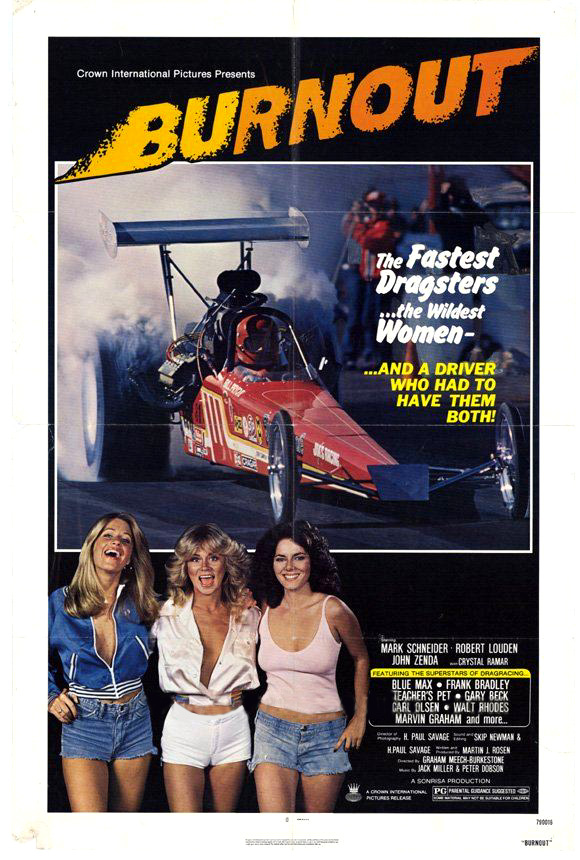
Hey, when you’ve got faux-Charlie’s Angels that look like they’re out of a The Dukes of Hazzard crossover episode . . . and rails on the poster, we aint’ hatin’, Hoss.
This one really is for the drag junkies, for this isn’t just a T&A comedy fest with a hotrod in it. This is hardcore: Don Garlits, Marvin Graham, Gary Beck, Don Prudhomme, Raymond Beadle, Tony Nancy and Shirley “Cha Cha” Muldowny (who earned her own hot roddin’ drag flick with Heart Like a Wheel) appear.
So, we have Mark Schneider from Supervan as Scott, with aspirations to be a drag racer. Of course, his affluent businessman pop is against that career choice, even though his dad is a fellow drag fan. In spite, Scott signs up as a gopher for a driver and hits the road. Don’t worry: Dad and Scott come to find a common ground.
That’s the movie.
For this flick isn’t about the drama. Or Scott. Or pop. It’s about the drag racing padding. But, not footage shot for the film. It’s all stock footage creatively written into the “plot” of the film. Truth be told, there’s decent story here — even though it’s 80% stock and 20% real actors. Take Tom Cruise’s Days of Thunder, give him a pop instead of team captain, take out the stock cars, put in rails, and you’d have a box office hit flick about drag racing.
Yeah, this is one budgetary Crown flick I really like. Then again, I grew up watching weekend sports show on network TV in the pre-cable days for those drag racing “events,” so your own nostalgia mileage may vary from mine.
As for director Graham Meech-Burkestone: this was his only film. He entered the business as a hairdresser and makeup artist on Burnt Offerings, Day of the Animals, The Manitou, The Exterminator (we know that’s the Part II link!), Day of the Locusts, and The Amsterdam Kill. Wow. If he was a director on all of those films, that’d be a tribute week right there for the B&S About Movies’ schedule alongside Mark L. Lester and Michael Fischa.
But jam on this: Unlike most Crown International actors who vanish from the biz, Mark Schneider is still in the business. He worked his way up to being a regular on TV’s Matt Houston and had a long, successful career with the U.S. TV daytime dramas Santa Barbara and Days of Our Lives. In addition to a recurring role in the syndicated sci-fi’er Babylon 5, Mark recently appeared in the indie horrors Obscura (2017) and Remains (2020).
Editor’s Note: Welcome to our debut review for our three day “Drag Racing Week” tribute to the funny cars and rails speeding down the quarter mile during the ’60s and ’70s.
Oh, wow . . . when this commercial came on TV . . . EVERYBODY went to see this documentary that chronicles a summer in the life of “Funny Car” racer Jim Dunn and his family.
The most popular, best known, and best-distributed film of the night — it is also the most disappointing (to those wee eyes of long ago) of the films of the night. You know how great Pawn Stars and American Chopper were when they first went on the air — then they turned into a Kardashians-styled sit(shite)com that’s all about Chum Lee and Corey Harrison bumblin’ about the shop and Junior and Senior fighting? Where’s the neat junk? Where’s the bikes? Where’s Frank and Mike? Who in the hell let Danielle, this Memphis blond chick, and Mike’s bumblin’ brother on the set? Where did the pickin’ go? This is American Pickers, right?
Well, that’s what watching this movie is like: all family drama and little vroom-vroom. Way to go marketing department and Mr. Distributor. You broke our little-tyke hearts — and pissed off our parents, who paid the drive-in fare, because we bitched from the backseat that we were bored — and watched 99 and 44/100% Dead (or was it The Exorcist) through the rear window, instead.
You can watch Funny Car Summer on You Tube HERE and HERE.
We also featured Funny Car Summer as part of our weekly “Drive-In Friday” feature with a tribute to drag racing documentaries.
About the Author: You can learn more about the writings of R.D Francis on Facebook.He also writes forB&S About Movies.
Why have we spent an entire week on the films of someone who is almost universally critically savaged, who has been called the Italian Ed Wood, who would rather outright steal footage from other movies than shoot them himself?
Because Bruno Mattei understood what he was doing, saying “Movies are supposed to be entertaining. So, they have to be made with that kind of spirit.”
Mattei’s movies may never be art. Or even competent filmmaking. But you cannot deny that they will do everything and anything to entertain you, even if that means upsetting, arousing and shocking you, often within the very same scene.
Bruno Mattei was born in Rome on July 30, 1931 to a father who owned an editing studio. Between the family business and classes at the national film school Centro Sperimentale Centrale, Mattei learned how to write and edit films. In fact, he would claim that he edited nearly a hundred movies, a claim that is difficult to fact check. He did, however, edit at least 56 films, including Revenge of the Black Knight; Desperate Mission; Agent 3S3: Passport to Hell; Goldface, the Fantastic Superman, The French Sex Murders, Black Cobra Woman and Jess Franco’s 99 Women. For that film, he also went behind the camera, shooting the adult inserts that show up in the French cut of this women in prison epic.
Of course, those inserts featured actors and actresses who looked nothing like the people they were supposed to be and there was no continuity at all, with scenes that were in the dark of night suddenly appearing in broad daylight, but these trivial things never seemed to phase Mr. Mattei.
Around this time, Bruno also edited several episodes of Gerry Anderson’s U.F.O. TV series into five feature films that were released by Avofilm.
His first documented experience as a director was Armida, il Dramma di Una Sposaa. He used the name Jordan B. Matthews to make this cover version of the Greek movie* O Lipotaktis (which was released as The Deserter in the U.S.). He went so far to remake the film that he even used the same star, Franca Parisi.
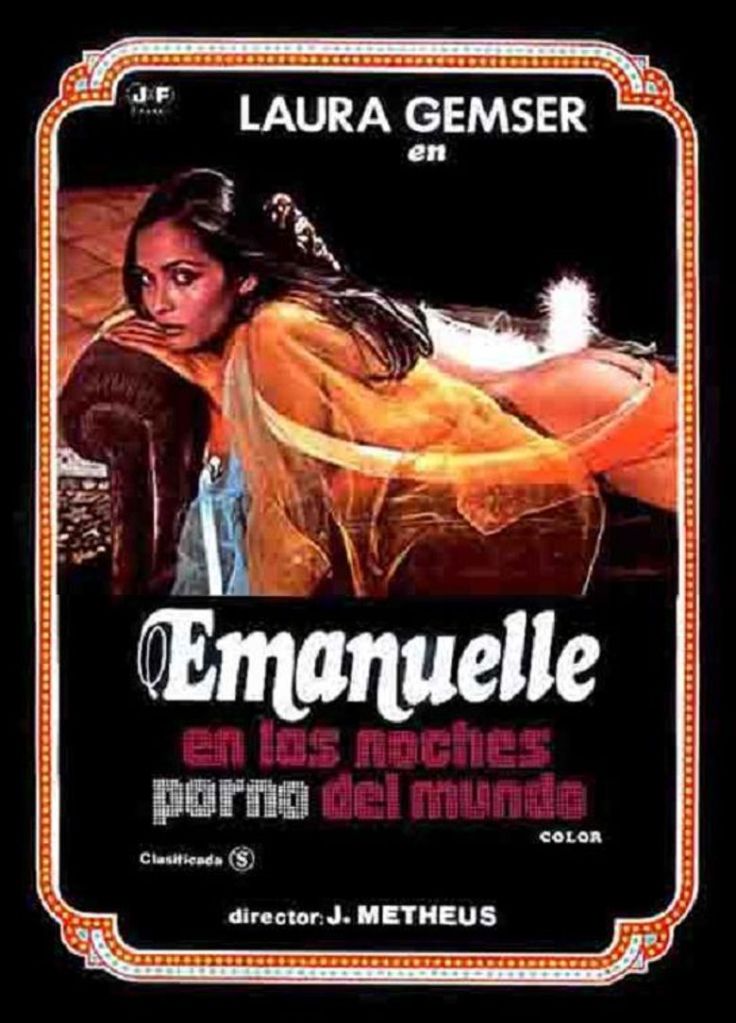
Speaking of Emmanuelle, Matte would also make several films with Laura Gemser, such as Notti Porno nel Mondo (AKA Sexy Night Report and Emanuelle and the Porno Nights) and Emanuelle and the Erotic Nights(a movie in which Mattei would co-direct with Joe D’Amato, perhaps the only director to use more pseudonyms and have less of a filter). This also led to another adult mondo, Libidomania (AKA Sesso Perverso) and its sequel Sesso Perverso, Mondo Violento (Perverted Sex, Violent World), as well as the mainstream film** that Ilona Staller made before she became Italy’s most famous adult star, Cicciolina Amore Mio.
After one outright adult outing — 1980’s La Provinciale a Lezione di Sesso, Mattei began making movies with screenwriter Claudio Fragasso. As mentioned earlier, they often made two films at once — like The True Story of the Nun of Monza and The Other Hell — with each directing scenes. They would work together until 1990’s Three For One.
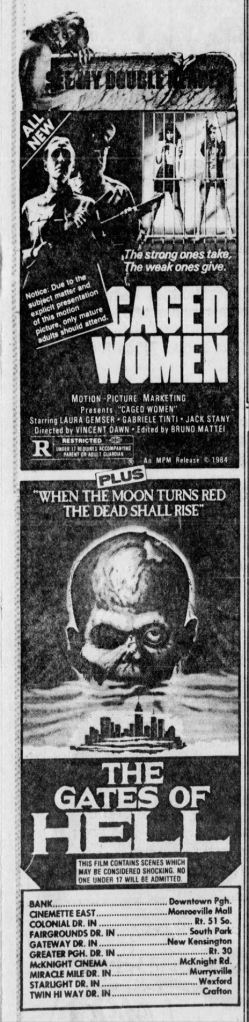
If you love movie ads like this, check out Groovy Doom on Facebook!
Mattei’s movies started showing up all over the world, such as Hell of the Living Dead(AKA Virus, Night of the Zombies and Zombie CreepingFlesh) and the aforementioned Violence in a Women’s Prison, which I still cannot believe played American multiplexes. What was it like for people who wandered into the wrong screen and were confronted by that absolute assault on decency? The Other Hell even played in the U.S. as Guardian of Hell!
Unlike many Italian exploitation directors who retired or went into adult films, Mattei kept on making movies. When the VHS and cable era started, he was ready to answer with a multitude of Rambo takeoffs like the two StrikeCommando films, Double Target, Cop Game and Born to Fight.
While many knock Mattei for not only stealing ideas but also outright taking footage from other films, my joy in watching his movies lies in just how many movies he can take from sometimes making you wonder what movie you’re really watching. Robowar is Predator yet with rich floral notes of both Robocop and Terminator. And speaking of rkTerminator, Mattei had the absolute bravery to title Shocking Dark — a movie that rips off Aliens throughout — as Terminator 2.
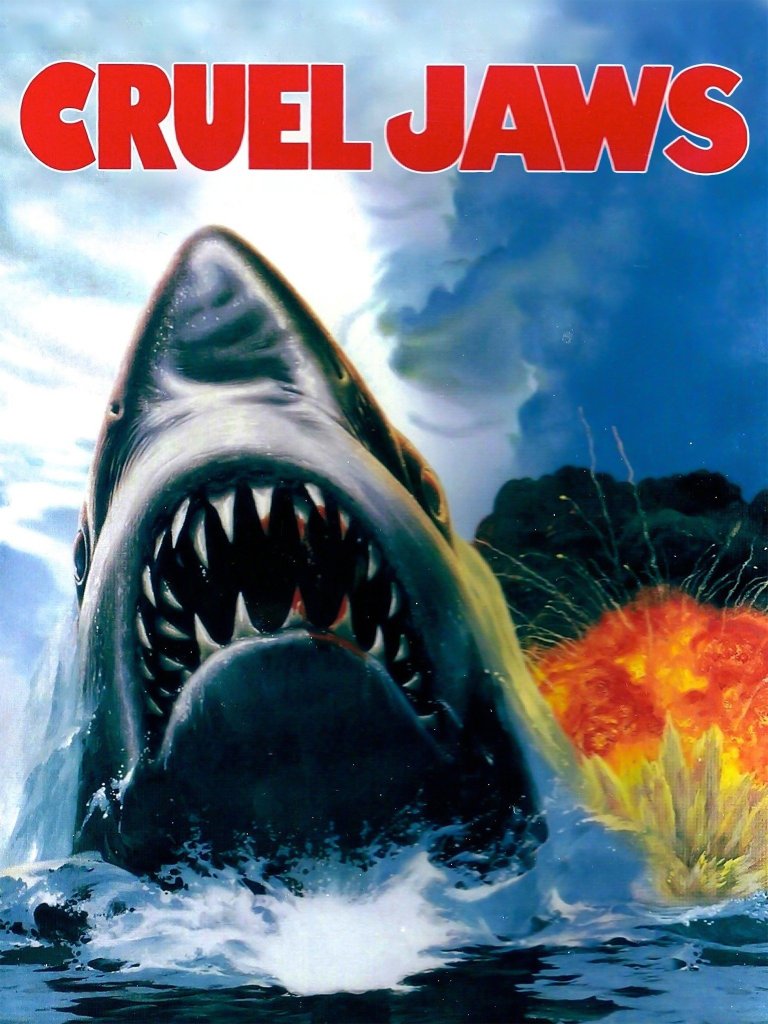
Cruel Jaws may be Mattei’s most amazing case of theft. It starts by stealing the plot of Piranha, then using the Mafia subplot from the novel Jaws was based on before outright using the actual footage of the windsurfing race from The Last Shark and a Regatta stolen from Jaws 2. Is it any wonder that this movie is also known as Jaws 5?
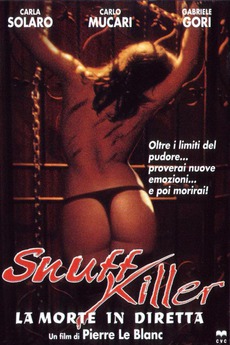
Through the 90s, Mattei found a new partner in producer Giovanni Paolucci and realized that the video and cable industries needed more Basic Instinct remakes. It’s as if Bruno said, “I’ll show those movies that they dare to call American giallo!” This led to a run of movies that includes Legitimate Vendetta, Body and Soul, Belle da Morire: Killing Striptease, Snuff Trapand Dangerous Attraction.
Bruno even found the time to make two giallo efforts of his own — in the 90s no less! There was Madness, a movie that goes so far as to steal two murders from A Blade in the Dark, and Omicidio al Telefon, a story of a killer who is obsessed with phone sex and dressing like a clown that is completely Out of the Dark.
By the point, Mattei was in his mid 70s, but when the rest of the world slowed down and forgot Italian horror, he was a force, heading to the Philippines to make another series of erotic thrillers like A Shudder on the Skin and Secrets of a Woman before reminding the world of his ability to shock, awe and generally lay waste to good taste with a new series of cannibal and zombie films, often starring Yvette Yzon as a 2000s era Laura Gemser.
A master of stock footage and making unofficial sequels on the cheap, there’s not really anyone else quite like Bruno Mattei in the annals of filmmaking. There’s a real sense of fun in his films for me, as you’re watching someone of the rails that is not concerned about focus groups or test scores. He’s only worried about finding something taboo-breaking so his audiences will keep coming to see his movies or renting them from the video store or watching them late at night on cable.
As Mattei was quoted as saying, “Il talento prende in prestito, il genio ruba.” Actually, I’m making that up. No one knows who really said “Talent borrows, genius steals.” But wouldn’t it just like Bruno to outright steal a great line and present it as his own?













 B&S About Movies
You must be logged in to post a comment.