Fatal Exposure (1989)

Oh, this friggin’ SOV’er . . . it’s a bizarre gem that wastes no time and is everything that the SOV porn-backed Spine strove to be — and failed. It skips the opening title cards and gives us two 30-year-old virgin teenagers making out for the first time — well, Marybeth gives herself away for the first time — on a backwoods rural road — and goes porn. Then the tits and dicks are a-floppin’ (we don’t see any penis, but you get the point). One silhouette figure in the fog later (it’s not an owl, Marybeth) and we get an ice pick in Biff Preppy’s ear and Marybeth — breasts a-flyin’ — gets another ice pick through the mouth into the tree trunk, and that’s after our black-clad killer in a beret — and no mask — gives her a quiz about dying and blood. So, you see: if you fail, you die. (And that’s an important “plot point,” so keep that under your beret, for later.)

Okay, so two kills are on the tote board. Roll the opening title cards with the not-Whitesnake metal tune about “moving violations” and “being under the gun” and “lost desires.” Is the SOVness as cheesy as the unpoofy hair metal?

Oh, hell yes. And so much more. This is a movie where, if you’re not a baptist, you’ll be forced into being a baptist. So, yeah, baptists are dying here: brutally. Luckily, the female ones wear lingerie and, once they take off the glasses and let down the hair bun — they’re “hot” as you know what. Yeah, so we think this is a bunch of adult film stars nom de plumin’ for mainstream legitimacy between the Penthouse reels.

Not Body Heat. Not Basic Instinct. Not Fatal Attraction. But wants to be. But Jack likes his ice picks like Catherine Trammel. But he’s no Michael Douglas.

In case you’re wondering — and if that opening kill salvo doesn’t put you wise: Fatal Exposure isn’t a repack of Dennis Devine’s SOV debut, Fatal Images (1989), although this, as with Devine’s flick, centers around cameras. But the camera isn’t haunted. But the photographer is: by Jack the Ripper.

I know. I know. Another Jack the Ripper movie? As if Christopher Lewis’s The Ripper, and Jeff Hathcock’s Night Ripper! and Peter Sasdy’s Hands of the Ripper, and Jess Franco’s (who fucks up any genre) Klaus Kinski-starring Jack the Ripper, and Lucio Fulci’s nothing-to-do-with-Jack Halloween ripoff The New York Ripper wasn’t enough . . . now we get SOV’in Jack Rippington, he the great, great grandson of the pride of White Chapel. So, Jack Jr.’s not possessed by a spirit, just a couple of f’d double helices from granddad Jack’s semen sacs.

So, what’s Rip’s (Blake Bahner, formerly of the U.S. soap Days of Our Lives) glitch? He photographs women . . . and drinks their blood, as it’s his “viagra,” if you will — so Jackie is a sort of vampire. As with this week’s review of Murderlust pinching-foretelling the serial killer exploits of Dennis “BTK” Rader, this time we’re getting a pinch of ex-race car driver and faux-photographer Christopher Wilder who used women to lure other women under the guise of “modeling” for him.

So, to than end, Jackie finds, not a new victim, but “love” with Erica — he picks her up in a cemetery; she’s “turned on” by death. She’s perfect: he uses her as bait to lure women for him to photokill. Of course, Erica (Ena O’Rourke, in her film debut; vanished shortly after) is as dumb as Marybeth who kissed the ice pick, earlier. And Erica will make — finally, after all the searching — a great incubator for Jack’s son to carry on the family’s business: making great art for: okay, you see, the real reason the original Jack the Ripper killed all those women: for his photography endeavors. Oh, and it gets weirder: Erica is a doppelganger for Jackie Rippington’s great grandmother. Calling Dr. Freud: Jack wants to oedipal grandma. Lovely. Let loose the semen sacs o’ double helices.

So, speaking of the ice picking that opened the movie: under 20-minutes in, we get a stockade decap and a gym drink tumbler blood refill. See, we told you baptists were going to die . . . in a soft-core sex slasher that ended up on Showtime’s late night “after dark” weekends all those cable-years ago. Circular saws, electrocutions, and a wide array of SOV-cheap gore, long, soft-core bedroom sex scenes padding the short running time, moonshine jugs of chloroform, a lingerie bondage scene, bumbling sheriffs, serial killers breaking the fourth wall, serial killer inner thoughts via voice overs, southern plantations that aren’t Dunsmuir Mansion but wants to be such, wooden actors (trying), and Bloody Mary drink jokes cut footloose across Alabama — with nary a banjo on anyone’s knee — ensues.
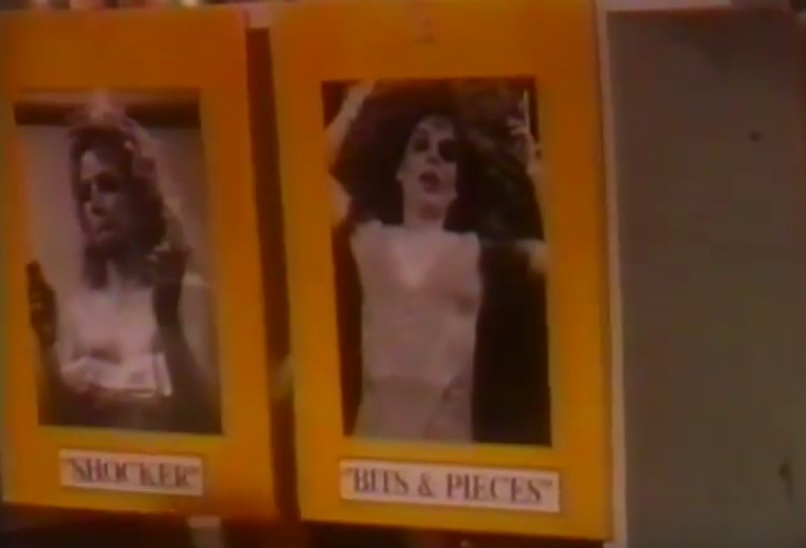
Master-pieces. Yuk, yuk. And Bits and Pieces is the title of another, earlier, SOV. A homage? Probably not. “Shocker,” meaning Wes Craven? Nah.

If you read our reviews for our “SOV Week” tribute, we’ve sunk pretty deep into the analog mire — but the quagmire gets quaggier via Google as you’ll find so many more SOVs from the ’80s and ’90s to overwhelm the VHS shelves of your analog mind. And this directing effort from Peter B. Good, the producer behind the death-docs Faces of Death III and IV (he made his directing debut with the 1978 sci-fi/haunted forest romp The Force on Thunder Mountain*) is one of the better SOV’ers of the ’80s that will be one of those analog scuzz’ers you’ll return to for a few more views over the years — as have I. It’s a shame this was Good’s final directing effort, as Fatal Exposure showed a lot of potential for future growth.

We found a nice, clean VHS rip on a really great, You Tube retro-VHS page, The Burial Ground 5. Enjoy!

* Yes, you know us all too well, for we have since reviewed the VHS slopper that is The Force on Thunder Mountain. Once a film title is dropped, the tape worm bores into the cortex and it must be excised by sheer QWERTY force.

About the Author: You can learn more about the writings of R.D Francis on Facebook. He also writes for B&S About Movies.
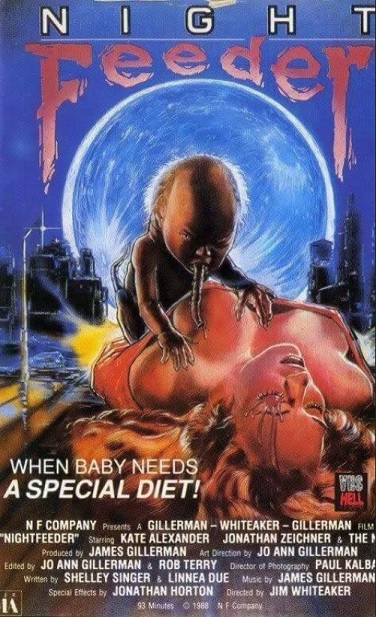
Night Feeder (1988)

“Slit your wrists, you f**kin’ b**ch.”
— The oh, so snotty and so punk DSZ, who, after the show, got their poseur arses tag-teamed by Jello Biafra and Henry Rollins in the back alley where Johnny Rotton urinates on them while Sid Vicious gives ’em a Doc Martin to the ribs.


A brain-eating monster-mutant baby and the San Francisco band the Nuns . . . together in a shot-on-video and direct-to-tape horror film. Here. Punch my VHS home video membership card. And toss one of those Clark Bars on the bill.

Okay, so let’s get the demon baby stuff out the way: Larry Cohen’s It’s Alive (1974) is afoot here, but not Lucio Fulci’s Manhattan Baby (1982), which seems like it’d be a demon baby movie, but really it’s an Egyptian tomb possession movie. But Night Feeder is a more expensive (and most SOV’ers are) kin to the Canux’er Things (1989), which, if you’re keepin’ SOV notes, was the first Canadian shot-on-Super 8 gore issued to VHS — and has its own monster-mutant baby. Sadly, with that cover and that fetal promise . . . this doesn’t deliver the over the top gore we anticipated.

Now, the baby, here, looks like George Constanza’s boss, Mr. Kruger, from Kruger Industrial Smoothing . . . with no offense to the awesome, and late, actor Daniel von Bargen, intended. But all offense intended to Sam, my boss, who keeps telling me to stop with the embedded Seinfeld references in my reviews.

If only the scene from the cover was in the film.

As for the rest: There’s boobs. Lots of skin. There’s bad acting, really bad acting. And stillborn dialog with too much of that honey hush yakity-yak and not enough blades and blood to go with the boobs. And too much watered punk-to-new wave music and not enough blood. Where the frackin’ feldercarb is the mutant baby that’s sucking human skulls brain-dry and fillin’ up the slabs in the morgue where our cop gets to overact and underact and scenery chew (but the gore is decent).

So, what does San Francisco’s the Nuns have to do with this?

Well, they’re not the Nuns: they’re the band DZS, aka Disease (not to be confused with DMZ, who recorded for an album for Sire and are located in New York). And the DZS’ers are also a violent street gang. And the ubiquitous keystone coppers think the incognito Nuns are a sicko brain removal cult — or something. Well, their groupies have been either OD’in or found brain-drained around ‘Frisco, so they’re on top of the suspect list.

Oh, and there’s an ex-Vietnam vet street guy known as “the Creeper” dithering around that’s also on the suspect list. Why not toss Michael Moriarty and Christopher Connelly on the suspect list while you’re at it, SFPD? Where’s Harry Callahan when we need ’em? Oh, okay, we got that nosey (hot female) writer lookin’ for that “big break” on the case . . . as the “case” splatters across San Francisco’s new wave scene (shot on location in the actual clubs with actual fans and was shot by ‘Frisco artists and scensters).

Yawn. Okay. Where’s the gore?

Well, there some gouged eyes. Well, one eye, on each head, as that’s how the brains are removed. We got gooey zombie corpses. Dream sequence shock scares. We could have done without the female journalist and male cop romantic subplot . . . yes, just like that other San Francisco cop movie — with Harry Callahan — The Dead Pool (1988), you know, the one where Jim Carrey was “Axl Rose.” Oh, and our reporter: she’s roommates with the leader (the actor of) of DSZ, which is, again, actually the Nuns — but we wished this was a sequel with a subplot about Johnny Squares as an on-the-way up local, unsigned artist right before Peter Swann cast him in Hotel Satan, so Johnny’s record label got a bargain on a rock video shoot.

And that’s pretty much what this is: a police procedural without the Harry. And the Nuns ain’t the Gunners or a faux-Axl. And this ain’t a slasher. Or a horror. It’s a cop figuring out stuff with a reporter helping . . . and instead of it being a mobster or a vampire — as in the really awesome Robert Loggia mobster-vamp flick Innocent Blood (1992) from John Landis — we end up with a killer baby. And the baby takes almost to the end of the film to “birth.”

Cue the baby, finally!

While Night Feeder is an SOV, it is also a “regional horror” (we did a tribute week to regional horrors back in March) that played out in and around San Francisco. Then, the story goes: after its premiere, the film vanished from U.S. shores — only to rear its ugly VHS tape in Poland, of all places. Stateside audiences — well, everyone outside of Poland — finally got to see this uber-obscurity of the SOV terra firmas courtesy of a 2017 DVD reissue through Bleeding Skull and Mondo Video. Nope. Sorry, kids. No trailer or online streams of the freebie or PPV variety to be shared.

However . . . the things you discover when you “right click” IMDb hyperlinks to pump up the word count on a review — and create one-stop review shopping by going film trivia gonzos.

Anyway, unlike most SOVs, the filmmakers behind the scenes on Night Feeder moved on to bigger and better things. Well, the co-writers and director vanished in short order, but special effects artist Jonathan Horton, had quite the career. He got his start on the Dennis Quaid sci-fi’er Enemy Mine (1985) and worked on David Cronenberg’s The Fly (1986), then moved onto Anaconda (1997). So, when the baby finally show up (and not for that long), that’s why it’s the BEST part of the movie.

Now, as you pick through the credits, you’ll discover that Night Feeder was made by women. Sure, Jim Whiteaker is a man, but at this point, since he never did anything else, could “Jim” possibly be a creative alias — for fear that a movie about a brain-sucking baby by a feminine creative team wouldn’t be accepted? (Check your David DeCoteau vs. Ellen Cabot credits.) However, our writers are Linnea Due and Shelley Singer. The producer — as well as the art director and editor — is Jo Ann Gillerman (and that’s her husband, James, on the score; he also co-produced).

The star here — amid all the men, be it cops or musicians — is Kate Alexander, as Jenna, our fearless “Lois Lane” reporter. Kate was a local ‘Frisco actor and also fronted two other SF-shot films: The Method (1987) and the comedy-horror, Kamillions (1990); the later has the same creative team as Night Feeder. Oh, and Kate was in something called From a Whisper to a Scream,which isn’t the Vincent Price-fronted omnibus we know; it’s a Yaphet Kotto-starring action film, aka Love You To Death (1989), that looks like USA Network “Up All Night” and Showtime “After Dark” programming plate fodder (I wasn’t aware of the film — until writing this review).

Speaking of which, Jonathan Zeichner, our detective, also did a soft-core “erotic” cop thriller, Deadly Desire (1991), with Kathyn Harold and Jack Scalia in the Sharon Stone vs. Micheal Douglas roles of the Basic Instinct variety. Support player Cinta Wilson (Victoria, here) worked her way up to So I Married an Axe Murderer (1993). And this SOV’er could have used an errant axe murder or a nail gunner of the Nail Gun Massacre variety . . . it’s cheaper than a latex mutant baby!

About the Author: You can learn more about the writings of R.D Francis on Facebook. He also writes for B&S About Movies.

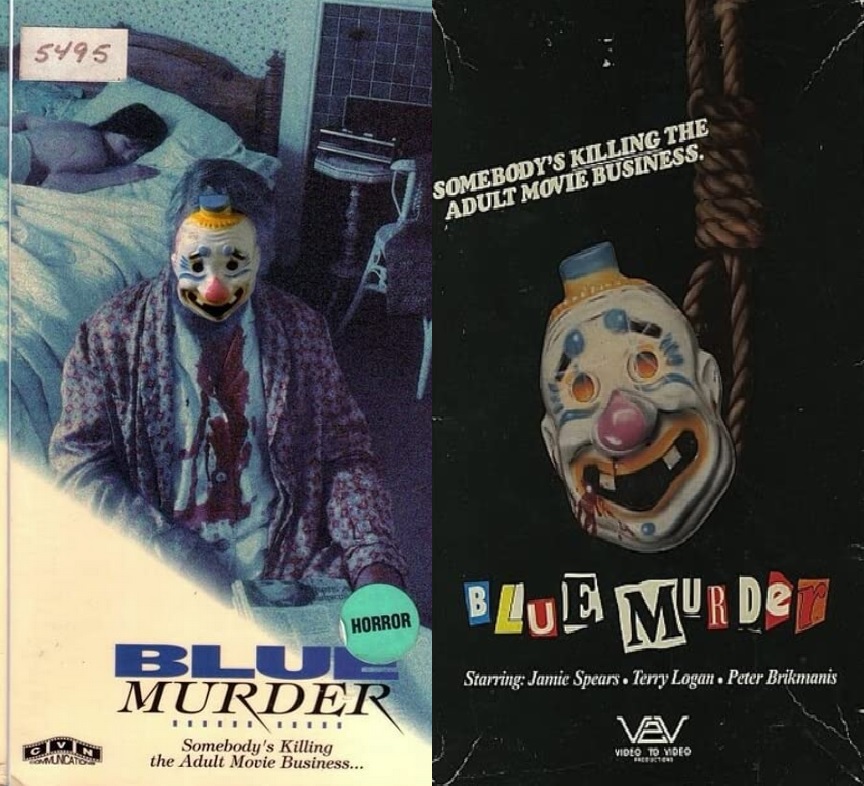
Blue Murder (1985)

It is “films” such as Blue Murder that give our beloved SOV ’80s a bad reputation because, as with the lesson in apoc-tedium that is Survival: 1990 (yes, made by Emmeritus Productions, the Canadian studio that also made this; as well as the computer-takes-over-a-skyscraper romp, The Tower), this inert John Carpenter knock off is just another mismarketed Canadian TV movie, a chunk of celluloid with the unmitigated, analog gall to dovetail its fast-forwarding poo-stank alongside our cherished, rightful SOV classics of Boardinghouse (1982), Blődaren (1983), Copperhead (1983), Black Devil Doll from Hell (1984), Sledgehammer (1983), Truth or Dare (1985), and Spine (1986). Now, as we ramble n’ praddle our SOV love, there’s a caveat: Not all were shot-on-video. Some of these VHS oddities (such as Truth or Dare) critically lumped in the SOV category were shot on 16 mm and released on video — and if it’s released in a direct-to-video format for exclusive, off-the-beaten Blockbuster Video path distribution at mom ‘n pop video stores, then it’s an SOV. Got it?

Two covers, twice the Underoos stinkeroos.

You’ve been caveated, ye dear reader, for there is nothing worse than a shot-on-video Canadian TV movie (that gives those old Dan Curtis shot-on-video ’70s TV movies a bad name) masquerading as a legitimate “made for the home video market” slasher of the superior Christopher Lewis Blood Cult (1985) variety. So let’s unpack this loaded baby diaper. And don’t let the emptor hit you in the ass on the way out when you see this grindhouse aka’ing in the VHS marketplace as The Porn Murders. And if you’re wondering what the “Blue Murder” title means, well, Google “blue movies” to find that bit of marketing brilliance.

Don’t be Trans World Entertainment duped: The Clown Murders is another stinkeroo from 1976 reissued in the video ’80s (not) starring John Candy, as directed by Martyn Burke of The Last Chase fame. Oh, yeah . . . John also made an early appearance in 1978’s The Silent Partner.

Now, you’d think with a movie with a killer adorned in a dime store, plastic-elastic Clown mask hacking up porn filmmakers and actresses — leaving them with a clown-mask calling card on their faces — we’d end up with some serious shower-after-watching sleaze n’ gore. Well, we could have — if the “Roger Corman of Canadian,” William Fruet of Death Weekend (1976) fame, was at the bow of the U.S.S Argento. Or Shaun Costello of Forced Entry (1973) fame was second mate. Or Jim Sotos of that film’s remake The Last Victim (1975) was swabbin’ the decks, ye matey. Maybe if real-life porn makers Justin Simonds and John Howard of Spine fame were in the galley.

Be we digress, again.

So, to solve the crimes, the old “hard-nose homicide cop” and “intrepid crime reporter” trope (neither are hard-nosed nor intrepid, natch) spools from the master to slave sprocket as we see our killer clown fire a gun . . . then cut to the body falling to the floor. And this goes on for eight more bloodless killings — nary a boob in sight via POV Italian black-leather gloved hands clutching a silencer. Remember how Billy Eye Harper killed all of those people in Rocktober Blood (1984) — off camera? Yeah, it’s like that. Only there’s no Sorcery tunes aka’in as Head Mistress rockers to ease the boredom.

“Sexy, slick and bloodthristy — with an amazing surprise ending.”
— CVN Communications copywriter hornswogglin’

Oh, speaking of music: There’s an opening credits-glam rock theme, “Blue Murder,” but it’s not by the band of the same name Carmine Appice put together with John Sykes of Whitesnake and Tony Franklin of the Firm because, well, Carmine was too busy with King Kobra tunes masquerading as Damien-written tunes for Black Roses (1988) rockers. There’s another sappy-as-sentimental-ass love song “Madly in Like with You,” that’s not by Girlschool — and both songs should have been ditched for Kim McAuliffe and company’s “Screaming Blue Murder” and “Don’t Call it Love.”

“Okay, R.D. Enough with the ’80s heavy metal memories. Get back to the movie.”

Okay, well, the real band in the movie is known as One Life to Live. And don’t bother, as we already researched those never-was Cannuck non-rockers and there’s nary a QWERTY-character of web-Intel. But we do know that they’re not one of “Canada’s Top 20 Greatest Bands” . . . but Nickelback and Bare Naked Ladies? Oh, Canada, what the hell. Thank god Four Non-Blondes aren’t from the Great White North . . . but April Wine, is.

Hey, maybe if our killer dressed like a kitchen worker and had a beef with Entenmann’s and killed pastry chefs and left Jelly Roll calling cards. Then add in a couple Girlschool tunes — and (real life) porn actresses in schoolgirl outfits instead of friggin’ one-piece bathing suits with feather boas — and we’d be onto a sticky-sweet something.

I know, back to the movie . . . with the only online clip available . . . from Turkish TV. Yes, this made it across the ocean into Turkey.

So, eh . . . “The Porno Killer” is on the loose and attempts to harangue Dan Blake, our resourceful crime reporter, into covering his exploits . . . or more will die. So Dan consults with Lt. Rossey, his homoerotic-implied buddy-boy (e.g., the sitting-on-the-toilet-while-I-take-bubble-bath conversation) to sift through the so-not-giallo red herrings of mobster-cum-porn producers battling for each other’s 3/4-inch tape territory and corrupt cops on-the-porn take. Then there’s the one-eyed henchman and houseboys in the mansions and on the yachts of the porn producers. And don’t forget the Catholic Priest with a psychology degree explaining why someone would don a clown mask and hot-wire bombs to beds and wine bottles. (No joke: there’s bomb-wired libations.) There’s not even one of the 24th letters of the alphabet here, let alone three; but there’s a whole lot of Zzzzzz that take us to that “amazing” twist ending. . . .

Alas, the only “twist” we care about: Is the Jamie Spears starring here — in his only acting role as our intrepid reporter Dan Blake — really the father of Britney and Jamie Lynn Spears? The Magic 8-Balls of the web say, “YES” — but there’s nothing amid the web-myriad of Spears digital ephemera that states that fact. And I’m looking at both Jamie-stills and I’m not seeing the resemblance between the actor and the dad. If it is Brit’s pop — eh, is it — no wonder this was his only movie and he leeched off his daughters, aka he’s awful at acting. Really awful. And wouldn’t it have been funnier — and this film needed a dash of comedy, if anything — if the football jersey Danny-boy perpetually wears throughout the film was number “69” (yuk-yuk) instead of 66? Ah, but “66” is the numeric code for spooning . . . which makes Danny’s downward stare and Lt. Rossey’s leg hike in the tub even more distributing . . . jokes about sexually denied spherical objects in one of the three primary colors between violet and green, be damned.

“Oops, I’m lookin’ again.”

The name of Charles Wiener — considering the material — is no joke: he’s a real person who, after this writing and directing debut — wrote a Canadian not-Police Academy ripoff Recruits (1986) that only has the presence of Jon-Mikl Thor (Zombie Nightmare) to recommend it, as well as writing and directing the-Police Academy-set-inside-a-fire station-ripoff Fireballs (1989). Did you see Wiener’s Animal House-cum-Porky’s inversion, Screwball Hotel (1988)? Neither did we . . . DOH! We did? But if you’re a martial arts completionist and need a Canadian not-starring Jean-Claude Van Damme rip, there’s Wiener’s third and final directing effort, Dragon Hunt (1990), for your shelf. (No, I will not review the dogger that is Dragon Hunt, for I’ve choked down enough wieners for one day.)

Hmmmm. This sounds like another B&S About Movies gauntlet drop. But Sam never answered the Robert Clouse Gymkata (1985) challenge, so my Dragon Hunt throw down to complete the Wiener catalogin’ at B&S is for naught.

Okay, time for a nice cup of Green Tea and a slice of Entenmann’s Pound Cake, hold the crappy-ass Van Hagar not-a-pastry ode. Excuse me, could you pass a spoon? You’re lookin’ mighty fine in that numero “66” jersey, big fella.

Fork me, R.D. out.

About the Author: You can read the music and film reviews of R.D Francis on Medium and learn more about his work on Facebook.

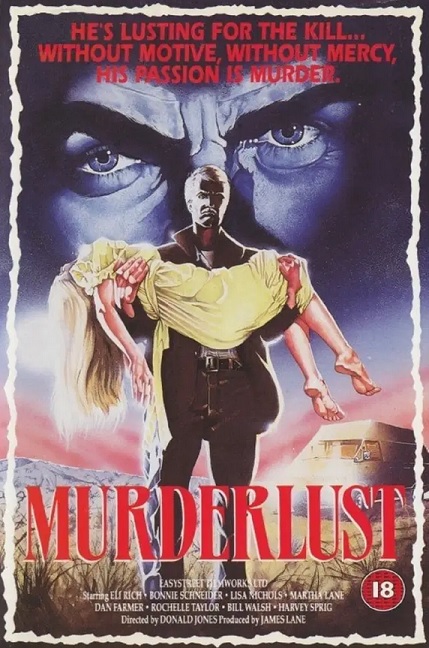
Murderlust (1985)

Indiana poet James Whitcomb Riley was long gone by the time of 16mm and SOV backyard filmmaking. But his rule regarding quacking ducks applies: If it looks like an SOV and quacks like an SOV . . . well, I’ll call that 16mm bird an SOV duck.

So, yeah. Technically speaking, Murderlust isn’t a shot-on-video water fowl that falls under the “SOV Week” theme week we’re rolling at B&S About Movies, as it was shot on 16mm film in the 1:33:1 aspect ratio and released in a direct-to-video format by Prism Entertainment — the home of the (annoying) side-opening VHS box (give me clam-shells, give me a “Big Box” with the crinkle-plastic tray, or bottom-loading sleeves, but not side flaps).

As with the work of Don Dohler — who also shot on 16mm (and seen theatrical releases with his films; see The Alien Factor), but is name-dropped often in discussions regarding SOV filmmaking — Donald M. Jones shot in 16mm (but seen only direct-to-video releases), but all of his film — from their VHS images on the tape to the artwork encasing the tape — ooze the same SOV sleaze of films shot on 3/4-inch U-Matic tape via broadcast ENG and Ikegami cameras. Courtesy of that video-tape technology, Boardinghouse* (1982) became the first shot-on-video feature-length horror film. Shot direct-to-video tape, Boardinghouse was transferred to 16mm, then blown-up to 35mm for limited theatrical exhibition. David A. Prior — who’s a pretty big deal to us Allegheny County cubicle farmers on the celluloid pastures — shot his debut feature film, Sledgehammer* (1983), on video and released direct-to-videotape.

The grainy, 16mm documentary vibe of Murderlust that we watched on VHS didn’t receive its less-than-stellar, grainy “atmosphere” from being “road showed” via Drive-In reels emulsion-scratched to hell and back again, and again (or from cinematic incompetence; it’s actually well-shot and edited). It was because of that cover — and the subsequent write-ups in our pulpy horror movie mags, Murderlust (like Blood Cult and Spine issued in 1985 and 1986), received its celluloid battle scars courtesy of its incessant rental-replays on the ‘80s home video market beating it to hell and back again, and again. Murderlust was a movie, with one, singular-stocked store copy: always rented out, damn it — the in-the-plastic sleeve-cased box perpetually perched on the shelf with no VHS tape tucked behind it. As with Romero’s The Night of the Living Dead, the “to hell and back again” consumer processing (first via drive-ins, then UHF-TV, then VHS for Romero’s zom’er), lent, more so, to the documentary-grainy quality of Murderlust — and left it looking oh so SOV-ish . . . even through, er, that bird ain’t a duck.

Paul Zamarelli of VHS Collector comes through with the clean image of the original cover.

It was the hazy, grey days of filmmaking, adrift somewhere between 16mm giving away to video tape technologies, while drive-ins felt the financial pinch of the burgeoning home video market — with its confounded contraption called a “VCR” that played something called a “VHS tape” — that provided a more cost-effective and marketing-effective format. The new format was so effective that Christopher Lewis wowed us VHS dogs when he shot his debut film, Blood Cult, on video for exclusive direct-to-video distribution — a pioneering first. Films such as Cliff Twemlow’s GBH and Justin Simonds’s Spine were marketed on “mainstream” imprints backed by porn producers to get in on the home video horror game, as well.

Unlike most SOV filmmakers, director Donald M. Jones managed to make more than just one self-financed backyard film. “Backyard,” if that term is new to you, is a pre-SOV term — one that also came to encompass shot-on-video films — reserved for films shot on Super 8 or 16mm that were produced on shoestrings with friends, relatives, and neighbors — each lacking in their own levels of disciplinary professionalism — that were literally shot in the backyards of the filmmaker and whomever was shanghaied into the film. In the case of Murderlust: the “backyard” was California’s Mojave Desert, while scenes in the church and bar were shot in and around metro-Los Angeles — on the sly sans permits, which is a part of the “backyard” modus operandi.

Jones got his start with Deadly Sunday (1982)**, then followed up Murderlust — his best known and distributed film — with Project Nightmare (1987), and Housewife from Hell (1993) — then vanished from the home video tundras until the direct-to-video release of Evil Acts (2015). Unfortunately, as with John Carpenter, Don Coscarelli, and Sam Raimi before him — and stymied by the direct-to-video marketplace — Jones’s slasher ’80s-era films failed to achieve a Halloween, Phantasm, and The Evil Dead-styled connection with horror audiences (the fate that cursed the really fine The Redeemer issued around the same time). Only fans of the most obscure low-budget horrors remember Jones with the same celluloid-cum-analog vigor as David A. Prior, who’s noted for the aforementioned Sledgehammer, or John Wintergate’s Boardinghouse and Christopher Lewis’s Blood Cult.

Overseas VHS issue. Nah, too giallo for a film that’s not a giallo and looks like a past-his-prime Fulci or Martino romp. Give me the ol’ U.S. sleeve.

Murderlust is a movie that takes this QWERTY warrior back to days of those cardboard-musky vinyl repositories of old, aka, record stores, when we purchased record albums — primarily metal albums — strictly for their cover art, with nary a clue as to the band’s lineage and backstory. And we rented — or aftermarket purchased — VHS tapes on the same principles. And sometimes the music under the artwork (such as buying the New Jersey-indie After the Bomb by Hammers Rule) was just as “meh” as the movies inside the VHS case.

Such is Murderlust: the cover is great, but the movie is a hard slice of dry, white toast with no butter and hold the grape jelly packet. For a cover that shows a woman violently strangled, there’s very little strangling afoot, here — and none of the sleazy n’ scuzzy, over-the-top SOV splattering after taste of the Snuff Kill variety. Our resident murderluster is no Mancunian cutting a GBH swath across London, well the Mojave, in this case. Instead, we get two strangles, with the rest of the kills off screen and bloodless (our killer buys a newspaper with the headline: “9 bodies found in the desert”). Instead of John Carpenter giallo-suspense (Halloween) or Sam Raimi graphic-to-dark comedy (the first The Evil Dead, not the meh remake-sequel), we get a character study. To pinch Alice Cooper, “the man behind the mask,” as we “study,” is a psycho who doesn’t enjoy, but struggles with, his “murderlust” of kidnapping, raping, and desert-dumping women — while he maintains a (crappy) job and even begins a “normal” heterosexual relationship.

And that’s the sole strength of Murderlust: Steve Belmont, our church-attending security guard who serves as a Sunday School teacher and elder tortured by his psycho-sexual impulses, isn’t just some mindless, supernatural hockey-masked maniac who cuts a Krueger swath across the Mojave. Screenwriter James C. Lane — who penned all five of Donald M. Jones’s films — intelligently ditched the slasher-blueprint to give us one of the slasher ’80s best-arced, non-trope characters. Belmont is a man who Jekyll and Hydes as he’s denied sex by his dates (he’s a nice guy, but a security guard at a guard gate — “. . . you’re cool and so is your job, but you’re just a DJ,” they’d preamble their R.D-dump), he’s plagued by financial issues, his cousin’s criticisms grind him down some more, his boss enjoys writing him up, and he’s accused of sexual misconduct by a misguided teen at his church when he’s promoted to a counselor’s position.

For whatever reasons, Jones made an artistic choice not go nude or graphic, as is the case with American slashers and giallo-imports in the ’80s — be them SOV or 16 mm backyard. (While graphic, not “going nude” — considering its porn-linage — is what scuttled Spine; going “nude” and “uber-graphic” is what made Blood Cult a hit.) While that artistic choice makes for a pseudo-boring film, it also leads to an authentic, grimy film. But grime is not goo and strangling is not slashing (unless it’s Don Dohler’s red cloud-infected, strangulation killer in Fiend) and, without the goo and the slash, we’re in a damsel-in-distress “final girl” finding-her-inner strength flick that, today (under the eyes of Fred Olen Ray and David DeCoteau!), are pumped out at ad nauseam program-replays on Lifetime (David D.’s most recent is The Wrong Valentine). And since those telefilms are void of grime and never go “goo,” well, you know how a Lifetime flick goes: yawning from unknown Canux actors (sometimes in vanity projects, pushin’ themselves, if not their Kardashian-sytled brats) frolicking about Toronto masquerading as Anywhere, U.S.A., ensues (such as the channel’s 2021 “Shocktober” entry, Seduced by a Killer).

In the end, while actor Eli Rich is head and shoulders above most backyard and SOV-era actors to sell the inner struggles — and everything is decently scripted and well-shot — Steve Belmont is no Frank Zito cutting his own mannequin-murderlust swath in the best of the Carpenter-inspired slashers: William Lustig’s Maniac (1980). If Murderlust went for that Maniac-styled depravity, we could have had a precursor to John McNaughton’s truly chilling Henry: Portrait of a Serial Killer (1986). That based-in-reality film bastardly-birthed out of the exploits of Henry Lee Lucas; Murderlust chillingly predicts the backstory of Dennis Lynn Rader, a church elder and common working man (ironically: home security systems) who lead a secret life as the B.T.K Killer between 1974 to 1991. (Gregg Henry of The Patriot and Hot Rod chilled us with his portrayal of Rader in a 2005 CBS-TV movie.)

The VHS of Murderlust was highly edited (and I never found an uncut version, if there even was one) — which degraded Steve Belmont’s secret life to a serial killer cut loose in a TV movie (even a police procedural TV series; thus our Lifetime comparison). The Severin restoration reissues the film with those scenes intact. I’ve haven’t the pleasure to see this “as intended” version, so perhaps those restored scenes may pique your interest to add Murderlust to your DVD/Blu collection. Plus, you’ll learn more about the film courtesy of writer James C. Lane’s commentary track.

You can view the Serverin Films’ age-restricted trailer and 1985 VHS trailer on You Tube. You can stream a VHS rip of the 1985 version of the film, also on You Tube. There’s also an upload on Tubi (which runs non-aged restricted) — with the Severin rebooted artwork as the upload avatar. However, the You Tube and Tubi uploads are both fuzzy and washed-out and of the same running time — and the same ’80s VHS cut of film.

* Those whole enchiladas of Boardinghouse and Sledgehammer are on the way, so look for ’em! Put in the effort and use that search box, buddy. (See, we did ’em! No searchin’ no more. Click the links!)

** Not be confused with the revenge-seeking pastor romp that is Dark Sunday (1976).

About the Author: You can learn more about the writings of R.D Francis on Facebook. He also writes for B&S About Movies.

Mirror of Death (1987) and Bloodspell (1988)

Oh, R.D, you’re a real pain in the posterior and a kick in the lower abdominal area this week with your ‘squeezin’ the Charmin’, SOV fanboydom. Yes, I am a self-aware man: a man that fights his life of monotony on the highway to mediocrity by binge-watching SOV films.

So, I’ve pretty much — with the other camcorder SOVs, as well as the 16mm-blown-to-35mm-backyard’ers-that-walk-and-quack-like-an-SOV that I’ve dovetailed into our “SOV Week” tribute — name dropped all the essential films and ramble-babbled as to the SOV “about” of it all. (If you click the SOV tag at the end of this review — and all of this week’s reviews — you’ll populate all of our past and present reviews and chit-chat on the SOV/direct-to-video genre.) So, we’ll skip the SOV genre “plot points” and get right into the dual, shot-on-video careers of our camcorder auteurs behind these two flicks: writer Gerry Daly and director Deryn Warren.


Mirror of Death, aka Dead of Night in some quarters, was their joint direct-to-video feature debut. Bloodspell, aka The Boy From Hell, was their second film. Then came Black Magic Woman (1991), which was Deryn’s lone writing credit (and stars Mark Hamill and Apollonia, if that inspires a stream). Then Jerry Daly came to write Crystal Force (1990) (although it looks like one, it isn’t a repack of the Alien-rip, Star Crystal) and Witchcraft III: The Kiss of Death (1991)* — all of which fall under the SOV banner and populate-in-memory on many o’ fans SOV-genre lists. Apparently team Warren-Daly returned with the PG-13 comedy Sweet Tessie and Bags (2008), which is a barren IMDb page and Google quest to nowhere . . . with images of handbags and a child eating an Eggo waffle (which isn’t a film still, by the way).

Today, Deryn Warren is a noted L.A.-based acting coach and publisher on the film arts. As with my previous Google excursion: it’s another digital tundra quest to nowhere, with pictures of Tim and Tyne Daly — and an image of a guy that’s not our Jerry — noshin’ a Smuckers pastry.

Waffles, Smuckers, and damn Jerry’s too-common-of-a-name, oh, my! Where will this yellow-tainted, SOV road take me, now?

Mirror of Death

What’s a bitchy-boss chick like you doin’ in a mirror like this?

So, if the cover doesn’t sell it: this is a backyard possession opus. Hold the pea soup and the Lisa and the Devil thrown-up frogs, as we meet Sara. Sara is another one of those bullied mousy-to-hotties that goes from mousy-to-hottie after lighting a few candles and ramblin’ a voodoo incantation. But like Stanley Coopersmith in Evilspeak and those “no false metal” horndogs, Holy Moses, in Hard Rock Zombies: when you mess with Luciferette, you get the hornettes — wrong chants and mirrors cracked, be damned.

What the . . . hey, is this the same red-optical possession effect from Doh Dohler’s regional drive-in’er Fiend (1980; also reviewed this week, look for it)? So that answers all the questions of that film: our poor violin teacher in that film was possessed by Empress Sura from Egypt?

So, our fire from Cairo rises from the looking glass and makes Sarah beautiful, so as to more effectively cruise all the local bars and hotspots Sarah could never go to before. But like Angel Martin in Shock ’em Dead, who went from dorky pizza boy to buff rock star, Sarah — now Sura — needs to pick up men and feed off their souls. (So, just like the fat red worm, two-tentacled octopus-thingy in Dohler’s movie.) Throat rips, heart rips, and the ol’ ancient dagger-in-eye gag, ensues, but are cheaply done and not the least bit overly, well, gag-inducing — which is what we want in our SOVs: to gag. (Then puke our mirco’d-burrito and slightly micro’d Ben and Jerry’s Phish Food: Remember, you have to soften those Fudge Fish into the gooey marshmallow swirls and improve the mallow-to-caramel swirl ratio content in our stomachs.)

And that’s all I am gonna say about that, Forrest. Except that every time I watch Striking Distance, I wait for Bruce Willis to say, “Hey, Lt. Dan! I’m a shrimp boat captain on the mighty Three Rivers.”

This is where the trailer for Mirror of Death was embedded . . . until You Tube cancelled the uploader’s account.

Bloodspell

Uh, it’s not the Dunsmuir Mansion, but wants to be, again. Hold the Burnt Offerings. Order up for the Silver Sphere, table two!

And team Daly-Warren are back with another ne’er-do-well SOV demon and a put-upon yoot (know your Joe Pesci references) by a dickhead of a dad who’s a dicksicle of a dad because a dickhead of a demon possessed dad, you got that? But, etc., and so on, in a tale that doesn’t not ensue in the “tradition” of The Fury or The Shining, no matter what the copywriters at Marketing Media Corporation and Vista Street Productions tell you. So the demon ditches dad and nestles into junior, so our resident supernatural terror may knock off the student body of the Ed Wood School of Non-Thespin’, aka the St. Boniface Group Home for Bullies.

Yeah, it’s the ol’ Stanley Coopersmith-hold-the-Tranya (know your Star Trek; don’t make us go all-Corbomite on your ass) bit as one too many practical jokes on ol’ Danny boy has sounded the pipes to summon our demon. And, once Danny-not-Torrence turns 18th, the demon will be cast inside not-the-son-of-Jack-and-Wendy, forever.

Is Bloodspell an improvement over Mirror of Death? Yep. Is it still a gore-deprived backyard’er? Yep, and more so than the prior. But at least we have a demon with a woodchipper fetish (but sadly, not for corkscrews, as in our this-week-reviewed SOV’er, The Brainsucker). Then there’s the errant, mind-controlled pigeon into the window that cuts up a bully’s face and a spontaneous-burnt-to-crisp stunt by-mind. And a showstopping (sarcasm) dad-gets-a-metal-pipe-impaling-so-lighting-can-strike gag lifted out of one of the Friday the 13th sequels (it was VI, but Jason was revived and didn’t die from the gag). Oh, and Danny, well, the demon, kidnaps Jenny (Theodora Louise), the girlfriend of Charlie, Danny’s only and now-not friend. Why? Well, to celebrate his birthday because, Danny the Demon is 18 and he likes it. And we wished Alice Cooper came up with another “The Man Behind the Mask” Friday the 13th theme song (again, Part VI: Jason Lives) to make blood worth spillin’ . . . and spellin’.

In the end: Bloodspell isn’t just a film with not-special-special effects: there are no special effects. And no blood of the kill-by-E.S.P variety. And acting so inept-inert that, if Larry “Seinfeld the Soup Nazi” Thomas starred in Bloodspell (or Mirror of Death), he’d apologize for it, as he did with his involvement in Terror on Tour — but, amazing, not for his involvement in an even worse SOV, known as Night Ripper!, so what gives, Lawrence? But hey, Bloodspell — but not Mirror of Death — filled out a programming block on USA’s Saturday Nightmares** — which is how most of us saw it, in lieu of VHS.

This is where the trailer for Bloodspell was embedded . . . until You Tube cancelled the uploader’s account.


Now, why did I make that earlier, off-the-cuff Bruce Willis/Pittsburgh reference?

Well, as is the case with most of these backyard’ers of the 16mm (or 8mm formats, even) or SOV variety, the film’s IMDb pages aren’t complete — with blank actor profiles of thesp’ers who never appeared in another film. However, our resident damsel-in-distress at St. Boniface is Pittsburgh, Pennsylvania-born and bred Twink Caplan, aka Theodora Louise back then, who does have a profile — because she’s still in the business.

Remember when Jim Belushi was a comedy-thing? Well, Caplan produced Curly Sue (1991), as well as the Gen-X comedy Clueless (1995) and its related TV series, as well as Amy Heckerling’s follow up, Loser (2000). Acting wise, before Bloodspell, Caplan co-starred in Underground Aces (a pretty awful, 1981 comedy that I only watched because of its Dirk Benedict-Battlestar Galactica connection; it’s not “Animal House in a car parking garage,” trust me), as well as guest-starring on such ’80s series as L.A. Law, Who’s the Boss, and Valerie (aka The Hogan Family). Caplan still picks up parts in indie films and cable-streaming series.

Meanwhile, Ray Quiroga, the producer of Dead of Night, Bloodspell, and Black Magic Woman, continues to produce indie films.

* Witchcraft III (1991) was preceded by Witchcraft II: The Kiss of Death (1989). It all began with the Italian-produced but shot in Massachusetts Witchcraft (1988), aka Witchery, aka La casa 4, aka Ghosthouse II.

** Check out our “Drive-In Friday” featurette honoring USA’s Night Flight programming blocks. And speaking of Animal House and ’80s comedies: we examine those films with our “Drive-In Friday” Slobs. vs. Snobs and Teen Sex Comedy Nights.

Our thanks to Paul Zamarelli of VHS Collector.com.
What would we do without his preservation efforts of all things analog —
be it SOV or 16mm backyard?
Seriously, Paul is the king of clean .jepg images of the lost classics of the home video-era.

About the Author: You can learn more about the writings of R.D Francis on Facebook. He also writes for B&S About Movies.

Cannibal Hookers and Demon Queen (1987) and Scream Dream (1989): A Donald Farmer Three-Fer!

Kansas cult filmmaker Donald Farmer made his first film, the short Despondent Yearning, in 1973; by 1976, he completed his sixth short, A Taste of Flesh: based on those titles, we’re guessing they’re skin flicks. After Christopher Lewis single-handedly birthed the home video SOV-market by bypassing con-fest screenings, Grindhouse theaters, and four-walling Drive-Ins for one-off showings, instead opting for distribution exclusively on the new “screens” created by the home video market for Blood Cult (1985), Donald Farmer was inspired to shoot his first feature-length film (90 minutes): Cannibal Hookers (1987).

As you can tell from the artwork, in conjunction with the title, the major and regional chains didn’t stock Cannibal Hookers: only the more out-of-the-way mom & pop outlets for us wee-lads with more discriminating tastes carried it (see Snuff Kill); even then, it was behind the beaded curtain at most of those outlets. While Farmer cleaned and shortened the running time for the impossible-to-find Demon Queen (1987), it was his third film, Scream Dream (1989), that was his first film to receive the most wide-spread distribution on the main floor in the horror section. And for a wee-metal head (moi), the cheesy mixture of rock and horror of the Hard Rock Zombies and Shock ‘Em Dead variety made Scream Dream an instant rental.

Since his meager SOV ’80s beginnings, Donald Farmer has amassed another 30-plus credits, with titles such as Vampire Cop (1990) and Cannibal Cop (2017), the too-irresistible-not-to-rent Chainsaw Cheerleaders (2008), Shark Exorcist (2015) and, we’re guessing, its sequel, Bigfoot Exorcist (2021). In between, Farmer also completed two documentaries on cult film: The Bizarre World of Jess Franco (1988) and Invasion of the Scream Queens (1992), the latter features Janus Blythe of fellow SOV’er, Spine (1986).

Cannibal Hookers

So, when you’re renting a film such as Cannibal Hookers, the title, in conjunction with the cover, its tagline, and a couple of film stills on the back cover of a ripped-out neck and chest is all you need to get the gist of the situation. Plot means nothing, as the copywriters opted to only tell us to “be prepared for a film that is depraved, with bloodsucking terror” that includes ne’er-do-well johns being sliced n’ diced. Of course, in the SOV greylands adrift on the boarders of the adult film industry, there’s more than likely a couple of incognito adult film actresses in the cast and more than likely — like Spine — shot by a porn company looking to move into the legit horror realms. But guess what: there’s hardly any nudity here, just like Spine. But Sheila Best, aka Tara the Southern Bell from G.L.O.W. for your wrestling fans, is pretty good as the bitchy “Carmilla” of the sorority.

Regardless of the suggestive box art, Cannibal Hookers is not the all-out slaughterhouse cross-pollination of the cannibal and vampire genres marketed: this is a “comedy,” after all. And when you’re dealing with a movie that concerns two sorority pledges forced into Sunset Boulevard hooker-servitude for the night, you know you’re getting a T&A comedy. Of course, the sleazy Gamma Zeta Beta sorority is a lesbian vampire coven — and our two pledges are the newest flesh-eating zombie hookers (a great cult title if there ever was one) to join these ladies of the night.

The gore . . . well . . . this is a film where you see the blade coming down, the scene cuts to a scream, and a limb falls into the shot, à la The Spirits of Jupiter comes to my mind. But at least it’s all shot-in-camera practical effects (CGI blood splatter is the bane of my existence). In terms of SOVs overall: Cannibal Hoookers is a rougher VHS ride than most, one that’ll make you load up your copies of the superior Spine and Snuff Kill (1997) for one more spin.

You can view the trailer for Cannibal Hookers and learn more about Donald Farmer’s early career as he talks about the making of the film in the third episode of the SOV The True Independents web series as a You Tube sign-in. You can learn more about the full documentary at SOV Horror.com, your one-stop shop for all things horror.

Scream Dream

Donald Farmer impressively upped his game in this story about heavy metal’s newest superstar, Michelle Shock — whose albums are in the racks next to the faux metal gods of Black Roses (1988). As with those hypnotizing rockers led by the demon-morphing Damien in that film, Michelle Shock lords a supernatural power over her fans: a power so strong, just watching her videos has an effect on the males of the metal species. As with Black Roses, and the guys from Holy Moses in Hard Rock Zombies (1985) before her: when Shock’s band arrives in town to put on a concert, the town rises up in protest.

Needless to say: when the rock starts, the teenagers start to disappear. And when the rumors of Michelle Shock’s (a brunette) devil worship proclivities cause the promoter to cancel the show, her manager replaces her with (a blonde) Jamie Summers (ex-Playboy Playmate Melissa Moore, who’s done her share of Jim Wynorski flicks, such as Sorority House Massacre II and Linda Blair’s Repossessed). Shock then calls forth a demon (an impressive on-a-budget full body-and-mask by Tom Savini-crew member Rick Gonzales) to extract revenge on her band. We soon come to learn Michelle was actually possessed by a demon that’s been body-hoping metal singers over the years — and it now possesses Jamie to carry on the carnage.

The rock and the gore . . . well, we’ve always said Rocktober Blood (courtesy of its first and third acts, natch) is the best of the heavy metal horror flicks, and that hard fact still holds true. We’ll even go as far to say that, in a neck-to-neck race, Dennis Devine’s all female-rocking Dead Girls, crosses the finish line against Farmer, first.

While it’s as campy as Cannibal Hookers, Scream Dream ditches the comedic to play as a straight horror piece, one that’s helped by the familiar and experienced Moore adding a bit of thespin’ class to the SOV proceedings. And it’s kind of hard to hate a film that gives an unknown band, in this case, Rikk-O-Shay, a chance to get their hair-metal grunge tune “Ball Buster” out to a mass audience via a movie . . . that starts with a chainsaw-to-the-vagina bondage dream sequence and a blowjob-castration by demon-babe mouth.

You can view the trailer for Scream Dream as a You Tube sign in.

Demon Queen

Thank you, Massacre Video, for supporting the cause.

So, thanks to the fine folks at Massacre Video, the once hard-to-find Demon Queen is easily accessible for us horn-doggers who need it in our home library.

Ditching the sorority sister hi-jinks of Cannibal Hookers and cheese metal of Scream Dream, we’re now inside a video store with another ne’er-do-well clerk who implores members to rent his favorite horror films, for no other reason to pad out the film’s already-thin plot. The “plot,” such as it is, concerns a homeless female demon, natch, who’s actually a vampire (a bitch’s gotta drink), who moves in with a drug-dealing couple on-the-hook to a dwarf coke dealer for 6Gs.

Hey, it’s an easy swallow at only 46 minutes (40 if we cut the 6 minutes of end credits) — even with its cochlea-straining sound and repetitive Casio-whining synth music, so what’s the problemo? You know you love this stuff: it has all the over-the-top on-the-cheap gore and analog-tape effects that remind of those cheesy Missing Persons and Simple Minds camcordered-hits of early ’80s MTV yore. Oh, yes: the out-of-place “dream sequence” set piece from Scream Dream is back: only our succubus hottie does the dreamin’ as she de-hearts a guy. Meanwhile, those real-life heart-rips turn her victims into fine, Romeroesque citizens. Torn, bloody hearts against naked breasts and fleshy face rips, ensues.

Oh, yes! As with Cannibal Hookers and Scream Dream: I love every minute of the SOV-heart of it all; your own Dalton-ness down by the roadhouse, may vary.


While there’s no online streams of Cannibal Hookers, there’s a streaming copy of Scream Dream on You Tube. You can find DVDs of both films — which are not digitally restored, but straight VHS-to-DVD rips — on a couple of different imprints specializing in cult horror films. You can find Cannibal Hookers DVDs at Amazon and Walmart, while copies of Scream Dream are available at DVD Planet.

Oh, and guess what?! The SOV-lovin’ lads at Letterboxd Funtime You Tube makes my night, as I can sit and watch Demon Queen for the first time, ever. I’m stoked! Sam the Bossman is equally stoked, as he’ll be reviewing that film for our “SOV Week” blow out in September 2021.

Wow, it’s good to be home again, jammin’ on a “new” Donald Farmer SOV’er. Sweet!

From the Never Say Never Department: During the last two weeks of January 2023 we had, yet another, another “SOV Week” blow out — and gave Scream Dream a second, alternate look. Be sure to click through our SOV tags at the bottom of any of our SOV reviews to populate our ever-growning SOV catalog of shot-on-video films from the ’80s and beyond.

About the Author: You can learn more about the writings of R.D Francis on Facebook. He also writes for B&S About Movies.
Phantom Brother (1988)

Five years ago, a fiery car wreck wipes out a family and orphans young Abel Evans. Then, like Billy Eye Harper before him, Abel’s dead brother is back from the dead and taking his revenge. Of course, as the copy on the box gives it away . . . Abel’s brother isn’t a zombie: he’s a ghost. And, if the tagline of “It kin (can) happen to you” doesn’t give it away: this is a horror comedy (although some will debate on the “comedy”). But “Cain” on the cover looks like a hardcore Halloween-inspired slasher.

Starting out as Blood Brother, the film shot in Mamaroneck, New York, at a house that was owned by director Jeffrey Delman; the home also appears in his film, Deadtime Stories (1986). Another location that appeared in another film was the “hillybilly house,” aka the grandparent’s home of Gabriel Bronsztein, a film crew member; it was used in Frank Henenlotter’s beloved home video renter, Frankenhooker (1989).

Phantom Brother is one of those movies we love for the fact that the individuals who worked on the film drop their two-cents worth on social media (sometimes You Tube; in this case, the IMDb) about their experience. Right off the bat, Gabriel Bronsztein, who was the film’s camera assistant, key grip, and gaffer (holding multiple jobs on-set is par for the SOV course), lets it be known that the film “was not his fault” — which only succeeds in us wanting to watch Phantom Brother, even more. Bronsztein also appears as the director of “Vampires on Valium on Valentines Day” within the film. Phantom Brother was his first job fresh out of film school; he worked for director William Szarka as an assistant editor at a film distribution company.

Like Dead Girls . . . before Scream there was the . . .

Bronsztein speaks about how most [backyard] filmmakers [like Don Dohler] would opt to shoot on 16mm. Of course, as we have discussed all this week (and we still have a couple of more days of reviews and SOV analysis on deck), the ’80s home video revolution hit and the likes of Boardinghouse* and Blood Cult revolutionized the low-budget film industry. Because of video tape, filmmakers could eschew expensive film stocks, fiddling with “short ends,” and bypass regional drive-ins and go straight for national home video distribution — either via brick-and-mortar outlets or via mail order. (Blood Cult, while not the first SOV, it was the first SOV to eschew drive-in premieres or festivals and go straight to the stores while “four-walling” pulpy, genre movie mags.) In the case of Phantom Brother, they broke out the camcorder: a Betacam. Gabriel’s brother, David, who was the DP (Director of Photography) and owner of the camera, chipped in funding. Another actor who wanted to be in the movie, Patrick Malloy, who played Dr. Van Dam, also funded the production. Others involved with the film also held dual jobs: Art Director and set designer Nora Maher, appeared as the pasty-face “Killer Girl Scout.”

So, if you haven’t been in these woods before . . .

Not the Phantom Brother. Hold the Tranya.

We have a two “Totally ’80s” couples who run afoul of a crazy family at a secluded county house, complete with a masked brother and his perpetually, Girl Scout uniform-clad sister and their fat mother — of course, they’re all dead from the car crash, remember? Now, why did the couple end up at this house of horrors? Well, to work on that movie shooting there that we mentioned earlier. So we get a little meta here — and a shiny implement here and there — with a horror movie concerned with murders while real murders are being committed. And Able tends to, aka hides, the real murder committed by his family, got that?

Ack, no we don’t.

The four MTV-rocker dopes ventured into the woods to find the head of Abel’s dad and cash-in on the “buried treasure” urban legend. Oh, and get a little of the rock ‘n’ roll hoochy-coo. You know the teen-type: Pentgrams and “666” on the walls, and the little creepy doll (that resembles our killer) are of little concern when you’re a horny, 30-year-old high school teenager. To that end: Yes, we do get breast shots. And undie bottoms. And bad ’80s synth-ballad augmentation. And Able’s not telling everything.

Okay, so the plot is settled.

Hey, this is an SOV, so that means the special effects are so special, but what SOV throat slash n’ dismembered body part fest of the Karo Syrup variety is, right? We give these Tiger Bloodin’ Charlie Sheen’ers credit for tryin’ at “winning,” as they give us a decent body count, just like a good SOV should (but this should have gone full-on Fatal Exposure in the gore department; we’ve also reviewed that fellow SOV’er, this week).

And this is good. Okay, decent-to-fair (so spare us the smart-fuckery in the comments below that “we’re hipster douche bags” and this is the worst movie you’ve seen in 25 years). The parody aspect actually works here, with the hammy scenery-chews of Dr. Van Dam, in particular. Yeah, the film itself is grainy (leave the Ed Wood and “Citizen Kane of bad movies” comments at the B&S About Movies’ smoke post/ash can out back) — as it was shot on a camcorder, after all — but the shots are well-framed. I could, however, done without the voice over narration (the lazy deathknell of screenwriting). But the sub-plots are all over the place, so there’s a bit o’ skill here in the thought-process department, and there’s a decent twist that improves on the we-seen-it-coming twist in Rocktober Blood. Well, a double twist: once the “brother” angle is exposed.

Nope. Not the Phantom Brother: The before-Scream dude from Dennis Devine’s Dead Girls (1989).

I always thought screenwriter Joseph Santi and director William Szarka (who got his start cutting “coming attractions” promos for a distribution company) did alright with this late ’80s addition to the SOV canons, as each displayed sparks of potential. While Phantom Brother (which sounds like an ’80s “Brat Pack” mystery-thriller starring James Spader) is not as horror-comedy effective as the black laughter (a county-hicks connection in both) of Charles Kaufman’s Mother Day (and what horror-comedy is), this masked slasher romp is not as much of an epic fail as the comedic-horror boondogglin’ tomfoolery of Hard Rock Zombies (dopey teens and a remote house of crazies) — and that was shot on film by a “more experienced” filmmaker in Krishna Shah. Phantom Brother is not incompetent on the behind-the-lens end, but is a wee-bit clumsy in the comedy and even more so, as well as awkward, in the thespin’ departments.

And, with that, Santi and Szarka punched out after Phantom Brother. But Szarka made two prior films: South Bronx Heroes (1985) and Plutonium Baby (1987). I never came across his debut on VHS (it was shot on film). Plutonium Baby is another story. I have seen that on the shelf under a different title: The Mutant Kid. For whatever reasons, even after seeing it a couple of times on different shelves, I never rented it. Phantom Brother was the pure camcorder-shot film that I wanted and rented. It’s also Szarka’s best-known film — and one of the better SOV’ers of the era.

There’s no trailer to share . . . but BurialGround5 comes through again with the SOV-VHS memories assist (and spares us coin). You can watch Phantom Brother via their You Tube page.

* That review on Boardinghouse is coming. You know it! So search for it.

About the Author: You can read the music and film reviews of R.D Francis on Medium and learn more about his work on Facebook.

The Brainsucker (1988)

If you’re a fan of the junk cinema of Ray Dennis Steckler, who’s given us a celluloid trove of 52 directorial efforts — the most notable three being Wild Guitar (1962)*, The Thriller Killers (1964), and Rat Pfink a Boo Boo (1966) — then you may have heard of the career of actor, writer, and director Herb Robins in passing. As actor, you know Steckler, aka Cash Flagg, for The Incredibly Strange Creatures Who Stopped Living and Became Mixed-Up Zombies (1964). (We are also working on Steckler’s later, post-’80s slasher entry, Las Vegas Serial Killer (1986); it’s coming; use that search box, kiddies!)

Born in 1930 as “Rabinowitz” in Newark, New Jersey, Herb worked on a couple Steckler projects, making his acting debut in The Thriller Killers, as well as Steckler’s Body Fever (1969) and Sinthia: The Devil’s Doll (1970), which also served as his screenwriting debut; he Second AD’d Rat Pfink. And, if we are to believe the QWERTY’ing digital content warriors of the IMDb plains: Herb Robins had bit parts in Invasion of the Bee Girls (1973), the Ted V. Mikels classic (it really is) The Doll Squad (1973), the pretty decent CB-radio flick Convoy (1978), and Tobe Hooper’s The Funhouse (1981).

Then, after appearing in Fred Williamson’s Blaxploitation vanity western Adios Amigo (1975) with Richard Pryor and James Brown — and with one Steckler writing and AD credit each under his belt, and a production assist from Ted V. Mikels — Herb Robins decided to do the celluloid “Triple Lindy” (know your ’80s Rodney Dangerfield film references) to write, direct, and star in — we kid you not — the telepathic worm horror-comedy, The Worm Eaters (1977).

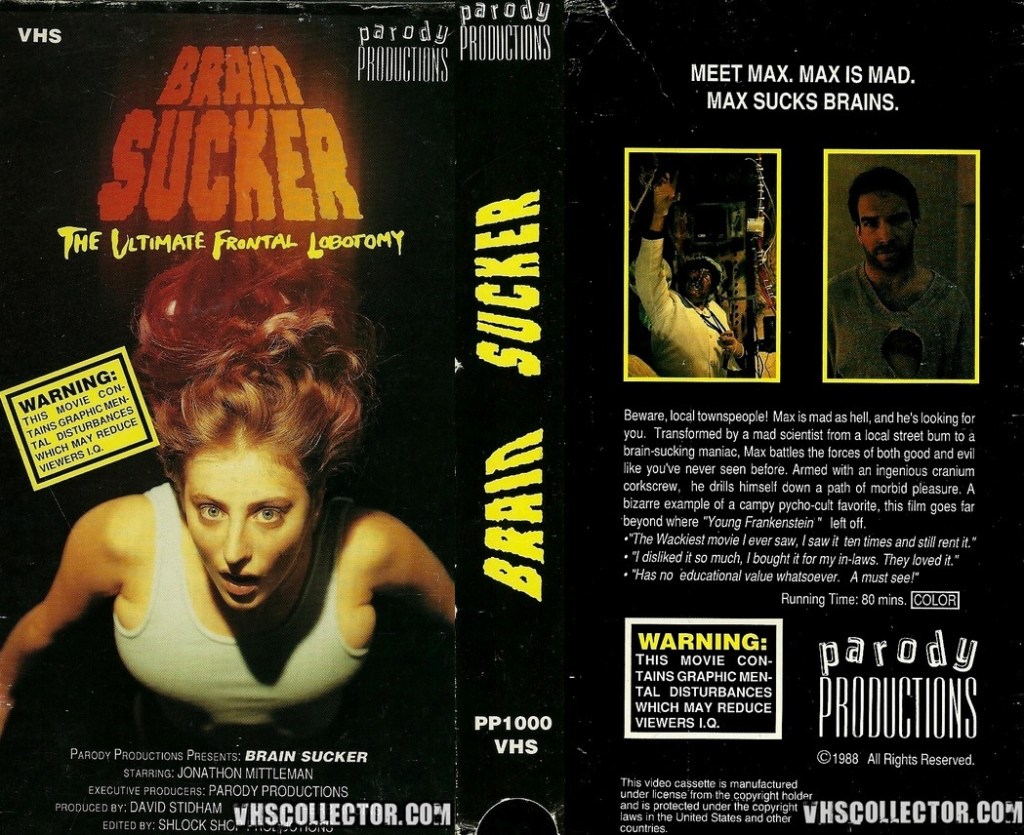
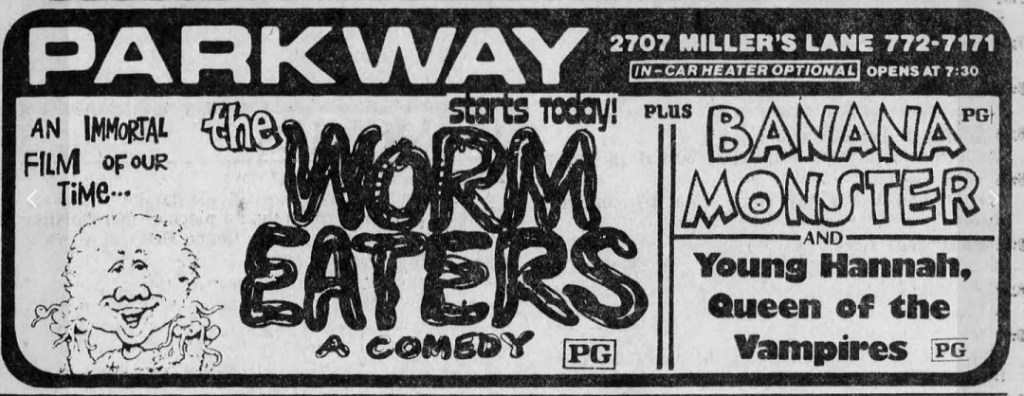
We’ve never reviewed The Worm Eaters at B&S About Movies. I can’t speak for Sam, but I have seen it. And it’s a case of don’t ask, don’t tell. But I will tell you that it’s pure Bill Van Ryn digging-up-the-old-drive-in-newspaper-ad fodder for a Groovy Doom Facebook posting — if he already hasn’t done one. So, The Worm Eaters did reasonably well. It must have, since Herb Robins returned — a decade later — in the midst of the shot-on-video craze of the ‘80s to write his third and final and direct his second and final film: The Brainsucker, a _______ that has the nerve to soil the name of Mel Brooke’s by name dropping the horror-comedy classic, Young Frankenstein. And, are they trying to tie this into Mad Max and make us think we’re getting a “futuristic” flick?

Paul Z. at VHS Collector comes through with the cover assist, once again. What would we do without him?

We’ve never had a reason to review The Brainsucker — no more than we had any reason to review The Worm Eaters. Then Sam the Bossman had to come up an “SOV Week” tribute, and you know me: I like to dive deep into the celluloid muck and mires of Allegheny County. I am ashamed to admit I rented this on VHS back in the day. Hey, at $0.49 one-day rentals at a Phar-Mor drugstore that had to be returned at midnight with a brisk walk down to the corner: why the hell not?

Exactly. I don’t know why. But I do know that it had nothing to do with Herb or Steckler or any connection to The Worm Eaters: I just liked stacking up the $.49 cent Phar-Mor tapes (I bought my used copy of FM and two of the four De Ossorio’s “Blind Dead” epics there) to see what I came up with — which was usually, you guessed it: muck and mire of a dog’s ass variety. Such a film is The Brainsucker, a ___________ that gives “backyard” filmmaking a bad name and was shot-on-camcorder because Kodak and Fuji Film forged an alliance to make sure not one frame of 16mm film was sold to Herb Robins. For it is a film (I hate using the word “film” in this review) that is an insult to the Reverend Samuell Henshall and wine bottles the world over.

“Corkscrews?” you say.

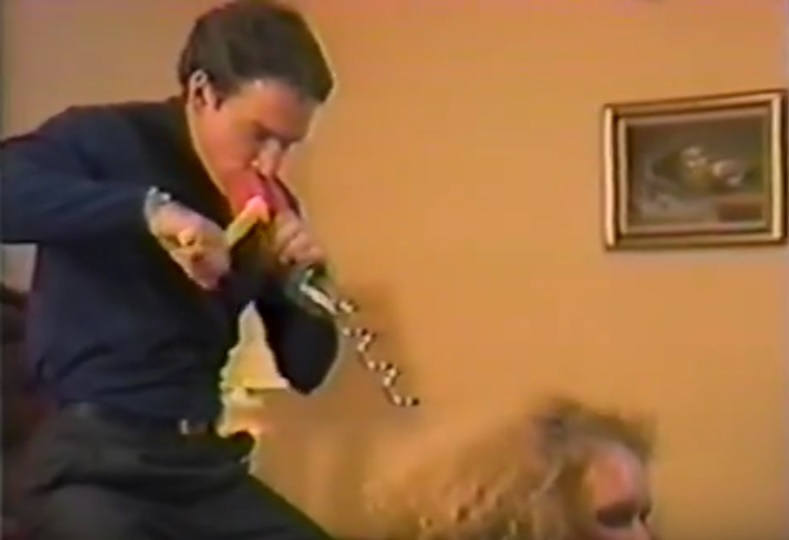
Yes. This is a movie about a serial killer with a loose screw on the loose (Santa Fe, New Mexico, where this was shot) with a corkscrew-sucker-thingy that’s part garden weasel and part bong. He carries it around in red bowling bag. He drills into the back of one’s skull, turns the handle, and sucks brains, aka raw, fatty bacon strips, up through the shaft. We think someone watched Phantasm one too many times — but couldn’t afford the Chinese harmony balls and X-Acto blades to come up with something better than a garden weasel, a bong, and a rotating handle from a kitchen vegamatic.

At least exploitation auteur Frank Henenlotter knew how to create insanity with the likes of Frankenhooker and Basket Case. Then, in his infinite mad genius of wisdom, gave us Brain Damage: an examination of man’s relationship to drugs — personified in a worm-creature named Aylmer who demanded his hosts eat brains to feed him. But The Brainsucker personifies nothing; for it has no brain to damage. There’s no mad genius. There’s just stone cold stupidity.

Did Herb Robins, perhaps, see the SOV’er Gore-met Zombie Chef from Hell (1986) and Redneck Zombies (1987) and said, “I can do that?” and broke (out) the camcorder? If so, he succeeded in making those (admittedly fun; with fan bases) inert-inept’ers look better than they are — and that’s a tall order to fill for a zombie-burger Wednesday Special. In fact, Robins succeeded in making T.L.P Swicegood’s utterly awful The Undertaker and his Pals (1966) look even better that it should — and that film strove — and failed, miserably — as a comedy rip on Hershell Gordon Lewis’s Blood Feast (1963; considered the first “splatter” film). But Swicegood’s final film wasn’t no Blood Feast and The Brainsucker ain’t no pal to the Undertaker, so it surely ain’t no Blood Feast.

Maybe, just maybe, if Glenn Danzig worked images from Robins’s opus into his music (as he did with Swicegood’s) or Rob Zombie sampled Brainsucker dialog into his music (as he did with Swicegood in “What Lurks on Channel X” from Hellbilly Duluxe) . . . no, not even Danzig or Zombie is helping us swallow this film’s hash browns and bacon-cum-brain-strips. Maybe if this was more “cannibal” and we had Lemmy and this was titled Eat the Rich (1987) and Motorhead composed the theme song, “. . . come on baby, and bite my brain / Come on, baby, suck my brain / drill the bong into the back of my brain / feel the sucking, roll / Come on, baby, Brainsuck the Rich.”

Nah.

Now available on eBay and other fine, online retailers. Bacon strips, not included.

The psycho-helixophile twistin’ the brain bong is not, however, Herb Robins: it’s someone named Jonathan Mittleman — as Max — in his film-and-then-vanished-debut. But Herb Robins is here as (the bumbling line-reading) Detective Kropotsky.

Now, with that name — and since were dropping Mel Brooks, and Mad Max, and soiling-ripping Frank Henenlotter — is the “Kropostsky” name supposed to evoke the New York urban legend of the Cropsey manic that fueled the slasher flicks The Burning (1981) and Madman (1982)? As with the lack of any Henelotter baskets, brains, or hookers . . . there’s no burning or madness . . . and no slashing, no special effects, no lighting, no sound, no framing, no soundtrack, no budget, and no permits, along with bad accents, and yelling and line-flubbing actors in a VHS toilet swirl with no rhyme, no reason, no purpose, and no plot. The Brainsucker is an SOV that, when the wow-and-flutter credits and soundtrack music ends . . . two more whole minutes of black screen accompanied by low-rez buzzing, ensues. And like an idiot: I watched those two minutes, thinking there was an “Easter Egg” to be had. And there was: 30-more seconds of hissing mixed with black-and-white snow flurries.

In the little that passed as a “plot”: Max is a career criminal placed by a judge under the care of a psychiatrist: an evil psychiatrist. Now Max is a corkscrewin’ n’ brainsuckin’ serial killer of the Troma variety. Why and how did the medical malpractice “Frankenstein” our little Maxwell into a helixophile is anyone’s guess. What’s Max’s backstory: Did he collect fine wines. Did he have a traumatic experience in a wine cellar. Did a rich, wine collecting uncle fondle Max’s lower abdominal Pez dispenser. Did his wine-swillin’ aunt seduce him on the couch in the wine cellar. What tragedy — if any — occur in wine country. Perhaps a flashback car wreck that killed mom and left dad impaled on a twisted road sign post?

Nope, there’s no reason. Max just like corkscrews.

What is certain: Troma movies do not audibly have their directors urge “zoom, zoom, zoom” off-screen to their DP (well, a kid holding the VHS camcorder) or implore their actors to “keep going” with a scene reaction. Troma movies also do not have a radio DJ swallow-breathing a portable cassette player’s microphone as a studio mic.

While Troma movies have their crimes (don’t get Sam the Bossman started), The Brainsucker is a celluloid-destroying wehrmacht that instills a whole new appreciation for all boondoggles Don Dohler — while it simultaneously inflicts 16mm backyardin’ of the ‘70s and shootin’ on video of the ‘80s with a bad name. Not that Ray Dennis Steckler is a cinematic genius by any stretch of the ol’ celluloid . . . but did Herb Robins learn nothing between the years of 1964 to 1988? Steve Martin said, “Comedy is not Pretty.” He did not, however, say comedy was deaf, dumb, indigent, and incontinent.

Was The Brainsucker possibly produced on an ENG camera sometime in the mid-‘70s and issued in the late ‘80s? Nope. The copyright in the end credits states this all got legal like in 1988. And it was, in fact, shot on an RCA-styled VHS Camcorder. It’s also the worst of the SOVs I’ve either watched and reviewed or re-revisited/nostalgia-binged this week. And I can’t believe I sucked my brain clean of 8,000-plus character to create 1,700-plus words for a movie that chilling described what it did to my cerebellum. Calling the Ramones! Give me a dose of DDT! The bacon-bong sucker is here for my teenage lobotomy.

Never under estimate the power of the Ryn/June 1982, Louisville, KY.

But hey, you gotta love a movie where one of the actresses — Marjorie Morris, who played Max’s girlfriend, Joanne — finds the movie on You Tube and leaves a comment of her fond memories of the project. Yes. Margorie, in a few simple keystrokes, just made The Brainsucker a lot less sucky and a lot more fun. And you, dear reader, can experience the sucky fun on You Tube, courtesy of film historian extraordinaire, TheBurialGround5. (Who’s going to be gettin’ an ear-mail full from me; for if there was no copy to share, I wouldn’t have gotten this far in the review.)

* So, you need a Arch Hall, Jr. fix? Well, we didn’t get to Wild Guitar, but we did review and overview Archie’s career with a look at The Choppers. And Arch is alright, we love the guy. Just like with Herb Robins.

About the Author: You can learn more about the writings of R.D Francis on Facebook. He also writes for B&S About Movies.

Wanton Want (2021)

Update, March 2022: You can now watch Wanton Want as a free-with-ads stream on Tubi. Other viewing options are available at the end of this review.


If you grew up watching Buffy The Vampire Slayer, then you’ll have an immediate streaming interest in Wanton Want, the ninth indie feature film from Joston Theney. In addition to starring Nicholas Brendon, who portrayed Xander Harris on that TV franchise (1996 to 2003), the film also stars Tuesday Knight (who got her start in A Nightmare on Elm Street 4: The Dream Master; with eleven films in various states of production) and Phillip Andre Botello (the 2019 Jesse Eisenberg vehicle, The Art of Self Defense). In support are Shoshana Wilder (Roku’s 2021 original series, Cypher) and a 55-indie credits strong Jackie Moore.

Wanton Want is the story of Douglas Paynter (Nicolas Brendon), a lackadaisical writer with hopes to shatter his recent bout of writer’s block and create his “magnum opus” by taking a remote (uh-oh), weekend getaway with his wife (Jackie Moore). No writing, however, will be done on this retreat: Paynter’s estranged friend Dan Mackie (Phillip Andre Botello) crashes the weekend with his femme fatale wife Pia (Shoshana Wilder) as the noirs of film slip and the screws turn when their once causal, sexual secrets and obsessions come to a head for a fatal weekend.

During a promotional interview for his second feature film, Axeman (2014), at Bio Gamer Girl, Atlanta, Georgia-born producer and actor, writer and director Joston Theney cited Takashi Ishii’s penned Evil Dead Trap (1988) as his favorite horror movie:

[I’m] probably gonna catch hell for this but Evil Dead Trap. It’s ruthlessly violent and gory. It’s dark and moody, and it’s visceral and gritty. It doesn’t pull any punches. It was made at a time and in a nation where films of that nature were pretty much banned. But a very ballsy [Toshiharu Ikeda] found the money, dug deep and made a truly disturbing and jaw-dropping film when it was very unpopular and detrimental to your career to do so.

Evil Dead Trap? What type of person chooses that film of all films as their favorite horror film? Passing over the oft, ad nauseam-cited bloody trinity of Carpenter, Cunningham, and Craven for a U.S-obscure director from Japan? You know what that means: Mr. Theney passes “GO!” and collects $200 bucks and becomes part of the B&S About Movies family.

Sadly, we don’t have $200. We can’t even afford to offer Joston a B&S drink tumbler or mouse pad. But we can review his movie.

I’ve been a long time fan of film in general. Growing up, I was always a quiet kid. I was always kind of shy. Movies and television is what I always turned to. As I grew up, I created my own little stories and stuff, short stories. I had a little comic book I started. I think all of that, overtime, naturally led to me picking up a camera.”
Horror Fuel, 2017

I say make a good film, show it where ever you can and tell everyone you can. You can’t just rely on social media. It’s only a cog in the machine. Without it, the machine doesn’t function properly, but you can’t focus solely on that or the rest of the engine will fail. Fans need to see it, feel it, sniff it, etcetera, and only hearing you yap about how awesome it is isn’t going to suffice.”
Horror DNA in 2014

Growing up on ’80s slashers and never really growing out of them . . . this was and always has been my favorite era of filmmaking. It was a time when creativity and entertainment value were the things that drove film.”
Sandwich John Films, 2014

As you can see from Joston Theney’s previous insights, he’s an accomplished filmmaker with a cause; a filmmaker that doesn’t wait for the studios to come to him. So, with that, he’s created nine feature films since 2011, which includes his Axeman trilogy, along with a tenth — The Tale of Two Faces — in post-production. As an actor in the frames of his own works, you’ve also seen the writer-director in the uber silly, but very entertaining streamer Snake Outta Compton (2018). He’s also appeared in the latest, unofficial entry in the ongoing Jurassic mockbuster franchise, Jurassic Hunt (2021)*.

The Amazon Prime and IMDb reviews for Theney’s self-produced efforts haven’t been kind, but there are a few that “get” his efforts. In preparing for my review of Wanton Want — not being familiar with his works — I spent some time with three of his films. While there are, as is the case with any self-made filmmaker blazing their own trail, cinematic faux pas (see the great Flywheel as an example), Joston Theney is certainly not an incompetent filmmaker; he knows how to act-structure a screenplay and create character arcs, and he’s learned his craft with each film in his past as he matures with the next film. That’s the sign of a true filmmaker: growth, as Joston Theney doesn’t make the same mistake — or the same film — twice. Courtesy of having the most recognizable and thespian-strong cast of his now ten films, Wanton Want proves Joston Theney’s tremendous growth as a filmmaker, as his ninth effort is by far his strongest effort. This may also be, with the exception of his in-post-production The Tale of Two Faces, his last self-produced film.

Last film? I am wishing him bad luck? No, exactly the opposite.

Joston Theney is infinitely ready to be called up to the indie-shingle big leagues; he’s professional prepared to tackle damsel-in-distress flicks, even romance Christmas romps for the Lifetime and Hallmark Channels (if our beloved Fred Olin Rey and David DeCoteau can make em, why not). So watch Wanton Want today, so you can say you remembered Joston Theney, then.

For it will happen for him, sooner than later. He’s a filmmaker to watch out for and remember.

Wanton Want will have its VOD release on September 28, 2021, via Amazon Video, GooglePlay, and YouTube Movies via Indie Rights Movies; you can learn more about their catalog of films on Facebook and stream them at their Amazon Prime portal. Other recent releases from the Indie Rights Films shingle we’ve reviewed include A Band of Rogues, Banging Lanie, Blood from Stone, The Brink (Edge of Extinction), Chasing the Rain, Double Riddle, The Girls of Summer, Gozo, Loqueesha, Making Time, and Still the Water.

You can keep abreast on the latest with Wanton Want on Facebook and Instagram or go direct to the source at the Joston Theney’s official website. You can also read more of his insights on film with interviews at Final Girl and Search My Trash, along with a new interview, post-Wanton Want release, with Authority Magazine.

As you wait for the debut of Wanton Want, you can catch up with Joston’s work on Tubi with the free-with-ads streams of Snake Outta Compton, along with his horror directing efforts Adam K, Axeman at Cutter’s Creek, and Stained. If you’d prefer your Joston experience ad free, you can VOD stream his efforts via his Amazon Prime page.

* We reviewed Jurassic Dead (2017), Jurassic Thunder (2019), and Attack of the Jurassic Shark (2021), as well as breaking down the Universal franchise with our “Watch the Series: Jurassic Park” featurette. And be sure to look for Jurassic Hunt, starring Joston Theney, which hit the streaming platforms on August 24.

Starring Joston Theney!

Disclaimer: We received a review request from the filmmaker prior to the film’s distribution. That request has no bearing on our review of the film. We researched and retrieved all review quotes within this review — on our own. Those materials were not provided to us by the filmmaker, any PR firm, or film studio now associated with the film.

About the Author: You can learn more about the music journalism, fiction and screenwriting endeavors of R.D Francis on Facebook. He also writes for B&S About Movies.

Bits and Pieces (1985)

If Leland Thomas, an ex-army combat photographer in his lone writing and directing effort, wanted to blow out all other SOV horror films released in the wake of Boardinghouse (1982; that review is coming!) — the first home video-era shot film — then he succeeded. (Blood Cult was the first SOV video store-only distributed film; Boardinghouse, while making it to the stores, began as a mail-order only release.) This is graphic, gruesome, crude, rude, and scuzzy. While Bits and Pieces is remembered as an SOV — and quacks like an SOV — it wasn’t shot-on-video, but on 16mm film in the summer of 1985 in and around Los Angeles — Burbank and the San Fernando Valley, in particular. But, no matter. Bits and Pieces is still an SOV’er forever in our VHS-pumpin’ hearts.

The overseas VHS of Bits and Pieces: a gagged, beheaded woman? Punch the membership card. We’re weird that way.

The set up is pretty simple: someone is killing the patrons of a male strip review, cutting them up into “bits and pieces,” as we are advised by the most unlikely news reporter to ever hit the field. Bits and Pieces is either incompetent or — in a Tommy “The Room” Wiseau twist — intended to be “bad” to push the funny to soften the graphic X-rated gore. And this film is gore and a bag o’ chips. Is this a pseudo-porn, like Spine? No, but there is bondage, as was in Spine. But the cheesy porn-esque music is “wah-wah’in” everywhere. But this is less Spine-bondagey and more Dead Girls-slashy. Oh, and our killer hears “wind chimes” in his head, we think; unless that was an artistic choice by the soundtrack composer (who’s connected to Spine; more on that later). Yeah, that’s it. This movie isn’t that “high” on the art to go “subjective” into the killer’s head.

So the “someone” is Arthur, and he has Norman Bates not-an-average-guy issues with his mommy — and he lives just down the street from head scalpin’ Frank Zito who plops hairpieces onto his mannequin collection — which leads Artie to carry conversations with an armless mannequin adorned in a red wig. Of course — in his mind — the mannequin talks back, berating him that he’ll never find a girl as pretty as her.

Man, does this film have the padding — no pun intended. There is a LOT of male stripping in this film. And lots of beat-up looking babes hootin’ and a tootin’ it up. That’s where we meet Tanya — the psych undergrad, natch (Sheila Lussier) — and her friend Rosie (Suzanna Smith) as they leave the “2001” strip club (a homage to 2001 Odyssey, the club in Saturday Night Fever, perhaps). So, one blow to the head later, and Tanya’s kidnapped. And our red-headed mannequin tells little Artie “how” to inflict the pain in his homespun Grand Guignol.

So Tanya ends up in a dumpster and makes the papers. Rosie goes to the cops. And we get our required, dry-as-toast inept cop in Lt. Carter. And we have another girlfriend, Jennifer (Tally Chanel), and it looks like Arthur has got some more kidnappin’ for faux-mommy mannequin to attend. And there’s a lot of “ensuing” in this film: Jennifer screaming and flailing through the woods. And while murders are afoot, Rosie goes on beach dates. And there’s hot tube interludes. And male strippers. And glasses of wine. And nary a one worried about a strip club-stalking serial killer. Yikes, and I thought the people in Stallone’s D-Tox were dumb, always putting their eyes up to peepholes at every door knock and door bell — with a serial-killing peephole-driller on the loose.

Lovely.

Well, this sure ain’t Bill Lustig’s Maniac (1980), because Bits and Pieces doesn’t have that film’s unsettling “creep” factor. And it sure as hell ain’t Alfred Hitchcock’s Psycho and doesn’t have anything from that film. If only our dippy Lt. Carter was Charles Bronson’s Leo Kessler and S.E Zygmont (Arthur, our serial) was Warren Stacey from J. Lee Thompson’s 10 to Midnight (1983).

But you know what: I love this movie: Leland Thomas is Wiseau-committed to giving us a deep psychological study into his poor, hapless killer f’d up by an abandoning dad and floozy mom. To that end, through flashbacks — because this ain’t no Jason Vorhees-cum-Micheal Myers just-kills-for-killing slasher romp — we learn the whole mannequin snafu with the wig n’ lipstick thang is because, as a form of punishment for spying on her and interrupting her boozin’ it up, she forced Artie to wear a wig and make up. Oh and the salami scene. Mommy taunts little Artie with summer sausage meats. And she turns into a bloody skull in a wig screaming at him. Yeah, NOW, I can’t help but think of Wesley Stuart, portrayed by Gerald “Simon & Simon” McRaney inflicting his own Night of Bloody Horror over his mommy issues. And that J.N Houck cardboard horror is bad, but is looking a lot better to me now — especially in the acting department — after my sitting in our Arthur’s flashback counseling sessions. And, like Wessy-pissy pants in that film, Artie kills mommy. The rest will be plot spoiling. . . .

So, is there life after Bits and Pieces?

Remember the Spine soundtrack Easter Egg we dropped? Don Chilcott, the musician responsible for Spine’s scuzzy, slasher-appropriate synth-soundtrack, also scored Bits and Pieces. Don never stopped rocking: he became a successful studio musician and a respected guitarist and lead vocalist for several California-based blues bands.

Remember, in our review of Peter Carpenter’s Point of Terror, when we discussed that everyone — even in Hollywood — has to start somewhere, and Oscar-winning editor Verna Fields, who worked for Pete on the film, later earned an Academy Award for her work on Spielberg’s Jaws (1975) and edited American Graffiti (1973) for George Lucas? Well, producer Richard Bansbach also worked on that influential shark fest’s second-unit for the film’s land-based shots; he also directed the Jaws-rip, Claws (1977). (Nope, not Islands Claws. That was in 1980 and a different, but sorta-the-same, movie. Well, the first was a bear, the second is a crab . . . oh, never mind!)

The BIG KAHUNA of the cast and crew is Thomas L. Callaway. He worked as the cinematographer on the USA Network favs Creepozoids and Slumber Party Massacre II (both 1987), as well as Friday the 13th Part VII: The New Blood (1989). And Callaway is still at it — 120-credits strong — with a lot of Lifetime movies, and is David DeCoteau’s go-to camera man for the likes of A Husband for Christmas (2016) and A Christmas Cruise (2017). (Yes, we have a Lifetime and Hallmark and Up Channel X-Mas flick fetish goin’ on at B&S.)

Did you see Chuck Vincent’s Warrior Queen (1987)? Well, that was Suzanna Smith’s only other role; Tally Chanel, who did a few of Chuck’s movies, was in that, as well. (Chuck’s done 55 T&A soft-porn flicks that ended up on Showtime or the USA Network in the ’80s; you’ve seem a couple of them, such as Bedroom Eyes II.)

Now, Sandy Brooke, who plays Ms. Talbot, Rosie’s (Suzanna Smith) tweaked mom . . . oh, do we ever know her around the B&S About Movies’ cubicle farm! She was an SOV warhorse, as she also appeared in David A. Prior’s SOV debut film, Sledgehammer*, as the lead, Taura. (Visit our week-long tribute to him; just search his name on our site and you’ll find all of his films.) Sandy was also in Fred Olen Ray’s Star Wars-dropping Star Slammer (1986), Ron Marchini’s directing sidekick Paul Kyriazi’s One Way Out (1987) (Join us for our two-day Ron Marchini tribute with this career wrap up), Terror on Alcatraz (1987; with Aldo Ray as Frank Morris!), and she ended her career with (YES!) David DeCoteau in Nightmare Sisters (1988; with Linnea Quigley, Brinke Stevens, and Michelle Bauer!).

Denied. No trailer to share, but wow! VoicesInMyHead does it again, as you can watch Bits and Pieces — uncut — on their awesome You Tube page. Spend some time there, as they have LOTS of great ’80s VHS oldies to enjoy.

* That review on the BIG KAHUNA of SOVs that is Sledgehammer, is coming. Oh, you know it. Search for it. Oh, already linked it!

About the Author: You can learn more about the writings of R.D Francis on Facebook. He also writes for B&S About Movies.