Directed by Christian Cashmir, who co-wrote the story with star Brielle Carter (who also was on second assistant camera), Elfette Saves Christmas is about an elf — yes, named Elfette — who heads to Florida on a vacation in the busiest time of the year.
If that wasn’t bad enough, Santa Claus (Quinton Aaron) has been kidnapped by an organized crime boss named Little Georgie (George Vricos), who wants Santa to stop cutting into his profits, as he now owns a company that makes pencil phones for $900. There’s also an elf hunter named Ernest Killingsworth III (Zachary Vazquez) who wants to make an elf dinner, so he starts hunting her and her best friend Sparkle (Aléa Figueroa).
I have no idea who the audience for this movie is, as the mob shoots the elves with freeze guns, which is scary enough, but then you have Santa getting tied to a chair and threatened by a crazed killer, as well as a man who loves to eat elves. Who can say. Elfette’s outfit, however, is a little something for daddy, as they say.
Who knew that elves were placed in castes with the wrapping paper elves at the lowest tier? Not me. I mean, I knew one elf who wanted to be a dentist and everyone treated him like garbage. What’s really amazing is that this movie got to Red One‘s plot five years before it did with about 5% of the budget. Then again, Santa got kidnapped is an easy story to tell, just look at Santa Claus Conquers the Martians.
One plot point I want to break down and discuss: Why is Elfette the one saving the day when Sparkle is the destined one? What is she supposed to do, bring balance to the naughty and nice? Why do I base so much of my life on dumb allusions to the Star Wars prequels?
The Brivido Giallo Collection collects the four film series directed by Lamberto Bava. Each film in this set is a standalone fully featured production that was completed between 1987 – 1989. The films stories are not connected, but were collected together for Italian television near the end of the 80s.
Cauldron Films is collecting all four movies — Until Death, Graveyard Disturbance, Dinner with a Vampire, and The Ogre — on blu ray for the first time in a limited edition five disc set with each movie fully uncut and restored from 4K scans of the 35mm film negatives, loaded with brand new cast and crew featurettes by Eugenio Ercolani (including 4 with Lamberto Bava himself) and an exclusive new interview with composer Simon Boswell, all housed in a rigid outer box with four folded posters featuring new artwork by Eric Adrian Lee.
Graveyard Disturbance (1987): I used to have a complicated relationship with Lamberto Bava. And by that, I mean that for every Demons, there’s a Devilfish. But then I realize that I kind of like Blastfighter, love Macabre and even kind of dig Delirium. I always giae him another chance and finally, one day, I came around to liking what Lamberto directed.
In July of 1986, Lamberto was hired to create five TV movies under the title Brivido Giallo (Yellow Thrill). Of course, none of these were giallo and only four got made: Until Death, The Ogre, Dinner with a Vampire and this film.
Originally titled Dentro il cimitero (Inside the Cemetery), this spoof of Italian horror is about five twentysomething teenagers who make a bet with an entire town — which is literally referred to as the kind of place from An American Werewolf In London — to see if they can survive one evening inside a series of catacombs. Not only are there zombies and vampires in there, there’s also death itself.
It all starts off with plenty of promise, as our gang of young punks has the most 80s van ever, complete with an image from Heavy Metal, U2 and Madonna. After the crew shoplifts, they go on the run and straight into supernatural trouble.
The person they’re stealing from? Lamberto. Which is only fair, as he uses this movie to rip off everything from — sorry, spoof or pay homage to — Carnival of Souls and Phenomena to his father’s Black Sunday and any number of zombie movies.
So where does the eating come in? Well, there’s one great scene in here where an entire family of multiple eyed creatures all dine on rotten food. This moment had to have inspired Pan’s Labyrinth.
The Cauldron release of Graveyard Disturbance includes commentary by Eugenio Ercolani and Nanni Cobretti; interviews with Bava, Gianlorenzo Battaglia, Karl Zinny, Massimo Antonello Geleng and Roberto Ricci; a trailer; a poster with artwork by Eric Adrian Lee and a reverse blu ray wrap with the original artwork.
Until Death (1988): As I mentioned above, I felt like I had never given Lamberto a fair chance. Then again, whenever I say that, people always remark that I’m always mentioning that I like his movies. Demons is a near-perfect movie but I’ve always qualified that by saying that he had Argento, Franco Ferrin and Dardano Sacchetti on board along with Michele Soavi as assistant director. And then I think, well, you know, I kind of really like Macabre and it has some really grimy stuff in it. A Blade In the Dark, Blastfighter, Dinner with a Vampire, Graveyard Disturbance, The Ogre, Demons 2 and Midnight Ripper all have charms. I’ve even come around to liking Delirium e foto di Gioia, Maybe not Monster Shark. But the more I think about it, I really do like Lamberto Bava.
This is the movie that put me over the edge into perhaps even love.
In July of 1986, Lamberto was hired to create five TV movies under the title Brivido Giallo (Yellow Thrill). Of course, none of these were giallo and only four got made: The Ogre, Dinner with a Vampire, Graveyard Disturbance and Until Death.
There were some hurt feelings about this movie when it was made. It was based on an older script by Dardano Sacchetti, but Lucio Fulci went on record saying that he was planning on making an adaption of The Postman Always Rings Twice with the title Evil Comes Back. Fulci said that Sacchetti wrote it up and sent it to several producers and later found out that when Luciano Martino bought it, his name wasn’t on it. Fulci said, “…because of our friendship I decided not to sue Sacchetti, but I did break off all relations with him.” Sacchetti responded, “The producer of Evil Comes Back didn’t have the budget required, and he gave up to do the film. That’s it. Years later, as the screenplay was mine, I sold it to another producer who used it for a b-movie with Lamberto Bava.”
Gioia Scola really could have been a remembered giallo queen if she’d come along 15 years early. As it is, she was in some of my favorite late 80s films in the genre, including Obsession: A Taste for Fear, Too Beautiful to Die, Suggestionata and Evil Senses.
In this film, she plays Linda, a woman whose husband Luca (Roberto Pedicini) left her eight years ago. All the men of the small village wondered why he’d leave behind such a stunning woman. In fact, this movie could have been called Ogni uomo vuole scopare Linda. She gave birth to Luca’s son and unknown to the town, has since become the wife of the man who helped kill her husband, Carlo (David Brandon).
Together, they run a small hotel near the lake. During one rainy night, Marco (Urbano Barberini) arrives to stay. And it seems like he knows way too much about what’s going on. Her son Alex (Marco Vivio) may as well, as he wakes up every night screaming, dreaming of his father clawing his way out of a muddy grave. She hires Marco as the handyman, but Carlo thinks they’re sleeping together. In no way can this turn out well.
How does Marco know where all the old clothes are kept? How does he already know the family recipes? And why is he so close so quickly with Alex?
What’s intriguing is how close this is in story and tone, yet goes off on its own path, to Bava’s father’s film Shock. The difference is where the father would use camera tricks and tone to create a mood of dread, his son will put you directly into the middle of the muck and grue with comic book lighting and great looking effects from Angelo Mattei. And keeping the family tradition going, Lamberto’s son Fabrizio was the assistant director. How wild that Mario’s grandson was AD on movies like Zoolander 2 and Argento’s Giallo and The Card Player, using the name Roy Bava for those last two movies.
My favorite fact about this movie is that it was released on VHS as The Changeling 2: The Revenge. Trust me, it has nothing to do with The Changeling.
The Cauldron release of Until Death includes commentary by Eugenio Ercolani and Troy Howarth; interviews with Bava, Battaglia, David Brandon and Massimo Antonello Geleng; a trailer; a poster with artwork by Eric Adrian Lee and a reverse blu ray wrap with the original artwork.
The Ogre (1989): Following the success of the film Demons and Demons 2, this film was announced as part of Bava’s TV movie series. The script, written by Dardano Sacchetti, is pretty much the original script for The House By the Cemetery before Lucio Fulci added to the tale. Seeing as how it was a TV movie, there was some self-censorship, as Bava said that were this a real movie, the ogre would have eaten children.
Cheryl (Virginia Bryant, Demons 2, The Barbarians) is a sexually confused American writer of horror novels who traves to Italy with her husband Tom (Paolo Malco, The New York Ripper, Thunder) and son Bobby — yep, little Bob, but not Giovanni Frezza — to work on her next book.
She begins to have nightmares of childhood memories of being stalked by an ogre and becomes convinced that the house has a curse on it that is bringing her past memories into our reality.
Alex Serra, who was the blind man from the original Demons, also shows up. Speaking of Demons, this movie was released outside of Italy as the third film in that series. As you’ll soon learn from the Demoni sequels, it has nothing to do with the first two films. Even more confusing, this was released on DVD in Germany as Ghosthouse II, the sequel to the Umberto Lenzi’s Ghosthouse/La Casa 3. That movie is confusing, too, as it’s the third movie in the La Casa series, which translates to house in Italian, but has nothing to do with the movie House. Instead, Evil Dead is known as La Casa in Italy.
Want more info on how all that works? Check this article out on La Casa and this article about the Demons movies.
The Cauldron release of The Ogre includes commentary by Rachel Nisbet; interviews with Bava, Geleng and Ricci; a trailer; a poster with artwork by Eric Adrian Lee and a reverse blu ray wrap with the original artwork.
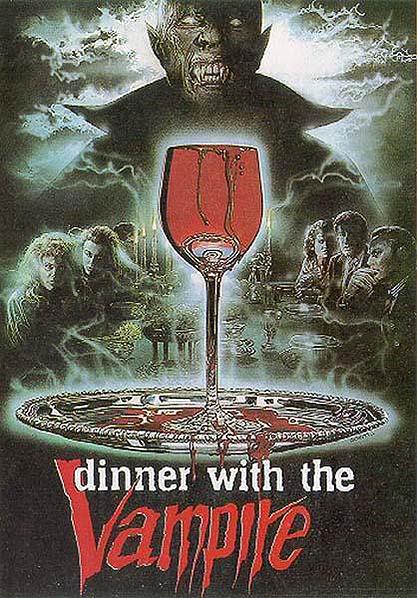
Dinner With a Vampire (1989): Four actors — Gianni (Riccardo Rossi, the Italian voice of Simba in The Lion King), Rita (Patrizia Pellegrino), Monica (Yvonne Sciò, who was in the Tal Bachman video for “She’s So High”) and Sasha (Valeria Milillo) have won their audition to appear in a new horror movie. As they’re on the way to meet Jurek the director (George Hilton, All the Colors of the Dark, The Case of the Bloody Iris) — who lives in a large castle — they learn that he’s a vampire and has a challenge: he believes that they can kill him.
There are movies within a movie. There’s a hunchbacked assistant named Giles (Daniele Aldrovandi). And there’s lots of gore, particularly at the end. Written by Bava with Dardano Sacchetti, this comedy isn’t going to change your world, but it will entertain you unless you have a major issue with goofy humor.
The Cauldron release of Dinner With a Vampire includes commentary by Eugenio Ercolani, Nathaniel Thompson and Troy Howarth; interviews with Bava, George Hilton, Geleng and Boswell; a trailer; a poster with artwork by Eric Adrian Lee and a reverse blu ray wrap with the original artwork.
The set also comes with a soundtrack compilation CD featuring tracks from each Brivido Giallo film curated and supplied by composer Simon Boswell.
This is an incredibly exciting set! Here’s to more Italian TV movies making their way here.
SNL has been a part of my life since I could remember. My parents were the right against for it, as it debuted when my father was 36 and my mother was 26. They’d get us home from shopping just in time to watch it and I remember being so excited to be allowed to stay up, like some child adult and get to watch something no one else in school was allowed to.
As soon as the early 80s, when Newsday columnist Marvin Kittman said that the post-original Not Ready for Prime Time Players was Saturday Night Dead On Arrival, the show has been said to be worse than it was when it started. I’m not sure about that, although the quality has ebbed and flowed with today’s cast being as abysmal as it gets.
I’ve spent most of my life being obsessed with the show, how Lorne Michaels puts together episodes and its history, devouring almost every book published on the subject. I was excited when this movie was announced, but it has the danger of being too worshipful, too fawning over its subjects and probably trying to jam so much in to a short time.
And sure, that happens. It’s also a game of spot the writer or important person.
But for someone who has gone over the most small of details when it comes to this show, it’s also pretty great.
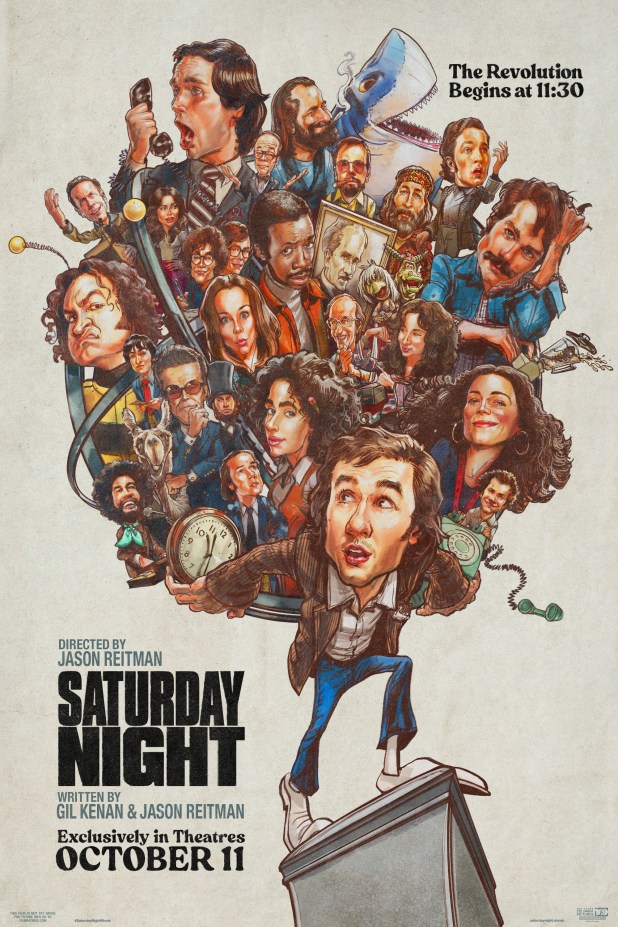
On October 11, 1975, Lorne Michaels (Gabriel LaBelle, who already pretty much played Steven Spielberg in The Fablemans) has no time left to get the first episode of the show on the air. His boss Dick Ebersol (Cooper Hoffman, Licorice Pizza) tells him that David Tebet (Willem Defoe), a high ranking NBC boss, is here to watch and will possibly just play a repeat of The Tonight Show Starring Johnny Carson instead of allowing the show to play on NBC.
As for Carson, voiced by Jeff Witzke, he calls and lets Michaels know that late night is his place and that he’s fighting with NBC. As soon as he gets what he wants, the show will be off the air.
Despite all the pressures that Michaels is dealing with, he still has to get his cast on the air. Belushi (Matt Wood) is fighting with everyone and refuses to sign a contract; Chevy Chase (Cory Michael Smith) is the brunt of his anger when he isn’t trying to keep Milton Berle (an incredible J.K. Simmons) away from his fiancee Jacqueline (Kaia Gerber). His writers are battling a censor (Catherine Curtin) while his host, George Carlin (Matthew Rhys) has no interest in even being there.
I don’t really believe that the show was saved at the last minute by Andy Kaufman (Nicholas Braun, who does great work here as Andy and Jim Henson) and the newly hired Alan Zweibel (Josh Brener), nor do I think anyone rallied around Garrett Morris (played by Lamorne Morris, no relation), despite the fact that they should have. It’s great to see him get such a part of this story, even if he was barely used on the show.
The nerd in me loved seeing how Rosie Shuster (Rachel Sennott), Anne Beats (Leander Suleiman), Al Franken (Taylor Gray), Tom Davis (Mcabe Gregg), Dave Wilson (Robert Wuhl), Paul Shaffer (Paul Rust), Herb Sargent (Tracy Letts) and even Leo Yoshimura (Abraham Hsu) show up in this, but the best lines are saved for Michael O’Donoghue (Tommy Dewey). You know, they should be. My biggest comedy nerdom is saved for genuflecting before his anger and caustic tone.
Gilda (Ella Hunt), Danny (Dylan O’Brien), Laraine (Emily Fairn) and Jane (Kim Matula) all appear as well, even if their stories are barely fleshed out. Just like the show, this doesn’t have the time to get into them, although it does have Billy Crystal (Nicholas Podany) trying to get on the first show and failing.
Naomi McPherson shows up as Janis Ian, Jon Batiste — who also did the soundtrack — as Billy Preston and Brian Welch as Don Pardo, another major part of the feel of SNL to me. It feels like at times it’s just trying to pack things in, as I get the feeling that Jason Reitman, who directed and wrote the script with Gil Kenan, is as much of a super fan as me. That’s why Finn Wolfhard may play an unnamed NBC page, but we don’t see this through his eyes. Instead, we are with Lorne all the way until the end, when the words “Live from New York, it’s Saturday Night!” end the movie and cue the credits, inverting their typical placement.
That said, if you are a big SNL nerd, you know that Belushi didn’t wait 39 seconds on live TV to show up in the first sketch or that Milton Berle didn’t host the show until Season 4. And there was no official host of the first episode. There wasn’t a host until episode 2 when Paul Simon appeared on the show. That’s also kind of like all the discussion if Rosie Shuster will use her husband Lorne’s last name in the credits and she picks her own. In truth, her name was Rosie Michaels on the show’s end titles.
These are all things that only nerds will understand. At best, SNL is something that works 40% of the time, at best, and even the greatest moments of the show are seen through the lens of what era you grew up in. As for the rest of, well, everyone, they’re probably watching this and wondering where Bill Murray was.
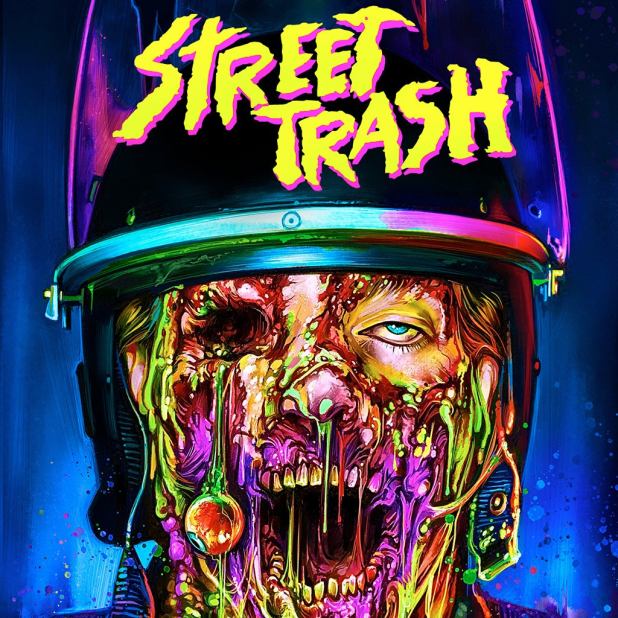
Ryan Kruger made Fried Barry and if you like that movie, well, good news. His reimagining of Street Trash, based on the 1987 movie, will probably delight you. Gary Green, who played Fried Barry, plays just about the same role in this.
Produced by Vinegar Syndrome and shot on 35mm, this has the Tenafly Viper booze being replaced by drones that give unhoused people in South Africa a case of the melts. There’s also Sockle, a little gremlin that shows up for some reason, which I have no idea why, as this Cape Town-set future of 2050 is about Ronald (Sean Cameron Michael) and his gang of weirdos — Chef (Joe Vaz), Pap (Shuraigh Meyer), Wors (Lloyd Martinez Newkirk) and 2-Bit (Green) — helping Alex (Donna Cormack-Thomson) adjust to life on the streets.
It’s Street Trash for people who were upset by the first movie and the fact that it didn’t just pretend to be transgressive but was wildly and violently odd. Or, as the review on Comic Book Resources wrote, “While Muro’s original film is notoriously cruel and ugly, Kruger wanted to create likable characters who the audience could root for.”
Or this line: “The original film’s jarring juxtaposition of slapstick comedy and severe misogynistic violence has proven to be too much even for seasoned gorehounds.”
I don’t know, I’m getting sick of the stripmining of my past, as I’m sure all old people get to be at some point. It got to the point that at the end, when they use Buckaroo Banzai’s line “Wherever you go, there you are” I reacted with an exasperated groan.
Anyways, this movie.
Mayor Mostert (Warrick Grier) has learned how to take the body melting results of the New York incident to get rid of undesirable people. He sends his cops into the streets to make it happen, all while people excessively swear at one another and make jokes like, “If two vegetarians get into a fight, is it still called a beef?”
The end of this goes full action movie and at least has some action and the practical effects are fun, even if the rest of the technical parts of the movie — the ADR is rough and it seems like the sound is low in others — lack. You could just watch this to see people melt in different colors and be told the sledgehammer plot and get past it. Or, you know, you could wonder why this movie spends so much time dissecting the pedophilic qualities of other stories instead of applying a critical lens to itself and, you know, actually being a halfway decent movie.
Steven Kostanski and the movies that he’s made with Astron-6 have always entertained me. Whether satirizing giallo with The Editor, making a perfect John Carpenter movie with The Voidor creating 80s rental movies out of time like Psycho Goreman and Manborg, the movies that result are always great.
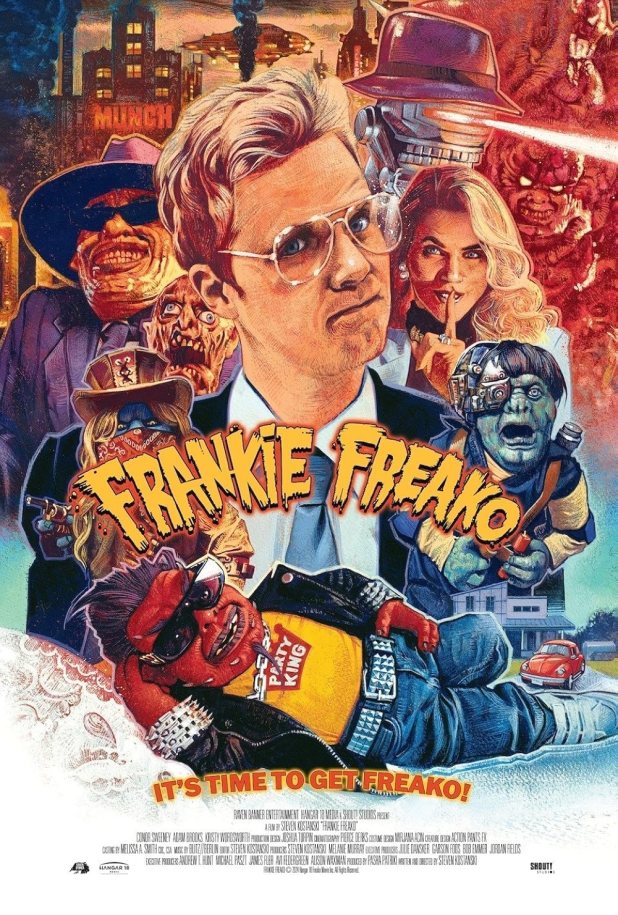
Inspired by the movies that ripped off Gremlins like Ghoulies, The Gate and Critters, Franky Freako takes place at some time in the 1980s, a time in which Conor (Conor Sweeney) is accused by his wife Kristina (Kristy Wordsworth) and boss Mr. Buechler (Adam Brooks) of being boring and way too uptight. As she goes away on a business trip, he decides to call the 1-900 number of Franky Freako (Matthew Kennedy) and gets pulled into the insane party world of the mini monster and his crew of oddballs.
Along with his friends Dottie Dunko and Boink Bardo, Franky brings the party into Conor’s life and by that, I mean he destroys his house and somehow drags him to his world, a place run by Freaklord President Munch that feels a lot like the future where Biff became President in Back to the Future Part II.
I wonder if 1-900-555-FREAKO is a real number. Every movie — well, every horror movie made in the 80s, it seemed — had numbers like that. This is a movie made for people that get the joke that Conor’s boss is named for John Carl Buechler, that wished that they’d make more of the Hobgoblins movies and that hoped for Ghoulies V: Ghoulies Get Jobs. I made that up, but wouldn’t that have been a good one?
For the rest of the world, you may wonder why this spent so much on practical little people partying and not get it. Your life is infinitely boring compared to the rest of us.
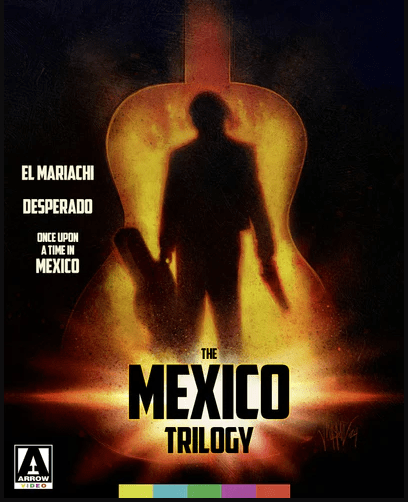
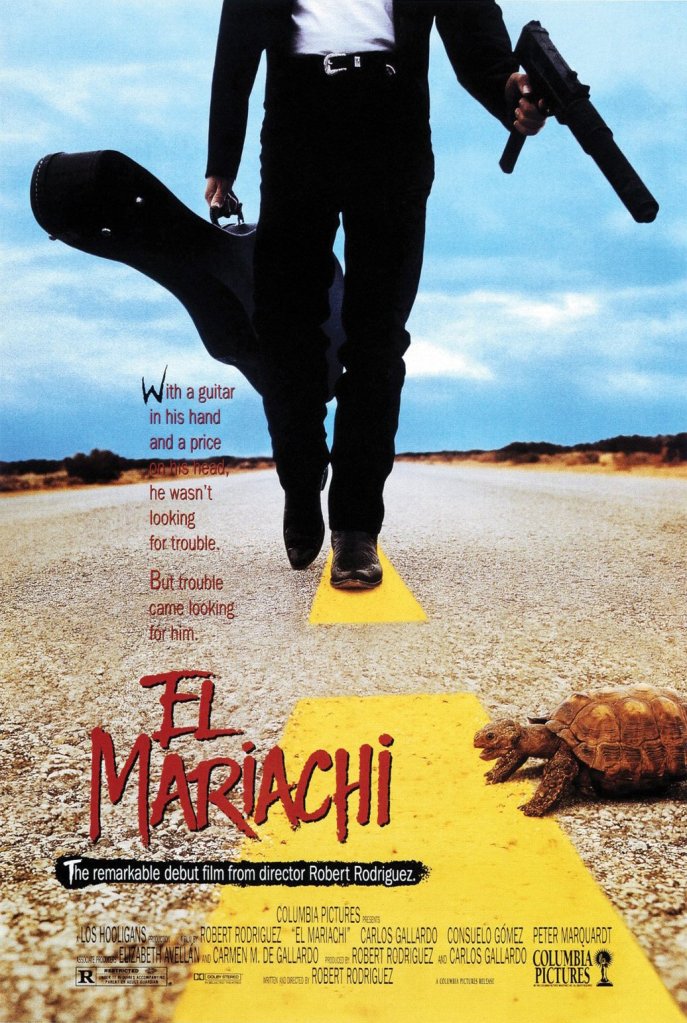
Robert Rodriguez’s 1993 debut El Mariachi was filmed for only $7,000 and has a naive young musician being caught in a deadly case of mistaken identity. It made the director’s career and allowed him to expand the universe in two sequels, which are featured on this Arrow Video box set.
El Mariachi (1992): Made for $7,225, the original goal for this movie was a Mexico home video release. Columbia Pictures liked the film and bought the American distribution rights, putting $200,000 into the budget to transfer the print to film, remix the sound, and market the film.
El Mariachi (Carlos Gallardo) has come to a border town to be a performer like his father. His guitar case holds, well, a guitar. The problem is that it gets confused with the guitar case full of gun carried by Azul (Reinol Martínez), who is coming to kill a drug lord named Moco (Peter Marquardt).
The guitar player has fallen for the gorgeous Dominó (Consuelo Gómez), a bartender and lover of Moco, who herself is in love with Azul. The multiple twists and identity issues will bring all of them together, ending in blood and bullets.
El Mariachi has been deemed “culturally, historically, or aesthetically significant” by the United States Library of Congress and selected for preservation in the National Film Registry, who said that it “helped usher in the independent movie boom of the early 1990s.” I love how they describe the way that Rodriguez was able to combine genres to create his movie, saying that it merged “the narcotraficante film, a Mexican police genre, and the transnational warrior-action film, itself rooted in Hollywood Westerns.”
It was only the start of the creator’s career.
Desperado (1995): Steve Buscemi tells the story of El Mariachi in a bar, about how a musician with a guitar case filled with guns was out for revenge before waking up the person he’s been telling everyone about. He has a target for revenge, Bucho (Joaquim de Almeida), who he blames for killing his lover.
Helped by a bookstore owner named Carolina (Salma Hayek), but is nearly killed by Navajas (Danny Trejos), a hitman sent by the Columbians who is soon accidentally killed by Bucho’s men. El Mariachi, in love with Carolina and wanting to protect her, calls in his friends Campa (original El Mariachi Carlos Gallardo) and Quino (Albert Michel Jr.), who kill most of Bucho’s henchmen before discovering that the drug dealer and El Mariachi are brothers.
He gives the dark hero a choice: he can live, if he allows the bad guy to kill his lover. Of course that’s not going to happen.
With small roles for Quentin Tarantino and Cheech Marin, this movie had critic Janet Maslin writing, “Overdependence on violence also marginalizes Desperado as a gun-slinging novelty item, instead of the broader effort toward which this talented young director might have aspired.” A lot of people were upset about the violence and thought it was keeping Rodriguez from being the success that he could be.
As for fans of action movies, they had found the perfect union of modern movies and Italian Western sensibilities in Rodriguez. He still did it on a budget — a thousand times what he spent the first time, but less than Hollywood usually spends — which led Banderas to say, “It was crazy. We did a movie with practically no money. We did a movie with $3 million. For an action movie, that’s practically nothing. There was a guy in the movie, a stunt guy, that I kill, like, nine times. I killed the guy with beard, without a beard, with a mustache, with blond hair, with glasses, without glasses. I mean, I think the guy who made the most money in the movie, was the stunt guy.”
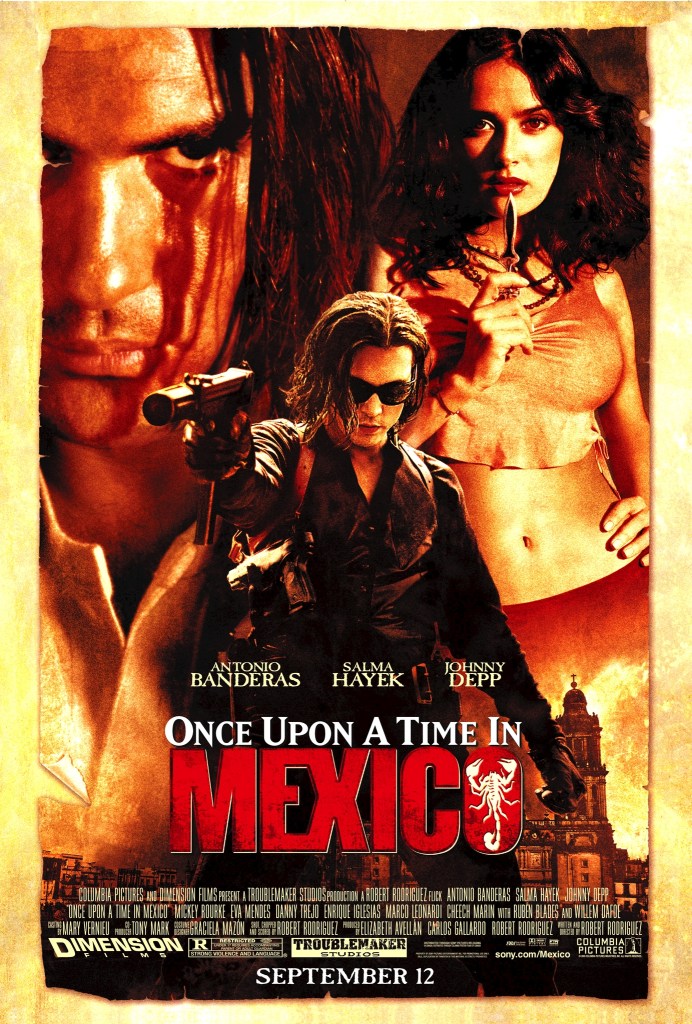
Once Upon a Time In Mexico (2003): A lot has happened since the last movie. El Mariachi (Antonio Banderas) and his wife Carolina (Salma Hayek) had a battle against General Emiliano Marquez (Gerardo Vigil) that ended up with him eventually killing her and their daughter. Now, Marquez is working for drug boss Armando Barillo (Willem Dafoe) to kill the President of Mexico.
CIA officer Sheldon Jeffrey Sands (Johnny Depp) gets El Mariachi and FBI agent Jorge Ramirez (Rubén Blades), whose partner Archuleta was killed by Barillo, along with AFN operative Ajedrez (Eva Mendez) to stop the drug kingpin.
There’s also a plan to use Billy Chambers’ (Mickey Rourke) chihuahua to record Barillo, Danny Trejo as another henchman in a Rodriguez movie, El Mariachi’s friends Lorenzo (Enrique Iglesias) and Fideo (Marco Leonardi) coming to help, Sands having his eyes drilled out but still being a killing machine and Rodriguez making his version of The Good, The Bad and The Ugly, which upset some as El Mariachi becomes a minor character in a movie most figured would make him the star.
Roger Ebert understood, as he said, “Like Leone’s movie, the Rodriguez epic is more interested in the moment, in great shots, in surprises and ironic reversals and closeups of sweaty faces, than in a coherent story.”
It’s a big mess, but I mean that in the greatest of ways. It’s also the first of many movies that Rodriguez shot digitally, which allowed him to do things on budget despite the challenges of trying to get so many FX shots and even not having real guns for the first two weeks of shooting.
The Arrow Video set includes high definition blu ray presentations of all three films and a 4K UHD version of Desperado. It has an illustrated collector’s booklet featuring new writing by Carlos Aguilar and Nicholas Clement, reversible sleeves featuring original and newly commissioned artwork by Paul Shipper, double sided posters featuring original and newly commissioned artwork by Paul Shipper and a collectible poster featuring Robert Rodriguez’s original poster concept for El Mariachi.
El Mariachi has commentary and a new interview with Rodriguez; an interview with Carlos Gallardo; The Music of El Mariachi, a newly produced featurette on the music in the film, featuring interviews with composers Eric Guthrie, Chris Knudson, Alvaro Rodriguez and Marc Trujillo; Ten Minute Film School; Bedhead, a short from the director; the trailer and a TV commercials.
Desperado has commentary and a new interview with Rodriguez; Rodriguez; interviews with producer Bill Borden, stunt coordinator Steve Davison and special effects coordinator Bob Shelley; Game Changer, a newly filmed appreciation by filmmaker Gareth Evans (The Raid: Redemption); Ten More Minutes: Anatomy of a Shootout, an archive featurette narrated by Rodriguez; a textless opening and trailers.
Once Upon a Time In Mexico has commentary and a new interview with Rodriguez, an interview with visual effects editor Ethan Maniquis; deleted scenes; Ten Minute Flick School, Inside Troublemaker Studios, Ten Minute Cooking School, Film is Dead: An Evening with Robert Rodriguez, a presentation by the director given in 2003; features on the Mariachi’s arc and KNB FX and trailers.
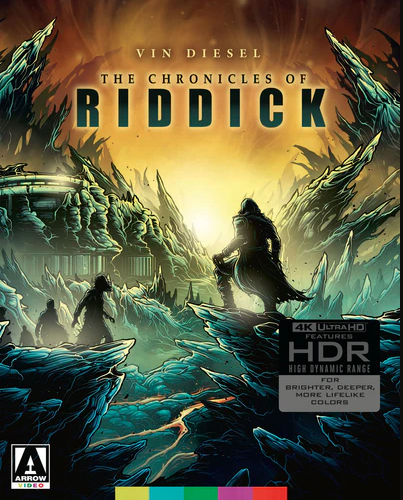
The character of Riddick first showed up in Pitch Black, a movie that became a surprise success, leading to not just this sequel, but the 2013 sequel Riddick, all directed and written by David Twohy, based on characters created by Ken and Jim Wheat.
Richard B. Riddick (Vin Diesel) is one of the last surviving Furyans, a race that excels at combat and can see in the dark. After the events of the anime Dark Fury, Riddick has been hiding on the frozen planet U.V.
Bounty hunters under the command of Toombs (Nick Chinlund) are hunting Riddick, who easily kills most of them and demands to know how they found him. There was a communication from New Mecca on planet Helion Prime, where Imam (Keith David), a survivor from the first movie, lives. Imam wanted Riddick to know that the Necromongers are looking for him, led by Aereon’s (Judi Dench) prediction that he is the last of the Furyans and must be killed. Her prophecy is that the leader of their faith, Lord Marshal (Colm Feore), will be murdered by this warrior. Commander Vaako (Keith Urban) is sent on a mission to stop Riddick.
Riddick is caught and sent to a prison planet called Crematoria, where he meets Jack, who is actually Kyra (Alexa Davalos), the girl that he saved in the first movie. She resents him for stranding her all alone. Meanwhile, Dame Vaako (Thandie Newton), Commander Vaako’s wife, has a conspiracy to have her husband replace Lord Marshal.
I kind of love this movie because it feels like Twohy was given the keys to the money vault and backed up a truck, ready to make his science fiction visions — and Diesel’s love of Dungeons and Dragons — an actual motion picture. It’s so dense with backstory that it feels like you’re several movies deep in a franchise instead of a sequel starring a character who was the secret hero of the first film that was a sleeper success.
Here’s how geeky this movie is. When Universal decided that they wanted to make a sequel, Twohy wrote the screenplays for not one, but three sequels, to which he and Diesel put into separate leather binders and presented them along with the key for the first binder.
Vin Diesel wanted Dame Judi Dench to play Aereon as he was a long-time fan. As she was acting in a play, he had her dressing room filled with so many bouquets of flowers that she couldn’t get into it. He told her that they couldn’t cast this movie until she agreed to accept the role. In her autobiography And Furthermore, she says that she never really understood what was going on, but enjoyed the experience of making the movie and loved the sets, which were the third-largest user of electricity in Canada.
The Arrow Video 4K UHD of The Chronicles of Riddick is packed with so much! It starts with brand new 4K restorations by Arrow Films of the theatrical and director’s cuts of the film, approved by David Twohy. Then, you get a reversible sleeve featuring newly commissioned artwork by Dan Mumford and an illustrated collectors’ booklet featuring new writing on the film by Walter Chaw, original production notes and the Chronicles Compendium, an overview of the characters and planets featured in the film.
Extras on the discs include Ambition on Another Scale: Chronicling a Blockbuster Sequel, a brand-new feature-length documentary on the film, featuring interviews with writer-director David Twohy, actors Keith David and Linus Roache, storyboard artist Brian Murray and many others; interviews with Twohy, Murray and David; trailers; two audio commentaries, one by David Twohy and Vin Diesel and the other by Twohy and co-stars Karl Urban and Alexa Davelos; an introduction by Twohy; archive features on the worlds of the movie and its characters; a production calendar and behind the scenes features; three deleted scenes; animated segments that describe the many worlds in this movie; Toombs’ Chase Log, a short film narrated by Nick Chinlund in character; a guided tour of the set by Vin Diesel, along with 360-degree panoramic views of eight sets from the film; on-set interviews with Twohy, Diesel, Dench, Urban, Colm Feore, Alexa Davelos, Thandiwe Newton and producer Scott Kroopf; promotional interviews with Twohy, Diesel, Newton, Urban, Davelos and Feore; Escape from Butcher Bay, a compilation of cutscenes from the acclaimed tie-in video game and The Lowdown, a television special produced to promote the film’s original release.
You can get this movie on 4K UHD or blu ray from MVD.
There’s a bed that eats people. That’s the concept but this goes so much deeper than that and even has a major meaning to my life. Learn all about how, why and where this was made, as well as the genius who made it.
Directed and written by Jeffrey Boam (Funny Farm, The Phantom), this episode stars Jeffrey Jones as Professor Finley, a teacher of Egyptology. His latest lesson is about a mummified monster named Ramseth, who makes an annual return from the grave to search for his lost lover Princess Nefra.
“Hello, creeps! I’ll be with you in a moment. I was just in the middle of cramming for my final exams. Bet you didn’t know your pal the Crypt Keeper was still in s-ghoul. As a matter of fact, I’m at the top of my class at Horror-vard! Which brings us to tonight’s all-frighter. It concerns a couple of college kids who’ve got their own ideas about higher dead-ucation, in a bit of hack-edamia I call: “Creep Course.””
Finley has it in for the dumb jock Reggie Skulnick (Anthony Michael Hall) and is in love with a student named Stella Bishop (Nina Siemaszko), who may know as much about Egypt as him. Everything leads you to believe that Reggie is using her to get answers for the test, but he’s actually working with the professor, all so they can have her be the latest sacrifice for Ramseth (Ivan E. Roth), who Finley has been keeping in his basement.
Remember how I said that she knows more than her teacher? That’s true. And she knows how to get to Ramseth, too. Well, she has to make love to the undead thing, but if that’s what it takes to live, she’ll do it.
This episode is based on “Creep Course” in Haunt of Fear #23. It was written by Al Feldstein and William Gaines and drawn by Graham Ingels. The story does have a college class, but it’s more about a girl trying to use her good looks to get a better grade and paying the price for it.









 B&S About Movies
You must be logged in to post a comment.