What if Kevin Smith introduced vampires into his 1994 debut breakthrough film, Clerks? Well, courtesy of that spare $35,000 in actor-writer Sean Farley’s pocket, we have our answer. Oh, and don’t be distributor duped: Troma didn’t bankroll or produce this: they only gave it a national release (beyond the film’s initial, self-distributed Midwest boarders) via the Tainted Vampire Collection, a DVD three-pack with the SOV-analogous Sucker the Vampire and Rockabilly Vampire. But this Michigan-lensed slacker vs. vamp fest is definitely more Lloyd Kaufman than Richard Linklater. It’s more Andy Milligan that Quentin Tarantino. It makes Don Dohler look like John Carpenter. And check the Sam Raimi comedy-horror mix at the door of the Evil Dead cabin, Sumerian demons be damned.
So. Is this a ripoff or homage to Smith?
Well, Clerks had a convenience store. Tainted has a video store. Clerks had the customer-abusing smart assery of video clerk Randal Graves and the less verbally-sharp convenience store jockey Dante Hicks. Tainted has the customer-abusing smart assery of video clerk J.T. (actor-writer Sean Farley) and the less verbally-sharp clerkin’ sidekick with Ryan. All Randal and Dante wanted to do was play hockey on the roof. All J.T. and Ryan want to do is go to a midnight-moving screening of Bladerunner*. And like Randal and Dante, J.T. and Ryan slack off and yakity-yak riff on each other all day long. Smith had $7,500 less-in-his-pocket than Farley. And Clerks was shot on an Arri SR camera running 16mm black and white. Farley shot in color on video.
Yeah, uh, we’re not in the View Askewiverse anymore, Antie Em. For this ain’t Blade. This ain’t Near Dark. For you’ve just clicked your heels into the Ed Wood Plan Niniverse, Dorothy.
You ever have one of those co-workers who rat-a-tat bulldozers their way through conversations with a faux-poignancy, so impressed with themselves and opinions and, with each jaw-hinging, you’re hit with their pretentious-tainted and substance-void breaths? And you just want to punch them in their trite-spewing face, then cram a Tic-Tac down their throat — in lieu of doing them the “favor” they just asked for?
That’s J.T.
And J.T. and his he-makes-me-seem-more-important sidekick Ryan are stranded after hours at The Video Zone (actually Detroit’s Thomas Video) when their ride punks out — and there’s nothing of more importance in this world than making that Bladerunner showing. So, as any self-centered I-could-give-a-shite-about-you personality would do: the slacker-duo beg a ride from the new clerk, Alex (Dean Chekvala). Oh, and unbeknownst to our two Clerks-clone: Alex is a vampire. And so is Aida, Alex’s girlfriend. And when Alex’s car breaks down (natch), they hoof it to Aida’s house — and find her staked by local sociopath vampire Slain, who’s intent on tainting the local plasma supply and hoarding all the clean corpuscles for his own fangs. And, with that, Alex recruits Randal and Dante J.T. and Ryan on a low-budget, hallucinogenic journey across the “D” to foil Slain’s insane plan. And J.T. and Ryan, for once, have to care for something bigger than their Seinfeld-nothingness selves (sorry, Sam!).
Granted, Tainted is surely an interesting, fresh take on the played-out vampire vs. vampire genre, but if this had only nixed the vampires and stuck to being a low-budget tale about two (or three) carless losers on a Homeresque odyssey across Detroit (say, like Adam Rifkin’s pretty-darn-cool coming of age get-to-the-Kiss-concert-at-any-costs teen comedy Detroit Rock City) to get to that Bladeunner midnight movie showing, we’d be onto something. But $35,000 does not a (good) vampire flick make. And Farley is off the vanity calling-card rails with his purposeful, spotlight dialog-diatribes. Yeah, it’s intelligent at times, but the “snappiness” simply runs-on (and on) way too long — like some of the shots in the film (including “shakey cams”!) — and quickly transitions from a cut-’em-some-slack-because-it’s-an-SOV-and-they’re-trying quaint blood sucker to being just plain annoying. And in a closing twist that would send Sam on a Shirley Doe-killing spree across Lawrenceville, we have the longest-running set of end credits (to pad that running time) in horror film history.
In a cool, ironic twist: Dean Chekvala kept on thespin’ away (he’s actually very good here) and worked his way up to guest-starring roles on TV’s Num3bers, the NCIS franchise, and Without a Trace to a recurring role on HBO’s True Blood. Sam Raimi junkies may recognize Sean Farley from his work on Raimi’s failed post-Evil Dead work, Crimewave (1985), but he’s since retired from the biz. Director Brian Evans hasn’t directed, lensed, or edited a film since, but he’s carved (sorry) himself a commendable, behind-the-scenes career on a wide variety of direct-to-video flicks, feature films, and network television series.
There’s no trailer or clips available, but you can watch the full film on You Tube.
About the Author: You can learn more about the writings of R.D Francis on Facebook. He also writes for B&S About Movies.
* We had a post-apoc blowout back in September 2019, so do check out our two-part “Atomic Dustbin” catch-all overview of the genre that also features links to all of our film reviews.
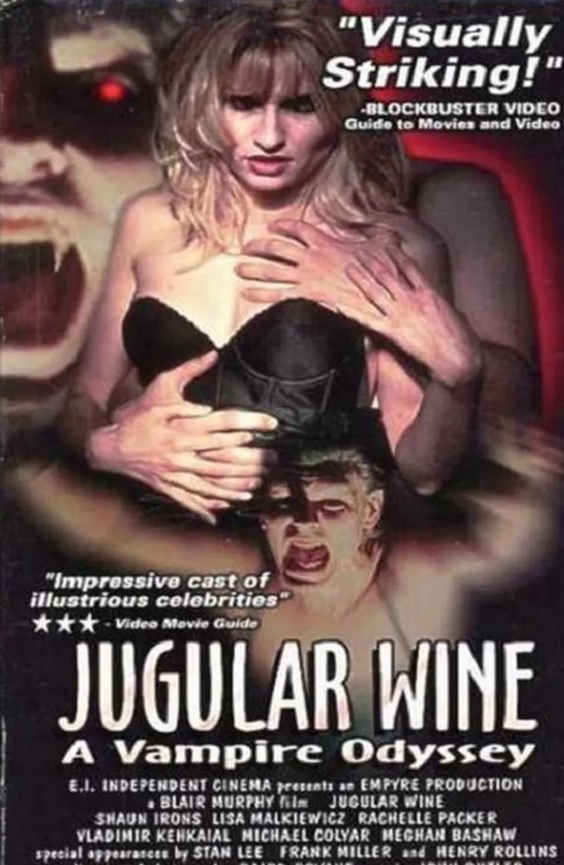
If you ever wanted to see a vampire flick that slaughters Black Flag’s Henry Rollins (playing himself; then at the top of his solo game with The End of Silence and Weight albums) and comic-book icons Stan Lee and Frank Miller (an anthropology professor and a fellow grad student, respectively)—as it quotes the poems of Walt Whitman (remember: the father of the modern vampire genre, Bram Stoker, was a Whitman admirer, and later, pen-pals with the poet)—then this idiosyncratic vampire romp is your goblet of blood.
After several centuries of undead romance, Ms. Dracula needs a new neck in her life, so she decides to fall in love with the food that comes in the form of James Grace, a Philadelphia thesis-working anthropologist in Alaska (he’s on a ship; thus the Whitman quote about “deep waters” and “seas of god”) who becomes the unwitting third side in a gothic love triangle. Why? Because mortal women aren’t exactly banging down the doors of anthropologists . . . so when a several-centuries-old hottie shows up and drops her parka naked-to-go, you don’t did-a-doddle with your rocks and dirt: you go for it. (I would. Undead me, baby.) Well, it’s not that cheesy: Alexandra the Vamp is actually on the run to Alaska, the last earthly sanctuary for vampires as the nights grow shorter—and she’s being hunted by her kind’s eldest, known as Legion.
When the half-vampirized Grace discovers Mr. Dracula, aka Legion, has murdered Alexandra, his new undead-life’s love—as result of her mortal infidelities—he embarks on an Easy Rider meets Phantasm II-inspired sunless odyssey; a hallucinatory roadtrip through America’s underground lands of the undead where he meets an array of fringe-society characters in Los Angeles, Utah, New Orleans, and Philadelphia in his quest for revenge. Then there’s the side plots with Nickadeamous (writer-director Blair Murphy) tracking down Grace—and Grace tracking down Dr. Donna Park, who has the secrets to the mythical Induit creatures that fuel the vampire myth. And that she’s not dead or missing—but a vampire herself, and Grace killed her back on the ship when Nickadeamous attacked him.
One of the most—if not the most—ambitious indie-art house vampire flicks you’ll ever see (if there is such a genre), this vamp’s cross-country ambitions hold up (somewhat) against its aspirations-over-budget, courtesy of its avoiding the graveyard brooding and strip club clichés of most modern vampire flicks, as the protagonist’s search takes him to unconventional, underground-kitschy coffee houses and maybe-a-little-bit-more-conventional goth night clubs (aka, the pretty-cool named Caligari’s Casket that spins F.W Murnau’s 1922 vamp-romp, Nosferatu for “atmosphere”; you know, the place where Henry Rollins hangs out to become fang-chum).
It’s all from the mind of indie writer-director Blair Murphy who self-financed the film through his family’s funeral home business. Is this a case of “. . . if Tommy Wiseau made a vampire flick?” Eh, well . . . while this was made in the early ’90s and shot-on-film, the proceedings look like an ’80s “Big Box” SOV romp, à la (the much better granddaddy of SOV) Blood Cult. (But Jugular Wine isn’t as bad as fellow SOV’ers Spine. Or Things.) And we’re not sure if that’s from cinematic ineptitude, purposeful SOV-homage, or the battered VHS is so washed-out that it looks like an ’80s SOV’er. And what’s the deal with the white grease paint vamps? Again, we’re not sure if that’s special-effect ineptitude (due to cash) or a homage to Herk Harvey 1962 classic-creeper, Carnival of Souls, which, in many ways, Jugular Wine resembles in its self-financed, one-off guerilla filmmaking style. But make no mistake: Carnival of Soul (which should be as revered as George Romeo’s Night of the Living Dead) is the far superior film. Far superior.
While Murphy certainly possessed the same generous self-financing verve as The Room’s auteur, Murphy has a more effective grasp of filmmaking. Sadly, in lieu of his musician and comic-book stunt castings, he should have dug up a few down-on-their-luck B or C-List actors (Eric Roberts was already down to direct-to-video potboilers like Power 98 by this point; he would have been a prefect class-up-this-joint casting) to carry his intelligent script—as the strained overacting, in conjunction with its way-too-long 98-minute running time, make this vamp romp a hard swallow (yuk, yuk, sorry) . . . for you, maybe. But I dig this way more that Tom Cruise’s mainstream fang sporting, so kudos, Mr. Murph!
There’s no PPV-VOD streams or freebie rips of the VHS. And that “Blockbuster” plug on the box art is totally bogus. Across three local Blockbusters, I never one saw a copy of Jugular Wine on their mainstream shelves: this was strictly a 10,001 Monster Video or mom-n-pop rent-n-carry. For you digital hounds: Yeah, there are DVDs in the marketplace, but caveat emptor: they look like grey market burns. (No, they are definitely grey market burns.) For those of you that have never seen Jugular Wine, the best we’ve got is this eight-years post documentary (on You Tube in six-parts) that Murphy strung together in 2002, which features scenes from the film. Apparently, the later-issued DVDs contain the documentary.
Guess what? We found a six-part upload of the “Making Of” featurette.
About the Author: You can learn more about the writings of R.D Francis on Facebook.He also writes forB&S About Movies.
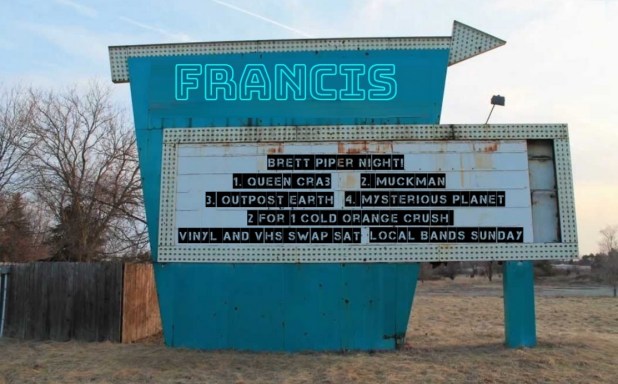
New Hampshire’s Brett Piper is a self-made screenwriter, director, and special effects artist who shoots most of his films in Pennsylvania, most notably in the western and northwestern counties of Cambria and Tioga County. He’s also a self-professed purveyor of “schlock” who eschews modern CGI for “old school” special effects, such as matte paintings, miniatures, and stop-motion animation.
And we, the staff of B&S About Movies, love Piper for it: For if Piper had been around during the regional era of Drive-in exploitation, we’d be warmed by the crackle of a speaker hanging on our car window. We’d rent every one of his VHS ditties from the ‘80s home video shelves, warmed by the cathode ray tube’s glow.
Piper’s resume is extensive, there’s a lot to watch: he’s directed 18 films, wrote 19, and created special effects for 22 films—for his own films as well as the films of his frequent brothers-in-arms collaborator, Mark Polonia (Empire of the Apes).
So if you’re nostalgic for the works of Ray Harryhausen, but burnt out on repeat viewings of that stop-motion master’s works; if you’re burnt out on today’s green-motion tracking and After Effects computer-animated extravaganzas; if you want aliens cast well-made masks and full-body suits and actors emoting alongside in-camera effects, then the films of Brett Piper are just what the VOD streaming doctor ordered.
Movie 1: Queen Crab (2015)
We’ll start off our Friday Brett Piper festival with my favorite of his films: one with best character development, acting, and special effects—and one that we have not yet reviewed at B&S About Movies. While there’s a soupçon of Ray Harryhausen in the crab pot (ugh, sorry!), this is a full-on Bert I. Gordon homage to his (very loose) 1976 H.G Wells adaptation of Food of the Gods (with an honorable mention to the Robert Lansing-starring Island Claw from 1980).
What causes the crab to go “gigantic”? A little girl brings home Pee-wee, a baby pet crab from the lake behind her house—and feeds it grapes infused with her daddy-scientist’s plant growth hormone. After her parents die in a freak lab explosion and she’s adopted by her uncle-sheriff, Melissa grows up into a tough-as-nails teenager, aka Queen Crab, who serves as protector to Pee-wee and her clan of babies—complete with a psychic link. Shotguns n’ rednecks, tanks n’ planes (well, one of each) ensues as the misunderstood crustacean who, like King Kong before her, didn’t ask for any of this sci-fi ruckus.
And speaking of misunderstood: There’s poor little Melissa, stuck in the middle of the sticks of Crabbe County with no friends and parents that constantly bicker and ignore her. She’s practically a latchkey kid with only a crab as her friend. So, do we root for the crab? Damn straight. Kick ass, Pee-wee, for Melissa is Queen in this neck of the Pennsylvanian countryside.
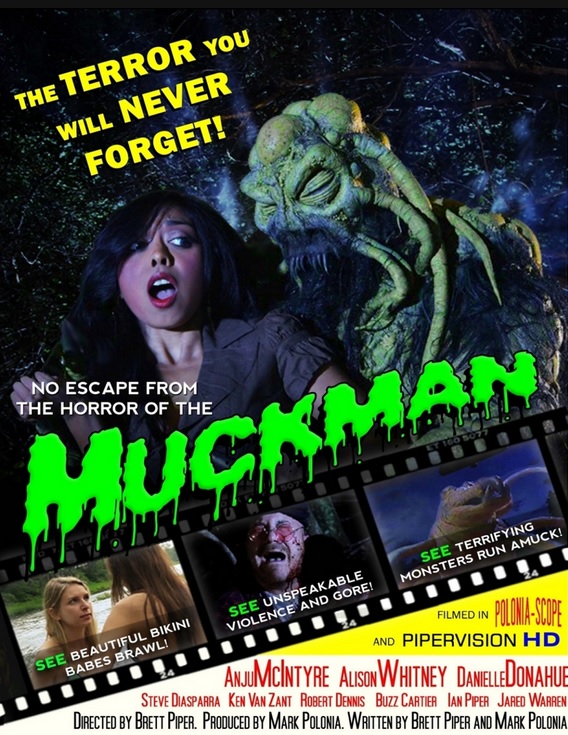
When a TV producer’s (Piper acting-mainstay, ‘80s metal drummer-cum-actor Steve Diasparra; also of Amityville Death House, Amityville Exorcism, and Amityville Island*) career disintegrates on live TV when his report on a legendary backwoods demon haunting Pennsylvania’s Pine Creek Gorge is exposed as a fraud, he’s hell bent on redemption. When he convinces a cable TV mogul to back his quest, Mickey O’Hara heads back into the swamps with a sexy TV personality. Only, this time, there’s no need to “fake it” as the gooey, tentacled Muckman shows up—and he’s not only got the love jones for film crew member Billie Mulligan, Mucky’s brought along a tentacle sidekick of the Queen Crab variety.
Just a good ‘ol fashioned, campy monster romp from the analog days of old.
You can watch this as a free-with-ads stream on TubiTV.
The snack bar is open . . .Intermission!
Thank you, Vinegar Syndrome for honoring the works of Brett Piper! Now back to the show!
Have you ever wondered what would happen if Bert I. Gordon produced a Ray Harryhausen-directed mockbuster of Independence Day? Well, wonder no more with Brett Piper’s most recent, eighteenth and best-produced film of his resume. And, bonus: we also get a throwback to all of our beloved ‘80s Italian apocalypse flicks** in the bargin!
Blake is the resident Trash-cum-Parsifal (known your ‘80s apoc heroes!) who teams with Kay, a radiant, supermodel bow-hunter, to help a crusty elder scientist discover the key to save the Earth from the invading alien hoards and their otherworldly “hunting dogs” in the form of giant, stout lizards.
A fun, something fresh and new watch filled with the nostalgia that we love in our films.
You can watch Outpost Earth as a with-ads-stream on You Tube.
We confessed our perpetual love for this debut feature film from Brett Piper during our two-week December Star Wars blowout*ˣ in commemoration of the release of Star Wars: Episode IX – The Rise of Skywalker.
Pipers’s Star Wars-inspired take-off of Jules Verne’s Mysterious Island—by way of Ray Harryhausen’s classic 1961 film of the same name—concerns a “wretched hive of scum and villainy” band of mercenaries crash landing on an uncharted planet after a space battle. Adopting a jungle girl into their fold, they battle prehistoric snails and dragons as they make their way into a final showdown with the planet’s ancient ruler: a super-intelligent computer ˣ*.
The bottom line: Brett Piper overflows with that same Tommy Wiseau-heart (The Room) and John Howard-tenacity (Spine) as he gives us a special, endearing quality with his films that’s absent from most—if not all—major studio offerings.
So strap on the popcorn bucket and ice up the Dr. Pepper and Doc Brown back to the Drive-In ‘70s with one of the greats of the retro-cinema. Keep ’em coming, Brett. We love ’em!
* We went nuts on Amityville and all of its sequels, rip-offs, and sidequels, etc. back in February with our “Exploring: Amityville” featurette. Uh, Sam? You’re the resident Amityville authority in this neck of Allegheny County. Time to get crackin’ on the newest, latest entry in the series: Amityville Island . . . and Amityville Hex, Witches of Amityville Academy, Amityville 1974, and Amityville Vibrator.
** Be sure to join us for our two-part September blowout as we explored the Italian and Philippine apocalypse of the ‘80s with our “Atomic Dust Bin” featurettes.
ˣ* Sentient computers? Don’t forget to visit with four of sci-fi’s most-infamous artificial brains with our “Drive-In Friday: Computers Taking Over the World” featurette that posted on July 17th.
About the Author: You can learn more about the writings of R.D Francis on Facebook.He also writes forB&S About Movies.
I have great memories of hearing the commercials on my local rock radio station for Down on Us when it played at the—then—behemoth six-plex in the big city as a midnight movie. Our hopes were high. We loved the Doors. We all dog-eared our copies Jerry Hopkins’s No One Here Gets Out Alive. We loved those midnight showings of AC/DC: Let There Be Rock, Led Zeppelin’s The Song Remains the Same, and Sam Raimi’s The Evil Dead. This was going to be an epic night where the classic rock spewed from the speakers, mixing with the waft of nacho cheese congealing over tortilla chips and the sweet flow of Mr. Pibb. . . .
To say we were disappointed at what unfurled across the silver screen would be an understatement. This wasn’t Rock ‘n’ Roll High School. This was Plan 9 from Outer Space: The Rock Musical. Yes, if Ed Wood made a rock ‘n’ roll flick, it would be this Larry Buchanan hot mess of a movie. Where’s Roger Corman and Allan Arkush when you need them?
While we’re on the subject of the Ramones: The modern-day doppelganger for Down on Us is Randall Miller’s muddled bioflick boondoggle, CBGB (2013). Randall Miller, the first film director in history to be convicted in the U.S. for the death of a cast or crew member (during the production of Midnight Rider, his Gregg Allman bioflick), was unable to secure permissions from the estates of Joey and Johnny Ramone, so faux “Ramones” tune were created—and Ramones tunes were absent from the accompanying soundtrack. (A movie about CBGB’s without the Ramones? Why bother making the movie at all?)
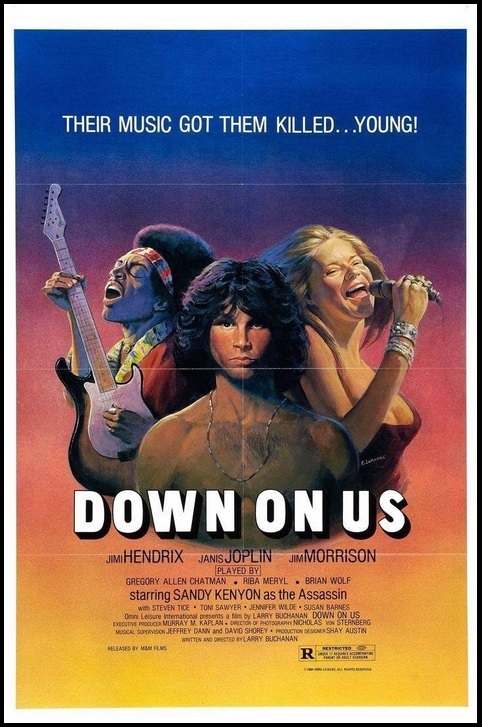
Original 1984 theatrical one-sheet courtesy of IMDb.
As for American exploitation filmmaker Larry Buchanan: He proudly wore his self-professed “schlockmeister” honor on his chest, an award he earned for his beloved (blue-jelled) day-for-night shoots trash-classics of Curse of the Swamp Creature, The Eye Creatures,In the Year 2889, Mars Needs Women, and Zontar: The Thing from Venus (need we say more: he made the Planet of the Apes rip-off Mistress of the Apes). Buchanan’s faux-biographical drama format—mixed with his ubiquitous speculations and conspiracy appendixes—that he utilized in Down on Us dates back to his “exposés” on the Kennedy assassination with The Trail of Lee Harvey Oswald (1964), the gangster chronicles The Other Side of Bonnie and Clyde (1968) and the life Charles “Pretty Boy” Floyd in A Bullet for Pretty Boy (1970), and the “romance” between billionaire Howard Hughes and actress Jean Harlow in Hughes and Harlow: Angels in Hell (1977). Buchanan also twice explored the life of Marilyn Monroe with his same theories-vigor in Goodbye, Norma Jean (1976) and Goodnight, Sweet Marilyn (1989). Not even folklore dinosaurs are immune from the depths of Buchanan’s conspiracies: he made the speculative-drama The Loch Ness Horror (1982).
Courtesy of its chintzy-muddy production values, Down on Us looks like a porn movie—only backed by a cover band sloggin’ through some “originals” they wrote that ersatz-as-tunes for Jimi Hendrix, Janis Joplin, and The Doors. Yikes! This wasn’t Oliver Stone’s The Doors—not by a longshot. This was Ferd and Beverly Sebastian’s Rocktober Blood—only with Jim Morrison instead of Billy Eye Harper (and Nigel Benjamin) fronting Sorcery. And if not for Oliver Stone going into production with his 1991 biography on the Lizard King, even with the home video market’s voracious appetite for analog delights to line their shelves, this Buchanan conspiracy faux-fest would most likely have never made it to video on the cusp of the grunge decade.
Although many critically attacked Buchanan’s film that explores Jim’s paranoia of the government—not so much a theory, but more a cinematic license playing with a “what-if” story line—as rubbish, it seems those critics are not familiar with the legend of Jim Morrison. For Morrison, it was a real, believed threat: American Government agents were after him; that he was marked as “Number 3”—after Hendrix and Joplin. Therefore, Morrison left America for Paris to find shelter and reject the legal controversies of his life. Except, in Buchanan’s bizarro-Jim world, Morrison didn’t die in a Paris bathtub: Jim fled to Spain and took up residence in a monastery.
And speaking of legal controversies: It’s one thing to craft a bogus dramatical document about the psychedlic rock triumvirate of Hendrix, Joplin, and Morrison. It’s another to licensing their music. So Buchanan contracted musicians to forge replicates of those artists for the film. Oscar nominated and award-winning director Gus Van Sant exceptionally and effectively executed this same approach with 2005’s Last Days, his faux-Kurt Cobain docudrama concerning actor Michael Pitt’s eerily portrayed pseudo-grunge rocker, Blake, fronting the film’s scripted Nirvana substitute, Pagoda (featuring stunning Nirvana simulations composed by Pitt; it all goes back to poet William Blake, one of Jim Morrison’s lyrical inspirations. The circle completes). The man Buchanan hired to mimic Jim Morrison was a musician also speculated as one of the possible musicians behind the Phantom mystery of March of 1974; an enigmatic Morrison-ersatz that released the album Phantom’s Divine Comedy: Part 1 on Capitol Records: Richard Bowen.
Richard Bowen’s other musical offering, starring Fabian!
Courtesy of Bowen, it was Buchanan’s film—not Oliver Stone’s The Doors—which offered the first on-screen interpretation of Jim Morrison, as done by actor Brad Wolf, who lip-synced to the music written and performed by Bowen. Bowen construct haunting Doors mimics with “Knock So Hard,” “Sorcery,” “Old Pictures,” “Holding On,” and “Phantom in the Rain”—each sounding like doppelganger leftovers from Phantom’s Divine Comedy: Part 1, or as outtakes from the recording career of Jim Morrison’s alleged son, Cliff Morrison. (Cliff Morrison—in a career-analogous path to Jimi Hendrix’s “son,” Billy Yeager (and to a lesser extent, Frank Marino of Mahogany Rush and his Hendrix-medium myths)—evoked his “dad’s” memory with two, late-nineties albums: Know Peaking and Color of People, fronting his Lizard Son Band.) Not only were the vocal similarities between Morrison, the Phantom, and Bowen contributing to the theory that Bowen could be the Phantom: the songs titles composed by Bowen for Down on Us also fueled the theory. Again, Bowen wrote two songs: “Sorcery” (which is what a “wizard” performs—and ties into the lead track on Phantom DC’s “Tales from a Wizard”), and the second song that appears in the film, “Phantom in the Rain.”
Image of 1989 reissue by Unicorn Video courtesy of Paul Zamarelli/VHS Collector.com and user 112-Video.
The first theory about Morrison’s demise was murder: In the backwash of Oliver Stone’s 1991 document, another film sloshed the brackish tributaries first navigated by Buchanan, a film that played it very fast and very loose with the Morrison-was-murdered theory: the 1992 direct-to-video rock flick Sorority House Party (You Tube). In this case, three hotties thwart a managerial plot to kill Attila, and unpredictable, high maintenance, costly ‘80s rock star, to boost album sales. This murder theory regarding Jim was the direct result of Hendrix and Joplin doing great sales numbers after their deaths. Moreover, with Jim flaking out on the band and a split of the Doors proving costly to both the band and the label, knocking off the Lizard King doesn’t seem like an implausible idea. (Also known as Rock and Roll Fantasy,Sorority House Party served as the directing debut of David Michael Latt, who came to incorporate the successful mockbuster purveyor, Asylum Studios.)
Other movies in the 1980s also tailored the mysterious threads of Jim’s death as cinematic narrative inspiration.
The second theory regarding Jim’s “demise” was a death hoax: Jim, tired of the dealing with the band and his Miami indecency trial ending in a possible jail sentence (like counterculture comedian Lenny Bruce), paid a French doctor to create a phony coroner report and death certificate. The cable movie-rock flick favorite Eddie and the Cruisers played with this myth—no doubt inspired, in part, by the last chapter of No One Here Gets Out Alive, the 1980 best-selling, first biography on Jim, which theorized Jim Morrison may have faked his own death. In Eddie and the Cruisers, a Rimbaud-inspired rocker of the Sixties, distraught over band infighting and record company hassles, bailed out with an elaborate death ruse. In the eventual Eddie sequel, the rocking protagonist, Eddie Wilson, ended up as a construction worker in Canada; not exactly ranking with the romanticized rumors of Jim running away to Africa—then returning to music in 1974 as a mysterious rocker, the Phantom; or as the Circuit Rider (that’s a whole other Jim-tangent that we won’t get into here).
And that brings us to best of the Jim-inspired conspiracy rock films: Down on Us (1984), eventually reissued to video as Beyond the Doors (1989). And we say “the best” because it’s all about the schlock n’ trash at B&S About Movies. (Honorable mention going Michael A. Nickle’s portrayal of the Lizard King in Wayne’s World 2, of course, living out his life as a sage beyond the immaculate perimeters in the desert.)
Larry Buchanan’s film speculated Jim was not murdered, nor did he fake his death: he went underground to avoid assassination. The plot line: President Richard M. Nixon, despondent over the antiwar sentiments agitated by the hippie icons of Hendrix, Joplin, and Morrison, sanctioned the F.B.I to kill the trio. Morrison apparently caught wind of the plot and “got out alive.” And, to complete the final cover up of the plot: the agent (Sandy Kenyon) who carried out the sanction is murdered. When his son discovers his dad’s files, the plot unfolds via flashback, then the son tracks down Morrison in Spain . . . .
While Buchanan’s film doesn’t get into it: The alleged “F.B.I murdered Jim” scheme has been in circulation since Jim’s death in 1971, cobbled in a basket with theories alleging the American government assassinated Dr. Martin Luther King, Malcolm X, and Marilyn Monroe (Hi, Larry!), along with Robert Kennedy and his brother, President John F. Kennedy (Hey, Mr. Buchanan!).
One of the earliest critics of the Warren Commission report regarding President Kennedy’s assassination, Mae Brussell, the late counterculture public radio personality of the Carmel and Monterey, California, radio stations KLRB and KAZU, most likely influenced Buchanan’s screenplay. The former host of the nationally syndicated Dialog: Conspiracy program compiled her government conspiracy theories in an unpublished November 1976 report: From Monterey Pop to Altamont, Operation Chaos: The C.I.A’s War Against the Sixties Counterculture (it was online to read in full; now it’s gone again). This report, along with current Doorsphile conspiracy theorists on social media platforms, contend there was a coordinated effort initiated in 1968 by the F.B.I’s Counter Intelligence Program and the C.I.A’s “Operation Chaos” to undermine the counterculture movement. These theories point out that Jim Morrison knew Charles Manson, through his mutual acquaintanceship of the Beach Boys’ Dennis Wilson and music producer Terry Melcher, and Morrison composed “Riders on the Storm” about Manson’s “murderous” followers.
Additionally, theorists opine the membership list of the 27 Club (with its own outlandish conspiracies; e.g., Courtney Love hired El Duce of the Mentors to murder Kurt Cobain) ties into the military service of the rockers’ parents. In addition to the high-ranking, classified naval service of Jim Morrison’s Admiral father, Lt. Col. Paul James Tate, the father of Manson Family murder victim, actress Sharon Tate, also served in the military. Theorists also point to Lewis Jones, the father of the Rolling Stones’ Brian Jones, a PhD mechanical engineer, who served as a military aeronautical engineer for Bristol Aircraft . . . et cetera, one may read the extended theories online, but the point: the deaths of their famous children were “assassinations.” The “theory” concludes: Charles Manson and his family were either hired as “actors” for the “plot,” or Manson himself was a patsy—like Kennedy assassin Lee Harvey Oswald (Oy! Larry!)—set up to take the fall for the Tate “assassination.”
It all began, according to Brussell, with the 1966 death of anti-establishment comedian Lenny Bruce (1967 memoirs: How to Talk Dirty and Influence People)—the first victim of the “operation.” The critical and financial success of the Monterey Pop celebration in the summer of 1967 simply solidified the government’s resolve to snuff out the counterculture’s icons. Brussell goes onto state that, between 1968 and 1976, many of the most famous names of the counterculture movement, were dead: Mama Cass Elliot of the Mamas and the Papas, Otis Redding, Jimi Hendrix, Brian Jones, and Janis Joplin all participated in or attended the Monterey Pop Festival. The report’s assassination roster also “stars” Duane Allman and Berry Oakley of the Allman Brothers (Hey, Randall?), folkie Tim Buckley, Jimi Hendrix’s manager Michael Jeffrey and the Beatles’ manager Brian Epstein, along with Graham Parsons of the Byrds, Ron “Pigpen” McKernan of the Grateful Dead, blues musician Jimmy Reed, and, of course, Jim Morrison, along with his wife, Pam Courson. All became victims of coordinated mind control tactics via Lysergic Acid Diethylamide (LSD)—a poisoning that altered the icons’ personalities and behaviors, encouraging their accidental “deaths-by-misadventure. . . .”
I know . . . I know . . . tangents and non-sequiturs. Let’s get back to the movie! But wait! There’s one last tangent: what’s this all have to do with Rocktober Blood?
Riba Meryl, who co-wrote the faux-rock epic “Rainbow Eyes” with Sorcery’s Richard Taylor, became an actress and portrayed Janis Joplin in Down on Us. Surprising, Riba, an accomplished singer in her own right, lip-syncs the faux-Joplin tunes “Easy Now” and “No Way” written-performed by Janet Stover (her lone film credit). Riba also repeated her Joplin character in a 1987 episode of the syndicated rock ’n’ roll U.S television series Throb (You Tube). After her lone, non-Janis character acting role in 1987’s Banzai Runner, Meryl concentrated on television and film session work and contributed the song “Brand New Start” to a 1987 cop-murder drama, The Jigsaw Murders (You Tube). Sadly, Riba passed away in 2007 at the age of 52 from breast cancer. (And why didn’t Riba Meryl provide the vocals for the song she wrote for Rocktober Blood? We may never know.)
The studio band who helped create the faux-soundtrack for Down on Us was comprised of the members of the American-New Jersey hardcore punk band Adrenalin O.D (they also as appeared as musicians-background actors). If you’re familiar with the Slickee Boys (their punky-take on Status Quo’s “Pictures of Matchstick Men”) or the Dead Milkmen (remember “Punk Rock Girl”?); AOD are goofy like that. How else can you describe a band who releases an album Crusin’ with Elvis in Bigfoot’s U.F.O that features “Bulimic Food Fight” as a lead single? Formed in 1981, AOD broke up after the failure of their “big rock move” on Restless Records, their fourth album, Ishtar (1990) (they do Queen a hell of a lot better than Metallica; it’s like the Monkees on crack. And they played CBGB’s several times).
And we never heard again from the acting-musician duo behind faux Hendrix: Gregory Allen Chatman mimed to the music written and performed by David Shorey (he also served as the film’s music supervisor): “Today or Tomorrow,” “Looks Like You,” “Crystal Wings,” “Three Day Rain,” “Poet’s Reprise,” “Just My Size,” and “Seriously Shot Down.”
We did, however, hear from two of the film’s lead actors, again: Sandy Kenyon, as government agent Alex Stanley, and Toni Sawyer as his wife; neither let there involvement with Buchanan dissuade their careers. Kenyon continued to work up until his 2010 death, amassing over 130 credits on a wide array of TV series since the 1950s (. . . I’ll never find a copy of the 1974 TV movie Death in Space starring Kenyon and Cameron Mitchell, will I? Nope: The only known surviving English language print is stored at Library of Congress, alongside Kim Milford’s lost TV rock flicks Song of the Succubus and Rock-a-Die Baby). Toni Sawyer’s latest (her 74th project), the family-adventure, When the Moon was Twice as Big (Facebook), is currently in post-production.
Both versions/titles of the movie are exactly the same: so don’t fret over which VHS issues you decide to buy. Although, in all my years, I’ve never seen a post-1984 VHS on the shelves as Down on Us, only the 1989 Beyond the Doors version. And I only found the ’89 VHS, out of six video memberships —once—at a 10,001 Monster Video. The VHS pops up in the online marketplace from time to time, Amazon and eBay in particular. However, beware of those DVDs: they’re all grey market rips-from-the-VHS.
As for online streaming: There’s only two choices to watch this online—via You Tube, natch. There’s a multi-part upload (of 13, 10-minute segments) HERE that was the only choice for many years. However, someone recently uploaded the complete film in one upload HERE.
“Our assignment: neutralize the three pied pipers of rock music.” — F.B.I Agent Alex Stanley
Indeed. And you “neutralized” the after effects of my cheesy nachos and Mr. Pibb, Agent Stanley. (I miss you, John, my brother. Good times.)
About the Author: You can learn more about the writings of R.D Francis regarding Jim Morrison’s doppelganger, the Phantom of Detroit, on Facebook and Medium. He also writes film reviews for B&S About Movies.
Post Script: Down on Us is a movie that never ceases to keep on giving. Check out Bill Burke’s new, February 2022 take on the film at Horror News.net.
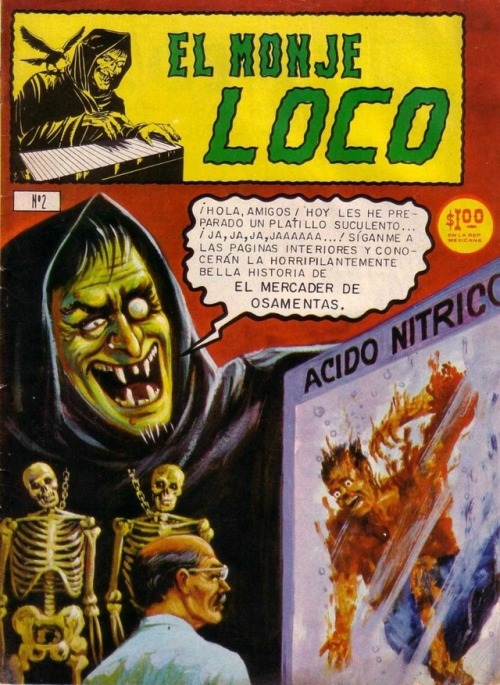
Supposedly a remake of a 1940 film, this shot on video oddity is all about, well, a mad monk who claims to be Satan but is closer to the Crypt Keeper. He introduces us to two tales, one of which is about a priest who falls in love with an attractive women in his congregation and ends up knocking her out a window, leading to his crucifix being cursed. Then there’s the story of a couple who uses a magical object and all of the wishes go wrong, as if they were in, oh let’s say The Monkey’s Paw.
All of this effort came from Julio Aldama, who not only directed and starred in this movie, but got his whole family to be part of it. You may think that time with the family is valuable and worthwhile, but did your dad ever ask you to be part of a movie where a horny priest accidentally murders someone he was trying to sexually assault? Nope. I don’t think your dad ever did that.
Obviously, I will watch any movie ever, but man. Once I saw the goofy eye of the Cripta-esque teller of these two tales, I almost checked out. However, I am a brave man and consider you, the reader of this site, special. So I toughed it out for you.
Actually, I did some more research, feeling that this wasn’t enough, and learned that The Mad Monk was a radio series in the 1930’s that started with the monk saying the words, “No one knows, no one knew, the truth about the terrifying case of…”
There were comics of The Mad Monk as well and from the looks of things, they feel very EC Comics inspired, but of course taken to the typical Mexican extreme.
El Monje Loco also appears in a series of memes, too. Who knew?
It’s the ‘80s all over again. It’s The USA Network’s Commander USA’s Groovie Movies and Night Flight (check out our “Drive-In Friday” tribute) all over again. It’s an ‘80s retro-dream of renting Frank Henenlotter’s Basket Case one too many times. And, based on the theatrical one-sheet’s tagline: “Everyone is a science project,” this is Weird Science (1985)—if John Hughes was a fresh-out-of-film school teen, ready to take on Hollywood with a sci-fi/horror on-a-shoestring comedy.
It’s a 16 mm-to-35 mm blown up drive-in flick and SOV retro-joint threaded on one sprocket and I like it.
Soft Matter is a film that I “get” because of my enjoyment of Ed Hunt’s The Brain, Peter Jackson’s Braindead and Bad Taste, and Adam Rifkin’s The Dark Backward, along with Surf Nazis Must Die, Severed Ties, The Toxic Avenger, and, going a further back, The Undertaker and His Pals. I’d even toss in those ’80s Big Box VHS/SOV horrors (but Soft Matter has a clever humor element they don’t) of Boardinghouse (1982), Sledgehammer (1983), Truth or Dare (1986), 555 (1988), Spine (1986), Things (1989), and Gorgasm (1990); however, I mention these SOVs in the context of their Ed Woodian heart, passion, and tenacity: the production quality of Soft Matter is far superior.
Soft Matter is one of those “WTF did I just watch” type of films—like our recently reviewed Michael Reich greymatter-screwjob that is She’s Allergic to Cats. And to that end: you’ll enjoy the washed out, retro-‘80s video touches of this film’s opening titles sequence in relation to Reich’s similar retro-romp.
So, before you hit the big red streaming button: If you’re not familiar with those movies, you may want to peruse those reviews, and maybe watch their respective trailers, to get yourself up to speed to enjoy Connecticut screenwriter/director Jim Hickcox’s feature film debut (he has six shorts under his belt, along with production credits on thirty others; he knows what he’s doing behind the camera).
But seeing Hickcox was born in 1982—and knew not the joys of growing up during the burgeoning cable television and home video store universe—I’d have to say Hickcox’s O.D’d on one too many hours of my nieces and nephews’ Nickelodeon kid-coms, FOX KIDS airings of the Canadian horror anthology Goosebumps (based on the tween novels by R.L Stein), and Cartoon Network’s Adult Swim (now that I watched, along with MTV’s Liquid Television; if this was the ’90s, and Soft Matter was a short, it would be Liquid-programming).
And that brings us to this: A one-too-many-hits-on-the-bong world where Guillermo del Toro’s The Shape of Water collides with Lloyd Kaufman’s The Toxic Avenger as two immortality-obsessed scientists (like in the WTF’er Re-Animator) DNA-splice incognito in an abandoned hospice. And the secret of life lies in the aquatic helixes of sea creatures—all with the goal of re-engineering man as an indestructible cephalopod (hey, isn’t that what the god complex’d nerds in Underwater did?).
Of course, all mad scientists need to be stopped. So, to that end, two plucky graffiti artists decide to create an art space in an abandoned building—the same building where Squid-Man and Lobster Boy are bubbling in petri dishes. Together, they help defeat the mad scientists and rescue an ancient sea goddess from her mop bucket prison.
If you’re in the mood for lots of hammy glob n’ goo n’ squish n’ slimy retro-‘80s, or ‘90s, fun—depending on your age and pop-culture references—then you’ll enjoy the horror/comedy mash-up that is Soft Matter.
It’s out now on DVD through Wide Eye Releasing. And at a brisk 70-minute runtime, Wilcox’s work is worth a what-the-hell watch with its homages to 1951’s The Thing from Another World and 1954’s Creature from the Black Lagoon. And besides: look what happened to Peter Jackson after his early works . . . so watch Jim Hickcox’s feature film debut now, so you can brag to your friends were “hep” to him, then.
Disclaimer: This movie was sent to us by its PR company and that has no bearing on our review. But based on the trailer and its wacked-out premise, we would have purchased our own copy of Soft Matter.
About the Author: You can read the music and film reviews of R.D Francis on Medium and learn more about his work on Facebook.He also writes for B&S About Movies.
There was a hole in the B&S About Movies schedule at 12 noon on Friday, March 13. And I can’t think of another film more fitting than Dohler’s third film, Nightbeast, to slide into the VHS shelf between Crown International’s Terror in the Jungle*—the worst jungle flick of all time—and Ed Hunt’s The Brain (coming up at 3 pm)—the most whacked-out horror flick of all time (yes, even more whacked-out than Stuart Gordon’s Re-Animator).
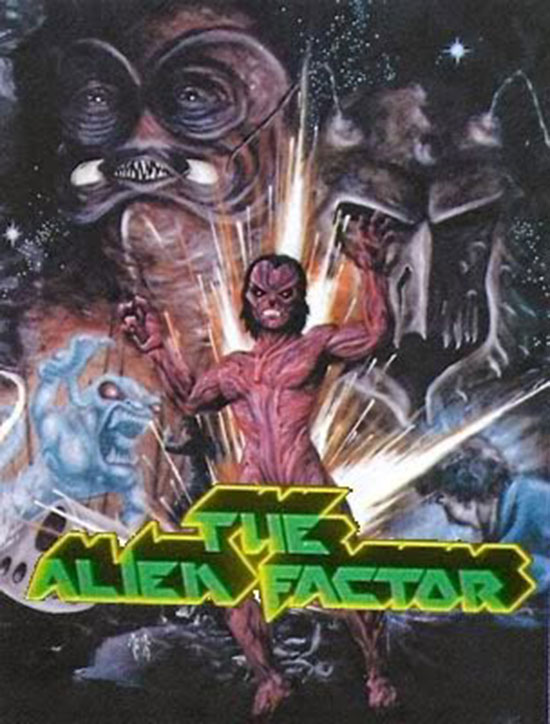
I have to admit: When Dohler came back from his decade long, self-imposed celluloid exile after The Galaxy Invader (which is, pretty much, the SAME movie—to a very sad, lesser effect—as his The Alien Factor and, of course, Nightbeast; which is why I’ve passed on reviewing it, myself), I never went back to his oeuvre, which revived with Blood Massacre (1991), then six more films until 2007.
Oh, the nostalgia: I’ll always remember Donnie for his “Big Four,” 16-to-35mm drive-era, SOV ’80s** precursors (which I lump into my SOV lamenting and pontificating at the site, for it’s all about the “vibe” of it all): The Alien Factor (1978), Fiend (1980), Nightbeast (1982), and The Galaxy Invader (1985), each of which end up on some variation of an ‘80s video fringe critic’s “Ed Wood’s School of Filmmaking” worst-of lists. As for me: Dohler is the Tommy Wiseau of sci-fi and horror. His films may be incompetent, but he, like Ed Wood before him, had a lot of heart. A lot. Sure, you can call Don an awful filmmaker . . . but he is an inspired one.
As part of the site’s March 2019 review of The Galaxy Invader, in promotion of the new Rifftrax version of the film, we briefly explored Dohler’s backstory, so we’ll dispense with the history lesson and pop-in his VHS ‘80s classic and get to reviewin’!
It’s the same . . . but different.
As with The Galaxy Invader, we have ourselves another Earth-stranded alien chasing rednecks though the woods. And as with John Carpenter and Don Coscarelli not taking any chances with their sequels to Escape from New York and Phantasm, Dohler crafted Nightbeast as a sequel-remake of his debut film, The Alien Factor—which also a has an alien loose in the Americana backwoods. And even for a Dohler film, Nightbeast shows a vast improvement in quality. As it should: The Alien Factor was shot for, get this, $3,500; he upped his game for Nightbeast to $14,000. And it’s so good that it made the U.K Section 3 “Video Nasties” list, which we touched on in our “Exploring: Video Nasties Section 3” overview.
What the hell? “Music by Jeffrey Abrams” in the opening credits? Not the J.J Abrams from the Star Trek and Star Wars reboots? Yep. Everyone has to start somewhere, and a teenaged Double-J started with a Don Dohler film.
And that film starts out really good—considering its budget—with decent matte, modeling, and camera-plate work that rivals any of Alfonso Brescia Star Wars knockoffs (watch Star Odysseyand compare), and reminds of Charles Band’s Laserblast (1978; only Nightbeast is the better film), as an alien ship comes out of a space-warp over Jupiter and a subsequent meteor collision causes it to crash on Earth—in the hick town of Perry Hall. (Did you ever notice how these alien spawns always land/crash in a “hick town” in these flicks, e.g., Alienator, anyone?)
Coolness that makes me want to watch, again!
So, you say you can only afford the (honestly, for a Dohler film, they’re very impressive) head and hands for your Gigeresque alien? Not a problem, pop that bad boy into a silver lamé jumpsuit and get to the killin’.
And we get our first kill (again, for a Dohler film, it’s impressive) with a ray gun that dispenses a redneck-dufus in a colorful lightshow-animation. And when it’s not gunslingin’, our xenomorph lets loose with some pretty decent on-a-budget eye-pops and gut rips. And bonus: this movie isn’t afraid to disintegrate two kids.
And that’s pretty much the whole film in a nutshell. The local sheriff’s department is dispatched and he gathers a redneck posse that, as with William Malone’s Creature(1985), uses the old The Thing from Another World “trick” of setting a trap-by-electricity.
How loved is this movie? Director Panos Cosmatos runs the film on a TV in a scene from his 2018 film, Mandy. And that impressive alien costume and model work? Those were designed by John Dods. He would come to work on the Poltergeist, Ghostbusters, and Alien franchises. You can also see his early work in the video fringe nasty, The Deadly Spawn (1983).
You have two choices to watch Nightbeast for free: You Tube has it commercial free, and it’s also on TubiTV. While on TubiTV you can also queue a copy of John Kinhart’s Don Dohler documentary Blood, Boobs & Beast. If you’d like to own both, they were packaged as a 2009 Troma DVD double feature. Vinegar Syndrome’s reissue doesn’t include the documentary, but it’s loaded with behind-the-scenes extras.
Be sure to click that SOV ’80s tag, below, to open yourself up to a world of 16mm and camcorder-shot films that populated our video store shelves.
** Click through our SOV category tag to discover more SOV films from their ’80s VHS birth to the digital and phone-shot brethren of today.
About the Author: You can read the music and film reviews of R.D Francis on Medium and learn more about his work on Facebook.He writes for B&S About Movies.
From the Editor’s Desk, December 10, 2022: Pure insanity! As with Delirium (out now) and UFO: Target Earth (coming in 2023), both which we previously reviewed on a whim just because we love ’em, here’s another obscurity that’s readying for a reissue. Well, not a “whim,” per se: those two reviews were inspired by our “Video Nasty Week” and “Space Week” features.
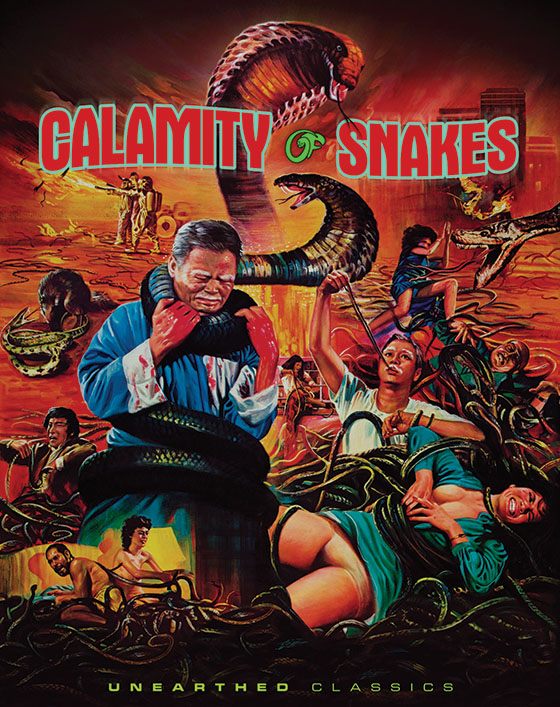
On December 10, Unearthed Films—with a special thanks to the gang at Dawn of the Discs Facebook—officially announced the April 2023 Blu-ray release of the original Calamity of Snakes as an official 2k scan restore-remaster for preservation in the Hong Kong Category III horror cinema annals.
The bonus materials include: A commentary from Nathan Hamilton and Brad Slaton, a Full Length Documentary: From Shaw to Snakes: The Venom and Violence of Early Chinese Language Horror Cinema, and Reptilian Recollections: Lin Kuang-Yung In Conversation With Chui-Yi Chung. The release, which comes with an English dub and subtitles, features three cuts: the Full Uncut version, an Alternate Cut, and a Cruelty Free Cut (but there is so much cruelty in Calamity, e.g., the hard-to-watch, extended snakes vs. mongooses battle, the jumping (well, thrown) snakes vs. samurai sword battle, the gassing and flame throwings—complete with their dying-wiggling aftermath—what’s left in that cut?).
Based on the likes, shares, and comments on the Unearthed post, everyone is clamoring for the calamity on this one!
Well, anyway: here’s what we had to say about The Serpent Warriors . . . and the career of porn purveyor, John Howard, back in March 2020.
“I’m sick of these mother f’in snakes in this mother f’in plane!” shouts Samuel L. Jackson. Only, there is no plane. But there is a temple (of dud and not doom). And we have Eartha Kitt in place of Samuel L. Jackson.
“John Howard didn’t make this or Scorpion! He only made Spine, you stupid mother f’er. Don’t make me go medieval!” threatens Mr. Jackson on your VHS-lovin’ ass.
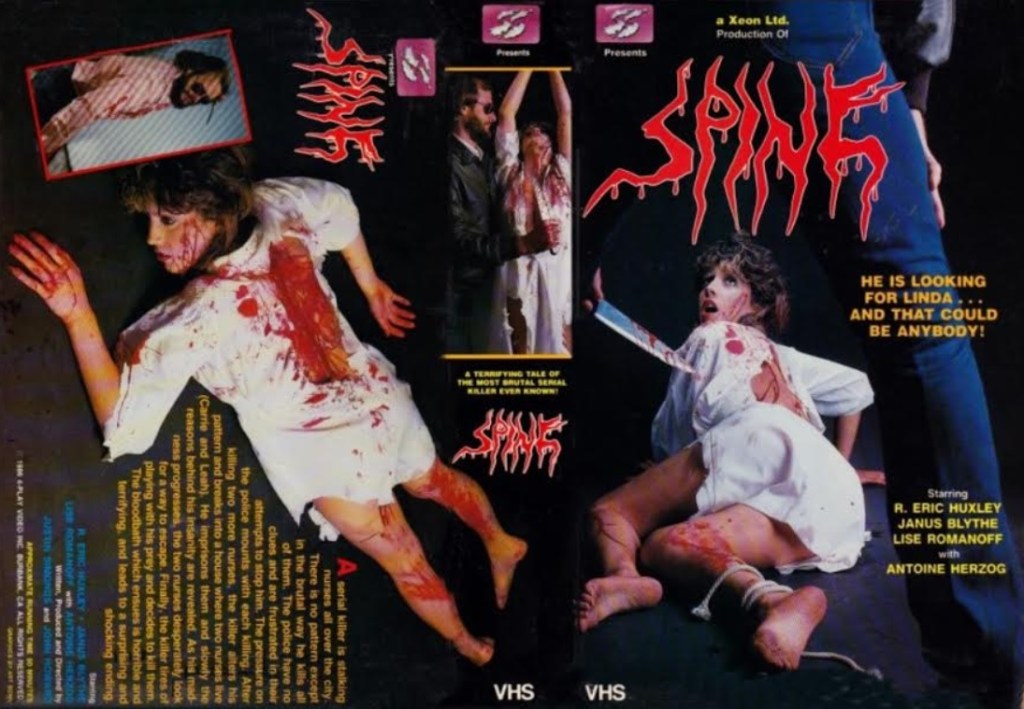
Yes, ye analog warrior of the snowy tundras: Contrary to the web-chatter: B&S About Movies brings you this caveat emptor regarding the “specialty video” oeuvre of writer-director John Howard, he of the shot-on and edited-on 3/4-inch video, lo-res and audio-buzzing Big Box/SOV horror-classic Spine.
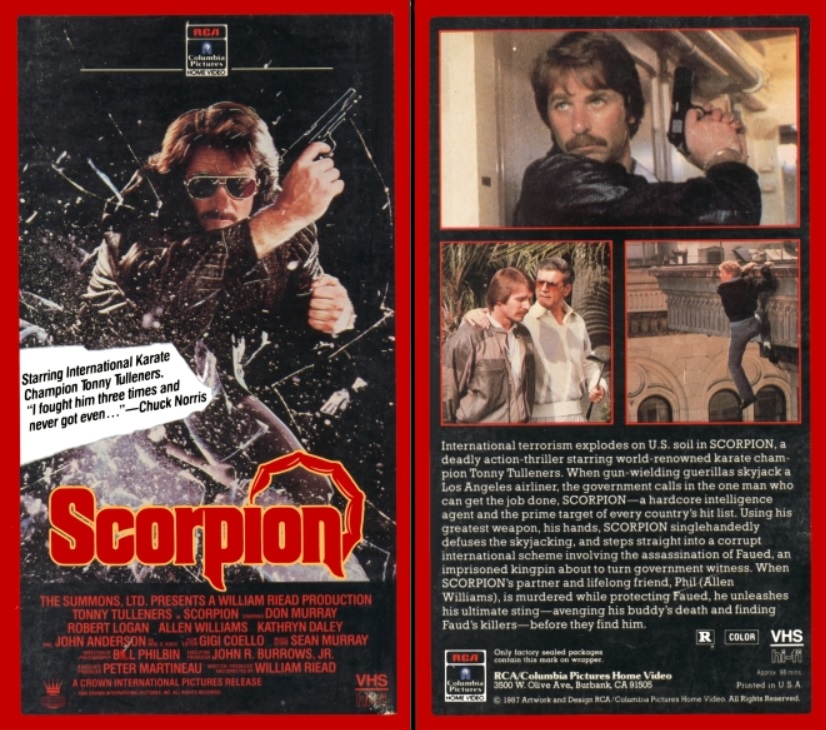
Nope. John Howard never went “mainstream” and he never worked outside of the adult film industry. Not only did the John Howard of Spine fame not direct the 1986 Tony Tulleners-starring Scorpion(he did, however, direct the Linnea Quigley one, also released in 1986), he did not direct this Hong Kong-Taiwan actioner. Hey, you know how it is with these Asian-Pacific Rim-produced oddities from the ‘80s VHS fringe: they’re infamous for their untraceable, Americanized director-pseudonyms—thus the John Howard-confusion.
So sure, with our adult film knowledge and the infamy of Spine, the name of “John Howard” piqued our interest—at first. Then we see the what-the-hell-why-not-we-need-a-paycheck kitchen sink cast and say, “Oh, hell yes! We must watch this!”
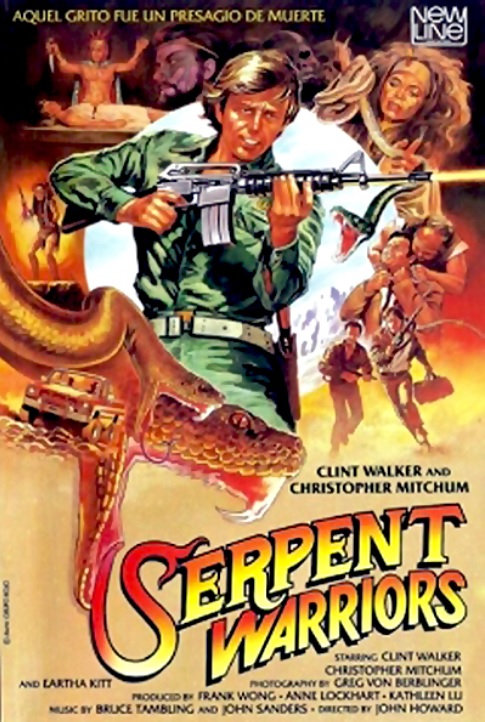
Yep. The same “New Line” that repacked the ’70s TV movie Death in Space.
Seriously, how can you turn away from a film starring ‘60s TV cowboy Clint Walker (in his final film) from our beloved TV movie, possessed construction equipment romp Killdozer, Eartha Kitt—as a snake-mistress bitch!—from TV’s Batman, Christopher Mitchum from the ‘80s apoc-slop fests Aftershock and SFX Retaliator, and the comely Anne Lockhart from Battlestar Galactica: TOS?
You can’t. You break out the hot-air popper and convince the little lady to go out to have a few drinks with her girlfriends. “No, sweetie, really. I’m not trying to get rid of you for a booty call. I just wanna hug my VCR and reel in the ’80s for the evening,” you assure her furrowing brow.
While its rare VHS goes for about 40 to 60 bucks in the online marketplace, beware of those bogus DVD-r grey-market rips of The Serpent Warriors (and know your regions before you buy, if you must). If there’s ever a film that the fine folks at Vinegar Syndrome or Arrow Video need to reissue, it’s this slithery, beautiful disaster that, somehow “roped” Catwoman and BSG’s Sheba into starring.
“Okay, so what’s the movie about, already? Get to it R.D.”
Crazy ass heavy metal snakes, that’s what! Seriously: Every time the snakes appear, you get screeching metal guitars!
Another You Tube clip bites the dust. Thanks for ruining the bit, content flagger.
After that, uh, I don’t know. You have to take in account this movie is a patch job from two different directors, the other being some guy named Niels Rasmussen who, if we believe the IMDb (they got the whole John Howard thing wrong, so, well, you know), he was the editor on some late ‘70s never-heard-of-it-before 3D Asian slop fest, Revenge of the Shogun Women, and the Frankie Avalon-starring ‘80s horror film, Blood Song.
Most of the film is actually culled from a 1983 Chinese nobody-ever-heard-of-it (well, if you’re a normal person) nature run amuck potboiler Calamity of Snakes starring iconic Chinese actor Yuen Kao. Kao worked on some 70-plus films from the early 1950s to the late 1980s—most notably the martial arts movies The Angry River (1971) and Flying Sword Lee (1979), for us fans of the genre. Here, Kao’s been Americanized as “Jason King.”
Nope. This is not a repack of The Serpent Warriors. This is a reedit-repack of King of Snakes, aka Da she wang (1984), done up by Godfrey “Oh, no!” Ho, the master of remake-remixes.
You know, we’re a having a “Kaiju Week” in the coming weeks at B&S About Movies, and that just about sums up what’s going on with this snake fest. Remember how 1955’s Godzilla: King of the Monsters was Americanized with those annoying inserts with Raymond Burr and he’s never in any scenes with the lead Asian actors? That’s what’s going on here: you’re really getting a repack of Calamity of Snakes with awful American dubbing and worse American-acted inserts shot outside of Las Vegas, Nevada.
The “plot,” such as it is, concerns the death of Yuen Kao’s Taiwanese sister some 40-years ago on a Pacific South Seas island. The group of Americans—well, the relative of one of them—responsible now find themselves stalked by a snake worshipping tribe that’s triggered by the discovery of a den of snakes at a construction site managed by Kao.
So a zoologist-herpetologist (Clint Walker and his assistant-son, Chris Mitchum, and their lab assistant, Anne Lockhart) are dispatched to the site. The trio soon discovers the building site sits upon the ancient temple of a snake-worshiping cult (so, yes: we are in Spielberg rip-off territory here, not only with Raiders of the Lost Ark, but Poltergeist as well) and that Clint’s father was responsible for the murder of Kao’s sister. Of course, they discover it all too late and find themselves attacked by thousands of deadly snakes. And Eartha Kitt is going to take over the Earth with her reptile minions.
At least I think that’s what’s going on. . . .
Well, the one thing we do know: If you were offended by the animal mutilations committed by Ruggero Deodato in Cannibal Holocaust, then buckle up, young VHS warrior. Calamity of Snakes is beyond the offensive in its on-screen killing of reptiles. At least The Serpent Warriors gives you a reprieve from the animal cruelty and just pillages Calamity of Snakes for stock-snake footage—of which there’s plenty of it!
The Serpent Warriors’ source material: 1982’s Ren she da zhan, aka Calamity of Snakes, which is actually a horror action-comedy-thriller in the vein of Sam Raimi’s Evil Dead.(In this reviewer’s opinion: yes, even with the cringing animal violence.)
“I’m sick of these mother f’in pieces-o-shite movies in my mother f’in VCR!”
Okay, Samuel L., calm down. Here, have a Royale with Cheese and let the B&S About Movie hoards enjoy the original William Chang/Cheung, aka Chi Chang, version of the film, Calamity of Snakes, on Daily Motion, since there’s no online rips of The Serpent Warriors. By the way, both films are in the marketplace under a variety of titles; however, because of the two-films-in-one mess that it is, it’s hard to know which retitle is which: is it a retitle of Calamity or The Serpent Warriors? Throughout the overseas markets the titles used are Snake Inferno, Golden Viper, War Between Man and Snakes, and Revenge of the Snakes.
What we do know: The title of The War Between Men and Snakes, which itself features alternate footage, is the South Korean-language cut of Calamity. Phew! Oh, and there is an undubbed/non-subtitled, previously issued laser-disc version of Calamity of Snakes out there for the taking. Also, the release dates vary: some video repositories use dates of 1983 and 1987 for both films.
And the adult film industry-employed John Howard of Spine fame didn’t make any of them. Nor did William Riead of Scorpion fame. Neither did Joe Livingstone, aka Willie Palmer, aka Godfrey Ho . . . but he did make Robo Vampire!
Our thanks to the folks at Unearthed Films for the pull-quote.
New film Intel for 2022: Inspired by Unearthed Films’ reissue, I started digging . . . I really needed to know MORE . . . and discovered Paul Freitag-Fey’s insane, deep review of Calamity of Snakes/The Serpent Warriors from 2017 for Daily Grindhouse. God bless ya, Paul!
Paul sifted through the confusion to discover that four distinct films with a total of seven different titles were made from director Chi Chang’s original.
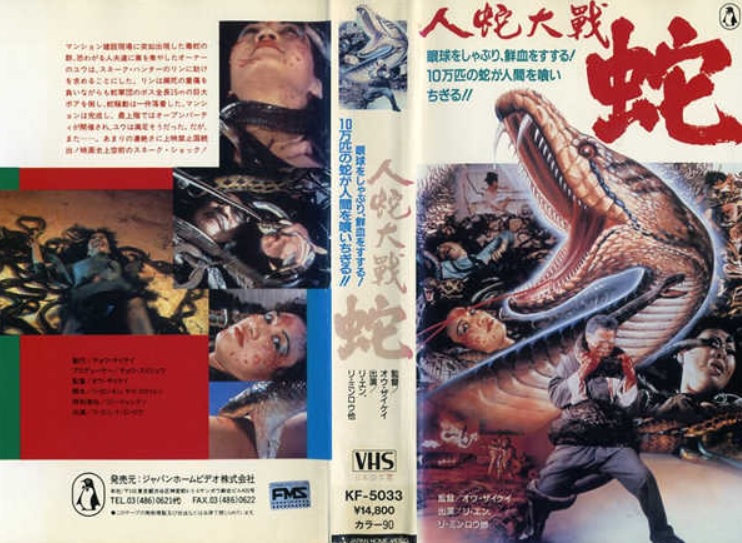
During its next year of release, Calamity of Snakes reached English-speaking countries via a dubbed version issued on Brentwood’s out-of-print “Eastern Horror” DVD collection (which are easily Googled). One of the first remixes was released in Pakistan as Revenge of the Snakes (1982) (artwork). Then, Korean directors Kim Seon-gyeong and Qi Zhang (either using the original Calamity or the Pakistani cut) added addition scenes (of a girl having a nightmare initiating the horror), as the film we previously mentioned, The War Between Man and Snakes (1983). This was a Korean-only release.
Then, apparently—not with the Chang original, but the Korean cut—the film was repurposed by U.S. filmmaker Niels Rasmussen, aka’in as John Howard, as The Serpent Warriors. That cut—using three different sources—edited-out the animal cruelty and most of the plot—with new sequences shot in Los Angeles, California, Honolulu, Hawaii, and Nevada. From that point, Rasmussen’s remix failed to find distribution in the U.S. but was distributed in Denmark, Spain, and Germany (as Snake Inferno), and Hong Kong as Golden Viper.
As the early ’90s arrived, the titles became more confusing as the original Calamity of Snakes was re-release as Snake’s Revenge (shouldn’t it be Snakes’ Revenge?) with newly, computer-generated snakes, while 8 minutes from the original film were cut for a 78-minute running time. And, as you can see from our VHS image above, New Line (no, not that one) finally brought The Serpent Warriors version to U.S. home video shelves.
So, in the end: If you must have the snake violence: go for the Calamity of Snakes original—which you can get in a restored version from Unearthed Films.
Phew. I’m exhausted. No more snake films or Hong Kong Category III films for me. Yeah, right. That’s not gonna happen.
April 2023: With the new reissue coinciding with “Day 11: What Movie Upsets You?” for our second annual, “April Movie Thon” feature, we’ve taken a fresh look at the Calamity of Snakes orginal.
About the Author:You can learn more about the writings of R.D Francis on Facebook.He also writes for B&S About Movies.
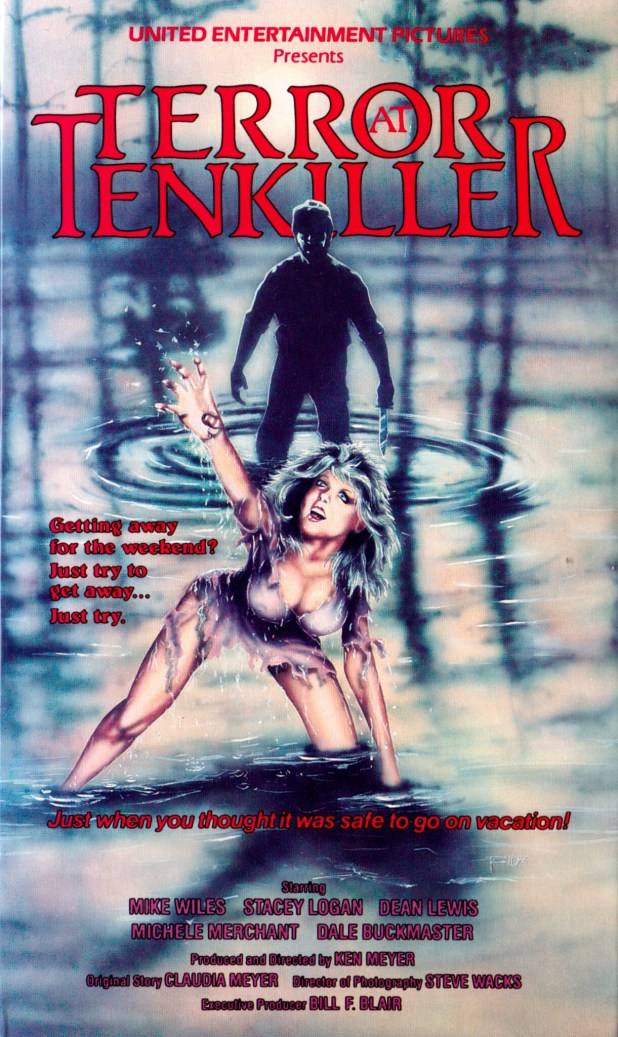
In rural Oklahoma, late one night, Tor (Michael Shamus Wiles, Breaking Bad, Sons of Anarchy) murders Denise and then dumps her body in Lake Tenkiller. So begins the 1986 one and done film by Ken Meyer, Terror at Tenkiller. Soon, Leslie and Janna show up for a vacation at the remote cabin in the woods, but are they next on the list of Tor the killer?
Shot entirely in Oklahoma near Lake Fort Gibson and the Fort Gibson dam — not at the actual Tenkiller Ferry Lake which is actually named for the Native American family who donated it — this movie honestly doesn’t have a single thing that I can recommend it for.
Some guys come down, some people get killed and there’s little to no drama as to what happens for the rest of the film.
At least the VHS box has some great artwork.
Terror at Tenkiller tells you who the killer is right away, its kills are boring and the end attempt at a shock ending is as vanilla as it gets. At least the Rifftrax guys took a shot at making it better. You can watch it with their commentary on Tubi and Amazon Prime.
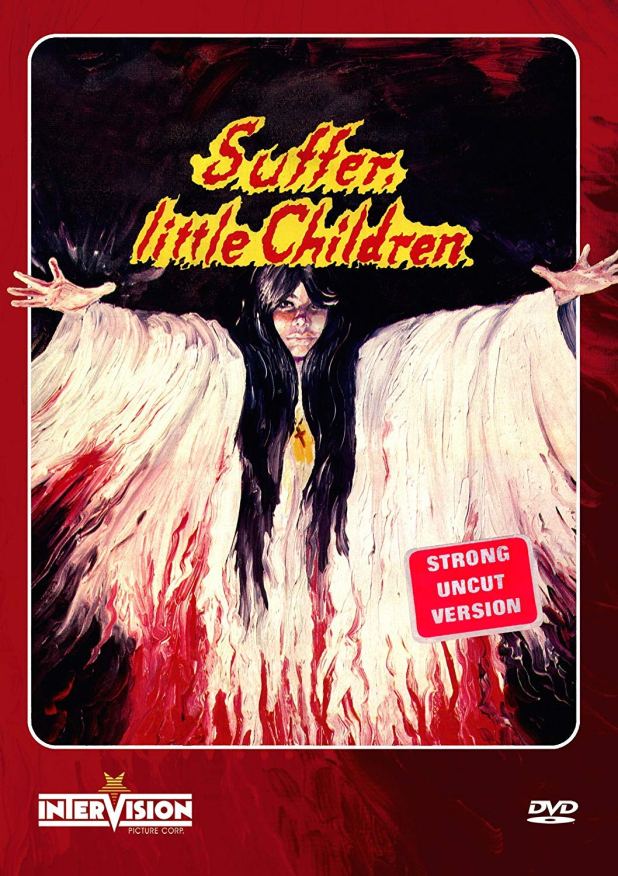
A beyond low budget film made by a drama school and directed by the former owner of the Brixton Academy, Alan Briggs, this movie is strange beyond strange. Basically shot on VHS yet proclaiming that it’s based on true events, it comes off as both amateur hour and endearingly earnest. It’s a combination that more than pays off.
Elizabeth shows up at a children’s school with a note that says she’d be better off being there. That’s because she’s possessed — not to skate, but by Satan. Soon, zombies are rising from the dead and the other children are under her control.
This sounds like so many movies that I love, like Cathy’s Curse, but this movie makes it even better by having blaring heavy metal play every time Satan’s powers are used and VHS static between each and every transition.
It’s the last fifteen minutes of the movie that make it great, with the evil kids decimating the adults until Jesus Christ himself shows up to take care of business, complete with video game drones, boops and beeps.
No, I didn’t believe it either.
You have to love a movie that has its child actors writing about it on IMDB.
You can get this — of course — from Intervision and Severin.
According to Severin, “Suffer, Little Children is a reconstruction of the events, which took place at 45 Kingston Road, New Malden, Surrey, England in August 1984. None of these events were reported in the press and now the house is scheduled for demolition in the immediate future.”
You basically want this in your life right now.
Sam’s right: you need this 3/4″ spool of trashy incompetence in your life that isn’t in the least biographical and everything about pinching from Stephen King’s The Shining, as well as The Exorcist and The Omen — and probably even Amando de Ossorio 1975 rip of The Exorcist with Demon Witch Child, but with none of that film’s de Ossorioness.
All of these bad actors are from a drama school? The owner of the Brixton Academy — where The Smiths played their last gig in 1986 — made this? Stick to concert promotions and venue management. Even at 74 minutes, this is too long. And there’s the dodgy sound, the poor framing . . . and poor everything else. But hey, they tired, they made a movie . . . about Jesus showing up and killing all the devil worshiping kids. Come to think of it: didn’t Jesus show up in Giulio Paradisi’s The Visitor?
Yeah, this is SOV gold at the end of the crinkly, celluloid rainbow. Marshmallow stars, included.














 B&S About Movies
You must be logged in to post a comment.