California Girls: The Motion Picture (1983)

Courtesy of Marian Green/Pinterest.

So, yeah . . . courtesy of all of the stock footage — and its resulting documentary feel — some are inclined to call this bee-boppin’ lesson in tedium a “mondo movie.”

Well, yeah, if “mondo boring” is a thing.

Any film that feels the need to suffix their film title with “The Motion Picture” — see Hamburger: The Motion Picture and Hot Dog: The Movie, as an examples — you know the film has an array of problems, and then some — obviously of the production variety, but, in the case of this movie, mostly of the legal variety. In fact, the only time the suffix worked was when Star Trek: The Motion Picture was released . . . and even then (with its bald alien chick V’ger non-sense). Bottom Line: “The Motion Picture” movies that feel the need to explain to us what it is, will suck ass steaks — studios and budgets of the mega and non variety, be damned. And California Girls sucks the peroxide right out of the bleach-bottle blonde hair shafts and the decals off the bumpers of the VW hippie-surfer bus.

Look, I get it. Every budding producer and aspiring writer and director has to start somewhere, but this inept radio comedy . . . just wow . . . and I thought Zoo Radio, (Young Hot ‘n Nasty) Teenage Cruisers, and On the Air Live with Captain Midnight (by the Rocktober Blood team) were inept radio comedies. Out of his 16 producer credits, eight of which he directed and four of which he wrote, you, more than likely — courtesy of its connection to all things Battlestar Galactica — known William Webb for one film: Party Line (1988), as result of your celluloid schadenfreude to see how far Richard Hatch had fallen and Leif Garrett (done a few for Webb’s production shingle) will desperately keep trying. Then again, if you’re a fan of Richard Roundtree chompin’ cigars and yelling from behind a desk, that was probably your incentive to watch that bit o’ sleaze noir.

As for California Girls: my incentive of plucking it off the home video shelf was result of its being set inside a radio station. However, if your celluloid schadenfreude runs analog waters deep — like whatever happened to Leigh McCloskey, Robbie Rist, Martin Landau, Robert Forester, Jeff Fahey, Yancy Butler, James Coburn, and Stephen Baldwin deep — perhaps you’ve seen Webb’s mid-’80s to mid-’90s direct-to-video potboilers Dirty Laundry, Delta Fever, The Banker, The Hit List, and Target. Maybe you’re a completist and need to see the past-their-heyday works of Zach Galligan, Catherine Mary Stewart, Michael Nouri, James Brolin, and Meg Foster, so you rented The Psychic and Back Stab.

Hey, at least Webb employs all of the actors we get jazzed about at B&S About Movies. That’s right: Jennifer Aniston and Melissa McCarthy fans need to just keep on surfin’, for there is nothing here for you to see.

And, there’s nothing here for YOU, the loyal B&S About Movies frequent surfer to see, either.

“Extra, Extra!” you’ve been warned.

Extra! Extra! Read all about our cinematic rip off!

But . . . if you want to revisit the glory years of late ’70s and early ’80s T&A drive-in flicks, you’re celluloid schadenfreude mileage, may vary. But hey, when a movie gives you full nude skydiving and topless mud wrestling scenes — that had to be cut by 3 1/2 minutes — for its subsequent video distribution, well, you just gotta pull out the Kleenex and the coco butter hand cream, and believe in the plot.

Well, there is no plot.

Eh, well, if you count the about 10 minutes of “Mad Man Jack,” an L.A disc jockey trapped in the booth of KRZY (they’re “crazy”), a decrepit L.A radio station with sagging ratings that decides to boost their numbers by finding “The Most Exciting California Girl” and award the winner with a $10,000 prize. And you thought the Zoo Radio gang at “94.5 FM KLST K-Lost” were a bunch of this ain’t Animal House or Porky’s losers*.

Wait, if the joint is a dump and the ratings are in the tank, where did they get the prize money? Oh, well, the “stunt” will perk up the potential advertisers’ ears (see the newspaper, above) and they’ll buy spots. Okay, the “mountain comes to Mohamed” approach is not how radio advertising and programming works, but, whatever.
You need more flicks set inside radio stations? Then check out our “Exploring: Radio Stations on Film” featurette.

Meanwhile, on the other end of the radio . . .

Three spandex-clad girls (one being 1976 Penthouse pet Lindsay Freeman; who also starred in the groundbreaking SOV’er Boardinghouse as the aka’d Alexandra Day, along with Mary McKinley, who is another one of our spandex babes, here) in a cramped apartment decide going fully nude while riding horses, roller skating, and skydiving should be exciting enough to win the prize. And yes, things go full frontal. But don’t go for popcorn during the skydiving stunt or you’ll miss the quickie “triangle of death” shots. (Again, this is the “nasty” 3 1/2-minutes excised from some video prints; the You Tube upload of the film, provided below, is the uncut version.)

And, with that, we spend the next 80-minutes of watching on-the-sly, Los Angeles travelog stock footage — backed by a hip, new wave soundtrack (yes, the music by the bands listed on the poster really appears in the movie) — of girls . . . rolling skating, wind surfing, doing karate, playing softball, navigating water slides, lifting weights, riding mechanical bulls, disco dancing, shopping on Rodeo Drive, pumping gas (and pressing their breasts into the windshield), mud wrestling, riding dolphins, soaking in hot tubs, competing in roller derby tournaments, and (it’s highly unlikely with the NFL authorization) ogling the L.A Rams cheerleader squad on the sidelines. Then our three ne’er-do-well chickies naked skydive-land on the radio station’s roof and net the prize. Then they all hop into Mad Man Jack’s ’65 Ford Mustang and head off to the beach (and he’s fat, hairy, giggling, and disgusting) to frolic in the waters.

Then end.

No. Seriously. That’s the movie. Pick up your empty soda and popcorn containers as you leave. And put away your coco butter.

If you’re looking for a movie with three-plus minutes of endless hang gliding to the tune of 10 CC’s “I’m Not in Love” . . . if you want three minutes of wet tee-shirt bikini boxing to the tune of Kool & the Gang’s “Ladies Night” . . . you’ve found your movie. That’s how this whole movies goes down: DJ mentions ladies “doing something” (e.g., racing dirt bikes) and it cues a song — that plays out in full (in the case of the dirt bikes, it’s Foreigner with “Urgent”), and so on.

Of course, that bit runs thin pretty quick, so Man Man Jack sends out his studio assistant to conduct “man on the street” interviews to ask listeners that burning question: “Who do you consider the most exciting girl?” Then we’re treated to an endless stream of . . . well, it looks like a bunch of down-and-out acting hopefuls auditioning, making clips for their actor’s reels. One even appears as ex-President Richard M. Nixon. And yes, it’s as awful as you think and you hope the hang gliding footage returns.

Now, if duping the NFL by shooting on-the-sly at a football game wasn’t enough . . . how in the world did William Webb afford the rights to the music of Blondie, Devo, the Go-Go’s, Foreigner, Kool & the Gang, Queen, the Pretenders, the Police, Sister Sledge, Rod Stewart, Donna Summer, and 10 CC?

Magic 8-Ball says, no way, Jose. Call the lawyers. And we say that because Rod Stewart is not credited on the theatrical one-sheets, the VHS sleeves, nor credited in the film. Ah, but Hot Rod’s song, “Passion,” does legitimately appear in the Corinne Alphen-starring softcore anthology, New York Nights, aka Shackin’ Up (1984), for those of you needing film with A) a Rod Stewart tune, B) another Penthouse Playmate acting, C) Willem Dafoe making his acting debut, and D) a film to settle the bet that Marilyn Chambers doesn’t star in the movie, but in the 1994 softcore flick New York Nights with fellow softcore actresses Susan Napoli and Julia Parton, which Cinemax’d as Bedtime Stories.**
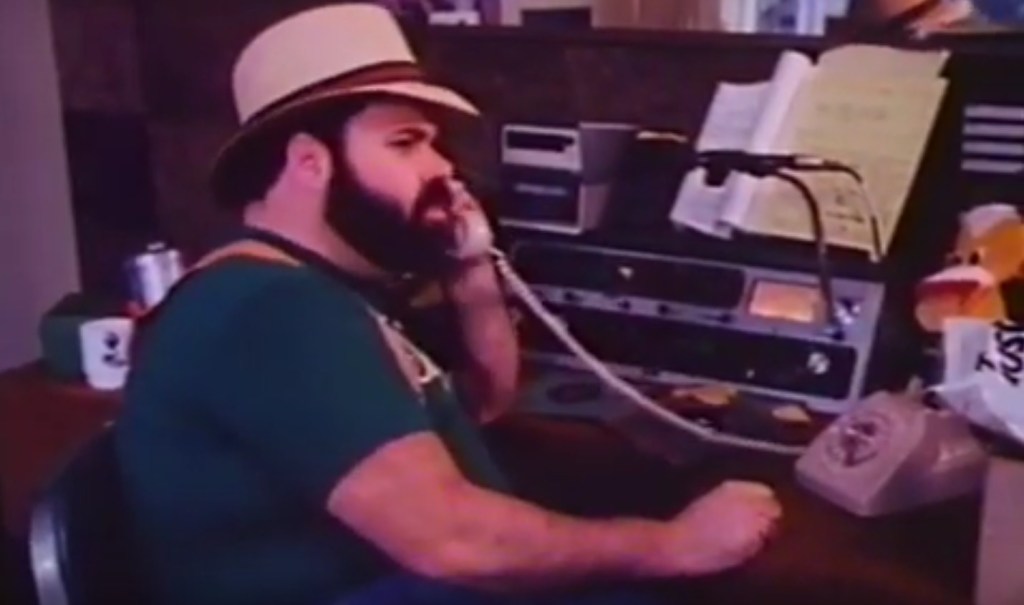
Hey, at least the radio studio (uncredited in the film) is legit. Too bad the rest of the movie, is not.

And it’s not just B-Sides and studio leftovers, as is the case with most budgetary soundtracks on low-budget films. We are talking about the aforementioned bands’ major hits with the likes of “Heart of Glass” and “Rapture,” “Our Lips Are Sealed,” “Celebration” and “Ladies Night,” “Another Bites the Dust,” “Brass in Pocket,” “De Do Do Do, De Da Da Da,” “Passion,” “All American Girls,” and “Hot Stuff.” Yeah, the California Girls: The Movie soundtrack is almost as cool as the new wave delight that is The Last American Virgin . . . but thank the celluloid overloads there’s no pretentious Bono crooning over a teenage abortion scene amid the Mad Man Jack pattering . . . and you don’t have your nostalgic teen heart ripped out at the end. Hey, back in the day, before you easily accessed porn on the Internet, or were old enough to get behind the beaded curtain of your local video store, or were allowed to pick skin mags off the high racks, you had titillating movies such as California Girls to sooth your tween savage beast.

Not that it helps in watching this mess: The real life Maggie Parker, who has her new wave concert broadcast on the air of KRZY (with the song “My Baby”), is better known as Maggie Mayall, the wife of British blues-rock legend John Mayall (know your Eric Clapton trivia). Their son, Jason, worked as a production assistant on the film.

The doppelganger caveat: Don’t confuse this long-form T&A rock video mess with the year-later released Tawny Kitaen comedy California Girls. As for this California Girls, this movie — and we use the term in the loosest form possible — must be seen to be believed. You can see it (for now, so watch it quick) on You Tube, because, with that soundtrack, this is surely to be pulled and it’s never coming out on a DVD or Blu — and least not in a non-grey variety. The VHS tapes are out there, and they ain’t cheap. Hey, we found this clip “Barney’s Girls” to sample, and here’s the soundtrack (hopefully, by the time you read this, they’ll still uploaded.)

* Hey, don’t forget that we discuss Animal House and Porky’s — as well as all of their knockoffs — courtesy of our “Exploring: ’80s Comedies” featurette.

** Update: We since conversed with the film’s uploader and learned they overlaid the Rod Stewart song as result of copyright issues over Blondie preventing the upload. You fooled me, as the Stewart tune fits in perfectly. But still . . . how did this cheapjack flick afford all of those songs? So you still gotta call the lawyers . . . you know, the kinda lawyer that cops a table at Barney’s Beanery and uses the payphone on the corner as the “office” phone.

About the Author: You can read the music and film reviews of R.D Francis on Medium and learn more about his work on Facebook.

The Beatles: Influence on Film 2

This is the second installment in our three-part series. We are discovering 33 films in the series, with 11 films each over the next three days — at 3 PM — as part of our third “Rock ‘n’ Roll Week” installment.

The films are listed by year of release.

“Rubber Soul” image with logo courtesy of 60s Girl Deviant Art/banner design by R.D Francis

Backbeat (1994)
Ian Softley (Hackers) makes his feature film writing and directing debut in this chronicle on the early days of the Beatles in Hamburg, Germany — the relationship between Stuart Sutcliffe (Stephen Dorff, S.F.W.), John Lennon (Ian Hart, again), and Sutcliffe’s German girlfriend Astrid Kirchherr (Sheryl Lee, U.S. TV’s Twin Peaks), in particular.

While the movie’s production values are stellar and the accents are spot-on (well done, Mr. Dorff) — and it’s based on interviews conducted by screenwriter Stephen Ward with Astrid Kirchherr — the real gem of the film is the Backbeat “alt-rock supergroup” on the soundtrack. The band is comprised of Dave Pirner of the Soul Asylum (as Paul McCartney), Greg Dulli of the Afghan Wigs (as John Lennon), along with Thurston Moore of Sonic Youth and Don Flemming of Gumball on guitars (Moore and Fleming also worked in a “supergroup” capacity on Velvet Goldmine), Mike Mills of R.E.M on bass, Nirvana’s Dave Grohl on drums. On lead vocals for Dorff’s Sutcliffe: Black Flag and the Rollins Band’s Henry Rollins.

Steven Dorff lip syncing Henry Rollins? Awesome.

That Thing You Do! (1995)
Okay, so the Beatles’ personas or music doesn’t show up (but they’re mentioned several times) in this writing and directing debut love letter to the Beatles and the Beatlemania-inspiring “one-hit wonder” craze of the 1960s. Our “Fab Four,” here, are Erie, Pennsylvania’s the Wonders — who shoot to the top of the charts with their ersatz-British Invasion rave-up, “That Thing You Do.” The film works its wonders (sorry) courtesy of its spot-on production design in conjunction with a brilliant soundtrack composed by bassist Adam Schlesinger of the alt-rock bands Fountains of Wayne (with their own “one hit wonder’ in 2003’s “Stacy’s Mom”) and Ivy (whose music appears in There’s Something About Mary; they also scored Shallow Hal). Mike Viola of Sony Records’ the Candy Butchers (later of Panic! at The Disco and Fall Out Boy) provides the vocals for the Wonders.

Sadly, we lost Adam Schlesinger on April 1, 2020, due to COVID compilations. Listen to this soundtrack — and anything from Fountains of Wayne — for great, goes-down-like-gumdrops tunes.

The Linda McCartney Story (2000)
Armand Mastroianni — yes, the one and the same who made his debut with the ’80s slasher He Knows You’re Alone (yep, the acting debut of Tom Hanks!) — directs this adaptation of the best-selling book Linda McCartney: The Biography that dispels of the Beatles — even Paul’s solo career — instead centering on Linda’s life with Paul.

The soundtrack, featuring the Beatles’ originals “I Wanna Hold Your Hand” and “Please Please Me,” along with the Beatles’ covers “Kansas City,” “Yeh Yeh,” and Willie Dixon’s “Back Door Man,” are interpreted by acclaimed Southern California-based Beatles tribute band, the Fab Four.

Paul Is Dead (2000)
The Google rabbit hole that opens for the “Paul Is Dead” legend is twisted and deep, so search with caution — or least do it on your day off, because you’ll be instantly hooked and surfin’ until sunset.

If you know your basic Beatles trivia: The band left “clues” in the 1968 John Lennon-composition “Glass Onion,” on the cover of Abbey Road, and in the backmasked grooves of “Revolution 9,” all which fueled the urban legend that Paul McCartney died on November 9, 1966, in car crash. To spare the public from grief, the Beatles replaced Paul with a lookalike, alternately known as William Campbell and the more widely accepted, Billy Shears. While the rumors got off and running in 1967, it really took off on Detroit radio stations in 1969 (which also birthed the “Jim Is Alive” urban legend in 1974 — and that Morrison recorded albums as “The Circuit Rider” and “The Phantom”), then spread via U.S. college newspapers.

In this German-shot/language film, Tobias, our young Beatles fan in an early 1980s German town, describes (in the scene, below) his conspiracy theory about how Paul McCartney died in the 1960s and was replaced his murderer.

The tale, while with its share of against-the-budget faux pas, is intelligently written and enjoyable, with imaginative plot twists: Paul is not only dead and replaced by Billy Shears, Shears murdered Paul; Shears — still alive — arrives in town driving a yellow, ’60s VW Beetle with the license plate “LMW 281F” — the car from the cover of Abbey Road.

While this impressive movie plays as a mystery-drama, the urban legend returns in a comedic take in 2018.

Two of Us (2000)
This Beatles “What If” comes courtesy of MTV’s softer sister station, VH-1, back in the days when the music channel produced original movies to a meandering-shrug effect. (However, their Def Leppard bioflick, Hysteria, is pretty good; Daydream Believers, their take on the Monkees, is also decent enough.) In this, the channel’s third film, the smart bet was placed on hiring Michael Lindsay-Hogg, the director of the Beatle-chronicle Let It Be (1970). What makes this all work: Jared Harris and Aiden Quinn as Lennon and McCartney are excellent in their roles — especially Harris, the son of the great Richard Harris (Ravagers). No, we do not see them sing, well, lip sync, in the film.

As with 1978’s I Wanna Hold Your Hand using the Beatles’ 1964 New York television appearance, and 1987’s Concrete Angels using the historical folklore regarding the Fab Four’s first Toronto concert appearance that same year, this time, the folklore concerns the mid-’70s public demand for a Beatles reunion show. One of those offers came from Saturday Night Live producer Lorne Michaels on April 24, 1976, who made an on-air offer of $3,000.

The script is based on a 1980 interview with John Lennon in the pages of Playboy, in which Paul McCartney, then on the road with his Wings Over America tour (promoting 1975’s Venus and Mars and 1976’s Wings at the Speed of Sound), visited with John Lennon at the Dakota when Michaels made the offer. And they almost took up the offer. . . .

VH-1 was unable to obtain the rights to the Beatles’ catalog, so none of their songs appear in the film. And the ghost of Let It Be is coming back a little later in another film.

I Am Sam (2001)
If you’re searching for a primer to help you swallow Across the Universe, the later-produced “film based on the Beatles’ songs,” and if All This and World War II wasn’t enough to send you reeling back to your VHS copies of Sgt. Pepper’s Lonely Hearts Club Band, this overwrought, saccharine hokum, is it.

Sean Penn’s performance (Tell it, Sgt. Osiris!) as a Beatles-obsessed, mentally-challenged man fighting for the custody of his bright, young daughter is outweighed by the Beatles tunes expertly covered by alt-artists such as Nick Cave, Ben Folds (of the Ben Folds Five), Heather Nova, Paul Westerberg (of the Replacements), and Pearl Jam’s Eddie Vedder. Not the same as the original verison-Beatles, but what is?

Writer-director Jessie Nelson, she, the force behind 1994’s incredible Corrina, Corrina (her daughter is Molly Gordon, of Booksmart), later produces a tale based on ’70s folk musician Steve Tilson almost meeting John Lennon. . . .

The Rutles 2: Can’t Buy Me Lunch (2002)
Is there such a thing as Rutlemania? Well, not in the U.S. where the 1978 original, All You Need Is Cash, bombed with the lowest ratings of any show on U.S. prime time television that week. However, in the U.K., the film’s intended audience, the mania led to Eric Idle and the Python troupe to embark on tours and recording full-lengths albums as their mock-Beatles.

As with Spinal Tap diluting the brilliant joke with an ABC-TV spoof concert special, The Return of Spinal Tap (1992), this Rutles sequel also dilutes the once brilliant gag — and it’s nothing more than a new edit of All You Need Is Cash, presented in the same chronological order, with a few new interviews, a couple faux celebrity insights (SNL’er Jimmy Fallon and Steve Martin show up; even Tom Hanks of That Thing You Do!), and a couple scenes cut from the first movie, as the Rutles embark on a reunion tour of America.

Across the Universe (2007)
As Robert Stigwood’s debacle based on Sgt. Pepper’s Lonely Hearts Club Band wasn’t enough . . . and with Sean Penn’s Oscar-bait still wormed in your brain . . . we get another musical drama written “around the music” of the Beatles. As with the later “alternate universe” romp, Yesterday . . . the Beatles “don’t exist” in this film’s verse: a “jukebox musical” that features 33 Beatles songs to weave the tale of two lovers, Jude and Lucy.

While it had a tumultuous studio vs. creative post-production process over the film’s length (it was intended to be longer), the film none the less won over Paul McCartney, Yoko Ono, and George Harrison’s widow Olivia.

Still no word on what Ringo thinks.

Chapter 27 (2007)
Jared Leto gives a bravo performance as Lennon assassin Mark David Chapman in this adaptation of the best-seller Let Me Take You Down (1992). While the book pinches its title from the Beatles’ “Strawberry Fields Forever,” the film’s title references J.D Salinger’s 1951 novel The Catcher in the Rye, which has 26 chapters — with the film’s title suggesting a “continuation” of the book, which was an obsessive favorite of Chapman’s. Another Lennon fan is portrayed by Lindsay Lohan — and she’s actually good, here, for you Lohan detractors.

Chapman’s psyche is also explored in 2006’s The Killing of John Lennon — but we didn’t see it U.S. theaters until after the release of Chapter 27.

Walk Hard: The Dewey Cox Story (2007)
“Spinal Tap” does not strike twice in this Judd Apatow-backed mockumentary concerning an ersatz-hybrid of Johnny Cash and Bob Dylan. The film barely cleared $20 million against is $35 million budget.

The Beatles appear in the form of Paul Rudd as John Lennon, Jack Black as Paul McCartney, Justin Long as George Harrison, and Jason Schwartzman as Ringo Starr. Sadly, their time is brief . . . and we wished the producers realized what they had, ditched John C. Reilly (an acquired taste that inspires more passes than watches), and just gave us a “What If” Beatles flick about the band moving on after the death of Paul McCartney . . . of which there is one. . . .

The Killing of John Lennon (2008)
While this was completed first, and released first in the U.K. and overseas markets in 2006, it was released in the U.S. in 2008 — after the 2007 release of the (much) better and better known, Chapter 27. Lennon, Harrison, McCartney, and Starr appear as themselves via 1960s archive news footage, but actors Richard Sherman and Tom J. Raider dually portray John Lennon against Jonas Ball’s Mark David Chapman.

Courtesy of 1000 Logos.

Join us tomorrow for our third installment with our final batch of films.

If you missed “Part 1,” you’ll find it, here.

About the Author: You can learn more about the writings of R.D Francis on Facebook. He also writes for B&S About Movies.

A Bullet for Pretty Boy (1970)

Wow! This movie has it all! It’s an American International Pictures release! Cheapjack drive-in copycat Larry Buchanan! Beach flick purveyor Maury Dexter! Still livin’ the dream ex-’60s teen idol Fabian! And a connection to Jim Morrison?

Strap on the popcorn bucket!

In 1967, Warner Bros. hit a $70 million payday on a $2.5 million investment with the Warren Beatty-produced and Arthur Penn*-directed (1969’s Alice’s Restaurant and 1970’s Little Big Man) Bonnie and Clyde. The film not only instigated a slew of “(criminal) lovers on the run” films, such as the Martin Sheen-starring Badlands (1973) and the Peter Fonda-starring Dirty Mary, Crazy Larry (1974), it also set off the production of more traditional gangster films, such as Roger Corman’s The St. Valentine’s Day Massacre (1967) — who never seen a hit film he couldn’t knockoff — and Dick Clark’s written and produced Killers Three (1968), a knockoff for — coincidentally, as was A Bullet for Pretty Boy — American International Pictures. Then there’s Roger Corman’s backed Bloody Mama (1970) (not to be confused with New World Pictures’ similar female-gangster romp from 1975, Crazy Mama) starring Shelley Winters and a young Robert De Niro and, thanks to director Martin Scorsese (on his second film), Roger Corman’s superior Boxcar Bertha (1972) starring David Carradine and Barbara Hershey. As with Scorcese, another superior (but fictional-based on a late ’30s novel) gangster flick was the Robert Aldrich-produced and directed (but a box office flop) The Grissom Gang (1971).

Of course, the notorious career of this film’s subject, Charles Arthur “Pretty Boy” Floyd, was covered in the poverty-row production Pretty Boy Floyd (1960). You know that film’s German-American actor, John Ericson, for the sci-fi cheapy The Bamboo Saucer (1969), the early Charles Band-directed hicksploitation’er Crash! (1977), and Oklahoma-shot, poverty horror anthology House of the Dead (1978). And yes, Ericson, as most ’60s and ’70s B-Movie actors at the end of their careers, worked for Cirio H. Santiago (we love you, Uncle C!) in one of our beloved Philippine war romps, Final Mission (1984).

Now, we gave you that little bit of back story on the admittedly dashing — and a pretty decent thespian, natch — on John Ericson, in that, this time, Pretty Boy Floyd is now portrayed by . . . you guessed it, teen idol Fabian, who started using his last name, Forte, on his works. He was, certainly, looking for this “grown up” gangster romp as a role that would bury the teen-memories of his lightweight beach romp Ride the Wild Surf (1964) and the process-shot racing rallies of Fireball 500 (1966), Thunder Alley (1967), and The Wild Racers (1968). Oh, and let’s not forget Fabian’s work in the James Bond-cum-beach knockoff Dr. Goldfoot and the Bikini Machine and Mario Bava’s sequel, Dr. Goldfoot and the Girl Bombs (1966).

Then the reviews for A Bullet for Pretty Boy came in.

The New York Times accused Larry Buchanan of making “a murderous gangster movie full of mostly nice guys which looks a little as if they had taken the members of the cast of, say, Beach Blanket Bingo and put them in costume and given them old cars to drive and told them to play it for real.”

The Los Angeles Times opined the film was “surprisingly free from gratuitous gore, but was still another very pale carbon of Bonnie and Clyde, in which Fabian handles himself in competent fashion amidst a host of amateurs.”

The film did, however, prove to be a box office hit, grossing over a million dollars in drive-in receipts; however, even though he was called out for the quality of his thespian turn across the board by critics, the film was not the critical and commercial breakthrough Fabian had hoped.

At that point, Fabian diddled in some guest television roles of no consequence, eventually returning to the big screen alongside Karen Black in, ironically, another based-in-fact gangster film — for Crown International Pictures, no less — Little Laura and Big John (1973) — that film concerned with the 1910s and 1920s-era Ashley gang. (The only film directed by art director Luke Moberly, it was made in 1969 as a failed/shelved Bonnie and Clyde cash-in.) Then Fabian gave us the trashy one-two punch that we so cherish here at B&S About Movies: Soul Hustler (1973) and Jukebox, aka Disco Fever (1978) — again, two “grown up” films rejected by the mainstream box office hoards. Fabian’s career then wound down (but not to the Cirio H. Santiago depths, thank god) after his working in the ’80s slasher genre with Kiss Daddy Goodbye (1981) and a bit-support role in the rock comedy Get Crazy (1983). (Hey, how did we miss his work in the George Peppard-starring airline disaster flick Crisis in Mid-Air (1979) for our “Airline Disaster TV Movie Week” feature?)

In typical A.I.P fashion, the against-the-low-budget and bargain-basement talents (the acting, outside of Fabian, is pretty abysmal) behind the film, in front of and behind the cameras, made the production a troubled one. The studio, while fronting Larry Buchanan a $350,000 budget, the largest the writer-director every worked with — and Fabian ever worked on — the studio, well, mostly studio head James H. Nicholson, grew concerned Buchanan (who gave us the likes of Mistress of the Apes and “It’s Alive!”) would fail to bring the film on budget and schedule with “some level of quality.” So A.I.P replaced Buchanan with Maury Dexter — in his final directing effort. While Dexter and the studio were ultimately impressed with what Buchanan shot, it was considered “too slow and talky.” So Dexter took a small pick-up crew, along with stunt doubles and the lead actors, to shoot action sequences to splice into the film.

Shot and produced in five months betwen June to October 1969, Buchanan’s story was inspired by Woody Guthrie’s folk-tune “The Ballad of Pretty Boy Floyd,” while TV series scribe Henry Rosenbaum (1970’s pretty cool budgeted-horror The Dunwich Horror and the aforementioned Get Crazy) whipped the concept into shape. And yes, it’s the same Henry Rosenbaum who penned Sly Stallone’s Lock Up (1989).

Needless to say, if you’re tempted to stream a Larry Buchanan-with-Maury Dexter-on-the-assist gangster flick, just know you’re not getting a gritty gangster romp on the level of the superior, John Milus-directed Dillinger (1973) starring Warren Oates: you’re getting a Roger Corman-backed New World Pictures-exploiting ’30-era gangster romp in the vein of his Big Bad Mama (1974) and The Lady in Red, aka Guns, Sin and Bathtub Gin (1979). Actually, the proceedings are closer to Buchanan’s own — long forgotten and of no consequence — take on the Bonnie and Clyde legend with The Other Side of Bonnie and Clyde (1968), which is the reason why he got the green light on his Pretty Boy Floyd project, in the first place.

Buchanan’s gangster chronicle — like the recently (some quarters) critically derided bio-flicks Bohemian Rhapsody, The Dirt, and Hidden Figures — plays it very loose with the facts. And, instead of documenting Floyd for the violent criminal that he was, Buchanan transforms the bane of Bureau of Investigations’ (the BOI was the precursor to the FBI) agent Melvin Purvis as a romanticized, misunderstood product of the Great Depression (that swept across 1930s American) by casting Floyd as a Robin Hoodesque folk-hero for the people.

Sure, Floyd gained his “hero” (well, anti-hero) status for burning mortgage documents, which effectively wiped-out people from their debts (but is not based in fact and believed to be folklore myth), but Floyd was still, first and foremost, a bank robber — who not only robbed “evil” banks, but also terrorized citizens by robbing company payrolls and committing numerous highway robberies. In reality, the newspaper-reading public who considered Floyd a “folk hero” of the downtrodden, was a multiple murder behind the killings of two police officers, one federal agent, and two, rival hood-cum rum runners who crossed his path. Then there was the Kansas City Massacre of July 1933 that resulted in the death of four law enforcement officers (though Floyd’s involvement is disputed, in some authoritative circles).

Whatever, Larry.

Charles Arthur Floyd wasn’t a hero, anti or otherwise. He was a thug who struck fear and dread in people, aka a terrorist. His exploits were so feared, officially, in July 1934, the newly formed F.B.I ranked Floyd as “Public Enemy No. 1” — and yet, the citizens of Oklahoma and Texas still helped him evade capture.

As you can see, the tale of Floyd is heavy material. And you can see why Fabian lobbied for the role.

Of course, keeping in mind Roger Corman backed the gangster romps Bloody Mama (1970) and Boxcar Bertha (1972) — themselves recycling off the A.I.P prop house from The St. Valentine’s Day Massacre (1967) — Buchanan easily pulled together a film that, while not fictionally accurate, is at least historically accurate in its set and costuming (we’ll forgive those few 1940’s model cars). And, if you know Larry Buchanan’s filmography, a resume rife with one, cheesy science fiction, inept horror, and conspiracy flick after the another, this gangster flick is one of his better, if not the best, films on his resume — thanks, in part, to Maury Dexter injecting those action set pieces.

Of particular interest in the cast department, especially to uber fan Bill Van Ryn of the Groovy Doom and Drive-In Asylum collective: Fabian’s supporting cast of Annabelle Weenick, Camilla Carr, Hugh Feagin, and Gene Ross appeared in the films of the all-too-short resume of S.F Brownrigg, he of the films Don’t Look in the Basement (1973), Don’t Hang Up (1974), Scum of the Earth (1974), and Keep My Grave Open (1977). And, why yes, Brownrigg does connect back to Larry Buchanan: Brownrigg worked as an editor and sound engineer on Buchanan’s ’60s flicks The Naked Witch, High Yellow, and the sci-fi epics Zontar: The Thing from Venus and Attack of the Eye Creatures.

Oh, and lets not forget Fabian’s co-starring moll was Jocelyn Lane, an Elvis flick vet co-star in Tickle Me (1965). An admittedly smokin’ hot, but (very) marginal actress, who certainly hoped for more from the film, as did Fabian, left the business after the crushing reviews for A Bullet for Pretty Boy. Also look for Fabian’s criminal side kick portrayed by ’60s B-Movie leading man Adam Roake (who appeared in the aforementioned Dirty Marty, Crazy Larry), and character actor extraordinaire and Buchanan stock player Bill Thurman (‘Gator Bait, Creature from Black Lake). Those who look really hard will see Morgan Fairchild (The Initiation of Sarah, Shattered Illusions) in her uncredited, feature extra debut.

You can watch the full film on You Tube.

“Hey, wait a minute, R.D! What about the ‘Jim Morrison connection,’ you teased?”

Read on, ye reader!

The Soundtrack by Richard Bowen and the Source

An August 8, 1970, Billboard Magazine advertisement for the soundtrack that served as the debut album for The Source.
Record images courtesy of Discogs.com and 45 Cat.com/soundtrack embedded below.

American International Pictures started their recording branch, American International Records, distributed by MGM Records, on March 19, 1959. Early on, AIR’s catalog was mostly 45-rpm singles, with rock and roll selections from their horror films, most notably, The Ghost of Dragstrip Hollow (1959). Later, AIR’s catalog featured long-play soundtrack releases, such as A Bullet for Pretty Boy. A decade later, in 1969, AIR and another company, Together Records (also distributed by MGM Records), went into business together — and shared the (sometimes confusing) sequence of catalog numbers on their releases. One of the label’s coveted records is “(Oooh, I’m Scared of the) Horrors of the Black Museum” b/w “The Headless Ghost” by The Nightmares (1959). (The Nightmares were fronted by Jimmie Maddin, who also appeared and performs in The Ghost of Dragstrip Hollow with the tune, “Tongue Tied.” He also cut “Roadracers” for the 1959 film of the same name.)

The soundtrack for A Bullet for Pretty Boy was produced by Harley Hatcher. B-Movie fans of all things Roger Corman know Hatcher for his scoring, penning and singing songs for the biker and rock flicks The Glory Stompers (1967), Wild in the Streets (1967), and The Hard Ride (1971). His other contributions are the Peter Fonda biker classic The Wild Angels (1966), several songs to Satan’s Sadists (1969), and Fabian’s Christsploiter, Soul Hustler (1973). Hatcher, who also served as the singing voice of actor Christopher Jones’s rock star Max Frost in Wild in the Streets, went on to become a top executive at Curb Records**. (Angel, Angel, Down We Go, another of AIR’s film soundtracks (1969), served as an A-Side album showcase for actor-singer Jordon Christopher, formerly of The Wild Ones.*˟)

Richard Bowen and the Source

And that brings us to Richard Bowen, the lead vocalist of the L.A. band the Source, who serves as the “Jim Morrison connection” teased at the beginning of this film review.

Richard Bowen and the Source never released an official album through AIR; none of the label’s artists did. Their “debut album” was the A-Side of A Bullet for Pretty Boy, in which the B-Side features Harley Hatcher’s film score. Of the six songs by the Source produced by Hatcher, he wrote three: “”It’s Me I’m Running From,” “I’m Gonna Love You (‘Til I Die),” and “Got Nowhere to Go,” with the former paired for single release with “Gone Tomorrow” penned by Richard Bowen. Bowen wrote the remaining songs “Ruby Ruby” and “Ballad of Charles Arthur Floyd.”

And we fast forward to the early ’80s.

Buchanan was fully committed to his faux-biographical drama format — mixed with his ubiquitous speculations and conspiracy theories — a format that dated to his “exposés” on the Kennedy assassination with The Trail of Lee Harvey Oswald (1964), the gangster chronicles The Other Side of Bonnie and Clyde and A Bullet for Pretty Boy, and the “romance” between billionaire Howard Hughes and actress Jean Harlow in Hughes and Harlow: Angels in Hell (1977). Buchanan twice explored the life of Marilyn Monroe with his same theories-vigor in Goodbye, Norma Jean (1976) and Goodnight, Sweet Marilyn (1989). Not even folklore dinosaurs were immune from the depths of Buchanan’s conspiracies: he made the speculative-drama The Loch Ness Horror (1982).

Then, with Jim Morrison mania sweeping the world in the wake of Jerry Hopkins and Danny Sugerman’s runaway best seller — and the first biography on the Doors’ lead vocalist, No One Here Gets Out Alive (1980) — Buchanan concocted Down on Us. Finally seeing release in 1984, it wasn’t a Jim bio-flick as Oliver Stone’s later The Doors (1991) — it was a “What If” tale about the deaths behind Jimi Hendrix, Jim Morrison, and Janis Joplin. Remembering the Morrisonesque qualities of Richard Bowen’s voice, Larry Buchanan brought Bowen on the project to be “Jim Morrison’s” vocals. So Bowen took an old 1970 tune, “Phantom in the Rain” (the image of the original 45-rpm single, seen above), that never appeared in an American International Pictures production, and retooled it as a faux-live cut for the film.

Upon the 1984 release of the Down on Us — and Bowen’s eerie Morrison qualities on the songs “Phantom in the Rain” and “Knock So Hard” (it’s unknown if the second song was an old ’70s song by the Source or a newly-penned tune for the film) — for a time, before the early-’90s rise of Internet, it was believed — amid assumptions it was Iggy Pop and the Doors, or an ad-hock group of Detroit musicians, or Capitol Records’ SRC with a new lead vocalist — that the infamous, post-death “Jim Morrison solo album” known as Phantom’s Divine Comedy: Part 1 (1974) was recorded by Richard Bowen and the Source.

Of course, when CEMA, Capitol’s digital reissues arm, released the first-ever compact disc version of the album in 1993 — and the truth, every so slowly and inaccurately, came out across blogs and music sharing sites — it was learned the faux Jim Morrison solo album was the lone release by Detroit musician Arthur Pendragon and his band, Walpurgis, a group managed by and recorded for Ed “Punch” Andrews’s Hideout Records and Palladium Productions that also oversaw the career of Bob Seger (Seger’s Gear Publishing published the album’s songs). (The 1974 studio version of Phantom’s Divine Comedy is also available on You Tube.)

Buffaloes, Grass Roots, and Eagles, Oh, My!

In addition to his catalog with American International Records, Richard Bowen penned the song “Trivial Sum” with Terry Furlong of the Grass Roots (the ’60s hits “Temptation Eyes” and “Midnight Confessions”) for the band, Blue Mountain Eagle.

Blue Mountain Eagle, hailing from Texas, was a quintet assembled in 1968 by Dewey Martin, who served as the original drummer in the Buffalo Springfield, and Randy Fuller, brother of the late Bobby Fuller of the Bobby Fuller Four (his brother Bobby, another celebrity murder mystery like TV’s Bob Crane and Iron Butterfly bassist Philip Taylor Kramer), to tour as “The New Buffalo Springfield.” When Stephen Stills and Neil Young took legal action to prevent Martin from using the “Buffalo Springfield” name, the band became Blue Mountain Eagle and recorded one album for Atco in 1970.

The group toured extensively, opening for Santana, Jimi Hendrix, Love, and Pink Floyd before their demise. Dewey Martin was eventually sacked; he formed Medicine Ball with Randy Fuller, while the rest of the band — Bob Jones, also formerly of Buffalo Springfield, along with David Johnson, formed Sweathog with the one-named sticksman Frosty from Lee Michaels (the early ’70s hit, “Do You Know What I Mean?”). Prior to the band’s formation, BME’s guitarist and vocalist, David Price, through his old Texas friend Micheal Nesmith, came to be Davy Jones’s stand-in on The Monkees TV series.

* We discussion the career of Arthur Penn’s son — and later, production partner on the Law & Order television franchise — in our review of the lost rock flick Rock ‘N’ Roll Hotel.

** You can learn more about the career of Harley Hatcher at his official website.

*˟ You can learn more about American International Records’ complete roster of releases at Both Sides Now Publications.

Oh, by the way . . . we are deep into our third “Rock ‘n’ Roll Week” blowout. Yes, we’ve done this twice before, and you can catch up with our “Rock ‘n’ Roll Week” Round-Ups 1 and 2 with their full listings of all the rock flicks we’ve watched.

All the ’90s mobsters you can handle . . . with a few more Pretty Boy Floyd portrayals.

About the Author: You can learn more about the writings of R.D Francis on Facebook. He also writes for B&S About Movies and publishes short stories and music reviews on Medium.

The Beatles: Influence on Film 1

This is the first in a three-part series. We are discovering 33 films in the series, with 11 films each over the next three days — at 3 PM — as part of our third “Rock ‘n’ Roll Week” installment.

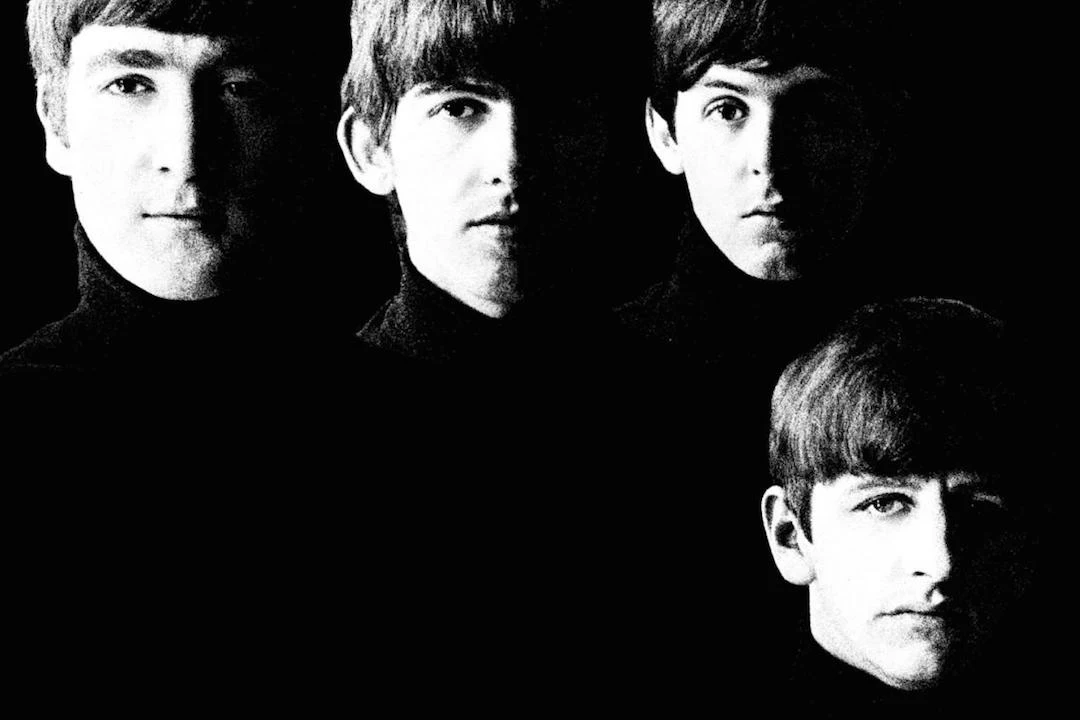
Image courtesy of Parlophone/Town Square Media via Ultimate Classic Rock/logo courtesy of 60s Girl Deviant Art/banner design by R.D Francis

As we developed this third “Rock ‘n’ Roll Week” in February, the 52nd anniversary of the Beatles’ final live performance in 1969 — shot for Let It Be (1970) — passed on January 30.

As you can tell by this article’s title, this isn’t about the Beatles’ movies, such as A Hard Day’s Night or Help! or Magical Mystery Tour or Yellow Submarine (well . . .) or Let It Be or any of the wealth of theatrical, television, and direct-to-video documentaries on the band.

And we are passing on John Lennon in Richard Lester’s How I Won the War (1967) and his work with the “supergroup” the Dirty Mac in The Rolling Stones Rock and Roll Circus (1968/1996), as well as Paul McCartney’s vanity piece, Give My Regards to Broad Street (1984).

And we are passing on chronicling the works of George Harrison’s Handmade Films, so nothing on Monty Python’s Life of Brian (1979), The Long Good Friday (1980), and Time Bandits (1981), or his production of Shanghai Surprise (1986), in which he appeared and recorded five new songs.

And we are passing on Ringo Starr’s resume with Candy (1968), The Magic Christian (1969), and Blindman (1971), as well as his co-starring roles in That’ll Be the Day (1973) and Son of Dracula (1974), his work as the Pope in Lisztomania (1975), his starring role in Caveman (1981), his appearance as Larry the Dwarf in Frank Zappa’s 200 Motels (1971), and his work on Harry Nilsson’s animated film The Point! (1971). We’re also passing on Ringo’s appearances in Martin Scorsese’s The Last Waltz, his document on the 1976 farewell concert of the Band, and the Who’s The Kids Are Alright (1979). And how can we forget, Ringo (1978), Starr’s made-for-television adaptation of The Prince and the Pauper, and Princess Daisy (1983), with wife Barbara Bach. And Ringo’s appearance in Sextette (1978), and directing debut of the T.Rex concert document, Born to Boogie (1972).

This exploration is concerned with the speculative biographical flicks, the films using the legend of the “Fab Four” as plot fodder, and the historical sidebars to their careers — both as a band and solo artists.

The films are listed by their year of release.


Yellow Submarine (1968)
We each have our fond memories of this sort of . . . and it’s not . . . but it is . . . Beatles film. Sam the Bossman remembers watching it on UHF-TV as his dad and grandad fixed the furnace. Me? My sister still doesn’t let me live down my nightmares . . . of the Blue Meanies coming to get me. What did my parents know about LSD trips? It’s those loveable moptops from A Hard Day’s Night, after all . . . and it’s a cartoon. What’s the harm . . . and I am still scarred by it, for life.

Initial press reports stated that the Beatles themselves would provide their own character voices. But all was not well at Apple Corp. and the lads weren’t enthusiastic about working on a new motion picture to fulfill their three-picture deal with United Artists, having been dissatisfied with their second feature film, Help!.

So, the Beatles bailed on project, giving the over 200 artists — who crafted the film across 11 months — all the creative space they needed. John, Paul, George, and Ringo composed and performed the songs (a mere six that comprises 22 minutes of Side One; the other half was comprised of George Martin orchestral compositions). As actors, the “real” Beatles only participated in the film’s closing scene, while their animated doppelgangers were voiced by other actors.

Obscure Beatles cover song hokum: There’s been a LOT of covers of Beatles tunes over the years . . . but one of the coolest covers of “Yellow Submarine” was done by Philadelphia, Pennsylvania’s More Fiends from their album, Toad Lickin’ (1990). Here’s the rub: The song, titled “Yellow Spades,” is actually a cover of Motorhead’s “Ace of Spades” backing Paul McCartney’s lyrics.

I wonder if Paul has ever heard it? Did Micheal?

Micheal Jackson sold Northern Songs, Ltd., the publisher of the Beatles’ catalog, in 1995; the More Fiends, it seems, escaped the Gloved One’s legal wrath. The same can not be said of New York’s SST recording artists Das Damen. On their Marshmellow Conspiracy EP (1988), they recorded “Song for Michael Jackson to $ell,” which was actually an uncredited cover of the Beatles’ “Magical Mystery Tour.” After discovering the unlicensed cover, Jackson’s lawyers assured the track was removed from future editions of the album.

Still, I wonder if Micheal would have unleashed the legal hounds of war on the More Fiends? “Yellow Spades” is still commercially available on Apple Music or Spotify. So, either no one cared or the legalese was settled.

And yes. There is a band called, Blue Meanies, a ska-core band from Illinois, U.S.A. that recorded several albums between 1988 to 2007 — with no illegal Beatles covers from Yellow Submarine.

All This and World War II (1976)
So, before the creation of the abyssal Sgt. Pepper’s Lonely Hearts Club Band, the sappy-hokey I Am Sam, and the not-much better Across the Universe — and before Robert Stigwood gave record executives a bad name by ravaging the Beatles — Russ Regan, president of both UNI Records and 20th Century Records, and vice-president of A&R at Motown, came up with the idea to document the horrors of war through newsreels. He wondered, “What if The Beatles provided the soundtrack?”

Uh-oh.

Instead of real Beatles tunes — and in a warm up for their later work with Robert Stigwood — the Bee Gees stand in for the Fab Four, initially contracted for the entire soundtrack. In the end, the Brothers Gibb recorded six songs; three ended up in the film: “Golden Slumbers/Carry That Weight,” “She Came In Through The Bathroom Window” and “Sun King”; their versions of “Lovely Rita,” “Lucy In the Sky With Diamonds,” and “She’s Leaving Home” didn’t make the cut. Elton John, Ambrosia, Rod Stewart, and a host of other chart-topping musicians take care of the rest.

All You Need is Cash, aka The Rutles: All You Need Is Cash (1978)
Eric Idle and the Monty Python troop devised rock mockumentary of skits and gags chronicling the fictional tales of Dirk, Stig, Nasty, and Barry, aka the Rutles, a band whose career mimics the Beatles’. Airing as an NBC-TV special, the movie earned the lowest ratings of any show on U.S. prime time television that week.

Are the proceedings are better than that? Yes. On equal with Spinal Tap’s exploits? No. But it’s darn close.

The ersatz Beatles tunes were written by ex-Bonzo Dog Band (friends of the Beatles appearing in Magical Mystery Tour) member Neil Innes, who portrayed John Lennon to Eric Idle’s Paul McCartney. Ex-Beach Boys drummer Rick Fataar portrayed George Harrison; Lou Reed band member John Halsey (1972’s Transformer) parodied Ringo Starr.

Yes . . . as with Spinal Tap, there is a sequel.

I Wanna Hold Your Hand (1978)
Robert Zemeckis, later of the Back to the Future franchise and awards-sweeper Forrest Gump (and Used Cars is pretty fine, too), makes his feature film writing and directing debut with this examination of the hysteria of Beatlemania. It’s seen through the eyes of four teenagers (headed by Nancy Allen and the always-great Wendy Jo Sperber) as they try to meet the Beatles during their time in New York to appear on The Ed Sullivan Show on February 8, 1964.

The Beatles show up, as well as Brian Epstein, in archive footage, while William Malone cameos in an uncredited role as George Harrison. And yes, we are taking about the writer and director behind Creature. And we get a “Ringo” in the form of Eddie Deezen’s nicknamed Richard Klaus in the film, so all is well. The soundtrack features seventeen original recordings — covers and originals — by the Beatles.

Sgt. Pepper’s Lonely Hearts Club Band (1978)
The Beatles’ cover tunes by the Bee Gees and Peter Frampton, as well as Aerosmith showing up for an “evil” rendition of “Come Together,” for this tale about Billy Shears and the “band” of the title, are quite good; it’s the celluloid wrapped around it that stigs, uh, stinks. Oh, the overwrought Frankie Howerd (as Mr. Mustard) and ham-fisted Steve Martin (murdering “Maxwell’s Silver Hammer”), why?

It’s been 43 years since seeing this in a theater — and never on cable or tape, no way; for once was enough for me. For the memory . . . the horror . . . is still burned into my cerebrum. I need a Beatles lobotomy, Joey. Where’s the Pepperland-invading Blue Meanies to stop the Bee Gees when we need ’em?

Birth of the Beatles (1979)
Dick Clark (who also made Copacabana . . . based on the Barry Manilow song) hired ex-Beatles’ drummer Pete Best as a Technical Advisor and Richard Marquand (Star Wars VI: Return of the Jedi) as his director to give us this take on the early history of the Beatles — then known as the Silver Beatles. The film is noted as the first biographical drama on the band, released nine years after the announced break-up of the Beatles themselves, and is the only Beatles biopic to be made while John Lennon was still alive. While it was released as a worldwide theatrical feature, this was issued as a TV movie on ABC-TV in the States.

Courtesy of a publishing loophole — unlike the later and similar early-days-of-the-Beatles Backbeat, which used songs the Beatles recorded as covers — the songs in Birth of the Beatles were written by the Beatles themselves, only interpreted by the Beatles tribute act, RAIN.

The “loophole” of using cover versions of Lennon-McCartney compositions, of course, backfired. As result, Birth of the Beatles has fallen out of print and will more-than-likely never be reissued to DVD or Blu-ray. But there’s a TV rip uploaded to You Tube.

Marquand, who made his made his debut directing Roger Daltry in The Legacy, also directed ’60s folkie Bob Dylan co-starring with ’80s pop singer Fiona (the 1985 Top 15 hit “Talk to Me”) in the pretty awful, Joe Esztherhas-penned flick, Hearts of Fire (1987).

Beatlemania: The Movie (1981)
A smash Broadway musical-rockumentary advertised as “Not the Beatles, but an incredible simulation” that ran for 1,006 performances from May 1977 to October 1979 is a sure bet for a theatrical film adaptation.

No, it’s not.

The show — a multimedia production consisting of backdrops and projected images of art and video footage from the Beatles-era, as well as numerous clips of the Beatles — consisted of 29, chronologically-played songs, complete with costume changes.

So — with a Broadway hit on their hands — the managerial impresarios behind the production, Steve Lever and David Krebs (known for their handling of the Rolling Stones, Joan Jett, and Aerosmith; remember “Boston’s Bad Boys” appeared in Sgt. Pepper’s Lonely Hearts Club Band), decided that — Apple Corps. lawsuits, be damned — it was time to take on the albums charts and the silver screen.

The original cast of Joe Pecorino (rhythm guitar, John), Mitch Weissman (bass guitar, Paul), Les Fradkin (lead guitar, George), and Justin McNeill (drums, Ringo), and the second cast of Randy Clark as John, Reed Kailing as Paul, P.M. Howard as George, and Bobby Taylor as Ringo, headed into the studio for a 1978 Arista The Album release — which bombed with record buyers as it scrapped into the lowest regions of the Billboard 200.

Seriously? Who wants to buy a Pickwick (Discogs) budget sound-alike of Beatles tunes?

Okay . . . well, maybe a movie would work, better.

Uh, no it won’t. Remember All This and World War II?

Production began in late 1980 — shortly before John Lennon’s December 8 murder — under the tutelage of TV director Joseph Manduke (Harry O, Hawaii Five-O, Barnaby Jones). The cast featured a mix of musicians from the Broadway production and album, with Mitch Weissman back a third time as Paul, David Leon as John, Tom Teeley as George, and Ralph Castelli as Ringo.

Released in the summer of 1981, Beatlemania: The Movie quickly became a critical and box office bomb. Apple Corps, who launched their first legal volleys regarding publicity rights and trademarks in 1979, finally won in damages in 1986.

And Ringo hated the concept, in whole.

You can learn more on the making of Beatlemania (the Broadway show) with this Chicago news station-produced TV documentary on You Tube.

John and Yoko: A Love Story (1985)
This NBC-TV effort chronicles the relationship between John Lennon and Yoko Ono. The movie was made with the co-operation of Yoko Ono, who controlled the song rights. The film begins on August 19, 1966, in the wake of a protest initiated by Lennon’s (misunderstood) comment that the Beatles “were more popular than Jesus” and end with Lennon’s murder in 1980.

In a production twist: Actor Mark Lindsay booked the role of John Lennon. When Ono discovered that was his professional name — and that his birth name was Mark Lindsay Chapman — the similarity gave her “bad karma,” so he was recast with Mark McGann.

In 2007, Mark Lindsay was cast as an “older” Lennon in Chapter 27 (2007) — the tale of Lennon’s assassin, Mark David Chapman.

Concrete Angels (1987)
Robert Zemeckis scripted his Fab Four tale, I Wanna Hold Your Hand (1978), around the Beatle’s historic February 8, 1964, appearance on CBS-TV’s Ed Sullivan Show. In that tale, a group of friends schemed to meet the band.

This time, a quartet of ne’er-do-well teens from the wrong side of Toronto’s tracks form the Concrete Angels to enter a radio station’s battle of the bands contest and win the opening act slot for the Beatles’ gig. Will they win and escape their poverty or will they fall back into their juvenile acts of crime?

The Hours and Times (1991)
Christopher Munch makes his writing and directing debut with this fictionalized account of “what might have happened” during a real holiday taken by John Lennon and (the homosexual) Beatles’ manager, Brian Epstein, in 1963. Ian Hart, who stars as John Lennon, portrays him one more time, in Backbeat. The film was restored for a 2019 DVD release.

Secrets, aka One Crazy Night (1992)
As with the previous Beatles-inspired films I Wanna Hold Your Hand (1978) and Concrete Angels (1987), this Australian production works as a coming-of-age drama — a retro ’80s John Hughes coming-age-drama — backed by Beatles folklore. Now, instead of trying to meet the Beatles at their first New York and Toronto concerts, we have five teens who sneak in, then find themselves trapped in the bowels of a Melbourne concert venue where the Beatles are set the make their June 11, 1964, Down Under debut. Saccharine soul bearing, ensues.

As with most Beatles films, you’re getting covers (most outside of the timeline of the movie) — this time from Dave Dobbyn, of New Zealand’s Th’ Dudes (their hit, “Bliss“) and DD Smash (their hit, “Outlook for Thursday“) (DD Smash would sweep the New Zealand Music Awards in 1982 and 1983, but a Men at Work or Split Enz crossover to America wasn’t meant to be). The Judd Nelson/John Bender of the bunch comes in the form of an antithesis Elvis fan stuck in the ’50s. Another looks like Wolowitz from The Big Bang Theory — only with out the nose (because he’s obsessed with George, not Ringo), who always wears Fab-inspired suits.

Impossible to find on U.S. shores as a VHS or DVD on home video shelves, we found copies on You Tube HERE and HERE.

Courtesy of 1000 Logos.

Join us tomorrow for our second installment with our next batch of films.

About the Author: You can learn more about the writings of R.D Francis on Facebook. He also writes for B&S About Movies.

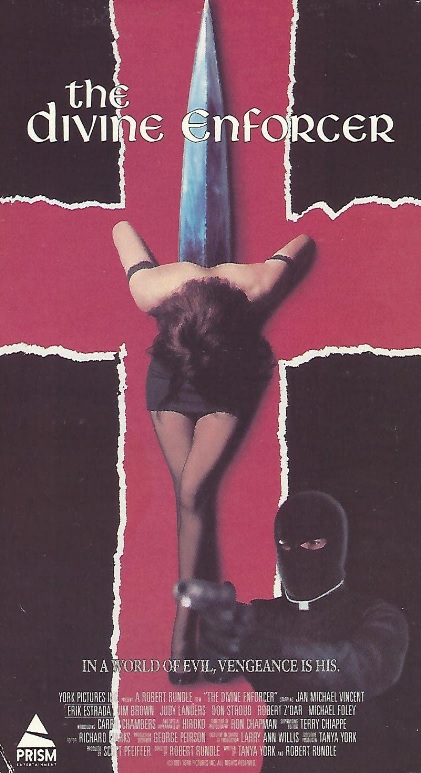
The Divine Enforcer (1992)

“Open the gates of Hell! For I am the right hand of God!”
— So speaks Father Daniel

Trust us: We aren’t plot spoiling when we tell you what we have here is a great idea of a Sylvester Stallone Cobra (1986) ripoff — with Sly as a catholic priest, instead of a toothpick-chewin’ rogue cop, after an ravenous serial killer — a vampire killer, no less.

Needless to say, this karate-horror hybrid isn’t as good as that Stallone pitch-premise. Ah, but we have the presence of a Ponch and Stringfellow and a Ron Marchini-lite karate-thespian as a priest raising a Jean-Claude Van Damme’in holy hell on a Z-movie budget.

Damn straight, I want to watch this. Load the friggin’ tape! LOAD THE TAPE! Man the drink blenders, Sam. Pull up a section of couch, Bill Van Ryn. This is gonna rock the VHS heads.

Prism. How many films from your shingle have I watched? Let me count the tapes. For the ends of spool and I shall not erase. Most quiet VCR, by remote and candle-light.

So, welcome to another never-heard-of-it-or-seen-it-before lost VHS’er that’s never been released on DVD or Blu-ray, which, unless it is reissued on either format and a freebie copy is provided to the reviewer — or the writer is paid to write the review — they/their website home, doesn’t review it. Now, true: We at B&S About Movies get our fair share of promotional DVDs and Blus, as well as box sets of reissued classics, as well as the newer 2021 fair, and we get plenty of promotional digital screeners from P.R firms. And we enjoying exposing those reissued and new films to audiences — but it’s the analog barnacles: the VHS ditties lost to the ages; the films never reissued to hard or streaming digital formats that’s our jam; the films no reissues studio shills for the greenbacks. (And that ain’t no cliched ensuing trope we’re spewing, there, my friend. Nor do we do conventional, simple summary of the plot reviews. Where’s the fun in that QWERTY’in trope? You gotta go gonzo, sans the green.)

Such a film is The Divine Enforcer — a film with more critic and user reviews than we anticipated. This is a known film?

Shockingly, yes.

So, unlike us Allegheny pugwackers splashin’ about the Three Rivers confluence, the more discriminating VHS’er have, in fact, watched this, well, let’s face it: poverty row junk, courtesy of its rusty ‘n crumbled, star-power sparkle of Jan-Michael Vincent, Robert Z’Dar, Erik Estrada, Don Stroud, and Judy Landers. So, yeah, basically, it’s a B&S About Movies all-star cast. Then, in support roles, we have the insane Scott Shaw (100 film and TV acting credits, with 153 as a producer — one of which is The Roller Blade Seven). And, do we really need to tell you about Micheal M. Foley from Ron Marchini’s Karate Cop, as well as Prison Planet and Cybernator? Well, we just did.

And that’s why we are here, today: Our review of Cyberator, in conjunction with our Ron Marchini two-day blowout, put The Divine Enforcer on our radar. So let’s sit back, together, as we enjoy this video-store renter for the first time — 29 years after its release.

Cybernator served as our debut introduction to the resume of writer-director Robert Rundle; that apoc’er served as his debut feature film. For his next movie, the movie we are reviewing today, in addition to securing the services of everyone above — yes, that is the Jim Brown, the blaxploitation extraordinaire in the cast — Rundle secured the scripting services of Randall Frakes of Hell Comes to Frogtown and Roller Blade Warriors fame — so there’s that B-Movie enticement. Then Rundle gave us Vampire Hunter (1994) with B-Movie screamer, Linnea Quigley, Run Like Hell (1995) with Robert “Maniac Cop” Z’Dar, and the return of William Smith (from Cybernator) in Raw Energy (1995). Sadly, Rundle hasn’t made a film since 2005 and, according to the IMDb, Rundle had a website, but it’s lost in the 404 error-verse.

So, if you haven’t already figured it out from the VHS cover: we are dealing with a religious-based thriller. A monsignor (Erik Estrada, stepping way down from his first post-CHiPs work in Light Blast; most recently in The Hallmark Channel’s Dead Over Diamonds) and his assistant, Father Thomas (Jan-Micheal Vincent, stepping way down from his work in Alienator; in this case: yes, his work in Ice Cream Man is better, even though that, in itself, is awful) — both in the ol’ sit-down-thespian-roles-for-a-paycheck — recruits a new priest, Father Daniel (Michael J. Foley), to their Los Angeles parish. The newcomer priest proceeds to turn vigilante (as Vincent did in the HBO-dumper pastiche of The Warriors and Death Wish in 1980’s Defiance) and takes on various thugs and criminals that rule the neighborhoods.

Of course, knowing Foley’s skill set as we do, Father Daniel (wow, where was Ron Marchini, he was made for this role) has mad martial arts skills — and he’s armed with a stockpile of crucifix tossing-blades and a Boondock Saints-style pistol with a cross on the handle — only that 1999 film wasn’t made yet.

So, amid Father Dan’s daily duties of cleaning up the city of drug-dealing scumbags (cue Jim Brown and Robert Z’Dar) and protecting his landlady (call Judy Landers to set), Father D. runs afoul of Otis (cue Don Stroud, hacking at the ham), who claims to be the bloodsucking — and beheading n’ skull-stealing — vampire terrorizing Los Angeles. Assisting Father Dan in the fight is, Kim (Carrie Chambers; made her debut in Karate Cop alongside Foley; also appears in Sleepaway Camp IV* and Bikini Carwash Company II) with her psychic link to Otis.

So yeah, this purely a Michael J. Foley and Carrie Chambers joint, with Estrada and Vincent washed-up and on-board doin’ the now de rigueur Eric Roberts (Lone Star Deception) walk on-to-sit down role, a mantel recently taken up by Nicolas Cage**. Ditto goes for Jim Brown and Robert Z’Dar in their blink-and-you’ll-miss ’em-put-a-name-on-the-box roles. Oh, and we get to see Asian singer Hiroko belt out her 1990 Enigma Records’ release, “My Love Is Waiting” (You Tube). Oh, and there’s lots of gratuitous boobs bouncing about the frames.

Yeah, it’s awful. Really awful.

And it’s also sad.

Jan-Micheal has his script taped inside a newspaper as he “reads” about the ongoing killings; Estrada, is well, Estrada, who wishes he didn’t cop an attitude during his CHiPs heyday and tank his career, and Don Stroud — a B&S About Movies hero — is out of shape, pasty, and saddening as he goes full-on Shakespeare (with a little tongue) to a boiled, bloody skull. But, again, we get Ponch and Stringfellow and a priest raising holy hell. So what’s not to likey here?

Not a damn thing.

You can roll it on You Tube — complete with original Prism VHS opening trailers, so this is truly a retro, home-video ride. However, if an hour and thirty minutes of a martial arts Catholic priest is too much too handle, the fine folks at Cine Arcadia Productions confessed their fandom for The Divine Enforcer by cutting out the fat and distilling the film down to — get this, 17 minutes — with this You Tube upload.

Me? I’m an analog masochist. I’m went for the Full Monty-hour and a half ride, baby! Which is why Sam the Bossman runs drink blenders. Toastin’ the livers is required with a flick such as The Divine Enforcer.

* Yeah, we know. Since we did the first three — Sleepaway Camp, Sleepaway Camp II: Unhappy Campers, Sleepaway Camp III: Teenage Wasteland — we need to put part IV from 1992 — which we didn’t even know existed — on our review list.

** Did you check out our “Nic Cage Bitch” blowout? It has links to all of his films we’ve reviewed so far. Go head, click the link. Be Nic’s bitch.

About the Author: You can read the music and film criticisms of R.D Francis on Medium and learn more about his work on Facebook.

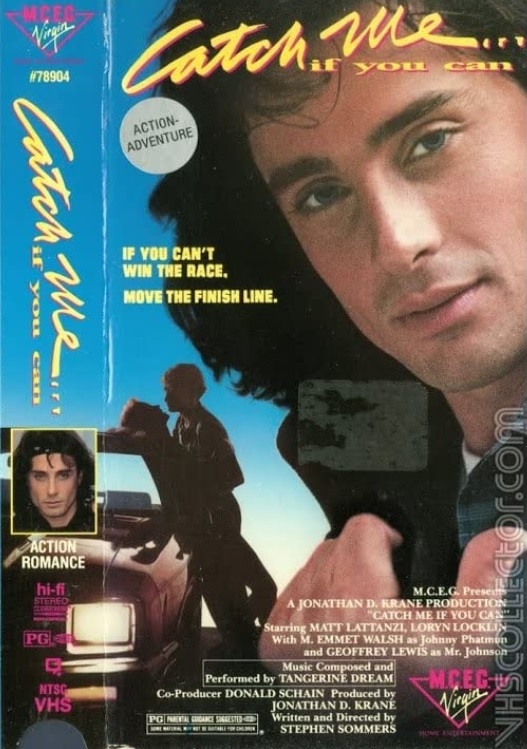
Catch Me If You Can (1989)

Well, as with the previously-reviewed-this-week Corey Feldman-fronted Round Trip to Heaven, this Down Under car flick is a doublesploitation whammy: we all know what makes a carsploitation movie . . . but what makes a teensploitation movie, now that’s the question.

Well, for me, it’s when your film has 30-year-old teenagers — in this case, our stars of Matt Lattanzi, Loryn Locklin, Grant Heslov, and Billy Morrissette (Severed Ties!), who were 30 and 21, 26, 27, respectively — and no matter the filmmaker’s intentions — you’ve made a teensplotation movie. Yes, even when your film is loaded with classic cars, hot-rods, and muscle cars and qualifies it as a carsploitation movie.

The filmmaker in this case . . . isn’t the usual, expected filmmaker. No, it’s not Albert Pyun. It’s not David DeCoteau. It’s not Fred Olen Ray.

It’s Stephens Sommers.

Yes. The same Stephen Sommers — in his writing and directing debut — known as the writer, director, and producer behind The Mummy, The Scorpion King, and G.I Joe franchises. Meanwhile, actor Grant Heslov became a producing partner with George Clooney and received four Oscar nods and one win (2012’s Argo).

As with the countless teen movies dating back to the ’50s, we have a gaggle of teens who — in addition to not being teenagers and are far more intelligent and resourceful than your typical, goofy teenagers (at least when I was in school) — work together in the ‘ol “Let’s save the teen center, gang!” plot of old. Only this time: it’s the ol’ “save the school” plot.

Of course, the school will be saved by resident “bad boy” Dylan (Matt Lattanzi of Xanadu and My Tutor) who sidelines between the reading, writing, and arithmetic as an illegal street racer. Dylan convinces the school’s resident goody two-shoes (Loryn Locklin, in her acting debut; her next was the inane Jim Belushi comedy Taking Care of Business) to bet the $3000 already raised on an illegal race he knows he can win — and turn that 3-grand into the needed 200-grand to save the school.

That’s right. He doesn’t win.

Explore the soundtracks of Tangerine Dream! Catch Me If You Can is one of their many scores.

Now, the adults — school board administrators, mind you — are sanctioning an illegal, winner-take-all road race, with Dylan against the town legend. You know, just like any school board would handle a funding crunch that’s closing a school.

Look, the proceedings are cliched and utterly unbelievable. The teens don’t behave like teens (as in my Bruno Kirby guilty pleasure with the high school politics comedy, 1978’s Almost Summer) and the adults don’t carry themselves as roll models (of which Almost Summer had none, well, except for the adult-as-teens actors). But we have M. Emmett Walsh (who runs the local gambling syndicate backing the races) and Geoffrey Lewis (our principal) as the “responsible” adults, Loryn Locklin looks great in saddle shoes, there’s no cheese in thespin’ department, the driving and stunts (an old Chevy jumps through the school’s football field goalposts in a highlight) are top notch, and the ’50s and ’60s tunes (Elvis, Del Shannon, the Platters, Danny and the Juniors; but Tangerine Dream scores) give this homage to Sommers’s old hometown days of growing up in St. Cloud, Minnesota (where this was shot), a nice retro-juvenile delinquency flick of the ’50s feel — which is the whole point of the movie. And a fun movie to watch.

Sure, even at a production budget at $800,000, this car flick still bombed in the U.S., but cleaned up in the overseas markets — especially in Australia — where it made $7 million, courtesy of Matt Lattanzi then being the first husband of singer-actress Olivia Newton John. Meanwhile, in the U.S., it was HBO and Cinemax to the rescue, turning it into a cult classic.

Oh, and by the way, don’t confuse Catch Me If You Can with the other Aussie car flick we’ve reviewed, Freedom, which stars Matt Lattazni lookalike Jon Blake. That’s a whole other, carsploitation movie (and carries the soundalike “grab it while you can” tagline on its one-sheets).

Need more car flicks? Check out two-part Fast and Furious tribute weeks!

We had this writing and directing debut by Stephen Sommers on our review backburners for quite a while (sorry, Steve) and never managed to fit it into our two “Fast and Furious” weeks of reviews (HERE and HERE) of, well, Carsploitation films. We’re also guilty of passing over Catch Me If You Can (again, sorry, Steve) as part of our “Exploring” tribute to the film soundtracks of Tangerine Dream. So, we do get them, eventually.

You can stream this really great car flick on Vudu without commercials. But we found a copy on You Tube — here’s the trailer. As you can read from the You Tube upload comments, everyone loves this movie. Why it didn’t click with theater audiences and turn Matt into the next Tom Cruise is anyone’s guess. So goes the power of HBO and Cinemax endlessly replaying movies back in the ’80s.

About the Author: You can learn more about the writings of R.D Francis on Facebook. He also writes for B&S About Movies.

Varieties on Parade (1951) and Forty Acre Feud (1965)

We’ve made it our life’s mission to watch and review — sans his twenty-plus westerns as a producer, writer and director — all of Ron Ormond’s secular and Christian films. (The westerns will get done, eventually.) And we’re almost there. We’re left with The Eternal Question (1956), a soft skin-flick of which we have yet to locate a copy — hard or streaming.

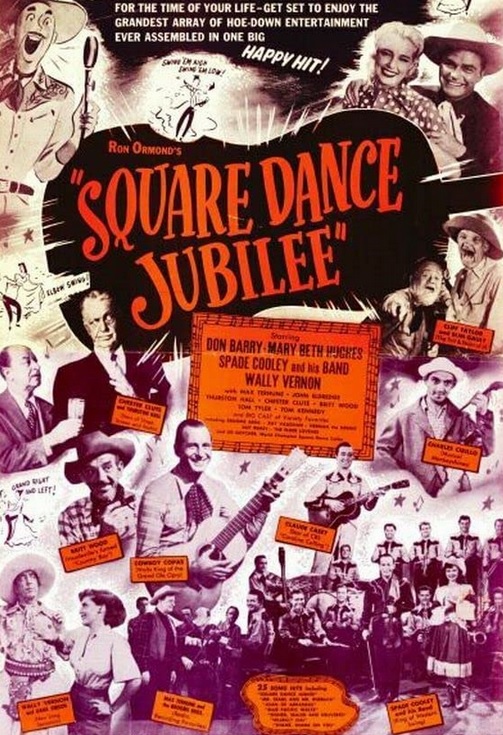
The two most recent, Ormond non-western secular flicks we’ve watched are the films headlined on this review. We spoke of Ron Ormond’s work in the jukebox musical format with Square Dance Jubilee (1949) and Kentucky Jubilee (1951), each which thread a dramatic-cum-comedy plot through the film’s many musical acts. While Varieties on Parade and Forty Acre Feud both end up on some critics’ jukebox musical lists, these two works are less plot-driven and more about capturing a variety stage show in its entirety.

Remember, at the time of the release of each of these films, the new, technical advancement of television was not as integrated into our lives as it is today. Not everyone owned a television to watch the variety show styling of Milton Berle and Ed Sullivan. So, films, such as these Ormond productions, brought the show to the silver screens in outdoor, rural America.

Forty Acre Feud

Back in the day, country music concerts incorporated comedy into their sets, and this jukeboxer is filled with a gaggle of country singers (each doing two songs), including George Jones, Loretta Lynn, Bill Anderson, Ray Price, Del Reeves, and Roy Drusky (each lip-sync their hit songs, but doing it so well, you can’t tell), while Minnie Pearl and Ferlin Husky bring on the comedy. Shot at Bradley’s Barn in Mt. Juliet, Tennessee, the “plot,” of what little there is to keep the acts hitting the stage with some semblance of rhyme and reason, concerns local election shenanigans.

Ferlin Husky went on to star in two films Sam the Bossman and I really love: The Las Vegas Hillbillys (1966), and its sequel, Hillbillys in a Haunted House (1967). Both are, in fact, jukebox musicals themselves, with plots about organized crime and an inherited casino, and a mad scientists hiding out in a haunted house.

By the close the decade, as televisions became more prevalent in homes, the jukebox musical format of the silver screen was rendered obsolete by the premier of CBS-TV’s “Kornfield Kounty” series Hee-Haw in 1969.

Varieties on Parade

The whole purpose of this film is to give you “60s minutes of Star-Studded Entertainment” by bringing a big-city, vaudeville stage show to the drive-in screens of rural America. Unlike Ron Ormond’s other jukebox musicals — outside of the film’s opening POV shot, as you walk up to the box office and get a ticket, then are taken to your seat by an usher — there’s no plot to speak of to thread the acts.

This time capsule gets right down to it with an endless stream of singers, dancers, and magicians. There’s a mother-daughter bicycle stunt team and a brother juggling act, while former kid actor Jackie Coogan spoofs a routine with fellow comedian and the evening’s emcee, Eddie Garr. Are you in the mood for two comedians coming out on stage dressed as a horse? A three-woman trampoline act? An aerobics routine along with slapstick interludes? Then buy a ticket for the show!

Jackie Coogan, who got his start as a child actor with Charlie Chaplin in The Kid (1932) — but since this is B&S About Movies: The Phantom of Hollywood (1974), Won Ton Ton: The Dog Who Saved Hollywood (1976), and the slasher The Prey (1980) — also appeared in Ron Ormond’s Outlaw Women (1952) and Mesa of Lost Women (1953).

You can get both of these films — and other Ron Ormond jukebox musicals (Yes Sir, Mr. Bones) — as part of VCI Entertainment’s “Showtime USA” DVD series. The restores on both are excellent and they also offer bonus commentary tracks with in-depth examinations on all of the films in the series.

About the Author: You can learn more about the writings of R.D Francis on Facebook. He also writes for B&S About Movies.

Kentucky Jubilee (1951) and Square Dance Jubilee (1949)

Bruce Eder, in the liner notes of the 1989 The Criterion Collection reissue of A Hard Day’s Night, reminds us that, in a 1964 review of that classic Beatles’ film, critic Andrew Sarris described it as “the Citizen Kane of jukebox musicals.”

Since then, the term “jukebox musical” has, in my opinion, gone a wee-bit off the critical rails. I don’t see music-oriented biographies, such as the recent (each a barely one-watch-and-done abysmal) Bohemian Rhapsody (2018) and Rocketman (2019), and the Aretha Franklin bio, Respect (2021), as part of the genre. My opinion carries over to, speaking of the Beatles, Across the Universe (2007) and Yesterday (2019) centered on their catalog. Is the Beatles’ Yellow Submarine (1968) a jukebox musical, as well? Is Harry Nilsson’s Son of Dracula (1974) a jukebox musical or a visualized rock opera, like the Who’s Tommy (1975), which no one considers a jukebox musical?

For me: when you say “jukebox musical,” I reminisce having to watch a singing-and-dancing James Cagney in Yankee Doodle Dandy (1942) while babysat by my Aunt Martha. For me, a jukebox musical means my enjoying Billy Haley and the Comets and the Platters in Rock Around the Clock (1956), the first rock n’ roll musical — of which famed DJ Alan Freed made five*. Then, there’s one of Kentucky Jubilee‘s offspring with the low-budget, major studio cash-in by MGM to jump on the folk music bandwagon with Hootenanny Hoot (1963). And who can forget — oh, how we try — when accordionist Dick Contino graced our screens as a hipster, Elvis-styled leading man in the likes of Daddy-O (1958) and Girls Town (1959) alongside Paul Anka and the Platters. And there’s no way to forget “The King of Swing,” jazz trumpeter Louie Prima (?!), jumpin’ on the jukebox bandwagon with Twist All Night (1961).

Sure, there was a little bit o’ plot n’ action in the frames (e.g., mobsters muscling-in on the club; Louie Prima throws a punch between trumpet blows), but the celluloid raison d’être was to market music (yes, even the outdated Louis Prima). Back in the day, not everyone owned a television set. Not as many people saw Elvis and the Beatles for the first time on television as you think: their first visual experience of both was in a movie theater. Today, going to a concert — now major industry unto itself — is a common place event in our lives, but not back in the day. In fact, to hear my dad tell it: he went to one concert in his entire life: the tragic Buddy Holly tour in 1959 at the Syria Mosque in Squirrel Hill, east of Pittsburgh.

So, the best way for record labels and promoters to expose their artists to the masses: take the acts to the people — by way of a movie. And in most cases, the movie wasn’t so much a “movie” with a plot, but a loosely connected series of pre-recorded “pop clips” of bands inserted into the film (e.g., kids would be sitting in a living room, they’d turn on a television; the Platters would play their latest hit). Unlike a Beatles or Elvis flick, the songs were not original to the film itself, just the latest tune from an artist’s catalog.

Kentucky Jubilee

Let’s bust-out that barn with a “real” jukebox musical!

Such a film is this entry from our ever-expanding, beloved Ron Ormond catalog (Mesa of Lost Women, Girl from Tobacco Row, The Second Coming), himself a filmmaker loosely connected to the Earl “Snake” Richards-starring jukebox rock-musical, That Tennessee Beat (1966), by way of producer Robert L. Lippert.

Remember us calling out the cinematically-challenged Dick Contino and Louis Prima? Well, not only were unfashionable accordion and trumpet players squeezing out their last moments of relevancy via films: even bug-eyed, mustachioed Ritz Brothers knockoffs like the Vaudvillian-bred Jerry Collona (a Bob Hope associate; appeared in 1940’s Road to Singapore) just gotta try. He stars, here, as a music festival emcee involved in — like just about every jukebox musical before or after — a crime caper. Which is even more ludicrous than Louis Prima “getting the drop” — in full comic effect — on the bad guys.

While this was shot-in-Florida with a gaggle of that state’s regional talents, this all takes place in Hickory, Kentucky. (Why not title the film Hickory Dickory Rock? Well, when one of the acts is a one-man band playing oil funnels and a banjo, it’s not rockin’.) And — like just every jukebox musical before or after — a big time, Hollywood director comes to town to find musical acts to make ern’ of dem dere movin’ picktures. This time, instead of having a corner on the jukebox racket, our mobster (Russell Hicks, a Phil Silvers associate; also in the 1950 jukeboxer, Square Dance Kathy) has control of the town’s lone club and its annual jubilee — and he can’t have any big city outsider musclin’ in on the territory.

Of course, the director (the equally-hammy Fritz Feld, later of The Phynx and Hello, Dolly!, also Professor Greenleaf in TV’s Batman) and Jerry Colonna, are kidnapped. Why not have the cute blonde, Jean Porter (who made it to the MGM lot by way of winning a Texas talent show), be a damsel-in-distress to spice it all up? Doh!

Making pillbox hats, sexy : GULP! MGM contract player, Jean Porter.

So, a cub-reporter (Jimmie Ellison) sent to cover the shindig, and the members of the fifteen we-never-heard-of-before-or-heard-from-again acts (also finding time to curse us with 25 songs, along with corn-bred comics, contortionists, a whip-act, and vaudeville bits) join forces to save the day. If you know your Ron Ormond westerns, you’ll notice Jimmie “Shamrock” Ellison and Raymond Hatton starred in six Robert L. Lippert westerns directed by Ron Ormond. So, yeah . . . bad jokes, not-so-wise cracks, Colonna sportin’ a turbin and reading a crystal ball, and puddy-faced camera mugging that would give Joe Piscapo pause, ensues.

Hey, scoff if you will, but movies like Kentucky Jubilee were more convenient and cheaper than going to an actually hootenanny or jubilee. And Ron Ormond incorporated all of his well-honed western skills to string together one of the better-plotted jukebox musicals.

Yes, this once, long-lost Ron Ormond film has been digitized (a stellar restore that keeps you watching) for your enjoyment at the Internet Archive.


Learn more about the Ormonds in the pages of Filmfax, Issue 27 (1991), preserved on The Internet Archive. (The extensive article begins on Page 40.)

Square Dance Jubilee

Prior to Ron Ormond writing and directing Kentucky Jubilee — of the seven films he directed that year — he earned his “jukebox musical” stripes writing and producing this “musical western” starring 250-plus credits strong, gruff n’ tough-as-nails western/cop actor Don “Red” Barry (’60s TV’s The Virginian and Surfside 6) and redhead-to-platinum blonde, 20th Century Fox/Universal/MGM B-Movie contract player Mary Beth Hughes. On the musical front, we have the-then-hip fiddler Spade Cooley and his western-swing band. (Laugh, but there’s some serious, Hendrix-styled theatrics with fiddles and upright basses goin’ on up in this ‘ere jubilee.)

As with the later Kentucky Jubilee, the story is the same: In the earliest days of some new-fangled contraption called tele-ee-vish-un**, two talent scouts for a New York-based country music TV show called “Square Dance Jubilee” (hosted by Spade Cooley), are sent out West to find authentic western singing acts for the show. In addition to finding acts, they find themselves mixed in up in cattle rustling and a murder mystery.

If you’re familiar with, and didn’t mind, Rock Around the Clock being retooled as Twist Around the Clock and Don’t Knock the Rock returning as Don’t Knock the Twist, then you have fun as Don “Red” Barry plays the straight man to another, fading vaudevillian in the form of a camera-mugging Wally Vernon (in the Jerry Colonna role) taking care of the crime drama. The Cowboy Copas and Claude Casey handle the tunes. Of course, variety acts also show up, this time with ventriloquist Max Terhune. In a twist: Red Barry croons a tune, “Girl in the Mink Blue Jeans,” and Wally Vernon’s goofy-rubbery soft-shoe must be seen to be believed.

So, what’s not to likey, here? We’ve got Ron Ormond scripting, Robert L. Lippert producing, and a western-driven crime drama threaded by the way of music, vaudeville bits, and comic relief.

Meanwhile, behind the scenes . . . Spade Cooley had a contentious marriage with Ella May Evans, a singer in his band; she’d go on to have an affair with . . . TV and film cowboy Roy Rogers . . . and Cooley was eventually convicted of murdering Ella May. His biggest hits during his ’40s heyday were the #1 “Shame on You,” the #2 “Detour,” and the groundbreaking-influence on popularizing the use of the steel pedal guitar, “Steel Guitar Rag.”

Since Amazon shelved Nicolas Cage’s “Tiger King” project, I wonder if the Cage would be up for doing a Spade Cooley biography flick?

Meanwhile, behind the scenes . . . the twice divorced Don “Red” Barry had an affair with Susan Hayward in the mid-’50s . . . who got in cat fight with another woman visiting his apartment. In July 1980, Barry shot himself in the head, shortly after a domestic dispute with his estranged, third wife, Barbara.

Yeah, sometimes reality, aka truth, is stranger than fiction. And the reality of Don “Red” Barry and Spade Cooley are sad, graphic tales.

Anyway, you can enjoy a very nice, restored rip of Square Dance Jubilee on You Tube.

Me and Jean Porter at the sock hop under the tent under the stars . . . heaven. Uh, Mary Beth, er, what are you doin’ here?

* We’ve reviewed Alan Freed in Rock, Rock, Rock (1956), Shake, Rattle and Rock (1956), Mister Rock and Roll (1957), and Rock All Night (1957). There’s more ’50s rock ‘n’ roll films to be had, daddy-o, with our “Drive-In Friday: Fast & Furious ’50s Style Night” featurette.

** You need another movie inspired by that new fangled contraption? Then check out our Mill Creek box set review of Trapped by Television (1936).

About the Author: You can read the music and film reviews of R.D Francis on Medium and B&S Movies, and learn more about his work on Facebook.

Lydia Lunch: The War Is Never Over (2021)

“Lunch’s defiantly unfashionable sort of feminism is the main point of interest in this documentary. Viewers will . . . marvel at a woman who, at 60, seems just as fierce as she was 40 years ago.”
— John Defore, The Hollywood Reporter

Filmmaker Beth B and multi-media artist Lydia Lunch have been friends since the late ’70s, when both integrated themselves into New York’s “No Wave” movement: Beth B* excelled in film; Lunch drifted towards music. Taking her cues from Patti Smith, Lunch burst onto the scene with Teenage Jesus and the Jerks, which reached a national audience when Brian Eno (David Bowie, Taking Heads) included the band on his 1978 No New York compilation.

After her work as a singer and guitarist in Teenage Jesus and the Jerks, she fronted the band 8-Eyed Spy, then broke out on her own as a solo artist with the albums Queen of Siam (1980) and 13:13 (1981). During this period, she transitioned into acting, working with the experimental, “No Wave” filmmakers Vivenne Dick, James Nares, and Beth B, for whom she worked with an early James Russo (Beverly Hills Cop, Donnie Brasco, The Postman) and Ann Magnuson (Making Mr. Right with Malkovich) in the noir-homage, Vortex (1982). Lunch also worked with low-budget undergrounders Nick Zedd and Richard Kern (each known for Geek Maggot Bingo, 1983, and Sonic Youth’s “Death Valley 69,” respectively**). Lunch also worked with director Amos Poe (later of the more mainstream-distributed Alphabet City (1985) with with Vincent Spano of Over the Edge; Rocket Gibraltar (1988) with Burt Lancaster) on his early feature, Subway Riders (1981).

First collaborating with Sonic Youth on their album Bad Moon Rising (1985), for that album’s college radio single, “Death Valley 69,” she came to collaborate with that band’s bassist, Kim Gordon, as the guitarist and lead vocalist in Harry Crews. The band released the lone album, Naked in Garden Hills (1987), in honor of the Deep South, dark-noirist author of the same name (his books The Gospel Singer (1969) and The Knock Out Artist (1988) were adapted as songs on the album).

For this first documentary on Lunch’s career, Beth B secured the insights of fellow New York scenesters, and artists inspired by her, such as Thurston Moore of Sonic Youth, Donita Sparks from L7, and Henry Rollins. Lydia Lunch: The War Is Never Over became available in select theaters and national streaming on June 30, 2021, by Kino Lorber. You can also learn more about the film’s virtual screenings at KinoMarquee.


* As part of our “John Doe Week” of film reviews, courtesy of the film starring his ex-wife and X bandmate Exene Cervenka, we reviewed Salvation! (1987), Beth B’s parody on organized religion and the mass communication medium of television. We also reviewed Lydia Lunch’s appearance in Mondo New York (1988), as well as taking a look at The Blank Generation (1976) — a 16-mm black & white DIY documentary co-directed by Lydia Lunch and Patti Smith Group guitarist Ivan Kral with director Amos Poe — in the context of our review for Ulli Lommel’s Richard Hell-starring Blank Generation (1980).

** Richard Kern’s other MTV 120 Minutes-era alternative rock videos include King Missile’s “Detachable Penis” and “Marilyn Manson’s “Lunchbox.”

Other female punk/new wave musicians who transitioned into film that we’ve reviewed are the late Christina Amphlett of the Divinyls in Monkey Grip (1982), Nena in Hangin’ Out (1983), and Nina Hagen in Cha Cha (1979). While we haven’t reviewed them, Debbie Harry of Blondie fame, and later of David Cronenberg’s Videodrome (1983), appeared in Amos Poe’s Unmade Beds (1976) and The Foreigner (1978).

There more rock ‘n’ roll on film — including many punk and new wave-inspired films — with our “Rock ‘n’ Roll Week” blowouts (Part 1 and Part 2). Is there a “Part 3” on the way? Oh, you bet! Join us during the last week of August through the first week of September for thirty more films concerned with rock and radio. Oh, speaking of radio . . . be sure to visit our round up of “Exploring: Radio Stations on Film” . . . and we get into Gen X/Grunge films with our “Exploring: 50 Gen-X Grunge Films of the Alt-Rock ‘90s” featurettes.

About the Author: You can learn more about the writings of R.D Francis on Facebook. He also writes for B&S About Movies.

For Madmen Only: The Stories of Del Close (2021)

We knew that to make the definitive movie about this icon/unknown, we would need to take the same kind of creative risks that he was famous for. As someone known for breaking down genres and experimenting with form — not to mention playing fast and loose with the truth — we decided to apply the same ideas to our film and try to break new ground with the documentary genre. This resulted in constructing a set of scenes imagining the creative process behind Wasteland, Del’s comic book autobiography.”
— writer and director, Heather Ross

When the fans of Saturday Night Live think of that groundbreaking series, they remember Bill Murray and John Belushi . . . then they’ll remember the influential Animal House and Caddyshack*, in short order.

That is, until, you watch this multimedia documentary.

After watching, you’ll come to know that all roads to that iconic, late night NBC-TV comedy series began with Del Close: the actor and writer, comedy teacher and improv maestro who directed at Chicago’s Second City — where he mentored that series’ Bill Murray, John Candy, and Tina Fey — and San Francisco’s The Committee — where Howard Hesseman, later of WKRP in Cincinnati and Head of the Class, got his start.

Of course, comic and graphic novel fans know Del Close, best, for his semi-autobiographical DC Comics anthology Wasteland — a work which serves as the source material for this documentary, with reenactments starring his past pupils, such as Patton Oswalt (Failure to Launch) and Lauren Lapkus (The Wrong Missy). Actors and filmmakers who knew him best, such as Bob Odenkirk (The Solomon Brothers), Tim Meadows (The Ladies Man), and Adam McKay (The Other Guys), also appear with their insights and memories of Del’s work.

If you’ve laughed at any of those above films, or something on television since Saturday Night Live went on the air in 1975, or any of the films connected to the cast of that iconic series — you have the “Where’s Waldo” of comedy, Del Close, to thank for those laughs. And this multimedia piece — that goes beyond the usual “talking heads” trope of most documentaries, inserting a clip here, and a photo there — is a one-of-kind, passionate testament to a man that was everywhere, and nowhere: a true dark man of comedy.

Watch it. And learn where from where the laughter comes.

For Madmen Only: The Stories of Del Close was acquired for international distribution by Utopia Media, which also brought the British rock document on Suzi Quatro, Suzi Q, as well as the recent WITCH: We Intend to Cause Havoc, about the Zamibian ’70s progressive-rock band, to the international marketplace. Another of Utopia’s award-winning documents is Martha: A Picture Story, concerned with Martha Cooper, a New York-based, trailblazing female graffiti artist and street photographer.

Utopia is headed by Robert Schwartzman — of the band, Rooney, and a writer and director in his own right — who made his feature film directing debut with the really fine comedy, The Argument, released last September. You can learn more about the launch of Utopia Media with this February 19, 2019, article at Deadline.com.

* Our resident comedy maestro, Robert Freese, of Videoscope Magazine and Drive-in Asylum, went deep into the comedic ’80s with our “Exploring: ’80s Comedies” featurette. We also explored “‘80s Teen Sex Comedies” and “Snobs vs. Slobs Comedies” as part of our “Drive-In Friday” featurette.

About the Author: You can read the music and film reviews of R.D Francis on Medium and learn more about his work on Facebook. He also writes for B&S Movies.