“It should be comforting for you to know that you’ll always have a friend, here, at Love Camp 7.” — The Commandant, making the understatement of the decade
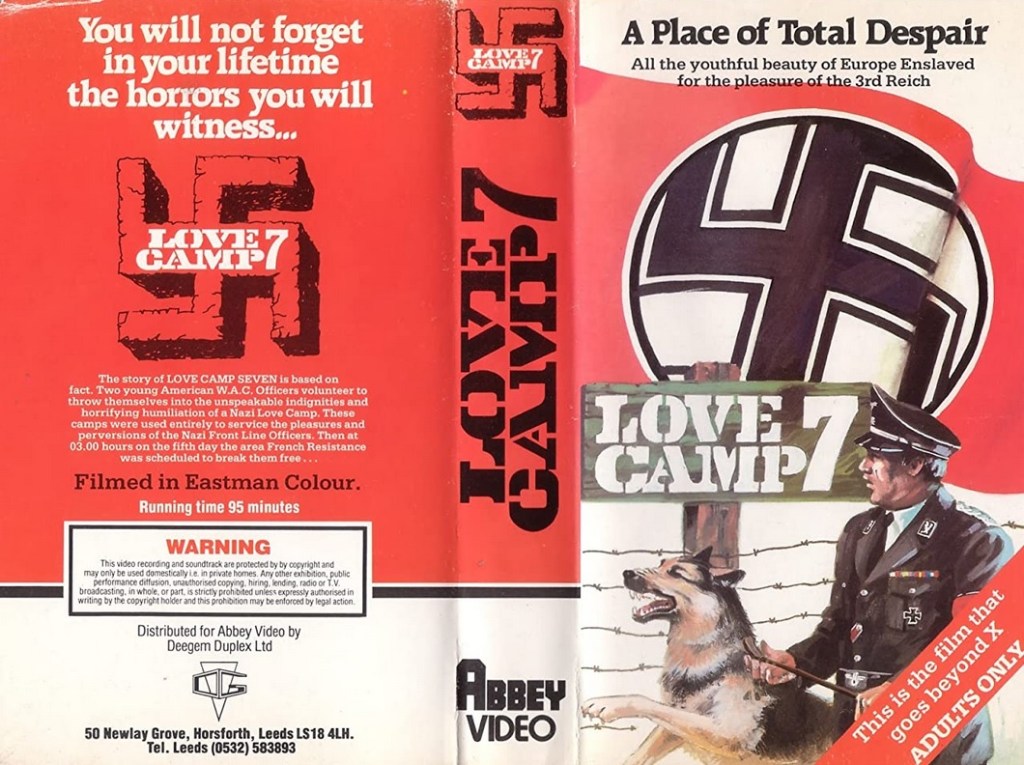
Sam the Bossman, who touched on this ’80s VHS ditty with his three part “Video Nasties” series nails it: there’s just some films that ask for it. And this Lee Frost and Bob Cresse Naziploitation affair — Frost directed and Cresse scripted with Wes Bishop — about two American female officers-agents (the large-breasted, natch, Maria Lease and Kathy Williams) going undercover in a Nazi prison camp — rightfully when straight to the front of the U.K.’s “Section 1” video nasties line.
So, how rough is this film?
Well, our Commandant (Bob Cresse) personally greets his prisoners in his office, while the women strip, are hoisted on to a table, and a female doctor slips on a glove for an “examination” — but don’t worry: it all stops just before it goes into full-on porn territory. To Frost and Creese’s credit: There is an actual story here, with plot and character development, the set design and costuming is solid, and, unlike its exploitation-offsprings, while it’s rough, Love Camp 7 isn’t rough for roughness sake. It truly is the best made — excluding Isla, She-Wolf of the SS — of the Nazisplotation films, even with its cinematographic weakness.
Yeah, I know Dr. Dalton, opinions vary down at the ol’ Cinema Road House, but the celluloid proceedings here are, still, more laughable than despairing, not all that horrifying, and utterly forgettable. Love Camp 7 was, however, a movie of its time — a time when the major studio mainstream films Valley of the Dolls (1967), Midnight Cowboy (1969), and Shampoo (1975) were slapped with X-ratings for their content about drug-pushing housewives, New York sex hustlers, and sexually-aggressive hairdressers.
So, yes, in the context against those films — which, watching these years later, are so not X-rated (to my eyes, anyway) — Love Camp 7 certainly deserves the 24th letter-branding, but when watched against the films from the ’70s “Golden Age of Porn” — films wholly deserving of their X-ratings — this Nazisplotation debut is tame in comparison. When you claim your movie is based in fact — and sadly, Jewish women were subjected to real life horrors in German interment camps and that is what makes the genre offense, on whole — you get, as Sam pointed out, what you asked for: a U.K. scarlet letter.
Spreading a woman in an eagle positions to play up your X-rating? Geeze-a-lou, Market Video.
As with all of the films released in its wake, the women — two WAC Lieutenants who dually work as spies, but also to attempt a rescue of a female inmate: a captured aero-engineer with information regarding a cutting edge jet engine — come to discover the female inmates (in perpetual full-frontal nudity) serve as sex slaves for German officers, subjugated to various experiments, bondage, torture, and rape.
Amid the cast, keep your eyes open for exploitation stalwart Bruce Kimball . . . wow, Bruce Kimball . . . he goes back to Run, Angel, Run! (1969), Al Adamson’s Brain of Blood (1971) and Dracula vs. Frankenstein (1971), and Moonshine County Express (1977). He eventually hit the mainstream with the box office hit Rollercoaster (1977), along with appearances on TV’s CHiPs and B.J and the Bear. (Uh, yeah, we’re pretty big Bruce Kimball fans around here.)
Not as “X” as we were lead to believe.
Love Camp 7 rightfully earned its cult classic status in the exploitation realms for inspiring two, very hot genres in the drive-in and grindhouse cinema ’70s: women-in-prison flicks and Nazisploitation films.
The former genre — which dates to the rock ‘n’ roll bad girl romps Reform School Girl (1957) and High School Hellcats (1958), flourished in the ’70s courtesy of Lee Frost’s own hit, Chain Gang Women (1971), and the Pam Grier-starring hits Women in Cages (1971) and The Big Bird Cage (1972), and then continued into the VHS ’80s with the Wendy O. Williams-starring Reform School Girls (1986) and the Grim Reaper song-fronted (“Lust for Freedom,” “Rock You to Hell“) Lust for Freedom (1987) — could be a B&S theme week in itself.
The latter genre began with this first, iconic film in the Nazisploitation cycle of films centered around WWII concentration camps populated by incarcerated women. The genre achieved its nadir — or zenith, depending one’s perspective — with Love Camp 7 actor David F. Friedman producing the superior Isla: She-Wolf of the SS (1974), which starred the divine Dyanne Thorne (Point of Terror) that led to a series of Thorne-starring sequels. That birthed the Mario Caiano-directed and Sirpa Lane-starring (The Beast in Space) not-a-sequel Nazi Love Camp 27 (1977) and the (recently reviewed; look for it) fellow U.K. nasty, Gestapo’s Last Orgy (1977). In fact, many films released in the backwash of Love Camp 7 each had titles or alternate titles deploying the verbiage of “Love” or “Camp.”
Director Lee Frost amassed 30-plus directing credits in his career; his most “commercial” achievement — again, depending one’s perspective regarding nadirs and zeniths — was his genre-pollination of the Blaxploitation and Nazisploitation genres with The Black Getaspo (1975) and more so with the Warren Oates hicksploitation romp Dixie Dynamite (1976). However, if you’re a loyal hound of the video fringe, you’ve picked up Frost’s (we’ll always watch William Smith) bikesplotation slopper Chrome and Hot Leather (1971), and the cheapjack Frankenstein-inspired rip The Thing with Two Heads (1972).
Writer Bob Cresse — best know for his ’60s “Mondo” films and exploitation pieces, such as Mondo Bizarro (1966), produced with Lee Frost and Freidman — faded from the “mainstream” business after Love Camp 7. As the “Golden Age of Porn” matured, they each moved into the lucrative adult film realms, but Frost returned to the mainstream, somewhat, with the Jack Starrett-directed and Peter Fonda-starring drive-in hit, Race with the Devil (1975).
Shot in muddy-to-grainy 35-mm — that looks like it’s 16-mm, which isn’t a good sign — and burdened by obvious stock shots, narrative-threading voice overs, dialog by actors not seen-on-screen (Who’s talking; Where are they?), wide shots with no coverage; no medium shots or close-ups or reverses, you’re left thinking your watching a Larry Buchanan (Mistress of the Apes, Down on Us) production. And those English-accented Germans — ugh — are straight out of a Hogan’s Heroes episode.
X? It’s really not that nasty; Eli Roth and his 2003–2009 “torture porn” minions and the New French Extremity scene made a lot worse.
Due to the trailer’s content, you can only view it upon an account sign-in at Grindhouse Theatre’s You Tube portal. You can free stream the full film of Love Camp 7 at the Full Moon Archive (Thank you, Mr. Band, the VHS ’80s wouldn’t have been the same without you!), but it is also readily available on various pay-streaming platforms. You can learn more about Love Camp 7 as part of the insightful genre documentary Fascism on a Thread: The Strange Story of Nazisploitation Cinema (2020).
Not a drive-in or VHS reissue, but a wholly new film from Jess Franco released 1977.
You know our jam at B&S About Movies: we love the drive-in and VHS flicks of yesteryear (give us a Mill Creek box set to unpack), but we also enjoy exposing our readers to the new, indie vanguard of streaming filmmakers in lieu of the A-List popcorn balls and tent poles coming out of Hollywood.
Is that because of our cinematic snobbery? Not at all.
We enjoy the big movies (we loved Solo: A Star Wars Story, Wonder Woman 1984 was meh, while Hitman’s Wife Bodyguard and Suicide Squad ’21 worked out okay) as much as the little ones. What really intrigues us at B&S About Movies aren’t those filmmakers with ten or one hundred million dollars in their pocket: it’s what the filmmakers with $10,000 or $100,000 in their pocket can do. (The production cost of one shot/scene in Martin Scorsese’s The Irishman could cover the entire production cost of an indie streamer.)
Such a film is Apartment 413, an intelligently written and directed, feature film debut by screenwriter Ron Meade and director Matt Patterson. As explained during a showing at the Austin Film Festival in 2019, the duo came together via Patterson discovering Meade’s single-location screenplay — originally known as The Church Bells All Were Broken — on the on InkTip.com screenplay hosting service.
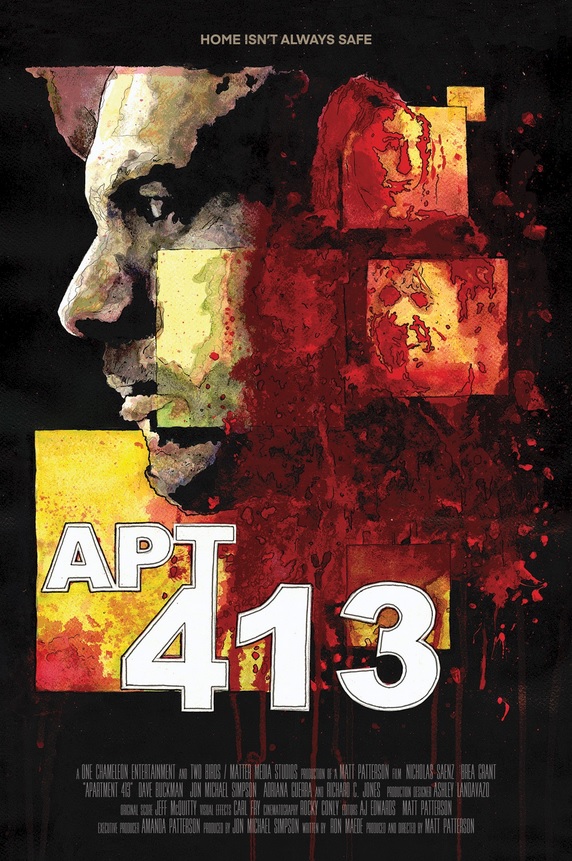
The 2019 film festival one-sheet.
Neither, as is the case with most of the feature-length indies uploaded to the streaming-verse, are inexperienced first timers: Meade and Patterson both come with extensive careers working in various disciplines on streaming series, shorts and features. In fact, Ron Meade most recently worked on the post-production process of a pretty fine indie we recently reviewed, Gap Weekend (2021). Kevin Smith fans know Matt Paterson as result of selling his screenplay for Bindlestiffs (2012) to the View Askew-verse.
The most accomplished, recognizable member of the cast is Brea Grant; her 85-credits strong career dates to recurring and co-starring roles on Friday Night Lights (2008), Heroes (2009), and Dexter (2011), as well as guest starring roles on Anger Management, NCIS: Los Angeles and NCIS: New Orleans. On the big screen, you’ve seen Grant in Rob Zombie’s Halloween II (2009) and the indie-horror Beyond the Gates (2016). You’ve seen her fellow lead, Nicholas Saenz, on John Ridley’s short-lived series American Crime (2015), as well as NBC-TV’s failed apoc-drama, Revolution (2014).
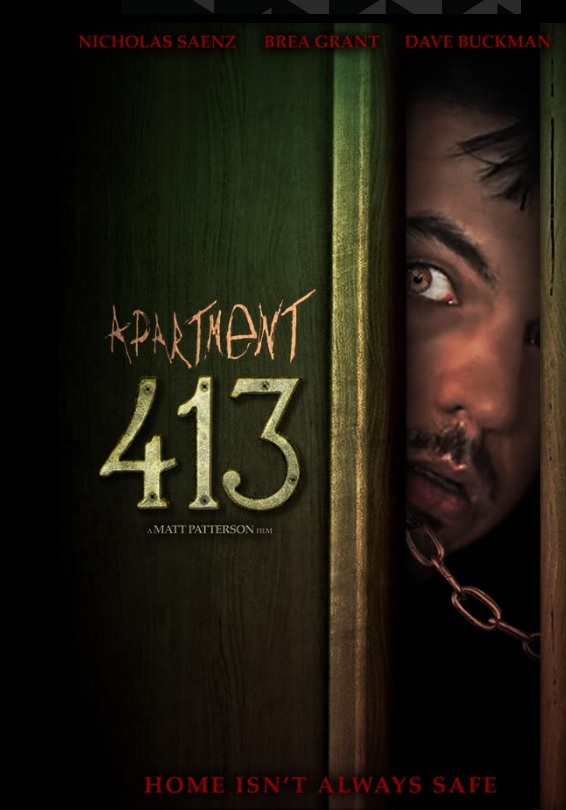
The 2021 streaming one-sheet.
An unemployed Marco (Saenz) spends his days applying for jobs online and waiting for Dana (Grant), his employed, pregnant girlfriend to get home . . . if she is, in fact, even real. As his lonely, shut-in world begins to shrink, strange post-it notes mysteriously appear around the apartment with cryptic warnings, notes that may be from his own-self or reminders from Dana. Perhaps it’s that creepy car mechanic he sees in the complex parking lot through the apartment window who is texting and calling him from an old, non-functioning cell phone. Will anyone hear Marco’s cries . . . or will his paranoia, self-loathing and doubt destroy his world? Are his “church bells,” in fact, broken?
Courtesy of its skilled group of filmmakers behind and in front of the camera, the Hitchockian-styled Apartment 413 accomplishes much with its obviously tight budget and small cast. This is one of those indie-streamers worthy of dropping your coin in the digital nickelodeon. It’s also one of those films where you look forward to the next works of Ron Meade and Matt Patterson.
Apartment 413 becomes available for streaming from Terror Films on various platforms on September 17, 2021. You can learn more about the film’s production on its official Facebook page, as well as the previously noted Austin Film Festival and InkTip links.
Disclaimer: We were provided a screener copy of this film from the production’s PR firm. That has no bearing on our review.
About the Author: You can learn more about the music journalism, fiction and screenwriting endeavors of R.D Francis on Facebook.He also writes for B&S About Movies.
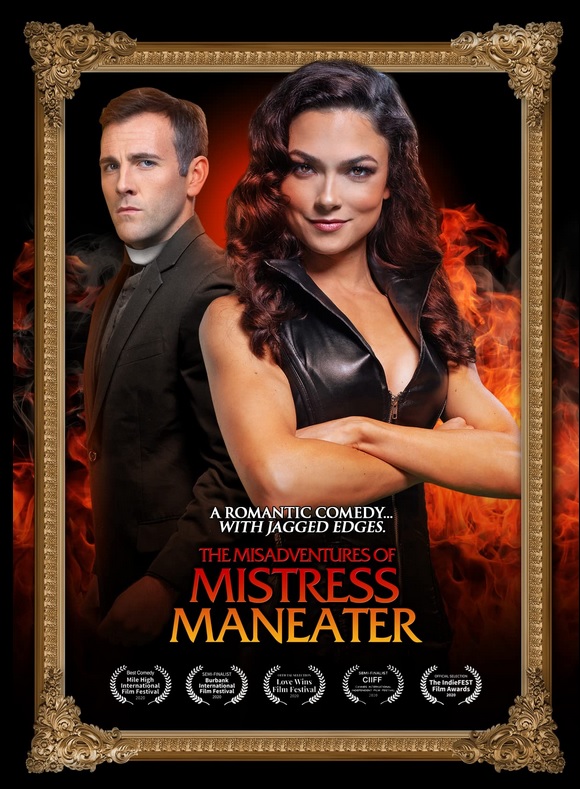
This “romantic comedy with jagged edges” is the feature film debut by the Chicago-based acting, writing and directing team of C.J. Julianus and his wife Lorrisa Julianus, under their Binary Star Pictures banner.
Filmed throughout the Chicago area, our maneating mistress Ava Moriatry (Lorrisa Julianus) is a disgraced Art History PhD with a unique sideline to put herself through school: she’s a highly-sought after dominatrix. As with most ne’er do wells: she wants out of the business, the adult entertainment business, that is. And her Russian mobster ex-boyfriend will let her out of the business, provided she pays off her $500,000 loan. (“That wasn’t our deal!” “The deal has changed.”) So she’s forced into one last job: seduce, then extort, Sebrian-Episcopalian priest Father Radovan (a fine Mickey O’Sullivan, aka Detective Tom Doyle, for you Chicago P.D. fans), who not only moonlights as an MMA fighter, but makes extra scratch by embezzling priceless art pieces. As she falls for the Father, what will Ava do: help him sell the artwork to save his parish or pay off her own debts?
In spite of its adult material concerning the noirish entanglements of a priest, a gangster and a dominatrix, the presentation is not religiously offensive or sexually graphic. The proceedings are softened by it’s-played-for-comedy scripting (by accomplished playwright Lorrisa Julianus) and the comedy works well against its unpredictable, twisty-noir vibes. The film, overall, at pokes fun at itself and has its campy moments, but team Julianus pull back the reins and never lets the camp go over the top to keep everything feature film, major studio classy on an indie budget.
Primarily a theater writer and director, C.J. Julianus certainly proves himself highly capable behind the lens as he extracts the very best from his unknown cast of Chicago theater thespians. The real star here, however, is producer John Wesley Norton doubling as the film’s cinematographer. Working against an obviously low budget, this debut by Binary Star Pictures looks way more expensive — major studio feature film expensive — than it is. A writer and director in his own right, and based on what I’ve seen in the frames, here, I am inclined to seek out his other works, of which Tubi streams two: the horror comedies Paranormal Calamity (2010) and Doctor Spine (2015). His 13-episode series, Dark Country (2018), streams on You Tube.
My only qualm with the film is that it runs a little long at an hour fifty minutes. That length is fine for streaming platforms, but stymies any cable television replays, which requires tighter, 80-minute films that program into two-hour blocks. While the production values and acting, here, are above the female-driven products of the Lifetime and Hallmark Channels, C.J. and Lorrisa Julianus are certainly on a bright road, as their Binary Star Pictures can certainly shine by providing a higher grade of romantic comedies or damsel thrillers for either channel.
This is a fine, debut indie-feature with class and style that exceeds any of the expected vanity trappings of similar, self-produced industry calling cards. I, for one, look forward to C.J. and Lorrisa’s next production. Keep your eyes open for that Binary Star Pictures banner, for that production will happen sooner, than later.
You can enjoy The Misadventures of Mistress Maneater as a with-ads stream on Tubi or as an ad-free experience on Amazon Prime via Indie Rights Movies. You can also learn more about the production on its official Facebook page.
Disclaimer: We were provided a screener copy of this film from the production’s PR firm. That has no bearing on our review.
About the Author: You can learn more about the music journalism, fiction and screenwriting endeavors of R.D Francis on Facebook.He also writes for B&S About Movies.
Hey, dude. Never say never. So goes another “Rock ‘n’ Roll Week” in the can. If you’re here expecting our insights on Bohemian Rhapsody, Rocketman or Rock of Ages, then you’ve come to the wrong website. Really, you should know us better by now.
Let’s rock and round ’em up, mijo. Turn it up and twist it off.
“Heavy Metal Movies” During the last week of May/first of June 2021, we paid homage to the late Mike McPadden with a week of movies that appear in his book, Heavy Metal Movies. If you love your metal, you’ll love these movies.
Another of Mike’s great film reference guides is Teen Movie Hell.
Will there be a “Rock ‘n’ Roll Week IV”? You never know. “No sleep ’til Squirrel Hill!”
About the Review Authors: Sam Panico is the founder, Chief Cook and Bottle Washer, and editor-in-chief of B&S About Movies. You can visit him on Lettebox’d. R.D Francis is the grease bit scrubber, dumpster pad technician, and staff writer at B&S About Movies. You canvisit him on Facebook. (*Reviews by R.D Francis) Jennifer Upton is a floater and swing-shift QWERTY warrior at the B&S Bar ‘n’ Grill and an American (non-werewolf) writer and editor based in London. You can visit her at JenniferUptonWriter.com.
Amid the flurry of Beatles movies we reflected on during this third “Rock ‘n’ Roll Week” with our “The Beatles: Influence on Film” series, this one-watch, utterly forgettable Beatles-inspired sidebar came to mind. Then there’s our memorializing the late Tawny Kitaen . . . and our remembering her work in the analogous, sick ‘n sensitive musician flick, Crystal Heart (1986). (See our “Exploring: Tawny Kitaen” featurette.)
Yes, we said “Beatles” sidebar.
Now, before you start with the comments, let us explain.
Not Crystal Heart . . . not in a bubble.Not Vibrations . . . not in a cybersuit.
Back in the days when Sting of the Police flexed his thespian skills and received positive reviews in his fifth project and first leading-man role in Brimstone and Treacle (1982), and then the lead as Baron Frankenstein in The Bride (1985), the pre-Internet rock press (don’t search for it online, it’s not there) reported Sting would star in the lead of While My Guitar Gently Weeps. Inspired by the George Harrison composition from the Beatles’ “White Album” (1968) — Beatles’ friend Eric Clapton — who provided the lead guitar on the classic tune — would provide the soundtrack (it could have been in Circus or Hit Parader, maybe Spin).
The Beatles’ recording appeared on the soundtrack to Withnail and I (1987), a comedy film set in late-1960s London and produced by Harrison’s company, HandMade Films. (I can’t recall if HandMade was involved in the production, again, in that news blurb that . . . is not a figment of my imagination.)
Regardless, that proposed-rumored film, about a famous musician (Sting) losing his hands in a tragic accident (guitar by Eric Clapton), who then deals with the aftermath of no longer being able to create music, was never made.
And to the cinema gods, we thank you.
For meshing John Travolta’s The Boy in the Plastic Bubble with a Beatles rock ‘n’ roll subplot is a film that would send any sane Beatles lover screaming out of their local Blockbuster with blood-soaked hands. So, with that project from hell, finite: we get this Miramax-backed (curse you, Weinsteins) cyberpunk version of the Hands of Orlac, aka Mad Love (1935, but remade in 1961 and 1962), starring a then-hot Twin Peaks and Married . . . with Children alums.
Oh, HBO in the ’90s, when you were too cheap to purchase decent films to justify your excessive subscription rates, we love you for giving us films like Vibrations in between your incessant replays of Dom DeLuise’s Hot Stuff and nobody-asked-for-Bill Murray’s brother in Moving Violations.
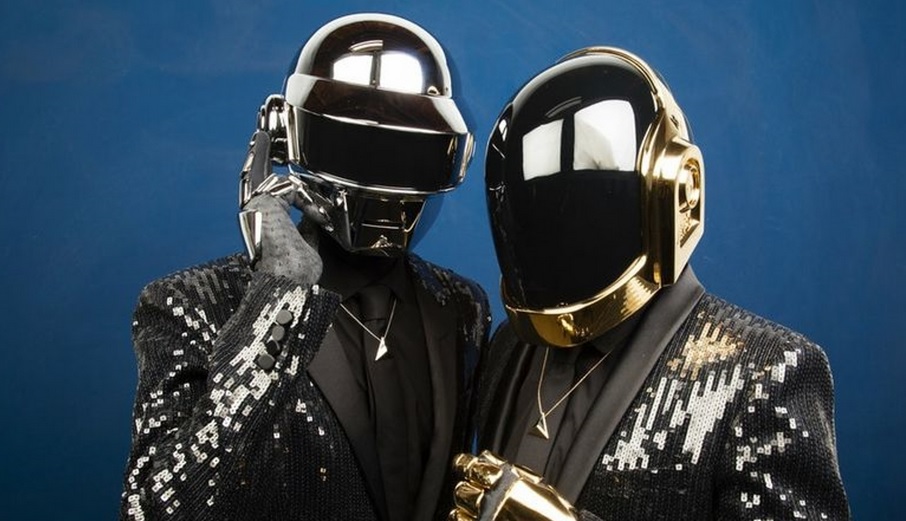
Picking up the good vibrations: Daft Punk
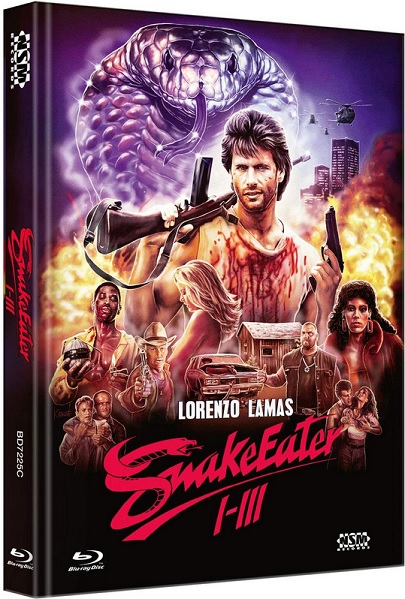
Michael Paseornek — who gave us (well, at least me and Sam the Bossman) an always-welcomed Lorenzo Lamas (in the pretty fine 2020 indie, Water) one-two punch with his screenplays for Snake Eater (1989) and Snake Eater II (1989) — makes his lone directing bow with his seventh (and final) screenplay.
In this Ed Wood meets cyber-novelist William Gibson tale — we meet T.J Cray (James Marshall of Twin Peaks, but looking a lot like John Savage, here), an up-and-coming rock star. On his way to an A&R audition, he’s victimized by thugs — and loses his hands in the melee.
With his ability to make music, gone, and his girlfriend repulsed by his plastic-artificial hands (perpetual magnets for sharp, stabbing objects and fire), T.J becomes a homeless drunk. Upon his rescue of a damsel-in-distress outside of an illegal rave (this film is loaded with slobbering-for-fun-thugs), T.J finds sympathy from Anamika (Christian Applegate), a computer artist and the promoter of that illegal warehouse rave, because . . . well, in real life, hot girls always treat sketchy homeless men like a stray puppy in the movies. And, unlike real life street urchins, T.J is — even under the soot and grime — a non-alcohol, six-packed hottie, again . . . only in the movies: where the homeless, sans access to dental care or gym equipment, always have perfect teeth and muscle tone. (Just don’t. I am not making light of homelessness. I was, once, myself. So stow the acidic comments, Cletus.)
Anyway . . . taking up residence in Anamika’s artist-occupied apartment building (the income-to-abode ratio, as with Jennifer Aniston and the Friends gang, doesn’t compute), she introduces T.J to her Wired to Kill-inspired techno-geek neighbor who fits him with his new invention: robot hands, aka cyberhands. Then, fitted with a metallic “cybersuit,” and his piano skills returned — even more efficiently because of the robotics — T.J becomes an international sensation known as Cyberstorm.
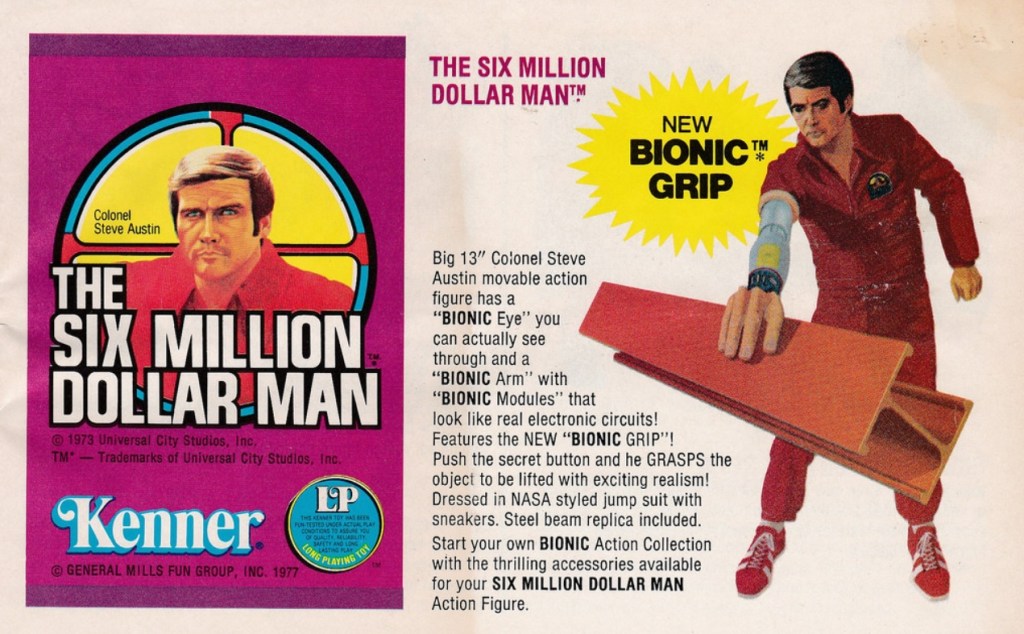
And we’d rather go see the Blue Man Group and the Residents. Maybe if Cyberstorm wore a giant eyeball over his head. Or lost his eyes, as well as his hands, and received a set of Steve Austin* eyes . . . and became the internationally known Ministry with the worldwild hit, “Jesus Built My Hot Rod.”
But can he grind on a Hammond B-3 or a Yamaha CS-80?That’s the question.
Yeah, in case you’re wondering: this film’s knowledge of techno, rave, and avant-garde dance rock is utterly non-existent and is nothing but the set design window dressing that it is. (Illegal raves are by word of mouth; raves do not set up 800 numbers.) But if you can get past the dopey characters spewing techno-gobbly-gook, the music of the genre’s stars — who serve as the “sounds” of Cyberstorm — Utah Saints and 808 State, are pretty cool.
Sure, we got Daft Punk out the deal. But Jesus still didn’t build this hot rod — a hot rod that, if we go by the dates on the set-design flyers inside one of the rave warehouse gigs, took three years to transition from the film set to the cable screen. And notice that, before social media: you (apparently) called 800 numbers for the scenster hook-up.
Eh, whatever. It’s all captured in the lens well enough, but the proceedings are pure meh Albert Pyun — if you recall Radioactive Dreams and Vicious Lips. Marshall and Applegate are mediocre, and Faye Grant (TV’s V, Omen IV) and Paige Turco (April O’Neill from the Teenage Ninja Mutant Turtles franchise) have been better, and in better. And it saddens that Vibrations served the final film of journeyman TV actor Steven Keats (of the films Death Wish, Black Sunday ’77), who died in 1994 (at a youthful 49), just after completing his work on the film (which additionally “dates” the production).
And we dare you to call that number. We dare you. Hey, maybe Jenny will answer. You never know.
As an executive producer, Michael Paseornek would go to great success with Rob Zombie’s The Devil’s Rejects, the critically-acclaimed Akleelah and the Bee (2006), the Americanized J-Horror The Eye, Punisher: War Zone, and The Hunger Games franchise. And, thanks to Mike, we get this sweet-as-hell box set.
Oh, hell yes, Mr. Paseornek. Oh, yes. We bow.
Even with its shortfalls, Vibrations is a pre-The Matrix VHS classic with a loyal fan base, as these You Tube uploads of the film HERE and HERE, and clips from the film HERE and HERE, prove. If you’re into the techo-rave side of ’90s alternative rock, this will hold your interest.
Now, when is someone making a metal version of The Hands of Orlac with Swedish symphonic metal bands?
Many thanks, once again, to Paul Z. over at VHS Collector.com for the clean images. Be sure to check out his reviews of the DVD and Blu-ray reissues of the lost VHS classics of the ’80s on his Analog Archivist You Tube portal.
* We did an entire week of Lee Majors flicks. Do join us with our “Lee Majors Week,” won’t you?
Speaking of Beatles: Be sure to join us for our three part “The Beatles: Influence on Film” series as we look at 33 films dealing with the legacy of the Beatles.
About the Author: You can learn more about the writings of R.D Francis on Facebook. He also writes for B&S About Movies.
This lost and obscure Canadian theatrical made its way across the U.S. boarder on VHS — sans publicity or any distribution. It’s a film I never came across by way of my multiple video memberships nor cutout bin excursions. It wasn’t until our local, dead and abandoned shopping mall transformed into an “outlet mall,” where retailers rented out a store space (well, cubicle) to sell their wares. In other words: it was an indoor swap shop.
Anyway, this older, crusty but still chatty gentleman, who was in the drive-in racket back in the day, then, when that industry dried up, he got into the home video market — but he hated running a video store. So he rented out a space and started purging his inventory. Then he got sick of that: one day I go to his canvas-fenced cubicle — and he’s gone.
So goes the story of how I got my copy of I-never-heard-of this faux-band romp that crosses Eddie and the Cruisers with American Graffiti — and uses the Beatles’ September 7, 1964, debut appearance in Toronto, their first of two concerts, at the Maple Leaf Gardens hockey area.
This isn’t the first time the history of the Beatles fueled a fictional tale. Robert Zemeckis (I love him for Used Cars, alone; the rest is gravy) scripted I Wanna Hold Your Hand (1978) around the Beatles’ historic February 8, 1964, appearance on CBS-TV’s Ed Sullivan Show. In that tale, a group of friends (headed by Nancy Allen and the Wendy Jo Sperber) scheme to meet the band.
This time, a quartet of ne’er-do-well teens from the wrong side of Toronto’s tracks form the Concrete Angels — in a plot that reminds of the earlier Brian Adams tale about a failed teen band, “Summer of ’69” — to enter a radio station’s battle of the bands contest and win the opening act slot for the Beatles’ gig. Will they win and escape their poverty or will they fall back into their juvenile acts of crime?
Fortunately, unlike Larry Buchanan’s earlier faux-Jim Morrison romp, Down on Us (1984), with its ersatz Doors, Hendrix, and Joplin tunes, first time producer and director Carlo Linconti secured the right to Beatles tunes — but only in cover tune form (“Twist and Shout,” “Money (That’s What I Want),” “I Saw Her Standing There,” “A Hard Day’s Night,” “P.S I Love You,” “Misery,” “From Me to You,” “Love Me Do,” and “She Loves You”) — as interpreted by the Canadian new-wave band Quasi Hands (their lone EP is on eBay and heard on You Tube). Other songs appearing in the film are the oldies-classics (originals/covers mix) of Chuck Berry, Little Eva, Dion, and the Shirelles. One of the Beatles’ major influences, Buddy Holly, appears — however, in a cover form — by way of the Blushing Brides (who later etched out a career as a popular Rolling Stones tribute band; you can learn more about the ‘Brides at Canadian Bands).
Do we meet the faux-Beatles as portray by actors? Nope. But Paul’s voice shows up for a quickie (phone call) as voiced by Gary Grimes (aka “Hermie” from the American Graffiti knocks Summer of ’42 and Class of ’44) — or was he duping John, I wasn’t paying that much attention.
Do the Fab covers have the vim and vigor of the Beatles? Nope. They’re the “Drab Four”; the bar band covers you’d expect from a band as you suck back an Iron Horse at your local suds dispensary (know your Bob & Doug McKenzie trivia).
As for the acting: Eh, the acting is okay, but nothing to write home about. Italian-Canadian actor Tony Nardi, however, in his first starring role (after a bit part in Videodrome), earned his first of five Genie Award nods (Canada’s Oscars) for his role as Sal — was he a slimy band manager, radio executive, or . . . eh, don’t care; again, I wasn’t paying that much attention. Yeah, Concrete Angels is one of those films that lends itself to one viewing (two, if you’re a smarmy critic writing for a website in Pittsburgh), and you’re done. It’s not — as with Splitz or Hail Caesar — a beauty, eh.
Carlo Linconti is still active as a producer and director. Amid his 20-plus producer credits — one was the 1974 killer bugs romp Phase IV — he’s directed fourteen films; his most recent, in-production film is the western adventure, Bordello.
As for Concrete Angels, there’s no online streams — free or pay — but the VHS copies are out there on Amazon and eBay. There’s no DVDs from what we can see, but if they are, be assured they’re grey market rips off the VHS, so emptor the caveats, ye junk cinema purveyor. But we did find a trailer.
Be sure to join us for our three part “The Beatles: Influence on Film” series as we look at Concrete Angels and 33 other films dealing with the legacy of the Beatles.
About the Author: You can learn more about the writings of R.D Francis on Facebook. He also writes for B&S About Movies.
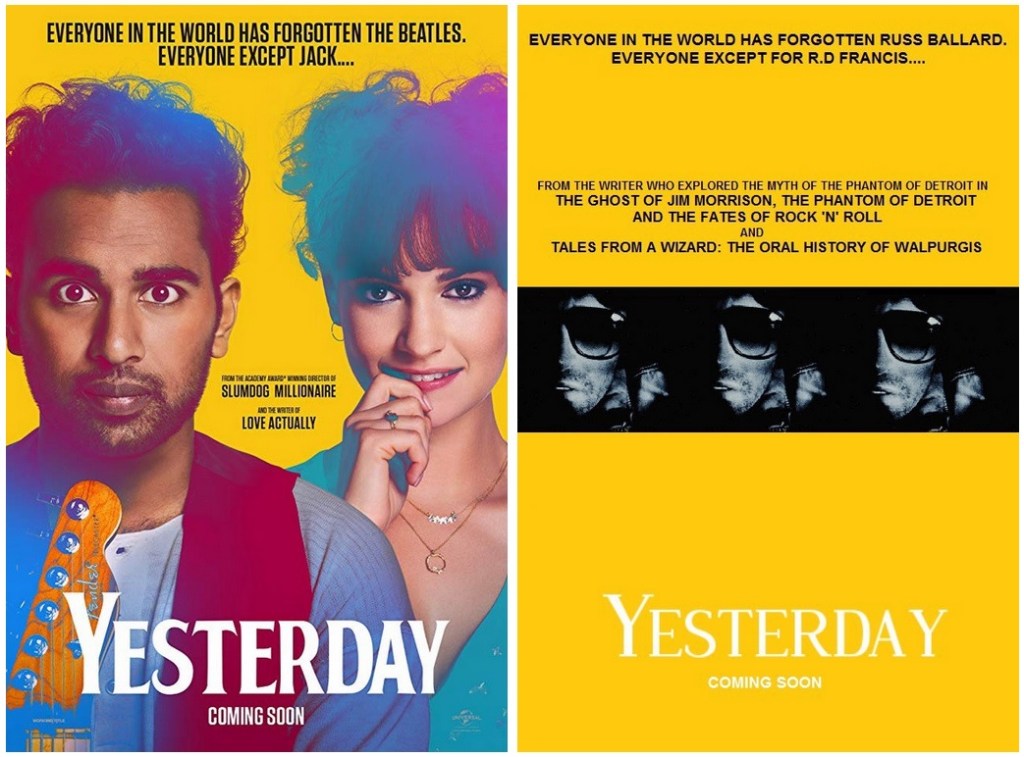
Editor’s Note: What does this all have to do with the obscure, progressive rock band Pheonix and their connections to the Kinks, MTV popsters Charlie, and New Wave of British Heavy Metal stalwarts Saxon? Indulge me and keep on reading. Russ Ballard is more influential than you realize . . . beyond the smash hits he wrote for America, Ace Frehley, Kiss, Rainbow, Three Dog Night, and Uriah Heep.
Yeah, it’s no secret I’m a huge Russ Ballard fan.
In the “alternate universe” of the musical-fantasy, Yesterday, a failed singer/songwriter gets a bump on the head and wakes up in a world where the Fab Four never existed; he subsequently becomes an overnight sensation with the greatest hit-making album in the world — based on the Lennon-McCartney catalog (Who?).
In this writer’s ‘Yesterday’: R.D Francis becomes an overnight sensation with the greatest hit-making album in the history of recorded music — based on the songwriting catalog of Russ Ballard. . . .
Sadly, the screenplay based on my Russ Ballard-fantasy was rejected by all the major Hollywood studios. Even the dinky indie studios rejected me; the ones that pay struggling actors and screenwriters with an “IMDB credit” and “copy of the DVD.” (Even the studios who offer you a producer’s credit and an acting role . . . if you pony up several thousand dollars to make the movie.)
My fellow aspiring actors and struggling screenwriters know about those “deals”: the DVD never arrives and you have to send the self-professed auteur a self-address-stamped-envelope to receive your “pay” — and they misspell your name on the IMDB page. So goes our trip down the boulevard of broken dreams.
“Who?” smirked the high-seated, cigar-chopping movie executive to the sniveling screenwriter cowering in a low-slung chair before the golden throne of fate.
“Russ Ballard, ah-em. He wrote songs for Kiss — .”
“Russ Ballard? Never heard of him.”
“Well, uh . . . what about Billy Steinberg, he wrote songs for Pat Benatar and Heart— .”
“Mr. Weinstein, you’re 4 PM massage is here,” crackled the receptionist’s voice over the intercom.
(Sorry, Mr. Weinstein. Just a little creative license-joke? Okay?)
“That’s not funny, kid. You’re finished,” scowled Mr. Weinstein.
And . . . creative license revoked. Goodbye, screenwriting career.
So, since you will never see my biographical movie or hear my album, ‘Yesterday,’ it’s back to keyboard-jockeying once again. Yes, my fair-weathered readers, it is time for another ethereal journey into the phantasmic wormhole with another rock star you never knew or forgot (at least in the U.S., anyway). No, not me — it’s Russ Ballard.
“Hey, wait a minute, R.D. I thought Russ Ballard never existed and you wrote all those hit songs.”
Oh, yeah . . . I did . . .
The record breaking, most successful hit-producing album in the world . . . with every song a hit, your’s truly, R.D Francis, wrote it!
My album!
. . . And it was a whirlwind.
Jimmy Fallon, James Corden, The View, Live with Kelly and Ryan. The girls! The parties! A world tour as a headliner my first time out on the road! I’m best friends with Danny “Hey, Baby Doll” Collins, who looks exactly like Al Pacino (from the opposite end of the wormhole, you know, where Al Pacino is “Al Pacino,” and he’s an actor).
I became the only artist to have four hits simultaneously in the U.S. Top Ten. I charted more singles from a debut album and charted more #1 hits in multiple countries than any other artist — even the Beatles!
I charted on Adult Contemporary radio with “You Can Do Magic.” I ruled the metal charts with “Riding with the Angels.” When my drummer, Ian McLatchen-McManus Davis Mitchell III, on loan from Spinal Tap, went up in flames, Dave Grohl from the Foo Fighters sat behind the kit to finish the tour. Dave told the Rolling Stone that I was “more prolific than Kurt Cobain.” When AC/DC was in a jam, I filled in for Brain Johnson and helped Angus and the boys finish their world tour.
In this brave new rock world: Weezer doesn’t exist. Rivers Cuomo and Patrick Wilson have an alt-rock band, Sixty Wrong Sausages. Sure, they had a very cool “SWS” logo, but their hit, “Freddie Garrity,” was stupid, as was its video that parodied TV’s Leave It to Beaver.
In this continuum variant-mishap: Van Halen doesn’t exist. The producer of Van Halen’s landmark debut, Ted Templeman, was successful in having David Lee Roth fired from the band and replaced by ex-Montrose lead vocalist Sammy Hagar.
The infamous “VH” wings-logo doesn’t exist: Van Hagar’s logo is a “VH” inside a white circle — emulating an old-style Formula 1 racing car — emblazoned on the side of Sammy’s red Trans Am. I ended up marrying one of the models covered in soap suds washing that red Trans AM on the album’s rear cover — Sir Denis Eaton-Hogg’s niece, Icelandic superstar model Erika von Bjőrn.
David Lee Roth sold a lot of albums with his next band: Diamond Dave. Erika and I vacation with Dave and his wife every year. Our best friends: David Coverdale and Tawny Kitaen. The oft told tale about my old band, Wyatt, Brian Adams, and the Moose in the hotel room, is true. When that grasshopper got stuck up my nose, Nikki Sixx, who wisely stuck to snorting ants, rushed me to the hospital.
Oh, and SWS had a pair of alt-radio hits with their quirky covers of Wyatt’s big hit, “Hold Your Head Up,” and “Hash Pipe” from our final album.
However . . . before my hit solo album, ‘Yesterday,’ I was in this little ‘ol band, Wyatt, that did a couple of albums. You bought Leather Assassins and Red, White ‘n Screwed, right? You might remember our big FM radio hit, “Hold Your Head Up,” and our tours with Van Hagar (Who?), AC/DC, and Whitesnake (yep, we hung out with Tawny Kitaen*). And that embarrassing onstage melee we had with Guns N’ Roses; regardless of what the press says, Axl didn’t start it — I did. I kicked his punk ass back to the Sunset.
Then, it all came to a screeching halt.
Jimmy Fallon ambushed me during my third appearance on The Tonight Show. He brought out these two chaps from England who claimed they were responsible for all the songs from Wyatt, and ‘Yesterday,’ my solo album. Some guys named Russ Ballard and Rod Argent. . . .
. . . Well, back to the wormhole and through that space-time continuum rip to my crappy, boring life. You play a good game, Mr. Ballard. Until we meet again. You can have your life back . . . for now. See you at the next vortex, Chewie.
The Reality of the Real Russ Ballard
Born on October 31, 1947, in Waltham Cross, England, Ballard joined his first professional band, Buster Meikle & the Day Breakers, in 1961 with his older brother, Roy, and drummer Bob Henrit. Together, Ballard and Henrit joined Adam Faith’s backing band, the Roulettes. The band appeared a record-breaking nine times between 1964 and 1965 on the legendary U.K. television series, Ready, Steady, Go!
I hear voices . . . oh, my brains are like scrambled eggs . . .
After the world famous, hit making Zombies took a pick axe to the brain for the last time in the late ’60s (“She’s Not There,” “Tell Her No,” “Time of the Season”), keyboardist Rod Argent formed his namesake band, a harder-rocking affair, Argent; he drafted Russ and Bob from the Roulettes into the group, along with his cousin, bassist Jim Rodford (ex-Mike Cotton Sound). Argent, Ballard, and Rodford shared lead vocals.
During the Russ Ballard years, Argent produced five popular, U.S. progressive FM radio favorites with their 1970 debut, Ring of Hands (1971), All Together Now (1972), In Deep (1973), and Nexus (1974). While “Liar” and “God Gave Rock ’n’ Roll to You” became progressive FM album cuts, Argent scored only one U.S. Top 40 and Classic Rock radio staple (now criminally absent from the airwaves), “Hold Your Head Up,” written by Rod and sung by Ballard, which made it to the Top Five in 1972.
While Russ Ballard recorded as a solo artist with his old band’s label, Epic, Jim Rodford (bass) and Roger Henrit (drums), along with Ballard’s replacement, John Verity (guitar/bass), rose again on Columbia Records with Phoenix; they issued two albums: Phoenix (1976) and In Full View (1979).
Phoenix with “Easy” from 1976. Sound and feels a little bit like early ’70s Rush, right?
Verity and Henrit were then drafted as the rhythm section for the European-respected, British pop-rock outfit Charlie on their 1981 RCA Records release, Good Morning America. Henrit remained with the band for their follow up, Here Comes Trouble (1982) and their U.S. radio and MTV breakthrough, Charlie, which featured their U.S. Top 200 hit, “It’s Inevitable.” Verity also became a sought-out producer; he worked on the debut album for the pioneering New Wave of British Heavy Metal band, Saxon. (Yeees! SAXON! SAXON!)
Charlie’s lone U.S. hit single and beloved 1982 MTV-era hit, “It’s Inevitable.”
Saxon’s self-titled debut with their European hits “Stallions of the Highway” and “Backs to the Wall,” produced by John Verity.
Verity and Henrit worked together again in the Kinks during Ray Davies’s well-deserved “American” career resurgence with the hits “A Rock ’n’ Roll Fantasy,” “Low Budget,” “(I Wish I Could Fly Like (Superman)”, “Paranoia,” “Around the Dial,” and “Come Dancing.” (Hit remakes of the Kinks ’60s hits “You Really Got Me,” “Where Have All the Good Times Gone,” “Stop Your Sobbing,” and “All Day and All the Night,” by Van Halen, the Pretenders, and New Wave of British Heavy Metalers, Praying Mantis (know your Iron Maiden sidebars), respectively, sparked Ray Davies’s resurrection.)
However, unlike Davies, Russ Ballard was unable to forge a front-and-center career as a solo artist on U.S. shores; instead, his songs created a rapid succession of U.S. — and worldwide — Top Ten and Top Forty chart hits for other artists:
“Cookoo” — Bay City Rollers “Free Me” — Roger Daltry “God Gave Rock ’n’ Roll to You” — Kiss “I Surrender” — Rainbow “I Know There’s Something Going On” — Frieda (Fältskog; of Abba) “Liar” — Three Dog Night “New York Groove” — Ace Frehley of Kiss “On the Rebound” — Uriah Heep “Riding with the Angels” — Samson (w/Bruce Dickinson of Iron Maiden) “Since You’ve Been Gone” — Rainbow & Head East “Some Kinda Hurricane” — Peter Criss of Kiss “So You Win Again” — Hot Chocolate “Voices” — Russ Ballard “When I’m With You” — Sheriff “Winning” — Santana “You Can Do Magic” — America
Thanks to MTV’s support on the video frontier, U.S. radio stations were encouraged to chart Ballard as a solo artist with “Voices” from his eponymous 1984 effort and the title cut from the The Fire Still Burns, which became his best known U.S. solo hits (Russ is known for a lot more throughout Europe and Asia).
In addition to “In the Air Tonight” by Phil Collins and Glenn Frey’s “Smuggler’s Blues” on episodes of the hit U.S. television series Miami Vice, “Voices” was also featured in an episode: “Calderone’s Return: Part 2 — Calderone’s Demise,” which aired on October 26, 1984.
The London-based soft-rock outfit America, whose radio chart career with a succession of early-to-mid ’70s gold and platinum U.S. Top Ten hits (“Horse with No Name,” “I Need You,” “Ventura Highway,” “Tin Man,” “Lonely People,” and “Sister Golden Hair Surprise”) had tanked by the late ‘70s, experienced a career resurgence in the early ’80s with Russ Ballard’s “You Can Do Magic,” which put the band back into the Top Ten around the world.
This “Russ Ballard” playlist (over on my personal You Tube page) features the solo versions of his most popular tunes, along with a few artists who covered his material — when versions by Russ cannot be located. Some of the songs appear on the following albums:
Catalog
1976 — Winning (Epic) Features “Winning,” “Since You’ve Been Gone,” and “Cuckoo.”
1978 — At the Third Stoke
1980 — Barnet Dogs Features on the “On the Rebound” and “Ride with the Angels.”
1981 — Into the Fire
1984 — Russ Ballard (EMI) Features “Voices.”
1985 — The Fire Still Burns Features “The Fire Still Burns.”
For Russ Ballard’s complete catalog, visit with him on Discogs.
Russ Ballard’s most recent worldwide hit came courtesy of the 1998 rock ’n’ roll dramedy, Still Crazy. The soundtrack and film spotlights his song, “What Might Have Been,” sung by British actor Jimmy Nail, the “bassist” for the movie’s faux-British rock band, Strange Fruit. Russ wrote the lyrics, while his collaborator on the song, Chris Difford of Squeeze, wrote the music.
The bottom line: Russ Ballard is one hell of a songwriter and vocalist. In this writer’s reality, Russ’s albums shelve-proud alongside the multi-platinum, hit-driven catalogs of Neil Diamond, Billy Joel, and Bruce Springsteen, and the not so hit-driven ’70s catalogs of Moon Martin and Warren Zevon — and some guy named Michael Bolotin (read about him on Medium).
Richard Curtis previously wrote another great, rock ’n’ roll film, The Boat That Rocked, aka Pirate Radio in the U.S. (2019), a comedy about Britain’s late ’60s pirate radio scene. When Danny Boyle and Richard Curtis are on the marquee, you don’t overthink the movie, you hold onto your popcorn bucket and go for the ride.
So, save me the aisle seat . . . and don’t sue me, Mr. Curtis, for having some fun with this “review” of your film to honor one of my all time favorites in Russ Ballard.
About the Author: You can learn more about the writings of R.D Francis on Facebook. He also writes for B&S About Movies.
Poster Image Left: Yesterday poster courtesy of Etalon Films/Working Title Films/Universal Studios, via IMDB.com. Image Right: Graphic by R.D Francis. Russ Ballard’s Voices courtesy of Discogs. Typeface: “Anton” and “Dustismo” courtesy of Picfont.com.
Sidewalk Star courtesy of redkit.net image generator.
Wyatt Album Image Left: Graphic by R.D Francis. Peter Fonda/Easy Rider screen cap by R.D Francis. Chopper: unknown, from the R.D Francis image archives (Google Images can’t located it). “Flying W logos” designed by and courtesy of Weezer drummer, Patrick Wilson. Image Right: Record graphic By R.D Francis. Yellow 45-rpmImage: R.D Francis.
Acclaimed music video director Jay Dubin* made his feature film debut with this chronicle of Black Sabbath’s and Blue Öyster Cult’s co-headlining “Black & Blue” tour, which became, not only a concert box office smash, but also a hit on the U.S. “Midnight Movie”** circuit — alongside AC/DC: Let There Be Rock, released in 1980 and playing out through 1981.
The footage was shot on October 17, 1980, at the Nassau Memorial Coliseum in Hempstead, Long Island, New York. Originally shot for and used on a December 6, 1980, episode of Don Kirsher’s Rock Concert*˟, that footage, along with additional footage, was edited into this feature film released in 1981 after the completion of the tour (remembering that MTV launched on August 1, 1981, and subsequently ended theatrical-released concert films and programs like Rock Concert). The tour and its accompanying film came together under the tutelage or Sandy Pearlman, who managed both bands at the time (as well as New York’s the mighty Dictators and Shakin’ Street at one point). (Blue Öyster Cult returned to the venue on December 30, 1981; their live version of “Dr. Music” appears on their 1982 album, Extraterrestrial Live.)
The U.S. theatrical poster/courtesy of the IMDb.
At the time, both bands were on the road as separate headliners (with the likes of Molly Hatchet, Journey, and Cheap Trick as their opening acts): Black Sabbath was promoting Heaven and Hell, their new release featuring Ozzy Osbourne’s replacement in ex-Rainbow frontman Ronnie James Dio; Blue Öyster Cult were promoting their seventh album, Cultösaurus Erectus, which, while a Gold-selling album (500,000 units), it produced no hit singles, although “The Marshall Plan” became an FM rock favorite. (BOC would have to wait until their next album, 1981’s Fire of Unknown Origin to — as did their 1976 album, Agents of Fortune, with “Don’t Fear the Reaper” — return them to the U.S. Top 40 album and singles charts.)
Speaking of “The Marshall Plan,” that’s how the film starts off: with BOC’s new, pre-MTV “promotional clip” featuring Don Kirshner (who also appears in the song’s speaking-intro). Then we segue into the concert, with Ronnie James Dio tearing it up on Sabbath’s new hits: the mighty “Neon Knights” and the title cut from the new Sabbath’s album, Heaven & Hell (they wanted to ditch the Sabbath name and call the Dio-fronted concern Heaven & Hell; the record company said otherwise), as well as the Ozzy-era classics “War Pigs” and “N.I.B.” BOC gives us “Cities on Flame (with Rock ‘n’ Roll),” while drummer Albert Bouchard dons a Godzilla mask for their FM radio stable, “Godzilla,” and Eric Bloom rides out on a chopper as a precursor to their cover of Steppenwolf’s “Born to Be Wild.” And there’s lot of purple “black and blue” lights as fog machines belch, stage throwers spew flames, and giant, illuminated crucifixes flash in the darkness under seizure-inducing strobe lights.
The film cuts back and forth between the band’s sets. There’s no backstage hokum, or interviews (as in the aforementioned AC/DC: Let There Be Rock), no fancy camera work (as in that said film; just transitional fades), or cinematic special effects (outside of what the bands bring to the stage) — just pure rock ‘n’ roll. The film is cut seamlessly, so you even though we go back and forth between the two bands for the 80-minute running time, it’s never choppy or jarring.
After their joint October 17, 1980, appearance at the Nassau Memorial Coliseum, the tour moved to Madison Square Garden: for that show, BOC went on first and Sabbath went on second. Then there was the riot in Milwaukee (which was not filmed and does not appear in the film).
The Riot
As the theatrical one-sheet states: one and a half million people attended the co-headlining tour. However, what is not preserved in the frames of Black & Blue was a tale told in a October 25th, 1980, Billboard magazine issue regarding the tour’s infamous October 9, 1980, gig at the MECCA – the Milwaukee Exposition Convention Center Arena, which disintegrated into a 9,000-person riot. (I remember the musical melee making the national, network nightly news and my ol’ pop chastising “my generation,” for the umpteenth time.)
Opinions vary as to the cause: BOC’s set ran too long and fans wanted the more popular Sabbath. Or it was the hour-long delay between the band’s sets. Then, with Sabbath finally on stage, while the lights were down (for a theatrical effect), Sabbath bassist Geezer Butler was beaned on the head by a beer bottle by the third song. The lights came up: Sabbath is gone. The stage is empty.
Between BOC going long, the hour wait time, and Sabbath abruptly leaving the stage to rush Butler to the hospital: a riot ensued. Riot geared-officers 150-strong arrived. Fist-fights broke out inside and outside the venue. Over 160 goers were arrested (a mix of riot and drug-related charges) and the venue sustained $40,000 worth of damage. In the aftermath, “hard rock” concerts were banned at the MECCA and beer sales for all shows, suspended. (The exact page with the Billboard story is HERE; the embedded You Tube video below has the audio of the riot.)
The MECCA’s next big concert starred (the non-hard rock) Bruce Springsteen and the E Street Band on Oct. 14; the show went on without incident, but without beer sales. Of course, when you’re dealing with the economic realities of operating a multi-purpose indoor arena, you cave when the accountants break out the spreadsheets. So the bans were lifted, with hard-rockers AC/DC and Van Halen appearing, respectively — and beer taps, flowing.
The DVD Reissue
Black & Blue was released to the ’80s home video market by Warner Bros. in the U.S. (Black Sabbath’s label, which also released AC/DC: Let There Be Rock to video) and Polygram’s video division in the U.K. In the U.K. and Japan, in addition to VHS, the film was also released on both Betamax and Laserdisc formats; the first VHS-only copies appeared in Europe (outside of the U.K.) and the U.S.; first Laserdisc was issued in 1984 by Polygram, while Warner Brothers released it in Japan on a (quickly pulled from the market) 1993 Laserdisc.
According to Dio.net, in 2002, Castle Pictures promoted the first, official DVD reissue — with licensing snafus leading to the project’s cancellation in January 2003. By 2004, Universal Studios’ video division acquired the rights and released their DVD into the marketplace. The same licensing issued resulted in the film being quickly pulled from the European market — but not until a limited amount were distributed into some European countries.
While the earlier-released (most likely the Laserdisc over the VHS or Beta versions) home video versions certainly fueled the bootleg markets in the pre-Interent epoch, those 2004 Universal DVDs have certainly been grey-marketed, since. In fact, a Brazilian company flooded the market with copies ripped from the Laserdisc — rips considered to be of “higher quality” than the countless overseas DVD-r greys in the online marketplace ripped from the more accessible (and worn out) VHS tapes. Those ersatz impresses carry release dates of 1998 and 2008. In 2006, the quickly-pulled Universal-European DVD returned to the grey market, the copies believed to originate from companies based in Russia, Sweden, and Finland.
As you can see, Black & Blue is a legalese quagmire, with the members of Blue Öyster Cult wanting the release, while and the members of Black Sabbath — including Sharon Osbourne (?) and Wendy Dio — not wanting it on the market. Ironically, all of their respective legal bickering ended up feeding the grey markets and now fans are stuck with inferior impresses. Wouldn’t you want to do a full restoration proper and put an official version in the marketplace to quash the bootleggers?
Whatever.
You know me: I always go for the original VHS, anyway, which is a direct copy of the film I enjoyed all those midnight-weekends ago in that little ol’ six-plex theater. For before there was “my MTV,” and I was able to go to concerts, and I wanted more than watching bands on TV by way of the pre-MTV Don Kirshner’s In Concert and Rock Concert, and NBC-TV’s The Midnight Special, going to a movie theater to “see a concert” was all we had in the ’70s and early ’80s.
A blessing . . . but ultimately, a curse.
The “Midnight Movie” Days
Yeah, it’s fun to be able to go back to revisit these concert films and other, non-rock “Midnight Movies.” And it’s great for B&S About Movies’ younger rock flick fans to experience the Black and Blue metal time capsule for the first time. But experiencing this Sab/Cult document is all about the theater: with the ticket holders treating the movie theater like a concert hall, screamin’ and-a tootin, while sneaking-in brews and lighting joints to the chagrin of the ushers. As a “Midnight Movie” goer, you remembered to pack an extra t-shirt, hang your head out of the car window to air out your hair, then hit yourself with a slap/squirt of cologne (guys used Memmen Skin Bracer; chicks used Revlon’s Jean Nate) to rid your teen-self of the second-hand pot smoke (and Listerine flowed to cover the brew breath, since we passed a bottle).
Yeah, before the advent of video stores and cable television in the ‘80s, the “Midnight Movie” was a ‘70s marketing gimmick for non-commercial films, mainly exploitation films and just about everything that made the dreaded “video nasties” list. Sam Raimi’s The Evil Dead, the animated rock flick Heavy Metal, and Pink Floyd: The Wall broke to a mass audience, first, as midnight programmers. British graphic design company Hipgnosis — known for their Pink Floyd and Def Leppard album covers — founded by Storm Thorgerson and Aubrey Powell, had a “Midnight Movie” hit on their hands with their long-form video-infused drama, Incident at Channel Q.
For those of us too young to go to concerts, we got to see Led Zeppelin for the first time in The Song Remains the Same. We became “Dead Heads” courtesy of The Grateful Dead Movie. Our first AC/DC concert (distributed by Ferd and Beverly Sebastian of Rocktober Blood fame; also a midnight flick, natch) was, again, AC/DC: Let There Be Rock (linked above). And how can we forget The Rocky Horror Picture Show? The ’70s radio comedy, FM, also, because of its rock slant, ran as midnighter.
Yeah, the good times of convincing the ol’ ‘rents to let me go to the theater to see AC/DC: Let There Be Rock and Black & Blue with friends because, at the time, no way the ‘rents were allowing me to go a concert, alone, and they sure as hell weren’t taking me to a show. (The last concert my dad went to was the tragic Buddy Holly tour in 1959 at the Syria Mosque in Squirrel Hill, east of Pittsburgh. Square.) Black & Blue was pure awesomeness for me in the theater in 1981. Re-watching it for the first time in forty years to preserve it for the pages of B&S About Movies has been a real treat. And it’s been forty years because, between all of my video store memberships and cut-out bin excursions, I never once came across a VHS copy of Black & Blue.
While you can readily purchase greys of Black & Blue at Amazon.com (some may be original presses, but emptor the caveats), we discovered a ripped copy on You Tube.
The 1980 Polygram European VHS artwork/courtesy of Dio.net.
* After his work with Sandy Pearlman to promote Black Sabbath and Blue Öyster Cult, Jay Dubin directed multiple video hits for REO Speedwagon, Hall & Oates, John Mellencamp, Billy Joel, and Chicago, as well as concert film documents for Andrew Dice Clay. Durbin’s only other film, according to the barren page at the IMDb, is the 1982 TV Movie Dangerous Dan. All we know about the film is that it’s co-produced by Dean Hardgrove Productions and Fred Silverman Productions, who produced a lot of product for NBC-TV, but it’s distributed by Viacom, which is tied into CBS-TV. So, who knows which network it aired on? If you know anything about the movie, let us know.
*˟ We discussed Don Kirshner’s work in rock ‘n’ roll television with our reviews of his film productions with Jeff Beck’s Kim Milford in Song of the Succubus and our “Exploring: Don Kirshner” featurette.
We Bow: To uber-Dio fan Tapio Keihänen at Dio.net, as well as the Milwaukee Sentinel Journal, for the research in sorting out this hard-to-find, beleaguered, classic “Midnight Movie” for preservation on B&S About Movies. Somebody’s gotta do it, right? No sleep ’til Squirrel Hill, daddy-o.
About the Author:You can read the music and film reviews of R.D Francis on Medium and B&S Movies, and learn more about his work on Facebook.
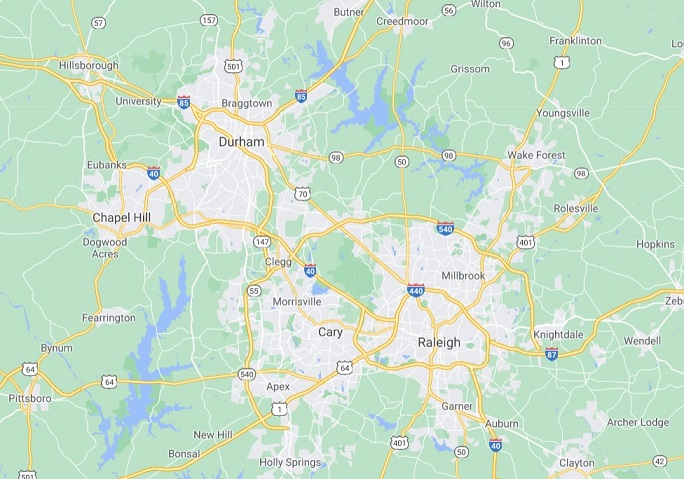
So, after reviewing the North Carolina-shot rock flicks Rockin’ Road Trip (that featured Marietta, Georgia’s Guadalcanal Diary) and Bandwagon (shot by and featuring members of Raleigh, North Carolina’s the Connells) for our latest “Rock ‘n’ Roll Week,” I recalled this SOV vampire obscurity also shot in North Carolina — and it stars another of that state’s alt-rock ’90s musicians: Greg Humphreys of Mammoth Records’ Dillon Fence, who hailed from the city of Chapel Hill.
Yeah, I know. “Who?” you ask. “Where?”
Oh, Chapel Hill and Raleigh-Durham North Carolina. What might have been. Damn, you Pacific Northwest, with your Seattle to Portland flannel and Doc Martins tomfoolery.
The scene is now! Get the Athens out of here, Stipe.
The scene fermenting in that southern local college town dates back to the early ’80s, when all ears learned towards Athens, Georgia — the city that unleashed ubiquitous college rockers R.E.M on our pre-MTV radios. Then, with MTV in full swing, we came to discover Jason & the Scorchers (“Absolutely, Sweet Marie”), and then, with grunge mania in full swing — as record companies searched for instant “Nirvana” — a band that named their album after a toilet manufacture and their band name inspired by TV’s CHiPs, Seven Mary Three, continues to rock our classic rock radios with their one-hit wonder, “Cumbersome.” And, in keeping with the grunge era: one of alt-rocks most respected bands — connected to the history of Nirvana, the “Dirty Nirvana,” if you will — the Melvins, signed with the label that gave us these sounds . . . and those heard in this movie.
That label was Mammoth Records based in Chapel Hill, North Carolina, a label noted as the first independent label (before Epitaph hit it big with the Offspring and that annoying “Come Out and Play” drek that leaves me wanting the loathsome Spin Doctors . . . and I loath them, as well) to produce not one, but two platinum records. The first, of course, was American Standard by Seven Mary Three. The second was by Chapel Hill’s Squirrel Nut Zippers, which released six albums with Mammoth from 1994 to 2000; their second album, Hot, released in 1996 — as the alt-rock craze inspired by Nirvana began to cool (and Mammoth ended their distribution deal with Atlantic Records; they were briefly under the RCA umbrella) — became Mammoth’s second platinum record. If you picked up copies of the soundtrack to The Crow (1994) and The Crow: City of Angels (1996), you heard the sounds of Mammoth’s Machines of Loving Grace and Seven Mary Three alongside the bigger hit sounds of Nine Inch Nails, Rage Against the Machine, Hole, and White Zombie. The mid-90s U.S. TV series My So Called Life spun the likes of the label’s Frente!, the Chainsaw Kittens, and Juliana Hatfield.
Other Mammoth artists you may know came courtesy of the oft-played MTV’s 120 Minutes spins of the Chainsaw Kittens, while the channel’s Headbanger’s Ball spun Fu Manchu. And, back in the days of the mainstream press needing grungy fodder for their pages, you may have come to know Juliana Hatfield (who recorded for the label with the Blake Babies; the band turned into the very cool Antenna when she went solo) as result of her relationship with the Lemonheads’ Evan Dando; they were, sort of, a safer Kurt and Courtney-light, if you will. (In addition to those bands, my personal favorites from the Mammoth roster, which I had the pleasure of spinning my alt-radio days, were Dash Rip Rock, Machines of Loving Grace, Vanilla Trainwreck, and . . . Dillon Fence.) Unable to reach the heights of most the label’s other artists — or fellow scenesters the Connells (who made it to late night network television, to no avail), Dillon Fence, as lead by Greg Humphreys, released three (really fine) albums: Rosemary (1992), Outside In (1993), and the one that should have broke then nationally, Living Room Scene (1994), which fell under Atlantic’s East/West alt-imprint through Mammoth.
Okay. Okay. I know. Get to the movie, already, R.D.
If you haven’t figured it out, writer/director Walter Michael Bost (with an assist from the one-and-gone Steven D. White) was raised in Winston-Salem, North Carolina, (another scenester hotspot) and went to college at The University of North Carolina at Chapel Hill, majoring in Radio, Television and Motion Pictures and Business Administration.
From his humble beginnings with Immortal, Bost developed a still-going-strong career working in various capacities — mostly in the sound departments — for over 70 films and TV series, most notably U.S. TV’s Felicity, The District, Veronica Mars, and iZombie. He returned to writing and directing with the recent streaming series, The New 30.
So, as with the Connells’ John Schultz logically working within his (then) means, writing what he knew, and around locations he knew he could secure — and with his friends-on-the-cheap cast and crew (including Greg Humphreys of Dillon Fence; Mammoth label head Jay Faires provided the soundtrack) — Bost decided, we’re guessing, to combine two of his loves: the North Carolina music scene he haunted and the vampire movies that haunted his youth. (Did you sleep with towels around your neck, Walt? I sure as hell did.)
Of course, as with A Matter of Degrees and Bandwagon before it, when news of this North Carolina-indie rockin’ with all of the alt-rock bands we loved (Archers of Loaf! Reverb-o-Ray! Dillon Fence! Squirrel Nut Zippers! — each who appear on stage in the film) hit the alt-rock presses (Alternative Press, B-Side, Option), myself and my fellow radio, roadie, and club rats went looking for it.
Were we disappointed with this tale of indie rock vampires?
Sorry. Another You Tube trailer bites the dust.
But not as much as we were with Rockin’ Road Trip (the music is better, here), but we still didn’t dig this rock ‘n vamp romp as much as A Matter of Degrees (the quintessential college-rock film and soundtrack) and Bandwagon. Courtesy of its SOV production values (a genre we jam on at B&S; we have a full, packed week of SOVs coming in September) — and the fact that it’s about vampires — I pair this rock ‘n’ horror piece with writer-director Blair Murphy’s pretty fine Jugular Wine (1994), which, again, because of the alt-press coverage afforded the film due to Henry Rollins appearing in the film (acting, not musically), we grunge-kiddies searched it out.
Jugular Wine — even with its admitted, but charming, weaknesses — is clearly the better film. Depending on one’s Daltonness down at the Road House, opinions vary: Immortal is either an insightful, slow burn — or a too-long lesson in boredom that could have benefited from a tighter, 80-minute home video cut. However, one has to consider the music-basis of the film, so the music segments are greatly extended vs. most rock films of its ilk. And, while the B&S crew is more understanding when it comes to the realms of against-the-budget shot-on-video films, it’s a production style that doesn’t appeal to everyone. So, are music heavy segments awash in hazy-to-muddy video tape-lighting your jam?
Dex Dregs (Andrew Taylor, who also crewed and wrote music for the film) is a Kurt Cobainesque guitarist trying to make his bones (pardon the pun) on North Carolina’s college music scene. As with George A. Romero’s Martin (1978), this film’s — in my opinion — raison d’être, Dex runs with that film’s Martin Mathias: a trouble young man who believes himself to be a Bram Stoker-like vampire. Or is it a figment of his mind?
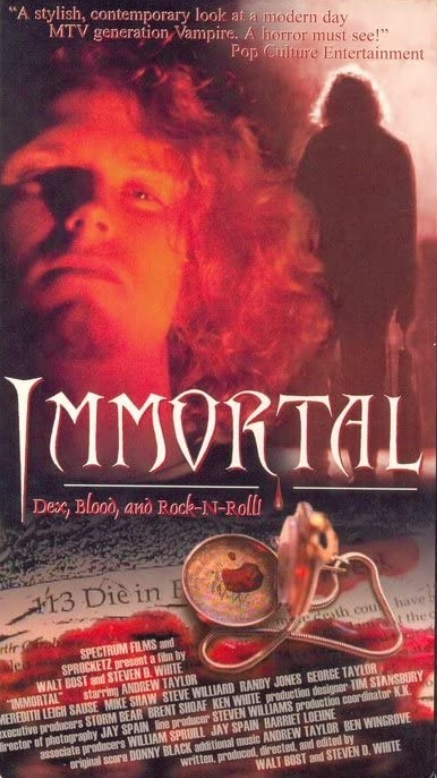
As Dax tries to make his mark on the music scene amid the mortals, he comes to discover music is no longer his addiction or his key to immorality — his quest for fresh human blood is his reason for being. As he makes his music (in what I see as an AIDS or cocaine addiction allegory; again, think Cobain), Dax struggles to keep his lusts in check and hidden from his bandmates and his girlfriend Linda (Edith Snow, aka Meredith Leigh Sause, currently in production on the indie horror, Prom Queen) . . . until he succumbs and feeds off a groupie and one of his guitar students — and a movie star who returns to his home town (Greg Humphreys). Will Dax find a “cure” courtesy of Wiley Wrestling? The mysterious albino (Frank J. Aard, later of the abysmal 2008 remake of 1986’s April Fools Day), who was the lone survivor of a horrific train wreck (the “113 Die” you see in the theatrical one-sheet), also wants his gold pocket (with a W.W inscription) in Dax’s possession, returned.
Upon succumbing to his lust and feeding off Linda, his addiction destroying his love, Dax takes to the streets playing for pocket change. Then a strange woman walks by and tosses an engraved pocket watch into his guitar case — inscribed with the initials “D.D.”
Courtesy of cwustman/eBay. Good luck finding a copy of the Permanent/Spectrum soundtrack. Sounds like another Rocktober Blood hornswoggle, to me.
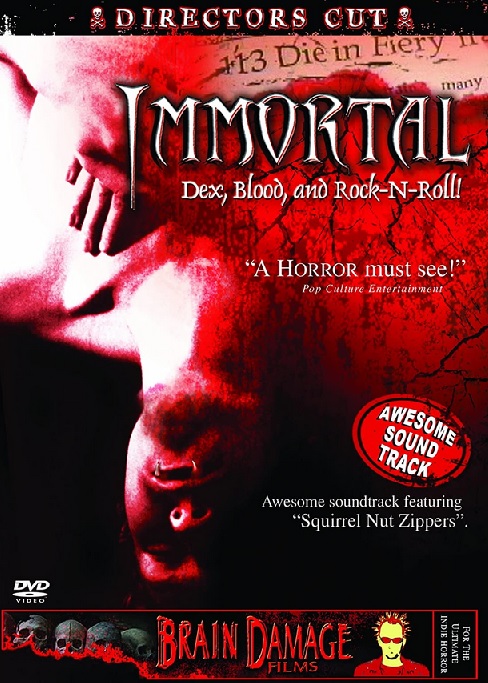
This is an SOV’er that is impossible to find on VHS (well, it used to be, before http reared its ugly bytes), and you can forget about the streams, free or pay, but the fine folks at Brain Damage Films resurrected this lost rock ‘n’ horror flick to DVD in 2007 — in a directors cut. Now, the VHS original runs at — what I feel — a too long one hour and forty minutes. As of press time, we’ve been unable to determine if the DVD reissue is longer or shorter than the original 1995 VHS issue.
You can find DVD copies at online retailers, such as Amazon and Best Buy. VHS copies are available on eBay/eBay. Brain Damage no longer lists the DVD in their catalog, so you’re at the mercy of used online copies.
Since the Squirrel Nut Zippers hit platinum after the films release, they’re now put to the forefront in the film’s reboot marketing.
And, sorry, Chum. There’s no trailers, clips, or music from the film in the online realms to share. But Googling any of the bands, as well as Mammoth Records, will expose you to the music behind the Chapel Hill and Raleigh-Durham, North Carolina scene that inspired the film.
You say you’re interest in more film shot in Chapel Hill, North Carolina? Well, you can dig into them courtesy of this IMDB filming locations list for the city. And here’s an IMDB list for Raleigh. And, in the mother of all lists, Wikipedia has a list of everything shot in the state. Be sure to swing by Greg Humpheys’s blogspot/social media portal and say “hi,” and let him know we remember him over at B&S About Movies. His new 2021 solo album, Spanish Steps, is out now.
About the Author: You can read the music and film reviews of R.D Francis on Medium and learn more about his work on Facebook.
The later DVD reissues of this love letter to the college rock era proclaim the film as “This Is Spinal Tap meets The Commitments” on the box copy. However, I feel a more accurate pitch to inspire your viewing is “Kevin Smith’s Clerks meets Singles.”
I’d pair this delightful (and accurate) indie comedy about the trials and tribulations of musicians alongside its college radio chronicle counterpart, A Matter of Degrees (1990), long before double-featuring it with the faux-band tomfoolery of This is Spinal Tap. In fact, Bandwagon plays better as a two-fer with Steve Buscemi’s feature film writing/directing debut Trees Lounge, as both films carry that same looser-with-hopes vibe — only Buscemi’s flick didn’t have a rock band in it (but did give us a great, college-rock title cut theme song by Hayden).
When it come to films encapsulating the Athens, Georgia, to Chapel Hill (and Raleigh-Durham), North Carolina ’80s college rock scene — spreadheaded by that scenes “Nirvana” in R.E.M — no film does it better than this debut feature film writing and directing debut by John Schultz, the original drummer for Raleigh, North Carolina’s the Connells (he left the band prior to their debut recording to pursue film).
If you had a college rock or community/non-commercial radio station (that supported indies and local music) in your area, or if you stayed up late on Sunday nights to watch MTV’s alt-rock programming block 120 Minutes, or perhaps you picked up copies of Alternative Press, Option, or B-Side magazines instead of the faux, non-commercial ramblings of Spin, you come to know the Connells melodic Elvis Costello-cum-the Smiths sounds with their underground hits “Hats Off” and “Seven” from their well-received debut album Darker Days (1985), and “Scotty’s Lament” from their sophomore effort Boyland Heights (1987). Both albums should have taken the Connells to the commercial heights of their contemporaries, R.E.M — but did not.
Instead, the Connells settled into a comfortable, college-rock star status with their albums Fun & Games (1989), which produced the modern rock hit “Something to Say,” and One Simple Word (1990), which produced the Billboard hits “Stone Cold Yesterday” and “Get A Gun.” Their fifth album, Ring (1993), while still not finding any headway on commercial U.S. radio stations (even in the “Rock Alternative” craze flipping hair-metal oriented AOR stations at a dizzying rate), none the less expanded the Connells audience to Europe, where the album and its related singles, “74-75,” and the should-have-been-the-hit-that-broke-them-in-America (on the level of Cracker with “Low”), “Slackjawed,” charted in several Euro-counties. Not even a national television appearance with “Slackjawed” on NBC-TV’s Late Night with Conan O’Brien (it didn’t work for John Doe* on David Letterman’s show, either) could breach the commercial inroads afforded to the drek spewed by the likes of the Crash Test Dummies and the Spin Doctors.
The film’s connection to the Connells, by way of the band’s ex-drummer John Schultz, continues with the band’s lead singer Doug MacMillan starring as the legendary band manager Linus Tate, who takes the film’s scruffier, ersatz-Connells of the film, Circus Monkey, under his wings to college rock stardom.
Courtesy of John Schultz writing what he knows (a lesson that many first time screenwriter-directors fail to realize; keep it intimate) for his first feature film, Bandwagon displays a well-honed grace against its low budget, a skill that Schultz developed while creating feature documentaries for Steven Spielberg’s Hook and Jurassic Park. If you enjoyed Kevin Smith’s grungy, Gen-X debut, Clerks (released two years earlier in 1994; both the film and its soundtrack), then there’s something here in this North Carolina-shot musical chronicle for you to enjoy.
Courtesy of his connections working on those documents, and Bandwagon being well-received at Sundance, Schultz came to direct two major studio projects that you may have come across on cable or plucked off your local video store shelves: the Melissa Joan Hart-starring Drive Me Crazy (1999) and the basketball comedy Like Mike (2002) starring Lil Bow Wow. His most recent features (his 9th and 10th) were the Netflix-backed A Christmas Prince: The Royal Wedding and The Royal Baby (2018/2019). His sophomore screenwriting credit to Bandwagon was the comedy When Zachary Beaver Came to Town (2003) (from the days when the kid from Jerry Maguire was a “thing” set to be the next Macaulay Culkin).
In an interview with The Boston Globe (the city was a major college radio hub/market at the time), John Schultz said, “On the shoot, we (as with most of the crew, as himself, it was their first-ever film) didn’t really realize what we were doing right and what we were doing wrong [during their six-weeks shoot in 1993 in Raleigh, North Carolina] and a lot of the problems we found in the editing room.”
Musician Greg Kendall, hired to write the songs for the faux Circus Monkey, met Schultz through their mutual friend, Doug MacMillan. “They were to have good songs,” Kendall told The Boston Globe‘s Jim Sullivan, “but they had to be believable. They couldn’t be too stupid and they couldn’t be too ornate.” Schultz, Kendall explained, supplied the titles to the songs and Kendall wrote and sang them. The songs were recorded at the world famous (well, at least in college rock circles) Fort Apache Studios in Cambridge, Massachusetts (know you Dinosaur, Jr. history). In addition to the film’s eight songs, Kendall also scored the film. “There’s nothing ‘MTV’ about it [the film]. It’s naive, some would say to a fault. I would say it’s a strength,” explained Kendall.
You just gotta love humble musicians and filmmakers who know their strengths and weaknesses, and are truthful in their quest do their best to create their art.
As far as the original tunes go: If you enjoy the Connells, or the lighter, less fuzzy-distorted side of Dinosaur, Jr., and the poppier-sloppy sounds of the Replacements, with a dash of Uncle Tupelo/Wilco, you’ll enjoy the tunes crafted by Kendall. For me, “It Couldn’t Be Ann” is a real stunner (the link takes you to the video single of the tune that features scenes from the film). Sadly, the official soundtrack was an elusive one to track down . . . so, yeah, this was one of those patch the VCR into the cassette deck movies to get the songs for your car, type of films.
The elusive soundtrack — easier to find in today’s online marketplace.
The band Circus Monkey comes together as three slacking Raleigh musicians — Eric (Steve Parlavecchio), a jock bassist; Wynn, a drug-addicted guitarist (the always great Kevin Corrigan; Ray Liotta’s brother in Goodfellas); and the always-babbling drummer, Charlie (Matthew Hennessey) — deal with their own issues of friendship and relationships and career frustrations on the local indie scene. The label signing of the rival “frat-band” Spittle (think Pearl Jam’s “fake grunge” vs. Nirvana’s righteousness) instills a resolve for our ne’er-do-well six-string slingers to get their you-know-whats together and net a record deal . . . if only they could win Rival Records’ upcoming Battle of the Bands talent showcase . . . and not become a Faustian record company victim . . . and end up like the bane of their existence, that is their rivals, Spittle.
The only problem: none of them can write a decent song. So they recruit Tony (a really fine Lee Holmes), a shy, neurotic garage mechanic whose songs — perpetually about a girl named “Ann” — never leave his makeshift studio in the back of said garage. And when Tony is finally coaxed out of the garage and onto the stage — he stands in the corner with his back to the audience . . . if only the elusive Ann (who no one believes is real) would turned up at a show and notice him. . . .
Is the script a bit uneven, punctuated with some directorial missteps and a wee-bit of thespian weakness? Sure. But, again, John Schultz lived the life and he expertly encapsulates the romanticism for his college-home town roots.
As we discussed in our “Drive-In Friday: First Time Directors & Actors Night” featurette**, not every celluloid neophyte is hitting a Quentino Tarantino over the 410 at PNC Park, or infield-homering a Boondock Saints. But make no mistake: John Schultz is no Tommy Wiseau and Bandwagon is no The Room. Unlike Matty Rich, who wowed us with his heartfelt simplicity in his debut Straight Out of Brooklyn, only to scuttle his career Troy Duffy-style, Schultz, gave us an admitted strained, but technically adept film that, like Alex Kendrick before him with his first film, Flywheel, came not from a quest for fame, but to express his soul though a lens instead of behind a drum kit.
And I am glad John Schultz came out from behind that drum kit to create one of my favorite — and not just rock films — but films, period. It was a blast watching this again (how many times does that make, now).
You can enjoy the full film as a free-stream on You Tube.
* We blew out a week’s worth of films starring John Doe of X, so do check out our “John Doe Week” of reviews.
Update, September 2022: Thank you for the positive support from Club Videodromo for reference-linking our review in their overview of the film. Keep up the great work on your end, as well!
About the Author: You can learn more about the writings of R.D Francis on Facebook.He also writes for B&S About Movies.




















 B&S About Movies
You must be logged in to post a comment.