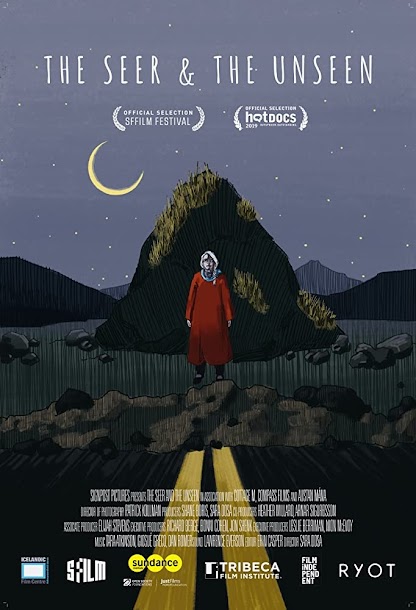
“A magic realist documentary about invisible elves, financial collapse and the surprising power of belief, told through the story of an Icelandic woman.”
Ragnhildur Jónsdóttir is a person who speaks on behalf of nature under the threat of great change. And she speaks to the past as well, a place that — well, we’ll leave that up to you, dear viewer — may be still filled with elves and invisible forces that are able to still influence our modern world.
It doesn’t matter if you believe it or not. You just need to watch this.
Ragga, as she is called, is a seer who communicates directly with a parallel realm of elves called the huldufólk that at least half of her native Iceland believes in. That means that businesses, individuals and even the government ask her to see where they should build and develop property. However, not everyone believes or listens to Ragga, so when a new highway begins construction across an untouched lava field near Reykjavik — and threatens an elven church within the rocks — Ragga fights to protect the homes of those who only she can see.
Director/producer Sara Dosa said, “When I first learned about Ragga, I not only thought that she was a delightful, strong and wise person who’d make for an inspiring protagonist for a film, but also that her story provided an unexpected conduit to exploring the belief in invisible forces: be they invisible elves or the ‘invisible hand of the free market,’ to call upon Adam Smith’s original phrase. By juxtaposing these systems of belief, I wanted to make a film about what humans choose to see: the spirits of the land who beckon protection for the environment or the valuations of an economic logic capable of producing gross inequality, environmental destruction and that bankrupted Iceland (among many others). My hope is that the film can show the power of these unseen forces and reveal not just what is worth seeing but what is worth saving.”
In her director’s statement, Dosa really sets the tone for this film: “We can’t see God, for instance, but somany of us believe God exists, and that beliefhas profound consequences on how many live their lives.The same is true of the forces animating markets, which are regularly taken as fact and the products of ‘natural laws,’ rather than understood as comprising a system of beliefs. Rather than state this insentiment in academic language, our protagonist, Ragga Jónsdóttir, instead is the spirited conduit for thisexploration. And, by juxtaposing these systems of belief, my desire ultimately was to make a film about what humans choose to see: the spirits of the land who beckon protection for the environment or determinations of economic value capable of bankrupting a nation. My hope is that the film shows theseinvisible forces that shape our world and transform our natural landscapes, revealing not only what isworth seeing but what is worth saving.”
To Ragga, the invisible hand that guides the world of money seems just as foreign as you or I may see the world of magic. Sosa is uniquely able to tell the story of this juxtaposition, as she graduated from the London School of Economics’ joint Master’s program in Cultural Anthropology and International Development Economics.
We often see foreign countries as a strange place that we’re afraid of exploring. Or we make fun of their unique customs. But perhaps by looking to these places, we can learn something new that can help the parts of the world that we inhabit. That’s one of the many reasons why this film is worth more than just a look.
The Seer and the Unseen is being handled by Utopia in North America and they will release the film on AppleTV and Altavod.
Utopia is headed by Robert Schwartzman — of the band, Rooney, and a writer and director in his own right — who made his feature film directing debut with the really fine comedy, The Argument, released last September. You can learn more about the launch of Utopia Media with this February 19, 2019, article at Deadline.com.
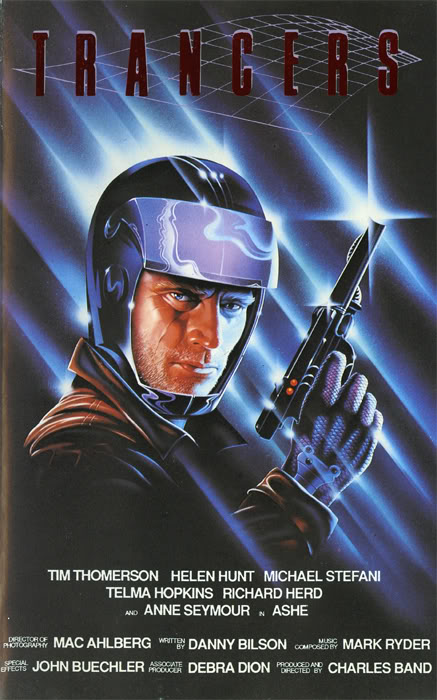
Look, there are bad Full Moon movies — there are more than a few — and there is also Trancers, a movie that has people in the future doing drugs to go back in time and the cop who polices the time stream, who is called Jack Deth, is played by Tim Thomerson and for some reason is a hardboiled film noir character in the midst of what is kind of a science fiction zombie movie that eventually also becomes a medieval parallel world story as the sequels keep on coming.
It was written by Danny Bilson and Paul De Meo, who really had some great ideas, writing — and occasionally directing — everything from Zone Troopers and The Wrong Guys to The Rocketeer and TV series like The Flash, Viper, Human Target and The Sentinel. Bilson was also the go-between for the Harry Potter games, making sure that EA and creator JK Rowling were on the same page. The team also worked for THQ, where they pushed for the video game company’s own IPs to gain prominence — THQ mostly made licensed games at first — including the great Saints Row series. Bilson also wrote Eliminators and Arena, but sadly died in 2016. The team’s last script, Da 5 Bloods, became a Spike Lee joint in 2020.
Deth has come to our time from the 23rd century on the hunt for Martin Whistler, a psychic supervillain who can use his mental powers to make people into mindless Trancers, which Jack can detect with his special bracelet. Once they are triggered, these human bombs go from normal people to killers in seconds; as Jack would say, “Only squids get turned into Trancers.”
Our hero is currently in the body of Phil Dethton, a journalist ancestor, and gets an instant girlfriend in the form of Leena, who is played by Helen Hunt. That may surprise you. What is even more astounding is that she showed up for the sequel.
How can you not love a movie that has a member of Tony Orlando and Dawn — Telma Hopkins — as the engineer of a time machine? Trancers is full of ridiculous moments that somehow all work out and a lot of the credit for that goes to Thomerson, who was once in the Army National Guard with Brion James before becoming a stand-up comic.
Look, they’ve made six of these — and a short — and I could watch them all multiple times. I realize my taste is not the best, but I can honestly say that the Trancers films fall on the good side of the Empire and Full Moon release slates.
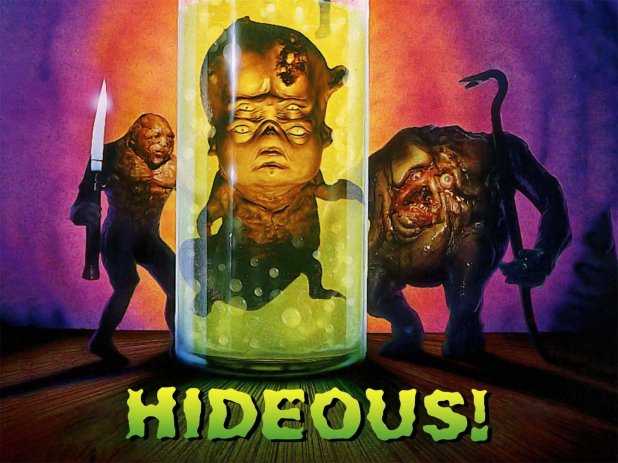
A Full Moon shot in Romania movie directed by Charles Band himself, this one is all about a fleshy speciman that washes up in a water treatment plant that everyone wants for themselves. There’s a scene with a woman in a bikini and an ape mask stealings aid specimen by gunpoint, so there’s definitely a few memorable moments, right?
There ends up being four different specimens. One has a little body and an enlarged deformed head with two pairs of eyes and two mouths, plus tentacles. There’s also a blob with a face, a hairless ape that likes breastfeeding — another memorable moment — and a skeleton with porcupine-like spines.
That said, this is the kind of Full Moon movie that really leaves me cold. It makes time stand still and you keep looking at how much time is left, the only joy being the moments when the little guys are on the screen. More goopy fetus babies! Less human beings talking in rooms!
Yes, Full Moon has a kid’s line called Moonbeam. Is it weird that a company founded on killer dolls would make movies for the entire family?
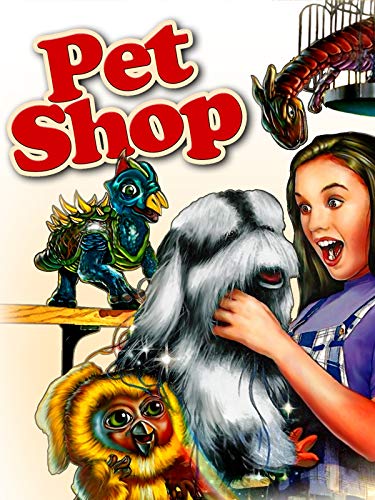
An alien couple comes to Earth in cowboy clothing and as soon as you realize that one of them is Terry Kiser, it all kind of makes sense. They have quite the plan: get kids to come inside their store, give them a free pet, then said pet reveals that its an alien that needs special food. When the kids come back, they kidnap them and then take them to sell in space as an entirely different kind of pet shop, which is in no way not horrifying to any child that watches this and then goes to PetSmart to get litter for their cat.
Does Full Moon have pictures of Pino Donaggio in a compromising position? I have no idea how they got him to give a song to this film other than money and I don’t think they throw all that much of that around.
This was directed by Hope Perello, who also made Howling VI: The Freaks. That should tell you all you need to know.
There have been five Killjoy movies. How about that? I mean, who knew?
This poor nerd named Michael just wanted to ask out his friend Jada, who has a gangster boyfriend named Lorenzo, which leads to him getting beaten down, then later shot and killed. Before he died, Michael had been trying to animate a doll named Killjoy.
A year later and Jada has left Lorenzo for another gang member named Jamal yet has never dealt with Michael’s death. And now, Killjoy is real, living inside an ice cream truck and killing off all the members of the gang.
Somehow, Killjoy has merged with Michael’s spirit in order to kill more people and gain power. I mean, he has enough power to get shot multiple times and spit bullets out of his mouth, so there’s that. Only Jada — who loved Michael — can kill this demon by finding the doll and killing it. Yet Killjoy has an entire army of the dead who answer his commands.
You have to love a movie that ends with a guy going under the covers to go down on the film’s heroine and reveals that he’s really a murderous clown.
Ángel Vargas played Killjoy in this first effort, but he declined the sequel Killjoy 2: Deliverance from Evil. Trent Haaga took over the role and would play the part in Killjoy 3, Killjoy Goes to Hell and Killjoy’s Psycho Circus.
Dennis Paoli wrote Re-Animator, From Beyond, Dagon, The Dentist, Spellcaster and Castle Freak, so I would put his Full Moon work on the good side of the “Is it a good or bad Full Moon?” equation that we’ll discuss throughout this week of their films. I am thanking him for somehow getting Charles Band to make a movie with all non-small characters, save Phil Fondacaro, because Mr. Band just can’t seem to make a movie without someone short or miniature.
Unlike so many other Full Moon films, this one looks and sounds great, with a Pino Donaggio score and a lush and romantic feel, because hey, it’s the Full Moon version of Beauty and the Beast.
It’s also incredibly troubling, as Lawrence and his twin brother are under a curse and may only be killed by someone who loves them. I don’t believe that said curse gives them license — here’s the rough part — to drug and assault our main character Catherine Bomarzini (Sherilyn Fenn) and her friend Gina (Charlie Spradling, who was also in the Full Moon films Bad Channelsand Puppet Master II).
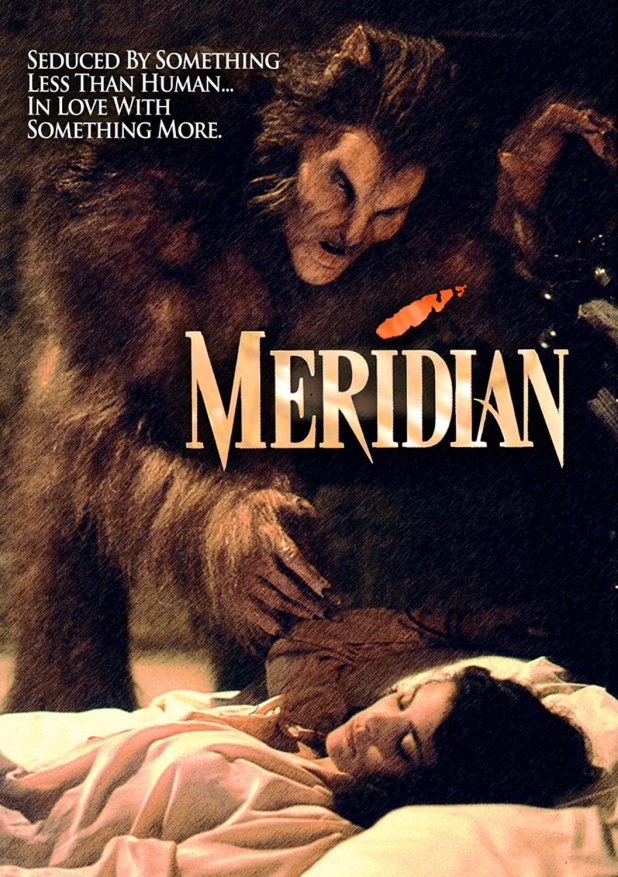
Also known as The Ravaging, which is the re-mastered title, this movie also has a ghost girl, a faithful nanny and monster and human lovemaking. It’s kind of like the Cinemax version of a fairy tale — umm, no wait, that would be Fairy Tales — and I’m sure that lots of folks rented this before they could actually rent VCA movies and were rewarded with something even stranger than an actual adult movie.
Ashley, a young cheerleader, may seem like she has a perfect life. But the trust is that her parents are really the killers of her birth parents. And sure, they’re parents and you expect any mom and dad to have some problems, but I mean, they really have issues. When a home robbery happens, Ashley gets the chance to either escape or be part of this family for good.
A man named Mark has broken into Ashley’s home, but he learns that her family may be even worse criminals than he is. He’s willing to whatever it takes to survive, but they’re doing everything they can to make sure he won’t.
Nicole Henderson, who plays Ashley, is pretty great in this, taking on a role that hovers between someone you sympathize for and may even fear a little. She’s got a good script from Laura Ashley Polisena to work from and the direction of Eddie Augustin, making his full-length debut, to guide her.
The conclusion to this movie — which struck me as very A Bay of Blood — actually shocked me. That hasn’t happened in some time, so well done to all involved.
You can watch Hostage on digital from Terror Films. It’s also on Tubi.
Once upon an ’80s VHS time . . . there was a Canadian exploitation tax shelter film franchise known as “Screwballs” that was created to cash-in on Porky’s and the Police Academy series. Courtesy of your HBO subscription back in the ’80s, the Screwballs films were oft-run T&A favorites on that early pay-cable service, as well as perfect programming fodder for the USA Network’s “Up All Night” weekend programming blocks.
It all began with Screwballs (1983). Then along came Loose Screws, which aka’d on HBO and the USA Network asScrewball Academy, and home video as Screwballs II (1985/1986). Then there’s this third and final entry — sometimes appended with a “3” in home video quarters — which has less to do with the first film as the second film has to do with the first film. The overall gist of the first Screwball film isn’t so much Police Academy as it is Porky’s, courtesy of the resident screwballs as a gaggle of horny, 1960s high school students trying to get laid.
AKA, Screwballs 3 . . . notice that while the legs look real, the dippy bellhop is an artist rendering? Way to go, art department!
The only real through line between the first and second films (well, there is one more connection, for all three films, but we will get to that, later) is that Rafal Zeilinski directed both screenplays written by actress/director Linda Shayne (she wrote her own directing debut Purple People Eater; Screwballs (I) served as her screenwriting debut; she also wrote Crystal Heart). The original plan for what became best known as Screwball Academy to the cable television masses was to bring back the four leads from the first film; instead, all new actors were cast in a re-write of the original story. Only now, our horny students covet their new, sexy French teacher at . . . Cockswell Academy (yes, that’s the level of comedy you’re getting); the original lads attended Taft and Adams High School and coveted the school’s “hottest, pure girl,” Purity Bush (again, comedy . . . you gotta love it).
So that’s the Screwball-back story . . . and brings us up to speed — somewhat — for Screwball Hotel, a film whose only connection to the “franchise” is that Rafal Zielinski directed all three films. And you know what: while each have their detractors, each also has their fans: ones who fondly recall either watching them on cable TV via HBO or The USA Network or as a $.49 cent Friday Night rental (I fall in that grey area-between the two of not loving but not hating them. But as you get older . . . nah, nostalgia wins, again).
The Review
Yeah, it’s the same ‘ol song and song and dance in the pants as horny ne’er-do-wells kicked out of a military academy take jobs at a dying Miami Beach hotel (while a Canadian production, this shot in Miami). To save the hotel, our lustful lads organize the “Miss Purity Pageant” — with the hotel’s prudish female guests (boilerplate-reminding of Purity Bush from the first Screwballs) as contestants. Of course, as with the first film, and despite the material’s intent, there’s no nudity or sex scenes to trip the triggers; just lots of T&A innuendos, but no actual nudity or sex. Pour Porky’s, Police Academy and the teen-flick cycle of John Hughes into your National Lampoon logo-tumbler and serve up a film that’s . . . not so much of a plot, but SNL-styled vignettes and sight-gags that run from the outrageous to the raunchy to the ugh-enduring stupid.
The character boilerplating continues with . . . remember the tubby, food-loving Larry “Fink” Finkelstein from Meatballs (1979)? Well, Screwball Hotel has a Finkelstein. Remember the “Spanish Fly in the food” scene in Screwballs? Well, we have one of those — only with cocaine. Then there’s offensive Arab stereotypes, a dominatrix trope shows up, a Australian guest into sheep-bestiality appears, along with women’s oil wrestling, more nympho women, more horny men, and hot-but-ditzy women everywhere.
If this sounds a lot like Johnny Depp’s marquee-leading man debut in Private Resort (1985), then it probably is. Adding to the six degrees of celluloid separation is the fact that actor Michael Bendetti, who replaced Johnny Depp’s replacement of Richard Grieco on FOX-TV’s 21 Jump Street, as Anthony “Mac” McCann in that series’ fifth and final season, makes his feature film debut, here (his dual acting and leading man debut), as Mike, the ne’er-do-well leader of the hospitality shenanigans. The only other actor worth mentioning is two-time Penthouse “Pet of the Month” and “Pet of the Year” Corrine Alphen Wahl, who we’ve enjoyed in BrainWaves (1982), Spring Break (1983), and Equalizer 2000 (1987). (Wait, there’s another Penthouse Pet, here, more on that later.)
The ’80s comedy déjà vu caveats: Don’t confuse any of this Cannuck tax shelter tomfoolery with Oddballs (1984), which Miklos Lente, the cinematographer of Screwballs, directed . . . and it’s pretty much a rip of Meatballs, which, if you haven’t figured out, is ripped ‘n’ pinched by Screwballs, natch. Of course, Golfballs! (1999) — which is no way connected to the Screwball franchise — is as much like Oddballs as Oddballs is like Meatballs, which is, in turn, is like Caddyshack. And the beat, well, ball, bounces on . . . to Daniel “Paco Querak” Green, who made his big screen acting debut in the same ol’ “dying hotel on Miami Beach” plot in Rosebud Beach Hotel (1988).
So, this time — for Screwball Hotel — in lieu of Linda Shayne, we get the pen of Charles Wiener. After his writing and directing debut with a Canadian TV movie slasher ripoff, known as Blue Murder (1985; Starring Britney Spear’s dad? Nah. Uh, maybe?), he wrote a Canadian not-Police Academy ripoff, known as Recruits (1986), as well as writing and directing the-Police Academy-set-inside-a-fire station-ripoff, Fireballs (1989) — which was shot back-to-back with Screwball Hotel. If you’re a martial arts completionist and need a Canadian not-starring Jean-Claude Van Damme rip, there’s Wiener’s third and final directing effort, Dragon Hunt (1990), for your shelf.
Rafal Zeilinski made his directing debut with Screwballs; his fifth directing effort, Valet Girls (1987), copies the template of the Screwball movies and Recruits — but changes it up with an all-female valet car service; it’s a film as blatant in its copying Deborah Foreman’s better-remembered My Chauffeur (1986) as it is Porky’s. And Zeilinski repeated the Screwball Hotel premise one more time in Last Resort (1994), which was backed by National Lampoon and starred the “Two Coreys” Feldman and Haim (another Corey two-fer is Dream a Little Dream) . . . but don’t confuse that film with the better (but not by much) Charles Grodin-starrer Last Resort (1986). And let’s not forget Zeilinski remade it all over again with State Park (1988), which ditches the schools, academies, and hotels for, well, a state park. By the early aughts: Zeilinski moved into Christian Cinema — yes, the guy who made T&A Screwball movies made Jesus movies — with The Hangman’s Curse (2003).
The Soundtrack
We had this penciled in for our “Rock ‘n’ Roll Week III” review series at the end of August (and we master listed Screwball Hotel in our round up of that week), but we bumped it back to our one of our “free range” weeks, when we just review anything that tickles the fancy. Just because.
So, Taiwan’s Golden Horse Film Festival nominee and China’s Changchun Film Festival winner, songwriter and composer Nathan Wang made his soundtrack debut with the songs “Check In, Check It Out,” “Making Money,” and “Punk Song” on Screwball Hotel, which he also scored. You may also have heard his tune “You Are the One” in Jackie Chan’s Rumble in the Bronx. He’s since scored over 160 international films and TV series. The songs on Screwball Hotel were sung by Terrea Oster, who provides the vocals for our ersatz rocker chick of the film — portrayed by Penthouse Pet Lisa Bradford-Aiton, in her only mainstream film role. The fruitful career of Oster’s son, Canadian Douglas Smith, led to roles in Terminator Genisys (2015), as well as starring in the Bill Paxton-fronted HBO series, Big Love.
Terrea Oster, who acted under the name Foster, as well, appears in the aforementioned, original Screwballs (1983), Oddballs (1984), and Screwball Academy. In addition to providing her singing voice to their soundtracks, she also worked in both disciplines on Flesh Gordon Meets the Cosmic Cheerleaders. Her husband, British producer Maurice Smith, has a resume that goes all the way back to classic counterculture biker romps The Glory Stompers (1967), The Cycle Savages (1969), and Scream Free!, aka Free Grass (1969). Yep, in addition to backing Flesh Gordon, he gave us Linda Blair’s Grotesque (1988) — and ALL of the Screwball/Oddballs films.
So, there’s the final through line we teased earlier, as well as the music portion (and Penthouse connection) of the film — for what that’s worth in your wanting to watch Screwball Hotel. Hey, sometimes you just gotta — even if you’re not a smarmy online film critic navigating the Three Rivers of cinematic fate in Steeltown.
About the Author: You can read the music and film reviews of R.D Francis on Medium and learn more about his work on Facebook.He also writes for B&S About Movies.
What do you get when you put writer Snoo Wilson and director Phillip Saville (Crash: The Mystery of Flight 1501), two Shakespearean-trained and BBC-TV nurtured chaps, into a room to create a project for an always worth the price-of-admission Patick Macnee? You get an obscurity that had its last television showing in its native U.K. on Channel Four in April 1998; in Australia in 1996. As with the recently reviewed Mill Creek The Excellent Eighties box set programmer, Blunt, the Fourth Man (1987), Shadey was part of Channel Four’s efforts in making movies for television and theatrical release.
So, with a touch of David Cronenberg’s Scanners (1981) and a pinch of Videodrome (1983), and a soupçon of Brian De Palma The Fury (1978), and, why not, a dash of Douglas Trumbull’s Brainstorm (1983), we get Oliver Shadey: a sexually-frustrated, lonely car mechanic-owner of a bankrupt garage who decides to cash-in on his ESP abilities.
Our man Shadey (Antony Sher, from Monty Python’s Erik the Viking to Joe Johnson’s The Wolfman) isn’t your run-of-the-mill clairvoyant: he can visualize anything happening in the world — as well as see into the future — and transfer those images to film. So Shadey makes a deal with Sir Cyril Landau (Patrick Macnee), a wealthy British industrialist — who subsequently sells him out to British Intelligence for his own person gain. Oh, and it’s not just personal and business bankruptcy that drives Shadey’s greed: he needs the money for a sex change operation.
Oh, by the way: this is a comedy.
We know this is a comedy, not because of the sex change operation angle, but because Shadey runs around with a camera strapped to the side of his head. And because the film opens with aerobics porn. And there’s a goth-punk band video shoot with shapely women swingin’ hoola-hoops — while adorned in gas masks. And Sir Landau may be in an incestuous relationship with his daughter. And Shady cross-dresses and dates an older man. And the film co-stars noted U.S television actress Katherine Helmond (Soap, Who’s the Boss, and Everybody Loves Raymond), who’s not exactly know for her work in serious, dramatic roles.
So, what’s with the camera and how did Shadey and Sir Landau get into business? Well, by way of his abilities, Shadey’s discovered a new, Russian diamond field excavation in the heart of Siberia. And Shadey “knows” how much Sir Landau loves his diamonds. Once the word is out on Shadey’s gift, he’s on the run with the MI5 the CIA hot pursuit — evil government psychologist Doctor Cloud (Billie Whitelaw, 1976’s The Omen to 2007’s Hot Fuzz), in particular — as we are left questioning what is real and what is hallucination in our reluctant-spy’s mind. Helping Shadey are Macnee’s agoraphobic-looney wife (Helmond) and materialistic model daughter (Leslie Ash, The Who’s Quadrophenia and Curse of the Pink Panther).
Since we are dealing with a movie created by two classically-trained BBC filmmakers, the proceedings are assembled well-enough, there’s a couple laughs amid the seriousness, and the acting from all quarters is solid — that’s played straight against the comedy.
You know what?
Forget the comedic Cronenberg inference: this is sounding all a wee-bit like a John Carpenter joint. Celluloid project with me: Instead of British actor Antony Sher: Chevy Chase stars as Shadey and Daryl Hannah stars as our evil operative instead of Billie Whitelaw, as we foreshadow the sci-fi black comedy bomb that was Memoirs of an Invisible Man (1992). “North by Northwest meets Starman,” indeed, John. Indeed.
Since those late ’90s TV airings, Shadey has since turned up on DVD (DVD Planet Store and DVD Lady are two outlets), but caveat your regions and emptor your grey-market DVR discs, dear readers. Shop smart. You can also find copies of Shadey on Amazon Prime UK (again, region and grey alerts).
You can watch Shadey online via a with-ads stream on You Tube as a sign-in view courtesy of FilmRise Features (there’s a lot of eclectic uploads on their page, so check ’em out) or as a (very clean) VOD on Amazon Prime US.
Hey, Mill Creek! Give us Shadey on a DVD — even on a box set. Hey, Shout! Factory, do for Shadey what you did for that Chevy Chase stinkeroo. We, the denizens of the video fringe, demand it.
About the Author: You can learn more about the writings of R.D Francis on Facebook.He also writes for B&S About Movies.
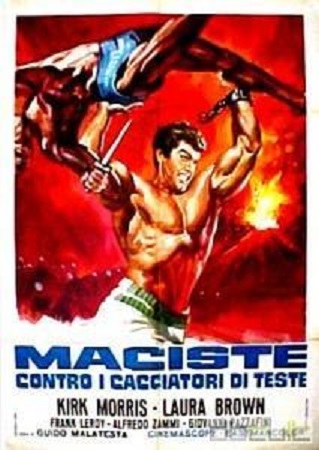
Known as Colossus and the Head Hunters here in America, this peplum was directed by Guido Malatesta, who also made Tarzana, the Wild Woman and a few other sword and sandal films, as well as the Eurospy Riuscirà il nostro eroe a ritrovare il più grande diamante del mondo? (Will Our Hero Be Able to Find the Largest Diamond in the World?).
Partially shot in Yugoslavia, this Maciste sequel takes the same volcano footage from Malatesta’s Maciste contro i Mostri (Fire Monsters Against the Son of Hercules in the U.S.).
It stars Italian bodybuilder Kirk Morris as Maciste, but you can see original star Reg Lewis — he was in Maciste in the aforementioned Fire Monsters — in a few long shots. That’s how much care this movie put into this, a film released at the near death of the sword and sandal cycle. Queen Amoa (Laura Brown, Colossus of the Stone Age) gets kidnapped by headhunters and our heroes defies the fates to save her.
This may be the movie that you need Mystery Science Theater 3000 to get through.





 B&S About Movies
You must be logged in to post a comment.