Angel, Angel, Down We Go (1969), aka Cult of the Damned (1970)

Poet, novelist, playwright and screenwriter Robert Thom is someone the B&S About Movies crowd knows best for Roger Corman’s quest to beat Rollerball to the theaters, with an adaptation (which Charles B. Griffith* doctored) of Ib Melchoir’s short story “The Racer” as Death Race 2000 (1975). Thom’s Hollywood (or is that Hollyweird) resume goes back a bit further, with the “teensploitation” screenplays for All the Fine Young Cannibals and an adaptation of Jack Kerouac’s The Subterraneans (both 1960). His screenwriting debut, Complusion (1959) — in which he was rewritten and not credited — was based on the infamous Leopold and Loeb murders and starred Orson Wells. (For Don Kirshner, he’d write the 1975, Kim Milford-starring Song of the Succubus.)

Thom’s next teen-oriented romp was the more “hep” counterculture-rock flick Wild in the Streets (1968), based on his short story “The Day It All Happened, Baby!”. When that American International Pictures’ $700,000-budgeted project cleared $4 million in drive-in receipts, Thom was given an opportunity to direct his first film, which he also wrote — and is the film we’re reviewing today: Angel, Angel, Down We Go.

Is it a counterculture drama . . . or a horror flick? Hey, whatever AIP – American International Pictures needs it to be to make a buck.

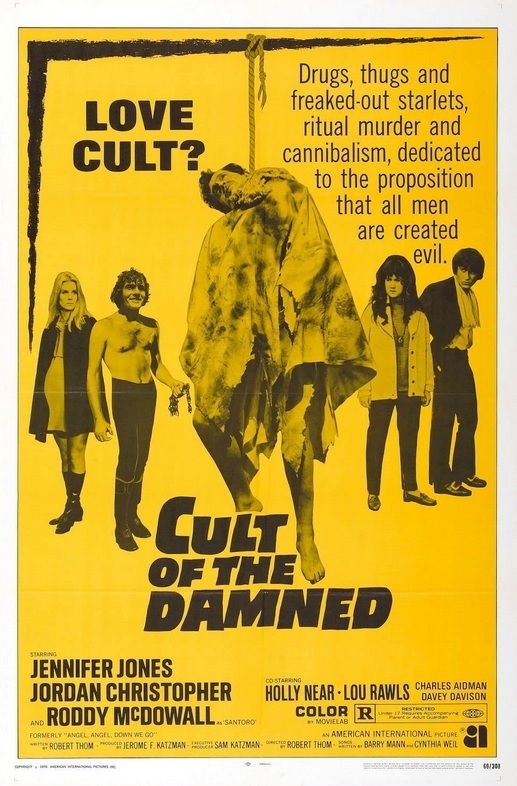
As with Wild in the Streets, Thom’s sole directing credit centers around a disillusioned rock star; its genesis was an unproduced stage-play of the same name written as a vehicle for his then wife, Janice Rule (better known for her ’70s guest-starring TV work than her films), who later became the wife of Ben Gazzara (The Neptune Factor, Road House).

By the time the script made it to the big screen, five-time Academy Award nominated and winning actress Jennifer Jones (won for 1944’s The Song of Bernadette) was cast as the affluent Mrs. Astrid Steele, the downtrodden wife of an airline magnate (think a gay Howard Hughes) and mother of the overweight and emotionally troubled Tara (folk musician, Broadway musical actress, and ’70s TV actress Holly Near in her feature film debut; she was Barbara Pilgrim in Slaughterhouse-Five) who becomes involved with Bogart Peter Stuyvesant, a charismatic rock star who takes advantage of the Steele family’s damaged emotional state to integrate himself and his Manson-like clique into their lives.

So, for his rock star, Thom cast . . . well, remember how Ben Affleck and Jennifer Aniston experienced a career boost based on their marriages? Such was the case of struggling Ohio-to-New York-based rock singer Jordan Christopher.

After his unsuccessful years as the leader of the doo-wop-inspired the Fascinations in the early ’60s (they recorded a few singles; here and here), Christopher came to join New York’s the Wild Ones, which replaced Joey Dee and the Starlighters¹ (of which Joe Pesci was once a member; without Pesci, they starred in Hey, Let’s Twist!) as the house band at New York’s famed Peppermint Lounge (where that movie was filmed). After that successful residency, the Wild Ones booked the same gig at the more chichi club, Arthur, operated by Richard Burton’s soon-to-be ex-wife Sybil Williams, aka Burton; Burton owned the club.

As with Ben and Jen after her, Sybil found her fame via her marriage to Richard Burton, who was a huge screen star at the time. And when Sybil came to become involved with — and within a month of the band’s residency, married — Jordan Christopher, his “star” began to rise, as well. Thanks to the pre-Internet gossip press and scandal sheets of the day, not only did Arthur transform into a “hot” club that decimated the Peppermint Lounge out of existence, Jordan Christopher’s the Wild Ones signed a record deal with United Artists Records to release the live-recorded The Arthur Sound (that’s Christopher at cover right; that’s Sybil hoisted on the band’s shoulders).

However, after that lone album, and his “image” hotter than ever, Christopher left the Wild Ones to become a “star” in Hollywood. An accomplished stage actor in minor productions back in New York, Christopher booked supporting roles in the forgotten late ’60s flicks The Fat Spy (a really awful “beach movie”; the worst of the pack, which featured the Wild Ones), Return of the Seven (the awful nobody-wanted-it bomb-sequel to western classic The Magnificent Seven), and The Tree (a kidnap drama). Angel, Angel, Down We Go, his fourth film, was Christopher’s leading man debut. In addition to recording the soundtrack to the film, UA signed Christopher as a solo artist for the album Has the Knack; without Christopher, the Wild Ones recorded the first, original version of “Wild Thing,” which was penned by Chip Taylor (brother of actor Jon Voight) specifically for the band (the Troggs version is the one you know).

The novelization/image WonderBook eBay.

So, since you probably never heard of Jordan Christopher, you have probably guessed the fame-cum-career by marriage and connection to the Richard Burton dynasty doesn’t not a solo career or a hit film make.

As with any of today’s cable TV-cum-Internet social media influencers, Jordan Christopher’s Kardashianesque fame, well . . . down, down it went, as the all-important Los Angeles Times and New York Times referred to his leading-man debut film Angel, Angel, Down We Go as “a pretentious mess” and “an unmitigated financial disaster,” respectively; the NY Times’ review was titled “The dime-store way to make a movie and money.”

Actress Holly Near, already Rubensque (think of a ’60s Ricki Lake of Hairspray; chunky-cute), put on even more weight for her debut film role, had hoped the film would transition her out of stage work, referred to the film as “it was trash.” She left film at that point and retreated into stage and limited TV guest-star work.. And it’s no loss, for Near’s no prize in the acting department; her binge eating scene at the coming-out party is still cringe-inducing; she even gorges on the scenery throughout. The gist behind party: Near’s Tara Steele turned 18 and returns from boarding school; her parents hired Bogart Peter Stuyvesant and the Rabbit Habbit to play the party . . . and Tara falls in love.

While Christopher never publicly spoke of the film, he retreated into stage work as an actor and theatre operator — not appearing on the big screen again until Star 80 and Brainstorm (both 1983). Truth be told, Christopher’s departure into theatre was no big loss to Hollywood, either; he’s simple awful in both films marking his return — and truly annoying as a childish/horny, unrealistic “scientist” in the latter. And he’s pure ham — by lack of a thespian skill set, not an acting choice — here, and you see why the undercarded Roddy McDowell, and not Christopher, had the career.

As for Robert Thom, who actually was a decent writer in the low-budget realms, came to write the ’70 gangster romps Bloody Mama and Crazy Mama for Roger Corman — but he never directed another film.
More bogus bands to be had with our “Ten Bands Made Up for Movies” featurette.

And Jennifer Jones, starring here as a former porn actress whose mainstream Hollywood “movie star” career is on the skids, playing up an overtly, sexed-up homage to Gloria Swanson’s Norma Desmond in the noir classic, Sunset Boulevard (1950), well, just what was she thinking? Jennifer couldn’t have possibly been hoping for a repeat on the lessons of social obscenity with Madame Bovary (1949), in which she starred? Doing an AIP grindhouse flick is a long, hard fall for Jones — who was long-time married to David O. Selnick, the producer who gave us the original King Kong**. Sadly, this was Jones’s first film after her much-publicized suicide attempt; then, later, her daughter committed suicide by jumping from a 20-story window.

To see an Oscar-caliber actress quoting the likes of . . . “I made thirty stag films and never faked an orgasm,” “In my heart of hearts, I’m a sexual clam,” “Do you want me, or do you want my daughter?,” and “You’re a bloody, sadistic dyke” . . . you’re sorry and embarrassed for her. So, with the one-two punch of her performance slammed by critics, and her daughter’s later suicide, one can see why Jones walked away from the biz, only to return one more time in Irwin Allen’s The Towering Inferno (1974). And, in the end, out of her mere 26 films, Angel, Angel, Down We Go is the one film of Jones’s that trash cinema lovers care about because, well, video fringe fandom is all about the trashy.

Meanwhile, American International Pictures wasn’t about to flush $2 million down the toilet. So, courtesy of Jordan Christopher’s Manson-like rocker, and with Charles Manson all over the press as result of the Tate-LaBianca Murders of August 8-9, 1969 (which fueled Quentin Tarantino’s Once Upon a Time . . . in Hollywood), AIP retitled and reissued the film as Cult of the Damned on a double bill with the first entry in Hammer Studios’ “Karnstein Trilogy,” The Vampire Lovers. And the Los Angeles Times slammed it, again, as “a terrible piece of trash.”

As the Los Angeles Times’ review stated in their negative review of this tale centered around the overweight debutante daughter of a wealthy couple who falls in with a tripped out, skydiving-addicted rock star and his reactionary clan, “. . . it can never be said to bore.” Hey, we never said bad films can’t be entertaining . . . well, except the ones with Jennifer Aniston and Jennifer Lopez, for the two-Jens — that’s just movie hell in a hand basket (and their bitching when they’re not “nominated” come awards season, doesn’t endear them to anyone; at least Holly Near has reality on her side).

The Barry Mann-produced soundtrack/image Discogs.

Valley of the Dolls (1967), the trashy, celluloid doppelganger to Angel, Angel, Down We Go, is in no way a good movie nor a classic; however, that Patty Duke-starrer is an undeniable guilty pleasure. And Angel, Angel, Down We Go so wants to be that Jacqueline Susann-adapted flick, but only ends up being even abysmal-trashier than the Roger Ebert-written and Russ Meyer-directed ripoff sequel Beyond the Valley of the Dolls (1970). And let’s not forget: Susann called the adaptation of her own book, “a piece of shit.” So that gives you a good idea on the low-grade, non-quality of Robert Thom’s sole directing effort. I’d even take the critical comparison a wee-bit lower, down to Peter Carpenter’s trashy, sexually-manipulating lounge singer in Point of Terror (1971). (If Christopher didn’t star here, Carpenter could have filled the role, admirably; hey, anything to bring back that red-fringe Elvis get-up, Peter! We recently honored Peter with a two-fer review-career blowout with Vixen! and Love Me Like I Do.)

Then again, if you’re into these counterculture LSD flicks of yore and enjoy the whacked-out realities of Skidoo (1968), The Phynx (1970), or the “fucked up future” of Gas-s-s (1970), then there’s something in the frames of this symbolism feast of the stoned senses. For lost . . . somewhere . . . in the frames is a statement on the nihilism of wealth and celebrity. But my inner being tells me even Kant and Nietzsche would reject Robert Thom’s tales as poppycock . . . once the house maid is exposed as a lesbian and the husband’s bisexuality come to light (he’s shower be-boppin’ the butler). And never in the writings of those metaphysical thinkers, did they ever dream up the Machiavellian likes of the Rabbit Habbit, a band which features Lou Rawls (in his feature film debut) and Roddy McDowall . . . with McDowall’s Santoro spewing his nihilistic sociopolitical ejaculate over his love for carrots. Yes, Cornelius is “turned on” by veggies. Read into that as you may, you dirty bird.

Jim? Is that you? Nope, that’s Bogart Peter Stuyvesant! Bogie, Bogie, Bogie. . . .

In the end, both the counterculture hippie masses, as well as the conservative masses (aka my parents, who got dressed up for dinner and a movie to see Valley of the Dolls, as parents did in the ’60s; mom loved the book, but HATED the movie), rejected Robert Thom’s attempt to graft the teachings of Kant and Nietzsche into the taboo-intellectual visuals of Pier Paolo Pasolini*˟. An allegorical work on the level of Pasolini’s underbelly tale of pimps and thieves in Accatone (1961) and his bourgeoisie-supernatural thriller Teorema (1968), Robert Thom’s lone directing effort, is not; it’s as inept as an inept high school production of a Tennessee Williams play.

The only real stand out of the film is Jordan Christopher (by singing, not acting) cloning a shirtless and leather pant Jim Morrison — with a touch of Iggy Pop — as our ersatz rocker belting the Barry Mann and Cynthia Weil-penned tunes (as part of Don Kirshner’s house of hits, they supplied tunes to the Monkees˟*) “Angel Angel Down We Go,” “The Fat Song,” “Hey Hey Hey and a Hi Ho,” “Lady Lady,” “Mother Lover,” and “Revelation,” which are actually pretty good tunes. Oddly enough, Lou Rawls — who reached his own solo career highs with the Top 40 ’70s hits “Lady Love” and “You’re Gonna Miss My Love,” doesn’t sing in the film.
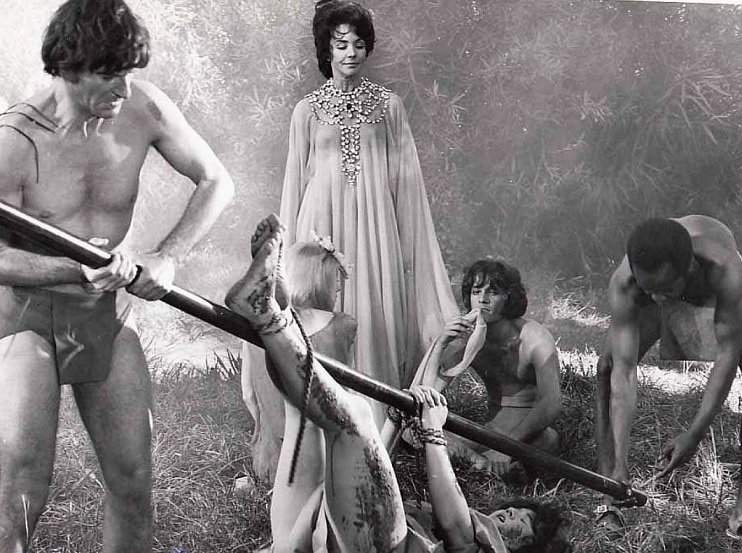
L – R: Roddy McDowall, Jennifer Jones, Davey Davison (seated/back), Holly Near (on the spit), Jordan Christopher, and Lou Rawls — bringin’ on the pretentious symbolism.

If you read our recent review for Breaking News in Yuba County, you know that on October 7, 2020, four decades after the imprint’s closure, Metro-Goldwyn-Mayer reactivated the AIP-imprint to release digital and limited theatrical releases (MGM will handle streaming while United Artists will handle the theatrical end). The studio was founded by James H. Nicholson and Samuel Z. Arkoff and all AIP releases followed the ARKOFF formula:

Action (exciting, entertaining drama)
Revolution (novel or controversial themes and ideas)
Killing (a modicum of violence)
Oratory (notable dialogue and speeches)
Fantasy (acted-out fantasies common to the audience)
Fornication (sex appeal for young adults)

So, yeah, Angel, Angel, Down We Go is a bizarre pint of an ARKOFF-crafted microbrew (bubblin’ with images of Near’s face on a guerilla, and then a lion, as part of a trip and its “message”), a libation of choice that we gulp with glee at B&S About Movies. You know us, with our celluloid schadenfreude of the Sexette (1978)˟˟ and Myna Breckenridge (1970) variety (both spiritual, washed-up actor sloppers), for that is what it’s all about, out on the video brewin’ fringes. So pair Angel, Angel, Down We Go with Robert Thom’s rock “prequel” Wild in the Streets and Mick Jagger’s decadent rock star turn in Performance (1970), toss back an ARKOFF, and pop open a bag of salty American International Psychedelic Trash Nuggets. Yum.

You can stream Angel, Angel, Down We Go on You Tube. For a cleaner, commercial-free stream, we found a PPV copy on Vudu. To get you started, we found a trailer and a copy of the 45-rpm/7″ single for the film’s title cut-theme song.


* Charles B. Griffith gave us the redneck romps Eat My Dust! and Smokey Bites the Dust; went “Jaws” with Up from the Depths and, as an actor, appeared in Hollywood Boulevard. Check out our “Top 70 Good Ol’ Boys Film List” feature with more hicksploitation-cum-redneck reviews.

** Join us for our “Kaiju Day” and “Son of Kaiju Day” review recaps as we pay homage to all manner of Kong and Godzilla movies to celebrate the release of 2021’s Kong vs. Godzilla.

*˟ We discuss Pasolini’s work in our review of the 2020 documentary Fascism on a Thread: The Strange Story of Nazisploitation Cinema.

˟* We discussion Don Kirshner’s film production career in our “Exploring: The Movies of Don Kirshner” featurette.

˟˟ Check out our “Box Office Failure” week of film reviews.

¹ Felix Cavaliere, later of the Young Rascals and the Rascals, got his start with Joey Dee & the Starlighters. He, along with Gene Conrish, have recently reactivated the Rascals (then, as with all other tours, got COVID derailed); after his stint with Joey Dee, Cavaliere formed the Young Rascals with Gene Cornish, Eddie Brigati, and Dino Danelli.

After the Rascals collapsed, they morphed into the harder rocking Bulldog, with Gene Cornish and Dino Danelli at the helm. After Bulldog’s two albums in the early ‘70s, Cornish and Danelli teamed with Wally Bryson, from the early ‘70s “power-pop” pioneers the Raspberries (also out of the same Akron, Ohio, scene as Jordan Christopher), to form Fotomaker, which issued three albums in the late, new-wave ‘70s: Fotomaker, Vis-à-vis, and Transfer Station. A Cars or Knack-like success for Fotomaker was not meant to be, even with their great, debut single, “Where Have You Been All My Life.”

While Fotomaker was going on, Felix Cavaliere — who once played with Joey Dee, mind you — formed Treasure, a harder AOR band that issued an album in 1977 — and featured Vinnie “Vincent” Cusano, later of Kiss, on lead guitar.

Dino Danelli ended up in Little Steven and the Disciples of Soul — playing alongside ex-Plasmatics bassist, Jean Beauvior. After the Raspberries, and before Fotomaker, Wally Bryson formed the hard-rock outfit Tattoo with Thom Mooney from Todd Rundgren’s the Nazz, which put out one album in 1976 on Prodigal Records (a Motown subsidiary). Thom also did time in Fuse with Rick Neilson and Tom Petersson, both later of Cheap Trick. And, the drummer in Fuse was Chip Greenman; he ended up in the Names, which doubled as faux “No False Metal” rockers the Clowns in Terror on Tour. And, of course, Cheap Trick came to be known via their first soundtrack effort, Over the Edge.

Don’t forget! We are deep into our third “Rock ‘n’ Roll Week” blowout. Yes, we’ve done this twice before, and you can catch up with our “Rock ‘n’ Roll Week” Round-Ups 1 and 2 with their full listings of all the rock flicks we’ve watched.


About the Author: You can learn more about the writings of R.D Francis on Facebook. He also writes for B&S About Movies.

John Travolto… da un insolito destino (1979)

John Travolta…By an Unusual Fate* is the translation of this title, but you may also have heard it called The Face with Two Left Feet. It was written and directed by Neri Parenti, whose main claim to fame is making cinepanettoni, which are comedy films that are screened during the Christmas season.

He was joined by Massimo Franciosa (SpasmoThe Four Days of Naples) and Giovanni Simonelli, who in addition to directing the “Fulci presents” movie Hansel e Gretel wrote Special Mission Lady ChaplinAny Gun Can PlayHave a Good Funeral, My Friend… Sartana Will PaySeven Dead in the Cat’s EyeThe Ark of the Sun GodJungle Raiders and Cat in the Brain.

And on what a tale these men are ready to spin, as a hotel worker named Gianni uses his Travolta-esque face to woo a disco queen played by Ilona Staller, the woman who one day soon would become not only adult star Cicciolina, but also a member of Italian Parliament and an international woman of interest.

Another sex symbol, Sonia Viviani, appears in this as well. She was thought to look like Princess Caroline of Monaco, which lead to appearances in the foreign editions of Playboy and Penthouse as well as roles in Nightmare CityThe Blood Stained ShadowThe Return of the Exorcist, Bruno Mattei’s Women’s Camp 119 and Luigi Cozzi’s The Adventures of Hercules.

Not many people — well, Jesus and Bruce Lee — get their own exploitation category. Somehow, a few years into his career, John Travolta joined that group of very special people. Even the disco in this movie is called John’s Fever.

Those that love Italian movie music will be overjoyed to discover that the song “Baby I Love You” is by Italian disco pioneer Giancarlo Meo with Claudio Simonetti from Goblin under the name Easy Going, which was named after a gay disco. They had a song called “Fear,” which was about a man wanting to commit a crime so people would stop thinking he was a homosexual, as well as songs called “Little Fairy” and “Gay Time Latin Lover.”

The cover of their first album was an actual photo of the Easy Going club dancefloor.

There’s also a song called “Go Away” by Linda Lee, who is also Rossana Barbieri and appears on the soundtracks of ZombiInferno and The Psychic.

*This is a reference to the film Swept Away. Not the Madonna remake, FYI. It also has the title The Lonely Destiny of John Travolto.

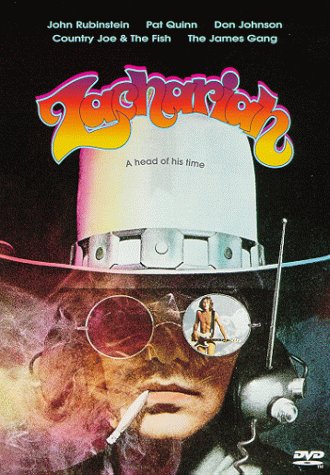
Zachariah (1971)

“The first electric Western” is the kind of movie that could have only have come out in 1971.

How else do you explain a musical Western that is based on Hermann Hesse’s novels Siddhartha and Narcissus and Goldmund that stars — and has music by — the James Gang (featuring Joe Walsh, playing Job Cain’s Band), White Lightnin’ (a Cream soundalike band that Old Man’s Band), New York Rock ‘n Roll Ensemble (a classical baroque rock group that includes Michael Kamen (who did incidental music for Lifeforce but is probably better known for all those Bryan Adams songs that your mom loved), Marty Fulterman (AKA Mark Snow, who composed the X-Files theme) and Dorian Rudnytsky, plus two rock musicians Brian Corrigan and Clif Nivison, as Belle Starr’s band) and Country Joe and the Fish as the Crackers?

This is a movie with no less than five writers**:

Joe Massot: This filmmaker is best known for George Harrison’s Wonderwall, as well as starting Led Zeppelin’s The Song Remains the Same before being sacked and subbed by Peter Clifton*. Massot was inspired to make this movie when he followed the Beatles to study with Maharishi Mahesh Yogi.  When he got there, only George*** and John were there, locked in a meditation duel.

Phil Austin, Peter Bergman, David Ossman and Philip Proctor: Better known as The Firesign Theater,   who was called “the Beatles of comedy” by no less a source than the U.S. Library of Congress, this surreal comedy group existed to remind us that “Everything You Know Is Wrong.” Again, only in the 70s and not today, but they became famous through radio and comedy albums.

After finding a mail-order gun in the desert, Zachariah (John Rubinstein) and his best friend Matthew (Don Johnson) leave behind their small town and decide to become gunfighters. They start to follow the Crackers and Zachariah shows that he’s an able gunfighter, but when challenged by the deadly gunfighter drummer Job Cain**** (Elvin James, who played drums for John Coltrane, Charles Mingus and Miles Davis), Zachariah decides to leave behind this life, worried that at some point he and Matthew will end up killing one another.

Zachariah’s vision quest takes him to the Old Man who lives alone in the desert and refuses the violence of the west. He tells him of the town of El Camino, a place where pleasure — and Dick Van Patten — is readily available, including the carnal delights of Belle Starr (Pat Quinn, who played Alice in Alice’s Restaurant). But hedonism isn’t what our protagonist is into either. So he wanders back to the Old Man who teaches him the mantra “Hurry up and die.”

On the other hand, Matthew has moved up in the world of crime and has plans of taking over from Cain. He travels to El Camino where he meets Zachariah, who takes up his gun again and angers the Old Man so much that he claims that he will never speak with him again.

The conclusion takes both men into town where the death of Cain — and possibly both of our heroes — hangs over the proceedings. Can Zachariah’s love for his friend save both of them?

Director George Englund was married to Cloris Leachman for nearly twenty-five years and also made The Ugly American and produced the post-apocalyptic film The World, the Flesh and the Devil.

I have no idea why people aren’t losing their minds over this movie every single day. It’s a head film about cowboys who carry guitars along with their guns and where a man — a black man in 1971! — can shoot another man dead before playing a two-minute drum solo. Just imagine if the role went to the musician it was originally intended for, legendary maniac Ginger Baker.

*Strangely enough, Clifton had one of the missing NASA films of Neil Armstrong taking mankind’s first steps on the moon. Wait, what? Yes, believe it or not, Clifton has forgotten that he had the film, keeping it for twenty years in a safe as part of his personal film collection. He had originally ordered the film for just $180 from the Smithsonian and had forgotten to return it. The rest of the original NASA tapes have been lost somewhere in the U.S. and the hope is that Clifton’s part of the overall library will lead researchers to the rest.

**AFI reports that the Firesigns publicly rejected the film because their original script had been changed so much. Massot, who was to be the director, resigned over artistic differences.

***According to Levon Helm, Harrison discussed making Zachariah as an Apple Films project starring Bob Dylan and The Band. At one point, Cream’s drummer Ginger Baker and The Band were also to be the main actors in this movie.

****The sound was so poorly recorded here that New Orleans session drummer Earl Palmer had to play an ADR and hit every single bear. You can hear Palmer play on everything from Little Richard’s “Long Tall Sally” and Richie Valens’ “La Bamba” to “You Send Me” by Sam Cooke, Jan and Dean’s “Dead Man’s Curve,” “River Deep – Mountain High” with Ike and Tina Turner and Tom Waits’ “Whistlin’ Past the Graveyard.” He was also the session drummer for plenty of TV theme songs like The FlintstonesGreen AcresThe Brady BunchMidnight Special and Mission: Impossible. At 72 years of age Palmer played with Cracker in the video for “I Hate My Generation.” When lead singer David Lowery asked Palmer if he would be able to play along with the songs, he looked at the one-time Camper Beethoven singer and bassist before simply saying, “I invented this shit.”

You can watch this on YouTube.

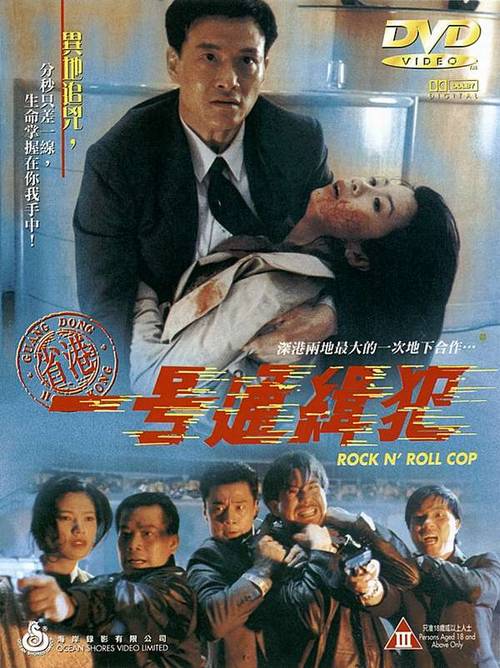
Rock ‘N Roll Cop (1994)

ABOUT THE AUTHOR: Jennifer Upton is an American (non-werewolf) writer/editor in London. A member of the Society of Authors, she currently works as a ghostwriter of personal memoirs for Story Terrace London and writes for several blogs on topics as diverse as film history, punk rock, women’s issues, and international politics.

For links to her work, please visit:

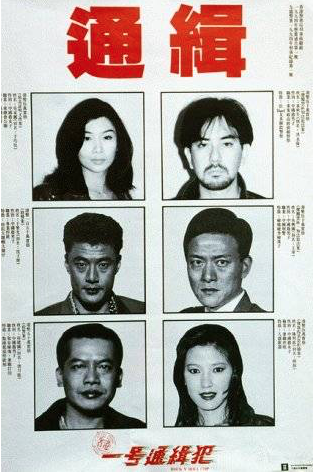
Hong Kong’s movie industry churned out films in the 1990s at a breathtaking pace. Anthony Wong worked twice with director Che-Kirk Wong in 1994. First in Organized Crime and Triad Bureau and next in the lighter Rock ‘N Roll Cop. Don’t let the title fool you. This movie has very little to do with rock ‘n roll other than that Anthony Wong plays the guitar in a couple of scenes. He made a punk album called Underdog Rock in 1996 worthy of a listen, proving he really does have musical ability. 

Here, Wong plays Hong Kong cop Inspector Hung who must work with the Mainland China police to catch a criminal (Yu Rong-Guang) who has committed crimes on both sides of the border. Hung has trouble fitting in with the straight-laced uniform-clad Mainland officers. He dresses like Bono from U2 in black jeans and a black leather jacket, and gets drunk on his first night in town. He spends a great deal of time talking about the superiority of the Hong Kong police force, which inevitably creates difficulties in the working relationship between Hung and Mainland officer Captain Wong Jun (Wu Hsing-kuo.) Many films from the pre-handover period featured representations of the anxiety felt by the HK entertainment industry at that time. 

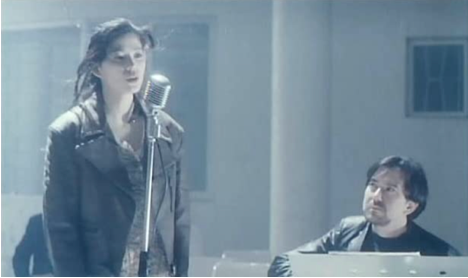
As the plot progresses, Wong and the Mainland cops come to an understanding that they’re not so different and that working together benefits both sides. The two leads wind up helping one other in a climactic chase/bloody shootout filled with plenty of Kirk Wong’s signature kinetic editing and glossy cinematography. There’s a nice romantic subplot between Wong and singer Jennifer Chen, giving Wong a chance to play a guy without a dark side for a change (don’t worry, he slaps her once.) While enjoyable, the film is neither as complex in terms of character development nor as good overall as Organized Crime and Triad Bureau, placing it firmly in the “good enough to recommend if you’ve got the time” category. Sadly, watching it in 2021 against the background of Hong Kong’s recent riots and the subsequent crackdown by the Chinese government makes its message of teamwork a bit optimistic to say the least. Sadly, it’s highly unlikely Hong Kong cinema will ever see another golden era like this one. 

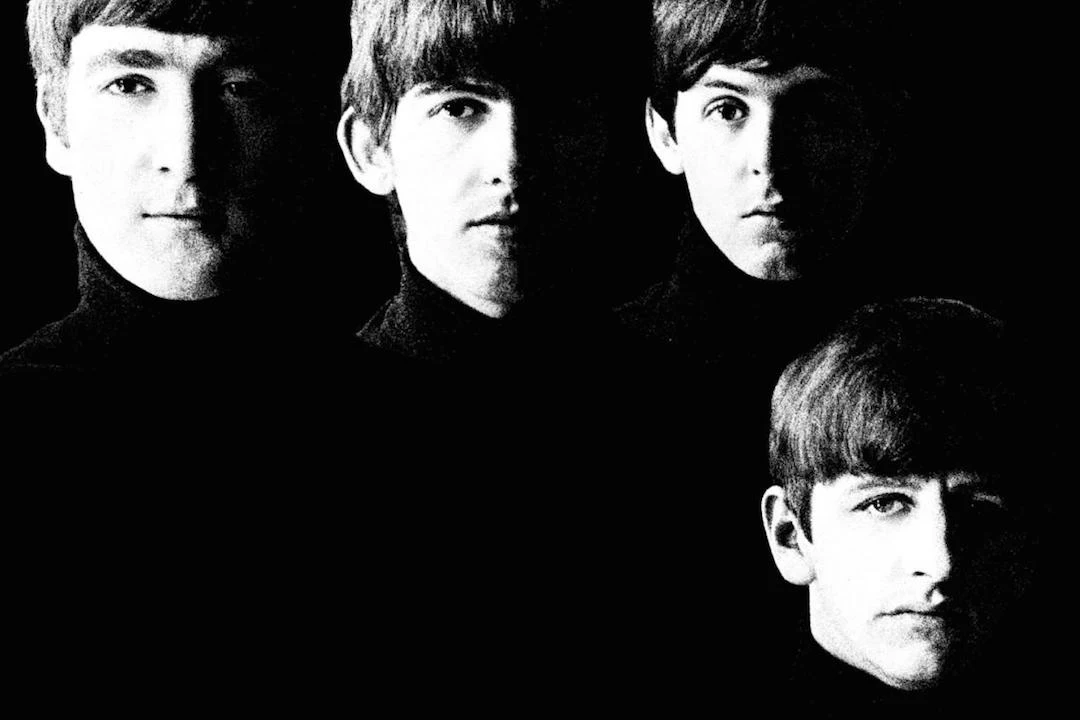
The Beatles: Influence on Film 1

This is the first in a three-part series. We are discovering 33 films in the series, with 11 films each over the next three days — at 3 PM — as part of our third “Rock ‘n’ Roll Week” installment.

Image courtesy of Parlophone/Town Square Media via Ultimate Classic Rock/logo courtesy of 60s Girl Deviant Art/banner design by R.D Francis

As we developed this third “Rock ‘n’ Roll Week” in February, the 52nd anniversary of the Beatles’ final live performance in 1969 — shot for Let It Be (1970) — passed on January 30.

As you can tell by this article’s title, this isn’t about the Beatles’ movies, such as A Hard Day’s Night or Help! or Magical Mystery Tour or Yellow Submarine (well . . .) or Let It Be or any of the wealth of theatrical, television, and direct-to-video documentaries on the band.

And we are passing on John Lennon in Richard Lester’s How I Won the War (1967) and his work with the “supergroup” the Dirty Mac in The Rolling Stones Rock and Roll Circus (1968/1996), as well as Paul McCartney’s vanity piece, Give My Regards to Broad Street (1984).

And we are passing on chronicling the works of George Harrison’s Handmade Films, so nothing on Monty Python’s Life of Brian (1979), The Long Good Friday (1980), and Time Bandits (1981), or his production of Shanghai Surprise (1986), in which he appeared and recorded five new songs.

And we are passing on Ringo Starr’s resume with Candy (1968), The Magic Christian (1969), and Blindman (1971), as well as his co-starring roles in That’ll Be the Day (1973) and Son of Dracula (1974), his work as the Pope in Lisztomania (1975), his starring role in Caveman (1981), his appearance as Larry the Dwarf in Frank Zappa’s 200 Motels (1971), and his work on Harry Nilsson’s animated film The Point! (1971). We’re also passing on Ringo’s appearances in Martin Scorsese’s The Last Waltz, his document on the 1976 farewell concert of the Band, and the Who’s The Kids Are Alright (1979). And how can we forget, Ringo (1978), Starr’s made-for-television adaptation of The Prince and the Pauper, and Princess Daisy (1983), with wife Barbara Bach. And Ringo’s appearance in Sextette (1978), and directing debut of the T.Rex concert document, Born to Boogie (1972).

This exploration is concerned with the speculative biographical flicks, the films using the legend of the “Fab Four” as plot fodder, and the historical sidebars to their careers — both as a band and solo artists.

The films are listed by their year of release.


Yellow Submarine (1968)
We each have our fond memories of this sort of . . . and it’s not . . . but it is . . . Beatles film. Sam the Bossman remembers watching it on UHF-TV as his dad and grandad fixed the furnace. Me? My sister still doesn’t let me live down my nightmares . . . of the Blue Meanies coming to get me. What did my parents know about LSD trips? It’s those loveable moptops from A Hard Day’s Night, after all . . . and it’s a cartoon. What’s the harm . . . and I am still scarred by it, for life.

Initial press reports stated that the Beatles themselves would provide their own character voices. But all was not well at Apple Corp. and the lads weren’t enthusiastic about working on a new motion picture to fulfill their three-picture deal with United Artists, having been dissatisfied with their second feature film, Help!.

So, the Beatles bailed on project, giving the over 200 artists — who crafted the film across 11 months — all the creative space they needed. John, Paul, George, and Ringo composed and performed the songs (a mere six that comprises 22 minutes of Side One; the other half was comprised of George Martin orchestral compositions). As actors, the “real” Beatles only participated in the film’s closing scene, while their animated doppelgangers were voiced by other actors.

Obscure Beatles cover song hokum: There’s been a LOT of covers of Beatles tunes over the years . . . but one of the coolest covers of “Yellow Submarine” was done by Philadelphia, Pennsylvania’s More Fiends from their album, Toad Lickin’ (1990). Here’s the rub: The song, titled “Yellow Spades,” is actually a cover of Motorhead’s “Ace of Spades” backing Paul McCartney’s lyrics.

I wonder if Paul has ever heard it? Did Micheal?

Micheal Jackson sold Northern Songs, Ltd., the publisher of the Beatles’ catalog, in 1995; the More Fiends, it seems, escaped the Gloved One’s legal wrath. The same can not be said of New York’s SST recording artists Das Damen. On their Marshmellow Conspiracy EP (1988), they recorded “Song for Michael Jackson to $ell,” which was actually an uncredited cover of the Beatles’ “Magical Mystery Tour.” After discovering the unlicensed cover, Jackson’s lawyers assured the track was removed from future editions of the album.

Still, I wonder if Micheal would have unleashed the legal hounds of war on the More Fiends? “Yellow Spades” is still commercially available on Apple Music or Spotify. So, either no one cared or the legalese was settled.

And yes. There is a band called, Blue Meanies, a ska-core band from Illinois, U.S.A. that recorded several albums between 1988 to 2007 — with no illegal Beatles covers from Yellow Submarine.

All This and World War II (1976)
So, before the creation of the abyssal Sgt. Pepper’s Lonely Hearts Club Band, the sappy-hokey I Am Sam, and the not-much better Across the Universe — and before Robert Stigwood gave record executives a bad name by ravaging the Beatles — Russ Regan, president of both UNI Records and 20th Century Records, and vice-president of A&R at Motown, came up with the idea to document the horrors of war through newsreels. He wondered, “What if The Beatles provided the soundtrack?”

Uh-oh.

Instead of real Beatles tunes — and in a warm up for their later work with Robert Stigwood — the Bee Gees stand in for the Fab Four, initially contracted for the entire soundtrack. In the end, the Brothers Gibb recorded six songs; three ended up in the film: “Golden Slumbers/Carry That Weight,” “She Came In Through The Bathroom Window” and “Sun King”; their versions of “Lovely Rita,” “Lucy In the Sky With Diamonds,” and “She’s Leaving Home” didn’t make the cut. Elton John, Ambrosia, Rod Stewart, and a host of other chart-topping musicians take care of the rest.

All You Need is Cash, aka The Rutles: All You Need Is Cash (1978)
Eric Idle and the Monty Python troop devised rock mockumentary of skits and gags chronicling the fictional tales of Dirk, Stig, Nasty, and Barry, aka the Rutles, a band whose career mimics the Beatles’. Airing as an NBC-TV special, the movie earned the lowest ratings of any show on U.S. prime time television that week.

Are the proceedings are better than that? Yes. On equal with Spinal Tap’s exploits? No. But it’s darn close.

The ersatz Beatles tunes were written by ex-Bonzo Dog Band (friends of the Beatles appearing in Magical Mystery Tour) member Neil Innes, who portrayed John Lennon to Eric Idle’s Paul McCartney. Ex-Beach Boys drummer Rick Fataar portrayed George Harrison; Lou Reed band member John Halsey (1972’s Transformer) parodied Ringo Starr.

Yes . . . as with Spinal Tap, there is a sequel.

I Wanna Hold Your Hand (1978)
Robert Zemeckis, later of the Back to the Future franchise and awards-sweeper Forrest Gump (and Used Cars is pretty fine, too), makes his feature film writing and directing debut with this examination of the hysteria of Beatlemania. It’s seen through the eyes of four teenagers (headed by Nancy Allen and the always-great Wendy Jo Sperber) as they try to meet the Beatles during their time in New York to appear on The Ed Sullivan Show on February 8, 1964.

The Beatles show up, as well as Brian Epstein, in archive footage, while William Malone cameos in an uncredited role as George Harrison. And yes, we are taking about the writer and director behind Creature. And we get a “Ringo” in the form of Eddie Deezen’s nicknamed Richard Klaus in the film, so all is well. The soundtrack features seventeen original recordings — covers and originals — by the Beatles.

Sgt. Pepper’s Lonely Hearts Club Band (1978)
The Beatles’ cover tunes by the Bee Gees and Peter Frampton, as well as Aerosmith showing up for an “evil” rendition of “Come Together,” for this tale about Billy Shears and the “band” of the title, are quite good; it’s the celluloid wrapped around it that stigs, uh, stinks. Oh, the overwrought Frankie Howerd (as Mr. Mustard) and ham-fisted Steve Martin (murdering “Maxwell’s Silver Hammer”), why?

It’s been 43 years since seeing this in a theater — and never on cable or tape, no way; for once was enough for me. For the memory . . . the horror . . . is still burned into my cerebrum. I need a Beatles lobotomy, Joey. Where’s the Pepperland-invading Blue Meanies to stop the Bee Gees when we need ’em?

Birth of the Beatles (1979)
Dick Clark (who also made Copacabana . . . based on the Barry Manilow song) hired ex-Beatles’ drummer Pete Best as a Technical Advisor and Richard Marquand (Star Wars VI: Return of the Jedi) as his director to give us this take on the early history of the Beatles — then known as the Silver Beatles. The film is noted as the first biographical drama on the band, released nine years after the announced break-up of the Beatles themselves, and is the only Beatles biopic to be made while John Lennon was still alive. While it was released as a worldwide theatrical feature, this was issued as a TV movie on ABC-TV in the States.

Courtesy of a publishing loophole — unlike the later and similar early-days-of-the-Beatles Backbeat, which used songs the Beatles recorded as covers — the songs in Birth of the Beatles were written by the Beatles themselves, only interpreted by the Beatles tribute act, RAIN.

The “loophole” of using cover versions of Lennon-McCartney compositions, of course, backfired. As result, Birth of the Beatles has fallen out of print and will more-than-likely never be reissued to DVD or Blu-ray. But there’s a TV rip uploaded to You Tube.

Marquand, who made his made his debut directing Roger Daltry in The Legacy, also directed ’60s folkie Bob Dylan co-starring with ’80s pop singer Fiona (the 1985 Top 15 hit “Talk to Me”) in the pretty awful, Joe Esztherhas-penned flick, Hearts of Fire (1987).

Beatlemania: The Movie (1981)
A smash Broadway musical-rockumentary advertised as “Not the Beatles, but an incredible simulation” that ran for 1,006 performances from May 1977 to October 1979 is a sure bet for a theatrical film adaptation.

No, it’s not.

The show — a multimedia production consisting of backdrops and projected images of art and video footage from the Beatles-era, as well as numerous clips of the Beatles — consisted of 29, chronologically-played songs, complete with costume changes.

So — with a Broadway hit on their hands — the managerial impresarios behind the production, Steve Lever and David Krebs (known for their handling of the Rolling Stones, Joan Jett, and Aerosmith; remember “Boston’s Bad Boys” appeared in Sgt. Pepper’s Lonely Hearts Club Band), decided that — Apple Corps. lawsuits, be damned — it was time to take on the albums charts and the silver screen.

The original cast of Joe Pecorino (rhythm guitar, John), Mitch Weissman (bass guitar, Paul), Les Fradkin (lead guitar, George), and Justin McNeill (drums, Ringo), and the second cast of Randy Clark as John, Reed Kailing as Paul, P.M. Howard as George, and Bobby Taylor as Ringo, headed into the studio for a 1978 Arista The Album release — which bombed with record buyers as it scrapped into the lowest regions of the Billboard 200.

Seriously? Who wants to buy a Pickwick (Discogs) budget sound-alike of Beatles tunes?

Okay . . . well, maybe a movie would work, better.

Uh, no it won’t. Remember All This and World War II?

Production began in late 1980 — shortly before John Lennon’s December 8 murder — under the tutelage of TV director Joseph Manduke (Harry O, Hawaii Five-O, Barnaby Jones). The cast featured a mix of musicians from the Broadway production and album, with Mitch Weissman back a third time as Paul, David Leon as John, Tom Teeley as George, and Ralph Castelli as Ringo.

Released in the summer of 1981, Beatlemania: The Movie quickly became a critical and box office bomb. Apple Corps, who launched their first legal volleys regarding publicity rights and trademarks in 1979, finally won in damages in 1986.

And Ringo hated the concept, in whole.

You can learn more on the making of Beatlemania (the Broadway show) with this Chicago news station-produced TV documentary on You Tube.

John and Yoko: A Love Story (1985)
This NBC-TV effort chronicles the relationship between John Lennon and Yoko Ono. The movie was made with the co-operation of Yoko Ono, who controlled the song rights. The film begins on August 19, 1966, in the wake of a protest initiated by Lennon’s (misunderstood) comment that the Beatles “were more popular than Jesus” and end with Lennon’s murder in 1980.

In a production twist: Actor Mark Lindsay booked the role of John Lennon. When Ono discovered that was his professional name — and that his birth name was Mark Lindsay Chapman — the similarity gave her “bad karma,” so he was recast with Mark McGann.

In 2007, Mark Lindsay was cast as an “older” Lennon in Chapter 27 (2007) — the tale of Lennon’s assassin, Mark David Chapman.

Concrete Angels (1987)
Robert Zemeckis scripted his Fab Four tale, I Wanna Hold Your Hand (1978), around the Beatle’s historic February 8, 1964, appearance on CBS-TV’s Ed Sullivan Show. In that tale, a group of friends schemed to meet the band.

This time, a quartet of ne’er-do-well teens from the wrong side of Toronto’s tracks form the Concrete Angels to enter a radio station’s battle of the bands contest and win the opening act slot for the Beatles’ gig. Will they win and escape their poverty or will they fall back into their juvenile acts of crime?

The Hours and Times (1991)
Christopher Munch makes his writing and directing debut with this fictionalized account of “what might have happened” during a real holiday taken by John Lennon and (the homosexual) Beatles’ manager, Brian Epstein, in 1963. Ian Hart, who stars as John Lennon, portrays him one more time, in Backbeat. The film was restored for a 2019 DVD release.

Secrets, aka One Crazy Night (1992)
As with the previous Beatles-inspired films I Wanna Hold Your Hand (1978) and Concrete Angels (1987), this Australian production works as a coming-of-age drama — a retro ’80s John Hughes coming-age-drama — backed by Beatles folklore. Now, instead of trying to meet the Beatles at their first New York and Toronto concerts, we have five teens who sneak in, then find themselves trapped in the bowels of a Melbourne concert venue where the Beatles are set the make their June 11, 1964, Down Under debut. Saccharine soul bearing, ensues.

As with most Beatles films, you’re getting covers (most outside of the timeline of the movie) — this time from Dave Dobbyn, of New Zealand’s Th’ Dudes (their hit, “Bliss“) and DD Smash (their hit, “Outlook for Thursday“) (DD Smash would sweep the New Zealand Music Awards in 1982 and 1983, but a Men at Work or Split Enz crossover to America wasn’t meant to be). The Judd Nelson/John Bender of the bunch comes in the form of an antithesis Elvis fan stuck in the ’50s. Another looks like Wolowitz from The Big Bang Theory — only with out the nose (because he’s obsessed with George, not Ringo), who always wears Fab-inspired suits.

Impossible to find on U.S. shores as a VHS or DVD on home video shelves, we found copies on You Tube HERE and HERE.

Courtesy of 1000 Logos.

Join us tomorrow for our second installment with our next batch of films.

About the Author: You can learn more about the writings of R.D Francis on Facebook. He also writes for B&S About Movies.
Jurassic Shark 2: Aquapocalypse (2021)

“There’s bad and then there’s boring-bad and this is just bad, which is a nice thing to say.”
— Sam Panico of B&S About Movies in his review of Brett Kelly’s Jurassic Shark

Great poster . . . one day, the film will live up to the one-sheets. Nah!

In our never-ending quest to review every shark flick ever released, we just have to. . . .

Besides, when you have Mark Polonia, who we jam on over here at B&S About Movies (who treaded these waters before with the bonkers Shark Encounters of the Third Kind) making a (unofficial) sequel to Brett Kelly’s nine year old film, who we also jam on at B&S (who slopped these waters before with Ouija Shark), well, we just have to. . . .

Do we have to tell you the CGI shark is bad and that the acting — babbling about the dangers of bio-engineering — is bad? That’s there not one practical, in-camera gunshot, blood drop, or explosion effect to be had? That the wide-to-close up continuity is beyond fubar’d? Yeah, we just have to. . . .

So, anyway, if you missed the Brett Kelly instigator: The (50-foot) megalodon unleashed by an oil rig frackin’ up the ocean floor in the first film is back, still swimming around the rig . . . one of the most understaffed rigs in the history of the fossil fuels industry because, well, the budget could only afford a cast of four. Well, there’s the folks in that local fishing village, flailing about as only bad “look at me” extras can.

“Dude, is the ’90s video game-era shark even original this film?”

Eh . . . with so many of these CGI “Shark Weak” films produced, these selachimorpha romps are probably recycling at a rate that would give Roger Corman pause. At least that shark jumping out of the ocean to clamp down on a CGI’d T-Rex poking along the beach — in a 50 million year flashback — looks new to the game. Why yes, that’s Polonia and Kelly — and sometimes Brett Piper — familiar stock players Jeff Kirkendall and Titus Himmelberger in the cast. At least, as Sam pointed out in his review of Brett Kelly’s Jurassic Shark, Mark Polonia’s sequel isn’t padded by twelve minutes of credits against fifty minutes of actual movie. To that end: we’ve only got two minutes of credits against a not-to-painfully quick 68-minutes . . . not counting the two minutes of opening titles of a shapely bikini babe wading in the water . . . who then swims for a minute, before her chomping. See, you can handle a 65-minute movie. . . .

Eh, stop your snobby bitchin’, ye film critic.

As is the case with any Brett Kelly flick (I liked Countrycide), or Polonia Brothers shingle swinger (which had the balls to mesh the shark genre and Amityville franchise via Amityville Island), or Brett Piper joint (who’s a god around here*) that comes down the streaming pipeline, we had a lot of ’60s retro drive-in fun. They all studied at the Dennis Divine School of Cinema**, so we likey.

In the middle of July, we rolled out a “Shark Weak” of reviews. During the earliest days of the site, we also rolled out a “Bastard Son of Jaws Week” and “Exploring: Ten Jaws Ripoffs” featurette. Yeah, that’s a lot of digital chum to swallow, but you can do it! Click those hyperlinks! Yeah, we know that Brett Kelly’s Raiders of the Lost Shark and Mark Polonia’s Virus Shark aren’t amid those reviews. Look, we are Polonia and Kelly fans, not masochists . . . but for more Polonia-related reviews, check out our reviews of  Amityville Deathhouse, Amityville Exorcism, Empire of the Apes, Outpost Earth, and Return to Splatter Farm.

You can learn more about many of their films by visiting the Facebook page and official site of Wild Eye Releasing. Jurassic Shark 2 — as has Virus Shark — will probably end up on Tubi soon enough. But for those who can’t wait, it started streaming this week on You Tube and Amazon Prime. (Clicking either link will launch the official Wild Eye trailer.) Meanwhile, over at Asylum Studios, they’ve just released their own CGI shark fests that are Swim and Shark Season (I liked Swim; Shark Season not so much.) See, told you we are on a quest aboard the U.S.S B&S: all unofficial “Amityville” and “Jurassic” and “Shark” films will be watched!

* What? You never read our “Drive-In Friday: Brett Piper” night tribute? Bad B&S reader. Bad boy!

** What the hell, son? You never read our “Drive-In Friday: Dennis Devine” night tribute, either? You got sum hyperlinkin’ to do!

FYI: For our many European readers: Tubi is not available overseas without a U.S.-hosted proxy server. Please refer to You Tube or search on other streaming services. Wild Eye films are widely distributed, so you will surely find a streamable online copy in your country.

Disclaimer: We did not receive a review request for this film. We just like shark flick, and Polonia flicks, and what chum Wild Eye Releasing tosses into the digital streams.

About the Author: You can learn more about the writings of R.D Francis on Facebook. He also writes for B&S About Movies.
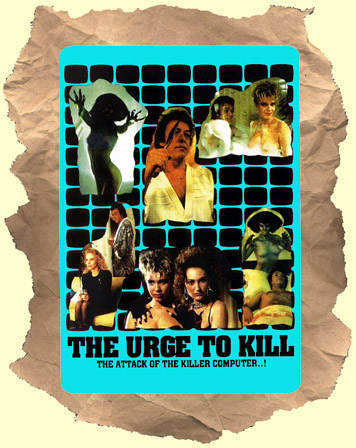
The Urge to Kill (1989)

Bono Zorro is a famous music producer, or so this movie tells us, but most of the time he’s bringing new ladies into his apartment which is under the control of the proto-Alexa unit named Sensual Environment Control System. Yes, she’s called SEXY and she’s definitely a she. That’s because she’s in love with Bono and she’ll murder every other band aid, groupie and woman in his life to keep him.

This sounds like it could be a very exciting movie but this thing is the very definition of plodding and for some reason, I kind of love that it’s so slow and pointless, a movie where models just lounge around and the dialogue sounds like the first time anyone has ever seen the script.

Writer/director Derek Ford made British smut like Secret RitesI Am a GroupieKeep It Up, JackThe Girl from Starship Venus and was the uncredited director of Blood Tracks. He made this for Dick Randall, whose career has the kind of moments that we can only hope to live through. Starting as a joke writer for Uncle Miltie, it took a failed George Jessel Broadway play to send him to Italy where he figured out that Americans wanted to see some sleaze. So he sent us stuff like Primitive LoveThe Wild Wild World of Jayne MansfieldThe French Sex MurdersThe Real Bruce Lee and so much more. He was the writer of Pieces and Lady Frankenstein as well as the writer/director of The Girl In Room 2A and Frankenstein’s Castle of Freaks. Man, just when you think you have scratched everything Randall made, he surprises you with more — Slaughter HighDeath DimensionFor Your Height OnlyDon’t Open ‘Til ChristmasCrocodileKing of Kong Island…what an amazing contribution to our lives he has made.

Anyways, this movie features a woman being killed by a laser to the nipples, another burned by an acid shower and yet one more woman finding her doom at the bristles of an electric toothbrush before SEXY somehow possesses Bono and makes him drown his girlfriend in the hot tub, which is the most 80s way to die.

SEXY is also kind of like Synergy from JEM because she can manifest herself as a body-painted woman and run people over with her car. I don’t think Synergy ever did that, but trust me, it’s a good comparison.

Also: SEXY could be CECS and stand for Central Environment Control System. This movie is so brain-destroying that either answer is correct and you know, this movie is such a mess that you can just sit back and enjoy it. I mean, a naked woman who looks like she has makeup out of Liquid Sky kills and kills and kills in-between ladies taking bubble baths and having BDSM finger-licking sessions that are grosser than watching Peter Hooten eat the Colonel’s eleven secret herbs and spices in Night Killer.

Obviously, this movie has my highest recommendation.

Thunder Alley (1985)

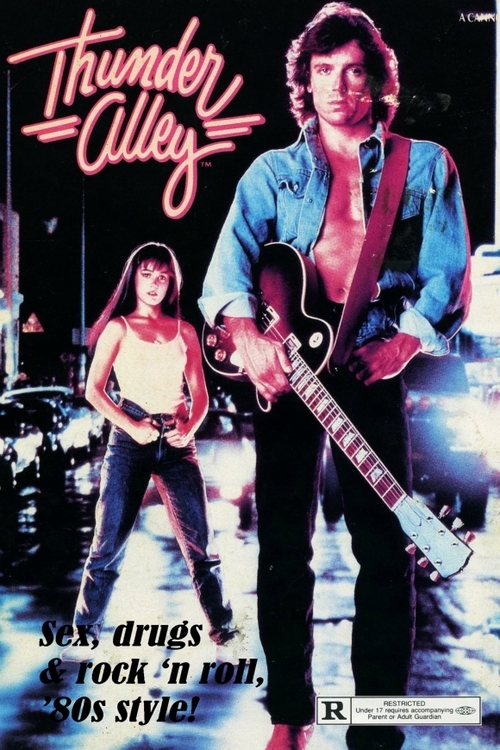
Roger Wilson, the star of this movie, lost his parents at a young age and inherited several million. He graduated Woodberry Forest School in 1975 with Marvin Bush, the brother of the former President, and had a pretty astounding life, marrying Estée Lauder model Shaun Casey before dating Christy Turlington and Elizabeth Berkley, which was the reason why a member of Leonardo DiCaprio’s circle of friends punched Wilson in the throat and damaged his larynx so badly that he never sang again. You can read more about that in a past review of this film.

Anyways, Roger is Richie in this movie, the working class kid who becomes the guitarist and singer of the band Magic and also the boyfriend of Beth (Jill Schoelen). You know, if you’re a touring musician and dating Jill Schoelen, you should just settle down and not do too much more. You’re already so far ahead of the rest of all humanity.

Richie has taken the lead role from Skip (Leif Garrett, who knows a thing or two about rock and roll and drugs). Donnie, the keyboard player, is the one who gets into the drugs so badly that he just doesn’t make it. But it’s not all rough. I mean, the band has Clancy Brown — the Kurgan — as their road manager!

Director J. S. Cardone also made The Slayer, a movie that makes no sense so much that I love it, and the direct to video sequel to 8mm. He also directed ShadowzoneA Climate for Killing; Black DayBlue NightOutside Ozona; True Blue and Wicked Little Things.

Shot in Tucson, Arizona — using some of the same locations as The Wraith and Harley Davidson and the Marlboro Man — with local band Surgical Steel* showing up to play, Thunder Alley isn’t the best rock and roll movie there is. But you know, you could microwave up some food and have your own rib fest while you watch it.

*Their singer, Jeff Martin, sang in Racer X and played drums for Badlands after Eric Singer left. He’s also worked with Paul Gilbert and Michael Schenker quite often.

Vampire Journals (1997)

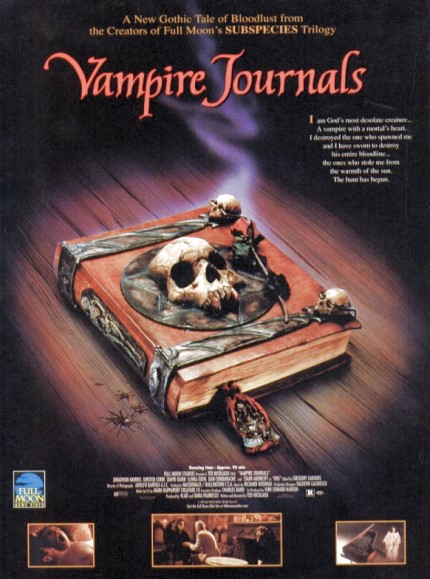
Zachary is something like a hooker with a heart of gold. He’s a vampire with a conscience, hunting down the bloodline of vampires that made him like a gaijin Alucard from the Castlevania games. So yeah, the vampires have even turned the love of his life into one of them, so he must destroy her and her master Serena — last seen in Subspecies 4: Bloodstorm which comes out a year after this so, you know, it’s alright if you’re confused — with the enchanted sword of Laertes.

The rest of the film is all about Ash trying to take out our hero, using a pianist named Sofia to draw him out by drinking her blood and making her one of his followers. And then there’s another vampiric consort named Iris who decides to throw a wrench in destiny.

Consider this one a side mission in the world of Subspecies, as all of these characters will get involved in the next one. Full Moon would later remake this as Decadent Evil.

If you’d like to see a cutdown version of this movie, it is the “Undead Evil” chapter of their anthology film I, Vampire.

You can watch this on Tubi.

Like a Dirty French Novel (2021)

We first reviewed the writing and directing work of self-taught award-winning filmmaker Mike Cuenca with last year’s music ensemble drama I’ll Be Around. We enjoyed that eclectic-eccentric character study, so seeing Cuenca’s name on the one-sheet advanced his latest film to the top of the review stacks. Equally intriguing: Cuenca shot the film in one whirlwind week during the height of the Winter 2020 COVID lockdowns.

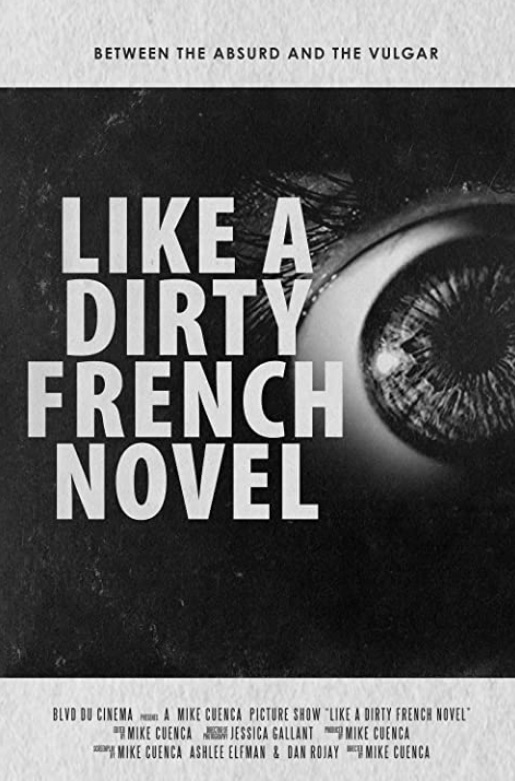
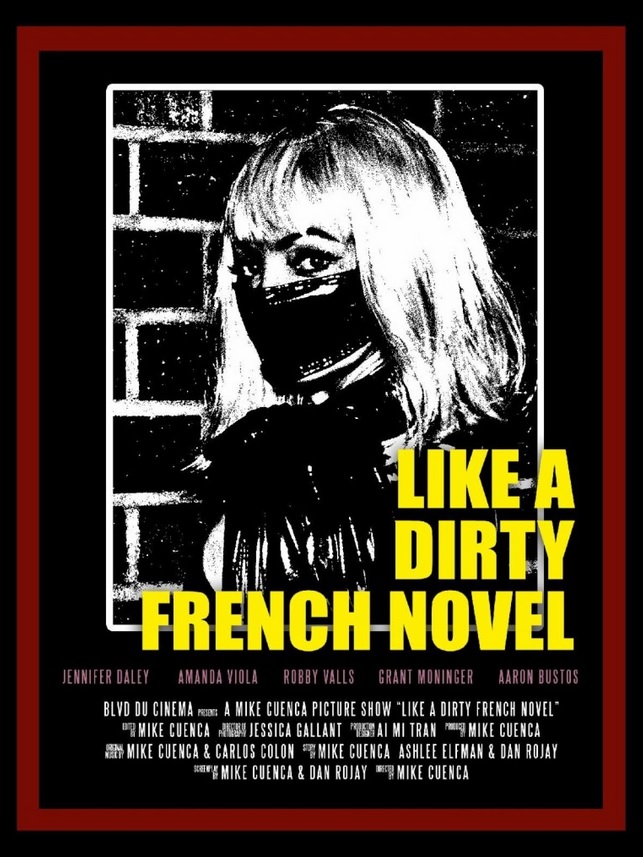
Note the homage of the Velvet Underground’s “Some Kinda Love” (lyrics) for the film’s title and tagline/streaming one-sheet.

If the title’s not giving it away, Mike Cuenca’s taken his same abilities at adeptly interweaving plots and characters — only in the context of a film noir, with the proceedings less James M. Cain commercial (The Postman Always Rings Twice, Double Indemnity) and more non-mainstream David Lynch (think Lost Highway). Upping the ante: Cuenca’s drafted the pandemic into the plot, which serves as the catalyst (in lieu of greed or sexual weakness) to a surrealist nightmare. While it plays, at first, as a disconnected anthology about unrelated people making due during the pandemic with a weak through line, it all comes together in a plot that’s nicely psuedo-Giallo’d along the way. While non-linear — and we know how that rubs the wrong way with some viewers — give it time: the dots connect.

What are the “dots” as it were?

A mysterious woman in the deserts surrounded by a cult-masked group. There’s two gun-toting thugs executing a kidnapping plot. A mysterious woman makes a phone call that sexually intrigues and frightens a man at once. A rare comic book is at stake. There’s a meeting in a city park with a person that may be “love,” but more wishful-illusion than reality.

Quentin Tarantino scripting meets Lou Reed’s lyrics/the festival one-sheet.

For a film shot-on-the-fly with no budget under pandemic restrictions: just wow. This film is twisty-scripted, nicely shot, Giallo-expertly lit, and the acting — which I’ll assume was done sans paychecks by the cast for the love of the craft with the need to create “something” to quell the lockdown madness — is well-concentrated, with everyone on-point with their characters.

Like a Dirty French Novel is everything you don’t expect to see in a streaming indie flick — and we love the film for it. The caveat is that I enjoy non-linear films: again, they are not for everyone. Truth be told: If not for Mike Cuenca impressing me with I’ll Be Around last year, I might have looked this one over and reviewed something else because, not all filmmakers can pull off multi-character plots and non-linear tales. Mike Cuenca, can.

If this is what he can do on the fly sans a budget, I look forward to what Mike Cuenca will do with a budget — possibly a studio shingle behind him — in a post-pandemic world.

Mike Cuenca is a writer-director to keep an eye on. He’s two-for-two in my review books.

Disclaimer: We were provided a screener copy of this film from the production’s PR firm. That has no bearing on our review.

About the Author: You can learn more about the writings of R.D Francis on Facebook. He also writes for B&S About Movies.