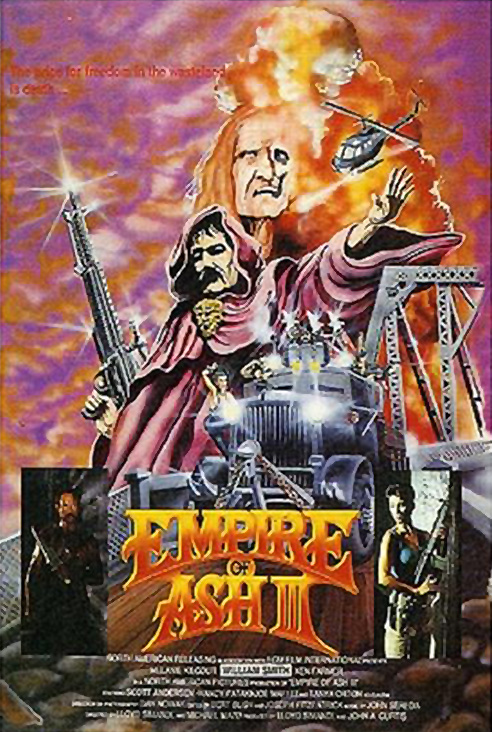
You’ve seen Empire of Ash. And hey, doesn’t Empire of Ash II seems like exactly the same movie? That’s because it is. So Empire of Ash III is really the second movie just to confuse you. I can make things even more puzzling for you. This movie is also known as Maniac Warriors, just like the first Empire of Ash, so you may have no idea what movie you’re in store for.
Lucas (William Smith) and Danielle are back in this movie, which is all about an attempt to stop the blood harvesting of the ruling elite, who have all become monsters thanks to a nuclear war and have sent the Warriors, led by Baalca, to steal blood from women by using needles. Sure, alright, sounds like a plan, I guess.
This is a movie so brazen that it thanks Conan in its credits and has this tagline: “Mad Max Paved the Last Road…The Last Of The Warriors Destroyed It.”
This was directed by Michael Mazo and Lloyd A. Simandl, who also made the first film together. They decided to throw more nudity in this one and William Smith to test the theory that if breasts and William Smith make any movie better, sweater meat and Mr. Smith teaming up may win this movie an Oscar. It didn’t, but you have to admire that kind of Canuck-spa.
There’s nothing like a theme week — in this case, another “Apoc Week” — to expose us to a filmmaker that we’ve never heard of, well, at least not moi. Now, you know all about the B&S love for all things SOV, especially when it comes to the resumes of ’80s direct-to-video purveyors Dennis Devine and Brett Piper. (Why else do you think we dedicated an entire Drive-In Friday feature to both of their careers?) And with the advent of digital technologies, we now have a new guard of shot-on-digital filmmakers that are just as prolific as Dennis and Brett. And one of those filmmakers is Providence, Rhode Island-based writer and director Richard Griffin. During his now 20-year career, Griffin’s produced 29 feature films and 13 shorts in the horror genre. He’s the kind of filmmaker who can pinch out three films in a year without breaking a sweat. And, from what I can see, he’s never not been able to secure worldwide distribution for his product. I bet, if I go to Walmart right now, I’d find a couple of his films in the Wallyworld impulse-buy barrels in the electronics’ aisle.
I have to admit, after looking at over his resume, with retro-inducing titles such as Raving Maniacs (2005), Beyond the Dunwich Horror (2008), Atomic Brain Invasion (2010), Frankenstein’s Hungry Dead (2013), Seven Dorms of Death (2015), and Flesh for the Inferno (2015), I’m diggin’ the Griffin-vibes. I’ll have to see how many of his films I can exhume from the net’s digital coffers for a weekend of couch-grazing. And, as you can see, Richard Griffin loves his horror flicks. But how does he fair in the sci-fi genre?
Let’s fire up that retro-VCR for his lone — so far — sci-fi adventure, Future Justice.
We dig the ’80s retro-VHS cover art.
So, since we are in a digitally-based retro-land, the tentpoles on Future Justice are, of course, the earth-based, ’80s Italian ripoffs of Mad Max and Escape from New York, with a smidgen of George Romero’s The Night of the Living Dead and soupçon of that other Carpenter film (that J.C keeps remaking to lesser and lesser effect, i.e., the utterly shitty Ghosts of Mars), Assault of Precinct 13. And Carpenter’s pre-Assault film comes to play: Dark Star (more on that later). And keepin’ that Carpenter vibe going: you’ll see a touch of Luc Besson’s blatantly plagiarist Plissken romp, Lockout. And since we’ve got a maniacal ex-military man hellbent on ruling the Earth, we’ve got a little of Kevin Costner’s The Postman. But since we are in low-budget land: I’ll take the retro-vibes back a bit further . . . with Invisible Invaders, the 1959 John Agar-starring film that everyone seems to forget inspired George Romero’s zombie romp, which plays a sci-fi angle (of alien spirits possessing dead humans) in lieu of Romero’s later horror angle. And instead of Costner’s apoc-romp, we’ll evoke the cheaper, 1984 Canadian apoc’er Def-Con 4, with that film’s Earth-fallen astronauts besieged by a self-appointed, maniacal ruler run amok in the woods of Nova Scotia.
Now, if you’ve seen Lockout — or any of the countless “space prison” flicks released over the years in the wake of David Fincher Alien 3 (another of this film’s influences; also Fincher’s Pitch Black with its Riddick character comes to play) — then you’re up to speed in the Griffin-verse as we meet the solar system’s most infamous criminal: Python Diamond (screenwriter Nathaniel Silva). After serving out his five-year cryo-sentence on the prison moon of Titan, he’s now ready for transfer back to Earth to complete his sentence. And in mid-transport . . . the five-man military police crew in charge of our reluctant hero loses contact with Earth . . . and comes to discover a nuclear war has devastated the planet.
Of course, with these space marines, Semper Fidelis isn’t their motto: they need Python Diamond on their team — and they’ll see to it his faux-Plissken-ness gets a Hauk-esque full pardon for helping out. And, with that, our Magnificent Six fight their way through the anarchy and come to defend a group of scientists in a warehouse bunker laid siege by the Earth’s now crazed, radiated survivors. Oops, they’ve just lead the paramilitary crazies right to the very scientists trying to save the Earth.
I know, I know. Where’s the logic with these “space prison films” shipping the Earth’s malcontents to the Saturn’s moon to freeze them, then defrost them and ship them back? Hey, don’t blame Griffin: he’s homaging the films that came up with the ol’ prison freezing snafu in the first place. (And don’t get me started on my disdain for Demolition Man and its prison-freeze tomfoolery, which is only matched by my acid-refluxin’ for Starship Troopers . . . and upchuckin’ for Carpenter’s Escape from L.A., but I digress.)
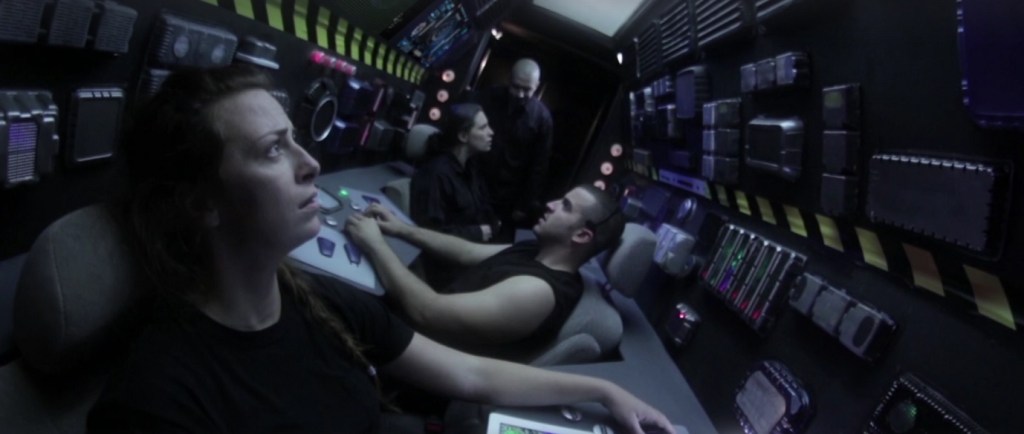
Look, are these apocalyptic proceedings a wee bit plastic and cardboard in appearance? Is the thespin’ wooden to manically over the top? Is the embattled group of outsiders battling against overwhelming odds in a cramped space a bit trope-laden? Of course it is. And you’d be remiss to expect otherwise. However, my jam on this film is that it looks awesome during its time in space, as the in-space set (that’s where the Dark Star comparison comes in) is pretty impressive, considering the film’s reported $20,000 budget. And the CGI, while obvious, is equally against-the-budget impressive than most of the CGI fails of today’s indie streamers. The costumes — especially the black-clad military gear of our space cops — looks good, too (dig the insignias). And the soundtrack by Daniel Hildreth is pretty fine and oh, so very Carpenter-esque evoking.
Is this all as good as Steve Barkett’s and Chip Mayer’s respective, somewhat similar astronaut-returns-to-a-nuked-Earth apoc-romps The Aftermath (1982) and Survivor (1987)? Eh, depends on how far your nostalgia miles may vary.
Not the U.S.S Dark Star, but still impressive, none the less.
Then, after those first 12 minutes are over and everything falls to Earth . . . everything falls apart (at least for moi), as we end up with just a whole lot running around an old warehouse and make-piece paramilitary dolts in fatigues and hockey gear. Granted, kudos are given for Griffin securing a pretty impressive, out-of-commission warehouse — that makes me think of the past inventiveness of Sergio Martino using an abandon yogurt factory for his Eurac headquarters for his not Plissken-romp, 2019: After the Fall of New York. Truth is: Future Justice, if under the thumb of Martino, would have worked great as the further adventures of Parsifal sequel.
That’s not saying the rest of the not-spaceship bound Future Justice is awful, as the film would play nicely on the SyFy Channel or even work wonders in filling up a two-hour block on the national cable channel Comet. I was just left so impressed by Richard Griffin’s inventiveness with his interior spaceship designs, I just wished this was retooled to remain on the spaceship or ended up on a space station-cum-prison. In the end: Griffin does a good job in stretching the most out of his budget and seamlessly mixing practical effects with CGI. If you’re burnt out your re-watches of the apoc-romps of old and you need a new film to watch, you’ve done worse on the scorched plains of the post-apoc terra firmas.
Once you check out the trailer, you can watch Future Justice as a free-with-ads stream on Tubi. We’ve also found an authorized upload — just released on February 14th — courtesy of my You Tube rabbit holin’ on Sci-Fi Central‘s web-channel. There’s a lot of interesting stuff to stream on that Australian-based page, so check ’em out. The DVD release of Future Justice also includes the 2010 short Mutants of the Apocalypse, which apparently served as the test film in creating Future Justice, as well as commentary tracks from the director, cinematographer, and some of the cast.
About the Author: You can learn more about the writings of R.D Francis on Facebook.He also writes for B&S About Movies.
EDITOR’S NOTE: The crew at the new magazine It Came From Hollywood asked if we’d be interested in running an interview with Dardano Sacchetti and my answer was, “Why are you even asking this question?” Thanks for sending this!
The name Dardano Sacchetti needs little introduction to fans of the 80’s post-apocalyptic movies that followed in the wake of Mad Max (1980) and Escape from New York (1981). In a very short time, Sacchetti wrote a number of action pictures set in a not-so-distant future rife with nuclear fallout, demented overlords, and bands of mutated survivors. 1990: The Bronx Warriors (1982) is probably the one fans are most familiar with, featuring such genre luminaries as Fred Williamson, Vic Morrow, Luigi Montefiori (better known as George Eastman) and Christopher Connelly as well as serving as the first film appearance for fan-favorite Marco di Gregorio (Mark Gregory).
With the launch of the magazine It Came From Hollywood, Sacchetti agreed to an epic, two-part interview. Rather than rehashing the titles he has talked about in various print and screen interviews, It Came from Hollywood explores how he worked all those years in the world of Italian cinema, quickly learning that on-screen credits aren’t always correct, and then diving into a number of films for which he has rarely commented. What follows is an excerpt from our interview, covering the less than bright future of our world as created from Sacchetti’s typewriter.
Releasing in Spring 2021, It Came From Hollywood will be available from Amazon in print and digital editions. You can keep up with the mag’s Facebook page and website.
Without further ado, the future worlds of Dardano Sacchetti.
Although the film was partially shot in New York City, do you know how much of it was shot in Rome?
Producer Fabrizio De Angelis’s technique was simple: shoot a week in America with a very small crew. Sometimes it was only the director, the camera operator, and an actor. There was a lot of material to steal, that is, to shoot without permits. (The famous scene of the zombies on the bridge in Zombie was shot at four in the morning with the bridge closed.) Then the film was completed in Italy, paying close attention to the locations and the costumes. Usually there was always a baseball bat, a university or fan cap, some posters, etc. The rest was all an illusion, but it worked.
Did you have much contact with director Enzo G. Castellari after you delivered the script for any rewrites?
Whenever Italian directors ask for changes or rewrites on set while filming, it is because they either have little ideas to add or they take suggestions from the actors for a few lines, but more often it is for production problems. It happened that you came in the morning to shoot a scene with a horse, and you found yourself without a horse.
Did Fabrizio De Angelis give you guidelines for the movie he wanted, or did he just ask you to write about gangs in a future New York City?
For horror films, of which he didn’t understand anything, he gave me maximum freedom. He just invented the titles that were in fashion. For all other films he told me, “Dardano, make it like Rambo, or something like that.”
Actor Marco di Gregorio’s (Mark Gregory) career was made up mainly of appearances in films you wrote. To this day he is a mystery to fans. Did you ever have the opportunity to meet him?
Marco di Gregorio was a boy who belonged to the same gym as Castellari, who noticed him and used him first in 1990: The Bronx Warriors. He was a good guy, unable to act and with a serious defect in that he did not know how to run. He had agility. He had a nice physique, a nice face and he cost nothing. I think I met him once in production just to say hello, but I don’t think he even understood who I was or what I was doing.
Fred Williamson is another actor who has starred in many films that you have written. Have you ever met him?
Never met, but we became friends on Facebook a few years ago.
You know, I don’t remember, but maybe Dario Argento has something to do with it because I think he was a producer of a couple of Argento’s films, and he looked for me.
How did Exterminators of the Year 3000 come about?
The film was born as a catastrophe and it was a catastrophe because of Teti, director Giuliano Carnimeo, and me too.It simply shouldn’t have been made.
The biggest surprise was when Tommy’s secret was revealed. Was that always the challenge with these films, inventing new surprises to keep the audience entertained?
I always try to include surprises in all my scripts. In my scriptwriting courses I explain that every scene is a small film. It must have a beginning, an end, and a central idea. I have never written transition scenes. There was a director, Giorgio Capitani, who said, and he was right, that my scripts were a series of crucial scenes, and it is true.
The heroine’s name is Trash, the same name as the hero in 1990: The Bronx Warriors. Was it just a coincidence or at any point was this script conceived as a possible third installment of the Bronx films?
I always reused names in my scripts. It is a little cunning way to prove, if anyone would like to steal, that I am the creator of the character.
With 2073, Rome AD: New Gladiators, it appears that you are commenting on how large corporations only seek profits and ratings, at the expense of their workforce, as well as a comment on the situation at the time of the collapse of the Italian film industry when television took over?
It was a great movie, which Americans later copied with Arnold Schwarzenegger’s The Running Man (1987). It was very anticipatory of the future, but Fulci made it a mess. He had signed two contracts for two different productions, Blastfighter and this one, The New Gladiators. He was convinced he could fool the producers by doing one after the other. Fulci had to give up Blastfighter, but when it came to making The New Gladiators, the atmosphere had turned negative. Fulci’s name at that moment was no longer sought by foreign buyers. The budget was cut in half and the story was about the future fight against the domination of TV. The film’s advertising partially transformed the film into a mediocre thriller, losing sight of the central nucleus of the idea. But I was already pissed off because without any fault I had lost a contract and the good relationship I had with a producer. There was the clamorous quarrel between me and Fulci, that led to ten years of coldness between us.
Was this script an original script you wrote or was it a job of doctoring an existing script?
It was an original story of mine that Fulci wanted to make. Blastfighter was the only apocalyptic movie I wrote that I liked a lot, but Fulci made a mess of it and it was diverted to Lamberto Bava. Then the story changed completely. There was no longer anything similar to my original story, but the title remained because the film had been sold with that title.
There is a lot of speculation that the original script was a science fiction story similar to Mad Max but set in the woods.
That is a mistake. The location was a desert covered in a huge cloud of sand and fog. There were two cities that were a cluster of car carcasses piled on top of one another, that moved slowly in the desert. The car-city was like a sort of western village and in the center there was a saloon. The most valuable thing were the batteries because there was more energy.
So, Blastfighter ‘s original concept was a post-apocalyptic desert world, and cities were literally made up of thousands of cars stacked on top of each other, with an entire city inside, and these gigantic traveling cities moved slowly across the desert. This is a fantastic concept!
Exactly. In my opinion it was a spectacular idea, a very strong one that maybe I will take up again. The only one who came close to capturing a similar spirit of the film is the Canadian director David Cronenberg with Crash (1997). I say that meaning, Crash has absolutely nothing to do with my original story to Blastfighter, but the overall atmosphere of “a place of death where life is remembered” is the same, even if developed with different visions.
You were credited as Frank Costa on the finished film, but in the print of the movie I saw, that credit doesn’t appear.
Frankly, I don’t know. Frank Costa was a pseudonym invented by producer Amati. Another time he made me say I was John Gould or something, for Cannibal Apocalypse (1980). They were little cheats, like when they gave Italian actors American names to fool both Italian viewers and U.S. buyers.
Was Hands of Steel a script revision or original screenplay?
It was a script revision born to become something else.
Was this the only time you and Elisa wrote under the name of Elisabeth Parker, Jr.?
No, we used it other times too.
The poster for the film gives away the film’s biggest surprise.
The director did not believe in the film, which was written in a completely different way.
In a video interview, Luigi Montefiori has condemned the senseless helicopter accident that killed co-star Claudio Cassinelli during filming. Do you recall this tragedy?
I don’t know what Montefiori said, but it’s the truth that Cassinelli didn’t need to be on board.
John Waters claimed that this movie showed him what an underground movie was, so we have Mike Kuchar to thank. This is the first film he made without his twin brother George, financed from his day job as a photo retoucher. It actually paid off well enough that he was able to become a filmmaker.
A million years in the post-nuclear war future, androids called Fleshapods fulfill every desire human beings have, making them even lazier than now. Two of them, Xar and Melenka, have decided to fall in love and woe be to any human who gets in their way. Also, there’s a prince and a princess who have fallen out of love just as our heroes discover that robots certainly can find romance.
Keep in mind that all of this futuristic magic is being told inside an apartment, with a soundtrack of slowed down records predating the chopped and screwed aesthetic, with word balloons appearing on screen for some of the dialogue. Space pilots with football helmets, nude princesses with Christmas ornaments, male on male longing, snack food that somehow makes its way to a million years from now, neon everything and the gaudiest make up this side of a drag show.
The end of the world has never looked so fabulous.
Writer and director Armand Gazarian has written two (Double Cross and Badlanders) and directed five (including the IMDb-barren pages for Streets of War and The Searcher) SOV/direct-to-video features. As result of my post-apoc fandom, I’ve seen the two we’re reviewing today. And that’s probably two more than you.
At least until now.
Yep, this all comes courtesy of Sam the Bossman devising another “Apoc Week,” so this is as good a time as any to hip you to the ’80s SOV canons of Armand Gazarian. Hey, anyone who decides to eschew the usual horror route for Road Warrior tomfoolery in the SOV-doms of the VHS wastelands is aces in my book.
So, is this Gazarian SOV-apoc one-two punch better than the adventures of Ace Hunter — in the utterly awful — Megaforcefrom Hal Needham? Oh, by the Kobol Lords, yes! Uh, yeah, right, Hal. You willfully made a “campy” and “spoofy” movie. Sure, you did. That’s what they all say when their movie bombs and sweeps the Golden Raspberries to pull a 0% rating on Rotten Tomatoes. You had $20 million of Albert S. Ruddy and Golden Harvest Studios money to play with and made crap, Hal. Armand Gazarian shot his apoc-romps on couch coins, lunch money, and paper route income. He had chicken shit and made a chicken salad. And you turned your poultry and greens into daggit dung.
So guess who got my .99 cents? That’s right, Uncle Al. I will always err to the side of SOV-made movies. Always. For I bow at the SOV altars of Lord Brett Piper and High Priest Dennis Devine where Armand Gazarian is an obvious disciple.
Not a spoof cover. That is the real VHS cover. More on the “S,” later.
Now, we kid our ol’ Uncle Hal and Al because, as you watch the opening pursuit of our ersatz man with no name — okay, well, his name is Zane — you’ll notice that (impressive) low-budget rat buggy looks a lot like the goofy dune buggies from Megaforce. And the homages don’t stop there, as we’re getting a pinch of Allan Arkush and Nicholas Niciphor’s always cool-in-my-book-even-though-it-ain’t-Rollerball Deathsport. Now, if you’ve never watched that terminally weird Corman apoc (shame on you), that David Carradine and Richard Lynch-starrer concerns a post-apoc dictator forcing prisoners into games of motorcycle-gladiatorial combat.
Hey, wait a sec . . . we’ve been def-conned! We’re not on a post-apoc Earth! We’re on a post-apoc planet in a galaxy far, far away. And our faux Max-cum-Pliskken, Zane (Nicolas Hill), is now a prisoner aboard a space prison. The prison’s cloaked-lizard warden, in a bit of galactic glasnost, decides he’ll offer freedom to seven of his ne’er-do-well charges to “play a game of strength, skill, and survival.” The game field: Los Angeles, Earth. The object of the game: Return our BSG-inspired Imperious Leader’s cherished family heirloom: a spiked ball, hidden on the L.A. game field. The penalty for not playing the game or attempting to escape: your head is Bob Hauk’d off of your body via an embedded micro-sensor.
And, with that, Zane, along with the likes of the Conan the Barbarian-clad Skullblaster, Moozy, Baarg, Zooloj, Gygon, and Minig, are dropped into their present-day Los Angeles battlefield. Of course, the action is inept, as it is shot on the fly, sans permits, which provides us with a well intention — or ill intended — comedic effect. Of course, our alien warriors are sometimes confused or frightened by Earth technology and culture — and get cruised by gay men — but they do love our pizza. Of course, love must ensue, and to that end, as Jack Deth hooked up with Helen Hunt in Trancers, Zane meets Cindy Sexton — who introduces him to the freeze-dried Celestes and helps him win his freedom. Oh, wait . . . this is more Highlander (“There can be only one!”) than Trancers, so it’s be-still-my-beating-heart Roxanne Hart (who is still breaking my heart in a 2019 episode of NBC-TV’s The Blacklist) rollin’ in my VHS-cortexes.
You’ll have a lot of fun watching this SOV take of Richard Connell’s 1932-inspiring short story, The Most Dangerous Game. But, if you’d rather not, give this four minute sampling (embedded below) a spin. My only two complaints with Game(s) of Survival: I wish the VHS rip was of a better quality, as it’s obvious the tape used on the upload we found on You Tube has seen its better days, as it is washed out and darkened. Second, the opening scene with that Philippines-styled armed dune buggy is so good, I wish Armand Gazarian would have held his game on an alien planet and given us an SOV version of Charles Band’s Spacehunter: Adventures in the Forbidden Zone and Metalstorm: The Destruction of Jared-Syn — instead of Fred Olen Ray’s Alienator. But any guy who channels his milk money and his aunt’s and grandma’s birthday money to homage Death Race 2000, Endgame, and Rome 2072, is okay in my book.
Ah, but wait! That Earth-bound snafu is solved — somewhat — with our second film in today’s Armand Gazarian double feature: Badlanders.
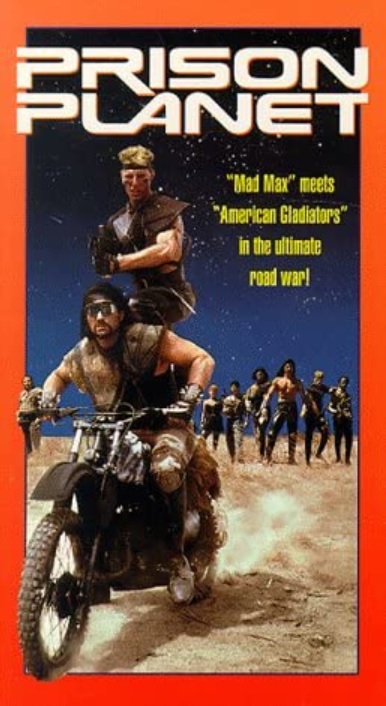
Settle down, kids. Badlanders is also known as Prison Planet.At least there’s no errant “S” to deal with, as in Game(s) of Survival.
For his second apoc outing, Armand Gazarian impressively upped his game to improve on the Game(s) of Survival model as he gives our ol’ apoc-good buddy Cirio H. Santiago a run for his Philippine pesos. Sure, you’ll name drop Mad Max in the frames, but the real inspiration here is all of those Philippine and Italian-made knockoffs of The Road Warrior. Nope, while it looks like Bruno Mattei made this — and if you’ve seen his apoc romps Rats: Night of Terror or Shocking Dark, you’ll know what we mean — he didn’t make this. Nope. Claudio Fragasso — and if you’ve seen Interzone, you know what we mean — didn’t make this either.
Anyway, in the distant Earth year of 2200 — in the badlands of Yuma, Arizona (anyone see Parsifal in his battle car on his way to the “Baked Apple”) — we meet our intrepid freedom fighter, Blaine (U.S. born-cum-Thailand acting James Phillips), who boondoggles a Snake Plissken-styled robbery of a government repository.
Instead of being sent to Manhattan Island Prison, Blaine is sent to Prison Planet, aka the planet of Annakin (uh-huh), committed to fight in gladiatorial combat games. Then he kills the brother of Broxton (Micheal M. Foley from Karate Cop), the planet’s blood thirsty warlord.
Ah, but this is a secret mission: Blaine wanted to get caught and shipped off-world to find fellow Prison Planet inmate Himshaw — the good brother of the Earth’s evil dictator — who holds the key to overthrown the Annakin regime and restore freedom on Earth.
Spiritual hokum, shirtless muscle-bound nomads, porn-flick mustaches, oversized penis-envy swords, slave girls, virgin maiden sacrifices, weasel-whimpy convicts, and slave traders — all in glorious overacting — a-go-goes, and then some. And the guns, Oy! The guns always “jam” when you need ’em the most in the apocalypse. Hey, the big-budget movies always roll out the ol’ “dead car battery/faulty starter” (on a brand new car, no less) trope, aka now the “dead cellphone/no signal” trope, so why can’t a low-budget movie have the a “gun jams” trope? And yes . . . even though we are in the throes of the 21st century — and as with all Italian ’80s apoc films — all the cars are from the ’70s.
Where are they now?
From his humble SOV beginnings, Nicolas Hill worked his way up to the better-made, ’90s-era martial arts flicks Showdown (with Billy Blanks), Death Match (with Martin Kove), Raw Target (with Dale Apollo), Fists of Iron (with Michael Worth), and Bloodsport 2 (not with Jean-Claude Van Damme, but with Pat Morita).
James Phillips, according to the digital QWERTY warriors of the IMDb, co-starred with Eric Estrada in the 1989 Thailand-shot actioner The Lost Idol (check your golden Ark at the door, Indy). And for that same director, Philip Chalong, aka Chalong Pakdeevijit, Phillips co-starred with Jan-Michael Vincent (see why we dropped Alienator), and Sam J. “Flash Gordon” Jones in 1990’s In Gold We Trust (and Sam did his own apoc-slopper, Driving Force). Our villain, Micheal M. Foley, in addition to Karate Cop, you may have seen his martial arts skills in 1991’s Cybernator (I haven’t*) or 1992’s DesertKickboxer (again, nope).
Jonnie Saiko — who appears in Game(s) of Survival as Zooloj — also appears in Hell Comes to Frogtown, Roller Blade Warriors: Taken by Force, and The Guyver. He’s since gone on to a successful career as a special effects mold technician to work in the X-Men, Alien, Predator, and Scary Movie franchises.
As for the rest of the Gazarian canons: Streets of War stars Frankie Ray from Badlanders; digital streamers may have seen him in 2018’s Jurassic Galaxy (not moi). The Searcher stars Robert “Maniac Cop” Z’Dar, so there’s that incentive to find it. One of Gazarian’s producer credits is 1998’s Blood Revenge starring martial artist Chris Cuthrell, so there’s that. And Gazarian is still at it, as his latest (in post-production) credit is Awaken, starring Lance Henriksen, Edward Asner, and Tobin “Saw” Bell.
Yep. From an SOV debut to working with Tobin Bell. That’s a pretty cool career, Armand. See, there is a career to be made after ENG cameras and 3/4-inch U-Matic videotape and Hi-8s and NewTek Video Toasters.
Where to Watch
You can watch a VHS rips of Game(s) of Survival — recently uploaded in September 2020, so thank you, VoicesInMyHead — on You Tube. Check out that page! It has lots of great uploads, such as the bonkers-trashy Lightblast, Death Nurse, more SOV’in with Bits & Pieces, and Mumsy, Nanny, Sonny & Girly. So have fun! Hey, bonus! We found an even cleaner copy on the Internet Archive.
Now, as for Badlanders, aka Prison Planet, there’s no freebie uploads to share. What’s the deal, Tubi? You had it, but now it’s not available? Denied. At one time, Badlanders was part of the VOD programming of the now — sadly — defunct IMPACT cable channel. However, as result of it once being a part of the IMPACT library, you can watch Badlanders as part of the Sling streaming platform, which also makes it available on the upper-tier cable channel EPIX. Perhaps you’re awash in disposable income (frack you, preppy) and you can afford ATT’s DirecTV to watch it there.
I love my SOV ’80s and Gazarian’s two apoc-romps slide nicely onto my “alien shelf” amid the collection. Be sure to click on the SOVlink at the end of this article and you’ll discover all of our reviews of — not only ’80s SOV’ers — but films that are also inspired by and pay tribute to the era. And for as many that we have reviewed, there’s as many we have not. So, to remedy that, come September 12 to the 18, we’re blowing out a week-long tribute to another 25-plus more of those SOV ’80s classics, mostly horror, natch. Join us!
* Doh! Now we did! Check out Cybernator . . . which is not to be confused with Cy Warrior, which is already confused with Hands of Steel.
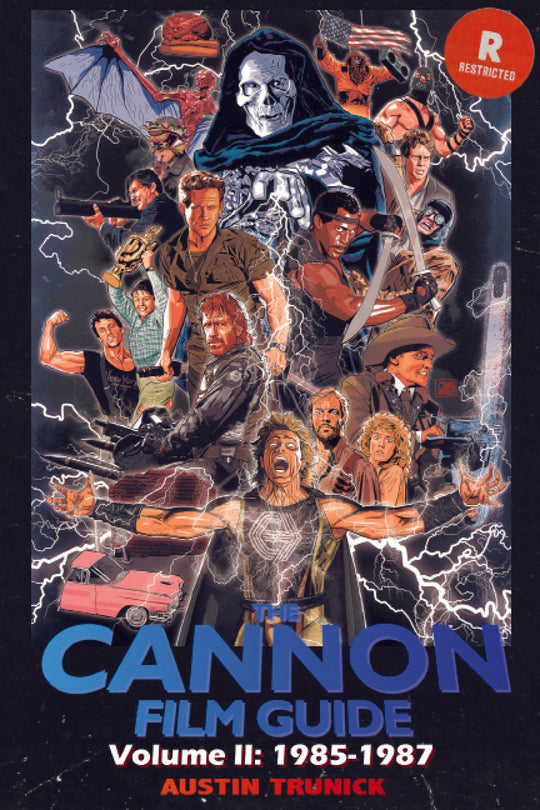
Hey, did you know we blew out two-months of nothing but reviews from Cannon Films with our “Cannon Month” feature? As result, we’ve done another take on Badlanders, aka Prison Planet. And we got there, thanks to Austin Trunick, who sat down with us for a five-part interview.
About the Author: You can learn more about the writings of R.D Francis on Facebook.He also writes for B&S About Movies.
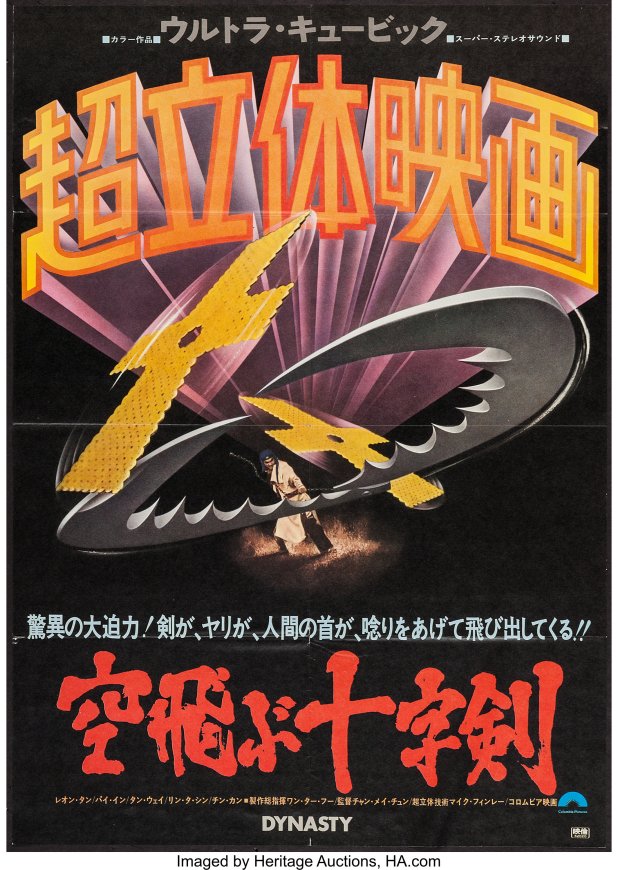
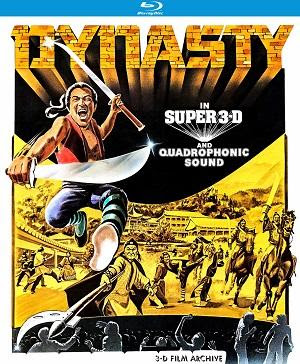
Qian Dao Wan li Zhu AKA Super Dragon AKA Dynasty was the first Hong Kong/Taiwan 3D film, as well as using the Sensurround 8-track stereophonic sound system. That way, the things you’ve come to expect from martial arts films — punches, kicks, swords and flying guillotines — mix up with things you will in no way expect — flying heads, crushed skulls, metal umbrellas as weapons and even a man battling with his amputated knubs — while flying directly at your face.
The prince of the Emperor is accused of treason against the throne by an evil eunuch and his sword-wielding henchman and must fight for his life, which is all the set-up you need for 94 non-stop minutes of fighting. It’s not the best martial arts you’ve ever seen, but it is one of the few that made it into the third dimension.
Director Mei-Chun Chang*also made Young Dragons: Kung Fu Kids and understand that we want to see 3D bust our eyeballs. And serving as the 3D advisor on this? Michael Findlay. Yeah, the very same.
Kino Lorber has released a special edition blu ray of this film, working alongside the 3-D Film Archive to create something that be viewed with either BD3D polarized or traditional red and blue glasses (it comes with one pair). That’s because this blu ray was made with Adaptive Multi-Band Anaglyphic Encoding, which they claim is a vast improvement over any previously used process for red/cyan 3D imaging. I’ll be honest, in my trial of this, it worked perfectly.
The disk also features a restored comic book, some 3D slideshows and a 3D music video.
Here’s to Kino Lorber — you can get this blu ray from them — is planning on releasing more in your face action. This is one of my favorite blu ray releases of the year and is begging to be in your collection.
*Chang also directed another 3D martial arts film, Revenge of the Shogun Women.
PS – This movie played on TV stations across the country with giveaway 3D glasses. In Pittsburgh, it played on Chilly Billy’s Chiller Theater, which got to use the Money Movie set for the evening.
Produced and directed by Roger Corman, this movie somehow had newsman Chet Huntley as its narrator and tells the story of the end of the world and the mutant monster that comes afterward.
U.S. Navy Commander Jim Maddison and his daughter Louise have somehow survived all the atomic bombs, a uranium miner named Rick, a gangster named Tony and his girl Ruby (Adele Jergens, who was an understudy of Gypsy Rose Lee).
Between the creature on the loose, Tony being a jerk and radioactive fallout, how will anyone make it to the end of this movie alive? Well, you will learn a new science fact in this movie: rain can wash away radiation.
Larry Buchanan remade this movie, using almost all the same dialogue, as In the Year 2889 in 1967.
A nine day wonder with a foam rubber monster, this got its name from future American-International Pictures boss James H. Nicholson before it was even filmed. It was Corman’s fourth film and played on a double bill with The Phantom from 10,000 Leagues.
That “Special Combat Unit” subtitle ain’t helpin’, Mr. Copywriter.
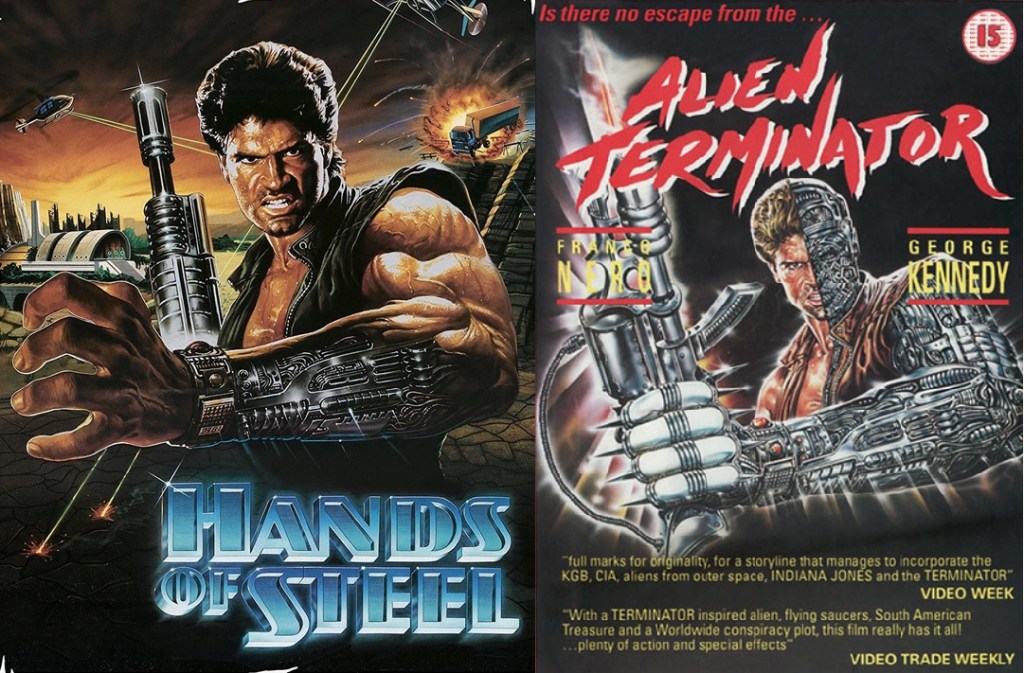
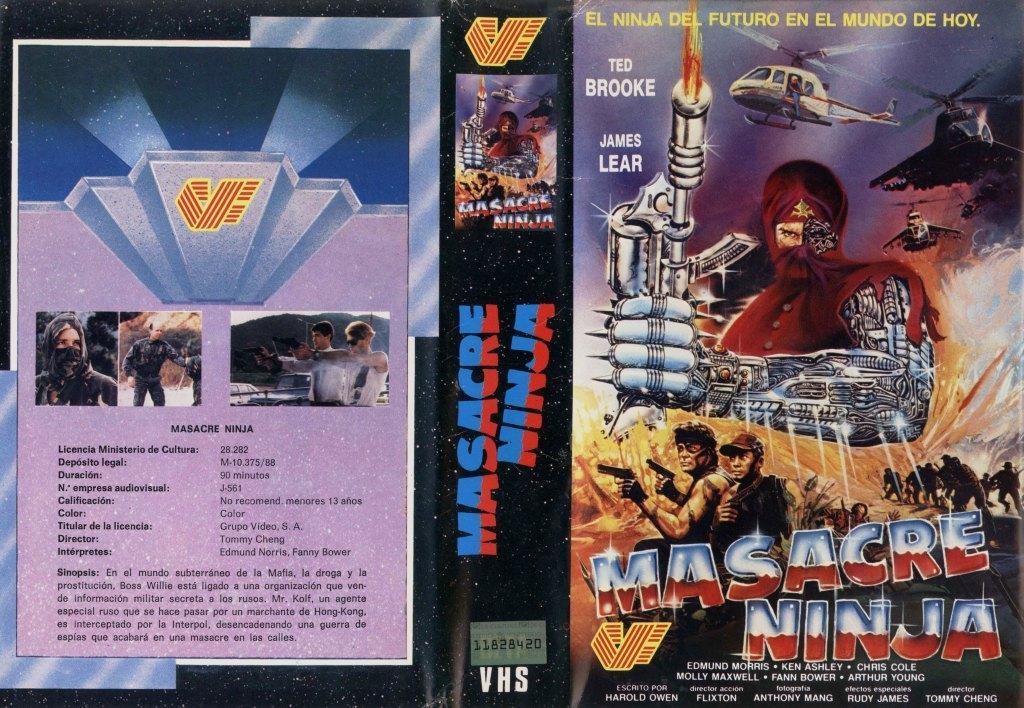
Let me stop you right there, ye VHS junkoid: This isn’t a retitle-repack of Hands of Steel or Alien Terminator, aka Top Line, and Godfrey Ho’s Massacre Ninja is a ripoff in artwork, only. Oh, yes you VCR zombie: this is a whole new movie — well, as “new” as any Italian ripoff of The Terminator can be — starring Henry Silva. And just to make sure you’ll fooled into thinking — I don’t know how anyone was — this is, in fact, a sequel to the James Cameron film, this was also released as The New Terminator. And it was also — although it has nothing to do with the Albert Pyun written and directed and Jean-Claude Van Damme-starring movie of the same name — released as Cyborg II. Now, if you’re keeping track, that Pyun-Van Damme flick had its own sequel, Cyborg 2 (1993), starring Angelina Jolie and Jack Palance . . . but that’s actually a “sequel” to the other cyborg ripoff’er, Nemesis (1992). But our cyborg in this particular cyber-romper stomper has slick-backed hair and wears military fatigues . . . so he looks like a member from the Universal Soldier platoon.
Which came first? The Cy Warrior or the egg . . .
. . . or Godfrey Ho’s typo’d rip, Massacre Ninja?
Ugh. I have a headache. And we haven’t even rolled the movie, yet. So, yes, goodbye headache. Hello, migraine. And who’s responsible for this insane pain in the brain?
Make up artist Giannetto De Rossi in his directing debut. Perhaps you’ve seen his follow up film Killer Crocodile 2 from 1990? Or his E.T. ripoff Tummy from 1995? No, didn’t think so. But you’ve seen his make up work in When Women Had Tails (1970), the Star Wars dropping The Humanoid (1979), and Lucio Fulci’s The Beyond (1981). Then there’s Zombie, House by the Cemetery, and Atlantis Interceptors. De Rossi also worked on the major studio flicks of Dune, King Kong Lives, and Rambo III.
So, needless to say: the make-up work in Cy Warrior, aka, The New Terminator, aka Cyborg II, aka Invulnerable Exterminator, aka Cyborg Warrior, is excellent. Sadly: the rest of the movie sucks apoc ass steak, with its endless stream of political pondering and military yakity yak and forced cute kid-robot comedy. Yes, even with the always welcomed presence of Henry Silva and Miami, Florida-based actor Frank Zagarino in the cast. We’ve enjoyed Frankie Z. many times at B&S About Movies, courtesy of his work in the Project: Shadowchaser franchise, working with Mark Gregory in Ten Zan – Ultimate Mission, and too many Philippine-shot actioners of the post-apoc and Rambo varieties to mention.
And we mention Zargarino’s birthplace because this was shot, partly, in Miami, Florida, as well as the Dominican Republic. And I never thought I’d come to review another Sherrie Rose (be still my weeping heart) movie, but here we are, as she’s here as our ersatz Linda Hamilton. You might remember, as part of our “Fast and Furious” tribute week, we reviewed Sherrie’s (pretty fine) writing and directing debut with Me & Will, as well as her work in Sergio Martino’s American Rickshaw and the teen T&A’er, Summer Job.
Okay, so that takes care of the actor and director trivia. Let’s roll the movie!
Henry Silva and Sherrie Rose on the set of Cy Warrior, February 1989.
Frank Zagarino is our resident cyborg, part of the Cy-W project in which the U.S. government has perfected a robotic warrior. For reasons that baffle, he’s in the process of being programmed-transported in cryogenic suspension on a ship the middle of the Caribbean. Courtesy of the usual incompetent soldiers and “accident,” Cy-W escapes mid-programming and makes it to the shores of the Dominican Republic.
And we cue the poorly dubbed and annoying kid.
Now, if you remember the plot of T-2, where the youthful John Connor attempted to teach human behavior to Arnie, that’s pretty much the plot of our movie. Our little Brandon runs off from his class field trip and discovers the wounded Cy-W in the woods. And Brandon takes his new friend home to introduce to his sister Susan (Sherrie Rose). And they teach “Cy” how to be human, which means, since this is the ’80s, our poor borg looks like he’s in an episode of Miami Vice. And Henry Silva is hired to bring Cy back. And ol’ Henry is the type of heavy that has no problem mowing down a few innocent Dominicans along the way. Hey, what’s a little rocket launcher projectile into a night club — if it protects U.S. national security?
Of course, Brandon is kidnapped. And Silva ends up injuring the kid. And Cy must die to save his friend.
What’s perplexing about this film — in addition to the utterly awful English dubbing of all the characters (including Silva and Rose) — is that the writer on this is Dardano Sacchetti, a usually dependable scribe who gave us the likes The Cat o’ Nine Tails, Bay of Blood, and Shock . . . as well of 1990: The Bronx Warriors, Devil Fish, and Warriors of the Year 2072. Just so many great — well, as great as a B-Movie knockoff of the Italian variety can be — giallos, zombies, and post-apoc movies . . . then there’s this Terminator turd on Sacchetti’s resume. Perhaps if Lamberto Bava, Lucio Fulci, or Sergio Martino — all whom Sacchetti wrote for — directed this? Again, Giannetto De Rossi is great in the up-against-the-budget make-up chair, but not so much in the director’s chair.
Movies like this make me feel for an actress like Sherrie Rose. She gets a lead in a movie — and it ends up not even being her voice in the final product. And for you Sherrie Rose fans that need to complete that David A. Prior and Eric Roberts section in your home movie room: Sherrie stars alongside Roberts in Prior’s 2015 offering, Relentless Justice. And that also stars Vernon “The Wez” Wells from The Road Warrior. So that looks like that may be worth checking out, right?
See. At least you discovered another new movie out of the ass steak that is Cy Warrior, which you can watch on You Tube.
Is it just me, or is this alternate video art for Igor and the Lunatics a rip-off of Hands of Steel? If you’ve seen this artwork on another Euro-apoc flick, let us know!
Honestly, they could have made hundreds of movies in the Heroic Trio series and I would have watched every single one of them. The Wonder Woman (Anita Mui), The Invisible Girl (Michelle Yeoh) and The Thief Catcher (Maggie Cheung) have returned, but the city around them has been decimated from a nuclear attack.
Unlike most superhero films, each of the characters has made major growth in their lives. Wonder Woman is now a mother, hiding her powers to become a better provider. Invisible Girl works to atone for being evil and even trains her former master’s hunchbacked henchman Kau to be a hero. And Thief Catcher may try to steal everything, but she now realizes that she is part of something bigger than herself.
Director Siu-Tung Ching also made the A Chinese Ghost Story series and he directed this with original Heroic Trio maker Johnnie To.
I often obsess about how sequels never change up the game. This movie decided to take a colorful comic book romp and make it a violent and bleak post-apocalyptic movie about the lack of water at the end of the world and the changing roles of women. Hong Kong, you always have so many surprises.
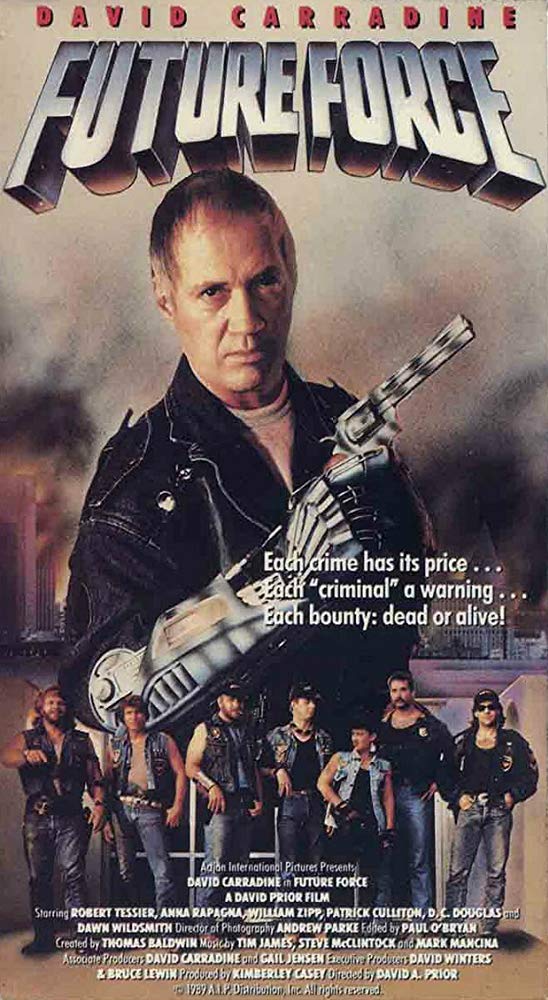
We love David A. Prior around here. Of course, you know that already, as we drop his name a lot around the digitized pages of B&S About Movies. And we like to kid David A. Prior a lot around here, too. But it’s out of respect. Which is why, even though Sam the Boss already took a crack at Future Force and Future Zone during our past post-apoc excursions, we’re reviewing them both with a second, fresh take, for this new apoc week.
In the coming months, we’re rolling out a week-long tribute to ’80s SOV films, and David A. Prior is on the list with his infamous film debut, Sledgehammer (1983), which starred his bodybuilding and ex-Chippendale’s dancing brother, Ted. And from that humble, shot-on-video beginning, David A. came to incorporate AIP — Action International Pictures — with David Winters and Peter Yuval. Winters’s own humble beginnings began with Thrashin’; after being overruled on a casting decision (Josh Brolin instead of Johnny Depp; we reviewed Brolin’s Jonah Hex, by the way), Winters vowed to make movies on his own, without studio interference. Then he gave us Space Mutiny . . . so, maybe it pays to have studio interference.
Ah, but we’re here to praise the ’90s-VHS resume of David A. Prior, a resume that would require two tribute weeks to review the joint Prior brothers’ resume. What we have reviewed is the spa ‘n blades romp Killer Workout and the Filipino actioners Firehead, The Final Sanction, and Silencer. Then there’s his female Rambo ramblings with Relentless Justice. And while Prior didn’t direct them, his Action International Pictures, which later rebranded as West Side Studios after David Winters bought out his partners, also gave us the holiday horror Elves, the apoc-slop of Phoenix the Warrior, and the exploitation zombie mess Zombie Death House.
Mr. Prior dipped his toes in the post-apoc pool again — and Brigette Nielsen in tow — with Hostile Environment, aka Watership Warrior (1999), concerned with the ol’ rebels and tainted water supply gag. We’re wondering if Dave A. brought back the flyin’ robot forearm we’ll soon discuss? We wanted to review it this week because, well, another David A. Prior flick on the site is a good thing — really. Sadly, there’s no online streams — or trailer, not even clips — for us to review and share with you.
The Reviews
And that brings us to the Mad Maxian one-two punch of the post-apoc adventures of John Tucker — he of the flying, remote controlled robot arm-cum-glove. Seriously. John can either slip on the glove to kick apoc-ass . . . or use a remote control on his belt to fly said robo-glove out of its toolbox home to zip around and punch out the bad guys. Oh, and it can shoot lasers and take out an errant helicopter. So there’s that.
Anyway — one year earlier, in the far-flung year of 2020 — things haven’t got so bad to be Mad Maxian, but bad enough to be Robocopian. But, since this is a low-budget apocalypse, the world of John Tucker is just down the street from the also not-the-Main Force Patrol apoc-shenanigans of Ron Marchini’s John Travis in Omega Cop (1990) and Karate Cop (1991). (And, to add to the confusion, David Carradine cameos in Karate Cop.) And since we don’t have the budget for full-blown Robocopbody armor or Road Warrior body leathers, our cops wear sleeveless denim vests with “Special Police” and “COPS” patches on their chest.
And if it all sounds like the same movie . . . it probably is. And none of it — regardless of the vests — is very heavy metal.
You’ve got the right to rock alongside Ron Keel, Mr. Carradine. Flash those horns, Mr. Marchini.
This time, our merry band of law officers are a civilian bounty hunter-based organization known as C.O.P.S, aka Civilian Operated Police Systems. Our intrepid John Tucker (David Carradine) is a bitter, washed up drunk roamin’ the mean streets of Los Angeles who’s more interested in dispatching justice — like Judge Dredd — than collecting bounties in his pocket. Of course, as in Robocop, the police force is corrupt and a reporter — a female reporter, natch — has the proof. (So, yeah, we’re pinchin’ Stallone’s Cobra, too.) And now the C.O.P.S are out to stop the duo from exposing the corruption. Oh, and Tucker’s only ally is Billy (the 260-plus credits strong D.C Douglas; six new films in production), a computer genius with a spiffy wheelchair. Oh, and the chief baddy that gets his ass robo-gloved kicked is Robert Tessier from Burt Reynolds’s The Longest Yard — but since this is B&S: The Glory Stompers, The Velvet Vampire, and Chief Thor in Starcrash, just to name a few of Robert’s B-Movie delights.
So, we’ve ripped off Mad Max and mixed it with Robocop. And tossed in some Cobra and Ron Keel. What’s left to rip: The Terminator . . . or more like Charles Band’s Trancers— didn’t that have time travel and see an overseas release as Future Cop? — since there’s no way this movie can afford a James Cameron cyborg, well, at least not a borg that extends beyond the right forearm. And John Tucker ain’t no Jack Deth. And neither is a Snake Plissken. But Plissken was packing a 1998-era, mission-critical Kraco audio cassette tape and a laser-sighted revolver. And Tucker has a robo-arm. So who is kicking whose ass around Los Angeles: David A. Prior, for at least he came up with a techno-trinket and didn’t have Tucker packing Carpenter’s “future” audio cassettes.
Anyway, this time, the C.O.P.S will stop John Tucker . . . so they think. Tucker’s son, Billy (Ted Prior) — and not the same Billy from Future Force — travels back in time to 1990 to stop his dad’s murder. Oh, and save Tucker’s wife — and Billy’s mom — from kidnappers. And that’s pretty much it. The glove kicks ass. There’s explosions. Turned over cars. Oh, and requisite baddie soldier-cop Charles Napier (best known in the mainstream, celluloid throes as CIA officer Marshall Murdock in Rambo: First Blood Part II) and Jackson Bostwick, the original Captain Marvel from the ’70s Saturday morning TV series Shazam!, beef up the cast (well, this is a step up from the Gold Key Entertainment-verse with Killing at Outpost Zeta and Escape from DS-3, after all, right Jackson? Uh, is it?).
So, which is better and which is worse? Opinions vary. Can you make it through both and figure it out for yourself? Well, what do you expect from a law enforcement agency that spends their money on a fleet of un-Mad Maxian Jeep Cherokees with remote control doors — then blows their remaining operational budget on robo-gloves that flash an “OK” and Devil’s Horn” signs after its remote ass-kickings?
Exactly.
For no one thought to rent the repurposed Death Race 2000 Calamity Jane from Claudio Fragasso used in Interzone or Scorpion’s bubble-topped Camaro from Enzo G. Castellari’s Warriors of the Wasteland. And speaking of Trancers and cars . . . Band’s future cop romp repurposed the Spinner from Bladerunner, which was also repurposed in Solar Crisis (1990) and Soldier (1998). Come on, Mr. Prior, a fleet of Jeep Cherokees will save our future? Could you be more cheapjack? Okay, so don’t rent out the Spinner. Could you have at least attempted a flashy, MFP-styled paint job on the jeeps? And . . . hey . . . wait a sec . . . are those the same Jeep Cherokees from the earlier adventures of John Travis in Omega Cop(y) and Karate Cop(y)?
Where to Watch
You’ve got four chances to tough out the John Tucker-verse: Tubi offers the RiffTrax’s versions of Future Force and Future Zone. If you’re a purist — like moi — you can watch the un-riffed VHS rips on You Tube for Future Force and Future Zone. And no, while David Carradine stars in the similarly-titled Crime Zone, that’s a whole other zone unto itself — courtesy of Roger Corman’s Concorde Productions. The same goes for Carradine’s brush with Cirio H. Santiago in Kill Zone from 1993.
And since we mentioned Ron Keel and are in a musical mood: The resident damsel-in-distress in Future Zone, aka Ms. and Ma Tucker, is Gail Jensen, aka, Ms. David Carradine. The Carradines married in Rome in 1988 during the filming of the Italian-British co-production of the Terence Young-directed sports drama, Run for Your Life, aka, Marathon. Now, if the name Terence Young is familiar to you spy flick junkies . . . yes, Young is the director behind the early Bond classics Dr. No (1962), From Russia with Love (1963), and Thunderball(1965). (We could do a theme week on Young’s resume; we haven’t reviewed many of his films, but we did take a look at his box office bomb, Inchon.)
Anyway, back to Gail Jensen.
While Jensen acted (she made her debut in a 1974 episode of TV’s popular cop-procedural, McCloud, and had a support role in the ’80s slasher Don’t Answer the Phone) and helped co-produce David’s later films, she was primary known as a musician and songwriter. Her credits include the songs “Walk the Floor” and “Hello Heartbreak” — both sung by David — and “History Hall” and “Shot Full of You Love” — both sung by Gail — for Larry Cohen’s Maniac Cop. Her biggest success as a songwriter was the Lee Majors-sung “Unknown Stuntman,” which she co-wrote with Glen Larson and Dave Somerville (Larson were both members of — but not at the same time — The Four Preps; Somerville went onto greater fame with the ’50s vocal quartet, The Diamonds). Jensen also wrote the 1977 single “Prairie Dog Blues” for McCloud actor Dennis Weaver. (You can also check out David Carradine’s songwriting and singing with “Divining Rod” featured in Roadside Prophets.)
Unfortunately, when you Google Gail Jensen to learn more about her music career, all links lead to her disclosure of David Carradine’s kinky sex proclivities, which led to his death. For the curiosity seekers of the dark side of Hollywood, you can learn more about the legal fallout of David’s — and eventually Gail’s — deaths via the IMDb’s news section on Gail Jensen (and that page with the press links has now been wiped; you’re on your own with Google).
Personally, I much rather know more about Gail’s music career — which Hollywood seems to have swept under the rug.
About the Author: You can learn more about the writings of R.D Francis on Facebook.He also writes for B&S About Movies.

















 B&S About Movies
You must be logged in to post a comment.