I think I can also speak for Sam that, when we were in college (remember those days, Sam), the last thing on our minds was going into the woods to look for aliens or hairy rugs of the Bigfoot variety. High School was a bitch for us both and college was a weekly proctological exam. So what in the hell is with the ne’er-do-well kids with all the free time to curiosity seek in the woods? Yeah, we know: their thesis paper, etc., bla, bla, and yada, yada. Which is why Sam and I leaned towards the artistic: both visual and written. No cramming on law journals or dissecting or field trips. It was art tables and typewriters and radio studios for us. For nature outside: bad. VCR movie-womb room (with turntables and vinyl): good. And thanks to those VCR binges, we know better: going to the woods in a cabin with friends for an isolated vacation, well, you just end up possessed. Or infected. Or dead. Or worse.
So here we are. And it’s real.
We dig Bruce Wemple, who gave us a pretty cool pair of wooded-mystery steamers with Monstrous (a Bigfoot) and The Retreat (an Indian-myth Wendigo). And he’s giving us a double-dose in Dawn of the Beast. So, it’s sort of a sequel-trilogy. It’s like those ongoing Kaiju movies of old, with one film building onto another, with a creature from one film tag-teaming in the next, as the films keep getting bigger and better as they progress.
In the streaming-21st century — with the Canon Reds and other digital devices — it’s the slasher ’80s all over again. In either era: You’re a new-to-game filmmaker who wants to tell stories. You don’t have the budget to “go big” like the big studios, with fancy sets and props. So, you head off into the woods: the sets are cheap and bountiful. And Wemple uses those wooden environs to his advantage with a skill-set that always gives us an engaging story.
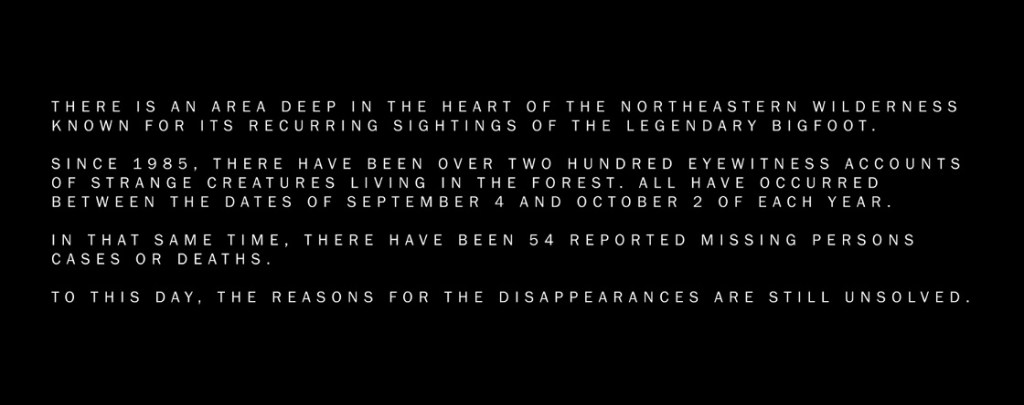
So, those students with their Bigfoot obsession head off into the Northeastern wood, known for its “strange creature sightings,” natch. And the “strange creatures” are double the terror: our Mystery Machine gang not only runs afoul of Bigfoot, but the spiritual Indian creature, a Wendigo. The ancient creature, wooden battle royale, with the kids caught in the middle, ensues (oops, lazy writing, again!).
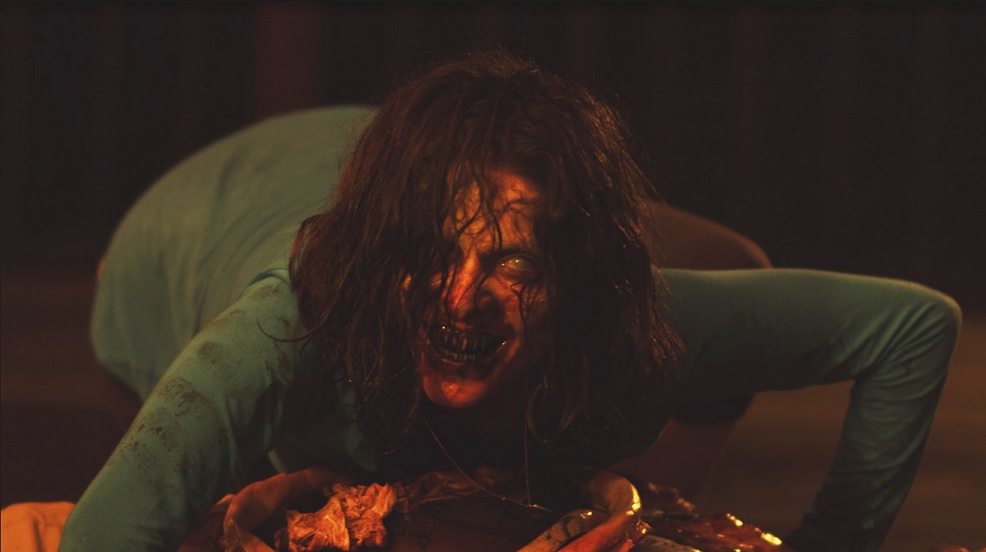
As you can tell from the film stills, Bruce Wemple has really upped his game: the makeups and effects are against-the-budget stellar. Wendigos, Bigfoots, and Raimi demon possession. Oh, my! Auntie Em! Toto!
Good stuff, once again, Mr. Wemple. Keep ’em comin’!
While we didn’t officially review either for the site, be sure to also stream Wemple’s two previous, upper New York State-based indie-features, After Hours (2016) and LakeArtifact (2019). The welcomed and dependable Anna Shields, who starred in those two films, as well as Monstrous, stars — and pens Dawn of the Beast. Her co-star, Grant Schumacher, also returns from Lake Artifact, Monstrous, and The Retreat. Needless to say, they’re excellent, as always.
Uncork’d Entertainment will release Dawn of the Beast to digital platforms and DVD on April 6, 2021.
Disclaimer: We were sent a screener by the distributor’s P.R firm. That has no bearing on our review.
About the Author: You can learn more about the writings of R.D Francis on Facebook.He also writes for B&S About Moviesand publishes short stories and music reviews on Medium.
This unsold TV pilot — made in 1988 for ABC — tried to take advantage of the boom in all things post-apocalyptic. It was even shot in some of the same places that Max Rockatansky race across, like Bourke-Wilcannia Road, Broken Hills and The Barrier Highway in New South Wales, Australia. And directing it? George Miller.
No, not that George Miller.
The George Miller that directed The Man From Snowy River and The Journey to the Center of the Earth TV mini-series.
That said, this movie also features Hugh Keays-Byrne, who was Toecutter in Mad Max and would one day become Immortan Joe in Mad Max: Fury Road. It’s also got Gus Mercurio (he was in plenty of Australian films like Harlequin and Turkey Shoot), Justin Monjo (who was in the post-apocalyptic The Blood of Heroes), Debra Engle (who played Blanche’s daughter Rebecca on Golden Girls), Caitlin O’Heaney (He Knows You’re Alone) and even Sharon Stone in an early role.
It goes so far to be a Mad Max-style film that they used stunt coordinator Glen Boswell (The Road Warrior, Razorback, Mad Max Beyond Thunderdome, Dead End Drive-In). A lot of the crew — art director Rob Robinson and assistant directors Tony Wellington and Nikki Long — also worked on the end times film Sons of Steel.
It’s all about the aftermath of a severe drought that has pushed America away from the west and made water the most precious resource there is. As settlers move back into the destroyed cities, U.S. Marshalls like Garson MacBeth (Lewis Smith, Perfect Tommy from The Adventures of Buckaroo Banzai) and his cyborg partner, Rex (Miguel Ferrer, who a year earlier had helped build RoboCop) are there to protect them.
Sure, it’s kind of silly, but I loved the idea of MacBeth being obsessed with the idea of the west that he only knows from old movies and TV shows. And any post-apocalyptic movie that ends with Miguel Ferrer becoming a T-800 style robot and unleashing a barrage of bullets is something that I’m totally going to enjoy. Oh yeah — and it’s written by Rueben Leder, who also wrote A*P*E*!
If you’re a fan of Asian cinema from Japan, then you know the name of Kinji Fukasaku. In addition to directing the Japanese portion of the Hollywood war film Tora! Tora! Tora! (1970), he directed Toho’s Star Wars hopeful, Message from Space (1978), and the controversial and influential—and his final film—Battle Royale (2000).
After the international failure of Message from Space, Fukasaku set off to make what he hoped would be his masterpiece: an apocalyptic epic based on Sakyo Komatsu’s best-selling novel Fukkatsu no hi, aka Day of Resurrection, intended to rival the likes of Hollywood’s A-List apocalypse pieces such as Soylent Green and The Omega Man and Irwin Allen-styled disaster films such as Earthquake and The Towering Inferno. Westerners—courtesy of their film adaptations—may also know Komatsu’s best-selling Eastern novels Japan Sinks (1973) and Sayonara Jupiter (1982), which were turned into the disaster films Tidal Wave (1973; the U.S. cut featured Lorne Greene from Earthquake) and the space opera Bye, Bye Jupiter (1984). (You may recall Tidal Wave was Roger Corman’s Americanized cut of Japan’s highest-grossing film of 1973 and 1974, Nihon Chinbotsu, aka Submersion of Japan, aka Japan Sinks!, from Komatsu’s best seller.)
Upon its release, Kinji Fukasaku’s Virus was the most expensive film Japan ever produced—at $16 million U.S. It was also one of the country’s biggest box-office failures: even more so than Message from Space.
To make a return on their investment, Toho decided that the film needed to cast familiar western actors—albeit from Hollywood’s B-List—alongside their homeland’s familiar actors to successfully break into the Western markets of Europe and the United States. So an English-speaking international cast featuring Chuck Connors, Glenn Ford, British actress Olivia Hussey, George Kennedy, an up-and-coming Edward James Olmos and Canadian actor Nicholas Campbell, Henry Silva, Bo Svensen, and Robert Vaughn was assembled to star alongside Sonny Chiba and Masao Kusakari. Not only was the cast of an international persuasion, the film was shot on-location, not only in Tokyo, but in various locations in and around Ottawa, Canada, and Halifax, Nova Scotia. The film was supported by the Chilean Navy (Olmos stars as Russian-speaking Chilean), which lent their submarine the CNS Simpson for the production, as did the Canadian Navy, which lent out their submarine the HMCS Okanagan (Connors stars as a British naval officer).
The original cut of the film, which played in the Pacific Rim territories and was intended to play internationally, clocked in at 156 minutes (2 hours and 36 minutes). The film, of course, heavily features Sonny Chiba and Masao Kusakari, as their characters developed during the course of the film through a series of pre-apocalypse flashbacks to their earlier life.
Say it was too long; say it relied too heavily on its Japanese stars; or say that the film’s “blaming” the U.S. and other Western countries for unleashing a deadly pandemic—then nuclear devastation—upon the world was a tad too realistic (the scenes depicting marital law and infected bodies burnt in piles are undeniably dark) and not the dumbed-down Irwin Allen disaster epic with a happily ever after ending that Hollywood was expecting. And there was no way Hollywood was putting a two and a half-hour epic*—filmed mostly in English-subtitled Japanese—into theaters. So, instead of a full, worldwide theatrical release, the majesty of Kinji Fukasaku’s to-be crowning cinematic achievement was cut into a syndicated television version that ran at 108 minutes (1 hour 48 minutes). There’s also a third, shorter TV version that runs seven minutes shorter at 101 minutes (1 hour 41 minutes).
The missing 48 minutes eliminates all of the Tokyo-based flashbacks and most all of the scenes that take place at a remote, isolated Japanese station—which conveniently eliminated all of the English subtitled Japanese. While the 156 minute cut is the suggested watch—which finally seen an official U.S. DVD release in 2006; the original cut is also part of the Sonny Chiba Action Pack—you’re better off, of course, if you can only get a copy of the TV version, watching the longer of TV 108-minute cut. Sadly, the U.S. TV versions—which are now in the public domain on cheapjack DVD sets—reduce Sonny Chiba and Masao Kusakari from the “stars” of the film to peripheral characters; a heart-wrenching scene with the Japanese station making a contact with an orphaned U.S. child begging for help, is lost; Kusakari’s epic trek from a decimated Washington D.C.—which he and Svenson’s soldier tried to stop—is also deleted, which also cuts another great scene with Kusakari carrying a conversation with a burnt-out skeleton—and Jesus Christ on a cross—in a church. And whole scenes are also rearranged, most notably with Chuck Connors’s naval officer’s part not only reduced, but appearing in different parts of the film, depending on the cut you watch.
So, yeah, we’re telling you to watch the original, “too bleak for the U.S.” theatrical cut as Kinji Fukasaku intended. And it’s important to take into account that this is all pre-CGI and shot with practical in-camera effects and seamlessly incorporated stock footage, but those effects—wow, especially those showing the world’s devastated cities, including an overgrown nation’s White House—are stunning set pieces. And if you take the time to watch the original—and are able to, considering our current COVID circumstances, digest a film about a global pandemic unleashed by man’s own greedy stupidity—you’ll agree this is one of the best—if not the best—post-apoc movies you’ll ever watch**.
In a timeline that runs from the year 1982 to 1988, the apocalypse begins as East German and American scientists bicker over the deadly MM88 virus—a virus that absorbs and amplifies other viruses, making them more deadly. Of course, its creation was “accidental,” and it was stolen from a U.S. lab. Successfully recovered, the plane transporting the virus to the states, crashes, and what becomes known as the “Italian Flu,” is unleashed. Oh, and a goody-two shoes lab tech that discovered the truth behind MM88 is murdered to keep it all quiet. (Sakyo Komatsu’s based his book’s “Italian Flu” on the Spanish Flu pandemic of 1918 to 1920, which started in Kansas, USA.)
In a mere seven months, most of the world’s population is dead—and eventually claims the lives of Glenn Ford and Robert Vaughn (starring as the President and VP). Henry Silva (Silva, Ford, and Vaughn are excellent) is their paranoid-mad military Chief of Staff insistent that the new ARS Defense system must be armed to protect a now weakened America from a Soviet invasion. And being the crackpot that he is—after his bosses are all dead, he arms the system just before the flu claims his life.
Seven years later, all that’s left of humanity is 855 men and eight women at Palmer Station Antarctica, as the virus can’t survive in temperatures below 10-degrees Celsius. Their somewhat peaceful existence (women are forced into sexual servitude to propagate the species) is upended when it’s discovered the Soviets also have—and armed—their own ARS system: and one of the missiles is aimed at Palmer Station (because it’s a “secret military base”). Then, if the virus and the threat of nuclear war isn’t enough, the station’s seismological team discovers an earthquake will hit the U.S. eastern seaboard—and the magnitude of the quake will be interpreted by the ARS system as an “attack” and launch its rockets.
So, Bo Svenson’s Major Carter and Masao Kusakari’s Dr. Yoshizumi head off to Washington D.C. on an icebreaker to shut down the ARS. Only they’re too late: the earthquake hits and the U.S. ARS launches—and Carter dies in the earthquake rubble. Then the Soviet’s ARS counterstrikes. The world is destroyed.
And that’s how the TV movie version ends.
The theatrical version continues—with those extra seven minutes cut from the 108-minute TV version—as Yoshizumi treks south across the wastelands back to Tierra del Fuego, Antarctica, where the Earth’s final survivors—from the ocean-bound ice breaker, escaped, and successfully created a vaccine.
As far as this reviewer is concerned: Kinji Fukasaku, in fact, created a masterpiece. And, if you’ve spent any amount of time on the digitized terrains of B&S About Movies and are familiar with the later, collective schlock ‘80s resumes of Chuck Conners (Tourist Trap), George Kennedy (Top Line), Henry Silva (Megaforce), Bo Svensen (Night Warning) and Robert Vaughn (Starship Invasions), you’ll realize that they’re all very good here—and Virus gave them their last great film roles before the Italian and Filipino film industries got their low-budget hooks in them. (Nicholas Campbell and Silva later worked together on the Canux-slasher Baker County, U.S.A; Campbell was “Luke Skywalker” in the Canux-star slop that was The Shape of Things to Come; Olivia Hussey ended up in things like Ice Cream Man.)
You can watch the full-length director’s cut courtesy of Tubi. You can watch-compare to the U.S. TV version on You Tube and the VHS version on You Tube.
* We discussed, extensively, those epic “intermission” films of the ‘60s and ‘70s in our review of the 2021 release of the Australian film Rage.
** We discuss a few of our ’70s apoc favorites with our “Drive-In Friday” tribute to Hollywood’s A-List Apocalypse. Then there’s . . .
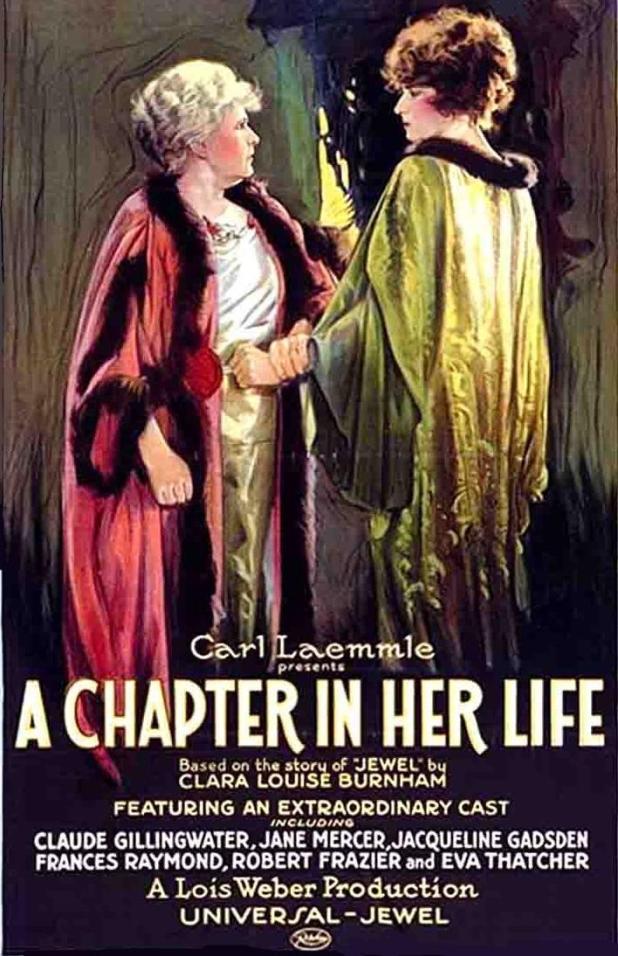
Based on the novel Jewel: A Chapter in Her Life by Clara Louise Burnham, this film was the second time that Lois Weber had directed an adaption of that book. The first was 1915’s Jewel, which she co-directed with her husband Phillips Smalley. She went uncredited on that movie but this one, made shortly after their divorce, gave her full credit.
Somehow, within this mainstream film, the views of Christian Science are shown to win the day for young Jewel. She’s staying with her angry grandfather while her parents go overseas on business, but all the vitriol is easily fixed thanks to our heroine’s love and trust in others.
Lois Weber is an intriguing figure in film history and one worthy of study.
Born in Allegheny, PA, Weber was first a streetcorner evangelist before starting her career as an actress. She appeared in what experts consider the first narrative film, 1908’s Hypocrites*, and by 1911 was co-directing and starring in the film A Heroine of ’76.
By 1914, she was making 27 films a year. In the spirit of her early call to evangelism, she began directing, writing and then producing films dealing with the themes of abortion, alcoholism, birth control, drug addiction and prostitution.
One of her many innovations was the split-screen, which she used in 1913’s Suspense, as well as early experiments with sound. She also made the first adaption of Tarzan in 1918.
She wasn’t a novelty. She was actually Universal Studios’ top director and even had her own production company. Sadly, her career didn’t translate to talking pictures, but that isn’t because of her gender.
Lois Weber died after making only one talking film, 1934’s White Heat. By that point, she’d been forgotten by Hollywood, but more than 300 people attended her funeral, which had been paid for by Frances Marion, the most renowned screenwriter of the 20th century and someone who had been inspired by Weber. In 1960, she was awarded a star on the Hollywood Walk of Fame.
Kino Lorber has released A Chapter In Her Life and Sensation Seekers on blue ray, with 2K restorations by Universal Pictures. I was excited to see a clean-looking copy of this film, as well as to learn more about Weber’s life. It’s pretty astounding that she was a divorcee and a leading force in Hollywood at a time when both of those things were well outside the boundaries of normalcy.
*A film that features a full-frontal female nude scene.
There was a time, like probably 1986, where end of the world movies and rollerskating movies crossed paths to make one film. Mel Brooks was involved. And it went nowhere in our reality, but if we are to believe the theory of multiple Earths each with their own divergent timelines, there is one version of life where Solarbabies was a Star Wars sized hit and there would be a whole new slate of Italian ripoffs of end of the world rollerskating movies and not just the Roller Blade movies that Donald Jackson unleashed on an uncaring planetoid.
There’s no water in the future and there are orphanages and there’s a game that’s kind of like rugby on skates. A team of orphans — Jason (Jason Patric), Terra (Jami Gertz), Rabbit (Claude Brooks), Metron (James LeGros), Tug (Peter DeLuise) and Daniel (Lukas Haas) — have bonded over this game and when Daniel finds a glowing orb that might be the key to everyone having enough water, this family unit has to seek it out.
That’s because another orphan named Darstar (Adrian Pasdar) has stolen it and taken off for the desert with the Eco Protectorate e-Police in hot pursuit. Oh yeah — that orb is also called the Bodhi and is part of an alien who the government also wants to capture.
This movie leaves me with so many questions, like why did talented people like Charles Durning, Sarah Douglas and Alexei Sayle from The Young Ones end up in it? How do rollerskates work in the desert? How amazing is it that Mel Brooks lost $9 million dollars of his own money on this and had to fly out to the set to threaten to fire everyone when the cast fought with director Alan Johnson, who up until then was a choreographer and only directed one other movie, Brooks’ To Be Or Not to Be? Can you believe that this movie was delayed for weeks because of rain, even though it was lensed in a Spanish desert? And how absolutely wild is it that it has a theme song by Smokey Robinson, “Love Will Set You Free” that directly quotes Jesus throughout*?
Bad gut Grock — great name — was played by Richard Jordan, who had to have been sick of being in desert movies that bombed after this and Dune.
And you know, I loved this when it came out. I was that lone kid when Patric and Gertz got hot in The Lost Boys that kept saying, “But have you seen Solarbabies?”
*To be fair, every character in this movie is named for some religious figure and the Bodhi is at one point literally called the sphere of Longinus, which is a direct tie to the Spear of Destiny that pierced the side of Jesus and ended his life after being crucified.
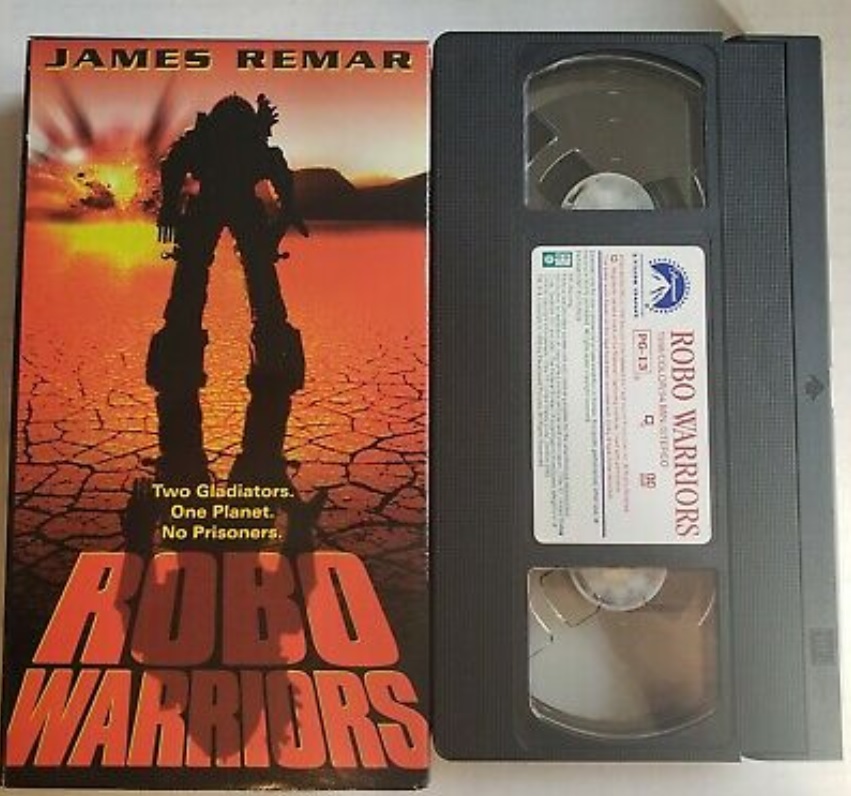
Charles Band is one to never keep a good robot down — not when he laid out several million bucks to create his first robot-verse romp in 1989. So the anime-inspired mechs that we know and love are back, along with an all-new, never-seen-before mech: the Lucasian-inspired AT-AT that is MRAS-2, which resembles a mechanized scorpion.
Now, if you read our reviews for the they’re-not-sequelsRobot Jox and Crash and Burn (both reviewed this week), then you’re up to speed on the all-over-the-place timeline of the Band-verse that our poly-carbon alloy friends operate in. Adding to the confusion: In the overseas markets, courtesy of the U.S. home video promotional one-sheets touting the tagline: “First, there was Robot Jox . . . ,” this third installment of Band’s live action anime-mechs is known in the overseas markets as Robot Jox 2: Robot Wars. Yeah, we know. Crash and Burn was Robot Jox 2: Crash and Burn in the overseas markets. So, why not suffix Robot Wars with a 3?
Oh, ye poor B&S reader. Why are you overthinking a movie with a giant scorpion robot?
And speaking of overthinking: While Robot Wars takes place eleven years after (in 2041) the events in Crash and Burn (set in the year 2030), this isn’t the future-continuation of that timeline. In fact, the world — instead of being devastated by a nuclear war as depicted in Robot Jox, and the world economic collapse due to man’s dependence on technology ballyhooed in Crash and Burn: now the North American continent was devastated by “the great toxic gas scare of 1993” that’s left large parts of the former United States a barren, desert wasteland. (You know, the same desert wasteland Parsifal, Bronx and Ratchet drove across on motorcycles to the Eurac-backed Big Apple, aka Arizona, U.S.A.) Oh, and let’s not forget the great robot ban of 2015 that decommissioned all the battlebots. (Uh, oh. Are we pinching from Damnation Alley, here? Remember that ’70s post-apoc’er had giant scorpions raised on radioactive fallout.)
And Band changed the sociopolitical backstory, yet again. Gone are the U.S.-led Common Market and the Russian-bred Confederation. And it seems the Independent Liberty Union foiled the tech-oppressive Unicom Corporation. Now, the New World Order is known as North Hemi, which assimilated the United States. The opposing side is the Eastern Alliance. And, at one time, the Hemis and the Alliancers had at it out with their now extinct 120-foot mechs we know and love, hence the great robot ban of 2015. (Uh, oh. Are we pinching from Francis Ford Coppola’s Battle Beyond the Sun? Remember that Corman-hatchet job of the superior Russian space epic Nebo Zovyot (1959) was rewritten by Frank, set in the year 1997 with a world divided into North and South Hemi governments.)
Sadly, all that is left of the once ubiquitous war machine mega-robots is the MRAS-2 scorpion-styled robot, now reduced to being tourist attraction that transports civilians across the wasteland — but still carries a full weapons complement, complete with a laser-tipped tail. Ah, but this isn’t just another wasteland tour: Wa-Lee, an Eastern Alliance dignitary is on board, on his way to negotiate a trade agreement with the North Hemis to manufacture a new line of “mini-megs” for the Eastern Alliance. (Although Danny Kamekona is the only actor from the franchise to act in two of the three Robo flicks, he’s a different character in each.)
That trade agreement is jeopardized when it is discovered the terrorist-based Centros, desert bandits who attack North Hemi transports, are now backed by Eastern Alliance sympathizers. As the story develops, it’s learned that Wa-Lee, and Drake, our Plissken-styled MRAS-2 pilot (Don Michael Paul; he’s since written and directed sequels in the Jarhead, Sniper, Tremors, and Death Race franchises) were once friends, but now enemies. Their animosity boils over when Wa-Lee, with the support of the Centros, hijacks the MRAS-2 and holds its passengers hostage. And with that, Drake faces his fears and climbs back into the cockpit of a reactivated MEGA-1 for some battlebot action. Oh, and a pretty cool, double-turret laser tank (right off the cover of David Drake’s 1979 paperback Hammer’s Slammers) shows up. However, also showing up along the yellow-plotted road is the Bogie and Bacall-styled romantic bickering between Don Michael Paul’s Han Solo-esque scoundrel and Barbara Crampton’s (Re-Animator) Leia-inspired archeologist who helps him resurrect the thought lost MegaRobot — that digs itself out of its subterranean grave in an impressively executed effect.
Yeah, but just a little too late with the effects there, Chuck.
Charles Band was really onto something special with Stuart Gordon’s Robot Jox. Then he fumbled the ball with his two they’re-not-sequels and got ass-smoked by Toho Studios’ hell-of-a-lot-more fun, GUNHED (1989). And team Band (Charles produced while pop Albert directed) most likely realized that fact, as their fourth not-a-sequel, Battle Jox — featuring giant dinosaur-styled robots — was cancelled. (Thank the Lords of Kobol for saving us from that feldercarb. In what logic-verse would man build dinobots, except for some lame-ass toyline for kids 9 and under.)
Dave Allen and Jim Danforth really knocked it out of the park with the newly-added Scorpion robot. Double for the special effects team of Greg Aronowitz and Rob Sherwood who designed the robot cockpits. The plate work is also top notch in depicting the rocking of the passenger cabin/cockpit against the landscapes as the scorpion walks. (The VHS has a great documentary vignette — void from the later DVD presses — that explains/demonstrates the plate processes of the film.) It’s when the proceedings get outside of the cockpit — with the Paul-Crampton romancing, Lisa Rinna’s journalist investigating the nefarious goings in the metropolis of Crystal Vista (aka old Los Angeles), and the sociopolitical rambling — that it all goes to feldercarb. Is the third act here, yet? Can we please just get to the robot battle we came for in the first place?
While you’ll notice the Full Moon prop and costume department raiding throughout the film (that looks like leftovers from Spacehunter: Adventures in the Forbidden Zone and Metalstorm: The Destruction of Jared-Syn to me; reviews coming for both, look for them), the proceedings are of the oh-so Buck Rogers plastic-verse variety to the point you’re wondering when a (bitchy-Season 1) Erin Grey or (pudgy-Season 2) Gil Gerard will show up. But we’re grateful for iconic Asian actors Danny Kamekona and Yugi Okimoto bringing their A-Game and selling the silliness with gusto. (They both appeared together in The Karate Kid Part II (1986); along with Don Michael Paul, they also appeared in Aloha Summer (1988).)
As with its sister films, VHS copies are bountiful in the online marketplace, with the first DVDs issued in 2007 as part of the Full Moon Classics: Volume Two disc set, and then the Full Moon Features: The Archive Collection, with 17 other Full Moon titles. Robot Wars is also double-featured with Crash and Burn on a Shout! Factory DVD issued in 2011. Blu-ray’ers can pick the Full Moon single-movie version issued in 2017. Question is: When are we going to get a three-pack set proper — complete with the VHS documentaries restored?
You can enjoy Robot Wars as a free-with-ads stream on Tubi. Here’s the TV promo spot to get you started.
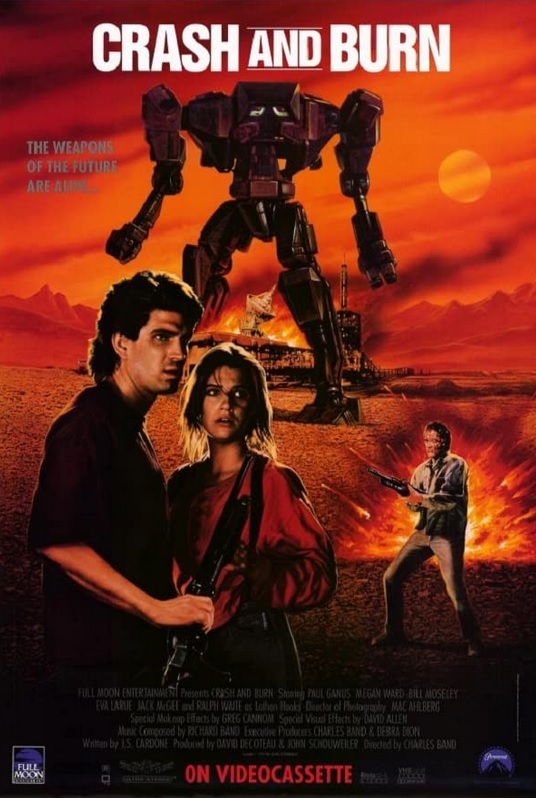
This sequel-but-its-not-a-sequel to Robot Jox — marketed in the overseas markets as Robot Jox 2: Crash and Burn — unlike its predecessor, foregone a U.S. theatrical release and went straight-to-video. As with Roger Corman creating Forbidden World and Space Raiders for the sole purpose of not so much to tell a compelling story, but to maximize his $5 million dollar investment in Battle Beyond the Starsby recycling that dopey Star Wars cash-in’s sets and special effects, Crash and Burn recycles the impressive Dave Allen and Ron Cobb stop-motion animated robots from Robot Jox. Just don’t hit the big red streaming button with the expectations of another anime-mech battle of the robots: at its core, Crash and Burn slaps a sci-fi coat of paint on the plot of Friday the 13th, with that film’s supernatural, woodsy killer, replaced by a James Cameron-inspired, unstoppable, synthetic desert killer.
Why is the tagline “The Weapons of the Future are Alive” in grey-against-red: you can’t read it. Why not go with a black typeset-against-orange?
To make sense of this new, its-not-a-sequel Band-verse: Let’s assume that the post-fifty years-after-the-nuclear war new order created by the two, new world superpowers from the Robot Jox timeline — the Common Market and the Confederation — suffered an economic collapse. That, coupled with the world ravaged by the greenhouse effect and an out-of-control sun creating “Thermal Storms,” allowed for the rise of the powerful Unicom Corporation controlling the world’s marketplace. Blaming the economic instability and collapse on the world’s technological dependency, Unicom banned all human usage of computers and robots. (In this new-verse, the mech-robots were develop for mining operations.)
While we have a pinch of The Terminator here, you’ll also notice an Orwellian pinch of the influential, “ancient future” novel, 1984, with scattered pockets of citizenry operating the “Independent Liberty Union,” a loose resistance movement in authoritarian opposition. One of the last free-speech strongholds against the corporate rule is a battered, over-the-air Public Access television station housed in an abandoned industrial facility, operated by Union sympathizer Lathan Hooks (Ralph Waite of TV’s The Waltons), a one time media executive who moonlights as a revolutionary. And, in a pinch from Alien — if you remember that the Weyland-Yutani Corporation infiltrated the Nostromo’s human crew with a cyborg to harvest alien eggs — Unicom manages to plant Quinn (a great Bill Mosley of Dead Air), a Sythnoid-cyborg operative (he’s the station’s Chief Engineer) among the station’s staff to kill Hooks and shutdown the station.
Keep your eyes open for the great work by a familiar cast of characters actors: John David Chandler of Drag Racer is a scruffy-creepy gas station owner; ubiquitous TV and film character actor Jack McGee (Brad Pitt’s Moneyball) is a slobbering talk show host; Megan Ward of Encino Man is Waite’s granddaughter and studio engineer; a perfectly-stoic-for-the-role Paul Ganus is very good in an early role (and one of his few leading-man roles) as Tyson Keen, a Unicom fuel courier who takes up the with TV station-based rebels after his departure is waylaid by a thermal storm.
For a Charles Band production-edict patched together by producer David DeCoteau (Sorority Babes in the Slimeball Bowl-O-Rama) with a script by J.S Cardone (The Slayer, Outside Ozona), the production quality is high (courtesy of Band’s inventive repurposing of a rusted processing plant that reminds of Ravagerssimilar against-the-budget architectural redeployment). In addition, the acting on all quarters is solid, Band’s direction is tight and suspenseful, and Cardone crafted an interesting “ancient future” by way of convincing techno-speak and a well-fleshed sociopolitical backstory for a nicely-layered twist to its Alien-cum-Terminator-cum-Friday the 13th plotting. And while the Dave Allen 120-foot robot we came for doesn’t show up until the last throes of the third act, Cardone and Band earn bonus points for — instead of putting the words “July 2030” on the screen to advance the plot, they made a sensible, creative choice to have John Davis Chandler’s character swat a fly that lands on a dated calendar. And, instead of a text scroll or voiceovers (the bane of my screenwriting existence), they have Ganus’s Unicom courier watch Waite’s newscast on a television in the gas station to get us up-to-speed as to “the future” of Crash and Burn. (And since this is all in the Full Moon family: Ted Nicolaou, the director of the studio’s Bad Channels, The Dungeonmaster, Subspecies, TerrorVision and The Dungeonmaster, serves as the editor, here.)
All in all, Crash and Burn isn’t a bad Full Moon flick; it’s one that rates right up there with their vampire variant Subspecies as one of the studio’s best. Well, okay the sci-fi’ers Arena and, especially, the space westerns Oblivion and its even better sequel, Oblivion 2: Backlash, are pretty cool shots from the Full Moon canons, too.
There’s a couple alternatives to owning your own copy of Crash and Burn. Of course, used VHS tapes are bountiful in the online marketplace, with the first DVD version released in 2000 by Full Moon. Then, under the “Charles Band DVD Collection” box set, it was reissued in 2006 with other Full Moon titles. The most recent reissue is a 2011 double-feature DVD with the third, loose sequel, Robot Wars.
You can enjoy Crash and Burn as a free with-ads-stream on Tubi. And look for our reviews of Robot Jox and Robot Wars, this week.
About the Author: You can learn more about the writings of R.D Francis on Facebook.He also writes for B&S About Movies.
Editor’s Note: We’re going tech crazy these two weeks, with another “Post-Apoc Week” blowout this week, along with an “Ancient Future Week” to follow, next week.
Robot Jox — and its two pseudo-“sequels,” Crash and Burn and Robot Wars — has that “. . . years after the war . . . the catastrophe” expostional preamble trope we know and love, but unlike the ’70 post-apoc classics Ravagers and No Blade of Grass (from our last apoc blowout), Charles Band’s VHS-loved trio are front-loaded with tech. So consider Band’s robotic-computer baloney as a silicone slice of metal-tasting appetizers for the more present day, “Ancient Future Week” of films running from April 11 to the 17.
Let’s robo-tech this mother!
Before Michael Bay turned Hasbro’s Transformers into a film franchise, there was Stuart Gordon’s Robot Jox, itself inspired by that toyline-cum-cartoon series and the mid-’80s imported Japanese amine series Robotech. Yeah, in the ’80s it was all about combat mech, with giant robots kicking their mech-on-mech carbon-alloy carcasses across the terra firma. All of us ex-Dungeon & Dragons geeks enamored with all thing Lucasian wanted a live-action version of our tabletop BattleTech game brought to life. Gordon inspired us to head into our cobwebby attics and dank basements to pull out our old Rock ‘Em Sock ‘Em Robots game.
Like this . . . only bigger. Make it happen, Mr. Allen.
The man that Charles Band hired to flesh out Stuart Gordon’s live-action mech concept for Empire International Pictures was Nebula and Hugo Award-winning science fiction writer Joe Haldeman. If you grew up loving sci-fi in the pre-Lucasian epoch, you read Haldeman’s best-seller The Forever War (1974). If you were a Trekkie, you read his novel-continuations of the Starship Enterprise’s missions with Planet of Judgement (1977) and World Without End (1979). (Gordon previously worked with Haldeman in producing a failed, four-part TV miniseries based on The Forever War.) To say we were stoked when the news hit the pages of Starlog that Joe Haldeman was bringing, somewhat, our beloved Battletech and Robotech to the big screen, is an understatement. After what George Lucas and his main effects man, John Dykstra, accomplished with Star Wars — and the AT-ATs in Empire — we knew this would be epic.
Oh, how naive we wee lads were: welcome to the not-so-epic, Buck Rogers-inspired plastic-verse fail of . . .
Let’s face it: Empire Pictures’ “low budget” of $7 million was no match for Lucas’s self-bankrolled $20 million for the adventures of Luke Skywalker. And the man creatively hamstrung to bring our dreams of Japanese-styled anime mecha to the big screen was the offspring of model animator gods Ray Harryhausen and Jim Danforth: David Allen.
Allen was a name QWERTY’d often in our pages of Famous Monsters and Starlog, courtesy of his stop-motion work in Sam Raimi’s The Evil Dead inspiration, Equinox(1970), and the Galaxina-precursor-porn-comedy Flesh Gordon (1974). (Of course, we wee lads watched Equinox on UHF-TV; Flesh Gordon had to wait until the midnight movie and home video ’80s arrived.) Together, Allen and Jim Danforth also provided the models for The Crater Lake Monster (1977), while Allen worked on the animated aliens (the best part of the movie) for Laserblast (1978). Also working on the film was Ron Cobb, whose work we knew from Dark Star (1974), Star Wars (1977), and Alien (1979).
So, out on a dry lake bed in the Mojave Desert, Allen and Cobb set off to create an “ancient future” world set fifty years after a nuclear war devastated the Earth. Out of the ashes, a new world emerged with two, new world superpowers: the Common Market, composed of the old U.S.A. and Japan, and the Confederation, composed of Russia and Europe. (Hey, I thought the EURACS fused Asia, Europe, and Africa into a “super continent” in 2019? Parsifal, save us!)
To save what’s left of the Earth, the two nations forged a treaty banning warfare. But, as in the now ancient future of the year 2018 in Rollerball, the peaceful-want not citizens and government officials are restless: they need action and entertainment. And since the same old territorial pissings between the governments still rages and, since no lessons were learned from our past, nuclear faux pas and man still fails at diplomatic unity over land and resources, they do what the Romans do: toss two men into the Colosseum for gladiatorial combat. May the best country win. (Somewhere, in the frames, is a reported adaptation of Homer’s The Iliad. Okay.) Only the men (and women) representing their countries in the ring are “RoboJox,” mech-pilots encased in 120-foot weaponized robots. And just like in Rollerball: these jocks are futuristic football stars. Sadly, while man has grown to the point of the ability to construct eleven-story robots, society is still as sexist and racist as it ever was. Yeah, women are harassed for being mech-pilots . . . how dare females invade our he-man world.
Unlike its two sequels-but-they’re-not-sequels, Crash and Burn, aka Robot Jox 2: Crash and Burn (1990), and Robot Wars, aka Robot Jox 2: Robot Wars (1993) (don’t worry: we’re going to sort that all out in those coming reviews), we laid down our $3.25 to see Robot Jox in our town’s empty duplex cinema. The film barely made over a million dollars against its seven million budget. Curiosity got the best of us, however, and we rented the two direct-to-video-not-sequels, full well knowing we were getting a Corman stock footage rehash of the Battle Beyond the Stars-into-Forbidden World-into-Space Raiders variety: for when you spent seven million bucks on effects, it pays to recycle.
Now, you know that musicians who were kids-teens like us that grew up to form successful bands and came to sample dialog from our mutually-favorite films, is kind of our jam at B&S About Movies. So, as with Rob Zombie utilizing dialog from The Undertaker and his Pals (1966) and My Life with the Thrill Kill Cult creating a new audience for The Brotherhood of Satan (1971), Trent Reznor sampled bits from Robot Jox in “The Becoming” on the Nine Inch Nail’s The Downward Spiral (1994).
You know how it is down at the ol’ road house, Dalton: opinions vary. You can still give me Robot Jox over the mechanized Godzilla-hornswoggle that is Pacific Rim (and Transformers) any day of the week, and twice on Sundays, because, well, a bigger studio and bigger budget doesn’t always mean better. There’s a reason why cult film retrospectives honor and distributors like Shout! Factory digitally preserve Robot Jox: its “ancient future” is by far, the more enjoyable film.
You can get in on the fun with a free-with-ads stream of Robot Jox on Tubi.
Update, May 2023: Arrow has reissued Robot Jox as part of their Enter the Video Store — Empire of Screams set. You can get the extras-packed details with our second take on the film.
About the Author: You can learn more about the writings of R.D Francis on Facebook.He also writes for B&S About Movies.
ABOUT THE AUTHOR: Mark Rochester’s bio says, “Librarian. Mad about movies, traveling, books and film soundtracks. Perfect night – Watching The Private Life of Sherlock Holmes with Ornella Muti.”
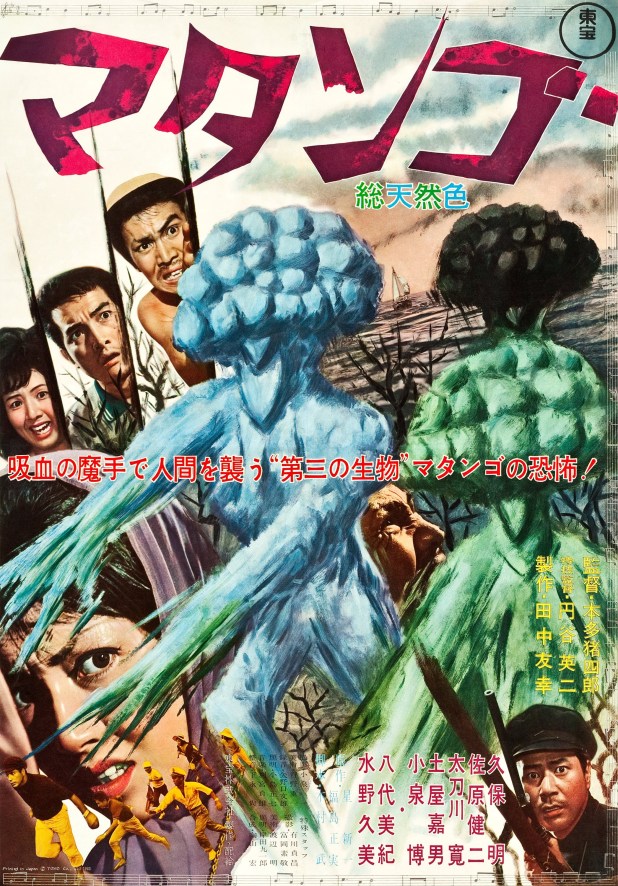
Matango is a Japanese horror flick from Ishiro Honda, director of Godzilla, based on the short story The Voice in the Night by English writer and bodybuilder William Hope Hodgson.
Rumored to be the inspiration for the American sit-com Gilligan’s Island that ran from 1964-67, Matango, also known as Attack of the Mushroom People has people turning into mushrooms on a mysterious island. Sounds great, doesn’t it?
Well, it did to me, anyway, and I was buzzing with anticipation when I settled down to watch it, late at night, with, for effect, a cup of Heinz Mushroom Soup with double croutons. However, twenty minutes into the film and I was having second thoughts – about the film, that is, not those extra croutons. Our small cast, led by Akira Kubo (Son of Godzilla), have not yet got their yacht wrecked on the eerie, deserted island, the setting for most of the film, we have had a strange musical number on board the yacht, and it is all a bit slow and… dull. Even after Kubo and co start exploring the island it is another twenty minutes before we see a mushroom man, creeping about the boat at night, attacking the crew, in what is one of the best moments in the film. Bafflingly, the next morning almost everyone is in denial over seeing anything, and carry on as if nothing has happened. Maybe it was all a dream? Too much sake – or mushrooms?
Much of the rest of the film is spent watching the shipwrecked group struggling to survive on the island, fighting one another, mostly for the attractive Mami, played by Kumi Mizuno (Invasion of Astro-Monster), and slowly starving to death, unable to eat the dangerous mutative Matango mushrooms that seem to grow everywhere on the island lest they morph into “mushroom people.” There are a couple of clunky flashback sequences that pop up as the group looks for food – one is used to squeeze in another musical number, and the other a “risque” dance sequence.
The film is colorful, but rarely atmospheric. The mushroom people effects, though good for the time, are now hopelessly amusing – not a good thing for “horror” movie. But there are some unforgettable moments – like the scenes in the jungle with the exotic-looking mushrooms blooming and mushroom people wobbling about, and the ominous sequence near the start when the crew find another wrecked boat completely covered in fungus. Although this all sounds a bit wacky, and “creature-feature” tacky, Ishiro Honda intended Matango as a serious movie warning of the way the Japanese people were changing after the war, and striving for things that would ultimately change and destroy them. Unfortunately, it is now easy to overlook this subtle message today and see it as a cheap monster movie.
According to film historian Anthony Slide, Florence Lois Weber “was the American cinema’s first genuine auteur, a filmmaker involved in all aspects of production and one who utilized the motion picture to put across her own ideas and philosophies.” She’s also been called the most important female director in the history of American film. It’s amazing that she was making movies in a time when women were still battling for the right to vote.
This is the story of a small town girl turned Long Island jazz baby Egypt Hagen (Billie Dove) who can’t be tamed, not even by the minister who seeks to save her. The dancing scenes are filled with passion matched only by the spectacle close of a shipwreck.
Kino Lorber has released Sensation Seekers and A Chapter In Her Life on blu ray, with 2K restorations by Universal Pictures and commentary on this film by Shelley Stamp, who wrote Lois Weber in Early Hollywood.
This is a recommended purchase, as its an opportunity to see the start of Hollywood and learn the story of an important female artist whose story has not been told nearly enough.










 B&S About Movies
You must be logged in to post a comment.