Games of Survival (1989) Badlanders (1992)

Writer and director Armand Gazarian has written two (Double Cross and Badlanders) and directed five (including the IMDb-barren pages for Streets of War and The Searcher) SOV/direct-to-video features. As result of my post-apoc fandom, I’ve seen the two we’re reviewing today. And that’s probably two more than you.

At least until now.

Yep, this all comes courtesy of Sam the Bossman devising another “Apoc Week,” so this is as good a time as any to hip you to the ’80s SOV canons of Armand Gazarian. Hey, anyone who decides to eschew the usual horror route for Road Warrior tomfoolery in the SOV-doms of the VHS wastelands is aces in my book.

So, is this Gazarian SOV-apoc one-two punch better than the adventures of Ace Hunter — in the utterly awful — Megaforce from Hal Needham? Oh, by the Kobol Lords, yes! Uh, yeah, right, Hal. You willfully made a “campy” and “spoofy” movie. Sure, you did. That’s what they all say when their movie bombs and sweeps the Golden Raspberries to pull a 0% rating on Rotten Tomatoes. You had $20 million of Albert S. Ruddy and Golden Harvest Studios money to play with and made crap, Hal. Armand Gazarian shot his apoc-romps on couch coins, lunch money, and paper route income. He had chicken shit and made a chicken salad. And you turned your poultry and greens into daggit dung.

So guess who got my .99 cents? That’s right, Uncle Al. I will always err to the side of SOV-made movies. Always. For I bow at the SOV altars of Lord Brett Piper and High Priest Dennis Devine where Armand Gazarian is an obvious disciple.

Not a spoof cover. That is the real VHS cover. More on the “S,” later.

Now, we kid our ol’ Uncle Hal and Al because, as you watch the opening pursuit of our ersatz man with no name — okay, well, his name is Zane — you’ll notice that (impressive) low-budget rat buggy looks a lot like the goofy dune buggies from Megaforce. And the homages don’t stop there, as we’re getting a pinch of Allan Arkush and Nicholas Niciphor’s always cool-in-my-book-even-though-it-ain’t-Rollerball Deathsport. Now, if you’ve never watched that terminally weird Corman apoc (shame on you), that David Carradine and Richard Lynch-starrer concerns a post-apoc dictator forcing prisoners into games of motorcycle-gladiatorial combat.

Hey, wait a sec . . . we’ve been def-conned! We’re not on a post-apoc Earth! We’re on a post-apoc planet in a galaxy far, far away. And our faux Max-cum-Pliskken, Zane (Nicolas Hill), is now a prisoner aboard a space prison. The prison’s cloaked-lizard warden, in a bit of galactic glasnost, decides he’ll offer freedom to seven of his ne’er-do-well charges to “play a game of strength, skill, and survival.” The game field: Los Angeles, Earth. The object of the game: Return our BSG-inspired Imperious Leader’s cherished family heirloom: a spiked ball, hidden on the L.A. game field. The penalty for not playing the game or attempting to escape: your head is Bob Hauk’d off of your body via an embedded micro-sensor.

And, with that, Zane, along with the likes of the Conan the Barbarian-clad Skullblaster, Moozy, Baarg, Zooloj, Gygon, and Minig, are dropped into their present-day Los Angeles battlefield. Of course, the action is inept, as it is shot on the fly, sans permits, which provides us with a well intention — or ill intended — comedic effect. Of course, our alien warriors are sometimes confused or frightened by Earth technology and culture — and get cruised by gay men — but they do love our pizza. Of course, love must ensue, and to that end, as Jack Deth hooked up with Helen Hunt in Trancers, Zane meets Cindy Sexton — who introduces him to the freeze-dried Celestes and helps him win his freedom. Oh, wait . . . this is more Highlander (“There can be only one!”) than Trancers, so it’s be-still-my-beating-heart Roxanne Hart (who is still breaking my heart in a 2019 episode of NBC-TV’s The Blacklist) rollin’ in my VHS-cortexes.

You’ll have a lot of fun watching this SOV take of Richard Connell’s 1932-inspiring short story, The Most Dangerous Game. But, if you’d rather not, give this four minute sampling (embedded below) a spin. My only two complaints with Game(s) of Survival: I wish the VHS rip was of a better quality, as it’s obvious the tape used on the upload we found on You Tube has seen its better days, as it is washed out and darkened. Second, the opening scene with that Philippines-styled armed dune buggy is so good, I wish Armand Gazarian would have held his game on an alien planet and given us an SOV version of Charles Band’s Spacehunter: Adventures in the Forbidden Zone and Metalstorm: The Destruction of Jared-Syn — instead of Fred Olen Ray’s Alienator. But any guy who channels his milk money and his aunt’s and grandma’s birthday money to homage Death Race 2000, Endgame, and Rome 2072, is okay in my book.

Ah, but wait! That Earth-bound snafu is solved — somewhat — with our second film in today’s Armand Gazarian double feature: Badlanders.
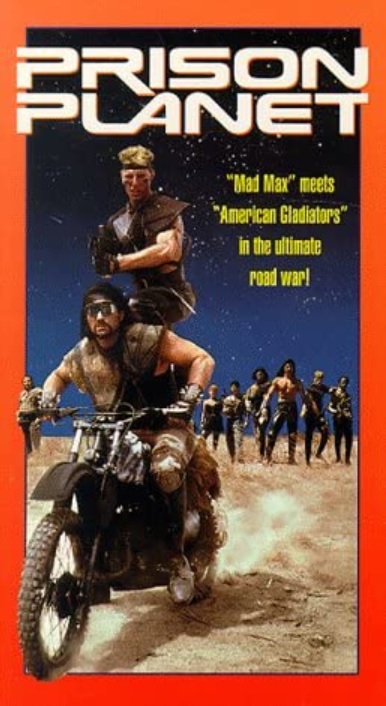

Settle down, kids. Badlanders is also known as Prison Planet. At least there’s no errant “S” to deal with, as in Game(s) of Survival.

For his second apoc outing, Armand Gazarian impressively upped his game to improve on the Game(s) of Survival model as he gives our ol’ apoc-good buddy Cirio H. Santiago a run for his Philippine pesos. Sure, you’ll name drop Mad Max in the frames, but the real inspiration here is all of those Philippine and Italian-made knockoffs of The Road Warrior. Nope, while it looks like Bruno Mattei made this — and if you’ve seen his apoc romps Rats: Night of Terror or Shocking Dark, you’ll know what we mean — he didn’t make this. Nope. Claudio Fragasso — and if you’ve seen Interzone, you know what we mean — didn’t make this either.

Anyway, in the distant Earth year of 2200 — in the badlands of Yuma, Arizona (anyone see Parsifal in his battle car on his way to the “Baked Apple”) — we meet our intrepid freedom fighter, Blaine (U.S. born-cum-Thailand acting James Phillips), who boondoggles a Snake Plissken-styled robbery of a government repository.

Instead of being sent to Manhattan Island Prison, Blaine is sent to Prison Planet, aka the planet of Annakin (uh-huh), committed to fight in gladiatorial combat games. Then he kills the brother of Broxton (Micheal M. Foley from Karate Cop), the planet’s blood thirsty warlord.

Ah, but this is a secret mission: Blaine wanted to get caught and shipped off-world to find fellow Prison Planet inmate Himshaw — the good brother of the Earth’s evil dictator — who holds the key to overthrown the Annakin regime and restore freedom on Earth.

Spiritual hokum, shirtless muscle-bound nomads, porn-flick mustaches, oversized penis-envy swords, slave girls, virgin maiden sacrifices, weasel-whimpy convicts, and slave traders — all in glorious overacting — a-go-goes, and then some. And the guns, Oy! The guns always “jam” when you need ’em the most in the apocalypse. Hey, the big-budget movies always roll out the ol’ “dead car battery/faulty starter” (on a brand new car, no less) trope, aka now the “dead cellphone/no signal” trope, so why can’t a low-budget movie have the a “gun jams” trope? And yes . . . even though we are in the throes of the 21st century — and as with all Italian ’80s apoc films — all the cars are from the ’70s.

Where are they now?

From his humble SOV beginnings, Nicolas Hill worked his way up to the better-made, ’90s-era martial arts flicks Showdown (with Billy Blanks), Death Match (with Martin Kove), Raw Target (with Dale Apollo), Fists of Iron (with Michael Worth), and Bloodsport 2 (not with Jean-Claude Van Damme, but with Pat Morita).

James Phillips, according to the digital QWERTY warriors of the IMDb, co-starred with Eric Estrada in the 1989 Thailand-shot actioner The Lost Idol (check your golden Ark at the door, Indy). And for that same director, Philip Chalong, aka Chalong Pakdeevijit, Phillips co-starred with Jan-Michael Vincent (see why we dropped Alienator), and Sam J. “Flash Gordon” Jones in 1990’s In Gold We Trust (and Sam did his own apoc-slopper, Driving Force). Our villain, Micheal M. Foley, in addition to Karate Cop, you may have seen his martial arts skills in 1991’s Cybernator (I haven’t*) or 1992’s Desert Kickboxer (again, nope).

Jonnie Saiko — who appears in Game(s) of Survival as Zooloj — also appears in Hell Comes to Frogtown, Roller Blade Warriors: Taken by Force, and The Guyver. He’s since gone on to a successful career as a special effects mold technician to work in the X-Men, Alien, Predator, and Scary Movie franchises.

As for the rest of the Gazarian canons: Streets of War stars Frankie Ray from Badlanders; digital streamers may have seen him in 2018’s Jurassic Galaxy (not moi). The Searcher stars Robert “Maniac Cop” Z’Dar, so there’s that incentive to find it. One of Gazarian’s producer credits is 1998’s Blood Revenge starring martial artist Chris Cuthrell, so there’s that. And Gazarian is still at it, as his latest (in post-production) credit is Awaken, starring Lance Henriksen, Edward Asner, and Tobin “Saw” Bell.

Yep. From an SOV debut to working with Tobin Bell. That’s a pretty cool career, Armand. See, there is a career to be made after ENG cameras and 3/4-inch U-Matic videotape and Hi-8s and NewTek Video Toasters.

Where to Watch

You can watch a VHS rips of Game(s) of Survival — recently uploaded in September 2020, so thank you, VoicesInMyHead — on You Tube. Check out that page! It has lots of great uploads, such as the bonkers-trashy Lightblast, Death Nurse, more SOV’in with Bits & Pieces, and Mumsy, Nanny, Sonny & Girly. So have fun! Hey, bonus! We found an even cleaner copy on the Internet Archive.

Now, as for Badlanders, aka Prison Planet, there’s no freebie uploads to share. What’s the deal, Tubi? You had it, but now it’s not available? Denied. At one time, Badlanders was part of the VOD programming of the now — sadly — defunct IMPACT cable channel. However, as result of it once being a part of the IMPACT library, you can watch Badlanders as part of the Sling streaming platform, which also makes it available on the upper-tier cable channel EPIX. Perhaps you’re awash in disposable income (frack you, preppy) and you can afford ATT’s DirecTV to watch it there.


I love my SOV ’80s and Gazarian’s two apoc-romps slide nicely onto my “alien shelf” amid the collection. Be sure to click on the SOV link at the end of this article and you’ll discover all of our reviews of — not only ’80s SOV’ers — but films that are also inspired by and pay tribute to the era. And for as many that we have reviewed, there’s as many we have not. So, to remedy that, come September 12 to the 18, we’re blowing out a week-long tribute to another 25-plus more of those SOV ’80s classics, mostly horror, natch. Join us!

* Doh! Now we did! Check out Cybernator . . . which is not to be confused with Cy Warrior, which is already confused with Hands of Steel.
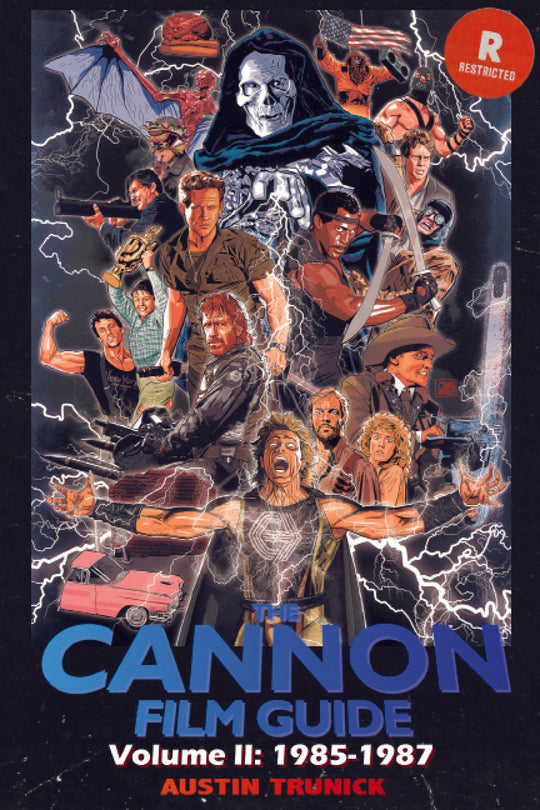
Hey, did you know we blew out two-months of nothing but reviews from Cannon Films with our “Cannon Month” feature? As result, we’ve done another take on Badlanders, aka Prison Planet. And we got there, thanks to Austin Trunick, who sat down with us for a five-part interview.

About the Author: You can learn more about the writings of R.D Francis on Facebook. He also writes for B&S About Movies.

Cy Warrior (1989)

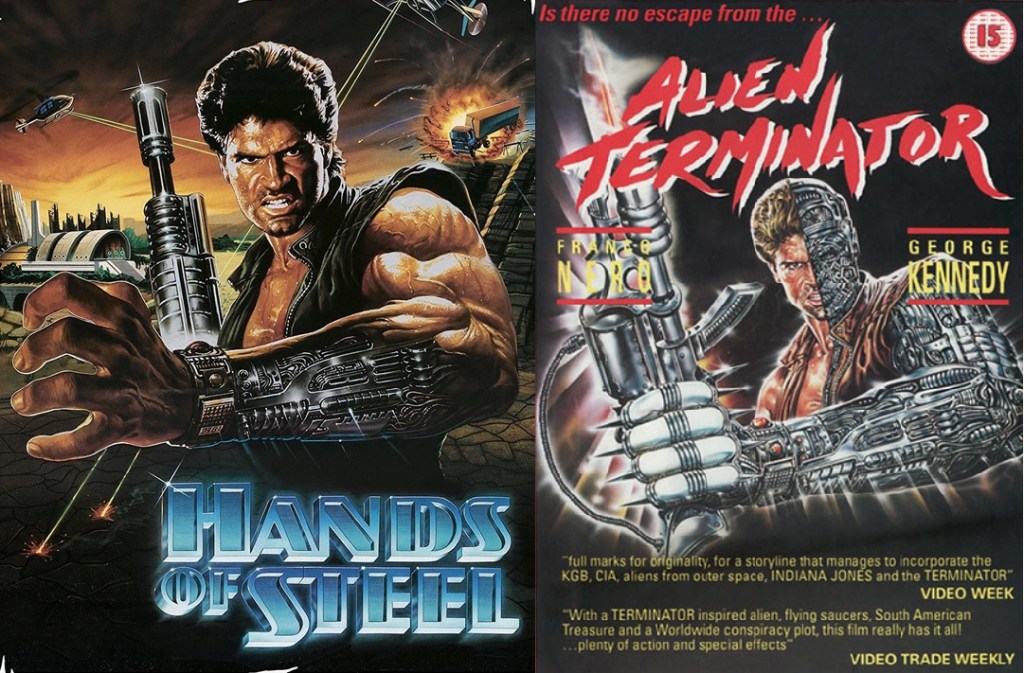
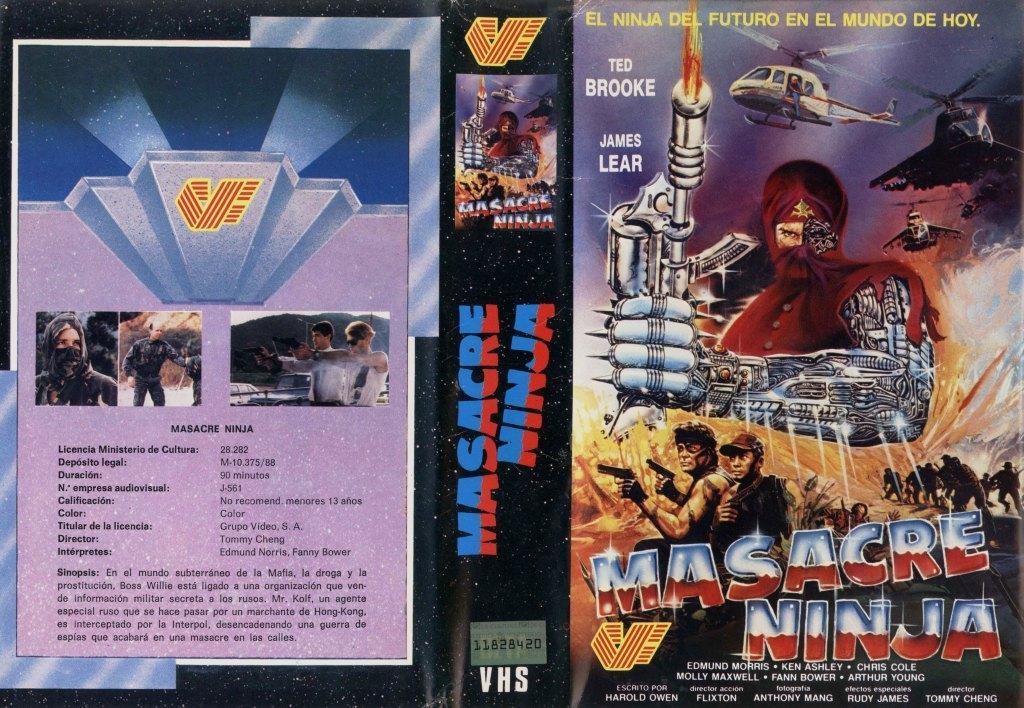
Hey, wait a minute . . . I know that artwork!

That “Special Combat Unit” subtitle ain’t helpin’, Mr. Copywriter.

Let me stop you right there, ye VHS junkoid: This isn’t a retitle-repack of Hands of Steel or Alien Terminator, aka Top Line, and Godfrey Ho’s Massacre Ninja is a ripoff in artwork, only. Oh, yes you VCR zombie: this is a whole new movie — well, as “new” as any Italian ripoff of The Terminator can be — starring Henry Silva. And just to make sure you’ll fooled into thinking — I don’t know how anyone was — this is, in fact, a sequel to the James Cameron film, this was also released as The New Terminator. And it was also — although it has nothing to do with the Albert Pyun written and directed and Jean-Claude Van Damme-starring movie of the same name — released as Cyborg II. Now, if you’re keeping track, that Pyun-Van Damme flick had its own sequel, Cyborg 2 (1993), starring Angelina Jolie and Jack Palance . . . but that’s actually a “sequel” to the other cyborg ripoff’er, Nemesis (1992). But our cyborg in this particular cyber-romper stomper has slick-backed hair and wears military fatigues . . . so he looks like a member from the Universal Soldier platoon.

Which came first? The Cy Warrior or the egg . . .

. . . or Godfrey Ho’s typo’d rip, Massacre Ninja?

Ugh. I have a headache. And we haven’t even rolled the movie, yet. So, yes, goodbye headache. Hello, migraine. And who’s responsible for this insane pain in the brain?

Make up artist Giannetto De Rossi in his directing debut. Perhaps you’ve seen his follow up film Killer Crocodile 2 from 1990? Or his E.T. ripoff Tummy from 1995? No, didn’t think so. But you’ve seen his make up work in When Women Had Tails (1970), the Star Wars dropping The Humanoid (1979), and Lucio Fulci’s The Beyond (1981). Then there’s Zombie, House by the Cemetery, and Atlantis Interceptors. De Rossi also worked on the major studio flicks of Dune, King Kong Lives, and Rambo III.

So, needless to say: the make-up work in Cy Warrior, aka, The New Terminator, aka Cyborg II, aka Invulnerable Exterminator, aka Cyborg Warrior, is excellent. Sadly: the rest of the movie sucks apoc ass steak, with its endless stream of political pondering and military yakity yak and forced cute kid-robot comedy. Yes, even with the always welcomed presence of Henry Silva and Miami, Florida-based actor Frank Zagarino in the cast. We’ve enjoyed Frankie Z. many times at B&S About Movies, courtesy of his work in the Project: Shadowchaser franchise, working with Mark Gregory in Ten Zan – Ultimate Mission, and too many Philippine-shot actioners of the post-apoc and Rambo varieties to mention.

And we mention Zargarino’s birthplace because this was shot, partly, in Miami, Florida, as well as the Dominican Republic. And I never thought I’d come to review another Sherrie Rose (be still my weeping heart) movie, but here we are, as she’s here as our ersatz Linda Hamilton. You might remember, as part of our “Fast and Furious” tribute week, we reviewed Sherrie’s (pretty fine) writing and directing debut with Me & Will, as well as her work in Sergio Martino’s American Rickshaw and the teen T&A’er, Summer Job.

Okay, so that takes care of the actor and director trivia. Let’s roll the movie!

Henry Silva and Sherrie Rose on the set of Cy Warrior, February 1989.

Frank Zagarino is our resident cyborg, part of the Cy-W project in which the U.S. government has perfected a robotic warrior. For reasons that baffle, he’s in the process of being programmed-transported in cryogenic suspension on a ship the middle of the Caribbean. Courtesy of the usual incompetent soldiers and “accident,” Cy-W escapes mid-programming and makes it to the shores of the Dominican Republic.

And we cue the poorly dubbed and annoying kid.

Now, if you remember the plot of T-2, where the youthful John Connor attempted to teach human behavior to Arnie, that’s pretty much the plot of our movie. Our little Brandon runs off from his class field trip and discovers the wounded Cy-W in the woods. And Brandon takes his new friend home to introduce to his sister Susan (Sherrie Rose). And they teach “Cy” how to be human, which means, since this is the ’80s, our poor borg looks like he’s in an episode of Miami Vice. And Henry Silva is hired to bring Cy back. And ol’ Henry is the type of heavy that has no problem mowing down a few innocent Dominicans along the way. Hey, what’s a little rocket launcher projectile into a night club — if it protects U.S. national security?

Of course, Brandon is kidnapped. And Silva ends up injuring the kid. And Cy must die to save his friend.

What’s perplexing about this film — in addition to the utterly awful English dubbing of all the characters (including Silva and Rose) — is that the writer on this is Dardano Sacchetti, a usually dependable scribe who gave us the likes The Cat o’ Nine Tails, Bay of Blood, and Shock . . . as well of 1990: The Bronx Warriors, Devil Fish, and Warriors of the Year 2072. Just so many great — well, as great as a B-Movie knockoff of the Italian variety can be — giallos, zombies, and post-apoc movies . . . then there’s this Terminator turd on Sacchetti’s resume. Perhaps if Lamberto Bava, Lucio Fulci, or Sergio Martino — all whom Sacchetti wrote for — directed this? Again, Giannetto De Rossi is great in the up-against-the-budget make-up chair, but not so much in the director’s chair.

Movies like this make me feel for an actress like Sherrie Rose. She gets a lead in a movie — and it ends up not even being her voice in the final product. And for you Sherrie Rose fans that need to complete that David A. Prior and Eric Roberts section in your home movie room: Sherrie stars alongside Roberts in Prior’s 2015 offering, Relentless Justice. And that also stars Vernon “The Wez” Wells from The Road Warrior. So that looks like that may be worth checking out, right?

See. At least you discovered another new movie out of the ass steak that is Cy Warrior, which you can watch on You Tube.

Is it just me, or is this alternate video art for Igor and the Lunatics a rip-off of Hands of Steel? If you’ve seen this artwork on another Euro-apoc flick, let us know!
Need more films with art work ripoff tomfoolery? Check out our “Exploring: The Films of Maria Konstantynova” feature.

About the Author: You can read the music and film reviews of R.D Francis on Medium and learn more about his work on Facebook.

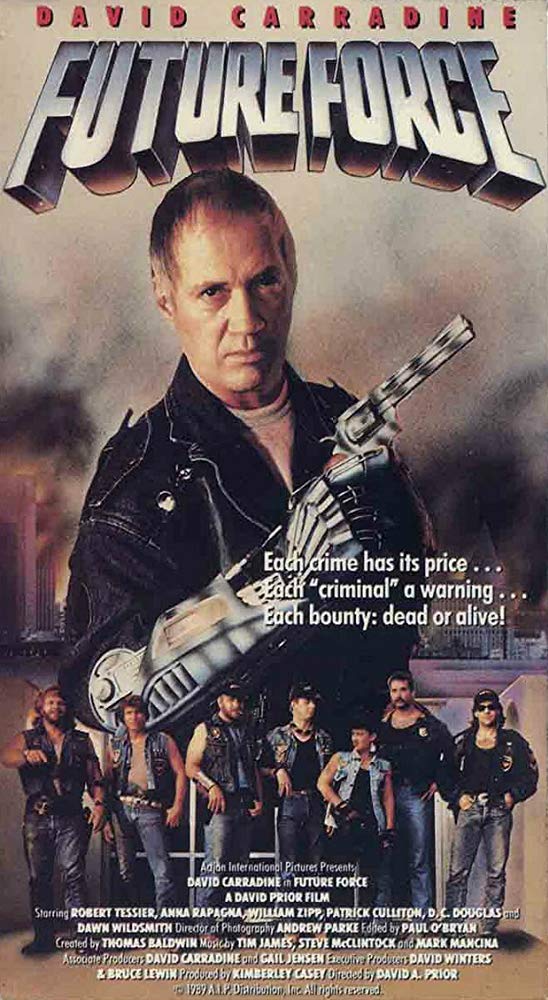
Future Force (1989) Future Zone (1990)

Who’s David A. Prior?

We love David A. Prior around here. Of course, you know that already, as we drop his name a lot around the digitized pages of B&S About Movies. And we like to kid David A. Prior a lot around here, too. But it’s out of respect. Which is why, even though Sam the Boss already took a crack at Future Force and Future Zone during our past post-apoc excursions, we’re reviewing them both with a second, fresh take, for this new apoc week.

In the coming months, we’re rolling out a week-long tribute to ’80s SOV films, and David A. Prior is on the list with his infamous film debut, Sledgehammer (1983), which starred his bodybuilding and ex-Chippendale’s dancing brother, Ted. And from that humble, shot-on-video beginning, David A. came to incorporate AIP — Action International Pictures — with David Winters and Peter Yuval. Winters’s own humble beginnings began with Thrashin’; after being overruled on a casting decision (Josh Brolin instead of Johnny Depp; we reviewed Brolin’s Jonah Hex, by the way), Winters vowed to make movies on his own, without studio interference. Then he gave us Space Mutiny . . . so, maybe it pays to have studio interference.

Ah, but we’re here to praise the ’90s-VHS resume of David A. Prior, a resume that would require two tribute weeks to review the joint Prior brothers’ resume. What we have reviewed is the spa ‘n blades romp Killer Workout and the Filipino actioners Firehead, The Final Sanction, and Silencer. Then there’s his female Rambo ramblings with Relentless Justice. And while Prior didn’t direct them, his Action International Pictures, which later rebranded as West Side Studios after David Winters bought out his partners, also gave us the holiday horror Elves, the apoc-slop of Phoenix the Warrior, and the exploitation zombie mess Zombie Death House.

Mr. Prior dipped his toes in the post-apoc pool again — and Brigette Nielsen in tow — with Hostile Environment, aka Watership Warrior (1999), concerned with the ol’ rebels and tainted water supply gag. We’re wondering if Dave A. brought back the flyin’ robot forearm we’ll soon discuss? We wanted to review it this week because, well, another David A. Prior flick on the site is a good thing — really. Sadly, there’s no online streams — or trailer, not even clips — for us to review and share with you.

The Reviews

And that brings us to the Mad Maxian one-two punch of the post-apoc adventures of John Tucker — he of the flying, remote controlled robot arm-cum-glove. Seriously. John can either slip on the glove to kick apoc-ass . . . or use a remote control on his belt to fly said robo-glove out of its toolbox home to zip around and punch out the bad guys. Oh, and it can shoot lasers and take out an errant helicopter. So there’s that.

Anyway — one year earlier, in the far-flung year of 2020 — things haven’t got so bad to be Mad Maxian, but bad enough to be Robocopian. But, since this is a low-budget apocalypse, the world of John Tucker is just down the street from the also not-the-Main Force Patrol apoc-shenanigans of Ron Marchini’s John Travis in Omega Cop (1990) and Karate Cop (1991). (And, to add to the confusion, David Carradine cameos in Karate Cop.) And since we don’t have the budget for full-blown Robocop body armor or Road Warrior body leathers, our cops wear sleeveless denim vests with “Special Police” and “COPS” patches on their chest.

And if it all sounds like the same movie . . . it probably is. And none of it — regardless of the vests — is very heavy metal.

You’ve got the right to rock alongside Ron Keel, Mr. Carradine. Flash those horns, Mr. Marchini.

This time, our merry band of law officers are a civilian bounty hunter-based organization known as C.O.P.S, aka Civilian Operated Police Systems. Our intrepid John Tucker (David Carradine) is a bitter, washed up drunk roamin’ the mean streets of Los Angeles who’s more interested in dispatching justice — like Judge Dredd — than collecting bounties in his pocket. Of course, as in Robocop, the police force is corrupt and a reporter — a female reporter, natch — has the proof. (So, yeah, we’re pinchin’ Stallone’s Cobra, too.) And now the C.O.P.S are out to stop the duo from exposing the corruption. Oh, and Tucker’s only ally is Billy (the 260-plus credits strong D.C Douglas; six new films in production), a computer genius with a spiffy wheelchair. Oh, and the chief baddy that gets his ass robo-gloved kicked is Robert Tessier from Burt Reynolds’s The Longest Yard — but since this is B&S: The Glory Stompers, The Velvet Vampire, and Chief Thor in Starcrash, just to name a few of Robert’s B-Movie delights.

So, we’ve ripped off Mad Max and mixed it with Robocop. And tossed in some Cobra and Ron Keel. What’s left to rip: The Terminator . . . or more like Charles Band’s Trancers — didn’t that have time travel and see an overseas release as Future Cop? — since there’s no way this movie can afford a James Cameron cyborg, well, at least not a borg that extends beyond the right forearm. And John Tucker ain’t no Jack Deth. And neither is a Snake Plissken. But Plissken was packing a 1998-era, mission-critical Kraco audio cassette tape and a laser-sighted revolver. And Tucker has a robo-arm. So who is kicking whose ass around Los Angeles: David A. Prior, for at least he came up with a techno-trinket and didn’t have Tucker packing Carpenter’s “future” audio cassettes.

Anyway, this time, the C.O.P.S will stop John Tucker . . . so they think. Tucker’s son, Billy (Ted Prior) — and not the same Billy from Future Force — travels back in time to 1990 to stop his dad’s murder. Oh, and save Tucker’s wife — and Billy’s mom — from kidnappers. And that’s pretty much it. The glove kicks ass. There’s explosions. Turned over cars. Oh, and requisite baddie soldier-cop Charles Napier (best known in the mainstream, celluloid throes as CIA officer Marshall Murdock in Rambo: First Blood Part II) and Jackson Bostwick, the original Captain Marvel from the ’70s Saturday morning TV series Shazam!, beef up the cast (well, this is a step up from the Gold Key Entertainment-verse with Killing at Outpost Zeta and Escape from DS-3, after all, right Jackson? Uh, is it?).

So, which is better and which is worse? Opinions vary. Can you make it through both and figure it out for yourself? Well, what do you expect from a law enforcement agency that spends their money on a fleet of un-Mad Maxian Jeep Cherokees with remote control doors — then blows their remaining operational budget on robo-gloves that flash an “OK” and Devil’s Horn” signs after its remote ass-kickings?

Exactly.

For no one thought to rent the repurposed Death Race 2000 Calamity Jane from Claudio Fragasso used in Interzone or Scorpion’s bubble-topped Camaro from Enzo G. Castellari’s Warriors of the Wasteland. And speaking of Trancers and cars . . . Band’s future cop romp repurposed the Spinner from Bladerunner, which was also repurposed in Solar Crisis (1990) and Soldier (1998). Come on, Mr. Prior, a fleet of Jeep Cherokees will save our future? Could you be more cheapjack? Okay, so don’t rent out the Spinner. Could you have at least attempted a flashy, MFP-styled paint job on the jeeps? And . . . hey . . . wait a sec . . . are those the same Jeep Cherokees from the earlier adventures of John Travis in Omega Cop(y) and Karate Cop(y)?

Where to Watch

You’ve got four chances to tough out the John Tucker-verse: Tubi offers the RiffTrax’s versions of Future Force and Future Zone. If you’re a purist — like moi — you can watch the un-riffed VHS rips on You Tube for Future Force and Future Zone. And no, while David Carradine stars in the similarly-titled Crime Zone, that’s a whole other zone unto itself — courtesy of Roger Corman’s Concorde Productions. The same goes for Carradine’s brush with Cirio H. Santiago in Kill Zone from 1993.

Gale and David Carradine/courtesy of BodyWeightHeight.com.

The Music of Gail Jensen

And since we mentioned Ron Keel and are in a musical mood: The resident damsel-in-distress in Future Zone, aka Ms. and Ma Tucker, is Gail Jensen, aka, Ms. David Carradine. The Carradines married in Rome in 1988 during the filming of the Italian-British co-production of the Terence Young-directed sports drama, Run for Your Life, aka, Marathon. Now, if the name Terence Young is familiar to you spy flick junkies . . . yes, Young is the director behind the early Bond classics Dr. No (1962), From Russia with Love (1963), and Thunderball (1965). (We could do a theme week on Young’s resume; we haven’t reviewed many of his films, but we did take a look at his box office bomb, Inchon.)

Anyway, back to Gail Jensen.

While Jensen acted (she made her debut in a 1974 episode of TV’s popular cop-procedural, McCloud, and had a support role in the ’80s slasher Don’t Answer the Phone) and helped co-produce David’s later films, she was primary known as a musician and songwriter. Her credits include the songs “Walk the Floor” and “Hello Heartbreak” — both sung by David — and “History Hall” and “Shot Full of You Love” — both sung by Gail — for Larry Cohen’s Maniac Cop. Her biggest success as a songwriter was the Lee Majors-sung “Unknown Stuntman,” which she co-wrote with Glen Larson and Dave Somerville (Larson were both members of — but not at the same time — The Four Preps; Somerville went onto greater fame with the ’50s vocal quartet, The Diamonds). Jensen also wrote the 1977 single “Prairie Dog Blues” for McCloud actor Dennis Weaver. (You can also check out David Carradine’s songwriting and singing with “Divining Rod” featured in Roadside Prophets.)

Unfortunately, when you Google Gail Jensen to learn more about her music career, all links lead to her disclosure of David Carradine’s kinky sex proclivities, which led to his death. For the curiosity seekers of the dark side of Hollywood, you can learn more about the legal fallout of David’s — and eventually Gail’s — deaths via the IMDb’s news section on Gail Jensen (and that page with the press links has now been wiped; you’re on your own with Google).

Personally, I much rather know more about Gail’s music career — which Hollywood seems to have swept under the rug.

About the Author: You can learn more about the writings of R.D Francis on Facebook. He also writes for B&S About Movies.
A Visitor of a Museum (1989)

After an ecological disaster, our planet has been divided and decimated into survivors and mutant degenerates. There also exists the rumor of a museum that has all of the information of the past that can only be found when the tides are at their lowest.

Directed by Konstantin Lopushanskiy, this is one of the few examples of Russian post-apocalyptic film that I can think of. It’s also one of the bleakest ones I’ve ever seen, a movie that establishes a soul-crushing mood from the first frame and only getting rougher from there.

So about that museum. There’s only one day a year when the tides are low enough to walk along the ocean floor to visit the place where information still exists and humanity still has part of its soul. Perhaps there’s something more inside that place. There could be a portal that leads to another — and better — world away from this burned-out hell.

This isn’t one of those fun end of the world movies, but that doesn’t mean that you should skip it.

Beyond Dreams Door (1989)

I don’t want to jinx it, but every time I think that I am running out of movies that blow my mind with how unhinged they are, I discover something new. Usually, those grubby film highs come from Italy or Turkey or from the early 70’s, but man, Beyond Dreams Door was made at the end of the 80’s and comes from Ohio of all places.

Made with the cinema school at The Ohio State University, this is a film all about Ben, who stopped dreaming once his parents died when he was 9. Now, the dreams are coming for him, a fact he learns from the dream version of himself who warns:

“Beyond dream’s door is where horror lies,
Where love may sleep with sorrow’d eyes,
Where demons wait to greet the ones,
Who dare not reach its darkened shores,
Beyond dream’s door tomorrow dies.*”

As low as the budget for this film may be, its concept is high. Somehow, this also looks like anything but a movie made for thousands of dollars. It’s slick as hell and certainly doesn’t seem like director Jay Woelfel’s first movie. In fact, I saw Art of the Dead a few years back and recognized that he edited it. I’m glad he’s still working, whether that means composing music, writing films and even acting.

Imagine a movie as hard to explain as Phantasm with — amazingly — less of a budget. That’s what you’ve got here. And it’s exactly as great as you’d hope.

You can learn more at the official site for the film and gear up, because Vinegar Syndrome has announced that this movie will be part of an upcoming no budget 80s regional horror box set. If you’ve been reading the site this week, you know that we’re all about this news.

*Thanks to the astounding Bleeding Skull for writing that poem out.

UPDATE: Vinegar Syndrome has released this as part of their Homegrown Horrors box set, along with Winterbeast and Fatal Exam. You can get it here.

Devil Worship: The Rise of Satanism (1989)

ABOUT THE AUTHOR: Herbert P. Caine is the pseudonym of a frustrated academic and genre movie fan in Pennsylvania. You can read his blog at https://imaginaryuniverseshpc.blogspot.com.

Devil Worship: The Rise of Satanism hits all the markers of a Christian scare film: warnings about dark forces aiming to get you and above all your children, testimony from less then reliable “experts,” sermons about the dangers of rock music and heavy metal, and unsubstantiated claims about murderous conspiracies. At first glance, it is nothing to take seriously. However, it has broader social significance as it reflects a dangerous 1980s moral panic, one reflected in the modern rise of QAnon.

This hour-long film is part of the Pagan Invasion series of alarmist Christian documentaries released during the late 1980s. Pagan Invasion argued that the growth of alternate religious groups such as the Wiccans posed a threat to the souls of Christians. One film in the series, Halloween: Trick or Treat, reviewed by the Cinema Snob, contended that participation in Halloween festivities leaves children vulnerable to influence by Satanists and that the holiday was an occasion for animal and human sacrifices, backing its points with dubious evidence and even less reliable commentary.

The devil worship documentary follows much the same pattern as the Halloween entry in the series. It opens with a montage of news stories about murderers such as the Nightstalker, Richard Ramirez, who claimed satanic inspiration for their killings. The film’s host, Caryl Matrisciana, goes on to allege that Satanism is on the rise in 1980s America and that children are danger of being killed, molested, or even worse converted by the Satanic hordes. The film then attempts to document her claims.

Perhaps the most amusing aspect of this documentary is the highly questionable quality of the “experts” it interviews. The most noteworthy of these witnesses is one William Schnoebelen, a man who alleges that he was once granted supernatural powers by a deal with the devil and that he was a member of the Illuminati. Schoebelen also claims that the Earth is flat and that he was a “90th degree Freemason,” never mind the fact that Masonry only has 33 degrees. In spite of these outlandish claims, the filmmakers bring him on to warn parents about how their children’s cartoons will indoctrinate them into practicing witchcraft, complete with a freeze frame of Skeletor. (Schnoebelen is backed up in this by another interviewee, Rev. Kevin Johnson, who portrays the He-Man cartoon as a particularly dangerous purveyor of Satanism, even treating the related action figures as idols. This was apparently not an uncommon belief within 80s fundamentalist circles, as another Christian scare film, Deception of a Generation, also warned of the dangers of Masters of the Universe, and Scooby-Doo to boot.)

The other “experts” who appear in this film are all in a similar vein. For instance, Maureen Davies, credited as an occult researcher is a member of the British evangelical group Reachout Trust, which is known for attacking New Age groups as well as the Jehovah’s Witnesses. According to the Sub-Culture Alternatives Freedom Foundation (SAFF), a New Age advocacy group in the UK, Davies and her associates promoted false allegation of child abuse during the 1980s and 1990s. One of her associates, Audrey Harper, a supposed former Satanist, is interviewed in the documentary (identified only as Audrey). Harper claims to have participated in Satanic infant sacrifices, but as the SAFF points out, her local police force found no evidence such as sacrifice had ever taken place. Another interviewee, David Wilshire, was at that time a Conservative MP in the British Parliament. He warns viewers of the dangers of “full-blown Satanism,” though perhaps he would have been better off warning of the dangers of government corruption, as his career ended in 2009 with an expenses scandal that he compared to the Holocaust.

Possibly the most amusing interview of all is from Mark, the alleged high priest of the Satanic Cult Temple of Olympus and lead singer of the heavy metal band the Devoted Men. Mark appears dressed in Greek style robes and implies that his songs’ lyrics are transmitted to him by demons. Interestingly, although the documentary claims that the band is one of the more popular musical groups in London, very little reference to it can be found on the Internet. They also trot out two former high priestesses of the group who claim that the Temple is a front for perverted sex rituals. Why they never went to the police about these rituals is never explained.

However, Devil Worship: The Rise of Satanism becomes much less amusing when one considers the real-life tragedy caused by the Satanic Panic of the 1980s. During this mass hysteria, people became convincing that Satanists were conspiring to molest and abuse their children. Media figures such as Oprah Winfrey and Geraldo Rivera fanned the flames of this moral panic by doing sensationalistic reports. In reality, many of these allegations were based on extremely questionable recovered memories, often the results of pressure from psychiatrists and law enforcement officials. As a result, people ended up in prison on false charges, as in the case of the McMartin Trial.

Particularly unsettling is the participation of law enforcement officials in this documentary. One of the experts interviewed is Randy Emon, a police officer who went on to become the Supervising Deputy Coroner Investigator for San Bernadino County. He alleges that there are families of “generational” Satanists where children are trained from birth to worship Satan and endure all manner of abuse in his name. He also argues that 80s metal bands such as Venom, Slayer, and Merciful Faith “will blatantly teach these kids various occultic practices.” Emon claims in his interview that powerful politicians are covering up Satanic practices such as animal sacrifices because they fear it will damage their communities’ reputations. To be clear, I have no reason to believe Emon was involved in any compromised cases, but just to hear a law enforcement official embrace such outlandish claims is unsettling.

One could just dismiss this as a grotesque phenomenon of the 1980s, but it reflects at once a much older and a much newer trend. As a recent article by Daniel Loxton in Skeptic Magazine points out, the Satanic Panic mirrors many of the allegations put out by the QAnon conspiracy theory, followers of which participated in the recent attack on the Capitol building, while simultaneously echoing centuries-old anti-Semitic smears against Jewish people, particularly the blood libel. Credulity and a lack of critical thinking were, and still are, a danger.

Devil Worship: The Rise of Satanism is available on YouTube here.

The Excellent Eighties: Casablanca Express (1989)

Oh, yes! The ’80s are excellent when you get an old Sergio Martino war flick from those HBO days of yore, as you binged this alongside High Risk, Tuareg: The Desert Warrior (both reviewed this month via Mill Creek, look for them), and Inglorious Bastards. And don’t let the fact that we have the sons of Sean Connery and Anthony Quinn, Jason and Francesco, as our costarring leading men, deter your watching: they’re very good, here. When it is learned the Nazis are plotting to kidnap Winston Churchill on his way to the 1942 Casablanca Conference also attended by Franklin D. Roosevelt and Joseph Stalin, a crack commando unit is assigned for protection. Let the bullets fly and the explosions mushroom!

This isn’t — based on it being an Italian production headed by Sergio Martino, who gave us 2019: After the Fall of New York and Monster Shark (and too many Giallos* to mention) — a copycat schlock festival of pasta-war madness. Thanks to Glenn Ford and Donald Pleasence (as Maj. General Williams and Col. Bats) classing up the joint as only they know how, this — for moi — goes down as one of the best war movies of the early ’80s cable-era. This is the level of film that Michael Sopkiw deserved to be in. Even though Mike retired from acting by this point, Sergio should have called him in — especially after sticking him with Monster Shark. Mike would have been great in Jason Connery’s role.

You can get your own copy of Casablanca Express as part of Mill Creek’s Excellent Eighties 50-Film Set and you can watch it on You Tube.

* We dive deep into the bloody, yellow mayhem of Sergio Martino’s — and many other’s films — with our “Exploring: Giallo” featurette of 70-plus film reviews.

About the Author: You can learn more about the writings of R.D Francis on Facebook. He also writes for B&S About Movies.

The Excellent Eighties: Slipstream (1989)

Editor’s Note: Beware of the duplicate titles snafu, for there are two Slipstream movies: The 1973 one by William Fruet of Funeral Home, Baker County, U.S.A., Killer Party, and Blue Monkey fame, which is a Canadian drama about a troubled disc jockey: that’s the Slipstream no one knows. Then there’s the one that everyone knows — and most haven’t seen: the Mark Hamill one that, regardless of its pedigree, fails on all levels. And we wish that Mill Creek would save the 1973 one from obscurity and put it on a box set. You have two choices to pick up a copy of the Mark Hamill Slipstream: we reviewed it on November 5, 2020, as part of their Sci-Fi Invasion set and we’re revisiting it — with this second, alternate take — as part of its inclusion on Mill Creek’s Excellent Eighties 50-film pack, which we are reviewing all this month.

The overseas 25-minute making-of documentary courtesy of Pineapples 101 Movie Memorabilia Emporium blogspot.

This is a movie that many of us encountered, not in theaters as intended (at least not in the U.S.), or on VHS where it ended up: but as an oft-run movie on HBO. And regardless of how many times the pay-channel ran the film, most of us never finished it.

Why? Because it’s boring. But how is that possible?

We have Gary Kurtz who produced the first two Star Wars films with George Lucas at the helm. We have director Steven Lisberger who set the tone for future computer-animated universe films with Tron. And how can we forget Kurtz also gave us The Dark Crystal, and a bit further back, Two-Lane Blacktop and American Graffiti. Behind the camera is Frank Tidy, who got his start working with the Scott brothers, Ridley and Tony, in commercials and came to shoot The Duellists for Ridley, as well as one of the better Star Wars droppings with Spacehunter: Adventures in the Forbidden Zone (a film that’s still eluded a B&S once-over). We’ve got a score by Elmer Bernstein, whose work goes all the way back to Cat-Women of the Moon (you’ve seen, at the very least, ten movies in your lifetime with his composing and/or conducting). Behind the typewriter is, in part, Charles Pogue, who gave us David Cronenberg’s The Fly reboot and the Star Wars-inspired swords-and-sorcery romps Dragonheart and Kull the Conqueror. In the plot department: you’ve got a Mad Mad-cum-The Road Warrior post-apocalyptic vibe about dueling bounty hunters. In front of the camera: you’ve got Mark Hamill from Star Wars and Bil Paxton (who was fantastic) in Aliens, along with support roles by both Ben Kingsley and F. Murray Abraham.

So what went wrong?

Maybe it’s because the film opens with a homage to the “Crop Duster Scene” from Alfred Hitchcock’s North by Northwest (You Tube) that many seemed to miss — and those that “got it,” weren’t wowed by it. Then there’s that kiss of death: the dreaded voiceover that sets up the mythology where “global warming” finally did it: the Harmonic Converge baked the Earth, split the continents and created a “river of wind” that rendered the planet into one big dust bowl. The few who survive are the ones who’ve learned to harness the wind and solar power, just as Al Gore has always hoped for.

Amid this “green new deal” backstory: We meet Will Tasker (Mark Hamill) and Belitski (British actress Kitty Aldridge, who came to marry Mark Knopfler of Dire Straits) who are — as in Mad Max — part of a ragtag not-the-Main Force Patrol law enforcement agency that allows their agents to sideline as bounty hunters. After a run-in with Matt Owens (Bill Paxton) and confiscating his illegal arms contraband, Owens kidnaps Tasker’s bounty (British Shakespearean stalwart Bob Peck) to collect the reward and recoup the cost of his arms shipment. Oh, and Peck is actually a healing-android (he can heal blindness) who perpetually quotes the poems of Lord Byron to communicate his feelings, which leads Owens to call his new solar-wind plane shipmate, Bryon. Before you know it: Owens gets caught up in Bryon’s quest to reach a mystical land beyond the Slipstream where others, like him, live in peace and harmony.

In the end: No one was ready for an off-the-road aviation-version of The Road Warrior (or Kevin Costner’s all-water version, either). And for as many who consider this Mark Hamill’s best role, there are those who say this role — as well as his work (in the even more abysmal) Time Runner (Australian made) and The Guyver (Japanese made) — is why Harrison Ford and not him — became an A-List Hollywood leading man. Yes, there’s a reason why Hamill retreated (abet successfully) into video game and anime voice work: Slipstream is one of those reasons.

Meanwhile, as Hamill kept pumping out one late-’80s clinker after clunker, poor Gary Kurtz didn’t fair much better. After his creative fallout with George Lucas that lead to Kurtz leaving the franchise during the pre-production of Return of the Jedi and still feeling the sting of his first post-Star Wars outing, The Dark Crystal, bombing with critics and audiences, Kurtz was hoping for a box office bonanza that would set up another franchise. Instead, Slipstream — even more so that The Dark Crystal — was a critical and commercial box office bomb that also failed to find a cult audience on home video. The film drove him into bankruptcy that, in turn, lead to his divorce. Worse: he burned though his Lucasian cash windfall to create his fantasy world solely dependent on wind and sun, just like Al Gore always wanted.

So, was it all worth it? The criticism on this British-made sci-fi’er splits down the middle with no middle ground: Star Wars ephemera-oids either love it or hate. And you can decide by checking out Slipstream on Tubi or own a copy as part of its inclusion on Mill Creek’s Sci-Fi Invasion and Excellent Eighties 50-film box sets.

About the Author: You can learn more about the writings of R.D Francis on Facebook. He also writes for B&S About Movies and publish music reviews and short stories on Medium.

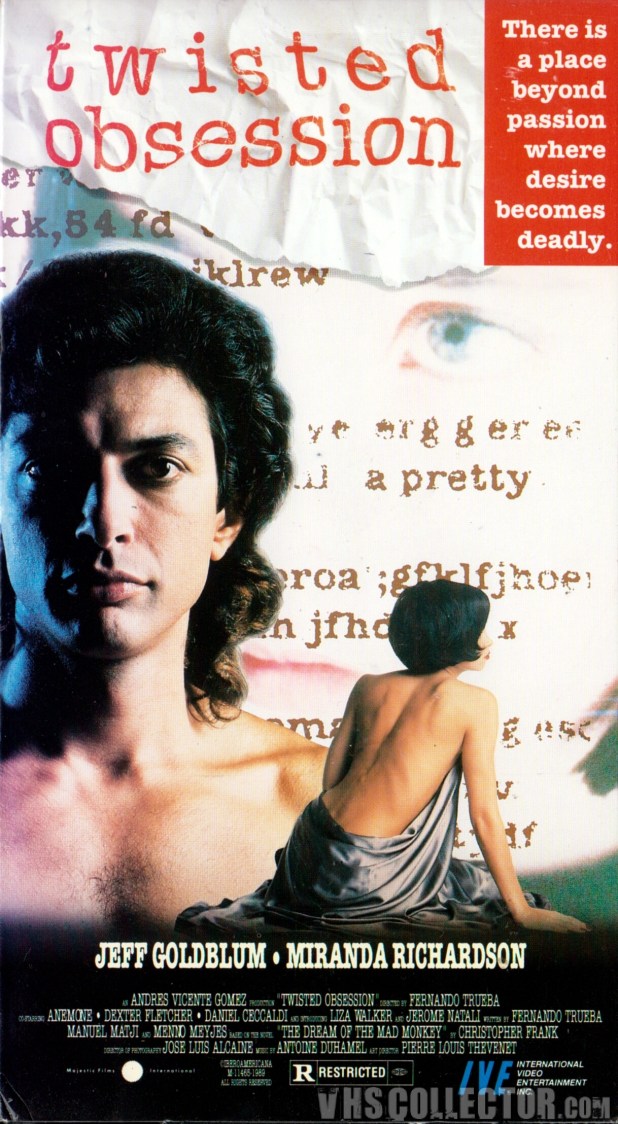
THE EXCELLENT EIGHTIES: Twisted Obsession (1989)

Originally titled El Sueño del Mono Loco (The Dream of the Mad Monkey), this is based on the Christopher Frank book. While it has the 90’s genre of erotic thriller attached to it, this is very much in the world of the giallo.

To wit: Jeff Goldblum’s Dan Gillis is a stranger in a strange land, one of the key tropes of the giallo, a writer in Paris who has been left behind by his wife and suddenly a single father to his son Danny. A writer by trade, he’s brought in by a producer to work with an enfant terrible young director named Malcolm Greene on a script.

Ironically, the actor playing that young director — Dexter Fletcher — would grow up and move on from acting (he was Baby Face in the absurd and wonderful child gangster musical Bugsy Malone) to directing some of today’s biggest films, such as Bohemian Rhapsody and Rocketman.

What draws us closer to the psychosexual domain of the giallo is that Gillis soon becomes obsessed by Malcolm’s sister Jenny (Liza Walker from Hackers in her first film). While presented as somewhere in her teens, she’s also a lolita who possesses the sexual attention of every man she meets, from our protagonist to her brother.

Miranda Richardson also figures in as Dan’s disabled agent who, like everyone in this movie, just wants to get horizontal with one of West Homestead’s favorite sons.

I’m not saying this is a good movie. I’m just saying that it’s interesting that somehow Goldblum made two movies one after the other — this and Mister Frost  — that are borderline bonkers horror experimentations that no one really talks about. This is after he was a star from The Fly and yet here he is, making really strange movies in foreign lands. Leave it to a Mill Creek box set to bring this to my attention.

THE EXCELLENT EIGHTIES: Laser Mission (1989)

ABOUT THE AUTHOR: Rob Brown is one of the two or three people who write for us that has his own IMDB page. He also has a cool Dragon Sound t-shirt.

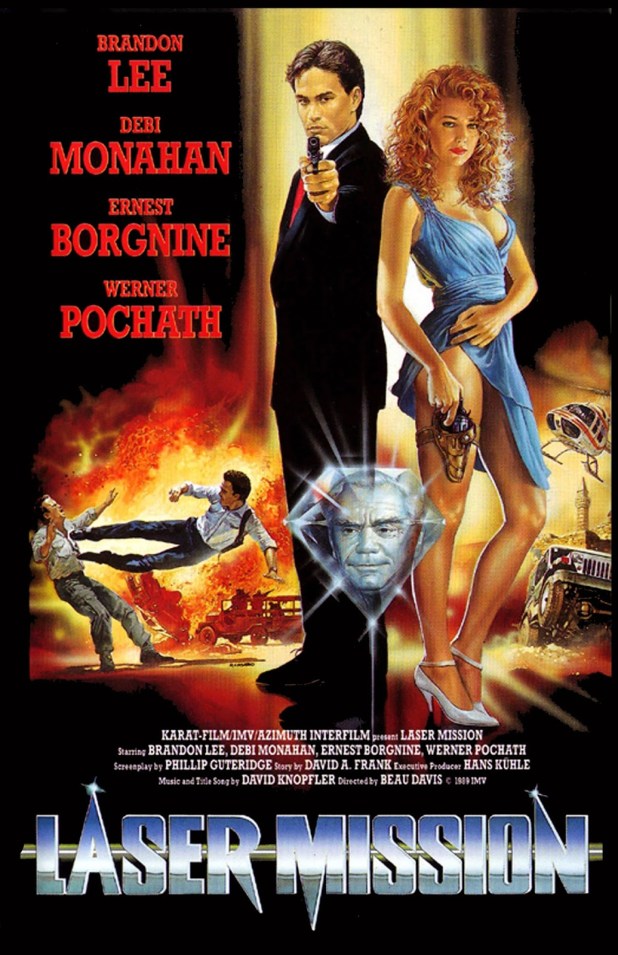
Laser Mission is a 1989 action film starring Brandon Lee, Ernest Borgnine, and Debi Monohan. Lee plays Michael Gold, a mercenary hired by the CIA to bring in laser expert Dr. Braun (Borgnine), who is in danger of being captured and forced to build diamond-powered laser weaponry by a corrupt Soviet Colonel and a psychotic German soldier of fortune. The first attempt to get Braun to defect is thwarted when both men are captured and separated. Gold soon escapes and enlists the help of Braun’s daughter Alissa (Monohan) to find the doctor and prevent World War III.

I first saw this film in the mid-90s, probably around the time that The Crow was coming out or hitting home video, and sadly, that’s probably the only reason that anyone really bothered to check Laser Mission out. Brandon Lee had been appearing in films for several years, but had only recently emerged as a leading man before his untimely death. As was tradition pre-Internet, when an actor died, any distributors that had movies he appeared in cranked out cheap tapes with box art that wasn’t even for the movie that you were about to watch, with hopes that the newfound notoriety would get you to shell out $0.49 for that one-night rental. I specifically remember that the copy I picked up from the Hastings in Idaho Falls featured the same picture from the poster for Lee’s 1992 actioner Rapid Fire.

Was it any good, though? Even at the time, when I was 16 and would watch absolutely anything with a ninja or kickboxer in it (American or otherwise), I didn’t think it was “good”, but it was fun and memorable enough to want to revisit and talk about a quarter century later. I think I could appreciate a lot more about it this time around.

In the canon of 80s action movies, this one is sub-Cannon in its production values, but it’s just as absurd as its bigger-budgeted contemporaries and shows the same lack of regard for the lives of its performers as many of those same films that were just far enough under the mainstream radar to get away with it if they were able to shoot somewhere where they’d never be found.  In this film’s case, we spend much of our time in Namibia.  I was confused at first, as the characters in this film seem to come from all over the world (A Russian and German are running the show, supported by Cuban and African soldiers) and a lot of the signage in this movie is in Portuguese, but a little Googling revealed to me that most of the countries that use it as their official language are right there in that part of Africa.

Oh, and there are no lasers. Not a single one. Lots of talk of lasers and preventing the creation of laser weaponry, but none to be seen. It’s probably better that way, as I can’t imagine what that effect would look like in this movie. After all, when we see the theft of the Verbig Diamond in the film’s prolog (“Larger than the Hope, more spectacular than the Cullinan”), the place looks less like a museum and more like an Olive Garden that got shut down early for a private work party.  A bunch of goons get armed up in a Commando-like gearing-up scene, but they end up just gassing the whole room and walking out with the diamond without any shots fired or casualties, like in an episode of Batman. Aside from not using lasers or real diamonds, a lot of the sets are very sparse. Half the interiors look the same, whether it’s supposed to be a hotel, university, airport, or an apartment building. At one point during his escape from an African prison, where he was sentenced to die the next day by guillotine (a gift from the Belgian king in 1907), Gold knocks a guard unconscious and leaves through a door, only to enter the next shot through the SAME door, complete with unconscious guard still slumped over in the corner, running back down the same hallway that he just came from. I could go on and on about the cheapness of the film all day, but it’s more of a “seeing is believing” (or not believing you’re hearing the same song for the fifth time) kind of thing that’s more fun to discover for yourself.

(David Knopfler’s “Mercenary Man” plays.)

The action in the film is totally fine, with a few standout stunts that really go for it that mostly involve out-of-control vehicles and people being launched from them, as well as some impressive falls, a full body burn at one point, and guys really selling the hell out of the beatings they’re taking. Brandon Lee’s father was Bruce Lee, of course, and he’s quite a martial artist on his own, but they seem to make him more of a traditional American action hero here.  He has more of a brawling style that works better when you’re being attacked in the middle of a desert by a variety of hired guns, including probably the only white guy in a karate gi on the entire African continent.  The film’s director, Beau Smith, only made a handful of films before finding his niche in directing documentary specials and shows, but he has had a very extensive career performing and coordinating stunts in nearly 150 projects, most recently in 2014’s Amazing Spider-Man 2.

The performances are not bad, but they do get sketchy once you get away from the main characters. Lee is a lot of fun and is certainly charismatic and makes the most of what he’s given. As far as Michael Gold is concerned, I think they were shooting more for a Bond-like character, but he comes off as more of a sarcastic smartass. He has good chemistry with his co-stars and doesn’t seem to be phoning it in, but his one-liners don’t seem to rise very far above a “See ya, but I wouldn’t want to be ya”. I don’t know if he thought that this role would propel him to bigger and better things quite yet, but he’s trying.  Ernest Borgnine has just a handful of scenes, and while he appears happy to be there, he doesn’t seem to be putting a lot of effort into trying to pass for German, aside from saying “Liebchen” a lot. Debi Monohan is someone I didn’t recognize that would go on to have a pretty solid run of guest appearances on sitcoms and action shows throughout the 90s, and she’s pretty solid in this part as someone that could have easily been a damsel in distress that ends up being as much a part of the action as anyone else. Her and Lee have a good rapport and a back-and-forth that doesn’t feel too scripted or forced. The actors portraying the Russian Colonel and German villain also play those types well, but it gets kind of weird the further down the call sheet you go. Early on, we’re introduced to a pair of bumbling Cuban soldiers that serve as comic relief in a film that doesn’t really need it that somehow manage to Forrest Gump their way into all of the important events of the film after first encountering the very not-Hispanic Michael Gold impersonating their commanding officer. After that, it’s mostly extras with a few words here and there that don’t seem to understand the lines they’re deadpanning, which doesn’t really help sell Lee’s lame one-liners any better, but they all appear to be local hires that probably don’t speak English as a first or second language, so good for them.

Overall, Laser Mission is a quick, goofy way to spend eighty minutes.  It’s probably exactly the same movie that my 11-year-old self would have cooked up in 1989 if everything I knew about action was based on the twenty minutes I remembered from A View To A Kill, A-Team reruns, and a hundred episodes or so of GI Joe, all on what appeared to be a Nollywood budget. It’s rated R, I’m guessing for violence and very brief semi-nudity, but could probably pass for PG-13, as the violence is mostly bloodless and there isn’t any gore that I can remember.  This film can be found in the “Excellent Eighties” DVD collection from Mill Creek Entertainment.

(David Knopfler’s “Mercenary Man” plays…again.)