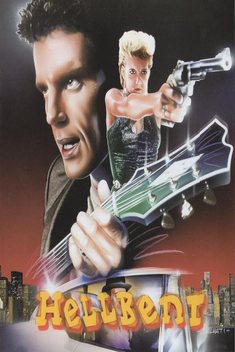
Director Richard Casey made one of the most bonkers movies I’ve ever seen, Horror House on Highway 5. I’m pleased to report that this movie — which melds Faust — no, not that Faust — and the Los Angeles music scene in mix of the first two Decline of Western Civilization films to create a blast of pure strangeness. Imagine if the Dark Brothers (Night Rhythms) or Rinse Dream made one of their films with no pornography, but after doing even more drugs and never sleeping. It’s that good.
Lemmy (Phil Ward, who shows up Horror House on Highway 6, as well as being the art department for Space Mutiny, if you can believe that) is the lead singer of a band that’s not going anywhere until he meets Mr. Tanas — pronounced tannis, like the root or spelled backward like…oh you get it — who offers him fame in exchange for his soul.
That’s the basic story, but this cough syrup drinking, drug abusing, machine guns in the recording studio affair is unlike any movie you’ve watched before.
David Marciano, who plays Mr. Tanas, would go on to appear on the show Homeland. Phil Therrien, who was Dr. Mabuse in the two Highway films, is also in this.
If you’re looking for a movie where a hobo screams “Black Betty,” where a mother looks for her son by killing everyone she comes near, where sound engineers act like jerks to everyone near them, where singers proclaim that they are Satan’s son, a gang shows up called Satan’s Cheerleaders and a cursed establishment is named Bar Sinister, well, look no more.
It’s not great, but it’s awesome. If you understand that sentence, you’re going to love this movie.
If I can chime in, Sam?
Just when I think you’ve reviewed “everything” at B&S About Movies. Why do I doubt my brother-in-VHS arms would not have reviewed the two-movie oeuvre of an ex-rock video director who gave us two of MTV’s most-aired videos: Blue Oyster Cult’s “Burning for You” and Aldo Nova’s “Fantasy.” I remember this SOV-VHS, as well as the bonkers Horror House on Highway 5 (it’s only a matter of time before we get a remake — with a killer in a Donald Trump instead of Richard Nixon mask), and I’d always felt Hellbent was a Satanic, F-up version of Suburbia, which is an excellent punk-era rock flick from Roger Corman directed by Penelope Spheris. But the Decline movies by the divine Ms. Spheris work as well, in comparison. You need another Faustian rock ‘n’ roll tale, be sure to check out the Paul Williams-starring Phantom of the Paradise. And watch Hellbent. You have to. It’s the shite.
Since we’re in the midst of a two-week Star Wars blow out in celebration of Star Wars: Episode IX – The Rise of Skywalker, and our “Ape Week” gala in commemoration of Disney announcing their production of a new Planet of the Apes sequel, is forthcoming (the simian fun begins December 29!), we need to take a look at the career of an impressive and successful indie filmmaker who has worked on low-budget homages to both franchises.
New Hampshire’s Brett Piper (Arachnia) is a self-made screenwriter, director, and special effects artist—and proud, self-professed purveyor of “schlock”—who eschews modern CGI for “old school” special effects, such as matte paintings, miniatures, and stop-motion animation. (Dude, you had me at “old school!”)
While Piper’s written, directed, and created effects for eighteen of his own films released from 1982 to 2019, he’s also designed effects for other directors, such as the Ape homages of fellow low-budget indie filmmakers, Mark and John Polonia (we’ll be reviewing the Polonia brothers’ films Empire of the Apes and Revolt of the Empire of the Apes as part of “Ape Week”).
But for this review, let’s take a look at Brett Piper’s debut film: a futuristic adaptation of Jules Verne’s 1874 novel, The Mysterious Island. Hey, if Disney can reboot Jules Verne’s 20,000 Leagues Under the Sea as The Black Hole, then why not a deep-space version of another Verne’s tale? And if it all looks a lot like the Apes rip Planet of Dinosaurs (1977) . . . then it probably is (and that’s a good thing!).
Just keep in mind this Star Wars rip is a grassroots amateur project: it is, in fact, a home movie shot on a shoestring budget—with even less of a shoestring than John Carpenter and Dan O’Bannon’s USC student film, Dark Star (1974). As Sam opined in his review of Piper’s Arachnia (2003): If Piper—and the Polonia brothers—had been around for the regional era of exploitation, each would be making drive-in flicks in the ’70s or direct to video films for the VHS ’80s.
So let’s get the guffaws out of the way.
Yes, we see filament lines suspending the ships. Yes, the sound sometimes unsyncs. The acting is questionable. Is that two-headed snail monster a riot? Do the stop-motion and matte effects send Jim Danforth (The Thing, They Live) running for the exits? Does this home-grown space opera make Alfonso Brescia’s Star Odyssey look like an Oscar Winner?
Oh, hell yes. And it makes Starship Invasions (1977) look like a Lucas Films’ production.
And you know what: I love this movie. For I dig this movie just as much as Sean and Patrick Donahue’s Richard Lynch-starring sort-of-apoc romp, Ground Rules.
I love Mysterious Planet a hell of a lot more than the Roger Corman star drek that is Space Raiders (ugh, that film!). Why? Brett Piper overflows with that same Tommy Wiseau-heart and has John Howard’s tenacity. Sure, their respective films, Mysterious Planet, The Room, and Spine have their (many) flaws, but they each have a special, endearing quality that’s absent from most—if not all—major studio offerings. (And you can add Flywheel(2003), Alex Kendrick’s Christian-message debut film to that list.)
The story is a simple one: Piper leads a “wretched hive of scum and villainy” mercenary crew. After a space battle, their ship encounters a “space-storm” (via—this time, will give you a pass*—an acceptable budget-saving voiceover), and they water-crash on a primitive, uncharted planet. They soon encounter strange, prehistoric life forms (the snail, and the later flying dragon that reminds of 1970’s Equinox, are both actually quite impressive considering the film’s budget), the inevitable scantily clad jungle girl, and the planet’s ruler: an ancient, super-intelligent computer (Ancient computer? Hey, wait . . . that sounds a lot like Brescia’s Cosmos: War of the Planets) who warns the planetwill be destroyed by an asteroid storm.
The questions and answers are simple with this film: Did you enjoy The Evil Dead demon-romp precursor, Equinox(1970), John Carpenter’s debut student film, Dark Star (1974), and James K. Shea’s Planet of Dinosaurs (1977; a review as part of “Apes Week” is on the way)? (I did!)
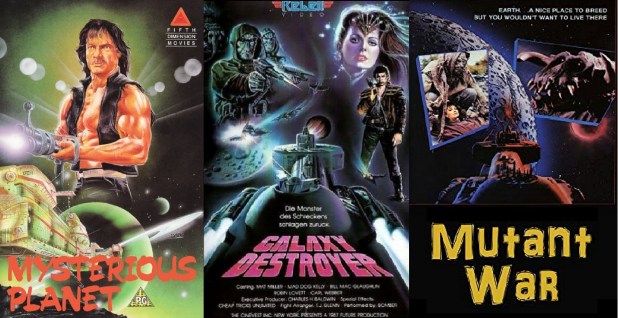
Well, that’s what Piper brings to the table with his, to be quite frank, impressive debut film (that also carries the alternate title of Star Odyssey!?!). His other “Star Wars” films are the much improved adventures of that scruffy nerf herder, Harry Trent: Galaxy Destroyer** (1986; aka Galaxy), and its sequel, Mutant War (1988). All three films are internationally distributed and dubbed, each finding loyal fan bases in France and Germany. (The full films and clips of each can be found on various video sharing sites.)
“You did alright, kid. Good job,” backpats Academy Award-winning stop-motion effects animator Ray Harryhausen to the wide-eyed comic book and sci-fi and horror film geek, Brett Piper. “Don’t get cocky. Now get back to work.”
Brett Piper’s latest sci-fi offering—in conjunction with the Polonia brothers—is 2019’s Outpost Earth. Be sure to check out Brett Piper’s work on his Facebook Fan Page. And we’re not done yet! We’ve been rolling out the “Star Wars Week” film reviews since the 16th and there’s more “Star Wars” film reviews coming up until the 28th, then it’s “Ape Week” at B&S Movies.
* Galaxy Destroyer, which also aka’d as Battle for the Lost Planet, stars Matt Mitler and Denise Coward. Mitler bowed out of the business after his 1985 vanity project, Cracking Up, which he starred, wrote and directed. Coward, who starred in Sig Shore’s Sudden Death (1985), later starred during the 1984-1985 season of CBS-TV’s daytime drama, The Edge of Night. Sig, by the way, also gave us the post-apoc’er, The Survivalist (1987).
** You know me and my pet peeves with voiceovers (with a character’s “inner feelings”) and words-on-screen set ups.
What’s this? A new Piper flick?Hell, yes!
And, we are still not done yet bowing to the Altar of Piper. We’ve dedicated one of our “Drive-In Friday” featurettes to Brett as we screened four of his films, including Queen Crab and Muckman. Yeah, we love ‘the Pipe ’round these analog wilds.
Star Wars: Episode IX – The Rise of Skywalker is currently playing in theaters and was released theatrically on December 20 in the United States.
About the Author: You can read the music and film reviews of R.D Francis on Medium and learn more about his work on Facebook. He also writes for B&S Movies.
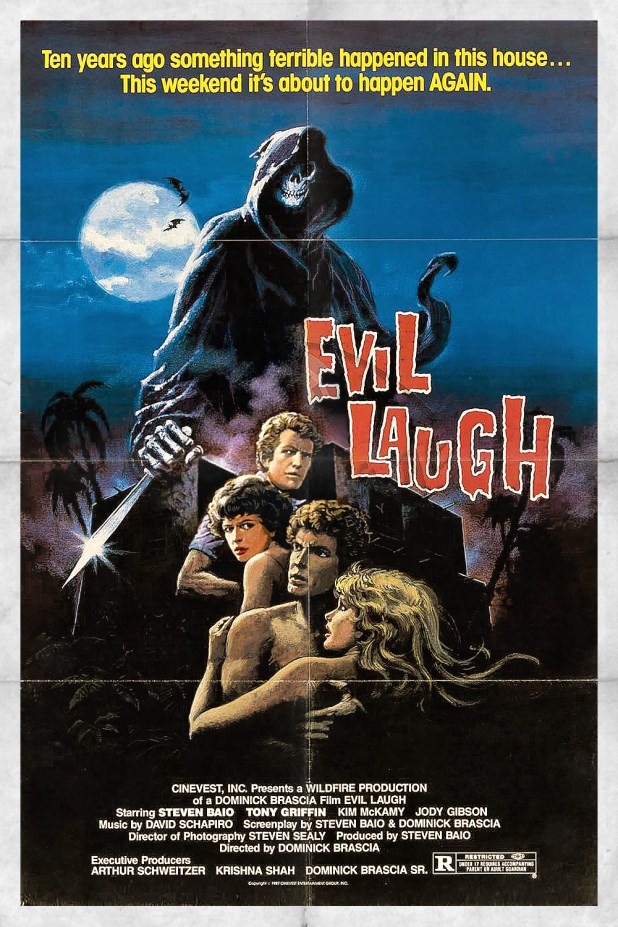
At the tail end of the slasher boom, hell, maybe even a few years past its expiration date, Steven Baio — yes, the brother of Scott, co-produced and starred in Evil Laugh. We all have dreams. Dreams that Scott Aaron Stine, in The Gorehound’s Guide to Splatter Films of the 1980’s, would crush by saying that “There is nothing, I repeat, nothing worthwhile or even remotely worthwhile or even remotely memorable about this waste of celluloid.”
A decade ago, an orphanage is being rebuilt after the community burning it down, thanks to rumors of child molestation from the janitor who lived there. He went nuts, killed a bunch of people and totally has nothing to do with Freddy Krueger.
Much later, some medical students decide to rebuild the space as a foster home, but they get killed one by one. Probably the only person of note — other than the Baio sibling — is star Kim McKamy, who is better known as adult star Ashlyn Gere. She refused to do nude scenes for this movie, which is kind of ironic.
Another actress in the film, Jody Gibson, was known as Sasha of the Valley and boasted a call girl service with clients alleged to be Bruce Willis, Steve Jones from the Sex Pistols and Tommy Lasorda. Oh yeah — her mom is the talent agent who found Tom Cruise. Life’s crazy, people.
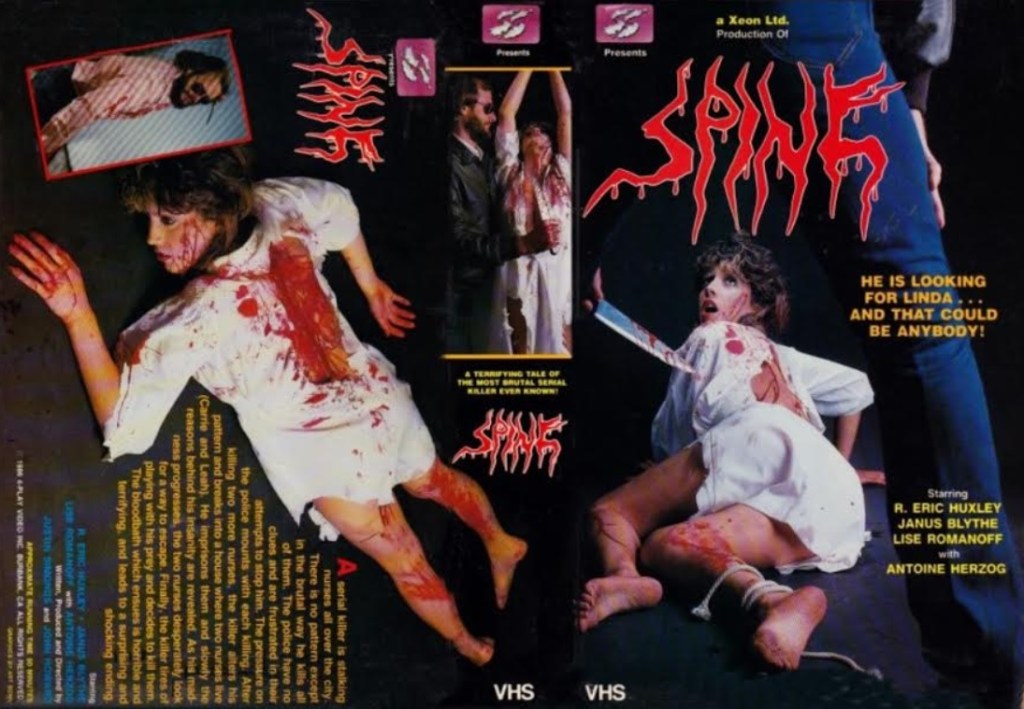
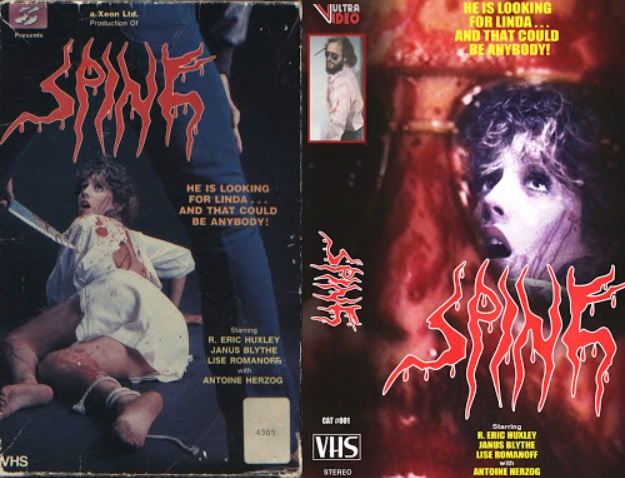
When the wee pups of the video fringe first watched Spine during its initial release 33 years ago, it was, as was the case with most of the Big Box VHS/SOV horror flicks of the ‘80s, acquired via mail order from an ad in the back of a monster or underground film magazine. Just one look at that very heavy metal, bloody-carved knife font: you had to have it. Spine was supposedly so “nasty” that video stores wouldn’t carry it in their horror section. The fact that these stores were renting out copies of the infamous SOV blockbuster-nasty, Blood Cult (1985), and not Spine — well, telling someone they can’t have it only makes them want it more.
The “Big Box” we love.
On the rare occasion when a store did carry Spine, it was cataloged in a three-ring binder on the counter that you were not even allowed to browse through, with the VHS tucked away behind the green curtain in the “21 and over only” porn section. When the more adventurous (well, clueless) store operators did carry Spine on the main floor in the horror section — alongside the oeuvres of Argento, Bava, Carpenter, Craven, Fulci, and Lenzi — the word-of-mouth marketing kicked in and Spine became a top-rental.
Yeah, those marketing gurus at Xeon, Ltd. knew how to sell a film on the video fringe.
We’ve read the online reviews advising us that Spine is woefully inept and downright boring in parts, with no gratuitous nudity and no on-screen kills. Every time something good is about to happen, the scene cuts away or fades to black (and has way too many clunky fade-edits). We’ve seen more graphic sex and eroticism in Martin Scorcese’s The Wolf of Wall Street and more gratuitous nudity and violence in ’70s Italian and Spanish Gialli. When the actors aren’t overacting, they’re underacting. When actors aren’t staring into the camera, they’re visibly reading their lines from papers on a desk. In an Ed Wood-Tommy Wiseau casting snafu: a bearded actor cast as one of the detectives — who quit in mid-production — is replaced, without explanation, by one of the film’s crewmembers — because he had a similar beard/build, as if no one would notice.
Yes, if Tommy Wiseau wrote a slasher flick, it would be Spine: Do you remember the scene in The Room when we learned Lisa’s (superfluous) mother was “dying from breast cancer” — then it was never mentioned again? Spine has a lot of those “is plot twist” moments. Oh, and most importantly: there are no spine removals.
“Uh, so why would anyone want to see a film that’s that awful?” you ask.
Well, for those wee horror and heavy-metal lovin’ pups of the under-21 variety surfing the ‘80s video fringes, Spine, unlike the films it attempted to mimic, provided those teen renters with their first exposure to . . . a porn movie — and they were masturbating to the film’s extended bondage scenes. Now that sounds crass, but it’s the truth. While masquerading as a slasher flick, Spine is really an adult erotic film — and chickens are choked in the process.
Today, those extended bondage scenes seem mild in a post-James Wan and Eli Roth torture-porn world, but in 1986, for those hormone-infused teen minds that never experienced a porn film: Spine was a sensory overload. Sure, those teens experienced light “damsel in distress” moments on the police procedural TV dramas of their youth — everything from Dragnet to Charlie’s Angels — but nothing like Spine’s “X-Rated” scenes.
As I write this review three decades after its release, we horror geeks are still coveting, talking about, and purchasing copies of Spine. Collectors are shelling out $200 to $400 for the original VHS — and willing to plop down $150 just for the box. The official 2015 DVD reissue by Massacre Video sits on the shelves of your local Best Buy, Barnes and Noble, and Walmart. It’s even available on Amazon and eBay with your PayPal account.
Oh, how the times have changed.
The VHS slip case we remember.
Not bad for a week’s worth of work in the summer of 1984 in Los Angeles — shot on the fly without permits via broadcast-news ENG cameras and 3/4-inch U-Matic videotape using Ikegami cameras on a $20,000 budget*. It’s that S-VHS and U-Matic recording format that lends to the fuzzy, color hazing of the film that leaves it with an almost documentary-like pale. The film came together with financing from porn purveyors 4-Play Video, Inc., and producers Xeon, Ltd. created the SS “Sterling Silver” Video imprint for the sole purpose of distributing Spine without the nasty porn aftertaste. Released with a 70-minute running time, Spine was marketed as a 90-minute feature film, so as to get it out of the back room and into the horror section shelves of the main floor. Plans for Xeon and SS to produce and distribute another horror-porn film never materialized. (*One of the first motion pictures shot electronically-on-videotape, using Norelco PCP-70 portable plumbicon NTSC cameras and portable Ampex VR-3000 2″ VTRs, was the 1973 Glenn Ford-starring western Santee produced by Crown International Pictures; unlike its ’80s SOV offspring: it was transferred to film stock for theatrical release.)
Spine required a set of reshoots when co-director/producer Justin Simonds realized the final edit clocked in at 45 minutes. The film needed more material: so he wrote and shot an expanded detective storyline that was interposed into the existing slasher footage shot by John Howard with actor R. Eric Huxley. Most of the film was shot at a commercial-office complex (doubling as a “medical center”) owned by the same businessman who loaned out his spacious house where the film comes to its harrowing conclusion. The “police station” is actually a computer company where Simonds worked his day job.
When you factor in its production cost-to-box office ratios, Spine, more than likely, has a profit margin percentage analogous to John Carpenter’s Halloween and George Romero’s Night of the Living Dead. In an adult film industry perspective: the ‘70s “Golden Age of Porn” blockbuster-classics Behind the Green Door, Deep Throat, and The Devil in Miss Jones. Spine is, simply put, The Room of ‘80s SOV horror (we go deeper in the genre with our joint review of The Last Victim/Forced Entry). No one is going to be talking about the highbrow, 2019 Oscar winners Green Book and Roma thirty years from now and clamoring for extras-packed DVD reissues on either.
While it was shot-on and edited-on 3/4-inch video like its fellow, lo-res audio-buzzing, Big Box/SOV horror brethren Boarding House (1982), Sledgehammer (1983), Truth or Dare (1986), 555 (1988), Things (1989), and Gorgasm (1990) — Spine is a semi-pro production. It’s obvious that co-directors/writers/producers John Howard and Justin Simonds knew what they’re were doing and, in spite of the budget and time constraints, did their best to emulate John Carpenter’s Halloween (1978) and Brian De Palma’s Dressed to Kill (1980). If the duo had, say, a month-long shooting schedule and a $100,000 budget that allowed them to hire a skilled, student screenwriter from UCLA looking for a break, along with studied, non-porn actors to flesh out their concept of grafting Giallo-inspired plotting into a porn production, it could have, at the very least, elevated Spine to the commercialized sleaziness of The Toolbox Murders (1978) or Pete Walker’s even sleazier The Confessional (1976) and Charles Kaufman’s sick-fest, Mother’s Day (1980). A nudity-loving Paul Naschy-directed version of Spine would have become a Spanish Giallo classic. Why 16mm home-grown filmmaker Andy Milligan failed to make the adult film-to-slasher-hybrid transition — considering his own films, Seeds (1968), which, once after-the-fact sex scenes were edited-in, became the “adult film” Seeds of Sin, and Fleshpot on 42nd Street (1972) starred porn actors Laura Cannon and Harry Reems (both from the aforementioned-linked Forced Entry) and played to the adult grindhouse crowd, is anyone’s guess.
John Howard and Justin Simonds each have long resumes in the adult film industry, producing a successful series of 30 to 70-minute “specialty videos” (i.e. bondage films) for the industry-respected California Star Productions (aka CalStar). As is the case with adult films, their productions didn’t waste time with plot contrivances and concentrated on women being tied up — the more ropes and knots, the better. While their films showed lots of skin, sometimes with the occasional, mild sexual situations, their main objective was to expand upon those very same “damsel in distress” bondage scenes seen on police procedural TV dramas — without any yammering cops or whiny villains getting in the way of the knots and ropes.
According to reviews published at the time of its 1986 release, critics logically — because of the killer’s similar obsession with nurses — believed Spine was inspired by Richard Speck’s July 1966 Chicago murders of eight student nurses. The irony of that Richard Speck analogy is that Speck’s murder spree served as the inspiration behind Charles Bronson’s entry in the ‘80s stalker-slasher blood pool, 10 to Midnight (1983) — which isn’t far off the mark on what Spine failed to accomplish with its “detective vs. serial killer” plot. (Cobra and D-Tox are Sly Stallone’s two solid examples of the genre.)
Go retro!
Courtesy of a Massacre Video interview with Justin Simonds, it turns out that it was Brian De Palma’s Dario Argento homage, Dressed to Kill (1980) — and not Richard Speck’s exploits — that led to John Howard’s idea for Spine. Unfortunately, that slasher-porn concept was compromised at the last minute by the film’s two lead actresses urging the directors to cut-out the nudity and create a more commercially-accessible slasher film. It’s a decision Simonds now regrets: the gratuitous nudity (and sex) would have served as an effective counterbalance against the film’s technical and creative shortcomings.
While the script is an arduous journey through an exposition-burdened hell that grossly violates the “show, don’t tell” edict of screenwriting, along with “plot twists” to nowhere that don’t even come close to the beloved red-herring modus operandi typical of a Giallo, still, there’s actually a very Giallo-sleazy tale lost amid the film’s low-res hums.
Eric Huxley’s creepy and seriously screwed-up mama’s boy — a Norman Bates-styled may-have-had-a-sexual-relationship-with-mama fey who laments on how much he enjoyed “rubbing momma’s back and feet” — successfully carries the film as the hulking, perpetually aviator-shaded, cowboy boots and pink western shirt-clad psycho, Lawrence Aston. (For inside Hux’s chest beats a Tommy Wiseau-committed-to-the-role heart.)
As a successful entrepreneur who runs his family’s business (expositional cop babble), Larry leads a double life terrorizing the nurses of Los Angeles. His modus operandi: First, he binds them ass-up over the backs of chairs and rapes them (camera-angled out of view and not as graphically portrayed as you’d expect; again, you’ve seen worse in the critically-acclaimed, mainstream-porn that is The Wolf of Wall Street). Then he hogties them and, as they struggle, the rope from their feet to their neck tightens and strangles them — in a form of “self punishment” for “hurting mama” (on-camera). Then, after administering a flurry of stabs wounds (camera-angled out of view/cuts away), Larry beheads them, carves out their spines, and with their blood, scrawls “Linda” on the wall (all off-camera exposition via cop talk). And, we’re just sleazy-guessing: Larry-boy goes home, puts on his dear, dead momma’s dresses and masturbates. And probably plays with decapitated Donald Duck heads, like in a Fulci movie. And, like in an Argento movie, obsesses over crystal bird feathers, nine-tailed cats, and grey velvet-fluttering flies.
So, when nurse Carrie Lonigan (Janus Blythe), whose friend becomes Aston’s sixth victim, interrupts the killing of nurse number seven (another one of Carrie’sfriends; it seems all of the victims work at the same medical office?), Carrie becomes the next “Linda” to be relieved of her spinal cord. (And why did Larry pick Carrie’s two friends and what’s Carrie’s connection to the mayhem? Why did Larry pick that medical office? Was his mama treated there? Was Linda employed there? It’s never explained.) That sets up the film’s extended bondage scene third act (that everyone rented for) where Larry-boy ties up and tortures Carrie, along with her recently Kansas City-transplanted friend, Leah Petralla (Lise Romanoff).
Although the execution is clumsy, the Howard-Simonds collective does a commendable job in taking the time to develop Carrie and Leah as real people that viewers can care about: Leah “got into trouble” in Kansas City and had to runaway to Los Angeles; Carrie previously visited Kansas City and met Leah through a mutual acquaintance; Carrie owns a van because she loves swap meets and camping; she house sits a friend’s mansion while they’re vacationing in Europe. Even the bumbling cops are developed as ordinary average guys with everyday problems: dealing with computer issues, job pressures and sports betting pools, bitching about crappy coffee and putting the moves on the hot police dispatcher, and so on. Again, a valiant effort was made to develop the characters and story beyond porn norms.
“Okay, so what’s the deal with Linda and her spine?”
It turns out that poor, lonely Larry developed a crush on his sick momma’s healthcare nurse — Linda. When he made a clumsy, romantic overture (in his mind; he really tried to rape her) she gouged-out his eye with a pair of scissors (we see it for a second; no great shocks). Then, while he’s chilling out in the nuthouse, momma took a tumble down the stairs in her wheelchair — and broke her spine in three places. Now little Larry is convinced that Linda — in an act of revenge to take away his momma from him, forever — “pushed momma down the stairs.” (Again, all of these plot-twisty events are off-camera exposition. And we never meet the “real” Linda, either. And why not stab “Linda” symbolically, three times, say in both eyes and the heart? Hey, don’t over think the plot, my friend!)
Of course, no Italian Giallo-homage is complete without some fucked-up dream within a dream plot twist — complete with Leah discovering she has “psychic abilities” linked to the killer, as all Gialli damsels do. So, Carrie and Leah still have their spines and . . . no, wait! Larry is hiding in the shadows of the garage and Carrie’s going to take out the trash and close the mysteriously opened garage door . . . again. “Carrie, don’t go in the garage, he’s in there!” screams a bug-eyed Leah.
So goes the tale of “The Linda Murders” plaguing Los Angeles during those first two, carefree weeks of Larry-boy’s release from the nuthouse, when he killed nine nurses. Or was it seven nurses? No, five? Argh! Leah’s confounded deus ex machina psychic-dreaming hysteria screwed up the kill count.
While Janus Blythe has done better work, she certainly deserved better than having to take a role in an SOV horror flick — financed by a porn studio, no less — to pay the rent. (Several years ago, a fellow con-freak told me Janus was “in the running” for the Janet-role on ABC-TV’s Three’s Company and, she “lost out” on the part of Lynn Starling in Rocktober Blood? I’ve been unable to confirm those “facts.”) In addition, Lise Romanoff, in her only acting role, does a pretty decent job as well. It would have been nice to see her develop as an actress.
The same can’t be said for the rest of the cast, especially the perpetually changing baseball cap-clad (is it a Tom Selleck-Magnum in-joke?) lead detective on the case, Leo Meadows (Antoine Herzog, the acting alias of director John Howard who, in a pretty decent bit of comedic writing, is constantly mistaken as “Leo Fields” by Blythe’s character). Fairing worse, god bless him, is Simonds’s non-acting father, James, as the precinct’s commanding officer. Considering their castings were the result of the two “professional” actors cast in the rolls dropping out at the last minute, you’re willing to cut them both some slack. Seriously, how many dads do you know — with no acting experience — who would bail out his son’s film by taking a role? And Howard, he was Wiseau-committed: come hell or high water, Spine was going to get made. And, for better or worse, he got his film made. And that’s awesome.
“So, where’s the cast and crew of Spine now?”
Janus Blythe is always etched in our ‘70s drive-In and ‘80s VHS hearts, courtesy of her breakout role as the tough-as-nails Ruby in Wes Craven’s The Hills Have Eyes, along with her turns in Stu Segall’s exploiters C.B Hustlers and Drive-In Massacre, Tobe Hooper’s Eaten Alive, Bob Kelljan’s Black Oak Conspiracy, William Sach’s The Incredible Melting Man, and The Hills Have Eyes Part 2 (just released by Arrow Video and newly reviewed on B&S Movies!). Before retiring from the business, Janus kicked some serious, gun-slinging ass alongside Gil “Buck Rogers” Gerard, Charles Napier, and Dan Haggerty in her final film: the not-so-awful 1991 direct-to-video Rambo knock-off, Soldier’s Fortune (trailer). Yeah, we dig you, Janus!
Also appearing in a small role as one of Spine’s precinct’s detectives (acting under the Ray Hicks nom de plume) is Roger Watkins. In 1973, at 24 years old, with $3,000 bucks in his pocket and a 16-millimeter camera, he produced, wrote, directed, and starred in the well-regarded grindhouse classic — now a highly-coveted VHS — Last House on a Dead End Street (it has an extensiveWikipage). Unable to obtain a foothold in mainstream films, Watkins forged a successful career in the adult film industry — he produced several films for CalStar directed by John Howard — up until his death in March 2007. (Our “spines” are tingling in anticipation as Joe Rubin and the Vinegar Syndrome crew currently works on Last House’s DVD restoration.)
The most successful person to rise from the ranks of the SOV horror ‘80s is Lise Romanoff. After becoming a successful special effects artist (Night of the Creeps is one of her many credits; it’s reviewed, again, on B&S Movies! Yes, we love it that much!), she became a mainstream producer and distributor, eventually incorporating and becoming the CEO of Vision Films. In addition to serving on the board of the IFTA (Independent Film and Television Alliance), she’s a noted industry authority on film copyright and trade laws.
Don Chilcott, the musician responsible for Spine’s scuzzy, slasher-appropriate synth-soundtrack, also scored the SOV horror romp Bits and Pieces (1985). Don never stopped rocking: he became a successful studio musician and a respected guitarist and lead vocalist for several California-based blues bands. An age-restricted VHS rip of Bits and Pieces is available on You Tube and you can learn more about the film on Horror News.
John Howard (Letterboxd) — with R. Eric Huxley as his go-to leading man — stuck with the vision he set forth in Spine, injecting extended bondage scenes into erotic adult films featuring fleshed-out characters and extended out-of-the-norm-for-porn plots. His films starred our beloved exploitation scream queens from the USA Network cable-TV ‘80s: Linnea Quigley (aka Jessie Dalton) and Michelle Bauer in Avenged (with Crystal Breeze of Rollerblade, newly reviewed on B&S Movies!), Scorpion (female agent/spy action; no, not the Tony Tulleners one), Stalked (white slavery adventures), and Flash! (a plucky investigative reporter-photographer runs afoul of drug dealers). So, if you want to see more of John Howard and R. Eric Huxley’s joint-oeuvre, it may be worth it to seek out those films.
Spinewas reissued as a DVD-R rip on the Substance grey-market imprint (2005) and Vultra Video issued a VHS repack in a retro-clamshell case (2012). Alongside Justin Simonds, R. Eric Huxley contributes to Massacre’s audio commentary track and gives an on-screen interview that gets into the nuts and bolts regarding the hardships of low-budget filmmaking — conducted by Massacre Video’s Louis C. Justin and Vinegar Syndrome’s Joe Rubin. In addition to a generous stills gallery, Massacre’s official 2015 DVD reissue (Region: 0 NTSC) comes with high-quality, reversible cover-art that replicates the original’s big box artwork. You can purchase Spine direct from Massacre Video or through Cinema Wasteland and Amazon. There’s an age-restricted VHS rip of Spine to enjoy on You Tube. Will there ever be aremake proper of Spine? As B&S Movies recently points out in “Exploring: Slasher Remakes,” the scuz-classics The Toolbox Murders and Mother’s Day were remade — so why not Spine (with Sly Stallone hunting down a Linda-hating “Spine Killer,” perhaps?).
Nope. Not John Howard’s fault.
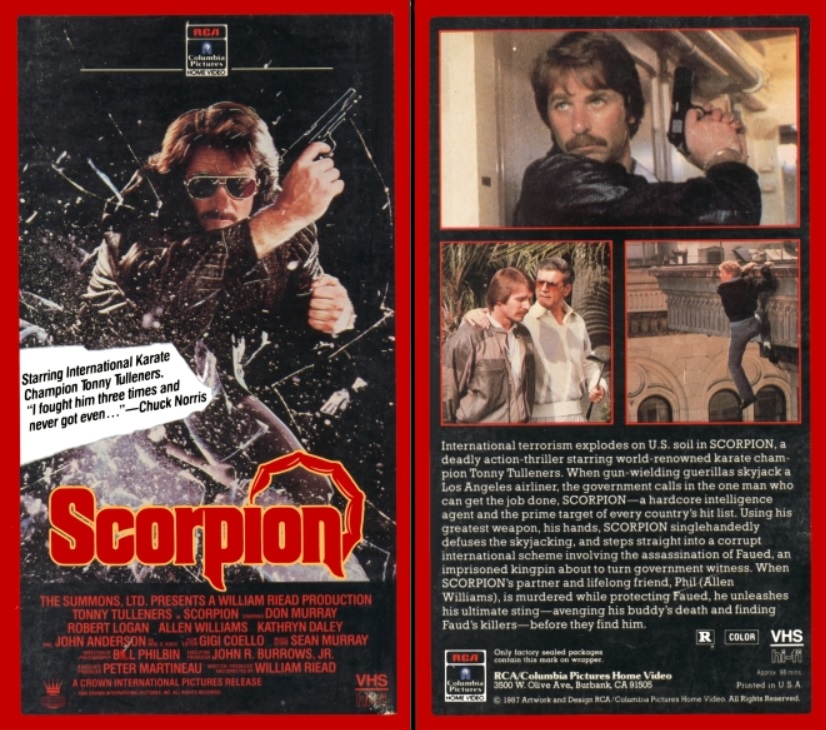
Contrary to the web-chatter/caveat emptor John Howard sidebar: The Scorpion (1986) reissued on the Explosive Cinema 12-film pack by Mill Creek (Amazon, Walmart) — starring karate champ Tony Tulleners, the one guy the “invincible” Chuck Norris could never beat — is not the same film as the “specialty video” Scorpion (1986) shot by John and starring Linnea Quigley, noted above. You can watch the VHS rip of Tulleners’s Scorpion and listen to an extensive review by All Natural Reviews on You Tube.
Nope. Again. Not John Howard’s fault.
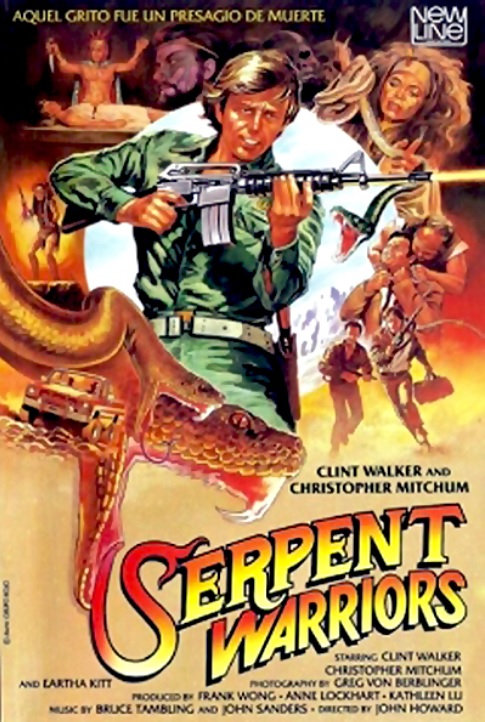
The John Howard sidebar, Part Deux: The 1985 Hong Kong actioner The Serpent Warriors (Wikipedia) — starring Clint Walker (Killdozer, TV Movie alert!), Eartha Kitt (as a snake bitch!), Christopher Mitchum (Aftershock, SFX Retaliator, double yes!), and Anne Lockhart (Battlestar Galactica: TOS) — is not the same John Howard who directed our beloved Spine. (Don’t forget: Asian-Pacific Rim-produced oddities from the ‘80s VHS fringe are infamous for their untraceable, americanized director-pseudonyms.) While its rare VHS goes for about $40 bucks, beware of those bogus DVD-R grey-market rips (and know your regions before you buy, if you must). Sadly, there’s no video-hosted VHS rip of The Serpent Warriors, but you can watch the trailer on Daily Motion. If you need to know more, you can read an extensive “Snake Week” review at Daily Grind House. Here’s to hoping the fine folks at Vinegar Syndrome or Arrow Video do a reissue of this slithery, beautiful disaster that, somehow, “roped” Catwoman and BSG’s Sheba into starring.
“Dude, you know way too much about John Howard. What kind of a freak are you?”
I know, right? It’s an illness, my addiction to these forgotten VHS’ers of ’80s yore.
Okay, I need to go get my “freak” on. Now, where is that little rabbit? Where’s the chicken? Have a knotty . . . uh, I mean, naughty Halloween, ya’ll!
About the Author:You can read the music and film reviews of R.D Francis on Medium and learn more about his work on Facebook.He also writes for B&S About Movies.
During the Blood Cult media frenzy splashed across the trash cinema, monster, and underground movie magazines of my youth — such as my cherished issues of Famous Monsters and Fangoria — I can’t recall if the Hollywood movie and rock ‘n’ roll royalty lineage of director Christopher Lewis was reported on, and, if it was, that it meant anything to anyone at the time.
Christopher Lewis one-stop three-in-one shopping.
I doubt it: I was too busy jamming Slayer’s new album, Hell Awaits, and saving my slave wages to see Iron Maiden. I was pissed off I wasted money on tickets to specifically see Saxon open for Triumph — only for Saxon to pull out at the last minute. And I was trying to retrieve my cherished April Wine concert t-shirt from my psycho ex-girlfriend (my nutty, late-cousin, Johnny, made up a parody tribute to her insanity: “Psycho Robyn” — appropriately enough, within the context of this film review — based on the Talking Heads’ hit “Psycho Killer”: Psycho Robyn /She’s a bitch /a ba-ba-ba, ba-ba-ba bi-i-i-tich).
Anyway, it turns out, Christopher’s dad, Tom Lewis, was a noted film and television producer; his mother an award-winning Emmy and Oscar-caliber actress, Loretta Young. His stepdad was Clark Gable of Gone with the Wind (1936) fame. His uncles were Ricardo Montalban (Star Trek II:The Wrath of Kahn) and director Norman Foster (of the “Charlie Chan” series of movies). His rock ‘n’ roll connection came courtesy of his little brother, Peter, who co-founded seminal San Franciscan rockers, Moby Grape. His cousin was noted lap-steel guitarist David Lindley who, in addition to fronting his own psych-rock band, Kaleidoscope, joined the bands of Jackson Brown, Warren Zevon, and Linda Ronstadt (remember his FM “Top 40” hit, “Mercury Blues” from the MTV ’80s?).
Meanwhile . . . cuzzin’ Chris spearheaded the ‘80s SOV home video distribution boom.
In the lost kingdom of ‘80s Big Box VHS/SOV horror (sigh . . . just look at Blood Cult’s beautiful, soft-pak clamshell with the artwork insert), Christopher Lewis was the king of the video fringe that we all survey with his exclusively distributed-by-video store, blockbuster triple threat of Blood Cult, The Ripper (1985), and Revenge (1986; aka Blood Cult 2). For those two gloriously bloody years, you couldn’t open a genre magazine and not see an interview, a film review, or an ad adulating his SOV oeuvre.
Sure the Big Box/SOV horrors Boardinghouse(1982) and Sledgehammer (1983), along with Blődaren (1983), Copperhead (1983), and Black Devil Doll from Hell (1984) — and not taking into account the video-shot-for-television movies canons of the prolific Dan Curtis (‘70s TV Movies!!!!) — were the first of the low-budget, VHS-only issued films. Inspired by the blockbuster success of John Carpenter’s Halloween and Sean S. Cunningham’s Friday the 13th, SOV horror films took advantage of JVC’s VHS tape-format and the cost-effectiveness of shooting with 3/4-inch U-Matic tape via broadcast ENG and Ikegami cameras. But those films, while groundbreaking, were mail-order distributed, with a few gaining convention-based screenings at comic-cons and horror-fests.
So while Blood Cult isn’t the “first” shot-on-video horror film, it is the first SOV to bypass con-fest screenings and Grindhouse theatres and Drive-Ins in one-off showings to be distributed exclusively on the new “screens” created by the home video market. Filmed in nine days on a paltry $27,000 budget that wouldn’t cover the cost of a Roger Corman Philippines-shot schlock fest (we love you, Cirio H. Santiago!!!!), Christopher Lewis revolutionized the video store industry. Courtesy of his success, all other SOVs in his bloody wake spilled upon the retail-rental altars of the brick-and-mortar afterworld.
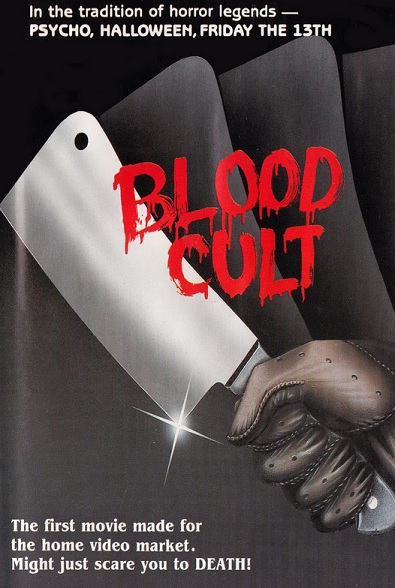
Courtesy of my craving-nostalgia fueled by the glorious results of my misspent youth, I give Blood Cult a Gene Siskel and Robert Ebert “Two Thumbs Up,” a Time Magazine “5 out of 5 Stars,” and the Rotten Tomatoes couldn’t be juicer and plumper; however, I am not going to sugarcoat. The damsels in Blood Cult, with their unconvincing caterwauling under the threat of rubbery blade makes the sundress-clad and high heels-running from Templar-zombie babes on the Italian and Spanish Gialli fringes (can you hear the Panic Beats?) look like Oscar and Emmy winners. If you’re looking for novelty special effects of the Spirit Halloween or Party City variety — this is your movie. If you don’t want be shocked — as the Big Box claims: “In the tradition of horror legends Psycho, Halloween, and Friday the 13th” — then this is your movie. While Blood Cult is no Necropolis (and what SOV is, thank god), the body-part cult shenanigans are more of the Rocktober Blood variety than any of those films.
You have to give Blood Cult credit though: it wastes no time in getting a kill on the TV screen. As soon as the VHS tape rolls — WACK! — a nubile sorority shower bunny loses an arm. Then, on no — it’s a “tell, don’t show” prologue alert: We’re in a bogus crime story documentary about a serial killer collecting body parts in a small Oklahoma college town. The only clues, beside the lost limbs, are some gumball-machine golden amulets left on the bodies. I guess they couldn’t afford any grey velvet or flies, or Donald Duck heads, or lizard skins. Or call F.B.I agent Jake Malloy from D-Tox.
We are, of course, supposed to care for the cadaverous sheriff (that makes horror icon John Carradine look moist) who, in a modus operandi typical of a politician, is more concerned with his jeopardized run for state senate as result of all the limbless woman piling up around him.
Luckily, his resourceful student-librarian daughter, Tina (local Okie actress Juli Andelman of the Cameron Mitchell slasher, The Silent Scream), picks through some books and discovers the shiny trinkets are the symbol of a Salem Witch Trials-era cult bent on avenging the death of 19 witches. To return balance to the afterworld, they must create a complete body—one body part at a time (“my ears, my nose, and mouth . . . head, shoulders, knees and toes, knees and toes” come on, sing it with me)—and have a midnight body barbeque to celebrate.
Uh-oh. Here comes The Wicker Man. All the major political power players in Hicksville, USA are the cult and want Sheriff Cadaverous out of the senate race; so they spike his coffee and ready him for dismemberment and burning . . . and here go again with the was-it-a-dream-or-was-it-real double-plot twist.
Regardless of its SOV shortcoming and, like with John Howard’s Spine, Christopher Lewis knew what he was doing behind the camera; Blood Cult isn’t a Plan 9-Ed Wood boondoggle. Chris capitalized on its blockbuster rental status with Revenge, which picks up where Blood Cult left off.
Ah, the original VHS cover that feels like home.
In the grand tradition of notable-successful actors hitting hard times and slumming in an SOV romp to pay the rent (and for a producer to get a marketable name on the Big Box), such as Michael J. Pollard in Sleepaway Camp III: Teenage Wasteland (1989), adult-film star Amber Lynn in Things (1989), and Janus Blythe of The Hills Have Eyes in Spine (1986), Revenge stars John Wayne’s son, Patrick — the star of the huge (in our hearts!!!!) mid-‘70s drive-In hits The People That Time Forget and Sinbad and the Eye of the Tiger.
Exhibiting still cheesy, but vastly improved technical skills in front of and behind the camera, star Wayne returns home to investigate the death of his brother from the first film. Rut-ro, Shaggy! He runs afoul of a dog-god cult with a body-part fetish overseen by cadaverous horror icon John Carradine who, even with the dreck he’s been in, deserves better than ending his career with an SOV appearance.
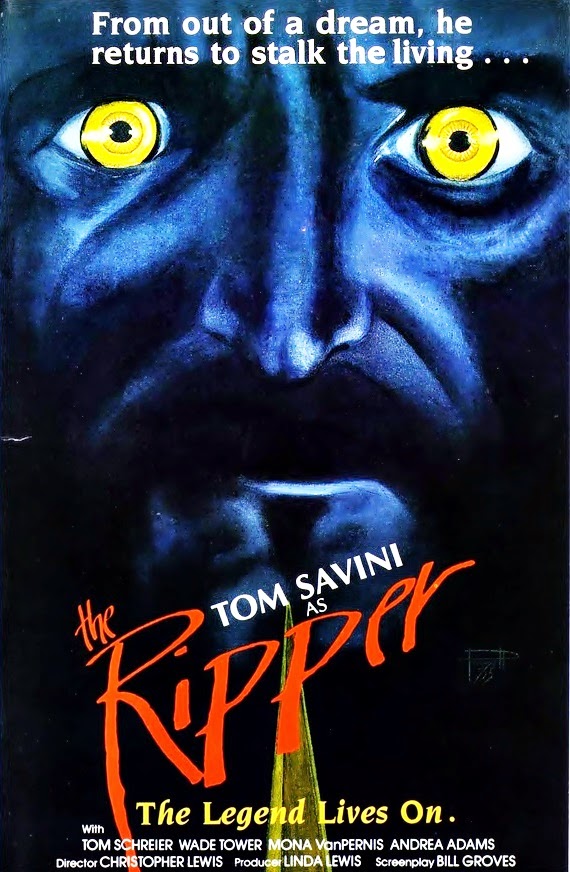
In between those body-part cult romps, Christopher Lewis teamed with famed special effects artist and horror icon Tom Savini on The Ripper (because of Tom, everyone rented it). Starring as Jack the Ripper, Tom (who’s very good) comes to possess a college professor and recreate The White Chapel Murders, courtesy of an antique ring.
As with the “video nasty” status of Spine, here we are, 30 years later, able to type “Blood Cult 1985” into Google and take our pick of Best Buy and Walmart, Amazon or eBay to buy our copies. Blood Cult made its DVD debut via VCI Video (2001) as a standalone disc and as part of its three-disc “The Ripper Blood Pack” featuring The Ripper and Revenge (2006). Mill Creek issued Blood Cult on its 12-disc “Decrepit Crypt of Nightmares: 50 Movie Pack” (2007), and as a double feature “Scream Theatre: Volume 5” with its sequel, Revenge (2012).
You can learn more about the making of Blood Cult and the world of SOV filmmaking with a two-part documentary uploaded to the You Tube page of Christopher Lewis: Part 1 and Part 2. While there’s no VHS or DVD rip online for Blood Cult, you can watch Revenge and The Ripper on You Tube.
About the Author:You can read the music and film reviews of R.D Francis on Medium and B&S Movies, and learn more about his work on Facebook.
DAY 666. THE DEVIL’S WORKSHOP: A mass, ritual or summoning scene celebrating the Dark Prince.
Holy shit, this movie.
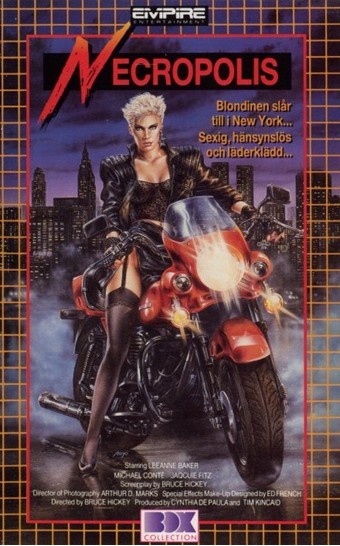
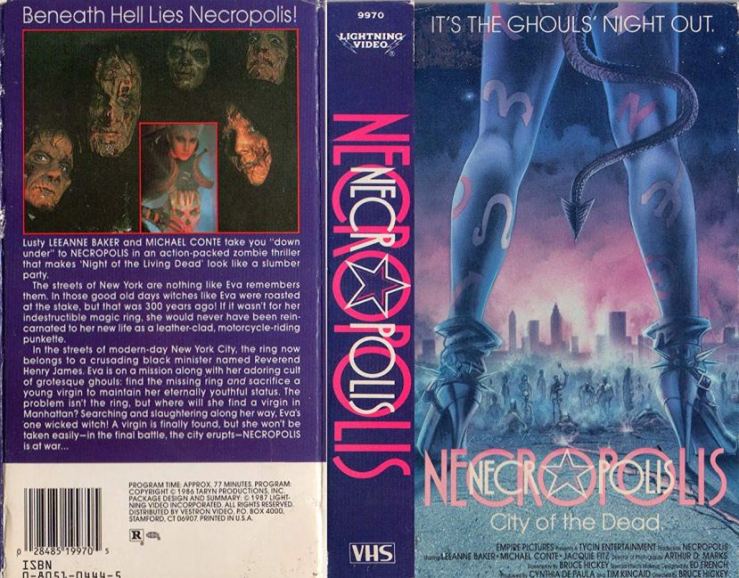
The poster art for Necropolis has called out to me many times and I’ve just never found the time. Now, I’m sad that I didn’t get to this sooner. This movie can’t be from our Earth. It’s too odd to be made by human hands. It’s oddly perfect, the kind of movie that I become an evangelist about and beg people to watch it. Then, they never get it like I do and think I’m insane.
Thanks, Scarecrow Challenge.
Necropolis is a one and done movie written and directed by Bruce Hickie, who I assume is from some parallel Earth, because it’s the only way I can understand the creation of this film. It was originally released by Empire Pictures before Lightning Video put it out on VHS and then it was later re-released by Vestron. My copy came by way of Full Moon, whose Grindhouse line has been re-releasing some awesome stuff.
Sometime back in the 1600’s, a witch named Eva (LeeAnne Baker, who was in Breeders and Mutant Hunt looking like every punk rock dream of my teenage years) abducts Dawn from her wedding ceremony and attempts to sacrifice her to the Lords of the Flies before Henry, a former slave, breaks on in and banishes her to Hell. Eva lets everyone know that she’ll get her revenge.
Now, Eva has returned to the streets of New York, sexing and killing her way through all manner of victims to get her Devil’s Ring back from the reincarnated Henry, who is now a street preacher who helps junkies get off smack. Meanwhile, Dawn is back as a reporter — saying everything as deadpan as possible in a British accent — while Billy is a New York cop. Everyone in this movie is as stereotypical as possible except Eva, who is really the heroine of the film to me. I’m all for her wiping every single one of them off the face of the Earth, even if we never really get a reason and even when she does, it just means she gets to walk the streets of New York City and look cool smoking a cigarette.
Let me tell you, you’ve never seen a film where a street priest who has an office in a closet and uses crosses make of sticks to repel evil battles an evil witch — who looks like Tianna Collins or Lois Ayres — that eats the goo of human brains and then uses it to nurse demons from her six breasts.
There are all levels of acting in this movie. Some folks read their lines like legitimate actors while others are clearly reading off of a cue card plastered to the wall. The effect is kind of mesmerizing, to be honest.
Much like Night Killer, this is one of those movies where I was screaming at the screen “I love this movie!” within minutes of it starting. There are also moments in the movie where Eva just starts dancing for no reason and I love each and every time that happens. In fact, I wish she danced throughout the entire film. She spends most of the movie making people kill themselves or have sex with her, which of course ends with them dying.
Also, this movie was made with all the budget and aesthetic quality of a Rinse Dream or Dark Brothers adult film. I mean that as the highest of all compliments. Seriously, this is the movie that I will be forcing people to watch with me for the rest of the year and well beyond.
Full Moon is making a sequel/remake/reimagining of this later this year called Necropolis: Legion. It doesn’t look anywhere near as fun as the original, but there are lactating evil breasts with mouths for nipples in the trailer, so watch at work at your own peril.
As for Necropolis, You can watch this for free on Tubi or order it from Full Moon. Or, you know, just come over the house and watch it with me. Bring some beer.
Remember B&S Movies’ past geographical warnings about staying the hell out of South Africa and keeping your ass in the Philippines, Italy, and Australia for your post-apocalyptic fixes?
Well, add Canada to the list. Be warned, my fellow apoc-rats. The lands of Survival 1990 aren’t across the border from 1990: The Bronx Warriors. If ever a film needed a meeting of the Riders and Tigers, this is the movie.
Also known as Survival Earth in its VHS revival, this canuxploitation dropping that makes the Canux nuc-fest Def Con 4 look like Escape from New York occurs in 1996, ten years after “The Fall,” which refers to the collapse of the world economy and . . . hey, wait a minute . . . 10 years after 1996 is 1986 . . . so why does the title refer to the year of 1990? I know, I know. Don’t overthink the (lack of) plot . . . and math. Which brings us to questioning who made this? Yep, the mathematicians at Emmeritus Productions, the Canadian studio that also made the computer-takes-over-a-hi-tech hi-rise A.I tomfoolery, The Tower, and the inert John Carpenter-porn knock off, Blue Murder.
Duh. You’ve been warned.
Anyway, this shot on video tape for Canadian TV potboiler starts with a stock footage montage of some riots, newspaper articles, nuclear power plants, and politician infighting that fades out under an optical effect informing us the big one dropped. And that’s the end of the special effects for the movie.
The resident “Adam and Eve” survivors living in the wiles of Toronto are John and Miranda, who meander through the woods and talk, talk, talk . . . and read poetry (at least books survived “The Fall”), and goes all philosophical quoting Yeats. And when drippy John isn’t reading poetry, he talks about the good ol’ days of mowing grass, driving his ol’ Honda Civic, and about his dad’s cloning experiments (a major plot twist, don’t forget!).
In addition to a mysterious “creature” shadowing their every move, they meet up with Simon, a soldier of fortune (in run-of-the-mill camo-fatigues off the rack at Bass Pro Shops) who survived the war and becomes their ally. And thank god, because Simon at least has a rifle and a pistol to fight off the mutant-vandals (that aren’t at all “mutant” and look more like raggedy street people) who kill John. Then John’s clone—who’s been spying on them—shows up and rescues Miranda. And they read more poetry and bicker happy ever after. The end.
So if you need to explore the post-nuke wastelands of the Great White North — sans any Snakes or Trashes, or props, or special effects, or sets, or costumes, or action, or plot, or point — then this is your film. This rarity from the video ‘80s — that’s never been issued to DVD or Blu-ray (complete with trailers for the low-budget videotape pot boilers Deadly Pursuit and The Edge) — is on You Tube.
Star Nancy Cser, who played Miranda, received some video-store fame courtesy of the 1986 Canadian soft core skin flick, Perfect Timing, which had plenty of naked women for us horn dogs—and nary a plot. Not that we cared about the plot. For when you have boobies, you need no plot. Wow. We already sat through The Tower. So, sorry, Nancy: no more reviews for you. Some movies are best forgotten.
About the Author: You can read the music and film reviews of R.D Francis on Medium and learn more about his work on Facebook.
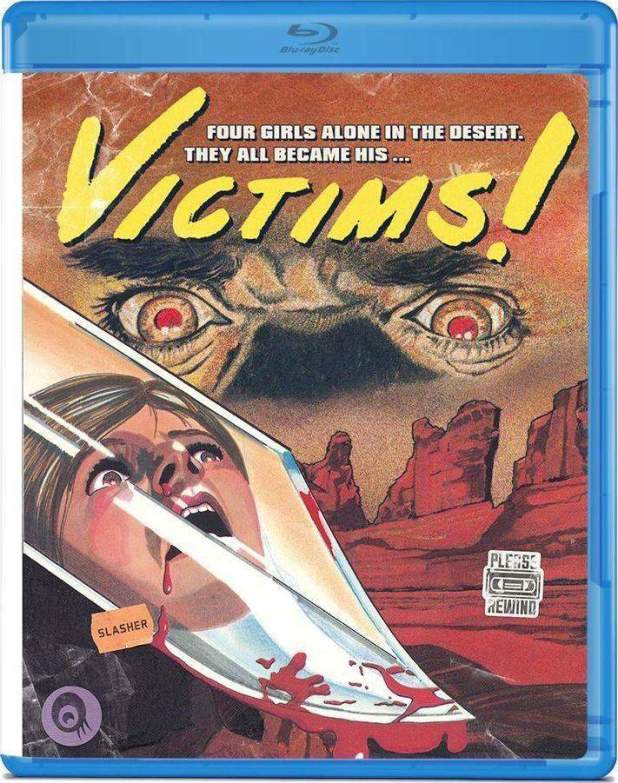
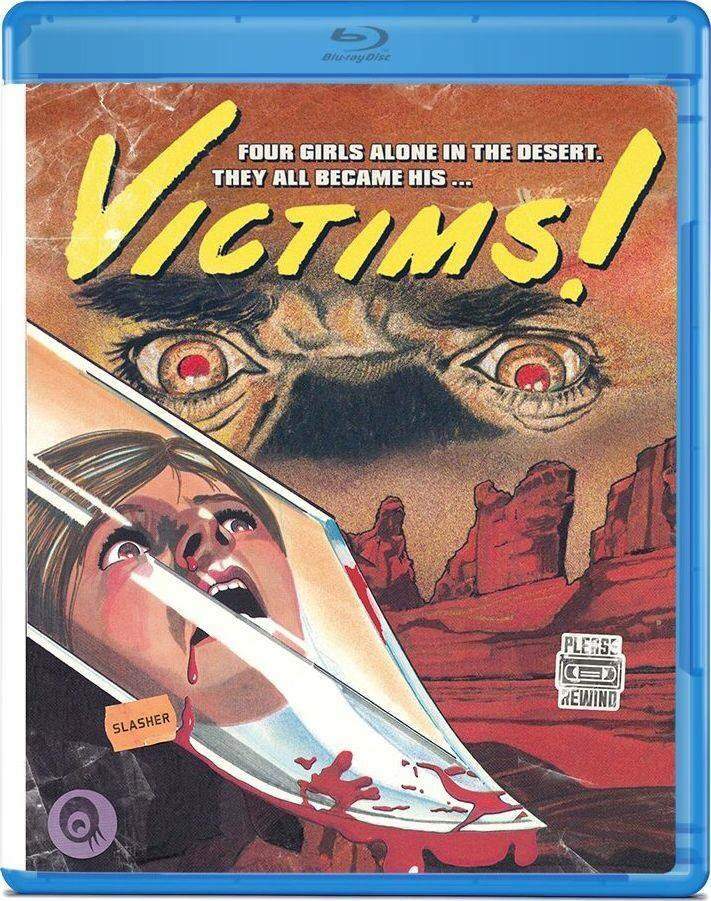
If you remember the film Night Ripper! that we covered a while back, then you understand what you are getting into with Victims! It’s another film from Jeff Hathcock, who also was behind Streets of Death and the Troma film, Fertilize the Blaspheming Bombshell.
Four young girls go on a camping trip in the woods and are stalked by a pair of crazed serial killers. That’s pretty much all you need to know. Perhaps a more interesting story would have been what really happened when Hancock ran afoul of an actual devil cult while making this.
One of the killers, Robert Axelrod, would go on to play Lord Zedd on TV’s Mighty Morphin Power Rangers. So there’s that.
This is one of those strange breeds of film that want to have a feminist message, yet spends most of its running time showing women either being raped, killed or menaced by raping and killing. So it’s kind of hard to get on its message when it doesn’t even know what its message is.
If I can chime in, Sam.
Obviously, this SOV obscurity is not to be confused with the Kate Nelligan and Howard Hesseman (Dr. Johnny Fever? A rapist?) 1982 TV drama-movie, Victims. Which I did at first glance of this review . . . “It got Blue Ray release?” I said. No, it didn’t. That Victims “TV Movie” is on You Tube for free, by the way, for you Dr. Johnny completists. (Yep, just checked and it’s still there.) And I am shocked this SOV’er is seeing a Blu-ray release. Unlike most SOV filmmakers, Jeff Hathcock, as Sam points out, released four more films in quick succession between 1985 to 1992, before the ugly head of digital filmmaking rose up and killed off the 16mm and 3/4″ U-Matic tape formats — which is how a true SOV or backyard’er should be shot: microphone on the camera. Get that i-Phone-shot and Amazon uploaded tomfoolery out of here. I need the low-rez buzz n’ hum and fuzzy frames of a JVC VHS-C, Kodak 8mm video camcorder, and Sony Compact 8.
As for the SOV Victims!: Sam’s four-girls-campin’ sums it up: it’s a cross between Charles Kaufman’s Mother’s Day and Wes Craven’s The Hills Have Eyes, IMO, you know, R.D., the film critic you love to hate. Victims! was one of the many flicks that I rented under the ‘ol 5 Movies-5 Days-5 Bucks gamblin’ days of video stores where I planted in front of the TV every Saturday — and rode that FF button most times. Sigh. I miss those days. Reviews like this make me miss video stores. And as Sam pointed out in his review of Night Ripper!: you could shoot horror movies directly on video and they’d still get into video stores. And we loved those ol’ brick-n-mortars for it.
The back of the VHS box for this movie promises that “A new horror classic is born!” It also states that “Tom Savini, the master of film gore — whose credits include Friday the 13th, Day of the Dead and a cameo role in Creepshow — brings new dimension to the character in this startling version of the Ripper legend.” Keep in mind that Savini used to get down on his knees at conventions and beg forgiveness for this one. He was paid $15,000 for a one day of acting. One would argue that he should have done something — anything — else with his time.
Christopher Lewis, the director of this affair, is the son of actress Loretta Young. He attended USC film school with George Lucas but by the 1980s, he was living in Tulsa, Oklahoma and hosting their afternoon newsmagazine show PM Magazine on KOTV. His wife, Linda, was working in the promotions department and regularly produced and starred in a show called Intermissions with Linda Lewis, which used her face to face interviews with movie stars on their press junkets to promote new films.
The Lewises wanted to stop promoting other peoples’ movies and make their own, which started with their first shot on video effort Blood Cult. It was one of the first shot directly to video movies released into video stores and earned the couple $475,000 in profit. That leads us to their second film, The Ripper.
A student and his teacher, Mr. Harwell, spend most of the movie calling one another about movies. Seriously, I started wondering if this film was about their affair and how no one in 1986 would be able to understand it. But no, it’s really about Harwell teaching a film class about famous killers and coincidentally finding the ring of Jack the Ripper. You remember the ring of Jack the Ripper, his famous ring, right? No? You don’t? Me either.
There’s also plenty of Jazzercise looking classes taught by Harwell’s wife and Whitechapel recreated on the streets of Tulsa. One of the locations, Colonial Antiques in downtown Tulsa, was where the ring buying sequences was shot. The Lewises Mercedes was stolen while these scenes were filmed.
The most amazing thing about this movie is that the writer took to IMDB to dismiss some of the critiques of the film and set straight how much the Lewises changed up his words. Magical.
There are some gruesome effects as the Ripper kills off young women, but otherwise, there’s not much here. Even Savini can’t save this with his mustache twirls, as if he were a yinzer Snidely Whiplash.
I’ve seen plenty of bad movies, but never one quite so bad as The Ripper. Let that sink in and decide if you want to see it for yourself.
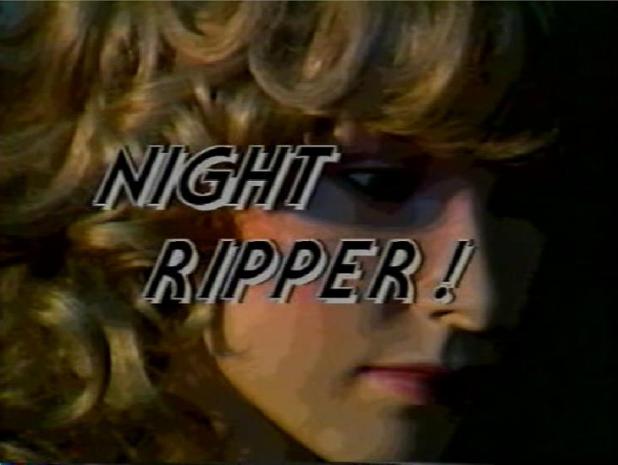
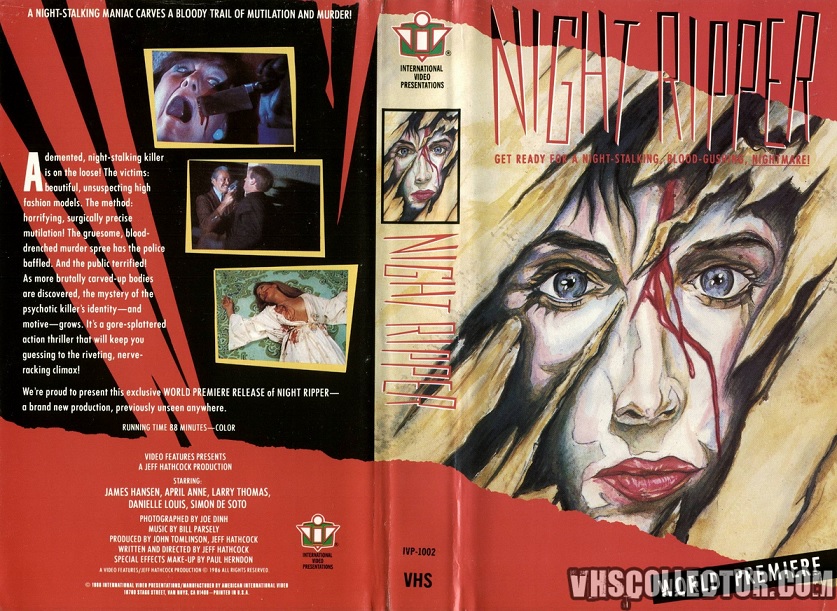
Back in the 1980’s, you could shoot horror movies directly on video and they’d still get into video stores. Jeff Hathcock did that with two movies, this one and Streets of Death. He also created Victims! and the Troma film, Fertilize the Blaspheming Bombshell. But today, we’re here to discuss his 1986 slasher film, Night Ripper.
Sure, this movie is packed with sheer Velveeta, but I kind of loved it. It turns out that a guy who ignores his fiancee — who is having sex with her boss anyway — and meets hot models as he does glamour shots for them ends up getting blamed for some murders that are just like Jack the Ripper. He becomes a suspect and also falls in love with one of the girls who gets targeted by the real Night Ripper. Or is that Night Ripper!?
Even better, Larry Thomas, the Soup Nazi, is one of the suspects. And if you are keeping track: Thomas was in Don Edmond’s Terror on Tour — which looks like and stinks like an SOV, but was shot on film. There’s also tons of bad acting, worse line readings, soap opera music cues and incredible dialogue like “This isn’t love! This is two sweaty bodies fucking under flood lamps. And I’m tired of flood lamps!”
I think more movies should have this much surface noise, with actors being recorded probably from the microphone that’s on the camera. It’s also got an awesome climax inside a mannequin factory, making me think that I should have saved this for my upcoming theme week of mannequin movies.
This is really hard to find, so I’m just going to share the whole movie (via You Tube) in the hopes that you watch it and love it as much as I do.
Do you need more SOV Jack the Ripper hijinks? Check out Christopher “Blood Cult” Lewis’s The Ripper starring Tom Savini







 B&S About Movies
You must be logged in to post a comment.