ABOUT THE AUTHOR: Gregg Harrington is a podcaster, freelance journalist, musician and amateur screenwriter, known primarily for co-hosting the ’80s horror podcast Neon Brainiacs along with local filmmaker and actor Ben Dietels. When he’s not talking about Jason Voorhees or Freddy Krueger, he can be heard playing drums in the heavy grunge revival band, Pummeled and masterminding the straight edge power violence band, Rabid Pigs.
The importance of the radio has waned in the 21st century. The evolution of on-demand content via the Internet and other venues where we take in what we want when we want did a pretty swift job of dismantling the tastemaker privileges of the radio business. You can even hear it when you listen to the radio: Pittsburgh’s local “alternative” station has become an amalgamation of a handful of grunge bands, modern pop and one-hit wonders from the early 2000’s. You can hear Nirvana, Imagine Dragons, Pantera, New Radicals and Three Doors Down back to back. It’s weird. It’s also weird to think of a time where stations dictated what bands were huge and had more of a hand in curating local concerts and festivals.
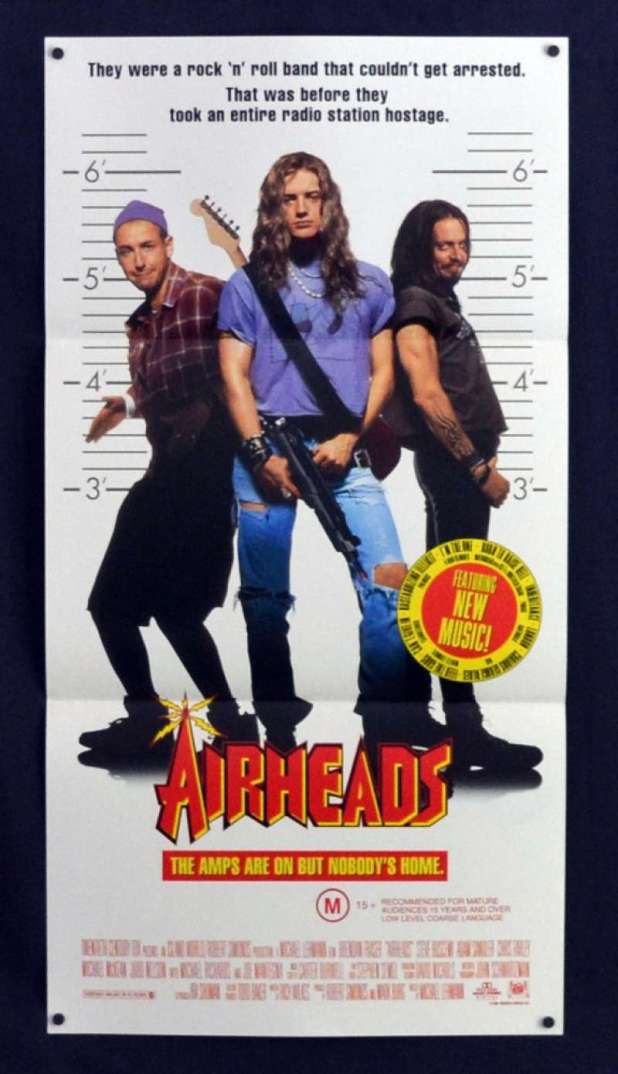
One bastion of the importance of radio is 1994’s rock comedy Airheads, directed by Michael Lehmann (Heathers, Meet the Applegates). While Lehmann is known more for television directing these days, he certainly hit a home run with me in my adolescence with Airheads. Wearing out my VHS of it and later watching it over and over on Comedy Central glued each line of dialogue to my brain. Boasting an impressive cast and an even more impressive soundtrack, Airheads finds itself acting as a time capsule, capturing the hostile takeover of grunge, usurping the tight grip hair metal had on the American music scene, and recording a time where radio play made or broke local bands. Our absentminded heroes, played by Brendan Fraser, Steve Buscemi and Adam Sandler do a bang-up job embodying the spirit of musicians trying to “make it” in the 90s.
Down on their luck rock band the Lone Rangers are trying as hard as they can to get noticed around the Los Angeles music scene to no avail, so they resort to breaking into the local radio station, KPPX Rebel Radio, to force the station’s lead DJ, Ian The Shark (Joe Mantegna), to play their demo. When things go south due to the meddling of station manager Milo (Michael McKean), the gang pulls out an arsenal of toy guns that look extremely real and take the entire radio station hostage. From there, hilarity ensues. The chaos of the whole situation is fueled by the police presence outside and the shenanigans inside the station and over the airwaves, culminating in a feeding frenzy of a music video shoot in the parking lot and, later, in jail.
The musical touchstones of the film are many. For starters, Airheads revolves around the emerging single by the Lone Rangers (“there’s three of you, you’re not exactly lone”), “Degenerated”, which was originally performed by the New York punk band Reagan Youth. Kind of strange to think about that since the Lone Rangers are supposed to lean more towards Guns N Roses than east coast punk music. The movie version features Brendan Fraser on vocals with White Zombie’s guitarist Jay Yuenger and bassist Sean Yseult on the track as well. Speaking of White Zombie, for the club scene in the middle of the film, they can be seen performing “Eat The Gods” at the Whisky. Funny enough, the role of the live band was initially offered to Cannibal Corpse, but after the producers found out they had already appeared as a club band in Ace Ventura: Pet Detective, they opted to go with White Zombie instead. It’s been reported that Metallica and Testament also turned down an offer to portray the band in that scene as well. The movie’s background is also doused in music ephemera, mostly of the punk and extreme metal variety. Stickers and posters can be seen with the logos of Cro-Mags, Obituary, and more. I’ve always felt this clashed with the Lone Rangers’ leanings more towards Sunset Strip glam metal, but I appreciate it nonetheless.
Airheads’ soundtrack is also pretty great, which is not surprising given the amount of 90s movie soundtracks that have lived on in the public consciousness (Judgment Night, Singles, Spawn, etc). Kicking off the movie is a re-recording of the Motorhead track “Born To Raise Hell”, which features guest spots from Ice-T (Body Count) and Whitfield Crane (Ugly Kid Joe, Life Of Agony). The original appeared on the band’s 1993 album Bastards. It’s a Motorhead song so you know it kicks ass. It’s also a great song to put over the opening credits, which is composed of the names of cast and crew along with time-lapse animations of random scenarios like making a sandwich and changing guitar strings. There are a few interesting cover songs on the soundtrack as well, including 4 Non Blondes covering “I’m The One” by Van Halen and, even more surprising, Anthrax covering the Smiths deep cut “London”. Coincidentally, Anthrax is also featured on the August 1993 cover of R.I.P. Magazine being read by Carter (David Arquette) during the film. Primus, Prong, the Ramones and the Replacements also make appearances as well.
As far as the movie itself, while it may not have gotten the best reviews or box office return, Airheads has lived on as a great music comedy, which I find to be on par with a film like This Is Spinal Tap. The villain-type characters portrayed by Michael McKean and Judd Nelson are spot-on, and the litany of secondary characters led by Joe Mantegna, Ernie Hudson and Chris Farley knock their performances out of the park. Plus, how many 90s comedies were made featuring three former Saturday Night Live cast members, two Ghostbusters, and a handful of MTV’s mover and shakers? Airheads is a truly fun watch and a visit back to a simpler time where people were radio stations were so influential, they were worth breaking into and taking hostages to get airplay.
George Hickenlooper was a director who excelled at telling peoples’ stories. Edie Sedwick in Factory Girl. Jack Abramoff in Casino Jack. And documentaries on Dennis Hopper, Apocalypse Now, Peter Bogdanovich, Monte Hellman and this take of Rodney Bingenheimer, Rodney on the ROQ, the Mayor of the Sunset Strip, the man who launched so many bands into American consciouness.
When Rodney was 16, his mother dropped him off at Connie Stevens’ house, told him to get her autograph and abandoned him. He ended up as a stand-in for Davy Jones, as the live-in publicist for Sonny & Cher, opened a club, brought glam to the U.S. and took to the air on Los Angeles’ KROQ.
The list of bands that Rodney broke on his show includes The Runaways, Blondie, the Ramones, Social Distortion, Van Halen, Duran Duran, Oasis,The Donnas, No Doubt, The Offspring, The Go-Go’s, The B-52’s, X, The Smiths, Suicidal Tendencies, Dramarama and Nena.
In fact, I always wondered how a song like “99 Luft Balloons” broke in our country. It was because Nina Hagen and Christiane Felscherinow liked the song and asked Rodney to play it. The rest was 80’s video history. And in the same way he brought glam to the U.S., he’d bring Britpop here as well.
This movie took six years to produce and presents Rodney as a Zelig, a person that was there for the biggest moments in rock ‘n roll. He got Bowie his record contract, but he lives in a small apartment and until 2017, was happy playing music on Sundays from midnight to 3 AM on KROQ. But no more.
Rodney wasn’t the only Mayor of the Sunset Strip. There was also Bobby Jameson, who released Songs of Protest and Anti-Protest under the name Chris Lucey. He appears in Mondo Hollywood and his role in the Sunset Strip riots earned him the title.
Then, there was the shadowy cult figure Kim Fowley, who held sway over the Runaways (duBeat-e-o), recorded the song “Alley Oop,” wrote “They’re Coming to Take Me Away Ha-Haaa!,” co-wrote “King of the NIght Time World” for KISS, produced the demos for Gilby Clarke’s band Cherry, started another version of the Runaways and even had the time to make a mess of underground films.
Rodney comes from a time when celebrity actually mattered, when rock and roll felt like something and when one play of a song could make you rich and get you laid. We’ll never know that era again.
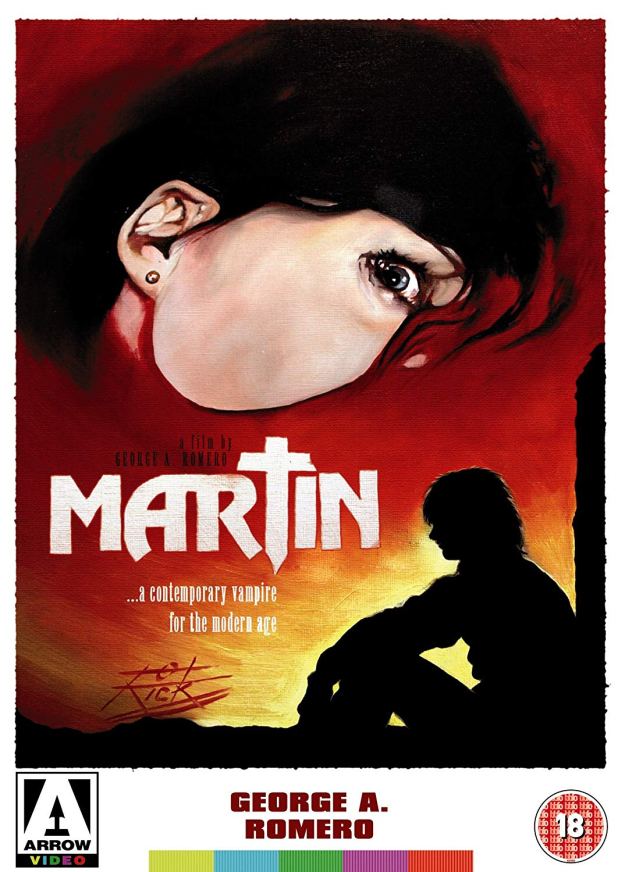
In the five years between The Crazies and Martin, much had changed, both in the life of George Romero and his adopted hometown of Pittsburgh.
After the post-World War II economic boom, an outdated manufacturing base — that had already been overextended for the past two decades — was further taxed by hostile relationships between management and labor. And Pittsburgh had even worse issues than the rest of the country, as the raw coke and iron ore materials to create steel were depleted, raising costs. The giant Pittsburgh mills also faced competition from non-union mills with lower labor costs.
As a result, layoffs began happening throughout the region. For example, Youngstown, OH — about an hour and a little more from the Steel City — never recovered from the Black Monday of September 19, 1977 and the closing of Youngstown Sheet and Tube.
According to a 2012 story in the Pittsburgh Post-Gazette, by January 1983, the regional economy officially bottomed out. Unemployment in Allegheny County (where most of the Pittsburgh metro calls home) hit between 14 and 18% with 212,000 jobless individuals. It’s never been that high before or since. And in areas like Beaver County (close to where your author grew up and also where my grandfather worked in the furnaces for forty years), home to industry giants Jones & Laughlin Steel Corp. and Babcock & Wilcox Co., the unemployment hit a staggering 27%. That’s higher than the Great Depression. And for many of the 300,000 manufacturing workers impacted by these changes — before this, you went to high school, you worked in the mill, you had kids, you died — Pittsburgh was dying.
George Romero found himself in similar straits. He was nearly a million dollars in debt thanks to the failure of every film after Night of the Living Dead. He’d taken to working on sports documentaries like his Pittsburgh-centric series The Winners and even directed The Juice is Loose, the story of football hero OJ Simpson — albeit years before his reversal in fortune — and Magic at the Roxy, a TV magic special. He confided in producer Richard P. Rubinstein that he was nearly out of cash. While the producer counseled Romero and explained that bankruptcy was an option, Romero didn’t want to screw over the people who helped him make his films. This action gave Rubinstein plenty of respect for the director and led to their partnership. While this, their first film together, didn’t pay back those investors, Dawn of the Dead would.
Deciding on Braddock — one of the hardest hit mill towns — and utilizing family and friends, Romero started to film what he would later call his favorite film.
In the film’s first script, Martin was an older man who is definitely a vampire, struggling to live (unlive?) in the modern world. But after seeing John Amplas in a Pittsburgh Playhouse production of Philemon, Romero rewrote the film to make Martin younger and more innocent.
Martin’s family has all died in Indianapolis, so he’s on his way to Pittsburgh — but not before shooting a woman up full of drugs and drinking her blood. He’s met at the train station by his uncle, Tateh Cuda, and taken to his new home. Even today, Braddock is one of the most run-down sections of Pittsburgh — the decay evident in the movie got a lot worse before John Fetterman was elected and numerous civic campaigns have brought new business in. That said — it’s still a great setting for a horror film.
Cuda and his niece Christine share a home and have allowed Martin to stay. The old man gives Martin several rules, including one that if ever kills anyone in Braddock, he’ll stake him through the heart. He keeps crucifixes and garlic all over the house, continually telling Martin that first, he’ll save his soul, and then, kill him. Martin yells at Cuda, showing him that he can touch the crucifixes and eat the garlic and bitterly exclaims, “There’s no real magic…ever.”
This is in direct contrast to Martin’s fantasies, shot in black and white (there’s supposedly a 2 hour and 45 minute cut of this film that’s only in black and white) like a romantic vampire movie, where women willingly give up their throats to him. The truth — he barely defeats the women in battle, needs drugs to sedate them and with no fangs, he must use a razor blade to kill them.
Despite Cuda’s continual threat of death, he hires Martin to work in his butcher shop as a delivery man. This allows him to meet several women, including Mrs. Santini, who tries to seduce him. Unlike his dreams of control over these women, he can’t even control his own feelings and runs away.
Pittsburgh has always been a talk radio town — local powerhouse KDKA boasts a 50,000-watt antenna that can be heard throughout most of the continental US in the evening — and Martin takes advantage of this, calling a local DJ (Michael Gornick, director of Creepshow 2) to try and figure out life. He becomes known as “The Count” and is one more lonely voice seeking comfort until the sun comes up — again, in marked contrast to the way vampires traditionally fear daytime. The DJ segments hit close to home — I was a long-time listener (1989-2005) of Bob Logue’s Undercover Club. Pittsburgh has a long history — as stated above — of radio shows like Party Line. We’re slow to give up on technology, so AM radio still remains strong here.
Martin tries to keep his thirst under control, but finally sneaks out to the big city — Pittsburgh is very much a bridge and tunnel town where folks stay within one of the ninety small neighborhoods that make up the overall town — and attacks a woman he’d seen at Cuda’s market. But she isn’t alone — she already has an extramarital lover over — and Martin barely overcomes them both before he drugs and rapes the woman. Martin gives in to another hunger after this — a yearning for sex based on love — that he finds with Mrs. Santini.
Meanwhile, Christine, Martin’s sole advocate in the home, finally gives up on living with the uultra-religiousCuda and leaves, despite her unfulfilling relationship with her boyfriend (played by an incredibly young Tom Savini). She is slapped across the face by Cuda and shocks him by not registering the blow, instead telling that his time is over and that she doesn’t care what he or the church says.
Martin loses control once he realizes that Christine won’t come back, so he goes into the city and attacks two homeless men, but is almost killed in a battle between the police and drug dealers. He returns to Mrs. Santini’s house to try and escape with her, but she has already killed herself.
In a quick, shocking scene, Cuda dispatches Martin — who he blames for Mrs. Santini’s death — with a stake. During the credits, Cuda buries him as radio callers ask what happened to The Count. The answer? He’s freshly buried, with a crucifix over his grave.
Martin is not only Romero’s most personal films, but it’s also one of his most technically polished. The scenes where the talk radio dialogue plays against Martin’s actions allow for exposition without sacrificing pace. And the black and white versus color sequences — particularly the exorcism scene — play out as a grisly counter to the expected Wizard of Oz dichotomy.
Most strikingly, Martin presents a sympathetic hero versus a snarling monster. The true vampires in the film are the city of Pittsburgh itself, losing the vital blood of young men that once were pumped through its mills and mines and now would go elsewhere, abandoning the city for jobs and lives elsewhere. It would not be until the early 2000s that the city would rise, more phoenix than vampire, and become the tech and gourmet destination that it is today. To go from the Braddock of 1978 to a five-time most livable city in the country has been quite the journey.
The second — and perhaps main — monster of the tale is Tateh Cuda. Whereas we have been traditionally taught to see Dracula as the villain and Van Helsing as the hero, this is a man who will not break from the ways of old, the days when the word of men and church stood above all. He is not to be defied — and when he is and his manhood is decimated by Christine’s departure and final words — all he can do is reassert said manhood in the most phallic way possible: a wooden stake through the heart of the other child he has lost. More than Martin — who questions if he truly is a vampire or not and if he can escape the family cruse — Cuda is trapped in his ways and will never leave them.
When faced with the change of guard at his church, Cuda cannot understand why so many are abandoning not only their faith but the city itself. When faced with the retirement of a priest he has known his whole life, he yells at Father Howard (Romero, in a small role) “Retired? Huh! Father Carelli is younger than I am. He asked to leave. He left like the rest of them. He thinks this town is finished!” Then, he learns that Carelli left only because cancer has taken him. Father Howard stands in contrast to the pre-Vatican 2 Catholic faith, a new style priest who laughs at The Exorcist without realizing that to someone like Cuda, those rites are very real.
Note: Lincoln Maazel, father of well-known orchestra conductor Lorin Maazel, played Tateh Cuda and lived to be 106 years old — he was already 75 when Martin was filmed.
Martin is not often said in the same breath as Romero’s zombie films and that’s a shame. It remains my favorite of his works, as there are so many ways to analyze the film. It’s not light watching or escapism, but the questions that it poses will stay with you long past the end of the film.
PS – Martin is not an easy film to find. I was satisfied knowing that I could get it at the Carnegie Library until I found my copy at VHSPS.com (sadly, it’s no longer available on their online store, so I’m glad I got my copy).
If you’re a voracious reader of mystery novels, especially if you grew up in the ‘80s, chances are you may have read at least one of the prolific Stuart M. Kaminsky’s 60-plus novels concerning the adventures of the ‘40s film noir-styled gumshoe Toby Peters, Moscow Police Inspector Rostnikov, and grizzled Chicago police officer Abe Lieberman.
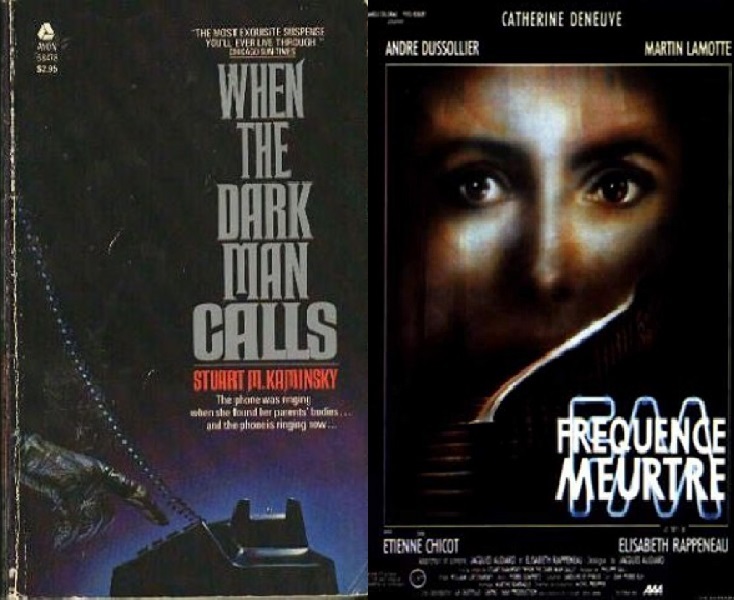
However, when it came time to adapt Kaminsky’s best sellers to the big screen, it was his two standalone non-series novels, 1983’s When the Dark Man Calls and 1985’s Exercise in Terror, which made the transition. While Exercise in Terror became the 1993 USA Network TV movie Hidden Fears starring Meg Foster (John Carpenter’s They Live, Stepfather 2, Deep Family Secrets) and Frederic Forrest (Apocalypse Now, The Rose,One from the Heart), When the Dark Man Calls was first adapted into the 1988 French thriller Fréquence Meurtre (aka Frequency Death, Frequent Death) starring Catherine Deneuve.
Kaminsky’s New York Times–and European–best seller and the 1988 French language film adaptation.
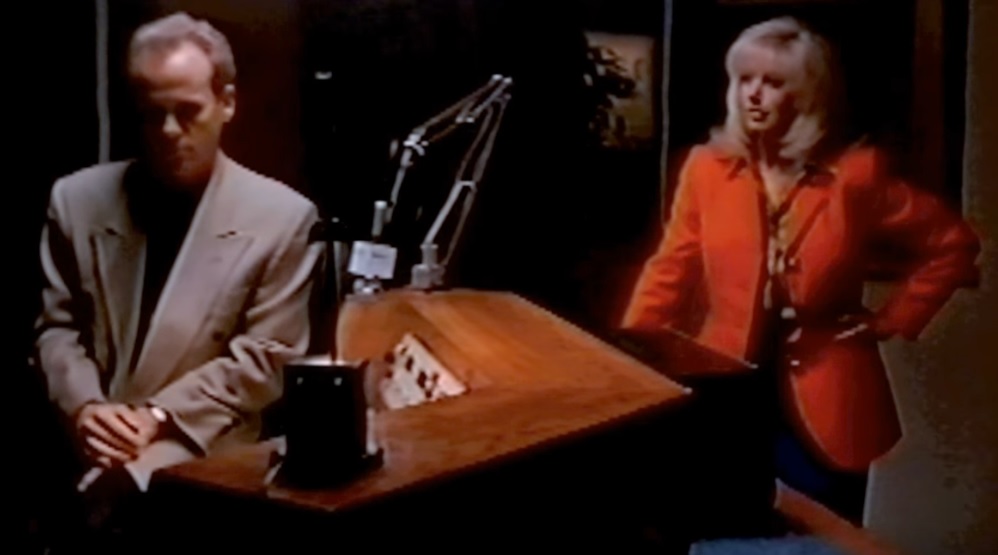
In this inferior, homogenized English language version shot on-the-cheap in Toronto as a USA Network original movie (in the days before the channel was usurped by the NBC Network to run all-day Law and Order marathons), TV actress Joan Van Ark—who’s no Catherine Deneuve in the thespian department—stars as Julianne Kaiser, the stalked Chicago talk radio psychologist.
Yes, you guess it: As with any stalked radio psychologist, Julianne has her own closet of repressed memories and tormented skeletons: Twenty-five years ago, when she was a ten, she discovered her parents murdered in their bed. It was her testimony that put away the killer, Mr. Parmenter (Tango & Cash; Clint Eastwood stock player Geoffrey Lewis), a border who lived in the back room of their home—and he always claimed his innocence. Now that Parmenter has been released, he begins making threatening calls to her show. Then, when he turns up dead and the calls don’t stop, the whodunit red herrings start flipping and flopping.
Who killed Julianne’s parents? Who killed Parmenter? Who’s stalking her and harassing her 14-year-old daughter?
Is it her vengeful, soon-to-be ex-husband Max (familiar TV actor Barry Flatman; The Dead Zone with Christopher Walken; still acting on ION Network’s Private Eyes)? Is it her doting, construction company-owning brother Lloyd (Chris Sarandon from Fright Night) with his own closet of secrets? And there’s Michael (genial TV actor James Read; ‘80s TV series Remington Steele; still acting on the U.S soaps Days of Our Lives and General Hospital), her ex-boyfriend cop bumbling about, still carrying a torch for Julianne.
While the quality in casting, acting, and direction in a ‘90s-era USA Network original movie is certainly a step above a present-day Lifetime original flick and raises the violence bar (just a smidgen), When the Dark Man Calls is still a thriller with no thrills or suspense—ironically, just like a Lifetime movie. And that’s a shame when considering the great critical reviews for Kaminsky’s 1983 novel. (Because of the radio angle, I read it back in the ‘80s and it is a page turner. Kaminsky’s works should not only be better known, but subject to more film adaptations.)
Yes, Joan Van Ark is certainly gorgeous and she looks fantastic on screen (and still acting on a wide array of films and series). But so is Catherine Deneuve. While Ark is affable enough in an ensemble cast of a hit nighttime TV drama, in her case, Dallas and Knots Landing, carrying an entire picture as the put upon damsel-in-distress isn’t her forte; under her tutelage the on-the-edge-of-your-seat plot twists of Kaminsky’s novel fall flatter than a dead herring.
Sure, we get the always awesome Geoffrey Lewis as the revengeful convict and Chris Sarandon’s harboring-dark-secrets brother as part of the bargain (if not for them both, I wouldn’t have stuck with this one to the end) and they deliver the goods, but they’re not in the film long enough to make a lasting impact.
On the plus side: The set design is solid and the radio station looks pretty legit for a low-budget set build. But who built it, Irwin Allen? Yep, it’s more budget conscious, ambiguous dark voids to nowhere. (In all my years in the business I never, ever worked in a studio so dark.) And those dumbbell faux call letters of WRAP (talk, “rap,” really?). And the total lack of a 7-second audio delay in the studio. And the fact that no radio station would ever risk FCC fines or license loss by putting live calls on the air from a serial stalker—even with an audio delay—for the sake of “ratings” or to “catch a killer.” Another problem: Joan’s age. If we abide by the flashbacks and flash forwards, Julianne Kaiser is 35—a very hard 35: Van Ark was already in her 50s—again, she looks great—when she shot this flick. All of it stretches the limits of screenwriting credulity.
Unfortunately, the Catherine Deneuve version isn’t available online for a comparison—and it was never released on stateside video. However, When the Dark Man Calls was released by Paramount as a VHS in the states and overseas. There are no official online streams available, so you’ll have to settle for this VHS rip posted on You Tube.
If you’d like to watch Kaminsky’s Hidden Fears, it is also available on You Tube.
About the Author: You can read the music and film reviews of R.D Francis on Medium and learn more about his work on Facebook.
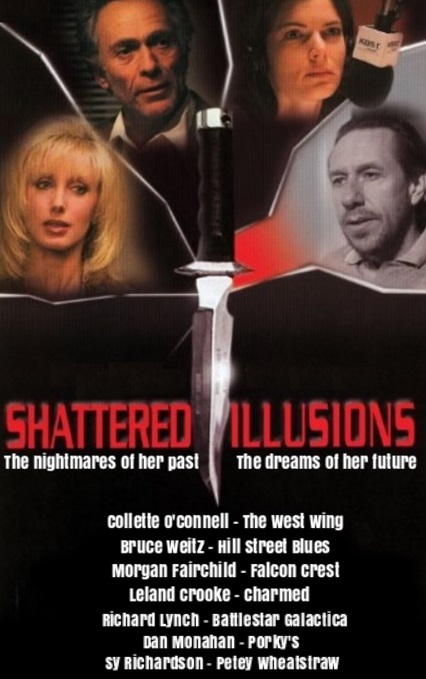
Lynn Richards (Collette O’Connell, guest roles on TV’s Law and Order: Criminal Intent and CSI: Crime Scene Investigations) is an (expositional) small town Christian radio psychologist (who babbles about “conquering life’s illusions,” thus the title) who lands the gig of a lifetime: a drive time airshift on KBST “K-Best 98 FM” Los Angeles.
Of course, all radio stations in the “radio psycho” universe suffer from low ratings and ad revenues. And we know this, thanks to station manager Richard Lynch—yes, Ankar Moor from friggin’ Deathsport—telling us “K-Best” is getting killed in the ratings by its main competitor. “We just lost five more shares to KTLL!” Ankar Moor snipes at Pee Wee—yes, it’s Dan Monahan from the Porky’s franchise, as the station’s program director.
Oh, yeah. This movie had me at “Ankar Moor.” Richard Lynch as a working stiff running a radio station? He’s not kicking someone’s ass or shedding any blood? I’m all in.
“But he’s at least the serial killing stalker, right?”
Nope.
“Is he at least a ‘red herring’ and we think he’s the serial killer?”
Nope.
“Oh, then Pee Wee, the ‘80s version of McLovin from Superbad, is the serial killer?”
Nope.
“Is he a ‘red herring’?”
Nope.
Of course, as with any female radio psychologist of the Lifetime cable channel variety, Lynn’s harboring her own personal demons and could use a shrink of her own. But wait, she’s already been through psychiatric treatment as result of her attempted teenaged suicide—a suicide that resulted from the depression of her alcoholic father Henry (Bruce Weitz of TV’s Hill Street Blues, Judging Amy, ER) causing a car wreck (tightly shot “flashbacks” of grimacing faces amid few shards of glass) that killed a family, killed her mother, mentally damaged her little sister (now a teen that she takes care of), and sent her father to jail for 12 years.
Hey, maybe Dr. Angie (Morgan Fairchild!), the obligatory “bitchy” psychologist (I guess the producers settled when Joan Collins didn’t return their calls) can help Lynn? Nah, Dr. A’s got a bone to pick with Lynn: Pee Wee promised the drive time shift to her.
“Oh, so Morgan Fairchild goes psycho!”
Nope.
“Is she a ‘red herring’?”
Nope.
“Dude, this movie sounds like it sucks.
Yeah, this psycho pool has a bad case of red algae that killed off all of the herrings and not even a dose of Richard Lynch, a pinch of Pee Wee, and the familiar face of ‘80s TV actor Sy Richardson from Rudy Ray Moore’s Petey Wheatstraw (and Bad Dreams, Repo Man, Sid and Nancy, the list goes on and on) as the detective can change the pH balance and stop the aquatic carnage.
It’s not that this first time—and only—effort by the female writing and directing team of Toni Callas and Becky Best is incompetent. Sure, we’ve seen better, and there are films are that far worse—way worse (the somewhat similar “radio psycho” romp Open House comes to mind). All of the “parts” are there for Shattered Illusions to be an edge of your seat neo-noir of the Basic Instinct variety (a radio talk host instead of novelist). But there’s no mystery, suspense, or thrills—as is the case with the low-budget stalked-female-radio host romps of the Lifetime variety. And outside of Lynch and Sy Richardson, the acting is dreadful. If you ever wondered why you never saw Pee Wee in anything after Porky’s, this movie answers that question.
“So why do they keep having their ‘meetings’ in the restroom? Why is The Lynch looking up under stalls at Pee Wee? Is it a Porky’s homage?”
Uh, I guess so.
“Okay, so who’s the serial stalker? Is it her father who just got released from prison?”
Nope.
“Is it the no-name actor that plays the school teacher who rehabilitated Lynn’s sister, the one with whom Lynn’s now having a torrid love affair?”
Nope.
When Lynn was locked up in the nuthouse, Adam (familiar TV actor Leland Crooke from Charmed and Angel), one of the inmates from her group therapy sessions, fell in love with her—and he was heartbroken when she was released. Then, he heard the voice of his lost love return on the radio. So he goes “Michael Myers” and breaks out. And he kills his doctor and house squats—and builds a doll house, complete with little paper doll replicas of him and Lynn. And he collects portable radios and has them all tuned to KBST. And he kills a dog that Lynn complains about on the air. And he kidnaps her brutish neighbor (Michael Horse of TNT’s Claws and the 2017 Twin Peaks series reboot) that she complained about on the air. If Lynn complains about it, like the car repair guy that screwed her, Adam “fixes it” and calls into the show with an update.
Now, Ankar Moor was never on board with hiring a Christian radio host in the first place, and the station’s board of directors is on his ass: “It’s been two weeks and her numbers aren’t up!” so Ankar wants to fire her. But Pee Wee is the type of program director who thinks that animals and people dying at the hands of a serial killer obsessed with one of their hosts is “publicity that money can’t buy.”
At least they shot inside a real (and uncredited) Los Angeles radio station. And Ankar Moor, Pee Wee, and Morgan all “sound” like real radio people.
My suggestion: Don’t buy any ad time on KBST and change the frequency so the ratings tank and Ankoor Moor can flip the format and get his ad rates up. Better yet: he’s gets fired and washes out of the radio industry. Then he’ll fall headfirst into a wicked gambling addiction, develop a severe case of germaphobia, and create a bogus knock off of Rollerball in Ground Rules.
To say Shattered Illusions is an out-of-print obscurity is an understatement; there are DVDs out there in the online marketplace, but be wary: they look like grey-market rips to me. There was a copy on a Tubi-like site known as Echelon First Run Films; however that site no longer exists.
About the Author: You can read the music and film reviews of R.D Francis on Medium and learn more about his work on Facebook.
ABOUT THE AUTHOR: An American living in London, Jennifer Upton is a freelance writer for International publishers Story Terrace and others. In addition, she has a blog where she frequently writes about horror and sci-fi called Womanycom.
A cult classic about teenage rebellion, the medium of radio (and the importance of rock music) features throughout Times Square (1980.) In the plot, it’s the vehicle through which the two protagonists connect. Initially, to each other and eventually to the greater adolescent female population of 1980 New York City.
Two girls, Nicky Marotta (Robin Johnson) and Pamela Pearl (Trini Alvarado) come from divergent backgrounds. One is a street kid with no family bounced from home to home and the other the motherless daughter of a wealthy politician gaining notoriety for cleaning up the area where Nicky lives. Times Square. The two meet in the hospital where each is being examined for perceived mental illness.
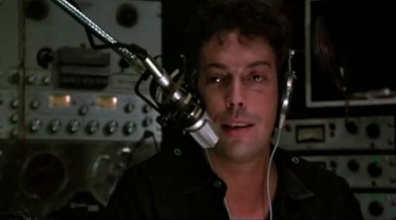
Despite their apparent differences, both are misunderstood by the adult establishment. The girls connect through their love of music their shared fandom of an all-night radio show hosted by Johnny LaGuardia played by the velvety-voiced Tim Curry, who is excellent as always. Pam admires Nicky’s free spirit, and Nicky admires Pam’s intellect. The casting of the two leads is perfect.
Following her discharge, Nicky goes back to break Pam out, wandering the hospital corridors, blasting The Ramones’ classic “I Wanna Be Sedated” on her boombox to entice her new friend to defiance. Together, they escape in a stolen ambulance and hole up in an abandoned warehouse by the east river.
DJ Johnny picks up on the story and uses it to start a movement against Pam’s father, whom he despises for trying to gentrify his neighborhood. He puts the girls on the air and makes them famous. They become Icons for other disaffected young ladies itching to rebel against the “banality” and “boredom” of their everyday lives. They start a band called The Sleeze Sisters and begin spreading their message through their music all over the airwaves in graffiti throughout the city. Even when the girls engage in potentially dangerous hijinks–they throw televisions off of high-rise buildings onto busy sidewalks as a symbolic gesture against societal brainwashing–Johnny supports and protects them.
Eventually Pam, who has been building up her self-confidence working as a stripper who “won’t dance nude” tires of Nicky’s high jinx and develops a crush on Johnny. Although it never explicitly says the two are lovers, their sleeping arrangements and Nicky’s jealous reaction to Pam’s wandering eye says it all. Nicky sets up an interview situation designed to prove to Pamela that Johnny is only in it for himself. He’s tired of his job on the night shift and sees this movement to boost his own brand and his show’s ratings. She suffers a mental breakdown and throws herself into the East River only to climb out asking herself, “What the fuck am I doing?” Johnny calls a doctor, who sedates her. Upon seeing this, Pam confronts Johnny angrily. She hates seeing her friend devoid of her usual fighting energy and inspires her to perform one last act of ultimate provocation. An illegal concert in Times Square.
Full soundtrack recreated on You Tube.
Pam calls all the news outlets and announces the free gig to take place on top of a theatre marquee smack in the middle of Times Square. Johnny’s message on the radio brings girls from all over the five boroughs to see their hero perform, dressed for the occasion with their eyes blacked out “like a criminal.” The cops show up to shut them down, leaving Nicky one last chance to grand stand “about life” and to thank Pam for changing hers for the better. She knows Pam must go home. Her Dad is watching from below. As a duo, the girls have taken things as far as they can and now it’s time for them to walk their own individual paths, each armed with the determination and confidence inspired by the other.
As a final farewell, Nicky salutes the police and Pam and jumps into the crowd. They catch her and disappears into a sea of look-alikes. Pamela reunites with her Dad and the credits roll. Over a Bee Gee’s song. An odd, preternatural choice made by producer Robert Stigwood, who managed them at the time. They have no business being on a soundtrack with Patti Smith, The Ruts, David Johansen, Lou Reed, XTC, and the Ramones. Moyle and star Johnson discuss this at length on the commentary track for Anchor Bay’s 2000 release.
Along with being a fun ride, the film is also a beautiful snapshot of what Times Square was like in 1980. The real one. Before it became boring and banal. It’s magnificent in its corruption. You can almost smell the dried semen in the 42nd Street porn theatre the girls run through dodging law enforcement in the second act. It might be odd to say that I miss that time in New York’s history. As Nicky says in the film, “No sense makes sense.”
If any movie has earned being on the video nasty list — this one is on the Section 3 group of films, which couldn’t be prosecuted for obscenity but were liable to be seized and confiscated under a less obscene charge — it’s this movie.
This is the scummiest movie I’ve ever seen outside of films like Waterpower and Bloodsucking Freaks. Every single character is a horrible person, even the protagonists. It feels like you could take a Silkwood shower after this and it wouldn’t be enough. You’d still feel dirty.
Former paratrooper and powerlifter — who would later become a born-again Christian — Nicholas Worth plays Kirk Smith, who is also a veteran and bodybuilder. He has talent — well, when it comes to the lighting and composition of his pornographic photos, which have the ability to offend everyone, even scumbags like, well, everyone else in this movie. When he’s not grunting and lifting weights, he’s calling the talk show of Dr. Lindsay Gale (Flo Lawrence, who is also in Schizoid, Over the Top and The Lords of Salem). When he gets on the air, he speaks in fake accents and complains that he has migraines and blackouts.
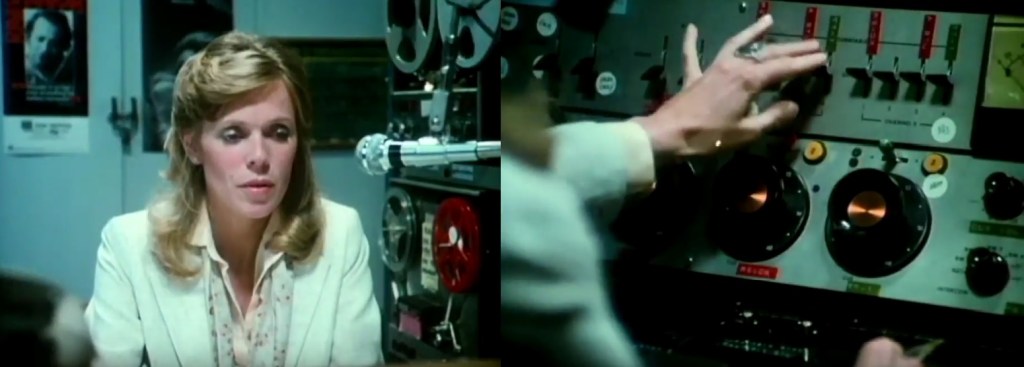
Dr. Gale on the air. While there is no radio station thanked in the end credits, it’s obvious this isn’t a set build and the film was shot in an unused production studio inside a real Los Angeles radio station. Bonus.
All of that would be fine if he wasn’t stalking and killing women right and left, not unlike the Hillside Stranglers of real life. That makes sense, as this movie was shot under the working title of The Hollywood Strangler. None of this was shot with permits, either.
It gets worse. He not only kills women, he has, well, intimate relations with their dead bodies before conducting religious ceremonies, trying to talk with his dead father and crying
Two detectives — Hatcher (Ben Frank, Death Wish 2) and McCabe (James Westmoreland, who was in Stacey and was married to Kim Darby; also in The Undertaker and His Pals) — are on the case, but it feels like they’re just as horrible as anyone else in this movie, overworked and on the edge.
There’s also a porn dealer named Sam Gluckman, played by Chuck Mitchell, who would one day be Porky himself from Porky’s, a role that is packed with more class than this movie. The sheer amount of salaciousness and scum in his scenes nearly fills the scene with bile.
Dr. Gale and McCabe quickly go from love to hate. Neither actor liked one another much, so Lawrence — who played Gale — ate a bunch of onions and Westmoreland — who was McCabe — didn’t shave on the day that their tender and romantic scene was shot.
Of course, it ends with Smith attacking Dr. Gale and McCabe saving her, shooting the strangler many, many times before he falls into a swimming pool, upon which the hero — such as this movie is — says, “Adios, creep!”
Director Robert Hammer is a one and done wonder. Sure, he made documentaries on Crosby, Stills, Nash & Young and The Steve Miller Band, but that’s it. Otherwise, he became a CFO for several companies.
Keep an eye out for April 1978 Playboy Playmate of the Month Pamela Jean Bryant as Sue Ellen. She’s also in all manner of late 70’s and early 80’s films that probably only I care about like H.O.T.S. and Lunch Wagon. Dale Kalberg, who was in scumtastic flicks like Mistress of the Apes and SexWorld, is another victim. And Susanne Severeid, who was a former model, plays yet another prostitute who ends up in Kirk Smith’s list of crimes. Interestingly enough, her husband was a WWII Dutch resistance fighter who was hired by the Simon Weisenthal Center to hunt Dr. Josef Mengele in real life.
Gail Jensen is another victim in this movie. She also performed the song “Sweater Girl” from the movie of the same name, as well as two songs on the Maniac Cop soundtrack. It gets crazier — she wrote “The Unknown Stuntman,” the theme from Lee Majors’ TV series The Fall Guy, along with being married to David Carradine, who she starred alingside in Future Zone.
If you don’t have the Pure Terror box set, you can get this from Vinegar Syndrome.
Despite my warnings of the sleaze quotient of this movie, you should know that I loved early single moment of it. I’m ashamed, but isn’t that part of the fun of lurid movies like this? If you’re of a similar mind — let’s say you’re a maniac — you will probably feel the same way.
* This review originally ran on November 27 as part of our Mill Creek Pure Terror box set of reviews. If you missed any of those 50 films, you can catch up with our Pure Terror Recap.
On the distant planet of Ganton 9, the annual Karn Evil—a societal rite of passage—is a young person’s final opportunity to experience the unbridled freedom of the decadent world before subjugating themselves to the order of the dictatorial-technocratic ruling class. When attendees of the Karn Evil right-of-passage ceremonies fail to return from their rebirthing experience, fear sweeps across the lands of Ganton as its citizens rise up in revolution to topple what is discovered to be an artificial intelligence that’s drained humanity of its will.
In other words: look down at the Smartphone in your hands, kiddies. Welcome to Karn Evil 9.
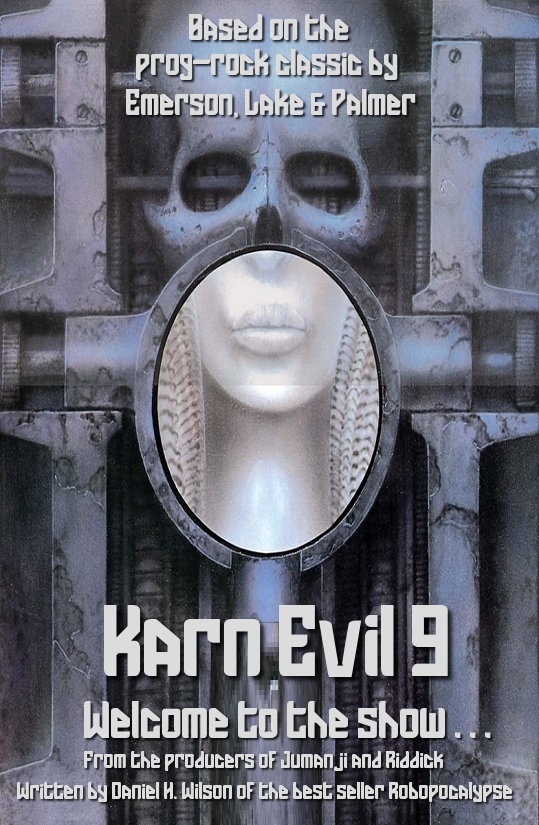
Michael Napoliello and Maria Frisk for Radar Pictures, the producers behind Vin Diesel’s Riddick franchise and Sony’s Jumanji franchise reboot, are currently working with New York Times best-selling author Daniel H. Wilson on a screenplay adaptation of the 30-minute futuristic rock suite featured on British prog-rock legends Emerson, Lake & Palmer’s 1973 album Brain Salad Surgery. Wilson, also the author of The Andromeda Evolution, most recently adapted his novel Robopocalypse for a co-production by Michael Bay and Dreamworks.
While the world came to know the artwork of Swiss surrealist H.R Giger through his 1977 book Necronomicon, which showcased his futuristic images of man meshed with machines, and became the inspiration behind Ridley’s Scott’s 1979 film Alien (check out our “Alien Ripoffs Week“), it was Emerson, Lake & Palmer who first brought Giger’s work to a worldwide audience when they commissioned the artist to design the cover for Brain Salad Surgery.
You’ve come to know Keith Emerson through his Italian giallo soundtrack work for Dario Argento’s Inferno (1980), Lucio Fulci’s Murder Rock (1984), and Michele Soavi’s The Church (1989). In addition to Sylvester Stallone’s Nighthawks (1981), Emerson also composed the soundtrack for Toho Studios’ 28th Godzilla film, Godzilla: Final Wars (2004). Here’s to hoping the production design of Karn Evil 9 will be infused with H.R Giger’s visions and the soundtrack will replicate Emerson’s use of Hammonds, pipe organs, harpsichords, and Clavinets from the album.
One thing’s for sure: Karn Evil 9 isn’t going to be no Alice’s Restaurant, a Harper Valley PTA, or an Ode to Billy Joe—but will probably freak us out with some crazy, surrealistic nightmare akin to the Beatles’ Yellow Submarine. Heaven only knows how long it’ll take before Rush sells the film rights to their 1976 epic, 2112.
In a twist of technology: Emerson, Lake and Palmer—via new technologies—will return to the road in 2025! The tour announcement at the band’s official Facebook page will get you where you need to be.
You can listen to ELP’s four-movement “Karn Evil 9” suite in its entirety on You Tube while you read the full lyrics at Genius.com and fan through the pages of Giger’s Necronomicon at Google Images. And be sure to visit our “Exploring: Movies Based on Songs” featurette, as well as our three-part “Rock n’ Roll Week” tributes. They’re all whoppers—with links o’ plenty—so grab a cup ‘o joe and join us, won’t you?
* Mock movie one-sheet by R.D Francis based on Giger’s Brain Salad Surgery. Typefaces courtesy of Picfont.com.
About the Author: You can read the music and film criticisms of R.D Francis on Medium and learn more about his work on Facebook.
Author’s Note: Due to the controversial nature of this film, please note this is a film review that addresses the creative art of filmmaking only, most importantly, what constitutes a “bad film,” why actors pursue “passion projects” (aka “vanity projects”), and the struggles of unknown actors wanting to a make a mark in Hollywood; it also analogizes similarly-themed films, so as to reach an understanding regarding the creative development of the subject-film and its creator. This review is not a political or racial dissertation intended to incense any reader regarding social or free speech/opinion issues and was written as part of an affectionate “Radio Week” exploration in tribute of movies set inside radio stations.
Thank you for your time and understanding.
Once again, the stars align. It’s a two-in-one! A box office failure and a movie set inside a radio station. And it fits perfectly into our review schedule of rolling out a week of box office failures* and rolling out a week of reviews regarding movies set inside radio stations (“Radio Week” runs March 15 to 21). Oh, the joy. But I must admit that if not for the radio broadcasting angle, I wouldn’t have watched this one at all.
And maybe you shouldn’t either.
Welcome to the most polarizing film of 2019.
This debut film from Jeremy Saville—which has a lot more going on than it just being a radio station-set comedy—has no middle ground. It’s either loved or it’s hated. Over on Amazon Prime it’s pulling a three-out-of-five star review based on 142 users—that either rates it with one star, or ten stars. And over on the IMDb (where users are purposely sabotaging the page with bogus production “trivia” and plot keywords): it earns one star, or ten. How’s that for polarizing? The popular You Tube stop for film buffs, WatchMojo, ranked Loqueesha as the #1 Worst Movie of 2019, #5 on the Worst Movies of the Last Decade, and #7 of the Worst Comedy Movies of the Last Decade. And it has 0% approval rating on Rotten Tomatoes (based on five users).
And while The Hunt (2019)**, Universal Studios’ overtly liberal-slanted take on Richard Connell’s novel The Most Dangerous Game (where the liberal ruling-class kidnaps republican sympathizers, aka Walmart-shopping deplorables, dumps them into a rural game zone, and hunts them for sport) was pulled from release after poor test screenings and an acidic online response that deemed the film’s political content “offensive,” Jeremy Saville decided to press on and “quietly” released Loqueesha as an Amazon Prime stream. The film had, as most films do, a promotional website at one point: now, when you click the Wikipedia link for, or Google that page, it goes to a 404 prompt and advises you the “account is suspended.”
Now, does that “suspension” mean that Saville simply took down the site˟ , or was it removed by the Internet Service provider? The latter seems probable because, as result of the film’s critical backlash and cries of the film being “racist” and “sexist,” Loqueesha was abruptly pulled from a few festival screenings where it was previously accepted—and the festivals issuing apologies stating that they’re “reviewing their screening-entry processes” and that they’ll “try better.”
Okay, so. This is the part of the review, where, after watching the trailer below, you will probably stop reading . . . after I tell you that this is a movie about (and what so many inaccurately critique): a white man pretending to be a black woman. (By “voice” only; he does not don a “blackface” or “tan” his skin, as in a couple of acceptable movies that we’ll discuss later in this review. And, we’ll check out a movie where a black character dons a “white voice,” as well.)
However, the plot is a bit more complex than that: Loqueesha is about a white man who pretends to be a black female talk radio host. Needless to say, even based on that simplistic IMDb logline (which doesn’t accurately describe the film in whole: it’s poorly written; a logline, like any storyline, must have a beginning, middle, and end . . . and that logline has no “ending”) and watching a two-minute trailer—everyone immediately attacked the film. (It’s important to note: When the film reaches the third act, the heartfelt wisdom of Joe’s on-air alter-ego stops a woman from committing suicide and Renee (Mara Hall), who started out as the “fake” Loqueesha, becomes the “real” on-air Loqueesha. Of course, one will have to actually watch the film to know those plot twists.)
How the page’s logline should read: Faced with a financial crisis, Joe, a divorced, quick-witted bartender, applies for a job at a failing Detroit radio station—as a black female disc jockey.
And the page’s search keywords should be: comedy, controversial, bartender, desperation, Detroit, disc-jockey, divorced, education, financial, money, radio, radio station, unemployment, and vanity-project. Clandestine, smart aleck-classifying the Loqueesha as a “horror” film and entering the terms “bloviating,” “fraud,” “patriarchy,” and “psychosis” as keyword searches isn’t helping anyone or proving one’s disagreements with the film.
Hopefully, you’ll heed the words of actor/comedian Dwayne Perkins (who portrays Mason, the radio engineer), one of several black actors in the film. (In a bit of irony for those “offended” by the choice of the film’s title: Perkins does a bit in his stand up act about “made up ethnic names” as well, shown below.) Perkins clarified the film in a May 2019 interview with the BET Channel: “[Louqeesha] is a comedy about a guy who does the wrong thing for the right reasons, and the movie really gets into all of it more than the trailer does. I think you have to withhold judgment until you see the movie.”
Now that’s a familiar plot device. We’ve seen lots of characters do the wrong thing for the right reasons before, on film. And that character always learns a valuable life lesson in the process and finds love (interracial, in the case of Loqueesha’s romantic sub-plot) and a new-found respect for themselves and others—which is how the third act in every story arc ever written, ends.
In the context of Jeremy Saville’s feature film debut: There’s Dustin Hoffman’s out-of-work actor, Michael Dorsey, who needs money to finance his friend’s play, so he becomes “actress” Dorothy Michaels in Tootsie (1982). C. Thomas Howell’s pampered Mark Watson, with the threat of having to drop out college when his family cuts him off, masquerades as an African-American student to apply for the last student loan available in Soul Man (1986). Robin Williams’s Daniel Hillard transforms into the (stereotypical) British nanny, Mrs. Doubtfire, to circumnavigate his wife’s legalese to keep him from his children in Mrs. Doubtfire (1993). Meanwhile, in Louqeesha, the sole-goal of Saville’s Joe is to make enough money to place his gifted child—and his wife constantly puts him down in front of their son—into a private academy; so Joe’s struggle is no different that the Dorsey, Watson, and Hillard characters.
Then there’s Martin Lawrence’s Big Momma’s House franchise, which rolls out the stereotypical tropes of loud, large black women with his FBI Agent Malcolm Turner going undercover as Hattie Mae Pierce to crack a crime ring. And there’s Martin’s exaggerated “ghetto girl” stereotyping of Shenenheh Jenkins from his eponymous 1992 to 1997 Fox series. And there Tyler Perry rolling out the “vindictive, angry black woman” trope as Medea Simmons in a series of eleven films from 2005 to 2019—which Spike Lee criticized in interviews as “coonery buffoonery” and that if a white director made a movie depicting black people in such a manner he would be ostracized.
And Spike was right: for that director’s name is Jeremy Saville—and Saville’s film doesn’t remotely approach the “Lee Level” of Perry’s films.
But is Lee also guilty of his own accusations with 2000’s Bamboozled? It’s another film that has no middle ground: movie goers that hate the film, hate it (and refer to Lee as a “racist”); the ones who love it, defend Lee as “brilliant.” (Personally, I dig Spike’s films (but not your remake of Oldboy, sorry, Spike) and enjoyed Bamboozled; it’s unfortunate it didn’t connected with a mass audience, as there’s a powerful, eye-opening message and unique voice to be had.)
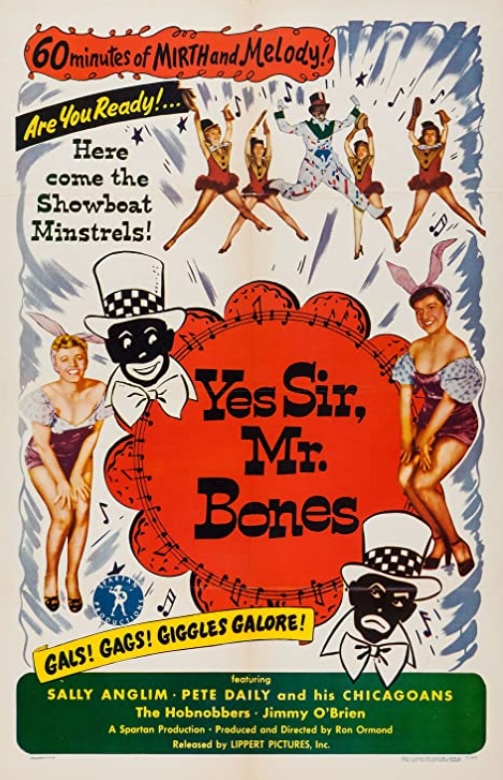
Lee laid a box office bomb (2.5 million against a 10 million budget) with his tale about a black TV executive bullied by an outrageously stereotyped, white-racist boss who denigrates his black employees in black vernacular and can’t make it through a sentence with dropping the N-word. In frustration, the executive creates a modern-day minstrel show that features an all-black cast in blackface—that his boss approves, and it becomes a hit with audiences.
Those who discovered this film—many years after-the-fact on You Tube and Facebook—are quick to denounce this entry on Ron Ormond’s resume. Unfortunately, they don’t know the man behind the lens: hopefully, our review will enhance one’s perspective.
While Lee defended his over-the-top satirical attack against the “white-controlled” media and its misuse of African American images as a modern-day parody on the minstrel shows of old with Bamboozled, critics called him out for misrepresenting those same African American images himself. Ironically, when Saville repeated Lee’s logic, that Loqueesha was a “modern-day satire on the minstrel shows of old,” critics . . . well, you know what the critics think of Saville at this point.
White Chicks and Bamboozled. Both considered as “racist” and “eye-opening social parody.”
And finally: 2004’s White Chicks was referenced more than any of the above mentioned films when reviewing (read: eviscerating) Loqueesha—and was staunchly defended by critics in the same breath as Loqueesha was scorched-earthed. White Chicks takes a page from the Big Momma’s House playbook with Shawn and Marlon Wayans starring as F.B.I agent-brothers Kevin and Marcus Copeland; they don “undercover” whiteface as two (outrageously stereotyped) spoiled, privileged white girls to solve a crime.
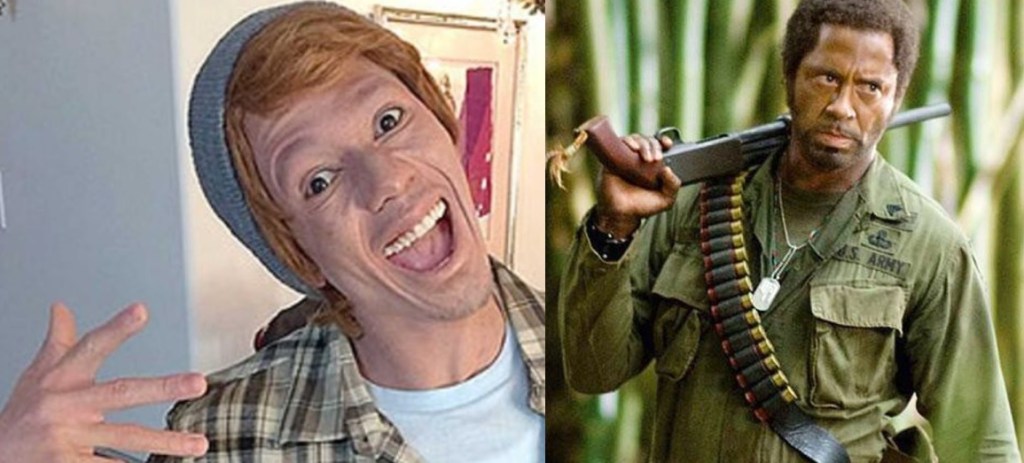
And while we are on the subject of “whiteface”: Back in 2014, comedian and R&B artist Nick Cannon (TV’s America’s Got Talent) donned a self-admitted, purposefully controversial “whiteface” as a “humorous character satire” and “character impression” to promote his then album White People Party Music (then, when called out on the gimmick, Cannon stated that “blackface is racist and whiteface is a mountain snow bank in New York”—which, in itself, is a racist comment).
Now, let’s assume Nick Cannon was the lead actor in a dramedy about a black radio DJ who, as result of his station’s format change from hip-hop to “white” classic rock (based on ratings and ad revenue, not racism) , was laid off. And he can’t find a new gig—without moving across the country. And his ex-wife berates him in front of their son and hounds him about their son’s tuition. He’s desperate. He loves his son. So he does what anyone would do: the wrong thing for the right reasons. So, to get back on the air and stay in town, he dons whiteface and cops a “white voice”—as in Boots Riley’s Sorry to Bother You (2018)—to get back on the air. What would the public response be: Would the film be pulled, like The Hunt, or praised, like Sorry to Bother You? (Watch Danny Glover explain “white voice” to Boots Riley’s co-worker in the clip below.)
Nick Cannon . . . whiteface and white voice. Robert Downey Jr. . . . blackface and blackvoice.Both socially and critically accepted.
And what was the consensus on the portrayal of Staff Sergeant Lincoln Osiris by Robert Downey Jr. in 2008’s Tropic Thunder? It was regarded as a “biting satire” and “subversive humor” and “an unforgettable turn.” The Rotten Tomatoes and Metacritic crowd that hated Loqueesha loved Tropic Thunder. Meanwhile, Entertainment Weekly cited Tropic Thunder on their “25 Great Comedies From the Past 25 Years.” Along with Newsweek magazine, The New York Daily, Premiere magazine, the San Francisco Chronicle, and even author Stephen King, Entertainment Weekly also placed the film on their “Top 10 Films of the Year” lists.
As it turns out, the ensuing social protests and critical backlash against Tropic Thunder’s “social parody” weren’t about the black characterizations of Staff Sergeant Lincoln Osiris by Robert Downey Jr., but about Ben Stiller’s portrayal of his actor/character Tug Speedman’s portrayal of the mentally challenged Simple Jack character.
Sadly, as with Jeremy Saville’s portrayal of the radio host Loqueesha, those shouting the loudest (and didn’t take the time to see Tropic Thunder beyond the trailers or marketing materials) missed the point of Ben Stiller’s and his co-writer, Etan Cohen’s, intentions: they weren’t making fun of handicapped people (nor Saville of black people), but were making fun of the actors who use the material as fodder for acting accolades. (And in an ironic twist: Robert Downey Jr. received a Best Supporting Actor nomination at the 81st Academy Awards.)
Jimmy Fallon and his recently controversial impression of Chris Rock was acceptable in 2000 and applauded; he apologized twenty years later.
So how did we get here? Why did Jeremy Saville make this film?
Loqueesha is, first and foremost, a vanity project, which are projects that are produced, written, and directed by its lead actor (sometimes, they’ll even serve as the cinematographer). At first, a film fan’s mainstream celluloid indexes will load up copies of Dennis Hooper’s The Last Movie (1971), Sly Stallone’s Paradise Alley (1978), Paul McCartney’s Give My Regards to Broadstreet (1984), Prince’s Under the Cherry Moon (1986), Steven Seagal’s On Deadly Ground (1994), Kevin Costner’s The Postman (1997), and the Tom Green disaster, Freddy Got Fingered (2001) (I liked it; Green’s a nutbag and I dig ’em).
But those mainstream films are more “passion projects” than vanity projects—although they reek of vanity’s stench nonetheless.
The true vanity project is a film reserved for the frustrated and unknown actor; some of them can “act,” most of them can’t; some can work well with directors, while most others can’t take direction (six weeks in a Konstantin Stanislavski method-acting class held in the back of a public library’s conference room, while folding baskets of laundry to “find their inner self,” and suddenly, they’re Oscar ready and don’t need “direction”). So those “actors” craft their own calling cards to the industry. Have you ever taken the time to read the credits on Hallmark, Lifetime, or Up movies? All three channels overflow with those actors on the “can’t” list. And they drag in so many family members, well; they could school Will Smith on the art of nepotism. And let’s not mention the rest of those “Oscar Winners” on TubiTv.
Ah, but when it works—usually with the ones on the “can” list, it breaks the actor into the big time: Billy Bob Thornton’s Sling Blade (1996), Jon Faveau’s Swingers (1996), Matt Damon and Ben Affleck with Good Will Hunting (1997), and Zach Braff with Garden State (2004) are the best case examples.
And while Edward Burns did okay for himself after The Brothers McMullen (1995) and Vincent Gallo forged a career after the tour de forces that are Buffalo ’66 (1998) and The Brown Bunny (2003), on the other side of the reel is Monster’s Ball (2001). Written as a modestly-budgeted drama by Will Rokos and Milo Addica as their “Good Will Hunting” to showcase their acting and writing talents, they didn’t end up starring, plans with Robert DeNiro fell through, and Halle Berry’s Oscar for the role that they wrote didn’t rub off on them. And Miss March (2009) didn’t work out for actors Zach Creggar and Trevor Moore. Neither did Hedwig and the Angry Itch (2001) for John Cameron Mitchell, Just One Time (2001) for Lane Janger, and there’s Fay Ann Lee with Falling for Grace (2006). But Brit Marling seems to be doing alright after Another Earth (2011). And while it was eviscerated by critics, we all know how Tommy Wiseau’s The Room (2003) turned out (it’s still playing in theatres worldwide).
And we could go on and on. The list of unknown actors, who’ve made unheard of films that we’ve channel surfed by many times on our TV’s VOD menus or bypassed on the lower-tier cable channels, like Movieplex, rife with obscure fillers, are many. Even TubiTv needs a digital Drain-O to clean the stream of crappy vanity films clogging our screens before we get to the watchable stuff.
And if not for his debut film’s May 2019 You Tube-posted trailer resulting in a social media backlash for the film’s perceived, overt racism, sexism, stereotyping, and cultural appropriation, we may have never heard of comedian and aspiring actor Jeremy Saville’s calling card to the industry. But make no mistake: Saville did not purposely make an “offensive” film to create controversy and be recognized. He wasn’t out to “get” anyone or “appropriate” their culture.
ComedianLouie C.K.—with the full support of Leslie Jones, who later turned a much-publicized cold shoulder to Louie over his 2017 sexual misconduct allegations—receives audience-acceptable laughter for his skit, “This Is How I Talk”/image courtesy of Saturday Night Live You Tube.
I get it, Jeremy. All of those comedy one-nighters off the circuit, endless rounds of acting auditions that accomplish nothing but draining your gas tank and sapping your will to live, and the ouroboros existence of sending out aircheck after aircheck to radio stations wears you down and pisses you off. So, like many actors before you, you decided to take your destiny into your own hands.
Sadly, Jeremy, while your attempt to raise questions regarding various societal tropes was a noble one (just like Spike Lee), it seems, unlike Billy Bob Thornton before you, Loqueesha had a reserve effect: it killed your career. For we live in a world where Internet Warriors roam in digital wolf packs with keyboard-scorching branding irons, ready to burn scarlet letters into another’s social media account: for our society is a society that loves to kick a man when he’s down. And if they have a chance to kick you before you get up, even the better. The digital wolves drip drool as they sharpen their utensils, readying their “bytes” with a smart phone’s screen-gleam in their eye.
In the initial and many non-reviews of the film, I was expecting a cinematic trainwreck; an ineptitude from Jeremy Saville that made Tommy Wiseau’s The Roomreally look like Orson Wells’s Citizen Kane (and not just the “Citizen Kane” of bad movies). Critics tossing around the terms “worst film of the year,” “worst film of the decade,” ” . . . of all time,” “. . . ever made,” and namedropping Ed Wood and his film Plan Nine from Outerspace. Going on and on about Loqueesha‘s “poor cinematography,” “editing,” “audio,” etc. No film discipline was left uncritiqued as “poor” or “bad.”
Really now, Mr. Critic?
Have you ever seen an Al Adamson film (Carnival Magic is your primer)? Have you ever experienced an Eddie Romero (Mad Doctor of Blood Island is your primer) or Willy Milan (W is War is your primer) or Cirio H. Santiago (The Sisterhood is your primer) Philippines-shot film? Did you ever see Dünyayi Kurtaran Adam (1982) or Alfonso Brescia Italian Star Wars oeuvre? Do you know the filmographies of the Polonia brothers (Empire of the Apes), Brett Piper (Arachnia), or Neal Breen (this “scene” says it all)? Have you ever loaded up a Sergio Martino film (our “Ten Sergio Martino Films” overview is your primer)? Or experienced a Crown International Pictures romp (Point of Terror will get you started)? Perhaps a Fred Olen Ray boobs, blood and babes opus (our review of Alienatorwill serve as your introduction Ray’s oeuvre)? Have you ever experienced the societal tropes of a hicksploitation film˟ from the 1970’s?
Trust me, I’ve seen itall—and then some—and I know a “bad film” when I see one. And Loqueesha doesn’t even rise to the level of these “worst of _______” crtiques. Dwayne Perkins was right: Did anyone that attacked the film look past the trailer? (No, because many reviewers admit they never made it past the trailer.) But alas, the world loves Tommy Wiseau, and Hollywood even made a biographical film about his dreams, The Disaster Artist (2017). Meanwhile, Saville is a marked man with a scarlet “R” on his chest.
Film screencap courtesy of The Best Movie/Saville Productions.
While Loqueesha, admittedly, has its share of flaws, for a first-time, self-produced effort, it’s a commendable start. Does some of the non-racial humor fall flat and illicit groans? Yes. However, some of that humor lands and brings on a chuckle. Sure, Loqueesha is no Slingblade by any means, but it’s not The Room either. It’s obvious Saville (as Joe/Loqueesha) is schooled, somewhat, in the film arts—according to the IMDb, he’s been at it at least since 1997—and knows, to a degree, what he’s doing behind and in front of the camera.
As an actor, he doesn’t suck as badly as the Internet reviews on Loqueesha will lead you to believe. There’s no reason why Saville can’t carry bit parts on a U.S comedy series, like The Connors, or pull off an under five role on a drama like Law and Order: SVU. And while the rest of the lead cast—Susan Diol (Joe’s ex-wife), Tiara Parker (as Rachel, the love interest; yes, she’s black), and Dwayne Perkins (Mason, the engineer)—aren’t award winners, they’re not cardboard-stunned driftwood-line readers. Each come across as natural—and are certainly better at the craft than the strained acting we witnessed in Wiseau’s The Room. And an honorable mention goes out to the scene-stealing Mara Hall as Renee, the “fake” Louqeesha (who’s funny; and not a bit racist). A testament to her talents: she worked her way up from short films to co-starring roles on ABC-TV’s hit Scandal and multiple episodes of ABC-TV Grey’s Anatomy, along with starring roles on Bounce TV’s highest-rated series Saints & Sinners and OWN’s Ambitions.
While there’s no official numbers on Loqueesha‘s production cost and P&A against its box office receipts (which entails the purchase of Amazon streams), it’s a sure bet that Jeremy Saville is drowning in red ink with his debut film.
Sure, you’ve seen better. But you’ve also seen worse. I surely have seen way worse.
Meanwhile, the worldwide gross on White Chicks was $113 million against an almost $40 million budget (not its counting P&A), so it wasn’t exactly a “hit,” either. And it, like Loqueesha, got its share of “worst of” suffixes: White Chicks was nominated for five Razzies, including Worst Picture, Worst Actress (for the Wayans brothers in drag), Worst Director (for their brother, Keenan), Worst Screenplay, and Worst Screen Couple (it lost in all categories). At the 2004 Stinkers Bad Movie Awards, White Chicks received five more nominations for Worst Picture, Worst Actor (Keenan Ivory Wayans), Most Painfully Unfunny Comedy, Worst On-Screen Couple (Shawn and Marlon Wayans), and Least “Special” Special Effects (its only win was for Most Painfully Unfunny Comedy). Film critic Richard Roeper placed the film at #1 on his list of the worst films of 2004, calling out its unconvincing (white) prosthetics and racism. In Roger Ebert’s review he said it took an “act of will” to keep him in the theater. (In a bit of irony: White Chicks 2 is currently in development.) (I’ve watched White Chicks on a free HBO weekend and it was alright; I wasn’t “offended” by it. For me: it was no different than watching a raunchy Judd Aptow comedy: it’s not great, but it’s not awful; it’s competently made. I got a couple chuckles, a few groans and “they didn’t just do that?” moments.)
And there’s Boots Riley’s vanity project, Sorry to Bother You, about a young black telemarketer who adopts a “white accent” to succeed at his sales job. His debut film received across-the-board critical praise for its “concept as an absurdist dark comedy.” It even won a Best First Feature award at the Independent Spirit Awards. Critics waxed Riley’s debut as a “fearless dissection of identity politics,” as a “brilliant satire,” and a “story of a man dealing with social injustice.”
Huh? Isn’t that what Jeremy Saville did with Loqueesha?
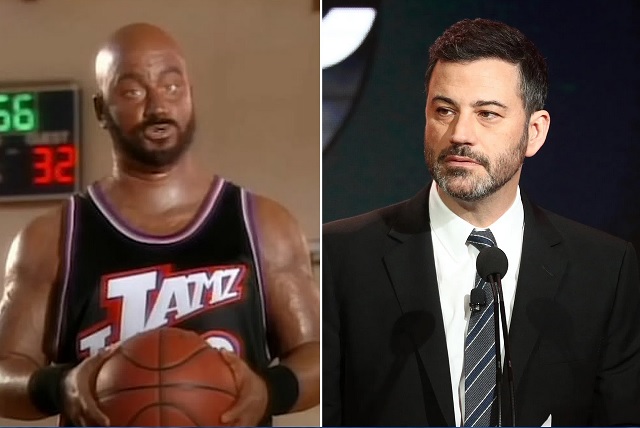
Jimmy Kimmel dons blackface and black voice. He’s still on the air at ABC-TV. And everyone with problems over Loqueesha are okay with Kimmel. He also skated on his skit where he asked women to touch his crotch, as well as his most recent “bit” regarding LGBTQ spokesperson Caitlyn Jenner, demeaning the transgendered woman’s right-to-choice as a man wearing a wig.
However, when it comes to the everyday, run-of-the mill movie goers like you and I, as with Saville’s first feature, Riley’s Sorry to Bother You also has no middle ground: reviews who hate it, hate it (the words “dumpster fire” and “racist” are used), and others who love it call out “the haters for hatin’”—without giving any reasons as to why criticizing Riley’s work as “racist” is wrong. But Riley didn’t endure (nor does he deserve) the attacks Saville did—for basically making the same movie. Make Saville’s character a telemarketer and Riley’s an out-of-work DJ and, content wise, you basically have the same “absurdist dark comedy that satires identity politics and socioeconomical injustice.” (I watched Riley’s film and found it relevant and not at all racist. It’s not great, but it’s not awful, either. It’s a commendable first feature and I’ll check out his next film.)
So, does Loqueesha deserve to be the blockbuster of the year? No. Does it deserve to be the box office bust of the year? No. Does it deserve at least the same 15% Rotten Tomatoes rating given to White Chicks? Yes. Does it deserve its current 3.5 out of 5.0 Amazon Prime review? Yes. For a first time, self-produced effort, that rating is perfect. Loqueesha certainly doesn’t deserve a 0% Rotten Tomatoes rating and WatchMojo’s “worst of” ranks.
So, instead of forming judgments of Saville’s film from the trailer alone, take a moment to discover that Loqueesha, while utilizing an admittedly wild and controversial way to get its message across (like Spike Lee’s Bamboozled), is a movie cleverly communicating that, above all else, we each must be true to ourselves and each other (again, like Spike Lee’s Bamboozled).
Jeremy Saville’s taken a hell of beating for giving his best. So do ‘em a solid and try to watch his debut movie, won’t you? After its “quiet” Amazon Prime roll-out, Loqueesha recently debuted in the beginning of 2020—for free, with limited commercial interruptions—on TubiTV, courtesy of Indie Rights Movies.
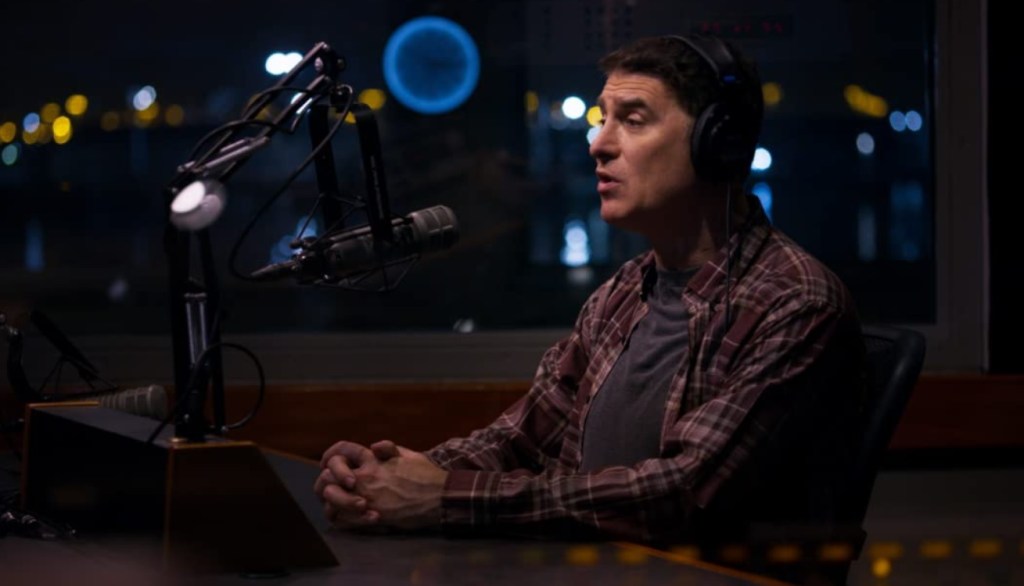
On the air at Detroit’s WCRW 92.1 FM (Screencap courtesy of The Best Movie/Saville Productions).
Ah! Finally! The radio technical stuff! After all: this is a “radio week”film review: Unlike most low-budget films set inside radio stations, the broadcasting jargon—regarding ratings, competing with podcasting and music streaming services, and ad revenue—shared between the father-and-son owner and program director is industry accurate. And while there’s no end credit thanks given, it’s obvious that “WCRW 92.1 Detroit” isn’t some makeshift build: the production rented out the facilities of a real radio station. In addition, Saville knew that, unlike most of the low-budget radio films, radio station frequencies never end in even numbers (always the odds 1, 3, 5, 7, 9) and never use prefix letter other than W or K in the United States. Saville did his research and that attention to detail is appreciated.
— END —
* Join us for our “Box Office Failures” week featuring well-known, big-budgeted studio movies and lesser-known low-budget films. In addition: We also examine Jimmy Saville’s self-made filmmaking brethren with our “Drive-In Friday: First Time Directors & Actors Night” feature. Speaking of “first time”: Our recent reviews for The App by Elisa Fuksas, Allison Powell’s Banging Lanie, Bethany Brooke Anderson’s Burning Kentucky, The Girls of Summer by Tori Titmas, Mindy Bledsoe’s The In-Between, and Joston Theney’s Wanton Want (well, sort of “first”) are more, fine examples of first time writer-director-actor projects.
** As you read this review, The Hunt finally made a theatrical release on March 13, 2020. If you’d like to know more about the creative roots behind the “Human Death Sport” concept of the film, join us in our review of 1965’s The 10th Victim. While we did not review The Hunt, we reviewed its low-budget “mockbuster” variant, American Hunt.
˟˟ Be sure to visit “The Top 70 Good ‘Ol Boys Film List,” which is a roundup of our month-long (September 2019) reviews of hicksploitation films, where we also get into the same societal tropes issues in film—only regarding white “southerners.”
And don’t forget: You can review all of the radio station-based films we reviewed from Sunday, March 15, to Saturday, March 27, with our “Exploring: Radio Stations on Film” featurette.
About the Author: You can read the music and film reviews of R.D Francis on Medium and learn more about his work on Facebook. He also writes for B&S About Movies (links to a truncated teaser-listing of his reviews).
Quentin Tarantino screened this hicksploitation “radio on film” obscurity during a three-night festival (on a “Redneck Night” that featured 1974’s Hot Summer in Barefoot County and 1977’s Polk County Pot Plane) to mark the May 2007 closing of the iconic Alamo Drafthouse Cinema Downtown, Austin, Texas.
I once owned a copy of this redneck radio romp on VHS from a TV (edited) taping, which I think was purchased through the VHS grey market dealer VSOM: Video Search of Miami. Or was it Sinister Cinema? Something Weird Video? It was a while back from one of those greys that advertised in the back pages of either Psychotronic Video or Cult Cinema magazines.
Anyway, I lost my copy of Redneck Miller, along with The Dirty Mind of Young Sally (an X-Rated sex-bore about a radio station secretary who ran a pirate radio station from the back of her pimp’s 18-wheeler) and Dennis Devine’s Scream precursor, Dead Girls (1990; a rock flick; not a radio flick), to a bad case of mold—which happens from time-to-time with low-grade VHS tapes from bargain-imprints. Live and learn.
I had always hoped the Q would release Redneck Miller as part of his Rolling Thunder Pictures imprint, but Miramax shut down the specialty label before we got a restored VHS copy. And since this has never been released on VHS home video, there’s no online VHS rips. Not even a copy of the trailer or any photo stills.
Shot in Charlotte, North Carolina, and making the rounds on the Southeastern U.S Drive-In Circuit via numerous double and triple bills in throughout 1976 and 1977, Redneck Miller stars Al Adamson stock player Geoffrey Land as DJ “Redneck” Miller, a disc jockey on a decrepit, small-town radio station. He finds himself on the wrong side of the local thug-pimp when he beds Pearl, Supermac’s (Lou Walker) squeeze. So while Red is bedding his best friend’s wife, Rachel, Supermac’s gang kidnaps her. And when Red thwarts the kidnapping, they steal Miller’s beloved chopper in retaliation and use it to transport drugs—and set up Red as a drug mule. Between all of the sex and fighting, Red works to clear his name.
Geoffrey Land’s career mostly consists of Al Adamson’s (Brain of Blood, Satan’s Sadists) Drive-In/Grindhouse trash-fests The Female Bunch (1971), Jessi’s Girls (1975; western “Death Wish” with a female), Black Heat (1976), and Doctor Dracula (1978). His best known works are two of Adamson’s most successful films: 1975’s Blazing Stewardesses and the Exorcist knockoff, 1978’s Nurse Sherri.
The bit part, B-Movie career of familiar black actor Lou Walker culminated with roles support roles in Mississippi Burning (1988) with Gene Hackman, My Cousin Vinny with Joe Pesci (1992), and The Firm (1993) alongside Tom Cruise.
Screenwriters Joseph Alvarez and W. Henry Smith knew their backwoods: they also collectively wrote 1974’s aforementioned Hot Summer in Barefoot County and 1975’s Trucker’s Women for producer Will Zens and the General Film Distributors-Preacherman Corporation brain trust. Personally, I’ve never heard of or seen their early ‘70s precursors Preacherman and Preacherman Meets Widderwoman on the VHS shelves—and good luck finding those two obscurities (yeah, it figures Sam heard of it!). The same goes for director John Clayton’s Summerdog (1977) and Duncan’s World—never seen them on VHS or UHF-TV. Another of Will Zens’s hick romps is the musical, The Road to Nashville.
Say what? You need more redneck flicks? Then check out our “Top 70 Good ‘Ol Boys Film List” that round-ups our month-long reviews of downhome, hicksploitation obscurities released from 1972 to 1986. And you can learn more about Quentin Tarantino’s love of film with “Exploring: The 8 Films of Tarantino’s Rolling Thunder Pictures.” And we’re reviewing movies set inside radio stations all this week, which we will round up with another one of our patented “Exploring” featurettes his coming Saturday at 6 PM with even more radio flicks.
About the Author:You can read the music and film reviews of R.D Francis on Medium and B&S Movies, and learn more about his work on Facebook.













 B&S About Movies
You must be logged in to post a comment.