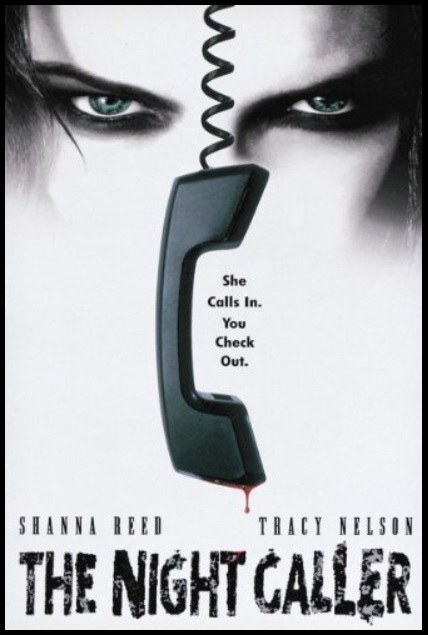
The Night Caller (1998)

Sometimes, those stars on the Hollywood Walk of Fame align.

Courtesy of B&S About Movies’ recent obsession with Christmas movies written and directed by David DeCoteau and Fred Olen Ray—some of which starred Eric Roberts—colliding with our recent flurry of reviewing radio broadcasting-set films—one of which starred Eric Roberts (Power 98)—careening off our recent “Ape Week” homage to the Planet of the Apes franchise, it brings us to this moment: a review of the debut screenplay by Mark Bomback, the producer and screenwriter behind Dawn of the Planet of the Apes and War for the Planet of the Apes.

Like David Mickey Evans before him: every screenwriter has to start somewhere. Before Evans got to Radio Flyer (1990) and The Sandlot (1993), he had to write, yes, the radio-psycho romp, Open House (1987). For Mark Bomback, his start in the business was writing a direct-to-video damsel-in-distress vanity flick produced by American television actress Shanna Reed (CBS-TV’s Major Dad).
Watch the trailer.

Needless to say, one’s first impression of The Night Caller is that it’s a variant of Clint Eastwood’s Play Misty for Me—only with Tracy Nelson (NBC-TV’s Father Dowling Mysteries, the “female” Jerry Seinfeld in the “The Cartoon” episode) in the role played by Jessica Walter. Only Nelson’s Beth Needham isn’t a spurned one night stand who transforms into a flat-out crazy bitch; the character is a bit more twisted and prone to psycho-visions and voices and suffers with an unhealthy co-dependency on her mother, so she’s more like Norman Bates.

However, as I re-watch The Night Caller all these years later, I can’t help but think that Stephen King’s Misery (1990) served as an influence, with James Cann’s famed novelist Paul Sheldon traded out for Shanna Reed’s Dr. Drew-inspired radio psychologist. Once you hear Nelson’s wholesome rants-mixture of horror and dark comedy with the epithets of “baboon butt, “snoopy poopy,” and “bossy the cow,” and her singing goofy, nonsequential songs about “peanuts up your nose,” you’ll understand the connection.

Do not, however, let the fact that this radio-psycho variant went straight-to-video and aired on Showtime leaving you to think The Night Caller is inferior to the bigger-budgeted, theatrically released Psycho, Play Misty for Me, Misery, or Hand that Rocks the Cradle. Tracy Nelson tears this movie up, giving us an amazing performance that equals and exceeds the psycho interpretations of Anthony Perkins, Jessica Walter, Kathy Bates, and Rebecca De Mornay. Nelson single-handedly saves what would have otherwise been just another run-of-the-mill Lifetime-inspired damsel-in-distress romp.

Nelson’s Beth Needham is a childish, socially-repressed and friendless, thirty-something convenience store nightshift clerk who spends the days taking care of her bed-ridden, verbally abusive mother (TV actress Eve Sigall in a bravo performance) who blames Beth for her own sexual abuse at the hands of her late father. Beth finds solace in the late night musings of Dr. Lindsay Roland on the air of San Diego’s KBEX radio—her obsession brimming with lesbian tendencies. (If this was produced as an R-rated theatrical, that sexual dynamic may have been more deeply explored; so here, it’s just insinuated.) So deep is Beth’s obsession—in bed she fawns over Dr. Roland’s picture in the newspaper—she’s prone to seeing visions of the radio shrink as a glowing, white-adorned advice-granting angel.

One night, when Beth musters the courage to call into the show to tell of her plight, Beth takes the good doctor’s encouragement to “make changes” and to “plant the seeds” of friendship, literally.

Before you know it, Beth threatens her boss with a knife, quits her job, and murders her mother—and “pickles” her hands in mason jars. But those angelic visions and advice aren’t enough: it’s time to “plant the seeds.” Beth’s stalking leads her to apply for a job with the answering service used by the radio station—and Beth’s kills the woman who got the job. Then Beth’s knocking off babysitters, answering service coworkers, and radio station employees—with it culminating in her kidnapping Dr. Roland and taking her on a motorhome road trip to their “new shiny, start” so they can live like “Thelma and Louise.”

As far as the problems with the technical accuracy of radio stations in film, “KBEX San Diego” gets a pass.

That’s because The Night Caller isn’t about Shanna Reed’s good doctor: it’s all about Tracy Nelson’s tour-de-force and her psyche. As result, there’s no need for any scenes of Dr. Roland’s day-to-day toiling at the radio station or any broadcasting expositional dialog with station managers, etc. And since there’s no “thank you” in the credits to any particular radio station or technical credits, the “radio studio” is a cost-effective build (set design) with a microphone boom screwed into a table top; slap a set of headphones on Shanna Reed and have her punch a couple buttons on a wired-up Telos phone board—and “shoot it tight” and in the shadows—and POOF, you have a radio studio on a budget.

While The Night Caller was released in 1998 on both VHS and DVD in the overseas-international marketplace, it was never released on DVD in the United States. So be wary of those online DVDs and know your regions, and watch out for those grey market DVD-Rs before you buy. None of the online content delivery services, such as TubiTV or Vudu, are streaming The Night Caller. Amazon Prime had it, but lost their rights to it. So you’ll have to settle for a really clean VHS upload on You Tube.

About the Author: You can read the music and film reviews of R.D Francis on Medium and learn more about his work on Facebook. He also writes for B&S Movies.
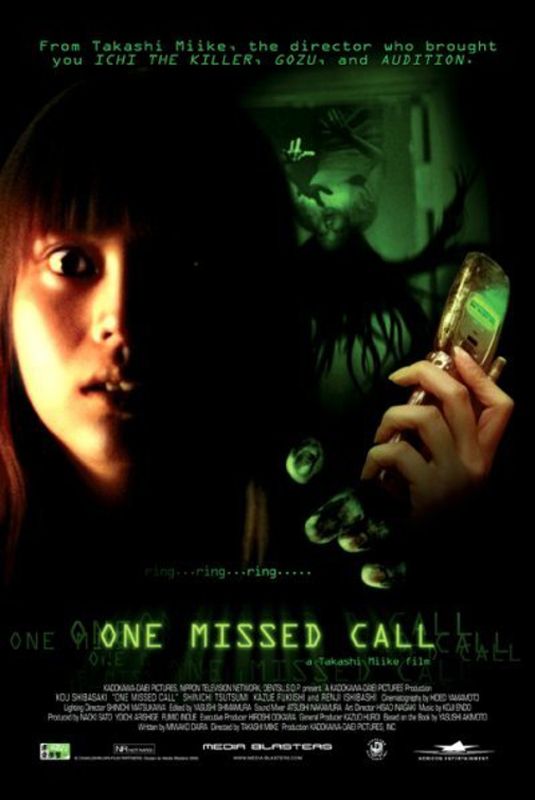
One Missed Call (2003)

This Japanese horror film — directed by Takashi Miike (Ichi the KillerDead or AliveThe Happiness of the Katakuris and a few other movies that will either upset you or make you happy) and written by Minako Daira (who wrote all three films in the series) — is all about a psychology student named Yumi Nakamura (Ko Shibasaki, Battle Royale) whose friends begin getting messages from the future that gives the time and date of their deaths. And then — you guessed it — they die. Now, Yumi has received her message.

Based on the novel Chakushin Ari by Yasushi Akimoto, this movie was remade in that mid-2000’s time when every single J-horror movie was getting Westernized.

Detective Hiroshi Yamashita (Shinichi Tsutsumi, Why Don’t You Play In Hell) begins helping Yumi, telling her that she isn’t crazy. His sister was one of the early victims, who are all called an hour after each murder and then die at the time and date that the message prophecizes. Then, they spit out a red jawbreaker.

Everything points to Mimiko Mizunuma, a girl who died from an asthma attack and whose ailments would indirectly happen to her sister Nanako like some psychic Munchausen syndrome by proxy.

There’s also a televised exorcism that goes horribly wrong, more possession, stabbings, severed hands clutching cel phones and the kind of twisted imagery that would be beyond the scope of most directors. However, this may be one of Miike’s tamest movies. That’s not a slight, but he has a tendency to go well beyond the boundaries of sanity. There’s also plenty of light and shadow here, along with a Bava-esque blue and red color palette in some scenes.

If you enjoy Japanese horror, consider this a greatest hits collection. A ringtone plays music from Miike’s Gozu, the idea of the curse itself is from Ringu, the apartment building with a water tank shot is from Dark Water, the idea of ghosts in the machine of modern technology comes from Pulse and The Grudge lends the ghost child imagery.

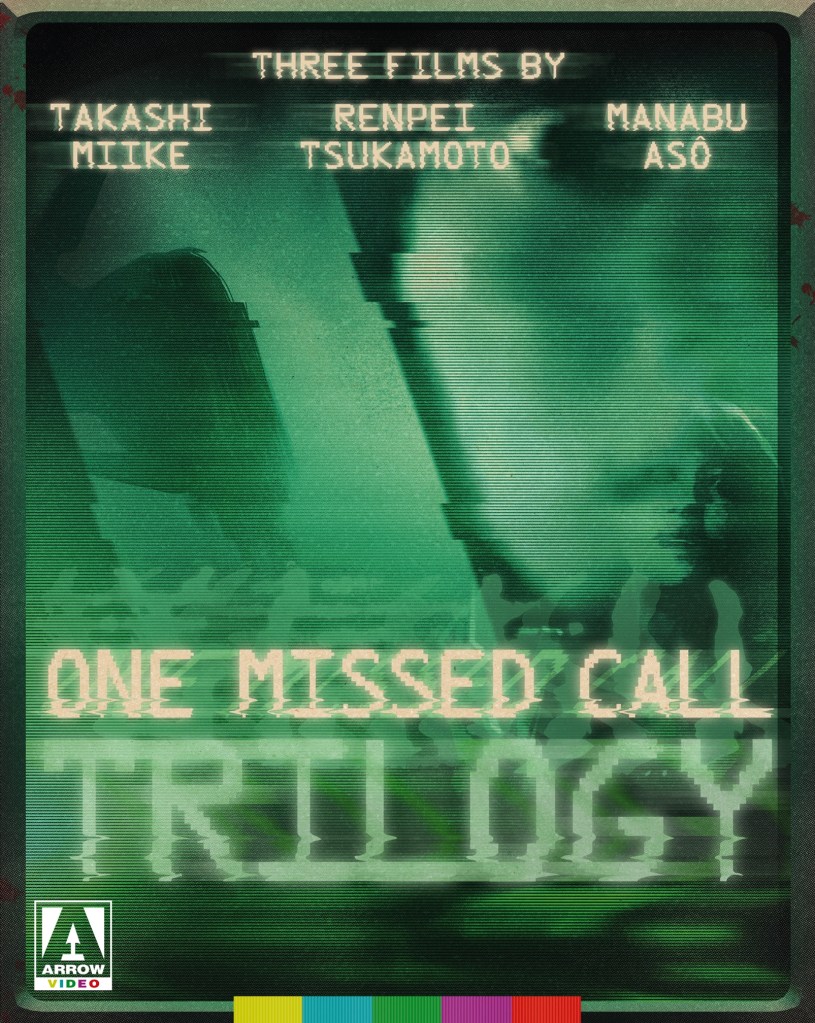
This film is available on the One Missed Call Trilogy release from Arrow Video. Not only does it have all three films in high-def 1080p, it also features plenty of extras for each film. This one has new audio commentary by Miike biographer Tom Mes, archival features like The Making of One Missed Call, interviews with actors Ko Shibasaki, Shinichi Tsutsumi and Kazue Fukiishi, and director Takashi Miike, footage from the premiere, an alternate ending, the Live of Die TV special and a feature called A Day with the Mizunuma Family.

DISCLAIMER: This set was sent to us by Arrow Video.

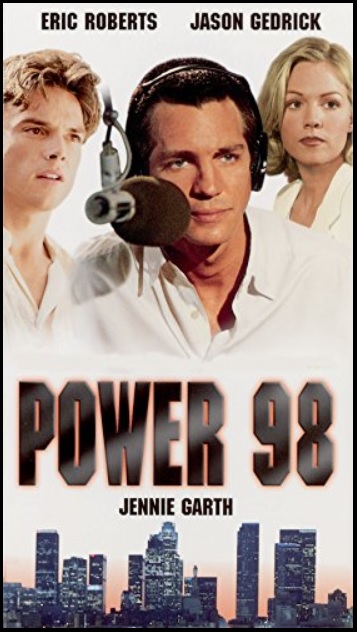
Power 98 (1996)

“If God didn’t want us to masturbate, he would’ve made our arms shorter.”
Karlin Pickett, KRZY “Power 98” Radio

Chances are—even if you are a diehard fan—you missed this neo-noir erotic thriller from Eric Roberts’s direct-to-video and direct-to-cable twilight years, one of his—to date—prolific 562 film and television roles. Even his most diehard fans wouldn’t be able watch each and every one of the 74 projects he filmed in 2017 alone. But we sure as hell try.

Why?

Because we, the fans of the video fringe, praise Eric Roberts with the same high regard we bestow to David DeCoteau (A Christmas Cruise) and Fred Olen Ray (A Christmas Princess). Yes, we will sit through a Lifetime damsel-in-distress movie—their Stalked by My Doctor franchise, now up to part 3—for our Eric Roberts fix. Yes, we sat through two Hallmark holiday movies—A Husband for Christmas and The Great Halloween Puppy Adventure—that Eric Roberts shot for David DeCoteau. Yes, we streamed Fred Olen Ray’s Boggy Creek: The Series on series on Amazon Prime just to listen to Eric Roberts’s voiceover narration. Yes, we watched David DeCoteau’s A Talking Cat just to hear Eric Roberts be . . . well, a cat.

Eric Roberts—as well as Nicolas Cage and John Cusack (Arsenal)—is either a down-on-his-luck and past-his-prime desperate thespian taking any job that comes his way to pay the bills—or he’s a brilliantly prolific actor who turns celluloid lead into ribbons of gold. For us, Eric Roberts is always the latter and never the former. When a project needs a slimy scumbag that, regardless of the slime, remains charismatic and likeable, Eric Roberts is the man who never disappoints his audience.

Such is the case with Power 98, the lone fictional writing and directing credit of Jaime Hellman, an equally prolific, Emmy Award-winning TV documentarian director (CBS, Oxygen, CNN) who delivers a script that’s not only well-versed in the film noir genre, but in the radio broadcasting industry as well. Courtesy of Hellman’s well-researched script rife with spot-on expositional broadcast terminology, Roberts’s—as well as Jason Gedrick’s and Steven Tobolowsky’s—radio broadcasting professional characters sound like—unlike most TV series or films set inside radio stations (see Zoo Radio as the worst case example)—real radio broadcasting professionals. Also lending to the film’s credibility: it was filmed, after hours, inside a real radio station: KPHX 1480 AM located Phoenix, Arizona (which doubles as L.A in the film). The sharp cinematography is courtesy of commercial director Kent Wakeford, who got his start behind the lens on Martin Scorsese’s Mean Streets (1973) and Alice Doesn’t Live Here Anymore (1974), along with the Blaxploitation classic Black Belt Jones (1973).

The “real” KPHX. Stickers courtesy of Radio Sticker of the Day blogspot.

Unfortunately, Power 98’s direct-to-video low budget format stymied the more-than-competent Hellman and Wakeford celluloid tag team. If this radio-set neo-noir had been backed with a mid-double digit millions budget that would have lent to expanding its 89-minute cable movie length to a 120-minute theatrical length, Power 98 could have achieved the blockbuster erotic thrills of Adrian Lyne’s Fatal Attraction (1987) and Paul Verhoeven’s Basic Instinct (1992) or, at the very least, the backstabbing betrayal highs of John Dahl’s indie film noir homage, The Last Seduction (1994). Thus, we’re left with a film that stagnates as being too racy to qualify as a Lifetime damsel-in-distress flick and not racy enough to qualify as an Andrew Stevens and Shannon Tweed erotic soft-core fest for the late night Showtime cable crowd.

Yes, Power 98 could have been so much more. But it could have been much less. And that’s why we love Eric Roberts: he balances the scales of cinematic injustice for the low-budget film maker.

Think back to Clint Eastwood’s directorial debut, the definitive radio psycho romp, Play Misty for Me (1971) (which Fatal Attraction later ripped off, only ditching the radio angle), with the disc jockey—and not the fan—as the psycho. Instead of Barbet Schroeder’s Single White Female (1992), think Single White Disc Jockey. Now you’ve descended into the twisted and paranoid, murder and revenge-filled neo-noir that is Power 98.

Eric Roberts is Karlin Pickett, a successful shock jock on the air in Phoenix with lots of fans—female fans in particular. After one his (many) one-night stands goes bad—with his date taking a seven story header—Karlin covers up her death and heads to Los Angeles. Rick Harris (Stephen Tobolowsky; Ned Ryerson in Groundhog Day and Commissioner Hugo Jarry in HBO’s Deadwood), the owner of a dying classical music station in L.A isn’t fond of Karlin’s brand of humor concerned with penises, testicles, and masturbation, but he does “love the numbers,” so women judging male butt contests and strip poker tournaments on the air, it is.

But this is a film noir and Karlin’s “big plans” for his show needs a patsy, so he picks Jon Price (Jason Gedrick; 1986’s Iron Eagle, 1991’s Backdraft), an ambitious producer at the station with dreams of getting his big break. The screws begin to turn when Jon discovers a creepy call from “Eddie,” in which he confessed to a murdering a woman, was faked—so says Karlin; he set it up “for ratings.” That is until two detectives (Larry Drake of Darkman and Dark Night of the Scarecrow and James Pickens Jr. of TV’s Grey’s Anatomy and The X-Files) inform Jon that the caller wasn’t a crank. Then another dead woman shows up—and this time, all evidence points to Jon. And, with that, it’s a cat and mouse game of turning screws, bitchy women, and smoking guns as the cyanide-laced bourbon flows. And guess who “Eddie” turns out to be?

Courtesy of the film’s distribution through Warner Home Video and Curb Records’ distribution relationship with Warner, be sure to stick around for the end credits, which feature the track “Sea of Love” by Lonesome Romeos. Signed to Curb Records, the Los Angeles-based alt-rock/roots-rock power trio also placed two songs, “U.S Male” and “Oh, You Angel,” on the soundtrack for the baseball comedy, Major League (1989). If you’re into Bruce Springsteen, John Cougar Mellencamp, and Tom Petty (Heartbreakers’ drummer Stan Lynch and keyboardist Bentmont Tench backed the Romeos in the studio on their 1989 and 1996 albums), then you’ll dig the Lonesome Romeos—one of the many forgotten bands that drowned in the grunge wave that swept in from the Pacific Northwest and wiped out the Los Angeles music scene.

You can watch pristine uploads of Power 98 for a small fee on Amazon Prime, Vudu, and You Tube. Or you can watch a pretty clean Finnish-subtitled version on You Tube for free. And be sure to check out Eric’s Vanity Fair career retrospective, it’s a great read.

Yeah, we love Eric Roberts. And always will.

If you have a You Tube account — and don’t we all — you can watch the unlisted and non-embed, age-restricted sign-in only trailer, here.

There’s more radio flicks to be had on B&S About Movies with the comedies A Matter of Degrees and FM, and, the slasher flick Open House, and the suspense-thriller Outside Ozona. In fact, this is the first review of our weeklong blowout of movies set inside radio stations. Stay tuned to B&S About Movies on your radio dial!

About the Author: You can read the music and film reviews of R.D Francis on Medium and learn more about his work on Facebook. He also writes for B&S Movies.
Harriet (2019)

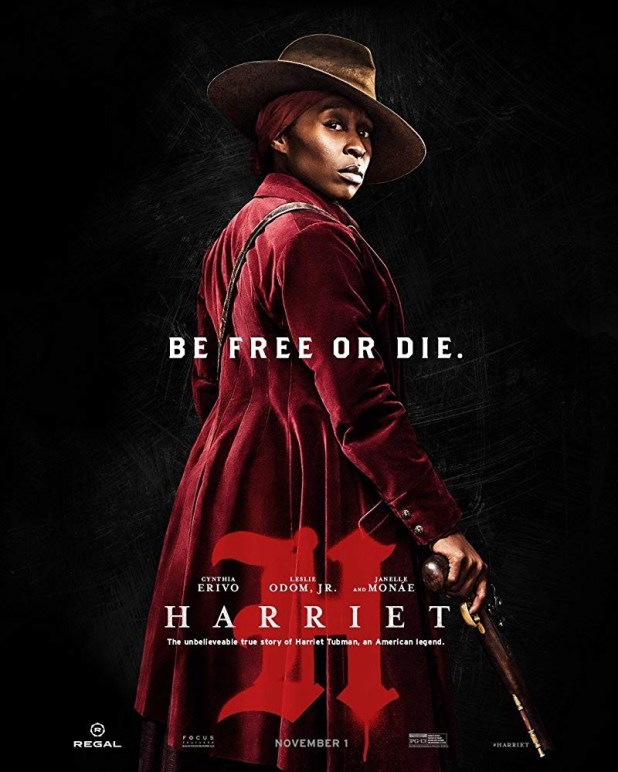
Kasi Lemmons started her entertainment career as an actress — she was Bernie in — before starting to direct. The movie I remember her for most is The Caveman’s Valentine. A film about Harriet Tubman was rumored for years and I’m quite glad she got the job, as this is a movie that moves quickly and imparts plenty of emotion and history without feeling preachy or boring. That’s quite a feat for a historical film.

Cynthia Erivo, who was in the stage revival of The Color Purple and who has been great on The Outsider every week, plays Harriet throughout her life, as she escapes from slavery (choosing to either live free or die) and then continually comes back to help others escape. It’s a harrowing tale filled with twists that history class never taught me, such as the fact that the man who gave her the last name Tubman remarried, as everyone in her family believed that she died after she jumped off a bridge to escape her owner Gideon Brodess.

Leslie Odom Jr., who was the original Aaron Burr in Hamilton, is in this, as is Janelle Monáe, a freewoman whose sophisticated ways are in direct contrast to young Harriet.

I would have never watched this movie if not for a freelance assignment where I’ve been creating teacher guides for biographical films. So in some strange way, the predicament of my occupation has led to me experiencing plenty of new things I would have otherwise never had the opportunity to see, listen, watch or learn.

You don’t need to go through all that to see this. I recommend you watch it at your first opportunity.

The Farewell (2019)

Turns out award shows can have a positive result on my movie watching. I wouldn’t have known anything about this film if Awkwafina hadn’t won the Best Actress – Musical or Comedy Golden Globe for her work here.

Luckily, the movie lived up to my expectations and then some.

Based on director Lulu Wang’s real life —  which she first publicly discussed on an episode of This American Life — The Farewell proves that the foreign may not be so foreign. Billi (Awkwafina) learns that her grandmother Nai Nai (played by Chinese theatrical actress Shuzhen Zhao) is dying from cancer, yet her family refuses to tell their matriarch. Instead, an elaborate wedding ruse is invented so that they may all see her one more time.

The truth is, six years after the real life diagnosis, Wang’s grandmother remains alive. She still didn’t know that she even had the disease until this movie. Incredibly, Wang kept the secret from her during and after the making of this movie. She would only discover the true story when she discussed the movie with her sister Lu Hong, who plays herself in the movie. The fact that the movie was released in China as Don’t Tell Her was not lost on the real life Nai Nai, who remarked, “…that’s why you didn’t tell me, because I am the “her” of the Don’t Tell Her.”

The way that families deal with aging is strange. My father had a stroke last year and often worries so much about the shaking in his hands — which he can’t understand and needs an explanation daily — that the rest of my family told him that it was all because one of the knives he uses isn’t balanced properly and that the shaking isn’t really his fault. Much like the lies in this movie, that simple explanation makes things easier for him. Is it right? I’m not entirely sure.

The lesson here comes from Nai Nai’s farewell. She warns Billi of being “the bull endlessly ramming its horns into the corner of the room” and tells her that “life isn’t just about what you do, it’s more about how you do it.” Certainly this seems like no great revelation, but this movie is all about the way the story and the advice and the emotion are told.

I enjoyed it. Perhaps you will. You can watch The Farewell on Amazon Prime.

The Taste of Betel Nut (2017)

A polyamorous male couple decides to test the limits of the restrictive society that they live in when they become romantically involved with a young woman. Yes, this is the winner of the SIFF 2018 China Stars Award for Best Film and not usually the kind of film we feature on our site.

That said, it’s well-made and interestingly shot, starting off almost as a series of non-sequiturs.

Li Qi works at a dolphin show and his friend Ren Yu runs a mobile karaoke that is popular because he looks like screen actor Leslie Cheung. A young woman Bai Ling hooks up with both of them, but soon, an event rocks all of them to their very souls.

This movie is mostly dialogue-free, so if you’re concerned about the foreign language barrier, there really is none. The movie is known as Bing Lang Xue in its original language.

It’s the second film of Hu Jia, who also directed Dance With Me.

The Taste of Betel Nut is available on demand and DVD from Uncork’d Entertainment.

DISCLAIMER: This movie was sent to us by its PR department.

A Wakefield Project (2020)

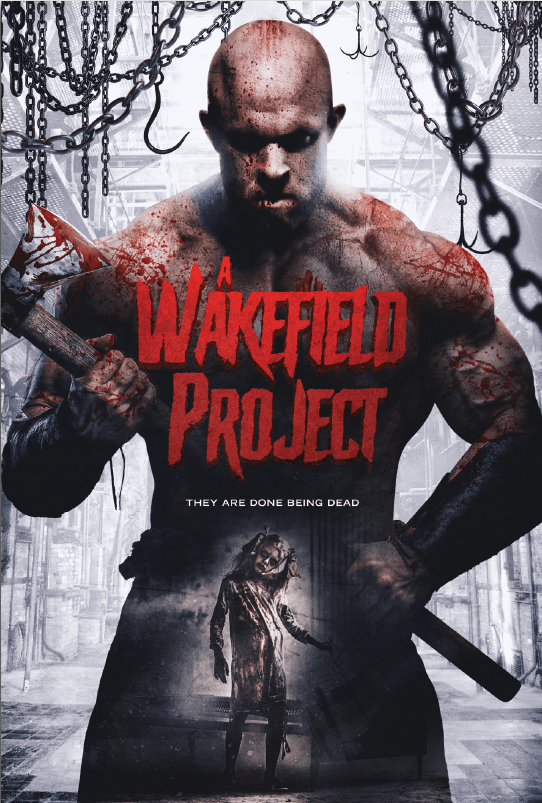
Eric and Reese have moved to Wakefield to start a bed and breakfast, just in time for solar flares to kick in. A medium shows up and starts informing them of the history of their property, which was once owned by a killer named Nathan Cross. A shift in energy from the flares causes the veil between the living and dead to lift, so all the death in this quaint little town has come back to haunt everyone.

Director L.A. Lopes played a cashier in the remake of Poltergeist and now she’s making movies of her own. It was written by Lindsay Seim, who was in Insidious: Chapter 2 and St. Agatha before this. Oddly, she doesn’t list writing this film in her IMDB credits.

A Wakefield Project is available on demand and on DVD from High Octane Pictures.

DISCLAIMER: This movie was sent to us by its PR department.

Moon 44 (1990)

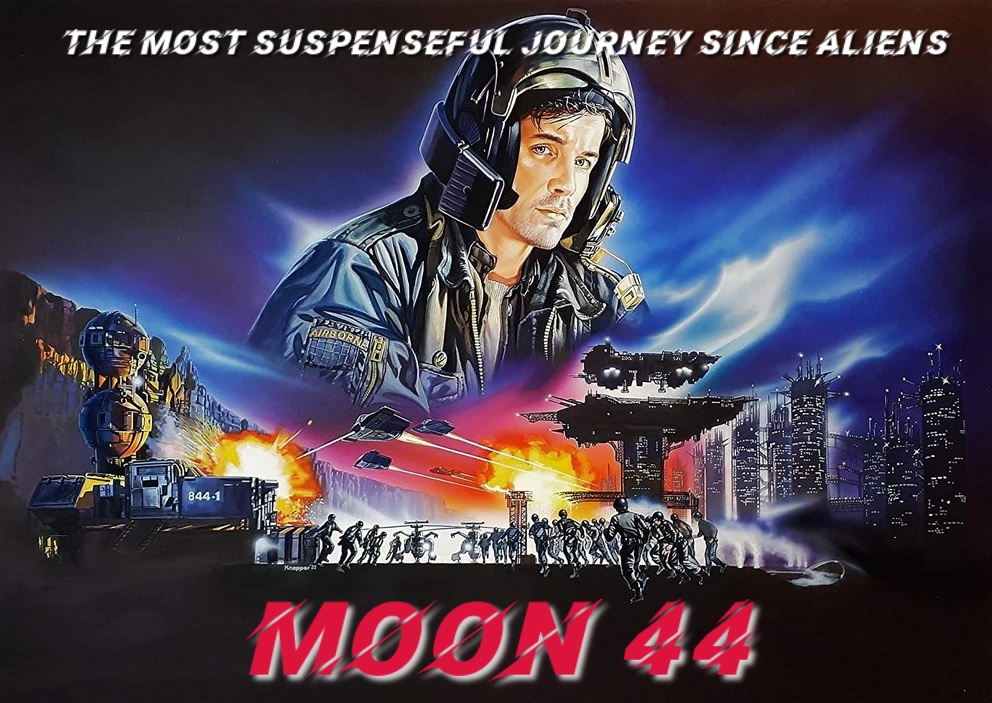
Critics didn’t care for Roland Emmerich’s sci-fi warm up to Universal Soldier (1992), Stargate (1994), and Independence Day, but I’ve always enjoyed this galactic cocktail that pours one part Escape from New York (a disgruntled ex-soldier/anti-hero Felix “Don’t call me Snake” Stone) and two equal parts of Outland and Alien into a Roger Corman New World Pictures commemorative tumbler that’s shaken and poured over Blade Runner.

Toto? We’re not on LV 426 anymore. I think this is “the dark side” of Moon 44!

Check out the trailer.

In the year 2038, in the wake of all of Earth’s natural resources being depleted, multinational corporations—as in Creature (1985)—have taken control of the galaxy and battle each other for mining rights. The two leading companies, Pyrite Defense and Galactic Mining, are in a current battle over a grouping of moons—46, 47, and 51—in a remote region of space known as the Outer Zone. Pyrite has already taken control of the moons and stole two of Galactic Mining’s mineral shuttles—and they’re on their way to take Moon 44.

So Galactic Mining hires Stone (Michael Pare of Eddie and the Cruisers and Streets of Fire) who, to get out of his contract, must take an undercover mission—as a prisoner, along with other prisoners that’ll be granted full pardons for flying a fleet of Airwolf meets Blue Thunder hybrid battle-choppers to protect the mining operation. While there, Stone mixes it up with fellow prisoner O’Neal (Brian Thompson, who made his debut in Sly Stallone’s Cobra) and the crooked mining operation defense officers played by Malcolm McDowell (Rob Zombie’s Halloween reboot, American Satan, FOX News mogul Rupert Murdoch in 2019’s Bombshell) and Leon Rippy (General West in Stargate, HBO’s Deadwood).

So, is Moon 44 galactic flotsam and jetsam for the Death Star’s trash compactors? Eh, for a $15 million budgeted B-Movie shot in West Germany, Moon 44 certainly looks great, thanks to cinematographer Karl Walter Linderlaub (who shot Universal Soldier, Stargate, and Independence Day), and the up-against-the-budget production designs by Oliver Scholl and Sven Hass. (While Hass faded from the business, Scholl pressed onward, working on Edge of Tomorrow, Spider-Man: Homecoming, and Suicide Squad.)

Moon 44 served as the final mainstream film of actor Stephen Geoffreys, who portrayed Cookie, a drug-dealing military flight navigator. After starting out with memorable roles in the ‘80s hits Heaven Help Us, Fraternity Vacation, Fright Night (as Evil Ed), and 976-Evil, he left Hollywood to work in gay porn—under the names Larry Bent and Sam Ritter. And it was also the last acting gig for Dean “I’m not John Cryer” Devlin, who rose through the ranks of Hollywood as a writer and producer, most recently with Geostorm (2017).

Originally intended for an American theatrical release, the producers eventually realized the film’s shortcoming as a weak competitor to the films from where it pinched all of its ideas, so it became a popular direct-to-video rental (marketed as “The Most Thrilling Adventure Since Star Wars,” and “The Most Suspenseful Journey Since Aliens”) and was part of a “Moon” TV syndication package that aired on American UHF-TV alongside The Dark Side of the Moon (1990) and Moontrap (1989).

Free VHS rips of Moon 44 come and go — and the two decent uploads we once had linked are now gone from You Tube. It was also on Amazon Prime — and that upload is gone as well. So Google and You Tube at your leisure to see if you find a streaming upload.

And while we’re on the subject of cool, little sci-fi films such as Moon 44, The Dark Side of the Moon, and Creature, be sure to check out our reviews for two clever, ultra-low budgeted sci-fi films filled with more heart and soul than most big-budget studio romps: Space Trucker Bruce and Ares 11. You’ll be glad that you did.

50-plus space flicks to enjoy.

About the Author: You can read the music and film reviews of R.D Francis on Medium and learn more about his work on Facebook.

Severed Ties (1991)

This third and final movie by Fangoria magazine’s film shingle, produced in conjunction with Columbia Pictures, who wanted to get into the home video horror market, wants to be to the ‘90s what Basket Case and Re-Animator (in particular) were to video renters in the ‘80s. And while Severed Ties doesn’t measure up (does any movie co-starring SNL third banana Garrett Morris, ever do?) to the unhinged, off-the-wall dark humor of either, it will slide in nicely into your retro-horror collection shelf alongside both, along with your copies of the Bill Paxton-starring Brain Dead (1989) and the granddaddy of black humor horror, Return of the Living Dead. And will you flashback to David Cronenberg’s mind-of-its-own asassinating arm in Videodrome? Yes, and it’s a welcomed reminder.

My advice: double feature Severed Ties with Edward Hunt’s The Brain (1988; which is equally off-the-wall, but played straight) and you’ll have yourself one hell of a popcorn-noshing night starring brains and lizard arms swingin’ their tails.

Harrison Harrison (‘80s TV actor Billy Morrissette from Family Ties, Growing Pains, and Blossom) is a young scientist carrying on his dead father’s work in tissue and limb regeneration utilizing reptilian DNA—much to the chagrin of his overbearing and domineering mother, Helena (Elke Sommer; a long ways away from Baron Blood and Lisa and the Devil).

During the course of good ‘ol mom and her ex-Nazi doctor-lover, Dr. Hans Vaughn (Oliver Reed, a long ways away from Burnt Offerings), stealing the formula to sell as their own, the ensuing argument that erupts between the trio ends in tragedy when the lab’s automated door closes and severs Harrison’s arm. So he injects himself with the regeneration serum (in Re-Animator day-glo green, natch) to grow a new arm. And one does sprout—only with reptilian scales. Then it transforms into a lizard-snake monster that can detach from his body, crawl off, and kill. (The arm detachment and reattachments scenes—with, I kid you not, Harrison’s “shoulder vagina” and his phallic arm—are a piss-and-a-half and only darkens the already dark comedic bend of the film.)

Now every on-the-run anti-hero needs a sidekick, so Harrison meets up with Stripes, a homeless war vet (Garrett Morris) who lives with a sewer-based religious cult led by wildman wrestler, actor and musician Johnny Legend, doing what he does best as a crazed, maniacal preacher (Sam? How is it that you never reviewed My Breakfast with Blassie?). Harrison’s lizard arm, of course, dispatches Legend—and Harry takes over as leader of the cult and sets forth to create a lizard-spawn army. Oh, and our anti-hero needs a damsel-in-distress love interest, so he meets Eve, a homeless mute girl (Denise Wallace, who vanished from the business and never acted in another project) that’s kidnapped by the evil corporation that wants the regeneration formula.

And wow . . . just wow. You gotta watch out for that out-of-left field, incestuous twist ending right out David Cronenberg’s The Fly.

Elke and Oliver, being the pros that they always are, know the material is pure camp, so they just go for broke, chewin’ the scenery with relish and aplomb—with Reed stealing the show with his deadpan comedic performance. (Reed is regarded as Britain’s “purest actor”; unlike most stodgy British actors, Reed never studied Shakespeare or acted on the stage. For a brief time in the early ‘70s, he was the #1 box office actor in the world—and had the balls and clout to turn down the role of Quint in 1975’s Jaws. That’s bad ass . . . and a bag o’ chips.)

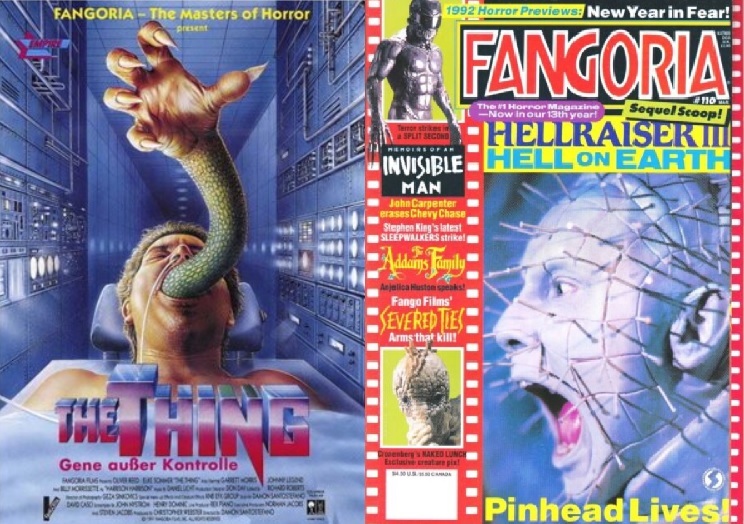
The German theatrical one-sheet and Fangoria’s promotion of the film in the pages of their magazine.

The most interesting of aspect of Severed Ties—as with Jay Roach getting his start with Zoo Radio—is that it also marks the beginning of a long and successful screenwriting career. Before you can get to write the big, major studio pictures The Net (1995; starring Sandra Bullock), Terminator 3: Rise of the Machines (2003), Cat Woman (2004), and Terminator  Salvation (2009), you have to make your bones writing for Fangoria magazine’s bid to create a film shingle over the door. So John Brancato scribed two of their films: Severed Ties and Mindwarp (1992; starring Bruce Campbell and Angus Scrimm). (Fangoria’s other film was 1991’s Children of the Night starring Karen Black).

(Enjoy this trailer for Fangoria Films/Columbia Pictures Corporation co-productions of Severed Tied and Children of the Night from the 1992 VHS release of Mindwarp (1992). Upload courtesy of the Goremet.)

Severed Ties is another one of those obscurities that never plays on TV (come on Comet and Antenna TV, do us a solid) and is not available on DVD. So if you want it for your collection, you’ll have to purchase one of the many VHS copies available on eBay and Amazon. And watch out for those grey market DVD rips. You can watch a pretty clean VHS rip on You Tube.

Do you need more WTF? movies of the Severed Ties variety? Then check out our December 2018 “Ten WTF Movies” with links to full reviews.

About the Author: You can read the music and film reviews of R.D Francis on Medium and B&S Movies, and learn more about his work on Facebook.

The Brain (1988)

“It’s a brain. Not an animal.” — Dr. Anthony Blake

Warning! This Canuxploitation shocker carries the Shapiro-Glickenhaus Entertainment seal of approval. Yes, the studio that brought us everything from Basket Case to Maniac Cop, from Black Roses to Frankenhooker. Then there’s C.H.U.D., Death Spa and Zombie Nightmare. If you haunted the video store shelves of the ‘80s, you’ve loaded a Shapiro-Glickenhaus VHS into a VCR.

And you know what that means: The acting will be questionable (and, in the case of The Brain, you’ll end up rooting for “The Brain” and not the dick-whiny high school hero and his screechy girlfriend). The story will be weak (and, in the case of The Brain, the ending is just stupidly lame). But you will get yourself a slice of low-budget entertainment of the first order. The fact that Ed Hunt directs is icing on the B-Movie schlock cake.

Oh, and yes: you will get some questionable production values; it is an SGE flick, after all. However, in the case of The Brain, you do not want to miss director Ed Hunt’s opening hallucination set piece of inward-pressing walls, live teddy bears bleeding from the eyes, demon hands tearing through walls, and monster tentacles punching out of TV sets. Considering the budget, it’s very well done.

Hey, why am I telling you? See for yourself!

Yeah we love Canadian director Ed Hunt here at B&S Movies. Why? Hunt’s an “all in” type of filmmaker and you do not get run-of-the-mill storytelling. When he does a Star Wars rip, you get Starship Invasions, a tale about UFOs and an underwater pyramid filled with telepathic aliens and Sir Christopher Lee in a black Gumby outfit. When he does a slasher flick, you get Blood Birthday, a story about telepathic kids born under a solar eclipse infected with a taste for blood. And with The Brain you do not get a straight, graphic horror film: you get a campy, sociological statement on Scientology brainwashing, the psychological effects of television, and a lesson that, in order to succeed, you have to submit to some level of conformity. But again, this is an Ed Hunt flick, so you’ll have to wade through the blood of a wife “divorcing” her husband via an electric carving knife.

The Brain reunites Bloody Birthday screenwriter Barry Pearson (Firebird 2015 AD) with Ed Hunt (they also worked together on 1986’s Alien Warrior) for more of that same “what the hell, why not” approach in a film that critical guides opine is a cross between the ‘50s classic Invasion of the Body Snatchers and the dumber John Agar camp fest that is The Brain from Planet Arous. Now, while that’s an accurate pitch, I’d have to add that this mind control romp also tosses in a hallucinatory dash of Don Coscarelli’s Phantasm and David Cronenberg’s Videodrome. More astute fans of the video-obscure may name check the New Zealand-Australian shot Strange Behavior (aka Dead Kids), which dealt with teens mind-controlled into murder.

As with the aforementioned-linked Blood Birthday, we’re back for more horrors in the small “Southern California” town of Meadowvale (actually a real Canadian town). Dr. Anthony Blake (played by British-Canadian actor David Gale, who pleasantly reminds us of his superb work as Dr. Carl Hill in Re-Animator) is a local psychiatrist and self-help guru of wayward teens. The fact that his teen patients have suffered hallucinations that led them to commit murders and suicides doesn’t seem to alarm anyone. In fact, the ratings of his Dr. Phil-inspired “Independent Thinkers” cable TV show has climbed so high in the local ratings that it’s ready to go national. And what’s the reason no one is alarmed: the show has everyone in town brainwashed. But don’t expect the “brainwash” to be some man-made, electromechanical device of the Cronenberg variety. There’s no From Beyond “Sonic Resonator” making anyone “see” things. This is an Ed Hunt what-the-hell-why-not mind control movie, after all.

The newest inductee to Blake’s clinic (that, with its curved architecture and round windows, looks like a UFO) for wayward teens is Jim, a high school delinquent who’s “so smart” that he’s intellectually bored to the point of blowing up the school’s toilets and has reached the point of expulsion. Jim’s “intellect” helps him in rejecting Blake’s mind-control methods masquerading as therapy—and he stumbles into Blake’s secret: a giant, disembodied alien brain, which is able to spread open its two hemisphere and swallow a person whole, is wired into Blake’s TV show’s transmissions. And what is up with the brain? Is it an alien creature? Is it something Blake cooked up in his lab? Is Blake, like The Tall Man in Phantasm, himself an alien? Or is he a human with once noble intentions now under the control of his own experiment?

Well, keep wondering. We never find out. Argh!

And remember the lame ending? Gale’s Dr. Blake gets punched in the face—one punch, mind you—and his head falls off (a funny homage to his career-making role) and spurts green zombie-goo. Then Jim, the prank-pulling jackass “hero” once on the verge of suspension, rides off into the sunset and gets into Princeton? Where’s the Phantasm twist-ending where we get the ol’ “it’s just a dream/no, it’s not” and Jim the Dick gets what he deserves: an alien brain tentacle choke n’ chomp as he’s yanked into the hallucinatory abyss. We loved Mike—and we were sad when The Tall Man sucked him through the broken mirror. Jim deserves a Dr. Blake from beyond comeuppance.

Eh, who cares! How can you turn down a movie with David Gale hamming it up and losing his head, again (!), nudity, a damsel chained up in cold storage, and a giant, man-eating brain that grows a face and slimes around the catacombs of a psychiatric hospital on its spinal cord? The Brain is one of those movies, like Phantasm or Black Roses, Shock ‘em Dead or Shock Waves, that I’ve revisited many, many times over the years from the warmth of my VCR. Is this as crazy as Fangoria’s Severed Ties. Oh, hell yes, and a bag ‘o chips!

Thanks to those fine folks at Shout Factory, you won’t need to scour the web for a muddy VHS print for your collection, as they released The Brain on Blu-ray in April 2019. If you’d rather a DVD copy, then you will have to scour the web to find the now out-of-print 2011 DVD issued by Britain’s Boulevard Entertainment.

If you can’t wait that long, you can take a dive into the green, brain tank waters of You Tube with these VHS rips of the full movie here and here. We also featured The Brain — with a second look — as part of our weekly “Drive-In Friday” featurettes with a tribute to the old USA Network’s “Night Flight” programming block from the ’80s.

About the Author: You can read the music and film reviews of R.D Francis on Medium and learn more about his work on Facebook. He also writes for B&S Movies.