October is almost upon us and you know what that means…
It’s time to go crazy watching horror movies.
Not just any horror movies.
We’re talking stalk and slash. Awesome kills. Tom Savini. Prowlers, mutilators, phantom killers and the blackest eyes you’ve ever seen.
Get ready for two slashers a day, all October long. I’ve assembled a literal murderer’s row of gore and carnage for you to enjoy, but there’s still time to send in your requests.
None of these movies have ever been featured on the site before! If you want to see the ones we have covered, check out this Letterboxd list.
Don’t fuck in the woods. Keep your alcohol at home. And if you’re lucky, you just may survive slasher month!
It’s unfortunate that Wesley Barry’s honorable director-producer ambitions through his Genie Studios—portraying a post-apocalyptic society that, to save humanity, fuse man with machine to create human-like androids from freshly dead human corpses, then deals with their creations’ development of cyber-theology and a subsequent worker’s revolt—grossly exceeded this film’s restrictive budget.
Ultimately, Creation of the Humanoids, an entry from the first wave of post-apocalyptic films, which predates the ‘70s second wave initiated with the dual-tent poles of The Omega Man and Soylent Green (1971/1973), introduces interesting—and now familiar—concepts regarding racism, the state of marriage, and man’s loss of humanity. So, courtesy of its financial shortcomings, instead of a sci-fi classic (well, it is; in its own, strange way) in the vein of the groundbreaking black-and-white post-apocs Metropolis (1927) and Things to Come (1936), which it seems Barry was attempting to achieve, we’re left with the ambitious, cardboard incompetence of Journey to the Center of Time (1967) and In the Year 2889 (1968). It’s a stale, Aldous Huxley vision of a not-so-Brave New World.
Is Creation of the Humanoids beyond the mediocre to the point of being lifeless? Does the constant “human drama” yakety-yak set against the lack of special effects kill the film’s subtextual sophistication? Is the acting hackneyed to the point of the actors being mere cardboard cutouts against the Irwin Allen-styled ‘60s TV series stage play accouterments of obvious matte paintings, floor-to-ceiling drapes, and black-void backgrounds to nowhere? Do the humanoids look like they’re wearing latex bald-wigs and matching-color rubber gloves? Are those Confederate Army caps left over from the Gone with the Wind costume stockpile? Did Academy Award-winning camera-man Hal Mohr and Universal Pictures’ chief makeup artist (of Frankenstein fame) Jack Pierce do the best they could with the budget they didn’t have?
Director Wesley Barry was a 1920’s child star whose acting career began in the silent film era alongside its biggest stars: Mary Pickford and Gloria Swanson. While he directed eight films, including several ‘50s TV series episodes, and a slew of ‘60s and ‘70s TV series as an assistant director (he even worked on Roger Corman’s The St. Valentine’s Day Massacre)—he’s best known for Creation of the Humanoids, his final feature film as a director. And it’s all thanks to his sci-fi “connection” to the post-apoc masterpiece, Bladerunner.
To deny the similarities of Creation of the Humanoids to Blade Runner—the 1982 film drew from Philip K. Dick’s Do Androids Dream of Electric Sheep?, which was published six years after Creation and also deals with androids not aware they’re androids—is to deny the narrative similarities of Sam Raimi’s Evil Dead (1981) to Equinox (1970). And we sci-fi buffs remember the infringement and eventual settlement issues between The Terminator (1984) and Harlan Ellison’s ‘60s The Outer Limits episodes “Soldier” and “Demon with a Glass Hand,” don’t we?
It’s sometimes incorrectly reported that Creation of the Humanoid is an adaptation of a 1948 novel, The Humanoids by Jack Williamson. However, as with Ray Milland’s blatant “pinching” of John Christopher’s The Death of Grass for Panic in the Year Zero (1962), officially adapted as No Blade of Grass (1970)—the script for this Blade Runner precursor brazenly borrows elements from Williamson’s novel.
In today’s litigious society: lawsuits would fly fast and furious between book publishers, producers, directors, novelists . . . it’s all cinematic déjà vu (just like in the ‘70s submarine romp, The Neptune Factor).
This post-apocalypse tale concerns itself with the themes of racism and man’s loss of humanity against the scornfully referred “Clickers,” a man-made race of bald, blue-gray, synthetic-skinned, silver-eyed humans (read: blacks) whose population is increasing, while humanity—who’ve developed a technological codependency on their robot slaves—sees their own birth rate decreasing. This triggers the creation of the human-terrorist paranoia-organization (read: the ‘50s “Red Scare”) “The Order of Flesh and Blood” (read: the Klu Klux Klan).
Amid the sociopolitical upheaval, a scientist faces resistance in expanding the “labor force” Clickers’ programming for emotions—going as far as to transform them into human replicas (read: Ash from Alien). Dr. Raven, with mad-scientist tenacity, intends to “thalamic transplant” the personality and memories of recently deceased humans into a robot-replica of that person. However, the human-humanoids have one flaw: like their “Clicker” brethren, they must go to “temple” (recharging stations), which also serves as information exchange terminals with the “father-mother” central computer (read: cyber-theology/church).
Of course, all stories need a romance subplot: Captain Cragis, a leader in the Order of the Flesh and Blood resistance, falls in love with Raven’s assistant, Maxine, who opposes the Order’s manifesto. And Cragis is jealous of Maxine’s “love” for her grey-blue skinned concierge. And Cragis and Maxine come to discover they’re both android-replicants. And that the “human” Maxine died in a terrorist attack perpetrated by Cragis.
While Creation occasionally appeared on U.S UHF TV stations beginning in the late ‘60s, the hungry-for-product home video market released the film on Beta/VHS in 1985 (complete with a bogus rendering of ol’ Doc Brown from Back to the Future as a “mad scientist” with a captured babe-in-a test tube; cover), along with the eventual DVDs issued in the early 2000s.
Hey, wait! Where are you going? There’s another (production) plot twist!
Do you remember how wee young pups drooled over Andrea Marcovicci as Chalmers—the hottest android in the Universe (she puts Pamela Gidley’s android in Cherry 2000 to shame)—in Spacehunter: Adventures in the Forbidden Zone (1983)? Remember how we drooled, I mean, noticed she was reading a copy of the book, R.U.R, in bed? Remember how, like with Mike’s copy of My Name Is Legion by Roger Zelazny (Damnation Alley) in Phantasm (1979), we, the bullied sci-fi/horror fan and comic book collecting freaks n’ geeks searched out copies of those books?
No? Well, pull up a Chalmers, I mean, a chair.
All of this robot, genetic-biological engineering exposition we’ve enjoyed in Blade Runner and other sci-fi films begins with one man—who really did “create” the humanoids: Nobel Prize-nominated and award-winning, Hungarian-Czech writer, Karel Čapek. His 1920 stage play/book R.U.R (Rossum’s Universal Robots) introduced the word “robot” and many of the concepts used in today’s science fiction. You can read the free eBook online at Gutenberg.org or buy a copy at Amazon, then watch Creation of the Humanoids for free on You Tube.
We discuss the use of A.I in cinema with our “Exploring: The ‘Ancient Future’ of A.I” featurette, in which we also discuss the three, official film versions of R.U.R.
About the Author:You can read the music and film reviews of R.D Francis on Medium and learn more about his work on Facebook.
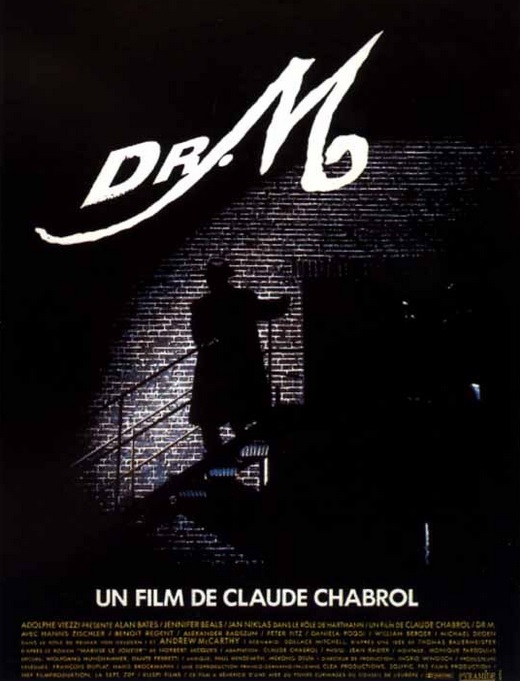
While not a household name in the U.S., director Claude Chabrol (with films like Bluebeard and 1975’s Innocents with Dirty Hands) is revered in his homeland—and throughout Europe—alongside other prominent, “mainstream” filmmakers birthed from the ‘50s French New Wave: Francois Truffaut (1966’s sci-fi Fahrenheit 451) and Jean-Luc Godard (1965’s sci-fi Alphaville).
Inspired by German Expressionist filmmaker Fritz Lang (1932’s apoc-futuristic Metropolis) and Alfred Hitchcock’s oeuvre, Chabrol is best known to U.S. audiences for his 1969 (written/directed) foreign hit, La Femme infidel (The Unfaithful Wife). A Fatal Attraction-esque husband-murders-lover-of-cheating-wife thriller, Chabrol’s film received renewed interest when remade by that film’s director, Adrian Lynne, as Unfaithful (2002; with Richard Gere and Diane Lane).
When the centenary year of Lang’s birthday came around, Chabrol decided to pay tribute to his cinematic idol with a futurist-Metropolis spin to Fritz Lang’s 1922 silent, two-part mystery-masterpiece, Dr. Mabuse: The Great Gambler and Inferno*. Most likely—with a cast featuring Jennifer Beals of Flashdance fame (as Sonja Vogler) and Andrew McCarthy (as an “assassin”; his appearance, so brief, it doesn’t warrant his top-billing)—this admittedly low-budget yet engrossing film (titled Dr. M throughout Europe) was criminally slapped with a hackneyed, U.S. teen-slasher title due to its American-based stars: Club Extinction, for its domestic home video bow.
In a cost-effective, not-too-distant Bladerunner future, Berlin (remember, the Berlin Wall didn’t fall until November 1991; so it is still standing in this “future”), a police inspector (as in the aforementioned-linkedAlphaville) traverses the city in his investigation of an “outbreak” of shocking-spectacular suicides that “plague” the city. Clues soon lead him to a “Big Brother” multimedia combine (as in Kamikaze ’89). The combine employs his lover, Sonja, as the spokeswoman for a series of commercials with a sinister, clandestine purpose (as in John Carpenter’s They Live; more accurately, David Cronenberg’s Videodrome): to hypnotize and control, and eventually destroy humanity (in Charbrol’s case: a Hitler metaphor).
The “Fuhrer” behind the plot: Dr. Mardsfeldt (the always incredible Alan Bates; Paul Newman’s post-apoc bow, 1979’s Quintet), who passes himself off as a self-help guru at a remote holiday “health” resort—complete with a “life support system” in a control room (read: brainwashing) for a Jim Jones-styled religious cult. And, Crazy Imagery Alert: One that only Chabrol can dream and commit to film: Bates and Beals having sex—intercut with images of war and destruction (interpret that how you will).
This examination of the life of Adolf Hitler and the goals of a Fascist dictatorship reminds us that, while the world reviled him as evil incarnate, Hitler saw himself as sane, righteous and justified. In most films, we encounter evil, cackling, mustache-twisting Castor Troy’s (Nicolas Cage in Face/Off). That is not how an “evil reality” thinks or operates. Dr. M doesn’t see himself as evil. In his mind, his goal is a logically sane endgame (and Bates plays it close to the chest; no histrionics). And technology, in the wrong hands—as we now experience in today’s modern world (as with the current vaping epidemic)—can be detrimental to humanity.
* Lang brought the character back for two sound-sequels: The Testament of Dr. Mabuse (1933) and The Thousand Eyes of Dr. Mabuse (1960), each starring Rudolf Klein-Rogge as the doctor. Then, five more German sequels were made, after Lang’s final Mabuse film in 1960 and prior to Chabrol’s variant: The Return of Dr. Mabuse (1961), The Invisible Dr. Mabuse (1962), The Testament of Dr. Mabuse (1962), Scotland Yard Hunts Dr. Mabuse (1963), and The Secret of Dr. Mabuse (1964). Dr. Mabuse fans will, of course, note, there are other sequels: The Vengeance of Dr. Mabuse (1972), along with sequels in 2013, 2014, and 2020.
Update: April 2022: Arrow Video has since honored Claude Chabrol‘s career with two box sets: Twisting the Knife and Lies & Deceit—sets which we have reviewed in full. Within those reviews, you’ll find individual reviews for each film in the set. Other Chabrol films we’ve reviewed include his Eurospy romp, Blue Panther, and his retelling of Alice in Wonderland, as Alice or the Last Escapade.
About the Author: You can read the music and film reviews of R.D Francis on Medium and learn more about his work on Facebook.
On February 28, 2016, George’s Miller’s beleaguered, long-gestating fourth film in the Mad Max-franchise swept the 88th Academy Awards with ten Oscar nominations and, deservingly, won six for its technical prowess. Mad Max: Fury Road not only surpassed all other nominated films for the evening; it broke the record for the most wins for an Australian film, previously held by The Piano (1993), which won three Oscars.
Mainstream critics across the wasteland praised the film—with movie goers giving it an 8.0 on the IMDb, 97% on Rotten Tomatoes, and 90% on Metacritic. As you can tell by those scores, there’s a segment, the hardcore post-apocalyptic fan segment—the ones raised on the ‘80s fucked-up futures of Sergio Martino and Enzo G. Castellari—that slogged the film as a “poor remake,” a “poor sequel,” and “don’t believe the hype.”
Yep, it’s the ‘ol “you say ‘tomayto’, I say ‘tomahto’” adage. While you, the mainstream swimmers who dare not dip so much as a toe into the toxic video-fringe waters, say “modern classic,” we, the apoc-rats of the ‘80s post-nuc generation, say “mundane crap.” Then we wash away the Hollywood hysterics with entertaining waste-barrel scrapes from the masters of the genre: the Philippines’ Willy Milan and Cirio H. Santiago.
So, yes. I’m on the side of the 489 IMDb reviewers who rated the film between 1 to 5 Stars out of 10 (248 gave it a “1”); where 1 to 5 Stars serves as a barometer, that translates to about 2, to 2 1/2 Stars. Now, if I was a studio executive, I’d be enraged. That’s not the feedback my studio was paying for with that $150 million price tag.
Flush the bombers. Get the subs in launch mode, General Jack Beringer. We have a few contaminated bones to pick.
Def-Con 5: The Pursuit Special, the baddest-badass car of the apocalypse, stolen and driven by others? We came to see Max tear up the radioactive roads—not have the car repainted, driven by others . . . and destroyed.
Def-Con 4: Tina Turner draped in chainmail lording over the Thunderdome—in place of The Humungous and Wez—bitching about the “Raggity-Man” and pop-crooning about heroes? Thank god Willy Milan and Cirio H. Santiago came to wash that Def-Fuck from our minds.
Def-Con 3: We didn’t come for some high-art, exploding vehicle POV-CGI shot tomfoolery threading us through the spokes of a tumbling steering wheel. We didn’t come for flame-throwing guitars, just so Conan O’ Brien could annoy us with an unfunny apoc-parody and piss us off.
Def-Con 2: Regardless of who fitted into Max Rockatansky’s leathers: We came for Max: not a “Mad Maxine.” When we are in the mood for an apoc-babe, we’ll pop in our copy of Phoenix the Warrior and cheer on Kathleen Kinmont. Your feminist bait-and-switch, which strung-up Max as a blood-bag hood ornament grunting through a face-cage for half of the film pissed us apoc-rats off.
Def-Con 1: No Mel Gibson. That’d be like John Carpenter doing his Escape from New York remake, I mean, reboot, I mean, sequel, Escape from L.A, without Kurt Russell. We came for Kurt. Kurt is Snake . . . and Mel Gibson is Max. Period.
Boom! You screwed us, McKittrick.
What we apoc-rats really want is a flat-out, crazy-ass, bigger-budgeted homages to Cirio H. Santiago’s Philippine-apocalypse series: Dune Warrior, Equalizer 2000, Raiders of the Sun, The Sisterhood, Stryker, and Wheels of Fire. We want Willy Milan’s Mad Warrior and W is War. Why? Because when it comes to the apocalypse: You stay the hell out of America, Canada, and South America. You go straight to the wasteland sands of the Philippines, then Italy, then Australia, and then New Zealand, in that order.
So while the cinematic, western Imperialism of Hollywood shoves down one bloated Armageddon and Geostorm* conniption after another on the East, China said: no. And Mad Max: Fury Road didn’t receive a major release in China. Then China’s film industry made their own.
Mad Shelia is not a faded Xerox of an Asylum mockbuster. It’s not a blatant and cheap, direct-to-video SyFy channel pukebuster that justifies it’s awfulness with an “it’s a parody,” excuse. This fun film is not a copyright infringement. Its homage to the Pacific-rim knockoffs, of the Italian rip-offs, of the English-language-made originals that birthed Snake Plissken and Max Rockatansky.
So put on your Cirio H. Santiago rose-colored glasses and enjoy the ‘80s apoc-throwback ride that travels the familiar radiated sands of our VHS upbringing with souped-up battle cars, jousting motorcycles, and steampunk-adorned vagabonds. We’re off on the road warrior adventures of Xi Liya who, with the assistance of her father, wonders the desert disguised as a man. For in this wasteland, the hordes aren’t after food, water, or the all-precious petrol—this Earth needs women, which are in short supply, and virginity is the gold they seek. After discovering Shelia’s sex, the warrior hoards want her. They murder her father.
That’s it. Shelia downshifts to “Def-Con 1” and rescuers a group of virgins on the auction block. Then she just starts kicking ass with aplomb from one end of the China Wall to the other.
I’m in love.
Yeah, I hear you, mainstream apoc-naysayer. This is the cleanest bunch of contaminated wastelanders since Barry Pepper’s pristine, post-apoc snowy whites lit up our soiled, post-WW III screens in Vinnie Barbarino’s Battlefield: Earth.
“So what?” I say to you.
In my tribute to Italian apocalypse cinema on Medium, I discussed the 20 “go to” spices and herbs added to the pasta pots of the apoc-world. And Mad Shelia boils it’s dumpling-apocalypse exactly the way it is supposed to. For in the post-apocalypse:
—Women always seem to not only find cosmetics, but the make-up stays on in the hottest and dirtiest, war-ravaged environments.
—Even in the absence of dental hygiene products . . . everyone has perfect teeth and gums.
—After running through sewers, deserts, and rubble, etc., men and women hop into the first burnt-out car or rat-infested hovel to have sex—body odors be damned. Where the deodorants stick stash is, is anyone’s guess.
—When it comes to body maintenance, there’s always a stash of finger and toe nail clippers to maintain hands and feet. Where’s the nail polish come from?
—There are no ugly women suffering from nuclear fallout hair loss in the apocalypse. Only well-endowed women with perfectly coifed hair survive.
Yeah, you can call me an apoc-chauvinist, but pretty girls with guns kicking wasteland ass is welcomed in my celluloid wheelhouse.
So, where can you see Mad Shelia, you ask?
Sadly, in the domestic marketplace, all we have are the two official trailers and the film’s numerous promotional stills/screen caps on the web to enjoy. Since the film was made exclusively for video streaming websites in China, there’s no Region-specific, dubbed or subtitled, physical releases—no Blu-rays or DVDs on this one.
The film is available on TenCent Video’s (Chinese Mandarin) streaming site. Sadly, even with an online language translator, the site is difficult for non-native speakers to navigate. As of March 2019, the site’s VOD traffic spiked to 900 million mobile users and 89 million subscribers, content which TenCent also distributes through China’s largest television maker, TCL. The film’s success also spawned two equally successful (and equally cool) streaming-sequels: Mad Shelia: Virgin Road (2016) and Mad Shelia: Revenge of the Road (2017).
So take that, George Miller.
Director Lu Lei is China’s prolific “Alfonso Brescia.” Brescia, or, as we VHS video hounds know him under his Americanized director-nom de plume, Al Bradley, was Italy’s Star Wars knockoff king. While George Lucas was still piddling around with the production of the second Star Wars movie, The Empire Strikes Back (1980)—Brescia was already on his fourth out of five not-Star Wars romps. (You can read about my affection for Alfonso Brescia’s oeuvre in detail on Medium).
Bottom line: Director Lu Lei’s films are awesome. He knows what his audience wants, he knows how to work a budget, and he delivers the goods—and brings the studio great returns on their investment. He’s a director’s director and, we hope, Lei takes a dilapidated page from the Cirio H. Santiago ancient wasteland playbook and bestows us nostalgic video fringers with more desert sands dust-ups and war and action films.
Here’s to hoping that, one day, possibly a retro-Digital imprint, like Arrow Video, will make Mad Shelia—a well-shot, fun film—easily available outside of China. It deserves it.
And be sure to check out review for another ignored blockbuster from China: 2019’s The Wandering Earth.
* As much as we bash Geostorm around here and would never review such a picture, we broke down and reviewed Gerald Bulter in Greenland. So much for our credibility, huh? Ah, but we did that review to call out Spanish director F. Javier Gutierrez and his film, Before the Fall. So, credibility restored.
From the “We Broke Another Promise File”: So, err, ah . . .we reviewed Geostorm for our recent “Disaster Week” of reviews . . . and, as it turns out, Greenland wasn’t so bad . . . well, not as bad as Geostorm. Hey, we’re the guys who reneged and reviewed Underwater, after all.
About the Author: You can read the music and film reviews of R.D Francis on Medium and learn more about his work on Facebook. He also writes for B&S Movies.
When film critics report on the highest-grossing releases for 2019, and those films’ successful directors, thus far, they mention Marvel/Disney’s Avengers: Endgame (by Joe/Anthony Russo; $858 million) and Captain Marvel (Ann Boden/Ryan Fleck; $426 million). Then there’s Pixar’s Toy Story 4 (Josh Cooley; $432 million), then Disney, once again, with The Lion King (Jon Favreau; $530 million).
Then there’s Frant Gwo, whose film grossed $700 million in box office.
“Frant who?” you ask.
An experienced filmmaker in his native homeland, Gwo’s a novice in comparison to the Hollywood-mainstream heavy hitters behind this year’s blockbusters of Spider-Man: Far From Home, Aladdin, and John Wick: Chapter 3 – Parabellum. Gwo’s adaptation of the Hugo Award winning novel of the same name (written by multiple Galaxy, Hugo, Lotus, and Nebula winner, Liu Cixin), produced for $48 million, grossed $700,000,000; it’s only Gwo’s third film in an eight-year career. The Wandering Earth is currently China’s third highest-grossing film of all time, the year’s eighth highest-grossing film worldwide, the second highest grossing non-English film to date, and it’s logged into the Top 20 highest-grossing science fiction films to date. But don’t bother looking for any articles or listings that praise-include The Wandering Earth in their rankings.
Whatever, Hollywood.
In the end, not a bad day’s day work for a guy who wasn’t even on the China Film Group’s shortlist of experienced science-fiction directors pitched to helm the film: Luc Beeson (The Fifth Element), James Cameron (Aliens, Avatar), and Alfonso Cuaròn (Gravity). All would have certainly knocked it out of the park. And if they did it, you’d be reading a completely different review right now. And you’d probably end up watching something that resembled Geostorm—with an exploding-sun-raining-down-destruction boondoggle, instead of a man-made-weather-satellite-grid boondoggle.
Yep. The Wandering Earth is the $700 million dollar elephant in the room that no one in the U.S knows about because none of the mainstream, Los Angeles-based studios in Hollywood made an overture to distribute this glossy masterpiece—with special effects that holds its own against Armageddon and Interstellar—domestically. Well, Hollywood made a little, tiny bit of an effort: The Wandering Earth was released on 129 screens—with no press and no promotion.
And no wonder no one heard of it. There was no opportunity to see it.
Meanwhile, the U.S film industry crapped out the falling-climate-control-satellite apocalypse turd, Geostorm (2017), which was made for $120 million, grossed an embarrassing $33 million in the U.S and $221 million worldwide—and recorded a $74 million loss. And that post-apocalyptic slop-trough was forced onto the international marketplace with dubs and subtitles to scrape up that $188 million in spare change.
And, with that, the internationally-acclaimed The Wandering Earth was dumped on Netflix.
Whatever, Hollywood.
That’s right. The cloud where critical and creative misfires and financial flops go: to not be watched—and bashed by subscribers when they are. And Netflix’s faith in the film was non-existent: the streaming service never uploaded a promotional trailer for The Wandering Earth to their official You Tube page and they failed to mention the film in its April and May 2019 release schedules. Remember the pomp and circumstance surrounding the 2018 Christmas release of Avengers: Infinity War—a film that grossed $858 million to The Wandering Earth’s $700 million?
Whatever, Hollywood.
When watching The Wandering Earth, the reference centers of science fiction film buff’s memory cores will extrapolate the plot with the UK-produced Sunshine (2007) and the Japanese-U.S co-production, Solar Crisis (1990; also based on a novel)—each which dealt with a future Earth heading into an apocalypse, courtesy of a dying sun. Older reference centers will pull up files of Sylvia and Gerry Anderson’s rogue moon romp: Space: 1999.
In the year 2061, scientists determine the sun will enlarge into a red giant and engulf the Earth’s orbit in 300 years. As result, the newly formed United Earth Government initiates a multi-generational directive to transform the Earth into a celestial spaceship. They’ll accomplish this plan with a series of ten-thousand fusion-powered “Earth Engines” across the globe to migrate Earth (an actual astroenginnering theory-solution to global warming) out of the solar system on a 2,500 year-long, 100 generations journey and “relocate” in the Alpha Centauri system, 4.2 light years away.
The journey results in the usual U.S-bred, Day After Tomorrow, 2012, and San Andreas-styled catastrophes: tsunamis triggered by the Earth’s stopped rotation and the gradual freezing of the Earth as it moves away from the sun, which forces man to live in underground, post-apocalyptic cities. In addition to a failed gravity assist from Jupiter that damages the Earth Engines, a team of astronauts battle an artificial-intelligence space station—an advance exploration vessel to assist the Earth’s journey—that decides to “save itself,” instead of helping Earth.
Are there touches of the usual, Armageddon human-drama complications and hysterics? Of course there is. The Wandering Earth is a big summertime, popcorn-ball tent-pole film: only, instead of being a U.S production, it was made in China. And while the Chinese film industry, as well as other European countries, are unable to command the budgets of their American counterparts—The Wandering Earth was made for $50 million, against the $140 million for Armageddon, the $165 million for Interstellar, and the $120 million for Geostorm—The Wandering Earth is on equal with its Western counterparts.
So the next time you’re doing the bored slug-on-the-couch-surfing-channel-grazing thing (even me!), and you are tempted to wither away while watching an offering from the Syfy/Asylum combine (Collision Earth and Asteroid-a-Geddon) , log onto Netflix. And stick with the vastly superior subtitled-Mandarin version and skip the English dub—as no expense was spared in hiring the worst voice-over artists, ever.
Sure, The Wandering Earth doesn’t have the engrossing flash of the rebooted Star Trek or latest Star Wars offering for U.S audiences. Then again, how many sci-fi films have you’ve watched that are that good and well-made?
Hello, Geostorm.
When it comes to The Wandering Earth, end user opinions vary. And this end user computes this film is worth the watch. It’s amazing. It’s beautiful. It’s majestic. And you can watch it on Netflix. We’ve also released the lots-of-fun, Chinese-produced Mad Max rip, Mad Sheila (2016). Double feature both for a great night of Asian sci-fi cinema.
Oh, and while I’ve been unkind to Geostorm, I quite liked Gerald Butler’s superior Earth apoc’er, Greenland (2020). Well, it sucked less, let’s put it that way.
Update, 2023: The Wandering Earth 2 (that’s a Wikipedia link), starring the always awesome Andy Lau, began production in October 2021 with a release on January 23, 2023. You can read more about it with this excellent article at Polygon. Just wow. If you thought the original was insane . . . this is one of those sequel-is-better-than-the-original moments.
About the Author: You can read the music and film reviews of R.D Francis on Medium and learn more about his work on Facebook. He also writes for B&S Movies.
Let’s not beat around the radioactive bush and go straight to the Def-Cons.
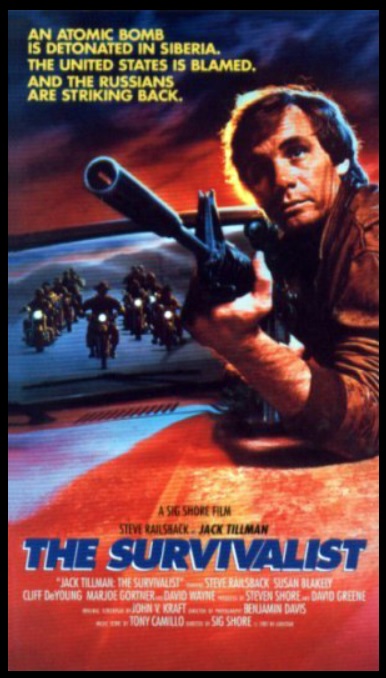
The Def-Con 3 caveat: Contrary to the VHS cover, the Russians do not “strike back.” Not by missiles. Not by a Red Dawn or Invasion USA invasion. It’s just Americans fighting Americans. There’s no Russian collusion; the enemy is within: his name is John Tillman.
The Def-Con 2 caveat: Don’t let the bogus post-apocalypse marketing and the multiple-alternate art works fool you. This isn’t a Mad Max swindle. This is a straight-up First Blood double-cross—with a pinch of Panic in the Year Zero (1962) and a love-triangle dash of The World, the Flesh, and the Devil (1958) because, well, you have to have a sex scene where a guy, whose wife’s dead body isn’t even cold—and facing the end of the world—must shimmy-sham his best friend’s wife. (Way to elicit our sympathies, John Rambo, uh, I mean, John Tillman.)
The Def-Con 1 caveat: I grew up reading the long-running, best-selling pulp-paperback series Mack Bolan: The Executioner. I also read a few of Jerry Ahern’s entertaining knock-off, The Survivalist, which concerns John Rourke, an ex-CIA operative turned weapons and survival expert, in the aftermath of a nuclear war. This run-of-the-mill action-film swindle is a straight-up double-cross. It’s not an adaptation of The Survivalist books (issue #1), as the producers faux-lead us to believe—although the film tells the exact same book-story. This Sly Stallone and Jerry Ahern screw job couldn’t be a more blatant copyright infringement if it was The Running Man sticking it to novelist Robert Sheckley’s (The 10th Victim) The Prize of Peril.
So, in a non-budget that wouldn’t cover the day’s catering bill on First Blood—or finance a day’s shooting on a Cirio H. Santiago Rambo-knock off—this post-non-apocalypse has no choice but to be set in the present with the same ol’ cars, architecture, and weapons . . . and a red text-on-black screen opening title sequence, followed by more words-on-screen telling us where we are, followed by National Guard maneuvers stock footage spliced-in with mushroom cloud stock footage, backed by voice-over narration, followed by more-words-on-screen telling us where we are.
We know where we are: Rambo land sans Stallone to class up the joint—and no Mark Gregory to Trash up the Bronx.
Wait a minute. I’m acting like a dickhead doomsayer loading in cases of Bandit and Snowman-smuggled Coors (we’re in Texas, after all), powdered milk and porno-mags into a 50-megaton bunker. This is a B&S Movies’ movie. This is one of your movies.
The Survivalist has it all: Two actors from multiple Stallone movies. Yakity-yak stock footage atomic bombs. The awesome Steve Railsback. Beer-swilling redneck hoards. Pansy rioting hoards of twelve people. More rioting hoards of those same twelve people. Bogus hospital rooms. Motorcycle rapist wimps. Epic maintain-the-speed-limit car chases. The über-cool Cliff De Young. Non-vehicular mayhem. Motorcycles don’t so much as crash; they fall over. Rogue army officers more concerned with murder and rape than restoring social order. No National Guard hardware, i.e., jeeps, trucks, transports, or helicopters. Camouflage fatigues off the rack at Bass Pro Shops. TV dream queen Susan Blakely. A National Guardsman biker gang because the movie couldn’t afford jeeps. One unarmed helicopter. Lots of driving. Lots of fishing. Lots of looking up at that one helicopter. Campfire tales. Campfire love. Faux-Harold Faltermeier Beverly Hills Cop synthesizer doodling. And, most importantly: Marjoe Gortner.
Hell, yeah. It’s a schlock-cinema dream come true.
It’s all about a “nuclear device detonation” in Siberia and the USA is blamed. Cold War mob rule ensues; the U.S suspends the Constitution and declares martial law. Why onenuc-accident in Russia (it could have been a power plant failure?)—with no retaliatory strikes on U.S soil—causes flag burnings and government shut downs of travel, bank closures . . . I know, I know. I’m over thinking the plot, again.
Meanwhile, back in a small town in Texas, Jack Tillman (Steve Railsback), an ex-CIA operative turned survivalist, and his pacifist doctor-friend Vincent (Cliff De Young), debate on the proper course of action as the same two-dozen dippy looters run rampant in the streets for TV sets and two cowering omega-cops (not baseball caps with “Police” patches again . . . Omega Copalert!) fail to maintain order.
Before Tillman can get his family the hell out of apoc-dodge to retrieve his son from a remote summer camp . . . (Oh, no. Here we go again: In typical apoc-fashion, the “Big One” drops and male hormones go into rape and murder mode; see the superior Ravagers and No Blade of Grass) . . . Tillman returns from getting cash n’ gas and finds his wife and daughter murdered. So he hits the road to rescue his son—in a beat-up, run-of-the-mill “Tillman Construction” pick-up truck with fishing poles (a guy’s gotta eat in an apocalypse!) and sans a machine gun turret—with Vincent and his nurse-wife Linda (Susan Blakely)—which sets up the ‘50s-era end-of-the-world “love triangle.”
Then the First Blood starts to flow in the form of a National Guardsman dickhead (instead of a town sheriff), and former Tillman Vietnam nemesis, Lt. Youngman (Marjoe Gortner; cloning his dickhead-rapist National Guardsman role in the 1972 disaster epic, Earthquake; 1972’s Marjoe). During the rioting, Tillman humiliates Youngman in a backhoe vs. motorcycle mishap; Youngman goes into Brian Dennehy-mode and his sole prime directive—as society falls apart—is to bring his arch-rival, Jack Tillman, to justice. The rest of society be damned and to hell with the Russians. Tillman must die. Call Troutman before someone gets hurt.
Overall, The Survivalist isn’t a bad movie; it’s not Survival 1990-inept. It’s just cheap and mediocre with a desperately needed injection of sadistic Mad Max craziness to elevate it beyond its flat TV movie-action trappings. You end up being pissed that the great Steve Railsback—as with Gary Lockwood in the somewhat similar Survival Zone—has to do these “films” to eat. Yep. Welcome to Blood City (1977), Keir Dullea.
(Did I just watch and review Survival 1990, Survival Zone, The Survivalist, and even Omega Cop, for the sake of B&S Movies? What’s wrong with me?)
Remember, you can also enjoy Steve Railsback in Lifeforce, Turkey Shoot, and Trick or Treats (all reviewed on B&S), Marjoe Gortner in Star Crash, Bobbie Jo and the Outlaw, Viva Knievel, and Mausoleum (all reviewed on B&S), and Cliff De Young in the video rental hits F/X (yes, Brian Dennehy!!), Flight of the Navigator, and Shock Treatment. And there’s Susan Blakely who, in addition to appearing in the ‘70s disaster hit, The Towering Inferno, worked with Sly Stallone three times: The Lords of Flatbush, Over the Top, and Capone.
The sad footnote to this film: It was the final film of the iconic David Wayne who, as always, brings his acting chops to the table in his cameo as a kind-curmudgeonly backwoods gas station owner. Wayne deserved better for his omega bow. The dude got his start alongside Spencer Tracy and Katherine Hepburn in the hit comedy classic Adam’s Rib (1949), and the smart ‘70s sci-fi piece The Andromeda Strain, but is best known as the Mad Hatter on TV’s Batman.
Equally insulting: J. Kenneth Campbell, a great character actor and requisite TV heavy-dickhead (pick a series)—from the sci-fi hits The Abyss and Mars Attacks, and Sly Stallone’s Stop! Or My Mom Will Shoot—is reduced to a perpetual television image (a pseudo voice-over narrator telling us what’s going on) as the White House Press Secretary.
The out-of-left-field projectile: The Survivalist was directed by Sig Shore, the producer of the Blaxploitation classic, Superfly (1972). He made his directing debut casting Harvey Keitel (?) as a record producer cavorting with Earth, Wind & Fire (?) in the 1975 disco-fucked musical, That’s the Way of the World (aka Shining Star). His fifth and final film was the nobody-asked-for-it-and-nobody-saw-it-sequel-because-it-didn’t-have-Ron O’Neal: The Return of Superfly (1990; because of the big studio Shaft reboot with Samuel L. Jackson).
And that’s why a VHS fringe-freak like me watched The Survivalist: I love ‘70s blaxploitation and music films—and Sig made one of each. So he gets a pass on wasting an hour thirty minutes of my life . . . and Sam the Bossman’s (but spare Becca, the “B” of it all). And yours.
So, you still don’t believe this one has it all?
Well, see for yourself: a VHS rip is uploaded on You Tube. And that’s the only way to see it, since it’s out of print, the VHS is ultra-rare, and it’s not available on DVD. And, even though the film has nothing to do Ahern’s The Survivalist pulp series, you can check out this listing of all 33 titles and, yikes, Wikipedia has the 4-1-1 on all of the books, and then some.
Or, may we suggest you can pass this Rambo 40.0 . . . and visit with the original Rambo, now back in theatres with Rambo: Last Blood?
Uh, oh. Are these alternate titles and artwork? Nope.
Not to be confused with . . .
Or with . . .
Our two-part apoc blow out!
March 2020 Update: Sad news to report. Thanks to McSmith and his site The Books That Time Forgot, we’ve come to learn than Bob Anderson, the main writer for the revived series of The Survivalist books, passed away this January at the age of 72. McSmith loves his Ahern books, he reviews them all, HERE.
Godspeed, Mr. Anderson. Thanks for the cool reads!
December 2022 Update: B&S About Movies’ reader Mark Brett, who is part of the Shore family tree, provided us with some additional insights to the film:
“Sig’s son Michael was married to my sister, so I’d met Sig several times. He actually gave me a VHS copy of Jack Tillman: The Survivalist and a movie poster of it, along with a [press kit promo] poster from Sudden Death [1985; stars Denise Coward from the U.S. daytime TV drama The Edge of Night, as well as Brett Piper’s Galaxy Destroyer].
“Sig’s sons played the rapists in the movie; his son Michael was the guy who killed Cliff DeYoung, and Michael Shore is listed incorrectly as “Michael Mayfield” on IMDb. As far as the other credits: Barbara Shore, Sig’s wife, helped with a lot of the writing and manners obviously were changed so it didn’t just look like a SHORE-fest on the credits.
“The actual vehicle Steve Railsback was driving [the Tillman Construction” truck we called out] was an Isuzu Trooper. Michael said, if I remember correctly, he picked it up from a California dealer and drove it about 4 hours to the set. He also said Marjoe was a good guy on the set.
“That said, as far as the “writing” goes: they pretty much made up everything while watching TV in bed on the last few films, according to my sister Lisa. Sig was putting a movie together called Tommy and the Ghost—a really horrible movie. I was asked to be the stunt guy for the kid on the dirtbike who races Tommy. They wanted a few jumps; Sig just asked what some of the types of jumps are called, and he threw them into this movie—without actual showing what they were supposedly doing. I only saw the movie once on my sister’s VHS copy. It was BAD!
“Michael Shore used to do sound editing years ago. I just wish I could’ve discussed movies more with Sig and Michael. I believe Steven Shore was in the film industry for a while, as well.
“All this said: I watch all these horrible movies for the same reasons [you do]. So, I figured I’d share some minor insights on Jack Tillman: The Survivalist.”
Our thanks to McSmith and Mr. Brett for their kindness; for using social media and blogging/comment platforms in a positive light to express their joy of books and film.We appreciate your positive reinforcement of our efforts to preserve films such as The Survivalist for others to discover.Hey, someone has to coddle lost and forgotten films like UFO Target Earth and The Spirits of Jupiter.Working together, we can make it happen!
About the Author: You can read the music and film reviews of R.D Francis on Medium and learn more about his work on Facebook.He also writes for B&S About Movies.
This one is for the Lords of the Rings trilogy fans.
This New Zealand-produced entry is an end-of-the-world dramatic-mystery thriller and not some Down Under, post-apoc frolic in the vein of Mad Max, Battletruck, Dead End Drive-In, or Turkey Shoot. Unlike most low-budget “futures” that have no choice but to create simplified futures utilizing clothing, technology, vehicles, and architecture that resemble our present—there’s nothing “simplified” about The Quiet Earth. This introspective story ranks with the class and style Francois Truffaut’s Fahrenheit 451 (1967), the American PBS-TV adaptation of Ursula K. LeGuin’s A Lathe of Heaven (1980; the great Bruce Davison), the equally beautiful Testament made for the PBS “American Playhouse” series (1983; starring the awesome Jane Alexander), and Nicholas Meyer’s exquisitely dire The Day After (1983; with the skilled John Lithgow, Amy Madigan, Jason Robards, and JoBeth Williams).
The Quiet Earth works because we’re in the “first day” of the post-apocalypse of our present and not a budgetary-inept projected future. There’s no low-budget nuclear holocaust or worldwide plague that text scrolls and voice-over photo montages us into boredom. There are no petulant dramatic arcs or epic events, just plausibility on how humans realistically accept the fact that they’re living in a world — a day after the end. While there are a few action set pieces and explosions, they’re not superfluous, Roger Corman-plot deficiency compensations.
New Zealand’s greatest acting export, Bruno Lawrence (who made the post-apoc rounds in Battletruck and received international acclaim for 1981’s Smash Place; VHS hounds remember him for 1981’s less successful, Race for the Yankee Zephyr), is Zac Hobson. A scientist employed by an international conglomerate, Zac wakes up the from the night before, only to watch the morning sun “oscillate” to darkness—and it kills all radio communications. He comes to discover that, while it’s the same work-a-day world as yesterday, everyone, except him, has vanished. And instead of the hackneyed apoc bomb drop, plague, or space infestation, Hobson discovers “Project Flashlight,” the consortium’s experiment to create a unifying and lifesaving “global energy grid,” malfunctioned, resulting in a dimensional timeshift.
As with his aforementioned apoc-thespian peers from across-the-pod, Lawrence (excellently) wanders through a deserted city as he copes with the silence and loneliness, and eventual madness, which results in his dressing in woman’s clothing and creating cardboard cutouts of people. He comes to find — and have a sexual relationship with — a young woman, Joanne (Allison Routledge of New Zealand’s “Deliverance,” 1986’s Bridge to Nowhere; with Lawrence). The duo then discovers a third person, Api, an indigenous Polynesian Maori man (Peter Smith). This sets up a reminiscent emotional triangle—only with superior acting chops and cinematic style—from the first wave of post-apocalyptic/end-of-the-world films of the ‘50s and ‘60s, with the analogous precursors: the good, MGM’s The World, the Flesh, and the Devil (1958), and that film’s inferior Corman-clone, The Last Woman on Earth (1966). Somewhat reminiscent of Richard Matheson’s 1954 novel I Am Legend; adapted as The Last Man on Earth (1964), The Quiet Earth is based on the 1981 Craig Harrison book of the same name.
Since you’re being encouraged to watch this intriguing film that embarrasses most of the other day-of-reckoning films reviewed on B&S Movies, there’s no need to inundate this review with plot spoiler minutiae, except to say: As the omega triangle begins to shatter and the trio discovers why they survived, the “MacGuffin” that created the rip in the space-time continuum is ready to “oscillate” once more.
Geoff Murphy gained worldwide recognition outside of New Zealand with his fourth feature, Goodbye Pork Pie (1981; stars Bruno Lawrence), a very funny road movie critically described as Easy Rider meets The Keystone Cops. Murphy made his Hollywood directorial debut — and had box office hits — with the brat-pack western Young Guns II (1990) and sci-fi’s Freejack (1992). He achieved his biggest international box office success as a director with Steven Seagal’s Under Seige 2: Dark Territory (1995). At that point, Murphy went into 2nd Unit work on the volcano-disaster epic Dante’s Peak (1997) and Peter Jackson’s Lord of the Rings blockbuster trilogy (2001 to 2003).
Film Movement Classics released a DVD/Blu-ray 2K Restoration in 2017. Arrow Films issued their Blu-ray in July 2018. You can also stream the films via Amazon Prime, Google Play, and Vudu. We also took another look-see as result of our “Cannon Month” of reviews, as they re-distributed the film on video in overseas markets.
Here’s a few, less quite Earth flicks to enjoy (click the images to get there).
About the Author: You can read the music and film reviews of R.D Francis on Medium and learn more about his work on Facebook.
Oh, hell no. Not more Def-Con 4 graphic art fuckery.
A dilapidated bridge. A decaying skyscraper. An eye patch. Armored motorcycle-knights. Mad Max spiked-adorned cars with blowers. Luigi Cozzi-spaceships. Post-nuclear action with Sergio Martino-vibes. Yeah, I won’t be confusing this with Enzo G. Castellari’s The Desert Warrior (1984, AKA Tuareg: The Desert Warrior). No wait . . . I did, actually . . . and I watched it anyway.
(“Poop, poop, poop, poop, I love you,” Sing it, Tina. Bob’s Burgers rules!)
Warning: Images do not appear in the film.No really. See for yourself: this trailer proves it.
Tuareg, the other “desert warrior” of VHS yore.
Times were obviously tough for ex-Hulks “two decades after the Third World War” when the world is a twisted jambalaya-tapeworm with Drones, Tyrogs, Zendos, Sterraz Amazonian Women, and Scavengers all bumbling about the Philippine wastelands in this way-too-late entry in the Mad Max rip-off sweepstakes. Lou Ferrigno (who went from this . . . to the CBS Network comedy King of Queens—in a clever parody of himself; an acting turn as respect-giving as Jean-Claude Van Damme’s turn in JCVD) stars as Zerak, a gay-leather Snake Plissken-baddy who scours the wastelands for the genre’s obligatory-uncontaminated females. His boss, the obligatory-horny fat slob, Lord Baktar of the Tyrogs (Hey, that’s Kragg! Canux-actor Kenneth Peerless from 1988’s The Sisterhood), wants to make babies à la George “Big Ape” Eastman in After the Fall of New York because . . . well, you know, the only way to save a post-apoc world is by rape. (Why is male sperm always potent in the post-apoc epoch and females are the ones with the bad plumbing? Oh, that’s right: fallout turns men into chauvinistic dicks.)
Anyway, Racela (Shari Shattuck), the bitchy “Princess Leia” daughter of Cortaz (Anthony East, Lord Jar of The Sisterhood!!) and the niece/granddaughter of the bloated, sash-adorned President Antarius of the techno-advanced Drones (Mike Cohen of 1985’s Warriors of the Apocalypse!), is out for a romantic, wasteland drive in a Logan’s Run-cum-super mutant Hot Wheels buggy (complete with vacuum cleaner-SFX engines). So Racela has a tiff with her boyfriend, jumps out, and gets captured by the desert-bandit Zendos for breeding. You know how it goes in the post-apoc Philippines: Zendonians aren’t having any luck raping the female Sterrazs, and the Tyrogs are sterile skank hoes no one wants—not even The Humongous. Not even the bald Urak dude from After the Fall of New York who gets his eyes gouged-out by a robot claw.
Anyway, love blooms when Zerak the Tyrog rescues Racela the Drone and they become the resident spaghetti western Moses and Zipporah tearin’ up the Exodus sands with a Star Wars (I mean, Star Crash) laser battle assault on the Drones’ fortress—after the usual low-budget/no-budget and off-screen yakity-yak nuclear holocaust. (Oh, no . . . RED ALERT . . . TEXT SCROLL plot-set up . . . lazy-writing warning . . . and, depending on what bogus-title version you see: voice-over narration to back up that text.) Oh, and get this: Zerak and Baktar close this epic with a friggin’ hug: A HUG, and Zerak and Racela stroll into the post-apoc sunset accompanied by the synth-pop ditty, “Love Will Find a Way.” (Dear Lord, we don’t need another hero!)
If you’re looking for something with no holocaust and no acting, with the same ‘ol apoc-props, not-special effects, sets, costumes, and action (Apoc-déjà vu: I swear this film is recycling footage from Cirio H. Santiago’s Filipino films, i.e., Stryker,Wheels of Fire, and The Sisterhood) lacking in plot or point: this is your movie.
If you’re cool with the fact that the bridge and skyscraper, the Mad Max cars, and the spaceships never show up—and you’re okay with a couple of ‘70s-era jeeps with machine guns: this is your movie.
If you find excitement with Star Crash laser blasts, a kiddie thunderdome match, a low-rent Humongous, recycled Roman galea/centurion helmets, Darth Vader warriors, white-clad “New Confederacy” penis soldiers from After the Fall of New York, and an appearance by the TOMY Omnibot 2000 doubling for R2D2: this movie is for you.
The Def-Con 5 caveat: That drippy Drones-mobile takes me back to those Hot Wheels with glass domes (Hairy Hauler, Silhouette, Splittin’ Image) and those ‘70s-era model kit cars and cycles (Monogram’s Cherry Bomb, Revell’s Beatnik Bandit, and the bright-green airfoil “Dragonfly” chopper-trike I can’t track down). I wish that old AMT Interplanetary UFO Mystery Ship, AKA “The Leif Erickson,” made an appearance to make up for the Def-Fuck we got on the spaceship cover tease.
The Def-Con 4 caveat: Filipino apoc-king Cirio H. Santiago did not make this movie. But how we wish pasta-apoc guru Enzo G. Castellari did, so we had some Trash.
The Def-Con 3 caveat: Beware of those bogus alternate titles: Sand Wars (Are you kidding me, Mr. Distributor?), Nuclear War and Kill Count with new artwork (more friggin’ skyscrapers?)—and all references to the country and year of origin removed—so as to dupe, you, the responsible post-apoc buyer, into thinking you’ve discovered some new, lost apoc-poo.
The Def-Con 2 caveat: Turns out that “nobody” director, Jim Goldman, is really a “somebody.” Duck and cover.
The Def-Con 1 caveat: The saga of these contaminated, inert desert bozos is only for the most non-discriminating, post-apoc VHS packrat storing their copies of Future Force and Robot Holocaust in a 50-megaton proof bunker amongst their David Prior and Tim Kincaid Def-Fucked ineptitudes. While you don’t want to, as B&S Movies’ proprietor Sam would say, give Jim Goldman a “David Prior-kick in the dick,” you will want to give Goldman a solid “Tim Kincaid-broadsword thrust into the brain,” so as to spare us video fringe survivors a sequel.
And thank Lord Humungous . . . there wasn’t one. No need to flush the bombers, General Jack Beringer. The video fringe is safe. If we can make it through this celluloid compost, we’ll be able to deal with Wez—no trouble at all. Plus, Jim Goldman never produced or directed another film and screenwriter Bob Davies never wrote another film.
Boom! You’ve been consumed by the mushroom cloud. Learn your Def-Con numbers.
Jim Goldman, AKA John Gale, is Filipina Jun Gallardo gone incognito who, after Bruce Lee’s untimely death, took the 100-odd hours of footage from Bruce’s unfinished final film and “directed” Golden Harvest Studios’ bogus 1974, first version of The Game of Death. Across his 54 credits, Gallardo flushed/dumped the VHS Rambo–Commando cheese-clones* that we love: The Firebird Conspiracy (1984), Commando Invasion (1986), and the BIG KAHUNAS: the Linda Blair-starring SFX Retaliator(1987), and the Shannon “Ms. Gene Simmons” Tweed and Reb Brown (Yor!, Space Mutiny!) non-war epic, The Firing Line (1988). (The Filipina nom de plume of Bob Davies is anyone’s guess. For when you script something this epic, there’s no way you wrote just one.)
At least the Jun Gallardo-connection didn’t kill the career of ex-MTV video babe Shari Shattuck (38 Special’s “Caught Up in You”; Sam, is that you chuggin’ the Bud at the 00:19 mark?), who we LOVE around here at B&S Movies. (Oh, man, I got the VHS shakes!) Amid her 50-plus U.S television and film credits: Shari starred in our FAVORITE piece-o-George Kennedy-fecal matter, the crazy cat movie, The Uninvited, the warped, how-did-it-ever-get-made movie with the asparagus-sex scene, Death Spa (1987), and the Don “The Dragon” Wilson’s wooden Steven Segal-rip, Out for Blood (1992; how have you not reviewed that one, Sam?). She eventually went “legit” with Jack Smight’s (Midway, Damnation Alley) genre-too-late Beverly Hills Cop/48 Hours-rip, Number One with a Bullet (1987), and Steven Seagal’s directorial debut, On Deadly Ground (1994; Shari’s scene/clip). You can catch up with Shari in this interview regarding her most recent film and top-billed role (hopefully, not her last), Scream at the Devil (2015; trailer).
May The Humungous be to your backs and may the radiated sands rise to meet your feet as you watch the full movie on You Tube. All praise Lord Baktar!
Our images our clickable?! Yep. Really!
You can catch up on the wide array of post-apocalyptic adventures with B&S Movies’ “Atomic Dust Bins” Part 1 and Part 2 featuring 20 mini-reviews of movies you never heard of, along with a “hit list” featuring all of the apoc-flicks we watched for September 2019’s Apoc Month.
* We unpacked a cornucopia, a virtual plethora of Pacific Rim war flicks with our crazed Philippine War Week I and II features. Yeah, we love our Jun Gallardo and Teddy Chiu flicks, well, anything under K.Y. Lim’s Silver Star Film Company shingle. So sue us. Or make fun of us. We don’t care. (Now, we gonna stuff our faces with sugar-shocking hopias.)
About the Author: You can read the music and film reviews of R.D Francis on Medium and learn more about his work on Facebook.
Andrew Stevens is back after the first film, this time helping the last human colony to survive underground against the mutants who yearn to destroy them. He also falls in love with another survivor long enough for her to be impregnated by a mutant, because that’s what these movies are all about.
You know, I love R. Lee Emery. Sure, he pretty much played the same role in every picture, but you have to respect a man who will give the same effort in a movie directed by Andrew Stevens as he did in one helmed by Stanley Kubrick. He’s also stated in interviews that he only did this movie to pay for his house. As a man struggling to keep up with all of the home improvement goals of my wife, I feel his pain. Here, he plays a doomed base commander, who at least has a love interest in Andrew’s mom, Stella Stevens. Speaking of respect, you gotta love a kid who makes sure his mom still has work.
The only thing I liked better about this sequel is that there’s an entire cult of religious nuts who constantly take peyote and worship the mutants. I wish the movie was about them doing drugs and hanging out with monsters, because that’s a way better movie than this.
You can watch this for free on Tubi and Amazon Prime. You can also get a blu ray of this movie from Ronin Flix.
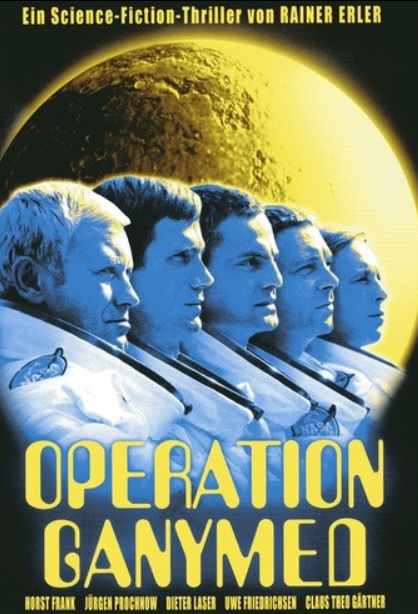
This dystopian-inspired version of a psychological Russian space epic (1970’s Signale, 1972’s Eolomea, 1980’s The Orion Loop, 1983’s Moon Rainbow) produced for German theatres in the wake of the ‘70s Star Wars-inspired production boom also appeared on German and European television as Heroes: Lost in the Dust of the Stars. Courtesy of the burgeoning home video market, Operation Ganymed appeared a few years later on U.S shores in a limited/low-key, admittedly patience-trying and poorly-executed English dub under its theatrical title on defunct Marathon Video (Atlantis in the U.K).
The now ultra-rare tape sought by VHS/Beta collectors doesn’t even appear in U.S tape guides. (How rare is the tape? A VHS is currently for sale on eBay for $78.00 . . . sigh, that’s the copy/version I rented from Tapes n’ More so many years ago!) The film was popular enough in Europe to warrant DVD reissues dubbed or subtitled for various markets—but are barebones VHS rips. And beware: most of those are DVD-Rs (but don’t complain and just be happy the film is at least digitally preserved).
Recognized as a winner of a few Euro-science fiction film festivals, the film earned a domestic stateside-release when star Jürgen Prochnowimpressed U.S audiences with his break out rolls in Das Boot (1981) and Dune (1984). Astute post-apocalypse fans will instantly notice those U.S-issued VHS tapes were most-likely plundered by the producers of the less intelligent Canadian exploiter Def-Con 4 (1985) and the South African gimp-clone Survivor (1987). If there’s ever a film that deserves a full-blown digital restoration from its original 35MM print—which was bestowed this year by Arrow Video to Def-Con 4—then Operation Ganymed is the film.
The long-awaited, inferior DVD currently in the marketplace came as result of respected German actor Deiter Laser (who I remember from the obscure and equally rare VHS The Elixirs of the Devil, a 1976 German take on the ‘70s Euro-horror nasties The Devils and Mark of the Devil) achieving his first taste of worldwide fame with his turn as the mad Dr. Heiter in Tom Six’s art house stomach churner, The Human Centipede (2009).
The remainder of us video and genre fringe geeks will recognize the third-billed Horst Frank, who became a go-to bad guy for spaghetti westerns (1968’s Django, Prepare a Coffin; with George Eastman and Terence Hill), Euro war epics (1964’s Mission to Hell), and Italian Gialli (1971’s Cat o’ Nine Tails for Dario Argento). The other two explorers, portrayed by Claus Theo Gardener and Uwe Friedrichsen, built extensive German-based resumes, with the late Friedrichsen in 121 projects and Gardener moving into directing.
As with the Russian you-either-love-it-or-hate-it epic-mindbender Solaris (1972), Operation Ganymed is an introspective, metaphysical journey concerning a United Nations-sponsored team of three Americans, two European, and one Russian who return from their four-year (left in 1985 and returned in 1989, according to the video box description; in the film it’s 1991) catastrophic mission to Jupiter’s moon in which, while they discovered rudimentary, primitive life (they pontificate on the foolishness of spending $38 billion for one tube of green slime), it was at the cost of 21 crew members, including two that perished on Ganymede’s surface.
What’s unknown to the crew: Earth lost contact with them 900 days ago (just over 2 1/2 years)—and considered Ganymed 2 lost. No one is waiting for them; no Earth-orbit rendezvous is prepared. Unable to establish radio contact, and with 21 hours of oxygen left and no mission control to guide them, the astroquintet decides to make an emergency ocean landing off a rocky desert coastline that may be Earth—possibly Mexico—or a strange, new planet.
As they begin their trek across the desert towards what they hope is the U.S, they come to believe the Earth was decimated by a mysterious, cataclysmic ecological event or nuclear war. Their lines of reality begin to blur as hunger, dehydration, possible radiation sickness, and long-stewing inter-ethnic tensions lead them to madness, murder, and cannibalism—real or imagined.
The film’s first 30 minutes are impressive in adapting Apollo-era technology, suits, and tech-jargon for a Jupiter mission (that’ll leave a sci-fi buff pining for another watch of the 1978 Apollo-Mars pot-boiler Capricorn One), and the later, frequent flashbacks to the crew’s spacecamp-training sessions on Earth, and the sequences on Ganymede, which details how the two crew members died, also exceed the film’s budgetary constraints—limitations not experience by the likes of Star Wars and Capricorn One, even the cheesy Italian pasta-space opera, Star Crash. So if you’re looking for a big-budget production with flashy models, blinding laser beams and drooling, human-crunching aliens, this film isn’t for you.
Regardless of those reservations, let it be known that respected and successful German film and TV director Rainer Erler delivers a product far more engrossing that most post-2000 CGI failed-mission-discovers-life-on-a-distant-planet romps, such as the fellow Euro-produced Stranded, Europa Report, and Last Days on Mars.
Since this is a psychological, post-apocalyptic journey through man’s “inner space,” be warned: Operation Ganymed takes its time and you’ll be left with more questions than answers: Were the astronauts crazy. Were they on Earth. Did they warp to another planet. Does the Earth even exist. Were they even in Mexico. Did their fellow crew members really die on Ganymede. Did they all die on Ganymede—and this is all a hellish penance. Are they guinea pigs in a test set up by the corporation that sent them into space?
Find out for yourself by watching the full movie for free In English (at 1:33:00) and the uncut German version (at 1:53:00; with no subtitles) on You Tube. The DVD is available as part of a German-issued Rainer Erler Kultfilme (Cultfilm) 6-pack. There are more current, professionally-packaged, non-USA Playback Region 2 DVDs at Amazon (Caveat: know your regions!), along with the older DVD-issues at Amazon (you can sample those DVD images with the two video-clip trailers provided in this review).
You can catch up on the wide array of post-apocalyptic adventures with B&S Movies’ “Atomic Dust Bins” Part 1 and Part 2 featuring 20 mini-reviews of movies you never heard of, along with a “hit list” featuring all of the apoc-flicks we watched for September 2019’s Apoc Month.
About the Author: You can read the music and film reviews of R.D Francis on Medium and learn more about his work on Facebook. He also writes for B&S Movies.















 B&S About Movies


_-_Computer_History_Museum.jpg)







You must be logged in to post a comment.