To gear up for Halloween, we crack open a Mill Creek box of fifty movies — then post those reviews throughout November. The Mill Creek madness began with their Chilling Classics set in 2018 and we also did the Pure Terror set in 2019. For 2020, we jammed on the Sci-Fi Invasionset.
Mill Creek’s 12-Packs always come in handy for our theme weeks, such as our recent “Fast and Furious Week,” when we need a lot of films, quickly, and the Savage Cinema set did the job. And, back in March 2020, we were so giddy with glee that we finally got our own copy of 9 Deaths of the Ninja courtesy of the Explosive Cinema 12-pack, we paid it forward to Mill Creek and reviewed all of the films in the pack.
Update: Thanks to Matthew Hale on Letterboxd, I’ve learned that there are alternate versions of this Mill Creek box set. For the sake of completeness and my obsessive-compulsive disorder, these movies have also been added:
EDITOR’S NOTE: We originally watched this on August 26, 2020 in the midst of a werewolf heavy seven days. We can’t argue having a TV movie on a drive-in box set, but Mill Creek, we still love you.
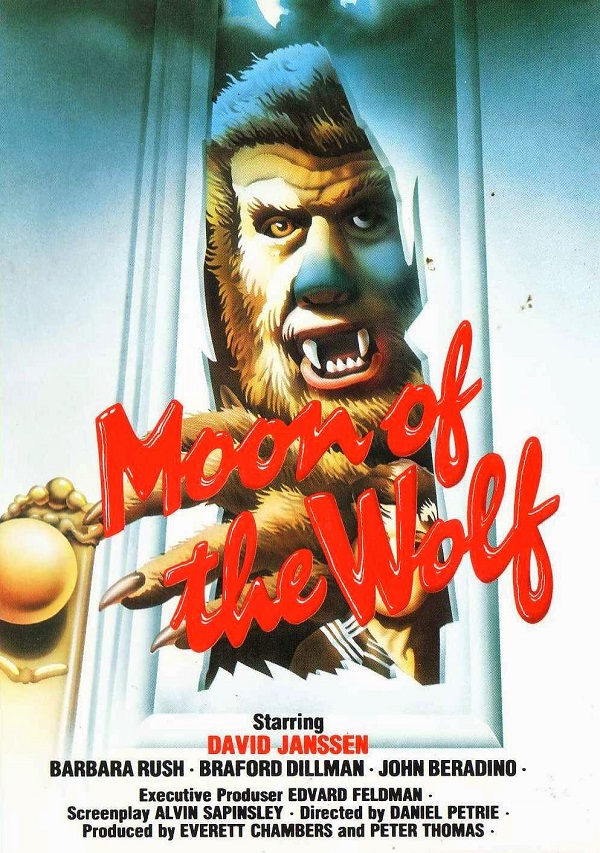
Daniel Petrie made some pretty much films — Fort Apache the Bronx, A Raisin in the Sun and The Betsy — as well as some memorable made-for-TV movies like Sybil (which ruled mid-70’s bookshelves and viewings) and The Dollmaker.
Here, he’s in Louisiana along with a stellar cast making a movie that honestly could have played drive-ins. That’s how great these made-for-TV films were.
In the Lousiana bayou country of Marsh Island, two farmers (Royal Dano! and John Davis Chandler) find the ripped apart remains of a local woman. Sheriff Aaron Whitaker (David Janssen!) and the victim’s brother Lawrence Burrifors (Geoffrey Lewis!) both show up at the scene, but it’s soon determined that somehow, some way, the girl died from a blow to the head. Lawrence blames her most recent lover. The sheriff things it was wid dogs. And the Burrifors patriarch claims that it was someone named Loug Garog.
That mysterious lover could have been rich boy Andrew Rodanthe (Bradford Dillman!), who along with his sister Louise (Barbara Rush, It Came from Outer Space) lives in an old mansion, the last of a long line.
Based on Les Whitten’s novel, this originally aired as an ABC Movie of the Week on September 26, 1972, then reran as part of ABC’s Wide World of Mystery on May 20, 1974.
One look at the theatrical one-sheet and you’re thinking of the Larry Cohen-penned and directed The Ambulance (1990) starring Eric Roberts. Of course you are: it’s Larry friggin’ Cohen! Hmmm . . . an “Exploring: Ambulance Movies” featurette covering flicks like the Harvey Keitel-fronted comedy Mother, Jugs & Speed (1976), the Playboy “Playmate of the Month”-fronted comedy Paramedics (1988), and Martin Scorsese’s Bringing Out the Dead (1999)?
Ugh. Sidetracked: back to the film at lopped-off hand.
The cult thriller based on the best-selling novel of the same name.
A respected filmmaker in his homeland and across Europe, German writer and director Rainer Erler is a filmmaker you’ve only seen — courtesy of ’80s U.S. UHF-TV syndication and home video — four times on English-language shores: the debut, Operation Ganymed (1977), Plutonium (1978), Spare Parts, and Sugar (1989). Prior to the English-language release of Operation Ganymed, Erler made 30-plus German-language films and a smattering of television series since making his debut in 1961.
As for his four, English-dubbed distributed films: I’ve only found and watched two of them: the great, Star Wars-era sci-fi’er on a tight budget, Operation Ganymed, and this desert-based horror romp known in its homeland — by what I think is a much more effective, ’80s slashy-titled — as Fleisch, aka Meat. I’ve given up my search for VHS copies of Plutonium and Sugar — films I’ve always wanted to see — long ago.
As much as Operation Ganymed atmosphere-drips with its desert-based, yet claustrophobic, psychological dread, so does Spare Parts: a noirish tale of a honeymooning couple’s spiraling stay at a not-so-quaint, run-down hotel in Albuquerque, New Mexico (where this was shot; not doubled, say, in the Spaghetti Western wilds of Italy).
The newlyweds’ love fest is cut short when an ambulance takes the Princeton-educated husband away . . . never to be seen, again (the innkeeper is overly friendly . . . then claims to not know what you are talking about and who you are). Monica, Mike’s (TV-prolific Herbert Herrmann) kidnapping-escaped, fish-out-of-water German exchange-student wife (prolific and a very good Jutta Spiedel) comes to team with a Texas truck driver (Wolf Roth) to discover the hotel’s dark secret . . . and its connection to the cryptic ambulance service: a black market organ-harvesting service run by a shady doctor (a perfectly-evil Charlotte Kerr).
One-stop shopping for movies from all over the world!
Spare Parts is a film of solid cinematography and well-scripted suspense complemented by a downbeat-creepy, mood-inducing score: one undone only by it needing a tighter edit (this runs a little long at an hour fifty minutes) and that Mill Creek’s print is a little rough. But I liked the Amsterdam-bred noir De Prooi, aka Death in the Shadows (1985), discovered on Mill Creek’s Pure Terror set that we unpacked in November 2019, so what in the hell do I know?
Sure, Michael Crichton’s Coma (1978) starring Micheal Douglas did the whole illegal organs scam a lot better, while the illegal organ shenanigans (and ripping Coma) of Cardiac Arrest (1979), an early attempt to turn Max Gail of TV’s Barney Miller into a film actor, did it worse (and it reminds of me of TV’s Mike Conners stumbling about in 1984’s Too Scared to Scream). The much-better-than-both Breakdown (1997) starring Kurt Russell (although that has no ambulance or organ theft, but kidnapping and ransom on the New Mexico back roads) also comes to mind. Oh, now I am remembering Body Parts (1991) with Jeff Fahey . . . but that was arm transplant surgery.
Hmmm . . . sounds like an “Exploring: Organ Harvesting” featurette to me. Never say never.
There’s a trailer to sample and the full film to enjoy, on You Tube.
About the Author: You can learn more about the writings of R.D Francis on Facebook.He also writes for B&S About Movies.
“The beauty of [a] Mill Creek box set is discovering a movie that you would otherwise never find.” — Sam Panico, in his review of fellow the “Drive-In Classics” entry, Throw Out the Anchor
Sure, by way of his string of hits with Robocop (1987), Total Recall (1990), and Basic Instinct (1992), we’re all fans of Dutch writer and director Paul Verhoeven. Then there’s the box office flop that is Showgirls (1995; Golden Raspberry for “Worst Director”) and his (I felt, misguided) fascism-in-space romp, Starship Troopers (1997). While he had a career in the Netherlands dating to the early 1960s, Verhoeven didn’t make his feature film-debut proper until a decade later with the comedy Business Is Business (1971) and the romantic “erotic drama,” Turkish Delight (1973; Oscar-nominated as “Best Foreign Language Film”). Katie Tippel, aka Keetje Tippel, was Verhoeven’s third film prior to his critically-acclaimed, international breakthrough with the romance-thriller Solider of Orange (1977), which introduced the world to Jeroen Krabbé and Rutger Hauer. Both actors came to star in two of Verhoeven’s later international hits, the murder-mystery, The Fourth Man (1983), and the historical adventure, Flesh + Blood (1985), respectively.
It tells the story of Katie (Monique van de Ven, the wife of cinematographer and director Jan de Bont of Speed and Die Hard fame; she made her debut in Turkish Delight), a young girl led into a life of prostitution to help support her impoverished family in 1881 Amsterdam. Based on the memoirs (it’s debated if the story is, in fact, real, made-up, or a patch work of the lives of others) of Dutch-born, Belgium-bred and French-writing Cornelia Hubertina “Neel” Doff, she is remembered as one of the Netherlands’ most important authors. Then noted as that country’s most expensive production, the film became the Netherlands’ number one box office draw of the year. Paul Verhoeven has said that, of all of his films, this is the one that he wants to remake and, in fact, he pulled elements of Katie Tippel into the Joe Eszterhas-penned disaster, Showgirls.
He should remake this film . . . or at least see this though a restoration (well, he did, as we’ll discover). The Mill Creek version does nothing to enhance your appreciation of the film as the version, here, is muddy and the dubbing, awkward. However, as Sam stated: this is a unique, bargain-based introduction to exposing yourself to Paul Verhoeven’s Dutch-language works; a film you would not see, otherwise.
In addition to Mill Creek, Anchor Bay offers a higher-quality, single-disc version — complete with an audio commentary track by Paul Verhoeven. For a deeper dive into that Anchor Bay version, this November 2002 examination by Dale Dobson at Digitally Obsessed will get you there. For another take — in addition to insights on four more of Verhoeven’s Dutch-language works, there’s no review finer than James Newman’s for Images Journal. Of course, Anchor Bay is no more, but used DVDs abound in the online marketplace.
You Tube offers a very clean, subtitled rip from the Anchor Bay version. I never heard of or seen this film (I’ve only gone back as far as Solider of Orange at Roger Ebert’s urging, as I recall) and I enjoyed it. It is, however, a dark, depressing film . . . and hardly a film you’ll snuggle up next to your honey near a crackling speaker and burning mosquito coil. It is also classic Paul Verhoeven: a film rich set design, costuming, and exquisite cinematography.
About the Author: You can learn more about the writings of R.D Francis on Facebook.He also writes for B&S About Movies.
ABOUT THE AUTHOR: Andre Couture writes about film on his blog Celluloid Consommé and on Letterboxd. You can hear his voice talk about monsters on Humanoids From the Deep Dive from time to time and read his Twitter rambles by following him at @demonidisco.
There’s something infatuating about how weird 70s science fiction can get. It’s hard to encounter those stories that haven’t been filled in with the jargon of the time, injecting it with a time capsule-like quality while further embellishing whichever angle the sci-fi narrative is presenting, usually a sociopolitical one.
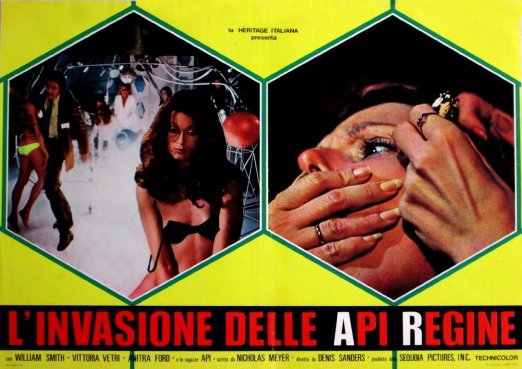
Invasion of the Bee Girls feels like the polar opposite of something like The Stepford Wives — in effect an act of revenge against men for all they take for granted and continually and casually oppress. It’s just so fitting that it takes the form of mutated women seducing men to death, literally.
The film opens on Neil Agar (played by William Smith, Captain Devlin and Count Sodom from Hell Comes to Frogtown) who is sent to California to investigate the mysterious death of a bacteriologist at Brandt Research, a government facility. It’s when he talks with some of the other lead scientists that he notices a lot of them are quite the players, living extravagant sex lives on the side. More bodies pile up that fit the same cause of death: congestive heart failure caused by sexual exhaustion. What a way to go! If anything, death by sex might be too good for these people.
In an early scene the local sheriff holds a meeting for the townspeople that feels ripped straight out of a Jaws ripoff. In some ways this one kind of is, too. But what this scene has going for it is wonderful and breathes some much-needed air into the movie. It includes an amusingly dated V.D. joke that even gets the town chuckling about the murders. I mean, if you’re going to make a sci-fi picture about women experimentally mutating bee DNA to kill male playboys with sex, you might as well have a sense of humor about it.
We loosely follow Dr. Susan Harris (Anitra Ford from Messiah of Evil) during her bee escapades while she wears large gaudy black sunglasses which at first seem to just be her own weird fashion choice that she’s latched onto (or Ford’s insistence on wearing them during her scenes as if she were recovering from a hangover while filming, something Cameron Mitchell fans can identify with). But as we see more and more Bee Girls they all don the same style. I’d say it works for some more than others, and while you’d think it’s not really that creepy just think how a crowd of them staring at you would feel like.
There’s one thing inarguably chilling in this and that’s the transformation sequence in the film where we see the entire process of what it takes to transform someone into the titular Bee Girl and its equal parts intense and frightening. In a completely dialogue-free sequence, a hypnotic drone sounds with a heavy dose of blue light blasting onto the subject. Various assisting worker Bee Girls cover the subject with a weird white substance that looks a little too much like Fluffernutter, then seal them into a chamber where bees swarm and cover every inch of their body. Daniel Robitaille, eat your heart out. They then emerge and the white stuff is peeled away, exposing the newly mutated lady inside. Truly creepy shit, and all achieved visually with no need for dialogue. If nothing else this is what you came to see.
Invasion of the Bee Girls is director Denis Sanders’ last feature film and Nicholas Meyer’s first film writing gig — he actually almost removed his name from the film after rewrites but was convinced to keep it. Got to take those credits when you can, I guess.
The beauty of the Mill Creek box set is discovering a movie that you would otherwise never find.
The terror of a Mill Creek box set is discovering a movie that you would otherwise never find.
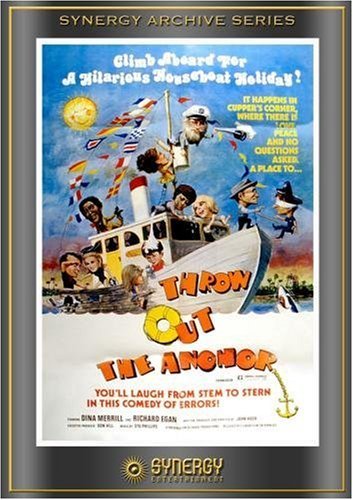
Throw Out the Anchor claims that it’s a comedy. It strains the very notions of what comedy is, let me tell you that much.
It’s about an unemployed widower who heads to Florida with his children for a vacation on a houseboat, but they get there and, comedy situation after his wife dies and he loses his job, there was never any boat at all.
Director John Hugh directed one movie and if you ask me, it was more than enough. A G-rated comedy from 1974 is my idea of a horror movie, all earnest and dry and poorly realized. But even worse, this is a message movie, as when the family finally gets a broken down boat, fixes it up and sets sail, the water is all polluted. Everyone laugh!
When I was eight years old, Jerry Lewis made a big return to America’s movie theaters with Hardly Working, a film that starts with a montage of his greatest hits and the entire theater went wild with laughter. After a decade away — and unbeknownst to young Sam, most of it spent on the Day the Clown Cried — Lewis was back, baby! And then the movie started, a film that ran out of money numerous times, had a depressed star and barely held together and it just started grinding. People started audibly sighing in the theater and as a young kid, I learned the lesson, the horrifying lesson, that movies can suck. They can just be so bad and this movie became the opposite of a comedy, it was a tragedy and each action that Lewis’ clown character undertook and each job that he got fired from — people in my small mill town did not want to be reminded of being fired in 1980 — just kept strangling the air and the funny out of every person in the theater until we left, shambling messes blinded by the mid-day sun, unsure of what we’d seen and realizing that each of us would carry some part of the ennui of that film with us until we died alone.
This movie doesn’t even get to have the montage at the beginning.
ABOUT THE AUTHOR: Melanie Novak writes about the Golden Age of Hollywood, infusing her weekly movie reviews with history, gossip, and the glamour of the studio era. You can read her reviews at www.melanienovak.com and follow her on Instagram @novak_melanie.
Loyal B&S About Movies fans will likely know Vincent Price for his horror films from the fifties and sixties. But long before he made The House of Wax (1953), Price cut his teeth on the London stage in 1935 playing Prince Albert in Victoria Regina.
Hollywood came calling, of course, and after a few early films with Universal (and a screen test for Ashely Wilkes in Gone With the Wind), he signed a contract with Twentieth Century-Fox that would allow him to split his time between New York and Hollywood.
In 1941 he starred in Angel Street on Broadway, playing a husband who convinces his wife she is going mad in order to steal her family’s jewels. The play was a smashing success and remains the longest-running melodrama in Broadway’s history with over a thousand performances. In 1944, it was retitled Gaslight and filmed with Charles Boyer and Ingrid Bergman, a role for which Bergman won her first Academy Award.
Vincent Price returned to Hollywood and had supporting roles in a pair of Gene Tierney film noirs—the classic Laura (1944), in which Price plays Shelby Carpenter, a playboy suspected of murdering his fiancé, and Leave Her to Heaven (1945), in which Price’s character is jilted by Tierney’s Ellen Berent, one of film’s most deliciously bonkers femme fatales.
After fifteen films and eight years in Hollywood, Price got his first starring role in the film noir Shock (1946), the only Price film in the Mill Creek Drive-In Classics 50 Pack.
Shock was a B-picture filmed in eighteen days. Price plays Dr. Richard Cross, a psychiatrist who is dismayed to learn that a woman witnessed him killing his wife after she refuses him a divorce.
Lucky for Dr. Cross that the sight of the violence shocks Janet Stewart into a catatonic state, and that Dr. Cross is called in to treat her. With the help of Elaine Jordan, his mistress and nurse, Cross uses sedatives to keep Janet Stewart confused. Channeling his gaslighting role in Angel Street, he convinces her and everyone else that she is insane so that she won’t be able to implicate him in his wife’s murder.
In true film noir fashion, it is Elaine, the low-rent Phyllis Dietrichson who pushes Cross deeper and deeper into the cover-up, using her icy sex appeal to convince him to give Janet Stewart a lethal overdose and make it look like an accident.
But can the successful psychiatrist, who killed his wife without premeditation, follow through with the cold-blooded murder of a patient to save his own skin?
Shock is not in the same league as Laura and Leave Her to Heaven (to say nothing of Double Indemnity), but it’s a satisfying B-film that foreshadows the great villains in Price’s future, who will not need a femme fatale to convince them to wreak havoc on the world.
With a scant 70 minute run time, you can’t go wrong gobbling this one up on a crisp fall evening.
Sources
Price, Victoria. Vincent Price: A Daughter’s Biography, 1999.
ABOUT THE AUTHOR: Nate Roscoe has been writing about film since the age of six, quite literally: he recalls penning an appraisal of Beauty and the Beast for a school assignment way back in ’91. His mastery of critique has improved a fair bit since then, and he recently contributed essays to a couple of Blu-ray releases from 88 Films. Currently, he is in the process of writing his first book. Nate is the editor of Trash to Tarkovsky, a blog devoted to the esoteric crannies of cinema. Catch him on Twitter @nutellanate
Psychiatry and cinema have always had a tempestuous rapport. For every well-intentioned – though seldom discerning – probe into the subterrain of mental illness, there are dozens of tone-deaf endeavours that circumvent authenticity for the glamour of lurid sensationalism. The setting of an institution, especially, has long been a prosperous fount of cinematic hysteria: that timeworn motif of sterile corridors stretching down to padded white cells, a motley crew of blathering idiots, sexual deviants, and slobbering freakshows housed within.
Make no mistake about it: Don’t Look in the Basement (1973) is neither shrewd nor particularly sensitive in its gauging of psychological impairment. But nor is it as trashy, violent, or exploitative as its moniker and marketing – or, indeed, its time spent back in the day on Britain’s notorious ‘video nasties’ hit list – would have you believe. The brainchild of Texan trash-master S. F. Brownrigg and screenwriter Tim Pope, the story follows beautiful Charlotte Beale (charismatic Playboy model Rosie Holotik) as she lands a new job at a privately-run hospital known for its subversive methods of treatment. Keen to make a good impression on both her employer (the formidable Annabelle Weenick) and those in her care, the young nurse does her level best to embrace the challenges that come with the role, but a sequence of alarming incidents in the workplace pushes her precariously close to the brink of her own sanity.
Predating Miloš Forman’sOne Flew Over the Cuckoo’s Nest (1975) by two years, one can surmise that sanatorium-based horrors such as Bedlam (1946) and Samuel Fuller’s Shock Corridor (1963) – along with the more traditional genre trappings of George A. Romero’s Night of the Living Dead (1968) – were pivotal to the inception of Basement. What it manages to cobble together from those illustrious scraps is a kind of psychotronic chamber piece, a late-night Southern Gothic soap opera comprised of oddball characters and the histrionic quintessence of golden age Douglas Sirk. As with the bulk of Brownrigg’s oeuvre, the visuals secrete a primitive austerity that could almost be certified as artless, yet there’s gumption to be found in the forthright technique; the stationary angles and invasive close-ups lending a docu-like immediacy to the picture’s stained, sweaty visage. Praise must also be bestowed upon the production design, the maze-like belly of the institution (a claustrophobic snarl of hallways, bedrooms, and staircases) evoking a malevolent ambience all its own – a would-be haunted house inhabited by drifting human spectres.
It is mostly in its allusion to the inconceivable terrors of Vietnam that Basement sets itself apart from the crud-laden crowd, pulling on the strings of post-war paranoia so prevalent at the time with a subplot involving Sgt. Jaffee (Hugh Feagin), an ex-military inpatient who spends his every waking hour warding off imaginary nemeses. As metaphors go, this one’s about as subtle as an AK-47, though it does suggest that Pope’s script was shooting for something a little deeper than surface-level schlock – an ambition it best achieves when it’s casting an affectionate spotlight on the quaint peculiarities of its subjects.
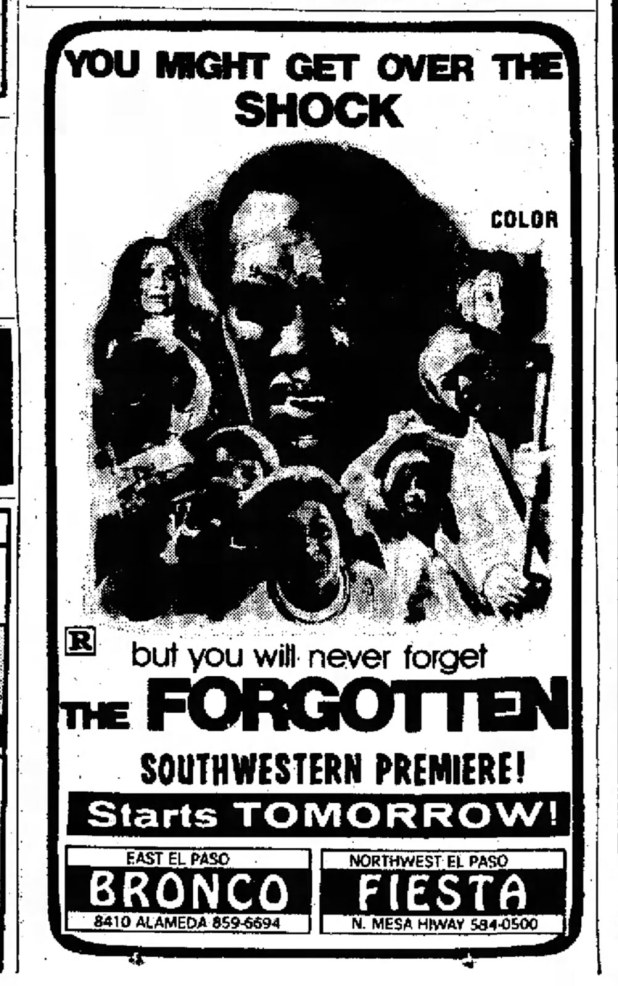
Whilst building to an expectedly berserk crescendo that sees the titular crypt (conspicuous by its absence thus far) come fleetingly into play, it is an unshakeable air of sadness, rather than one of revulsion, that lingers heaviest as the credits begin to roll. It’s impossible for us not to feel pity for these condemned pariahs, these flesh-and-blood footnotes in an unforgiving world that has long since turned its back on them (the original US release title, The Forgotten, feels so much more pertinent in this respect). The film overall could be described in much the same way: an anomalous footnote in the annals of Seventies drive-in cinema, as scrappily eccentric and singularly indefinable as those poor broken souls up there on the screen.
“This is as pointless and purposeless as Peter Fonda’s Idaho Transfer of 1973. A better soundtrack would help. And throw in A PLOT as well.” — A well-said comment by You Tuber Lee Larson on the film’s upload
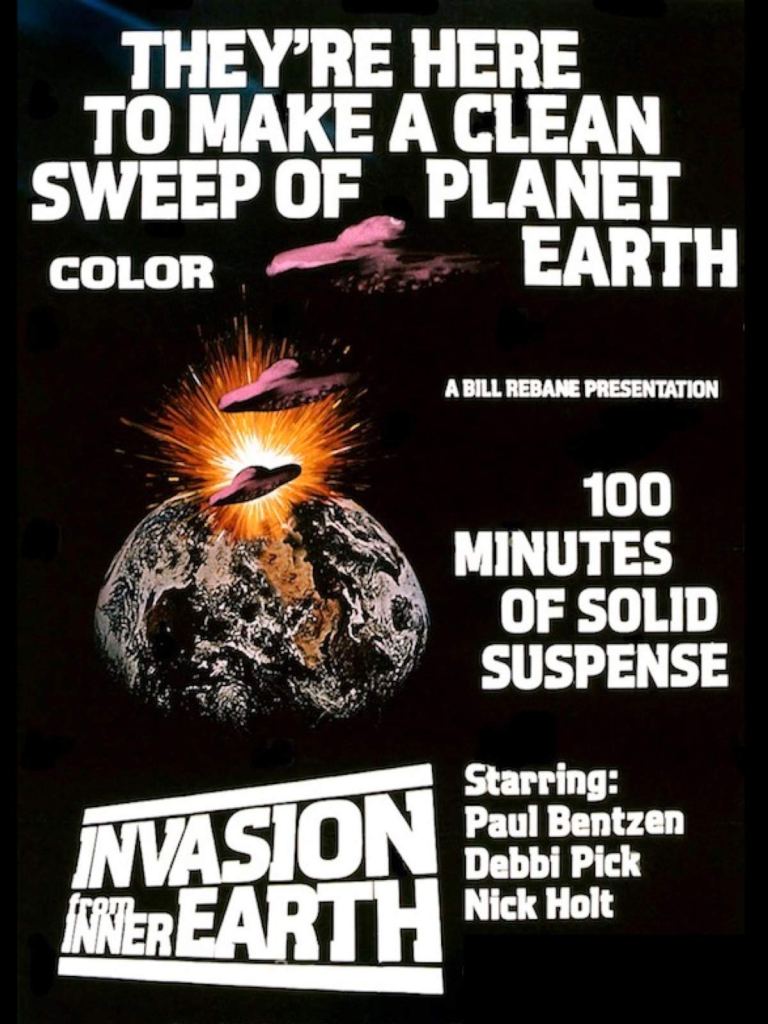
So, after Monster a Go-Go in 1965, producer, writer and director Bill Rebane took a decade-long break.
He should have stayed on break.
I have a feeling Bill Van Ryn of Drive-In Asylum and Groovy Doom loves this; movies where “nothing happens” is his groove. Well, groove on, Billy. Groove on. No polyester jackets required.
So there’s no questioning — regardless of the VHS and DVD reissues and box-set repacks — as to when this was made: Yes. this is a real, ’60s to ’70s era radio studio. Yes. That is a (blue) ashtray, to your left, as smoking in radio studios was oh, so 1970s.
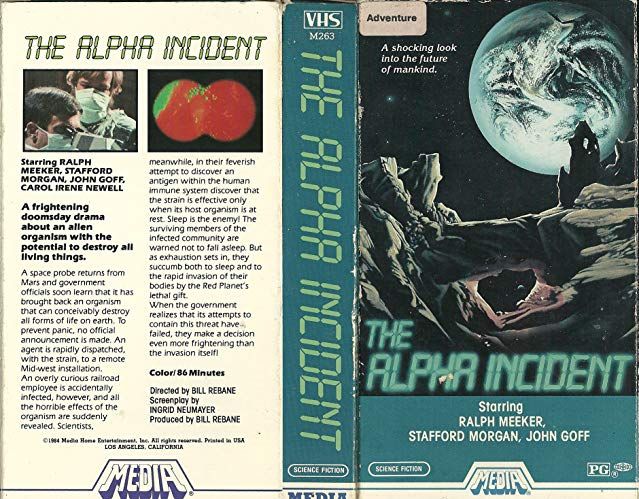
Anyway . . . Bill Rebane came back with a vengeance in this, his second feature film, with plot points he later recycled into his follow up non-epics The Giant Spider Invasion (1975) and The Alpha Incident (1978; part of Mill Creek’s Chilling Classics box set) — the former which actually received a wide spread theatrical release and screened at my local duplex because, well, because Alan Hale, Jr. — yes, the Skipper from TV’s Gilligan’s Island — and Barbara Hale — yes, the Della Street, the long-time secretary to TV’s Perry Mason — still had some UHF-TV rerun stank on them to get us, i.e., sucker us, through the doors. We knew enough to avoid The Alpha Incident until it appeared as a late night UHF-TV’er, since a washed up Ralph Meeker (who acted alongside Charlton Heston at Northwestern University) and George “Buck” Flowers didn’t have any iconic TV stank on them to get us into the doors.
No, the proceedings on either of those films got any better nor improved on their earlier Invasion from Inner Earth model. Yes, if you’ve seen The Alpha Incident, you’ve seen this, and vise versa. In fact: the same thing happens in Rebane’s The Capture of Bigfoot (1979; back to nobody-never-heard-of actors, natch), only a bigfoot — not connected to aliens — is responsible for the mystery. Oh, and nothing comes from “in” the Earth; the “it” comes from outer space. So, leave your zombie hopes on the deep woods’ cabin porch, Cletus.
What else should we expect from the guy who decided putting a ukelele-playing Tiny Tim (a huge, but very odd ’60s celebrity, Wiki him) in a slasher film with Blood Harvest (1987) was a good idea. Lest not we forget Rebane’s haunted piano romp with The Demons of Ludlow (1983). Did we forget his Loch Ness mess with Rana: The Legend of Shadow Lake (1981), and his millionaires trap people in a mansion comedy, The Game (1984)?
Yes. On purpose.
Hey, we’ll remember Rebane’s production of The Devonsville Terror (1983) because a film directed by Ulli Lommel starring his wife Suzanna Love, along with Donald “I’ll take anything” Pleasence, along with Robert Walker, Jr. and character-actor extraordinaire Paul Wilson isn’t a film you question: you watch. Oh, and Twister’s Revenge! (1988; part of this month’s Mill Creek Drive-In Classics review blow out) . . . that epic isn’t about killer weather: it’s a comedy about a computerized, Knight Rider-esque monster truck. No really. Do we want to find a copy of his paranormal “trip to the other side” romp that is his final film, Ghostly Obsessions (2004)? Do we, really? Do we? DO YOU?
Uh, no. . . ?
There’s no zombies here. Just aliens. Move along, you Romero vagabond.
Well, there you have it, then. So goes the mind of the pride of Riga, Latvia, in this grafting of The Thing (the original, not the remake) onto Raimi’s later The Evil Dead. Only not as good — not even close — to either, is what is sorta-kinda is happening here. In fact, instead of “The Thing,” this was also called They in some distribution quarters — not to be confused with the James Whitmore-starring Them!, which is about giant ants . . . that actually do come from inner earth.
Look, an Ed Woodian flying saucer arrives at Earth. Then planes crash. Cars stall. The UFO crashes in a swamp, and spews a red gas (fuel?) that infects the town. Wait, was it an alien “bomb” of some sort? (It’s not clear and I don’t care.) Uh, so, people get sick and die . . . the infection spreads and, before you know it: a plague has wiped out the planet and an alien invasion is at hand.
Anyway, since planes can’t fly anymore (a guy steals a plane and tries to escape; it crashes), four Canadian bush pilots hold up in a better-than-Raimi-dump-of-a cabin (but we are actually in Wisconsin, U.S.A. where Rebane shot all of his films) to wait out the invasion . . . or whatever the hell is going on, here.
Really? 100 minutes? I think I watched maybe 10 seconds, let alone ten minutes.
Oh, wait something is going on here. It’s just not all exactly clear, because the-ac-tor-re-ads-in-this-fi-lm-dr-i-ve-yo-u-to-no-t-li-sten-to-the-bug-e-tary move-the-non-plot exposition.
There’s junk science babbling about Mars and the Earth were once closer to each other than the Earth and the moon are now. And something about the planet alignments (oh, no, not more “Jupiter Effect” preambles). And about the Comet Kohoutek (discovered in 1973). And electromagnetic fields. And the inhabitants of Mars escaping their planet’s destruction. And the Holy Bible’s 7th seal. And something about a giant, immense rose. And Florida rising out of the ocean. And a newscast telling us about “worldwide UFO sightings and mass illness.” And an interview with a hick who claims he was “abducted by aliens from Uranus.” And, apparently, the “they” are from Uranus, as a TV broadcast — suddenly — is knocked off the air. “Something is blocking our transmission,” we’re told. Boy Howdy! And I thought the Georgia-made UFO: Target Earth (1974) piled on the Jesus-comet-aligned planets plot absurdities. Well, at least it’s not as inept as the Colorado-made The Spirits of Jupiter (1984). Or is it?
Yeah, for this is just a bunch of people walking around in the snow collecting firewood, riding snow mobiles, making campfires and talking-in-staccato because they-are-acting!
The excessive coffee drinking and cigarette smoking continues in Rebane’s 1978 outer space epic, The Alpha Incident, available on the Nightmare Worlds box set, in addition to their Chilling Classics set.
Oy! The bad acting.
The no-effects — expect for the red smoke bomb in the swamp. An annoying, all-too-loud, bonkers soundtrack stock-stolen from Lord knows where, that goes to-and-fro from electronic nausea, to folk guitar, to ragtime band clarinets. And not once — not once — is there any indication the aliens are, say, Atlantians, rising up from inside the Earth. And when the aliens do show up (or was that their spaceships; don’t know, don’t care), it’s a swatch of red cellophane (rubberbanded) over a flashlight because, well, remember the red smoke bombs? Oh, and radios make sounds, we are told, “that’s not the radio” . . . so, er, that must be the aliens, talking, or something?
You can watch Invasion from Inner Earth for free — don’t you dare pay a dime for this one — on You Tube. However, if you’d like a bargain-priced version for your collection, you can have it as part of Mill Creek’s Nightmare Worlds 50-Film Pack/IMDb alongside UFO: Target Earth and Alien Species — both which we also reviewed this week, so look for ’em!
Scoff we may, but we love Rebane so much, we reviewed this once more as we cracked open the entire box and reviewed all 50 films! Hello, Wisconsin!
Get your copy! Image courtesy of JohnGrit/Unisquare.
Ugh. The You Tube trailers we embed for your enjoyment keep being deleted. We give up! Search for ’em on You Tube.
About the Author: You can learn more about the writings of R.D Francis on Facebook.He also writes for B&S About Movies.
The one and done Jim West and Jim Clarke, in their respective director’s and writer’s chairs (and are probably one and the same), and the leads of Don Watson and Bobby Watson (real life brothers, natch), as our ne’er-do-well anti-Beau and Luke Duke heroes (the bearded longhairs Oosh and Doosh; no, really), smoke up ol’ Hazzard County — with the comedy dispensed for action (but the goofy stock library music cues, in places, are more comedy than action) as we hang from helicopters, demolish motor homes, and drive through houses transported-by-flat beds.
Oosh and Doosh, those dang “Watson boys” — since we’re off the small TV screens of Hazzard and on the big ol’ white screens of the Deep South mosquito emporiums — run pot and coke through the Georgia backwoods for corrupt politicians in the pocket the local Mafia. Of course, the brothers Watson get caught on that backwood, peach tree airfield where all that Cuban and Columbia gold flies in.
Hell, yeah, their employers break them out of prison because Oosh and Doosh are drug-runnin’ cash cows for the criminal cause. But their arrest — and eventual helicopter breakout — cost their bosses a lot of money. Now they’re on the hook to pay it all back. Yep! It’s time for the “biggest heist” of their ersatz pharmaceutical careers: Remember how the Bandit transported Coors from Texarkana to Atlanta? Well, those Watson boys are transporting an 18-wheeler filled with weed (disguised as a bags of potatoes). But the 18-Wheeler was trashed in a dust-up with the cops: now they’re in even deeper to their bosses: it’s time to rob an armored car — an unintentionally kill one of the guards. Once the big chase between the Watson boys’ Camero and a DEA agent’s pursuit Dodge Challenger comes to its eventual conclusion, there is only one thing left to do: the Watson boys steal their bosses’ home safe filled with money, hop the plane, and head for South America.
Get your own copy on Mill Creek’s Drive-In Classics!
Yeah, we know this is all pre-The Dukes of Hazzard and Smokey and the Bandit inspired it all — and this ain’t no Gone In 60 Seconds or even Double Nickles or even Flash and the Firecat — but this sure looks like it was made a lot earlier than 1976 or 1977. But it’s not: it was made post-1975, as we will soon learn.
Sure, the acting is awful, the action (while there’s occasional, momentary flashes of excitement) is inept, the script is beyond flawed-with-no-real-plot (it feels like it was “plotted” as the production plodded along), and the cinematography is a wee-bit muddy. But first-time filmmaker Jim West (we can’t find any background on his film-making past) works the cameras pretty decently. He keeps everything visually engaging with interesting shots and all of the required oners, doubles, reversals, and close-ups are there. West is certainly no Hal Needham, but he’s also not a Larry Buchanan or Bill Rebane, either (compare In Hot Pursuit against their respective films Down on Us and The Alpha Incident and you’ll see what we mean).
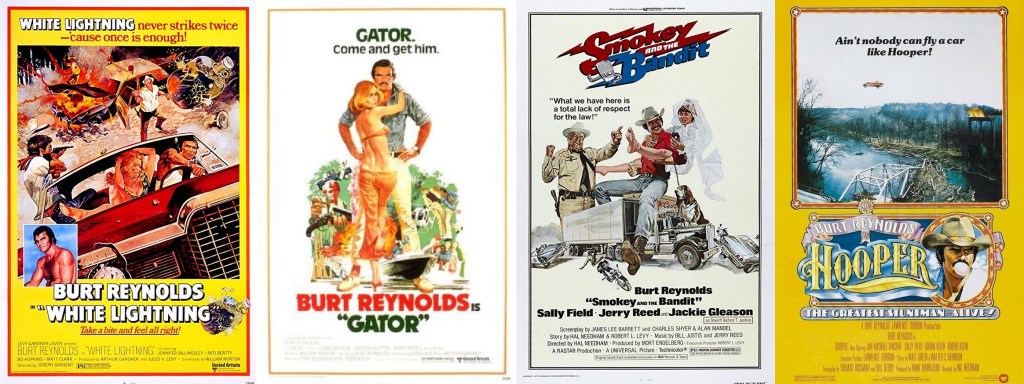
Yeah, ol’ Burt, who started it all with the likes of White Lightning and Gator, only to reignite the Hicksploitation genre for the ’80s with Smokey and the Bandit . . . well, the southern drive-in circuit was hungry for those modern-day, good ol’ boy westerns featuring redline revvin’ cars smugglin’ drugs lieu of horses and cattle rustlin’. As I rewatch In Hot Pursuit all these VHS years later, I’m reflecting back on Ulli Lommel’s (BrainWaves, Blank Generation) two-years later Cocaine Cowboys when I watch this. And those Watson brothers sure be do give me a hankerin’ to watch the Young Brothers, Richard and David, flyin’ their pot plane in Stuart Raffill’s High Risk.
Eh, you know what: I love this inept, stupid movie because everyone involved are on the cosine of the Z-List in their professions, but they’re given it their all to make a B-List drive-in flick. In a bonus round: Quentin Tarantino likes this one: he screened it as part of his annual “Grindhouse Film Festival,” so there you go.
And go you shall, to You Tube. Oh, Car Chase Wonderland, what would we do without you to satiate our red neckin’ car chase jonesin’? Ah, but just in case, we have a back-up You Tube copy, here. Meanwhile, the fine folks at the online magazine Condition Critical preserved a copy of the ’80s VHS sleeves, here. So, as you can see, this lone film by Jim West has its fans.
And this tale has a twist. . . .
Polk County Pot Plane is based on a real life incident chronicled on the Tallapoosa Memories Facebook page (the post also offers photos and articles about the 1975 events). The way the Georgia memories of smuggler Marty Raulins reads . . . well, it’s a hell of a lot more interesting than the fictional tale Jim West cooked up.
The story goes: Jim West was involved in all of the real life pot shenanigans of the federal government-confiscated DC-4 and buying the land where the airstrip was located . . . and the opening scene of the film of the plane being flown off the airstrip, and the third-act’s scenes of the heavy-equipment clearing of the airstrip . . . well, that’s the same government confiscated plane, and Jim’s clearing the airstrip to move the plane of its mountain perch. Turns out (and as a radio broadcast in the film tells us), the government made the bust and seized the plane . . . then had “no idea” how to get it off the mountain nor wanted to “pay for the cost” of moving it. So they auctioned the land and the plane to the highest bidder: Jim West won — then made his movie about Georgia’s infamous Polk County Pot Plane of 1975.
Courtesy of Wikimapia.org, who truncated the true story that led to the film:
“Drug smugglers flying a Douglas DC-4 (N67038) landed at a 1000 foot airstrip which had been bulldozed out of the forest only hours beforehand. The DC-4, designed for runways of 3000 feet or longer, managed to stop in less than 500. Numerous bales of marijuana were unloaded from the aircraft, which was then abandoned. As one might expect, a large four engine piston aircraft roaring about the countryside at low level in the dead of night attracted considerable attention from the locals, and law enforcement in particular. Numerous suspects were quickly apprehended in the following days. Charges were dropped against many, including the owner of the DC-4, as it could not be conclusively proven that he was the pilot at the time it landed in Polk County.
“The DC-4 had been seized by authorities as evidence. Various schemes for disposing of the aircraft were proposed. One involved using helicopters to airlift the ship out of the woods to the nearest proper airport. Another was to turn the site into a local tourist attraction. At length though, the aircraft was auctioned off to the highest bidder on the courthouse steps. The new owner lengthened the airstrip out to roughly 3500 feet and flew the aircraft out shortly thereafter [which is our filmmaker: Jim West!].”
You can also read another take of the tale in the August 2019 digital pages of the Rome News-Tribune by Kevin Myrick. The New York Times has also digitized their August 1975 coverage of the bust, “Plane on Mountaintop Perplexes Sheriff.” Do you want a commemorative tee-shirt? Polk Today, through the Poke History Society Museum, has ’em!
Just, wow. This one of the best backstories to a movie, ever. It even out-metas H. B. “Toby” Halicki’s Gone in 60 Seconds trilogy, with his movie-within-movie-within-movie shenanigans of The Junkman and Deadline Auto Theft! A producer needs to read up on this and do a meta-movie about the making of Polk County Pot Plane! I’d pay to see that movie. (And give me a role, will ya’? Even an under-five will do. I sure do need an acting gig.)
Be sure to check out our rundown of hicksploitation and redneck cinema delights from the ’70s and ’80s with our “Top 70 Good Ol’ Boys Film List.”
About the Author: You can learn more about the writings of R.D Francis on Facebook.He also writes for B&S About Movies.










 B&S About Movies
You must be logged in to post a comment.