APRIL MOVIE THON DAY 15: The Greatest Story Ever Told (1965)

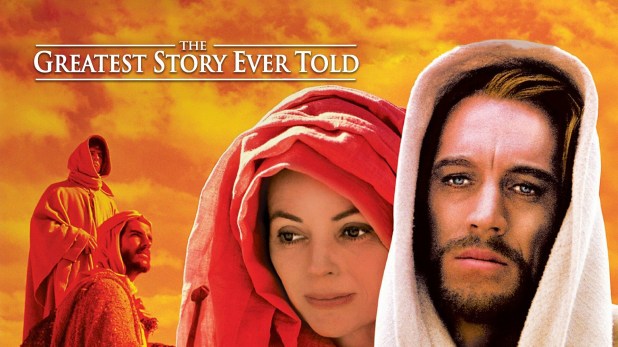
The Greatest Story Ever Told started as a radio series in 1947 written by Henry Denker and a 1949 novel by Fulton Oursler, a senior editor at Reader’s Digest. 20th Century Fox boss Darryl F. Zanuck acquired the film rights and Denker wrote a script, but when Zanuck left the studio in 1956, it was forgotten.

Fast forward two years and George Stevens, fresh off The Diary of Anne Frank, learned that Fox had the rights to the story — I mean, The Bible is public domain, so I have no idea what was different about the property other than the title and this was a decade after the radio show — and he got $10 million ($90 million in today’s cash) to make this movie.

Before the movie was even made, it was already busting its budget. Stevens spent two years writing the script along with Ivan Moffat, James Lee Barrett and even poet Carl Sandburg, as well as commissioning French artist André Girard to prepare 352 oil paintings of Biblical scenes to use as storyboards, which is quite the extravagance. Then, as no movie had been even started by 1959, Denker sued Fox to reclaim the rights and for $2.5 million of damages.

Two years after that, Fox withdrew from the project as $2.3 million had been spent without any footage being shot. Stevens was given two years to find another studio or 20th Century Fox would reclaim its rights, so he moved to United Artists.

Once filming finally started, Stevens shot each scene — often with hundreds of extras — dozens of times. Instead of going to the Holy Land, he also made sets throughout the U.S., being so full of art to say, “I wanted to get an effect of grandeur as a background to Christ, and none of the Holy Land areas shape up with the excitement of the American southwest. I know that Colorado is not the Jordan, nor is Southern Utah Palestine. But our intention is to romanticize the area, and it can be done better here.”

The major difference between Arizona and the Holy Land? It snows in the winter in Arizona.

By the time he was done, Stevens had shot 1,136 miles — miles! — worth of film. Before editing and promotion, he’d already spent $20 million or $180 million in 2022.

It made back $8 million dollars.

It ran for 4 hours and 20 minutes.

And man, it’s something else.

Balthazar (Mark Lenard, Spock’s dad), Melchior (Cyril Delevanti, a character actor and acting coach) and Gaspar (Frank Silvera, who was in another money loser, Ché!), the three wise men, are westward leading, still proceeding, seeking the King who will be born and meet King Herod (Claude Rains in his last role), who sneakily sends them to watch the Child emerge in Bethelem, but secretly he just wants to kill all the firstborn because whoever was born that night will take his throne. And he has Michael Ansara — who can be Native American or Arabic depending on the role — is ready to do the murdering.

They discover Mary (Dorothy McGuire) and Joseph (Robert Loggia!) in a manger, surrounded by animals, and they give the Son of God gold, frankincense and myrrh as an angel warns Joseph that they must escape to Egypt, where they stay until Herod dies. As they return to Nazareth, a pro-Israel rebellion rises against Herod’s son, Herod Antipas (José Ferrer), which is quickly stopped, but shows the Romans that the Messiah could be trouble.

Go read the Apocrypha and come back.

Pretty wild, huh? I mean, giants born of angel and man?

Start the movie back up again please.

John the Baptist (Charlton Heston, who knows something about Biblical films) is in the desert eating honey and locusts and preaching that someone even better than him will soon arrive. That would be Jesus (Max Von Sydow), who is baptized by John and then ascends a mountain where he’s tempted by the Devil (Donald Pleasence!).

Soon, Jesus promises Judas Iscariot (David McCallum), Andrew (Burt Brinckerhoff), Peter (Gary Raymond) and John (John Considine) that he will make them fishers of men. They soon meet James (well, there’s the younger played by Michael Anderson Jr. and the elder who is David Sheiner) and spend time with Martha (Ina Balin), Mary (Janet Margolin) and Lazarus (Michael Tolan).

After healing a crippled man, Matthew (Roddy McDowall!), Thaddeus (Jamie Farr!), Simon (Robert Blake!) and Thomas (Tom Reese) — the name means twin — all join the apostles as Pontius Pilate (Telly Savalas and there’s an urban legend that he shaved his head for this movie and liked it so much he never had hair again) and the church leaders debate the negative influence of John the Baptist, who is arrested and soon beheaded thanks to the influence of Salome (who of all people is not credited; some say that she was a dancer from Israel). In Capernaum, Jesus meets Mary Magdalene (Joanna Dunham, who got pregnant during the long shooting time and her belly needed to be hidden by clever filming tricks) and heals Shelley Winters, which made me stand up and beat my breast.

Jesus refuses to help a blind name called Aram (Ed Wynn) to see, he’s stoned yet returns to save the man’s sight, only to discover that Lazarus has died. The miracle of raising the dead happens as the leaders of the existing church worry about Jesus.

Intermission time. You know, old movies having a fanfare and an intermission are great, because they care so much about you that they provide moments for you to go to the bathroom. Thanks, old movies.

We come back to Jesus going wild in the temple, throwing tables over and causing mass chaos. We see Dr. Loomis following Judas, who is fated to turn heel on the Son of God and even Peter tries to babyface himself and Jesus shuts him down by saying, “Before the rooster crows today, you will disown me three times” and Peter answers by crying. Game, serve, match, Savior.

Jesus is put on trial and even the man whose sight he saved testifies against him. Nicodemus (Joseph Schildkraut, who was in The Diary of Anne Frank and died before the movie finished) stays out of it and Peter denies Jesus, once as Blofeld watches, another time as Blythe the forger looks on and a third time while Professor John McGregor forces Peter to realize that Jesus was right.

The Pharisees bring Jesus to Pilate, who tells the crowd that he will free him if they want. They ask for Barabbas (Richard Conte) instead, so the Only Begotten Son goes to be crucified alongside Richard Bakalyan (the voice of Dinky in The Fox and the Hound) and Marc Cavell (Frankenstein in The Wild Angels). The only people on his side are Simon of Cyrene (Sidney Poitier)and Joseph of Arimathea (Abraham Sofaer) and then, in the cameo of all cameos, a Roman centurion stands as Jesus expires and says, “Truly, this man was the Son of God.” Supposedly, Stevens did tons of takes to get this right.

And it’s John Wayne.

The film ends with the angel (Pat Boone!?!) rolling back the stone and Jesus ascending to Heaven.

Man, who did I miss in this parade of stars? How could I miss Victor Buono as Solak? Carroll Baker as Veronica? That’s how many people are in this. I missed Carroll Baker. Oh! There was also Martin Landau as a pharisee leader, Angela Lansbury as Claudia, Sal Mineo as Uriah, Paul Stewart as Questor, John Crawford as Alexander, Frank DeKova as Tormentor, Russell Johnson — the professor! — as a scribe and so many more. There are thousands of people in this movie.

Is it holy luck that this movie has three Blofelds in it with Pleasence in You Only Live Twice, Savalas in On Her Majesty’s Secret Service and von Sydow in Never Say Never Again? Isn’t it kind of cool that David Lean took a break between Lawrence of Arabia and Dr. Zhivago to direct some of this? That Stevens edited von Sydow so that Jesus never blinks?  And how sad is it that cinematographer William C. Mellor dropped dead on the set?

I waited a long time to see this movie, as I first read about it in the Medveds’ The Hollywood Hall of Shame. It’s something else and for once, they weren’t hating on a good movie. It’s bloated and just plain too much, but that makes me love it so much more.
APRIL MOVIE THON DAY 15: If Footmen Tire You, What Will Horsemen Do? (1971)

ABOUT THE AUTHOR: Herbert P. Caine is the pseudonym of a frustrated academic and genre movie fan in Pennsylvania. You can read his blog at https://imaginaryuniverseshpc.blogspot.com.

EDITOR’S NOTE: This is one of Sam’s favorite movies and he can and will take any opportunity to talk about it. Read his article about it. 

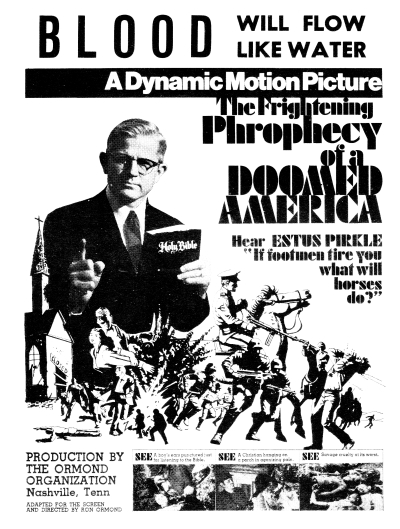
Exploitation films and fundamentalist sermons are two genres that generally do not intersect. Exploitation cinema deals in graphic sex and violence, the things fundamentalists generally most condemn in modern media. Apparently, no one told Mississippi Baptist preacher Rev. Estus Pirkle and exploitation director Ron Ormond, who combined their dubious talents during the early 1970s to make three religious propaganda films: If Footmen Tire You, What Will Horsemen Do?, The Burning Hell, and The Believer’s Heaven. The films reflect both Pirkle’s harsh interpretation of Christianity and Ormond’s background making sleazy movies.

Pirkle was a Baptist minister based in New Albany, Mississippi. He wanted to make a film adaption of his sermon “If Footmen Tire You, What Will Horsemen Do?” which warned that moral decline in the United States would inevitably lead to a Communist takeover. (The title was taken from a line in the Book of Jeremiah warning that the enemies of the present were nothing compared to the coming tribulations.) Fortunately for him, Ron Ormond had recently converted to evangelical Christianity after he and his family narrowly survived a plane crash in Nashville, Tennessee. Ormond had previously been known for directing Z-grade exploitation films such as Mesa of Lost Women, Untamed Mistress and The Girl from Tobacco Row, which featured the tag line “She was a preacher’s daughter, but wild as a peach orchard hog.” As luck would have it, this filmography was splendid preparation for a film adaptation of Pirkle’s lurid sermon.

If Footmen Tire You, What Will Horsemen Do? opens with men in military uniforms riding horses down a dirt road. As the credits end, Pirkle, in a voice over, claims he has sources to back up every atrocity story he relates in the film, but that the film transfers their setting to America in order to “emphasize that the same things can and will happen here, if they take over.” The film goes on to intersperse scenes of Pirkle preaching to his congregation at the Locust Grove Baptist Church with graphic depictions of Communists terrorizing Americans. There is also a sub-plot about an errant congregant named Judy, played by one Judy Creech, who is led back to the straight and narrow by Pirkle’s sermon.

The most memorable thing about this cinematic sermon is its sheer brutality, which would have earned it an R if not an X rating from the MPAA had it been submitted for a rating. At the very beginning, Pirkle warns that if America does not undergo a religious revival, his listeners can expect to see bodies piled up in the street, a warning the film reinforces by show us bloody corpses, including those of children, lining the sidewalk of small-town Mississippi. The film goes on to show such edifying sequences as a group of children being forced to murder their father by dropping him via rope onto pitchforks, complete with graphic shots of the father being impaled, bloody forks, and an obese commissar laughing his head off. Communist soldiers force their way into homes in order to rape women, and children caught listening to sermons have bamboo driven into their ears, which for some reason causes them to vomit. In the film’s memorable climax, a young boy, played by Greg Pirkle, Estus’s son and later a Congressional candidate, is beheaded by a commissar after refusing to trample on a picture of Jesus. The boy’s head is shown bouncing and rolling on the ground for at least five seconds, a shot that even today would likely earn the film an NC-17 rating.

The film’s overwhelming ineptitude, however, undermines its impact. It often fails at the basics of filmmaking, a mixture of Ormond’s incompetence and the very low budget. For example, the Communist soldiers’ uniforms have obviously fake armbands. Rather than the red and gold banner favored by most Communist countries of the time period, the armbands are just white cloth with a drawn-on hammer and sickle. Even more embarrassing are the scenes where people are machine gunned. According to Ormond and Pirkle, people struck by multiple bullets aren’t shaken by the impact; they just slowly drop to their knees on the ground, then lie down. The climactic beheading of a child becomes laughable when the commissar slips into an Arkansas accent and yells “You stupid little foo’!” when the boy refuses to renounce Christ.

Its impact also suffers from the ridiculousness of Pirkle’s arguments. Among the “footmen” Pirkle claims will lead to America being taken over by Communism are sex education, Saturday morning cartoons, declines in church attendance, and dancing, which Pirkle calls “the front door to adultery.” The film makes clear that Pirkle viewed these issues in hysterical terms. For example, Pirkle apparently believed that sex education consisted of a teacher encouraging elementary school children to engage in pre-marital sex and explaining the “seven erotic zones” in women. He similarly warns of the potential of cartoons to distract parents from reading their Bibles.

The disturbing thing is, Ormond actually toned down Pirkle’s hysterical tendencies for the film. In the audio recording of the original sermon, posted on YouTube, Pirkle goes on at much greater length about the dangers of the “footmen.” In one segment, he contrasts the virtuous content of the McGuffey Reader, a nineteenth-century teaching aid that he and his father grew up with, which consisted heavily of Bible stories, and the New Our New Friends reader being used in schools of his day He dismisses the latter as being full of “Jack and the Beanstalk stuff” while claiming that one of its stories, about a squirrel receiving a nut from a little boy in a white house, was meant to indoctrinate children into socialism. To put Pirkle’s rant into perspective, the New Our New Friends reader featured the well-known “Dick and Jane” stories. Ormond even apparently persuaded Pirkle to alter the delivery of his sermon; in the original recordings, the reverend’s voice often developed a shrill quality when he got excited.

The film does feature some interesting casting, with the Arkansas commissar being played by Cecil Scaife, who was actually an important figure in the history of rock music. Scaife was the National Sales and Promotion Manager for Sun Records, where helped to promote Elvis Presley, among others. Scaife seemingly turned religious later in life, becoming involved in the gospel music scene and participating in a failed effort to ban references to drug use in music. Other members of Scaife’s family, including his daughter La Quita, also appeared in the film. Later Pirkle-Ormond collaborations also featured some interesting, albeit less savory, cast members. The Burning Hell featured two guest preachers, Dr. Jack Hyles and Rev. Bob Gray. Dr. Jack Hyles was pastor of the First Baptist Church of Hammond, Indiana, and his tenure was notable for numerous scandals, including having an affair with the wife of another church official. Hyles was also notable for being very controlling of his congregation, to the point that his own daughter later denounced him as a cult leader. Rev. Bob Gray of the Trinity Baptist Church died while awaiting trial on charges of capital sexual battery on children in his congregation. In interviews with the police, he openly admitted to having French kissed young girls.

If Footmen Tire You, What Will Horses Do? can be found in a restored version on the website of artist Nicolas Winding Refn. That said, it might be worth watching the non-restored versions on YouTube, as the poor quality of the film stock in those versions fits the seedy atmosphere of the film.

APRIL MOVIE THON DAY 15: The Bible: In the Beginning… (1966)

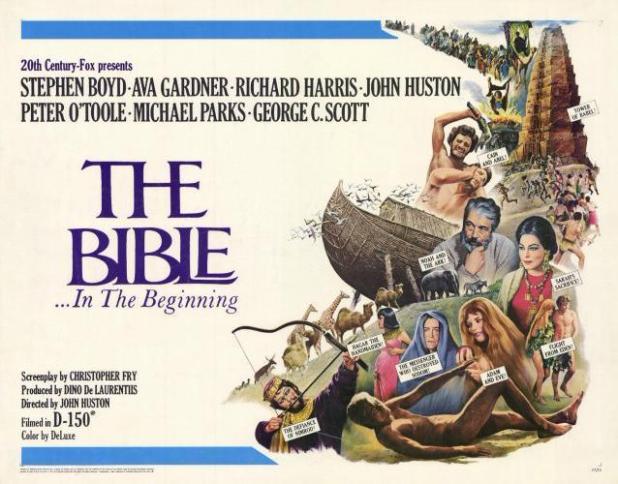
As movies battles television for the entertainmenty audience, theaters started showing movies so big that they couldn’t play the same on the small screen. Produced by Dino De Laurentiis and directed by John Huston, this was quite the project: make a movie of the first 22 chapters of the Biblical Book of Genesis from The Creation (of everything) and Adam and Eve to the binding of Isaac. It was written by Christopher Fry with contributions by Ivo Perilli, Jonathan Griffin, Mario Soldati, Vittorio Bonicelli and Orson Welles.

What got me watching this? Michael Parks is Adam! Who is the Creator, Tarantino? Anyways, his bride, Eve, is played by Ulla Bergryd, a Swedish anthropology student living who was discovered by a talent scout and on set in a few days. She was only in one other movie before leaving acting for a life in academics.

I mean, this movie is packed with people I love playing roles from the best selling book of all time. Richard Harris is Cain! Franco Nero, who was a still photographer on the set and had never acted before, is Abel! George C. Scott is Abraham, nearly sacrificing his children! Ava Garden was Sarah and she said, “It’s the only time in my life I actually enjoyed working — making that picture.” Stephen Boyd is Nimrod, great-grandson of Noah and not an X-Men villain! Peter O’Toole is an angel? Anna Orso from Day of Anger and Exterminators of the Year 3000 is Shem’s wife! Hagar is played by Zoe Sallis, who was Zoe Ishmail, until Huston decided that she should change her name because of its similarity to the name of Ishmael, her character’s son. Oh well, she was his wife. 1966 everyone. She’s also Angelica’s mother. Anyways, back to the people. Gabriele Ferzetti (On Her Majesty’s Secret ServiceThe Psychic) is Lot! As the Garden of Eden, a botanical garden…

That said, they spend $3 million ($26 million today) on the five sets that make up the Ark. And who will play Noah? Well, after Alec Guinness and Charlie Chaplin turned him down, director John Huston did it. And he was an atheist.

Anyways, I gained new respect for O’Toole when I learned that he was arrested while making this movie. He was on a night out with Barbara Steele and punched a paparazzi.

They planned a whole bunch of these movies and even though it was a big movie in theaters, it cost so much that it still lost $1.5 million.

APRIL MOVIE THON DAY 15: The Robe (1953)

The first Hollywood film made in CinemaScope, The Robe was based on Lloyd C. Douglas’ novel and was written by Gina Kaus, Albert Maltz and Philip Dunne, although Maltz was blacklisted and his name would not be in the credits of this movie for decades.

Directer Henry Koster knew something about being an enemy of the country himself, as even though he had escaped Germany before the war, he was considered an enemy alien and wasn’t allowed to leave his home at night during World War II. He’d go on to direct Harvey and Mr. Belvedere Rings the Bell.

Marcellus Gallio (Richard Burton) returns to Rome to discover that Caligula (Jay Robinson) is next in line to be Emperor. Despite being a playboy of sorts, Marcellus is in love with Diana (Jean Simmons), yet she is promised to Caligula. The two men engage in a bidding war for a Greek slave, Demetrius (Victor Mature), with Marcellus winning. He frees the man, who stays by his side, bound by honor.

In retaliation, Caligula sends Marcellus to Jerusalem, which is a death sentence. Before he leaves, Diane and Marcellus pledge their love for one another. When he arrives, Demetrius becomes much like Zelig, meeting Jesus (played by second assistant director Donald C. Klune with Cameron Mitchell’s voice) and later Judas (Michael Ansara) moments before he hangs himself. Demetrius begs Marcellus to save Jesus, who has already been judged by Pontius Pilate (Richard Boone), who places Marcellus in charge of the soldiers who will watch over the crucifixion. In fact, Marcellus wins the robe Jesus wore in a game of lots. When he attempts to use the robe to cover himself, he feels great pain and Demetrius curses both him and the Roman Empire.

He runs into the night with the robe and Marcellus descends into madness. He’s sent to destroy the cloth and is promised that he can marry Diane if successful. As he struggles, he soon learns that he believes in Jesus and is introduced to the apostle Peter. Thus begins a journey that will find Marcellus, Demetrius and Diane against the full power of the Roman empire.

When this first aired on TV in 1967, 60 million people watched it. We’ll never have TV ratings like that again. The film also had a sequel already in production before it was completed — despite nearly everyone dying — as Mature returned for Demetrius and the Gladiators.

Richard Burton wasn’t just an atheist who smoked a hundred cigarettes a day on set. He also was having an affair with Simmons, who was married to Farley Granger, who came to the set one day and threatened his life.

APRIL MOVIE THON DAY 15: The Precious Jade Calendar (2019)

ABOUT THE AUTHOR: Herbert P. Caine is the pseudonym of a frustrated academic and genre movie fan in Pennsylvania. You can read his blog at https://imaginaryuniverseshpc.blogspot.com.

When people think of religious scare films, they generally think of Christian productions such as Blood Freak, The Burning Hell or Unplanned. Those with more international tastes may remember Muslim works such as the anti-Salman Rushdie epic International Guerrillas, which ends with Rushdie being incinerated by lightning bolts from a flying Qur’an. However, thanks to a recent review in Shock Cinema magazine, I found a rare Buddhist entry in the genre. The Precious Jade Calendar is a Chinese-language animated TV series that offers viewers a lengthy tour of Buddhist hell. Even though the show appears to be intended for children, reportedly having run in a Saturday afternoon timeslot, it is as bloody as any adult-oriented anime.

This animated series is based off a Chinese text purportedly given to a monk by the rulers of hell in the eleventh century, although as Reed College Professor Ken Brashier notes, there are no known copies of it from prior to the nineteenth century. The Precious Jade Calendar, also known as the Jade Records and the Jade Guidebook, is essentially a tourist guide to hell. It describes the various subsections of hell – called small hells – and the sins that are punished in each one.

The series opens with two young boys at a Buddhist monastery talking. One feels guilty about having accidentally killed young birds in a bird’s nest he knocked down, so they go speak to the head of the monastery, who proceeds to describe hell in all its glory to them. From then on, each episode discusses a specific palace of hell where sinners from a particular category are judged and punished. Every so often, the children ask such cheerful questions as why do so many of the small hells feature tortures that involve tearing out someone’s guts.

The various small hells display an infernal division of labor that would make Dante seem creatively bankrupt. Among the hells the series warns of are “The Small Hell of Blood and Pus,” “The Small Hell Where Brain Is Taken Out to Feed Hedgehogs,” “The Small Hell Where People Are Eaten by Ants,” and “The Small Hell Where People Are Drilled by Purple Red Viper.” Although the series’ animation is limited, with figures remaining largely static other than moving their arms and blinking their eyes, the bloodshed is still quite graphic. Lots of blood splatters across the screen, and hearts and other organs are vividly torn from bodies.

Although Westerners often regard Buddhism as a more tolerant religion than many Judeo-Christian traditions, the variant on display here is as harsh and fear-based as anything preached by Jerry Falwell or Estus Pirkle. In one episode, making or distributing pornography is put on the same level as committing murder or raping teenagers. More troubling is the show’s assertion that disabilities or diseases are the outgrowths of wrongdoing in either this life or a previous life. At one point, the show asserts that infants born with missing limbs or other deformities were cannibals in a previous life. Similarly, one vignette depicts three siblings who mistreat their parents. One ends up getting struck by lightning, another dies of AIDS, and a third contracts cancer. This type of victim-blaming can result in the same type of ostracism that many people infected with HIV faced in the early years of the AIDS epidemic. Obviously, not all Buddhists would endorse this dark vision, but this series should serve as a footnote to Western stereotypes of Buddhism as necessarily a more forgiving religion.

The Precious Jade Calendar is available on YouTube broken up into parts on this channel.

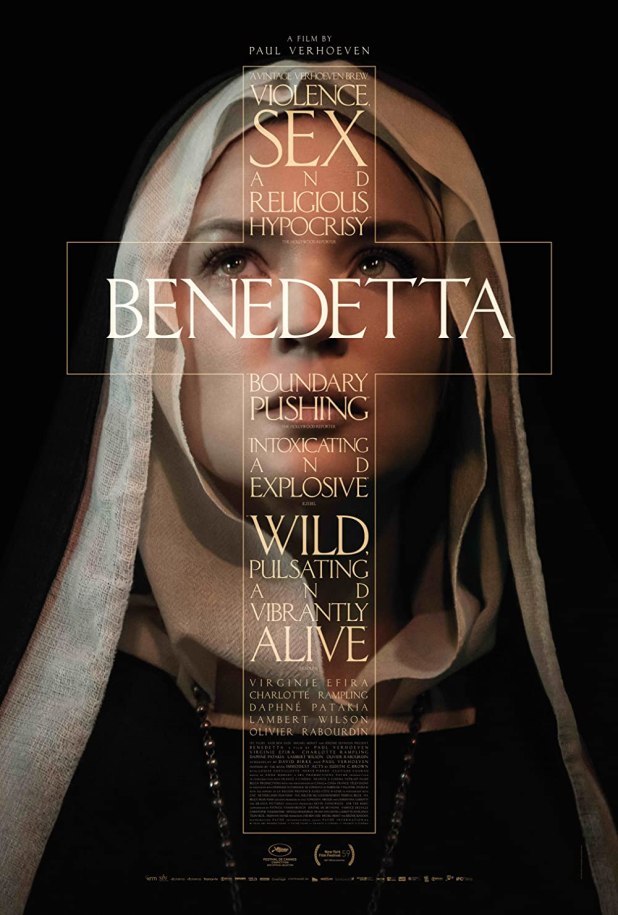
APRIL MOVIE THON DAY 15: Benedetta (2021)

When Jean-Luc Godard’s Hail Mary came out in 1985, the Catholic Church was so upset they talked about it in my little church in Ellwood City and I’d never heard of Goddard before, so thanks for using indignation to make me discover art. In fact, I’d already been turning to the films rated “O” by the Pittsburgh Catholic as films to hunt down, like Dawn of the DeadCarrie, Lemora: A Child’s Tale of the Supernatural and many, many more.

What does is say when Benedetta is beamed directly into my living room and presents a take on religion that seems to claim that it can exist hand in hand with sexuality and not a single protest happens? I demand more shock and upsetness!

Well, The American TFP — as well as other Catholic groups — did protest and it was banned in Singapore, but in the 80s, they would have been crying at the altar over this.

Benedetta Carlini was born into a family that seemingly led her into the life of Catholic mysticism, living a childhood filled with devil dogs that attacked her and nightingales — the symbol of carnal pleasure — singing at her command. Her family may have been too poor to pay the dowry — yes, Brides of Christ were literally brides then — and she finally joined a smaller ascetic order of sisters, where a statue was said to have fallen on her as she prayed to it.

In 1614, Benedetta’s life changed as she began to see visions of Jesus, who would battle snakes, scorpions and boars to protect her. The priests believed that she was either mentally ill, being consumed by demons or meeting the Divine, but leading to the former, even when she grew sick for two years and then had the visions return in 1617.

Now, instead of Jesus, she was being attacked by a handsome young man who attacked her with chains and swords, demanding that she leave the monastic life. These visions told her that the Church could not save her soul. A year later, as there was a parade through town, she went into a trance where Mary gave her two angels to guard her and she could see Saint Dorothy. Three months later, she received the Stigmata and as a result, she was one of the few women — if any to be honest — able to give sermons within the Catholic Church.

On March 21, 1619, one of the lead priests summoned Benedetta and told her: “Today is the day of St. Benedict, your saint’s day, go in ecstasy at your pleasure, I give you permission.” The next vision she recieved would be Jesus taking her heart and returning with a new one in three days for her. Nuns who felt her heart said that they could not detect it within her body. To maintain her pureness, Jesus ordered her not to eat meat, eggs and milk products and not to drink anything but water. And maintain her spiritual purity, the Son of Man assigned her a guardian angel, Splenditello, to let her know when she was sinning.

On May 27, 1619 — a Feast of the Holy Trinity — Benedetta claimed that she was married to Jesus himself, as others heard her speak in a different voice. Now, here’s where things get interesting. As stated before, women were to be kept silent at this time and most of all, quiet within the Catholic Church. By having these visions, she was able to have power, agency and voice.

She was investigated by the church multiple times, supposedly died and was resurrected, then was accused of being possessed. Her parents were also said to be demonically taken at some point in their lives and it was also claimed that she was avoiding the diet Jesus had given her by eating salami and Cremonese-style mortadella. More damaging was the discovery that she was causing her own spiritual cuts and wounds, as well as sleeping with a fellow nun, Bartolomea, acts that her guardian angel would say were not a sin.

No one is sure how Benedetta was punished, but the town of Pescia revered her even as she was kept within the convent for the rest of her life.

Basing his movie on Immodest Acts: The Life of a Lesbian Nun in Renaissance Italy by Judith C. Brown, director Paul Verhoeven and co-writer David Birke offer no easy answers. We do see the striking visions of Jesus that Benedetta is given, but it’s left to interpretation if what she sees is the madness of the divine. Virginie Efira is quite striking in the way that she can appear at once in charge and yet be pulled and pushed by the whims of God and man.

The director would not make this movie with the writer who started the project, Gerard Soeteman. He was not involved in the rewrites and filming of the movie due to his growing dissatisfaction with the director’s emphasis on sexual content. Soeteman saw Benedetta as being concerned with a woman’s struggle for power in a male-dominated world, but was disappointed by how Verhoeven had instead concentrated on making a nunsploitation movie.

I was intrigued by the stories of the other women in this movie, as Sister Felicita (Charlotte Rampling) has been the leader of the order with power that exists only inside the walls of their home. Bartolomea (Daphné Patakia) has left an abusive family and sees in Bendetta a partner to change her life and feels left behind — and is permanently damaged as a result of their relationship — as her lover’s power changes her existence.

For a movie that has a budget of every nunspolitation movie ever made all added together, this stays somewhat classy —  I say that in full knowledge that a statue of Mary is carved into a phallus — and presents a world where its heroine can achieve both spiritual and carnal ecstasy. This idea remains incendiary two millenia after the church began. It’s also a film that dares to have a violent and sexually inviting image of Jesus, attacking snakes and inviting the young nun to disrobe and embrace Him as he’s nailed to the tree.

“Sometimes it makes me tremble.”

APRIL MOVIE THON DAY 15

For the fifteenth day of the B&S About Movies April Movie Thon, let us kneel. Let us stand.

April 15: Good Friday — You don’t have to go to church but you do have to watch a religious-themed movie.

All April long, we’ll have thirty themes as writing prompts. If you’d like to be part of it, you can just send us an article for that day to bandsaboutmovies@gmail.com or post it on your site and share it out with the hashtag #BSAprilMovieThon.

Here are some films that we can recommend to watch today:

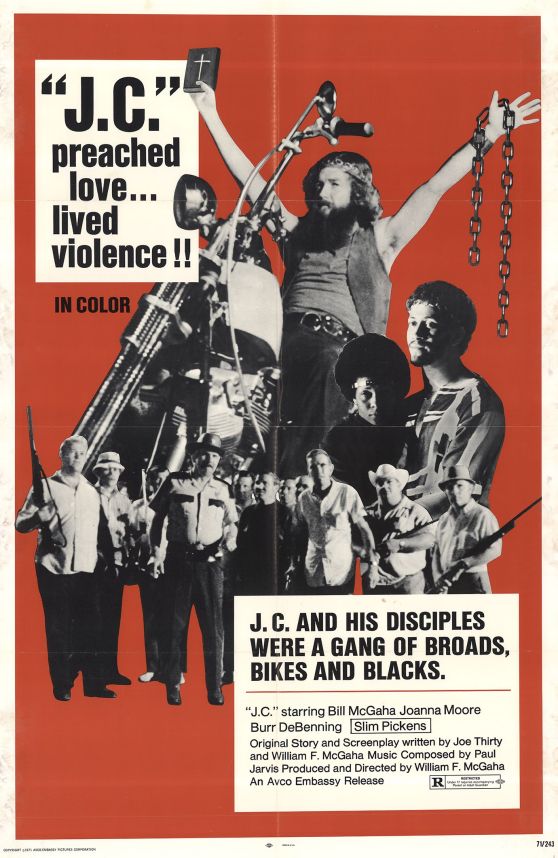
J.C. (1972): J.C. And His Disciples Were A Gang Of Broads, Bikes And Blacks. Basically, if Satan is an acidhead, so is Jesus. And if you ever heard someone say Christ on a bike, now you can see it for yourself.

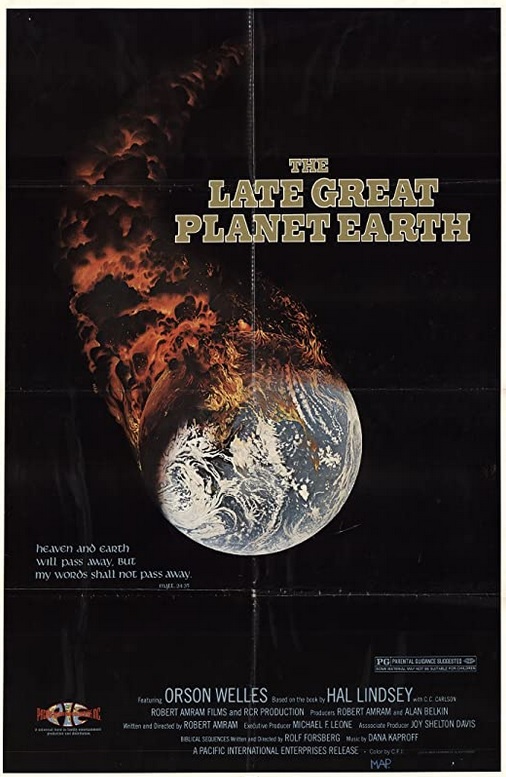
The Late Great Planet Earth (1978): 70 percent of The Holy Bible‘s predictions by the prophets of old have come true. So, if those predictions did, it follows the other 30 percent will happen in our lifetime. It’s time to get frightened.


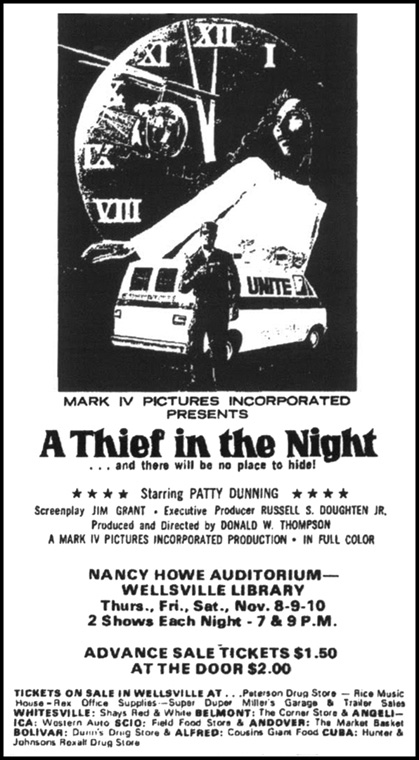
A Thief In the Night (1972): Years before Left Behind, Donald W. Thompson was creating an entire Rapture cinematic universe. Get ready to get even more frightened!

What are you watching?

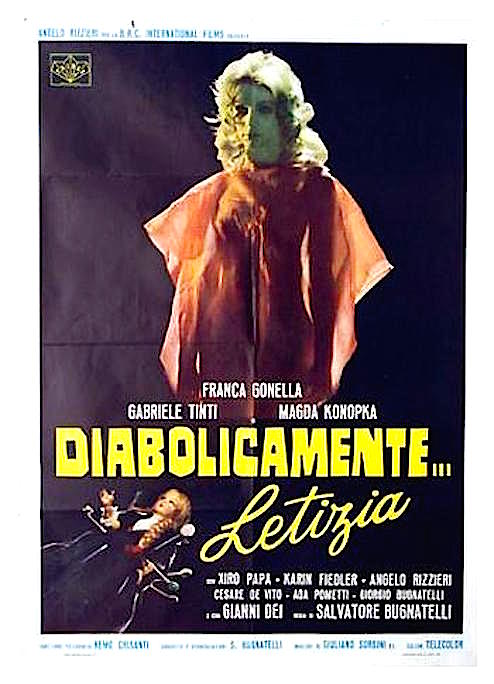
APRIL MOVIE THON DAY 14: Diabolicamente… Letizia (1975)

Sure, it translates as Diabolically… Letizia, but Sex, Demons and Death is a way better title.

Marcello (Gabriele Tinti, one-time husband of Laura Gemser; he’s in Endgame) and Micaela (Magda Konopka, Blindman) haven’t been able to have children. While Marcello wants to go to Switzerland, she decides to just have her niece Letizia (Franca Gonella, Revelations of a Psychiatrist on the World of Sexual Perversion) stay with them instead. This sounds like a bad idea even without the possession part of the deal.

Before you know it, she’s frightening their servant Giovanni (Gianni Dei, Patrick Still Lives) by appearing as a red demon, making out with the maid Luisella (Karen Fiedler, Last Harem) starting with psychically rubbing her face with toast and getting biblical with her own aunt. She’s also nearly a thirty-something teenager.

So imagine — some parts giallo, some parts The Exorcist and all the sleaze that Italy can sweat up.

Director Salvatore Bugnatelli only made seven movies, five from 1975-1989 — Excuse Me Padre, Are You HornyMizzzzica… ma che è proibitissimo?  (Mizzzzica…But What Is Prohibited?), Racconto immorale (Immoral Tale); Intimo profondo (Deep Underwear) and this movie — before coming back in 2006 to direct 80 Italian sexy models and Diario segreto di un feticista (Secret Diary of a Fetishist). It was co-written with Lorenzo Artale, who also did the dialogue for The Beast In Heat, which is the part where I said, “Oh, this makes sense.”

APRIL MOVIE THON DAY 14: Le porte dell’inferno (1989)

Dr. Johns (Giacomo Rossi-Stuart, Emanuelle in BangkokWar of the Planets) has spent 78 days in a hole and set a record, but now he’s claiming that everyone will die if they come down to rescue him.

Umberto Lenzi directed five movies in 1989 and of those, this is the weakest (in case you want to know, I’d rank the others in this order: Nightmare BeachHitcher In the DarkHouse of Witchcraft AKA Ghosthouse 4 and House of Lost Souls/AKA Ghosthouse 3). Maybe he was beyond busy, so busy that he thought no one would noticed if this movie was endless cave exploration and the end from Nightmare City.

Maybe he really loved his wife Olga Pehar and wanted to encourage her as this was her first script. She’d go on to write Hitcher In the DarkAfter the Condor, Karate RockBlack DemonsHunt for the Golden ScorpionNavigators of the Space and Karate Warrior 3 – 5.

I really wanted to love this movie. It has caves, it has gore, it has Lenzi. That said, he made some other movies that I’d totally recommend, such as OrgasmoSo Sweet…So Perverse, A Quiet Place to KillSpasmoGhosthouseCannibal FeroxSeven Blood-Stained Orchids and Oasis of Fear.

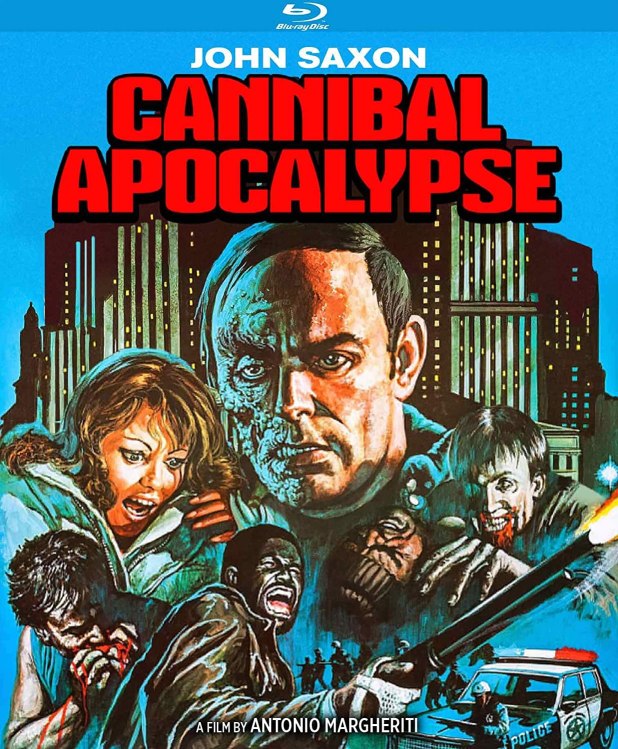
APRIL MOVIE THON DAY 14: Cannibal Apocalypse (1980)

Whether you call it Apocalypse domaniCannibals In the StreetsInvasion of the Fleshhunters or another of the many titles this movie has been given, you have to respect the vision of Antonio Margheriti who continually brings something amazing to each of his movie, no matter if they’re in science fiction (Assignment: Outer Space, The War of the PlanetsThe Wild, Wild PlanetBattle of the Worlds), horror (The Long Hair of Death), giallo (Seven Deaths in the Cat’s Eyes), westerns (And God Said to Cain), war (Jungle RaidersCode Name: Wild Geese) and whatever magical genre Yor Hunter from the Future is from.

In an interview with The Flashback Files, star John Saxon said, “It was talking about the Vietnam war like it was a virus you could bring home. I thought it was a great metaphor for a psychological condition.”

But then he started making the movie.

“At one point we were shooting a scene and a guy brings in this tray of meat. I asked what it was for and they explained to me it was supposed to be body parts, even genitals, and we were supposed to gnaw on them. I asked Margheriti to take me out of the scene and I went to my hotel room. Once I found out what the true nature of the film was I got so depressed.”

Yet no matter how wild this movie gets, Saxon is the glue that holds it together, adding energy and emotion to every scene he’s in.

Saxon plays Norman Hopper, a man haunted by his experiences in Vietnam, remembering one night when he was bitten by Charlie Bukowski (John Morghen AKA Giovanni Lombardo Radice, who had quite the year, also appearing in 1980s City of the Living Dead and The House on the Edge of the Park), a POV that he rescued.

He hears from Bukowski, who wants to meet him for a drink, but he’s late as he’s giving in to the charms of his young next door neighbor Mary (Cindy Hamilton AKA Cinzia De Carolis, Lori from The Cat O’Nine Tails). In the middle of them starting to make love, he bites her. And she likes it, because yes, this is an Italian horror movie.

Just then, Norman discovers that Charlie has barricaded himself in the mall and is threatening to kill civilians. Norman convinces him to surrender, but as they’re taking him away, he bites a cop. When he returns home, he confesses to giving in to his sexual impulses and feeling the need to bite Mary. His wife Jane (Elizabeth Turner, Beyond the DoorThe Psychic) struggles to understand. Meanwhile, Bukowski and another vet named Tom (Tony King, who is now Malik Farrakhan and the head of security for Public Enemy; he’s also in The Last HunterThe ToyAtlantis Interceptors and Hell Up In Harlem) battle guards; Bukowski tops that by biting a nurse named Helen (May Heatherly, PiecesEdge of the Axe).

No one is innocent, as Jane has been making time with Dr. Mendez (Ray Williams AKA Ramiro Oliveros, The Swamp of the RavensThe Pyjama Girl Case), who takes her on a date to a piano bar where he tells her that the virus causes a mutation that causes human beings to crave flesh. Norman goes to get tested by the doctor, but he really wants to find out what the man’s intentions are with his wife.

Everything gets bad fast. Nurse Helen bites a doctor’s tongue clean off, just as the infected cop goes wild, tearing through several of his fellow officers. Captain McCoy (Wallace Wilkinson, Invasion U.S.A.The Visitor) resolves to end the outbreak and sends his men into the sewers to stop the outbreak, which finds Norman, Helen, Bukowski and Tony battling a biker gang and slicing a man apart with a disc grinder. Despite battling cops armed with a flamethrower and being shot, Norman survives and makes his way back to his home just in time to save his wife from an infected Mendez. As he expires in his dress uniform, she kills herself. As for the disease, perhaps Mary and her brother might know something as well.

It would take several websites to contain everything that Dardano Sacchetti wrote. I love that this film is a cannibal movie and a zombie film together, yet the infected retain their intelligence. It looks gorgeous as well, as the Italian film crew uses Atlanta — and De Paolis Studios back in Italy — to its fullest. It definitely earns being a video nasty, making its way to the section 1 list of prosecuted movies.