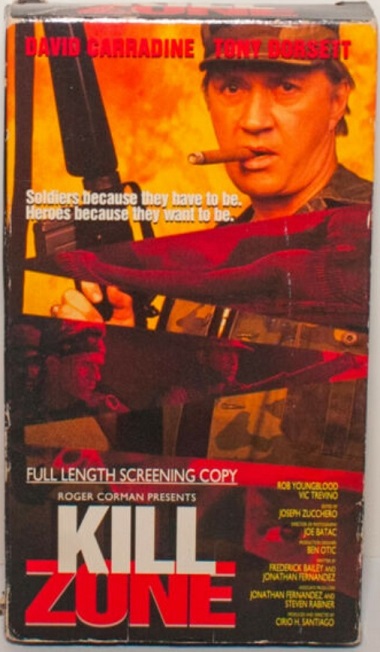
Roger Corman producing a Cirio H. Santiago Philippines-ripoff of Rambo starring David Carradine? No, back up that half-track, soldier! In addition to Rambo, we’re getting an inversion of Brian De Palma’s Causalities of War. See? Roger Corman is never one to allow a major studio theatrical hit go to waste.
The “Tony Dorsett” starring alongside David Carradine is, in fact, the Rochester, Pennsylvania-born Tony Dorsett, who served as a running back for the Dallas Cowboys from 1977 to 1987. And there’s Vic Trevino, who played Ricardo in HBO’s Pee Wee’s Playhouse (and also starred in Cirio’s Firehawk), and Ken Metcalf, who goes all the way back to the 1974 exploitation classic TNT Jackson (and also starred in Cirio’s apoc-slopper Stryker). Fans of the short-lived CBS-TV sci-fi series Space Precinct and Fox TV’s Melrose Place will also notice Rob Youngblood in the cast. If you’ve seen Black Mamba (1974), then you recognize Vivian Velez. And if you’ve seen any Philippines action flicks from the late ’80s — post-apoc or war — you know Jim Moss and Nick Nicholson.
Of course, while all of the actors look familiar . . . you also notice, as with most of Cirio’s flicks: stock recycling of war footage from Cirio’s other films is afoot.
Courtesy of darksidelouisville/eBay/TRAILER on You Tube.
Our man Carradine is, of course, the hellbent and perpetually cigar chompin’ Col. Horace Wiggins inflicting the war casualties as the commander of his own, unauthorized fighting force in Cambodia. And despite the orders of his superiors to not cross the border, he’ll burn the Viet Cong to the ground — no matter the cost. And Tony Dorsett is the just soldier who takes it upon himself to stop Wiggins.
And that’s pretty much it. Lots of huts blow up. Lots of bodies are mowed down by a never-ending stream of bullets. But there’s also a lot of philosophical war babbling. But when those last ten minutes of film roll . . . pure Cirio . . . stock footage be damned. The man knows how to put on a Corman-ploitation styled war drama.
Another scene-clip bites the dust: Why is every time we post a clip or trailer for a review, it’s pulled down?
You can watch a very clean upload of Kill Zone — along with a dozen other Cirio H. Santiago films — on Tubi TV. What’s great about this upload — unlike the numerous, washed-out VHS rips we usually get of Cirio’s work on You Tube — is that we can see how well his films were shot.
About the Author: You can learn more about the writings of R.D Francis on Facebook.He also writes for B&S About Movies.
And you thought, after two Teddy “Chiu” Page flicks with Romano Kristoff and Jim Gaines back to back in one day — Black Fire and Jungle Rats — we were doing another one? Gotcha!
As with Kristoff and Gaines, Jim Mitchum — the eldest son of Robert Mitchum (Thunder Road) and older brother to Chris Mitchum (who did his own share of Philippine-schlock with Aftershock, SFX Retaliator, and The Serpent Warriors) — jumped into the Sulu Sea as his career cooled off into a series of Phillipine-based actioners to close out his career. Jim was best known to U.S. audiences for starring in the theatrical inspiration to TV’s The Dukes of Hazzard, Moonrunners (1975). But you’re part of the B&S crowd, right? So you know Jim Mitchum best for his work alongside Richard “Captain Apollo” Hatch and Daniel “Paco Querak” Greene (know your ’80s apoc anti-heroes) in Sergio Martino’s Beyond Kilimanjaro: Across the River of Blood (1990). (Check out our “Ten Sergio Martino Films” featurette.)
Jim Mitchum’s co-star, Christopher Ahrens, is our (well, moi) “Michael Sopkiw,” if you will. Sopkiw made it through four movies before hangin’ up the clap board (2012: After the Fall of New York will get you started): Ahrens also stuck around for four leading-man roles: Raiders of the Magic Ivory being his debut, along with (Do we love this movie or what?) his role as Samuel Fuller in Bruno Mattei’s Shocking Dark (1989), third-stringing with Dirk “Starbuck” Benedict and Ted McGinley (from friggin’ Happy Days?) in the Top Gun-cum-Blue Thunder smash-up Blue Tornado (1991), and Beyond Justice (1991) with Rutger Hauer. As with Mr. Sopkiw and Mark “Trash” Gregory: we wished Aherns stuck around for more flicks. (If I had the money of a producer, I’d pull all three out of retirement and make an action movie . . . but I digress in my fanboy-dom.)
Now . . . before we get to the plot, we must discuss the all-too-brief directing career of Tonino Ricci and his bastard pup of Jaws-ness that is Night of the Sharks. Yes, even Treat Williams, who’s a really fine actor in his own right, when needing a paycheck, can be suckered into the ripoffness of the Spanish and Italian film industries. (See, now I’m the guy who, if I had the chance to interview Treat, I’d could give two shites about Hair; I’d go straight to Night of the Sharks with my first question.) Across his 22 credits, Tony R. gave us a couple of underwater adventures with Cave of the Sharks, aka Bermuda: Cave of the Sharks (1978) and yep, more Atlantis-shenanigans with Encounters of (in) the Deep (1979). And since we’re in Namsploitation territory: the one, two, three precursor Rambo-punch of Bruno Minniti as Rush in Rush, (1983), its sequels, A Man Called Rage and Days of Hell (1986). (Yeah, I know Big M’s character name-changes from Rush to Rage to Williamson . . . and the first two are technically post-apocs, while the third is in set modern-day Afghanistan, but if you watch the movies . . . hey, don’t argue the point with me: they’re “Rambo” “sequels,” so let it go.)
Does the fact that I’m the only person you know that’s seen seven Tonino Ricci films in my ’80s VHS travels concern you? That I’m the only person you know — maybe besides Sam the Boss at B&S (I doubt it, though) — that’s seen more than one Bruno Minniti film? And that I’d add Bruno to my own “Expendables” knockoff with Sopkiw, Gregory, and Aherns?
It should. Be very afraid.
Yeah, yeah. I know. The plot.
Oh, yeah. We know that this is an Italian production shot in the Dominican Republic — but the jungle Rambo-ness is oh, so Filipino. And besides, for all of our favorite B&S actors: when the Italians stop calling, you head to the South Seas.
Anyway, a Chinese businessman contracts Mitchum and Aherns’s mercenaries — for a cool and easy $250 K — to find that ubiquitous magic trinket that everyone seems to be after in these films, in this case: a rare ivory tablet lost in the deep jungles of North Vietnam. So, yes . . . we’ve just smushed our Raiders of the Lost Ark peanut butter into a bar of Namsploitation chocolate. Now, before you say “piranha” or “sharks” are swimmin’ around the treasure: this time we’ve got still-fighting-the-war Vietnamese soldiers, cannibalistic monks, and witch doctors. For the life of me, I don’t know, nor care, if this is set during or after ‘Nam. I just want action. So what’s with all the contemplating and yakity-yak? Friggin’ kill somebody already.
So what’s the dealo with the tablet?
The “evil” Lee Chang — like Lo Pan in John Carpenter’s Big Trouble in Little China — will be cursed for the next 2,000 years, or something, without it. (Of course: he’s a lying bastard with something up his sleeve.) And we need a damsel, and, just like with the cute Chantal Mansfield in Black Fire (reviewed this week) sticking around for only one movie, we have a kidnapped Clarissa Mendez in need of rescue from a black magic jungle cult. (POOF! Clarissa’s gone.) And, for that Rambo pinch: there’s LOTS of explosions and guns with a ridiculous, never-ending-supply of bullets. (There’s so many one-film-and-they’re-gone actresses in these Filipino films . . . did they give away film roles as prizes in Philippine modeling contests or beauty pageants? Crazy!)
So, yeah. It’s just a whole lot of bad-of-everything encased in better-than-the-movie-cover art that screams: RENT ME. And, back in the 5-5-5 days of home video stores and .49 cents Phar-Mor rentals, I gobbled up as much of it as I could. Seriously, how can you pass up a movie that gives the term “everything and the kitchen sink” new meaning?
And you can gobble it up for yourself on You Tube. Or — after reading my near 1,000 word dissertation (about 800 more words than it deserves) — watch the minute-long version.
The hilarious, ingenious minute-long edit of the film would be embedded here . . . if You Tube didn’t delete the user’s account before we went to press. Sorry you missed it.
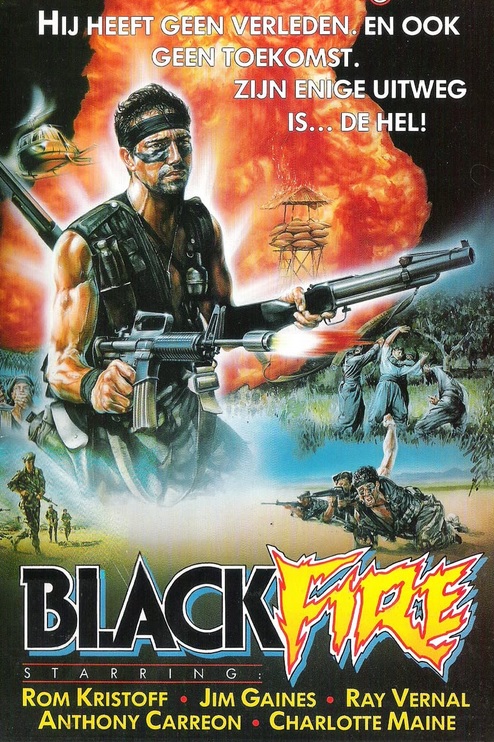
If their work in Jungle Rats (reviewed this week, look for it) wasn’t enough to satiate your Philippines-based, Rambo-inspired Namsploitation . . . Jim Gaines, Teddy “Chiu” Page, and Romano “Rom” Kristoff are back in Black Fire. (Go ahead, make fun. But I loved renting these Rom-Rambo knockoffs back in the day. My Rom-ness is only matched by my Michael Sopkiw-ness and my Mark Gregory-ness.)
Kristoff is Sgt. Frank Johnson — aka, Code Name: Black Fire — who is not just a lethal Vietnam killing machine: he’s a lethal ninja warrior killing machine: a skill the bulky Stallone didn’t know and couldn’t do if he tried. But our favorite Spanish expatriate martial artist can! But Agent Black Fire is so skilled that he’s become not only a danger to the ‘Gong, but to his own men: his commanding officers mark him for termination. And beware of Black Fire’s special ops, missile-equipped crossbow!
After suffering a concussion from a grenade blast in ‘Nam, Sgt. Frank experiences childhood flashbacks as a ninja in those dreams: he’s tapped back into is inner Qi — and he’s gonna need it. Upon recouping, Sgt. Frank is sent to San Sebastian with his buddy Sgt. Jim Anderson (yep, Jim Gaines) to work as U.S. military advisers . . . or investigate “something” (does it really matter; we’re not here for plot points). And the duo stumble into the (white-suited, natch) base commander’s illegal weapons ring. Yep: Black Fire must be terminated.
This one’s got it all: bad guys in eyepatches, exploding huts, exploding towers, “dramatic” slo-motion scenes of screaming as the bullets fly, and the ubiquitous, out-of-sync bad dubbing. Are there suspicious stock scenes you’ve seen before? Is the music muddy-familiar?
Uh, is this your first time watching a Silver Star Film production? Quick asking stupid questions and enjoy the “Rambo” of it all.
And, remember our “Ancient Future Week” of old computer-based movies from the ’80s and ’90s? Check out the very cute Chantal Mansfield (In her only movie role? Why?) banging out the data on the green-on-black MS-DOS CRT helping our Sgts. Frank and Jim solve the war crimes.
Logline: The American army sets up a special force unit to free three American officers who were captured by the Vietcong in Vietnam in 1968.
Yeah, Lt. Colonel Kilgore may love the smell of napalm in the morning: Me? I love loglines that reek of Rambo: First Blood Part II.
General Douglas Corad (Chattanooga, Tennessee-born Mike Monty, who you see in a LOT of Philippine action and horror films) heads up a reconnaissance team through the jungle border. They’re ambushed. Corad and a few of his surviving men are taken captive and imprisoned by the Vietcong. The Americans assemble a “magnificent five” to rescue the General: Romano “Rom” Kristoff (of Teddy Page’s Ninja Warriors with Ron Marchini and Ten Zan: The Ultimate Mission with B&S About Movies all-star, Mark Gregory) is Lieutenant John Smith leading the unit. Rom’s second-in-command is Jim Gaines — also the screenwriter here; also the writer and star of Black Fire that we reviewed this week — is his sergeant-at-arms, Pete “Killer” Rayo.
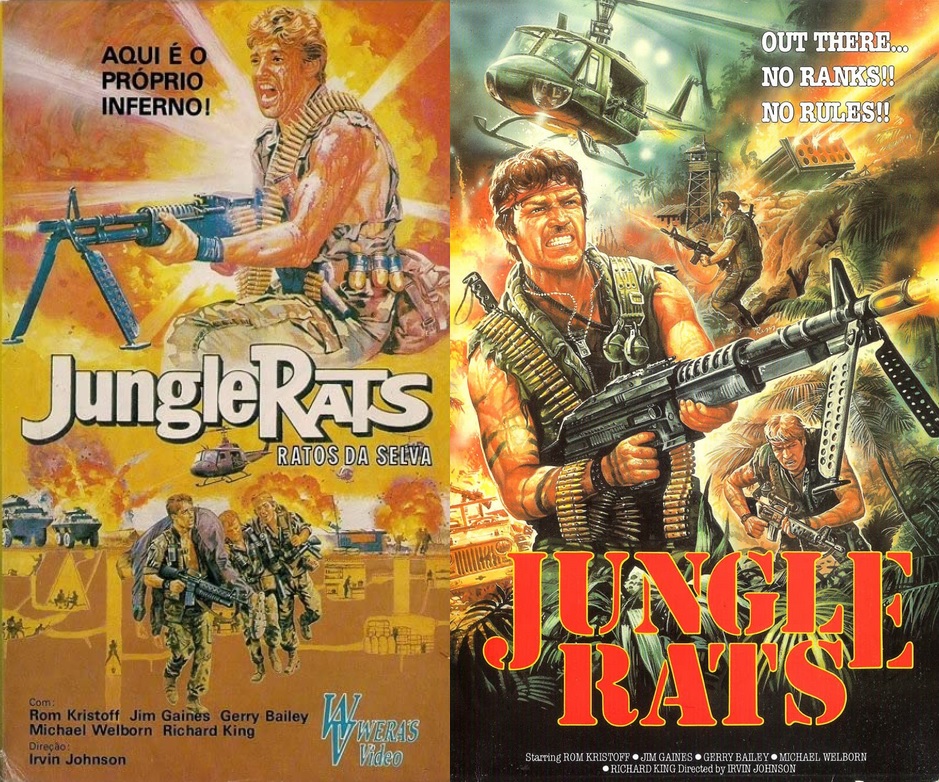
Yeah, that looks like Sly on the right . . . but why does the dude on the left look like Reb Brown?
There’s not much more to be said about the plot as there really isn’t one: one solider gets captured, others go in for the rescue, they slop through the enemy’s tunnel system, they’ll blow themselves up with a grenade to kill as many ‘Gong as possible to save their buddies, and they mow down Vietgong with an endless rain of bullets with aplomb. Oh, and one solider has to be crazy (Jim Gaines) so you can work in a sympathetic angle with the other soldiers appalled at their freedom-fighting comrade raping an innocent Vietgong woman.
The whole point of these Filipino war flicks is action. And displaced martial artists like Spain’s champion Romano “Rom” Kristoff and director Teddy “Chiu” Page, who burned through 40-plus of these Pacific actioners as an Assistant Director and Director between 1983 and 2001, always made these mindless, VHS Namsploitationers a hell of a lot of fun as we waited between our Stallone flicks.
No teaser trailer, but you can watch the full movie on You Tube.
About the Author: You can learn more about the writings of R.D Francis on Facebook.He also writes forB&S About Movies.
“Lunch’s defiantly unfashionable sort of feminism is the main point of interest in this documentary. Viewers will . . . marvel at a woman who, at 60, seems just as fierce as she was 40 years ago.” — John Defore, The Hollywood Reporter
Filmmaker Beth B and multi-media artist Lydia Lunch have been friends since the late ’70s, when both integrated themselves into New York’s “No Wave” movement: Beth B* excelled in film; Lunch drifted towards music. Taking her cues from Patti Smith, Lunch burst onto the scene with Teenage Jesus and the Jerks, which reached a national audience when Brian Eno (David Bowie, Taking Heads) included the band on his 1978 No New York compilation.
After her work as a singer and guitarist in Teenage Jesus and the Jerks, she fronted the band 8-Eyed Spy, then broke out on her own as a solo artist with the albums Queen of Siam (1980) and 13:13 (1981). During this period, she transitioned into acting, working with the experimental, “No Wave” filmmakers Vivenne Dick, James Nares, and Beth B, for whom she worked with an early James Russo (Beverly Hills Cop, Donnie Brasco, The Postman) and Ann Magnuson (Making Mr. Right with Malkovich) in the noir-homage, Vortex (1982). Lunch also worked with low-budget undergrounders Nick Zedd and Richard Kern (each known for Geek Maggot Bingo, 1983, and Sonic Youth’s “Death Valley 69,” respectively**). Lunch also worked with director Amos Poe (later of the more mainstream-distributed Alphabet City (1985) with with Vincent Spano of Over the Edge; Rocket Gibraltar (1988) with Burt Lancaster) on his early feature, Subway Riders (1981).
First collaborating with Sonic Youth on their album Bad Moon Rising (1985), for that album’s college radio single, “Death Valley 69,” she came to collaborate with that band’s bassist, Kim Gordon, as the guitarist and lead vocalist in Harry Crews. The band released the lone album, Naked in Garden Hills (1987), in honor of the Deep South, dark-noirist author of the same name (his books The Gospel Singer (1969) and The Knock Out Artist (1988) were adapted as songs on the album).
For this first documentary on Lunch’s career, Beth B secured the insights of fellow New York scenesters, and artists inspired by her, such as Thurston Moore of Sonic Youth, Donita Sparks from L7, and Henry Rollins. Lydia Lunch: The War Is Never Over became available in select theaters and national streaming on June 30, 2021, by Kino Lorber. You can also learn more about the film’s virtual screenings at KinoMarquee.
* As part of our “John Doe Week” of film reviews, courtesy of the film starring his ex-wife and X bandmate Exene Cervenka, we reviewed Salvation! (1987), Beth B’s parody on organized religion and the mass communication medium of television. We also reviewed Lydia Lunch’s appearance in Mondo New York(1988), as well as taking a look at The Blank Generation (1976) — a 16-mm black & white DIY documentary co-directed by Lydia Lunch and Patti Smith Group guitarist Ivan Kral with director Amos Poe — in the context of our review for Ulli Lommel’s Richard Hell-starring Blank Generation (1980).
** Richard Kern’s other MTV 120 Minutes-era alternative rock videos include King Missile’s “Detachable Penis” and “Marilyn Manson’s “Lunchbox.”
Other female punk/new wave musicians who transitioned into film that we’ve reviewed are the late Christina Amphlett of the Divinyls in Monkey Grip (1982), Nena in Hangin’ Out (1983), and Nina Hagen in Cha Cha (1979). While we haven’t reviewed them, Debbie Harry of Blondie fame, and later of David Cronenberg’s Videodrome (1983), appeared in Amos Poe’s Unmade Beds (1976) and The Foreigner (1978).
There more rock ‘n’ roll on film — including many punk and new wave-inspired films — with our “Rock ‘n’ Roll Week” blowouts (Part 1 and Part 2). Is there a “Part 3” on the way? Oh, you bet! Join us during the last week of August through the first week of September for thirty more films concerned with rock and radio. Oh, speaking of radio . . . be sure to visit our round up of “Exploring: Radio Stations on Film” . . . and we get into Gen X/Grunge films with our “Exploring: 50 Gen-X Grunge Films of the Alt-Rock ‘90s” featurettes.
About the Author: You can learn more about the writings of R.D Francis on Facebook. He also writes for B&S About Movies.
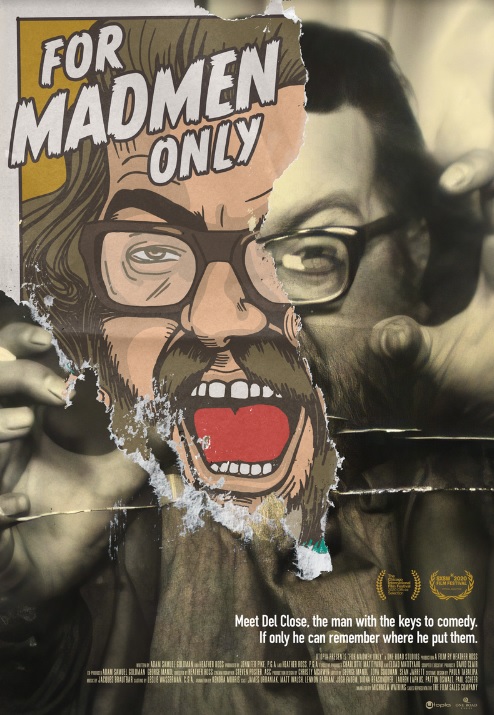
“We knew that to make the definitive movie about this icon/unknown, we would need to take the same kind of creative risks that he was famous for. As someone known for breaking down genres and experimenting with form — not to mention playing fast and loose with the truth — we decided to apply the same ideas to our film and try to break new ground with the documentary genre. This resulted in constructing a set of scenes imagining the creative process behind Wasteland, Del’s comic book autobiography.” — writer and director, Heather Ross
When the fans of Saturday Night Live think of that groundbreaking series, they remember Bill Murray and John Belushi . . . then they’ll remember the influential Animal House and Caddyshack*, in short order.
That is, until, you watch this multimedia documentary.
After watching, you’ll come to know that all roads to that iconic, late night NBC-TV comedy series began with Del Close: the actor and writer, comedy teacher and improv maestro who directed at Chicago’s Second City — where he mentored that series’ Bill Murray, John Candy, and Tina Fey — and San Francisco’s The Committee — where Howard Hesseman, later of WKRP in Cincinnati and Head of the Class, got his start.
Of course, comic and graphic novel fans know Del Close, best, for his semi-autobiographical DC Comics anthology Wasteland — a work which serves as the source material for this documentary, with reenactments starring his past pupils, such as Patton Oswalt (Failure to Launch) and Lauren Lapkus (The Wrong Missy). Actors and filmmakers who knew him best, such as Bob Odenkirk (The Solomon Brothers), Tim Meadows (The Ladies Man), and Adam McKay (The Other Guys), also appear with their insights and memories of Del’s work.
If you’ve laughed at any of those above films, or something on television since Saturday Night Live went on the air in 1975, or any of the films connected to the cast of that iconic series — you have the “Where’s Waldo” of comedy, Del Close, to thank for those laughs. And this multimedia piece — that goes beyond the usual “talking heads” trope of most documentaries, inserting a clip here, and a photo there — is a one-of-kind, passionate testament to a man that was everywhere, and nowhere: a true dark man of comedy.
Watch it. And learn where from where the laughter comes.
For Madmen Only: The Stories of Del Close was acquired for international distribution by Utopia Media, which also brought the British rock document on Suzi Quatro, Suzi Q, as well as the recent WITCH: We Intend to Cause Havoc, about the Zamibian ’70s progressive-rock band, to the international marketplace. Another of Utopia’s award-winning documents is Martha: A Picture Story, concerned with Martha Cooper, a New York-based, trailblazing female graffiti artist and street photographer.
Utopia is headed by Robert Schwartzman — of the band, Rooney, and a writer and director in his own right — who made his feature film directing debut with the really fine comedy, The Argument, released last September. You can learn more about the launch of Utopia Media with this February 19, 2019, article at Deadline.com.
About the Author: You can read the music and film reviews of R.D Francis on Medium and learn more about his work on Facebook. He also writes for B&S Movies.
“WITCH is like the Beatles of Zambia.” — from the film
In the ’70s, Anglo-American-bred heavy-psychedelic progressive rock flourished, not only in the U.S., the U.K, and on the European mainland — but all over the world. The bands were everywhere: even in Japan (Food Brain) and Israel (Atmosphera), to name a few. Even in the landlocked country of the Republic of Zambia in Southeastern Africa. And the nation’s most famous band was the Rolling Stones-influenced, psych-rock flavored (recalling the band’s 1968 to 1974 Beggars Banquet to It’s Only Rock ‘n Roll era), WITCH, the first Zambian band to record and release a commercial album.
Jagari, WITCH’s founding and sole original member, sets out on the road to rediscovery/Utopia Media.
As with Malik Bendjelloul — a Stockholm, Sweden, documentary filmmaker who, upon hearing the music from the two-album career of forgotten Detroit musician Sixto “Sugar Man” Rodriguez for the first time in a Cape Town, South Africa, record shop, became obsessed with discovering what became of the mysterious “Bob Dylan of Detroit” to create the film Searching for Sugar Man — Gio Arlotta — a Milan, Italy-based journalist who, upon hearing WITCH for the first time in 2012, became obsessed with discovering what became of the country’s original-influential “Zamrock” band. So Gio Arlotta, along with fellow fan, Jacco Gardner, a Dutch musician, they set out to Zambia to find their idols.
Their search led to finding the band’s sole surviving member, vocalist Emanyeo “Jagari” Chanda (an Africanisation of Mick Jaggar) (the filmmakers also find the band’s original engineer at the still-in-existence studio where they recorded/pressed their albums). As with the Sugar Man before him, Jagari experienced a career resurgence with his first-ever European tour — by a revived WITCH featuring an international cast of fan-musicians (the Netherlands, Germany, and Switzerland). The keyboardist in the band is Patrick Mwondela, who joined in 1980 — long after Jagari’s departure — and remained with the band until their 1984 demise (he appears on their final two albums; 1980’s Movin’ On and and 1984’s Kuomboka).
The golden-era of the band, in my opinion, are the Jagari years from 1973 to 1976, as the later parts of the band’s catalog transformed from ’70s-styled progressive rock — inspired by the Rolling Stones, Jimi Hendrix, and U.S. funk, James Brown, in particular (and, I feel, to critical disagreements: a pinch of Miles Davis and a soupçon of Santana) — into disco and more traditional Zambian material; bass-oriented Kalindula music, in particular. (You can learn more about the traditional African instruments incorporated by the band at the Atlas of Plucked Instruments.)
In addition to his noted work as a journalist, Gio Arlotta is also a video artist. To that end: Arlotta effectively frames his shots and works as a fluid editor; the film’s animations are equally intriguing with a stellar opening credits sequence (assisted by his co-producer and writer, and cinematographer, Tim Spreng; Spreng made his feature film debut with the Czech Republic romantic-drama, 2013’s All the Lost Souls). Arlotta — as with documentarian Liam Firmager in his earlier celluloid tribute to Suzi Quatro — provides WITCH: We Intend to Cause Havoc with a not just a run-of-the-mill rock documentary or artist preservation quality: it’s a tale about dreams; a tale of how hard work and never giving up hope, eventually, will return bountiful spoils. And that the gift of music is an eternal one.
As with the absolutely stellar The Changin’ Times of Ike White from last year reigniting a rediscovery of the genius of ’70s soul-fusion musician Ike White, this is another time when you drop your hesitations on watching a documentary for your evening’s entertainment — and watch it, as you learn how political upheavals can affect one’s pursuit of music. You also learn that, regardless of borders, musicians experience the same unrealized careers — and are reduced to giving up music for day jobs to support their family; in Jagari’s case: spending long days digging the African wilds for precious stones.
My only reservations with the film is that the African-accent English (remembering Zambia was once a British territory) is difficult to understand. Hopefully, the theatrical and streaming version — unlike the promotional screener I watched — will provide viewers with captioning; captions which will obviously be available on the film’s eventual hard media release. I also feel the film would have benefited from a tighter edit, even at 80 minutes, the proceedings dragged slightly against the hard-to-follow Zambian English. Those personal opinions, of course, vary from viewer to viewer and in no way detract from the power of witnessing a once lost artist rediscovering his past — and experience his forgotten, creative past becoming commercially accepted by the world stage for the first time.
You can enjoy WITCH: We Intend to Cause Havoc on July 13, 2021, available as a world premiere, pre-order rent-to-own at Altavod. After its premiere on that platform, as well as Apple TV, the film will be available on other streaming platforms and hard media.
The film was acquired for international distribution by Utopia Media, which also brought the British rock document on Suzi Quatro, Suzi Q, to the international marketplace. Another of Utopia’s award-winning documents is Martha: A Picture Story, concerned with Martha Cooper, a New York-based, trailblazing female graffiti artist and street photographer.
Utopia is headed by Robert Schwartzman — of the band, Rooney, and a writer and director in his own right — who made his feature film directing debut with the really fine comedy, The Argument, released last September. You can learn more about the launch of Utopia Media with this February 19, 2019, article at Deadline.com.
An essential part of a prog-rock collection/Utopia Media.
You can find the full WITCH discography on You Tube:
* Released as a two-fer CD in 2014 on Now-Again Records. The label — as well as reissuing the remainder of the WITCH catalog in 2011 and 2012 in digital and vinyl formats — also released the 2012 career-spanning compilation We Intend to Cause Havoc.
You can learn more about Emanyeo “Jagari” Chanda and WITCH with “We’re a Zambian Band,” a highly-recommended expose written by Chris A. Smith for the Austin, Texas, publication, The Appendix.
WITCH – Live in London, September 2017
About the Author: You can learn more about the writings of R.D Francis on Facebook.He also writes film reviews for B&S About Moviesand publishes music journalism pieces and short stories based on his screenplays, on Medium.
Editor’s Note: On June 26, 2021, we had a “Ron Ormond Day” in tribute to his films. You’ll find the links to the reviews from that day of films — and others — within this review.
This is the one Ron Ormond film that eludes the staff of B&S About Movies. Sure, Sam and I are familiar with the film, as our religious schooling and church youth group years exposed us to all of Ron Ormond’s films — including this lost, final film of the Ormond’s from, as we like to call it, their “Damascus Years.”
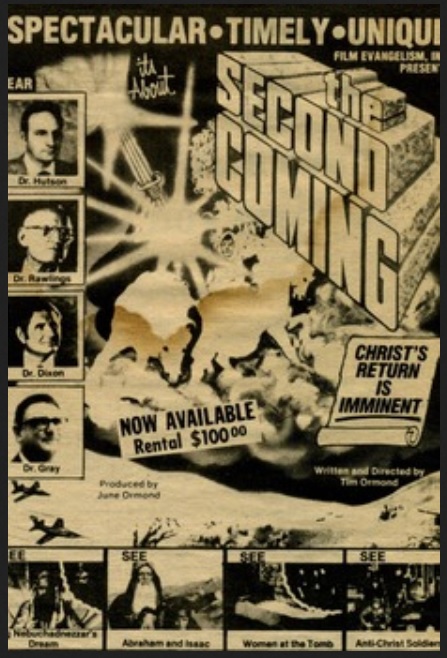
Out of the Ormond’s six Fundamentalist films — seven, if one includes their also-lost, hour-long “travelogue/documentary” feature, The Land Where Jesus Walked (1975) — this is the one film (two, including Land) that is not available as a vintage-resale VHS or reissues DVD. As with all of Ron Ormond’s post-salvation catalogue, The Second Coming did not play in rural Drive-Ins or indoor theaters: it was “rented out” (in this case: $100 a showing, as per the one-sheet) as a “roadshow feature” in churches and tent revivals.
Courtesy of Letterboxd; the only online copy.
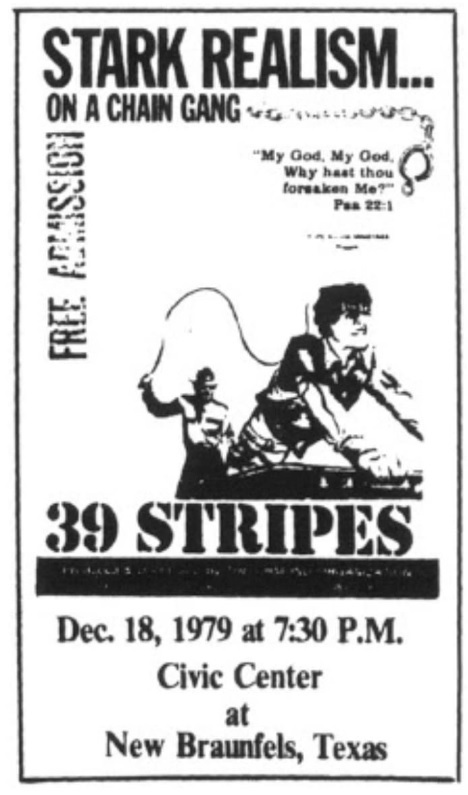
The Second Coming served as the directing debut of Ron’s son, Tim. Starting out as an actor in his father’s films: he starred in the family’s secular works Girl from Tobacco Row, White Lightin’ Road, and The Exotic Ones, then the Christian films If Footmen Tire You, The Burning Hell, The Grim Reaper, The Believer’s Heaven, and 39 Stripes. Tim matured to serve as an editor, cinematographer, writer (39 Stripes, The Second Coming), and director (the lost The Second Coming) on several Ormond family productions, which also included wife and mom, June Carr, on the production staff. Tim came to his directing debut through sadness: Ron Ormond died during the pre-production of The Second Coming — in 1981 at the age of 70s — leaving Tim and Ron’s widow to finish the film. June’s other films — under her maiden, professional name in the producer’s chair and as a Second Unit or Assistant Director include not only the above films, but Forty Acre Feud, The Monster and the Stripper, Please Don’t Touch Me, and the lost “jukebox musicals” Square Dance Jubilee and Kentucky Jubilee.
During our analog excavations to find an online stream or trailer to share (we were unsuccessful), we discovered an extensive, November 2007 interview with Tim Ormond, courtesy of Mondo Stumpo: an interview that assisted us in our additional documentation of The Second Coming. (We enjoyed the staff of Mondo Stumpo referring to the genre as “Christian Gore”; if you’re familiar with the Ormond’s “Pirkle” years, you know that’s a perfect analysis.)
We’d also extend our thanks to B. Earl Sink, Jr. — the son of Earl “Snake” Richards — in assisting us in our preserving of The Second Coming. As we’ve discussed in our previous reviews, Richards starred in two of Ron Ormond’s secular films: Girl From Tobacco Row (1966) and White Lightin’ Road (1967). Richards also starred in the non-Ormond “Jukebox Musical,” That Tennessee Beat (1966), by way of producer Robert L. Lippert, who produced many of the Ormond family’s works. It was during the course of that third film review, in which we came to speak with Earl Jr., who tipped us that he (regardless of the IMBb’s incomplete credits; they also have his mother’s credits split as “Carr” and “Ormond”) also acted in The Second Coming. And, as you read on, you’ll come to learn that four generations of the Sinks appeared in or crewed on Ormond productions.
In addition to writing and directing The Second Coming, Tim Ormond directed a documentary on long-time family friend, Lash LaRue, wrote 39 Stripes, and wrote the Jim Varney-starring Blood, Friends and Money.
If you’re familiar with the contemporary, Christian-apocalyptic oeuvre of Cloud Ten Pictures, with their B-star-studded Apocalypse series and their better known Left Behind series, as well as the films of David A.R. White’s PureFlix shingle (Jerusalem Countdown), or the ’70s Bible-apoc progenitors of Donald W. Thompson (A Thief in the Night), then you’re up-to-speed on the end-times tale in the frames of The Second Coming. But this is an Ormond film. And it is so much better for it: for Christian-based Ormond films come from the heart and, ironically, none are the least bit exploitative, although they appear on critical lists, i.e., “Christploitation,” as such.
As in the Ormond’s previous Estus Pirkle production, The Burning Hell: we have a similar, wayward youth in love with the world coming to find salvation through dreams, i.e., visions. This time, our scoffing youth, who dismisses his God-fearing mother and the family’s pastor, dreams of missing out on The Rapture. As with any Fundamentalist Ormond production — even the ones void of the crazed “Christian Gore” tutelage of Estus Pirkle — the imaginative creativity of the images presented in the frames is the always thing: God smites a Babylonian statue with a mighty rock (in repetitive, slow motion), dead saints of the past rise up out of their earthen graves, and new saints — the proclaimed 144,000 — vanish on the spot in an eye’s twinkle; then, in a grand, stunning piece of against-the-budget filmmaking (which we’ll get into detail, later): Jesus Christ returns with a phalanx of saints on white horses in the clouds.
Of course, our wayward lad returns to Jesus. As he should: Remember, Estus Pirkle warned us that communist invaders from Cuba would ram sharpened bamboo shoots through our brains via the ear canal, then dump our bodies in freshly bulldozed mass graves. Why would anyone want to stick around for those horrors?
As with the Pirkle trilogy — and the non-Pirkle The Grim Reaper — pastors show up, of course — six, in fact — amid the narrative with words of wisdom. Of course, while guys like Jack Van Impe and Jerry Falwell are committed and honorable in the word, it’s just not the same as having Estus ranting with his statistical analysis on the exact percentages of how many people end up in Hell, daily.
Hey, we can joke about the Pirkle trilogy, but the pastor, however off-putting he may be to secularists, he was committed to the cause. The Ormond family, on the other hand, created honorable, truthful films with a lighter touch. Fans of the Ormond’s Pirkle years may miss the “craze” of those films, here, and dismiss The Second Coming as less effective. We, the cubicle warriors of the B&S About Movies digital divide, do not: we adore all of Ron Ormond’s films.
Tim Ormond with mother June at a post-2000 convention signing/image courtesy of Dennis Dermody of Original Cinemanaic.
The Insights of Tim Ormond on the Making of The Second Coming
“After my dad died, I came to the final scene, which was the — and the way we got around things in general — was, someone would say, ‘That’s not the way it’s gonna be,’ and I’d say, ‘Well, this happened as kind of the way this person imagined it or dreamed it: like Daniel would have this dream.’ So that’s the way we would alibi things, [just] in case a theologian would say ‘Well that’s not the way it’s supposed to happen.’
“Anyway, this particular character in The Second Coming was visualizing Christ returning on white horses; wielding the sword, His face aglow. Well, I had to stage this scene. This was, of course, before computer graphics were like they are today. And even so, the cost would be prohibitive. So, I went to Hollywood, along with my Mom, and we looked up old friends; we found the wrangler who did Little House on the Prairie [for NBC-TV], as well as some old friends of my dad who’d worked on the Westerns [with Lash LaRue and Tex Ritter]. And I began to put together a crew and a shoot in Hollywood for staging this last [Christ in the clouds] scene.
“[While this was going on], I made a phone call to my friend in Nashville, Eddie King, who had played my brother in The Grim Reaper, and asked him if he could try to put together the same shoot in Nashville, because it would be much less expensive. So, I guess, just a few days before we were ready to go into production in Hollywood — and I’m just talking about on that one scene — I talked to Eddie, and he had put it together in Nashville. So we came back to Nashville to shoot it, merely from a cost standpoint.
“So, on that particular night, we gathered at the Riverwood Riding Academy, which was a great big field out near a park, not too far from my house, and people began to gather with the horses. We had a searchlight come in from Huntsville, which could basically shine this very bright, illuminating beam of light on Christ’s face: He was wearing a reflective surface so it would reflect the light back as bright as possible. He was dressed in the red robe, all the horses were white and groomed, all of his angels were riding alongside of him wearing white robes, we had fog on the ground, we had lights, we had big blowers running to move the fog. . . .
“And the funniest thing is, right exactly next door — I’m talking about a hundred yards away, but across a fence — was the park patrol. Just sitting there in the dark watching what was going on. And we didn’t know this. They didn’t bother us, but they were talking on their scanner. And one of my crew — actually the wife of the director of photography — was listening to them, and one guy said, ‘Come on, you’ve got to come over and see this! They’re doing a commercial for the Ku Klux Klan!’ So that was kind of a funny incident. But when it was done, it turned out very well. Of course, the ground was fairly dark on purpose, and there was a layer of fog. We superimposed that over the clouds, and it does appear like Christ returning triumphantly in the clouds. Which is a pretty graphical representation of the way it reads in the Bible. So that’s that one little scene.”
Earl and Rita Faye Sinks/courtesy of B. Earl Sinks, Jr. Facebook.
The Insights of B. Earl Sinks, Jr. on the Making of The Second Coming
“Ron [Ormond] wanted me to be in the film, as he wanted a 4th generation of our family to be in the film. Of course, my mother and grandparents were in Ormond films from back in California during the Lash LaRue days, as well as Square Dance Jubilee. My mom and grandparents also appeared in Girl From Tobacco Row, while my mom also did makeups for a few of the movies, like Burning Hell, and so on.
“So, Ron had my part written for me prior to his passing. Then Tim took over [as director]. I remember staying with Tim and June, his mom, rehearsing for the role along with Rev. Martin; he was in the movie 39 Stripes, which, as you know, was the story of his life. The reverend was such a Christ-like man that, to this day, I still think of him as such a sweet soul. When we finally got to the day of shooting, I recall when a cloud would pass over, or something wasn’t right, I would hear Tim call ‘CUT’ to end the scene. So, when we were shooting another scene, and I saw a cloud passing, I shouted, ‘CUT!’ like he did. Tim was tickled by that and let me know, jokingly, that he was the only one to say ‘CUT’ to end a scene. We all laughed.
“At the debut of the opening of the film, there was a man who thought my role, my acting, was good enough, so he asked me to read for a stage [production] of On Golden Pond. However, since it conflicted with school, my parents said ‘no’ to my audition. I also has a walk-on part in Tim’s Blood, Friends and Money with Jim Varney [but not as his character Ernest P. Worrell]; as I recall, my scene ended up on the cutting room floor.”
Bottom Right: Earl Sinks — aka Earl “Snake” Richards, the star of the Ormond’s Girl from Tobacco Row and White Lightin’ Road, as well as That Tennessee Beat — with the Crickets.
When you follow the links to our other Ron and Tim Ormond film reviews, you’ll understand the staff of B&S About Movies are fans, not only of the Ormonds’ secular films, but their Christian films, as well. We are doing our part to expose their films to our readers and preserve the Ormonds’ films for others to discover and enjoy — many for the first time.
To that end: We extend our thanks to Letterbox’d — and the anonymous uploader — who discovered a copy of the theatrical one-sheet of The Second Coming (the only copy of the theatrical one-sheet online). We also appreciate the film journalism efforts of Mondo Stumpo (still active, but ceased publishing in June 2012) and Original Cinemaniac for their previous efforts in preserving this lost Ron Ormond film.
And a special thanks to B. Earl Sinks, Jr. for taking the time to speak with B&S About Movies.
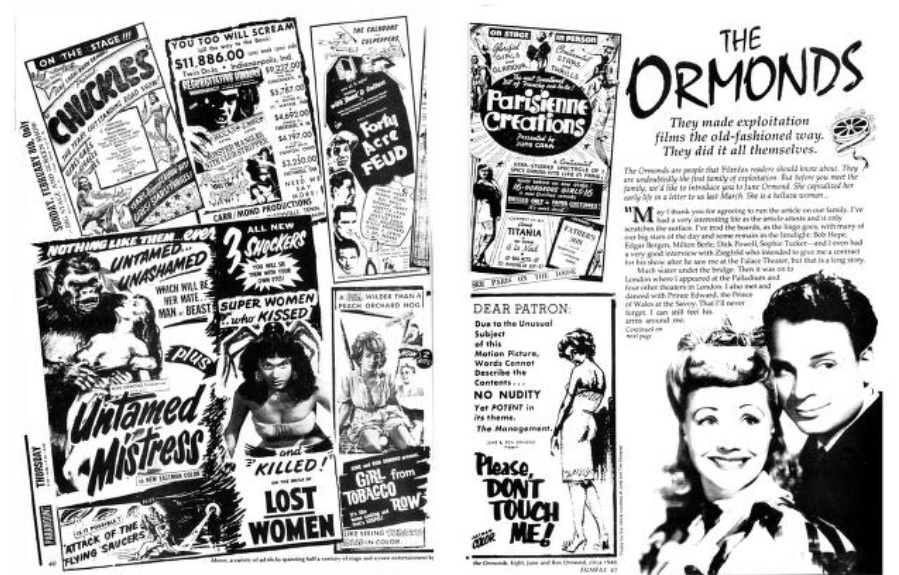
Learn more about the Ormonds in the pages of Filmfax, Issue 27 (1991), preserved on The Internet Archive. (The extensive article begins on Page 40.)
Update: July 14. 2021: Courtesy of film documentarian Brian Rosenquist — who’s currently working on a feature documentary concerning the joint exploitation films of Ron Ormond and Estus Pirkle, and who was involved in securing the original camera elements for Estus Pirkle’s three films, for Nicolas Winding Refn (Only God Forgives, The Neon Demon) to complete restorations — we’ve since learned The Second Coming was, in fact, released to DVD ten years ago on a double-DVD with The Grim Reaper. You can watch an online streaming version of The Second Coming on a Ron Ormond tribute page located at the Internet Archive.
In addition to streaming the only online copy of The Second Coming, the page also offers a copy of The Burning Hell, as well as the once lost “Jukebox Musical” Kentucky Jubilee, and Ormond’s pre-Christian film, Mesa of Lost Women.
You can learn more about the restorations of the Ormond-Pirkle trilogy with the Radio NWR podcast Estus Pirkle: A Celebration.
“Computer’s Log: Star Date 6969: Space, Space, Space. I’m sick of schlepping through space. I though it would be exciting to boldly go where no computer has gone before. To check out strange, new galaxies and kinky, new life forms. But noooo. I’m stuck, here, on this spaceship with three crazy chicks. All they do is snort coke, pop ludes and play with themselves. Its obnoxious.” — Heed the words of the (fey-gay) ship’s computer. For you will not laugh in the year 6969. You’ve been warned.
The whole universe?
By the time of the release of this not-funny Star Wars, well, more of a Close Encounters of the Third Kind rip, Norman J. Warren had two sexploitation flicks under his belt with the 1968 pairing of Loving Feeling and Her Private Hell; then he branched into horror with a trio of films: Satan’s Slaves (1976), Prey (1977; which had a sci-fi twist), and Terror (1978). So, after those films, of course, Norman’s next logical step was . . . a space comedy.
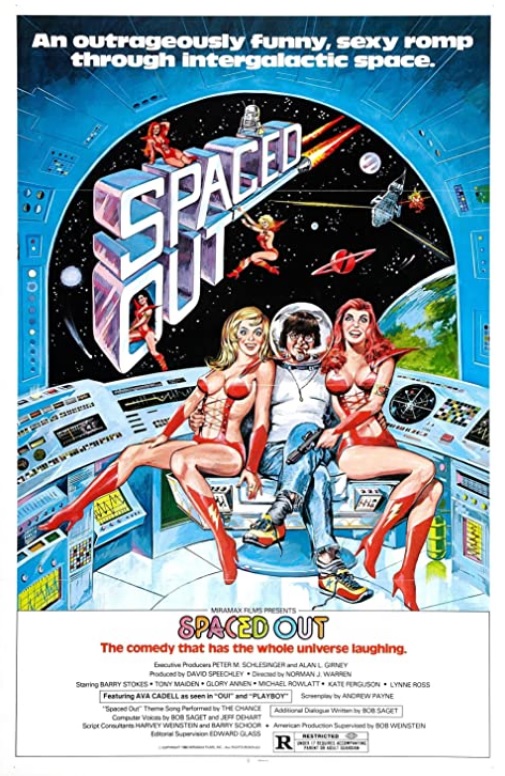
Courtesy of Simon Sheridan’s liner notes for the 2008 DVD reissue of the film, we come to know the original script was presented to Warren as “S.E.C.K,” aka Sexual Encounters of the Close Kind. Warren found the script a “funny but very corny” take on Fire Maidens from Outer Space (1956), so he agreed to direct, provided he was allowed to do a re-write. His new take on the script was known as Outer Touch, a play on the fact the aliens of the film are “out of touch” with Earth-human customs. The title was later proven as too esoteric, so the title of Spaced Out was used in the international marketplace.
And the studio behind the reimaging: Miramax. In addition to the new title, the Weinstein brothers, Bob and Harvey (the 30-year-old teenager rock ‘n’ roll comedy, Playing for Keeps was another of their early films), re-edited the film with new, sexed-up voice overs (provided, in part by Bob Saget, later of U.S. TV’s Full House fame; for another such, horny computer; see Warriors of the Lost World with its comic-crackin’ smart-cycle). As is the case with most directors-for-hire on a producer’s product: Warren wasn’t consulted on the Americanized changes by Miramax.
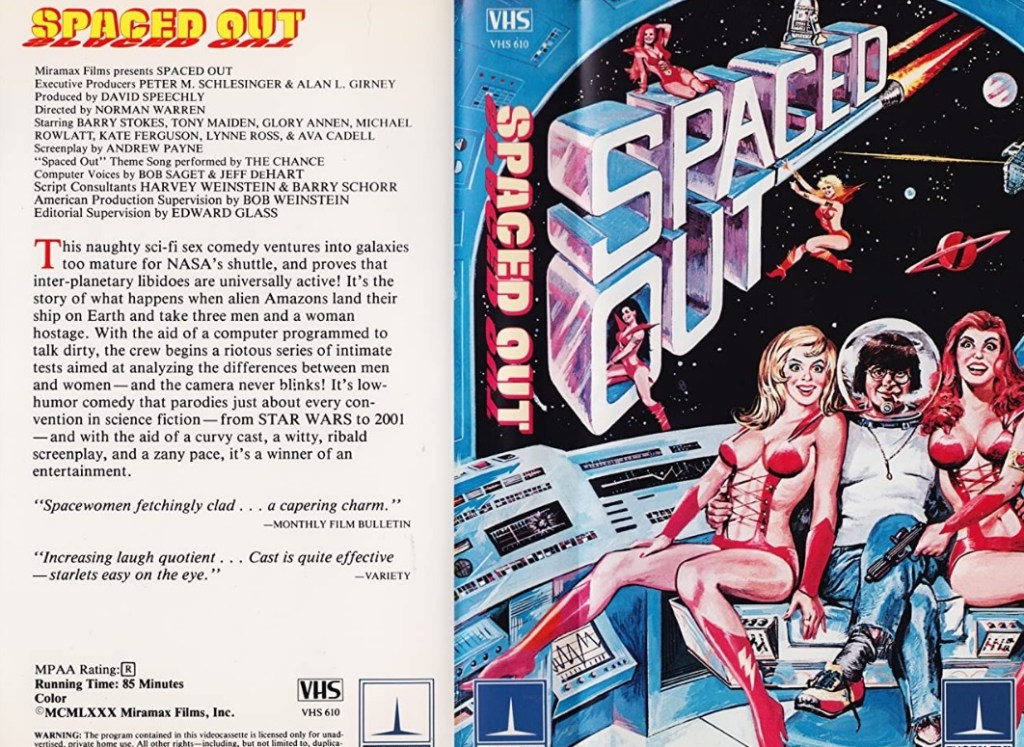
So, does this “low-budget humor-comedy” — as the U.S. VHS box claims — parody just about every convention in science fiction from 2001: A Space Odyssey* to Star Wars** — without mentioning its Spielbergian raisons d’être?
Well, Outer Touch certainly tries. But make no mistake: This is no BBC production of Red Dwarf or Hitchhikers Guide to the Galaxy. But to its credit: Outer Touch fairs better Galaxina in the comedy department (in my review’s opinion), but fails worse than its fellow Brit space comedy, Morons from Outer Space, in the production department — and that film’s no winner in the comedy department, either.
How cheap is Outer Touch?
Well, space ship exterior sections — when on Earth — were created by stretching sheeting over scaffolding.
Remember how David Winters cheapjacked all of his effects shot from Battlestar Galactica for Space Mutiny and Dünyayi Kurtaran Adam swiped their SFX from Star Wars — though Spaced Out isn’t as awful as either. But the mix n’ match SFX-jacking by Uncle Norm is worse than . . .
Remember when the 1977 Star Pilot recut of 1966’s Mission Hydra 2+5 Cormanesquely raided stock footage from Toho’s ’60s space epics Gorath and Invasion of the Astro Monster to “update” the film — with no care as to the continuity of the spaceships? Remember when 1967-to-1972 mess that was The Doomsday Machine ripped the same Toho footage to an even lesser, mismatched effect?
Well, that’s what we have in the frames of Outer Touch — only Warren clipped all of his spaceship footage from Britain’s ITV’s Space: 1999 — again with no care as to the continuity of the space ship changing from shot-to-shot.
To borrow from Sam Pacino’s review of Galaxina: “Cracked Magazine saw what Mad Magazine did and created a second-rate version that spent nearly half a century with a fan base primarily comprised of people who got to the store after Mad sold out.” And from frequent guest writer Herbert P. Caine‘s own Galaxina review: “Galaxina is a comedy with no laughs, a sex farce with no titillation. . . . as a science fiction movie, it reminds one of nothing so much as a black hole, sucking up all talent and effort that its cast and crew may have thrown at it.”
That’s — with all due respect to the late Norman J. Warren whom we love around the B&S Cubicle farm — is Spaced Out: A second rate version of a film void of laughs or titillation that you plucked off your video store’s rental shelf when copies of Leslie Nielsen’s later Naked Space, aka The Creature That Wasn’t Nice (1983) (itself awfully unfunny) wasn’t available to rent. I can’t believe I am saying this: I’d rather be watching Nielsen’s second sci-fi comedy, 2001: A Space Travesty — at least that film gives me Ophélie Winter to gander upon. (Sorry, there, Jennifer Upton, my fellow Norman J. Warren fan-in-arms. I know that’s sexist to call out an actress like that, but you’re not reviewing this film, now, are you? Can you give me a pass, here, sister-friend? I just need something to hang onto with these inept Not a Space Comedy, comedies.)
Oh, come on, You Tube: this film is not a “youth corrupter” by a long shot. It’s not like it’s an uploaded Russ Meyer movie. An age-restricted trailer that can’t be embedded? Please. You can only watch it direct on You Tube via an account sign-in? Ugh. Making our readers work for their analog noshin’ is not cool.
Not noted on the U.S VHS, as was the theatrical one-sheet: Oui and Playboy model Ava Cadellstars as the alien, Partha.
So, if the back of the VHS — and six minutes of the black leather fetish version of the purple-wigged and silver-suited babes of Space: 1999 (embedded below) — doesn’t sell the analog goods, we’ll make the effort to tell you that we’re dealing with, as the ship’s computer tipped us earlier, three horny alien babes (Partha, Cosia, Skipper) from Betelgeuse whose cargo ship (the Space: 1999 stock footage) crash lands on Earth to the attention of four sexually-hung up humans: the mild-mannered Oliver and Prudence, Willy (our bumbling, porn-obsessed comic relief), and a guy, Cliff, who would never associate with either — but so goes for walking the dog at the wrong time . . . and that’s not a sex pun; he really was walking his dog when abducted (don’t ask about the dog, as I lost interest and don’t remember).
Yes, of course, the aliens kidnap the Earthlings. What movie did you think you were watching?
Then — keeping in mind that an alien-astronaut’s main sources of employment is examining and slaughtering Earth cows — mistakes a heard of stampeding cows as a “hostile force,” so they lift off, regardless of their ship’s damage.
Yes, of course, we are lost in space. What movie did you think you were watching?
Along with way, the alien babes learn about Earth sex from Willy’s porn magazine collection, the uptight Cliff’s scores with Partha; she transforms into a nympho, and, due to their exotic Earth-anatomy, the girls decide to sell Cliff and Willy to an intergalactic zoo. And, as I lazily finish off this review to a film that I’ve given more digital ink than it deserves: sexual intercourse and dirty jokes, (ahem) ensues, in this (ahem) trope-laden and (ahem) cliche-ridden universe. (Yes. Triple word score! All three — not just in one review — but in one sentence! I rock!)
But, seriously, folks. This comedy is not pretty and there’s nothing more to tell. Except we wonder who in the hell paid off the critics at the Monthly Film Bulletin and (GASP!) Variety for those VHS box plugs.
For there is no plot: Outer Touch is just a disconnected collection of soft-sex vignettes that makes David Zucker, Jim Abrahams and Jerry Zucker’s early “dirty-comedy” mess The Kentucky Fried Movie taste good. And that’s a pile of rank poultry that in no way foretells of that trio’s brilliance with Airplane! and Naked Gun — the very films that inspired this 2001: Not a Space Comedy in the first place. (Okay, well, yeah . . . they came after, but, well . . . oh, never mind. I give up on this review.)
In the 1999 article “Alien Women: The Politics of Sexual Difference in British SF Pulp Cinema” by Steve Chibnall, in the pages of British Science Fiction Cinema, Warren called the film “dreadful in a nice sort of way.
No, sorry, Mr. Warren, as much as I enjoy your works, this is just dreadful. There’s nothing “nice” about it.
Outer Touch, aka Spaced Out, was unavailable on DVD until 2008, when the original, U.K. Outer Touch-cut was reissued — but under the better known U.S. title of Spaced Out. According to Simon Sheridan’s DVD liner notes, prior to its DVD release, Outer Touch never aired on U.K. television. We did, however, experience the film on HBO and Showtime as Spaced Out via Miramax’s distribution of the film, which also issued it on VHS in the U.S.
Norman’s next “spaced out” epic, sans the comedy, but lots of gore.
Thank the cinema lords, Warren saw the sci-ploitation writing on the wall and returned to horror with the offensive-sloppy Alien inversion that was Inseminoid. Then he had to go make the (not a) spy comedy, Gunpowder. But Warren course-corrected with the bonkers horror, Bloody New Year. So goes Norman J. Warren’s nine-feature film career. Sadly, we lost him at the age of 78 on March 11, 2021.
You can watch Spaced Out on You Tube. Since that’s not Bob Saget’s voice — and the original voice of British actor Bill Mitchell — as the Voice of Wurlitzer the Jukebox, the upload is the U.K. version of the film. The film — in its Spaced Out or Outer Touch form — was not, thankfully, included as part of Bloody Terror: The Shocking Cinema of Norman J. Warren 1976 to 1987 — even though it is shockingly bad. For that, Powerhouse films, we thank you.
Editor’s Note: We featured this film in our two featurette overviews written by Sam Panico, the proprietor of B&S About Movies, on the rash of Alien-inspired films of the ’80s — “Ten Movies that Ripoff Alien” and “A Whole Bunch of Alien Ripoffs All at Once” — as well as his third part of our “Exploring: Video Nasties Section 3” series. Since this is our “Norman J. Warren Week,” I’ve been inspired to give it a full review proper.
Sam, our Movie-Themed Drink Mixmaster of Ceremonies and overall Chief Cook and Bottlewasher at B&S About Movies, experienced Norman J. Warren’s second foray into the sci-fi genre (his first was the truly awful, HBO-ran comedy Spaced Out from 1979) as a home video release. I, on the other hand, was fortunate (not really) enough to see this mess — and Luigi Cozzi’s Alien cash-in, Contamination — at the local Twin Cinema. Is this as gory and demented — and poorly edited as Cozzi’s? Well, like James Dalton tells the patrons of The Double Deuce, “Opinions vary.” The opinion that doesn’t vary: this movie sucks. Well, we take that back: not if you watch the unsensored version. But still: Think of all of the things that made Alien a “wow moment” film. Think of all of the things that made Mario Bava’s Alien antecedent Planet of Vampires a UHF-TV classic. Now, take all of that all away. Then turn the premise into a (trashy) battle of the sexes, message-we-didn’t-ask-for allegory about the male-powered hierarchy corruption of females.
U.S. theatrical one-sheet.
Thus, unlike with 20th Century Fox being sued by science fiction writer A. E. van Vogt over copyright infringement for using his The Voyage of the Space Beagle (1950) (you did O’Bannon, end of story) in the creation of Alien, the studio had enough common sense not return a legal volley at Shaw Brothers and company for ripping off what was — regardless of it being of a uniquely layered, superior quality — a ripoff itself.
This movie has been, rightfully, criticized for bad sets, poor acting and bad special effects. However, in truth, these are all things you truly need to make a great genre film. But right there in the title, you know what you’re getting . . . if you want to get it. And you know we do: someone is getting inseminated by something from space. . . .
Image of U.S. home video version courtesy of Amazon.
So, what does £1 million and a two-month production schedule get you?
A British/Hong Kong co-production, this was financed by Run Run Shaw of the famous Shaw Brothers, who would also foist 1979’s Meteor into our theaters, if not our hearts. It’s directed by Norman J. Warren, who was part of a new school of ’70s British horror, pushing the boundaries of explicit sex and violence much further than the Amicus and Hammer studios of the previous decades. Cases in point: the obscure Satan’s Slave (Warren’s third film, but first horror film) and the better-known, also David McGillivray-penned Preyand Terror.
Bottom line: If you’re going to make a movie called Inseminoid . . . and a bunch of censors don’t get upset, you’ve really failed at your job. This was one of the first U.K. movies to quickly be released on home video after its appearance in cinemas, which led to it reaching seventh place on the British video sales charts in November 1981. One of the reasons why this movie was so controversial — I mean, other than the fact that it’s a movie for people who want to see an alien impregnate a human female — is that the producers did a direct mail campaign that featured lead actress Judy Geeson screaming alongside a headline that screamed “Warning! An Horrific Alien Birth! A Violent Nightmare in Blood! Inseminoid at a Cinema Near You Soon!”
Director Norman J. Warren came to regret that exploitation-inspired marketing gimmick, saying “The problem with mail-drops is that you have no way of knowing who lives in the house, or who will see it first. It could be a pregnant woman, and old lady, or even worse, a young child. So it was not such a good idea.”
Concerned with a group of Nostromo-inspired archaeologists and scientists excavating the ruins of an ancient civilization on a distant planet, the screenplay was written by Nick and Gloria Maley, a husband and wife special effects team who worked on Warren’s (very good) Satan’s Slave. The screenplay’s working title, known as Doomseed, was changed to Inseminoid, so as to avoid confusion with the A.I.-rape tale Demon Seed (1977), which makes no sense, as that big-budgeted, Herb Jaffe Productions’ sci-fi programmer for Metro-Goldwyn-Mayor wasn’t exactly a hit (or remembered much four-years later). (In some mainland Euro-countries, the film was releases as Seeds of Evil.)
The U.K.-paperback tie-in based on Nick and Gloria Maley’s screenplay. Image courtesy of Vault of Evil: Brit Horror Pulp Plus, where the book is discussed at length by readers.
Of course, Ridley Scott shocked the world when esteemed British actor John Hurt had an alien rip out of his stomach. So, those scenes of a male impregnated via a “face hugger” had to be one-upped. So, this time, the Xenomorph doesn’t waste time laying eggs in a derelict craft for some wayward space jockeys to stumble into: ol’ Xeno goes straight to the incubator source and (violently) rapes Judy Geeson (who we all fell in love with in her film debut, To Sir, with Love (1970); Rob Zombie honored Geeson with roles in his The Lords of Salem and 31). As would any Earthbound-cum-human rape victim of the I Spit on Your Grave or Abel Ferrara-Ms. 45 variety, Geeson’s raging-Ripley has a psychotic break (or a psychic link with her “attacker,” ugh) and kills the crew — then devours their flesh to nourish her “inseminoid” that soon births as hybrid twins.
Do the twins stowaway on the ensuing rescue ship . . . uh, you really don’t know your Alien ripoffs very well, mijo.
You can find out by streaming Inseminoid on Amazon and You Tube.
You say you want to buy a copy of all of, well, most of, Warren’s films? The Indicator/Powerhouse imprint released Bloody Terror: A five-film box set of Warren’s films, which includes Satan’s Slave, Prey, and Terror, as well as Bloody New Year, alongside Inseminoid. So, there you go: You have yet another reason to own a region-free Blu-ray player.
Here’s some trivia: The alien planet in the film was shot on the rocky, Mediterranean island of Gozo. And here we are, all of these years later, reviewing a psychological horror film shot on the island, Gozo (2020). That’s how B&S Movies, rolls.
About the Authors: You can learn more about the writings ofR.D Francis on Facebook. He also writes for B&S Movies.














 B&S About Movies
You must be logged in to post a comment.