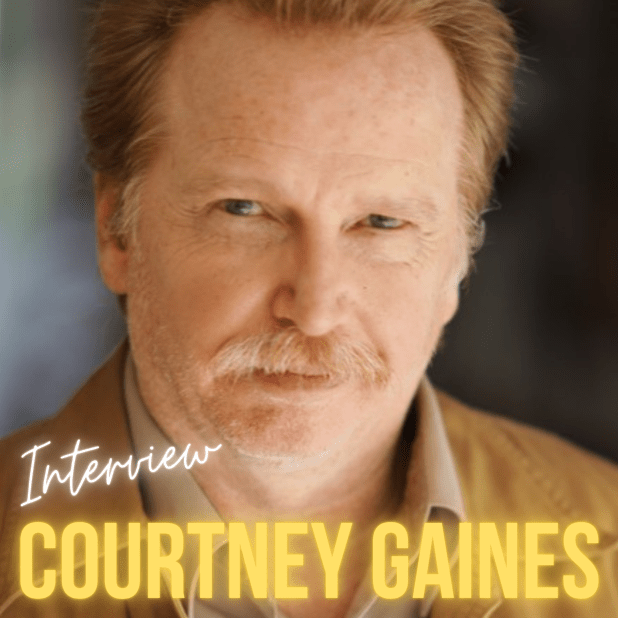
Exclusive interview with Courtney Gains, star of Children of the Corn, The Burbs and the new Queen Bees

With thirty years of being in the movies, Courtney Gains’ career is so much more than Children of the Corn. His resume is packed with plenty of classic films and TV shows — 132 and counting — including Sweet Home AlabamaColorsCan’t Buy Me LoveHardbodiesBack to the FutureThe BurbsLust in the DustSecret Admirer — and a memorable appearance on Seinfeld.

We were beyond lucky to get the chance to speak with him and learn what experiences have meant the most to him as an actor, what he gets recognized for the most, how he found his way on stage with Phish and what he’s up to right now.

B&S ABOUT MOVIES: Our experience with pop culture is to absorb it and discuss it, so your experience fascinates me. What’s it like to be part of so many different strains of pop culture?

COURTNEY GAINS: Because of all my 80s projects, right? Yeah, that’s something I’m proud of. As an actor at the time, once I did a horror film, my next goal was to not do the same thing twice — not just genre, but type of role. And I was able to accomplish that in the 80s obviously doing everything from like Malachi to Can’t Buy Me Love to Hans in The Burbs and even Colors. They were all very different types of roles, which was my goal.

B&S: When we brought up that we were interviewing you, everyone mentioned a different thing that they knew you from. Seinfeld came up a lot*.

CG: The smelly car! Apparently one of the top-rated shows of all time. I mean, what a great thing. What a great show.

B&S: Does what you get noticed for fluctuate all the time?

CG: For sure. Because what happens is you start getting recognized on the street again for a particular thing, right? Like you can all of a sudden it’s like The Burbs. Or like three people in a row say Seinfeld. Hmm, that must have been on TV recently. The things that get played the most nowadays are Back to the Future and Sweet Home Alabama seems like it’s on all the time.
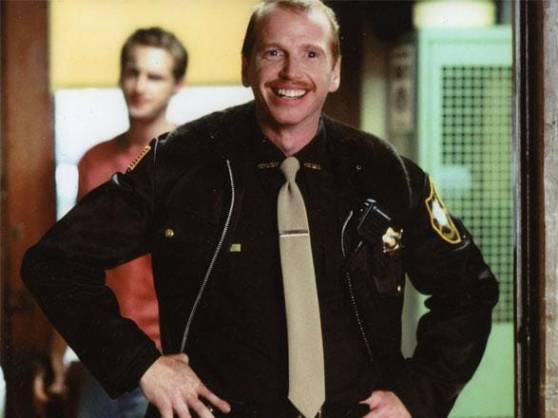
Courtney as Sheriff Wade in Sweet Home Alabama.

B&S: Is it amazing to just flip on the channel and there you are?

CG: Yeah, I’ve managed to be on TV every week. It’s nice. Overall the most recognizable role would probably be Children of the Corn and particularly that’s what I’m known for at conventions. But sometimes. people come up to me with pictures from Can’t Buy Me Love.

B&S: And then people want you to say the big line.

CG: Yeah. A lot of people want me to videochat with their mother. And they’re always asking me to shout “Outlander!” But that’s a lot of work to do over and over.

B&S: That’s extra if you want that.

CG: (laughs) I will flip you off in forty languages like Hardbodies, though, if you ask.

B&S: You hit the teen movie genre from both angles, the sweetness of Can’t Buy Me Love and the raunch of Hardbodies.

CG: Back when you know, seeing boobs in a movie was was was a thing. You know, pre-pre-internet porn.

B&S: It’s a different world now. We had to hunt for nudity.

CG: Skinemax! I got Hardbodies through the director Mark Griffiths. I was in an acting class and he and Geno Havens were casting the movie. They were running the class, so when Mark got that movie, he always asked for a chance to rewrite the script. He tailor-made that role for me. I still had to come in and audition, but it was kind of a done deal. So that was really nice for him to give me that opportunity.

B&S: What’s a movie that you’re really proud of that people may not think of?

CG: Lust in the Dust is a pretty cool film. A lot of people don’t know it, unless they’re Divine fans, but I just think it’s so many good performances and so many wonderful veteran actors. I stayed another two weeks just to watch everybody work because I was just, you know, getting a chance to Cesar Romero work. I didn’t know if I’d ever get a chance like that again.

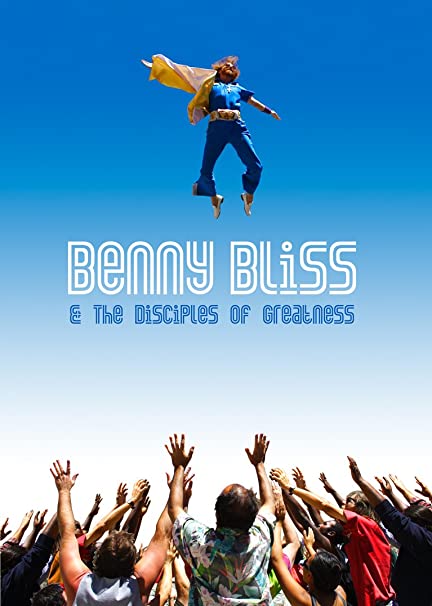
There’s a movie that I produced it that I’m proud of — I also do a lot of music in it — called Benny Bliss and the Disciples of Greatness. It’s an anti-technology, rock ‘n’ roll road comedy and I play the lead in it. I wrote four or five of the songs for that, too. It’s a movie I stand by and I think people would enjoy it.
B&S: You just put out a new album out…

CG: Yeah, got a couple things going on. So I have a solo project called Acoustic Gains. That’s just all acoustic songs I put out, we’ve released our first single called “There was a Time” and the second single “Cherish” is coming out.

EDITOR’S NOTE: You can listen to this song on Spotify.

I also have a band called Ripple Street. We’ve put out three singles this year. My bands are on opposite sides of the spectrum because the acoustic stuff is very mellow and then the other stuff is very heavy, like Black Sabbath.

B&S: You played with Phish, right?

CG: I met Mike Gordon hitchhiking in the mid-80s right before Can’t Buy Me Love came out. We hit it off and I kept in touch with them as they grew into this big band. They had this friend that they were always pranking who was deathly afraid of Malachi. They had an idea for a great prank and it was never the right time and place, but they were coming to Vegas and it was the perfect scenario.

They had been trying to do this for years. When it finally happened, they acted like they were just going to watch the movie while he was on mushrooms and then one by one, everyone else left the room. So I snuck in and put on Trey’s (Trey Anastasio, lead singer and guitarist of Phish) jacket and sat down next to the guy. I didn’t even have to be Malachi that much because the guy’s mind was just blown.

After that, they said any time I wanted something, it was like whatever I want. And I said, “Well, let me come up and play.” They said, “Done.” Got to play in front of 8,000 people in Vegas**. That was pretty amazing.

B&S: Now, you’re in Queen Bees. That has an amazing cast too, almost on par with Lust in the Dust.

CG: Yeah, on par with and then some. I only do a cameo in it, but I was surprised my cameo made the trailer so that’s been really cool. I got a chance to work with Ellen Burstyn, Jane Curtain, Ann-Margret and Loretta Divine and I was like, I’m not gonna pass this up. To get to watch those iconic ladies and work with them was great.

Jane Curtain was really sweet. You know, you get on a set, especially when it’s just for a day. And so often, how the movie feels depends on the vibe of the people right? There’s some of them that are like, “I’m not gonna see you tomorrow. I’m not even gonna bother to get to know you.”

Right. And others go out of their way. But she was so great. When I got introduced to all of them. She was like,” I’ve seen you” and everything like that. Wow, Jane Curtain just said that to me. How cool is that?

B&S: What else are you working on?

CG: I’m in a really dramatic horror movie called The Bleeding Dark that is coming out soon and just finished Tales season 3 for BET. It’s a ten episode anthology and I play a bad cop and it was really interesting.

I have another movie called River that comes out July 13 and it’s a real independent sci-fi type movie. When I say sci-fi that I don’t mean with a lot of special effects. But it’s got sort of alien undertones to it.

It’s a cool project. I play an interesting role — Dr. Michael Glenn — and he’s this small town antique store curator, but he’s also the local psychologist. So he works with this girl because she’s having time lapses. You know, she disappeared for like a week and doesn’t remember how and why. And so I work with her and it’s just a different role for me.

I had a nice long COVID beard for it. It wasn’t a normal role, not a bad guy role, somethingvery mature and a very loving role. And it’s nice to do something different like that.

I’ve never played a shrink before. I’ve always thought that it was something that I could do. Because I teach acting and have taught a lot of psychodrama, drama therapy, you know, where you get into people’s heads and how you can open up the floodgates for them emotionally.

I think actors are — we have to be — psychologists to ourselves, we have to know what pushes our buttons what we’re passionate about and what we’re not passionate about.

I’ve always found psychology interesting. As a matter of fact, if I hadn’t become an actor, I might have become a child psychologist. So that’s probably what I would have gone to school for, because I found it interesting.

B&S: You find yourself bouncing all of those emotions off one another in scenes…

CG: But you need to know people’s different styles I’m a method actor. And so I’m looking, you know, from the inside out. As I say, you have to know what’s gonna push your buttons.

When I taught acting, it’s about if a character has some type of loss, it can be something simple. Yet in a scene, you’re acting but the other actor isn’t connected.  So I find that it helps to talk to them about something they’ve lost. Let’s talk about something in their life and create that mood, right? And they can see that, they can feel that, it’s generating in themselves. And like that’s what I’m talking about. Now, let’s drop into the scene. Sll of a sudden the scene clicks, right? Does that make sense?

B&S: It totally does. Because it’s like creating an emotional language that people may not be able to fully tap into…

CG: Or do they even know how to go about getting that right? So once you start to show them some ways to get access, then they can start applying that to other stuff.

This is huge because as you audition, you have to prove to people you can do the part even though you don’t know the dialogue very well. You have maybe 24 hours to work on it, so it can feel like a cold reading. So you have to find some way to lock into the scene emotionally and bring that with you. And that’s the truth that you carry with you.

Eric Stoltz in one of the few shots of his brief time as Marty McFly.

B&S: I have a weird method question for you. Were you involved in any of scenes in Back to the Future when Eric Stoltz was still in it?

CG: Yeah, so I so I didn’t actually work with Eric at the time. We did Memphis Belle together, so we got to talk about all of this then. But I did work during the time Eric was on the movie.

The story was that he was being super method and making everybody call him Marty. And I guess the dailies were coming back and they didn’t think he was funny enough.

I mean, I think Eric’s a fine actor, but I guess they didn’t think so and that’s when they dropped him. The good news for me was that you can only drop an actor once and then bring them back on a certain date. They’d already done that. So basically, they did the reshoot for five weeks. I was on payroll on a job that I was probably only going to work a week on. So for it to go on to be one of the top-grossing — maybe still the top-grossing trilogy of all time — it’s been the best residual checks I’ve ever had. So I’m very thankful for Back to the Future.
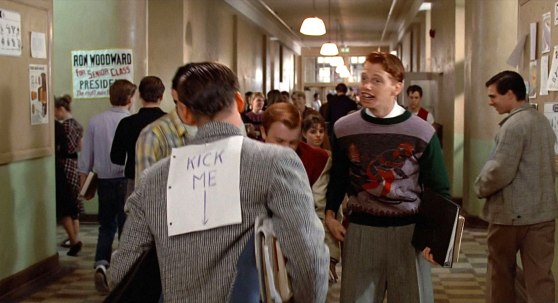
There’s Courtney as Mark Dixon in Back to the Future.He’s the guy who puts the kick me sign on George McFly and tries to cut in on his dance with Lorraine.

B&S: Any truth to the urban legend that when they fired him, Christopher Lloyd really thought his name was Marty and asked, “Did they fire Marty?”

CG: (laughs) Is that real? That’s really funny.

B&S: What actor have you learned from?

CG: That’s a tough question, because  I think it’s like you get little tidbits from everybody.

Here’s an example. Tom Hanks big monologue at the end of The Burbs, after he comes out of the burning house and says, “It’s not them. It’s us.” That was at like two or three o’clock in the morning. He could have just said, “Man, I’m tired. We’ve been up all night.”

But, you know, he did, he showed up. And that, that level of professionalism and commitment is what I got at that moment. and from him.

Another is Robert Duvall, one of my favorite actors. I got to work with him in Colors which was a big deal for me. I was watching him like a hawk. We had the last day of shooting which is also where he passes away after he gets shot. I was within four feet of the guy and they call him in to do the scene. This big death scene, they lay him down in the dirt and they’re not ready. And then Dennis Hopper comes in and says, “Hey, we have a lighting problem and it’s going to be 45 minutes.”

Now for an actor, you’re emotionally prepared for this scene and now, to have to sit there and wait 45 minutes is not easy. That can really throw your throw you off, you could burn out, you know?

He just laid there. Cool as a cucumber. And I was just sort of shocked they would do this to someone of the caliber of Robert Duvall.

They finally come in and ask, “Are you ready” And then he blew the lid off. It was the best performance I’ve personally seen. And I had to come up afterward and tell him — I’m one of the many actors on this set and he knows me but it’s not like we hang out — that it was awesome. And he said, “Well, I wish that was my close-up. Because I don’t have another one like that.”

He blew it out on the first one. And what they did, if you look at the film, you’ll see that the close-up of him is really kind of a little grainy. And kind of at a weird angle. I believe what they did was blow up the wide shot because the performance in that take was just exceptional.

What I learned from Robert Duvall was that he had humility. If he had let his ego get in the way at that moment, it would  have stopped the flow of that performance. He had to put his ego completely in check and just stay calm. And it allowed that performance to come through.

He taught me that you can get caught up in the BS, but if you do, it’s gonna cost you your work, you know? What a class act.

B&S: When I saw that scene in the theater, it destroyed the audience, who came in for an action movie and weren’t ready for that dramatic performance.

CG: If you watch it again, you’ll see he has three lines: “Let me catch my breath. I’ll get back on my feet. Call my wife, I’m going to be okay.”

Those are the three lines that were written, but what you watch happen as he keeps repeating them is that he’s sort of fading away, right? Well, he’s a Meisner guy, you know, Sanford Meisner technique. And one of the techniques they have is a thing called repetitions where people repeat back and forth to each other to in a listening/reacting drill. And that’s basically what he was doing.

He was doing  that repetition. He kept saying the same things over and over. It was genius that he did that because those, you sort of watch like this guy dying. He just kept saying the same things. But if you didn’t know that, if you didn’t know the technique — the Meisner technique — you wouldn’t realize what he was doing.

I studied all the methods. And so that was, you know, again, one of the things you file away and maybe you could use someday.

Thanks to Courtney for his time, energy and sharing in this interview. If you can’t tell, we had an absolutely incredible time. Also we really appreciate Rachel Michelle from October Coast for setting up the interview and, as with everyone there, being incredibly easy to work with.

*Gains appeared in the 1993 episode “The Smelly Car” as a video store clerk.

**Gains played on the song “Suzy Greenberg” on Phish’s 12/06/1996 Las Vegas show.

Norman J. Warren Week: Terror (1978)

ABOUT THE AUTHORJennifer Upton covered this movie for our month long February blowout of Mill Creek box sets on February 1, 2021, as it appeared on their B-Movie Blast set. You can learn more about Jenn’s writing at her official website, Jennuptonwriter.com. We’ve brought back the review as part of our “Norman J. Warren Week” of reviews.

I knew very little about this film when I chose to write about it. I knew even less about director Norman J. Warren. Terror, was produced and released independently in the United Kingdom. It starts out as a standard witch’s revenge film, with an opening sequence set 300 years in the past.

In the present, the witch returns in spirit to take revenge on the ancestors of her executioners. Not a new premise at all. Until the stalk-and-slash sequences begin. “Okay,” I thought, “So, it’s a witch movie that’s also a slasher movie.” Then I began to notice small clues both within the story and visually as to the creative intentions of Mr. Warren. The red herring eccentric characters (both male and female) that might or might not be the killer. The soft purple and green gel lights that draw the eye away from the primary action. The close-ups of mascara-clad eyeballs and gory murders where the victims bleed a hue of red patented by the Crayola corporation. The electronic musical score. A torrential downpour with drenched characters bathed in blue and white light. POV shots of the killer’s knife moving relentless towards its prey. A finale that comes out of nowhere and leaves no closure for the audience. Sound familiar? 


Released in 1978 at the beginning of the American slasher craze ushered in by the success of John Carpenter’s Halloween, Terror owes more to the Italian Giallo thrillers than any stalk-and-slash offering. A quick search on internet confirmed my suspicions. Warren was a big fan of Dario Argento’s Suspiria, released one year prior to Terror.

Paired with Warren’s Satan’s Slave.

While not a complete rip-off by any means, Warren manages to inject his own style into what is ultimately a wildly entertaining film. It’s much more grounded in terms of acting and story than anything Argento or Bava ever made, making it much more “British” in tone. While the Italians are much more given to fits of artistic abandon, with very little attention paid to story, most British directors – even the most creative ones like Ken Russell or Michael Reeves – never stray too far outside the bleak reality of Great Britain as a backdrop and generally adhere to a three-act structure. The acting is solid and the story engaging. Terror gets the point quite quickly in terms of action. There’s never a dull moment. Eagle-eyed genre-fans will likely feel the same warm fuzzies I got when I noticed posters for both Warren’s own Satan’s Slave (1976) and Bo Arne Vibenius’s Thriller: A Cruel Picture (1973) in the background of one scene. A scene very clearly shot in the film’s actual production office.  

By combining elements of classic British period horror and Italian Giallo, Warren has done what no British director had done before or possibly since. Terror could be considered the first and only true British Giallo. The fact that it was all shot in real locations (including a BDSM strip club) on a shoestring budget makes it all the more impressive. I look forward to exploring more of Mr. Warren’s work. Anyone who apes the Italian masters while still managing to make a movie that feels fresh deserves further scrutiny. 

Junesploitation 2021: Special Cop in Action (1976)

June 27: Junesploitation’s topic of the day — as suggested by F This Movie— is cops.

I am a conundrum. I speak up against the brutality and the militarization of our police nearly every day, but then the movies I choose to relax and watch are poliziottesco films in which cops go against the system and act nearly as bad — if not worse — than the criminals they are after.

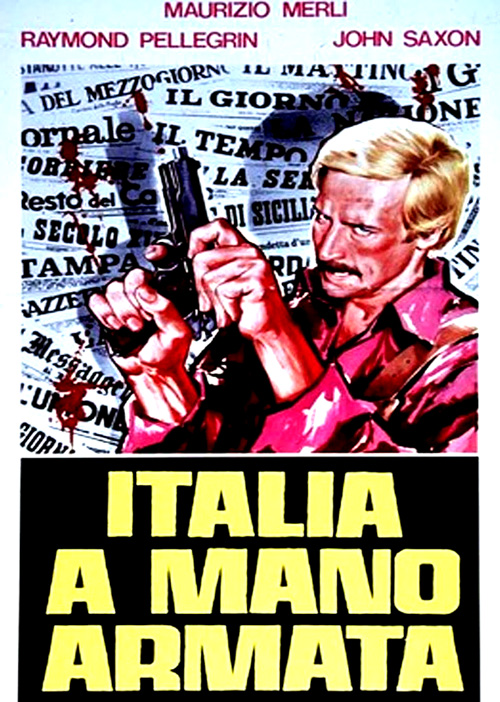
The third film in the Commissioner Betti trilogy — after Violent Rome and Violent Naples — Special Cop In Action is also known in Italy as Italia a mano armata (Italy at Gunpoint). This was directed by Marino Giorlami, who went from being a physical therapist to the director of films such as The Fury of Achilles and Zombie Holocaust. He’s also the father of director Enzo G. Castellari.

The mobsters in this film are the kind of Italian movie bad guys that go from realistic to super villains by the end of the film, moving from robbing banks and taking hostages to hijacking school buses filled with children.

Cops Betti (Maurizio Merli, Highway Racer) and Ferrari (Aldo Barberito) are trying to find one of those kids when one of the criminals assaults a female cyclist, altering authorities to their hiding place. When one of the kids is killed, a mother unloads on Betti, who decides to take the place of the children as a hostage. Man, Betti gets abused throughout this movie, shot multiple times, beaten and dumped on a highway and even set up for murder.

Man, this movie starts off hot and never slows down. Cops get dragged behind cars, John Saxon shows up, there’s a J&B appearance and a downbeat ending — the dead kid’s mom and our hero have dinner when some syndicate thugs blow him away in a drive-by. I’d say that that was a massive spoiler, but that ending doesn’t appear in every print, so who knows if they added it in the hopes they could make a fourth film someday. Or perhaps when they realized this was the end, they remembered it was the 70s and nearly every movie has to end with a downer, so they edited on this closing.

Honestly, I kind of think that Betti can shrug off getting gunned down. If anything, the excessive abuse he endures in this movie is proof.

Norman J. Warren Week: Gunpowder (1986)

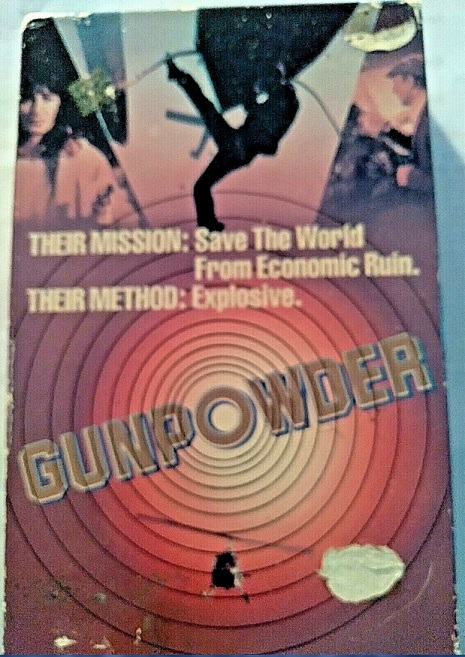
Sometimes you just have to bite the bullet . . . or swallow the gunpowder. This is that one, elusive Norman J. Warren movie that I haven’t seen — and so wanted to. And, in our quest to complete our Norman J. Warren tribute week — and since there’s no online streams of the PPV or free-with-ads stream variety to be found — I bought a beat-to-hell-but-plays VHS copy online. It just arrived in the mail. I watched it. And didn’t disappoint.

Well, it did, pretty much.

Sing it, everyone! He wears a suit and a bow-tie! / He wears jeans and a leather jacket! / One’s prim. One’s scruffy / He’s Gunn. He’s Powder (dah-dum).

Gunpowder is not the action-adventure knockoff of a ’70 Italian Poliziotteschi film that I was expecting: it was the action (bad) comedy I wasn’t expecting. And I can’t believe the guy who made my favorites of Satan’s Slaves, Prey, and Inseminoid made this. Gunpowder is also known as Explosive Gold (a great title) and Commando Gold Crash (a crappy title that evokes a low-budget Philippines-shot Namploitation flick) in overseas markets, but here, in the U.S., it’s known as Gunpowder — because the two secret agents in this dopey Bond wannabe are named Gunn and Powder. And they’re not named that for the comedy, either.

So, our intrepid Interpol agents (played by David Gillum and Martin Potter; Potter starred in Satan’s Slave, while you’ll recall Gillum from the when-animals-attack classic, Frogs, and the Jaws-rip, Sharks’ Treasure) are assigned by their “M” (which is known as Sir Anthony Phelps, here) to figure out who’s flooding the market with a gold surplus that can ruin the world’s economy. Of course, opposites must attract: Gunn is the dashing, American-bred ladies man and Powder is the proper English gent who files his nails at inopportune times because, well, it’s “funny,” you know, back in the days when insinuating a character was “gay” (for having proper hygiene) was funny.

Uh, dangerous cop? Proper cop? Cue-not Lethal Weapon. And not Austin Powers, either.

But do cue Auric Goldfinger — only not Gert Fröbe, thank you. We’ll take the lower-budgeted Dr. Vanche (David Miller . . . from Attack of the Killer Tomatoes!), who’s discovered the formula to manufacture synthetic gold — and he’s selling it on the open market.

This has it all — and it doesn’t: Two martial arts baddies known as “The Cream Twins” (Alan and Brian Fontaine, if you care) who kidnap a metallurgical (lady) scientist/heiress. A super spy lair that puts Bruce Wayne’s joint to cheesy shame (Adam West would have been PERFECT as the American Spy, here; it’s totally in his wheelhouse). Super spy gadgets. A milk factory used as a front to smuggle liquid gold in milk cartons (ugh), which why the scientist/heiress is kidnapped. Then there’s bad dialog. Failed comedic one-liners. And, instead of bullets: vats of liquid gold death traps. Then there’s the stupid (ugh) costumes the bad doctor Vanche’s minions wear — with a big “V” on their chests. And Dr. V’s bad gold hair. And it goes on and on . . . such as our milk heiress having the first name of “Coffee.” Yuk, yuk.

I guess you (well, moi) have to be British to appreciate this one.

Their Mission: Entertainment. Their Method: Boredom. Me: Re-eBay’in the tape to another sap.

Editor’s Note: We planned this Norman J. Warren week on a whim — as result of our February Mill Creek box set blowout featuring two of his films among the celluloid ruins: Prey and Satan’s Slaves. We just lost him on March 11, 2021. You can read up on Warren’s career with his obituaries at The Irish Examiner and Metro UK News.

After Gunpowder, Warren wrapped his career with the mystery-horror Bloody New Year.

About the Author: You can learn more about the writings of R.D Francis on Facebook. He also writes for B&S About Movies.

Norman J. Warren Week: Prey (1977)

Editor’s Note: Bill Van Ryn, the man, the myth, and the legend behind Groovy Doom and Drive-In Asylum contributed this November 15, 2020, review when we unpacked Mill Creek’s Sci-Fi Invasion box set. We’re bringing it back for our “Norman J. Warren Week” of reviews.

Norman J. Warren’s unique brand of low budget bat shittery is all over the damn place. While not always totally satisfying (I’m looking at you, Inseminoid), when he’s hot, he’s hot. 1977’s alien freakout Prey is one of the hot ones. It’s everything-but-the-kitchen-sink approach blends elements of D. H. Lawrence’s The Fox, Close Encounters of the Third Kind and a dash of Night of the Living Dead thrown in for the hell of it, and this is no accident — the script was being written while filming was progressing, with Warren taking on the project based on the premise alone.

MV5BOTIxYTJlMGQtNTEwYi00MDU2LWEwOGItNTU0ZWI1NWIyYjg4XkEyXkFqcGdeQXVyMTQwMzQ1MA@@._V1_

And oh, what a premise. Prey gives us the story of an alien creature who arrives on Earth in a spaceship (unseen by us, other than a colored light show that could have just been a groovy light from Spencer gifts) and immediately encounters two Earth people who are having a romantic tryst in a parked car. He murders both of them, assuming the identity of the man, whose name is Anderson. This being capable of interstellar travel uses a futuristic walkie talkie to communicate with some home base (apparently off-world, which…wow! That’s some wi-fi!), and appears to be on a mission to observe us in our natural habitat. He also likes to eat meat, and that’s it. Total carnivore, this alien.

He moves on and discovers a large secluded estate nearby, where lovers Jessica and Josephine are living an isolated life together. They encounter some mutilated rabbits, which Jo attributes to the work of a fox. They also find our space-hopping buddy “Anderson” (wink wink), seemingly injured, and even though Jo reacts with immediate total hostility, Jessica is excited to finally get someone to talk to other than Jo, who is suspiciously dedicated to making sure Jessica never, ever goes anywhere on her own. They take him back to the house and allow him to stay, which turns out to be a really bad idea on so many levels. 

I adore the fact that this movie is so low budget that it doesn’t even attempt to present any convincing alien technology, but it does have some built-in style that expensive effects could never buy. The manor where most of the action takes place is a fantastic location, with wooded areas bathed in muted green and overcast skies — this is England, after all — and amid all these earth tones are a few scenes with shockingly bright red gore. And for sheer “What the hell am I watching?” kicks, just wait until you see the weird slo-mo scene where Anders and the women roll around screaming in a shallow pond. There’s something almost S.F. Brownrigg about Warren’s work, despite their visual style being different. They both have the ability to create a memorable atmosphere in their films, despite having no visible budgetary advantages.

Anderson mostly stumbles around in a daze, acting like he has no idea what parrots are, or plants, or why people bring them into their homes for decoration. He doesn’t know any locations, either, claiming to be from London after he hears one of the women suggest it.  When they press him for his first name, he says “Anders”.  His hostesses serve him a vegetarian dinner — Jo goes total OG meatless preachy on him — but he responds by vomiting and rushing out of the house to find some more animals to mutilate for dinner.  He also doesn’t know anything about sex, and he spies curiously on Jessica and Josephine having screaming sex together. Jo develops a theory that Anders is an escapee from a local mental institution, and later on we come to realize she may have been doing some projecting when she came up with this idea.  

That’s one of the interesting things about this weird movie, there is actually an intriguing relationship between these two women, and the script ends up surprising us about one of them, but it exists uncomfortably alongside the fact that one of the characters is a flesh-eating alien, which sort of steals the spotlight.  For this reason, I suggest multiple viewings of Prey. In fact, it should be a tradition. 

* Be sure to check our “Exploring: Amityville” feature where we look at all of the legit Amityville films — and even more of its bogus sequels.

Norman J. Warren Week: Satan’s Slave (1976)

Editor’s Note: We reviewed this British horror obscurity on February 15, 2021, as part of our tribute reviews to Mill Creek’s Gorehouse Greats 12-Film Pack (Amazon). We’re bringing it back as part of our “Norman J. Warren Week” tribute of reviews. Visit our Gorehouse Greats Round-Up for all of those reviews.

How is it that we could go on all day about British actor and Hammer stalwart Michael Gough, starting with his first role as Sir Arthur Holmwood in Hammer’s Horror of Dracula (1958), watch his work in Horrors of the Black Museum (1959) multiple times, and watch him in The Phantom of the Opera (1962), The Skull (1965), and Horror Hospital (1973), but never encountered his work on Crown International Pictures’ Satan’s Slave? Even with all of our combined video store memberships and watching Friday and Saturday late night horror blocks on our local UHF-TV stations, we’ve never heard of it or seen it (at least it slipped by me). How is that possible? We fell in love with Euro-obscurities like A Bell From Hell and Symptoms from multiple UHF showings — and even seen them on home video shelves.

Well, let’s unpack this flick brought by the great Norman J. Warren!

Turns out, director Norman J. Warren has two flicks on Mill Creek’s Gorehouse set: this and Terror (1978), which is also on the B-Movie Blast 50-Film pack that we also reviewed back in February 2020. Truth be told, while he’s legendary — at least in B-Movie and video nasty circles — Warren is an under-the-radar obscurity to most horror fans (well, except for FUBAR’d dudes like Bill Van Ryn who’s made his fandom of Warren’s Prey well known), with only 16 credits. The Warren films you (may or not) know are the insipid, Star Wars-inspired sex comedy Spaced Out (1979), aka Outer Touch (that we passed on during our “Star Wars Month” tribute; the similar, better known Galaxina won that review pole position), and the Alien rip off (that we did cover with our “Alien Week” tribute) Inseminoid (1981). Then there’s that off-the-nut sci-fi zombie romp Prey (1977) that Bill Van Ryn digs, and Warren’s final tour de force: Bloody New Year (1987), that Sam digs. All of those films were, of course, better distributed projects that turned up in theaters, cable, and VHS (for me, that would be as Inseminoid; Spaced Out was an oft-aired HBO programmer).

Perhaps it’s because it was only Warren’s third feature film — after two Italian sex shenanigans flicks issued in 1968: Loving Feeling and Private Hell, which makes Satan’s Slave his first horror film. In between his Alien romp, Inseminoid, and his Slasher romp, Bloody Birthday, Warren changed it up with, well, looking at the cover, a Stallone Rambo-cum-Arnie Commando rip called Gunpowder (1986) — has anyone seen it?

Now, the writer on this, well that’s a different story: While he wrote Warren’s Satan’s Slave and Terror, he gave us the video rental favorites of ’70s British horror: White Cargo (1973), House of Whipcord (1974), Frightmare (1974), the sleaze-o-rama that is The Confessional (1976), and Schizo (1976): Lord Smutmeister David McGillivray (and we mean that as a complement).

This time we have a supernatural horror tale with Catherine (British horror “Scream Queen” Candace Glendenning; The Flesh and Blood Show) who comes to live with her uncle and cousin (Michael Gough and Martin Potter; his work goes back to Fellini Satyricon) after she survives a car crash that killed both of her parents. Of course, Uncle Alex and Cousin Stephen are behind the crash: they’re necromancers who need her as a sacrifice to resurrect a powerful, spiritual ancestor.

To say more will spoil the film, as this Rosemary’s Baby-inspired tale (but not at all like a cheap Italian ripoff of that film or The Exorcist) is an excellent watch; one that’s far above the fray of the exploitative-norm discovered on Mill Creek sets. The scripting, set design, and acting — from all quarters — is top notch. I loved it. Consider it one of my new classics in the British ’70s cycle of gothic horror tales, right alongside Captain Kronos: Vampire Hunter and Hammer’s Karnstein Trilogy.

The production story: There’s additional material shot that was even more violent, and alternative versions of existing scenes that are in the film are available in other prints in the overseas markets. So, what we get is an amped up, Gothic psychological-sexploitation tale that programs nicely with the better distributed (as with the aforementioned A Bell from Hell and Symptoms via VHS and UHF-TV) Virgin Witch (1971) and the always incredible to watch The Wicker Man (1973). Of course, keen eyes immediately notice that the house and grounds of the Yorke estate appeared in Virgin Witch; and when you watch Terror off this same Mill Creek set, you’ll notice the Gothic estate, reappears.

Another choice: Paired with Warren’s Terror.

While you can get this on the Mill Creek sets we’ve unpacked in February, the more serious Warren fan can get Satan’s Slave, along with Terror, Prey, and Inseminoid on Anchor Bay’s Norman Warren Collection DVD box set. Vinegar Syndrome and Severin also offer restored single-disc reissues. However you watch it: watch it. There’s a copy of Satan’s Slave on You Tube.

Norman J. Warren Week: Her Private Hell (1968)

The feature debut of Norman J. WarrenHer Private Hell came about producer Bachoo Sen approached Richard Schulman, owner of London’s Paris Pullman Cinema, with the idea to make their own films. This is how the production company Piccadilly Pictures started.

Schuman was the owner of London’s Paris Pullman Cinema and was showing Warren’s short film Fragment, so they made an offer for him to film two movies for them. The director would later tell Rock Shock Pop!, “I had no idea what the film would be, but to be honest, I would have said yes to anything. I was 25 and desperate to direct a feature film.

The story was written y Glynn Christian, a New Zealand immigrant who based his screenplay on his own experiences as a foreigner living in the swinging London of the 60s.

Marisa (Lucia Modugno, LSD Flesh of the DevilDanger: Diabolik) has come to London to be a model and the first magazine she works for decides to keep her in a fancy high rise apartment along with their top photographer, Bernie (Terry Skelton). They explain its for her protection and not to be the sole owner of her image, which she soon realizes as the magazine begins to control her every move.

While Marisa sleeps with Bernie, she also falls for Matt (Daniel Ollier, who beat Udo Keir for the role), a young photographer whose avant-garde nudes end up in Margaret — one of the magazine’s owners — possession and get sold to a foreign magazine. The film then becomes all about who Marisa will leave with — Bernie, Matt or alone. And perhaps Margaret and Bernie aren’t strangers to one another, as it turns out.

At once a naive girl done wrong film mixed with a movie about the literal swinging 60s morals, Her Private Hell isn’t the Norman J. Warren you may know and love. This is closer to French New Wave than anything else he’d make.

You can watch this on YouTube.

Norman J. Warren Week: Loving Feeling (1968)

At one point, this Norman J. Warren’s was rated X. Today, it plays uncut on YouTube. Such is the changing of the tides.

Just listen to that song that opens this up! You know instantly it’s the end of the 60s and you’re about to watch something romantic. Or dirty. Probably both.

This is the story of Steve (Simon Brent, Love Is a Many Splendored Illusion) who can’t decide between all of the women who want to sleep with him or his wife Suzanne (Georgina Ward, The Man Who Finally Died), who now has a new lover in her life.

Of course, when all of the women are as attractive as the French model who is new in town (played by Françoise Pascal, who was also in There’s a Girl In My Soup and Incense for the Damned), that’s not going to be so simple.

Warren would move on to make Her Private Hell before discovering the horrors that he’d make his name on, stuff like Satan’s SlavePrey and Terror — all great movies you should totally check out. For someone who started life stricken by polio and grew to adulthood with only one functioning arm, Warren ended up having one of the strongest careers a horror director can dream of.

You can watch this on YouTube.

Junesploitation 2021: Midnight (1989)

June 26: Junesploitation’s topic of the day — as suggested by F This Movie— is 80s horror.

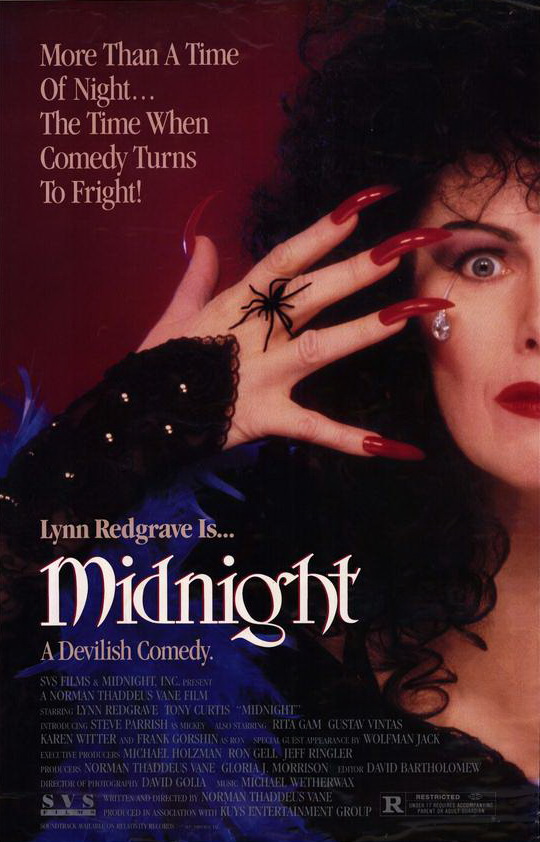
Midnight (Lynn Redgrave) is a horror hostess who wears low-cut outfits, makes bad puns before the movies she shows and looks like an undead mistress of, well, the night. Pretty much exactly like Elvira, which seems weird, because they could have just hired Elvira to be in this movie.

She’s fighting station owner Mr. B (Tony Curtis) for the rights to her name, who keeps throwing things in her way to screw up her life, like trying to lure away her boytoy Mickey Modine (Steve Parrish, Scanners III) by introducing him to Missy Angel (Karen Witter, Playboy Playmate of the Month March 1982, as well as Mortuary Academy and Popcorn).

Then, everyone around our protagonist — like her agent(Frank Gorshin) — starts getting murdered and all fingers point to Midnight.

This was written and directed by Norman Thaddeus Vane, who wrote and directed Frightmare. Before that, he was a contributing writer for Penthouse, working on the letter to Forum.

I really need to make a Letterboxd list of Wolfman Jack movies one of these days. He’s in this for a bit and is a welcome addition to the proceedings.

According to Stephen Thrower’s Nightmare U.S.A., this movie was a complete nightmare behind the scenes. Karen Black was originally going to play Midnight — I am so into that casting choice — with George Segal playing opposite her. Yet when she quit the film and Redgrave came on, Segal refused to be in the movie due to “agent conflicts.” As for Ms. Redgrave. she locked herself in her trailer and wouldn’t do any ADR after the film wrapped. Then Sont cut ten minutes and barely released it in theaters.

You know what? She’s awesome in this movie, acting like she’s playing for people in space, not just the back row of the theater. It’s a role that literally defines over the top. That said, she’s still no Cassandra Peterson.

White Lightnin’ Road (1967) and That Tennessee Beat (1966): A Tribute to Ron Ormond . . . and Earl Sink

For our “Ron Ormond Day” at B&S About Movies, I chose this early hicksploitationer* featuring an early role for Ron’s son, Tim. Tim would grow up to serve as an editor, cinematographer, writer (39 Stripes, The Second Coming), and director (the lost The Second Coming) on several Ormond family productions, which also included wife and mom, June Carr (her 2006 Variety obituary). Tim also acted in Ron’s films — only eight out of forty films — Girl from Tobacco Row, The Exotic Ones, If Footmen Tire You, The Burning Hell, The Grim Reaper, The Believer’s Heaven, and 39 Stripes. So, when in Ormondville, you might as well review White Lightnin’ Road to complete Tim’s acting resume . . . and honor the career of Earl Sinks — also the star of today’s second (non-Ron Ormond) film.

Who?

Read on, B&S surfer!

White Lightin’ Road (1967)

Look at that one-sheet! How can you NOT WATCH this?

This one has it all: Loose n’ tempting femme fatales, red-lining stock cars, driver rivalry, and love triangles between said rivals and femme fatales. So, yeah, the proceedings are just like any red-neckin’ romp with fast cars and faster women. And moonshine. And gangsters. And an illegal auto parts network. And murder. And shotgun weddings. And everything southern fried that we love. (Oh, Tim’s a young lad who hangs around the track that’s befriended by Joe, our ne’er-do-well hero.)

Earl “Snake” Richards — a ’50s rockabilly crooner who also appeared in Ormond’s Girl From Tobacco Row (1966), and a ’50s rock flick, That Tennessee Beat (we’re getting to it), before hanging up the clapboard — stars as Snake Richardson, the rough n’ tumble bad-boy racing rival of Joe (the one and gone Ter’l Bennett): your typical, straight-laced lad who has the need for speed. And, as in other back roadin’, moonshinin’ and asphalt romps, Ruby (the sexy n’ white-trashy, eyeball melting Arline Hunter; Playboy Playmate of the Month for August 1954), the bad guy’s girl, has eyes for the good guy. And she — one not to shriek from a good ol’ girl-on-girl catfight — gets Joe mixed up with Slick (played by Ron Ormond), who cons our lad into being the wheelman for a heist, which results in the death of a nightwatchman.

As you watch the trailer, you’ll take note that, unlike the Elvis (Viva Las Vegas) and Fabian (Fireball 500, Thunder Alley**) racing flicks Ormond emulates, there’s no stock footage: everything is staged and shot in-camera by Ron, himself, which makes White Lightnin’ Road superior to many of the racing flicks of the ’60s.

The new 35-mm trailer!


To say we love Ron Ormond’s films is a trope-laden understatement, as we’ve also reviewed Ron Ormond’s pre-salvation exploiters Mesa of Lost Women and Please Don’t Touch Me. And, if you feel like You Tubin‘ or Googlin’, you’ll discover that, after Buddy Holly went solo and left the Crickets hangin’, Earl Richards, aka Sinks, ended up fronting the Crickets. Oh, and did you know, Earl and the Crickets cut the original version of “I Fought the Law” made famous by the Bobby Fuller Four (and later the Clash; just heard it this week on a classic rock station)? True story.

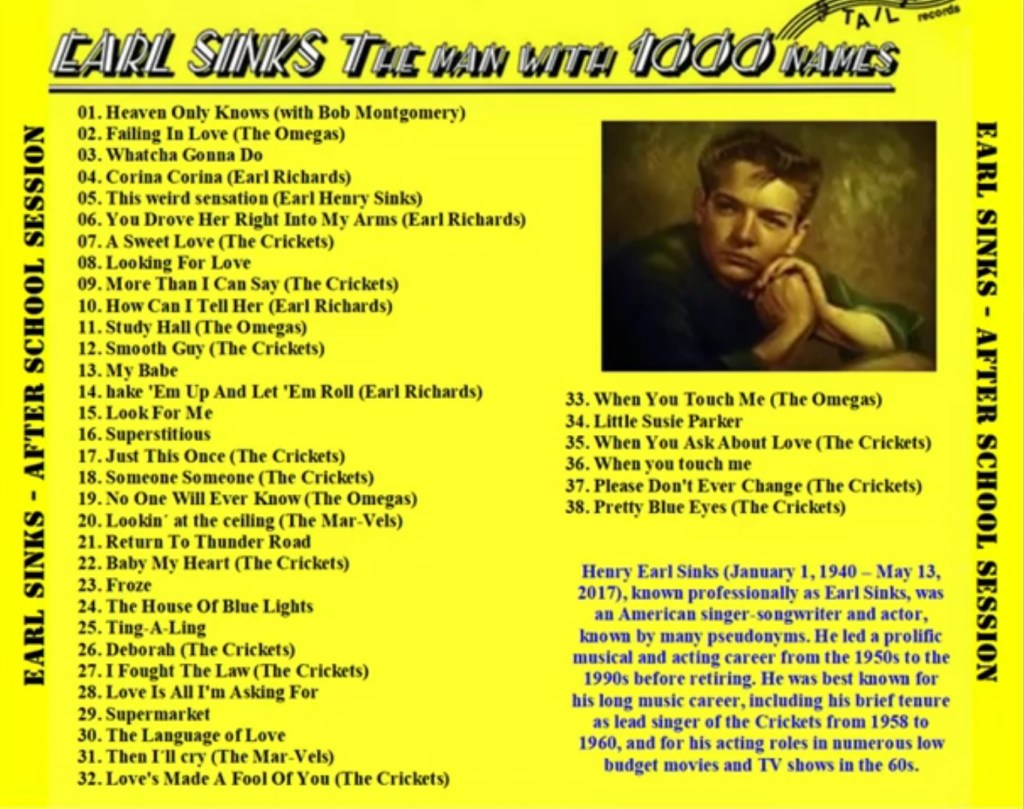
And, in a real treat, there’s a You Tube upload of the Earl Sinks compilation tribute CD The Man with 1000 Names — a super-fine, hour and a half of music featuring his work under the names Sinks, Earl Henry, Sinx Mitchell, and Earl Richards, as well as his work with the Omegas, the Hollidays, the Mar-Vels, and the Crickets. Embedded below, there’s a wonderful slideshow with Earl and the Crickets to the tune of their lost ’50s hit, “Someone, Someone,” to enjoy.


Earl “Snake” Richards in his acting debut for Ron Ormond.

Earl’s complete, career-spanning compilation/read his full biography on Wikipedia.

That Tennessee Beat (1966)

Earl Richards spotlighted on the newspaper ad for That Tennessee Beat.

The big selling point, here (this is B&S About Movies, after all), is American cinema chain owner and producer Robert L. Lippert, who we’ve waxed nostalgic in our reviews for just a few of his 300-plus films: Jungle Goddess, King Dinosaur, Project Moonbase, and Rocketship-XM. And Ron Ormond — the reason for this review — produced and directed several films for Robert L. Lippert, including many westerns with Lash LaRue. (Ormond also used Lash — as a therapist (!) — in the mondo sex-hypnosis romp, Please Don’t Touch Me. Another western star of old, Tex Ritter, worked with Ormond — as a priest (!) — in Girl from Tobacco Row.)

Star Trek: TOS scribe Paul Schneider — who gave two of the series’ best-known, first-season episodes: “Balance of Terror,” which introduced the Romulans, and “The Squire of Gothos” — pens; he also wrote episodes of The Six Million Dollar Man and Buck Rogers in the 25th Century. As for our director, Richard Brill: primarily a producer who worked on the TV series The New Steve Allen Show and Dateline: Hollywood, That Tennessee Beat was his only feature film.

This also proved to be the fifteenth and final film for (hubba-hubba) screen beauty Delores Faith, who wowed us in House of the Black Death (1965) with Lon Chaney and John Carradine, the 1966 Drive-In double-biller of The Human Duplicators and Mutiny in Outer Space, and her debut set in the far-flung future of 1980: The Phantom Planet (1961).

Then there’s our leading-lady, Sharon DeBord: During her slight, fifteen credit-career, she was Darrin Stephens’s secretary on TV’s Bewitched for several episodes. Did anyone one see her work in The Hoax (1972) with the recently passed (June 2021) Frank Bonner of Equinox fame? The Halloween rip Killer’s Delight, aka The Dark Ride (1978)?

Okay. Okay. I know. As Sam the Bossman would say: “Hey, don’t we have a movie to discuss?”

Sink — under his then stage name, Earl “Snake” Richards, is our leading man: Jim “The Nashville Kid” Birdsell. An aspiring country-western music star on the run after stealing money to fund a trip to Nashville, he’s subsequently robbed and left penniless by another road bandit. Luckily, Jim meets a brother and sister with a singing group who take him into the band and help him achieve his rock ‘n’ roll dreams. Jim, of course, falls in love with the sister, Opal Nelson (Sharon DeBord), as she and the Rev. Rose Conley (Minnie Pearl) put him on the straight and narrow.

As you can see from the newsprint ad, this film is packed — as is the case with all ’50s and ’60s rock films (see the similar The Road to Nashville; Mister Rock and Roll starring DJ Alan Freed) — with plenty of musical performances.

No disrespect to the ol’ Snake — and it’s not his fault, as he’s just a musician in an acting role — there’s not much of a story here; but again, as is the case with ’50s and ’60s rock films: the whole point is the performances. Remember, there was no MTV back then. And not everyone could afford a television to watch variety shows to see groups perform. And many couldn’t afford to go to concerts. So, it was movies, like That Tennessee Beat (distributed by 20th Century Fox, of all studios), which, for a mere buck a person (sodas and hamburgers were $.30 each*˟), brought the TV — and concerts — to America’s rural Drive-Ins.

You simply can not see a concert line up featuring Earl “Snake” Richards, Peter Drake, Boots Randolph (best know for the huge sax-driven hit, “Yakkity Yak”), the Statler Brothers, and Merle Travis (the film’s title song), not to mention the comedy stylings of the Grand Ol’ Opry’s grande dame, Minnie Pearl, for one dollar. Well, $4.00, if you toss in the sodas and burgers for you and your sweetie. So goes the genre of the “jukebox musicals” of old before Don Kirshner’s Rock Concert, ABC-TV’s In Concert, and NBC-TV’s The Midnight Special.


Sadly, I only have White Lightin’ Road recorded on an old VHS taped-off UHF TV. I also had That Tennessee Beat on a tape via UHF-TV, but lost that one to the blue screen of death. In all of my grey-market VHS years, I’ve never come across a copy of either film. And there’s no online streams to share of either film.

If there’s ever an actor-musician who deserves a restored, reissue box set of his films — only three, mind you — it’s Earl Sink. Make it happen, Arrow, Kino, and Severin. Yeah, we’re calling you out, our brothers. You can even toss in a restored greatest hits career-spanning CD of Earl’s tunes in the set.

* We paid our tribute to hicksploitation films with our “The Top 70 Good Ol’ Boys Film List” featurette.

** If you need more films with romance and burnin’ rubber (of the asphalt variety, dirty mind), check out our “Drag Racing Week,” as well as our “Savage Cinema (box set)” and “Fast and Furious Week” tributes, featuring review links to over one hundred films.

*˟ “Here’s How Much a ‘Cheap Date’ Cost Every Decade Since the 1940s” by Morgan Greenwald for Best Life.

For Henry Earl Sinks
January 1, 1940 to May 13, 2017
You rocked, it, Snake!

About the Author: You can learn more about the writings of R.D Francis on Facebook. He also writes for B&S About Movies.