One of my favorite things about Ron Ormond’s movies is that he brings back old western stars — often to my surprise — and gives them work long after Hollywood stopped hiring them. The congregation in this movie is led by Reverend E.F. Bolton, who is played by Tex Ritter, a singing cowboy who was the father of John Ritter and the Oscar-winning writer of “The Ballad of High Noon” from High Noon.
Bolton’s ministry is about to be tested, because a convict named Earl “Snake” Richards — played by Earl “Snake” Richards — is looking for some stolen cash in town before being taken in by the preacher’s son Tim (Tim Ormond, always a welcome sight) and falling for his daughter Nadine* (Rachel Romen, Maggie from Run, Angel, Run!). Also, his wife Rita is played by Rita Fey, who also is in Ormond’s The Burning Hell.
Country DJ and one-time The Nashville Network staple Ralph Emery shows up as a hit man, as Snake is being watched by the mob. He has a vision that he’s going to die surrounded by money and, well, he gets what he wants. If you’re wondering, who is that Vic Naro who plays the crime boss, well it’s Ron Ormond.
For a movie that promises, “A girl wilder than a peach orchard hog!” this is all pretty innocent. But it’s also crazy, because it somehow goes from preaching to country music to crime, sometimes all in the same moment.
*Nadine has some serious daddy issues, lusting after older men by literally screaming, “When you see snow on the mountaintop, there’s always fire in the furnace!”
This would be the last secular movie that Ron Ormond would ever make and what a movie to end that era of his career on. He also plays the mob boss Nemo, the man who rules the strip clubs of New Orleans — this movie is also known as The Monster and the Stripper — and decides to book a creature three men found in the marshes known only as Swamp Thing to be menacing next to his array of beehived go-go girls who are absolutely astounding in their inventiveness, twirling flaring tassels off their pasties.
The movie plays like a sketch comedy show, except that the Swamp Thing — played by Ormond’s next-door neighbor, a hulking rockabilly singer with the marvelous name of Sleepy LaBeef — is absolutely horrific, biting the necks off chickens to drink their blood and bearing men to death with their own arms. He’s like a Herschell Gordon Lewis movie character inserted into this wanna-be Russ Meyer film made by a Southern family who would soon almost die ina plane crash — and then Roger would have to nearly die again — and then find God and make movies with none of this sin.
This movie has something for everyone. You want a creature feature? It has that. How about some mob drama? Yes. And how about something for daddy? This movie is filled with dancing of the most prurient kind. The Swamp Thing falls for the new girl who is too shy to strip nude — someone needs to make a Letterboxd list of strippers in movies who never get unclothed — and when she’s attacked by the queen of the club, well, you’ve seen every monster movie ever made. Human beings are gonna pay.
This is the kind of movie that describes Bourbon Street as “sleepy by day, psychedelic by night,” which is pretty much the best thing ever written in a film. The world needs more movies that have 60s exotic dancing mixed with surprising torrents of gore.
Right before Ron Ormond’s road to Damascus moment, he was making movies like this, which feel like a mondo crossed with a sex ed movie and yet have all of the best things of both genres.
Using his real name Vittorio Di Naro, Ormond directed this film (and wrote it, too). It starts with Vicky (Vicki Caron, her only role; she’s a buxom redhead who seems like someone I would have pined over in my twenties. Who am I lying, if I were single, I’d be putting her through trade school) being assaulted as a teen.
Before we can reflect on what has happened, the movie goes into mondo territory and begins showing us the history of hypnotism, which is really an excuses to show us primitive cultures who still do things like rolling in glass and walking across fire. Yes, this film will have the theme of hypnosis in it, but there’s no reason for this footage and by that, I mean that I love that this footage is in this film.
Then, without any warning, we go from a drawing of a man with a one hundred pound plus tumor in his scrotum to watch an actual open heart surgery procedure. Some horror films use Val Lewton’s blueprint for suspense. Ron Ormond just lures you in with the promise that this is a sex movie and then punches you in the stomach with some of the sickest surgical footage possible.
Now, the movie can really begin.
Vicky is supposedly a real person and this story really happened, which is also the kind of thing that I demand in nearly everything I watch. She has some hang-ups because of the aforementioned assault which lead to her never allowing her new husband to touch her. Or maybe it’s because her mother (Ruth Blair, who unfortunately only did this movie) wants her daughter to keep on being her wingwoman.
This all leads Vicky to a therapist named Bill, who is played by Lash La Rue of all people. Yes, the very same cowboy actor who starred in eleven films from 1948 to 1951 in which he dressed all in black and used a bullwhip to stop bad guys. In 1952, Lash’s comic book adventures sold nearly 12 million copies, but a decade later and we have our hero appearing as a kindly doctor instead of a man in black battling bad guys.
La Rue is the perfect person for the Ron Ormond orbit, as he became born again and did church ministry after being a movie star. He also disappeared for most of the 70s, as he took the role of teh villain in the movie Hard on the Trail without realizing that it was an adult movie. To repent, he was a missionary for ten years before showing up in movies like The Dark Power and Alien Outlaw.
Lash appears on the back cover of the Johnny Cash and Waylon Jennings album “Heroes.”
In order to determine exactly why Vickie won’t let her husband near her, he brings in real-life hypnotist Ormond McGill to figure out the answers. At some point in the 50s, Ormond had spent in Asia with McGill in Asia researching and writing the book Religious Mysteries of the Orient/Into the Strange Unknown. They also wrote The Master Method of Hypnosis, The Art of Meditation and The Magical Pendulum of the Orient together; one wonders whether Ron gave it all up once he found God. McGill was such a mentor to Ron that he took his stage name from the man.
Despite the title, this film really does care about its subjects and how Vickie is damaged because of how she feels for her husband but can’t bring herself to care for him sexually. It’s a surprisingly deep topic for when this movie was made (shot in 1959, released in 1963).
There are also musical numbers by the Mulcay Brothers.
This movie plays like a mixtape for the mentally disturbed. I loved every single moment of it.
Man, in 39 Stripes, Tim Ormond nearly makes a roundtrip, going from the young kid protecting a convict in Girl from Tobacco Road to playing a criminal himself, portraying Ed Martin, former chain gang convict who converted to Christianity in prison in 1944 and formed the HopeAglow Prison Ministries.
A life of petty crime led Ed into prison, a place where they whip you 39 times — there’s an old Jewish tradition that if you get hit 40 times, you die — when you screw up. But a letter from Ed’s sister’s friend Alfreda Enders saves Ed’s soul.
This is sadly the last film that Ron Ormond would make. He directed the film and co-wrote it with Tim. It isn’t berserk like his early work and is very settled down versus the excesses of movies like The Believer’s Heaven. But man, I love Tim as an actor. He’s like a bad Jerry Mathers, sounding like the Beav while speaking about how heavy Christ’s cross was as the music gets way too loud over him.
The poster for this is great, but I think Ron was getting tired. But when you succeeded in making movies that non-stop blow minds, from your time making quasi-mondo movies about hypnotism to films where swamp monsters, the mob and strippers all live in the same swamp, you get a last movie pass.
Then again, Tim pretty much makes this movie. The film sets him up to be a major preacher and when he gets the mic, he kind of warbles his way through it. But again, the Ormond family has so much good will in my life that I would make dinner for them and give them a room in my house and they wouldn’t even have to ask.
Ron Ormond’s journey — from Southern deep-fried drive-in fare to religious grindhouse filmmaker — is the kind of thing that obsesses me. Usually working with Rev. Estus Pirkle, his films reach a level of ecstatic mania that I could only dream of discovering in a snake church revival, yet can do it in the comfort of my basement.
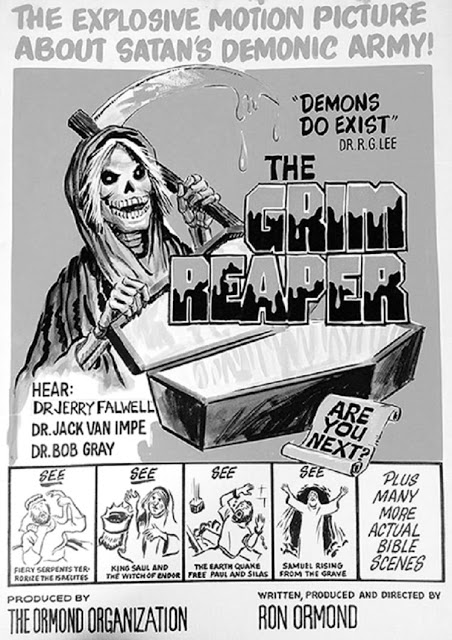
There’s a line we can follow from Ormond’s Mesa of Lost Women to these films, because at its heart, exploitation is exploitation. It’s getting you to not just want to watch something but need to watch it. Just look at the poster for this, which uses the same language and cues as a horror film, which is what this really is.
Verne (Cecil Scaife, who was in nearly all of Ormond’s religious movies, plus Girl from Tobacco Road; as well as producing and starring in The Hollywood Beach Murders) and Ruby Pierce (Viola Warden, who was also in The Burning Hell) have a son named Frankie (Eddie King, who was in The Burning Hell after a career in small Hollywood roles; he also worked with Ron’s son Tim to start the first video firm that was allowed to videotape legal depositions for showing at trials in Tennessee courtrooms) who is a wild man, racing cars and says, “Religion? Not fos this dude.”
When Frankie dies in a car crash, he goes straight to hell and the Pierce’s pastor refuses to preach at his funeral. So while Ruby clings to God, her husband goes into the occult to try and save his son from the left hand path, working with Dr. Kumran to speak directly to the dead. Yet this is putting him on the same way to the flames of the abyss, so his other son Tim (Tim Ormond, who I love in everything he appears in) tries to save his father.
Finally, the family gets to hear the words of Jerry Falwell and heed the altar call. But it’s too late for Frankie, who we see as a ghost and watch burn in hell, surrounded by masks that Ben Cooper would shun.
Best of all, the film uses church parishioners to recreate Acts 16:16-40 and 1 Samuel 28 with wigs and basic makeup instead of the special effects that were possible in 1976. Then, we see Moses in the desert before going back to hell again, which is populated by witches and even Dracula. Let me be as clear as possible: this movie is the kind of thing that I devour like a cool lemonade on a balmy day.
At one point, this comic book poster was up on church walls and people gathered to watch this movie in basements and rec halls. We’ll never have a time like that again, when movies like this were sermons, unless you come to my house, where beer will be our communion.
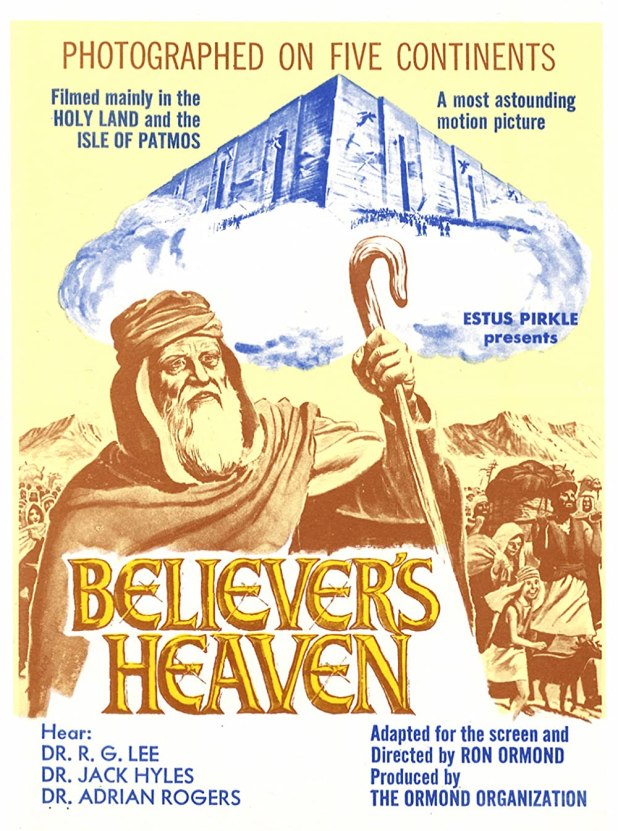
The basics of this movie: Fire-and-brimstone preacher Estus W. Pirkle gives a sermon to his followers, explaining what Heaven looks like.
Yeah, that’s kind of what it’s about, but that’s like me saying Edwige Fenech is a girl. The Believer’s Heaven is the kind of insane cinema that secular filmmakers could only dream of conceiving.
Pirkle made three movies — If Footmen Tire You, What Will Horses Do? and The Burning Hell are the first two parts of the trilogy — and all three of them have stuck in my mind way longer than any blockbuster I will see this year. Or any other year.
To get his gospel into the world, he relied on a former sinner. Ron Ormond started his entertainment career as stage magician Rahn Ormond, married a vaudeville dancer named June Carr, wrote books about psychic surgery and then made a string of movies that are just as odd as these movies, including Please Don’t Touch Me, Girl from Tobacco Road and the astoundingly unhinged The Exotic Ones, which is also known as The Monster and the Stripper. It took multiple near death experiences for Ron to find the Lord, but once he did, he started making the same kind of grab you by the balls cinema that he did for weirdos like you and me, but now he was doing it to save our souls.
This film isn’t filled with the brutality of the first two films but is just as odd and that’s a blessing. From views of a decidely science fiction heaven to moments where Pirkle’s congregation and Ormond’s family act out psychodrama to an ending where those not whole on Earth — like three children with leprosy — are brought Tod Browning style center screen to sing.
“Don’t you get so tired and worn out sometimes? The work hours are so long and the night’s rest is so short, the labor is so strenuous that you don’t feel like you can take it much longer. Or perhaps sickness and suffering have so weakened your body that you even long to die. Have you not wrestled with sin and temptation so long that you welcomed relief? Thank God that there is a place where the Saints of God shall rest from their labors.” So says this film, but man, when you have Pirkle basically berate you for an hour, do you worry that maybe you might spend eternity with him? Man, I hope so. That would be my Heaven, getting to make a fourth movie with Ormond and the reverend.
I’m beaten down by life some days, but when nothing else would do, this movie lifted me.
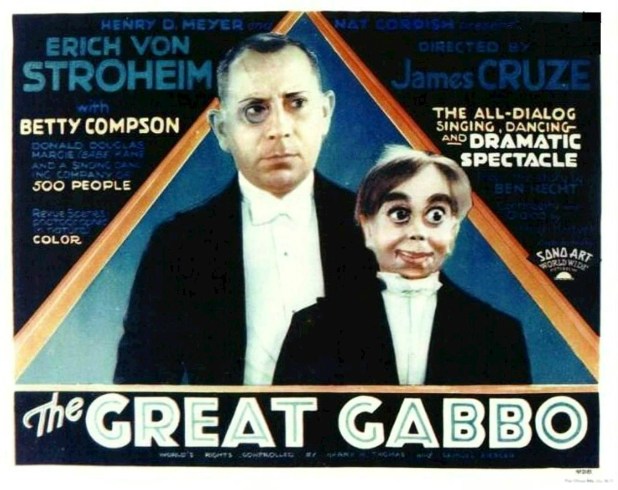
Based on “The Rival Dummy” by Ben Hecht, The Great Gaboo was released as an “all-dialog singing, dancing and dramatic spectacle” with huge musical numbers that stand in stark contrast to the plot and often stop the film’s pace cold. There was even a scene shot in color, “The Ga Ga Bird”, which is missing from nearly all prints of the movie today. The musical sequences are so big — “Web of Love” was used for years in other films and dance sequences was re-used with different music in 1932’s The Girl from Calgary — that you may forget that this is kind of a horror movie.
Predating Dead of Night, The Twilight Zone episodes “The Dummy” and “Caesar and Me,” Magic, Devil Doll and even The Simpsons episode “Krusty Gets Kancelled,” this is the tale of an artist — ventriloquist Gabbo (Erich von Stroheim, who in addition to being an actor — known as “the man you love to hate” — was also one of the first auteur directors, beloved by Surrealists and a man banned from Hollywood — he was unwilling to compromise his art for commercial cinema, while also being obsessed with the finest of details and more than willing to spend as much money as possible on his films despite scenes that were too shocking to ever be shown; yeah this is a run-on sentence but he’s a personal hero) — who only speaks through his dummy Otto*.
Gabbo is amazing — he can make Otto talk and sing while he smokes, drinks and eats, which wows audiences — but he’s a complete maniac who can only relate to the outside world through the dummy. His girlfriend and assistant Mary (Betty Compson) leaves him after years of suffering through his tics and complete hatred of the world.
Two years pass and Gabbo has become a star while Mary has moved on to a relationship with a dancer. The Gabbo she meets now is a complete man, one who relates to her with thought and romance. He confesses that without her, he realized his failings and worked to improve himself. She tells him that she is now married and they cannot be together, saying goodbye to Otto and not him. His life ruined, he explodes, punching the doll in the face before holding it, taking Otto to the stage where he ruins the show and loses his career.
Director James Cruze acted in, directed and or produced over 100 films in the silent era. Not much is known about his life before Hollywood as he told a different story to every interviewer. However, he sadly never was able to make the move from silents to talkies and after moving to work in Poverty Row studios like Republic, he killed himself in 1942.
I can’t imagine how audiences reacted to this. It really is a horror film, with a deranged protagonist who can’t relate to humanity that wants to desperately retain the two people who keep him sane — a woman in love with another man and his partner who is not even real. And then the music numbers! I love this movie for every odd thing it throws at me.
Newly restored by the Library of Congress — public domain versions have been out for years in much worse quality — The Great Gaboo is now available on blu ray from Kino Lorber.
*Otto was hand-carved by Frank Marshall, the same artist who made Edgar Bergen’s dummies.
June 25: Junesploitation’s topic of the day — as suggested by F This Movie — is a car movie.
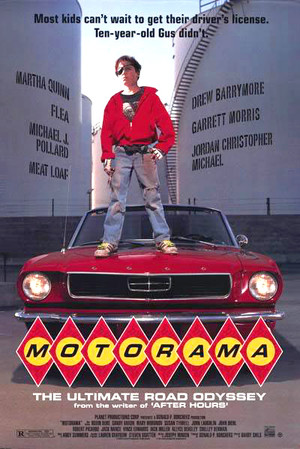
A ten-year-old runaway boy named Gus has left behind an abusive home to go out on the road in a stolen ‘66 Ford Mustang that he drives with stilts attached to the gas pedals. His goal is to collect game cards from the Chimera Gas Company and if he spells M-O-T-O-R-A-M-A, he wins $500 million dollars.
The first person Gus meets on his journey — and the last — is Phil (John Diehl), a gas station attendant who flies a yellow kit with a photo of a cop (Robert Picardo) shaking hands with him, all to show whatever is in heaven that he’s a worthwhile person.
The real thrill of watching this movie is in seeing who shows up next. From Martha Quinn as a bank teller and Jack Nance as a hotel clerk to Meat Loaf as an arm-wrestling biker, Mary Woronov as a kidnapper, Flea as a busboy, Robin Duke as a corporate drone, Allyce Beasley as a receptionist, Susan Tyrrell, Michael J. Pollards, Garett Morris, Drew Barrymore as the girl of our hero’s dreams and, of course, Dick Miller — man, this movie has something for everyone. And by everyone, I mean me.
Director Barry Shils produced Vampire’s Kiss and also made Wigstock: The Movie. Writer Joseph Minion wrote the aforementioned Vampire’s Kiss and After Hours, as well as directing Daddy’s Boys for Roger Corman, using the same sets as Big Bad Mama II.
This movie is great because it’s a hijinks ensue film, but within the context of a child becoming an adult by undergoing a quest to determine what really means the most in life. It’s not weird for weird’s sake. It just feels like it was filmed in a place not quite our own and sent to the wrong reality, where we must study it and determine what we can learn from Gus’s quest.
What a great, three-day rally of films from Bernard L. Kowalski (thanks for allowing me to free range, Sam) as we wrap it up with a TV movie that pays tribute to a great TV series from the ’70s. To say I am stoked to review this BK entry is an understatement: the development of this tribute week to ol’ Uncle Bernie centers on this flick. And we get Kent McCord, who never got the due he deserves, some props.
Let’s roll it!
By the late ’80s, the cable networks began eschewing their UHF-styled, bread-and-butter reruns format by going for the throat of the “Big Three” over-the-air networks of ABC, CBS, and NBC — with their own, original programming. The national “superstations” TNT and USA each began producing their own TV movies (many of which we’ve reviewed at B&S), so why not the all-new basic cable and satellite network The Nashvillle Network?
You don’t remember that logo? It’s okay, most TV viewers — not county-centric — don’t remember it either.
Put some good ol’ down home twang in your life.
Going on the air in March 1983, the network operated from studios on located on the grounds of the now-defunct theme park Opryland USA in Nashville. But, as with the major movie studios creating competing ripoff films for the marketplace (e.g., Armageddon vs. Deep Impact, White House Down vs. Olympus Has Fallen) The Nashville Network was beat on the air — by two days — by Country Music Television.
After the dust settled: The Nashville Network lost the ratings war.
TNN began its life as a country music alternative to Warner-Amex’s MTV’s rock and VH-1’s contemporary music formats by airing music videos; the programming soon expanded into concerts, game and talk shows, and country-eccentric movies (such as Smokey and the Bandit). By September 2000, the channel dumped their “southern” identity by ditching the “Nashville” moniker for “National” to become The National Network. Then, to the holier-than-thou, law-suitin’ and hissy fittin’ dismay of Spike Lee (“They’re stealing my brand!”), National transformed into the male-centric Spike TV in 2003. Today, you know the channel as the upper-tier cable dumping ground for all things Paramount-produced: The Paramount Network.
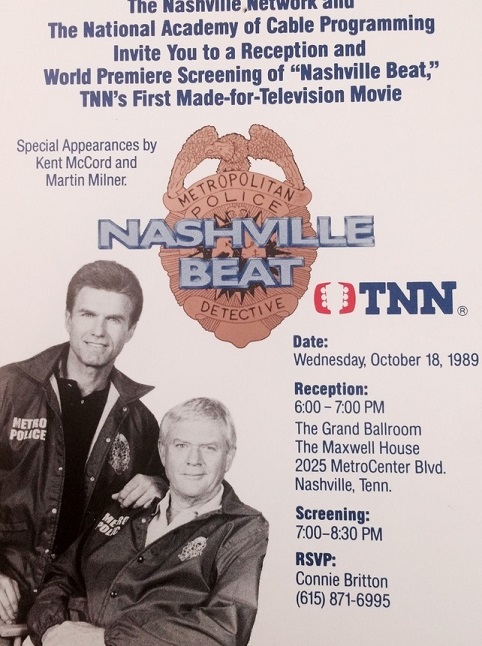
So, with that backstory out of the way . . . let’s polish off our three-day tribute to the films of Bernard L. Kowalksi (that began all the way back in 1956 with Hot Car Girl) and dig in to some slip-smackin’ BBQ with Bernard’s last film — and TNN’s first made-for-television movie — Nashville Beat.
Now, if you’ve been following along the Kowalski beat this week, you’ll know that his last theatrical film was the drive-in horror classic, Sssssss (1973). And, since we love our Six Degrees of Separation of actors and directors in the B&S cubicle farm: that turn-man-into-snakes-mad-scientist romp starred Dirk Benedict, later of Battlestar Galactica . . . and Kent McCord ended up on that failed Star Wars TV series ripoff’s second season, aka Galactica: 1980, as the all-grown up Boxey, aka Troy (we reviewed the overseas theatrical version of the series, Conquest of the Earth; look for it).
Anyway, after Sssssss (Who decided the title only needed six lowercase “S”; why not eight?), Kowalski returned to television — where he got his start — with multiple episodes of Perry Mason and The Untouchables, as well as Banacek starring George Peppard (more “Six Degrees”: he was in the fellow Star Wars dropping, Battle Beyond the Stars), and Columbo. In between, Kowalski developed the MGM Studios/CBS-TV series pilot for the Starsky and Hutch-precursor, The Supercops (1974), which aired on March 21, 1975, and continued the adventures of (real life cops) Dave Greenberg and Bobby Hantz. That series was quickly derailed by the (more powerful, due to Charlie’s Angels) TV production powerhouse of (Aaron) Spelling-Goldberg Productions’ TV movie-to-series pilot for Starsky and Hutch, which aired on the competing ABC-TV network on April 30, 1975. And, since we love our Six Degrees of Separation of actors and directors in the B&S cubicle farm redux: David “Ken ‘Hutch’ Hutchinson” Soul starred with Kent McCord in the CSI TV series-franchise precursor (and, in my opinion, superior), the all-too-short-lived TV Movie-to-series, UNSUB (1989).
While we didn’t get around to reviewing all them (or finding copies of most of them), other post-Sssssss and The Supercops TV movies Bernard Kowalski directed are Flight to Holocaust (1977), The Nativity (1978), TV’s response to Rocky with Marciano (1979), Nick and the Dobermans (1980), Turnover Smith (1980), Nightside (1980; with Doug McClure, from Kowalski’s Terror in the Sky), and Johnny Blue (1983).
Image courtesy of the Kent McCord Archives (with more pictures and article on the show.)
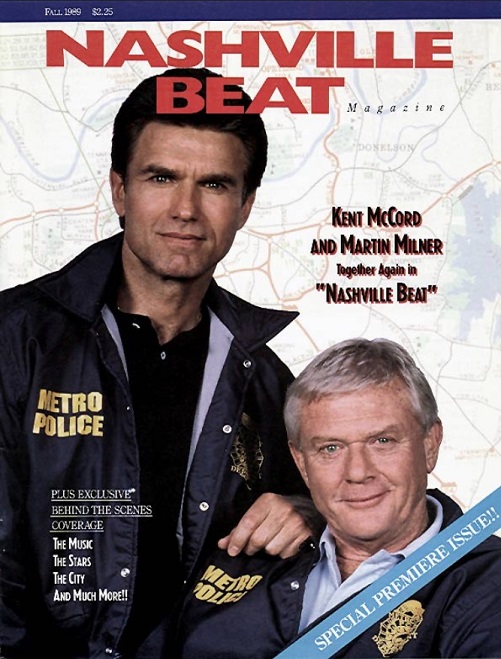
So, if you know if your ’70s TV: You’ll know Nashville Beat is the 14-years-in-the-making reunion of actors Martin Milner and Kent McCord after their successful, seven-season run on Adam-12 that aired on NBC-TV from 1968 to 1975. The final episode of that series ended in a cliffhanger, somewhat: we never knew what happened with officers Pete Malloy (Milner) and Jim Reed (McCord), as the series closed with Reed’s rookie copy readying to take the detectives exam and leave his seasoned, veteran partner and the streets. . . . Instead of NBC-TV giving us a late ’80s TV movie version of Adam-12, we got the closest thing to an Adam-12 TV movie: Nashville Beat, which was developed, produced, and co-written by McCord with the intention of becoming TNN’s first original drama series.
Milner and McCord — while pretty much the same cops, only older-but-wiser and in plain clothes — are Captain Brian O’Neal and Lieutenant Mike Delaney, both who started out like their Adam-12 counterparts: on the streets of Los Angeles. Even after his old partner left for a job as a detective in Nashville, Delaney and O’Neal remained close friends. Upon become a widower, Delaney heads to Nashville to help his old partner on a case with ties back to Los Angeles. And the case works out well, and Delaney’s heart is ready to love again with the sexy, big-haired owner (it was the ’80s, natch) of the honkytonk where O’Neal and his copy buddies hangout. So the movie ends with Delaney deciding that he just might move the kids out to Nashville to start over . . . which would set off the new series that never happened.
Meanwhile, TNN’s faux Adam-12 reunion got the folks at MCA Television (a division of Universal that supplied NBC-TV programming) to reboot Adam-12 in September 1990 to fill the UHF-TV blocks of the new, weekend syndicated programming crazy (ignited by Star Trek: The Next Generation and Xena: Warrior Princess). The syndicated revival, The New Adam-12 (1990) was cast-headed by John Wayne’s son, Ethan (who made his debut in his dad’s Big Jake). The series, which ran for 52 consecutive episodes, was cancelled after one year. No one (including moi) cared: Milner and McCord were never invited back to appear. But, we did see Milner and McCord share the screen again in a 1997 episode of Diagnosis Murder with Dick Van Dyke, playing, yet again Los Angeles police officers.
And that’s a wrap on our three-day tribute to the career of Bernard Kowalski. Discover his films with our reviews and enjoy!
You can watch a VHS rip of the home video version of Nashville Beat on You Tube. And look for our reviews of Hot Car Girl and Sssssss — this week — as we continue our tribute to Bernard L. Kowalski.
About the Author: You can learn more about the writings of R.D Francis on Facebook.He also writes for B&S About Movies.
Editor’s Note: We hope you’re enjoying our tribute to the films of director Bernard L. Kowalski. Today, we’re reviewing his first major studio feature film. And in a twist that only a B&S About Movies reader can appreciate: the leads of Maximilian Schell and Brian Keith would later star in their own, respective Star Wars-boondoggles that were The Black Hole and Meteor. Now, if that doesn’t make you want to watch this proto-disaster drama, then we don’t know what will.
Lost somewhere between Arthur Hailey and Irwin Allen igniting the ’70s disaster genre with their respective Airport franchise and the one-two-punch that is The Poseidon Adventure and The Towering Inferno (and not forgetting Mark Robson’s Earthquake for Universal), there was ’50s blacklisted and ex-Poverty Row Monogram Pictures and King Brothers low-budget drive-in scribe Philip Yordan’s return to the Hollywood majors with his proposal of making a film about the 1883 eruption of the island of Krakatoa. Yordan’s “blacklisting” was actually a blackballing, due a script mix up that brought forth a contractual dispute between 20th Century Fox and Warner Bros. Unable to work in Hollywood, Yordan ended up in Spain working for Samuel Bronston, where Yordan incorporated Security Pictures. However, when it comes to “blacklisting”: he did, before his own ouster, front for ’50s blacklisted writers.
Now, back in 1965: Yordan began his “come back” with the man-screws-up-the-Earth disaster epic, Crack in the World. (Yeah, it was made on the cheap in Spain for Yordan’s Security Pictures, but Paramount gave it a U.S. release.) However, for the B&S crowd, Yordan pumps our VHS-lovin’ hearts with his final films, ones that we go on and on about: Cataclysm (1980), The Nightmare Never Ends (1980), Savage Journey (1983), Night Train to Terror (1985), Cry Wilderness (1987), Bloody Wednesday (1987; which we need to review), and the The Unholy (1988). Oh, and how can we forget Marilyn Alive and Behind Bars (1992), aka Scream Your Head Off (sometime in the ’80s).
I know . . . let’s move on from my Yordan geek-dom. Back to the mountains of Krakatoa, we shall go!
So, for dramatic effect — as if people running for their lives from an erupting volcano wasn’t enough drama — ‘ol Phil concocted a subplot about a band of unsavory characters aboard the decrepit steamer Batavia Queen attempting to salvage a sunken cargo of pearls deep in the island’s watery outskirts, with the bragging rights of a $3 million production budget. Initially, the film started out at Columbia Pictures with Rock Hudson (who eventually ended up in a disaster flick of his own with 1978’s Avalanche) as Captain Chris Hanson, the commander of the Batavia Queen. As with most “big” movie plans, the project fell into “development hell,” and came out on the other side under the Cinerama Releasing Corporation shingle, a studio-distributor that did pretty with the John Boorman-directed (Zardoz, The Exorcist II: The Heretic) World War II drama Hell in the Pacific (1968) starring Lee Marvin.
Then, the real disaster erupted.
The then in-camera effects and process shots required to make the volcanic disaster appear convincing on film proved to be difficult; Philip Yordan gave up on his dream project; a new producer, Clifford Newton Gould, commissioned a new script; the film’s runtime ballooned to 130 minutes (two hours and ten minutes); once conceived as a family-friendly adventure, it now had racier, adult-dramatic elements added; the weather, the seas, and animals on the location weren’t cooperating within the budget.
At the time, Bernard L. Kowalski was a young TV director who cut his teeth with Roger Corman on Hot Car Girl, Night of the Blood Beast, and Attack of the Giant Leeches, but he more than proved himself in the more commercial realms of network television directing episodes of westerns (Rawhide, The Wild Wild West, The Virginian, Gunsmoke) and law procedurals (Perry Mason, The Untouchables, Mission: Impossible). There’s no doubt Kowalski was more-than-ready for a major studio, million dollar-plus project. But the “what ifs” abound: If only Columbia had backed the project (with more money). And, no disrespect to our leads of Maximilian Schell and Brian Keith, both are fine actors — if only Rock Hudson had carried the picture. And you didn’t have bickering I-know-better-than-you-do producers revamping a locked script and adding superfluous, saucy adult drama that left us with a confusing plot rife with a constantly changing adventure-to drama-to romance-to-adventure tone augmented with beyond-the-budget, haphazard special effects.
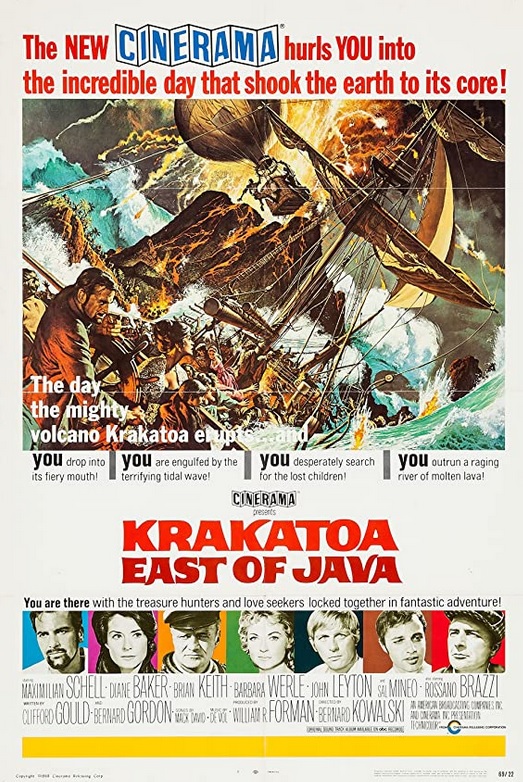
And, of course . . . there’s that pesky Cinerama Releasing Corporation boondoggle with the title: not only did the producers misspell (insist) the island, known as Krakatau; the island is — while technical part of the Indonesian “Far East” — is actually west of the isle and sea of Java. But how many of us dumb ticket buyers back in 1968 knew that fact? Well, the film critics made sure we knew in their reviews. And besides, “East” is sexier, you know, with Japan and all. In the end, the cataclysmic event that killed 36,000 people referenced in the film isn’t a docudrama: it is merely a (wildly, historically in accurate) backdrop for its family adventure-cum-adult dramatic relationships storyline.
So . . . do we need to tell you the movie was a critical and box office bomb? Not every movie with an overture and intermission (as did Fiddler on the Roof and 2001: A Space Odyssey) can be a success. The 130-minute print that ran in theaters in 1969 was later edited-for-television — with scenes shorted or wholly deleted — into a 106-minute print. Vying for the epic sweep of David Lean’s Lawrence of Arabia (1962), which ran near four hours long and cleared $70 million against its $15 million budget to sweep The Golden Globes and Oscars, Philip Yordan’s dream project turned into a box office bomb.
Sadly, as with most directors-for-hire who have no control over the script they’re hired to shoot, nor a voice against those I-know-better-than-you-do producers, Bernard L. Kowalski shouldered the blame. After making two more major studio films for AVCO Embassy Pictures, Stiletto(1969), based on a Harold Robbins paperback best seller (starring Alex Cord and Britt Ekland), and the Civil War western Macho Callahan (1970; stars Gene Shane of The Velvet Vampire and Werewolves on Wheels alongside David Janssen), neither which set the box office on fire, Kowalski made his TV movie debut — and forged a successful TV movie career — with the airline disaster flick, Terror in the Sky(1971).
While Tubi carries the 106-minute TV print, we found the 130-minute theatrical cut on You Tube to enjoy. Moi? Even with its flaws, I stick to the epic — in more ways than one — theatrical print. You can enjoy the trailer on You Tube.
About the Author: You can learn more about the writings of R.D Francis on Facebook.He also writes for B&S About Movies.


 B&S About Movies
You must be logged in to post a comment.