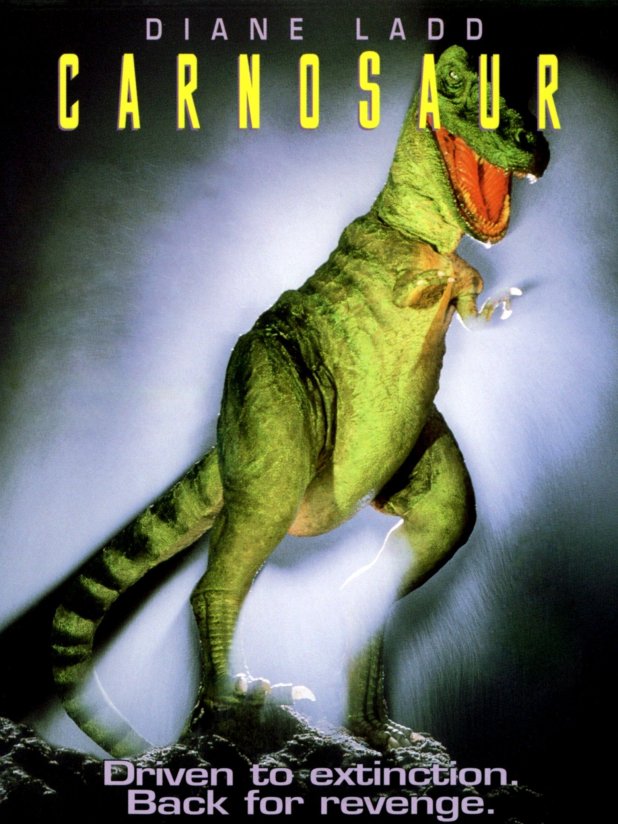
You have to love a movie that has a rubber dinosaur effect and also the budget to get Diane Ladd in its cast, much less one based on a book.
Dr. Jane Tiptree’s (Ladd) plan to exterminate the human race with a lethal virus and replace them with her own genetically created dinosaurs, which seems like something I can get behind. She’s been creating special chickens — Death Laid an Egg? — that hatch lizards and give people the flu and you know, that’s a very specialized plan for taking over the world.
Doc Smith (Raphael Sbarge) and Ann Thrush (Jennifer Runyon) are our protagonists and man, they’re ineffective throughout this movie and pay the price for it. I mean, for a movie with an obvious rubber dinosaur this is a movie that will shock you with scenes of families getting gunned down like they wandered onto the set of The Crazies.
Within a secret bunker, the new world order plans to repopulate the human face through artificial wombs and strict fertilization rules; Diane Ladd gets herself sick off her own disease and dies but not before she gives birth to a baby dinosaur and Smith crashes a backhoe into another big lizard. But — and man, I feel like saying spoiler warning but I doubt anyone cares about Carnosaur as much as me — he gets the cure to Ann just in time for government troops to shoot them and burn their bodies.
The really funny part is that Roger Corman rushed this out before Jurassic Park and had Laura Dern’s mom — Ladd — in his movie, which is some kind of casting miracle.
“The last thing we need is a biotech panic about chickens!”
2-4-5 Trioxin gas is the U.S. Army’s greatest weapon and will create nearly unkillable fighting machines, a fact that Curt Reynolds (J. Trevor Edmond, who is also in Pumpkinhead II: Blood Wingsand Meatballs 4) and his girlfriend Julie Walker (Melinda Clarke, Lady Heather from CSI and Jessica Priest in Spawn) learn as they snoop around the military base which is commanded by Curt’s father.
A SNAFU in the lab causes Curt’s military dad to be demoted and they need to move, but his son refuses and only wants to be with his girlfriend, who grabs his crotch while they’re riding a motorcycle and just like The Devil’s Honey, bad things happen.
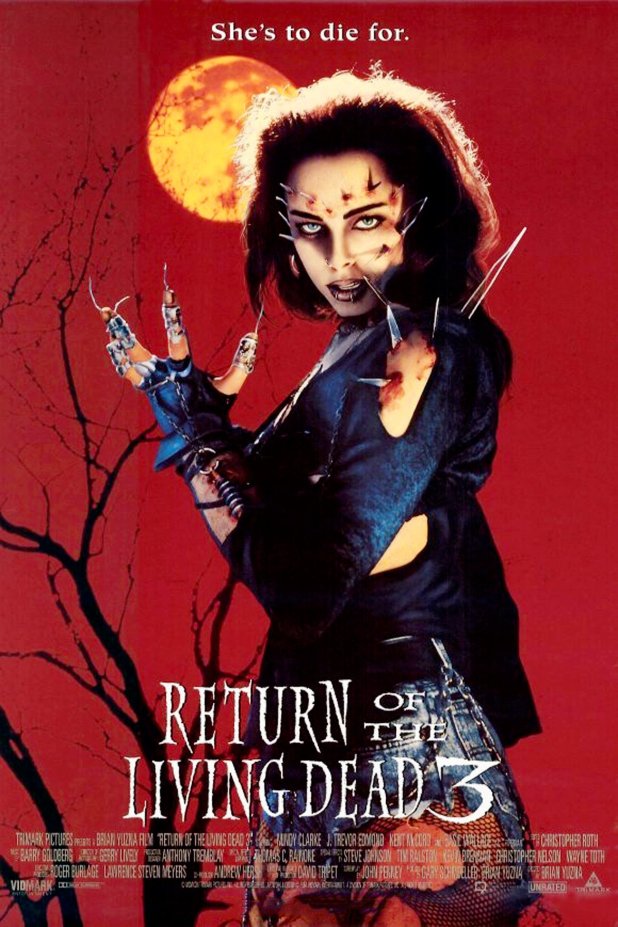
Unlike that Fulci erotic madness, Julie is reanimated as a zombie and just when you think this movie is going to get silly, well, it gets pretty great. She’s consumed by ravenous hunger and is continually upset by the idea that she can no longer feel her heart beating inside her body. How does a sequel to a reimagining of another franchise end up doing the best job of explaining what it’s like to be the undead of any other film I’ve seen?
To keep the hunger at bay, she begins skewering herself with metal, leading to a fetishistic zombie dream — nightmare? — look, which totally makes this movie work. Plus, you have a cast with people like Kent McCord from Adam 12, James T. Callahan (Walter Powell from Charles in Charge), Sarah Douglas (Ursa from Superman), November 1988 Playboy Playmate of the Month Pia Reyes and Waxwork director Alex Hickox as a doctor killed in the bloody opening.
Zombies with exoskeletons, doomed romance, movie punks, a lead heroine who hates who she has become and the military being as ineffective as ever. Man, this one has it all. It’s that rare sequel, the one that’s so much better than it has any right to be.
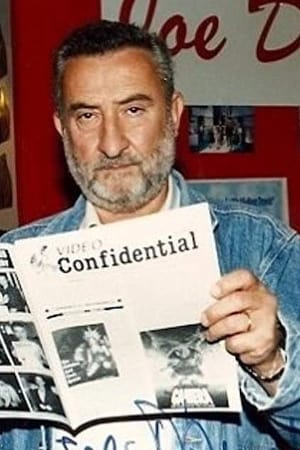
Tales of the Red Chamber finds our pal Joe D’Amato making a movie as Robert Yip, which may be one of my favorite of his many stage names. And this movie has been reviewed by exactly no one — so far — on Letterboxd, which makes it one of the few D’Amato movies with little to no attention.
A Filmirage presentation, this tells the story of an elderly traveler seeking shelter from the rain in a bordello. As he warms himself by the fire, he repays the kindness of the madame with a series of stories, starting with a young man who does everything to win over a woman who is already married, only to learn that she’s a man. In the second story, a jealous ruler uses a special chastity belt on his bride to destroy the manhood of three men. Yes, it’s a mini-guillotine. Then, an old man buys love potions to calm his wife and also cure his impotency and ends up mixing them up. And finally, a cloth seller pulls off the old adult film pizza delivery story, as he needs to get paid and the lady of the house wonders if there’s another way she can settle the transaction.
Strangely, this softcore movie was made in the midst of D’Amato making nearly all hardcore movies and many folks thought Robert Yip was a real person and this was actually an imported Asian film.
Fake names: It has Fabrizio Laurenti (Witchery) directing under the pseudonym Martin Newlin while the man of many names, Joe D’Amato, goes uncredited even though he directed a fair amount of this film. He also wrote this — with Laurenti and the always dependably insane Rossella Drudi. Also, Daniele Stroppa as Daniel Steel and man, his resume has Convent of Sinners, High Finance Woman and Blue Angel Cafe on it just to name a few.
It almost came out in American theaters: We should all be so lucky! It did come out here as a direct-to-video Columbia TriStar Home Entertainment VHS.
Italians in America: Much like the beloved Troll 2, it was shot in the big lights, big city of Porterville, Utah.
Earth vs. the Earth: Nuclear radiation makes vegetation go wild and kill people. Where can you run when there’s nowhere to run?
Costumes designed by: Laura Gemser, making the wardrobe person the most attractive person on the set.
A cast of people you may know from: Mary Sellers from Ghosthouse; Stagefright; Eleven Days, Eleven Nights and La maschera del demonio! Jason Saucier from Hitcher in the Dark and Top Model! An uncredited Gabriele Tinti — there on vacation with his wife!
A wild soundtrack: Carlo Maria Cordio, you have gifted us with the soundtracks of Endgame, Killing Birds, Night Killer, Troll 2 and this movie. Thank you for your synth.
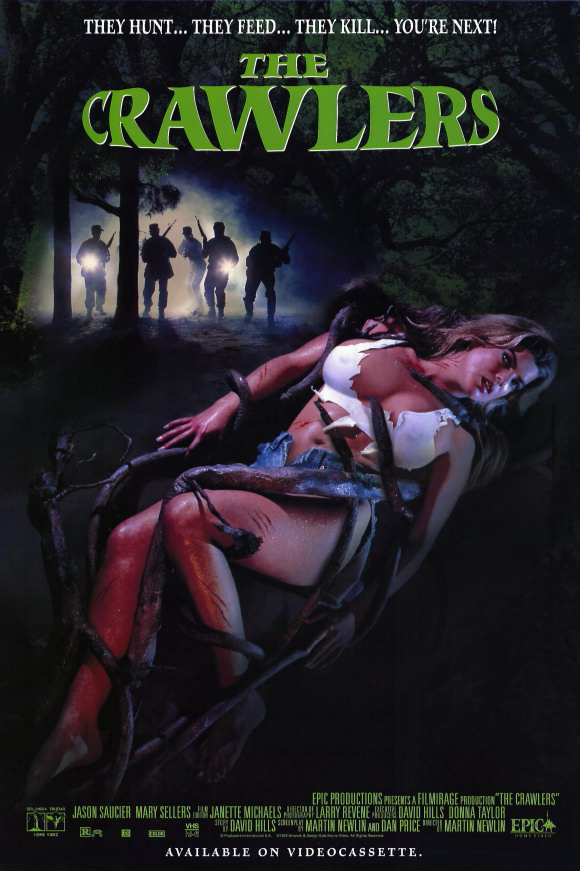
There are a lot of people that live to make fun of bad movies. I say that the only bad movie is a boring film. This movie is neither bad not boring. I mean, plants eat people, then people hack up the plants and put them into radioactive barrels and ship them off for somewhere else. The end.
There’s also a scene where an intelligent plant stops a car by doing the banana in the tail pipe trick from Beverly Hills Cop.
In the world of retail, “Christmas in July” is a promotional gimmick enticing mall shoppers to stock up on decorating supplies, as well as stocking up on discounted gifts. At B&S About Movies: we celebrate “Christmas in Summer” by spreadsheeting a six-months out “Christian Cinema Week” for the first week of December: we’re weird that way.
As this week unfolds, you’ll notice we’re concentrating primarily on the films of the ’70s, which we’ll round up (at 8 PM, Saturday the 4th) with one of our patented “Exploring” featurettes; this one entitled “Christian Cinema of the ’70s” that features a plethora of mini-reviews of even more films. And it seems Santa checked off those efforts in the B&S About Movies “nice column”: he gifted us with an early, July present: a never-heard-of-it-before Christsploitation flick.
It was a lazy July weekend, as I browsed the aisles of a second-hand store. Of course, the first section I always hit is the VHS/DVD section: it’s how I scored my copy of the Richard Lynch apoc romp, Ground Rules (1997); it’s also how I got this copy of a Christian apoc romp starring Richard Herd (our ersatz Caesar/King Herod) who, if you’re keeping track, was in the secular, French apoc romp, The Survivor (1998). Also encouraging our watch, and helping us swallow the low-budget exploitness of it all: the 230-plus television-and-film-credited Jeff Corey (our ersatz Pontius Pilate), as well as iconic daytime actor and prime-time character actor, Gerald Gordon (a government assassin, aka thief, nailed on a Calvary cross, next to Jesus). Needless to say, they are, in spite of the material and the other non-thespians stumbling around them, excellent.
Regardless of its additional lack of narrative quality, discovering The Judas Project for the very first time, 28 years after its initial release, is a blessing: considering when one compiles a week of Christian Cinema films and a film named The Judas Project — tossed willy-nilly between a copy Sandra Bullock’s Murder By Numbers and James Spader’s Supernova — calls out to you. It also becomes a double-blessing when you just rewatched the production-tragic Christian rock-apoc romp Raging Angels (1995) in the same week — specifically to review it for “Christian Cinema Week.”
The Judas Project: The Review
Jesus and helicopters: load and roll the tape!
The Holy Bible is rife with parables, but not with the moral or spiritual lesson of Tommy Wiseau (The Room) and fellow, self-proclaimed auteur Neil Breen (Neil Breen’s Movie Magic) discovering Jesus and deciding to proclaim their new-found faith by making a movie together, but not just any movie: a sci-fi Jesus movie.
The “message” here is the same ol’ salvation trope: Humanity is in peril, so God sends forth his son in the form of a man named Jesus Jesse to save mankind from the impending terror that is to destroy the Earth. The plot-twist in this fictionalized retelling of the story of Jesus Jesse: it’s told as if The Holy Savior arrived in the late 20th century.
No, we are not making this up: this movie is real.
As the film spins, one notices that, while the VHS sleeve indicates the year of release as 1993, the copyright on the film stock indicates the production began in 1990; as such, the film is woefully dated in its attempt to emulate-update the “Jesus in present times” progenitors Godspell, Jesus Christ Superstar, Pilate and Others, and Jesus of Montreal. The clue the proceedings are outdated: it makes reference to the “evil Russians” by calling out the USSR, which fell on December 26, 1991 — two years prior to its direct-to-video release.
Needless to say, as with all Christ-based films: none of the films are “bad”; reviewers in the Christian press loved The Judas Project, praising its action, acting, and even the (woeful, not-so-special) special effects (The lightning! The lightning!). The less-discriminating, secular reviewers, honestly — and isn’t that what Jesus taught us: to be honest and not deceive others — pounced on the movie: for all the same reasons the preaching-to-the-choir Christians praised the film.
Uh, no. I am not breaking the Eighth Commandment for a film review.
For this promoted, “made entirely apart from Hollywood” (in Savannah, Georgia) modernization of the “Greatest Story Ever Told” is actually the “Most Abysmal Story Ever Committed to Film”: a community theater-level production that should have closed on the same day it opened — and certainly never committed to celluloid.
We meet our “Jesus” in this updated version of the first-coming of Christ, in the form of Jesse (underdog ’80s AOR musician John O’Banion): he’s a new-and-improved, radical social revolutionist savior in this Passion Play — as he speaks to a beach-wondering multitude searching for a missing boy. Tired, stressed, and hungry, he comforts the downtrodden with wisdom — then feeds their bellies with an endless supply of bread and cheese.
Yes. Not fishes. Cheese.
Jesse eventually recruits twelve disciples, all white, natch, which goes against the grain of today’s multi-racial society in which the film is set. Why, yes: Judas shows up (daytime and prime-time actor Ramy Zada) — rollin’ in a fancy car with “Money 66” license plates. Why, yes: as is the case with any Christian apoc flick from the ’70s through the ’90s: people are crucified on crosses by threat of machine guns (to get its “point” across — and it is gruesome, natch). Why, yes, the film is anti-Semitic: Jesse’s chief antagonist is a powerful Jewish religious leader, determined to kill the Christ.
Look, I get it.
Writer-director-and everything else — also composing the companion soundtrack’s all-original CCM rock opera — James H. Barden is passion-trying with the same vigor as Mel Gibson with The Passion of the Christ (2004) — more so, if you consider the soundtrack. Barden’s “What If” question of an Earth that never knew Jesus Christ 2,000-plus years ago — only to have him arrive for the first time during the planet’s sci-fi apocalypse meltdown — is an intriguing concept. Barden’s detracting from the Revelation’s Antichrist trope proliferating most of the apocalyptic Christian films of the ’90s obsessed with the Mark of the Beast (Left Behind, Jerusalem Countdown, Megiddo: The Omega Code 2, Six: The MarkUnleashed — to name a few), instead placing the actual Christ into the same context via the synoptic gospels of Matthew, Mark, Luke, and John is, in fact, appreciated.
However, if you know your post-’80s Italian, and their even-worse Philippine (Stryker), apoc knockoffs (sans the superior Endgame or 2019: After the Fall of New York)*, Christian apoc flicks rarely pull off their honorable, against-the-budget intentions. Check your roster of Cloud Ten Productions apoc’ers fronted by David A.R White, accordingly: then file next to The Judas Project. Maybe if this was made in the early ’70s by 20th Century Fox, Metro-Goldwyn-Mayer, or Warner Bros. with an apoc-rugged Charlton Heston** as the “New Christ,” possibly George Peppard** as “Jesus” with a 12-wheeled amphibious battle truck*˟, we have something, here. . . .
To think protestors took to the theater sidewalks over Mel Gibson’s and Martin Scorsese’s takes on the life of Jesus. The Last Temptation of Christ (1988) is the film you praise for its quality and ability to get its subtext across. The Judas Project is, by far, the far more offensive picture, courtesy of its all-white apostle brigade, women are misogynistic victims, stereotyped as promiscuous, controlling Jezebels, with Jews as the “evil” responsible for the murder of the Christ, and anyone born in the lands of Mother Russia are inherently diabolical. Can we get a little philogyny and Semitic joy up in this here church? It’s not like the Russians are Estus Pirkle’in sharpened bamboo into the ears of children . . . will someone please spin Sting’s “Russians” and let the world know they love their children, too? An entire nation of peoples goes to Hell, just because they were born there?
Ugh, Christian cinema: just. please. stop.
Enough with the bogus, “faith-based” sci-fi shilled by the likes of Loophole (about a Judas Iscariot “violence gene”), The Judas Project, Raging Angels and a David A.R. White end-of-the-world production. Please take your production cues from Alex Kendrick and his Sherwood Pictures shingle (in Albany, Georgia, by the way). Stay out of the beyond-the-low budget-indie lands of apoc-futures and stick to present-day car lots (the really fine Flywheel), football fields (the finer Facing the Giants), and spiritually-conflicted firemen and police officers (the better-than-you-think Fireproof and Courageous). Mixing Apaches with The Holy Savior sends us running away from the “Romans Road,” not towards it.
Maybe if the wise, disembodied stone head of Zardozwas quoting the gospel and commanding the Apache helicopters, we’d hit the celluloid trail to Damascus. . . .
The Life of John O’Banion
Honestly, if not for this film’s obscure rock musician angle presenting an opportunity to honor a career, we wouldn’t have gotten this far.
Radio disc jockey, TV host, and one-time lead vocalist in American jazz trumpeter Doc Serverinsen’s Today’s Children (he, once the leader of Johnny Carson’s ’70s late-night band), John O’Banion made five appearances on Johnny Carson’s show as a solo artist, as well as multiple Merv Griffin and Mike Douglas daytime talk show episodes. O’Banion also appeared on American Bandstand, Solid Gold, and Star Search (hosted by Carson sidekick, Ed McMahon; big shock: O’Banion was the ultimate winner that season).
The Star Search “win” led to his single, “Love You Like I Never Loved Before,” charting in the Top 50 in the U.S., Australia, and Canada. His biggest chart hit was Crystal Gayle’s cover of “I Don’t Want to Lose Your Love,” which reached #2 on the U.S. country charts in 1983. Signed to Elektra Records, O’Banion released several snyth-pop albums: John O’Banion (1981; his highest charter, known as Golden Love Song in the overseas markets), Close Up (1982), and Danger (1982). Finding a more receptive audience in Europe and Japan, he released the German-made White Light (1985), and appears on the Elektra-produced soundtrack with two songs for the film Legend of the Eight Samurai (1983). The Asian film led to his recording Satomi Hakken-Den (1983) and Hearts (1995) for the Pacific Rim market, where he had his greatest chart success.
During his tenure with Elektra Records, O’Banion attempted to launch an acting career with a minor-support role in Charles Bronson’s Borderline (1980), and a larger supporting role the TV movie Courage (1986) starring Billie Dee Williams (Alien Intruder) and Sophia Loren. He closed out his acting career as the Christ in The Judas Project. He died in 2007 at the age of 59 in Los Angeles from complications after being stuck by a car while on tour in New Orleans.
There’s no free or pay streams to share. There is, however, a still active website where you can purchase streams. During its initial roll out, The Judas Project aired on the Christian cable network TBN – The Trinity Broadcasting Network throughout the ’90s. The network would later finance their own Christian-inspired apoc’er with the aforementioned, Six: The MarkUnleashed (2004).
This movie needs more helicopter . . . and cowbell.
* You can enjoy more ’80s apoc films with our two-part “The Atomic Dust Bin: 10 Post-Apocalyptic Films You Never Heard Of” featurette — Part 1 and Part 2. To see even more of our post-apocalyptic reviews, check out our complete Letterboxd list.
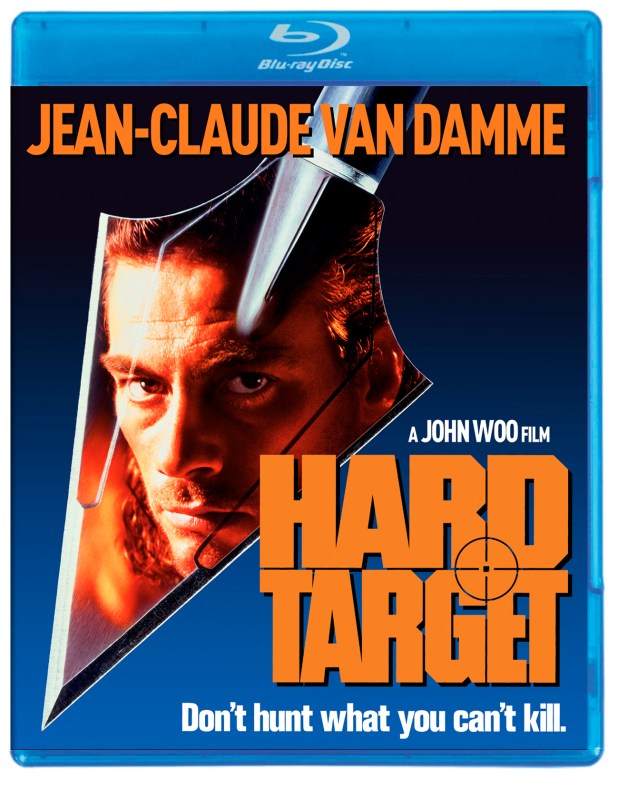
EDITOR’S NOTE: We love all things Van Damme, so much so that we watched more than twenty of his movies in one week a few years back. This review comes from then — July 13, 2019 — but now Kino Lorber has released UHD and blu ray versions of this film. They include a brand new 4K restoration of the unrated international cut from a 4K scan of the original camera negative, plus new interviews with John Woo, Lance Henriksen, Yancy Butler and stunt coordinator Billy Burton. Plus, there’s a newly restored trailer and new commentary by action film historians Brandon Bentley and Mike Leeder.
Was there some kind of boot camp that Hong Kong directors had to go through to make movies for Chinese audiences that required them to work with Jean-Claude Van Dam? Tsui Hark, Ringo Lam and John Woo all made their first Western movie with the actor. It seems like too much of a coincidence to believe otherwise.
Chuck Pfarrer wrote the script, which is based on the 1932 film adaptation of Richard Connell’s 1924 short story The Most Dangerous Game. He also wrote or contributed to the films Darkman, Navy SEALs (based on his own time as a SEAL), Barb Wire, The Jackal, Arlington Road, Shooter and The Green Hornet.
Beyond Hard Target being Woo’s first American film, it was also the first major Hollywood film ever made by a Chinese director. Universal Pictures was nervous about having Woo direct a feature, which kind of blows my mind. By this point in his career, he’d already made A Better Tomorrow, A Bullet In the Head and The Killer by this point, movies that are legendary action movies that are more memorable than any action Hollywood was churning out in the 1990s.
They sent Sam Raimi to look over the film’s production and possibly replace Woo if he started to fail. That said, Raimi was a big fan of the director and confident in his skills, saying, “Woo at 70% is still going to blow away most American action directors working at 100%.”
Kurt Russell was Woo’s original choice of a star, but he was too busy. The director then went with Universal’s selection of Van Damme, which allowed him to ramp up the action.
Amazingly, it took twenty different cuts of the film to secure an R rating. While all that was going on, Van Damme hired his own editor to create his own cut of the film. Van Damme’s version cuts out whole characters while including more close-ups of himself. When asked why, Van Damme said, “People pay their money to see me, not to see Lance Henriksen.”
The movie begins with a homeless veteran (scriptwriter Pfarrer) being hunted by Emil Fouchon (Lance Henriksen), Pik van Cleef (Arnold Vosloo, The Mummy and Zartan from G.I. Joe: The Rise of Cobra and Darkman in two direct to video sequels), Stephan (Sven-Ole Thorsen, Conan the Barbarian), Peterson (Jules Sylvester, a noted snake wrangler) and a businessman who has paid half a million dollars for the chance to hunt a human being. The man is killed before the credits roll.
We soon meet his daughter Natasha (Yancy Butler, TV’s Witchblade), who is looking for her father. She hires homeless martial artist and ex-Marine Chance Boudreaux (who would be in that role other than Van Damme?) to be her guide and bodyguard.
What follows is a veritable smorgasbord of fight scenes and bullets being fired by all manner of guns, including an amazing sequence inside a Mardi Gras float graveyard. Somewhere out there exists the original 116-minute long cut — outside of bootleg releases — that has even more mayhem still intact. That said, what survived is still action-packed.
I was let down when this movie was released, but realize now that Woo still had some adjusting to do when it came to Hollywood — beyond improving his English. Last year, he told the Hollywood Reporter that “…in Hard Target I was too ambitious, and tried to do everything in one film. This is unlike any traditional films in the States, so the audience didn’t understand what’s going on with these techniques. It’s not a typical Hollywood action movie. And slow motion. And also the violent moments, too, the audience couldn’t take it. And some people left the theater in the middle of the movie. Although the film didn’t achieve great success, it sold well.”
Looking back on it a quarter century later, I can appreciate a lot more of the film. Arnold Vosloo and Lance Henriksen make the perfect team of bad guys. And any movie that gives you both Van Damme with a magnificent mullet and Wilfred Brimley kicking ass as JCVD’s Uncle Douvee really made me enjoy this way more than I remembered. I mean, how many movies will you see this year where the hero shoots a bad guy five times with an upside down gun and then still spin kicks him?
Hey — we also have this ten things to know about Van Damme article too!
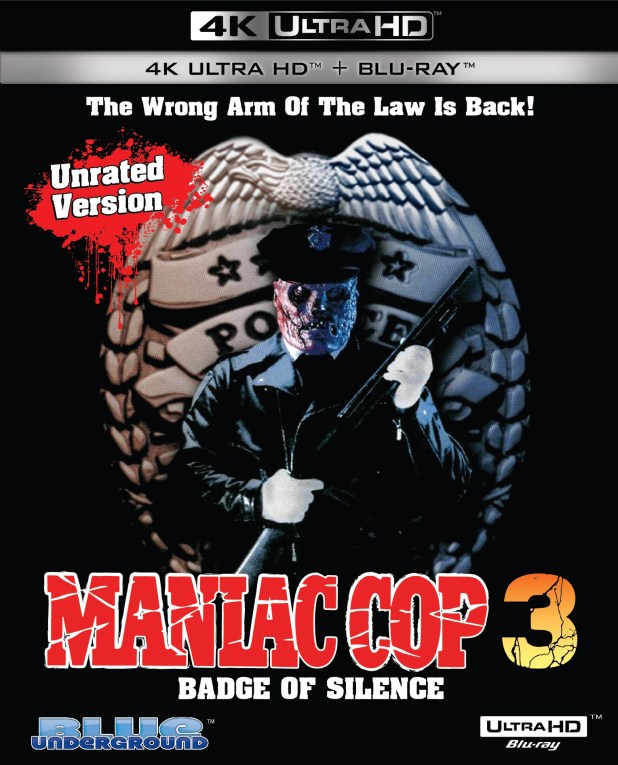
EDITOR’S NOTE: This movie originally appeared on our site on October 12, 2019. Now that it’s been released on UHD and blu ray by Blue Underground, we’ve edited that article and added some new information.
Their new UHD and blu ray set includes Ultra HD Blu-ray (2160p) and HD Blu-ray (1080p) Widescreen 2.35:1 feature presentations, as well as new audio commentary with director Alan Smithee*, a making-of documentary, deleted and extended scenes, the trailer, a gallery and the original synopsis.
You can order Maniac Cop 3: Badge of Silence from MVD.
But what if the Maniac Cop found love?
This is the question we must answer.
Aren’t we all worthy of adoration?
Even those of us who have risen from the grave and killed numerous people in an obsessive quest for bloody revenge?
But first, the problem of bringing back the Maniac Cop, Officer Matthew Cordell, played once again by Robert Z’Dar. Leave that to Houngan Malfaiteur, played by Julius Harris from Hell Up In Harlem, Black Caesar and Superfly. I love the character names that Harris had in movies, like Tee Hee Johnson in Live and Let Die, Gravedigger in Darkman and Speedbagger in Prayer of the Rollerboys. He uses the dark powers of voodoo to bring our favorite boy in blue back from the beyond.
Meanwhile, there’s also another cop named Katie Sullivan (Gretchen Becker, who is also in Firehead and was Martin Landau’s partner until the end of his life) who gets shot in a convenience store holdup. Thanks to more police corruption, she’s painted as using excessive force and the man who shot her is due to go free, which upsets investigating officer Sean McKinney (the returning — and always awesome — Robert Davi).
It also upsets the Maniac Cop, who shows up to the hospital ready for mayhem. He kills one guy with defibrillator paddles and another with straight-up x-ray radiation. And the four reporters who joined in on Kate’s frameup? Toast.
McKinney joins up with Doctor Susan Fowler (Caitlin Dulany, who along with Jesica Barth, formed Voices in Action after the multiple accusations against Harvey Weinstein) to investigate the murders and Kate’s strange behavior, even though she’s braindead.
The Maniac Cop is interested in Kate, who Houngan claims refuses to return from the land of the dead. So he does what any of us would do. He sets everything — including himself — on fire.
Despite getting blown up real good, the body of the titular protagonist survives enough to hold Kate’s charred hand, even in the morgue.
This movie is packed with talent, including The Breakfast Club‘s Paul Gleason, one-time Freddy Krueger actor Jackie Earle Haley as holdup man Frank Jessup and Doug Savant from Melrose Place and Robert Forster as doctors.
Maniac Cop III: Badge of Silence had a troubled production. Despite director William Lustig’s rough cut clocking in at just 51 minutes, he refused to shoot the additional scenes the producers wanted. That’s why the Blue Underground release has Alan Smithee listed as director. To fill in the gaps, there are several scenes that are obvious outtakes from Maniac Cop 2.
*When we interviewed producer — and one half of the Alan Smithee mentioned above — Joel Soisson, he said that he had just finished the commentary track for this and that it was a sparring match with William Lustig and said that it was not your typical commentary track lovefest.
DAY 12 — CAMPFIRES & FLASHLIGHTS: One where a character tells a scary story and then . . . flashback.
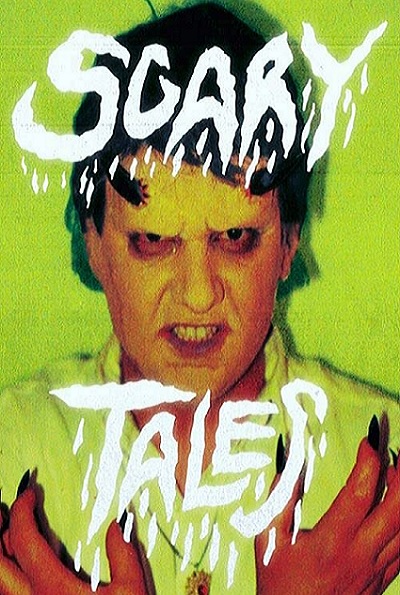
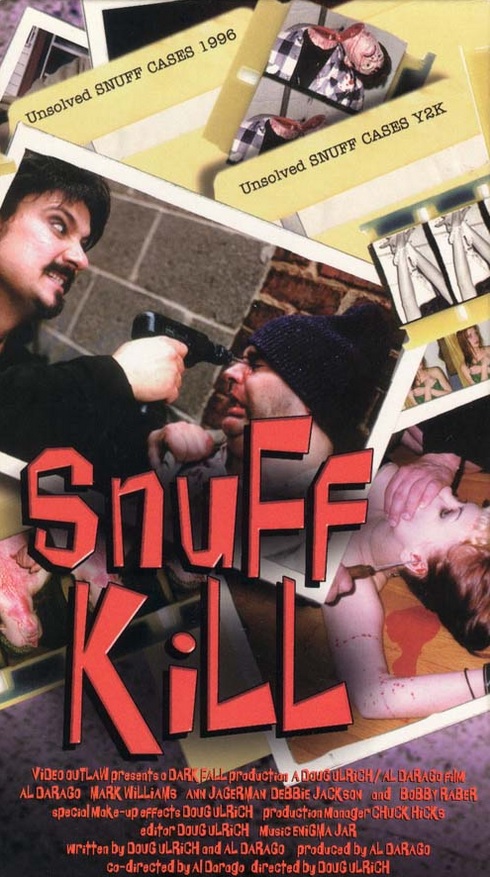
As part of our annual “Slasher Month” last October, we reviewed Snuff Kill (1997), the third film — and best known and distributed film — from homegrown Baltimore SOV filmmakers Doug Ulrich and Al Darago (Ulrich also came to work with our SOV forefather-hero, Don Dohler, on 2001’s The Alien Factor 2). Now it’s time to take a look at their debut film, the anthology Scary Tales that, while released in 1993, had a long-in-development on-off shooting schedule that began in the mid-’80s. As with Snuff Kill — in which Al Darago portrayed the rocker-slasher Ralis — he and Doug Ulrich provide the film’s original tunes (“Destined to Love,” “She’s a Good Time,” “Let It Go,” and “I’m in Love”) as well as take care of all of the other film disciplines.
As the film opens, we meet a hooded, faceless storyteller with glowing eyes who weaves three tales from an ancient text to a group of ghostly, silhouetted children: “Satan’s Necklace” concerns an evil piece of jewelry that possesses its owner’s soul. In “Sliced in Cold Blood” a man loses his sanity upon discovering his wife’s infidelity. Then things come very close to our current techno-reality in “Level 21,” as a man loses his soul — literally — to a PC-based video game.
Amid the expected muddy-to-distorted audio, Spirit Halloween-effects, and accepted non-thespin’, we get an inventive against-the-budget human-transformation-to-vicious, man-eating demon, lots of heads split-open or decap, a knife out through the mouth, demons breath fire flumes, and in the final Tron-inspired tale (but closer to the lower-budget “The Bishop of Battle” segment starring Emilio Estevez in the 1983 Universal-produced omnibus, Nightmares; even more so to Charles Band’s 1984 tech-manteau The Dungeonmaster with Jeffrey Bryon sucked into a netherworld overlorded by Richard Moll), we get a gaggle of netherworld dwarfs and ninjas in an ambitious against-the-budget Dungeons & Dragons playing field. Remember the computer non-effects in Jerry Sangiuliano’s tech-slasher Brain Twisters? Well, it’s like that, and not the least bit “Tron.” But that’s okay because this movie splatters to the side of bountiful, which is why we rented home video SOVs in the first place.
Look, if you’re expecting a celluloid-perfect homage to the ’70s Amicus anthologies that inspired Ulrich and Darago’s debut film, then just keep on walkin’ past the crypt and go watch George Romero’s Creepshow. In the end, this is The Night of the Living Dead-era fun, as we’re living vicariously through Doug Ulrich and Al Darago, two guys just like us, who, instead of watching, reading and writing about films, they went out and made them. (And watch Scary Tales instead of the yawn-inducing Creepshow 2. Yes, I am saying team Ulrich-Darago’s film is more entertaining than a George Romero comic-book based sequel.)
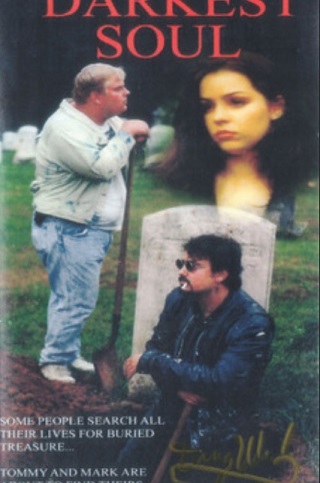
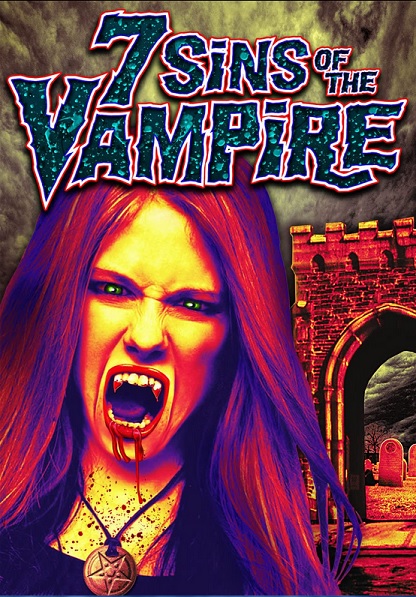
You have to give team Ulrich-Darago their props as — unlike most SOV auteurs, who only managed one film — our SOV duo from Baltimore made four, including Darkest Soul, the aforementioned Snuff Kill, and 7 Sins of the Vampire, in quick, back-to-back succession. The only other SOV’ers to pull off multiple films as quickly was Christopher Lewis with Blood Cult, The Ripper, and Revenge . . . well, because of Blood Cult’s rep as the first mail-order SOV, Lewis is the best known. But there’s the crowned king that is Dennis Devine of Fatal Images and Dead Girls fame that’s still making them, albeit digitally these days (his latest is 2020’s Camp Blood 8). And porn-funded British SOV purveyor Cliff Twemlow (with his directing-partner, David Kent-Watson) knocked out six film in quick succession in the wake of his SOV pinnacle, GBH. Jeff Hathcock made his debut with Victims! in 1985 and during the next seven years pumped out three more: Night Ripper!, Streets of Death, and Fertilize the Blaspheming Bombsell. Yeah, you’ll SOV-drop fellow Baltimorite Don Dohler with his ’80s shoestring trio of The Alien Factor, Fiend, and Nightbeast released between 1978 to 1982 — but while they have that SOV-couch change stank on ’em, those were shot on film.
In the lesser-accomplished SOV canons are Leland Thomas of Bits and Pieces, John Henry Johnson of Curse of the Blue Lights, Georgia’s William J. Oates of Evil in the Woods, Alaska’s Blair Murphy of Jugular Wine, the SOV-tag team of Bill Leslie and Terry Lofton of Nail Gun Massacre, sci-fi space-jockey William J. Murray of Primal Scream, porn purveyor Justin Simmonds of Spine, Brixton Academy owner Alan Briggs of Suffer, Little Children, Brian Evans of Tainted , and Canuxploitationer Andrew Jordan of Things fame — each who pulled off one film. Nick Kimaz of the ambitiously-failed Space Chase managed two (1988’s Rage of Vengeance), while the equally ambitious-better Philip J. Cook of Beyond the Rising Moon pulled off three (Invader and Despiser in quick succession), while SOV apoc’er Armand Garzarian did two with Games of Survival and Prison Planet, and then made three more, and still sits behind the lens for other filmmakers.
However, of all of those films and their makers, we’ll always pencil-in Doug Ulrich and Al Darago on the top of our SOV lists courtesy of their Wiseauian heart and tenacity to release their quartet of films in quick succession — while showing improvements in their storytelling and effects skills along the way. Sure Tim Ritter of the SOV classics Truth or Dare and Killing Spree and Donald Farmer of Demon Queen and Scream Dream are still makin’ movies into 2021 and should be at the top of the list for their still growing, extensive resumes . . . well, I don’t know . . . I just dig what Doug and Al loaded into the SOV canons. I like ’em, so sue me . . . plus: we haven’t gotten around to reviewing Ritter or Farmer flicks on the site — at least not yet. Too many films, so little time. And as we ramble n’ praddle our SOV love, there’s a caveat: Not all were shot-on-video. Some of these VHS oddities (such as Truth or Dare) critically lumped in the SOV category were shot on 16 mm and released on video — and if it’s released in a direct-to-video format for exclusive, off-the-beaten Blockbuster Video path distribution at mom ‘n pop video stores, then it’s an SOV. Got it?
You can learn about the new Blu-Ray release of Scary Tales at Vinegar Syndrome. But we found a VHS rip on the very cool You Tube home to all things SOV, with the fine folks at Letterboxd Funtime. Oh, our review of 7 Sins of the Vampire is on the way, as part of our October 2021 “Slasher Month,” so search for it in the coming days . . . whoop, there it is!
About the Author: You can learn more about the writings of R.D Francis on Facebook. He also writes for B&S About Movies.
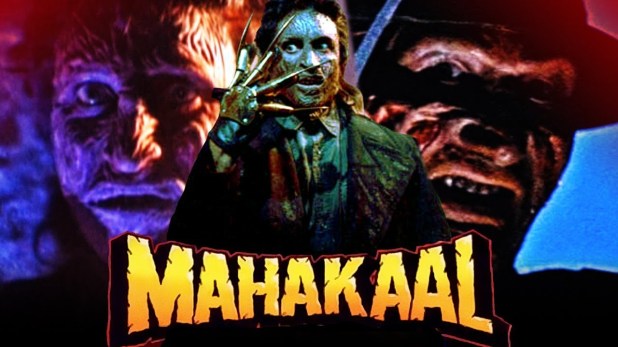
There are people that are just going to watch this movie — which combines Freddy Kreuger, Michael Jackson, Bollywood song and dance numbers and a low budget — just to laugh. And you know, I kind of dislike that foreign remix cinema is seen as such a joke. You try making a movie that lives up to a Hollywood big budget movie within a country that can’t raise those funds while working within the confines of the way movies are presented. Most of u slack the imagination and sheer nerve to do it.
So when Seema has a nightmare of a scarred man wearing steel claws, our western minds instantly see this as a cheap knock-off. But the film plays with expectations, as the villain is not some average custodian, but the evil magician Shakaal, who needed children to increase his magical powers and was only stopped by Anita’s father, who has kept the claw glove in a drawer all these years later.
An American — even an Italian — remix film would not take everything. Bad Dreams may have a burned up villain and Taryn from Dream Warriors, but it is very much its own film. Night Killer only takes the mask. Mahakaal takes everything, even the actual music from the first two A Nightmare on Elm Street movies and keeps on giving.
There’s also the Michael Jackson-loving Canteen, who becomes a werewolf by the end of the movie because, well, who knows. This isn’t the kind of linear cinema that you grew up on. Strangely — or not hat much when you think of it — there’s another Bollywood Elm Street cover called Khooni Murdaa that even takes the end of Dream Warriors but redeems itself because it tells the origin story of Ranjit — Fareed Krueger — who escapes prison and gets thrown into a campfire, creating the dream version that destroys everyone else.
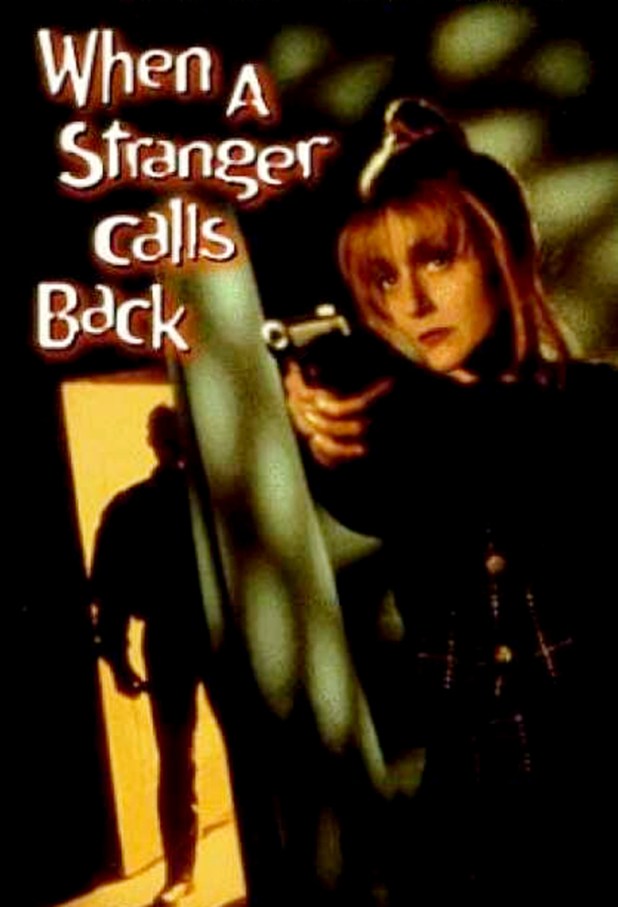
Fourteen years after When a Stranger Calls, this TV movie brings back Cheryl Wilson, Carol Kane and Charles Durning as Mrs. Schifrin, Jill Johnson and John Clifford, as well as director Fred Walton.
The opening of this movie is great. Julia Jenz (Jill Schoelen, an unsung scream queen) is babysitting when she hears a knock on the door. Smart enough to not let anyone in, she tells the man on the other side of the door that she can call a tow truck for him but won’t let him in. When she does try to call, the lines are cut and as she begins lying to the mysterious voice, she realizes that someone is coming in and out of the house. It’s too late — the children she was watching have been abducted.
Five years later and Julia is still traumatized, with whoever stole the children continuing to break into her apartment. She’s helped by counselor Jill Johnson, but the constant abuse causes her to try and kill herself with a self-inflicted head wound. Julia and John Clifford decide to figure out who the stalker is, a man who can throw his voice and has special makeup and clothing that allows him to blend into the walls of Julia’s apartment.


 B&S About Movies
You must be logged in to post a comment.