Cannibal Hookers and Demon Queen (1987) and Scream Dream (1989): A Donald Farmer Three-Fer!

Kansas cult filmmaker Donald Farmer made his first film, the short Despondent Yearning, in 1973; by 1976, he completed his sixth short, A Taste of Flesh: based on those titles, we’re guessing they’re skin flicks. After Christopher Lewis single-handedly birthed the home video SOV-market by bypassing con-fest screenings, Grindhouse theaters, and four-walling Drive-Ins for one-off showings, instead opting for distribution exclusively on the new “screens” created by the home video market for Blood Cult (1985), Donald Farmer was inspired to shoot his first feature-length film (90 minutes): Cannibal Hookers (1987).

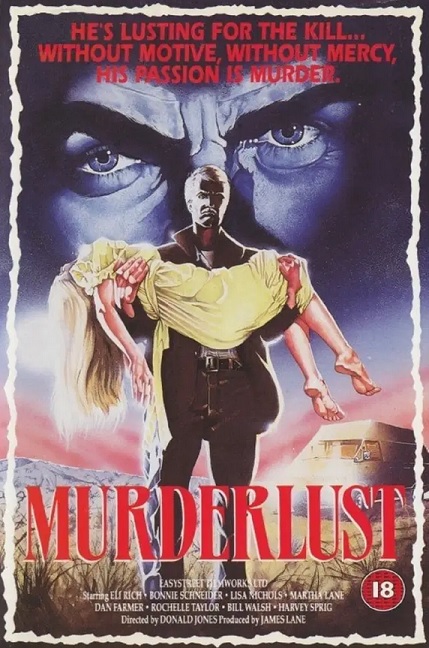
As you can tell from the artwork, in conjunction with the title, the major and regional chains didn’t stock Cannibal Hookers: only the more out-of-the-way mom & pop outlets for us wee-lads with more discriminating tastes carried it (see Snuff Kill); even then, it was behind the beaded curtain at most of those outlets. While Farmer cleaned and shortened the running time for the impossible-to-find Demon Queen (1987), it was his third film, Scream Dream (1989), that was his first film to receive the most wide-spread distribution on the main floor in the horror section. And for a wee-metal head (moi), the cheesy mixture of rock and horror of the Hard Rock Zombies and Shock ‘Em Dead variety made Scream Dream an instant rental.

Since his meager SOV ’80s beginnings, Donald Farmer has amassed another 30-plus credits, with titles such as Vampire Cop (1990) and Cannibal Cop (2017), the too-irresistible-not-to-rent Chainsaw Cheerleaders (2008), Shark Exorcist (2015) and, we’re guessing, its sequel, Bigfoot Exorcist (2021). In between, Farmer also completed two documentaries on cult film: The Bizarre World of Jess Franco (1988) and Invasion of the Scream Queens (1992), the latter features Janus Blythe of fellow SOV’er, Spine (1986).

Cannibal Hookers

So, when you’re renting a film such as Cannibal Hookers, the title, in conjunction with the cover, its tagline, and a couple of film stills on the back cover of a ripped-out neck and chest is all you need to get the gist of the situation. Plot means nothing, as the copywriters opted to only tell us to “be prepared for a film that is depraved, with bloodsucking terror” that includes ne’er-do-well johns being sliced n’ diced. Of course, in the SOV greylands adrift on the boarders of the adult film industry, there’s more than likely a couple of incognito adult film actresses in the cast and more than likely — like Spine — shot by a porn company looking to move into the legit horror realms. But guess what: there’s hardly any nudity here, just like Spine. But Sheila Best, aka Tara the Southern Bell from G.L.O.W. for your wrestling fans, is pretty good as the bitchy “Carmilla” of the sorority.

Regardless of the suggestive box art, Cannibal Hookers is not the all-out slaughterhouse cross-pollination of the cannibal and vampire genres marketed: this is a “comedy,” after all. And when you’re dealing with a movie that concerns two sorority pledges forced into Sunset Boulevard hooker-servitude for the night, you know you’re getting a T&A comedy. Of course, the sleazy Gamma Zeta Beta sorority is a lesbian vampire coven — and our two pledges are the newest flesh-eating zombie hookers (a great cult title if there ever was one) to join these ladies of the night.

The gore . . . well . . . this is a film where you see the blade coming down, the scene cuts to a scream, and a limb falls into the shot, à la The Spirits of Jupiter comes to my mind. But at least it’s all shot-in-camera practical effects (CGI blood splatter is the bane of my existence). In terms of SOVs overall: Cannibal Hoookers is a rougher VHS ride than most, one that’ll make you load up your copies of the superior Spine and Snuff Kill (1997) for one more spin.

You can view the trailer for Cannibal Hookers and learn more about Donald Farmer’s early career as he talks about the making of the film in the third episode of the SOV The True Independents web series as a You Tube sign-in. You can learn more about the full documentary at SOV Horror.com, your one-stop shop for all things horror.

Scream Dream

Donald Farmer impressively upped his game in this story about heavy metal’s newest superstar, Michelle Shock — whose albums are in the racks next to the faux metal gods of Black Roses (1988). As with those hypnotizing rockers led by the demon-morphing Damien in that film, Michelle Shock lords a supernatural power over her fans: a power so strong, just watching her videos has an effect on the males of the metal species. As with Black Roses, and the guys from Holy Moses in Hard Rock Zombies (1985) before her: when Shock’s band arrives in town to put on a concert, the town rises up in protest.

Needless to say: when the rock starts, the teenagers start to disappear. And when the rumors of Michelle Shock’s (a brunette) devil worship proclivities cause the promoter to cancel the show, her manager replaces her with (a blonde) Jamie Summers (ex-Playboy Playmate Melissa Moore, who’s done her share of Jim Wynorski flicks, such as Sorority House Massacre II and Linda Blair’s Repossessed). Shock then calls forth a demon (an impressive on-a-budget full body-and-mask by Tom Savini-crew member Rick Gonzales) to extract revenge on her band. We soon come to learn Michelle was actually possessed by a demon that’s been body-hoping metal singers over the years — and it now possesses Jamie to carry on the carnage.

The rock and the gore . . . well, we’ve always said Rocktober Blood (courtesy of its first and third acts, natch) is the best of the heavy metal horror flicks, and that hard fact still holds true. We’ll even go as far to say that, in a neck-to-neck race, Dennis Devine’s all female-rocking Dead Girls, crosses the finish line against Farmer, first.

While it’s as campy as Cannibal Hookers, Scream Dream ditches the comedic to play as a straight horror piece, one that’s helped by the familiar and experienced Moore adding a bit of thespin’ class to the SOV proceedings. And it’s kind of hard to hate a film that gives an unknown band, in this case, Rikk-O-Shay, a chance to get their hair-metal grunge tune “Ball Buster” out to a mass audience via a movie . . . that starts with a chainsaw-to-the-vagina bondage dream sequence and a blowjob-castration by demon-babe mouth.

You can view the trailer for Scream Dream as a You Tube sign in.

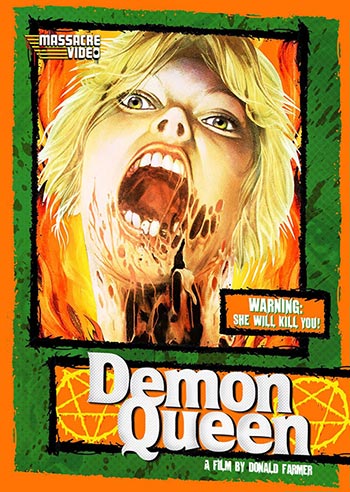
Demon Queen

Thank you, Massacre Video, for supporting the cause.

So, thanks to the fine folks at Massacre Video, the once hard-to-find Demon Queen is easily accessible for us horn-doggers who need it in our home library.

Ditching the sorority sister hi-jinks of Cannibal Hookers and cheese metal of Scream Dream, we’re now inside a video store with another ne’er-do-well clerk who implores members to rent his favorite horror films, for no other reason to pad out the film’s already-thin plot. The “plot,” such as it is, concerns a homeless female demon, natch, who’s actually a vampire (a bitch’s gotta drink), who moves in with a drug-dealing couple on-the-hook to a dwarf coke dealer for 6Gs.

Hey, it’s an easy swallow at only 46 minutes (40 if we cut the 6 minutes of end credits) — even with its cochlea-straining sound and repetitive Casio-whining synth music, so what’s the problemo? You know you love this stuff: it has all the over-the-top on-the-cheap gore and analog-tape effects that remind of those cheesy Missing Persons and Simple Minds camcordered-hits of early ’80s MTV yore. Oh, yes: the out-of-place “dream sequence” set piece from Scream Dream is back: only our succubus hottie does the dreamin’ as she de-hearts a guy. Meanwhile, those real-life heart-rips turn her victims into fine, Romeroesque citizens. Torn, bloody hearts against naked breasts and fleshy face rips, ensues.

Oh, yes! As with Cannibal Hookers and Scream Dream: I love every minute of the SOV-heart of it all; your own Dalton-ness down by the roadhouse, may vary.


While there’s no online streams of Cannibal Hookers, there’s a streaming copy of Scream Dream on You Tube. You can find DVDs of both films — which are not digitally restored, but straight VHS-to-DVD rips — on a couple of different imprints specializing in cult horror films. You can find Cannibal Hookers DVDs at Amazon and Walmart, while copies of Scream Dream are available at DVD Planet.

Oh, and guess what?! The SOV-lovin’ lads at Letterboxd Funtime You Tube makes my night, as I can sit and watch Demon Queen for the first time, ever. I’m stoked! Sam the Bossman is equally stoked, as he’ll be reviewing that film for our “SOV Week” blow out in September 2021.

Wow, it’s good to be home again, jammin’ on a “new” Donald Farmer SOV’er. Sweet!

From the Never Say Never Department: During the last two weeks of January 2023 we had, yet another, another “SOV Week” blow out — and gave Scream Dream a second, alternate look. Be sure to click through our SOV tags at the bottom of any of our SOV reviews to populate our ever-growning SOV catalog of shot-on-video films from the ’80s and beyond.

About the Author: You can learn more about the writings of R.D Francis on Facebook. He also writes for B&S About Movies.

Phantom Brother (1988)

Five years ago, a fiery car wreck wipes out a family and orphans young Abel Evans. Then, like Billy Eye Harper before him, Abel’s dead brother is back from the dead and taking his revenge. Of course, as the copy on the box gives it away . . . Abel’s brother isn’t a zombie: he’s a ghost. And, if the tagline of “It kin (can) happen to you” doesn’t give it away: this is a horror comedy (although some will debate on the “comedy”). But “Cain” on the cover looks like a hardcore Halloween-inspired slasher.

Starting out as Blood Brother, the film shot in Mamaroneck, New York, at a house that was owned by director Jeffrey Delman; the home also appears in his film, Deadtime Stories (1986). Another location that appeared in another film was the “hillybilly house,” aka the grandparent’s home of Gabriel Bronsztein, a film crew member; it was used in Frank Henenlotter’s beloved home video renter, Frankenhooker (1989).

Phantom Brother is one of those movies we love for the fact that the individuals who worked on the film drop their two-cents worth on social media (sometimes You Tube; in this case, the IMDb) about their experience. Right off the bat, Gabriel Bronsztein, who was the film’s camera assistant, key grip, and gaffer (holding multiple jobs on-set is par for the SOV course), lets it be known that the film “was not his fault” — which only succeeds in us wanting to watch Phantom Brother, even more. Bronsztein also appears as the director of “Vampires on Valium on Valentines Day” within the film. Phantom Brother was his first job fresh out of film school; he worked for director William Szarka as an assistant editor at a film distribution company.

Like Dead Girls . . . before Scream there was the . . .

Bronsztein speaks about how most [backyard] filmmakers [like Don Dohler] would opt to shoot on 16mm. Of course, as we have discussed all this week (and we still have a couple of more days of reviews and SOV analysis on deck), the ’80s home video revolution hit and the likes of Boardinghouse* and Blood Cult revolutionized the low-budget film industry. Because of video tape, filmmakers could eschew expensive film stocks, fiddling with “short ends,” and bypass regional drive-ins and go straight for national home video distribution — either via brick-and-mortar outlets or via mail order. (Blood Cult, while not the first SOV, it was the first SOV to eschew drive-in premieres or festivals and go straight to the stores while “four-walling” pulpy, genre movie mags.) In the case of Phantom Brother, they broke out the camcorder: a Betacam. Gabriel’s brother, David, who was the DP (Director of Photography) and owner of the camera, chipped in funding. Another actor who wanted to be in the movie, Patrick Malloy, who played Dr. Van Dam, also funded the production. Others involved with the film also held dual jobs: Art Director and set designer Nora Maher, appeared as the pasty-face “Killer Girl Scout.”

So, if you haven’t been in these woods before . . .

Not the Phantom Brother. Hold the Tranya.

We have a two “Totally ’80s” couples who run afoul of a crazy family at a secluded county house, complete with a masked brother and his perpetually, Girl Scout uniform-clad sister and their fat mother — of course, they’re all dead from the car crash, remember? Now, why did the couple end up at this house of horrors? Well, to work on that movie shooting there that we mentioned earlier. So we get a little meta here — and a shiny implement here and there — with a horror movie concerned with murders while real murders are being committed. And Able tends to, aka hides, the real murder committed by his family, got that?

Ack, no we don’t.

The four MTV-rocker dopes ventured into the woods to find the head of Abel’s dad and cash-in on the “buried treasure” urban legend. Oh, and get a little of the rock ‘n’ roll hoochy-coo. You know the teen-type: Pentgrams and “666” on the walls, and the little creepy doll (that resembles our killer) are of little concern when you’re a horny, 30-year-old high school teenager. To that end: Yes, we do get breast shots. And undie bottoms. And bad ’80s synth-ballad augmentation. And Able’s not telling everything.

Okay, so the plot is settled.

Hey, this is an SOV, so that means the special effects are so special, but what SOV throat slash n’ dismembered body part fest of the Karo Syrup variety is, right? We give these Tiger Bloodin’ Charlie Sheen’ers credit for tryin’ at “winning,” as they give us a decent body count, just like a good SOV should (but this should have gone full-on Fatal Exposure in the gore department; we’ve also reviewed that fellow SOV’er, this week).

And this is good. Okay, decent-to-fair (so spare us the smart-fuckery in the comments below that “we’re hipster douche bags” and this is the worst movie you’ve seen in 25 years). The parody aspect actually works here, with the hammy scenery-chews of Dr. Van Dam, in particular. Yeah, the film itself is grainy (leave the Ed Wood and “Citizen Kane of bad movies” comments at the B&S About Movies’ smoke post/ash can out back) — as it was shot on a camcorder, after all — but the shots are well-framed. I could, however, done without the voice over narration (the lazy deathknell of screenwriting). But the sub-plots are all over the place, so there’s a bit o’ skill here in the thought-process department, and there’s a decent twist that improves on the we-seen-it-coming twist in Rocktober Blood. Well, a double twist: once the “brother” angle is exposed.

Nope. Not the Phantom Brother: The before-Scream dude from Dennis Devine’s Dead Girls (1989).

I always thought screenwriter Joseph Santi and director William Szarka (who got his start cutting “coming attractions” promos for a distribution company) did alright with this late ’80s addition to the SOV canons, as each displayed sparks of potential. While Phantom Brother (which sounds like an ’80s “Brat Pack” mystery-thriller starring James Spader) is not as horror-comedy effective as the black laughter (a county-hicks connection in both) of Charles Kaufman’s Mother Day (and what horror-comedy is), this masked slasher romp is not as much of an epic fail as the comedic-horror boondogglin’ tomfoolery of Hard Rock Zombies (dopey teens and a remote house of crazies) — and that was shot on film by a “more experienced” filmmaker in Krishna Shah. Phantom Brother is not incompetent on the behind-the-lens end, but is a wee-bit clumsy in the comedy and even more so, as well as awkward, in the thespin’ departments.

And, with that, Santi and Szarka punched out after Phantom Brother. But Szarka made two prior films: South Bronx Heroes (1985) and Plutonium Baby (1987). I never came across his debut on VHS (it was shot on film). Plutonium Baby is another story. I have seen that on the shelf under a different title: The Mutant Kid. For whatever reasons, even after seeing it a couple of times on different shelves, I never rented it. Phantom Brother was the pure camcorder-shot film that I wanted and rented. It’s also Szarka’s best-known film — and one of the better SOV’ers of the era.

There’s no trailer to share . . . but BurialGround5 comes through again with the SOV-VHS memories assist (and spares us coin). You can watch Phantom Brother via their You Tube page.

* That review on Boardinghouse is coming. You know it! So search for it.

About the Author: You can read the music and film reviews of R.D Francis on Medium and learn more about his work on Facebook.

The Brainsucker (1988)

If you’re a fan of the junk cinema of Ray Dennis Steckler, who’s given us a celluloid trove of 52 directorial efforts — the most notable three being Wild Guitar (1962)*, The Thriller Killers (1964), and Rat Pfink a Boo Boo (1966) — then you may have heard of the career of actor, writer, and director Herb Robins in passing. As actor, you know Steckler, aka Cash Flagg, for The Incredibly Strange Creatures Who Stopped Living and Became Mixed-Up Zombies (1964). (We are also working on Steckler’s later, post-’80s slasher entry, Las Vegas Serial Killer (1986); it’s coming; use that search box, kiddies!)

Born in 1930 as “Rabinowitz” in Newark, New Jersey, Herb worked on a couple Steckler projects, making his acting debut in The Thriller Killers, as well as Steckler’s Body Fever (1969) and Sinthia: The Devil’s Doll (1970), which also served as his screenwriting debut; he Second AD’d Rat Pfink. And, if we are to believe the QWERTY’ing digital content warriors of the IMDb plains: Herb Robins had bit parts in Invasion of the Bee Girls (1973), the Ted V. Mikels classic (it really is) The Doll Squad (1973), the pretty decent CB-radio flick Convoy (1978), and Tobe Hooper’s The Funhouse (1981).

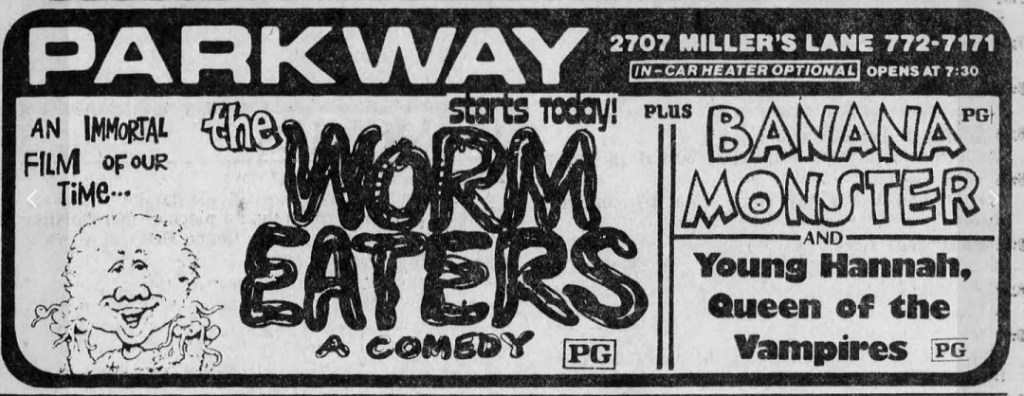
Then, after appearing in Fred Williamson’s Blaxploitation vanity western Adios Amigo (1975) with Richard Pryor and James Brown — and with one Steckler writing and AD credit each under his belt, and a production assist from Ted V. Mikels — Herb Robins decided to do the celluloid “Triple Lindy” (know your ’80s Rodney Dangerfield film references) to write, direct, and star in — we kid you not — the telepathic worm horror-comedy, The Worm Eaters (1977).

We’ve never reviewed The Worm Eaters at B&S About Movies. I can’t speak for Sam, but I have seen it. And it’s a case of don’t ask, don’t tell. But I will tell you that it’s pure Bill Van Ryn digging-up-the-old-drive-in-newspaper-ad fodder for a Groovy Doom Facebook posting — if he already hasn’t done one. So, The Worm Eaters did reasonably well. It must have, since Herb Robins returned — a decade later — in the midst of the shot-on-video craze of the ‘80s to write his third and final and direct his second and final film: The Brainsucker, a _______ that has the nerve to soil the name of Mel Brooke’s by name dropping the horror-comedy classic, Young Frankenstein. And, are they trying to tie this into Mad Max and make us think we’re getting a “futuristic” flick?

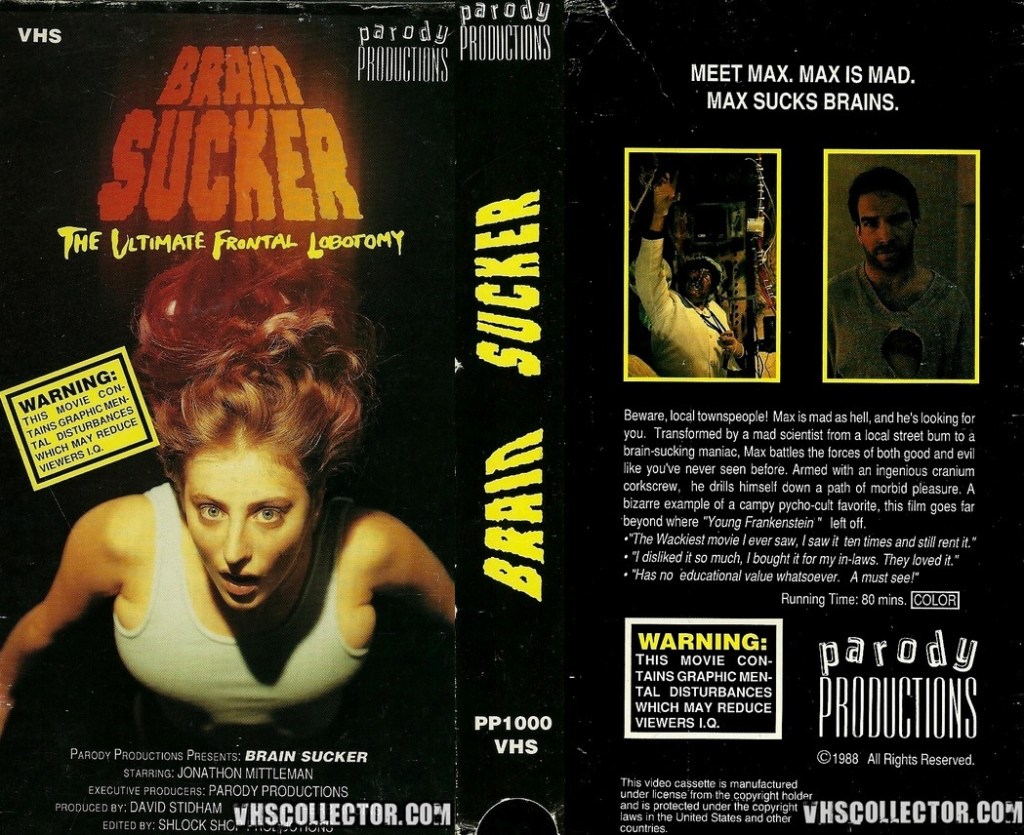
Paul Z. at VHS Collector comes through with the cover assist, once again. What would we do without him?

We’ve never had a reason to review The Brainsucker — no more than we had any reason to review The Worm Eaters. Then Sam the Bossman had to come up an “SOV Week” tribute, and you know me: I like to dive deep into the celluloid muck and mires of Allegheny County. I am ashamed to admit I rented this on VHS back in the day. Hey, at $0.49 one-day rentals at a Phar-Mor drugstore that had to be returned at midnight with a brisk walk down to the corner: why the hell not?

Exactly. I don’t know why. But I do know that it had nothing to do with Herb or Steckler or any connection to The Worm Eaters: I just liked stacking up the $.49 cent Phar-Mor tapes (I bought my used copy of FM and two of the four De Ossorio’s “Blind Dead” epics there) to see what I came up with — which was usually, you guessed it: muck and mire of a dog’s ass variety. Such a film is The Brainsucker, a ___________ that gives “backyard” filmmaking a bad name and was shot-on-camcorder because Kodak and Fuji Film forged an alliance to make sure not one frame of 16mm film was sold to Herb Robins. For it is a film (I hate using the word “film” in this review) that is an insult to the Reverend Samuell Henshall and wine bottles the world over.

“Corkscrews?” you say.

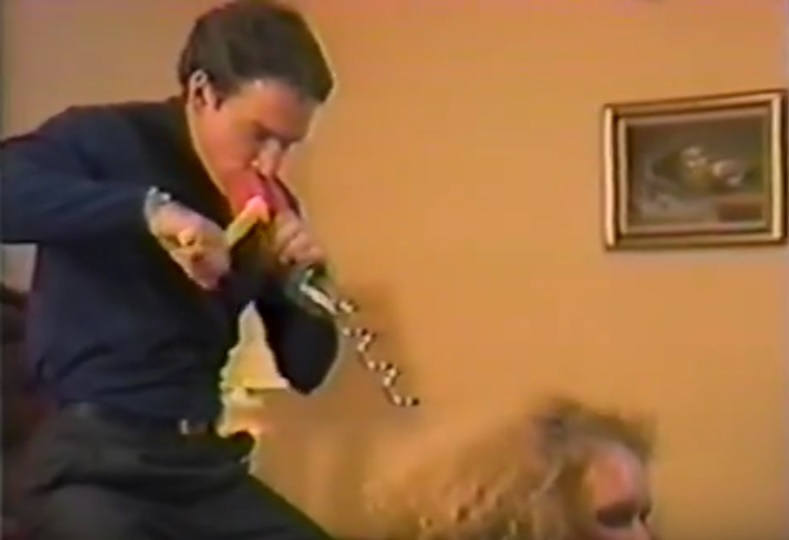
Yes. This is a movie about a serial killer with a loose screw on the loose (Santa Fe, New Mexico, where this was shot) with a corkscrew-sucker-thingy that’s part garden weasel and part bong. He carries it around in red bowling bag. He drills into the back of one’s skull, turns the handle, and sucks brains, aka raw, fatty bacon strips, up through the shaft. We think someone watched Phantasm one too many times — but couldn’t afford the Chinese harmony balls and X-Acto blades to come up with something better than a garden weasel, a bong, and a rotating handle from a kitchen vegamatic.

At least exploitation auteur Frank Henenlotter knew how to create insanity with the likes of Frankenhooker and Basket Case. Then, in his infinite mad genius of wisdom, gave us Brain Damage: an examination of man’s relationship to drugs — personified in a worm-creature named Aylmer who demanded his hosts eat brains to feed him. But The Brainsucker personifies nothing; for it has no brain to damage. There’s no mad genius. There’s just stone cold stupidity.

Did Herb Robins, perhaps, see the SOV’er Gore-met Zombie Chef from Hell (1986) and Redneck Zombies (1987) and said, “I can do that?” and broke (out) the camcorder? If so, he succeeded in making those (admittedly fun; with fan bases) inert-inept’ers look better than they are — and that’s a tall order to fill for a zombie-burger Wednesday Special. In fact, Robins succeeded in making T.L.P Swicegood’s utterly awful The Undertaker and his Pals (1966) look even better that it should — and that film strove — and failed, miserably — as a comedy rip on Hershell Gordon Lewis’s Blood Feast (1963; considered the first “splatter” film). But Swicegood’s final film wasn’t no Blood Feast and The Brainsucker ain’t no pal to the Undertaker, so it surely ain’t no Blood Feast.

Maybe, just maybe, if Glenn Danzig worked images from Robins’s opus into his music (as he did with Swicegood’s) or Rob Zombie sampled Brainsucker dialog into his music (as he did with Swicegood in “What Lurks on Channel X” from Hellbilly Duluxe) . . . no, not even Danzig or Zombie is helping us swallow this film’s hash browns and bacon-cum-brain-strips. Maybe if this was more “cannibal” and we had Lemmy and this was titled Eat the Rich (1987) and Motorhead composed the theme song, “. . . come on baby, and bite my brain / Come on, baby, suck my brain / drill the bong into the back of my brain / feel the sucking, roll / Come on, baby, Brainsuck the Rich.”

Nah.

Now available on eBay and other fine, online retailers. Bacon strips, not included.

The psycho-helixophile twistin’ the brain bong is not, however, Herb Robins: it’s someone named Jonathan Mittleman — as Max — in his film-and-then-vanished-debut. But Herb Robins is here as (the bumbling line-reading) Detective Kropotsky.

Now, with that name — and since were dropping Mel Brooks, and Mad Max, and soiling-ripping Frank Henenlotter — is the “Kropostsky” name supposed to evoke the New York urban legend of the Cropsey manic that fueled the slasher flicks The Burning (1981) and Madman (1982)? As with the lack of any Henelotter baskets, brains, or hookers . . . there’s no burning or madness . . . and no slashing, no special effects, no lighting, no sound, no framing, no soundtrack, no budget, and no permits, along with bad accents, and yelling and line-flubbing actors in a VHS toilet swirl with no rhyme, no reason, no purpose, and no plot. The Brainsucker is an SOV that, when the wow-and-flutter credits and soundtrack music ends . . . two more whole minutes of black screen accompanied by low-rez buzzing, ensues. And like an idiot: I watched those two minutes, thinking there was an “Easter Egg” to be had. And there was: 30-more seconds of hissing mixed with black-and-white snow flurries.

In the little that passed as a “plot”: Max is a career criminal placed by a judge under the care of a psychiatrist: an evil psychiatrist. Now Max is a corkscrewin’ n’ brainsuckin’ serial killer of the Troma variety. Why and how did the medical malpractice “Frankenstein” our little Maxwell into a helixophile is anyone’s guess. What’s Max’s backstory: Did he collect fine wines. Did he have a traumatic experience in a wine cellar. Did a rich, wine collecting uncle fondle Max’s lower abdominal Pez dispenser. Did his wine-swillin’ aunt seduce him on the couch in the wine cellar. What tragedy — if any — occur in wine country. Perhaps a flashback car wreck that killed mom and left dad impaled on a twisted road sign post?

Nope, there’s no reason. Max just like corkscrews.

What is certain: Troma movies do not audibly have their directors urge “zoom, zoom, zoom” off-screen to their DP (well, a kid holding the VHS camcorder) or implore their actors to “keep going” with a scene reaction. Troma movies also do not have a radio DJ swallow-breathing a portable cassette player’s microphone as a studio mic.

While Troma movies have their crimes (don’t get Sam the Bossman started), The Brainsucker is a celluloid-destroying wehrmacht that instills a whole new appreciation for all boondoggles Don Dohler — while it simultaneously inflicts 16mm backyardin’ of the ‘70s and shootin’ on video of the ‘80s with a bad name. Not that Ray Dennis Steckler is a cinematic genius by any stretch of the ol’ celluloid . . . but did Herb Robins learn nothing between the years of 1964 to 1988? Steve Martin said, “Comedy is not Pretty.” He did not, however, say comedy was deaf, dumb, indigent, and incontinent.

Was The Brainsucker possibly produced on an ENG camera sometime in the mid-‘70s and issued in the late ‘80s? Nope. The copyright in the end credits states this all got legal like in 1988. And it was, in fact, shot on an RCA-styled VHS Camcorder. It’s also the worst of the SOVs I’ve either watched and reviewed or re-revisited/nostalgia-binged this week. And I can’t believe I sucked my brain clean of 8,000-plus character to create 1,700-plus words for a movie that chilling described what it did to my cerebellum. Calling the Ramones! Give me a dose of DDT! The bacon-bong sucker is here for my teenage lobotomy.

Never under estimate the power of the Ryn/June 1982, Louisville, KY.

But hey, you gotta love a movie where one of the actresses — Marjorie Morris, who played Max’s girlfriend, Joanne — finds the movie on You Tube and leaves a comment of her fond memories of the project. Yes. Margorie, in a few simple keystrokes, just made The Brainsucker a lot less sucky and a lot more fun. And you, dear reader, can experience the sucky fun on You Tube, courtesy of film historian extraordinaire, TheBurialGround5. (Who’s going to be gettin’ an ear-mail full from me; for if there was no copy to share, I wouldn’t have gotten this far in the review.)

* So, you need a Arch Hall, Jr. fix? Well, we didn’t get to Wild Guitar, but we did review and overview Archie’s career with a look at The Choppers. And Arch is alright, we love the guy. Just like with Herb Robins.

About the Author: You can learn more about the writings of R.D Francis on Facebook. He also writes for B&S About Movies.

Bits and Pieces (1985)

If Leland Thomas, an ex-army combat photographer in his lone writing and directing effort, wanted to blow out all other SOV horror films released in the wake of Boardinghouse (1982; that review is coming!) — the first home video-era shot film — then he succeeded. (Blood Cult was the first SOV video store-only distributed film; Boardinghouse, while making it to the stores, began as a mail-order only release.) This is graphic, gruesome, crude, rude, and scuzzy. While Bits and Pieces is remembered as an SOV — and quacks like an SOV — it wasn’t shot-on-video, but on 16mm film in the summer of 1985 in and around Los Angeles — Burbank and the San Fernando Valley, in particular. But, no matter. Bits and Pieces is still an SOV’er forever in our VHS-pumpin’ hearts.

The overseas VHS of Bits and Pieces: a gagged, beheaded woman? Punch the membership card. We’re weird that way.

The set up is pretty simple: someone is killing the patrons of a male strip review, cutting them up into “bits and pieces,” as we are advised by the most unlikely news reporter to ever hit the field. Bits and Pieces is either incompetent or — in a Tommy “The Room” Wiseau twist — intended to be “bad” to push the funny to soften the graphic X-rated gore. And this film is gore and a bag o’ chips. Is this a pseudo-porn, like Spine? No, but there is bondage, as was in Spine. But the cheesy porn-esque music is “wah-wah’in” everywhere. But this is less Spine-bondagey and more Dead Girls-slashy. Oh, and our killer hears “wind chimes” in his head, we think; unless that was an artistic choice by the soundtrack composer (who’s connected to Spine; more on that later). Yeah, that’s it. This movie isn’t that “high” on the art to go “subjective” into the killer’s head.

So the “someone” is Arthur, and he has Norman Bates not-an-average-guy issues with his mommy — and he lives just down the street from head scalpin’ Frank Zito who plops hairpieces onto his mannequin collection — which leads Artie to carry conversations with an armless mannequin adorned in a red wig. Of course — in his mind — the mannequin talks back, berating him that he’ll never find a girl as pretty as her.

Man, does this film have the padding — no pun intended. There is a LOT of male stripping in this film. And lots of beat-up looking babes hootin’ and a tootin’ it up. That’s where we meet Tanya — the psych undergrad, natch (Sheila Lussier) — and her friend Rosie (Suzanna Smith) as they leave the “2001” strip club (a homage to 2001 Odyssey, the club in Saturday Night Fever, perhaps). So, one blow to the head later, and Tanya’s kidnapped. And our red-headed mannequin tells little Artie “how” to inflict the pain in his homespun Grand Guignol.

So Tanya ends up in a dumpster and makes the papers. Rosie goes to the cops. And we get our required, dry-as-toast inept cop in Lt. Carter. And we have another girlfriend, Jennifer (Tally Chanel), and it looks like Arthur has got some more kidnappin’ for faux-mommy mannequin to attend. And there’s a lot of “ensuing” in this film: Jennifer screaming and flailing through the woods. And while murders are afoot, Rosie goes on beach dates. And there’s hot tube interludes. And male strippers. And glasses of wine. And nary a one worried about a strip club-stalking serial killer. Yikes, and I thought the people in Stallone’s D-Tox were dumb, always putting their eyes up to peepholes at every door knock and door bell — with a serial-killing peephole-driller on the loose.

Lovely.

Well, this sure ain’t Bill Lustig’s Maniac (1980), because Bits and Pieces doesn’t have that film’s unsettling “creep” factor. And it sure as hell ain’t Alfred Hitchcock’s Psycho and doesn’t have anything from that film. If only our dippy Lt. Carter was Charles Bronson’s Leo Kessler and S.E Zygmont (Arthur, our serial) was Warren Stacey from J. Lee Thompson’s 10 to Midnight (1983).

But you know what: I love this movie: Leland Thomas is Wiseau-committed to giving us a deep psychological study into his poor, hapless killer f’d up by an abandoning dad and floozy mom. To that end, through flashbacks — because this ain’t no Jason Vorhees-cum-Micheal Myers just-kills-for-killing slasher romp — we learn the whole mannequin snafu with the wig n’ lipstick thang is because, as a form of punishment for spying on her and interrupting her boozin’ it up, she forced Artie to wear a wig and make up. Oh and the salami scene. Mommy taunts little Artie with summer sausage meats. And she turns into a bloody skull in a wig screaming at him. Yeah, NOW, I can’t help but think of Wesley Stuart, portrayed by Gerald “Simon & Simon” McRaney inflicting his own Night of Bloody Horror over his mommy issues. And that J.N Houck cardboard horror is bad, but is looking a lot better to me now — especially in the acting department — after my sitting in our Arthur’s flashback counseling sessions. And, like Wessy-pissy pants in that film, Artie kills mommy. The rest will be plot spoiling. . . .

So, is there life after Bits and Pieces?

Remember the Spine soundtrack Easter Egg we dropped? Don Chilcott, the musician responsible for Spine’s scuzzy, slasher-appropriate synth-soundtrack, also scored Bits and Pieces. Don never stopped rocking: he became a successful studio musician and a respected guitarist and lead vocalist for several California-based blues bands.

Remember, in our review of Peter Carpenter’s Point of Terror, when we discussed that everyone — even in Hollywood — has to start somewhere, and Oscar-winning editor Verna Fields, who worked for Pete on the film, later earned an Academy Award for her work on Spielberg’s Jaws (1975) and edited American Graffiti (1973) for George Lucas? Well, producer Richard Bansbach also worked on that influential shark fest’s second-unit for the film’s land-based shots; he also directed the Jaws-rip, Claws (1977). (Nope, not Islands Claws. That was in 1980 and a different, but sorta-the-same, movie. Well, the first was a bear, the second is a crab . . . oh, never mind!)

The BIG KAHUNA of the cast and crew is Thomas L. Callaway. He worked as the cinematographer on the USA Network favs Creepozoids and Slumber Party Massacre II (both 1987), as well as Friday the 13th Part VII: The New Blood (1989). And Callaway is still at it — 120-credits strong — with a lot of Lifetime movies, and is David DeCoteau’s go-to camera man for the likes of A Husband for Christmas (2016) and A Christmas Cruise (2017). (Yes, we have a Lifetime and Hallmark and Up Channel X-Mas flick fetish goin’ on at B&S.)

Did you see Chuck Vincent’s Warrior Queen (1987)? Well, that was Suzanna Smith’s only other role; Tally Chanel, who did a few of Chuck’s movies, was in that, as well. (Chuck’s done 55 T&A soft-porn flicks that ended up on Showtime or the USA Network in the ’80s; you’ve seem a couple of them, such as Bedroom Eyes II.)

Now, Sandy Brooke, who plays Ms. Talbot, Rosie’s (Suzanna Smith) tweaked mom . . . oh, do we ever know her around the B&S About Movies’ cubicle farm! She was an SOV warhorse, as she also appeared in David A. Prior’s SOV debut film, Sledgehammer*, as the lead, Taura. (Visit our week-long tribute to him; just search his name on our site and you’ll find all of his films.) Sandy was also in Fred Olen Ray’s Star Wars-dropping Star Slammer (1986), Ron Marchini’s directing sidekick Paul Kyriazi’s One Way Out (1987) (Join us for our two-day Ron Marchini tribute with this career wrap up), Terror on Alcatraz (1987; with Aldo Ray as Frank Morris!), and she ended her career with (YES!) David DeCoteau in Nightmare Sisters (1988; with Linnea Quigley, Brinke Stevens, and Michelle Bauer!).

Denied. No trailer to share, but wow! VoicesInMyHead does it again, as you can watch Bits and Pieces — uncut — on their awesome You Tube page. Spend some time there, as they have LOTS of great ’80s VHS oldies to enjoy.

* That review on the BIG KAHUNA of SOVs that is Sledgehammer, is coming. Oh, you know it. Search for it. Oh, already linked it!

About the Author: You can learn more about the writings of R.D Francis on Facebook. He also writes for B&S About Movies.

Demon Queen (1987)

Donald Farmer has forty credits as a director and they have titles like Cannibal HookersRed LipsShark Exorcist and Chainsaw Cheerleaders. This is an early SOV title from him that has a video store clerk that tries to get people to rent horror movies and a female demon — well, a vampire, but let’s make the title work — who moves on in with a drug dealing couple.

It’s also 46 minutes or so with 6 minutes of credit and sound that you can barely hear. So, you know, pretty great. It also has drone synth compositions of one long note, massive amounts of video effects that probably felt dated by 1987 and tons of actually pretty decent gore.

If this had better quality and was shot on film, I probably wouldn’t care as much. There’s just something about the beyond faded quality of Shot On Video that gives these movies a heart that they may not have had otherwise.

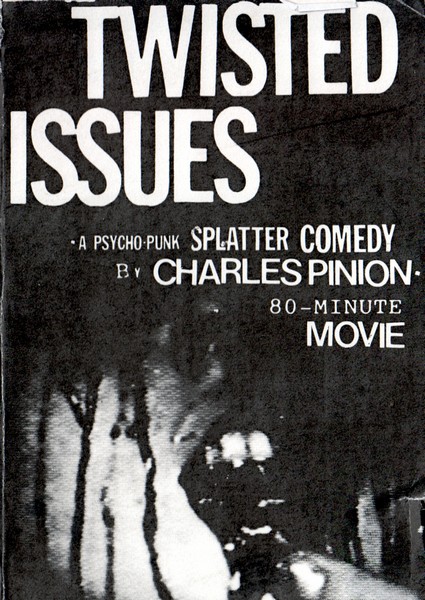
Twisted Issues (1988)

Man, talk about a movie I was not prepared for!

Originally intended to be a documentary of the Gainesville, FL punk/skate/thrash scenes, this somehow became a horror movie just as much as the opportunity to document bands like Psychic Violents, Young Pioneers, Mutley Chix, Doldrums, Just Demigods, Cindy Brady’s Lisp, Officer Friendly, the Smegmas, Hellwitch and the Bill Perry Orchestra.

Yet it can also be the story of the Death Skater, influenced by — according to director Charles Pinion in Underground Film Journal The Incredibly Strange Creatures Who Stopped Living and Became Mixed-Up ZombiesPolyester, Psych-Out, The 5,000 Fingers of Dr. T and Return of the Living Dead.

The moment where a girl sees a killer in her own house on her television before being killed by him and him enacting what he did on the TV afterward messes with time and scene and place and image better than most movies with way more of a budget. It also has tons of filler and moments of nothingness, but you know, we didn’t have jump to chapter buttons back in the days of VCRs.

Also: there’s an extended sequence inside a 1988 7-11 and for someone that hates advertising — and juxtaposition crazy has worked in it his entire life — I absolutely love everything about 7-11. The first thing I do in any new city — our new hometown has two of them — is find the 7-11 and grab a drink. In every fancy city my ad career has ever taken me, I’ve dined at more of these places and “thanked heaven” for them because they’re always there, even if my hometown didn’t get one until a year before I graduated high school. So the opportunity to drink in a time capsule of the store with the older branding and just live that world, man, that’s why I love movies.

If you die on a skateboard and a doctor brings you back to life, I hope that you have the festering brains that it takes to screw your board to your foot, wrap your face in bandages and then hunt down everyone who has ever wronged you.

You can get a handmade bootleg of this from the man who made it, Charles Pinion, on his official site. Sometimes they are sold out, but hey — again, it’s good to be made to wait.

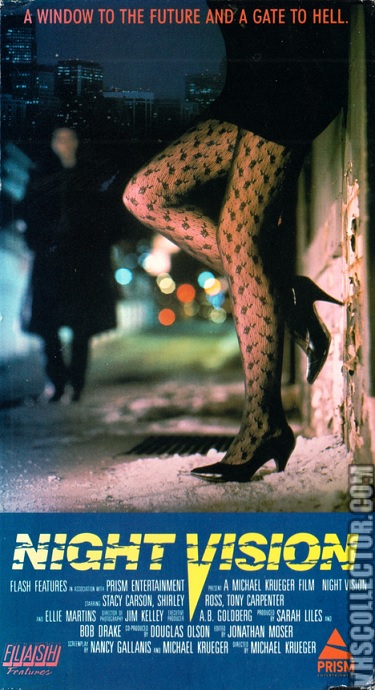
Mind Killer (1987) and Night Vision (1987)

The “brain breaks free of the body” romp that is Mind Killer is an SOV’er that also crosses over into regional filmmaking — two video fringe genres that’s our kind of our jam (yeah, we have a lot of those) around the B&S About Movies’ cubicle farm. Local Denver filmmaker Micheal Krueger made two of them as a writer and director: the shot back-to-back Mind Killer and Night Vision (1987).

As a writer and producer, he made his third film: the rock band vs. werewolf flick — did he see Alice Cooper’s Monster Dog? — Lone Wolf (1988). In that same capacity, Krueger upped his game and shot in Panavision 35mm (but released in the same direct-to-video format as his previous three films), The Amityville Curse (1990). Sadly, the cinematic visions of Micheal Krueger’s mind ended at the age of 49 (of undisclosed causes) on August 27, 1990, in Denver, Colorado — where all of his films were produced and shot.

The copy on the VHS sleeve for Krueger’s first film proclaims it as “an intellectual horror film” — and that’s not just copywriter hornswogglin’. While obvious in its low-budget, the proceedings are far from the amateurism infecting most SOV’ers. Clocking in at a brisk 84 minutes (one hour twenty-four minutes), Micheal Krueger does his best with what he’s got to work with and takes the best of David Cronenberg’s Scanners (1987) and Ed Hunt’s (not released yet) The Brain (1988) — with a pinch of the classic (well, it is to the B&S crew) Fiend Without a Face (1958), and a little bit of Frank Henenlotter’s Basket Case (1982) and Brain Damage (1988) — and engages us with an introspective, but fun n’ sloppy romp. And the acting from the leads Joe McDonald and Christopher Wade (aka Wade Kelly) rises above the expected SOV thespin’ tedium norms.

Warren is a lonely library clerk addicted to self-help books and videos, particularly ones with advice on how to attract women — and he ineptly applies those teachings to the local singles bar scene with his even more awkward co-worker, Larry, and his buff roommate, Brad. Of course, Brad scores without books — and Warren creepily watches as he does — with the librarian he crushes (Shirley Ross, later of Night Vision).

Then, in the library bowels. Warren stumbles across a manuscript that he uses to develop psychic powers, which make him irresistible to women. Soon, his powers get out of control as his brain turns into a monster with a mind of its own — that bursts from his skull.

While this is more tightly edited — at 80 minutes — than the 100 minutes of Micheal Krueger’s follow up, Night Vision, as well as a bit more graphic-gooey than that latter film, the effects are cheesy-campy (but charming-to-inept amusing) and the thespin’ by most of the cast is from the stiff to the overwrought. The sound mix, in places, strains your ears deciphering the dialog. And, as with Night Visions, its all pretty uneventful until those last ten minutes — when our brain creature runs amuck, with slop and humor.

And does the ending remind you a bit of Re-Animator? Yes, and that’s not a bad thing.

The trailer and the conclusion of the film is on You Tube . . . fool me once, video embed elves!

And now for our second feature!

The copy on the VHS sleeve for Night Vision proclaims we will “tune into the nightmare channel and fast-forward into hell” . . . and that bit o’ copywritin’ hornswogglin’ sums up the ol’ haunted electronics plot we’ve enjoyed in the video ’80s with the likes of TerrorVision (1986; a cable satellite system), The Video Dead (1987; a portable TV set), and Remote Control (1988; possessed VHS tapes). Uh, okay. Yeah, yeah . . . and the vapid John Ritter-waster (he made so many; and you’re stuck with Pam Dawber, too) Stay Tuned (1992; a comedic, possessed cable TV hook up, or remote, or . . . I don’t care).

Unlike most SOV auteurs who vanished after one lone, in most cases, tragically inept film (that will still have its charms), Michael Krueger shows us he learned his celluloid lessons with Mind Killer. The production values on Night Vision are slicker and the acting from our leads of Stacy Carson and, as his girlfriend and fellow video store employee, Shirley Ross (from Mindkiller) are, again, above the SOV norms — but her constant gum chewing and smoking (and both at the same time) becomes annoying and ventures into a poor thespian choice (and gross); meanwhile, Carson is too old to play the naive teenager bit.

So, who’s haunted whom, here? Well, Andy Archer, a naive bumpkin from the Kansas cornfields heads into big city Denver — in lieu of his own state’s Wichita — to pursue a writing career. And the muse isn’t calling. Then he buys a stolen, portable TV and VCR from his new friend and local street hustler, Vinnie Sotto (a not bad Tony Carpenter). (Their friendship gives the film an M.C Escher meets a horror-slanted Midnight Cowboy vibe — with Carson as our naive Joe Buck and Carpenter’s Sotto as Ratzo Rizzo. There’s no evidence that was Krueger’s influence or intent, just my take on the material.)

Loaded into the VCR is a videocassette created by a group of electronic-worshiping Satanists (set up in the beginning of the film) — and the gadget — which plays back when it’s not plugged in; shocks you, pricks your finger, and oozes blood when it runs the tape (is it real or hallucination) — can also predict future murders. So our geeky Andy Archer writes short stories based on what’s on the tape — and finds success. Soon, those Satanic rituals and devil worshiping ceremonies on the tape — just as the box copy promises — fast forwards Andy into a Droste effect-type hell as murders sweep Denver — murders that Andy’s accused of, since he’s chronicled the murders in his stories and he appears on the tape as he commits the murders.

Sure, the proceedings plod along slowly, but the shots are professionally framed and the competently edited. But at one hour forty minutes, you can see an easy ten minutes trimmed. In addition, tighter writing could have easily paired Krueger’s Cronenbergian-cum-Lychian psychological thriller into a decent 80-minute film from the 100-minutes we’re watching. Again, it’s a competent effort and you’ve seen worse — far worse — from the SOV and 16mm canons. The oddity here is that Tubi offers Night Vision as an age-restricted sign-in, but there nothing here that’s the least SOV offensive-graphic (and doesn’t kick in until the last ten minutes).

A fan-created trailer and scene clip at the crappiest video store in Denver, is on You Tube . . . you’re not fooling me twice. . . .


You can watch Mind Killer on You Tube HERE and HERE, but the best upload is the free-with ads stream on Tubi. You can watch Night Vision on You Tube HERE, but there’s a better free-with-ads stream upload on Tubi. You can also learn more about both of these Micheal Krueger works, as well as all of the films produced in Colorado, at Colorado Film.com.

We’ve reviewed several Colorado-shot films, with Curse of the Blue Lights, The Jar, and Manchurian Avenger, and The Spirits of Jupiter. Other other, obscure Mile Highers we’d like to review, but there’s no copies to be had, are Savage Water (1979), Lansky’s Road (1985), and Back Street Jane (1989).

As always, our many thanks to Paul Zamarelli and his efforts to preserve the VHS artwork of these films. Visit him at VHS Collector.com and enjoy his reviews on his You Tube channel The Analog Archivist.

About the Author: You can read the music and film reviews of R.D Francis on Medium and learn more about his work on Facebook.

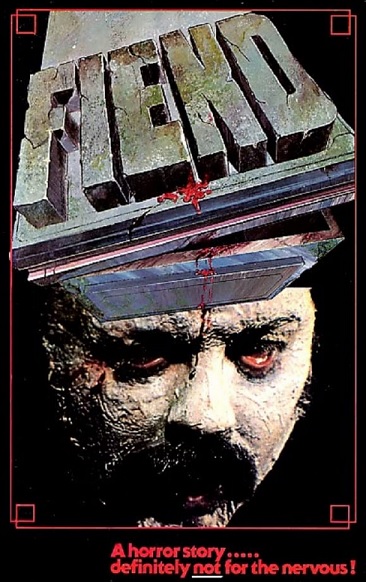
Fiend (1980)

Unlike most SOVs (frack, I know it’s shot in 16mm), this second feature film by Don Dohler — his follow up to The Alien Factor (1978) — foregoes gore or excessive, lingering nudity to give us old school, drive-in creepy atmosphere of the Amicus and Hammer variety. Since Fiend was shot on 16 mm and blown up to 35 mm, it’s actually better classified as a “regional horror,”* as it received a limited drive-in theatrical run in the Northeastern U.S. in and around Baltimore, Maryland — before the rest of us discovered Fiend as a VHS release. But truth be told: If there was a letter after the 26th letter of the alphabet, this would be ___ – grade horror. It’s also a movie — as are all of Dohler’s work — with a lot of heart.

As is the case when shooting in film stock, in this case 16mm, no-budget guys are shooting on short ends and, with the cost of said film stock, are one-take charlies: so no retakes, reverses or coverage. It’s all very Ed Woodian, but not as wooden as an Ed Wood film. To that end: Is the acting painful in places. Yes. Are the effects chuckle-enduing. Do you want to jump into the film with a flashlight to see what the frack is going on. Yep. Is it one of Dohler’s best? Yes. The story is great and it’s only held back by its no-budget.

So, did you know that evil spirits “see” in a red optical effect? Okay, it’s a misty, red cloud. But did you know a “fiend” is more than just a Funk & Wagnalls dictionary entry: it’s a supernatural entity — again, a red misty thing (that looks like a bloated red worm or fat and fucked up two-tentacled octopus) — that absorbs evil during its timeless travels. So, our red-filtered lens effect drifts into a graveyard and reanimates the corpse of (violin; if you care) music teacher Eric Longfellow (Don Leifert; of Dohler’s The Galaxy Invader and Nightbeast).

But why?

Watch the trailer.

Well, the Fiend needs to absorb the life of the living to continue its existence and needs a human vessel to harvest the life force of others. And also, so the vessel it possesses doesn’t rot away. Don’t ask where our spooky red cloud came from. Don’t ask why it picked poor Longfellow (perhaps he was the freshest corpse in the cemetery).

So, Longfellow digs himself out, well, there’s no “digging”; the Fiend just sort of “drifts-rises” out of the grave — since Longfellow is just a fleshy, transportation device for the Fiend. And taking its cues from George Romero’s Night of the Living Dead, we have a young couple in the cemetery (“They’re coming to get you, Barbara!”) for our zombie-fiend thing to feed on (and the queasy-sickly music here takes from Bach’s famed “Toccata and Fugue in D Minor BWV 565,” so cool).

And, with that, our Fiend moves to Kingsfield, Baltimore, where every day is a pleasant valley Sunday with kids on bikes and playing ball as dad mows the lawn . . . until the Fiend (now a bloated-set guy in a Walrus-mustache) comes to town and the dark storm cloud roll in. But life is pretty sunny for Longfellow: his house is fully furnished, he enjoys nice bottles of wine — and he even has Dorien, a cat. Yeah, you heard me right: the Fiend hates women, but love cats.

Like any vampire, or any vamp-chick jazzed-up on wasp juice (see your ’50s horror schlock), Fiend-Longfellow starts to rot, so he needs to suck up some spiritual juice to reverse the process. Of course, of the female persuasion. Of course, the snoopy neighbor (who rocks the mutton chops and plaid sports coats) who don’t take too kindly to da-dem dere newcumers (yep, the old “outsiders” trope of many horror films of old) — and hates Longfellow’s now seven-months of violin screeching — becomes obsessed with the strangulation murders plaguing rural Baltimore and thinks the quiet-weird violin guy, aka Longfellow, is the killer. Seriously, as stiff-as-cardboard liner-reader wife-Kender points out, in a roundabout way: Mr. Kender’s kind of a dick that itches to pick fights. The dude needs — deserves — to have his soul homo-sucked dry. And cool it with the faux-detective third degree on little kids. And berating your wife. If anything, ol’ man Kender is the real “fiend” of Baltimore. Someone red-optical effect his punk ass.

So, I am going over the razor’s edge of quality to say Fiend is the best of Don Dohler’s ’80s efforts?

As with Constantine S. Gochis’s (fantastic) The Redeemer, Fiend is so close: it’s almost there, to a John Carpenter Halloween-level, but misses the mark to be the next Bob Clark’s Deathdream (which Fiend reminds with its dead, rotting antagonist) or Alan Ormsby’s Deranged. Or Don Coscarelli’s so-awesome Phantasm. Why Dohler ditched the Hammer-Amicus creeps direction of Fiend to, essentially, remake The Alien Factor to a lesser-and-lesser effect with Nightbeast and The Galaxy Invader — then retire-vanish for a decade until bringing us Blood Massacre (1991), is an opportunity missed. Why? Because of Star Wars and Close Encounters of the Third Kind making aliens and sci-fi en vogue?

While it has its weakness — Don Leifert is actually very effective as the emotionless Fiend-Longfellow (but that cheesy ’70s mustache; yikes, only in the ’70s), and the decomposing face reanimation is equally effective on-the-cheap — all SOVs should be as well-written and shot as Fiend. (Unlike SOVs, Fiend received a drive-in and theatrical release.) Yes, I rank Fiend alongside Deathdream, Deranged, Halloween, Phantasm, and The Redeemer as one of those special, self-made nostalgic creep fests. As result of the Dohler lineage, Fiend is easily purchased on digital and hard media platforms in the online marketplace — and you can watch a free VHS rip of Fiend on You Tube.

* Sam discussed Fiend during our “Regional Horror” tribute week back in March. Look for it!

About the Author: You can learn more about the writings of R.D Francis on Facebook. He also writes for B&S About Movies.

Satan Place: A Soap Opera from Hell (1988)

The SOV format is pretty much made for horror anthologies. There’s a great story in here about a girl who watches a horror movie host all day long and tries to figure out how to murder her mother. This has more of a brain than you’d expect it to — I would assume that the feminine edge came from Melanie Johnson, who wrote this with Scott Aschbrenner and Alfred Ramirez. I mean, there’s still a story where a man kills his wife and puts her down the garbage disposal — he gets his, stay tuned — but it’s not the typical gore for the sake of gore that most SOV is all about.

There are also some great trailers for movies that never happened, like Bathroom BulliesPretty Girl FloydMissouri Mop MassacreNursing Home Revenge and Don’t Go Into the Kitchen.

There’s also a Satanic wraparound, which is always appreciated.

It’s not perfect, but this feels like the kind of movie that — were it on the shelf of one of the two rental stores in my hometown — I would have gone back and rented again and again. I mean, drunk drivers dealing with zombies is always something that I seem to enjoy in an anthology.


Woodchipper Massacre (1988)

Jon McBride acted, wrote, directed, edited, and composed this movie for $400. I kind of wonder why he didn’t name it The Connecticut Woodchipper Massacre. That may be because it’s way closer to Don’t Tell Mom the Babysitter Is Dead, but that movie never had a kid accidentally stab his aunt with a Rambo knife that she wouldn’t let him have. Let me tell you, I wanted one of those knives too, so I completely get it.

I also completely get the worry of having the yard raked before your father gets home when you told him it’d be done. That said, again, I’ve never used my cousin as compost spread all over the yard. I guess I lived a pretty sheltered life.

This film was based on the 1986 Newtown, CT murder of Helle Crafts by her husband Richard, which also was where Fargo got the idea. I would guess that the Coen Brothers didn’t have to shoot all of their woodchipper scenes in one weekend because they only had money to rent it once.