Exploring: Eddie Van Halen on Film

February 10, 1978: a day that changed hard rock music forever with the release Van Halen’s self-titled debut album.

Fueled by the FM radio hits of “Eruption,” “You Really Got Me,” “Ain’t Talkin’ ’bout Love,” “Running with the Devil,” and “Jamie’s Cryin'” the album eventually broke the U.S Billboard Album Top 20 to peak at #19 and sell more than a Diamond-certification of 10 million copies in the U.S. Not bad for an album that had its start as a three-track demo in 1976 financed by Gene Simmons of Kiss. The album was eventually recorded by ex-Harpers Bizarre guitarist and Doobie Brothers producer Ted Templeman in three weeks in October of 1977 at a cost of $40,000. And we’re grateful that Gene was unable to shanghai Eddie into Kiss (to replace Ace Frehley). And that Eddie convinced Ted that replacing Dave with Sammy Hagar and grafting Eddie into a Montrose reboot wasn’t going to happen.

The Pasadena rock scene where Van Halen developed their sound was hungry and competitive. Not every band that got a major-label deal “made it” to the top of the charts: most ended up in the cut out bins.

One of the bands sharing stages with the various incarnations of Van Halen — as Wolfgang and Mammoth, and then, Van Halen — was fellow Pasadena rockers Rockits. Led by guitarist and vocalist Brian Naughton, he was knockin’ around the L.A. rock scene since his first deal on MGM Records in 1970 with his Montrose-Van Halen precursor Rock Candy, along with tenures in the line-ups of hippie-rockers the Peanut Butter Conspiracy and Top 40 darlings the Grass Roots.

Sadly, unlike Van Halen’s deal with Warner Bros., the later known Rockicks’* deal with Robert Stigwood’s RSO Records (yes, home of the Bee Gees) failed to send their album, 1977’s Outside, up the charts. Also on that same local L.A. rock scene was a band that — unlike Van Halen and Rockicks — couldn’t get a deal (and when they did, it was in Japan). It was a band that featured a young ax slinger by the name of Randy Rhodes; a band that shared management and rehearsal space with Rockicks: Quiet Riot. And how can we forget Sorcery, who ended up in the films — as actors and soundtrack contributors — Stunt Rock and Rocktober Blood.
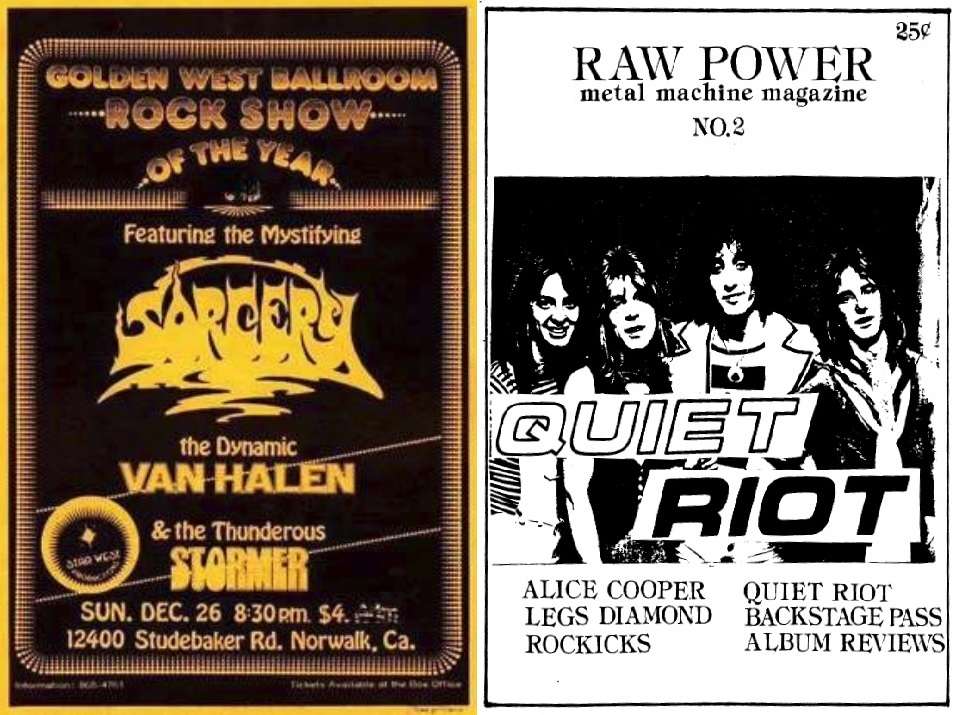
Image Left: Van Halen gig from December 1976, courtesy of The Roth Army Facebook/Image Right: Quiet Riot and Rockicks feature articles in a 1977 issue of L.A. rag Raw Power, courtesy of Scott Stephens.com.

And it wasn’t long after that little ol’ band from Pasadena starting out at the Whisky a Go Go and the Starwood was opening shows for Journey, Montrose (discovered and produced by Templeman, the band once featured Van Halen’s next lead singer), and Black Sabbath. Of course, the uppity critics at Rolling Stone and Village Voice hated Van Halen. But the fans loved them. And soon, the TV and film studios came-a-callin’. Between TV series and films — with lots of song repeats (“Jump,” “Panama,” and “Hot for Teacher” mostly) — Eddie amassed 100-plus credits.

Here’s the Top 10 highlights.


WKRP in Cincinnati “Hold Up” (1978)
“Atomic Punk”

Before MTV went on the air to break bands, record companies went to MTM Productions to have their bands spun on the faux-airwaves of a little ‘ol AM rocker in Cincinnati.

It’s hard to believe a network TV series could break bands, but this CBS-TV series did. Songs were, in fact, not just incidental, atmospheric pieces, but often tied into the plot of the episode with the DJs announcing the tunes. The Boyzz, which had their debut release out on CBS-affiliated Cleveland Int’l Records, were spun by Dr. Johnny Fever. Capitol’s Durocks had their poster/album featured on the show. Detective (signed to Led Zeppelin’s Swan Song label) led by Michael Des Barres, had three songs featured on the show. And the show’s use of Blondie’s “Heart of Glass” is credited with breaking the band in the U.S. In a show of appreciation, the band’s label, Chrysalis, presented the show’s producers with a gold album that was used as a set piece in the sales bullpen during the second, third, and forth seasons.

Another band “broke” — in the fifth episode of the first season, “Hold Up” (the inept Herb Tarlek makes a mess of a Dr. Johnny Fever remote at Del’s Stereo Shop) — was Van Halen with “Atomic Punk” from their debut album.

Sadly, our opportunity to revisit “Atomic Punk” — as well as most other songs featured on the show — is forever lost due to music licensing issues. MTM Productions’ song licenses expired in the mid-1990s and it proved too expensive to renew, so today’s syndicated and DVD home video versions now have those songs replaced with stock music. Your only hope is to find grey market VHS (now DVDs) box sets of the series taped-from-TV during the series’ initial network and pre-’90s syndication runs to watch-hear the series in its original state. (The Shout Factory DVD box set was able to reproduce most of Season One with 80 percent of the original music intact.)

Series producer Hugh Wilson explains the music licensing issues on You Tube, while superfan Mike Hernandez created an episode-by-episode Google Spreadsheet of every band and song featured on the series. He also created Google Graphs showing a song’s chart performance before and after its appearance on the series. (Be sure to check out our review proper of the movie FM with more about the relationship between that film and the series.)

Van Halen “live off the board” at their last show at the Pasadena Civic Center with “Atomic Punk” before the release of their debut album.


Over the Edge (1979)
“You Really Got Me”
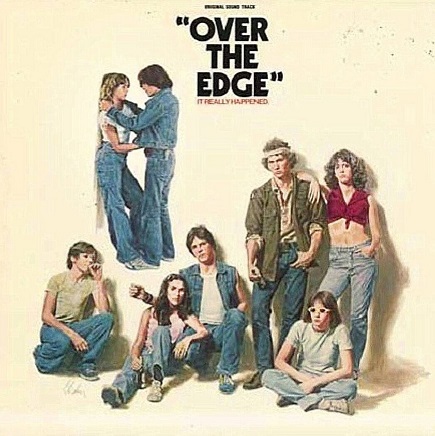
The digital content managers at the IMDb fell asleep at the data entry terminal by not including this film in Eddie’s soundtrack credits; for this second film from Orion Pictures (their first was the Diane Lane-starring A Little Romance) served as Van Halen’s big screen debut. You’ll remember Van Halen’s cover of the Kinks’ classic playing in the background of the house party scene where Carl only has eyes for Corey — who’s making out on the couch with Mark.

Sadly, the film’s eight-city test run was scuttled by negative publicity surrounding youth gang films such as The Warriors, Boulevard Nights, and Defiance — where actual violence broke out in the theaters between the gang rivals in the audience. The film, of course, found a cult audience on HBO and introduced the “new” sounds of not only Van Halen, but the Cars, the Ramones, and Cheap Trick to us youngins. And, since the film was scuttled, so was the soundtrack: us wee lads n’ lassies picked it up in the $1.00 cut out bins — and rocked.

And Kurt Cobain was one of us back then.

  • We go a deeper into the backstory of Over the Edge in our review of its sister film, River’s Edge.

The Wild Life (1984) and Back to the Future (1985)
“Donut City” and “Out the Window”

No one remembers Cameron Crowe’s follow up to Fast Times at Ridgemont High, which served as Eddie’s first film score. (Yes, he’s done others!) Recorded around the time of Van Halen’s sixth album, 1984, it features all new, instrumental tunes. A true solo effort, Eddie scored the entire film playing guitar along with an electronic drum machine.

Sadly, while many pieces of his music are in the film, only “Donut City” appears on the official motion picture soundtrack (Discogs). And thanks to those pesky licensing issues, the soundtrack has never been released on CD. You can, however, enjoy Eddie’s work from the soundtrack courtesy of a playlist on the official Van Halen Vault You Tube page.

Astute Van Halenites will recognize three musical vignettes from The Wild Life became the basis for three, later Van Halen songs: “Good Enough” from 1986’s 5150, “Right Now” from 1991’s For Unlawful Carnal Knowledge, and “Blood and Fire” from their final album, 2012’s A Different Kind Of Truth. The fourth, “Out the Window,” was later recycled in Back to Future. You’ll remember when Marty McFly — in a yellow hazmat suit as “Darth Vadar from Vulcan” — played the song to a headphoned George McFly.

  • Be sure to check out our full review of The Wild Life, coming soon, as result of its upcoming Kino restoration reissue.

Ugh. Again.
We give up with the trailer embeds.
You’re on your own.


The Seduction of Gina (1984)
Soundtrack Composer

Closing out her sitcom career with One Day at Time in 1984, and while the “Big Three” networks were still making TV movies, Valerie Bertinelli produced this CBS telefilm that deals with a newly-married and bored housewife who develops a gambling addiction. And Val brought on her husband to compose the soundtrack.

At the time of producing this film, Bertinelli was also in the running for Lori Singer’s role in 1984’s Footloose. Imagine Kevin Bacon boppin’ around to a score by Eddie Van Halen — Eddie Rabbit be damned. Or was that Kenny Loggins? I always get the two confused.

Eddie would go onto compose the theme music to Valerie’s next CBS-TV series, 1990’s short-lived Sydney. The show used “Finished What You Started” from OU812 and it’s said that Eddie also composed uncredited instrumentals throughout the series’ thirteen episodes.

Sigh . . . there was a You Tube clip — the only clip — of the film’s opening titles featuring Eddie’s music. It was posted for a few years . . . and right before we went press, the film’s copyright holder scrubbed the clip from You Tube. So we found this Nicki Swift report on Eddie and Val’s divorce to watch.


Better Off Dead (1985)
“Everybody Wants Some”

Then Eddie became a hamburger . . . in this mostly autobiographical film by Savage Steve Holland. According to Holland, he really was suicidal when his high school girlfriend left him for the captain of the ski team. Also, he really did have a paperboy who’d harass him for two dollars. And, when the film came out, his ex-girlfriend contacted him to apologize.

And the biographical continues . . . as the film’s infamous claymation hamburger scene was inspired by Holland’s first job working at McDonald’s. And while John Cusack went on record as hating this movie and chewed out Holland for it, Eddie VH’s “big scene” was the highest testing scene when the film was screened by audiences. The burger, of course, plays “Everybody Wants Some” from Van Halen’s third album, 1980’s Women and Children First. The burger also plays a guitar resembling Eddie’s Frankenstrat.

Regardless of “Claymation Eddie” being the only part of the movie we remember, “Everybody Wants Some” does not appear on the soundtrack (Discogs). The soundtrack does, however, feature two tunes from co-star E.G Daily (Pee Wee’s Big Adventure) and one from Terri Nunn of Berlin. And we wished Eddie wrote the entire soundtrack instead of Fixx producer Rubert Hine. And we thank Richard Linklater for using the song in his 2000 film named after the song.


Airheads (1994)
“I’m the One”

Why did they use the super annoying cover from the super annoying, didn’t-even-deserve-their-one hit wonder 4-Non Blondes instead of the Van Halen original? What gives Ian the Shark? KMPX is an Active Rock station, right? Wouldn’t Van Halen be on the station’s “Gold” rotation? Why not add the friggin’ Spin Doctors and Crash Test Dummies to the playlist while you’re at it? And we love Anthrax . . . but not when they’re covering the Smiths. Or friggin’ Joe Jackson. Where’s “Metal Trashin’ Mad” when you need it to spin?

Well . . . at least we got a get very cool dig at Sammy Hagar, which exposed Harold Ramis as a cop-cum-bogus record executive.

  • Be sure to check out our review proper of Airheads.

Twister (1996)
“Humans Being” and “Respect the Wind”

Could you imagine the above scene from Airheads ripping Patty Smyth of Scandal or Daryl Hall of Hall & Oates? Well, before Sammy Hagar joined, Eddie approached both singers — who turned down the offer. Yikes, talk about “thinking outside of the box,” right?

And could you imagine a world where Micheal Crichton became a “Yoko Ono” and broke up Van Hagar — and gifted us with Van Cherone? Well, it happened.

After completing their support slot on Bon Jovi’s European Summer stadium tour — which served to promote 1995’s Balance, VH’s then tenth album overall and fourth studio album with Sammy Hagar — Van Halen was contractually obligated to record two original songs for the Twister soundtrack. Hagar, who was against the Warner Bros. project to start with, wanted time off with his family, as he was expecting the birth of a child. And Eddie read him the riot act about what it means to be in a group. And Hagar ranted that being in a group sucks and he’d rather be a solo artist (no wonder the mighty Montrose — the Hagar version we cared about — fell apart after two albums). (Montrose bassist-keyboardist Alan Fitzgerald, who ended up in Night Ranger, served as VH’s off-stage/touring keyboardist from the early ’90s until the early 2000s.)

But Hagar, reluctantly, wrote and recorded “Humans Being.” And Eddie, unhappy with Sammy’s lyrics and halfhearted attempt, re-wrote the melody and re-titled the song, originally known as “Shine On.” And Eddie turned the song into, what is practically, an instrumental. And it sounds exactly like the shitty Van Halen B-Side not-suitable-for-a-studio-album outtake that it is.

Hagar was pissed.

And when it came time to record the second song, Hagar split for Hawaii. So the Van Halen brothers, with Alex on keyboards, alone recorded the instrumental “Respect the Wind,” which got dumped onto the film’s end credits. Is it the best end credits song ever? Yes. But surely Warner Bros. Pictures was expecting something more from Van Halen.

Update, November 2022: Sammy Hagar, in speaking with Consequence. net, tells of another song recorded for the soundtrack, “Between Us Two,” that didn’t make final cut. Long questioned by Van Halen fans as to its existence, Hagar claims the “mid-tempo ballad that’s almost country, kind of like “Can’t Stop Loving You” from 1995,” was not only recorded, but it was completely finished. Hagar thinks the song may resurface, as Eddie’s estate is currently going through the archives to remaster the Hagar-era material for re-release.


Mission to Mars (2000)
“Dance the Night Away”

What can you say about a movie that features astronauts spouting cheesy lines such as, “Okay, we’re ready to light this candle,” playing with M&M’s in zero gravity, product-placing astro-bags of Coca-Cola to seal hull breeches, and eventually gets turned into a Walt Disney theme park attraction?

Only that it gets worse: Gary Sinise wears eye liner throughout the film. The alien is CGI-hokey. And the crew dances in the ship’s zero gravity hub to a tune from Van Halen II. Where’s that copy of Hammer Films’ Moon Zero Two from 1969 when you need it?

Man, you just want to puke. And that’s not the zero-gravity sickness talking. Sorry, we can’t embed the video, but you can watch the “Dance the Night Away” scene on You Tube.


Sacred Sin (2006)
“Rise” and “Catherine”

After three lead singers and almost thirty years across eleven studio albums — the last being 1998’s critical and chart-flopping Van Halen III featuring ex-Extreme singer Gary Cherone — Eddie moved into the world of adult films.

If you go into this “Gothic ghost tale” expecting “Eruption” from Van Halen I or “Saturday Afternoon in the Park,” which served as the dark, instrumental opening to “One Foot Out the Door,” the closing track from Van Halen’s fourth album, Fair Warning, you’ll be disappointed. Don’t expect the heavy darkness of “Intruder,” the instrumental opening to “Pretty Woman” from Van Halen’s fifth album, 1982’s Diver Down; expect the lighter “Cathedral” from that same album. These two tracks, written for Eddie’s longtime friend, Micheal Ninn, are closer to “Baluchitherium” from Balance and “Respect the Wind” from the Twister soundtrack.

According to Eddie, in speaking to industry website AVN, his working on a porn film was no big deal. He was simply working with and helping a friend with his film, whose work he respected. In addition to the songs, Eddie, who also served as the film’s executive producer, provides a series of atmospheric piano interludes throughout the film.


Eddie the Actor
Frazier, Cafe Americain, and Two and a Half Men

Eddie was one of the many celebrity callers — as was the schtick of the series — as Hank on “Call Me Irresponsible,” a 1993 season one episode of Frazier. Of course, that voice-guest part was result of Eddie being on the Warners Bros. lot for the shooting of his wife Valerie Bertinelli’s failed, one-season series Cafe Americain, where he played a “Street Musician” in the series’ seventh episode, “Home Alone.” For his only on-camera speaking role, he performed “Two Burritos and a Root Beer Float” on “818-jklpuzo,” the first episode of the seventh season from CBS-TV’s Two and a Half Men.

Edward Lodewijk Van Halen
January 26, 1955 – October 6, 2020

We’ll never look at or hear the guitar the same way again.
You were our Mozart, Beethoven, and Bach.

“What time is it?”

“7:14”

“Quaalude, Quaalude.”

About the Author: You can learn more about the writings of R.D Francis on Facebook. He also writes for B&S About Movies and publishes on Medium.

* You can learn more about the career of Brian Naughton and L.A.’s Rockicks with a history on the band, as well as an interview with Rockicks’ guitarist Jerry Zubal, in the pages of the Euro-online publication, It’s Psychedelic Baby Magazine.

2020 Scarecrow Psychotronic Challenge Day 30: River’s Edge (1986)

Day 30: Bring It on Home: Something filmed in Seattle. (AKA we’re cheating with the Pacific Northwest.)

Okay, so why are we reviewing this dark, teen-crime drama in the middle of an all slasher ‘n horror month at B&S About Movies for October — outside of the fact that Slayer, Hallows Eve, and Fates Warning tear up the soundtrack? What more could possibly be said about a such a well-known, respected and positive-reviewed movie by the likes of us old sods and codgers of B&S About Movies?

Well, this review is all about the context.

During this month of October reviews, we took a look at the metal-influenced horrors of Dead Girls (1989), Snuff Kill (1997), Black Circle Boys (1998), and — by the way of the uber-graphic Deadbeat at Dawn (1988) — we poked a stick at Jim Van Bebber’s unforgettable short film, My Sweet Satan (1994). (We’ve also since reviewed Ricky 6.)

But let’s take it back a bit earlier: to the coming-of-age-crime drama Over the Edge (1979), which River’s Edge director Tim Hunter wrote. He based that Jonathan Kaplan-directed (White Line Fever) film on a 1973 San Francisco Examiner article entitled “Mousepacks: Kids on a Crime Spree” about the rampant teen crime and vandalism in an upscale, planned community outside of San Francisco (the film relocated the events to fictitious New Granada, Colorado).

I burnt the cassette back into Scotch Tape and cinnamon roll’d the album — and I taped Iron Maiden’s “Wrathchild” over that Burning Spear crapola. I dug the Wipers and Agent Orange, however; they remained to rock me.

As result of that Tim Hunter association — in conjunction with the film’s similar titles — in many ways, the later River’s Edge serves as a loose sequel/sidequel to the events in the earlier Over the Edge (Van Halen’s film soundtrack debut). True, those Colorado kids of the late ’70s were rocking out to the then burgeoning sounds of Van Halen, Cheap Trick, and the Ramones, while those mid-’80s Pacific Northwest teens were sporting tee-shirts by Motley Crue and Iron Maiden and thrashin’ to the sounds of Slayer, Fates Warning, and Hallows Eve; however, in a weird, metal rip in the space-time continuum and through the phantasmal crystal ball, we can see that while Carl Willat was leading the charge against the establishment at “New Granola,” Sampson Tollet was strangling the life out of his girlfriend Jamie and giving guided tours of the body.

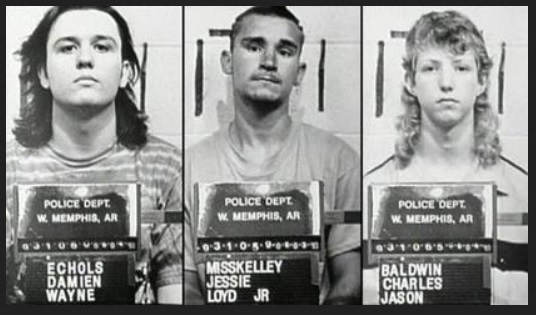
All of those aforementioned, metal-influenced horrors, as well as River’s Edge, are each loosely based on the horrifyingly true story about the 1981 California murder of Marcy Renee Conrad at the hands of Anthony Jacques Broussard outside of San Jose, California, and the 1984 New York murder of Gary Lauwers at the hands of Ricky Kasso. Occurring later and not directly contributing to the development of River’s Edge, but to all of the other metal-influenced films in this review, was the 1994 West Memphis 3 case in which Damien Echols, Jessie Misskelley, Jr., and Jason Balwin, three non-conformist boys, were wrongfully convicted as murderous “Satanists”; their guilt: a shared interest in rock music, horror films, and unconventional art and books. And while there’s no denying the guilt in the 1999 Columbine massacre — the maligning of the music of — and the career damage of Marilyn Manson and the industrial/goth bands KMFDM and Rammstein — as an “underlying cause” of the tragedy — was unconscionable.

Giving metal a bad name.

The legal atrocities of the West Memphis 3 case were, of course, foretold by the 1986 “subliminal message” trial in which British metal band Judas Priest was held responsible for the shotgun suicides of Nevada teens James Vance and Raymond Belknap. Then there’s the parents who sued the “Prince of Darkness” between 1985 and 1990, claiming the song “Suicide Solution” from Ozzy Osbourne’s 1980 debut album, Blizzard of Oz, encouraged their young sons to commit suicide; the best known of those was California teenager John McCollum who perished in 1984. Then there was Canadian, Nova Scotian teen James Jollimore — who killed a woman and her two sons on the “direction” of Osbourne’s then hit song, “Bark at the Moon.”

WM 3 Railroaded: The legal system needs an enema.

Sometimes, the reality of our world, when put to film, is more frightening than anything Stephen King, Wes Craven, or James Wan can dream and we stream in this post-A24 and Blumhouse world.

And there’s a reason why numerous mainstream critics classify River’s Edge a contemporary-day horror film. It’s real and it’s bone chilling. And you can stream it on Amazon Prime, while scene clips abound on You Tube . . . and here’s the trailer.


Jay Wexler, You Rocketh: For ye re-creating the River’s Edge Soundtrack on You Tube. We bow before ye as we rocketh through the the ramble-babbling actor sidebars that is our jam at B&S About Movies.

The Six Degrees of John Carpenter, aka Speaking of Sequels and Sidequels, Sidebar: Three of the cast members from River’s Edge appeared in the Halloween film franchise: The great Leo Rossi (Maniac Cop II), who played the boyfriend of Keanu Reeves’s mom, was Budd the paramedic in Halloween II (1981); Joshua Miller, who played Reeves’s little brother Tim, was one of Tom Atkins’s kids in Halloween III: Season of the Witch; and we’ll-watch-him-in-anything Daniel Roebuck appeared as Lou Martini, the owner of the Rabbitt In Red Lounge in Rob Zombie’s Halloween (2007) and Halloween II (2009).

The Rob Zombie Connection, aka, How I Learned to Stop Worrying and Embrace My Inner Hellbilly, Sidebar: And, to keep with the all-horror theme for this month, Roebuck also appeared in Rob Zombie’s 31 (Pastor Victor), The Lords of Salem (2012), and 3 From Hell (Morris Green) — as well as Don Coscarelli’s John Dies at the End (2012) and Phantasm: Ravager (2016).

The Crispin Is an Acting God, aka How I Learned to Stop Worrying and Embrace that Fact that Crispin Is an Acting God, Sidebar: How can we forget Crispin Glover — incredible here as the loyal, but troubled Layne — starting his career as Jimmy Mortimer in Friday the 13th: The Final Chapter (1984). We nostalgically wax over Crispin’s films Bartleby, Ed and Rubin, and Twister in our review of Steve Buscemi’s Ed and his Dead Mother. (Yes, Steve, ye are an acting god as well, so proclaimed; we even reviewed the majesty that is Trees Lounge.)

We get into Eddie Van Halen’s musical contribution to the River’s Edge spiritual cousin, Over the Edge, with our “Exploring: Eddie Van Halen” featurette. Remember how The Wild Life wasn’t a sequel, but a cousin-film to Fast Times at Ridgemont High? Well, Eddie worked on that Cameron Crowe film, as well. Check it out!


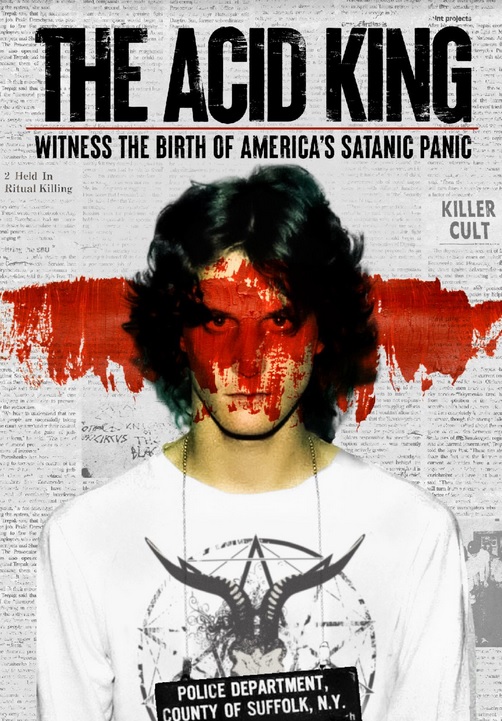
The new 2021 documentary on Ricky Kasso.

The real, well, sort of, Ricky Kasso.

About the Author: You can learn more about the writings of R.D Francis on Facebook. He also writes for B&S About Movies and publishes on Medium.

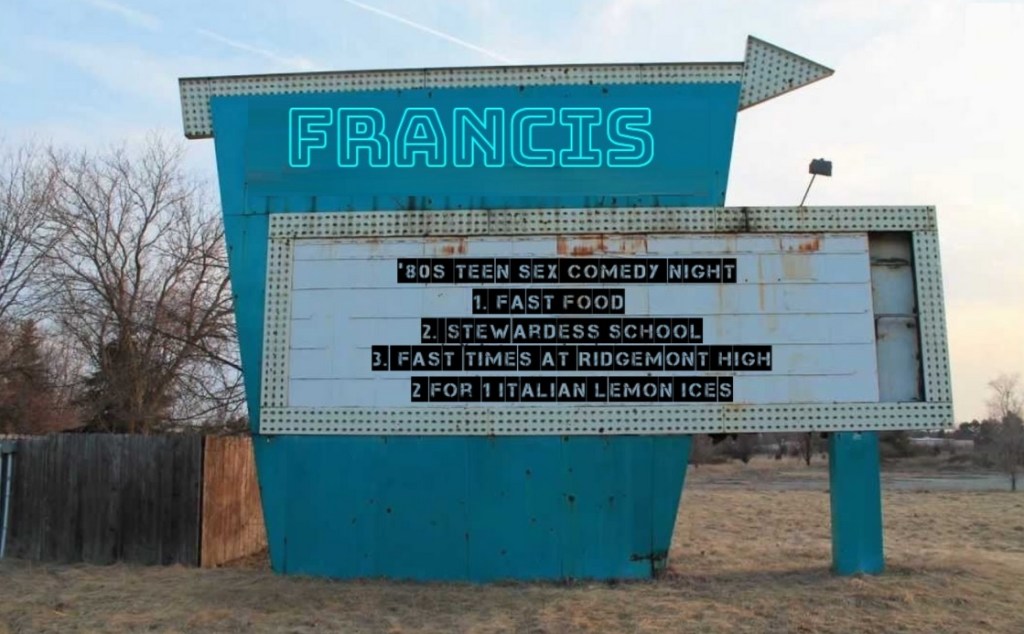
Drive-In Friday: ’80s Teen Sex Comedy Night

As Robert Freese pointed out in his “Exploring: 80s Comedies” featurette for B&S About Movies, Bob Clark’s Porky’s opened up a cottage industry of teen sex comedies. And boy, did producers scrape the grease pits . . . where’s Pee Wee, Kim Cattral, and Kaki Hunter when you need ’em? Robert Hays! Leslie Nielsen! Where are you, bros?

Movie 1: Fast Food (1989)

You a-lookin’ for a-finger lickin’ good burger joint (that’s not) down the road from Faber College . . . one that’s staffed by Melanie Griffith’s half-sister Tracy Griffith (Sleepaway Camp III: Teenage Wasteland) going up against evil burgermeister Jim Varney (yes, Ernest P. Worrell of the “Goes To” movies), along with Kevin McCarthy from Invasion of the Body Snatchers . . . and Michael J. Pollard (Memorial Valley Massacre) . . . and Traci Lords (Shock ‘Em Dead) as an industrial spy?

No?

How about a movie with lame jokes about “date rape drugs” in the special sauce and labs where men suffer from non-stop erections?

No wonder this ended up being the last film by ex-’80s TV teen idol Clark Brandon (My Tutor, TV’s The Fitzpatricks, Out of the Blue, Mr. Merlin, The Facts of Life). And why am I the only one who remembers watching 1977’s The Chicken Chronicles on HBO in the ’80s with Clark mixing it up with Steve Guttenberg and Phil Silvers?

Yeah, it’s as bad as American Drive-In and Hard Rock Zombies, which were both shot back-to-back by Krishna Shah. So thanks for the heads up, Blue Laser Studios. And thank you, You Tubers for uploading it HERE and HERE to enjoy. Eat ’em and smile!

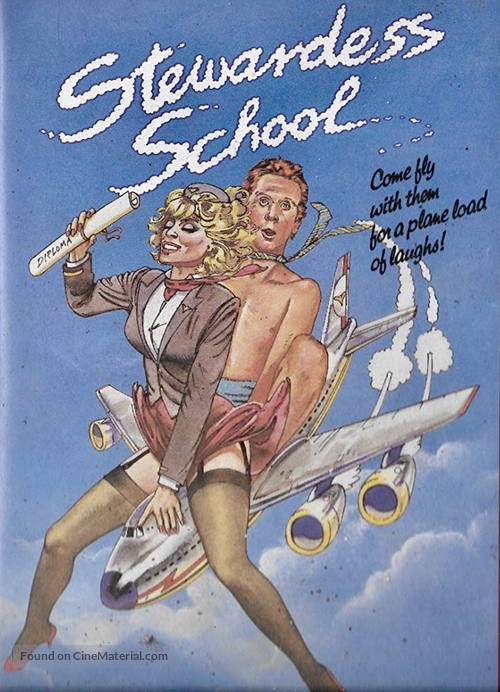
Movie 2: Stewardess School (1986)

You a-lookin’ for a ripoff of Airplane! starring Donnie “Ralph Malph” Most in a comedy that plays an airline crash in downtown Los Angeles for comedy? How about a ripoff of Police Academy set in a stewardess school?

Well, if Donnie, aka “Don,” Most as a washed-out pilot slummin’ as a steward doesn’t get ya . . . maybe Mary Cadorette — who played Vicky, the girl who finally got Jack Tripper to settle down and go from Three’s Company to Three’s a Crowd — as the hot air hostess, will get ya’. How about Wendie Jo Sperber as a frumpy, overweight air hostess?

No. Didn’t think so. Again, where’s Robert Hays and Leslie Neilsen when you need ’em?

Intermission! You need a Chilli Dilly! And a hotdog!

Back to the Show!

Movie 3: Fast Times at Ridgemont High (1982)

Leave it to Sean Penn to save day!

Of the glut of teen sex comedies, it’s this Cameron Crowe-penned comedy — along with Bob Clark’s Porky’s and, to a lesser extent, Boaz Davidson’s much-adored The Last American Virgin — that major and indie studios desperately tried to imitate but never duplicated.

This one has it all: Phoebe Cates changed our young lives rising out of a pool. The Sherman Oaks Mall is practically a character in itself. Jennifer Jason Leigh is so hot, she breaks up a friendship. We all wanted to be as cool as ticket scalper Damone and wore caps and vests. We wanted to hang out with Jeff Spicoli like his stoner buds Nicholas Cage, Eric Stoltz, and Anthony Edwards. And we begged our parents for a pair of checked vans. And we all wanted jobs at the mall slingin’ fast food and selling movie tickets (and working in the record store). And it came with a pretty cool Sammy Hagar theme song.

An all-out classic. Watch it.

About the Author: You can learn more about the writings of R.D Francis on Facebook. He also writes for B&S About Movies.

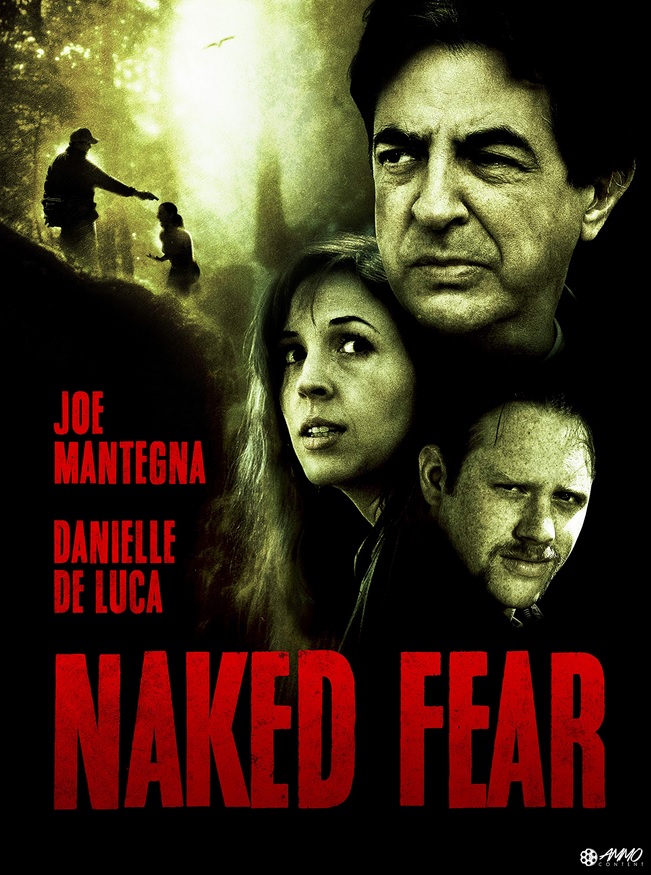
2020 Scarecrow Psychotronic Challenge Day 26: Naked Fear (2007)

Day 26: Don’t Mess with Texas: Watch one set deep in the heart of Texas. (Okay, we cheated . . . it starts in Texas and ends up in the pancreas of Texas, aka New Mexico.)

Yes, Sam . . . this does, in fact, fit into our “Slasher Month” for October. Although, technically, this is more of a serial killer “stabber-impaler,” but more on that later. . . .

One of the wonderful aspects of writing for B&S About Movies (i.e. cleaning the grease pits and dumpster pad out back) — besides the movie-themed drink recipes acquired during our Saturday Night Drive-In Asylum Double Feature Watch Parties brought to you by Bill Van Ryn, the publisher of the quarterly Drive-In Asylum and webzine Groovy Doom — are the rabbit holes: those wonderful analog white rabbits that lead us into a strange and absurd celluloid universe of once unwanted and forgotten direct-to-video gems. The “rabbit hole” in this case began with our review of Dennis Devine’s second film, Dead Girls, and his most recent film, Camp Blood 8, which lead to our upcoming “Drive-In Friday: Dennis Devine Night” tribute where we reviewed Get the Girl starring Danielle De Luca.

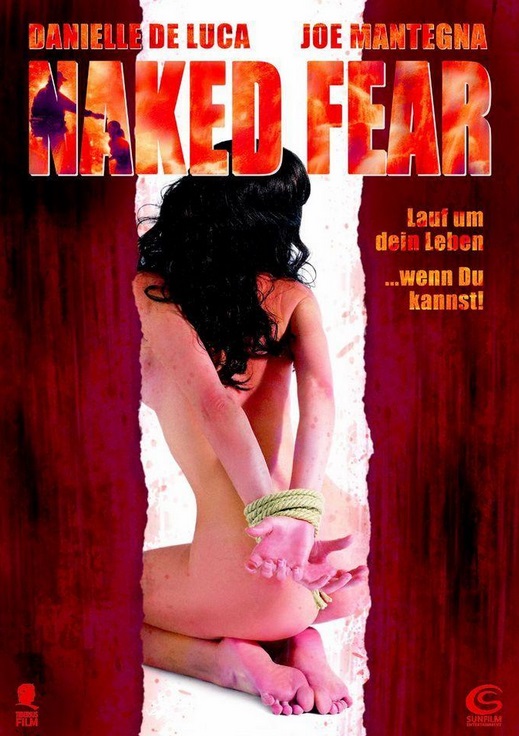
And . . . are we really inside a rabbit hole . . . or is it the psychedelic experience of the libations flowing forth from the B&S Bar n’ Grill? Whow, dude. I just blew liver . . . and my mind. Nope. Your mind and your optics’ rods n’ cones processed that DVD box correctly.

Watch the trailer.

Joe Mantegna of CBS-TV’s long-running Criminal Minds (aka Joey Zasa from Godfather III, Warren Beatty’s Bugsy, Stephen King’s Thinner, and, most importantly, one of the greatest faux-DJ’s to ever grace the silver screen, Ian the Shark from Airheads . . . oh, okay, yeah, and Fat Tony in The Simpsons) did an “Eric Roberts” (i.e., appear in few scenes to get a “name” on the box for marketing purposes) to help his ol’ buddy, Thom Eberhardt. (But Mantegna is in more scenes that the usual Eric Roberts gig (The Evil Inside Her). In fact, Naked Fear is third time Eberhardt and Mantegna worked together: their other films are (the really good) TV movie Face Down (1997), with Peter Riegert (Animal House) and Kelli Maroney (Fast Times at Ridgemont High, Chopping Mall), and I Was a Teenage Faust (2002), with Robert Townsend (The Meteor Man).

And, as we’ve said many times before in the digital ethers of B&S About Movies, that “Eric Roberts” casting-marketing works: if I didn’t see Joe Mantegna on the box, I wouldn’t have clicked deeper into the film. But wait a sec . . . no, it can’t be? It is! That’s under-the-radar directing-favorite Thom Eberhardt of the video rental and HBO subscription-favorites Sole Survivor and Night of the Comet (with Kelli Maroney; it’s “all in the family,” after all).

We say “under the radar” not as an insult to Thom, as we believe his name should be as remembered-revered as Tobe Hooper (Lifeforce), William Sachs (Van Nuys Blvd.), and Jim Wynorksi (Forbidden World). You’ve watched more of Thom’s movies than you realize. He directed the always-awesome Sir Michael Caine as a drunken Sherlock Holmes in the comedy Without a Clue (1988), Keanu Reeves (alongside the recently convicted Lori “Aunt Becky” Loughlin) in The Night Before (1988; which Thom also wrote), and Gross Anatomy (1989) with Matthew Modine and Daphne Zuniga (The Dorm that Dripped Blood). But the biggest film of his directing career, that is, the best-distributed and best remembered — courtesy of its star, Kurt “Snake Plissken” Russell — is Captain Ron (1992). Oh, and we can’t forget Thom wrote Disney/Touchstone’s Honey, I Blew Up the Kid (1992).

“Ahem. Sam?”

“Yeah, R.D?”

“Since your Christmas Movie goofy ’round ‘ere, did you know that the guy who made Soul Survivor and Night of the Comet wrote a Christmas movie, All I Want for Christmas (1991)? December’s coming up . . . so put that on your review’s shortlist for December.

“Hmmm. Lauren Becall, Leslie Neilson. Interesting . . . I’m on it.”

Anyway, sadly, Thom drifted away from mainstream Hollywood courtesy of the negative reviews for Captain Ron — and the $22.5 million gross against its $24 million budget. (Personally, and in spite of Martin Short’s camera-mugging, I liked it; come on, it had Kurt Russell in another eye patch!) At that point, Thom transitioned into low-budgeted TV movies — with Twice Upon a Time, Ratz, and the aforementioned Face Down and I Was A Teenaged Faust — with Naked Fear being his last feature film, to date. But, as you can tell by the title, there’s nudity in this one, full-frontal nudity (of the non-sexual nature), so this one’s strictly a direct-to-video release (I’ve never come across it on subscription cable). In fact, that “nudity” aspect is pushed to the forefront in its overseas release. So, if ‘ol Joe doesn’t inspire you . . . it’s all in the marketing.

Geeze, did John Howard of Spine (1986) fame make this? Did the art deparment at 4-Play Video, Inc. and Xeon, Ltd. design the box?

Okay, so . . . now for the Halloween-cum-October theme month-cum-slasher purpose behind this review. And, no. While you may think this is all influenced by Cornel Wilde’s (Sharks’ Treasure) The Naked Prey (1965), which had its roots in the 1924 short-story by Richard Connell, which became the 1932 film of the same name, The Most Dangerous Game, and Robert Sheckley’s grandfather of sci-fi “death sport” films, the Italian-made The 10th Victim (1965), based on his 1953 short story, The Seventh Victim, you’d be wrong. In fact, another variant of Connell’s novel — with its production also inspired by a serial killer we’re about to discuss — is 1994’s Surviving the Game, a present-day variant starring Ice-T as a kidnapped homeless man hunted on preserve by Gary Busey and the late Rutger Hauer.

So, in our last week’s reviews for Black Circle Boys (and this month’s upcoming reviews for Deadbeat by Dawn and River’s Edge; search for ’em) we discussed the real-life serial killer/murders that inspired those films. And in the case of Naked Fear, screenwriter Christine Vasquez used the exploits of the “Butcher Baker,” aka Robert Christian Hansen (he was a baker-by-trade, learned from his father), who, between 1971 and 1983, abducted, raped, and murdered at least seventeen women (mostly prostitutes) in and around Anchorage, Alaska. His modus operandi: he flew them out to (he was a licensed bush pilot) and dumped many of them into the wilderness and hunted them down with a semi-automatic rifle and a knife — and he kept their jewelry as mementos. He was also an avid hunter who excelled at archery (which carried over into the movie) — and took up arson. Sentenced to 461 years and a life sentence without the possibility of parole, Hansen died in prison, in 2014.

So, yes. While you’ve seen the “human death sport” plot many times before, such as the sci-fi variant Predator or the in recent, controversial-flop The Hunt (or the recent mocksploitation knock-off American Hunt), and all of the celluloid grandchildren born that we discuss in our review of Elio Petri’s aforementioned The 10th Victim, you’ve never seen the “human hunt” done so effectively on a small budget. Yes, it’s inherently better than American Hunt, which attests to Thom Eberhardt’s directorial skill set.

Danielle De Luca (also of 2011’s worth-the-watch Grizzly Flats with Judd Nelson, 2009’s pretty cool, award-nominated horror based on The Donner Party, Necrosis, and the Dennis Devine rom-com DeWitt & Maria), who’s very good here in her physically-demanding role, stars as the new-in-town Diane Kelper. Also new to town is recently hired sheriff deputy Dwight Terry (Arron Shiver of George Clooney’s The Men Who Stare at Goats, and as Dean O’Banion in the awesome Boardwalk Empire with Steve Buscemi, and Billy Barnes in AMC’s Longmire), a big city disgraced cop.

Deputy Terry, of course, wants the hell out of Podunk, New Mexico, and sees career redemption in the town’s recent rash of missing women — and ulterior-motive driven Sheriff Tom Burke (Joe Mantegna) wants Duputy Terry to back off the case. Of course the Sheriff does . . . and no one in the town cares, either; the missing are (in a nice subtextual turn-of-the-script) just strippers, prostitutes, or drifters that are just as worthless as the deer that’s killed for sport in these parts; the girls are, like the deer, are just “meat” after all.

After winning a bar dance contest in her Texas hometown, the naive Diane is lured to this small, dusty New Mexico boomtown — where game hunting is its main industry — and discovers her “dancing job” is at a seedy strip club. The club’s owner and his agent promised Diane a dancing gig as a “stepping stone” to a prestigious job in Las Vegas — but not the one in Nevada, but in New Mexico, east of Santa Fe (“. . . there’s two? Shit!”). Then she comes to realize she’s been scammed into a twisted form of indentured servitude of no financial escape. So, to make ends meet, she takes up prostitution as side job — which also benefits her bosses and was always their endgame. Her first client is Colin Mandle (as with the discussed Robert Christian Hansen), a successful food industry owner, avid bowhunter, and bush pilot who spends his evenings in strip joints and beds prostitutes. And Diane wakes up naked and alone in the wilderness. The hunt begins.

To tell any more would be to give away the effective, twist ending of who the newest serial killer to emerge in these parts — “The Southwest Slayer” — really is.

The upside to Thom Eberhardt’s direction is that, while those overseas video boxes push the nudity angle, and Danielle De Luca is fully nude for a (short) portion of the movie, the nudity is neither gratuitous or offensive and is essential to the plot; even the torture Diane endures before “the hunt” is downplayed. So, in the hands of a lesser, low-budget provocateur, Naked Fear could have degraded into a pseudo-soft core porn film (see Spine; yes, that was “the point” of that film, but work with me, here; while it bears similarities to Richard Speck’s July 1966 Chicago murders of eight student nurses, the film was not based on those killings). So kudos to Thom, not only for keeping the nudity at bay, but for dialing back the graphic horror to create a tight, survivalist thriller. And De Luca wasn’t cast because of how she looks in the buff: she illcits sympathy in her role, and pulls out all of the stops when the hunt is on. I’d really like to see De Luca her rise out of direct-to-videodom into smaller, featured roles in mainstream productions, or pop up in a Law & Order: SVU or Blue Bloods (you know my fandom for those two series). Ditto for Arron Shiver, who recently turned up alongside Christian Bale and Matt Damon in Ford v Ferrari (2019).

Yes, the film is a little long on the hour forty minute side, but since this wasn’t intended as a TV movie — which would require an 80-minute cut to fit into a 40-minute, two hour commercial block – Eberhardt’s frames aren’t superfluous. Changes are, as with most domestic TV movies or direct-to-DVD productions, and with Mantenga’s name, Naked Fear most likely had a limited, foreign theatrical release; thus, the length works.

The only issue I had with the plotting of the film: the cliff scene. After a blow to the head with a pretty large rock and a 30-foot cliff fall, our killer pulls a “Jason Vorhees” and come back, again — sans head wound, blood, disorientation, and nary a broken bone. Eh, that’s how all movies of this type roll (i.e., the victim has a false sense of victory-redemption). But it’s excused, thanks to Christine Vasquez’s solid scripting, Thom’s directing, and good acting against-the-budget from all that keeps you gripped in fear — and shocked that the story, while it seems preposterous, is actually based in fact.

You can watch Naked Fear as an account log-in on You Tube or as a non-log in, free-with-ads stream on TubiTV. Parental Guidance is suggested as result of the nudity.

Thom Eberhardt and Christine Vasquez have recently reteamed for the currently in-development Los Wildcats del Norte. You can keep abreast of that production’s developments at their official Facebook page. Some of the other films that you’ve seen from Naked Prey‘s producer and distributor, CineTel Films, include 976-EVIL (1988), Class of 1999 II: The Substitute (1994), Christmas Icetastrophe (2014), and Nic Cage’s Kill Chain (2019).

About the Author: You can learn more about the writings of R.D Francis on Facebook. He also writes for B&S About Movies and publishes on Medium.

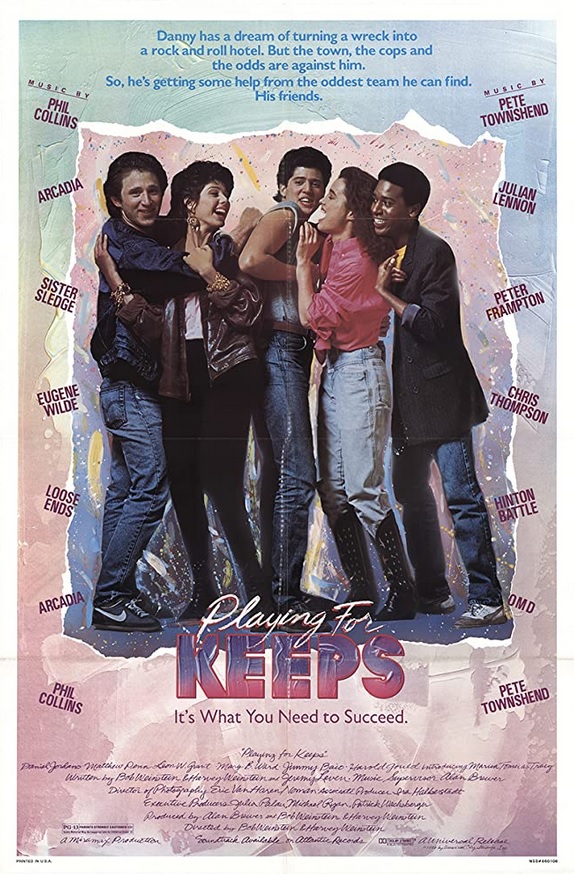
Scarecrow Psychotronic Challenge Day 25: Playing for Keeps (1986)

Day 25: Hey, Baby, Can You Dance to It? This one has to have at least one substantial dancing scene in it.

We spoke of this feature film writing and directing debut from the Weinstein brothers Harvey and Bob for their Miramax Pictures imprint in passing during our review for the somewhat similarly-premised Rock ‘N’ Roll Hotel and during Videoscope‘s Robert Freese’s overview “Exploring: ’80s Comedies” featurette for B&S About Movies. And now, courtesy of the gang at Scarecrow Video coming up with their 25th theme day—and the fact that, Marisa Tomei, in her feature film-starring debut (she gets an “Introducing . . . As” title card in the opening credits), soft shoes a roof-topped dance number with a paint brush in-hand during a renovation scene—we’re finally giving it a review proper. (Thanks, Scarecrow dudes, for thou doeth suck. Just kidding. No, not really.)

Watch the trailer.

So, before we get into the film itself, let’s unpack the film’s history and get the bad film Intel out of the way because this is one of those cases where the backstory (Playback, Spring Break ’83, Zyzzyx Road, Rocktober Blood 2: Billy’s Back) is much more interesting than the actual film.

First: Yes, Jimmy Baio—best remembered as the smart-mouthed Carmen Ronzonni in 1977’s The Bad News Bears in Breaking Training and Billy Tate in ABC-TV’s Soapis the cousin of Scott Baio (TV’s Happy Days, Charles in Charge). Matthew Penn, however, is not related to Sean Penn. And Matt’s dad is Bonnie and Clyde and Little Big Man director Arthur Penn. And Sean’s dad isn’t Arthur Penn; his dad is acclaimed network TV series director Leo Penn. Chris Penn, the actor, and Michael Penn, the singer, aren’t Matt’s brothers, their Sean’s.

Second: While Matthew made his feature film acting debut in the never-released Rock ‘N’ Roll Hotel (1983) alongside a pre-Breakfast Club Judd Nelson, none of the footage from that film was recut as, nor repurposed as stock footage for, Playing for Keeps.

Are you enjoying your stay at the Majestic? Not!

Third: Playing for Keeps was finished and in the can in 1984 (and also known as Rock Hotel Majestic in some quarters) and sat on the shelf for two years before its theatrical release. And while Matthew Penn awaited its release, his second feature film was a support role in the Kristie McNichol-starring Dream Lover. And, yes. The name “Matthew Penn” you’ve seen listed as an executive producer on Law & Order: TOS and USA Network’s Queen of the South is the same Matthew Penn.

Fourth: Playing for Keeps was all but forgot, and found a new audience, in late-2017 when the New York Times mentioned the movie as the scene for one of Harvey Weinstein’s earliest, alleged sexual harassment episodes; this according to 20-year-old aspiring actress and college-attending waitress Tomi-Ann Roberts (who subsequently didn’t appear in the film).

Fifth: Much like with Alan Arkush basing his lesser-known Rock ‘n’ Roll High School follow up, Get Crazy (1983), on his experiences working at New York’s The Fillmore East, Playing for Keeps was inspired by Harvey and his brother Bob’s experiences of owning the Century Theater in Buffalo, New York, and operating it as a rock ‘n’ roll club from 1974 to 1978.

Sixth: The film began production back in 1983 at the shuttered Bethany Colony Hotel in the northeastern Pennsylvania city of Honesdale—and while the old girl was in still pretty decent shape, the production trashed the joint and left it in worse condition than they found it. Nice going, Harvey.

Seventh: Playing for Keeps wasn’t the debut release for Miramax Pictures; it was the writing and directing debut for bosses Harvey and Bob. The film served as the only director credit for Bob; Harvey would direct one more feature: 1987’s animated The Gnomes’ Great Adventure. The brotherly duo’s first-distributed film was a chronicle of Paul McCartney’s 1976 Wings Over America Tour—1980’s Rockshow. Their first produced film (distributed by Filmways) was the 1981 slasher The Burning, which served as Bob and Harvey’s only other writing credit. And Miramax only produced; Universal distributed Playing for Keeps.

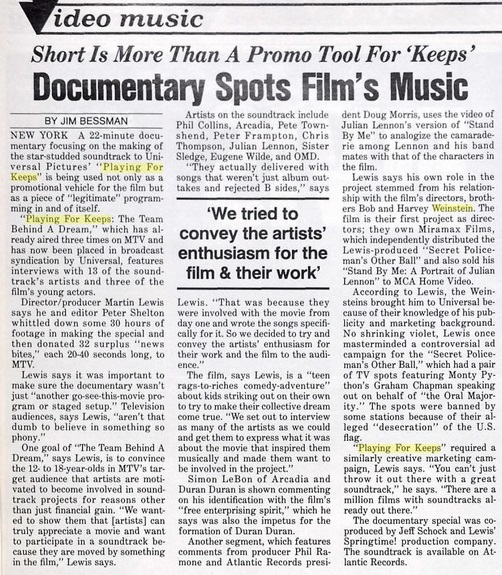
Eighth: MTV aired a 22-minute making-of documentary, Playing for Keeps: The Team Behind a Dream, as part of the film’s promotional efforts. It didn’t work: the film tanked, making just over two and a half million in box office.

Courtesy of Billboard Magazine; October 11, 1986/Google Books.

Playing for Keeps—like most of those ’80s snobs vs slobs, aka lovable losers, aka men behaving badly comedy knockoffs (as pointed out by Robert Freese) in the backwash of Animal House, Meatballs, and Caddyshack, i.e., Joysticks, My Chauffeur, and Hamburger: The Motion Picture—is a film of a time and place. The appreciation of a film—whether it is good or bad, well-made or poorly made—is based in the age of the viewer; if you were in middle school or just starting high school at the time of its release, re-watching the Weinstein’s film will warm your analog cockles as a “classic” film.

Me: I was already ensconced in adulthood, wearing shirts with collars, even ties, when Playing for Keeps was released. Those ’80s Harold Faltermeyer-gated synth drums and Herbie Hancock keyboard-noodles of the film’s score were the bane of my punk-new wave-metal upbringing—and the Atlantic Records-produced soundtrack (Discogs) was loaded with more than I could bear. At least the later, somewhat similar The Runnin’ Kind had a pseudo-punk snarl to it. Here, we get the annoying Duran Duran splinter group, Arcadia (What?! No Spandau Ballet?), appearing alongside side freakin’ non-Genesis Phil Collins to nullify any coolness Pete Townshend brings to the proceedings (and it’s not even a “cool” Townshend tune). And, wow. What producer showed Peter Frampton the way to a career resurgence was to go with the Def Leppard-sellout drum cacophony?

It’s amazing that Marisa Tomei course-corrected out of this into a 20-plus episode stint on NBC-TV’s Cosby spinoff A Different World—and discovered Oscar gold with My Cousin Vinny six years later. Then again, it’s not amazing, because, even in her minor role (regardless of the later VHS and grey-market DVD repacks pushing her to the forefront) with her sub-par acting, she’s the best actor in the movie. No, I take that back. Her, and the 200-plus credited (and Shakesperean-trained) Harold Gould, are the best actors in the movie. The rest are just as awful as they wanna-be (as you’d expect they’d be) in an ’80s snobs vs slobs, aka lovable losers, aka men behaving badly ripoff-programmer.

So the “snobs” in this one are a corrupt chemical company executive and town politician with their eyes on the dilapidated Majestic Hotel property in upstate New York. And everything is going according to their sinister plan . . . until Danny (seriously annoying and totally unlikable; you just want to give him an ol’ Corky Ramono-Chris Kattan nut punch), a ne’er-do-well dreamer n’ schemer high school graduate (this really needed a Michael J. Fox or Tom Cruise to pull it off) discovers his down and out divorced mom inherited the deed to the hotel from a dead aunt. (Comedy: you gotta love it.)

So, with his two lazy-Meatballs buddies—the trio runs around New York with their other Porky’s-friends playing some goofy inner city street game called “Christopher Columbus” (there was no water around to play “Marco Polo”)—they ditch their manual labor employment agency jobs to turn the Majestic into a rock ‘n’ club and hotel. But they need to pay off the $8,000 tax bill. But how? They dress up as boy-scouts and sell cookies to earn the doe. Seriously, that’s the level of comedy here . . . and common sense. Why not work your asses off at the employment agency jobs . . . oh, because that’s not “funny. . . .”

You tell ’em, Rocko. And get me a coke.


(Thanks for being cool, Mr. Duffy, and not having this clip, deleted, and ruining the gag.)

Now, I know this is sexist (Sorry, Harvey. Send your complaint to Sam; he’ll stick ’em in my employee file with the rest of ’em; I’ll see you at the annual review, Sam), but the gag could have worked . . . if we were dealing with three just out-of-high school women, say Marisa Tomei, with, say . . . Deborah Foreman and Elizabeth Daily. The whole scene of these three Stripes-dopes hocking thin mints in little Boy Scouts pseudo-military uniforms is utterly painful to watch. (Are you sure James Gunn didn’t make this? Nope. The Weinsteins did. Oops, Sorry, bad joke, Mr. Gunn. The awfulness of Playing for Keeps is inspiring me, I tell ‘ya!)

Okay, so we have dead aunts, overgrown pedo-boy scouts, and “Christopher Columbus” parkour dance numbers ripped from West Side Story, you got that? You keepin’ up?

Okay. Of course, when Shaggy and the Mystery Machine gang get there . . . the hotel is a rotted, rat-infested dump (that reminds of the Delta House, natch) that’ll fall over in a stiff wind. But Freddy, Thelma, and Daphne meet The Majestic’s kindly, ‘ol resident squatter (again, the-deserves-better-than-this Harold Gould) who inspires the misguided high school grads with good advice and nuggets of wisdom. And there’s sexual fantasy daydreams with Toni “Hey, Mickey” Basil doing her choreography thing (or was that Paula Abdul?). And Marisa Tomei doing a “Phoebe Cates” from Fast Times of Ridgemont High sexual fantasy daydream-ripoff holding a plate of cookies and candies. (“Oh, Brad, Spikes, you know, I always thought you were cute. are you hungry?”) And there’s “home improvement” dance numbers to Sister Sledge songs. And dancing—as per the Day 25 Scarecrow requirement—just breaks out without any particular rhyme or reason. And we wish Ferris Bueller had another day off and showed up with a hammer. And Bill Murray with a weed wacker and a brick of C4. Or Kevin Bacon took a day off and did a dance number with a broom. Or Michael Beck took a break from Xanadu. And that Tomei, Foreman, and Daily were selling the cookies to finance the paying off of the tax bill: Seriously, Weinstein bros. You already made a bad “cookie and candy” joke with Marisa, so why not put her in a sexed-up Girls Scouts uniform? Oh . . . because she wasn’t really hocking “sex cookies,” it was a “day dream.” Oh, okay. Screenwriting semantics. Got ‘ya, Harvey.

“You need to show ass to sell this movie! Is no ass here!”

LISAAAAAA! WHY?

Tommy Wiseau? What in the hell are you doing here? Didn’t I already make enough comparative critiques of your oeuvre in last October’s “Slasher Month” and “Scarecrow Challenge” reviews for Spine and Ice Cream Man, and last November’s Mill Creek Pure Terror*˟ box set tribute for Joy “J.N” Houck’s Night of Bloody Horror?

“Is plot twist. Oh, hi doggie.”

Anywhoo . . . in the end: Playing for Keeps took Miramax to the next level as they became America’s leading distribution purveyor of foreign and indie films. Then they met some kid named Quentin Tarantino* and distributed Reservoir Dogs. And some kid named Kevin Smith and distributed Clerks**. And you know the rest of the yada, yada, yada on Miramax. (Sorry, Sam. And I was doing so darn well with your Seinfeld References Ban.)

Anywhoo . . . you can stream the nostalgia for free on You Tube because, due to the usual licensing snafus regarding soundtracks with these old films, Playing for Keeps has never been officially transferred to DVD, so there’s no digital streams available in the regulated PPV and VOD marketplace.

* Be sure to join us in our review of the films distributed by Quentin Tarantino’s Miramax-backed Rolling Thunder Pictures imprint with our “Exploring: The 8 Films of Quentin Tarantino’s Rolling Thunder Pictures” featurette.

** Be sure to check out our “Exploring: 50 Gen-X Grunge Films of the Alt-Rock ‘90s” featurette that takes a look at Clerks and many others.

*˟ As we do every November, we’re blowin’ out another Mill Creek’er all of next month with their Sci-Fi Invasion 50-film box set.

About the Author: You can learn more about the writings of R.D Francis on Facebook. He also writes for B&S About Movies.

2020 Scarecrow Psychotronic Challenge Day 25: The Rosebud Beach Hotel (1984)

Day 25: Hey, Baby, Can You Dance to It? This one has to have at least one substantial dancing scene in it. (And this one has a LOT!)

“Where Sex and Laughter Run Riot.”
“Make your reservation for an explosive time at . . . The Rosebud Beach Hotel.”
— From the Harry Tampa-employed copywriter’s department

Remember the crack I made about Concentration, the ’70s NBC-TV game show and its subsequent board game, in the context of our 2020 Scarecrow Psychotronic Challenge Day 4 review? In that review I remembered little Jennifer Bates from the Georgia-shot Evil in the Woods grew up to work with director Bret Wood of Kino International, who recently returned to the big screen with Those Who Deserve to Die.

Well, this review is another “concentration” moment: for who else would remember the name of actor Daniel Green and go, “Holy Concentration, Batman! That’s Paco Querak!” And seriously: who else do you know that remembers the character names of D-grade Max Rockatansky and Snake Plissken knockoffs?

“I’d like to solve, Bill. ‘Daniel Green as Paco Querak!'”

Answer: me. And I am damn proud of my gifted “superpowers” that can’t save the world for shite . . . but Sam is lucky to have me on the staff at B&S About Movies to remember such things. Even Bill Van Ryn is amazed of the utter celluloid shite I can recall . . . for an VHS-analog-programmed brain is a terrible thing to waste. (Bill? You’re two weeks behind on the Groovy Doom and Drive-In Asylum plug payments. Don’t make me send Mr. Querak to collect and go apoc on your ass.)

So, back to Paco . . . sometime after doing the network TV rounds with episodes of Three’s Company, Matt Houston, and The Scarecrow (!) and Mrs. King, and The A-Team — and before his entry in the annals of Apocdom with Sergio Martino, aka Martin Doleman (2019: After the Fall of New York), in Hands of Steel — Daniel Green made his big screen debut in this Harry “Tampa” Hurwitz production.

“Oh, no, R.D! Not the Nocturna: Granddaughter of Dracula and Safari 3000 guy?”

Yes, the same guy who thought meshing vampires and disco was box office gold and that the road to the Oscars was paved with Smokey and the Bandit and Cannonball Run good intentions. And ‘ol Harry’s never one to pass on a trend: a “trend’ that Robert Freese of Videoscope Magazine expertly pontificated in his “Exploring: ’80s Comedies” featurette for B&S About Movies. (I accept Paypal, Roger. Again, Paco’s only a phone call away.)

Vampires, African Tundras, and South Beach Hotels, oh, my!

As Robert pointed out, after the Snobs vs. Slobs subgenre (Animal House, Meatballs, Stripes, Caddyshack), the next popular and most common comedy subgenre of the ‘80s was the Sex Comedies/Teen Sex Comedies or — what Robert accurately refers to as — the “Everybody gets laid” movies. And while sex comedies were bountiful in the ’70s and continued in the ’80s, with Tom Cruise’s big screen debut in Goin’ All the Way, Private Lessons, and Waitress!, it was Bob Clark’s Porky‘s, released in 1981 amid those films, that set the stage: for Porky’s was the Star Wars of comedy films.

And Harry Tampa jumped on that porcine ripoff train, baby.

Hey, but wait a minute . . . Harry was already in the sex comedy game! In 1970 he brought us The Projectionist starring Chuck McCann and Rodney Dangerfield (aka the requisite slob vs. snob actor with Caddyshack and Easy Money). And how can we forget that 1978 dirty-ditty Fairy Tales, starring Sy Richardson of Charles Band’s softcore version of Cinderella. And how can we forget Harry’s other Charles Band co-production: Auditions, a documentary on the casting call for the never-made sequel to Fairy Tales. (And while I don’t recall it as “sex comedy”: did you know Harry made Richard, a 1972 satirical biopic on President Richard M. Nixon. True story.)

“R.D. Dude? We get it. You’re a fan of Harry Hurwitz films. So, what’s this all have to do with ‘dancing’ and the Scarecrow Challenge?”

Well, in the universe of Harry “Tampa” Hurwitz, not only do you get lots of beach frolicking and dancing . . . and Paco Querak. You also get Colleen Camp (Valley Girl), Bobbi Flekman from the Polymer A&R Department, Eddie Deezen, Chuck McCann, Hamilton Camp, a has-been Bosom Buddy, and an ex-Runaway. And since Harry had Christopher Lee on the hook from last year’s Safari 3000, he’s shows up, too.

Yes, you heard me right: Sir Christopher Lee in a sexploitation movie.

You heard me right: Runaways, Paco, Draculas, and Buck Rogers. Oh, my!

And “Oh, my!” is right, because this thing — as most ripoffs are — is a mess. Like a Golfballs! ripoff mess. Like a Rock ‘n’ Roll Hotel mess — only with a few just-for-the-hell-of-it shots of topless bellhop women (by adult film stars Monique Gabrielle, Julia Always, Durga McBroom, Tina Merkle, Julia Parton, and Paula Wood), you know, to sell those tickets . . . but this, like Nocturna, didn’t sell any tickets. . . .

So, the ol’ Count owns a dying hotel on Miami Beach that he’s ready to torch for the insurance money. But his daughter Tracy (Colleen Camp) convinces him that her milquetoast-workaholic fiancé (Peter Scolari) can run the hotel. And Papa Drac hates ol’ Pete, so he’s got a plan in place for the hotel to fail so his daughter dumps him. And to make it all work: Tracy hires hookers (led by Madam Fran Drescher) to work as bellhops to “service” the clientele. And Eddie Deezen . . . is Eddie Deezen . . . the same Eddie Deezen we just reviewed in Beverly Hills Vamp. And if you know your Eddie Deezen you know what we Deez, ah, mean.

“Hey, what about the Runaways?”

Well, Cherie Currie, who long quit the Runaways (of duBeate-o fame) at this point, was attempting to forge a solo career with her sister Marie Currie, which put out their only album, 1980’s Messin’ with the Boys (their cover of Russ Ballard’s — by way of Rainbow and St. Louis’ Head East — “Since You’ve Been Gone” hit #95 on the U.S. Top 100). So why they’re here — as dialogless singing maids — four years after the failure of that album, is anyone’s guess. Well, there’s no guessin’ necessary because, hey, it’s a Harry Tampa production and common sense goes out the 10th floor of the Rosebud (well, actually, the hotel is the “Fiesta,” but that’s plot piffle).

“Hey, wait a sec, R.D? So, is Buster Crabbe in here? You mentioned Buck Rogers.”

Nope, he died in 1983.

“Gil Gerard?”

Nope. The red jump suit.

“The . . . what the frack, R.D?”

The Currie sisters rock out wearing the same jumpsuits Markie Post from NBC-TV’s Night Court wore during her season one guest stint as Joella Cameron on Buck Rogers in the 25th Century (the 1979 two-parter “The Plot to Kill a City” if you’re interested). As it turns out, the Universal Studios’ wardrobe department made two suits for the episode — and were shocked to re-discover the matching wares, when fitting the Currie sisters for the film.

Oh, and get this: the sci-fi connection continues . . . as Jay Chattaway, who scored the film, went on to compose the music for the Star Trek TV franchise. Oh, and he scored Maniac, Maniac Cop, and Maniac Cop 2.

Sadly, the Rosebud soundtrack — which the Currie sisters co-wrote with producer Dan Ferguson and their bassist, Stephen Crane — intended to be their follow up to Messin’ with the Boys, was never released. The Currie Sisters’ band also featured ex-Boz Scaggs and soon-to-be Cinderella drummer Jody Cortez (he recorded their hit album Night Songs but left the band before its release). Their guitarist, Duane Sciacqua, was a member of Marie’s husband, Steve Lukather’s, (Toto) solo bands and, with Stephen Crane, Sciacqua recorded an album for MCA Records under the KICKS moniker (“All My Love“). Sciacqua’s since toured and recorded with Glenn Frey, Joe Walsh, and Paul McCartney, and scored Sylvester Stallone’s Cobra.

While you can enjoy the Currie sisters tearin’ up their beach concert, you can enjoy several songs from the soundtrack, via film clips, on You Tube — and yes, each of the clips features LOTS of dancing, as per the Scarecrow requirement!

  1. Romeo
  2. “Where’s the Music”
  3. Here He Comes
  4. “Come Down to Miami”
  5. “Meltdown”
  6. “Don’t Like No Parties”
  7. “Baby Baby”
  8. “Scratch”
  9. Steel

You can watch — and dance to, and drool to Fran Drescher in a bellhop uniform — The Rosebud Beach Hotel on You Tube. And all kidding aside, Harry. We love you. Thanks for VHS and cable memories.

Hey, be sure to check out our “Drive-In Friday” tribute to five of good ol’ Uncle Harry’s films!


About the Author: You can learn more about the writings of R.D Francis on Facebook. He also writes for B&S About Movies.

2020 Scarecrow Psychotronic Challenge Day 24: Devil Girl (2007)

Day 24: At the Gig: Something with live scenes.

I don’t want to hear it Sam. This one’s got a ’69 Chevelle muscle car, vamps, zoms, goo, blood, slashings, lesbian sex with devils, a crazy clown on a motorcycle, a Rob Zombie tie-in, and Satan-influenced rock. So, while it’s not a straight slasher per se, I’m posting it. I mean, shite dude. Every time I think I got one that’s a perfect fit for October’s “Slasher Month,” you’ve already reviewed it. Even grease bit scrubbers need a break at the B&S About Bar n’ Grill.

Anyway, it’s all “Tails, Horns and Rock n’ Roll” according to the multiple-art work DVD covers of this low-budget, hallucinatory joyride crossing Quentin Tarantino’s From Dusk ‘Til Dawn with the film works of alternative rocker Rob Zombie — House of a 1000 Corpses, in particular. The caveat: If you’re not into non-linear storylines with a dreamlike-psychedelic vibe and cackling clowns, you’ll be pissed. But if you have an appreciation for a low-budget filmmakers and actors giving it their all and shooting for something a little bit different, then you’ll enjoy getting lost in this desert purgatory where nothing is as it seems.

After the death of her father, Fay, a small town girl, aimlessly hits the road in her mechanic pop’s cherish ’69 Chevelle, leading an Easy Rider existence (less the existentialism) as she searches for meaning and purpose. One of those “searches” result in a drag race that blows her engine and strands her along the desert asphalts of Route 66. To raise the funds to repair her car, she takes a job stripping in a dusty town’s night club (in a dominatrix outfit, natch). Her life quickly descends a film noir spiral as she raped by a someone in a leather mask, she stalked by a neurotic, drug abusing clown, deals with a creepy motel clerk of the Bates Hotel variety, a skeleton-ratting, bible-thumpin’ preacher with secrets to hid, and a sexy-strippin’, red-skinned lesbian devil (sporting great, head-to-toe red make-up, complete with horns and a pointy tale) who drives a classic T-Bird.

But is it any of this real? Is it all just a recreational drug fantasy? Or has Faye made her last stop in a purgatory stop-over to hell?

What this one has going for it: Awesome, unsigned-cum-indie-cum-pseudo local-cum-underground metal courtesy of the Los Angeles metal band the UV’s—featuring “Blare N. Bitch” of L.A rockers Betty Blowtorch—as the strip club band (again, know your Tarantino). The soundtrack also feature several songs by Scum of the Earth, a band formed by Mike Riggs, who served as a member of Rob Zombie’s solo band for the albums Hellbilly Deluxe and The Sinister Urge, and John Tempesta of Testament (now I know you remember their ‘80s MTV Headbanger’s Ball hit “Over the Wall”).

And, if you’re a radio dork like me, you’ll remember the American TV series WKRP In Cincinnati featured another Scum of the Earth — a fictitious band portrayed by ex-Silverhead leader Michael Des Barres and his band late ‘70s band Detective (Episode 104, if you want to search for it).

Devil Girl is the feature film writing and directing debut for upstate New York filmmaker Howie Askins who, like us kiddies frolicking the wilds of Allegheny Country, likes his comic books, dusk till dawn drive-in movies, and metal music. He’s since released his second feature, Evidence (2012), a POV found-footage romp about a camping trip gone wrong. Based on its 40 critic and 60-plus user reviews on the IMDb and its 3 out of 5 stars review based on 132 Amazon users, the horror-mystery mixed with sci-if received solid distribution, is easy to find, and worth dropping the .99 cents to watch it on Amazon Prime. It definitely has a nice twist beyond the usual POV-Blair Witch norms. Unfortunately, Devil Girl is currently unavailable on Amazon Prime and no other streams are available, but DVDs are easily found in the online marketplace.

I know. I know. Go scrub the grease pit. . . .

About the Author: You can learn more about the writings of R.D Francis on Facebook. He also writes for B&S About Movies.

Drive-In Friday: Slobs vs. Snobs Comedy Night

As Robert Freese pointed out in his “Exploring: 80s Comedies” featurette for B&S About Movies, the late ’70s one-two punch of National Lampoon’s Animal House (1978) and Meatballs (1979) opened up a cottage industry of comedies featuring snobs vs. slobs, lovable losers, and harmless, misguided man-children behaving badly — with Caddyshack solidifying the genre to carry us through the rest of ’80s . . . and beyond with the likes of American Pie and all of its subsequent knockoffs.

Sadly, for every Easy Money and Revenge of the Nerds . . . well, as Freese points out, there’s was a LOT more swings and misses than hits in the ’80s . . . and we’re scrapin’ the grease pits and threadin’ the reels with four of ’em.

You’ve been warned.

Movie 1: Joysticks (1983)

Oh, man. Movie tough guy Joe Don Baker as a curmudgeonly businessman who wants to shut down the local video arcade? Greydon Clark, who directed The Uninvited, Without Warning, and Wacko, and acted in Satan’s Sadists is behind the beeps n’ boops? Nicholas Josef von Sternberg, the guy who lensed Petey Wheatstraw and Mistress of the Apes, sat behind the camera?

I’m all in.

This movie was such a big deal that Midway allowed the image of Pac-Man to be used, as well as their new game Satan’s Hollow, and the as-yet-unreleased Super Pac-Man during the big showdown at the movie’s end.

What the . . . did I just program both a Greydon Clark and a Nicholas Josef von Sternberg Drive-In Friday tribute nights?

Movie 2: My Chauffeur (1986)

Sigh . . . Deborah Foreman, as Sam pointed out in his review, is our favorite 1980s comedy girl that caused our hearts to weep in the frames of Real Genius, Valley Girl, and April Fools Day. And she was always reliable and dependable on screen. How she never broke though to the A-List in major Hollywood films as the next “Meg Ryan” with her plucky Carole Lombard crossed with early Shirley MacLaine vibe is anyone’s guess.

Well, movies like this certainly didn’t help.

The “golf course” in this one is replaced by the Brentwood Limousine Service run by Howard “Dr. Johnny Fever” Hesseman and owned by E.G Marshall from Creepshow. And, of course, love blooms between Foreman’s commoner driver and E.G’s son played by Sam “Flash Gordon” Jones — on his way to the late ’80s post-apoc slop that is Driving Force and the early ’90s Basic Instinct wannabe that is Night Rhythms.

What the . . . did I just program a Sam Jones Drive-In Friday night?

Intermission! Let’s Eat! You need a Chilly Dilly!

Back to the show!

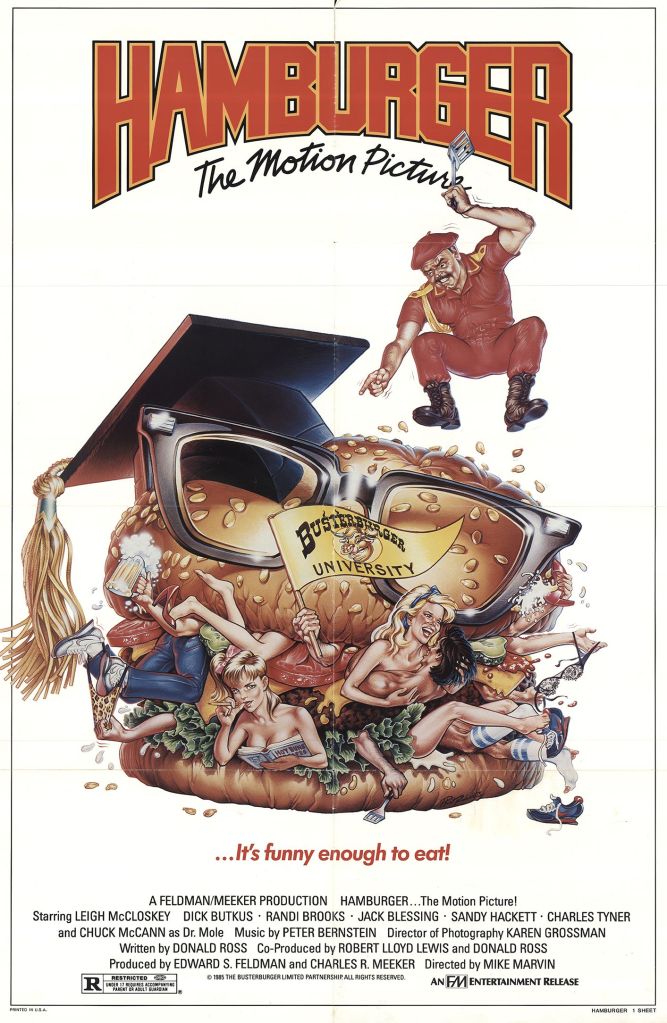
Movie 3: Hamburger: The Motion Picture (1986)

Not to be confused with Hot Dog: The Movie starring David Naughton (yep, the Dr. Pepper “Making It” from Meatballs American Werewolf guy). And not to be confused for being an actual movie. And no, you’re not confused: writer and director Mike Marvin — yes, the guy who concocted one of the most F’up car flicks ever, The Wraith — is behind both fast food oddities.

So, if you think that any movie that needs to suffix itself with a colon and remind you that it’s a “motion picture” and a “movie” has to be good . . . think again. But, as Sam pointed out in his more complete review: when you’re in a small town with one duplex theater and one quad drive-in back in the ol’ pre-cable TV days with no Internet streaming, you ended up seeing suffix n’ colon’d movies for lack of anything else to do during the summer.

So, if you ever wanted to see a movie where — I am safe enough in my masculinity to admit — the very hot Leigh McCloskey from Dario Argento’s Inferno can’t seem to stop being a hornburger horndog and hooking up with ALL of the girls on campus, this is your movie. And Leigh keeps getting kicked out of schools as result. And his reputation is so bad, Faber College won’t even have him. So he ends up at Buster Burger University run by Dick Butkus in the John Vernon role.

Dude, let’s get the hell out of here and head on down to the Delta House . . . to escape the “The Movie” marathon at the local theater also showing California Girls: The Motion Picture and The Kentucky Fried Movie.

Movie 4: Golfballs! (1999)

We dug up this way-late-to-the-course direct-to-video oddity during our “Police Academy Week” tribute because, well, you think you’re getting a Caddyshack redux, but your really getting a Police Academy rip sans cops and lots of golfballs boobs.

No, it’s not “alright,” when you blatantly steal a whole lot from Caddyshack (right down to a camouflaged Bill Murray clone) and add lots of gratuitous boobs from the likes of Playboy and Howard Stern’s perpetual radio guest Amy Lynn Baxter and adult film star Jennifer Steele. And there’s jokes about blue (golf) balls and bent “wood,” a farting Chihuahua, cussing grannies, and more golf double entendres about “sticks” and “balls,” vaudevillian spit-takes, shower scenes, and public urination.

Maybe if they added a colon and reminded us this was a “motion picture” it would have helped? Nah.

About the Author: You can learn more about the writings of R.D Francis on Facebook. He also writes for B&S About Movies.

2020 Scarecrow Psychotronic Challenge Day 19: Deadbeat at Dawn (1988)

Day 19: Beyond the Darkness: Watch one with a love story. There’s more than one way to get mushy! (But this also a “two-fer,” as it qualifies as an October “Slasher Month” entry!)

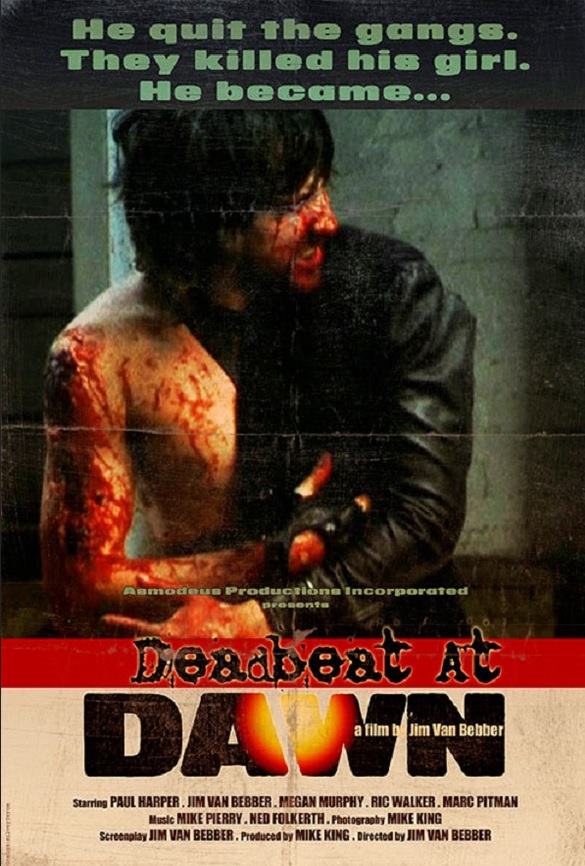
Once more unto the ’80s SOV breach, dear trash video friends, once more, we go — with a film that, for me, works as a homage to the violent n’ gritty, self-destructive characters of Abel Ferrara’s (The App) initial, “video nasty” one-two punch of The Driller Killer and Ms. 45. If you’re familiar with the Ferrara canons — even with his later, more commercial films, such as Fear City and Bad Lieutenant — you know his films are all about the faith and redemption of screwed-up people making do in a screwed-up world.

Watch the trailer.

So goes the life of Danny and Goose (Paul Harper and writer-director Jim Van Bebber) in a tale we’ve seen many times before: The leader of the Ravens wants out to create a better life for him and his girl — and after one, last job, he’s done (as in the recently reviewed The Good Things Devils Do). But once you’re in “the life,” you’re never out. So when the members of a rival gang kill his woman in spite of his wanting to leave the life, Goose is out for an over-the-top, video game-styled revenge (the love-gushy Scarecrow Video part!), full knowing that his bloody rage (that will remind the underground SOV connoisseur of Buddy Giovinazzo’s 1984 debut Combat Shock) will, most likely, leave him dead by dawn. (Don’t believe me? The dudes at the Sleazoids Podcast You Tube paired Combat Shock and Deadbeat at Dawn into one review-show.)

Now, you may have seen that described tale before . . . but not one that’s directed by Jim Van Bebber, baby. His outlandish scripting is supported by kinetic camera work capturing some of the most over the top, slasher-inspired splatter (it’s “Slasher Month” all this month B&S!) that rivals the worst (or best?) of the Italian cannibal genre-boom of the ’70s and ’80s. Seriously. That’s it. That’s the plot. A simple set up giving reason for Goose to set out on revenge — and Goose cutting an ultra-violent swath across the city without reason — well, actually, “for love,” right? This shite that goes down . . . dude, Patrick Swayze would shite his pants in the Road House* that Brad Wesley built. If Road House was made in the grindhouse ’70s — and slapped with an “X,” it would be Deadbeat at Dawn.

So, how did we come to review this SOV classic from Jim Van Bebber? (Yes, it was shot on 16mm, but it’s all about the “vibe” of it all; I lump Don Dohler into the SOV-doms — even though he shot on 16mm and blew ’em to 35. There’d be no SOV ’80s* without Don’s pre-video store, drive-era influences.) Well, first off, I went down an SOV rabbit hole with a review of Curse of the Blue Lights, Jugular Wine, and Tainted for “Vampire Week” and Snuff Kill and Dead Girls for our month-long slasher-horror blow out for October. (Nope, we didn’t forget Blood Cult and Spine, already reviewed ’em!) Then, there’s my upcoming October review for the (not really starring) John Doe flick, 1997’s Black Circle Boys.

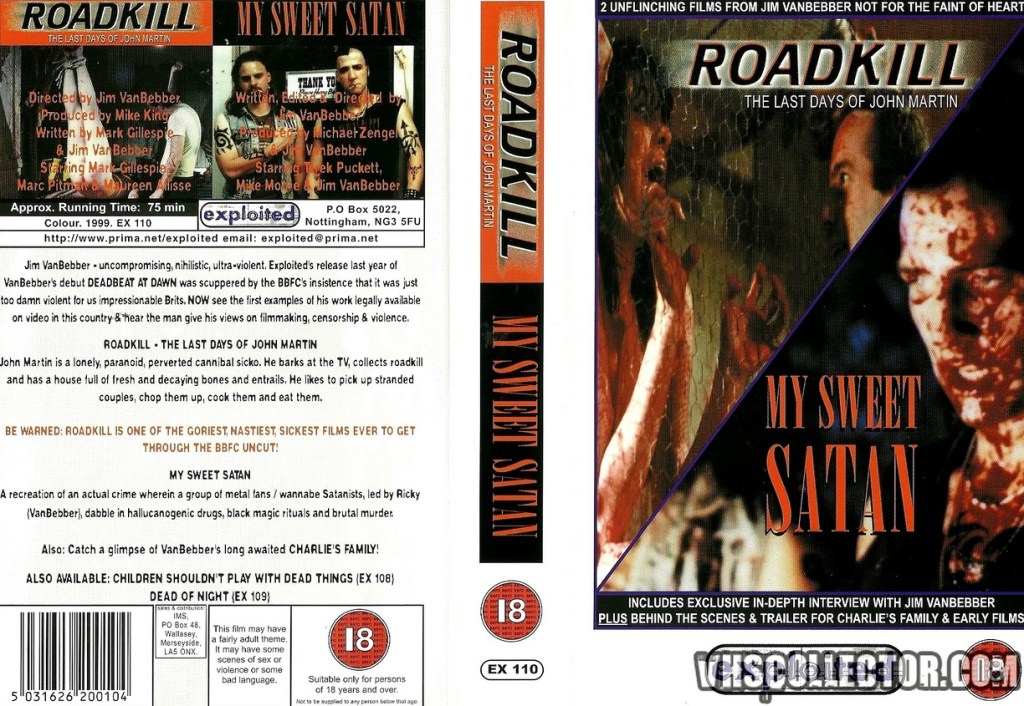
Now, if you know that Satanic-not-so-metal flick, you know that it’s based on inspired by the murderous, 1984 exploits of Ricky Kasso (which also, in part, fueled the scripting of 1986’s River’s Edge; a “Psychotronic Month” review is on the way later this month!). And that, in conjunction with one’s Van Bebber fandom, knows that, for his second film, he wrote, directed, and starred in one of the most unforgettable short films of all time, My Sweet Satan (1994). His loose take on David St. Clair’s 1987 expose Say You Love Satan, it tells the story of 17-year-old Ricky Kasso (Van Bebber) and the murderous exploits of the Knights of the Black Circle, which resulted in the sacrifice-death of his friend, Gary Lauwers.

Since released on DVDs available at Amazon.

Oh, and there’s the Rocktober Blood part of the equation. . . .

It’s just another one of those analog-celluloid alignment of the stars at B&S About Movies that makes all the overworked and underpaid writing worthwhile. So we noticed an unusual uptick in views for, not only for our second Rocktober Blood review-take (written in tribute to the death of Nigel Benjamin), but for our investigation of the lost sequel, Rocktober Blood 2: Billy’s Revenge, as part of our “Box Office Failures” week of reviews.

So we hit Google and Bing. Something’s up with Rocktober Blood. Why all of this sudden flurry of hits? Did Paul Zamerelli, over at the Analog Archivist on You Tube, discover something new about the film? Nope. It turns out Petar Gagic over at The Cine-Masochist on You Tube churned up the blood pool on the “No False Metal Classic” (check out our “No False Metal Week” of reviews) with an affectionate, August 14, 2020, review of Rocktober Blood.

Of course, Petar’s brain works like Paul’s, which works like Sam’s, which works like Bill Van Ryn’s, and works like mine’s: the movies just start bleeding together. So, after mentioning the controversy over the failed production of Rocktober Blood 2, Petar’s review logically dovetailed into the controversy between Synapse and Jim Van Bebber regarding the DVD reissue of Deadbeat by Dawn.

Now, if you know your underground SOV cinema, you know all about the infamous Van Bebber voice mails. And you know that the You Tube upload of those calls has long since vanished. But thee ye analog overloads inspired Petar to make a copy — which he included on the tail end (stars at 12:15, for those of you that never heard it) of his Rocktober Blood review. So, it seems, Petar inspired the denizens of the video fringe to Google n’ Bing “Rocktober Blood” once more — 35-plus years later — and they ended up at B&S About Movies.

And, with that final nail in the coffin, so to speak, the spirits from the netherworld spoke: “Ye must write a review of Deadbeat by Dawn, for it has been foretold. If ye doeth not, Jim Van Bebber will kick thou ass and leave not ye a skin cell or corpuscle to be found.”

So, hey, I do not fuck around with the netherworlds, as I have enough problems in my life. So I ye do as they commandeth. For it has been told that for every person that doeth heard of Deadbeat by Dawn, there is the one that hath not. And ye all must bow to the SOV majesty that is the work of Jim Van Bebber.

Amen. I’ve love fucking writing fucking film reviews for this fucking site!

How deep is the fandom for this film? Fans have cut music videos backed with their favorite tunes: Vegaton w/Autopsy, Suzipeach w/Helstar, theangryemonerd w/Reversal of Man, and RueMorgueDweller w/Exodus. Then there’s the clips of fan’s favorite scenes, such as the beloved “Bonecrusher,” the (epic!) “Cemetary Battle,” “Robbery (“Give me your gun, Grandma!),” “Stealing a Motorcycle,” and the fan-cut trailers. And, of course, Petar at The Cine-Masochist did his own review of the film that’s worth the ten minutes of your life.

You can stream Deadbeat at Dawn on You Tube. True Van Bebber fans can watch the film — along with his shorts My Sweet Satan, Roadkill: The Last Days of John Martin, Doper, Kata, Into the Black — in a convenient, one-stop streaming package from Shudder through Amazon Prime. It’s a well-shot, imaginative, over the top movie. Put it on your short list of films that you must watch before making your final, mightily stomps on the terra firma. Or Van Bebber will kick thou ass into oblivion.

Even truer Bebber fans — and aren’t we all — can check out this 2003 Shock Movie Massacre Interview with, wait, is that Dave Wyndorf of Monster Magnet? Nope, that’s Jim!

* Be sure to check out our four-part interview with Road House director Rowdy Herrington. And be sure to check out our reviews of River’s Edge and Black Circle Boys for our deep dive into the life of the sick f*ck that brought us here: Ricky Kasso. And we’ve recently reviewed the Kasso documentary, The Acid King.

* Click through our SOV tag to read our ever-growing list of reviews regarding shot-on-video films from their ’80s VHS-birth to the digital and phone-shot brethren of today.

About the Author: You can learn more about the writings of R.D Francis on Facebook. He also writes for B&S About Movies.

2020 Scarecrow Psychotronic Challenge Day 18: Witchhammer (1970)

Day 18: Resurrectionist: Watch something that came out on a reissues label

Courtesy of AIP Studios’ Witchfinder General (1968), everyone knows of the exploits of British witch-hunter Matthew Hopkins (as portrayed by Vincent Price) and his fictionalized counterparts in Count Christian von Meruh and Lord Cumberland (as portrayed by Udo Keir and Herbert Lom) in Mark of the Devil (1970) and Mark of the Devil II (1973). And now you’ll learn of the even bloodier exploits of Witchfinder Inquisitor Boblig von Edelstat.

Witchcraft was born during Europe’s transition from the Dark to the Middle Ages. For over five hundred years, fueled by ignorance and religious paranoia, governments decreed their countries be cleansed of evil and immorality. Thus, through armies funded by churches, soldiers hunted down the witches who carried the pestilence. Entire villages were laid waste, in acts analogous to the social cleansings committed by the third world countries of modern society. In fact, the acts committed by Witch Hunters in the name of the Lord surpassed the body count of modern day serial killers. Thus, the witch hunts led by General Cromwell and Matthew Hopkins begat McCarthy’s Red Scare in the nineteen-fifties. And the witch hunts begat the gathering of Japanese-Americans during World War II, and the Nazi regime shipping Jews, Pols, and Slavs on trains to their deaths. And the burning of witches at the stake begat African-Americans tormented with religious symbols wrapped in gas soak rags. The brutal truth of the world’s current sociopolitical system: these same hunts and killings, based in ignorance, continue. In today’s world of light and knowledge, men continue to invest in fear, ignorance, and greed. Will man ever be capable of conquering the delusions, the urges, and the ugliness? When will witchcraft disappear from our society?


Born in Austria-Hungary, Czech Republic filmmaker Otakar Vavra ranks alongside Denmark’s Carl Theodor Dreyer (1928’s The Passion of Joan of Arc and 1932’s Vampyr) as a first-rate director with a career that is, sadly, outside of their respective homelands (and the most discriminating, international film aficionadi), fading from our celluloid memories. Vavra’s IMDb page, while cataloging his oeuvre in full, the individual pages for those films are barren; not only are no plots or synopses offered, there’s no user or critic reviews.

Vavra is the cinematic equivalent of Polish futurologist and sci-fi writer Stanislaw Lem (Solaris, The Astronauts, The Magellan Nebula*): for as many of Lem’s books that have seen English adaptation, many never will—and many of us will never experience all—if any at all—of Vavra’s films. Across his 53 directing and 56 writing credits from the early ’30s up until his 2011 death, less than twenty of his films have expanded outside of Europe into the English-domestic marketplace. Some made the transition to the VHS format and later DVD format, but most have not been honored with digital preservation.

After three shorts, Vavra made his feature film debut as a director with the comedy Camel Through the Eye of the Needle (1937) and followed with the drama Virginity (1937). He closed out the 1930s with his two best-known and revered films: the historical dramas The Merry Wives (1938; hailed by the U.S. film trade Variety) and the working class-morality tale The Magic House (1939). Prior to those directing efforts, he wrote seven screenplays: the most notable of those is the comedy Three Men in the Snow (1936); the film’s homeland success initiated his directing career. His career culminated with a teaching position at Prague’s Film and TV School of the Academy of Performing Arts, a position he held since the 1950s. He was awarded the Czech Lion in 2001 and a presidential Metal of Merit in 2004 for his contributions to Czech cinema.

His other widely-distributed, directorial works include:

  • The Masked Lover (1940) — a romantic comedy concerning a Czech General
  • Enchanted (1942) — a romantic comedy
  • I’ll Be Right Over (1942) — a slapstick comedy
  • Happy Journey (1943) — a romantic comedy
  • Rozina, the Love Child (1945) — a historical drama
  • Against All (1957) — a historical war drama; part of the “Hussite Trilogy,” which are three of the most expensive Czech films ever made, with Against All as the most expensive at 25 million Czech Koruna (1.2 million U.S.)
  • August Sunday (1961) — a comedy
  • Night Guest (1961) — a drama
  • Golden Queen (1965) — a psychological drama
  • Romance for Bugle (1967) — a drama that won the Special Silver Prize at the 5th Moscow International Film Festival
  • Days of Betrayal (1973) — a historical war drama that won a honorary diploma at the 8th Moscow International Film Festival
  • Sokolovo (1974) — A Soviet co-production about the ’43 Battle of Sokolovo
  • The Liberation of Prague (1977) — a historical war drama; the third of a trilogy that began with Days of Betrayal and preceded by Sokolovo
  • Dark Sun (1980) — a crime drama that serves as Vavra’s rare foray into sci-fi that serves as a remake of his own 1948 film Krakatit
  • The Wanderings of Jan Amos (1983) — a biographical drama about 17th century Christian crusader Jan Amos Comenius


And that brings us to Vavra’s lone foray into the horror genre, a historical-drama concerned with the brutal inquisition of witches during the medieval era—a film that is heralded as Vara’s chef-d’œuvre and won several awards at Argentina’s Mar del Plata International Film Festival in 1970. One of those wins was for cinematographer Josef Illik who, after watching Witchhammer, you’ll wonder why Illik’s name is not as revered in international film circles as Hungarian-American cinematographer Vilmos Zsigmond (Deliverance, Close Encounters of the Third Kind).

Based on the best-selling Czech history novel Kladivo na čarodějnice (1963) by Vaclav Kaplicky, the 17th century tale chronicles the real-life, human rights atrocities of the North Moravia Witch Trails of the 1670s by Witchfinder Inquisitor Boblig von Edelstat in which 100 people were murdered. The book’s main protagonist, Priest Josef Lautner (Kryštof Lautner in the film), is a cleric who tries to help his people, but soon falls victim to the trails for opposing “God’s Law.” The book is heralded as an important to literary lesson of man’s ills in political-based paranoia and political prosecution on-level with Arthur Miller’s The Crucible (1953) (required high school reading; at least it was for me).

The resulting film adapted by Vavra was banned, ironically, not for its graphic nature, but for Vavra adapting the film as an acidic allegory to the Communist show trails that rocked Czechoslovakia in the 1950s. While the film was banned from showing by the Czechoslovakian government, it was accepted by the international marketplace as a cinematic masterpiece.

The atrocities began with an altar boy observing and reporting a destitute old woman hiding the bread given out during Holy Communion—a theft that she admits to, with the intend to feed it to her barren cow to re-enable its milk production. The indiscretion of hoarding holy bread, according to Witchfinder Inquistor Edelstadt, smacks of “witchcraft,” as based on his interpretation of the Catholic treatise The Malleus Maleficarum, aka Hammer of Witches (thus, the film’s title). The thumbscrews and other torture devices are dispatched in quick succession—and a young priest who opposes the trails soon finds himself among the wrongly executed.

Even if you’ve watched the admittedly more sensationalistic, West German-produced Mark of the Devil, aka Witches Tortured til They Bleed (1970), its sequel Mark of the Devil II, aka Witches Are Violated and Tortured to Death (1973), and the more reserved, Gothic-slanted AIP film that inspired its production: Michael Reeves’s Witchfinder General, aka The Conqueror Worm (1968), you’re not going to be prepared for this horrifying lesson in the absolute corruption of power. We won’t sugarcoat: Witchhammer, as was Pier Pasolini’s Salo, or the 120 Days of Sodom, isn’t pleasant (Pasolini’s film even more so), but it is an exquisite example of perfection in cinema.

You can watch Witchhammer on You Tube, but there’s a far superior, superb DVD rip available on the European F Share TV free-with-ads VOD platform. There’s an account sign-in viewable trailer on You Tube (due to graphic content). DVDs are readily available in the online marketplace at a wide variety of eRetailers or you can buy direct from Arrow Video.

Other classic witchcraft films to supplement your viewing of Witchhamer are the Sweden-Denmark co-production Haxen (1922) and Carl Theodor Dreyer’s own forgotten classic, Day of Wrath (1943).  We also examine the life of another Middle Ages’ serial killer of the von Edelstat variety, Gilles de Rais, and his inspiration behind two films by Spain’s Paul Naschy: Panic Beats and Horror Rises from the Tomb.

About the Author: You can learn more about the writings of R.D Francis on Facebook. He also writes for B&S About Movies and publishes on Medium.