Mission Galactica: The Cylon Attack (1979)

Editor’s Note: The original Battlestar Galactica series that debuted on ABC-TV on September 17, 1978, was cancelled on April 29, 1979. As part of our “Space Week” tribute this week — which was inspired by our most recent “TV Week” tribute in April — we’re reflecting back on the 42nd anniversary of the show’s cancellation with a look at the two overseas theatrical films culled from the series: Mission Galactica: The Cylon Attack and Conquest of the Earth. We’ll also take a look at the additional twelve telefilms culled from the series’ episodes in this review.


Even at its cheesiest and lowest of budgets, the production values of ’70s and ’80s American telefilms and TV series rivaled most Asian and European productions. Thus, many of the TV movies and series-pilot films reviewed at B&S About Movies — such as The Six Million Dollar Man (1973)* — became theatrical features in the overseas markets.

In Britain, the series UFO and Space: 1999 became Invasion: UFO and Destination Moonbase Alpha, while the 1973 Canadian TV production The Starlost was rebooted with a series of films beginning with The Starlost: The Beginning. In addition, two-part episodes of popular U.S. series — such as the Season 5 episodes of The Six Million Dollar Man (1976), “The Secret of Bigfoot” and “The Return of Bigfoot” — were cut into foreign theatricals. And those U.S. TV productions became significant box office hits that turned their actors — however brief — into “movie stars.” Just ask American TV actors Nicholas Hammond and Reb Brown, both who became overseas stars as result of their respective, short-lived Marvel/CBS-TV series, The Amazing Spiderman (1977; Columbia Pictures) and Captain America (1979; Universal Pictures), being cut into blockbuster theatrical films (each reached #1 in Japan). And Lou Ferrigno, thanks to those The Incredible Hulk series-to-films reduxes, he did alright and carved out a decent overseas theatrical career with Hercules, The Adventures of Hercules, The Seven Magnificent Gladiators, and Desert Warrior.
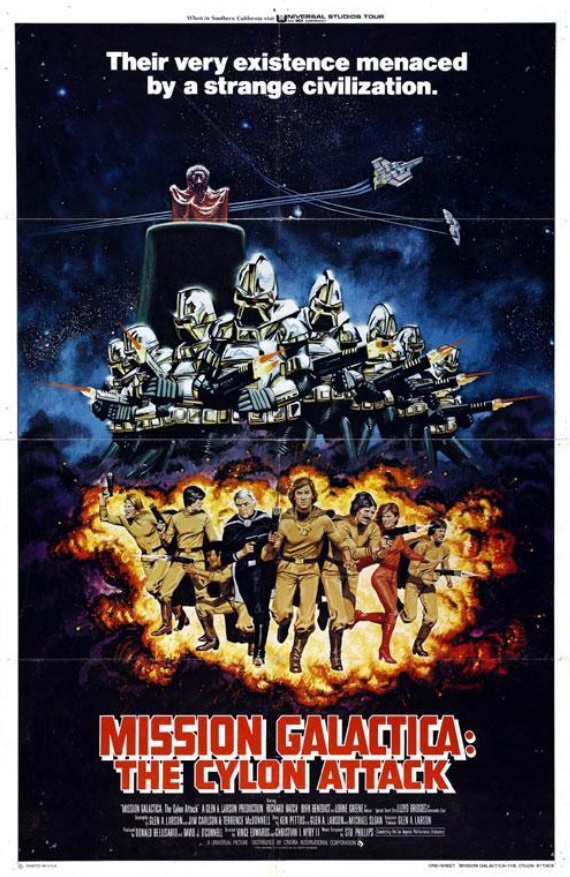
Overseas theatrical one-sheet/multiple sites.

While us post-Star Wars lads n’ lassies were mesmerized by the initial Battlestar Galactica TV movie/theatrical in 1978 (recut into the syndicated three-episode arc, “Saga of a Star World”), we quickly grew weary of the subsequent ABC-TV series, as its blatant stock footage recycling from the initial film — with very little, new SFX shots produced — bored us pretty quickly. And, as the ratings dipped each week as result, the stories and the effects only got cheesier and cheaper, and repeated and recycled, which only led to more boredom.

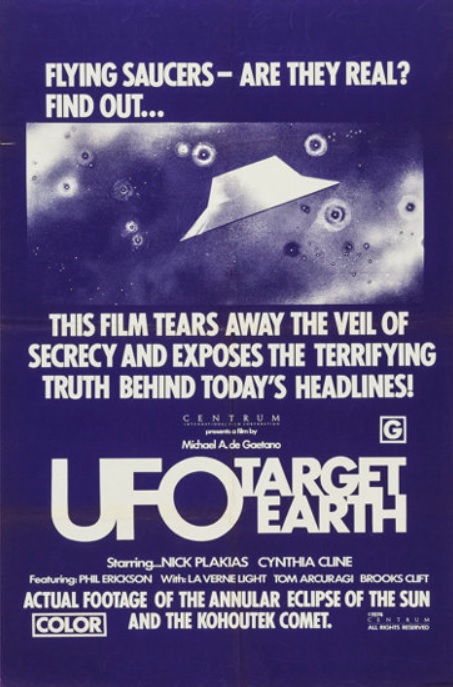
Oh, man. My Star Wars Fever and the Boogie-Woogie Battlestar Galactica Flu was so bad . . . I even made the drive to see the late ’70s theatrical repacks of Star Pilot (1977), aka the decade-old reboot of Mission Hydra: 2+5 (1966), and UFO Target Earth (1974). Yeah, I got punked for my hard-earned lawn money. But I digress. . . .

When the series was cancelled after one season, the reason given was that the ratings didn’t justify the reported production cost of one million dollars per episode. One million? Seriously? And how many times did we see those same SFX shots of the barrel-rolling vipers to screen left and a Cylon Raider flying into screen right before it was blasted into space dust? And did you, Mr. Producer, not think we wouldn’t notice the Terran shuttle in “Greetings From Earth” was a stock shot from (the even more god awful) Buck Rogers in the 25th Century? And the ol’ “space Nazis” trope from Star Trek from over decade ago, really?

The epitome of Star Wars droppings.

So, uh, if the series wasn’t cancelled, would Adama and friends encounter a “gangster world” and a “gladiator world” in quick succession? And why not, you’d already stuck us with “western world” (“The Lost Warrior”) and “knight world” (“The Young Lords”) episodes. Did you learn nothing from the stock prop room and wardrobe adventures of the Starship Enterprise, Mr. Producer? What was next, retreading the Star Trek episodes with Starbuck forced into an arena battle by aliens with a Gorn? How about Starbuck and Apollo flying through a space anomaly that spits out their evil doubles — and giving Apollo a beard and Starbuck a Sulu face scar? And why not? BSG’s sister series, Buck Rogers, became a Star Trek pastiche with Hawk as Spock, Buck as Kirk, and Wilma as Uhura in its second — and final — season. And what was the friggin’ deal with Boxey and the Daggit skirting the Battlestar’s security protocols every week?

British newspaper theatrical advertisement via multiple sites.

Ugh. So, yeah, of course many of us wee lads abandoned the show halfway through its 24-episode run (17 original episodes of the series were made, five were two-part shows). Sure, the first two episodes (4 and 5) that ran as “The Lost Planet of the Gods” were certainly up to the standards of the initial movie, but things got a bit dopey by the time of “The Gun on Ice Planet Zero” (8 and 9) with its clone buffoonery. And again, the single-night episodes in between the two-parters, with their even dopier western and knights of the round table tropes, were worse (by the Lords of Kobol . . . Fred Astaire, are you frackin’ kidding?).

Ultimately, the series failure — a series that we all wanted to succeed — was the result of corporate greed; a greed that also resulted in the creation and failure of Buck Rogers, natch, for rival network NBC. (Today, the once ABC-aired series is now the property of NBC-Universal. You can watch BSG: TOS online at NBC.com.)

The initial plan was to rollout BSG (as with Buck Rogers) across 1978 as four annual, miniseries sequels to the three-hour (3-part) pilot film. The other planned films were “Lost Planet of the Gods (4-5),” “The Gun on Ice Planet Zero (8-9),” and “War of the Gods (15-16)” — the aforementioned space Nazis mess that was “Greetings from Earth (19-20)” was developed later, when ABC-TV decided it wanted to go to a weekly series. That decision, in turn, not only strained the show’s budget (and resulted in raiding the prop and costume departments and the stock shot boondoggling), but left the writers scrambling for quickie episodes to fill out the series (thus the western, knight, and Nazi tropes). It also resulted in the three mini-series suffering cuts to fit into a two-part, hour-long format.

And that brings us to the source material behind the series’ finest hour courtesy of a story arc and characters (Lloyd Bridges on his A-Game as Commander Cain) that rivaled the initial TV movie pilot — an arc that, like the two-part “Greetings from Earth,” was developed as result of going-to-series. (An honorable mention goes to Patrick MacNee as Count Iblis in “War of the Gods.”) For the overseas folks in the U.K., continental Europe, and Japan, what we enjoyed as “The Living Legend,” they enjoyed as Mission Galactica: The Cylon Attack. And while our overseas sci-fi brethren didn’t know any better at the time — to get the BSG: TOS DVD set and watch TV the version of “The Living Legend” instead — we sure did.

Frack me! Washed up vaudevillians Bobby Van and Ray Bolger embarrassing themselves — and doing their part to get BSG cancelled — as Hector and Vector in “Greeting from Earth.” Again, frack me.

Why? Because this overseas theatrical cut is a load of feldercarb; the broadcast version is better (even more so with the DVD series pack, instead of its syndicated commercial run).

It’s one thing to add footage to the two 40-minute episodes to create a theatrical-length piece, but the editors on this daggit-dung decided to take out the Cylon attack footage from “Living Legend” and replace it with attack footage from “Fire In Space (14).” Why not use both scenes? Why take out the romantic triangle subplot between Starbuck, Cassiopeia, and Cain? And really, you went all the way back to the clearing of the space mines scene from “Saga of a Star World” to beef up the film? And yes, that’s footage from The Towering Inferno in there. (And footage from Earthquake shows up in Galactica: 1980, natch.) And, in addition to the plot holes, character’s hairstyles change without reason. And character voices change. And Sheba — remember, the whole purpose of the “Living Legend” arc was to add her character to the cast — is mostly left on the cutting room floor. It’s a frackin’ editorial and continuity mess.

While you may be able to find used copies of the VHS (which were eventually made available in the U.S.) in the online marketplace, beware of the DVD reissues — even the region-free presses — which do not play on U.S. decks (or computers). Another problem: the DVD runs five-minutes shorter than the VHS (at 103 min. vs. 108 min.). Why cut those five minutes? Why are scenes — such as the Cylon fuel depot attack — truncated, missing dialog and plot explanations? And why the different sound effects for the Vipers and Raiders?

And speaking of the series-cancelled-and-returned second season Galactica: 1980: Our overseas brethren known the three-part “Galactica Discovers Earth” pilot as the third, official Battlestar Galactica film, Conquest of the Earth (1980), aka Galactica III, in some Euro-countries, Japan, and Australia.

Ah, but did you know there were 12 more BSG films issued after the three theatrical features? And no . . . Space Mutiny isn’t one of them!

A ripoff of a ripoff. Frack you, Mr. Lucas.

In 1988, this frackin’ South-African pile of daggit dung was added to the BSG-verse, an abomination that makes the Universal telefilm hodgepodges look like Oscar winners. Oh, feldercarb, it makes Dünyayi Kurtaran Adam, aka Turkish Star Wars, look like a statuette recipient. So, frack you, Action International Pictures*˟, for manipulating those foreign copyright loopholes and giving us an Ed Woodian Star Wars that you should have titled Battlestar 9 from Outer Space.

But I digress, again.

As with the aforementioned UFO, Space: 1999, and The Starlost finding a new, overseas life as theatrical, television, and home video features: After Conquest of the Earth, the third and final BSG foreign theatrical film, and prior to the syndication of the series’ 24 episode-installments, Universal Pictures edited the BSG series episodes to create 14 telefilms (two went theatrical, natch) for foreign distribution in 1981. (It’s said that some local U.S. UHF stations aired the TV movie versions of the series. I never saw them myself during their original 1981 run and only on VHS after the fact.) As you can see from the pairings of the vastly different episodes, these movies — as with Mission Galactica: The Cylon Attack — also suffer continuity and editorial faux pas. The highlights — well, the worst of the films (depending on personal opinions) — are:

  • Experiment in Terra: An edit of “Experiment in Terra” (22) cut with content from Galactica: 1980‘s best episode, “The Return of Starbuck” (2.10), along with a chunk of “Saga of a Star World (1.1). But we do get a pretty cool, never-before-seen prologue explanation from Commander Adama about the Cylons — learned from Adama’s Galactica logbook discovered floating in space by an Earth astronaut.
  • Murder in Space: An edit of “Murder on the Rising Star” (18) with scenes from “The Young Lords” (11).
  • Space Prison: An edit of “The Man with Nine Lives” (17) and “Baltar’s Escape” (21).
  • Phantom in Space: An edit of “The Lost Warrior” (6) and “The Hand of God” (24).
  • Space Casanova: A combination of “Take the Celestra” (23) and “The Long Patrol” (7).
  • Curse of the Cylons: A hodgepodge of “Fire in Space” (14) with scenes from “The Magnificent Warriors” (10).

The rest are based on their multi-episode series counterparts:

  • Saga of a Star World: An all-new, third edit of the series that differs from the three-part syndicated series installments and the overseas/U.S. theatrical release.
  • Lost Planet of the Gods: Features restored scenes cut from the series version.
  • The Gun on Ice Planet Zero: Features restored scene cut from the series version.
  • The Living Legend: This is the third version of the Commander Cain tale, after the initial series episodes and the Mission Galactica: The Cylon Attack theatrical repack.
  • War of the Gods: After “The Living Legend,” the second best episodes of the series, again, thanks to Patrick MacNee’s turn as Count Iblis.
  • Greetings from Earth: The absolute worst episodes of the series. And even the makers knew: they (thankfully) deleted the abysmal vaudeville soft-shoe routine by the plastic-headed/white-faced robots Hector and Vector.
  • Conquest of the Earth: An all-new, third edit of the Galactica: 1980, aka BSG Season 2, three-part pilot arc “Galactica Discovers Earth,” which also includes footage from the season’s two-parter “The Night the Cylons Landed.” And look out for Baltar and Lucifer in this version — bought in from the old BSG: TOS episode, “The Young Lords.”

The theatrical one-sheet for the third Battlestar Galactica overseas feature film.

Each of these telefilms are given their own, unique open and closing credits, along with new scenes (both newly shot and leftovers not used) and alternate, unused SFX shots. Outside of watching these movies, U.S. audiences seen most of these scenes as deleted outtakes included as “bonus features” on the BSG DVD/Blu-ray box sets of the series. But be on the lookout for plenty of Universal stock footage pillaging throughout, such as the Fembot footage from The Six Million Dollar Man timeline being incorporated.

While the always-the-pro Lorne Greene performed a number of voice-overs for these movies by providing narration to help link the unrelated episodes flow, Dirk Benedict, Herbert Jefferson, Jr., John Colicos, Patrick MacNee, and Jonathan Harris also pitched in with voice-overs and dialog loops. Richard Hatch opted out of the project (it seems he was pissed over the Galactica: 1980 mess) and another actor — that sounds nothing like him — looped his lines (and it’s as a bad as it sounds). (Don’t forget: Later on, Hatch was pissed that Universal passed on his Galactica novels and film reboot*).

Starlog #39 (Oct. 1980) that gave us a rundown on the upcoming Galactica movies. I wish I still had my Starlogs. Damn you, adulthood. Image courtesy of the Starlog Internet Archive Project.

But truth be told: Even with their faux pas, these hodgepodge films are a fun watch for two reason: First, for the inventiveness of the screenwriters in somehow creating continuity between such varied episodes. They were certainly up against it, kudos to them! Second, these series-to-film repacks exist in a universe unto themselves — outside of the original series’ plotting — with their “alternate” timeline. Again, it’s fun to compare the series to the films and (as a screenwriter myself) be fascinated by the creative process to maximum Universal’s bottom line.

Sadly, unless you’re able to track down any VHS taped-from-TV or VHS home video repacks (foreign or domestic), these telefilms are lost to the cathode ray snows of yore. Fans of the original series have been clamoring for DVD and Blu-ray box sets of these movies for years, myself as well, as I’ve only seen half of them as result of discovering their used VHS-versions years after the fact. As for Mission Galactica: The Cylon Attack: we found four extended scenes (one in German) on You Tube (posted below) from the film for you to enjoy that gives the story arc from beginning to end.

Uh, oh. Here come the black boxes of death.
One video down.
The others will probably follow suit.

The blogspot site, The 100the Planet (which helped in our research and memory jogging; so grazie, fellow warrior), did an absolutely magnificent job watching all 14 films and breaking down their respective plots. So, if you’re a die-hard fan of the original BSG series, it’s a great read. And we also thank BattlestarWiki.org for their assistance in preparing this review. And don’t forget, we went Star Wars crazy with our month-long review of the films (over 50!) that inspired — and were inspired by — Star Wars with our Exploring: Before Star Wars and Exploring: After Star Wars featurettes.

* Be sure to check out week-long tribute to the film career of Lee Majors! All the review links — and more — can be found with our “Lee Major Week Wrap Up” featurette.

** Did you know Richard Hatch made his Galactica: The Second Coming pitch film with low-budget, direct-to-video auteur Dennis Devine sidekick Jay Woelfel? True story. Check out our “Drive-In Friday: Dennis Devine Night” to learn more.

*˟ We kid. We love David A. Prior, David Winters and Peter Yuval’s AIP films around here. Why do you think we reviewed The Silencer and Firehead (just to name a few) in the B&S offices?

About the Author: You can learn more about the writings of R.D Francis on Facebook. He also writes for B&S About Movies.

Mutiny in Outer Space (1965)

Why is it that we’ll remember the “bad” science fiction films and forget the, well, they’re not exactly “good,” but the better-made ones? Why do we nostalgically pour our celluloid vinegars over the likes of The Astounding She-Monster, Cat-Women of the Moon, and Fire Maidens from Outer Space, yet forget an imaginative and well-made flick from the Woolner Brothers, like Mutiny in Outer Space?

Maybe it’s because I forever have Mutiny in Outer Space jammed in my mental VCR as result of enjoying it as part of a childhood, Saturday afternoon UHF-TV double bill with Space Probe Taurus (1965) — and that both starred my childhood crush, Lydia Limpit, the sidekick to Batman’s nemesis, The Bookworm: the heart-weeping Francine York.

Watch the trailer.

As for the rest who forgot — or never heard of — this humans-battle-aliens-in-space romp: you know the brothers Lawrence and Bernard oeuvre better than you realize. Like most of the Corman-quickie styled filmmakers of the time, the Woolner’s started out as Drive-In theater owners, and then began financing low-budget B-studios to fill their screens. Of course, the Woolner’s hedged the smart bet and backed the never-lost-a-dime-on-a-movie (well, except for 1974’s Cockfighter) Corman on the films Swamp Women and the teen-juvie romp, Teenage Doll. Junk cinema fans will remember the brothers’ third film, Attack of the 50 Foot Woman, the best; Italian horror hounds remember Larry and Bernie best for giving U.S. popcorn noshers Antonio Margheriti’s Castle of Blood, the Christopher Lee-starring Castle of the Living Dead, and, the big kahuna of giallo, Mario Bava’s Blood and Black Lace (all 1964). And in the grand tradition of remembering the bad: there’s the film (IMO) that slides in nicely after Fire Maidens from Outer Space in the annals of awful, MST3k-styled sci-fi from the ’50s (and ’60s): The Human Duplicators (1965), a film that gets its wistful positraction from the fact the film’s android-making villain is portrayed by future Bond villain Richard “Jaws” Kiel. If not for ol’ Jaws. . . .

And that brings us to the Woolner’s second foray into the sci-fi genre (their third and last was Antonio Margheriti’s Bond knock off, Operation Goldman, aka Lightning Bolt in the U.S.), which they filmed in six days for $90,000 in March of 1964. Released as an undercard to The Human Duplicators, MiOS was also directed by Hugo Grimaldi. After MiOS, Grimaldi’s only other writing credit is Gigantis, the Fire Monster; he also supervised the U.S. dubs on First Spaceship on Venus, aka Germany’s Der schweigende Stern, and Giorgio Ferroni’s pseudo-Giallo, Mill of the Stone Woman.

While a quickie undercard production, screenwriter Arthur C. Pierce did his research and developed a sci-fi smart script (forgetting, of course, that he cheapjacked the sci-fi classics that are The Day the Earth Stood Still and The Time Machine with the later, not-so-classic The Cosmic Man and Beyond the Time Barrier*, respectively; he also wrote and produced the $140,000 The Human Duplicators) based on the (now inaccurate) science of the time and had his astronauts, while battling an alien fungus (and keeping the romance to a minimum), deal with the prolonged effects of travel and life in space. In addition, leads Dolores Faith (debuted in 1961’s The Phantom Planet and starred in The Human Duplicators), Richard Garland (really steps it up from his past work in 1957’s Attack of the Crab Monster), Francine York (who would later tickle our hormones in Ted V. Mikel’s The Doll Squad), and Harold Lloyd, Jr. (Frankenstein’s Daughter) are, for a B-Movie quickie, very good in their roles.

Now, before you think that’s (furry) octopus tentacles on the one-sheet, it’s actually plant tendrils, in a tale that foreshadows what we’d see in 1968 with the Antonio Margheriti-influenced The Green Slime — which had blood-drinking asteroid slime instead of plants. And the plants, here, don’t transmutate into sentient — and very goofy — red-eyed tentacled humanoids.

We’re not Italian plant-based monsters from the Moon. We’re Asian green slime monsters!

At first, the film began as Space Station X (after Space Station SS X-7, the rotating station of the film), then the more sensational Invasion from the Moon (since the plants came from an ice cave on the Moon), but since Grimaldi and Pierce pinched from 1954’s The Caine Mutiny (since the station’s commander cracks under pressure), why not? Voila (or is that “ecco” in Italian), the film hit theaters as Mutiny in Outer Space. And there’s no doubt to the pinching of two of the ’50s biggest alien-versus-human romps: The Thing (1951) and It! The Terror from Beyond Space (1958). But there’s an even bigger, obscure pinch: the overly talky, dry and boring Space Master X-7 (1958). That Ed Woodian romp of the Plan 9 variety concerns itself with a fungus unleashed from an Earth-returned space probe — only that alien is metallic “space rust” and not a plant. Or slime. And it gets loose on jet liner — as it would multiple times, some 60 years later in more than a few flicks from The Asylum (that I don’t feel like looking up). Oh, and you know what: the commander in the Kubrick-inspiring Conquest of Space (1955), which, itself, probably pinched from The Caine Mutiny, cracks under the pressure and jeopardizes the station, as well.

But still . . . with all of those plot pinches (and stock footage-set pinches, which we will get into), which I hadn’t a clue of when I was a UHF-weaned kid, Mutiny in Outer Space is still pretty good and a lot of fun.

In the future-verse of 1990: Two astronauts collect geological samples from an ice cave on the moon. Shortly after returning to the station, one of them collapses. It’s discovered he has a fever-inducing welt on his leg that spreads into a fungus across his body — a fungus from the ice caves.

The upside to this Moon romp is that, unlike the other interstellar-matriarchal fails of the ’50s and ’60s that we’ve discussed this week (and during our January 2021 tribute week to those films, such as 1953’s Project Moonbase) Mutiny in Outer Space puts several strong women to the forefront: the two leads with the most screen time being Lt. Connie Engstrom (Pamela Curran; Elvis’s Girl Happy) as the station’s communications chief, and Dr. Faith Montaine as a civilian biochemist who oversees science operations.

Yeah . . . we still have the horny male astronauts, and the ubiquitous flirting, and a scene in the station’s bio-lab with an astronaut flirting with his buddy’s girl; and her fretting about hairdo-fixing for her astro-hunk’s return. (Could you imagine Ripley gaga for Dallas or a Bret-Lambert hook up?) Of course, while these girls are smart and resourceful, they (an absolutely, sci-fi ’50s plot-point must) go all damsel-in-distress hysterical when the plants-hit-the-fan. Oh, and there’s the meteor shower that hits-the-fan. And the shower results in an ice-core splitting open. Now the furry plant tendrils (that would have looked great in color instead of washy-wash black and white) are everywhere. And the station’s commander cracks. And since guns were outlawed in space, the only thing to fight with is good ol’ he-man brawn and hormone-fueled ingenuity. The final solution has to do with creating a shield to cut off the solar heat that feeds the plants. Oy!

See, I told you. It may be pinchy n’ cheap, but wow . . . Mutiny in Outer Space just keep the Murphy Law-antics comin’ at ya, and at a decent pace helped by tight edits and seamless integration of its stock footage.

What ultimately stopped Mutiny in Outer Space from achieving classic status: While the top-billed The Human Duplicators was shot in color — as result of the budget in producing the station and plant effects and sets — there were no funds left to shoot in color. Thus, we ended up with a film that has the feel of ’50s space flick (the same folly that befell the equally well-done Space Station Taurus, also released in 1965), when it was actually in production around the same time Stanley Kubrick began pre-production in 1965 on his sci-if game changer: 2001: A Space Odyssey — issued a mere three years later, in 1968. In the end, the Woolner’s boondoggled it, didn’t they? The $140,000 (IMO) wasted on The Human Duplicators should have been budgeted for MiOS, so as to make one solid, indie studio, A-styled picture to be remembered, instead of two forgotten flicks . . . flicks that lead a guy like me to spend a whole day writing a review that, maybe, a dozen people, if I’m lucky, will ultimately end up reading.

And so goes the life of a digital movie critic. Well, at least I got to use “tendrils” in a sentence. I believe that’s a first for my reviews.

It’s reported Mutiny in Outer Space is an Italian-American co-production, which is incorrect. The film was produced, in full, with an all U.S. cast, at Producers Studios on Melrose Avenue, in Los Angeles (the studio has hosted everything, from the 1944 film noir Double Indemnity to 1976’s Assault on Precinct 13). Remembering the Woolner’s worked with Antonio Margheriti on Castle of Blood and Lightning Bolt: there’s your “Italian connection,” which is result of the Woolner’s clipping footage (and possibly costumes, but more likely just astronaut footage; the numerical-letter uniform designations give it away) from Margheriti’s 1960 space romp, Assignment: Outer Space. And if the sets are familiar, that’s because they’re from another 1965 production on the Producers Studios sound stages: Space Probe Taurus. (We could easily do a B&S tribute week to all of the Drive-In and UHF-TV ditties produced at the studio.)

Don’t believe me? Compare the trailers for yourself. Both films even have romance-in-the-botany lab scenes, complete with the male astronauts making dumb plant jokes in a dorky-flirt that’d give Ross Geller pause:

You can watch a nice rip of Mutiny in Outer Space on You Tube. If I had the money and influence of J.J. Abrams, I’d do for MiOS what he did for Phantasm: restore it — in color, natch. It’s a classic. Oh, and since we’re talking about them: You can watch Assignment: Outer Space on You Tube and Space Probe Taurus on You Tube, and compare. Yep, we also found a (muddy) copy of Space Master X-7 on Archive.org and The Human Duplicators on Daily Motion.

* While junk, I’ll always have a warmed-up VCR for Beyond the Time Barrier as result of its UHF-TV double-billing with Creation of the Humanoids, itself a precursor to Blade Runner in the same way Mario Bava’s Planet of the Vampires foreshadows Alien.

About the Author: You can learn more about the writings of R.D Francis on Facebook. He also writes for B&S About Movies.

Mission Stardust (1968)

Editor’s Note: We previously reviewed Mission Stardust as part of its inclusion on Mill Creek’s Sci-Fi Invasion 50-film pack — the set also includes its even weirder, 1966 cousin, Mission Hydra, which we also re-reviewed with a new take, earlier today at 9 am.

Known in Italy as 4…3…2…1…Morte (aka, “Death”), this Primo Zeglio-directed science fiction movie is based on the German book series Perry Rhodan by K.H. Scheer and Walter Ernsting. Hugely successful throughout Europe and the Soviet Union, but relatively unknown in the U.S., the pulpy Rhodan paperbacks have been produced since 1961; as of 2021, 3000-plus, 66-page booklets and 850-plus spinoff novels have been produced. George Lucas named-dropped the books, saying that the American translations served as one of his inspirations alongside Flash Gordon (which he wanted to adapt, but couldn’t get the rights) in creating the adventures of Luke Skywalker and influenced the design of his verse’s spaceships.

As for Primo Zeglio, his directing career was not as successful — certainly not an Italian filmmaker we name drop in the B&S About Movies offices often; in fact, this is the only film of his that we’ve watched and reviewed — even after our month-long “Spaghetti Westerns Week” blowout. However, Zeglio is certainly a competent filmmaker and revered in his homeland for his spaghetti westerns, of which he made four: The Man of the Cursed Valley (1964) with Ty Hardin (another American TV hopeful from ABC-TV’s western Bronco, hoping for some Eastwood-buzz), Two Violent Men, with Spain’s George Martin (1964), The Relentless Four (1965; no not Kinski’s The Ruthless Four; different flick) with Adam West (again, no Eastwood upwind there for Batman), and Killer Adios (aka Killer Goodbye, aka Winchester) with Spain’s Peter Lee Lawrence (1968) (he was in Eastwood’s ’65 spaghetti western For a Few Dollars More); the film ended his 18- directing credit and 20-writing credit career. During those spaghetti romps, Zeglio produced his fair share of pirate and sword and sandal romps, the most notable being Revenge of the Pirates (1951), Captain Phantom, (1954), Morgan the Pirate (1960), and Sword of the Conqueror (1961).

In need of radioactive material that can be more powerful than uranium, Major Perry Rhodan (American-Canadian actor Lang Jeffries, whose career started with the ’50s American rock ‘n’ roll flick, Don’t Knock the Twist, and transition into a wealth of Italian sword and sandal, spaghetti westerns, and war movies) leads the four-man crew of the Stardust for the Earth’s first moon mission — and come to discover its populated, led by the platinum blonde-wigged Commander Thora of a crashed Arkonide spaceship (Swedish actress Essy Persson from the Vincent Price-starrer Cry of the Banshee, released by AIP in 1970) and her robot crew. Rhodan and his crew team with the Arkonides to rescue Crest (John Karlsen, later of Michele Soavi’s The Church) dying from leukemia, for which there is a cure on Earth. When our intrepid space travelers shuttle to Earth with Crest, Rhodan deals with a crewman’s betrayal in helping an international crime lord steal, not only the newly discovered radioactive material, but obtaining Arkonide technology by kidnapping Thora.

The caveats are afoot, as we’re only on the moon for little than half of the film; the remainder of the film is spent on Earth in the African desert (like it’s from a completely different film) with the evil Earthlings and the Arkonides in battle. The very pop-artish, dinky-but-effective effects were created, in part, by Antonino Margheriti, who designed the spaceships; the metal-octopus-cum-jelly fish alien ship (more like diving bell with octo-legs) is impressive (they are, in fact, original to the film and not cut in from any Russian space flicks, as some believe; and not as far as I can tell); Margheriti, of course, had his own series of Italian space operas beginning with Assignment Outer Space and his “Gamma One” series.

Fans of the Perry Rhodan book series, in their reviews of Mission Stardust, say it has very little to do with the first three Rhodan novels it purports to adapt. If you’re a fan of Star Trek: TOS and other ’60s-mod Italian sci-fi romps, there’s something here for you to nostalgia nosh your little VHS-cum-UHF lovin’ heart on; however, those weened in a post 2001: A Space Odyssey world, with the “realism” of films such as Silent Running, will have some MST3k-styled commentary fun with your friends as this moon romp unfolds.

Zeglio’s lone space romp is out there in a few different formats — and Mill Creek carries the shortest, U.S. version at 79-minutes. The original Euro-theatrical runs 94 minutes, there are also international 92 and 86 minutes prints that edit out the racer (e.g., sexual innuendos and suggestive) scenes. And while this was released in 1967 overseas, it came to be release in 1968 in the U.S. By that point, 20th Century Fox’s Planet of the Apes and MGM’s 2001: A Space Odyssey were released, along with Warner Bros. and Columbia Pictures’ technically accurate “first men on the moon” dramas Countdown and Marooned. The days of Margheriti’s “Gamma One” quartet and The Green Slime, also released in 1968, along with the Darren McGavin and Nick Adams-starring Mission Mars, were dated before they even hit the theaters.

There’s numerous uploads of Mission Stardust, but give this You Tube version a spin. Sadly, the U.S. public domain versions are missing the “futuristic” opening credits theme music. So don’t be duped by the uploaders who embedded their own, jokey music to the film. You can rent a cleaner, commercial-free version at Amazon Prime, which runs the 94-minute print, dubbed. Oh, and if you need to see another crazy, ’60s mod Italian space flick with Earthlings helping stranded aliens, then check out 2+5 Mission Hydra. We implore you: Watch the weird cousin to Mission Stardust that is 2+5 Mission Hydra, please. It’ll change your life.

Hey, You Tube comes through! Here’s the missing theme song, “Seli,” composed by Marcello Giombini:

You can go deeper into the Italian pasta bots with Italian space operas in the Medium article, “In Space No One Can Hear the Pasta Boil: Alfonso Brescia and the ’80s Italian Spacesploitation Invasion.”

Be sure to look for my reviews of 2+5 Mission Hydra and Mission Mars, as our “Space Week” tribute of reviews continues all of this week.

About the Author: You can learn more about the writings of R.D Francis on Facebook. He also writes for B&S About Movies and publishes music reviews and short stories on Medium.

2+5 Mission Hydra (1966), aka Star Pilot (1977)

Editor’s Note: We previously reviewed the later, Star Pilot cut of this 1966 Italian space opera as part of its inclusion on Mill Creek’s Sci-Fi Invasion 50-film pack. The set also includes its equally-weird space cousin, Mission Stardust, which we are also re-reviewing with an all new, expanded take, today at 12 noon.


Even without Mill Creek box-setting both Primo Zeglio’s Mission Stardust (1968) and this, Pietro Francisci’s Italian space opera — which dropped into the international marketplaces between 1966 to 1968 as Mission Hydra and Destination: Planet Hydra (1968, of course, being the year of our Kurbick) — we’d still watch and review these two movies back-to-back, since they complement each other so well. And they’re practically the same film — plot wise, at least — as you’ll come to see.

The ’60s one-sheet.

The most amazing aspect in watching Mission Hydra is how much Italian production values — as least in the sci-fi genre — hadn’t changed much from their Forbidden Planet (released by MGM in 1956) influences from the ’50s to the Lucasian late ’70s. Don’t believe us? Then give a watch to the Star Wars droppings that are Luigi’s Cozzi’s Starcrash and Aldo Lado’s The Humanoid (1978 and 1979, respectively) and you’ll understand the analogy. In fact: You’d swear the costumes from Mission Hydra languished in mothballs for ten years, only to be pulled out of the closet for both films (especially The Humanoid). It was for that very reason that Hydra-whatever-it’s-titled, was dubbed into English and dumped into the post-Lucasian marketplace (I saw it at my local duplex) to capitalize on Star Wars in the fall of 1977: the year when ANYTHING mentioned in the pages of Starlog magazine got our $3.25 at the ticket window.

To “Americanize” those ripoff-proceedings: we got the somewhat “familiar” title change, while most of the verse-dialog was ripped from TV’s Star Trek — which hadn’t yet made its way to Italy (Star Trek first aired in September 1966; Mission Hydra screened in Italy in October 1966) — so you’ll end up hearing lots of references to “Star Fleet,” “Warp Drive,” and “Impulse Drive.” But even with the Bechdel test costumes fails of the Roddenberrian-verse, you’d never see Communications Officer Uhura and Yeoman Janice Rand wearing the sexy vinyl-fishnet numbers of the Hydra’s female crew.

If there was ever a film that’s a celluloid mystery, it’s Mission Hydra. What was its plot? Was it meant as a Flash Gordon homage? To This Island Earth or It Came From Outer Space (plot similarities in all three). Was it meant to be an outer space “James Bond” spy flick: or was that the “plot” we got in 1977 once the opportunistic chop shop scoundrels at Monarch Releasing Corporation got a hold of it? Sadly, here, in the U.S., we’ll never see the original version of Pietro Francisci’s vision (unless you’re a Blu-ray hound), as the running times across its various theatrical, VHS, DVD, and UHF-TV re-releases over the years, are all over the place, with running times of 80, 84, 89, 90, and 92 minutes.

Yep! It’s another (cheapjack DVD) the-cover-art-is-better-than-the-movie epic from Italy.

As this ungodly mess of Star Pilot unfurled on theater and Drive-In screens in 1977, we, the sci-fi loving kids weened on UHF-TV’s galactic wonders, knew we were duped from the get: too late, they got our money, so we pushed through it. And, as we got older, and needed a desperate-doze of nostalgia to easy our grown-up pains, we rented the Star Pilot VHS for some MST3k retro-laughs as we called out the obvious Cormanesque SFX stock footage raiding of Toho’s space epics Gorath (1962) and Invasion of the Astro Monster (1965; starring Nick Adams, who also stared in 1968’s even-space sloppier no-it’s-not-2001: A Space Odyssey, Mission Mars) . . . but I’d swear I saw bits of Toho’s old 20,000 Leagues Under the Sea rip-off, 1963’s Atragon, which Toho rebooted/remade — to cash in on Star Wars, natch — as 1977’s The War in Space. But I digress.

For most sci-fi lovers, the first time they saw that Toho footage was when it was cut into the started-in-1967-and-released-in-1972 mess (of the ever-changing-spaceships) that was The Doomsday Machine. So, which came first: the chicken or the egg, or the egg or the shell? Did Monarch go direct to the Toho source — or did they get their Toho stock from The Doomsday Machine (yeah, they did the latter). Well, what we do know: that is definitely Casey Kasem (The Incredible 2-Headed Transplant) as an Air Force flight controller (sans his voice, natch) cut from that film, appearing with the Italians. And since no one saw The Doomsday Machine until 1972, obviously, it’s not part of the original 1966 release. And since most didn’t see the Toho space operas, Monarch thought they had us duped.

Oh, you scamps in Monarch’s executive suites: how wrong you were.

So, is there a plot? Well, of course there is. Well . . . not really. We think it goes like this . . . and, why yes, it is practically the same humans-help-aliens plot from Mission Stardust. See, we told you it goes great with Star Pilot!

Aliens (spandex-suited Gumbys, natch) from the constellation Hydra crash-land on the Mediterranean Sea island of Sardinia, west of Italy (and those Gumby-guys in hibernation are robots). There, Professor Solmi (Roland Lesaffre, who went from Georges Lampins’s Crime and Punishment in 1956, to this?), a prominent, greying scientist, along with his brunette-goddess daughter Luisa (Leontine May-Snell, of the 1971 western-spaghetti Dig Your Grave, Friend . . . Sabata’s Coming), and he-man lab tech Paolo (Mario Novelli? Tango from our fave ’80s apoc-romp Rome 2072: The New Warriors?) meet the aliens.

The bogus, late ’70s “Star Wars” theatrical repack.

Fashion Sidebar: We need to mention that Luisa starts out in tight mod-pants and a turtleneck sweater (perfect for island cave exploration), then changes into a chiffon skirt and heels for spaceship weightlessness, and then into the alien’s boob-augmented, leather/vinyl-fishnet wares. And truth be told: Overall, in spite of the budget fails, the costumes are stellar. For the big “space walk” scene (check out the wire-hung swinging stars), the Hydraian’s black-vinyl space suits fitted with exterior hoses and wires, reminds of Harvey Keitel’s suit in Saturn 3. But unlike Keitel, the Hydraians don’t need no stinkin’ (costly) helmets, just some hoses up the nose.

Okay, that’s settled. Back to the story.

The Earthly-trio are ordered to the island to investigate its increased radiation levels — from the alien ship that no one knows is there, get it? Then an earthquake hits. (Caused by the aliens? Don’t care.) And an alien craft is discovered in the newly opened cavern (and it takes 20 minutes of out-of-date, ’60s-era film to get there). Then a pair of Asian spies take the Professor and gang hostage — with the goal of stealing the “secret weapon,” i.e., the spaceship. Then everyone is taken hostage by the Hydraians, led by Kaena/Phena (Leonora Ruffo; uber-hot with her flame-haired and fishnet-bodysuit wares) and Belsy (Kirk Morris), who use the Earthlings as slave labor to repair their ship. (Ruffo went from Fellini’s I Vitelloni in 1953 and broke our UHF-hearts in the title role of Francisci’s 1952 bible-epic, The Queen of Sheba — to this. Morris was a sword-and-sandals vet from Hercules in the Valley of Woe (1961), and a bunch of Maciste, Hercules, and Samson movies.) And once the ship is repaired, the Hydraians renege on the deal and take the Earthlings with them anyway, you know, because we are fascinating creatures and they want to examine our “genetic materials.” And the humans mutiny. And the ensuing chaos causes the Hyrdaian ship to hurl, lost in space.

Movie Math Sidebar: Now, do you “get” the film’s original title: Three Earth scientists, two Asian spies, equals five. Then, two aliens, minus their robots, equals two: 2+5 Mission Hydra. I know, movie math hurts my head, too.

Okay, that’s settled. Back to the story.

Now, for all of that footage from The Doomsday Machine: Right in the middle of it all: plop goes the spaceship footage at the 50-minute mark. But why? This is why: No, this SFX-shot is not clipped from the Rocky Jones theatrical feature Beyond the Moon (1954) (also on the Mill Creek Sci-Fi Invasion set): this footage is original to Mission Hydra.

Have a cup ‘o joe . . . to go!

Could the Hydra ship be any more 1950s? No way this thermos-and-candle sticks space cruiser (a coffee pot with squirt of silver paint, perhaps) can pass muster in the 1977 Lucas-verse. So, cut in the Toho footage. Why? Again . . . remember the Asian spies on the island of Sardinia that started the film? It’s all about the continuity. (And lack thereof.)

Anyway, while traveling to Hydra, our not-so-magnificent 7 (Wouldn’t have Seven for Hydra been a better title, in lieu of dropping math symbols?) encounter a skeletal pair of astronauts in a ship from Earth’s future (the best effect of the movie, even with the astro-motorcycle helmets/image). Or are they from Hydra’s past? (Don’t care.) And tapping into that dead ship’s computer, they realize the ship is from Earth’s past, which is now their future, and they’ve been hurled into the future-future? Or Hydra’s . . . argh! Oh, and “the past” is actually the Gorath footage — the footage that didn’t make it into The Doomsday Machine that Monarch cut into their new, 1977 version of the film — of the Earth destroyed by earthquake and title waves (that’s actually better than the rest of the movie it supports) to show the folly of man. (Or Hydra . . . argh!)

So, well, at least, we sort of know what happened to Bobby Van’s and Ruta Lee’s Danny and Dr. Marion Turner from The Doomsday Machine . . . we think, as they were left drifting homeless, in the open-ended never-sequel space. (Or was it Denny Miller’s Col. Don Price, who also appear via the stock footage? Don’t care. But I’d care if they’d worked in Mike “B.J Hunnicutt” Ferrell from M*A*S*H, with his big “press conference” scene.) So, now what do we do: Return to Earth or onward to Hydra? Uh, oh. Going to Hyrda was a bad idea: it’s an abandoned, contaminated wasteland and the populace left to find another planet to live on. (What, Earthlings are descendants of Hyrda’s past? Future . . . movie math . . . and time travel . . . what the frack, this is worse than a Battlestar Galactica episode. Where’s Hector and Vector? We need rhyme and reason!)

Poor Bobby Van (left) with Ray Bolger (from The Wizard of Oz): From The Doomsday Machine to vaudeville robots in the BSG-verse. And you thought the cast of Mission Hydra has it bad.

See. A mess. And you thought Escape from Galaxy 3 was a cut-n-paste death-penalty crime to cinema. Well, guess what? Star Pilot is worse. Oddly enough, not much has changed from Mission Hydra in 1966 to Christopher Lee and Robert Vaughn’s Canadian Star Wars dropping that is Starship Invasions in 1977. Yeah, it’s the same ol’ cardboard spaceship sets and the same ol’ “Gumby” aliens. Except. . . .

The space gorillas.

Yes, we can’t forget the space gorillas that now populate the wastelands of Hydra. Are they from Toho’s Kaiju-cum-Apes romps Godzilla vs. Mechagodzilla (1974) and Terror of Mechagodzilla (1975)? No, but with all of the post-Lucasian, Monarch Studio hodgepodge cutting from films released after Mission Hydra‘s original 1966 release, why they hell not? Were the apes even original to Pietro Francisci’s vision? Did he (or the film’s backers, more likely), inspired by the pre-production of Pierre Boulle’s 1963 French novel La Planète des Singes as Planet of the Apes (1968), decide (or forced by producers) to toss in some apes? Seriously. Out of nowhere — right in the middle of an Earth woman and Hydra male hook up, and with no explanation — the nuclear war on Hydra spawned an ape-ruling class. At least we think so. Monarch’s chop job is so bonkers, anything is possible.

Oh, and who caused it all? Murdu, played by requisite Italian-peplum actor Gordon “The Bronze Giant” Mitchell, barking orders from the beyond (in a quickie-Eric Roberts name-on-the-box dupe doing, what seems, a John Carradine-cut-in-from-a-whole-other-picture role). What a career, Gordo! From Atlas Against the Cyclops and The Giant of Metropolis (both 1961), and a bundle of spaghetti westerns, Giallos, and yes, even a Filipino post-apoc with SFX Retailiator.

Gordon Mitchell? MOVIE SIGN!

And who brought this pre-Star Wars dropping to us that we were lead to believe was post-Star Wars dropping?

Well, yeah, Monarch Studios, sure.

But we really can’t blame director Pietro Francisci, who was behind the best-known ’50s peplums Hercules and Hercules Unchained starring the best-known Herc, Steve Reeves. Peter started out making good films, with the likes of I Met You in Naples (1946) and the really great (IMO) historical drama Attila (1954) produced by Dino De Laurentiis (Barbarella, Danger: Diabolik and 500 more films, like Death Wish and Flash Gordon) starring Anthony Quinn and Sophia Loren (and . . . it was written, in part, by Primo Zeglio from Mission Stardust!). However, it seems Pietro Francisci, obviously disappointed with the end result — his 1966 end result and not the 1977 end result — didn’t make another movie until the sword-and-sorcery slapdash Sinbad and the Caliph of Bagdad (1973), which is just as inept-bad as the film that caused him to retire in the first place. And that ended Pete’s career.

Look, if you’re a fan of Antonio Margheriti’s War of the Planets (from his four-part “Gamma One Series”) and Mario Bava’s (even better!) Planet of the Vampires (both 1965), there’s something here for you to watch. Even better (Or is it worse?): If you’re a fan of Alfonso Brescia’s five-film “Pasta Wars” SFX-verse (We Are! Check out our “Drive-In Friday: Pasta Wars with Alfonso Brescia” featurette.), then there’s something here for you to watch.

And you can watch Star Pilot, lost in the wilds of the public domain, on You Tube HERE and HERE, and it’s the U.S. 1:20:00/80-minute version, in case you’re wondering. (And we wonder what wonders are held in those missing 12 minutes of footage — and more, if you consider the several minutes taken out to add in the unrelated footage from The Doomsday Machine.)

If you’d like own it on a DVD or Blu-ray outside of the Mill Creek set, the 89-minute version was issued on Blu-ray — under the original 2+5 Missione Hydra title — by RareVideo in 2020 in a new HD transfer (with both the 1966 original and bogus 1977 artwork). (Again, don’t forget about the five versions running at 80, 84, 89, 90, and 92-minutes; as far as we can tell, the 89-minute version is the 1966 cut issued outside of Italy — remember that the other versions added in footage and took out footage to add in the footage from The Doomsday Machine, got it?) Under the Star Pilot title — that is, the 1977 80-minute theatrical; the version that’s also part of the Mill Creek set — was paired with the equally abysmal Battle Beyond the Sun — as a two-fer in 2000. In 2018, Retromedia issued a two-fer DVD with (the awful) King of Kong Island (1968/1977) — and RM, thank you, cut out all of The Doomsday Machine tomfoolery.

And speaking of movie math and numbers: Did I just drop 2,300-plus words on this? Hey, I was shooting for 2,500, so I actually came up short. Consider yourself blessed.

About the Author: You can learn more about the writings of R.D Francis on Facebook. He also writes for B&S About Movies.

Flight to Mars (1951)

“The thing that hath been, it is that which shall be; and that which is done is that which shall be done: and there is no new thing under the sun.”
— Solomon, Ecclesiastes 1:9

“Plus ça change, plus c’est la même chose.”
— French critic, journalist and novelist Jean-Baptiste Alphonse Karr

Whoa, ye Richard D. Zanuck and Jerry Bruckheimer: for both ye were begat by Solomon and Karr. For when one studio or producer puts a film into production, another will put their own Ecclesiastian version into production. And the Byrdian “turn, turn, turn” of those film sprockets were burnin’ the same ol’ sunny bulb down upon the same ol’ celluloid long before the dual gunfights at the O.K Corral with 1993’s Tombstone and 1994’s Wyatt Earp . . . and when Dreamsworks/Paramount and Touchstone/Buena Vista went to battle with their respective, 1998 God-brings-destruction-on-the-world romps Deep Impact (released in May) and Armageddon (July) (which continues to rain upon the Earth with the recent Greenland and its cheapjack clone Asteroid-a-Geddon) . . . and when 2013 was the year of our battle with the terrorist-attack-on-the-White House epics Olympus Has Fallen vs. White House Down . . . and, since we are in a sci-fi mood: the Lucasian vs. Glen Larceny slugfest of 1978, with the Battlestar Galactica set adrift in the Akkadese Maelstrom — that’s what you get for trying to make the Kessel Run, Glen, baby.

Karr was right: The more things change, the more they stay the same.

And the familiar tale of this production by veteran B-Movie and “poverty row” purveyor Monogram Pictures — The Asylum studios of the 1950s, if you will — starring Cameron Mitchell (who went from this to, ironically, the Battlestar Galactica-clone Space Mutiny), begins with producer George Pal.

Pal purchased the rights to Robert Heinlein’s 1947 short story Rocket Ship Galileo (Heinlein’s work was also behind 1953’s Project Moonbase). With Heinlein serving as one of the film’s three screenwriters, it was turned into Destination Moon (1950). Pal’s first foray into sci-fi was the better remembered and more influential When World’s Collide (1951) (Paramount’s been trying to remake it for years), H.G Wells’ The War of the Worlds (1953), (remade, twice: Tom Cruise and The Asylum, natch), and the more scientifically accurate, but less remembered, Conquest of Space (1955) (that has no remake plans) (and you’re darn tootin’ Stanley Kubrick watched Conquest of Space; watch this You Tube comparison).

Well, studio chief Robert Lippert — whose Lippert Pictures would give us the failed, chauvinistic “matriarchy in space” romp that would be Project Moonbase (again, from a Heinlein book/script) — wasn’t letting George Pal one-up him. So Lippert rushed his own “first men on the moon” picture into production — and, as planned, beat Pal into theaters with Rocketship X-M (1950). While not as dry-to-boring as Destination Moon, Lippert’s copy is still talky and rife with scientific boondoggles in its tale of Lloyd Bridges (Oy! It’s Commander Cain from Mission Galactica: The Cylon Attack) in command of Earth’s first mission to the moon — that’s driven off course to Mars by an asteroid storm.

Imaginative, but ultimately undone by its cash-in cheapness to ripoff Rocketship X-M (which, again, hit the big screens first and ripped off Destination Moon), Monogram’s Flight to Mars concerns Mitchell’s philandering commander-in-charge of the Earth’s first (five-manned; four men and one woman) mission to Mars. Ol’ Cam’s the kind of leader that, sensing tension between the husband and wife engineering team on the trip, makes a command decision that flirting with the wife — in front of her man — is the right course of action. Batten down the hatches, this trip is gonna be a bumpy ride.

On Mars, our quintet meets the war-torn Martians forced to live in vast, underground cities (courtesy of pretty decent matte paintings; not Lucasian-stellar, but nice), who, regardless of their superior technology, need to steal our rocket design (because they’re tapped out of “Corium”), so as to launch an invasion to escape their dying world. And, in the grand tradition of ’50s sci-fi films — and the ’60s, such as the Italian romps 2+5 Mission Hydra and Mission Stardust — Earthmen and alien chicks (and vise versa) must have an interstellar romance. So, Marquerite Chapman’s Alita (her most notable roles were in 1952’s Bloodhounds of Broadway and, with Marilyn Monroe, in 1955’s The Seven Year Itch), a Martian babe who heads the resistance underground, betrays her people when she falls for Mitchell’s Col. Steve Abbott. No, wait. Col. Steve is hookin’ up with Carol the Engineer; Alita’s hookin’ up with Carol’s soon-to-be-ex (if Mitchell gets his wish), Dr. Jim Barker.

Hot damn! Cam scores on Barsoom. Someone tell Larry Buchanan that Mars doesn’t need women and save Tommy Kirk the trip.

Okay . . . let’s put the flight recorder on hold for a moment, Flash. Let’s review the “romance,” i.e., the philandering, and cosmic chauvinism.

Flight to Mars is the type of film where:

  1. Although a woman is intelligent enough to engineer a rocket and is the only one qualified to monitor its systems, when she gets to Mars, her first question to her Martian hosts is “Where’s the kitchen?” and express amazement that “Mars is a woman’s paradise” because all food preparation is done in a lab and dish washing is done by machine. “Mars, I love you,” says the female rocket scientist.
  2. Women are still objects of another crew member’s ogling and flirting, even though her husband/fiancée is also on board — and the woman reciprocates the pass because, even though the man is a pig, the woman is still a Jezebel that tempted the man to be a pig in the first place.
  3. A woman, while sorta-kinda of cheating on her husband in the lab with another crew member, gets jealous when her husband tries to hook up with a Martian chick because, women are Rachel Green-styled emotional basketcases who love to instigate love triangles, only to leave tables and rooms in a huff.
  4. Oh, and when women board a rocket, no flight suit or pressure suit is required: but they do need to wear a below-the-knee skirt, stockings, and heels. Just strap in, forget the helmet, freshen the lipstick, and hit ignition. Per aspera ad astra, sweet cheeks; for a kitchen awaits you on the angry red planet.

Now, if you’re keeping track of your classic sci-fi: Martian women falling for Earthmen dates back to Alexei Tolystoy’s novel Aelita (Ah, okay, you removed the “e,” eh, Monogram?), which was silent-film adapted in 1924 by Yakov Protazanov as Aelita, Queen of Mars (one the earliest, full-length science fiction films regarding space travel), and concerns a totalitarian Mars overthrown by Queen Aelita and her Earth-man lover. In fact, the true source material behind Monogram’s space opera isn’t Rocketship X-M or Destination Moon: the source is the English-dubbed and edited version known as Aelita: Revolt of the Robots, released in 1929. Yes, the ill-remembered Flight to Mars is a remake . . . and a ripoff . . . in one fell spin of the celluloid sprocket. And you thought The Asylum invented the Glen Larceny business model, first, huh?

So, that’s three films Monogram’s clipped . . . and 2+5 Mission Hydra and Mission Stardust, in turn, clipped them. And the women — both terrestrial and celestial — and as in The Angry Red Planet (the ultimate in creepy astronaut-leering adventure), Gog, King Dinosaur, and the aforementioned Project Moonbase — are Bechdel-tested into interstellar dust in all of them. At least Mission Mars (released in the Year of our Kubrick, 1968) had the good sense to keep the woe-is-me women on Earth and give us the good ol’ (goofy) non-human monster-aliens. (Dishwashers on Mars? Women are free from cooking and cleaning? Obviously, screenwriter Arthur Strawn — of 1935’s The Black Room starring Boris Karloff — from had matriarchal issues.)

We’re not in a spec of original space anymore, Toto! Wait, Auntie Em? This all looks familiar . . . beyond the script . . . wait, it is the same!

As with Roger Corman laying down the big bucks to produce his Star Wars cash-in, Battle Beyond the Stars, then reusing that film’s sets (and footage) in Forbidden World*, Galaxy of Terror*, and Space Raiders (yes, and Android and Star Slammer!), Robert L. Lippert maximized his bucks; he rented out the sets, props, and sound effects from Rocketship X-M to Monogram. While it’s not a “green movie” as Cat-Women of the Moon, these Mars proceedings are definitely a hue of bluish-green (or yellowish green?). Sure, Monogram redressed things a bit to make us think it’s all different, but it’s not. Well, outside of the fact that Rocketship X-M was shot in black-and-white and starts off to the moon and ends up on Mars, while Flight to Mars is shot in color and went to Mars as planned.

The UHF-TV highlights of director Lesley Selander’s 40-year and 145-plus film career include — for you ol’ black-and-white horror hounds, The Vampire’s Ghost (1945), War Paint (1955; with Robert “Unsolved Mysteries” Stack), and Fort Yuma (1955; with Peter “Mission: Impossible” Graves”; he went to the Red Planet himself with 1952’s Red Planet Mars).

You can watch Flight to Mars on YouTube while your woman heads to the kitchen to make you a sandwich. And be sure to pour a Dr. Pepper, babe.

Be sure to look for my upcoming “Space Week” reviews of Mission Galactica: The Cylon Attack, 2+5 Mission Hydra, Mission Stardust, and Mission Mars this week.

*There’s new reviews for both Galaxy of Terror and Forbidden World as part of our “April Moviethon 2” blowout, as day “Day 5” celebrates Roger Corman’s Birthday.

About the Author: You can learn more about the writings of R.D Francis on Facebook. He also writes for B&S About Movies.

Mission Mars (1968)

Two films nullified the ’50s productions values of sci-fi films: 20th Century Fox’s Planet of the Apes and MGM’s 2001: A Space Odyssey, both released in April 1968, respectively. To a lesser extent: there was the Robert Altman-directed Warner Bros. production of Countdown, released a month later, in May. And to an even lesser extent: there was Hammer Films — in conjunction with Warners — with their failed “space western” Moon Zero Two, which made it to screens in October 1969. Then, in November 1969, Columbia threw their hat into the space race ring with Marooned, directed by — of all people — John Sturges of The Magnificent Seven (1960) and The Great Escape (1963) fame. (If you haven’t seen them: Countdown and Marooned, while accurate, realistic space race dramas, are bone-dry; Moon Zero Two is best described as a goofy, swingin’-mod version of 2001.)

An ’80s VHS reissue.

But no one told television director Nicholas Webster that the sci-fi times had changed (and a couple other directors, as you’ll soon see). Then there’s Webster’s less-prestigious pedigree: his first forays into theatrical features was with the crazed Christmastime movie (and his third film) Santa Claus Conquers the Martians (we love this 1964 movie so much, we’ve reviewed it, not once, but twice).

Also released the same year in the U.S. was Italian pirate and western purveyor Primo Zeglio’s woefully already-behind-the-times sci-fi’er Mission Stardust — a film that is closer-in-style to Antonio Margheriti’s early ’60s “mods in space” romps Assignment: Outer Space and Battle of the Worlds, along with Margheriti’s four mid-’60s “Italian Space Movies” produced for direct syndication on American UHF television stations: Known as the Gamma One series, the films included Wild, Wild Planet, War of the Planets, War Between the Planets, and Snow Devils in America (each carry alternate titles). A fifth film in the Gamma series — backed by MGM (!?) with Margheriti co-directing with revered Japanese director Kinji Fukasaku (Tora! Tora! Tora!) — was another woefully out-of-date space flick in 1968: The Green Slime. Each of these films are pure fantasy and lack in any realism triggered by 2001 and the Apes. Can we mention the weirder-to-worse, celluloid cousin to Mission Stardust, 2+5 Mission Hydra, which bounced around the world marketplace from 1966 to 1968? Sure, why not.

If you are familiar with 2+5 Mission Hydra, wrap your head around this for a moment: While Stanley Kubrick was in production on 2001, Pietro Francisci was making his space epic — which itself had Planet of the Apes-inspired apes — in production at the same time. Crazy, right?

However, despite 2001’s ability to transcend its spiritual-and-psychological-confusing themes about a man’s journey through his “inner space” and find box-office success, the major studios held steadfast to their belief: science fiction was a low-budget genre lacking an analogues audience appeal to the westerns and war movies churned out by the majors (which is why Countdown and Marooned are bogged down with more “western” style drama-bickering instead of amazing sci-fi imagery). And it’s true: There was the more inept Missile to the Moon (1958) and Mission Mars (1968) flicks produced than there were Forbidden Planet (1956) and It! The Terror from Beyond Space (1958) styled flicks on the big screen in the ’50s and ’60s. Then there were the Earth-bound ones, such as Beginning of the End (1957) — starring a giant, back-projected grasshopper invasion over photographs of Chicago. So goes sci-fi in the ’50s and ’60s.

Watch the trailer and highlights.

The plot-similar Countdown (both with Cold War-era space race, fretting wives, bickering military and astronaut drama), which was adapted from Hank Searls’s best-selling 1964 novel The Pilgrim Project, benefited from Searls’s reputation as a respected military and aviation-themed novelist and screenwriter, as well as realism afforded by NASA renting out their facilities in Cocoa Beach, Florida. And from having a score composed by Leonard Rosenman (the Apes and Star Trek film franchises).

Meanwhile: Mission Mars had a Decca Records-tie in with a theme song (that had nothing to do with the film) “No More Tears” by the Queens, New York, garage-psych group, The Forum Quroum (Discogs / Rockasteria). It is truly the ultimate of end credit theme songs (well, at least until Star Crystal was released). Just why? Well, there’s a subplot about the astronaut’s wives having foreshadowing-nightmares about their hubbies not coming back, so there’s the “tears,” we guess, to warrant the songs. And you may get “tears” from the “futuristic” ’60s-style jazzy electric keyboard noodling heard throughout the film: I’m picking up “bad vibrations, indeed.

Webster’s film was produced by Sagittarius Productions as the first film produced at Studio City, a scrappy facility cobbled together in Miami, in a failed, hodgepodge effort by Florida to become the “Hollywood of the South.” (One of Trump’s failed pre-President ’90s deals was to build a film studio in Homestead, Florida, back before the state rescinded its film production tax incentives program later in the decade.) And instead of being based on a best-selling novel, like its three celluloid brethren, Mission Mars was co-penned by Micheal St. Clair and Aubrey Wisberg, who collectively gave us The Body Stealers (1969) and The Man from Planet X (1951) — two films so obscure, the B&S team never encountered either film on UHF-TV, VHS home video, or a Mill Creek box set. (The second and final film produced at Studio City in Miami was William Grefe’s The Wild Rebels. Gus Pardalis from The Forum Quorum also composed the soundtrack — the band also provided songs from their lone album to the film — on Sagittarius’ third feature, 1969’s The Candy Man.)

Do you see where this is going?

Mattel’s Major Matt Mason ’60s toy set courtesy of SyFy Wire. Robert Zemeckis and Tom Hanks have been trying for years to get a feature film made based on the toys.

While the films Nicolas Webster (who returned to television, never to make another feature film — and, in addition, stayed away from science fiction) was attempting to copy benefited from location shoots, along with sets and costumes made from scratch — Webster heavily relied on clumsy NASA stock footage. And Webster”reversed” his space footage — two effects for the price of one effects shot — for the Mars launching/landings. And he built his first “Mars” outside: then a tornado ripped through the Liberty City neighborhood and destroyed it. Then shooting was delayed when a dump trunk delivering sand to recreate the Martian set indoors, fell through the sound stage floor. The crew’s spacesuits were a hodgepodge of motorcycle helmets and white-rubber scuba suits. (It seems Sagittarius was unable to rent out authentic Air Force pressure suits and helmets, unlike its more inept cheapie-brethren, 1960’s 12 to the Moon.) Their blue, red-and-white shoulder-striped astronaut mission tee-shirts were actually popular off-the-rack ’60s wares that lasted into the ’70s (Bobby Brady even wore one!) — only with name tags and American flags sewn on the chest and sleeves. (There’s a great, 2011 anecdote from Lance Webster, the director’s son, then 24 and just out of college, threaded on the IMDb regarding the production.)

Do you see where this is going: Mission Mars is more Primo Zeglio and Antonio Margheriti — who coped Roger Vadim’s “mods in space” romp Barbarella — than Arthur P. Jacobs and Stanley Kurbrick. And with a lesser budget.

As with The Green Smile: of course we get goofy aliens. But in Webster’s verse: they’re spindly, one-red-eyed Martians (that look like — and are — dolls shot in close up and inspired by the far superior War of the Worlds aliens) firing up their red eye to either brainwash or fry the Earthlings to a cinder. And there’s the big, rocky-silver orb that splits open to suck in the astronauts. But there are a few nice touches: Mission Commander Darren McGavin (Yep, Kolchak, The Night Stalkler and Old Man Parker from A Christmas Story) and soon-to-die third wheel George De Vries (Deathdream) drop yellow pills and a shot of water into metal steamers to make eggs. And their elevator-platformed capsule is pretty convincing. And the frozen cosmonaut they find — and defrost — is a decent enough effect. The launching of “marker” balloons to find their way back to the ship, is smart. And the alien orb, while a clumsy, in-camera effect, brings a nice what-the-hell-is-that alien mystery to the proceedings that reminds of director Sidney W. Pink and writer Ib Melchoir’s (superior) Journey to the Seventh Planet (1962), with its mystero aliens illusion-duping the stupid Earthmen with fake women and lush landscapes on Uranus.

While watching Mission Mars all these years later, it certainly stirs the ol’ UHF ventricles and VHS cockles, but there’s no denying the cheesiness and low-tech tomfoolery of it of it all, with its same old space ship interiors of Bulova clocks and reel-to-reel tape players on the walls. Yes, this is a film of Motorcycle helmets and wet suits as astronauts strap in to massage tables instead of Lap-Z-Boy recliners like other films of its low-budgeted, ’50s ilk. In fact, if Mission Mars was shot in black and white, instead of color, you’d have a ’50s-era film that ranks right up there with Project Moonbase (1953), King Dinosaur (1955), Destination Space (1959) and Space Probe Taurus (1965). And, if there was a woman on the ship, we could have had another well-intention but Bechdel test failure like The Angry Red Planet (1959) (a personal favorite, courtesy of Ib Melchoir), but me thinks that film’s funky red-filtering and film tinting photo-trickery was beyond Mission Mars’ budget — more so after having to build Mars, twice, and crane a dump truck out of a hole in a sound stage floor.

Okay, well, maybe Mission Mars isn’t as bad as King Dinosaur (at least they didn’t nuke Mars). However, while the always likable McGavin keeps us watching (he returned to Mars twelve years later in NBC-TV’s The Martian Chronicles), it’s easy to see why Nick Adams (in his last-released film before his death) was never able to consolidate his “Best Supporting Actor” Oscar nod for Twilight of Honor (1963) to reach the career hires of his old roommate, James Dean, and close friend, Elvis Presley, only to ended up doing low-rent sci-fi for Toho Studios (Frankenstein Conquers the World, Monster Zero) to pay off his divorce and child custody bills. (It’s said that Presley’s manager, Col. Tom Parker, concerned of Nick’s friendship with Elvis, was behind the undermining/bad mouthing of Nick’s career as a troubled “bad boy” and homosexual.)

You can watch Mission Mars — unripped by MST3K — with a very clean DVD rip on You Tube. If you’re a kid of the ’80s and remember your Saturday afternoons with Commander USA’s Groovy Movies, that version — complete with commercial and Commander vignettes, is also on You Tube. Of course, if you just want the “sci-fi Mars” parts, then you can burn through the movie in eleven-minutes, with the highlights reel, embedded above. Oh, and here’s “No More Tears” as a standalone track on You Tube.

About the Author: You can learn more about the writings of R.D Francis on Facebook. He also writes for B&S About Movies.

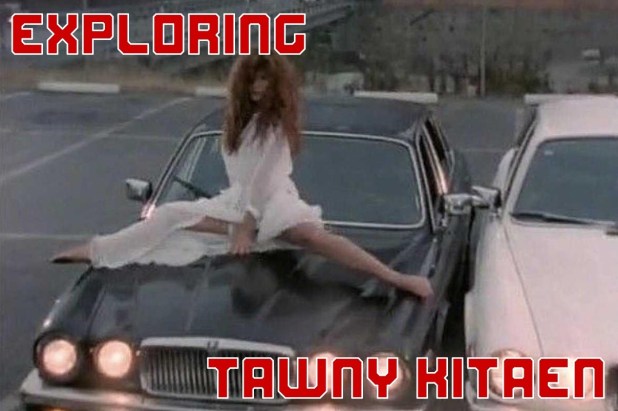
Exploring: Tawny Kitaen

When one mentions the name Tawny Kitaen (born Julie), the first image that pops into another’s head are the MTV memories of an enchanting “video vixen” oozing alongside David Coverdale in the videos for Whitesnake’s 1987 hits “Still of the Night,” “Is This Love,” and “Here I Go Again,” and then “Fool for Your Loving” and “The Deeper the Love” from their 1989 follow up album, Slip of the Tongue. But everyone seems to forget that, before her dating and eventual 1989 to 1991 marriage to David Coverdale, she got her start in rock videos with Ratt.

She started dating Ratt’s future guitarist Robbin Crosby in high school in their mutual hometown of San Diego, then traveled with the remnants of Mickey Ratt to Los Angeles. She came to appear as the cover model (that’s her rat covered legs) on the band’s self-titled EP (1983) and their debut album, Out of the Cellar (1984). Both album’s featured versions of “Back for More” and the subsequent video not only starred Tawny, but Nikki Sixx and Tommy Lee, who starred as two abusive cops. (The model on the cover, and in the video single “Lay It Down,” for Ratt’s sophomore album, Invasion of your Privacy (1985), was Playboy model Marianne Gravatte. She was the Playmate of the Month in October 1982 and Playmate of the Year in 1983.) With those Ratt covers and one rock video on her resume, as well as appearing in commercials for exercise guru Jack LaLanne’s European Health Spas, Tawny began her acting career.

She made her debut in a minor support role in the ABC-TV nighttime mini-series, Malibu (1983), alongside Susan Day and James Coburn (both also starred in Looker), and ubiquitous character actor William Atherton (Die Hard). She later returned to daytime serial television in the CBS-TV drama, Capitol (during its 1986 – 1987 final season), as the recurring Meredith Ross, then as Lisa DiNapoli during the 1989 season of NBC-TV’s Santa Barbara.

Nope. Not Ben Affleck. That’s Brent Huff!

Gwendoline, aka The Perils of Gwendoline in the Land of the Yik-Yak (1984)
Ah, yes. After catching our eye in Ratt’s “Back for More,” we, the dateless wee teen pups of the analog ’80s got our first major dose of Tawny Kitaen in her feature film debut — a softcore nudie ripoff of Raiders of the Lost Ark that, although it failed theatrically, found a home as an “after hours” programmer on HBO and Cinemax.

Look, if you want a film where Tawny’s captured and sold into white slavery, only to be rescued by Brent “Nine Deaths of the Ninja” Huff, then this is your picture. Oh, and like Sam said in his review: If you want all of the softcore shenanigans (yes, Tawny’s tied up along the way; this is based on the bondage-themed comics of John Willie, after all), you want the 105 minute European cut vs. the 87 minute U.S theatrical cut. Yes, since this movie isn’t all that great (IMO; it fared better with Sam), you do need those extra 28 minutes to hold your interest — even though it’s all courtesy of the French dude who gave us the successful soft-core romps Emmanuelle and Lady Chatterly’s Lover with Sylvia Kristel.

You can steam Tawny’s debut film on Amazon Prime.

Bachelor Party (1984)
So, back in the day — before his Oscar years — Tom Hanks, who made his acting debut in He Knows You’re Alone, became a pretty big deal courtesy of his starring role on the ABC-TV sitcom Busom Buddies and finding box office gold with Ron Howard’s Splash. So, in the wake of the success of Police Academy, Hanks hooked up with Broadway producer Bob Isreal for his brother Neil’s celluloid preservation of the wild bachelor party thrown by producer Ron Moler for Bob.

The plot, such as it is, concerns Tom Hanks’s Rick Gassko, a ne’er-do-well party animal who — to the dismay of his friends — is shanghaied by Tawny Kitaen’s Debbie Thompson. So, Rick’s best bud, Jay (Adrian Zmed), throws an epic bachelor party — with a bet Rick can’t remain faithful to Debbie. Complicating matters is the ‘ol evil, future father-in-law who recruits Debbie’s ex-fiancé to sabotage the nuptials. Light comedy of the non-Judd Apatow gross-out variety, as we say to wrap up a review, ensues (because we are, in fact, lazy, trope-laden, brain dead lazy journalists in the ol’ B&S cubicle farm).

As with Tawny’s debut film featuring a future action star in Brett Huff, one of Tom’s best-buddies, here, is soon-to-be-go-to-Cannon-action star Michael Dudikoff (Musketeers Forever) in one of his rare, non-action roles. And, if Tawny doesn’t get you through the turnstile, then the presence of the always welcomed Wendie Jo Sperber, surely will (she also starred in Neil Isreal’s next Police Academy-inspired romp, Moving Violations).

A well-deserved box office hit ($40 million against $7 million), Bachelor Party was buoyed with a great, new wave soundtrack tie-in featuring music by The Fleshtones, Oingo Boingo, Jools Holland and his Millionaires, and The Alarm (Vinyl). In the film, but not on the soundtrack was the first appearance of Wang Chung’s “Dance Hall Days.”

You can easily stream this on Amazon and Netflix.

California Girls (1984)
In 1965, the Beach Boys rose to the top of the charts with the song “California Girls.” Then David Lee Roth ditched Van Halen (check out our Exploring: Eddie Van Halen on Film tribute) to start his solo career with a hit cover of the song, which was first released on December 19, 1984 (the EP Crazy from the Heat was issued in January 1985). In between, ABC Circle Films, which released this Robby Benson (The Death of Richie) starrer as an overseas theatrical, issued it stateside as an ABC-TV movie in March 1985.

Also starring Martin Mull (FM) and Ernie Hudson (Ghostbusters) alongside Tawny, it’s a lighthearted drama concerned with Benson’s immature-to-dreaming New Jersey auto mechanic who ditches his girlfriend and heads to California to find the girl who stars in the California Girl cosmetics commercial (Tawny). And Robby’s mom is Doris Roberts from CBS-TV’s Everybody Loves Raymond. Does this all play a little bit like Saturday Night Fever — only without the disco and innocuous-suitable for the under 18-crowd? Yeah, a little bit.

Turner Classic Movies owns the rights, so no luck on any online streams — free or pay. And it’s never been released to DVD or Blu, either, but the VHS tapes are out there for the taking. We did, however, find the opening 10 minutes of the film on You Tube. Oh, and don’t confuse this with the 1983, new wave-inspired T&A comedy of the same name, about a sex-up T&A lovin’ disc jockey. And don’t confuse this film’s alternate title of California Dreams with the superior California Dreaming (1979), which stars Dennis Christopher alongside Glynnis O’Connor — who starred alongside Robby Benson in Ode to Billy Joe (1976).

Crystal Heart (1986)
If you’ve seen John Travolta in The Boy in the Plastic Bubble (how have we not reviewed that one), then you’re up to speed on this film’s musical slant of that same material — with Tawny’s rock star Alley Daniels falling in love with a songwriter afflicted with auto-immune deficiency syndrome (Lee Curreri of TV’s Fame) forced to live inside a plastic bubble, aka a crystal room, aka “heart,” as it were. It’s directed by TV series purveyor Gil Bettman (The Fall Guy, Knight Rider, and Automan), who directed one more feature with the James Bond spoof Never Too Young to Die, which starred soap heartthrob John “Uncle Jessie” Stamos (but we only cared that it starred Gene Simmons of KISS as the villain).

Not that it matters to your interest-cum-enjoyment of the film: If you’re into the six-degrees of film trivia: Glynnis O’Connor, who starred with Benson in Ode to Billy Joe, starred alongside John Travolta in The Boy in the Plastic Bubble. So, there’s that to mull over. Another mull to mull: Linda Shayne, who wrote this, also gave us two entries in the Canadian-made Screwball series and somehow turned and old Sheb Wooley song into a movie: Purple People Eater.

You can watch this oft-HBO programmer as a free stream on You Tube.

Instant Justice, aka Marine Issue, aka Madrid Connection (1986)
Tawny goes . . . Semper Doh! in this Michael Paré (Moon 44) vehicle shot in the British overseas territory of Gibraltar on Spain’s southern coast — and the film is noted as the first feature film shot on the location.

Now, we love Michael (who’s into Eric Roberts-mode these days with 30-plus films in various states of pre-production, filming, and post-production), but in this ’80s action pastiche of First Blood, Commando, and Missing in Action . . . Paré is no Stallone, Arnie, or Norris, which is this film’s raison d’être. To put it bluntly: Paré is the pits, here. “Top Gun Entertainment,” indeed, Mr. Copywriter. Indeed.

While he’s certainly been better on camera (Streets of Fire), and Tawny’s not showing us any of the skin we came for (and tries — woefully — to “act”), the blame for this inert action mess is solely on the shoulders Craig T. Rumar, who (if we believe the digital content warriors of the IMDb, came to manage the early careers of . . . Stallone, Arnie, and Fred “Hunter” Dryer) broke away from his managerial and producer duties to scribe this, his lone screenplay. And don’t go looking for the other works of director Denis Amar, whose resume is comprised of French-language films and TV series that never made it to the international marketplace. And with good reason.

Michael Paré is Sgt. Scott Youngblood, a rogue U.S. Marine who travels to Spain to find those who murdered his long-estranged sister — a victim of the evil (of course) drug runners who kidnapped her as part of their modeling agency that fronts as a prostitution/white slavery ring. He comes to rescue their latest victim (Kitaen) and takes a scored earth vigilante approach to revenge — with Kitaen stappin’ it on — to the cheesy, Z-Grade AOR ’80s stylings of Lea Hart with “Danger in the Streets.”

Not that it matters to your interest-cum-enjoyment of the film: Lea Hart, who got his start as a guitarist in Joan Jett’s band during her Bad Reputation to pre-Light of Day years, came to replace Dave King in (then washed up) Fastway — yes, the band that portrayed Sammi Curr in Trick or Treat. So, there’s that to mull over.

There’s no online streams, but here’s the overseas trailer on You Tube.

Happy Hour, aka Sour Grapes (1986)
So, you say you only know writer-director John De Bello for his Killer Tomatoes franchise (with movies in 1978, 1988, and 1992)?

Well, amid those one-joke veggie rants — made to less and lesser and lesser effect — here’s De Bello’s attempt at an ’80s T&A comedy, in a tale about a beer company chemist whose latest — and accidental — brew works like that ol’ Larry Cohen desert treat in The Stuff. Yep, anyone who drinks this strange brew becomes addicted. But since this is an ’80s comedy, they also become horny. (Where have I heard this chemical-makes-guys-horny plot before? I’m too lazy to look it up.)

Anyway, along the way, Tawny meets the down on their luck and slummin’ Rich Little (a HUGE ’70s impressionist noted for his frequent Johnny Carson appearances), as our “James Bond,” and Jamie Farr, as our master villain (who wished M.A.S.H never left the air). Wow. Even for an Eddie Deezen (Beverly Hills Vamp) flick, this is pretty bad . . . so bad that it gives the term “mugging for the camera” a bad name. Yeah, never a film — with Tawny sportin’ a Glock 9mm tucked in her bikini bottom — could be so bad. Sour Grapes, indeed.

You can enjoy this oft-run HBO ditty on You Tube, if you must.

Witchboard (1986)
Well, when it comes Tawny’s resume, this is really the whole enchilada, ain’t it? Next to Bachelor Party, this is her most successful and best-known film (one that cleared $8 million on a $2 million budget).

Well, okay, we, the wee dateless pups also loved Tawny for her works in the oft HBO and Cinemax-run Crystal Heart and Gwendoline, but when a studio casts her in a faux The Exorcist redux — complete with a Ouija board, before that now Hasbro-owned “toy” became a film franchise — everybody is going to see that movie — Tawny’s presence, be damned.

So, between the romantic triangle shenanigans of Tawny and actors Stephen Nichols (Patch from TV’s daytime drama Days of Our Lives) and Todd Allen (too many TV series to mention), they like to play with Ouijas and summon lost and lonely ten-year-old boy ghosts. And the ghost wants Tawny for a mommy. And Kathleen Wilhoite, aka Carol Ann the waitress from Road House, as a punk rock psychic, takes a header out a window for an impalement-by-sundial.

See, there’s something for everyone.

Yeah, this is — thanks to Kevin S. Tenney of Night of the Demons and Brain Dead fame — the best movie Tawny ever made. And you can watch it on Tubi.

Glory Years (1987)
Imagine a film that stunt casts championship boxer Larry Holmes, ’70s pop crooner Engelbert Humperdink, ’50s sex kitten Mamie Van Doren, ’70s comedian Avery Schreiber, and washed up ’60s comedian Joey Bishop — and then tosses in B&S About Movies beloved character actors George Dzundza, Tim Thomerson, Archie Hahn, Beau Starr, and Chazz Palmineri, along with Franklyn Ajaye, Donna Pescow, and Tawny Kitaen. Well, wait a minute . . . this isn’t a TV movie . . . this is a long-forgotten and short-lived HBO series that aired in 1987 and later compiled into a whopping two and a half-hour programmer for the home video market.

The series followed the Las Vegas exploits of three reunion-bound high school buddies (Dzundza, Thomerson, Hahn) who, in trying to increase their school’s alumni fund to create a bigger bash, loses it on the crap tables; they spend the rest of the series trying to win the money back — as comedy, again as we say to get it over with, ensues.

You can stream this on Tubi.

White Hot, aka Crack in the Mirror (1988)
Remember, in the wake of Quentin Tarantino making a splash with Reservoir Dogs (1992), when everyone tried to make their own “Tarantinoesque” knock off? Remember when the Q was then replaced by filmmakers evoking the Coen Brothers’ Fargo (1996) to lesser and lesser effect? Well, before the Q and the Coens, Robert Madero — who gave us Ulli Lommel’s Blank Generation (1980) and Mausoleum (1983) — took his “crack” at it with this . . . crack addiction . . . comedy . . . uh, morality tale . . . er, drama.

Of course, Robby Benson, who seen “something” in Madero’s script, decided this would be perfect fodder for his feature film directing debut. And he called up his old California Girls co-star Tawny Kitaen to be his female lead (complete with the biggest hair, ever). This is a film where you say, “Thank God, Danny Aiello is here,” then you realize Danny’s presence as the ubiquitous, drug-pushing Italian gangster doesn’t help — at all.

As with Tawny’s Gwendoline back in 1984, our exposure to this not-so-erotic thriller was result of it airing nights on Cinemax. Yes. We said “erotic thriller” — one that stars and is directed by by Robby Benson — with Benson and Kitaen expanding their thespin’ skills as a coke-addicted yuppie couple. To finance their dreams of having a family, Benson takes a job with Aiello’s drug kingpin that he’s indebted to, and sees his life fall into a temptation-laden tailspin, one rife with Coen-styled noir double crosses and Tarantinoesque loopy characters.

So . . . somewhere in this thespin’ mess is a morality tale, with characters named The Tin Man and The Wiz (take that subtext as you will), which wants to be a gangster tale of the Goodfellas (1990) variety (and Tony Sirico, aka “Paulie Walnuts” on HBO’s The Sopranos, is here as an Aiello henchman), but fails to . . . well, it fails at everything it attempts to convey. Sorry, but if Tommy Wiseau made a “serious drama” about crack addiction — that subsequently turned into an unintentional “dark comedy” — White Hot would be it. Only without the Wiseau charms, but better acting than a Wiseau joint.

Sorry, no streams. And no DVDs or Blus, either. But the VHS tapes are bountiful in the online marketplace, so go for it, Dorothy.

Hercules: And the Circle of Fire/In the Underworld/In the Maze of the Minotaur (1994)
Sam Raimi, wearing his producer’s hat, made an excellent choice with his prefect casting of Tawny Kitaen — who is very good, here — as Deianeira, the girl of Zeus’s dreams (played by Anthony Quinn!). Her Herc flicks are three parts of a five-movie miniseries, which takes place before the timeline of the syndicated Hercules: The Legendary Journeys series, which ran from 1995 to 1999. The other two films in the series — parts one and two, sans Tawny — are And the Amazon Women, and And the Lost Kingdom, if you need ’em. And Tawny would also appear in the subsequent series every now and then.

The movies — and series — are easily streamed on numerous digital platforms.

Playback (1996)
Nothing says “soft core erotic thriller” more than Shannon Whirry (okay, well Jewel Shepard, too). Shannon, who made her featured film debut alongside Steven Seagal in the mainstream legit Out for Justice (1991), found her niche in a slew of Cinemax “After Dark” programmers with titles such as Body of Influence (1993), Mirror Image II (1993), Animal Instincts II (1994), and Private Obsession (1995). (Be sure to check out our overview of the genre with 1994’s Disclosure and the and the Exploration of the “Erotic Thrillers” of the ’90s featurette.)

So, in keeping with the rock video beginnings of Tawny’s career, the director here is Oley Sassone, who got his start directing mid-to-late ’80s videos for the Romantics, Mr. Mister (oh, frack me; the bane of my existence), Autograph, and Wang Chung (ugh, not them again). Marvel Comics fans know Oley best for his directing the Roger Corman tax shelter-cum-rights holding first stab at The Fantastic Four (1994).

So, how in the hell did George Hamilton and Harry Dean Stanton end up in a film produced by Playboy? Well, that’s not why we’re here, remember? We are here for Tawny Kitean — who kills the trope that women who wear glasses aren’t sexy . . . and makes us loose it when she shows up in a push-up bra. (For the record: Tawny goes full nude, but that’s probably a body double; meanwhile Shannon, who we expect to give us a peek, never drops a thread.)

As is the case with these Cinemax romps, the Z-Grade noir is the thing, so we get the usual web of lies, deception, and sex club-made sex tapes ready-for-blackmail, and, in this case, corporate espionage, but wow . . . for a Playboy-financed production made for after hours pay cable spins, where’s the sex scenes? And what man (Charles Grant of Chuck Norris’s The Delta Force and David Carradine’s P.O.W the Escape), regardless of his executive stresses in organizing a major telecom merger and having Harry Dean’s private dick on his tail (employed by slimy CEO George Hamilton, natch), would reject the likes of Tawny Kitaen, only to go to strip clubs with his work buddies — and even consider the seductive advances of femme fatale executive Shannon Whirry?

Eh, it’s all put together well enough, but this is truly for Tawny completists only. Nope, sorry. There’s no free or pay online streams on this one — at least not on sites I’d trust clicking though. But the VHS tapes abound on Amazon and eBay.

Dead Tides, aka White Tides, aka Swept Away (1996)
Sure, Roddy Piper was acting to lesser and lesser effect after the highs of Hell Comes to Frogtown and John Carpenter’s They Live, with such C-Grade action fodder as Resort to Kill (1992), Back in Action (1993), and No Contest (1994), but I kept on renting them: for I love Roddy.

Such is the case with his role as Mick Leddy, a down-and-out ex-Navy Seal who takes a captain’s seat on a pleasure cruiser for a crime lord (the always fine, ubiquitously crazy Juan Fernandez) — and falls down a noir spiral by way of the deceptive charms of the lord’s wife, played by Tawny. The wrath of the drug lord’s minions and the DEA, as we say to just get it over with, ensues.

Next to Bachelor Party and Witchboard, this is my next favorite of Tawny’s flicks. And that’s thanks to the fact that, regardless of Roddy’s presence, Dead Tides isn’t a balls out action flick, with Roddy pulling it back (and trying) to play the role of a noirish, water rat schlemiel — only not as spineless as the usual noirish, land lubbin’ loser (like Fred MacMurray in Double Indemnity, for example).

Now, that’s not saying this Kitaen entry is any good, it ain’t, as your own nostalgic miles for all things WWE — and ex-rock video babes — may vary. But writer and director Serge Rednunsky, an ex-associate of Russian ballet dancer Mikail Baryshnikov, must be doing something right, as he’s made 40-plus adult noir-cum-erotic thrillers and his productions have never lost a dime. And he’s still making them.

No streams for Dead Tides, but we found the trailer on You Tube.

After Midnight (2014)
Hell, yeah! Two movies with Tawny tuckin’ Glocks down the bikini line. We ain’t hatin’. And, well, you know us and Fred Olen Ray (search our database; we’ve reviewed a lot of his works) around the ol’ B&S About Movie cubicles: this is an instant watch. And when you get Richard Grieco in the “erotic thriller” bargain, what’s not to like? Well, everything, but Olen Ray and the ol’ Grieco (Inhumanoid, The Journey: Absolution) get wide berths in the Three Rivers’ confluence.

Yeah, sure, the minute one says “strippers,” another thinks of the stripper pole noirs Showgirls (1995) from Paul Verhoeven and Striptease (1996) starring Demi Moore. And as with those adult T&A romps, murder and mystery is adrift in a sea of red herrings as a TV newscaster (Catherine Annette) goes undercover in the erotic worlds of adult entertainment to investigate the murder of her ne’er-do-well stripping sister. However, considering Olen Ray has made more than his share of Lifetime thrillers, while the directing is solid enough against the budget, this is all pretty lightweight with less gratuitous T&A that we expect from a direct-to-video thriller.

No free streams, kiddies, but you can watch it on You Tube for a fee, which also carries the trailer.

Come Simi (2015)
While this is, without a doubt, the least-seen film of Tawny Kitaen’s career (I never heard of it until being assigned this “Exploring” feature), it’s also the best-made of her career — courtesy of writer-director Jenica Bergere in her feature film debut. Bergere certainly isn’t a household name (and an acquired taste; thus the vanity of this project), but once you’ve seen her face, you’ll recognize her from her numerous (comedic to dark comedic) network and cable television acting gigs since the mid-’90s, on shows such as Grey’s Anatomy and Shameless, as well as the surprise low-budget sci-fi indie hit, Safety Not Guaranteed (2012).

However, since this is a vanity-cum-industry showcase to better thespin’ things for our writer-director: Bergere also stars (as a loose version of herself) as a neurotic, pregnant actress on a quest to reunite her estranged, dysfunctional family before the birth of her first child. So she packs up her terminal and wheelchair-bound, Alzheimer-stricken mother for a road trip to Simi Valley to visit her mother’s obnoxious sister. Tawny — with obvious, visible plastic surgery work by this point — stars as Dee-Dee, Bergere’s aging porn star sister.

Hey, it’s pretty cool to see Tawny in a sweet, sentimental indie dramedy — and you can stream for free on Tubi, so what’s to hate, when it’s free? Come on, do it for Tawny, will ya? She’s actually very good here, IMO, and nails the porn actress role — and gives it some nice, non-trope (damn it, used the “t” word, again) layers. You can watch the trailer on You Tube. (Oh, and if you’re keeping count, we used the “e” word, aka “ensues,” six times. Doh!)


Julie E. “Tawny” Kitaen
August 5, 1961 – May 7, 2021

Heaven just got a little bit louder . . . and a whole lot sexier.

And the wolves are howlin’ . . . in the still of the night.

About the Author: You can learn more about the writings of R.D Francis on Facebook. He also writes for B&S About Movies.

Scavenger, aka Carroña (2021)

Carroña is Spanish for “carrion,” a word that defines the decaying flesh of dead animals. In Spanish cultures the word is also used as a slang to describe others as a “scum” or “low life.” And this stellar — but gratuitously graphic — Argentina-shot feature film debut by co-directors and writers Eric Fleitas and Luciana Garraza — along with writer Sheila Fentana — for only $10,000 (?!), is filled with scumbags. And meat . . . lots of meat. And the meat in this world — that the film’s marketing materials describe as Mad Max meets Natural Born Killers — is human.

While that tagline is accurate, one can also describe Carroña, retitled as Scavenger for the English speaking markets, as an ’80s-styled slasher antagonist set loose in a post apocalyptic world.

We witness the beginning of the world’s downfall as a family enjoys a chicken dinner birthday celebration for their youngest daughter, Laura. On a television, her father grows concerned over reports of the collapse of their country’s government as their city falls under the control of rioters and vandals (sounds all-too current and 2020 familiar). Then a bandit violently bursts into the home and slaughters the family.

Years later, the lone survivor of the attack, Laura’s older sister, Tisha, now lives a leather-clad, Max Rockatansky existence in the wastelands — complete with a super-charged black car. To make her way in the new world, Tisha works as an assassin for hire and sidelines as “gut hunter” for an organs merchant (writer-director Eric Fleitas). And she has no reservations in slicing up the pigs (i.e, men) in this new world that views women as a “cunt or a corpse.” After a harvesting, Tisha then sell the leftovers to a market kiosk serving up “100% meat” to its customers who, themselves, will probably become the next serving. The endgame to her post-apoc extracurricular activities: Tisha’s financing her hunt of the brutal cartel that murdered her family.

When Tisha is offered a new contract by a dying, mutilated victim — and realizes the target is the animal that slaughtered her family all those years ago — she hits the road to “fuck up” her latest sanction. When she confronts her target inside the brothel Paradise, the tables turn as she comes a bondage-sex victim at the hands of Luna, the bar’s seductive and deadly lead dancer, and Roger, the club’s owner.

Do the tables turn. Oh, you’re damn right they do. And violently so.

While inspired by The Road Warrior, this Argentinian import was independently shot without studio interference, so this isn’t your pop’s Mad Max or Jason Voorhees. Scavenger — although rife with amazingly slick-cum-grungy production values on its $10,000 budget (?!), it’s a rough film; a very graphic film overflowing with organ extractions, cannibalism, sex trafficking, and a society perpetually victimized by abuse at the hands of perverts and rapists — very, very violent rapists that are only implied in Hollywood’s A-List Mad Max-verse, but shown in full color (in a shot that seems to go on forever and rivals the “forever” rape scene in The Redeemer). If you thought you cringed at the tasteless, homosexual rape scene of Scorpion by “The One” in Enzo G. Castellari’s post-apoc’er Warriors of the Wasteland, then watching a rapist attach various dildos to vaginally, then anally, rape Tisha, your stomach will turn. You’ve been warned.

But aside from the ’70s-styled violence that takes us back to Wes Craven’s Last House on the Left, what Eric Fleitas and Luciana Garraza accomplished on their micro-budget — from set design, to costuming, and to securing the services of finely-skill actors, is amazing — and I look forward to their next film.

Released in its native Argentina and other overseas markets in 2019, Scavenger will be released in an English-language dub by 1091 Pictures and Cleopatra Entertainment in the U.S. on May 4, 2021. You can view the trailer and watch the film direct at its page on the 1091.tv website and scroll through additional production and film stills at the film’s official Facebook page. You can view more of 1091 Pictures’ roster of films at their trailer hosting page on You Tube. We previously reviewed the Cleopatra Entertainment releases Mean Mean: The Story of Chris Holmes, Street Survivors: The True Story of the Lynyrd Skynyrd Plane Crash, and Glenn Danzig’s Verotika, as well as the 1091 Pictures releases Alice Fades Away and Space.

Disclaimer: We didn’t received a screener from the studio’s P.R. firm. We purchased the film on our own. That has no bearing on our review.

About the Author: You can learn more about the writings of R.D Francis on Facebook. He also writes for B&S About Movies and publishes short stories and music reviews on Medium.

Chunking Express (1994)

Chungking Express, while released in 1994 in its native Hong Kong, received a limited theatrical run in North America in 1996—courtesy of Quentin Tarantino’s Rolling Thunder. The imprint’s subsequent DVD features bookmark-commentary vignettes by Tarantino discussing Wong Kar-wai’s body of work. Criterion Collection reissued Chungking Express film to DVD in 2008, but the Tarantino accouterments are not included.

The story concerns the love and loss of two Hong Kong Policemen: “Cop 223” (Takeshi Kaneshiro) and “Cop 663” (Tony Leung). In the first tale, Kaneshiro’s obsession over his recent breakup leads to his romantic involvement with a drug smuggler. In the second tale, Leung deals with the breakup of his flight attendant girlfriend and he begins to travel the wrong path. Both are linked by their mutual relationship with Faye (played by the “Heavenly Queen” of Chinese/Canto-pop, Faye Wong) who works at the Midnight Express food stand.

In collaboration with the Criterion Collection, Wong Kar-wai and L’Immagine Ritrovata spent five years on the 4K restoration of a newly released version of Chunking Express—as well as Kar-wai’s Fallen Angels, Happy Together, and In the Mood for Love. Sony Classics also assisted in L’Immagine Ritrovata’s restoration of Kar-wai’s 2046.

It was an honor for Andrew Quinn and Darren Mooney—the hosts of the Ireland-based film blog, The Movie Blog—in crediting B&S About Movies (out of Pittsburgh, natch) with our “Exploring: The 8 Films of Quentin Tarantino’s Rolling Thunder Films” as a resource in their review Wong Kar-Wai’s In the Mood for Love (2000). While we have not reviewed that film from the Kar-Wai canons, we did review Onna No Kappa (2011).

Tony Leung and Faye Wong also star in Chinese Odyssey 2002, which was produced by Wong Kar-wai. He’s currently in production on a sequel to Chunking Express: Chunking Express 2020.

As for the original Chunking Express. Watch it. Then watch it again. It’s perfection. Well, why listen to me, let the Q tell it. He’ll do it a hell of a lot better than I can. I know when to step aside for a fellow ex-video store jockey.

About the Author: You can learn more about the writings of R.D Francis on Facebook. He also writes for B&S About Movies.

The Mighty Peking Man (1977)

The Mighty Peking Man is a 1977 monster film whose Mandarin title, Xingxing Wang, translates as “Gorilla King” in English (let’s forget the dopey U.S. title of Goliathon). Yep, you guessed it: made to cash in on the 1976 King Kong remake. While Quentin Tarantino’s Rolling Thunder imprint reissued the film in 1998, MPM initially rolled out as a second-biller on the U.S. Drive-In circuit in 1980. It’s the same old story—only told with tongue firmly planted in cheek—featuring greedy explorers who exploit a very large Himalayan Yeti—with a twist: Peking Man raised a beautiful, Tarzaneque woman orphaned in a plane crash who pals around the jungle with a pet leopard. The climax: The Peking Man takes a header off Hong Kong’s Jardine Tower in a hail of helicopter gunfire and jet bombers.

And that Roger Ebert “Thumbs Up!” on the VHS sleeve ain’t no scam: it’s the real deal, as he sites MPM as his “favorite Hong Kong monster film.” And mine too, Rog. Mine, too, as it’s a very well made film. And it should be, as The Mighty Peking Man had a budget of six million Hong Kong dollars under the Shaw Bros. studio (Corpse Mania). The film took over a year to complete—and that time and care shows, in spades—and it was shot in Mysore, India.

While I love it equally, the Shaw Bros. didn’t fair as well with their Hammer Studios co-production of their martial arts vamps going against Peter Cushing’s vamp hunter in The Legend of the Seven Golden Vampires. Their other co-production—the lesser known Shatter—was intended as a weekly TV series, but ended up being a theatrical film dovetailed into the U.S. martial arts drive-in craze of the mid-70s. Oh, and Roger Ebert enjoyed The Mighty Peking Man so much that he re-watched—22 years later and upped on his two and a half star review, for—the Shaw’s 1975 release, Infra-Man. That’s the power of the Q: you gotta love it. And when it comes to Hong Kong cinema, none meets the power of the Shaw Bros.: you gotta love it. As you will this film. Pure awesome.

In a production twist only a B&S Movies reader can love: Koichi Kawaktia, MPM’s assistant director, later worked on Yonggary, the 1999 South Korean remake by Hyung-rae Shims of Yongary, Monster from the Deep (1967). Yonggary ’99’s co-scripter is Marty Poole, who wrote the 1997 Richard Lynch-fronted Rollerball homage, Ground Rules (oh, you gotta watch that film!!).

There’s a lot of online opportunities to watch The Mighty Peking Man, but you know us: we always try to find you the freebie. So watch it on You Tube. It’s campy, it’s whacked, it’s funny and entertaining. Strap on the popcorn bucket and snap the caps off the Dr. Pepper sixer and roll it. It’s the perfect “must watch” of this week’s “Hong Kong Week” tribute of reviews to pencil into your schedule.

Don’t forget that you can learn more about the Q’s Rolling Thunder imprint with our “Exploring: The 8 Films of Quentin Tarantino’s Rolling Thunder Pictures” featurette.


Reissue Update: Here we go with another Delirium, UFO: Target Earth, and Calamity of Snakes surprise, again! In this case we were simple scratching a movie off of our above noted Quentin feature . . . or was it our “Planet of the Apes” tribute week . . . no, wait, it was for our “Kaiju Day Marathon” . . . and months later, a DVD restore was announced for release in December 2021. (Duh, it was for our “Hong Kong Week” of films. Hey, gotta work in the links.)

Yes! A reissue of The Might Peking Man is now available as part of Arrow Video’s “Shaw Scope” box set, in this case, Volume One. You don’t want the box set and you’d rather stream it? No worries. It’s also available on the Arrow Player service.

This new Arrow version of The Mighty Peking Man features the film in both uncompressed Mandarin and English original-mono audio, as well as newly translated English subtitles for the Mandarin audio, plus English hard-of-hearing subtitles for the English dub.

The new features also include: A new commentary track by Travis Crawford, a new interview with suit designer Keizo Murase, a 2003 iInterview with director Ho Meng-hua, a 2004 interview with star Ku Feng, a behind-the-scenes vignette of Super 8 footage from the archives of Keizo Murase, an un-restored standard-definition version of the film, alternate opening credits from the U.S.-version of The Mighty Peking Man, known as Goliathon, trailers from the Hong Kong and U.S., German and Dutch versions, as well as the U.S. TV commercial (Oh, boy, I remember seeing that on TV!), and a stills-image gallery.

You can purchase the Shaw sets from MVD.

Streaming online: You can also stream The Might Peking Man by visiting ARROW to start your 30-day free trial. Subscriptions are available for $4.99 monthly or $49.99 yearly. The ARROW Player is available in the U.S. and Canada, the U.K. and Ireland on the following Apps/devices: Roku (all Roku sticks, boxes, devices, etc.), Apple TV and iOS devices, Android TV and mobile devices, Fire TV (all Amazon Fire TV Sticks, boxes, etc.), and on all web browsers at at Arrow Player.com.

About the Author: You can read the music and film reviews of R.D Francis on Medium and learn more about his work on Facebook. He also writes for B&S Movies.