Oh, call it what you will, you ol’ ’80s “Midnight Movie” and VHS-renting road dogs: Mondo Cannibale, CannibalWorld, Cannibals, White Cannibal Queen, A Woman for the Cannibals, or Barbarian Goddess. All we known is that, once again, Jess Franco, casts himself as the patron saint of the video nasty, as he sticks his hands into the boiling native vats and fucks up a genre. While shooting, this soon-to-be U.K.-banned ditty was titled Rio Salvaje, aka Wild River, probably as an ersatz sequel to Umberto Lenzi’s 1972 progenitor, Man from Deep River. As if we’d be duped by a Franco joint.
White Cannibal Queen
Ah, the VHS clamshell sleeve I remember. Heaven.
On the plus side: Franco gives us the always welcomed Al Cliver (The Beyond) and Sabrina Siani (Conquest and The Throne of Fire). According to Franco, he did this movie and fellow cannibal romp Devil Hunter (1980) for the money and had no idea why anyone would enjoy these films. (Is it just me, or does Franco have a lot of those type of films in his career? He said the same thing about his NaziZom rip, Zombie Lake.) Franco also went on record that Sabrina Siani was the worst actress he ever worked with and that her only good quality was her “delectable derrière.”
Whatever, Jess. Pedophilic Pig.
However, to Franco’s credit, he does change it up a bit: Instead of looking for the usual lost tribes or oil, or whatever vegetable or mineral MacGuffin we need to steal from a peaceful native tribe to make a better life for the white man, our civilized man — with one arm, who lost it during the first expedition — returns to the jungle where he lost his family to rescue his now teenage daughter — who’s become the blonde white cannibal queen of the tribe.
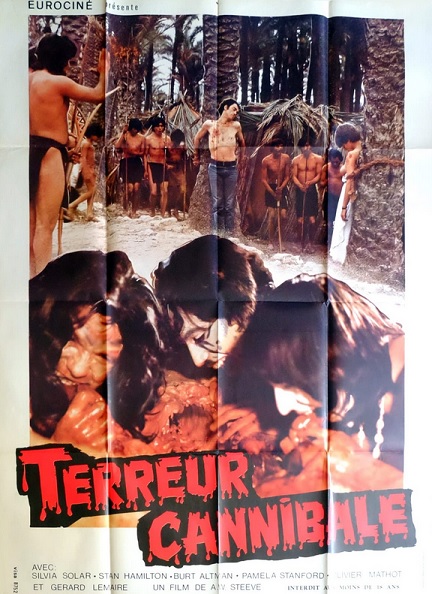
Cannibal Terror
It’s another Jess Franco joint: it’s different, but the same.
Now, don’t let Jess Franco bamboozle you with Cannibal Terror, aka Terreur Cannibale (1981). While Franco penned the script, it’s actually a way-too-late French entry into the genre directed by Alaine Deruelle, and not a repack of White Cannibal Queen, aka Mondo Cannibale. But it does raid that Franco film for stock footage. As result, we see Sabrina Siani, the White Cannibal Queen, while not starring in the film, appearing in a bar scene (oops); several shots of the dancing cannibals from Franco’s film are redux, here; a background actor (said to have a distinctive, Mick Jagger-type face) appears in three roles, here: as two cannibals, a border guard, and a third cannibal eating Al Cliver’s wife; the guitar player at the bar, here, found Al Cliver after he had his arm cut off in White Cannibal Queen (oops).
White Cannibal Queen and Cannibal Terror also share actors Olivier Mathot and Antonio Mayans, both whom have starring roles, as well as porn actress Pamela Stanford, who has a major role in Cannibal Terror, but a support role in White Cannibal Queen by way of stock pillaging. The leading woman change up is Silvia Solar from Umberto Lenzi’s Eyeball(1975).
As far as the “plot” goes in the French remake/ripoff: Two criminals take their kidnapping victim to their partner’s jungle hideaway. The local cannibal tribe hunts them down one by one.
Devil Hunter
Where I have I seen you before? Oy! Another Jess Franco cannibal joint!
And don’t let Jess Franco hornswoggle you with Devil Hunter (1980), aka, Sexo Canibal, The Man Hunter, and Mandingo Manhunter, for he is director Clifford Brown and writer Julius Valery, incognito; his second wife, Lina Romay, co-directed, while his first wife, Nicole Guettard, edited.
And since Devil Hunter was shot back-to-back with White Cannibal Queen, Al Cliver returns in the leading hero role. And Antonio Mayans, from it’s-not-Franco’s-film-but-it-is Cannibal Terror, returns as Cliver’s co-star. The change up, here, is that Ursula Buchfellner, a German model who became Playboy magazine’s “Playmate of the Month” in October 1979, stars as our resident damsel-in-distress. Did you see the Euro-adult comedies Popcorn and Icecream (1979), Cola, Candy, Chololate (1979), and Hot Dogs in Ibiza (1979), and Jess Franco’s women-in-prison romp Hellhole Women, aka Sadomania (1981)? Well, now you know four more Ursula Buchfellner’s films than most (normal) people. Do you feel blessed by B&S?
As far as the “plot” goes, well, it’s pretty much a retread of Cannibal Terror: After the kidnapping by white bandits of a top model/actress (Buchfellner) on a jungle shoot/location scouting trip, an ex-Vietnam vet (Cliver) and his mercenary pal (Mayans) head into the deep jungle of the island nation to rescue her, not only from the kidnappers, but from cannibals who worship a “Devil God.” And (snickering) the “God” is a tall African dude with ping-pong eyes falling out of his head.
And get this: Jess Franco claims the makers of Predator stole their idea from this movie.
Whatever, Mr. Franco. Ye who commits celluloid theft, himself.
Needless to say: All of the stock footage padding from White Cannibal Queen and Cannibal Terror, along with the expected Franco-sleaze, and awful dubbing, is back — to lesser . . . and lesser effect. Wow, Jess, thanks for making White Cannibal Queen look even better than it’s allowed to be. But it does “splatter” nicely to make the U.K.’s “Video Nasties” list, which is the whole reason we’re reviewing this film this week for our “Video Nasties Week.”
So, there you go. Now you’re an educated Euro-cannibal flick consumer in-the-know that Cannibal Terror and Devil Hunter aren’t alternate titles to White Cannibal Queen, but three distinct — as distinct as a Franco joint can be — separate films . . . that are different, but the same. Sorta. Kinda. Oh, Franco!
But you know Franco: He’s a magnificent, maniacal bastard and we love him for it. What would our youth have been without Franco flicks and Venom tunes?
We did a whole week of cannibal films with our “Mangiati Vivi Week” tribute back in February 2018. You can also learn more about the genre with our review of the documentary Me Me Lai Bites Back (2021). And there’s more “nasties” to be found with our “Section 1,” “Section 2,” and “Section 3” explorations.
You can purchase White Cannibal Queen from Blue Underground or watch it as a free-with-ads-stream on Tubi.
You can purchase Cannibal Terror from 88 Films or watch it as a VOD on Amazon Prime.
You can purchase Devil Hunter from Severin Films or watch it as as free-with-ads-stream on Daily Motion.
Update: In January 2023 we rolled out our Jean Rollin-uary month of reviews. If you’re not familiar with Rollin’s works, click through and check them out. Oh, yes! If you do a month of Jean Rollin, you must do a month of Jess Franco! February 2023 was our “Jess Franco Month.”
About the Author: You can read the music and film reviews of R.D Francis on Medium and learn more about his work on Facebook.
As Sam the Bossman pointed out in his review of Cannibal Holocaust: Jungle Holocaust is where Ruggero Deodato cut his teeth on the human flesh eating film — bringing along Me Me Lai (her second of three cannibal flicks; the first was Umberto Lenzi’s Sacrifice!; the final was Lenzi’s Eaten Alive!), Ivan Rassimov (also of Eaten Alive! and The Humanoid) and Massimo Foschi, (the Italian voice of Darth Vader, 1977’s Nine Guests for a Crime) — and pretty much cemented the genre with that film’s 1980 release.
Jungle Holocaust was originally slated to be directed by Umberto Lenzi as a follow up to his cannibal flick progenitor, Man from Deep River (1972). Depending on how you consumed Jungle Holocaust, as an ’80s “Midnight Movie” or home video rental, it’s also known as Ultimo mondo cannibale, aka Last Cannibal World, Cannibal, and The Last Survivor.
Nice deal, Code Red.
So, what can we possibly say — as with our reviews of Night of the Living Dead and Dawn of the Dead — about this film that hasn’t already been said by others, ad nauseam? However, for site prosperity — in our quest to catalog all things “video nasty” (this made it to the U.K.’s “Section 3” list) and “cannibal,” and with this being our “Video Nasties Week” tribute — let’s rip it open.
As in the 1976 King Kong remake (ugh), the greedy search for black gold sets off our horrific chain of events. When two oil prospectors and their team travel to a company outpost on the island of Mindanao in the Philippines, their plane sustains damage from a rough landing. Then they discover the camp abandoned — with rotted human remains.
Then the “ensues” that we expect from cannibal flicks, begins: A team member goes missing. Booby traps — such as a large mace — are tripped. A raft built to escape down river, falls apart. People are separated. People are eaten. “Death Cap” Amanitas are foolishly consumed. People puke. There’s leech-sucking body bathing. There’s civilized human-on-native rape. People are captured, stripped, and forced to eat rotten, raw animal entrails and internal organs. There’s more cooking and consuming of humans. Cobra-venom laced spears fly. Civilized humans take to eating livers. Two men survive. One man dies.
Ah, the ratty cardboard sleeve VHS I remember. Heaven.
While shocking in my “Midnight Movie” days and 5-5-5 VHS-binging weekends with my fellow ne’er-do-well brothers reading all things Circus and Fangoria, revisiting Jungle Holocaust all these years later — and applying my now hipster-critical eye — once you take away the shock value, this really isn’t a very good movie.
Sure, it’s nasty as hell and fucking savage: but that’s all it is. There no real story or characters to latch onto. There’s barely any dialog and what dialog there is, the dub stinks. So it’s just a whole lot of running around in the jungle. There’s no deeper meaning, no takeaway from the film concerning the state of modern man invading lands — as in Werner Herzog’s superior Aguirre, the Wrath of God — that he shouldn’t; the modern vs. native juxtaposition isn’t explored.
But, being the critical hipster hypocrite that I am, I still love it; for it is the sweet smell youth.
Man, being old sucks the offal.
Ronin Flix reissued Jungle Holocaust and it’s sold out, but copies are still available in the online marketplace via other retailers. You can learn more about the Blu-ray’s technical aspects at Blu-ray.com. Sorry, no freebie streams to share. Yeah, there’s some overseas streams, but when it looks sketchy, don’t hyper that link, my friend.
We did a whole week of cannibal films with our “Mangiati Vivi Week” tribute back in February 2018. You can also learn more about the genre with our review of the documentary Me Me Lai Bites Back (2021). And there’s more “nasties” to be found with our “Section 1,” “Section 2,” and “Section 3” explorations.
About the Author: You can read the music and film reviews of R.D Francis on Medium and learn more about his work on Facebook.
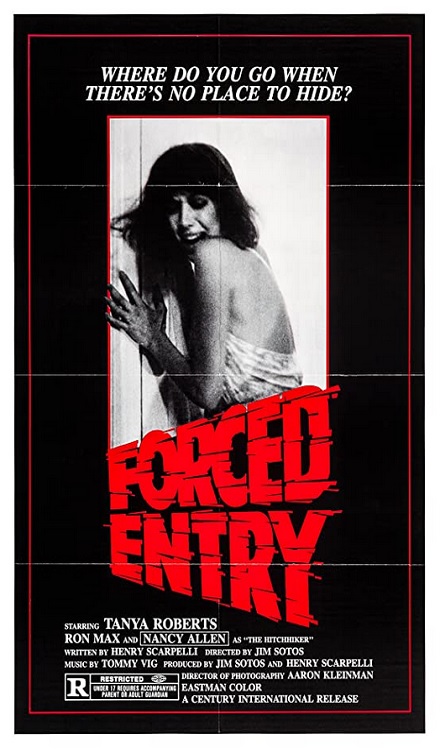
Yeah, we know this 1975 celluloid nasty isn’t officially on the U.K.’s “Video Nasties” three-part section lists that we are covering this week, but this big screen acting debut by Tanya Roberts — a commercialized, mainstream remake of the X-rated adult film/grindhouse’er Forced Entry (1973) — was none the less refused a U.K. cinema certificate in 1982.
That 1982 theatrical release — which also found a home on U.S. screens of the slowly dying drive-in era — came result of Tanya Roberts scoring the biggest roles of her career: ABC-TV’s Charlie’s Angels in 1980 and a theatrical hit with Don Coscarelli’s The Beastmaster (1982). Initially playing to drive-in audiences throughout 1976 under the title of its inspirational predecessor, Forced Entry returned to drive-ins with a post-Halloween slasher marketing make-over. The “madman” adjective in the copy under The Last Victim title was added to carry through the très chic faux-giallo/slasher connection — considering a slasher interpretation of the New York-based Cropsey urban legend, Madman (1982), rolled out on screens beginning in January.
Sadly, in a post-Charlie’s Angels world, the 93-minute original, first released in October 1975, was cut-down to 75-minutes; then to a third-time 72-minute edit in 1982 to pull a PG-rating to further capitalize on Tanya Roberts’s stardom. That cleaner theatrical cut was the result of fellow pin-up Barbie Benton experiencing box-office slasher success with Cannon Films’ Hospital Massacre (1982) released in July. The subsequent home-VHS, while nasty and rough, was “cleaned up” yet again, at 88 minutes — with Tanya’s more violence scenes truncated and Nancy “Robocop” Allen’s violent rape scene excised from all post-1975 versions.
So, who in their right mind would attempt “commercializing” a porn film into a Wes Craven’s The Last House on the Left (1972) cash-in clone?
We’ve dropped Jim Sotos a few times at B&S About Movies, by way of his directing the ’80s slasher Sweet Sixteen (1983) starring Bo Hopkins, and producing the adult film-connected hicksploitation romp Texas Lightning (1981). That “adult” connection comes by way of Adult Video News Hall of Fame filmmaker Gary Graver hired by Sotos as director. Sometime aka’ing as Robert McCallum, Graver made over 130 adult films, such as Amanda By Night, Coed Fever, and Suzie Superstar. One of his flicks, Unthinkable, won the AVN Award for “Best All-Sex Video” in 1985 (meaning it, as did most porns, had no plot).
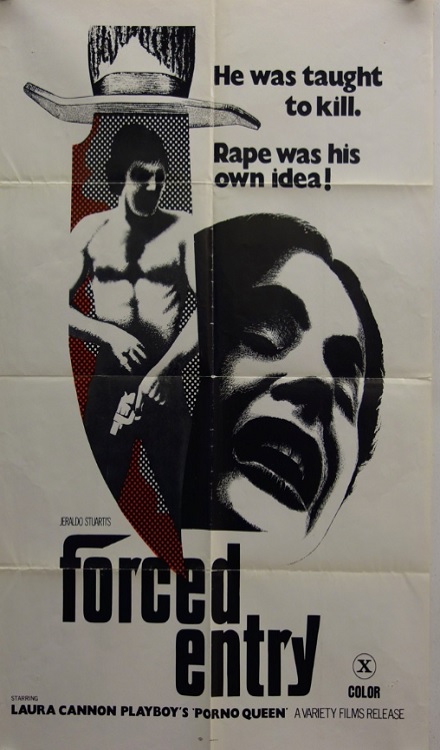
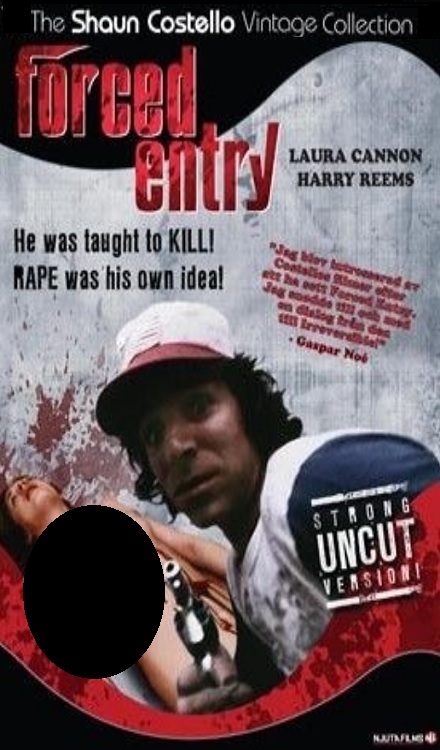
Here, Jim Sotos gives an R-rated makeover to porn purveyor Shaun Costello’s X-rated Forced Entry (1973). Starring adult film superstar Harry Reems, that film also aka’d as The Last Victim during its later behind-the-beaded curtain video shelf life in some quarters. (Costello also moved into the non-porn area and Romero zombiedom with Gamma 693.) For the remake, in place of adult actresses Laura Cannon (star of numerous Playboy loops; aka Laurel Canyon of 1972’s Wrong Way, itself a U.K. “video nasty”), Ruby Runhouse and Nina Fawcett, we get Nancy Allen — in her second film after working with Jack Nicholson in Hal Ashby’s The Last Detail (1973) — and a future Charlie’s Angel, well, not until she got past the likes of Tourist Trap (1979) and the David Winters-directed adult comedy, Racquet (1979).
The Shaun Costello original — his feature film writing and directorial debut after making porn-shorts, aka “loops” — filmed at the hippie loft of Ruby Runhouse and Nina Fawcett who allowed its use for filming as long as they could be in the film. Not only could they not act: they ended up so high on mescaline that their scene took five hours to shoot — and Costello had no choice but to work their drugged-out personas into the plot. Harry Reems — star of the “Golden Age of Porn” blockbusters Deep Throat and The Devil in Miss Jones — has said Forced Entry is the only film he regrets making.
While the Costello original is — as result of its misogynistic ultra-violence that would make even the most discriminating fan of Stanley Kubrick’s A Clockwork Orange (1971) cringe — critically derided, it’s also critically noted as one of the first films to depict a disturbed soldier returning from Vietnam — predating Martin Scorsese’s Travis Bickle in Taxi Driver (1976). It’s also regarded as a pivotal film in the later, giallo-inspired serial killer/slasher genre of the ’80s — predating John Carpenter’s Halloween (1978).
Unfortunately, the film’s pornographic activities overshadowed Costello striving to raise the story and character qualities of adult films, courtesy of his injecting a discourse on the rise of feminism and the independent woman, and the errs of war-mongering and the American military’s reluctance to address post-traumatic stress disorders in returning Vietnam veterans. To carry through his anti-war message, Costello depicted his antagonist with “flashbacks” to his days in Vietnam — via stock war footage cut with new, original footage — while he committed his acts of rape and murder.
If Jim Sotos had waited a couple of years for that post-Carpenter slasher-era to arrive, his remake of Forced Entry as The Last Victim may have been as well remembered as some of the slasher copies it predated, such as William Lustig’s similar — and far superior-made — Maniac (1980).
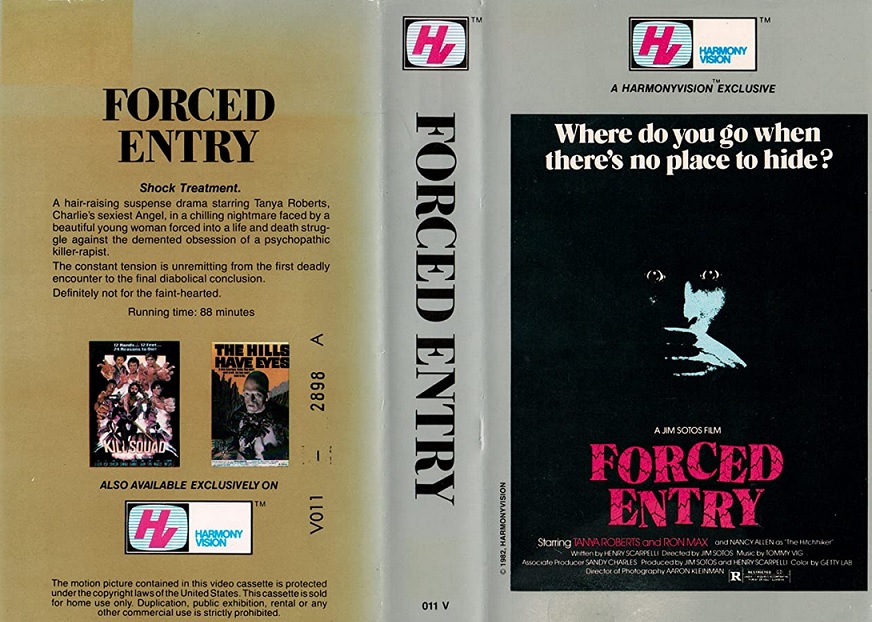
Again, as the video ’80s arrived — and Tanya Roberts star rose courtesy of her working on Charlie’s Angels in 1980 and then-hot Don Coscarelli’s first post-Phantasm movie, The Beastmaster (1982) — Harmony Vision took up the cause and released The Last Victim on VHS in the U.S. via the 88-minute version. The later Dark Force Entertainment Blu-ray released in 2019, which includes both the The Last Victim (75 minutes) and Forced Entry at (72 minutes) drive-in/theatrical-distributed versions, differs from the Harmony VHS version. The infamous wine bottle rape and Nancy Allen’s nude bondage scenes are missing from all of these prints. The 93-minute original has yet to be digitally restored and can only been seen via non-Harmony VHS-imprints.
In the Costello Forced Entry original, Harry Reems, aka Tim Long (again, to shed the porn stigma into mainstream acceptance), stars as a nameless Vietnam war vet who, like Travis Bickle after him, carries on a lonely life at a gas station where lives and works. Unlike most adult films, Costello classes the porn proceedings as he begins the story in media res — courtesy of a non-linear narrative structure indisputably influenced by the Billy Wilder’s classic film noirs Double Indemnity (1944) and Sunset Boulevard (1950): the film begins with detectives at a crime scene with a man shot in the head.
As the story unfolds, we come to learn the vet, through credit card receipts or lost travelers in need of directions, tracks down his victims, peeps at them, then later breaks in to sodomize and rape them — then murder, after he climaxes. Upon a having a psychotic break during one of the rapes (with the aforementioned, real life wigged-out Ruby Runhouse and Nina Fawcett), he commits suicide; the film then — as with the Wilder films before it — returns to the beginning with the sheet-covered body taken away by the police.
Say what you will about adult films of the singular-to-triple X ’70s, but Costello’s Forced Entry, while repugnant in the context of its graphic sex and rape portrayals, should be as highly regarded as the “Golden Age of Porn” classics of Deep Throat, The Devil in Miss Jones, and Behind the Green Door. Costello beat Justin Simmonds and John Howard’s joint post-Halloween effort Spine (1986) in logically cross-pollinating the porn and slasher genres.
(Due the the content, you can only view the trailer for Force Entry (1973) as a You Tube account sign in.)
While the 16mm-shot film is rough — in terms of its overall quality, to the point of being an ’80s SOV — Costello none the less produced an effectively framed, well-made film for $6,200 in two days — and took five months to edit. And the time in the editing suite shows, which is why the film influenced — and he offered a quote to the DVD reissue — Gaspar Noé in the making of his art-house rape-revenge film Irréversible (2002).
As discussed in our review of the recent Australian rape-revenge import, Rage (2021), that film, as did Noé’s, while brutal, is on the respect-level of Takashi Ishii’s Freeze Me (2000). And for as hard as it is for some (most) to watch Gaspar Noé’s non-exploitative Irréversible, and Rage and Freeze Me are analogous in their “hard to watch” moments, Shaun Costello’s Forced Entry harbors that same respect.
Granted, Costello’s 1973 work smacks with the scuzzy aftertaste of its raison d’être in The Last House on the Left (1972), but Costello’s Forced Entry rivals Wes Craven’s effort; Costello’s film is the more powerful, message-driven originator that should be revered and remembered; Meir Zarchi’s later I Spit On Your Grave (1978) is not of that caliber; nor William Freut’s Death Weekend (1976), as both are violence and rape for the sake of exploitative shock value. While undeniably cleaner and non-sexual in nature — and certainly not an influence on filmmaker Joshua Reale’s Necropath (2021) — there’s an undeniable through line from the work of Shaun Costello to Reale’s work. Both are dark, graphic works that intelligently expunge the objective for the subjective to take us into the mind of their antagonists.
Harmony Vision’s ’80s VHS repack of The Last Victim (1976). Notice the Charlie’s Angel’s copywriting-marketing angleand 88-minute run time.Check out this clip for the “Staten Island Scene” with Nancy Allen.
The same enthusiasm can’t be expressed for The Last Victim (1976), which, why still hyper-violent in its original form, is still watered down — and dumbed-down — for gone are Costello’s feminist and post-Vietnam subtexts. So we’re left with a film that’s actually closer to the mindless, rape-revenge sleaze of The Last House on the Left (1972) that the original Forced Entry (1973) copied — but rose to the next level.
In The Last Victim, our nameless maniac war vet of the original isn’t a war vet: Carl — while still a gas station attendant/mechanic — is now the product of a mentally-unstable mother who reveled in child abuse (a plot-point used in Joy “J.N” Houck, Jr.’s sloppy drive-in rip of Alfred Hitchcock’s Psycho with 1969’s Night of Bloody Horror). And the point-of-view changes in the remake. Gone is the subjective storytelling of Costello’s film that took us inside the killer. Sure, we are seeing things from Carl’s point-of-view; however, the “POV” is just a camera angle that gives us no-insights and couldn’t be more non-giallo in style; we simply travel on the road with Carl on the hunt for his station’s female customers that tickled his fancy. His mother screwed him up; he hates women; so he hunts women for rape and murder targets. And he ho-hum chokes, and stabs, and gets creative with beer bottles. The third-act twist, this time — since we’re devoid of the mescaline-stoned hippy chicks that altered the third act of Forced Entry — is Carl falls “in love” with his latest victim, played by Tanya Roberts, who is able to channel her terror against Carl by taking advantage of his “romantic” feelings.
Shaun Costello’s film has originality on its side as it attempted to take the “Golden Age of Porn” from an underground “très chic” image to a wider, commercial respectability; his only stumble was not taking a lesson from Nicolos Roeg’s in pulling the reins on the film’s porn-sexual components. Costello was almost there. Adapting Billy Wilder’s in media res noir-storytelling was inspired; a Roeg-softer, artful touch, as deployed in Don’t Look Now (1973), his mainstream, British Giallo exploration on the psychology of grief and the effects of trauma, would have been — pardon the pun — the cherry on top. (If you’re not familiar with scene: To get past the sensors, Roeg fragmentary softened-the-shock of the then “graphic” depiction of sexual intercourse between Julie Christie and Donald Sutherland post-coitally preparing to go out to a dinner party.)
Meanwhile, Jim Sotos gives us a 15-year-old girl who stops to put air in her bike tire, only to end up as Carl’s latest bondage and rape victim (in lieu of Nancy Allen’s hitchhiker bondage-rape) — with no reason, purpose, or point. If Sotos wanted to copy Craven’s Last House-offensiveness, he succeeded. And if you’ve seen Sotos’s Sweet Sixteen, with its 15-year-old female antagonist on the cusp of 16 picking up men in bars and luring them to a Native America burial ground for a roll in the sticks . . . well, if you wondered how (boring) offensive (and what the deal is with Sotos and 15 year olds) an ’80s slasher can be, that’s your film.
In the end: The Last Victim (1976) is just a slasher flick — a scuzzy hunk of celluloid utterly devoid of any John Carpenter class that’s best forgotten; one that inspires you to seek out William Lustig’s superior Maniac (1980) starring a tour de force Joe Spinell. Sure, you may dismiss the original Forced Entry (1973) as a “porn flick,” but it was a porn flick with a purpose possessed with a sense of style.
* Look for our upcoming reviews (Hey, they’re done!) of Gamma 693 and I Spit on Your Grave as we continue to explore more ’80s “Video Nasties” at B&S About Movies. Click on the images below to read each feature at your leisure.
Update, May 8, 2021: We’ve come to learn that Dark Force Entertainment, via a Facebook press release, will reissue the R-Rated U.S. theatrical version of Forced Entry. This 86-minute version — according to their release — contains about 10 more minutes of nudity and rape than the previous two director-cut versions featured on The Last Victim release from Dark Force.
From the Dark Force release: “One of the most confusing titles ever, we finally figured out the puzzle of this awesome 1976 [1975] movie, which underwent several cuts and both R and PG ratings. We found the original 35mm camera negative to the U.S. theatrical version which, went under the title Forced Entry. It is only missing about 2 minutes that is contained in the VHS release, which was the most complete version of the movie ever released. Confused yet? Don’t be, this movie is DEFINITELY worth the fuss and this will be the best looking and most complete, Hi-Def version available on the market. This release will be dedicated to the memory of [the late] Tanya Roberts. Coming in 2021 from Dark Force.”
According to Dark Force, via this May 8 press release, there are six versions of the Tanya Roberts-version: 1) The original PG-rated THE LAST VICTIM cut (they believe this is the same as THE LAST VICTIM cut on the Dark Force Blu-ray), 2) The Harmony Vision VHS, titled FORCED ENTRY, 3) The Intervision VHS, titled THE LAST VICTIM, 4) The 1981 theatrical version, titled FORCED ENTRY, 5) The 1983 theatrical re-release, titled FORCED ENTRY, 6) The director’s cut of FORCED ENTRY, as released on Dark Force’s first Blu-ray.
Update, again: This is now out on Blu-ray! Learn more with this Dark Force Facebook post.
About the Author: You can learn more about the writings of R.D Francis on Facebook.He also writes for B&S About Movies.
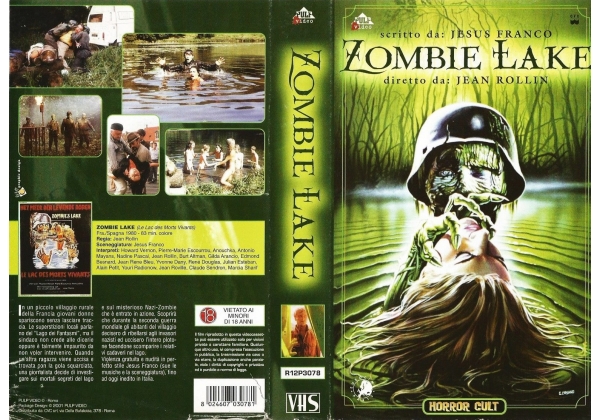
Do you want to watch a boring underwater Nazi zombie movie? Then, by all means, watch Zombie Lake. All others skip it and slosh on over to Ken Wiederhorn’s far superior Shock Waves (1977). How this test in zom-tedium ended up as one of the 82 films on the U.K.’s “Section 3” Video Nasties list is dumbfounding.
It all started with Jesús Franco. Then the testosterone started splashin’ around between Franco and the producers. Enter Jean Rollin — with less than a week before production was to begin. Yes, Jean Rollin, the director who never met a film he couldn’t thrust into boredom. Yes, Mr. Rollin (and Mr. Franco, for that matter): I do need more than just nudity and triangle-of-death shots to move me. Yes: I need my zombies to have more than green paint smeared on their puss. Another problem: Two editors worked on the film: one for the French and International version and one for the Spanish version. Yes, a film where Jess Franco quits and Jean Rollin signs on . . . well, you’ve been warned. Needless to say: the poster’s great, but the plot is a mess.
Mind you: A bulk of this film takes place twenty years after the end of World War II, so 1965 — but it looks like forty years later, aka 1985. Anyway: A group of nubile ladies take a (skinny) dip in the village’s small lake — a lake referred to by the locals as “the lake of the damned.” And it’s know as such because it was used for witchcraft ceremonies. And the “lake” swallows them whole. So, with fresh human blood in their bellies and energized, the green-faced and grey-uniformed zom troopers take their revenge on the town. The revenge stems — we come to learn — from a WW II Nazi soldier and a local French girl falling in love and having a child. The villagers, members of the French resistance, murdered the soldier’s platoon and dumped their bodies into the lake. And the “witchcraft” of the lake kicks in. We think.
Of course, the town mayor is behind the murders of the soldiers and a cover up is in order — that errant on-the-road all-girls basketball team traveling through France who decide to take a restful (skinny) dip in that same small town lake, be damned. Of course, the fact that the lake offers us the scuzziest, most uninviting swim in the history of Zagat’s Euroguides is of no consequence to none of the young ladies that happen up on Lake COVID. Are the ladies “hypnotized” and drawn by unseen forces, aka the witches, to feed the zombie? Uh, this is a Jess Franco-rejected-Jean Rollin production. Don’t ask questions.
I can’t help but think Jess Franco penned this as a homage to Amando de Ossorio’s second entry in his “Blind Dead” series: Return of the Blind Dead (1973), as that film also had a town mayor more concerned with his town’s annual festival and his personal reputation than the rise and return of the Templars. Of course, de Ossorio got his pinch off Roger Vadim’s And Die of Pleasure (1960). In addition to the story pillaging, there’s the stock footage pinching: Zombie Lake‘s WW II war footage comes from Jess Franco’s Nazisploitation romp The Depraved Third Reich, aka Convoy of Girls, aka East of Berlin (1978)*. Now, was that the original intent: for Franco to pinch Franco? Or did Rollin pinch Franco on his own? Who cares, a pinch is a pinch is a rip and this movie sucks scuzzy, quaint French pond scum.
When it comes to “bad” Euro zombie films, I err to the side of Bruno Mattei with his New Guinea laboratory romp Hell of the Living Dead (1980) and Andrea Bianchi’s cursed mansion romp Burial Ground (1981). While Zombie Lake is not an ’80s SOV film, boy, oh, boy it certainly plays like one — and makes ’80s SOVs look good. At least SOV’ers are first time filmmakers figuring it out as they go along with camcorders. But when you’re Jean Rollin and at the game since the late 1950s with hundreds of films on your resume . . . this should be so much better. There’s just no excuse. At least I only paid a buck on the 5-5-5 home video store plan. Euro-audiences paid the full theatrical freight. I’d be Solo: A Star WarsStory-pissed.
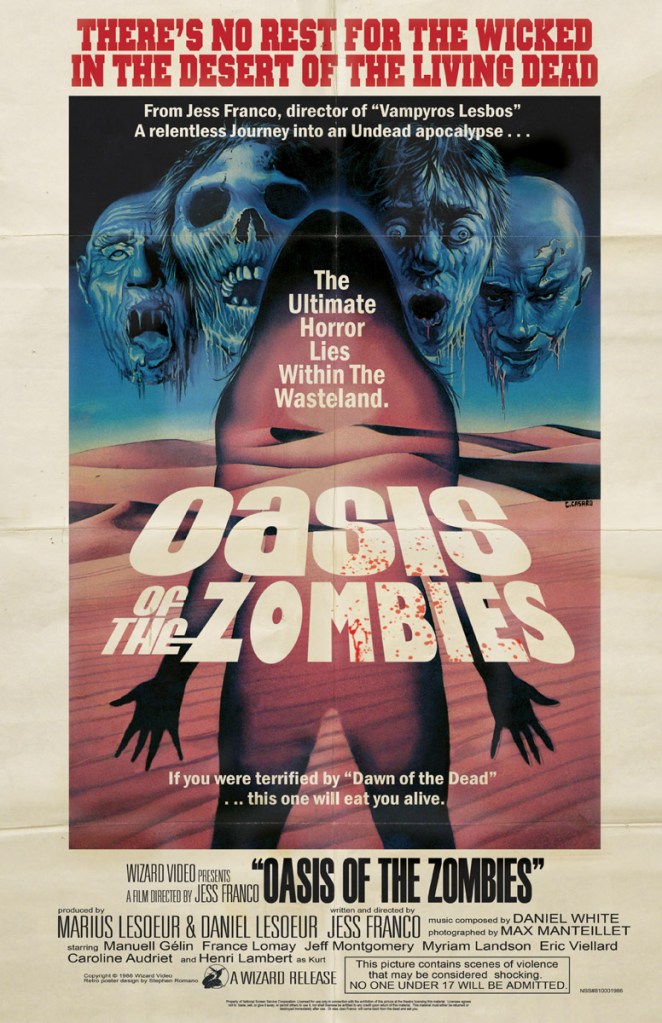
As for Jess Franco: He and the producer behind Zombie Lake, Eurocine (we’ve reviewed quite a few Eurocine films), made nice and did the Nazi Zoms thing again — only ditching the lake for the desert in Oasis of the Zombies. Did he fair any better? Oh, hell no. But that doesn’t mean we don’t dig it, for B&S reviewed it twice: Roger Braden and Sam the Boss offer their takes. As for my bottom line: Zombie Lake just isn’t all that nasty. Now, if the U.K. had a “Video Boring” list, those tea-taxin’ Red Coats would be onto something.
To quote Sam in his review of Burial Ground: “This movie is a real piece of shit. But you know, it’s an entertaining piece of shit. It’s the kind of film you can say, ‘But yeah, did you see Burial Ground? That one is totally insane.'”
Sadly, the same can not be said for Zombie Lake.
You can get Zombie Lake from Diabolik DVD. It’s also on the Euro Shock Collection issued by Imagine Entertainment (2001), as well as Arrow Films (2004), and Kino reissued it as a Blu-ray (2013). But you know us: we found you a freebie on You Tube.
Stay with us all this week, as we still have two and a half more days of U.K. video nasties from their three “Section” lists to review.
One of the many re-titles and covers to Franco’s Convoi de filles.
Update: In January 2023 we rolled out our Jean Rollin-uary month of reviews. If you’re not familiar with Rollin’s works, click through and check them out. We gave Zombie Lake a new take because, well . . . you never can never watch enough Jean Rollin flicks!
Oh, yes! If you do a month of Jean Rollin, you must do a month of Jess Franco! February 2023 was our “Jess Franco Month.”
About the Author: You can learn more about the writings of R.D Francis on Facebook.He also writes for B&S About Movies.
Here’s the U.K. Section 3 “video nasty” in the man-against-the-wilderness genre that began with Sam Peckinpaw’s Straw Dogs (1971) from 20th Century Fox and solidified with John Boorman’s Deliverance (1972) from Warner Bros. Produced for a little over $2 million, Straw Dogs stumbled with $8 million in U.S. box office. Produced for $2 million, Deliverance raked-in over $46 million in U.S. box office: thus, we remember and credit Boorman’s work for kickstarting the genre — as well as the revenge-rape sub-genre.
The revenge-rape sub-genre quantified with Wes Craven’s The Last House on the Left (1972), which was a sloppy n’ scuzzy, grindhouse remake of Ingmar Bergman’s tasteful-superior The Virgin Spring (1960). The sub-genre only got worse with the likes of the bogus, faux “sequels” in Roger Watkin’s Last House on a Dead End Street (1977) and Francesco Prosperi’s The Last House on the Beach (1978). Then there’s Charles Kaufman’s black comedic take on the genre — courtesy of the joint thespian tour de force by the actors behind Mother and her hicksploitation-bent sons Ike and Addley — with Mother’s Day (1980). Even Aldo Lado, he of the (brutal) Dario Argento rips Short Night of Glass Dolls (1971) and Who Saw Her Die? (1972), got on board the “Last House” caboose with Last Stop on the Night Train (1975), which — amid its Hallmark Releasing title myriads for drive-in and home video — was known as The New House on The Left,Second House on The Left, and Last House Part II.
While James Dickey’s screenplay was based on his novel Deliverance — which takes the Ingmar Bergman highroad — was graphic in nature, the violence was merely a delivery system of an underlying social statement about America’s class structure asking the questions: Who is stronger in a battle of wills between primitive man vs. civilized man. How deep into one’s base instincts will a civilized man delve for self-preservation?
So when you have a film produced for a couple million bucks pulling down mid-double digit millions at the box office, you know what that means: here comes the cash-in knockoffs.
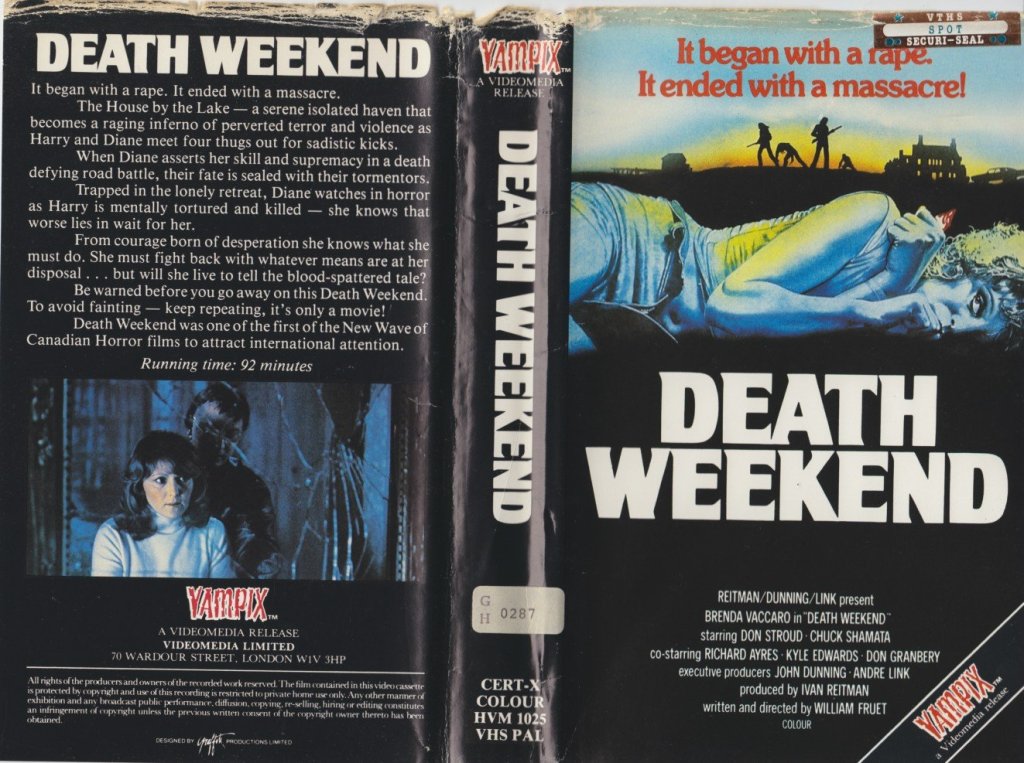
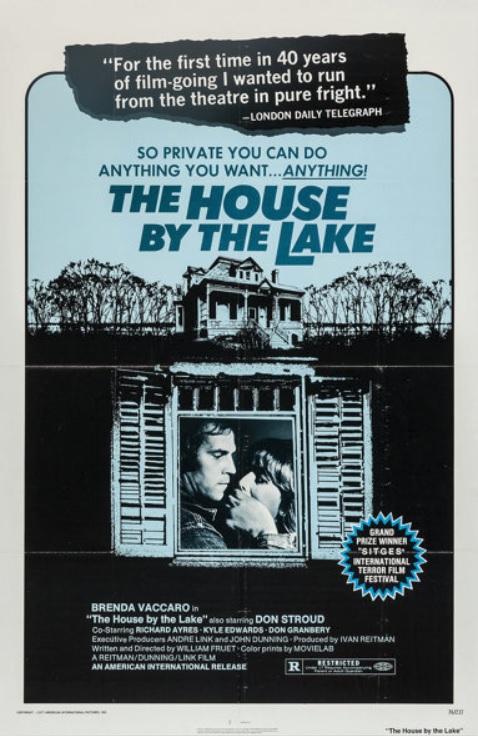
Originally released as Death Weekend in its native Canada, then released as House by the Lake during its U.S. Drive-In run, it returned to the Death Weekend title on home videovia a number of imprints, but Vestron Video in the U.S.
All of the subsequent man-against-the-wilderness tales produced in the Deliverance/Straw Dogs backwash threw away plots (that were cookie cutter boiler plates, anyway), character development and underlying themes, and amped the violence — even more so in a post-John Carpenter Halloween world of the faux-Giallo variety. Macon County Line (1974), Death Weekend (1976), Jackson County Jail (1976), Rituals (1977), Just Before Dawn (1981), and Walter Hill’s Southern Comfort (1981) each own their debt to Boorman’s backwoods-terror vision. The home invasion and rape-revenge genre went off the graphic rails with the likes of Sergio Martino’s Torso (1973), only to get cheaper and shoddier with the likes of Linda Blair’s Grotesque (1988), then more “artful” with the likes of Gaspar Noe’s Irreversible (2002) and Takashi’s Ishii’s Freeze Me (2000). The most infamously scuzzy of the bunch is Meir Zarchi’s I Spit on Your Grave (1978). And the genre continues as streaming fodder with the classy Australian change-up, Rage (2021).
Released to Drive-Ins as The House by the Lake, and then bestowed the Death Weekend title for home video, this low-grade Canadian inversion of the genre produced for a half million dollars was written and directed by William Fruet for American-International Pictures. The film caused quite the stir as result of the intensity — more so that what we watched in Straw Dogs and Deliverance — for its drudgery in violence and rape for the sake of violence and rape. While Brenda Vaccaro and Don Stroud are stellar in their roles, the “message” was tossed out to tumble down the main road and leaves us with a movie that makes us wanting to take a shower after watching. It’s no wonder the VHS was seized and confiscated in the U.K. under “Section 3” of the Obscene Publications Act of 1959 during the “Video Nasty” panic of the ’80s.
The U.S. and English-Canada VHS released by Vestron as Death Weekend is sans three scenes: an additional shot of Don Stroud’s Lep on top of Brenda Vaccaro’s Diane as he attempts to rape her, a more graphic shot of Diane slashing Richard Ayers’s Runt’s throat, and a longer shot of Don Granberry’s Stanley burning to death. However, French Canadian and Spanish home video renters were allowed to watch those scenes, intact. Death Weekend has yet to receive a domestic U.S. DVD release; it was released in Sweden as an uncut DVD in 2017 by Studio S Entertainment; in 2019, Death Weekend was released on Blu-ray in Germany. Once offered as an a U.S. VOD stream by Amazon, the film is no longer available. Diabolic DVD has copies of the Swedish all-region Blu-ray, but are currently out-of-stock (keep checking back with them for re-stocking information).
Writer and director William Fruet is a name we speak of often amid the digitized pages of B&S About Movies, as we’ve enjoyed his oft-HBO-ran works Search and Destroy (1979), Funeral Home (1980), Spasms (1983), Bedroom Eyes (1984), Killer Party (1986), and his Alien-inspired AIDS cautionary tale Blue Monkey (1987). And we particular enjoyed his long-not-seen radio DJ drama that he wrote, but did not direct, Slipstream (1973).
Fruet revisited the ‘ol fish-out-of-water backwoods shenanigans (with a unique hick-impaled-by-TV antenna scene and an unstoppable Henry Silva thespin’ it up while doused in hot tar) with Baker County, U.S.A. That film’s script came courtesy of ‘80s slasher-scribe John Beaird, who penned the entertaining My Bloody Valentine and Happy Birthday to Me. Shot for $2 million by Fruet, affectionately referred to as the “Roger Corman of Canada,” Baker County, U.S.A is basically the canuxploitation-version of the later-shot Hunter’s Blood (1986), itself a retread of John Boorman’s 1972 hicksploitation trendsetter.
While Fruet already proved his skills as a director on his first feature film, Wedding in White (1972), a film starring Donald Pleasence and Carol Kane that he also wrote, he fell out of favor with the theatrical industry to find work in television. An opportunity to get back into theatrical film work came courtesy of Ivan Retiman (later the director of Meatballs (1979), Stripes (1981) and Ghostbusters (1984)) and Don Carmody, who successfully produced David Cronenberg’s Shivers (1975) through Cinepix Films. They wanted another horror film: Fruet gave them Death Weekend. When the film was acquired by A.I.P – American International Pictures for U.S. Drive-Ins, the distributor changed the title to the House by the Lake for an all-female revenge double-bill with Wes Craven’s The Last House on the Left, which raked in the dough during its run.
Is there a statement here as to the way socially maladjusted men view women as “meat,” with Brenda Vacarro’s Diane dually serving as nothing more than an objectified outlet for Don Stroud (and his repulsive backwoods buddies) to channel his mental impotence-born violence (everything be “the bitches” fault), while her weekend-fling dentist playboy (who enjoys snapping pictures through two-way mirrors) sees women as disposable play toys? Is there a statement that, regardless of education and social standing, “men are men,” that is, pigs slopping in the same trough, when it comes down to gratifying their base desires?
No.
When Varcaro’s Diane, who accepts a “weekend at my lake house” invitation from a successful dental surgeon, are we supposed to look at her as an opportunistic “gold digger” that deserves the terror of torture and rape? When she takes the wheel of her weekend fling’s shiny Corvette and gets involved in a faux-drag-cum-road race and runs Lep (Stroud) off the road, does she deserve a comeuppance for not knowing her place?
No.
Sure, William Freut put everything together well enough, and Brenda Vaccaro and Don Stroud are, again, stellar, but personally, I can’t rank this alongside Sam Peckinpaw’s Straw Dogs and John Boorman’s Deliverance. There’s a reason why, beyond clever marketing, Freut’s home invasion-cum-rape-revenge was paired with Wes Craven’s The Last House on the Left and it found itself on the U.K.’s video nasty list. Fruet’s work possesses none of the class of Ingmar Bergman’s The Virgin Spring; it’s pure Meir Zarchi’s I Spit on Your Grave (1978) and Jim Sotos The Last Victim (1975) objectifying sleaze of the exploitation variety.
But you may like it. And if it’s your jam, stream on, my retro-analog brother. As Shirley Doe has come off the top ropes and told us may times: “films are funny that way.”
About the Author: You can learn more about the writings of R.D Francis on Facebook.He also writes for B&S About Movies.
“This is a true adventure. Filmed on location in the jungle where the events portrayed actually took place. The production thanks the Indonesian Government for allowing this story to be brought to the screen.” — Opening title card with a claim we’ve heard many times before
So, are you in the mood for a bizarre mix of repugnant gore wrapped in a blatant lack of common sense?
Well, then, wee video pup, you’re in the mood for an Indonesian cannibal movie: Strap ye not the popcorn bucket on thou chin, get the puke bucket. And ditch the Dr. Pepper for the Pepto-Bismol.
We’re not kidding.
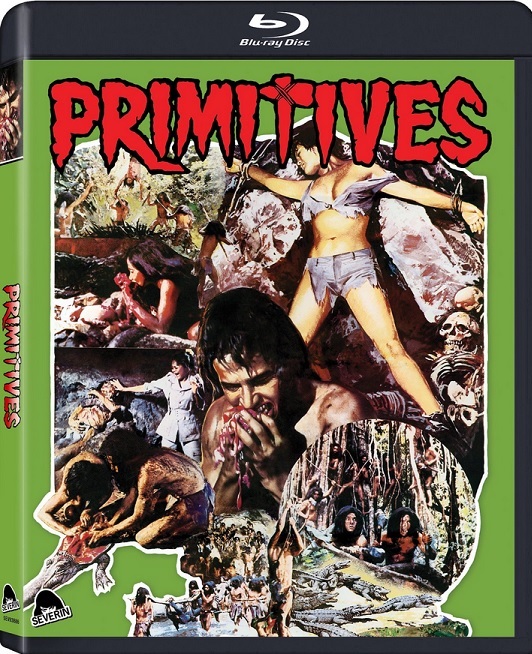
The VHS clamshell slipcover we remember that was part of the U.K.’s “Section 3 Video Nasties” list.
Yes, India did, in fact, jump on the Italian-made cannibal zombie sub-genre puke wagon . . . and upped the genre’s already stomach content-inducing cruelty and brain-burning weirdness. Well, what could we possibly expect from director Sisworo Gautama Putra?
You know Putra as the Indonesia horror purveyor who later gave us the whacked-o-rama (lifted from Phantasm) that was Satan’s Slave (1982). Primitives, aka Savage Terror in its home video shelf life, which served as Putra’s big screen debut, was inspired by his fandom of the successful Italian cannibal movies Sacrifice! (1972), Jungle Holocaust (1977), and Slave of the Cannibal God (1978). Putra’s — and his longtime screenwriting and producing partners Imam Tantowi’s and Gope T. Samtani’s — famdom were so great, that they lifted — okay, it’s a “homage” — scenes wholesale from those films. If you’re a fan of Cannibal Ferox and Cannibal Holocaust, you’ll see the homages (severed) afoot.
As with all films from the copyright-lawless tundras of India and Turkey . . . if ripping off Ruggero Deodato isn’t enough, and if the animal-on-animal wildlife stock footage violence isn’t enough, you’ll also hear “(We Are) The Robots” by Kraftwork, John Williams’s main theme from Star Wars, and James Last’s “The Lonely Shepherd” on its soundtrack.
Yeah, we’ve been here before: When three anthropology students, along with their guides, go in search of a lost primitive tribe — and have a rafting accident — they spiral into a nightmare of bloody rituals, torture . . . and the consumption of their own flesh, as they’re hunted down one-by-one by the very tribe they came to explore.
Martial Arts fans will find additional interest in the film as it stars Humbertus Knoch, aka Barry Prima for English-speaking audiences, in his feature film debut. Prima’s best known for his work in The Warrior (1981), The Warrior and the Blind Swordsman (1983), The Devil’s Sword (1984), and The Warrior and the Ninja (1985). He’s currently in production on his 75th project, Garuda 7.
You can get this Italian-styled cannibal slopper from Cult Action under its alternate title of Primitif, while the fine folks at Severin have it out under the Primitives title on Blu-ray and DVD. Severin’s reissue includes the extra-purchase incentives of bonus interview vignettes with writer Imam Tantowi and producer Gope T. Samtaini; it also includes an alternate opening title sequence, while the film is scanned in high-definition from the Jakarta Studio’s vault negative.
However, we found you a free-with-ads stream to watch on Tubi — and you can triple feature it with Eaten Alive! and Mountain of the Cannibal God via Tubi. You can also learn more about the Italian cannibal sub-genre of zombie films with our recent review of Naomi Holwill’s documentary Me Me Lai Bites Back (2020), as well as her producing partner Calum Waddel’s Eaten Alive! The Rise and Fall of the Italian Cannibal Film (2015).
Screenwriter Imam Tantowi and producer Gope T. Samtani also gave us their take on Indiana Jones with The Devil’s Sword (1984) and John Rambo with Daredevil Commandos (1986). But before those less-graphic ripoffs, they followed Primitives with Blazing Battle (1983). That film is an Italian cannibal-styled rip reset during the Japanese occupation of Indonesia during WW II. More than worthy of a U.K. “video nasty” albatross — if it only made it to the U.K. shores — the faux martial arts-marketed flick features equal, sloppy helpings of over-the-top depictions of rape, along with torture scenes of impaling, eye gouging, and so on. Regardless of its marketing on the video fringe as a (comical) martial arts movie, Blazing Battle is anything but. Your caveat has been served.
Warning: No joke. Primitives is graphic to the extreme — more so than its Italian inspirations — and the blatant animal cruelty may disturb you.
Ugh. Another trailer/clip bites the dust. You’re on your . . . perilto find one.
Be sure to surf over to our three part “Video Nasties” exploration that lists all of the films on the U.K.’s Section 1, Section 2, and Section 3 lists, as well as our “Mangiati Vivi Week” tribute to Italian cannibal films.
About the Author: You can read the music and film reviews of R.D Francis on Medium and learn more about his work on Facebook.
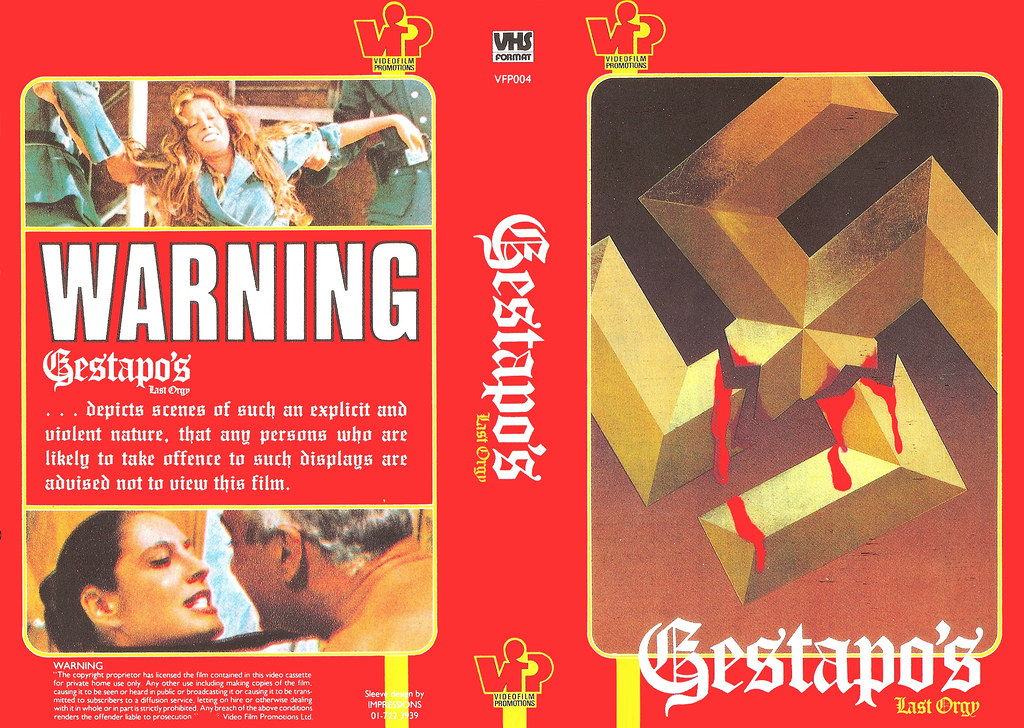
Can you get anymore “grindhouse” in the alternative titles department as Caligula Reincarnated as Hitler?
Nope.
Was this re-released in the U.K. after it’s initial “Section 1” banning?
Nope.
Italian writer and director Cesare Canevari gave us a mere nine films across 20 years, beginning in 1969. It was his final three films that received the widest distribution outside of his homeland and Europe: a piece of erotic-drama, The Nude Princess (1976), the psuedo-giallo-cum porn Killing of the Flesh (1983), and this Nazisploitation entry.
A Jewish WWII survivor revisits the ruins of a hellish concentration camp, and the memories are still vivid. How did she escape the humiliation, the tortures, and the destruction of human flesh? How did she flee from the Gestapo’s last orgy? are the questions asked in this film’s promotional materials.
That survivor, Lise Cohen, was an inmate at a special prisoner-of-war camp for female Jews, a camp run as a bordello to entertain the German officers and troops going in to battle. Commandant Conrad von Starker (Adriano Micantoni, credited here as “Marc Loud,” also of the notable 1962 Italian space slop Planets Around Us and the 1963 Goth-horror Tomb of Torture), as do all Commandants, runs the camp with iron fist — through the assistance of Alma (one of Maristella Greco’s six films; the other notable renter is the similar, 1980 Italian-Spanish women-in-prison flick Hotel Paradise). Starker’s game is instilling fear in his charges — but Lise proves to be tougher than any before her, so Straker devises even crueler experiments to make Lise yield to his desires, while Alma’s jealousy serves to increase Lise’s pain. Lise instead turns the tables and plays along with Straker’s twisted, insane atrocities, which results in her earning privileges others prisoners do not, to the chagrin of Alma, once Straker’s favorite.
While Gestapo’s Last Orgy well earns its “X” rating, it’s also a very well-made film (of the squeamish-intellectually quality of Pier Paolo Pasolini’s Salo, or the 120 Days of Sodom) and the flashback framing device of the now reformed and society-integrated Straker and Lise reuniting at the camp (the same seaside fortress seen in the 1970 Giallo In the Folds of the Flesh) to unfold the past as they explore the ruins, gives it a quality (and reminds of Billy Wilder’s Sunset Boulevard) — and deeper meaning — that rises it above most films in the genre. Yeah, and Spain’s Eloy de la Iglesia claimed a “deeper meaning” into the terror rout by President Richard M. Nixon’s buddy, Spanish dictator Francisco Franco, in the frames of The Cannibal Man (1972; itself a “U.K. Video Nasty”) . . . so your opinions on Cesare Canevari’s social commentary and subtext via his Nazisploitation narrative delivery device, may vary.
Complete and uncut in a new, 2K Restoration from the Negative.
As of November 2021, Gestapo’s Last Orgy has been re-issued to Blu-ray by 88 Films. Sam gives you a run down with his review. Another Naziploitation entry on the U.K.’s “Video Nasties” list with a Blu restore is The Beast in Heat.
About the Author: You can read the music and film reviews of R.D Francis on Medium and learn more about his work on Facebook.
“Bleeding women. No wonder there are so many queers.” — Steve “the Mancunian” Donovan
I’ll forever program this British-made ’80s SOV’er (titled with and without the periods) alongside the American-made Spine as result their analogous porn roots. It’s even possible that the porn-backed production of G.B.H influenced the later, 1984-begun and 1986-released production of Spine. Produced, written, and directed by John Howard and Justin Simonds, the horror/slasher-based Spine came together with financing from porn purveyors 4-Play Video, Inc. and producers Xeon, Ltd., who created the SS “Sterling Silver” Video imprint for the sole purpose of distributing Spine — and other planned horror flicks that were, sadly, never made — without the nasty porn aftertaste.
Ah, the ol’ big-box, paper-thin sleeve slid under the ol’ plastic cover. Sweet VHS delights.
Meanwhile, over in England, pornographer David Grant jumped on the stag film bandwagon along the yellow brick road to the “Golden Age of Porn” halcyon days initiated by Gerard Damiano’s box office bonanza known as Deep Throat (1972). Grant’s first film — Love Variations (1969) — masqueraded as a “sex education” film. So successful, Grant’s first film lead to his porn-pire expanding to include the incorporation of a chain of adult cinemas — the first being The Pigalle (named after the rue Pigalle section of Paris where Oscar Méténier’s famed horror-based Grand Guignol theatre was located) — and a film distribution company, Oppidan (read: Oedipus complex) — to distribute, not only foreign sex film acquisitions, but his own feature-length “sex comedies,” such as Girls Come First, The Office Party, and Under the Bed. He rose through the Golden Age-ranks to rake in the green with Snow White and the Seven Perverts (1973) and Pussy Talk (1975). Using a British taxation loophole, his films became wildly known for their inclusion as the undercard on numerous drive-in and grindhouse theater double bills. He also came to distribute the films of others — and break box office records — such as his 1977 reissue of Emmanuelle (1974).
Then the home video market exploded and grinded the grindhouse circuit into dust: it was time to break into the VHS-based marketplace. His new company, World Video 2000, started with the production and distribution of “soft sex” films in 1981. And it was a racket, to say the least. You may recall our Mill Creek “Pure Terror” box set review of Night Fright (1967) and its later home video title of E.T.N – The Extra Terrestrial Nastie (1983). Well, that’s was all Grant’s idea — to capitalize on the fact that Steven Spielberg’s E.T the Extra Terrestrial had not yet been released in the U.K. on home video.
As we say here often at B&S About Movies: the lawsuits from Universal, ensued.
Marketing: David Grant style.
Then — prior to GBH earning an entry on the U.K.’s Section 3 “video nasty” list, Grant’s World Video 2000 ended up on the Section 1 list with their “mainstream” follow up to their Spielberg boondoggle, Nightmares in a Damaged Brain, aka Nightmare. Again, more legal troubles, ensued (insert your “eye roll,” here). Only, this time, instead of just a pesky ol’ cease and desist lawsuit, he was imprisoned in the U.K. for distributing the film.
And, with that, Grant’s attempts to “go legit/mainstream” with the World of Video 2000 imprint was over: the company — and his parent company, April Electronics — were liquidated. Upon his release and those legal issues resolved, Grant issued one more film: Who Bears Sins (1987), which, if you know your Al Adamson schlock, was a piecemeal effort made from clips of Grant’s previous productions: Girls Come First, You’re Driving Me Crazy, Pink Orgasm, Miss Deep Fantasy, and A Woman’s Best Friend. Some of his other, 24 box office hits — which he either produced, wrote, or directed during the ’70s “porn chic” era — were the notable Au Pair Girls (1972), Secrets of a Door-to-Door Salesman (1973), The Over-Amorous Artist (1974), and The Great McGonagall (1974). Grant’s 50-plus distributed titles — in addition to the usual porn titles — included legit-mainstream films you’ve seen: Last House on the Left (1974), Ilsa, She Wolf of the SS (1975), Cathy’s Curse (1977), John Water’s Desperate Living (1977), John Carpenter and Dan O’Bannon’s Dark Star (1978), and the Peter Cushing-starring Nazi-Zom’er, Shock Waves (1978).
Retiring to the Turkish island of Cyprus — then being kicked out of that country for an array of alleged, questionable social and relationship issues — he returned to England, only to end up in a hot mess of (more) love triangles and violence, (unproven) drug-distribution accusations, as well as being suspected of — but never charged — with producing child pornography. So the fact that Grant was allegedly murdered — but never proven — as result of a “contract killing” in 1991, really doesn’t come as much of a shock.
If there was ever a life that deserves a hard cover biography or dramatic film, it’s the life of David Grant. (And yes, I have seen most of Grant’s notable adult titles listed this article. (More so than Twemlow’s!) That doesn’t make me weird. It just means I am SOV-VHS inquisitive.)
So, anyway . . . back to GBH . . . one and two.
At least there’s a bio on Cliff’s works. It’s a great read . . . and out of print and harder to find than his movies.
“When they put teeth in your mouth they ruined a good arse.” — Steve “the Mancunian” Donovan
The Reviews
So, you’ll notice Grant took it upon himself to name-drop The Long Good Friday, a critically acclaimed 1980 British gangster film starring Bob Hoskins and Helen Mirren that appears at #19 on the BFI – British Film Institute’s “Top 100 British Films.”
Grant — no pun intended — had a set of them, and then some.
Shot-on-Video with amateur actors — and like Spine before it — GBH is shaky across all of its respective disciplines as it tells its definitely, more brutal story than its mainstream, runyonesque inspiration (but fails). The man issuing the Jason Vorhees-without-the-mask grievous bodily arm is Steve Donovan, aka “The Mancunian” (a native or resident of Manchester/played by writer/director Cliff Twemlow): a gangster released from prison hired as a bouncer-body guard to stand down the brutal Keller (Jerry Harris), nightclub-owning mobster hellbent on controlling the city’s criminal enterprises — local gangster Murray in particular, who becomes Donovan’s new boss.
GBH is everything you expect in an SOV: it’s scuzzy, it’s brutal, it’s sexually gratuitous and stupidly lurid. After watching, you’ll know where Jim Van Bebber found his inspiration for this Death Wish-inspired street violence in his overly brutal SOV’er, Deadbeat at Dawn (1988). Van Bebber’s film may be — slightly — better made, but GBH, for moi, is still the more gritty, brutal of the pair. And it has all of the car chases and beat downs, and heartless brutal kills, white Bond-ish sportcoats splattered in blood, and strippers. And Donovan, like a low-budget Schwarzenegger, simply will not stop until no one is left standing.
Played by Cliff Twemlow — in the only notable film of his eleven-film acting career — he wrote eight films, including GBH (which is co-directed with David Kent-Watson). Known primarily as a music composer, his mostly notable film scores are Deathdream (1974) and Dawn of the Dead (1978), along with the long-running British TV series, Crown Court. His other, hard-to-find written/directed films (with David Kent-Watson) are his debut, Tuxedo Warrior (1982), The Ibiza Connection (1984), Predator: The Queitus (1988), Firestar (1991), and The Eye of Satan (1992). If you Google around, you’ll find uploaded clips and beat-to-hell VHS tapes for most of them (I’ve seen Firestar and Eye of Satan, but not the others).
“The booze tastes almost as bad as you look, Keller.” — Steve “the Mancunian” Donovan
The elusive sequel.
In 1991 Cliff Twemlow and Jerry Harris returned as Donovan and Keller in a sequel: Lethal Impact, aka GBH 2: Lethal Impact, aka GBH 2: Beyond Vengeance, which was also written and directed by Twemlow. Sadly, Lethal Impact, as did the rest of his SOV resume of action and horror films, did not live up to the infamy of the original. But Lethal Impact is even more of everything than the first film, with Donovan cutting a swath across Manchester as a low-budget Paul Kersey to avenge the forced-into-porn death of his schoolgirl niece.
Courtesy of You Tube uploader VoicesInMyHead (Wow, what a page!), you can watch GBH and GBH 2: Lethal Impact in all their static-shimmering and low-rez hummin’ glory. And we found the trailers for GBH and GBH 2.
About the Author: You can learn more about the writings of R.D Francis on Facebook.He also writes for B&S About Movies.
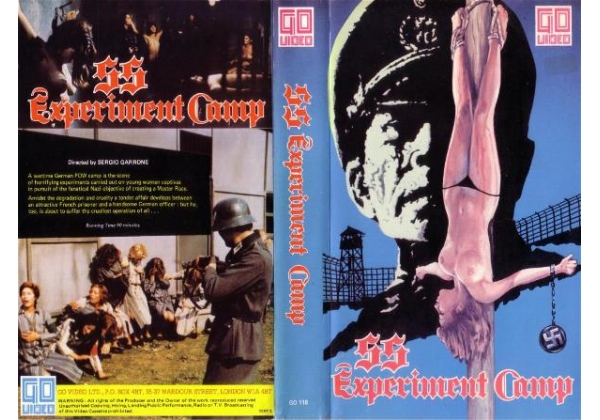
This is a film about Nazis. It’s also about a testicular transplant. It’s also known as SS Experiment Love Camp. It’s a film about prisoners of war used in experiments to perfect the Aryan race, while Colonel von Kleiben receives an oral testicle castration by a Russian girl. Its advertising campaign featured a naked woman handing upside down on a crucifix — which gave this film its infamy.
Courtesy of the cover, SS Experiment Camp easily found a slot on the U.K.’s “Section 1” list — but the British Board of Film Classification passed it with no cuts. The BBFC claimed that “. . . despite the questionable taste of basing an exploitation film in a concentration camp, the sexual activity itself was consensual and the level of potentially eroticized violence is sufficiently limited.”
Okay then, BBFC. But why didn’t you mention the film behind the VHS sleeve was boring.
Honestly, even being a Sergio Garrone fan — and aficionado of all things VHS taboo — the hoopla over this Nazisplotation film, while certainly worthy of its suffix, Garrone’s dip (one of two!) into the Nazi pool isn’t — as most “Video Nasties” — as shocking or offense as its reputation.
In addition to the boredom of it all, the production values, frankly, stink; as result, the entertainment value of the crowded jewel of the genre, Isla, She Wolf of the SS (1975), and the deeper, psychological study of — and superior scripting of — The Gestapo’s Last Orgy (1977) is utterly void from SS Experiment Camp.
It’s hard to believe Sergio Garrone made this, the writer-director who gave us spaghetti western buffs Django the Bastard (1969), Kill Django . . . First Kill (1971), and Bastard, Go and Kill (1971). Then, of course, there’s his superior work with Klaus Kinski in the pseudo-Frankenstein romp, The Hand That Feeds the Dead (1974), that we love amid the B&S About Movies’ cubicle farm.
The sleeve is more shocking that the film inside.
The “experiment camp” of this tale is just that: a medical facility experimenting in perfecting the Aryan race with German soldiers copulating with female prisoners. When one of the soldiers makes the mistake of falling in love with his prisoner-mate — he becomes Colonel von Kleiben’s testicle donor.
And that’s pretty much it, for this film is all about the genre hopping: It’s just a whole lot of lesbian wardens, sadistic guards, and softcore sex punctuated by (and not as graphic as you’d think) torture scenes (a water tank that both boils and freezes prisoners into submission), and lots of “superiority of the” Third Reich babbling. Oh, and lots of full frontal female nudity. Lots. But hey, when you’re an overweight and acne-covered kid berated for wearing a Misfits tee-shirt — and even the girl wearing a Clash tee-shirt turns you down — you get your naked girls where you can. That’s how it was in the video ’80s.
Oh, and the caveat here is that Garrone — to maximize his Lira (before the Euro) — shot this back-to-back with the even more abysmal SS Women’s Camp, aka SS Camp 5: Women’s Hell (1977) — which is not to be confused with the even more awful Women’s Camp 119 (1977) by Bruno Mattei. Both of Garrone’s Nazi romps are rife with sloppy camera work, worse acting, and dubbing that makes a Godfrey Ho flick seem in-sync. Don’t get us started on Mattei’s flick!
You can purchase a copy of SS Experiment Camp as part of the “SS Hell Pack Triple Feature” disc set, which also features SS Girls, aka Private House of the SS, by Bruno Mattei (1977), and Garrone’s SS Camp Women’s Hell (another of that film’s alt-titles) from Exploitation Digital on Amazon.
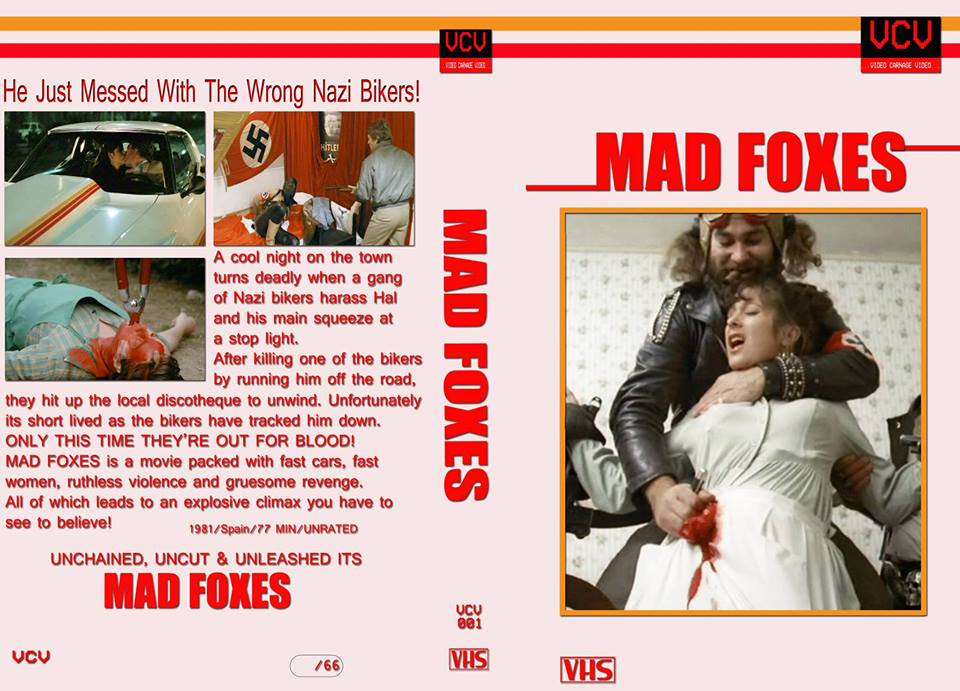
This Spanish revenge movie — with a Nazisploitation twist — is all about a man getting back at the bikers who killed his wife. Sounds simple? Well, there are tons of scenes that upset U.K. censors, including rape, gore, castration and nunchakus. Yes, that’s right. Not the Nazi stuff. But the nunchakus.
According to the BBFC website: “The success of Enter the Dragon, and the kung-fu genre in general, saw public concerns arise at the concurrent spread of the use of chainsticks (or nunchakus) and other martial arts weaponry among London youths. Media coverage of the issue caught the eye of Murphy’s successor as BBFC Secretary, James Ferman. In December 1979, Ferman recalled Enter The Dragon for another look in the light of these anxieties. Ferman asked the film’s distributor to remove the sight of chainsticks in the fight sequence between Bruce Lee and his attackers. The images nunchakus were also requested to be removed from the film’s trailer and its promotional posters.”
The removal of martial arts weaponry soon became standard BBFC practice with the advent of VHS bringing violent kung-fu films into the home in the early 1980s. When Enter The Dragon came out on VHS, some cuts were restored but the weaponry remained cut out, which has lasted way into the DVD and streaming eras.
That’s right — you can show guns in U.K. films, but not martial arts weapons.
Sounds legit to us.
Besides, you can’t go wrong with a film that pairs the violence with my then — and still — favorite band (next to the almighty Saxon and April Wine), Switzerland’s Krokus with “Easy Rocker” and “Celebration.” Appearing on their U.S. breakthrough album Hardware (1981), the album spawned their first U.S. Top 40 hit with “Burning Bones,” courtesy of its AC/DC-like qualities.
In fact, when formulating their next move after the death of Bon Scott, one of the first people Angus Young and the boys called in for an audition was Krokus lead singer, Marc Storace. At the time, Krokus made some headway in U.K. and U.S. with the minor hits “Heatstrokes” and “Bedside Radio” from Metal Rendezvous (1980), which were big hits throughout Europe. Storace turned them down because he felt Krokus was “going places.”
Then Black in Black (1980) — featuring Brian Johnson — shook the world. And I rented a copy of Mad Foxes after reading Krokus tunes would be in the film. It took four video stores, before I found a copy. And I was a happy, young metal pup.
You can watch the bad karate madness backed by Krokus on Tubi. You can hear April Wine tunes, by the way, in the Canadian film The Killing of Randy Webster. As for the almighty Saxon: How is it that they only made one film soundtrack appearance? “Everybody Up” (from the beginning to their downward slide; but the albums from that era grew on me over the years) from their seventh studio album Innocence is No Excuse (1985) appears on Lamberto Bava’s Demons released that same year.
About the Author: You can read the music and film reviews of R.D Francis on Medium and learn more about his work on Facebook.












 B&S About Movies
You must be logged in to post a comment.