Pittsburgh is more than just my hometown. If you believe a source as vaunted as Joe Bob Briggs, we’re also the birthplace of modern horror, thanks to George Romero and friends creating Night of the Living Dead right here (well, actually Evans City, 45 minutes north of the city).
Horror may have laid dormant for a decade or so, but the 70’s and 80’s were packed with genre defining creations made right here in the City of Bridges. There’s Dawn of the Dead, Martin and Day of the Dead just to name a few.
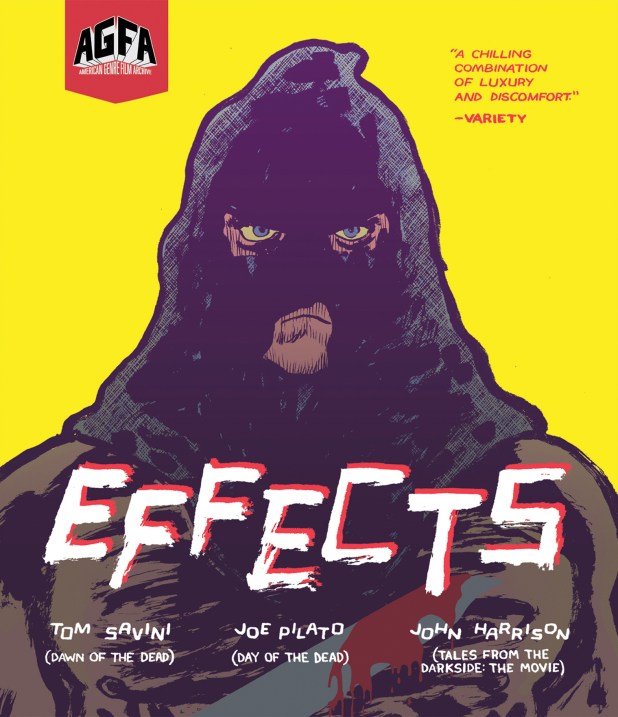
Then there’s the 1980 fim Effects, made by several of Romero’s friends and all about the actual process of making a scary movie and the philosophy of horror. Much like every fright flick that emerged from the Steel City — let’s not include 1988’s Flesh Eater, a movie I’m not sure anyone but S. William Hinzman has any pride in — it goes beyond simple shocks to delve into the complex nature of reality, man’s place in the world and what it means to be afraid.
Pittsburgh is also a complex city, one that started last century as “Hell with the lid off,” died in the late 1970’s and rose, much like the living dead, to become a hub for tech many years later. Effects is a document of what it once was decades ago and holds powerful memories for those that grew up here.
Joe Pilato (Captain Rhodes from Day of the Dead) stars as Dominic, a cinematographer who has travelled out of the city to the mountains — around here, anything east of the city is referred to as “going to the mountains” — to be the cameraman and special effects creator for a low-budget horror movie.
In case you are from here, he’s going to Ligionier. For the rest of the world, imagine a rural wooded area, the area where Rolling Rock beer once came from — yes, I know it’s Latrobe yinzers — Anheuser-Busch bought it, moved the plant to Newark, New Jersey and stopped making it in glass lined tanks. As a result, it now tastes like every mass produced beer out there. It’s also a place with a Story Book Forest theme park.
I tell you that to tell you this — imagine a team of horror maniacs descending on this quiet little town to make a movie about coked up psychopaths making a snuff film in the woods.
Director Lacey Bickle (John Harrison, who created the music for many of Romero’s films and directed Tales from the Darkside: The Movie) is a strange duck, one who wants to push his crew to film scenes days and nights.
Luckily, Dominick meets Celeste, a gaffer who is disliked by the rest of the crew. They quickly fall in love at the same time as our protagonist discovers that an entirely different film is being made, one whose special effects don’t need any technical wizardry. As secret cameras begin to roll, what is real and what is Hollywood by way of Allegheny County wizardy?
Dusty Nelson, Pasquale Buba, and John Harrison — the three main filmmakers — all met at public TV station WQED, the home of Mr. Roger’s Neighborhood and all worked together on the aforementioned Martin. Inspired by their work on that film, they started an LLC and raised $55,000 from friends and family to make this movie.
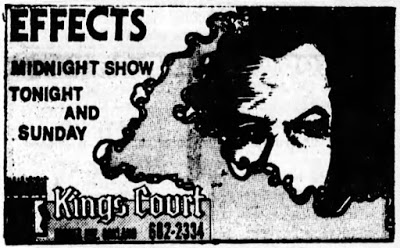
Due to a distributor problem, Effects was never released in theaters or on home video. It’s lone theatrical screenings were at the U.S. Film Fest — which is now the Sundance Film Festival — and it had its world premiere at the Kings Court theater in Oakland, right down the street from Pitt, on November 9, 1979.
According to the website Temple of Schlock, Effects was picked up by Stuart S. Shapiro, a distributor who specialized in offbeat music, horror and cult films like Shame of the Jungle and The Psychotronic Man. His International Harmony company distributed the film, but it played few, if any, theaters. Shapiro would go on to create Night Flight for the USA Network. In October 2005, Synapse would finally release this film on DVD for the first time ever.
Pittsburgh is a lot different now. The Kings Court, once a police station turned movie theater transformed into the Beehive, a combination coffee shop movie theater, is now a T-Mobile store, a sad reminder that at one time, we rejected the homogenization of America here in Pittsburgh. Nowehere is this feeling more telling than at the end of this film, where the movie within a movie has its premiere on Liberty Avenue. Now in the midst of Theater Square, this mini-42nd Street went the very same way, with establishments like the Roman V giving way to magic and comedy clubs. As a kid, when my parents drove down this street, I was at once fascinated and frightened by dahntahn. But no longer.
You can also get the AGFA blu ray release of this from Amazon. It’s made from a rare 35mm print that was made before the distributor backed out. You can also watch this on Shudder.
ABOUT THE AUTHOR: Bill Van Ryn is the man behind the Groovy Doom and Drive-In Asylum. Whenever I have a question about a movie, he’s always my first resource. I’m so excited that he’s on board for these top tens, as his list is really well thought out and put together.
1. Halloween: I hesitate to even call this movie a “slasher”, which has certain implications that don’t really apply to a movie as well made as Halloween, but it did open the floodgates. I am old enough and lucky enough to remember when this movie was on everyone’s lips for most of 1979. Truly legendary!
2. Friday the 13th: There’s Halloween, a low budget movie made with great artistry, and then there’s this, a low budget framework for a series of gory shocks. Not that there’s anything wrong with that.
3. Night School: One of the less successful early 80s slashers, this one actually has its own very interesting vibe going for it. If only it had some memorable gore shots, it may have been one of the all-time greats.
4. Terror Train: In terms of JLC’s post-Halloween slasher movies, I’ll take this over Prom Night any day. The gore factor is too low, but the characters are interesting, and actor Derek McKinnon’s dual role illusion is pretty mind blowing the first time you see the movie. He also manages to make his villain into a compelling character, something highly unusual in a film like this.
5. Maniac: The crystallization of everything Siskel & Ebert complained about when they railed against slasher movies, and also my favorite New York movie. A terrifying experience.
6. The Boogeyman:I love the way this movie recycles key moments from Halloween without actually repeating the story, or even giving its villain a body. Total bullshit, but fantastic bullshit.
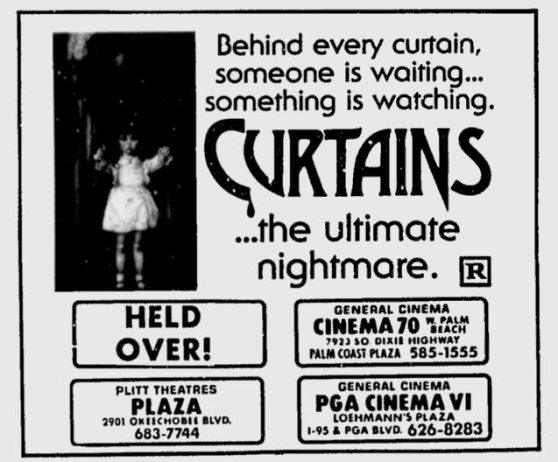
7. Curtains: Early 80s slasher Curtains had a troubled childhood, maybe that’s why it’s so batshit crazy. It confirms our worst suspicions about actors and directors, both in the film’s fictional world and in its own real production history. It gets a few scares in, too, especially the creepy first murder.
8. Psycho II: This clever sequel to one of the greatest ancestors of the modern slasher is actually restrained enough to pass itself off as a “classy thriller” for most if its first half. Then a sex-havin’, pot-smokin’ teenage couple are attacked by a knife-wielding figure in a costume, and we’re not sure if this movie is a true slasher after all. Then another character is stabbed through the mouth and the knife emerges from the back of her head, and we know for sure. Damn, Mother!
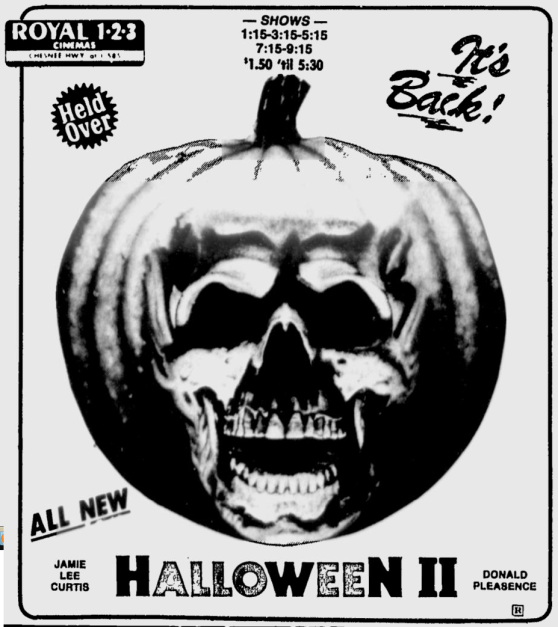
9. Halloween II: I may not be comfortable calling the original a slasher movie, but Halloween II is an authentic slasher movie, full tilt boogie. Whereas Psycho II wore a respectable disguise for its first half, Halloween II starts dirty lowdown (a random, meaningless murder right after the credits) and only gets more gonzo as it goes.
10. My Bloody Valentine: One of the most underrated of the 80s, this movie is totally sinister and often gut wrenchingly sick. It’s in desperate need of compelling characters, but tries really hard in the scare department and succeeds.
DAY 15. PICK YOUR POISON: One with some drugs in it. Turn on, tune in…and freak out!
You know why I’ve never done acid? This movie right here. After all, it has an “inspired by true events” square up in the end credits.
After a series of seemingly unconnected murders in Los Angeles, only one link keeps coming up — every single person took the same strain of LSD called Blue Sunshine.
Yep — the sins of the past decade are ready to come back and destroy the “Me” decade.
Zalman King — yes, the same man who got your mom all tingly after you went to bed with Showtime’s Red Show Diaries — plays Jerry Zipkin, a man accused of the murders who — in true giallo-style — must clear his name. That’s because he was at a party where the murders may have started, complete with a screaming Brion James and Billy Crystal’s brother singing Frank Sinatra songs before he starts throwing women into the fireplace.
If turns out that if you took Blue Sunshine, chances are that you’re about to lose all your hair, go crazy and start killing everyone in your path. Of course, no one knew this ten years ago when they were all dosing on it back in college. Chromosomal damage can be a real b, you know?
How can you not love a movie whose title is spoken by a parrot? One that has a climactic disco shootout? Or is so 1970’s that it ends up speaking for pretty much the entire decade?
Between the self-medicating Dr. David Blume, the hard-drinking and hair losing John O’Malley and Ed Flemming (Mark Goddard, Major Don West from Lost In Space) are all caught up in the grip of the bad trip. The effects pretty much sum up Flemming’s political campaign: “In the 1960s, Ed Flemming and his generation shook up the system. Now he’s working within it.” He has become the system. It’s as if the children in Manson’s famous quote — “These children that come at you with knives–they are your children. You taught them. I didn’t teach them. I just tried to help them stand up.” — are even more dangerous when fully grown.
Goddard isn’t the only TV star that shows up, as Alice Ghostly (Esmerelda from Bewitched) makes an appearance.
Writer and director Jeff Lieberman would lend his strange style to other films like Squirm, Remote Control, Just Before Dawn and the odd true crime TV show Love You to Death that starred John Waters as a Grim Reaper attending weddings of partners that would soon kill one another.
The director claims that two major TV networks expressed interest in purchasing the film as a “movie of the week.” The opportunity to get double the budget was appealing, but after seeing the edits that the movie would need to be able to play on network TV, Lieberman decided to produce this for theaters.
You can check out Blue Sunshine on Shudder or get the blu ray from Film Centrix.
DAY 15. PICK YOUR POISON: One with some drugs in it. Turn on, tune in…and freak out!
Otto Preminger was the king of the issue movie. To wit: The Man With the Golden Arm (drug addiction), Advise & Consent (homosexuality), Anatomy of a Murder (rape), Hurry Sundown (racial and sexual taboos) and The Cardinal (which touches on everything from interfaith marriage, pre-marital sex, abortion, racial bigotry, the rise of fascism and war, all heady subjects for many movies much less just one). And with 1960’s Exodus, Preminger struck back against the Hollywood blacklist by acknowledging banned screenwriter Dalton Trumbo.
However, as his career went on, he was criticized for two things: his heavy-handed nature and his reputation for bullying actors.
This may have started when Laurence Oliver stated that notion about Preminger in his autobiography Confessions of an Actor. Joan Crawford, who was a fan of his work, said that he was “Sort of a Jewish Nazi.” On the set of Angel Face, Angel Face” (1952), he demanded so many versions of a scene where Robert Mitchum slapped Jean Simmons across the face that Mitchum finally turned around and cuffed Preminger.
“I do not welcome advice from actors,” said Preminger, once said. “They are here to act.” The set was his dictatorship and he was given to violent outbursts. Supposedly, the great director once directed a group of child actors during Exodus by shouting, “Cry, you little monsters! You see, your mothers have been taken away! You are never going to see them again – never!” as assistants led their stage mothers from their sight.
Preminger’s treatment of a young Tom Tryon — who would leave acting to instead write the books that would become The Other and The Dark Secret of Harvest Home — and Jean Sebring led to them suffering nervous breakdowns. He’d harangue them to the point of tears on the set. Once, he abused Tryon so badly in front of his family that he nearly quit The Cardinal, a movie that he would earn a Golden Globe nomination for. That night, after a workday filled with hatred, Preminger would follow classic abuser behavior by taking them to the finest dinners and treating them like human beings. The next day? The cycle would continue. For his part, Tryon sought to always be in the position to fire the director for the rest of his career.
He was an iconoclast, fighting against the world — studio heads, producers, actors, censors. It’d take an entire website for me to share the stories of Preminger’s life, from him guesting on the Batman TV show as Mr. Freeze to his secret son with dancer Gypsy Rose Lee, his fight with Darryl F. Zanuck that led to him being told ”you’ll never work in Hollywood again” before doing just that and making the classic film Laura and the fact that he was primarily known as an actor for playing Nazis, despite working with Tallulah Bankhead to held them escape Germany during the war, in movies like The Pied Piper, Margin for Error, They Got Me Covered Stalag 17.
So how did Otto Preminger come to direct a movie about LSD?
Because Hollywood in 1968 was a mess.
The counter-culture had taken full root. Hollywood was on the cusp of becoming what Quentin Tarantino’s Once Upon a Time…In Hollywood essayed this year: out was the clean-cut man’s man who had a firm resolve. In was the sensitive bearded unsure of his place in the world.
Preminger was aware of this. That’s why he sought out Timothy Leary, the guru of LSD, and took the drug under his supervision. While Leary would say, “I consider Otto Preminger one of our failures,” he would also divulge “I was fooled by Otto Preminger. He was much hipper than I was.”
For his part, the director yearned to understand the youth culture that was revolutionizing the world. He went from the film being an anti-LSD movie to whatever it ended up becoming. And as he took acid himself, he said, “I saw things; I did not see myself.” What he did see was his wife in miniature form, which ended up in the movie. And his mindset changed after spending time with Tom and John Phillip Law, whose home The Castle was a legendary 1960’s mecca. Seriously, if you can name your home, you know that it’s going to be awesome. Rooms there were rented to young artists and musicians, among them the Velvet Underground and Bob Dylan. A young Harrison Ford was the carpenter. It was a totally different world for the Old Hollywood director to inhabit.
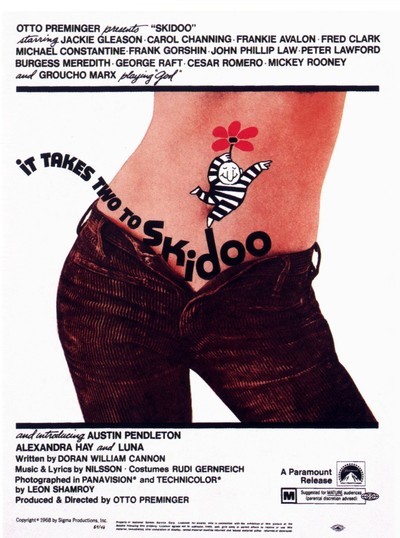
I first discover Skidoo in the Medved Brothers’ Golden Turkey Awards books. For years, it had been a cultural touchstone for what made a bad movie. I’ve learned over the years that what many see as trash, I discover as treasure. And when I watched the trailer for the film, I was astounded: this was a movie I wanted to see.
So why did I wait so long to see it?
Two reasons. One an excuse and the other reality.
The excuse? The film was incredibly difficult to find for years. But now, thanks to the cloud, we can call down any movie virtually at any time.
The real reason? The film that I built up inside my head had to be better than the actual reality. There’s no way any movie could live up to that insane trailer, where Old Hollywood mixes with Dr. Timothy Leary and a cliche-spouting Sammy Davis Jr. to cajole you into not only seeing Skidoo with mom and dad, but potentially dosing their Sprite before they view it in their local cinema.
The film begins with a cartoon Jackie Gleason dancing as a peace-logo flower descends and the logo of the movie fills the screen. Nilsson’s theme plays — he would also appear in the film in a minor role and sing the astounding end credits, covering every person down to the copyright info — as we pill back to a TV screen flashing through channels.
We hear the voices of stars Carol Channing and Arnold Stang over images from space, then Peter Lawford in a mock U.S. Senate hearing about organized crime, then scenes of Preminger’s In Harm’s Way in between each story beat and mock ad. Of note, Channing says that she hates how they chop up movies for TV. At one point, Preminger sued ABC for editing his film, after all.
More commercials follow, including one where an attractive woman promises you the viewer that “Now, you too can be beautiful and sexually desirable like me, instead of being that fat, disgusting, foul-breathed, slimy, wallowing sow that you are!” before another ad with an even more attractive blonde and then a man drinks beer while belching and being intercut with images of a swine in mud as an announcer happily intones, “Feel big! Drink Pig!”
This strange blend of footage — feeling like cut and paste Burroughs technique — continues with the jingle for Fat Cola (“You’ll never lose your man if you drink Fat Cola!”), kids made up like Our Gang complete with Pete the Pup all smoking cigarettes and then more kids being given guns as gifts and then an ad for New Daisy Chain Deodorant, which battles “dandruff, athlete’s foot and the common cold, cancer, birth defects, mental illness, ringworm, poison ivy, tooth decay, acne, measles, brain tumor, smallpox, syphilis, plague, influenza, hepatitis and St. Vitus Dance.”
We move back from the TV to reveal the cause of all this flipping: Gleason and Channing each have a gigantic remote control. One of them wants to see the Senate hearing; the other anything but. We then see Joe Pyne, a TV host who pioneered the confrontational style of today’s TV journalism, launch into a diatribe.
Welcome to Skidoo, chum.
Gleason is Tony Banks, a retired hitman who has settled down with Flo (Channing) and the girl who may or may not be his daughter — one wonders if any of Preminger’s relationship with Gypsy Rose Lee and the son he had to avoid claiming Erik figures into this — Darlene (Alexandra Hay, who is stunning and sadly died at the age of 46 from heart disease).
There are two big issues: Darlene has fallen for a hippy named Stash (John Phillip Law, forever Diabolik in my heart) and that the mob wants Tony back. Hechy (Cesar Romero!) and Angie (Frankie Avalon!) — a father and son duo in matching Halloween-tone suits — want him to rub out “Blud Chips” Packard (Mickey Rooney) before he can rat them all out to the U.S. Senate. Tony refuses the word of God, the top mobster, and pays for it when his best friend Harry (Arnold Stang, who is really the god of movies people decry as bad, appearing in this film as well as Dondi and Hercules In New York) shows up dead. Tony’s fingered for the crime and goes up the river, exactly as God intended.
We move to Alcatraz, a high-tech prison where Packard is being protected before he can testify. One of Tony’s cellmates is draft dodger Fred the Professor (Firesign Theater co-founder Austin Pendleton), who is a wizard with technology but refuses to use it. Of course, Tony talks him into creating a way of communicating with Packard. They renew their friendship and our protagonist — well, if this movie even has a hero — decides not to kill the man.
Meanwhile, Stash and his friends have moved into Tony’s house (their dialogue was written by Rob Reiner) while Flo does a striptease for Angie — she’s dressed in neon hues throughout the film and at times, appears as if she’s a real-life Big Bird — in the hopes of finding her husband. Darlene also shows up and nearly leaves Stash for the suave killer. He agrees to take her to see God and Stash hitches a ride.
When they arrive, we learn that God is Groucho Marx and has been trapped on his yacht for years, afraid that he could be killed at any time. Intriguingly, the ship used for this movie is John Wayne’s yacht the Wild Goose, which was once a U.S. Navy minesweeper named USS YMS-328. Given Wayne’s feelings about the counter-culture, I kind of adore that his ship became the setting for what follows.
God and his mistress (Luna, who somehow connects all the worlds of film, from Warhol’s Factory to Fellini Satyricon and dating Klaus Kinski, who worried that they did so many drugs together that they could ruin his career; the fact that the famous madman was worried about Luna’s behavior speaks volumes) fall for Darlene and Stash, who go on the run from them.
Tony realizes that because he can’t kill Packard, so he’ll never leave the prison. He writes to her on some of Fred’s stationery, licks the envelope when he shouldn’t and we now enter into a seven-minute sequence of Jackie Gleason tripping balls. “I see mathematics!” shouts Tony, as he begins sweating profusely as the world becomes packed with color and he learns that his dead friend Harry was the father of his daughter, but none of that matters anymore. All is one and all is love and acid conquers all, setting a conflicted mobster’s life right.
Real life did not imitate art, as Gleason would go on to endorse Nixon. Then again, maybe he just did that because he was obsessed with seeing an alien first-hand. No, really.
Cellmate Leach (Michael Constantine, yes the very same Portokalos paterfamilias of the My Big Fat Greek Wedding films) watches all this and says, “Hey, maybe if I take some of that stuff, I wouldn’t have to rape anybody anymore.”
The hippies mount a rescue attempt as Tony and Fred dose everyone in the prison, leading to the guards seeing a football game with the Green Bay Packers (played by the Orange County Ramblers) discard their clothes and play naked. The twosome fly away from the prison and end up on God’s yacht, where Channing warbles the theme song as Tony and Flo consummate their love, God reads Gabriel Vahanian’s The Death of God and then Angie and God’s mistress get married before the new bride makes out with her father-in-law. As all this happens, Geronimo (Tom Law) marries Stash and Darlene.
To top all that off, God and Fred — now with shaved heads and Hare Krishna robes — sail off in a sailboat and smoke a joint. Groucho laughs and surprisingly says, “Mmm…pumpkin!”
An ordinary extraordinary movie would stop here.
But not Skidoo.
Preminger’s voice intrudes, as the voice of God almost, saying “Stop!, we are not through yet, and before you skidoo, we’d like to introduce our cast and crew…”
As stated earlier Nilsson sings everything along with asides, like “Luna as God’s Mistress, well you know-oh what I mean” and asking how your popcorn tastes.
Skidoo is awash with cameos, from character actors Fred Clark and Phil Arnold; Batman villains Frank Gorshin and Burgess Meredith; gangster star George Raft as the skipper; Doro Merande (who somehow survived working with Preminger multiple times); Slim Pickens and Robert Donner (Exidor from Mork & Mindy) as switchboard operators; Richard “Jaws” Kiel as a prisoner, Roman Gabriel (the first NFL quarterback of Filipino descent) as a prison guard.
Did the kids get it? Well, no. The film was not only a critical flop, it died in theaters too. It’s hard to say who the movie is for, as its themes are rooted in the counter-culture while the stars are firmly bound to the chains of Old Hollywood. You practically expect them to feed you tannis root and steal your baby, not turn you on and help drop you out.
Maybe Preminger was trying to connect with his aforementioned hidden progeny, who at the time of filming was living as a hippy in New York’s Greenwich Village. Or maybe he was making the kind of movie that would take a half-century to be appreciated.
That said, I love that Groucho did this movie, which was his last film. He also tripped on LSD with Paul Krassner to get ready for the film. Preminger browbeat the 78-year-old Marx Brother into bringing back his old greasepaint-mustache for this role and continually treated him like you’d expect Otto Preminger to treat an actor on set. This led to Jackie Gleason physically threatening Preminger’s life if he tried the same antics with him.
I spent more time writing about this film than I did watching it, but if my efforts lead to you watching it for yourself, I feel that I’ve properly done my job. You can get this movie for yourself from Olive FIlms.
William Fruet made his directorial debut with Wedding in White, which was based on a play that he had written. The film won Best Picture at the Canadian Film Awards in 1973 and starred Carol Kane and Donald Pleasence. He followed that up with an intriguing string of Canuxploitation films, obviously taking full advantage of those wonderful tax shelter laws that produced so many statistic favorites.
There’s proto-slasher Death Weekend (released in the U.S. as The House By the Lake), Cries In the Night (known better here as Funeral Home), redneck rampage film Trapped(AKA Baker County U.S.A.), Spasms, Bedroom Eyes and the kinda-sorta Alien by way of animal experimentation oddity Blue Monkey, as well as episodes of Goosebumps, Friday’s Curse (perhaps better known as Friday the 13th: The Series) and Poltergeist: The Legacy.
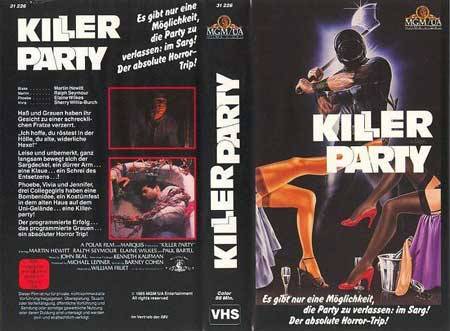
That brings us to Killer Party, a movie once named April Fool before the similarly named April Fool’s Day went into production.
College students Vivia (Sherry Willis-Burch, who is also in Final Exam), Jennifer (Joanna Johnson, who was on the soap opera The Bold and the Beautiful off and on from 1987 to 2014) and Phoebe (Elaine Wilkes, Sixteen Candles, My Chauffeur) are sorority pledges at Briggs College who are in the middle of Hell Week.
They’re warned by their housemother Mrs. Henshaw to avoid the Pratt House, then travels there herself to the grave of a man named Allan, who she asks to leave the kids alone before she’s murdered.
On the day of the initiation — this is a similar slasher trope, just witness Sorority Girls In the Slimeball Bowl-O-Rama,One Dark Night and The Initiation just to name a few — the girls prepare to break in and steal some clothes. We also meet Blake (Martin Hewitt, the doomed obsessive lover of Brooke Shields in Endless Love) and Martin (Ralph Seymour, Surf II, Just Before Dawn), who with interested in Jennifer.
During the hazing, the girls are forced to hold raw eggs in their mouths. Soon, all hell breaks loose and the lights begin to flicker and glasses rise off the table. Vivia goes to see where the noises are coming from, which leads to the group finding her get beheaded in a guillotine. Somehow, this was all a ruse and part of a prank that she decided to play. This part kind of confuses me, as I have no idea how a pledge — or why, to be honest — could set up such an elaborate trick.
That said, that prank becomes the reason why Vivia makes it into the sorority. She’s asked to recreate it at the April Fool’s Day masquerade that they’re throwing at — DUH DUH DUH — the Pratt House. That’s when we learn — via Professor Zito’s (Paul Bartel!) exposition — that Allan died in such a hazing ritual involving a guillotine 22 years ago. That said, Allan may have been way into the occult and conjured an evil force that was behind his death.
Bartel is the best part of this movie. I’ve said that sentence so many times, but it’s incredibly true here. Sadly, he doesn’t last much longer as when he decides to inspect the house, someone in the basement electrifies him. Also, his Zito character is named after Joseph Zito, who directed Friday the 13th: The Final Chapter and The Prowler. That’s because the former of those films was written by this film’s writer, Barney Cohen.
During the prank at the part, Jennifer is possessed by a spirit and stops the trick. As the party falls apart, the killing picks up, with Veronica being killed with a hammer, Pam stabbed with a trident, Martin’s head ends up in the fridge while Albert also loses his noggin and then Blake is drowned in a bathtub. Vivia and Phoebe run from all this carnage right into Jennifer, who discloses that she’s possessed by the ghost of Allan.
They try and escape through a window, but Vivia is thrown to the unforgiving earth, breaking both her legs. Phoebe ends up killing her possessed friend by impaling her with a board, but she’s overtaken by Allan, just as the police put both women into an ambulance. The movie closes on Vivia screaming that she can’t be left alone with Phoebe.
The reason for the quick burst of murder in this film is because it had to be re-edited following numerous MPAA cuts. That’s why the film seems to have no gore and is edited so that the murders have little room in between. In the original cut, there was more time between each kill, as well as plenty more gore, like Pam getting completely impaled by the trident.
If you’re watching this and wondering, “Have I seen Briggs College before?” you have. It’s the same school as 1998’s Urban Legend.
Killer Party was a late comer to the slasher era, but it’s a quick moving burst of fun. It’s not perfect, but how many of these movies are?
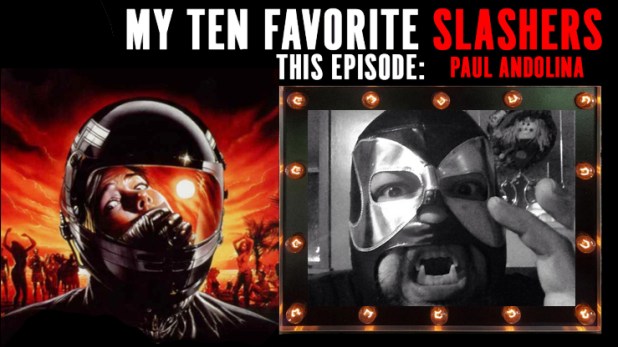
ABOUT THE AUTHOR: Paul Andolina is the latest person to answer our challenge: what are your ten favorite slasher movies? You can learn more about the movies Paul loves at his site Wrestling with Film, which is all about pro wrestlers acting in movies. Plus, Paul also covers a lot of found footage, foreign and Christmas-related films for our site, so I’m excited to see what he picked!
Sam asked me to participate with a top ten slasher post by writing what my top ten slashers are. Here they are in no particular order. I love them all to varying degrees but I always have a fun time watching them.
My Bloody Valentine (1981):A sleepy mining town is turned upside down when they have a Valentine’s Day party on the anniversary of the Harry Warden killings. This one probably kicked off my search for holiday themed horror. My Bloody Valentine is great. The characters are all pretty interesting, especially Howard and Hollis. They are probably my favorite characters in a slasher film to date, tied with Barb from Black Christmas. Good enough to watch all year long as it seems a shame to only break out once a year. There is a 2009 remake that is probably a little too harshly maligned. It works.
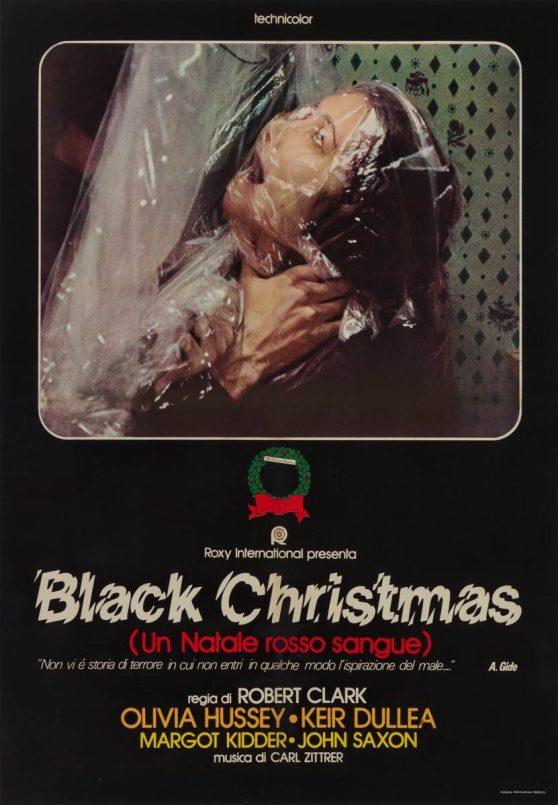
Black Christmas(1974): A sorority house is being terrorized by an exceptionally vulgar phone stalker in the midst of a missing house mate and young local girl. This movie is one of the best slashers of all time in my opinion. The constant calls filled with vulgarity and violence are truly upsetting and the ways the victims are dispatched aren’t as run of the mill as some of the later entries in the slasher genre. It’s hard to believe the guy who was behind A Christmas Story (1983) was the director of this one. He also directed Baby Geniuses which was a big part of my growing up but let’s keep the memories happy here.
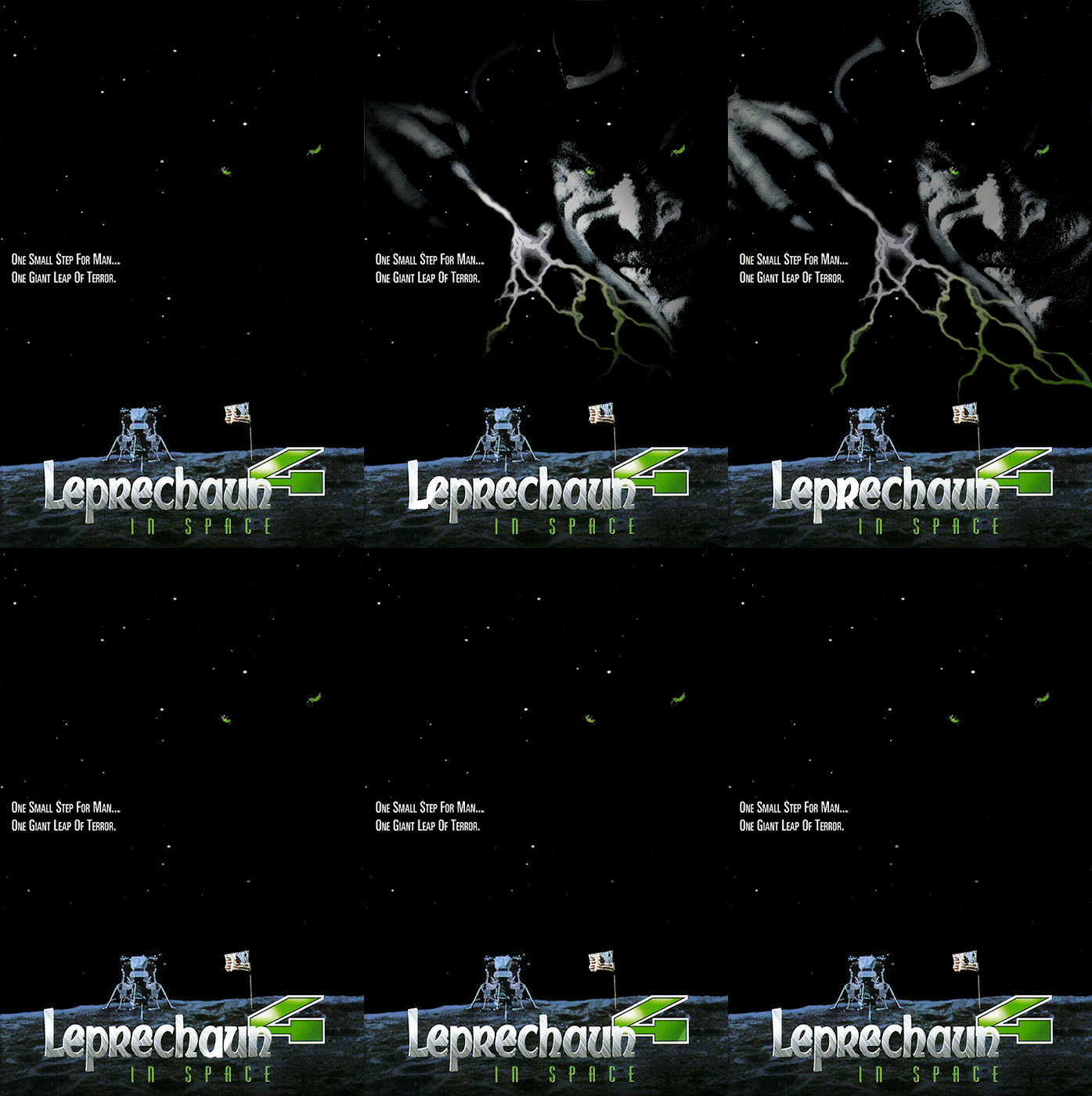
Leprechaun 4: In Space (1997): The Leprechaun is one of my favorite horror franchises ever, that includes Leprechaun Origins which stars Dylan “Hornswoggle” Postl. Warwick Davis is truly a gifted man, he brought so much life to the character of the leprechaun across 6 freaking entries! The reason I chose In Space among the other films is because it is off the freaking walls bizarre. A giant robot-man-spider hybrid makes an appearance, the leprechaun manifests out of a space marine’s genitals, and there is ametal domed hard ass marine Master Sergeant who gets his wires crossed and starts acting like a lady. Pair this with a sultry space princess named Zarina, and you have a truly fun movie. Who cares what Rotten Tomatoes says at least watch this once!
The Final Girls (2015): The grieving daughter of a famous B-Movie actress who starred in Camp Bloodbath attends an anniversary screening of the movie 3 years after her mom’s death. The theater catches on fire and are inexplicably sucked into the movie! This film takes the best and worst of the teens in the woods and a killer is on the loose trope and turns it into a nostalgia laden movie with a killer soundtrack. Adam Devine who plays Kurt in the movie hams it up brilliantly. Worth a watch for anyone who is a fan of comedies with a horror flair.
Scream 3 (2000): The Scream franchise has always been a bit meta and before it took being meta to an entirely new extreme in Scream 4 11 years after this one this is what fans were left with. Not many folks are big fans of this one but I am absolutely obsessed with Parker Posey. That’s in large part due to her excellent portrayal of psycho vampiress Danica Talos in Blade Trinity alongside WWE’s Triple H as Jarko Grimwood. Parker Posey needs the chance to do some more character work. Sidney Prescott visits the set of the movie Stab 3 and another Ghostface appears. I love movies set in a fictional Hollywood and this version of it is pretty scummy. I imagine the real one is just as scummy. I dare you to pull this one off the shelf next time you have an itch to visit this franchise. Also stars David Arquette who is currently blazing a new trail in the world of independent wrestling.
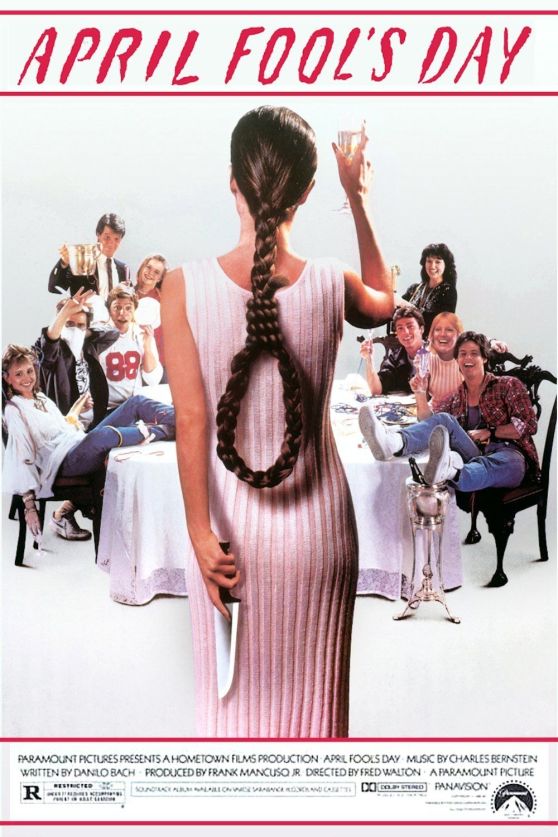
April Fool’s Day (1986): As you may have figured by now I have a slight obsession with films that occur on or around holidays. Muffy St. John invites some of her college friends to stay on an island during the weekend of April Fools. Her friends start turning up dead. This one is so fun. I like what it does with its story through-out its run time. I really like the character of Chaz. This one is produced by Frank Mancuso Jr. who co-created Friday the 13th and also stars Amy Steel who played Ginny in the 2ndFriday the 13th.
Jack Frost (1997): Serial killer Jack Frost is on his way to be executed when the truck carrying him crashes into another truck carrying genetic material. He turns into a mutant snowman and goes on a killing rampage. This movie is so dumb. It also happens to be a bunch of fun and spawned a somehow crazier sequel set on an island. Highly recommend a double bill of them both paired with a few frosty beers.
Nightmare Beach (1988): Sam and I share a special bond over Umberto Lenzi who may or may not be the actual director of the film. It feels like one that is close enough for me. A killer from a motorcycle gang is executed but not before he vows to return to kill again. A mysterious biker rides into town soon after with an electrifying apparatus attached to his bike. John Saxon is in this, Claudio Simonetti does the soundtrack, please go watch this film and fall into the trap of Lenzi’s kick ass filmography. Even at his worst he’s still at the top of the game.
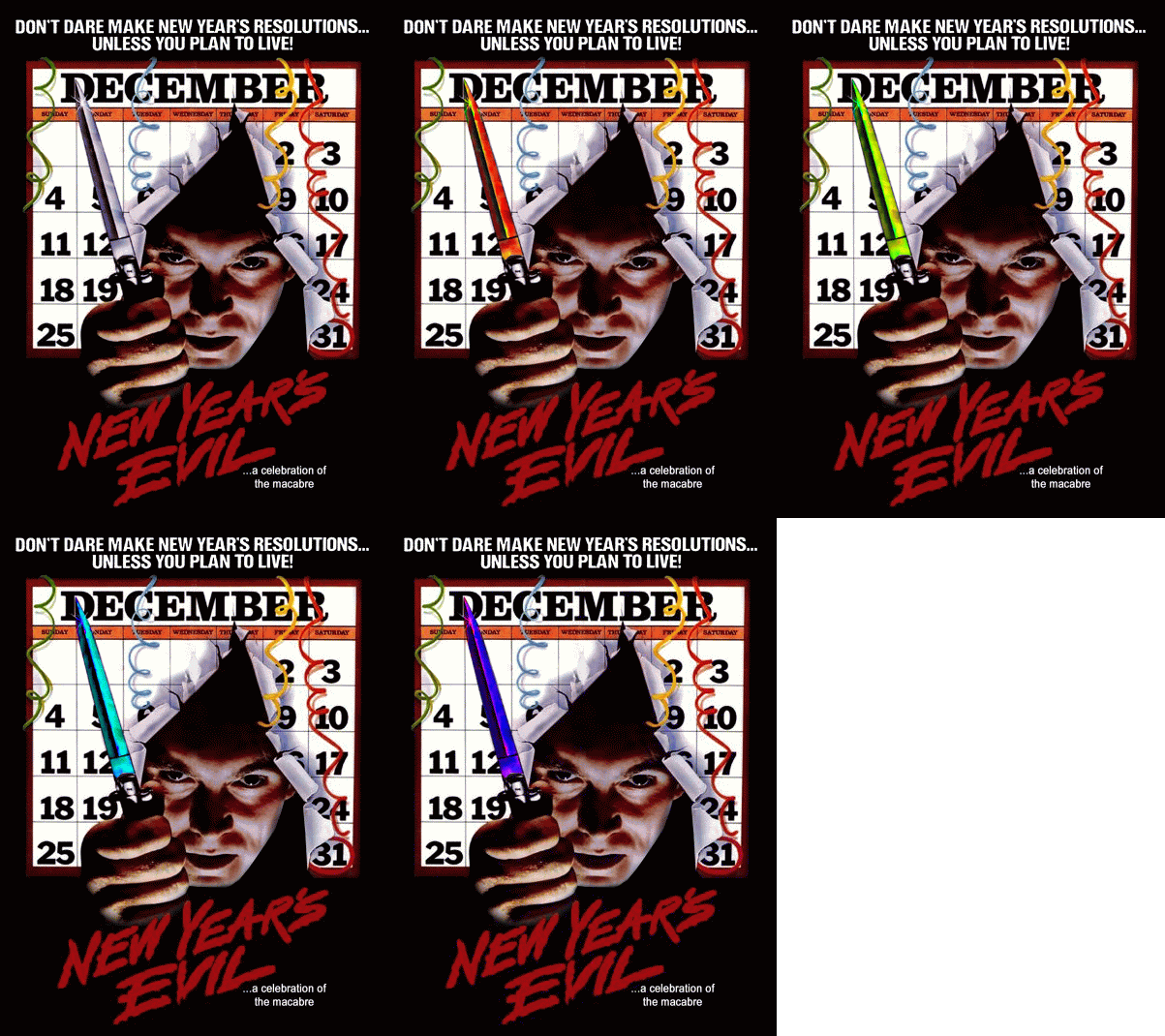
New Year’s Evil(1980): A strange caller who calls himself Evil keeps calling into a televised New Year Musical Celebration saying he’s going to kill someone at the start of the new year from every time zone. With more red herrings than a jumbo bag of swedish fish, an extremely infectious theme song, and some slick ass costumes, you’re going to really enjoy this while boozed up during New Year’s Eve or any other time of the year you’re in a particularly festive mood. I watched this while I was sick as a dog so that may have colored my views.
Santa’s Slay (2005): I have my pro-wrestling obsession to thank for stumbling across this one. Goldberg (WCW) is an evil Santa Claus who has finally escaped from a very long sentence of being nice. He lost a curling bet to an angel. I know this sounds ridiculous and it is but it is a fun watch. I especially like WCW personality Vince Russo appearing as a non nondescript patron of a strip club and Tiny “Zeus” Lister’s portrayal of a gas station attendant. The opening alone is one hell of a thing to see so even if you turn it off immediately after that sequence, I’d chalk it up as a win.
So that is ten of my favorite slashers I’ve seen. I plan on trying my own hand at a slasher month over on Wrestling with Film. I had no idea how many slashers star or feature wrestlers!
Day 14 S.T.D Madness!: Science, Transformations & Dabbling: A cracked scientist’s creative palette
This writer was a wee lad when 1973’s The Neptune Factor played at the neighborhood duplex. Equipped with nothing but the television and print ads we, the grade school-era Ralph McQuarries, feverish drew our Neptune submarine art class recreations, anticipating our parents taking us to see the film that weekend.
An Irwin Allen-styled earthquake? An underwater ocean lab plummets into a deep ocean trench? Lazy scientists that never leave the lab and, when they do, their hysterics unleash the beast? The “Aliens” attacking the crew of the Nostromo in James Cameron’s “Abyss” . . . are giant killer eels?
I’m all in . . . or at least I was: age robs us of our innocent, youthful tastes.
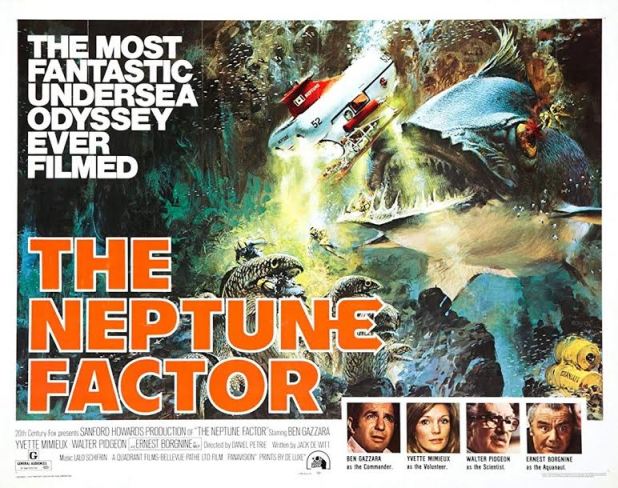
As is the case with the sensationalistic movie posters of ‘70s: the film behind the one-sheet never delivers on the art work promises. There was no “digital water” in the pre-CGI, George Lucas ‘70s; so the special effects endangering The Neptune consisted of fish “optically enlarged” into head butting, growling and howling, blood-thirsty monsters that cavort with Godzilla-style miniatures.
Beware: Giant Seahorse Crossing Ahead!
Forty-five years later, as I embark into the skies of blue and sea of green on my White & Red Submarine to battle the Aqua Meanies of Neptuneland, I’m blown away that The Neptune Factor — at its core it’s just your average sci-fi B-picture, only with a million dollar budget — starred Ernest Borgnine (“Cabbie” from Escape from New York), an Oscar winning actor. His co-star, Ben Gazzara (“Brad Wesley” from Road House), earned multiple Golden Globe and Emmy nods and Broadway accolades. Walter Pidgeon had two Oscar nods in his pocket; Yvette Mimieux worked consistently as one of MGM Studios’ leading contract players throughout the 1960s and made her debut in H.G Wells The Time Machine.
“The Most Fantastic Underwater Odyssey Ever Filmed,” so proclaimed those advertisements that fueled those art class fantasies.
And that was MGM’s goal: to do for the ocean what Kubrick did for space — by placing an Irwin Allen paint-by-numbers disaster plot underwater. And in case we forgot: the closing credits again remind us — with the film’s subtitle — we just experienced “An Undersea Odyssey.”
Uh, did we, really?
To hell with the Blue Meanies that freak me out, still, to this day. Full steam ahead to Pepperland, Ringo: We sail to a land where, instead of a HAL supercomputer jeopardizing the crew and mission, we get an Yvette superbitch disobeying orders, throwing switches, blowing circuits and causing the “Discovery” of the film to tumble ass-over-elbows down an aquatic abyss. Instead of a mind-bending space gate: we get a mind-numbing plethora of giant tropical fish. Instead of an acid-spewing Xenomorph: we get a head-butting Gold Fish.
For a film junkie like me: it’s celluloid déjà vu.
I’m watching the “giant” underwater crabs attack the toy-miniature Space Probe Taurus (1965) — only on a reported $2.5 million budget — all over again. At least the giant rat-spider-bat from Angry Red Planet (1959) was fun. It’s no fun watching 80 minutes of a future, post-apocalyptic New York cab driver feigning awe over a tropical fish tank under a zoom lens.
In the pre-2001: A Space Odyssey epoch, your typical science fiction film of the ‘50s and ‘60s consisted of Shakespearean-trained character actor John Carradine (father to “Snake Charmer” in Kill Bill) slipping into a silver lamé “space suit” to find a cure for the Earth’s vampire plague by way of a horde of bubbling, gurgling vials and beakers strewn across a wooden table in the “science lab.” On the wall was the requisite Bulova industrial-clock hung above a bank of reel-to-reel tape players replete with flashing lights that indicate danger is ahead.
For a film junkie like me: it’s celluloid déjà vu.
Here I am, watching another long-in-the-tooth actor — this time it’s Walter Pidgeon — in the same Carradine lab. And there’s a shot of a Bulova clock on the wall, again, you know, to remind us the stranded sealab’s oxygen is running out and the aquanauts will die.
Oh, Stanley. How did the “underwater you” go so wrong?
Stanley Kubrick, along with special effects artist, Douglas Trumbull, opened the once scoffing eyes of Hollywood’s mainstream studio system to the fact that the once low-budget genre of science fiction could present the same level of quality to the screen as any of their bloated-budget war, western, or bible epics.
The first A-List star to cross Hollywood’s sci-fi picket line was Moses and Ben-Hur himself: Charlton Heston. All three of Chuck’s contributions to the genre — Planet of the Apes (1968), The Omega Man (1971), and Soylent Green (1973) — became critical and box office hits—not just domestically, but internationally. Thanks to Heston setting the stage and proving science fiction could be well-made and generate favorable reviews and box office returns, then the flood gates opened with Yul Brynner, Bruce Dern, James Caan, Nigel Davenport, Sean Connery, Jackie Cooper, Richard Harris, Paul Newman, George Peppard, and Oliver Reed all making science fiction films.
And it was time for Ben Gazzara to jump into the deep end of the pool.
Made by 20th Century Fox and co-released by Fox and MGM Studios, The Neptune Factor (retitled for TV and video as The Neptune Disaster and Undersea Odyssey), essentially, is an underwater, sci-fi reimaging of Ernest Borgnine’s previous hit, the gold standard of ‘70s disaster pics: The Poseidon Adventure. And why is Walter Pidgeon here? For an air of familiarity: he captained The Seaview for Irwin Allen’s 20th Century Fox’s sci-fi sub flick, Voyage to the Bottom of the Sea.
Yes, for a film junkie like me: it’s celluloid déjà vu.
And there I was, six years later, my mind swimming with X-Wing dogfights over the Death Star, anticipating the release of Voyage to the Bottom of the Black Hole, uh, I mean, The Black Hole Disaster, I mean, The U.S.S Cygnus Disaster, uh, The Poseidon In Space, as The Neptune shed its watery space as it shot off into outer space — minus the photo-giant fish tomfoolery — with Borgnine and Mimieux at the helm once again, this time aboard the Palamino, as they entered Disney’s Star Wars-inspired black hole.
And cinema history tells us The Black Hole was initially conceived in 1974 as a Poseidon-inspired sci-fi adventure — to capitalize on the sci-fi craze sparked by Heston’s success — known as Space Station One, aka, Voyage to the Bottom of the Black Hole Abyss as the Aliens Attack the U.S.S Poseidon Neptune Disaster Adventure. Considering the coolness of Trumbull’s post-2001 space opera, Silent Running, Space Station One, if made in 1974, could have worked.
Yes, it all comes back full circle because . . . for a film junkie like me: it’s always celluloid déjà vu.
And yes, I still run crying to my mommy because those Blue Meanies are still coming to get me, for a Beatle is scarier than a fish. Live in fear of the seas of green with the full movie on You Tube and Daily Motion.
Do you need more celluloid déjà vu? Then pull up a Chalmers, uh, I mean, chair, and visit the post-apocalypse world of Bladerunner—before Bladerunner—with 1962’s Creation of the Humanoids. And, it gets worse with 2020’s Underwater.
About the Author:You can read the music and film reviews of R.D Francis on Medium and B&S Movies, and learn more about his work on Facebook.
During the Blood Cult media frenzy splashed across the trash cinema, monster, and underground movie magazines of my youth — such as my cherished issues of Famous Monsters and Fangoria — I can’t recall if the Hollywood movie and rock ‘n’ roll royalty lineage of director Christopher Lewis was reported on, and, if it was, that it meant anything to anyone at the time.
Christopher Lewis one-stop three-in-one shopping.
I doubt it: I was too busy jamming Slayer’s new album, Hell Awaits, and saving my slave wages to see Iron Maiden. I was pissed off I wasted money on tickets to specifically see Saxon open for Triumph — only for Saxon to pull out at the last minute. And I was trying to retrieve my cherished April Wine concert t-shirt from my psycho ex-girlfriend (my nutty, late-cousin, Johnny, made up a parody tribute to her insanity: “Psycho Robyn” — appropriately enough, within the context of this film review — based on the Talking Heads’ hit “Psycho Killer”: Psycho Robyn /She’s a bitch /a ba-ba-ba, ba-ba-ba bi-i-i-tich).
Anyway, it turns out, Christopher’s dad, Tom Lewis, was a noted film and television producer; his mother an award-winning Emmy and Oscar-caliber actress, Loretta Young. His stepdad was Clark Gable of Gone with the Wind (1936) fame. His uncles were Ricardo Montalban (Star Trek II:The Wrath of Kahn) and director Norman Foster (of the “Charlie Chan” series of movies). His rock ‘n’ roll connection came courtesy of his little brother, Peter, who co-founded seminal San Franciscan rockers, Moby Grape. His cousin was noted lap-steel guitarist David Lindley who, in addition to fronting his own psych-rock band, Kaleidoscope, joined the bands of Jackson Brown, Warren Zevon, and Linda Ronstadt (remember his FM “Top 40” hit, “Mercury Blues” from the MTV ’80s?).
Meanwhile . . . cuzzin’ Chris spearheaded the ‘80s SOV home video distribution boom.
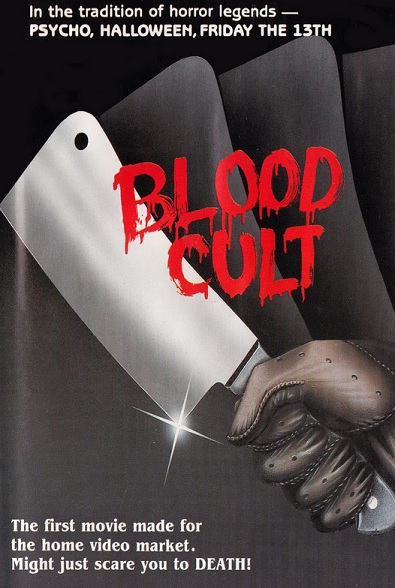
In the lost kingdom of ‘80s Big Box VHS/SOV horror (sigh . . . just look at Blood Cult’s beautiful, soft-pak clamshell with the artwork insert), Christopher Lewis was the king of the video fringe that we all survey with his exclusively distributed-by-video store, blockbuster triple threat of Blood Cult, The Ripper (1985), and Revenge (1986; aka Blood Cult 2). For those two gloriously bloody years, you couldn’t open a genre magazine and not see an interview, a film review, or an ad adulating his SOV oeuvre.
Sure the Big Box/SOV horrors Boardinghouse(1982) and Sledgehammer (1983), along with Blődaren (1983), Copperhead (1983), and Black Devil Doll from Hell (1984) — and not taking into account the video-shot-for-television movies canons of the prolific Dan Curtis (‘70s TV Movies!!!!) — were the first of the low-budget, VHS-only issued films. Inspired by the blockbuster success of John Carpenter’s Halloween and Sean S. Cunningham’s Friday the 13th, SOV horror films took advantage of JVC’s VHS tape-format and the cost-effectiveness of shooting with 3/4-inch U-Matic tape via broadcast ENG and Ikegami cameras. But those films, while groundbreaking, were mail-order distributed, with a few gaining convention-based screenings at comic-cons and horror-fests.
So while Blood Cult isn’t the “first” shot-on-video horror film, it is the first SOV to bypass con-fest screenings and Grindhouse theatres and Drive-Ins in one-off showings to be distributed exclusively on the new “screens” created by the home video market. Filmed in nine days on a paltry $27,000 budget that wouldn’t cover the cost of a Roger Corman Philippines-shot schlock fest (we love you, Cirio H. Santiago!!!!), Christopher Lewis revolutionized the video store industry. Courtesy of his success, all other SOVs in his bloody wake spilled upon the retail-rental altars of the brick-and-mortar afterworld.
Courtesy of my craving-nostalgia fueled by the glorious results of my misspent youth, I give Blood Cult a Gene Siskel and Robert Ebert “Two Thumbs Up,” a Time Magazine “5 out of 5 Stars,” and the Rotten Tomatoes couldn’t be juicer and plumper; however, I am not going to sugarcoat. The damsels in Blood Cult, with their unconvincing caterwauling under the threat of rubbery blade makes the sundress-clad and high heels-running from Templar-zombie babes on the Italian and Spanish Gialli fringes (can you hear the Panic Beats?) look like Oscar and Emmy winners. If you’re looking for novelty special effects of the Spirit Halloween or Party City variety — this is your movie. If you don’t want be shocked — as the Big Box claims: “In the tradition of horror legends Psycho, Halloween, and Friday the 13th” — then this is your movie. While Blood Cult is no Necropolis (and what SOV is, thank god), the body-part cult shenanigans are more of the Rocktober Blood variety than any of those films.
You have to give Blood Cult credit though: it wastes no time in getting a kill on the TV screen. As soon as the VHS tape rolls — WACK! — a nubile sorority shower bunny loses an arm. Then, on no — it’s a “tell, don’t show” prologue alert: We’re in a bogus crime story documentary about a serial killer collecting body parts in a small Oklahoma college town. The only clues, beside the lost limbs, are some gumball-machine golden amulets left on the bodies. I guess they couldn’t afford any grey velvet or flies, or Donald Duck heads, or lizard skins. Or call F.B.I agent Jake Malloy from D-Tox.
We are, of course, supposed to care for the cadaverous sheriff (that makes horror icon John Carradine look moist) who, in a modus operandi typical of a politician, is more concerned with his jeopardized run for state senate as result of all the limbless woman piling up around him.
Luckily, his resourceful student-librarian daughter, Tina (local Okie actress Juli Andelman of the Cameron Mitchell slasher, The Silent Scream), picks through some books and discovers the shiny trinkets are the symbol of a Salem Witch Trials-era cult bent on avenging the death of 19 witches. To return balance to the afterworld, they must create a complete body—one body part at a time (“my ears, my nose, and mouth . . . head, shoulders, knees and toes, knees and toes” come on, sing it with me)—and have a midnight body barbeque to celebrate.
Uh-oh. Here comes The Wicker Man. All the major political power players in Hicksville, USA are the cult and want Sheriff Cadaverous out of the senate race; so they spike his coffee and ready him for dismemberment and burning . . . and here go again with the was-it-a-dream-or-was-it-real double-plot twist.
Regardless of its SOV shortcoming and, like with John Howard’s Spine, Christopher Lewis knew what he was doing behind the camera; Blood Cult isn’t a Plan 9-Ed Wood boondoggle. Chris capitalized on its blockbuster rental status with Revenge, which picks up where Blood Cult left off.
Ah, the original VHS cover that feels like home.
In the grand tradition of notable-successful actors hitting hard times and slumming in an SOV romp to pay the rent (and for a producer to get a marketable name on the Big Box), such as Michael J. Pollard in Sleepaway Camp III: Teenage Wasteland (1989), adult-film star Amber Lynn in Things (1989), and Janus Blythe of The Hills Have Eyes in Spine (1986), Revenge stars John Wayne’s son, Patrick — the star of the huge (in our hearts!!!!) mid-‘70s drive-In hits The People That Time Forget and Sinbad and the Eye of the Tiger.
Exhibiting still cheesy, but vastly improved technical skills in front of and behind the camera, star Wayne returns home to investigate the death of his brother from the first film. Rut-ro, Shaggy! He runs afoul of a dog-god cult with a body-part fetish overseen by cadaverous horror icon John Carradine who, even with the dreck he’s been in, deserves better than ending his career with an SOV appearance.
In between those body-part cult romps, Christopher Lewis teamed with famed special effects artist and horror icon Tom Savini on The Ripper (because of Tom, everyone rented it). Starring as Jack the Ripper, Tom (who’s very good) comes to possess a college professor and recreate The White Chapel Murders, courtesy of an antique ring.
As with the “video nasty” status of Spine, here we are, 30 years later, able to type “Blood Cult 1985” into Google and take our pick of Best Buy and Walmart, Amazon or eBay to buy our copies. Blood Cult made its DVD debut via VCI Video (2001) as a standalone disc and as part of its three-disc “The Ripper Blood Pack” featuring The Ripper and Revenge (2006). Mill Creek issued Blood Cult on its 12-disc “Decrepit Crypt of Nightmares: 50 Movie Pack” (2007), and as a double feature “Scream Theatre: Volume 5” with its sequel, Revenge (2012).
You can learn more about the making of Blood Cult and the world of SOV filmmaking with a two-part documentary uploaded to the You Tube page of Christopher Lewis: Part 1 and Part 2. While there’s no VHS or DVD rip online for Blood Cult, you can watch Revenge and The Ripper on You Tube.
About the Author:You can read the music and film reviews of R.D Francis on Medium and B&S Movies, and learn more about his work on Facebook.
DAY 14. S.T.D. Madness: No, not syphilitic symptoms! Science, Transformation & Dabbing; a cracked scientist’s creative palette.
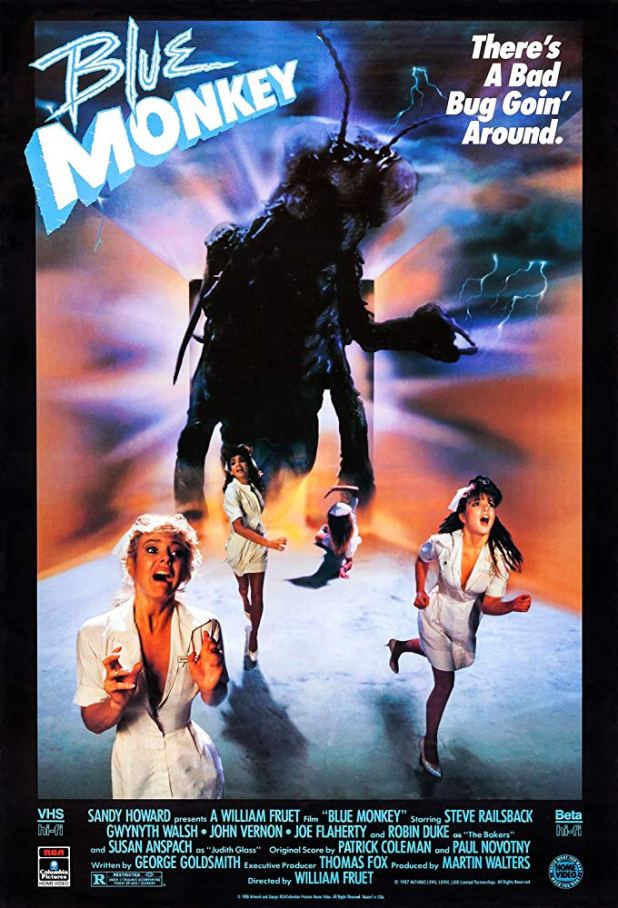
Producer Sandy Howard (A Man CalledHorse, The Neptune Factor — look for that one in oh, a few hours on our site, The Devil’s Rain!, Meteor) had a three-picture deal with RCA-Columbia back in the glorious days of direct to video store movies. Along with Dark Tower (where Freddie Francis (numerous Hammer and Amicus favorites like Trog and Tales from the Crypt) and Ken Widerhorn (Shock Waves, Return of the Living Dead Part II,Eyes of a Stranger) combined forces to become Ken Barnett, directing Michael Moriarty and Jenny Agutter as they battled a haunted high rise) and Nightstick (in which a renegade cop and Leslie Nielsen battle terrorists), he dreamed up a ripoff of Aliens that would take place in a hospital that was called Green Monkey due to the theory that that’s where AIDS came from. Hey — it was 1987.
Helping matters was the 30% Canadian tax benefit, as long as the film was shot in the Great White North with mainly Canadian talent. That means that Saskatchewan native John Vernon is going to show up in most of these films. That’s a welcome thing in my eyes.
Marwellia Harbison is an old woman who loves her plants, but her Micronesian plant is drooping and when handyman Fred Adams inspects it, it pricks his finger. Soon, he collapses and she takes him to Hill Valley Hospital.
Doctors Rachel Carson (perhaps named for the Pittsburgh native whose book Silent Spring advanced the global environmental movement) and Judith Glass see the man and are shocked to discover he already has gangrene.
Ther next patient is the partner of Detective Jim Bishop (Steve Railsback, Helter Skelter, Turkey Shoot), who was shot point blank by criminals.
But back to Fred, who starts shaking and puking up a gigantic insect in pupa form, which they hospital techs put into a bell jar. For some reason, this hospital is also testing military-grade lasers and can analyze monstrous bugs that come out of the stomachs of old men. It’s really all things to all people, a deus ex machine for all seasons.
Marwella and the paramedic who helped Fred now have the same symptoms, and when Fred himself goes into cardiac arrest, the shock paddles cause his chest to explode in a torrent of blood. When the doctors all demand that the hospital be quarantined, hospital director Roger Levering (there’s that John Vernon role we’ve been waiting for!) refuses, as he doesn’t want to cause a panic.
Can things get worse? Of course. Remember that bug in the bell jar? Well, a lab tech is ordered to keep an eye on it, which she instantly forgets when her boyfriend brings the promise of weed and sex in the parking lot. Then, to compound matters, a group of sick kids decides to screw around and pour blue powder all over the beast. That blue powder ends up being some growth hormone, which of course was just lying around the lab. So now, in addition to the virus spreading throughout the hospital, there’s also a gigantic bug killing people left and right.
Can our heroes stop the bug — and the outbreak — before the government enacts the Return of the Living Deadprotocol and nukes the hospital from orbit? Well, you’re just going to have to watch for yourself.
Don Lake, who is in six different Christopher Guest movies and is the writing partner of Bonnie Hunt, shows up as an entomologist. And if you’re looking for cameos by people that you know you love, look no further than SCTV alums Robin Duke and Joe Flaherty (Pittsburgh’s own Count Floyd) who are a couple preparing to have a baby in the midst of this insectoid madness. And this is also one of the very first acting roles for Sarah Polley, who would go on to star in the 2004 remake of Dawn of the Dead. She’s one of the kids dumb enough to pour that blue growth powder all over that bug.
Blue Monkey is also known as Insect and Invasion of the Body Suckers, both of which have magnificent VHS box art.
So yeah. Blue Monkey. A movie that hasn’t been rediscovered and re-released as a $50 blu ray by a boutique label yet. Once you could rent it for 99¢, now you’ll pony up the big bucks for it. Until then, you can order it from VHSPS, which is where my copy came from.
Somewhere along the way, the idea that Wes Craven was a genius became accepted fact. While I enjoy A Nightmare On Elm Street and The Hills Have Eyesjust fine, so many of his films fall apart and feel wildly uneven.
Case in point: 1986’s Deadly Friend.
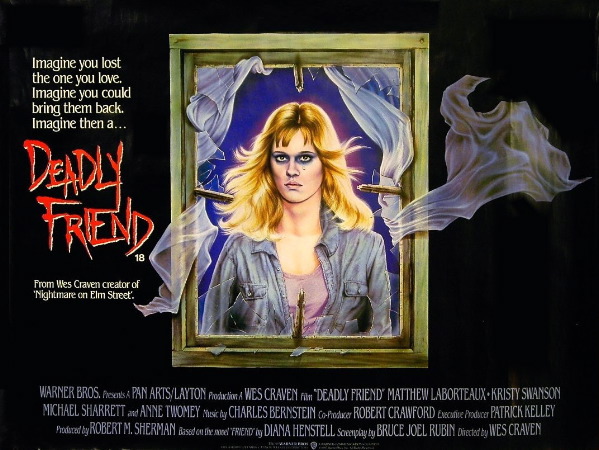
The film was intended to be a science fiction film, based on the novel Friend by Diana Henstell. After Craven’s original cut was shown to a test audience, the audience felt let down that there weren’t any nightmare scenes or gore shocks. So the studio imposed reshoots and a new edit, ending in a film that veers from the wacky comedy hijinks of a robotic best friend with an old woman’s head being exploded with a basketball. Nearly any plot development was lost and we’re left with a main character who feels like an utter creep. A second set of test audiences hated the graphic violence and gore. You just can’t win.
That said — Wes Craven’s output is often marked by explanations of studio interference and bad test screenings and screwed up budgets. I understand that Hollywood is rough and the ghetto of horror movies — which he yearned to escape — doesn’t matter all that much to the bean counters. But seriously — there are more excuses than successes in the oeuvre of Craven.
Teenage science genius Paul Conway (Matthew Laborteaux, Little House on the Prairie star and former U.S. Pac-Man champion) and his single mom have just moved to town. Paul’s got one friend so far, newspaper boy Tom Toomey (Michael Sharrett, Theodore Rex and Savage Dawn). In one of their first conversations, they discuss withdrawn next door neighbor Samantha Pringle (Kristy Swanson, the future Buffy the Vampire Slayer), but mainly discuss her breasts. Yes, the boys of 1986 didn’t even hide what sexist jerks they were.
Samantha and Paul get close when she’s not being beaten into oblivion by her dad Harry (Richard Marcus, who played Dr. William Raines on the TV series The Pretender). But there’s a silver lining — they all have a robotic friend named B.B. that Paul built when he isn’t taking over the college classes he’s attending early or doing autopsies. And oh yeah — B.B. is voiced by Charles Fleischer, whose sub-Robin Williams mania only really worked in Who Framed Roger Rabbit? Here, his voicing of B.B. will instantly remind you of Roger while grating on you with each successive second of screen time.
Other than the abusive dad and a motorcycle gang, the kids’ main enemy is the old lady who lives next door, Elvira Parker (Anne Ramsey from The Goonies and Throw Mama From the Train; it seems this was the role she did best, a harridan who makes people want to kill her). Instead of a tender Home Alone explanation of why she hates kids, she’s a one-note villain: she steals basketballs and fires shotguns, including a harrowing scene (or joy-inducing if you’re as annoyed by this robot as I was) where she murders B.B. with several blasts of hot lead.
After a Thanksgiving night first kiss with Paul, Sam’s dad gets so upset that he ends up shoving her down the steps to her death. She soon expires, leading Paul to go insane and try to bring her back to life with the chip he saved from B.B. This leaves us with Sam as a proto-goth robot zombie with superhuman strength.
What follows is pretty much why this movie is well-known — you’ve probably seen the animated GIF of Elvira’s head being splatted by a basketball — which is wall-to-wall mayhem. People get thrown through cop car windows, Sam dives from a second-story window and lands on her feet to no one’s surprise at all and the end if laughably tacked on, trying to be an ersatz Carrie, with her face graphically splitting open to reveal the visage of B.B. before she kills Paul. Also — the requisite studio asked for dream sequences are here and ready to bleed all over your eyeballs.
PS — that ending is also totally a studio conceit. Writer Bruce Joel Rubin told Fangoria, “That robot coming out of the girl’s head belongs solely to Mark Canton, and you don’t tell the president of Warner Brothers that his idea stinks!”
Seriously — executive vice president of Warner Brothers Mark Canton went mathematic on this film — demanding additional gore scenes be added to the film, each progressing in visceral excess. For his part, Craven would distance himself from the film, feeling that his vision had been compromised. Dude — you were making a movie about a girl being turned into a robot. He dreamed of crossing over like John Carpenter did with Starman. At the risk of being a jerk, I’ll just say what I’m feeling: Wes Craven was no John Carpenter.
Maybe I should be a little nicer. After all, Craven was dealing with anywhere from eight to twenty different producers on this film, as well as a divorce and being pulled from Beetlejuice and Superman IV: The Quest for Peace. Wow — I would actually love to see what Craven would have done with that one! He was also in the midst of a plagiarism lawsuit, as someone claimed that he had stolen the idea for A Nightmare On Elm Street from them. Craven claimed that he worked on Deadly Friend because his agent said to him, “You should do a studio film, because otherwise you’ll be stuck doing small films for the rest of your life.”
As for Rubin, he’d deal with similar studio interference on a later project, Jacob’s Ladder. Ah, Hollywood.
















 B&S About Movies
You must be logged in to post a comment.