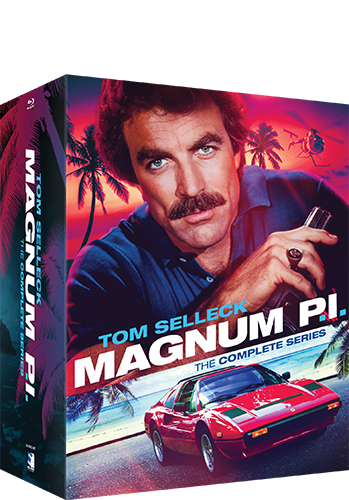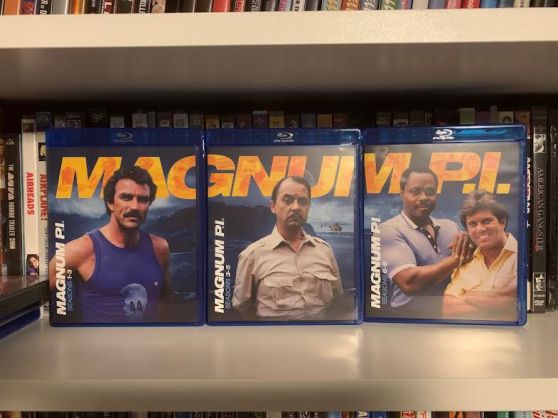
MILL CREEK BLU RAY RELEASE: Magnum PI (1980-1988)

Magnum P.I. was a constant in my life through a tumultuous time, starting when I was just 8 and ending when I was 16, seeing me through the most chaotic years of young life. Thomas Sullivan Magnum IV’s (Tom Selleck) adventures in Hawaii were a center, a Thursday night oasis — Wednesday from series 7 onward — that always knew would be there.

Magnum lives in the guest house of an opulent 200-acre beachfront estate known as Robin’s Nest. At some point, he provided services for its owner, world-famous novelist Robin Masters (voiced by Orson Welles for all but the final time when Red Crandell spoke for the character) and he’s been allowed full run of the estate and use of the author’s Ferrari 308 GTB/GTS in exchange for some nebulous security detail. In between, he takes on cases that rarely pay and often put his life in danger.

His archnemisis is Jonathan Quayle Higgins III (John Hillerman). Like Magnum, he’s also ex-army, but he’s by the book while our hero is laid back. He’s in charge of Robin’s estate, patrolling it with his twin Doberman, Zeus and Apollo. The relationship grows and changes as the series progresses, going from antagonistic to near friendship by the close, as well as the suspicion that Higgins is Robin Masters.

Magnum has a near-perfect storytelling engine as it has the perfect setting (all manner of people come to Hawaii for vacation or to escape), the perfect characters (Magnum can be just as much a film noir hero as he can be a military man or a romantic leading man; he’s a comedic figure without losing his coolness) and the perfect job (being a detective is a reliable TV profession for this reason). Add in his friends Theodore “T.C.” Calvin (Roger E. Mosley) — whose Island Hoppers helicopter can take Magnum anywhere — and Orville Wilbur Richard “Rick” Wright (Larry Manetti), whose King Kamehameha Club can be the origin for all manner of intrigue — and you can see why this series ran for so many years.

While T.C. and Rick are former Marines and Magnum is a former Navy SEAL — all served in Vietnam — none of them are shell-shocked zombies. They’re normal human beings who deal with their war experiences in their own way, which was a refreshing change for audiences — especially veterans — when the show started.

Magnum was such a big show that even other big shows crossed over with it, establishing a CBS detective show universe. In the episode “Ki’is Don’t Lie,” Magnum works with Simon & Simon to recover a cursed artifact, a mystery which had its conclusion in their show with the episode “Emeralds Are Not a Girl’s Best Friend.” Yet most famously, in “Novel Connection,” novelist Jessica Fletcher came to Hawaii — along with Jessica Walter and Dorothy Loudon — and then solved the case on her show, Murder, She Wrote, in the episode “Magnum on Ice.”

Speaking of guest stars, all manner of genre favorites appeared on this show, including Jenny Agutter, Talia Balsam, Ernest Borgnine, Candy Clark, Samantha Eggar, Robert Forster, Pat Hingle, Mako, Patrick Macness, Cameron Mitchell, Vic Morrow, John Saxon and many more.

Another reason why this show is so beloved is due to Selleck. He told producers, “I’m tired of playing what I look like.” His suggestion? He remembered having fun with James Garner on The Rockford Files and suggested making Magnum more of blue collar guy. This made him more identifiable with men, not just women.

One of the things that struck me as I caught up on the series was that the theme is different at the start! The original theme was written by Ian Freebairn-Smith and only lasted eleven episodes before being replaced with the iconic Mike Post and Pete Carpenter song that I hum all of the time.

At the end of the seventh season, Magnum died in a shoot out. I can’t even explain how upset everyone was. The letters page in TV Guide was aghast. Imagine if Twitter existed in the late 80s! Luckily, he came back for one shorter season.

Series creator Donald P. Bellisario — who created this show with Glen A. Larson — was born in North Charleroi, PA. I can probably see his house from mine. After fifteen years in advertising, he went to Hollywood, where he worked on the series Black Sheep Squadron and Battlestar Galactica before creating series like Tales of the Golden MonkeyAirwolfQuantum LeapJAG and NCIS. He was joined by writers like Richard Yalem (who made Delirium), Reuben A. Leder (A*P*E*Badlands 2005), Jay Huguely (Jason Goes to Hell), Andrew Schneider (the “Stop Susan Williams” and “Ther Secret Empire” chapters of Cliffhangers!), Stephen A. Miller (My Bloody Valentine), J. Miyoko Hensley (who wrote the Remo Williams: The Prophecy pilot) and even notorious celebrity fixer and detective Anthony Pellicano, as well as directors like David Hemmings (yes, from Deep Red), John Llewellyn Moxey, Jackie Cooper and Robert Loggia, amongst so many others.

The Mill Creek blu ray box set of Magnum P.I. has all 158 episodes of the show, as well as new interviews with composer Mike Post, writer/producer Chris Abbott, author C. Courtney Joyner on the sixty year career of director Virgil Vogel and actress/writer Deborah Pratt (who was the voice of the narrator and Ziggy on Quantum Leap). Plus, you also get two Tom Selleck guest star roles on The Rockford Files, featurettes on The Great 80’s TV Flashback and Inside the Ultimate Crime Crossover (Magnum P.I. and Murder, She Wrote) and audio commentary on three season 8 episodes.

Much like how Magnum was a calming part of my young life, having this set on my shelf during these turbulent times is just as warm of a feeling. Get this set and let the 80s wash over you like the beaches of Waikiki.

You can get this set from Deep Discount.

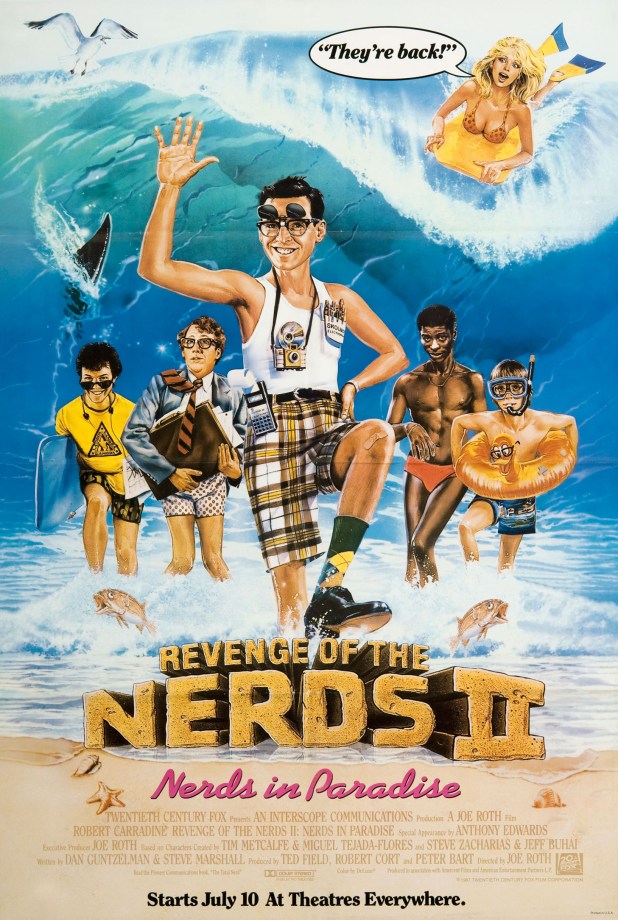
APRIL MOVIE THON DAY 2: Revenge of the Nerds II: Nerds in Paradise (1987)

At the thirtieth anniversary of Revenge of the NerdsJulia Montgomery (Betty) revealed that she originally had a scene in this movie, but turned it down, as it had her cheating on Lewis (Robert Carradine) with a jock. She felt that after her character fell in love at the end of the first movie — never mind that whole weird assault thing — it just didn’t feel right to cheat on her nerdy man.

She was right and understood her character better than the filmmakers.

This was also the last time that Anthony Edwards would play Gilbert, as he shot all of his scenes in one day.

As for the rest of the Lambda Lambda Lambdas, they’re headed to Fort Lauderdale for the national fraternity convention. Yet even amongst their own brothers, the Lambdas of Adams College are attacked at every turn.

Now, they’re up against Bradley Whitford as Roger Latimer — finally Ted McGinley is the one getting replaced — and Ed Lauter, who has stopped bothering Charles Bronson to ruin the hijinks for our geektastic protagonists. And how did James Cromwell get cast in this?

That said, I do love that Ogre (Donald Gibb) joins the Lambdas, as well as James Hong playing Booger’s mentor, Edgar Poe “Snotty” Wong.

I guess you can’t expect the sequel to teen sex comedies to live up to the dream of the original. Then they made two more of these, including one where inevitably the nerds win and become the bullies they once hated.

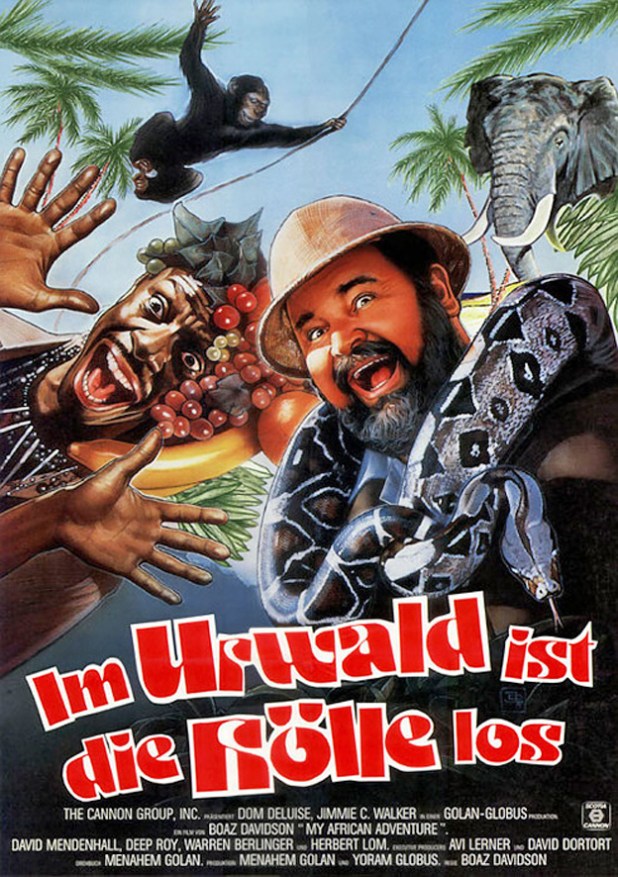
CANNON MONTH: Going Bananas (1987)

This movie sure had some changes before it got to the screen. Bonzo was going to be a real ape* before Deep Roy was cast, while Big Bad Joe Hopkins was going to be played by Bud Spencer — on the 1986 Cannon reel of upcoming films this was called Ben, Bonzo and Big Bad Joe — and Menahem Golan — who wrote the script, based on the Kofiko books by Tamar Bornstein-Lazar — and Sam Firstenberg were going to direct until Boaz Davidson was picked.

What emerges is pure Cannon.

Benjamin (David Menden-Hall, who if he annoyed you in Over the Top is ready to destroy your mind and play with it) is on an adventure with his guardian Joe (Dom DeLuise) and friend Mozambo (Jimmie Walker) in Africa. Specifically Momba-Zomba Land.

There, he meets Bonzo, a talking monkey who can not only fly a plane, but can practically fly — or if we follow the old TSR Marvel Super Hero rules, he’s like The Hulk who has Class 5000  Hyper-Leaping — and the whole story is about Herbert Lom as a cop stealing the monkey and putting him in a circus and that never works out whether it’s King Kong or Conquest of the Planet of the Apes. Or Going Bananas.

A lot of people debate, “What’s your favorite Cannon movie?”

No one has picked this one.

*Clyde the Organgatan from Every Which Way but Loose and Any Which Way You Can has a meeting at Menahem Golan’s office and there was an attempt to sign him as a Cannon actor, if you can believe that. When it fell through, Golan introduced Deep Roy to Davidson and said, “Meet your new monkey!” This story seems like it isn’t true, but it’s Cannon, so it probably is.

Also, according to Electric Boogaloo: The Wild, Untold Story of Cannon Films, Golan asked a publicist of Clyde, “Would you fuck this monkey?”

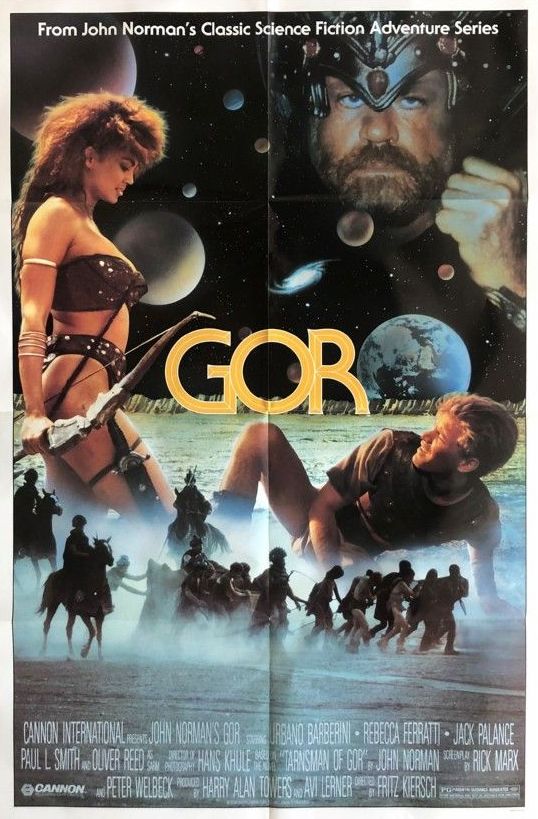
CANNON MONTH: Gor (1987)

EDITOR’S NOTE: We originally wrote about this on March 6, 2020. Now it’s back for Cannon Month.

John Norman is a professor of philosophy and the creator of the Gor series of books, which are basically male-dominated bondage science fiction fantasies that also feature critiques of modern society and the exploration of philosophical themes from a Nietzschean view. And you thought incels were a brand new thing, huh?

The series began in 1966 with Tarnsman of Gor — which this movie is based on — and was put on hold when DAW refused to publish the twenty-fifth installment, Magicians of Gor in 1988. The series returned in 2001 with Witness of Gor. There’s also an entire subculture called Gorean flourishes online, as you can only imagine that it would.

So yeah. Somehow, this got made. And so did a sequel, Outlaw of Gor.

Professor of physics Tarl Cabot (Urbano Barberini, DemonsOpera) is pretty much a loser with the ladies until he gets a magical ring that sends him to the world of Gor. Think Den from Heavy Metal and you have the picture.

He also comes into conflict with Oliver Reed, playing the priest-king known as Sarm, who is looking for the Home Stone to create more paths to Earth. Our hero accidentally kills Sarm’s son before he’s knocked out and left for the buzzards. Luckily, he’s saved by Talena (Playboy Playmate of the Month for June 1986 Rebecca Ferratti, who is also in Cheerleader Camp and Embrace of the Vampire), the barbarian princess of Ko-ro-ba.

Of course, while Cabot strikes out at home, he somehow scores with this vision of womanhood because on Gor, men are the rulers. But he’s still a moron and activates the Home Stone, sending him home to, one assumes, spill his seed, hack the carrot and sail the seas of mayonnaise all by himself.

Gor at least has some great character actors like Jack Palance, Paul Smith (Bluto from Popeye and the landscaper in Pieces) and a young Arnold Vosloo.

Norman almost didn’t get the movie made, as his publisher wanted nothing to do with it. He told the fanzine The Gorean Voice, “Ballantine Books refused to do movie tie-ins to either film; they failed even to answer my letters. My attorney finessed his way around Ballantine’s rights department and contacted the legal department at Random House. The movies were made by going over the heads of the censors.”

It was produced by Harry Alan Towers (who you may remember ran a vice ring that implicated the United Nations, JFK, Peter Lawford and several others when he wasn’t producing Jess Franco movies) and action film impresario Avi Lerner. Direction was provided by Fritz Kiersch, who also brought us Children of the Corn and Tuff Turf.

If you ever played lots of D&D and wondered why the popular girls liked jerks and figured, “I’m going to treat them badly, too!” Good news. You are the target audience for this movie.

You can listen to The Cannon Canon episode about Gor here.

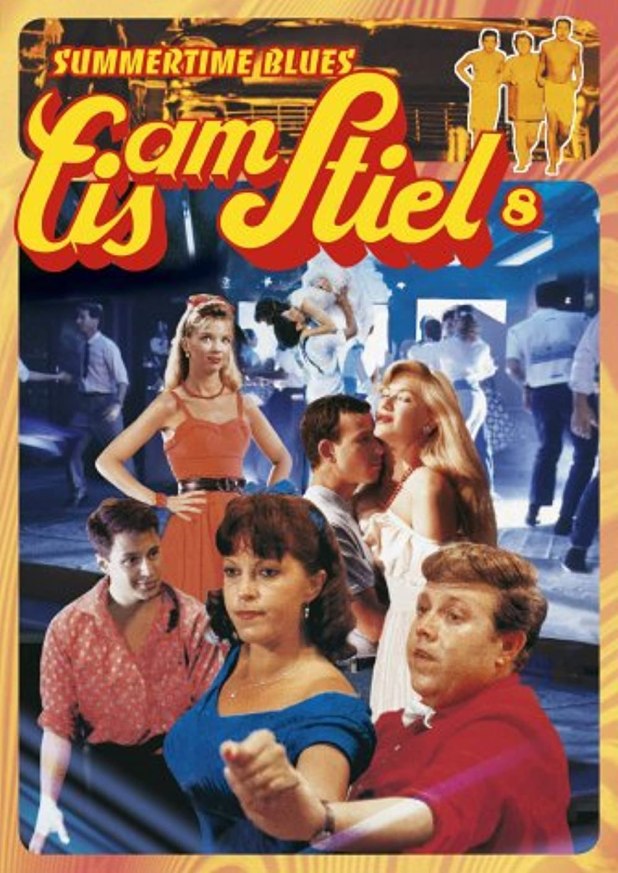
CANNON MONTH: Summetime Blues (1987)

Director Reinhard Schwabenitzky’s 1988’s Summertime Blues: Lemon Popsicle VIII is not director Yaky Yosha’s 1984 movie Summertime Blues, but wow, they’re really close. 50s soundtrack? Goofball jokes? Lots of sex? Yes, Lemon Popsicle movies have somewhat dominated my life over Cannon Month, so I often wonder if they have caused me to lose what’s left of my mind after a month of Jess Franco and now this.

But hey! It’s summer and Hughie (Zachi Noy), Benzi (Yftach Katzur) and Bobby (Jonathan Sagall) want to start their own bar, but they need money. The landlord, however, has a daughter named Polly (Elfi Eschke) who is the kind of girl the boys would never be interested in and yet her affection could cause them to get the party place of their dirtiest dreams, which inevitably include Sibylle Rauch. Are you surprised?

This movie exists in limbo. I’ve finally figured it out, as everyone is in the place between Heaven and Hell, a timeless void where 1950s cars exist alongside mentions of Kennedy and John Travolta.

I only have one of these movies left. I will not be sad when I finish it.

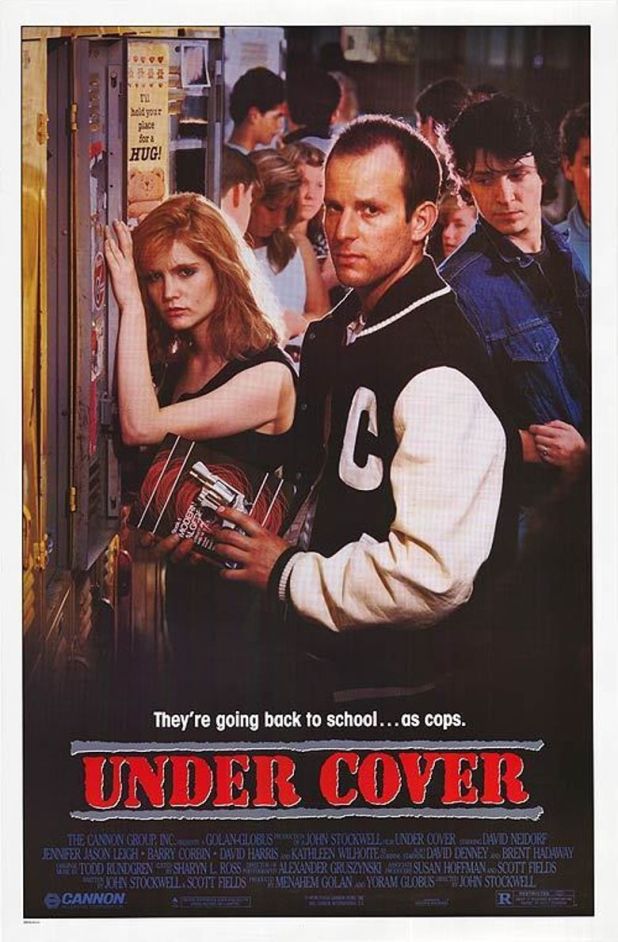
CANNON MONTH: Under Cover (1987)

If you wonder, am I watching Dangerously Close, I understand. In a moment of meta deja vu (meta vu?) director and writer John Stockwell can be seen being seen by police protagonist  Sheffield Hauser (David Neidorf), who is watching that movie. And Stockwell co-wrote that one with Scott Fields, who came back for this movie.

Weird, right?

This school is also like some kind of pre-21 Jump Street, as Sgt. Irwin Lee (Barry Corbin) and Tanille Laroux (Jennifer Jason Leigh) are also working undercover to stop the drugs in the classrooms.

I was pretty happy to see Kathleen Willhoite in this. While she doesn’t deploy the stellar vocabulary that she used in Murphy’s Law, she doesn’t make Hauser’s life easy at the police station. There’s also a soundtrack by Albert Lee and Todd Rundgren, so Under Cover has that going for it.

I did learn that cocaine is also called booger juice from this movie.

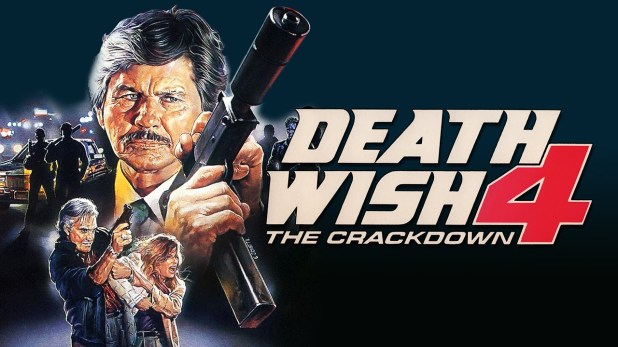
CANNON MONTH: Death Wish 4: The Crackdown (1987)

EDITOR’S NOTE: We originally wrote about this movie during Death Wish week on November 7, 2018. This article has been updated and added to since then.

Where do you go after the utter lunacy that is Death Wish 3? Well, you replace Michael Winner with J. Lee Thompson, who was the director for The Guns of Navarone, the original Cape Fear, the slashtastic Happy Birthday to Me and The Reincarnation of Peter Proud amongst many other films. He’d already worked with Bronson on 10 to Midnight, Murphy’s Law and The Evil That Men Do and would also direct Bronson in Messenger of Death and Kinjite: Forbidden Subjects after this movie wrapped. In fact, counting St. Ives, The White Buffalo and Caboblanco, they’d work on seven movies together.

Paul Kersey hasn’t learned anything from the last three movies. He has a new girlfriend, Karen Sheldon (Kay Lenz, The Initiation of SarahHouse) with a teenage daughter named Erica (Dana Barron, the original Audrey from National Lampoon’s Vacation) that you shouldn’t get to know all that well. That’s because — surprise! — she overdoses thanks to her boyfriend and her getting into crack cocaine and doing it an arcade. If you’re shocked that a Death Wish movie would prey upon the worst fears of America’s middle class, then you may have watched the last three films too.

Paul loved that girl like his own daughter, probably because she wanted to be an architect like him and also possibly because he hasn’t yet learned that the moment that he says something like that, tragedy is right around the corner. Honestly, the main message of the Death Wish films is that God hates Paul Kersey, will not allow him to die and will wait until he finds happiness again before visiting upon him great suffering, only for the cycle to repeat.

The night she died, Paul saw Erica smoke a joint with her boyfriend and was already suspecting the young dude, so he follows him back to the arcade the next night. That boyfriend confronts Jojo and Jesse (Tim Russ, Commander Tuvok himself!), two of the dealers who sold them the crack cocaine, and threatens to go to the police. This being a Death Wish film, they kill him pretty much in public. That murder unlocks the ability for Paul to start killing again, so he shoots Jojo and launches his body on to the top of bumper cars, where he’s electrocuted. No one dies in a Death Wish movie without a flourish.

Meanwhile, Paul gets a call from tabloid publisher Nathan White (John P. Ryan from It’s Alive), who knows that he’s the vigilante. His daughter had also become addicted to drugs and died, so he knows what Paul is going through. The storyline becomes pretty much like The Punisher’s first mini-series where The Trust paid for him to wipe out crime, as White funds Paul’s one man war against drugs while his girlfriend starts writing an expose on the two rival gangs in town.

To cut down the budget in this movie, when Paul and Nathan meet in the movie theater, that’s Cannon’s screening room.

One of those gangs is led by Ed Zacharias (Perry Lopez, Creature from the Black Lagoon) and the other is commanded by Jack and Tony Romero. Two LAPD officers, Sid Reiner and Phil Nozaki are also on the case, trying to figure out who killed the drug dealers at the arcade.

This is the first Death Wish film where Paul feels more like an urban James Bond than a fed up war vet. Trust me, he gets even more gadgets in the next one. Here, he uses his skills as a master of disguise — he has none — to dress as a waiter and serve a party at Zacharias’ house. The birthday cake is…man, let me just show you the birthday cake.

After witnessing the drug lord kill one of his guys who stole some cocaine, he’s ordered to help carry out the body. Soon, he’s killing all of that drug dealer’s men, including three guys in an Italian restaurant with a bomb shaped like a wine bottle. Look for a really young Danny Trejo in this scene!

After all that mayhem, Paul also starts wiping out the Romero gang one by one, including breaking onto a drug front and blowing it up with a bomb. Yet Nozaki ends up being on the take for Zacharias and tries to kill our hero and you know how well that works out. Now Paul looks like a cop killer, too.

In the stuntman piece de resistance of this one, the two drug lords are lured into an oil field shootout where Paul kills Zacharius with a high-powered rifle, instigating the fireworks. Nathan comes out to congratulate Paul, but sets him up with a car bomb. It turns out that the Nathan that Paul has met is a third drug lord (!) who set him up to take out all the competition. Then, two fake cops arrest Paul and take him downtown, but they’re really just trying to kill our hero. Again, you know how well that works.

The film ends with Detective Reiner searching for Paul out of revenge for his partner’s murder, the third drug lord kidnapping Paul’s woman and everything coming together in a parking lot and a roller rink where Paul uses an M16 with an equipped M203 grenade launcher to unleash holy hell.

Only the drug lord survives, holding Karen. She tried to escape and gets shot numerous times with a MAC 10 submachine gun. He tries to kill Paul but he’s out of bullets. Paul may be, but he still has a grenade, which he uses to blow the villain up real good.

The film closes with Reiner coming and ordering Paul to surrender and threatening to kill him if he walks away. “Do whatever you have to,” says the old gunfighter as he walks into the sunset.

For all the mayhem and madness throughout this film — keep in mind our hero just used an explosive device to decimate another bad guy just seconds before — this is a poignant ending. But of course, Paul — whether he wanted to use the new last name Kimble he came up with in this film or Kersey — would be back one more time.

Bronson made $4 million for this movie and in my opinion, he should have asked for more.

CANNON MONTH: Business As Usual (1987)

Based on the real case of Audrey White — who was a consultant on the movie — at a chain of Lady at Lord John boutiques, this Lezli-An Barrett directed and written film finds Babs Flynn (Glenda Jackson) managing a Liverpool shop and accusing the regional manager of sexual harassment after the way he treats an employee (Cathy Tyson). Babs gets fired, she goes to court and that’s our movie.

This did play Cannes, but I wonder what Cannon saw in it for American audiences. Maybe it was one of those movies a company threw in on another deal? As it is, it’s a fine movie, but not one you have to go out of your way to track down. Unless you’re a Red Dwarf fan, as Craig Charles is in the cast. Or Inspector Morse, because Jason Thaw plays Babs’ husband, who once tried to do the right thing just like his wife and ended up paying for it.


CANNON MONTH: Barfly (1987)

A semi-autobiographical version of Charles Bukowski’s life during the time he spent drinking like his life depended on it — as seen through the author’s alter ego Henry Chinaski — with a script by the author that was commissioned by director Barbet Schroeder. And somehow, it’s one of those Cannon movies that aspire to art.

Bukowski wanted Sean Penn to play him, but Penn insisted that Dennis Hopper direct. That was a problem as Bukowski had written the screenplay for Schroeder and he saw Hopper as a gold-chain-wearing Hollywood phony. Despite that issue, Bukowski and Penn remained friends.

Henry Chinaski (Mickey Rourke) may write stories and poetry for small change, but his real job is drinking at the Green Horn and fighting with Eddie the bartender (Frank Stallone). After one brawl, he heads to another bar, the Kenmore, where he meets and falls for fellow drinker Wanda Wilcox (Faye Dunaway).

Their relationship is one of drinking and fighting, while book publisher Tully Sorenson (Alice Krige) also chases after him. But while a life with her would give him access to limitless money — and booze — as well as an opportunity to finally live for his art, he realizes that she  lives “trapped in a cage with golden bars.”

The bar is filled with various lowlifes to fall in love with, including Bukowski as Oldtimer, Fritz Feld (who turned a popping sound into a career that saw him act in 140 movies in 72 years), Pruitt Taylor Vince (who is in Cannon’s Shy People), Joe Unger (Sgt. Garcia in A Nightmare on Elm Street and Tinker in Leatherface: The Texas Chainsaw Massacre III), Gloria LeRoy as Grandma Moses, Sandy Martin (Grandma in Napoleon Dynamite) and a detective played by Jack Nance who follows Henry.

Barfly is also the first movie to use a Kino Flo light. It was specially created by director of photography Robby Müller’s electrical crew for the movie as so much of the film was difficult to light because so many of the locations were quite cramped. The film’s gaffer Frieder Hocheim and best boy Gary H. Swink designed the high-output fluorescent light with a remote ballast, creating a lamp unit light enough to be taped to a wall. Hochheim and Swink went into business as Kino Flo Incorporated and now the light is a part of the standard motion picture lighting package.

I always say that crazy stories about Hollywood are usually kayfabe tales done to drum up publicity, but when it comes to Cannon, they have to be true. So here’s the one story on Barfly. Cannon was going through major financial problems and had to limit how many movies it could make. They decided to not make Barfly as there were other movies that could make more money. However, Schroeder allegedly appeared at the Cannon offices with a battery-powered portable saw, telling everyone that Cannon was cutting off a piece of him by abandoning the film.

CANNON MONTH: Surrender (1987)

Jerry Belsen, who directed and wrote this movie, along with Close Encounters of the Third Kind and Fun With Dick and Jane amongst many others, may have invented the phrase “You know what happens when you assume…”

Sean Stein (Michael Caine) is a successful novelist, but he’s been through so many divorces and bad relationships that he never wants to fall in love again, until he has his meet cute with artist Daisy Morgan (Sally Field) when they’re forced to strip and bound together by thieves at a charity dance. Yes, this actually happens.

Working with his lawyer Jay (Peter Boyle), Sean decides to hide who he is and actually win Daisy over with no money being involved. The problem is that she already has a boyfriend, the not so great Marty (Steve Guttenberg).

Then she finds out who Sean really is and tells him that she truly loves him. The problem is that he still thinks it’s all about money. This will rinse and repeat throughout the movie.

At least this has an interesting cast, with Jackie Cooper in his last role as Daisy’s father, along with Julie Kavner, Louise Lasser and Iman.

Supposedly, this movie is based on Belsen’s real life, with him claiming that every single thing that happened to Sean happened to him. Sadly, that experience could not help the death throes of Cannon, as this movie made $5 million on a $15 million budget.