CANNON MONTH: Under Cover (1987)

If you wonder, am I watching Dangerously Close, I understand. In a moment of meta deja vu (meta vu?) director and writer John Stockwell can be seen being seen by police protagonist  Sheffield Hauser (David Neidorf), who is watching that movie. And Stockwell co-wrote that one with Scott Fields, who came back for this movie.

Weird, right?

This school is also like some kind of pre-21 Jump Street, as Sgt. Irwin Lee (Barry Corbin) and Tanille Laroux (Jennifer Jason Leigh) are also working undercover to stop the drugs in the classrooms.

I was pretty happy to see Kathleen Willhoite in this. While she doesn’t deploy the stellar vocabulary that she used in Murphy’s Law, she doesn’t make Hauser’s life easy at the police station. There’s also a soundtrack by Albert Lee and Todd Rundgren, so Under Cover has that going for it.

I did learn that cocaine is also called booger juice from this movie.

CANNON MONTH: Death Wish 4: The Crackdown (1987)

EDITOR’S NOTE: We originally wrote about this movie during Death Wish week on November 7, 2018. This article has been updated and added to since then.

Where do you go after the utter lunacy that is Death Wish 3? Well, you replace Michael Winner with J. Lee Thompson, who was the director for The Guns of Navarone, the original Cape Fear, the slashtastic Happy Birthday to Me and The Reincarnation of Peter Proud amongst many other films. He’d already worked with Bronson on 10 to Midnight, Murphy’s Law and The Evil That Men Do and would also direct Bronson in Messenger of Death and Kinjite: Forbidden Subjects after this movie wrapped. In fact, counting St. Ives, The White Buffalo and Caboblanco, they’d work on seven movies together.

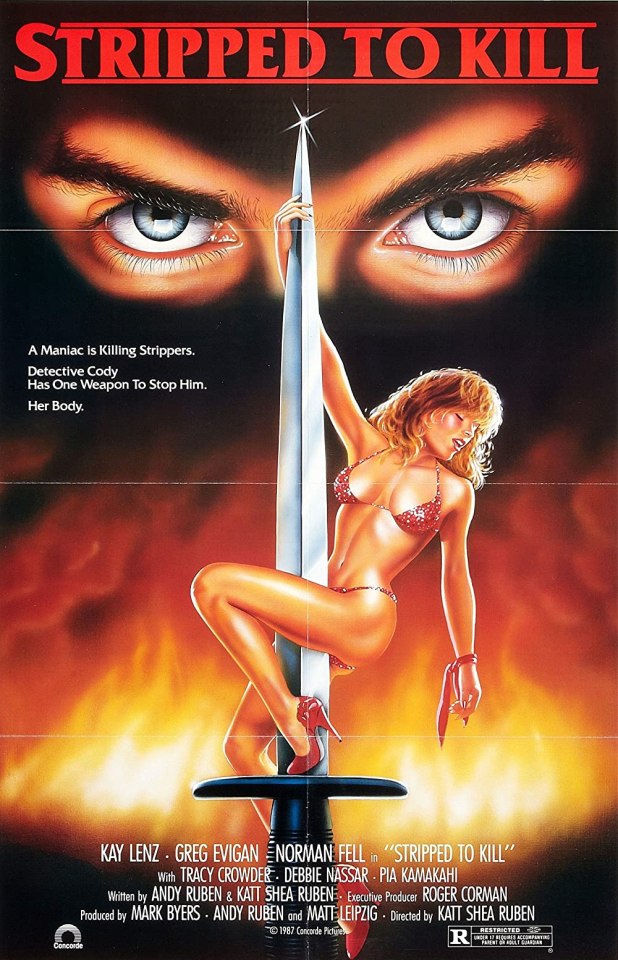
Paul Kersey hasn’t learned anything from the last three movies. He has a new girlfriend, Karen Sheldon (Kay Lenz, The Initiation of SarahHouse) with a teenage daughter named Erica (Dana Barron, the original Audrey from National Lampoon’s Vacation) that you shouldn’t get to know all that well. That’s because — surprise! — she overdoses thanks to her boyfriend and her getting into crack cocaine and doing it an arcade. If you’re shocked that a Death Wish movie would prey upon the worst fears of America’s middle class, then you may have watched the last three films too.

Paul loved that girl like his own daughter, probably because she wanted to be an architect like him and also possibly because he hasn’t yet learned that the moment that he says something like that, tragedy is right around the corner. Honestly, the main message of the Death Wish films is that God hates Paul Kersey, will not allow him to die and will wait until he finds happiness again before visiting upon him great suffering, only for the cycle to repeat.

The night she died, Paul saw Erica smoke a joint with her boyfriend and was already suspecting the young dude, so he follows him back to the arcade the next night. That boyfriend confronts Jojo and Jesse (Tim Russ, Commander Tuvok himself!), two of the dealers who sold them the crack cocaine, and threatens to go to the police. This being a Death Wish film, they kill him pretty much in public. That murder unlocks the ability for Paul to start killing again, so he shoots Jojo and launches his body on to the top of bumper cars, where he’s electrocuted. No one dies in a Death Wish movie without a flourish.

Meanwhile, Paul gets a call from tabloid publisher Nathan White (John P. Ryan from It’s Alive), who knows that he’s the vigilante. His daughter had also become addicted to drugs and died, so he knows what Paul is going through. The storyline becomes pretty much like The Punisher’s first mini-series where The Trust paid for him to wipe out crime, as White funds Paul’s one man war against drugs while his girlfriend starts writing an expose on the two rival gangs in town.

To cut down the budget in this movie, when Paul and Nathan meet in the movie theater, that’s Cannon’s screening room.

One of those gangs is led by Ed Zacharias (Perry Lopez, Creature from the Black Lagoon) and the other is commanded by Jack and Tony Romero. Two LAPD officers, Sid Reiner and Phil Nozaki are also on the case, trying to figure out who killed the drug dealers at the arcade.

This is the first Death Wish film where Paul feels more like an urban James Bond than a fed up war vet. Trust me, he gets even more gadgets in the next one. Here, he uses his skills as a master of disguise — he has none — to dress as a waiter and serve a party at Zacharias’ house. The birthday cake is…man, let me just show you the birthday cake.

After witnessing the drug lord kill one of his guys who stole some cocaine, he’s ordered to help carry out the body. Soon, he’s killing all of that drug dealer’s men, including three guys in an Italian restaurant with a bomb shaped like a wine bottle. Look for a really young Danny Trejo in this scene!

After all that mayhem, Paul also starts wiping out the Romero gang one by one, including breaking onto a drug front and blowing it up with a bomb. Yet Nozaki ends up being on the take for Zacharias and tries to kill our hero and you know how well that works out. Now Paul looks like a cop killer, too.

In the stuntman piece de resistance of this one, the two drug lords are lured into an oil field shootout where Paul kills Zacharius with a high-powered rifle, instigating the fireworks. Nathan comes out to congratulate Paul, but sets him up with a car bomb. It turns out that the Nathan that Paul has met is a third drug lord (!) who set him up to take out all the competition. Then, two fake cops arrest Paul and take him downtown, but they’re really just trying to kill our hero. Again, you know how well that works.

The film ends with Detective Reiner searching for Paul out of revenge for his partner’s murder, the third drug lord kidnapping Paul’s woman and everything coming together in a parking lot and a roller rink where Paul uses an M16 with an equipped M203 grenade launcher to unleash holy hell.

Only the drug lord survives, holding Karen. She tried to escape and gets shot numerous times with a MAC 10 submachine gun. He tries to kill Paul but he’s out of bullets. Paul may be, but he still has a grenade, which he uses to blow the villain up real good.

The film closes with Reiner coming and ordering Paul to surrender and threatening to kill him if he walks away. “Do whatever you have to,” says the old gunfighter as he walks into the sunset.

For all the mayhem and madness throughout this film — keep in mind our hero just used an explosive device to decimate another bad guy just seconds before — this is a poignant ending. But of course, Paul — whether he wanted to use the new last name Kimble he came up with in this film or Kersey — would be back one more time.

Bronson made $4 million for this movie and in my opinion, he should have asked for more.

CANNON MONTH: Business As Usual (1987)

Based on the real case of Audrey White — who was a consultant on the movie — at a chain of Lady at Lord John boutiques, this Lezli-An Barrett directed and written film finds Babs Flynn (Glenda Jackson) managing a Liverpool shop and accusing the regional manager of sexual harassment after the way he treats an employee (Cathy Tyson). Babs gets fired, she goes to court and that’s our movie.

This did play Cannes, but I wonder what Cannon saw in it for American audiences. Maybe it was one of those movies a company threw in on another deal? As it is, it’s a fine movie, but not one you have to go out of your way to track down. Unless you’re a Red Dwarf fan, as Craig Charles is in the cast. Or Inspector Morse, because Jason Thaw plays Babs’ husband, who once tried to do the right thing just like his wife and ended up paying for it.


CANNON MONTH: Barfly (1987)

A semi-autobiographical version of Charles Bukowski’s life during the time he spent drinking like his life depended on it — as seen through the author’s alter ego Henry Chinaski — with a script by the author that was commissioned by director Barbet Schroeder. And somehow, it’s one of those Cannon movies that aspire to art.

Bukowski wanted Sean Penn to play him, but Penn insisted that Dennis Hopper direct. That was a problem as Bukowski had written the screenplay for Schroeder and he saw Hopper as a gold-chain-wearing Hollywood phony. Despite that issue, Bukowski and Penn remained friends.

Henry Chinaski (Mickey Rourke) may write stories and poetry for small change, but his real job is drinking at the Green Horn and fighting with Eddie the bartender (Frank Stallone). After one brawl, he heads to another bar, the Kenmore, where he meets and falls for fellow drinker Wanda Wilcox (Faye Dunaway).

Their relationship is one of drinking and fighting, while book publisher Tully Sorenson (Alice Krige) also chases after him. But while a life with her would give him access to limitless money — and booze — as well as an opportunity to finally live for his art, he realizes that she  lives “trapped in a cage with golden bars.”

The bar is filled with various lowlifes to fall in love with, including Bukowski as Oldtimer, Fritz Feld (who turned a popping sound into a career that saw him act in 140 movies in 72 years), Pruitt Taylor Vince (who is in Cannon’s Shy People), Joe Unger (Sgt. Garcia in A Nightmare on Elm Street and Tinker in Leatherface: The Texas Chainsaw Massacre III), Gloria LeRoy as Grandma Moses, Sandy Martin (Grandma in Napoleon Dynamite) and a detective played by Jack Nance who follows Henry.

Barfly is also the first movie to use a Kino Flo light. It was specially created by director of photography Robby Müller’s electrical crew for the movie as so much of the film was difficult to light because so many of the locations were quite cramped. The film’s gaffer Frieder Hocheim and best boy Gary H. Swink designed the high-output fluorescent light with a remote ballast, creating a lamp unit light enough to be taped to a wall. Hochheim and Swink went into business as Kino Flo Incorporated and now the light is a part of the standard motion picture lighting package.

I always say that crazy stories about Hollywood are usually kayfabe tales done to drum up publicity, but when it comes to Cannon, they have to be true. So here’s the one story on Barfly. Cannon was going through major financial problems and had to limit how many movies it could make. They decided to not make Barfly as there were other movies that could make more money. However, Schroeder allegedly appeared at the Cannon offices with a battery-powered portable saw, telling everyone that Cannon was cutting off a piece of him by abandoning the film.

CANNON MONTH: Surrender (1987)

Jerry Belsen, who directed and wrote this movie, along with Close Encounters of the Third Kind and Fun With Dick and Jane amongst many others, may have invented the phrase “You know what happens when you assume…”

Sean Stein (Michael Caine) is a successful novelist, but he’s been through so many divorces and bad relationships that he never wants to fall in love again, until he has his meet cute with artist Daisy Morgan (Sally Field) when they’re forced to strip and bound together by thieves at a charity dance. Yes, this actually happens.

Working with his lawyer Jay (Peter Boyle), Sean decides to hide who he is and actually win Daisy over with no money being involved. The problem is that she already has a boyfriend, the not so great Marty (Steve Guttenberg).

Then she finds out who Sean really is and tells him that she truly loves him. The problem is that he still thinks it’s all about money. This will rinse and repeat throughout the movie.

At least this has an interesting cast, with Jackie Cooper in his last role as Daisy’s father, along with Julie Kavner, Louise Lasser and Iman.

Supposedly, this movie is based on Belsen’s real life, with him claiming that every single thing that happened to Sean happened to him. Sadly, that experience could not help the death throes of Cannon, as this movie made $5 million on a $15 million budget.

CANNON MONTH: Dancers (1987)

Based on Giselle by Adolphe Adam, Jean Coralli and Jules Perrot, Dancers tells the story of Tony (Mikhail Baryshnikov), who is trying to stage the final dance of Giselle in his career — much like Baryshnikov as this was to be a film record of his dancing in that play — just as he falls in love with Lisa (Julie Kent), but then she learns that he’s used the same romantic lines on every other lover he’s ever had.

Director Herbert Ross started as a dancer, became a choreographer and debuted as a director with the movie Goodbye, Mr. Chips. Some of his better regarded films are The Owl and the PussycatPlay It Again SamPennies From HeavenFootlooseSteel Magnolias and Boys On the Side. His wife Nora Kaye was a ballerina and produced several of his movies, including The Turning Point, Nijinsky, Pennies From Heaven and The Secret of My Succe$s. She executive produced this movie, but ssadlydied before it was released.

You can watch this on Tubi.

CANNON MONTH: Tough Guys Don’t Dance (1987)

I honestly have no idea how to classify this movie and you know what, let’s not put it in an easy bucket. Let’s just enjoy it for what it is.

Whatever it is.

Roger Ebert tried. He said that it had “an impressive content of sex and violence, but beneath that is a strange nostalgia that seems to have nothing to do with anything else. The nostalgia is for Provincetown, seen in a cold winter season with the weathered gray houses against a pink and purple sky, the gulls’ cries lonely in the twilight. This place is so deeply seen that the people in the movie sometimes seem like ghosts, occupying it for a time.”

Written and directed by Norman Mailer based on his novel of the same name, this feels like a David Lynch movie made by people who would make fun of David Lynch if he drank in the same bar as them, the kind of, well, tough guys who only order whiskey and whatever local beer is on tap.

As for the title, it comes up early and out of the mouth of Dougy Madden, played by real life tough guy Lawrence Tierney. It’s something boxer Roger Donahue told the writer: Frank Costello, the Murder, Inc. boss and his girlfriend met three champion boxers in the Stork Club. Costello demands that each, in turn, dance with his woman, and each nervously complies. The last, Willie Pep, who had a 229–11–1 record with 65 knockouts, who was described as “trying to fight a grass fire,” simply replied, “Tough guys don’t dance.”

Determining the moral of that story is like trying to divine what this movie is all about.

On the surface, it’s a noir about Tim Madden (Ryan O’Neal), former bartender, current ex-con and struggling writer, whose wife Patty Lareine (Debra Sandlund) has left him, who wakes up to a new tattoo that says Madeline, blood all over his car, a severed head where he keeps his marijuana and the new Provincetown police chief Luther Regency (Wings Hauser) showing up living with his former girlfriend named, you may have guessed it, Madeleine (Isabella Rossellini).

How did he get here? How did he lose the love of his life? Why did he answer that ad in Screw and swing with Madeleine and preacher Big Stoop (Penn Jillette) and his wife, who eventually became his wife? Why did he do that to Madeleine? Why did their argument cause a crash that cost him the child that he and Madeleine wanted? And now why would life take the only person he can depend on, his father Dougy, the guy who may be disappointed in him but who always tells it straight?

Tim’s life is a mess. After Patty left Big Stoop, she married his prep school friend Wardley Meeks III (John Bedford Lloyd), then got rich off her next divorced before marrying Tim and then leaving him and then disappearing. So maybe Tim killed her. And why is Madeline writing him to let him know that Regency was having an affair with Patty? It’s like a soap opera we haven’t watched for decades but need to get caught up on, except with great actors who maybe aren’t great actors in this, except they totally are and every frame is perect imperfection.

And just what does porn star Jessica Pond and her cucked husband Lonnie Pangborn (R. Patrick Sullivan) have to do with all this? Why are there now two heads in the marijuana hiding place? Why does Tim say, “Oh man! Oh God, oh man! Oh God, oh man! Oh God, oh man! Oh God, oh man, oh God!” which is ony topped by “Your knife is in my dog.” for dramatic reading? And what are we to make of the tales of the fires on the shore of Provincetown, the blend of The Fog and Messiah of Evil that is left as an aside in the film but definitely informs the storybook happy ending?

This is a movie about, by and for cocaine; a film in which the term imbroglio is said; where everyone is so sexed up that you can almost smell the Pine-sol scent of an adult book store’s neon flashing into the cold and foggy niht beckoning couples that are ready to decimate their lives for momentary and fleeting glimpses of the kind of orgasms they read about in letters to Penthouse; where women say things like, “Well, honey, I am a witch” and throw seance parties; and you wondder how can Tim ever settle down with Madeline with those bodies still floating out there and they’ve seen so much and done so much and the world is aways temptation because you can’t slow down and leave a pretty corpse after you’ve lived this kind of life; I came from this place, but my hometown is a small Western Pennsylvania town that has a brick building that is closed five nights a week but on Saturday and Sunday draws swingers from around the East Coast, a place where the English teacher who told me I’d never be a writer took a little blue pill and got in the hot tub and my grandmother heard on the scanner that he had one of those erections they warn you about in the commercials and they had to cut the blood to his member to stop the pain.

I mean, this is the movie where Wings Hauser and Isabella Rossellini have a shouting match made up of the following words:

“I made you come 16 times in a night.”

“Not one of them was good.”

“That’s because you’ve got no womb!”

You have to love Mailer, who made this his way, and then even read the negative commentary cards from a screening in the trailer.

I told you all this to tell you that if everything that Cannon did, if every line of coke and every wild story from Cannes and every failure was all so that this movie could be made, it was all so very much worth it.

You can get this movie from Vinegar Syndrome.

CANNON MONTH: King Lear (1987)

Yes, Cannon gave Jean-Luc Godard the money to make an experimental French New Wave Shakespeare adaptation written by Peter Sellars and Tom Luddy. It was originally to be written by Norman Mailer, who was also making Tough Guys Don’t Dance with Cannon and that’s a totally different story.

Famously, Golan and Globus signed the contract for this film with director Godard on a napkin at the Cannes Film Festival. Golan refused to sell the famous contract napkin for $10,000 when asked by the New York MoMA, which seems like a low figure.

Only three characters from the story — Lear (Mailer), Cordelia (Molly Ringwald) and Edgar (Leos Carax) — are in this. It’s set in and around Switzerland where William Shakespeare Junior the Fifth (Sellars) is trying to restore his ancestor’s plays in a world where civilization and culture has lost after Chernobyl.

Much of the dialogue isn’t spoken by the characters on-screen, but heard in voice-over or spoken, whispered or echoed by someone else off-screen. If that seems confusing, King Lear deliberately does not use conventional filmmaking techniques or even try to be watchable.

I definitely think that the beginning, where Menahem Golan complains about how long Godard is taking to make the film and demands its completion by the 1987 Cannes Film Festival is completely real.

King Lear did make its premiere at Cannes on May 17, 1987. It played U.S. theaters for two weeks and then disappeared for fifteen years. How many people actually saw it? Well, for years, Quentin Tarantino’s resume claimed that he had appeared in it, as he correctly figured that nobody would have seen it and known he was telling a lie.

You know who is in it? Burgess Meredith and Woody Allen.

CANNON MONTH: Penitentiary III (1987)

Five years after we last saw Martel “Too Sweet” Gordone (Leon Issac Kennedy), he’s back in jail after being framed for murder. And by set up, Too Sweet is given some PCP in his water bottle during a boxing match and he turns his opponent El Cid’s (Madison Campudoni) brains into so much jelly.

Who would set up our hero in such a way? Serenghetti (Anthony Geary, yes, Luke from General Hospital) who makes a team of fighters in the big house that once a year challenges the warden’s (Ric Mancini) team of fighters.

The last thing Too Sweet wants to do is ever box again with blood on his hands, so he sends The Midnight Thud to assault our hero and take his manhood. Fog surrounds the jail cell, we hear bestial growling and then realize that Thud is played by Raymond Kessler, who you may know better as small size wrestler The Haiti Kid. Yes, a small but feral beast is unleashed for eight minutes of battle and wow. Just wow.

By the end of the movie, the crack smoking Thud — he smokes so much that he kills the rats in his cell — trains Too Sweet through yoga as he goes for revenge, as his cellmate Roscoe (Steve Antin, Rick from The Last American Virgin and the brother of New York Doll Robin Antin) has been beaten unmericful by another PCP fighter See Veer (Danny Trejo).

This movie has it all and by all, I mean Rick Zumwalt (Bull Hurey in Over the Top) as a prison guard, Magic Schwarz (Stone Cold, Mad Dog Joe DeCurso in Grunt! The Wrestling Movie) as Hugo the final boss, Too Sweet in a leather codpiece/Bruce Lee outfit, Geary having a luxury cell with a French chef and a trans lover, Zap from American Gladiators, female boxers decided to stop fighting and instead start kissing and boxing matches that feel more like pro wrestling.

Jamaa Fanaka directed and wrote all three movies in this series as well as Welcome Home Brother Charles and Street Wars. Somehow, this series went for urgent melodrama to a Mr. T appearance to this and I’m there for all of it.

CANNON MONTH: Masters of the Universe (1987)

As a 15-year-old, I absolutely hated this movie. He-Man was a known property with a series that was on TV every day, one of the best-selling toys and just about everyone knew everything there was about the mythos of Eternia, but the movie only spends a few minutes in Eternia and has human characters in the place of ones you’d want to see like Stratos, Fisto and Zodac. Or Tri-Klops, Batros and Man-E-Faces. Or Mer-Man, Ram Man and Sorceress. If by now you don’t realize how deep my He-Man fandom goes, by the end of this you’ll realize just how little I ever believed that I’d date anyone.

If I’d just realized that it was a secret Jack Kirby movie, maybe I would have loved it.

John Byrne, who is one of my biggest artistic influences — well, next to Kirby — called this out, saying, “The best New Gods movie, IMHO, is Masters of the Universe. I even corresponded with the director, who told me this was his intent, and that he had tried to get Kirby to do the production designs, but the studio nixed it. Check it out. It requires some bending and an occasional sex change (Metron becomes an ugly dwarf, The Highfather becomes the Sorceress), but it’s an amazingly close analog, otherwise. And Frank Langella’s Skeletor is a dandy Darkseid!”

To be fair, Star Wars is also a complete pastiche of the New Gods.

Director Gary Goddard responded in the letter page of Byrne’s comic book Next Men: “As the director of Masters of the Universe, it was a pleasure to see that someone got it. Your comparison of the film to Kirby’s New Gods was not far off. In fact, the storyline was greatly inspired by the classic Fantastic Four/Doctor Doom epics, The New Gods and a bit of Thor thrown in here and there. I intended the film to be a “motion picture comic book,” though it was a tough proposition to sell to the studio at the time. “Comics are just for kids,” they thought. They would not allow me to hire Jack Kirby who I desperately wanted to be the conceptual artist for the picture… I grew up with Kirby’s comics (I’ve still got all my Marvels from the first issue of Fantastic Four and Spider-Man through the time Kirby left) and I had great pleasure meeting him when he first moved to California. Since that time I enjoyed the friendship of Jack and Roz and was lucky enough to spend many hours with Jack, hearing how he created this character and that one, why a villain has to be even more powerful than a hero, and on and on. Jack was a great communicator, and listening to him was always an education. You might be interested to know that I tried to dedicate Masters of Universe to Jack Kirby in the closing credits, but the studio took the credit out.”

As it was, the look of this movie was created by William Stout, who has drawn several comic books as well as drawing the storyboards for Raiders of the Lost Ark and First Blood and concept and production art for Invaders from MarsConan the BarbarianThe HitcherPan’s LabyrinthThe WilliesReturn of the Living DeadTheodore RexPredator and The Warrior and the Sorceress, which he also wrote. Obviously, I’m also a huge fan of Stout’s work.

He was joined by Jean “Moebius” Giraud, an artist whose influence on movies can’t be measured, from working on Jodorowsky’s Dune to being in the art department for AlienTRONWillowThe Fifth Element and The Abyss. So much of Blade Runner and its visual style is deeply in debt to Moebius.

Cannon claimed that Masters of the Universe would be the Star Wars of the 1980s and if we go just on the look of the characters, they tried. The hard part is that the end result is very Cannon: a lack of budget, focus and understanding of what they had on their hands.

Screenwriter David Odell had worked on The Muppet Show and The Dark Crystal. His original take on the material was closer to the cartoon, with He-Man’s mother coming from Earth, more of Beast Man and more time on Eternia. There was a rewrite by Goddard and Stephen Tolkin, who also wrote Albert Pyun’s Captain America, which was produced by Menahem Golan as part of his 21st Century Film Corporation after Cannon broke apart.

Instead, the movie begins at an apocalyptic ending, with Skeletor’s (Frank Langella, one of the major bright spots of the film; he was incredibly excited to make the movie as He-Man was his son’s favorite cartoon) army finally taking Castle Grayskull and capturing the Sorceress (Christina Pickles).

There’s one chance to save the day and it involves He-Man (Dolph Lundgren), Man-At-Arms (Jon Cypher) and Teela (Chelsea Field) mounting a rescue mission to get Gwildor (Billy Barty) free and find his Cosmic Key, which has been stolen by Evil-Lyn (Meg Foster, forever staring directly into your soul). Their escape takes them to Earth and meeting up with orphaned schoolgirl Julie Winston (Courtney Cox), her boyfriend Kevin Corrigan (Robert Duncan McNeill) and Detective Hugh Lubic (James Tolkan, pretty much playing what you hire James Tolkan for, an incredibly angry authority figure like he was in Back to the Future).

Skeletor sends Saurod (Pons Maar, who was the body model for The Noid), Beast Man (Tony Carroll), Karg (Robert Towers, who was Snoopy’s voice in You’re a Good Man, Charlie Brown) and Blade (Anthony de Longis, The Warrior and the SorceressThe Sword and the SorcererDangerously Close and the voice of Lord Zygon in Starchaser: The Legend of Orin; he’s also one of my favorite people in this film and trained Lundgren in sword fighting) to battle the heroes.

The battle eventually does take them back to Eternia, but I can tell you, when I first saw this movie, I never wanted to see any action on our boring planet. But as I’ve watched this numerous times, I’ve come to really enjoy the look and feel of what Goddard was able to capture with the budget that he had.

Goddard has claimed that Cannon forced the movie to be mostly on Earth to keep the budget down. He did ask for more money so he could at least start and end the film on Eternia. However, Cannon’s financial woes — there was so little money that Goddard did every pickup and second unit shot — saw them shut down filming three days early and the final battle between He-Man and Skeletor was unfilmed. Luckily, Goddard was able to get a day to shoot the end, but as sets were being torn down throughout and the need to get it done quickly, that’s why the final battle has no background in it.

A supposed sequel was written and would have been directed by Albert Pyun and star surfer Laird Hamilton. In it, Skeletor would return to Earth and destroy it, making this a post-apocalyptic movie. After Masters of the Universe wasn’t the Star Wars of the 1980s, Pyun rewrote the script and made Cyborg.

As for Goddard, he had quite an interesting career after He-Man. Producer Edward R. Pressman (who executive produced this movie) hired him to create, write and direct a Universal Studios show, The Adventures of Conan: A Sword and Sorcery Spectacular.

Goddard also wrote Tarzan the Ape Man for the Dereks, as well as developing the Captain Power and Skeleton Warriors shows and toy lines. He also helped develop Spider-Man, Terminator and Jurassic Park rides for Universal Studios.

There have been numerous attempts to make a new Masters of the Universe movie. The bar, obviously, is not very high, but perhaps my love of the past and Cannon makes me look at this film — not the first movie for the property, as He-Man and She-Ra: The Secret of the Sword came out in 1985 — in a much kinder light.

As you can see, I’m very influenced by the look of this film. If you’d like to see more of my art, I post a new Masters of the Universe painting every week on Instagram.