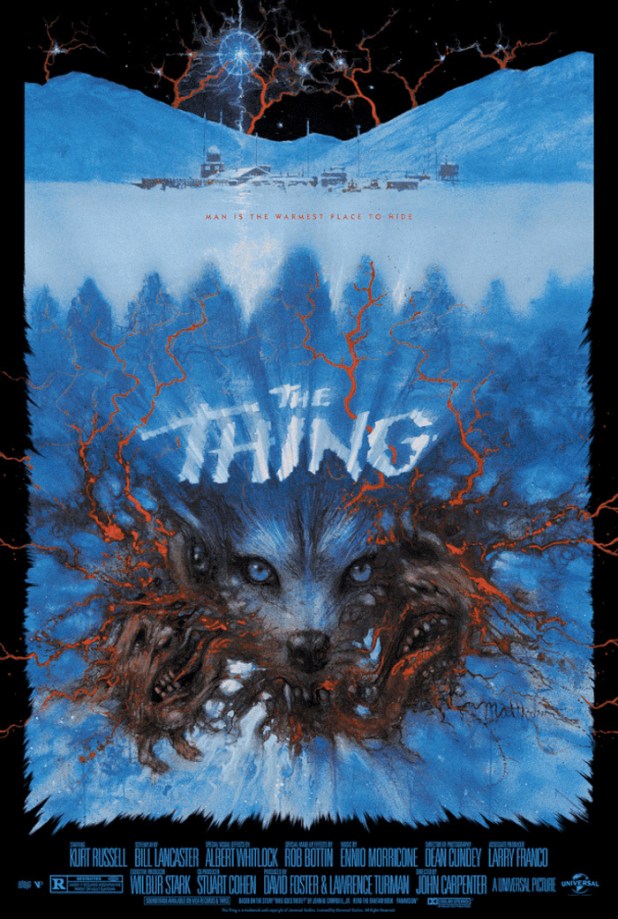
The Thing (1982)

This movie failed at the box office and nearly ruined the career of John Carpenter. Think of that as you watch it. But did it really fail? It made nearly $20 million on a $15 million budget, but audiences must have expected more. Studios certainly did.

Was it because E.T. came out at the same time, as well as so many other science fiction and fantasy films? Did the recession make people not want to watch something so nihilistic? Did the sheer level of gore turn people off? Were people upset that he remade a film some considered a classic*?

After one market research screening, Carpenter asked the audience what they thought. One answered, “Well what happened in the very end? Which one was the Thing…?” When Carpenter said that the answer was up to their imagination, the response was, “Oh, God. I hate that.”

How could audiences respond to a movie that did not spoon feed them any of the story beats? That doesn’t have a single character to root for or get behind? That is influenced by Lovecraft — as our the other Apocalypse Trilogy installments Prince of Darkness and In the Mouth of Madness — in that ordinary people face off with supernatural horror that they are doomed to be destroyed by, which isn’t really what mainstream America wants from a popcorn film?

Yeah, it could be all of those things. Or perhaps, the world was not ready for it. But watching the end of this film, as everyone sits around wondering who has a disease that they can barely understand and know will eventually impact them, yeah. I think the world of 2020 is ready for it.

I wonder what it’s like to watch this movie when it screens every year at the Amundsen–Scott South Pole Station. I bet it feels pretty real there, too.

In an interview with the AV Club, Carpenter said, “If The Thing had been a hit, my career would have been different. I wouldn’t have had to make the choices that I made. But I needed a job. I’m not saying I hate the movies I did. I loved making Christine and Starman and Big Trouble in Little China, all those films. But my career would have been different.”

As it was, Carpenter was reluctant to make the film** and nearly quit before it ever started filming. A lifelong fan of Howard Hawks***, he felt that his version of the story — both are based on Who Goes There? by John W. Campbell Jr. — was unbeatable. But as he re-read the original story — spurred on by co-producer Stuart Cohen — he saw how he could make a movie with a vision for his time, just as Hawks had thirty years ago.

Beyond Carpenter, so many talents make this film work. Of course, there are the actors on screen, like Kurt Russell, Keith David, T.K. Carter, Wilfred Brimley, David Clennon and Richard Dysart. But there’s also the astounding production design and storyboards from Man-Thing artist Mike Ploog and Mentor Huebner, which were so detailed that several of the shots from this look like carbon copies of their sketches. There’s Dean Cundy working to make every shot look amazing — this is his first major studio movie with Carpenter. Want it to get even better? Sure, Carpenter could have done the score, but he got Ennio Morricone****. And finally, the Rob Bottin-lef effects team were pushed to the brink of exhaustion — Bottin was only 21 years old and ended up going to the hospital for  exhaustion, double pneumonia and a bleeding ulcer after working for an entire year on the film, sleeping on set — but the work they created will never be duplicated and puts any CGI efforts to remake this film to shame. Carpenter thought that having someone in a suit — like Alien — cheapened the film. He wanted something more. Well, he got it. In the last battle with the Thing, fifty different artists are operating the monster.

We’re lucky that this movie exists. I saw it at the drive-in this year and it felt like it could have been made today. It was too imaginative, too nihilistic and too good for most people, even nearly forty years later.

*One of the reviews that upset Carpenter the most came from the co-director of the original, Christian Nyby, said, “If you want blood, go to the slaughterhouse. All in all, it’s a terrific commercial for J&B Scotch.”

**Originally, Universal was going with Tobe Hooper and Kim Henkel as the team for this movie, but were unhappy with their take. John Landis was also considered, but the film was really greenlit when Alien was such a big deal in 1979.

***How big of a fan is Carpenter? You can see scenes of The Thing from Another World during Halloween.

****Morricone’s score for this film was nominated for a Razzie, while his score for The Hateful Eight — which has some unused music from this film in it — won him his only Best Original Score Oscar.
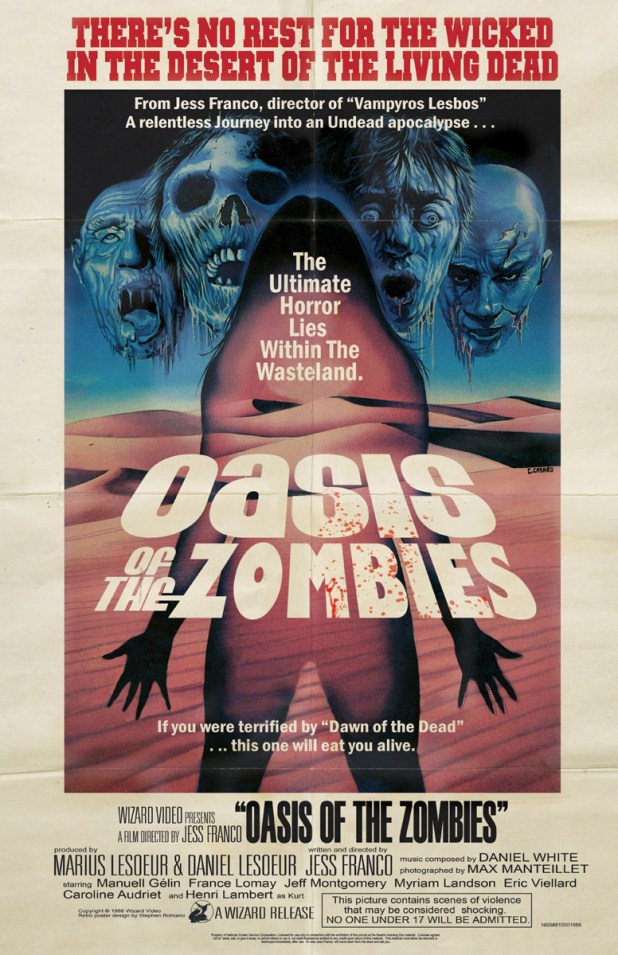
Oasis of the Zombies (1982)

Jess Franco wrote, directed, produced, acted and scored approximately 173 feature films and I have been cursed to watch all of them. This one, he made for French producer Marius Lesoeur and its also known as L’Abîme des Morts-Vivants* (The Abyss of the Living Dead).

I kid, actually. Sometimes, I kind of like what Franco does. This would be one of those times, when he somehow lulls you into a fuzzed out haze, helped by a bad looking print, as you wait and wait and watch and hope and dream of the moment when the zombies that guard some Nazi gold will emerge and kill the treasure hunters.

Tubi has a print that looks like a VHS that has been rented thousands of times, which makes this so much better of a viewing experience than a pristine version would be.

*It’s also known as Bloodsucking Nazi Zombies, El Desierto de los Zombies, The Grave of the Living Dead, The Treasure of the Living Dead and for having a Spanish version called La Tumba de los Muertos Vivientes that is blessed with Line Romay as the Nazi doctor’s wife.

Safari 3000 (1982): Fast and Furious Week

Editor’s Note: This review previously ran on October 14, 2020, as part of our 2020 Scarecrow Video Psychotronic Challenge month of reviews. We’re re-running the review as part of our “Fast and Furious Week, Part Deux.”


The B&S staff had this on our shortlists for our “Fast and Furious Week I” and our upcoming-December “Fast and Furious Week II” tribute weeks to the well-weathered leather, hot metal, and oily rubber burners of the home video-era. Well . . . we lie. This one was on our long-list actually, as we kept avoiding this used celluloid clunker. Then the Scarecrow gang had to come up with theme day #15 for the 2020 Psychotronic Challenge. So let’s just yank this one off like the icky-sticky, puss-soaked band-aid that it is and get it over and done with. . . .

How did Roger Corman NOT make this?

So you’re Harry Hurwitz, aka Harry Tampa, and your genre-meshing of disco and vampires with Nocturna, Granddaughter of Dracula was a critical and box office failure. So, what do you do for your next picture? You team up with ’50s television producer Jules V. Levy (The Rifleman, The Big Valley), who was one of the (of the many) co-producers on Smokey and the Bandit (as well as John Wayne’s McQ and Brannigan, and Burt Reynolds’s White Lightning and Gator), to mesh the ol’ the Bandit with The Cannonball Run (1981). And, what the hell: while we’re at it, we’ll clip from The Gumball Rally (1976), because, why not? The Cannonball Run clipped ’em.

As you can see: there’s not an original part under this hood.

Okay, so the “script” is locked (we think), but who do you get to star in your road racing rip-off? Well, John Wayne and ol’ Burt aren’t signing up for this non-sense, especially after you unleashed Nocturna on the masses. Well, what the hell, Christopher Lee — who’s always grateful to get out of the horror genre — is game for a villainous role.

But who do you get for the lead: the guy who starred in Death Race 2000 (1975) and Cannonball (1976), of course, because, well, this Harry Tampa gas-guzzler isn’t that far removed from those films.

And who will be our Sally “Frog” Field to get our Bandit into a mess: Stockard Channing, aka Rizzo, from Grease.

Okay, now we need a “Sheriff Burford  T. Justice” for this rubber-burning tomfoolery, only he needs to be a bit more regal . . . and he needs to be a “Count,” but who . . . yes, Mr. Lee, of course! He’s Count Lorenzo Borgia, an African horse rancher who’s also a racing fetishist. But wait . . . are they . . . ripping off Star Wars . . . and foreshadowing Lee’s work as Count Dooku/Darth Tyranus? Alright, Harry! You ripped off Paul Hogan and George Lucas films that weren’t even made yet. Way to go, Mr. Tampa! This movie is going to . . . crash and burn.

Because I am Harry Tampa and I just can.

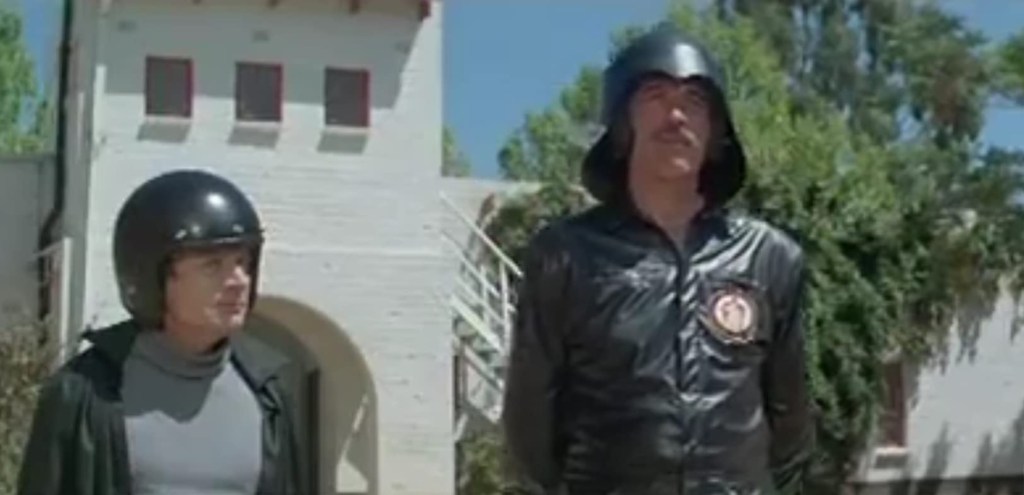
“Hey, R.D! Is that Rick Moranis, who played Dark Helmet in Spaceballs, standing next to Christopher Lee — wearing a “dark helmet” on his head?”

Nope. That’s Hamilton Camp . . . yes, he was in Smokey and the Bandit. And Starcrash. And Evilspeak. . . . Anywhoo, back to the plot.

There really isn’t one. At least one you haven’t already seen before. But the real “plot twist” is that this rips off Crocodile Dundee — which wasn’t even made yet! But since Linda Kozlowski wasn’t up for a Sue Charlton sidequal, well, prequel, we got Rizzo.

J.J Dalton (Channing) is your obligatory, ambitious richy-bitchy photojournalist (where’s Kay Lenz when you need her) for Playboy Magazine (she the type who, when doing an expose on prostitution, ends up arrested for prostitution). And she concocts a new story pitch: she’ll be a navigator for a race car in the 5th African International Road Rally. And she hires movie stunt driver Carradine as her driver. And Carradine’s ex-boss? The good ol’ Count. Yep, another “Frog” screws over another good ol’ boy.

What’s amazing about this auto-salvaged mess is that it isn’t just some low-budget schlock studio production. No. This isn’t a Roger Corman Eat My Dust-cum-Grand Theft Auto-cum-Smokey Bites the Dust stock footage recycler: MGM/United Artists — obviously hoping for some Smokey stank on the ol’ celluloid — ended up with a knock off Disney’s The Love Bug. But not all is lost: Christopher Lee is wonderfully deadpan and is adept at comedy. Who knew?! And Stockard Channing is quite the champ dealing with all of the baboons. And ol’ David is Dave: he never disappoints. But he was probably pissed he starred into two “3000 movies” — and they both sucked tailpipe (Deathsport, aka Death Race 3000). But hey, at least he didn’t star in America 3000 . . . but David A. Prior sucked Dave into Future Force (1989) and Future Zone (1990), so, Dave still got slammed in the ol’ celluloid hoosegow.

The VHS tapes on this, released between 1984 to 1987, are bountiful in the online marketplace, while DVDs were issued in 2011 by both MGM and 20th Century Fox Home Video. You can watch a pretty clean rip on You Tube and you can stream it Amazon Prime. Our advice: watch the You Tube one for free, as the Amazon print is of a pretty low quality.

We express our gratitude to the individual who, in an updating of this film’s Wikipedia entry, referenced and pull-quoted our review.

Our Drive-In Friday tribute to Harry!

About the Author: You can learn more about the writings of R.D Francis on Facebook. He also writes for B&S About Movies.

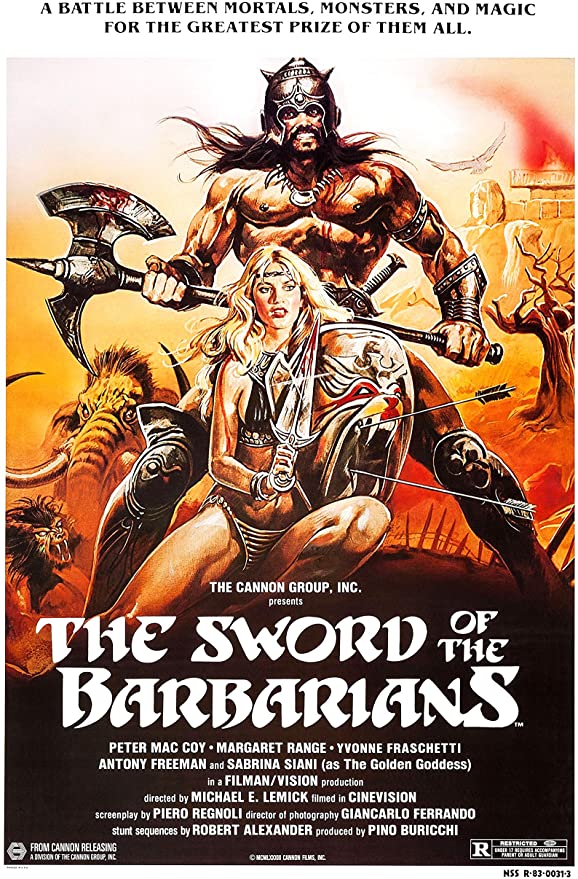
The Sword of the Barbarians (1982)

Known in Italy as Sangraal, la spada di fuoco (Sangraal, the Sword of Fire), this is the first of two barbarian movies that Michele Massimo Tarantini made. For a director better known for his commedia sexy all’italiana films, this is pretty decent. By that, I mean that you have to have an affinity for Italian sword and sorcery. If you haven’t figured out that I do, well, now you do.

This also has the alternate name, Barbarian Master, which is a very metal movie name.

Sangraal (Pietro Torrisi, who started his career in peblum movies like The Ten Gladiators and ended it in sword and sorcery movies like Gunan, King of the Barbarians) is Sangraal, whose father’s kingdom has been decimated by the evil warlord Nantuk (Mario Novelli, Warriors of the Year 2072Amok TrainEyes Behind the Stars). He leads his people to a new land which is ruled by Belem (Luciano Rossi, whose career hits all of the Italian trends, from westerns like Django to the Eurospy Killer 77, Alive or Dead to giallo sich as Death Carries a Cane and Death Smiles at a Murderer and poliziotteschi, war films and exploitation in Salon Kitty).

Nantuk has become a king, yet the Goddess of Fire and Death* (Xiomara Rodriguez) demands more. Sangraal must die or Nantuk will lose everything. So he does what any madman usually does and crucifies our hero — hello, Conan the Barbarian — and forcing him to watch everyone in the village be killed**, including the Goddess personally murdering his wife. He’s saved by the archer Li Wo Twan (Haruhiko Yamanouchi, the only actor I know who has been in both Joe D’Amato and Wes Anderson movies) and Belem’s daughter Ati (Yvonne Fraschetti, Demons 2).

This movie actually has something to say about love, loss and grief, as a wizard tells Sangraal that he must give up on the memory of his dead wife and keep on living if he wants to defeat Nantuk, who is devoted to killing him. Then again, as you deal with these issues in your life, I doubt you will ever battle an evil king. That said, perhaps you’ll find something in this to help you.

You have to give it to the servants of Nantuk. When Sangraal challenges our antagonist to a duel to the death by the traditional rules — with no interference — they refuse to help, even when their leader demands they kill our hero. And then, they just let Ati go at the end.

This movie has taught me that goddesses can be killed, if you have a magic crystal crossbow.

Also — and perhaps most importantly — Sabrina Siani (who is pretty much the queen of these movies, thanks to appearances in The Throne of Fire, Ator the Fighting Eagle and, most importantly, her turn as Ocron in Conquest) is in this as the Goddess of Gold and Life.

This is why I watch movies, to be battered into happiness by Italian barbarians battling half-naked and fully naked evil beings.

You can get this from Revok.

*If you’re watching this and wonder, “Have I seen this village get destroyed before?” You’re right. It’s the exact same footage that is in The Throne of Fire.

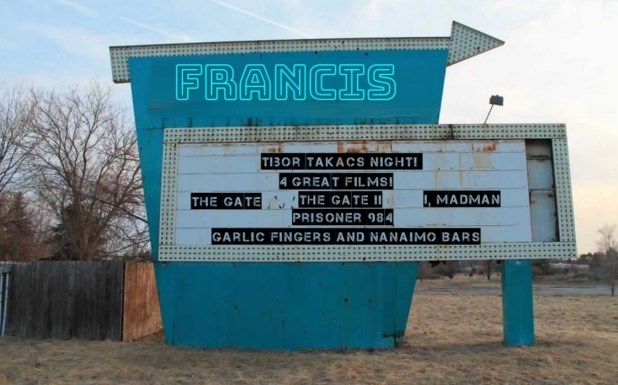
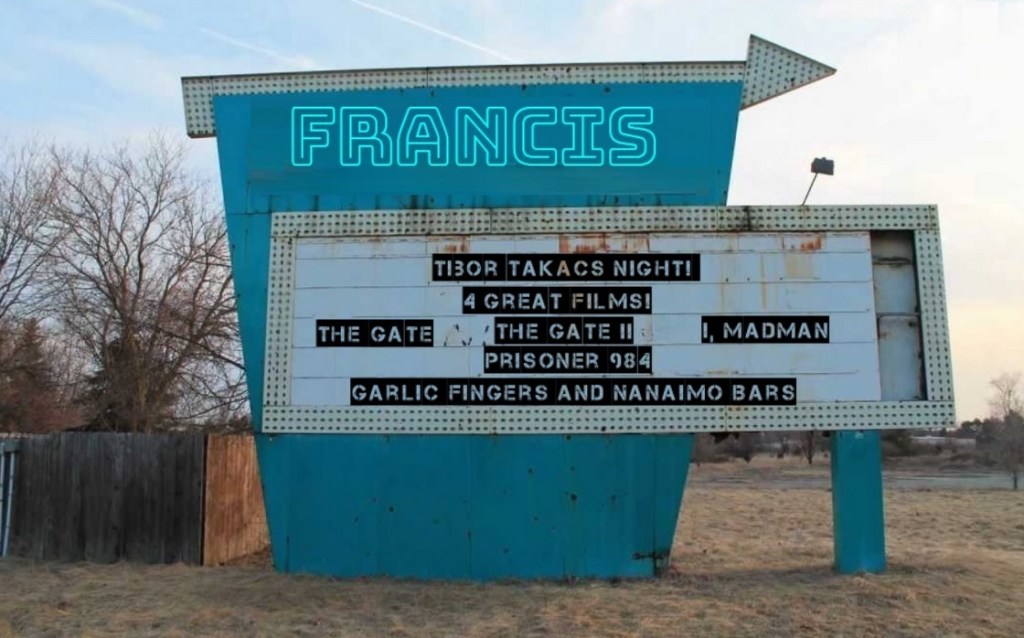
Drive-In Friday: Tibor Takács Night

Primarily known as a talent manager, studio producer and engineer, Hungarian born director Tibor Takács worked behind the boards for the Canadian bands the Viletones and the Cardboard Brains before he became a director. His first feature film project was the self-produced Metal Messiah (1978), a long-form rock opera/video which starred two bands from his stable: Kickback and the Cardboard Brains.

Best known for the internationally-distributed “No False Metal” classic, The Gate (1987), he made his feature film debut with the 1978-shot-and-1982 released CBC-TV movie 984: Prisoner of the Future, which has long since fallen into the public domain and is easily found on a wide variety of bargin-basement sci-fi DVD sets. After the cult VHS and cable status of The Gate, he was poised to direct A Nightmare on Elm Street 4: The Dream Master, but passed on the project . . . and he gave us The Gate 2: The Trespassers and the pilot movie for the original Sabrina the Teenage Witch.

These days, he’s churning out the mockbuster hoards of Ice Spiders, Mega Snake, and Destruction: Los Angeles, as well as other films concerning all manner of meteors, tornadoes, mosquitoes, black holes, and rats for the SyFy Channel . . . and he got into the Hallmark Christmas movie business alongside our equally beloved Fred Olen Ray and David DeCoteau.

Oh, and Hallmark romance flicks.

Did Sam and I watch The Secret Ingredient for its February 2020 premiere — making our significant others cringe in the process — as we chomped on our popcorn and gulped our A&W Root Beers with glee? Damn right, we did. And you know how B&S About Movies is about our Christmas movies . . . so yes, we did binge the Takacs X-Mas oeuvre of Once Upon A Christmas (2000), Twice Upon a Christmas (2001), Rocky Mountain Christmas (2017), It’s Christmas, Eve (2018), Memories of Christmas (2018), and A Christmas Miracle (2019). And when Tibor finishes off his currently-in-production Lifetime damsel-in-distress thriller Roadkill — his 48th directing effort — we’ll watch that one, as well.

But what we really want to know: Tibor, when in the hell are you and Eric Roberts going to do a movie together? It’s de rigueur for guys like you, Olen Ray, and DeCoteau. Make it happen, Tibor! Remember when you wrote and directed Redline, aka Deathline, that bionic-man-out-for-revenge actioner back in 1997 with Rutger Hauer and Mark Dacascos? Or Bad Blood, aka Viper, from 1994 with Lorenzo Lamas as a bad-ass trucker taking down the mob? Something like those flicks . . . just cut Eric Roberts loose to kick mercenary and mobster ass as an “aging action hero” thespin’ his little heart out . . . as a rogue C.I.A black-ops agent, like Mack Dacascos in 1998’s Sanctuary. Make it happen, buddy!

Movie 1: The Gate (1987)

Come on, you know this movie, ye wee metal pup.

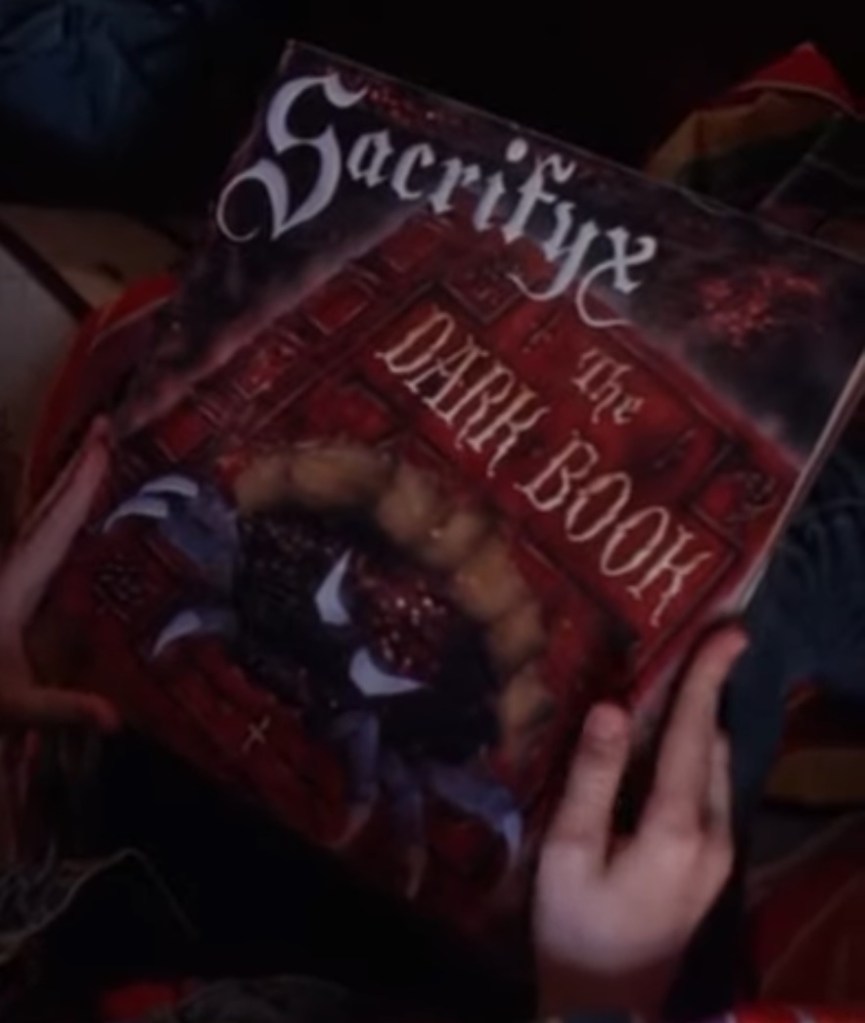
This is — non-CGI, mind you — a tale of an album known as The Dark Book by Sacrifyx — a band who died in a horrific accident after its recording — that serves as “the key” to opening a gate to hell . . . that just so happened to be under the roots of a lightning-stuck tree in the backyard of future Blu Cigs spokesman Stephen Dorff (he was 12 at the time).

How loved is this movie? You can buy Sacrifyx “The Dark Book” T-shirts on esty. Fans have compiled “Top 10” lists about the film. Sacrifyx is noted as one of the best “fake bands” on film. And . . .

There’s a (baffling, but awesome) Sacrifyx website, and . . .

An equally eerie album by a band called Sacrifyx listed on Discogs that recorded an album at Dunwich Analog Studios in Detroit, Michigan, in 1983 — with a song “The Gate.” But wait, the movie didn’t come out until 1987? Shivers. And guess what . . . the album is real. It’s on You Tube.

Which Old God is F’in with us, here? Love this movie, ye must!

Movie 2: The Gate II: Trespassers (1990)

Dude . . . imagine a Tibor-made Freddy Krueger movie? How awesome could that have been? Instead, we got a sequel to The Gate — both written by Michael Nankin, who made his debut with the David Naughton-starring (yes, the Dr. Pepper “Making It” Meatballs werewolf in London guy), Animal House-rip Midnight Madness in 1980.

The upside to this movie: Terry shoots and scores! He bags a babe. So, you see, it pays to worship Satan and dabble in the black arts. Do it! Chant Natas three times and the babes will come crawlin’ out the ground for ya!

Is The Gate II as good as the original? Nope. But it’s a lot of fun with great non-CGI effects, once again, from Randall William Cook, who also handles the SFX for the next feature on this evening’s program.

Intermission! Spin the dark circle, if you dare . . .

Back to the Show!

Movie 3: I, Madman (1989)

Long before meta-fiction became shot-on-iPhone de rigueur for the digital auteur crowd (For Jennifer), Julio Cortázar wrote a short story — La Continuidad de Los Parques (The Continuity of the Parks) — a tale that is three stories; each aware of one another in a universe where fiction collides with meta-fiction.

The much-missed Jenny Wright of Near Dark fame (I recall reading her interview in Shock Cinema Issues #45 that went into detail about the abuses she suffered and caused her exit from the business) is Virginia, a bookish girl obsessed with writer Malcolm Brand’s I, Madman. In the pages of that tale, the deformed Dr. Kessler attempts to win over an actress by killing people and adding their faces to his own. And she comes face to face, literally, with Dr. Kessler as he’s entered the real world.

Should this follow up to The Gate be as revered and remembered as The Gate. Yes. Is it? No. Love this movie, you must. It’s awesomeness and a bag ‘o garlic fingers.

P.S. You need more “film within a film” tomfoolery? Check out Anguish (1987).

Movie 4: 984: Prisoner of the Future (1982)

Tibor’s first commercial film project was this failed Canadian TV series pilot programmer in 1978. Courtesy of the Star Wars-infused sci-fi market, it was shook loose from the analog dustbins onto home video shelves in 1982.

Also circulating on DVD bargain comps as The Tomorrow Man, it’s a surreal psychological drama concerned with the imprisonment of an intelligence agent in an Orwellian future. Don’t let the Dr. Who-esque TV production designs deter you from watching this well-written and acted sci-fi’er — a commendable start to the awesome career of Tibor Takács. We found a trailer upload on You Tube.

About the Author: You can learn more about the writings of R.D Francis on Facebook. He also writes for B&S About Movies and publishes on Medium.

Burst City (1982)

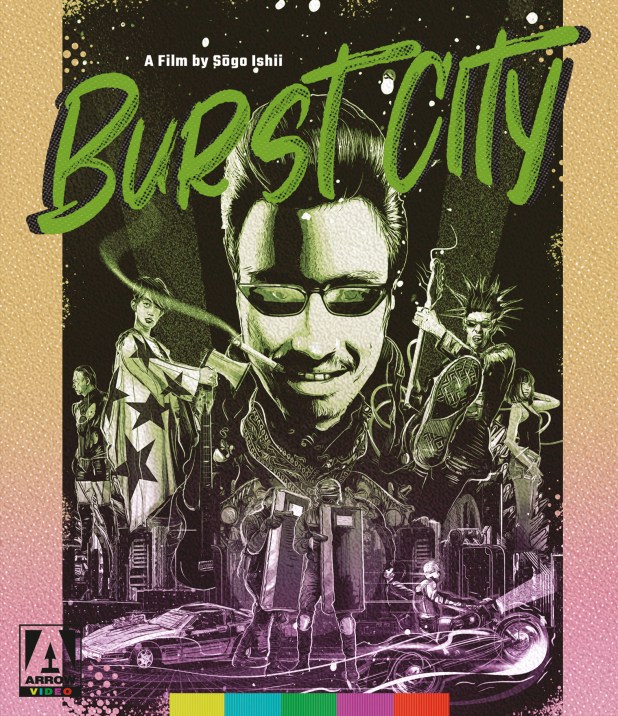
I don’t know what was in the water, because the frenzy of 1979’s Mad Max inspired imitators all over the world, from the Italian westerns with cars to the Filipino tricycle driving blasts of strangeness and, yes, this Japanese punk rock epic. This is one of the most frenetic and just plain loud movies I’ve ever seen, which made me fall in love with it right from the very first frame.

Whether its characters are rocking the stage, partying, fighting, getting wasted, hunting down a killer or battling any authority figure they can find, this is a film of noise, fury and high energy. It unites bikers, workers and punk as one to fight the Yakuza, which leads to the Battle Police shutting everything down.

Burst City has a soundtrack from all three of the major punk cities in Japan. The Stalin was from Tokyo, Machizo Machida was from Kansai, and The Roosters and the Rockers were from Kyushu. The cast and crew bonded by living on the post-apocalyptic set when they weren’t shooting, like some end of the world squatters.

Shot on filthy 16 mm film, this movie stops and starts, changes speeds and amplifies the strangeness throughout. Director Gakuryū Ishii is often cited as being a major influence on Japan’s cyberpunk culture with movies like Gojoe: Spirit War Chronicle and Electric Dragon 80.000 V, as well as music videos for The Roosters and Einstürzende Neubauten.

If you look closely, you can spot Japanese pro wrestling heel king Umanosuke Ueda, a bleach blonde heel who also shows up on Takeshi’s Castle. He’s one of the yakuza henchmen. If you’re a fan of New Japan Pro Wrestling’s Evil, you are watching the modern version of his character, which also inspired Mr. Gannosuke, Tatsutoshi Goto and Toru Yano.

This is 115 minutes of punk bands screaming*, motorcycles, fistfights, cops getting shotgun blasted and astounding fashion choices. It’s non-stop imagery and sound. In my dreams of punk rock 1982 Tokyo, I imagine that everyone dressed and acted exactly like this film, racing dekotora trucks and chugging sake right out of the microwavable containers when they aren’t plugging holes in their amps so they get even more distortion out of them.

The Arrow Video re-release of this has a 1080p hi-def presentation, which is kind of awesome because this is one of the grainiest movies I’ve ever seen. It also has new audio commentary by Japanese film expert Tom Mes, a 56-minute interview with the director and a 27-minute discussion of the film with filmmaker Yoshiharu Tezuka on jishu eiga (self-made movies).

This is one weird trip that you should totally take. You can get this from Arrow Video. Grab a helmet or something to restrain yourself, because this movie feels like it could give you whiplash.

*Becca: “Is this movie just an hour of Japanese people screaming?”

Drive-In Friday: Phil Savath Night

From Terminal City Ricochet with Jello Biafra to Beverly Hills, 90210 with Luke Perry? From the science fiction/horror musical Big Meat Eater featuring the soft-shoe of “Baghdad Boogie” to the historical drama Samuel Lount? Drag racing through the eyes of David Cronenberg? Children’s programming?

Welcome to the eclectic career of Phil Savath.

Phil Savath, born December 28, 1946, was an American-born Canadian film and television writer and producer. He was most noted as a two-time Genie Award nominee for Best Screenplay, with nominations for Original Screenplay at the 4th Genie Awards in 1983 for Big Meat Eater and Adapted Screenplay at the 10th Genie Awards in 1989 for The Outside Chance of Maximilian Glick. (The Genies are the Academy of Canadian Cinema and Television’s equivalent of the Oscars.)

Savath started his career in television in the late ‘70s as the co-creator and star of the CBC Television children’s comedy series Homemade TV and Range Ryder and the Calgary Kid, and then made his theatrical debut with David Cronenberg’s Fast Company.

Fans of FOX-TV’s Beverly Hills, 90210 know him for the dozen episodes he wrote for that post-Brat Back series, as well as the oft-aired HBO favorite, The Outside Chance of Maximilian Glick, which was turned into a short-lived TV series, Max Glick. He also wrote the Canadian hockey drama Net Worth (1995) and developed the Canadian TV series African Skies (1992) about a bi-racial teen friendship in post-Apartheid South Africa. As a producer, before his death in 2004, he produced the late ‘90s series These Arms of Mine, along with the TV Movies White Lies, Little Criminals, and Liar, Liar: Between Father and Daughter.

Movie 1: Fast Company (1979)

The influence of this Phil Savath-penned script on the career of David Cronenberg can’t be denied.

The first of Cronenberg’s feature films for which Cronenberg did not originate the screenplay, he was hired by the producers to direct. It was on Fast Company that Cronenberg developed long-time working relationships with cinematographer Mark Irwin, art director Carol Spier, sound editor Bryan Day, and film editor Ronald Sanders — each worked on Cronenberg’s later films. Actor Nicholas Campbell, who plays William Smith’s young protégé, also went on to appear in Cronenberg’s The Brood, The Dead Zone, and Naked Lunch. Sadly, Fast Company also serves as final release for Claudia Jennings (‘Gator Bait), who died in a car wreck several months after this drag racing drama’s release.

Movie 2: Big Meat Eater (1982)

Take one part Ed Wood’s Plan Nine from Outer Space, one part Paul Bartel’s Eating Raoul, and one part Richard O’Brien’s The Rocky Horror Picture Show and vigorously shake in your “intentionally bad cult films” tumbler, and serve: We’ve got a mad butcher, a murdered mayor, and aliens who reanimate the mayor to assist in the harvesting of a rare, radioactive fuel deposit beneath the butcher shop. Oh, and there’s song and dance numbers (which you can enjoy during our intermission).

And those Great White Northeners “got it,” since Phil Savath and his co-writers Laurence Keane and Chris Windsor received Canada’s Oscar equivalent — a Genie Awards’ nod — for Best Original Screenplay in 1983. While Windsor never made another film, Keane and Savath continued onward and upward . . . and what could Phil possibly write as a follow-up feature? It’s not what you’d think.

Intermission!
Courtesy of the Phil Savath-penned “Baghdad Boogie.”

Back to the show!

Movie 3: Samuel Lount (1985)

The man who gave us Big Meat Eater . . . wrote this? He did.

A historical drama set during the Upper Canada Rebellion of 1837, the film stars very familiar Canadian TV and film character actor R. H. Thomson (I remember him from the cable-played Escape from Iran: The Canadian Caper and The Terry Fox Story, as well as lots of American TV series) as Samuel Lount, an organizer of the rebellion who was ultimately convicted of treason and executed in 1838.

Receiving a limited theatrical run before debuting on Canadian television, it made its U.S debut on HBO and Showtime. While not winning any awards, it received five 7th Genie Awards’ nods for Best Actor, Best Cinematography, Best Costuming, Best Editing, and Best Sound Editing.

Yes, this powerful, fact-based drama is — in fact — from the pen of the man who gave us a film backed by a soundtrack performed by Alternative Tentancles bands. Yes, that’s right. Phil Savath worked with Jello Biafra. But Phil wrote “Baghdad Boogie” and incorporated “Heat Seeking Missile,” a song that would give Spinal Tap pause, into a movie — so what’s really shocking you at this point?

Movie 4: Terminal City Ricochet (1990)

So, Phil did a pretty good job with the sci-fi horror parody Big Meat Eater, so he took a crack at parodying the post-apoc sci-fi craze of the ’80s with this dystopian-political intrique romp. It’s the story of a media entrepreneur who weasels his way into the mayorship of Terminal City and manipulates the populace through television, with their ensuing addictions to consumerism lining his pockets.

Oh, and the good mayor’s Chief Social Peace Enforcement Officer? Jello Biafra of the Dead Kennedys.

Yeah, it’s a must watch.

About the Author: You can learn more about the writings of R.D Francis on Facebook. He also writes for B&S About Movies.

Mill Creek Sci-Fi Invasion: 984: Prisoner of the Future (1982)

Before his best known, first studio-backed film, The Gate, and its sequel, The Gate 2: The Trespassers . . . long before he passed up the chance to direct A Nightmare on Elm Street 4: The Dream Master . . . before I, Madman . . . long before he started churning out the mockbuster hoards of Ice Spiders, Mega Snake, and Destruction: Los Angeles for the SyFy Channel . . . before he got into the Hallmark Christmas movie business alongside our equally beloved Fred Ray Olen and David DeCoteau, Hungarian-born Tibor Takács shot this failed Canadian TV series pilot programmer in 1978. Courtesy of the Star Wars-infused sci-fi market, it was shook loose from the analog dustbins onto home video shelves in 1982. Criminally allowed to fall into the public domain, this well-written and produced production (on a budget, natch) turned up as a track selection (aka The Tomorrow Man) on numerous bargain-basement DVD compilations.

Primarily known as a talent manager, studio producer and engineer, this CBC telefilm-pilot was Takács’s first professional feature film project, after his self-produced feature film debut, Metal Messiah (1978), a long-form rock opera/video which starred two bands from his stable: Kickback and the Cardboard Brains. (We’ve wanted to review Metal Messiah since forever, but have been unable to locate a copy. And yes, we’ve had I, Madman (1989; with Jenny Wright!) on our shortlist of must-reviews since our 2017 review of The Gate. We’ll get to it, one day . . . what the hell . . . courtesy of our annual October 2020 “Slasher Month,” Sam reviewed it, finally!

As you read this review, please take into consideration my crazed fandom for Patrick McGoohan’s surreal psychological drama The Prisoner, concerned with the imprisonment of an intelligence agent, of which this Orwellian-influenced tale reminds — only with the resourceful, low-budget production designs of PBS-TV’s 1980 production of Ursula K. Le Guin’s 1971 novel A Lathe of Heaven. (Again, take into consideration of my fandom of that PBS adaptation igniting my sense of nostalgia for Takács’s dystopian tale.) And speaking of PBS-TV, one will also have a sense of Tom Baker-era Dr. Who déjà vu in the production designs (especially in the prison’s Cylon/Cybermen-styled sentries) and its cast of Shakespearian-skilled thespians.

Since Takács knows we are, at the very least, familiar with the dystopian tales of Aldous Huxley with Brave New World and more importantly, George Orwell’s 1984, 984: Prisoner of the Future dispenses with long-winded set ups in establishing how The Movement came into power and gets right into it: how affluent businessman Tom Weston became “984” by way of his entries in a ratty diary from the walls of his prison cell, which triggers a series of flashbacks to the mind games played by Warden Dr. Fontaine (the steely-excellent Don Francks (his work dates back to ’60s TV’s The Man From Uncle), his interrogator.

Don’t let the fact that this Canadian TV tale fell into, it seems, public domain territory due to a lack of legal due diligence on the part of the CBC, deter you from watching. This is a quality work by Tibor Takács that rises above the usual public domain or still legal, yet forgotten, odds ‘n’ sods from the VHS-era finding a new, digital home on these DVD box sets that brings the ol’ ’80s video store shelves to the abode.

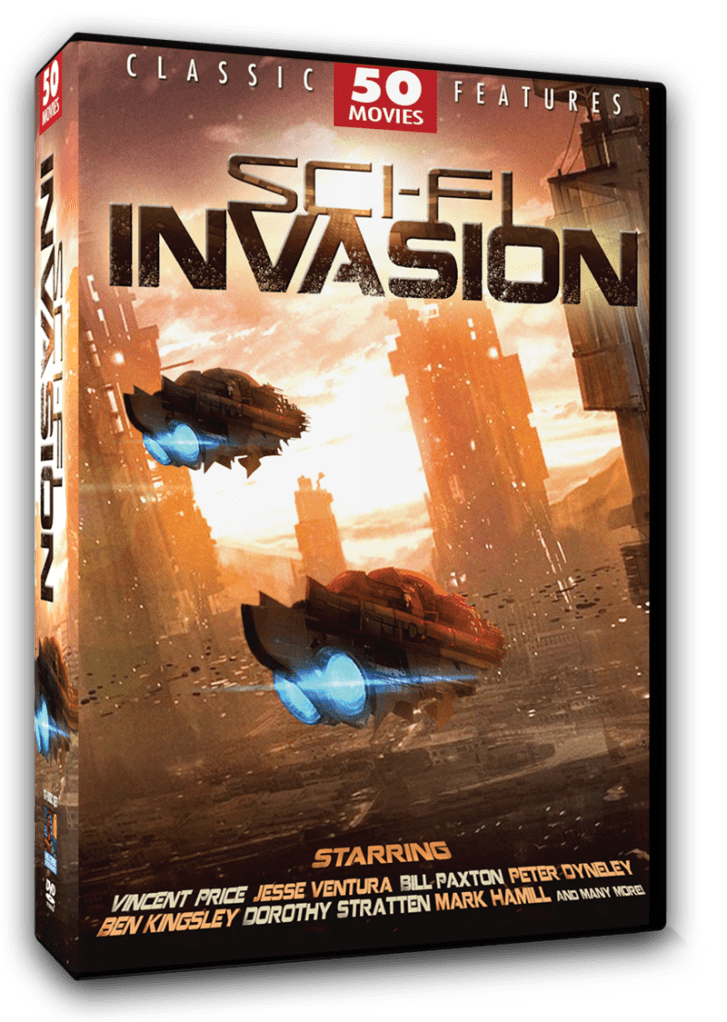
You can watch 984: Prisoner of the Future on You Tube or own it as part of the “Mill Creek Sci-Fi Invasion Box Set.” You Tube also offers the trailer. Be sure to join us as we examine Tibor’s career and films with our “Drive-In Friday” featurette.

Our thanks to the digital librarians of Wikipedia for referencing this review as part of the “List of Dystopian Films” page.

About the Author: You can learn more about the writings of R.D Francis on Facebook. He also writes for B&S About Movies.

SLASHER MONTH: Unhinged (1982)

“Violence beyond reason. Victims beyond help.”

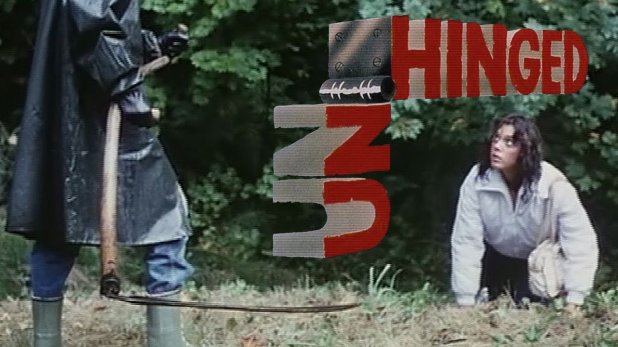
This section 2 video nasty was directed by Don Gronquist, who also wrote Stark Raving Mad and directed The Devil’s Keep, and has a cast of Portland, Oregon kids who never made another film. It was remade in 2017 in the UK, which surprised me because I usually keep on slasher reboots.

Even though this movie is barely 80 minutes, it still feels like nothing happens for a good stretch of time. That’s because, well, nothing does. There’s a lot of talking and sleeping, punctuated by moments of murder. Oh yeah, you can also spot the clapboard numerous times here, so don’t expect a technical masterpiece.

It does have a killer that — SPOILER WARNING — is a man posing as a woman, an early example of gender repression. Yet he still sees himself as a man, but a man who must wipe out all of the weak females that he finds. Don’t look for answers or political correctness here — this is a grimy slasher made in 19 nights way back in 1982. I’ve just never seen a movie before where — SPOILER AGAIN FOR A MOVIE MADE 38 YEARS AGO — the final girl gets eviscerated while the killer laments just how hard it is to be a woman.

You can watch this on YouTube.

Drive-In Friday: ’80s Teen Sex Comedy Night

As Robert Freese pointed out in his “Exploring: 80s Comedies” featurette for B&S About Movies, Bob Clark’s Porky’s opened up a cottage industry of teen sex comedies. And boy, did producers scrape the grease pits . . . where’s Pee Wee, Kim Cattral, and Kaki Hunter when you need ’em? Robert Hays! Leslie Nielsen! Where are you, bros?

Movie 1: Fast Food (1989)

You a-lookin’ for a-finger lickin’ good burger joint (that’s not) down the road from Faber College . . . one that’s staffed by Melanie Griffith’s half-sister Tracy Griffith (Sleepaway Camp III: Teenage Wasteland) going up against evil burgermeister Jim Varney (yes, Ernest P. Worrell of the “Goes To” movies), along with Kevin McCarthy from Invasion of the Body Snatchers . . . and Michael J. Pollard (Memorial Valley Massacre) . . . and Traci Lords (Shock ‘Em Dead) as an industrial spy?

No?

How about a movie with lame jokes about “date rape drugs” in the special sauce and labs where men suffer from non-stop erections?

No wonder this ended up being the last film by ex-’80s TV teen idol Clark Brandon (My Tutor, TV’s The Fitzpatricks, Out of the Blue, Mr. Merlin, The Facts of Life). And why am I the only one who remembers watching 1977’s The Chicken Chronicles on HBO in the ’80s with Clark mixing it up with Steve Guttenberg and Phil Silvers?

Yeah, it’s as bad as American Drive-In and Hard Rock Zombies, which were both shot back-to-back by Krishna Shah. So thanks for the heads up, Blue Laser Studios. And thank you, You Tubers for uploading it HERE and HERE to enjoy. Eat ’em and smile!

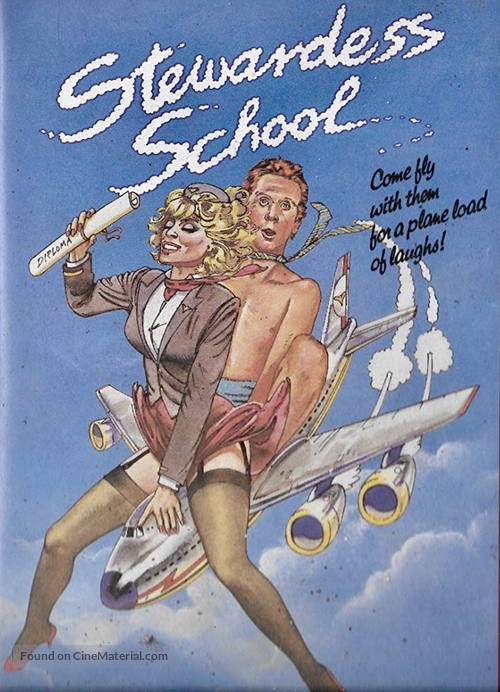
Movie 2: Stewardess School (1986)

You a-lookin’ for a ripoff of Airplane! starring Donnie “Ralph Malph” Most in a comedy that plays an airline crash in downtown Los Angeles for comedy? How about a ripoff of Police Academy set in a stewardess school?

Well, if Donnie, aka “Don,” Most as a washed-out pilot slummin’ as a steward doesn’t get ya . . . maybe Mary Cadorette — who played Vicky, the girl who finally got Jack Tripper to settle down and go from Three’s Company to Three’s a Crowd — as the hot air hostess, will get ya’. How about Wendie Jo Sperber as a frumpy, overweight air hostess?

No. Didn’t think so. Again, where’s Robert Hays and Leslie Neilsen when you need ’em?

Intermission! You need a Chilli Dilly! And a hotdog!

Back to the Show!

Movie 3: Fast Times at Ridgemont High (1982)

Leave it to Sean Penn to save day!

Of the glut of teen sex comedies, it’s this Cameron Crowe-penned comedy — along with Bob Clark’s Porky’s and, to a lesser extent, Boaz Davidson’s much-adored The Last American Virgin — that major and indie studios desperately tried to imitate but never duplicated.

This one has it all: Phoebe Cates changed our young lives rising out of a pool. The Sherman Oaks Mall is practically a character in itself. Jennifer Jason Leigh is so hot, she breaks up a friendship. We all wanted to be as cool as ticket scalper Damone and wore caps and vests. We wanted to hang out with Jeff Spicoli like his stoner buds Nicholas Cage, Eric Stoltz, and Anthony Edwards. And we begged our parents for a pair of checked vans. And we all wanted jobs at the mall slingin’ fast food and selling movie tickets (and working in the record store). And it came with a pretty cool Sammy Hagar theme song.

An all-out classic. Watch it.

About the Author: You can learn more about the writings of R.D Francis on Facebook. He also writes for B&S About Movies.