

Well, you know how the VCRs roll at B&S About Movies . . . where a review of Peter Carpenter’s Point of Terror, as well as Blood Mania, leads to a reader inquiry and discussion on whatever happened ever happened to Pete . . . which inspires a two-fer review of Vixen! and Love Me Like I Do to finish off his all-too-slight resume. And those discussion about Pete left us wondering . . . “What ever happened to Gene Shane from Werewolves on Wheels and The Velvet Vampire?”
Well, as you know, we solved “The Case of Peter Carpenter” with that said, two-fer review, and we peeled away at the onion that is “The Mystery of Gene Shane” watering our eyes with our review of The Velvet Vampire. Luckily — because we are so exhausted from those two crazed investigations of our favorite actors of yore — “The Case of Sherry Miles,” now known as DeBoer, is more easier slice and diced, thanks to her involvement in her own IMDb page, along with the many, loyal websites* dedicated to all things Hee Haw (an old “Kornfield Kountry” TV series that aired on CBS in the ’60s).
So, let’s pay tribute to one of our favorite — and missed — actress of the ’60s and ’70s.


That Teen modeling spread we used for our banner, above, soon transitioned Sherry into an acting career, which began with the pre-Gilligan’s Island Bob Denver series The Good Guys (1969), an early Aaron Spelling series, the counterculture sci-fi drama, The New People (1969), and Medical Center (1969) starring Chad Everett (The Intruder Within). Sherry’s other, early ’70s appearances included the popular series Mod Squad, Nanny and the Professor, Pat Paulsen’s Half a Comedy Hour, The Name of the Game, The High Chaparral, The Beverly Hillbillies, Adam 12, Love American Style, and The Partridge Family (Sherry over Susan Dey, every day of the week — and twice on Sundays!). As we crossed the nation’s bicentennial, Sherry appeared on the popular series Baretta with Robert Blake (Corky), Police Woman with Angie Dickinson (Big Bad Mama), Richie Brockelman, Private Eye with future director Dennis Dugan (Love, Weddings & Other Disasters), and Wonder Woman with Lynda Carter (Bobbi Joe and the Outlaw). And let’s not forget Sherry’s 26-episode run as part of the comedy ensemble on the homegrown variety show Hee Haw* during its 1971 to 1972 season.
A one-time heiress to the Hawaii-based Long’s Drug Store chain (now owned and operated by CVS since 2008; I’m in there, often), Sherry Miles got married, became a DeBoer, and retired from the business after her final, on-camera appearance during the third season of Wonder Woman. Since her retirement, she’s become a long-respected animal rights activist.

Some of Sherry’s films you may not know. Others you have seen. And, hopefully, after this “Exploring” feature, you’ll search out the others. But you’ll surely revisit with Sherry in everyone’s favorite film of her career: The Velvet Vampire, a film so gosh-darn fine that, no offense to Sherry, intended: even if she weren’t in it . . . basically, we’re telling you to put The Velvet Vampire on your must-watch list, unintended insults to Sherry, be damned.
Okay, let’s unpack Sherry’s all-too-brief, big screen career, shall we?
Cry For Poor Wally (1969)
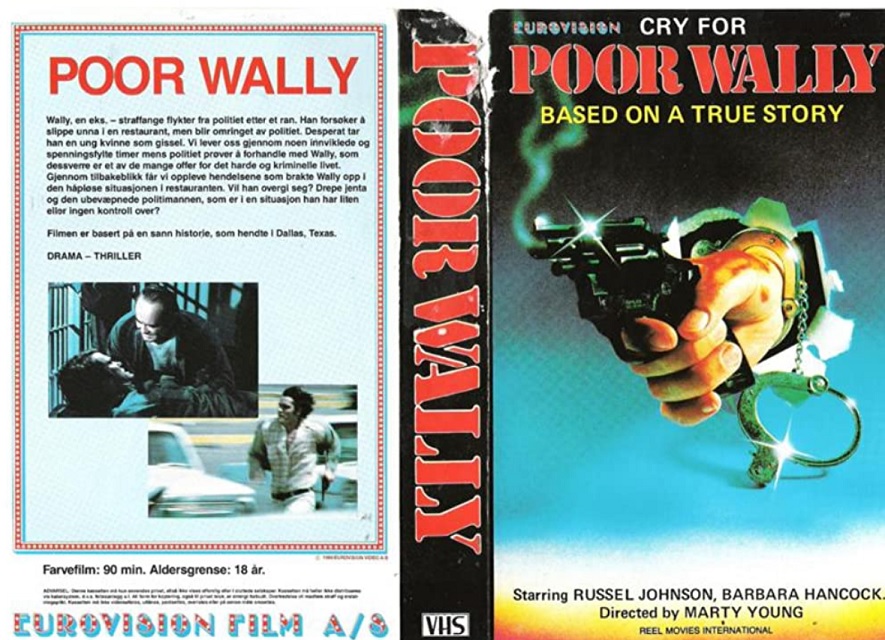
Russell Johnson (the Professor of Gilligan’s Island fame) stars as the small town sheriff in this “based on a true story” crime-drama filmed in Dallas, Texas. Johnson confronts Wally (a very good Keith Rothschild in his only film role; Johnson is equally fine): a fugitive on the run who takes a woman hostage in a diner with the goal of staying out of prison — no matter the cost. As Johnson tries to talk down Wally, the story flashes back as to the “why” it all happened: upon the death of his mother, his father leaves (abandons) him for greener pastures; his girlfriend (Sherry Miles) also contributes to his psychotic break.
Keep your eyes open for another slight-resume actress in Barbara Hancock, who we enjoyed in her fourth and final film, the “GP” horror film, The Night God Screamed (1972). In addition to Russell and Sherry, this is packed with a great cast of familiar character actors of the you-know-them-when-you-see-them variety of Elisha Cook, Jr., Bill Thurman (!) ,Gene Ross, and Paul Lambert.
Cry for Poor Wally proved to be the only producing and directing effort by Marty Young. Screenwriter Marshall Riggan followed with the Christian apocalypse drama Six-Hundred & Sixty Six (1972) and completed his features career with the lost, psychological horror, So Sad About Gloria (1973).
There’s a copy on the Internet Archive to stream. There’s also a ten-minute highlight reel — of its opening diner scene — courtesy of our friends at Scarecrow Video on You Tube, who also contributed the film’s full-digitized upload to the IA.
The Phynx (1970)

To say Sam and I love this movie — Sherry’s presence, aside — is a well-worn trope.
The Phynx are a manufactured band — kind of like the Monkees meets Stripes — made up of A. “Michael” Miller, Ray Chipperway, Dennis Larden and Lonny Stevens. They’re trained in all manner of espionage, as well as rock ‘n roll, including meeting Dick Clark, record industry-emissary James Brown, and being taught how to have some “soul” by Richard Pryor. Hey, wait a sec . . . didn’t Cliff Richards and the Shadows do the “spy rock” thing in Finders Keepers (1966)?
At once an indictment of the system and the product of the very hand that it is biting, The Phynx occupies the same weird space as Skidoo, i.e., big-budget Hollywood films trying desperately — and failing — to reach the long-haired hippy audience — like the Monkees with Head — yet failing to understand them at any level. Sort of like the next film on today’s program.
Since this is locked up in the Warner Archive, there’s no streams to share, but here’s a clip on You Tube.
Making It (1971)
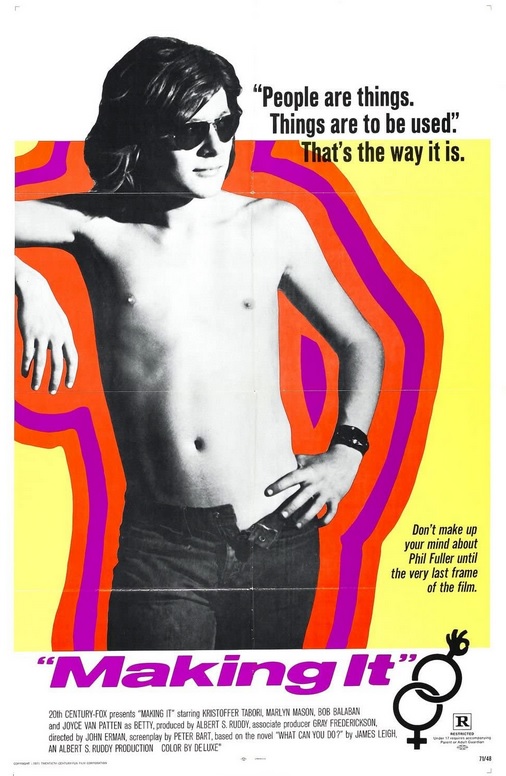
Ugh. The marketing of movies.
Based on the theatrical one-sheet and the R-rating, you’re expecting a soft-core sexploitationer: you actually end up with a not-so-bad, smart “coming of age” teen dramedy. As it should be: it’s written by Peter Bart (for 20th Century Fox), who you known best as the co-host, with film executive Peter Guber, of AMC’s film talk and interview programs Shootout and Storymakers, as well as Encore’s In the House. True movieheads known, that, after his screenwriting career, Bart was a writer at the New York Times, an Editor-In Chief at Variety, and later a Vice President of Production at Paramount Studios. While serving as the screenwriting debut for Bart, Making It was also the feature film debut for longtime TV director John Erman (Outer Limits, My Favorite Martian, Star Trek: TOS); continuing with TV series, Erman directed numerous TV movies into the early-2000s.
While Sherry Miles is what brought us here: we’re also captivated by a cast that features early roles for the familiar Bob Balaban (made his debut in in the iconic Midnight Cowboy), David Doyle (yep, Bosley from TV’s Charlie’s Angels), character actor extraordinaire John Fiedler, Denny Miller, Lawrence Pressman, and Tom Troupe, along with the brother-sister thespian duo of Dick and Joyce Van Patten.
Based on the ’60s best-seller, What Can You Do?, a very young Kristoffer Tabori (later of Brave New World and a Star Wars video game voice artist) stars as Phil Fuller: a 17-year-old ne’er-do-well clone of David Cassidy (who would have been perfect in the “grown up” role) living with his widowed mother (Joyce Van Patten). He quenches his self-centered needs by using the girls in his school (prom queen, Sherry Miles), his nerdy best friend (a very young Bob Balaban), and his basketball coach (Denny Miller) — by taking up with his wife (Marlyn Mason). Meanwhile, Joyce Van has or own sexual issues: she’s facing the thoughts of an abortion after shacking up with an insurance agent (played by her brother!). Then Phil, himself, deals with the issues of abortion when he gets one of his high school-conquests, pregnant.
In the end, what you get in the frames of Making It is not a sexploitation comedy, or even a “coming of age” dramedy, but an insightful examination of a pre-Roe vs. Wade world regarding the legalities surrounding abortions (then illegal in California, where this takes place, but legal in New York, where a Patten’s character considers going to get one).
It’s pretty heavy stuff of a time and place, but without the favorable atmosphere of Fast Times of Ridgemont High — if that film centered soley on Mike Damone knocking up Stacy Hamilton. My youthful nostalgia for movies like this slide in nicely next to an early Sam Elliot in Lifeguard, Dennis Christopher in California Dreaming, and the genre change-up with Cathy Lee Crosby in Coach. Your own nostalgia mileage — and for all films Sherry Miles — may vary.
No streams to share, but here’s the trailer.
The Velvet Vampire (1971)
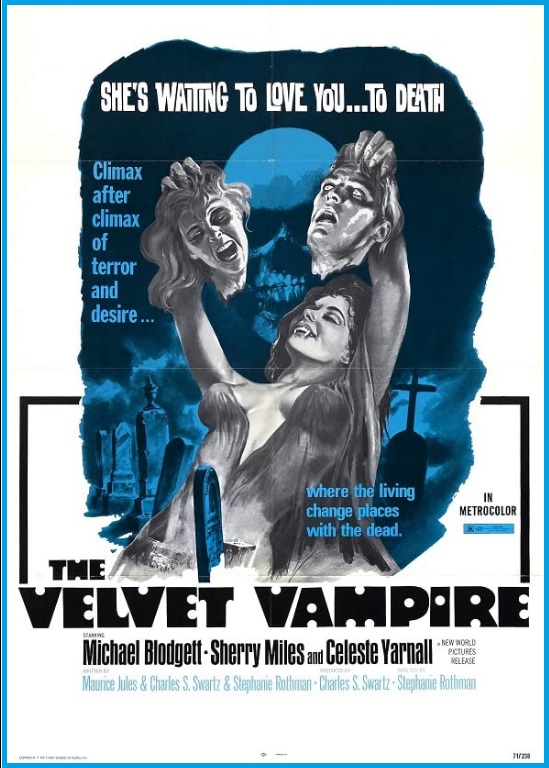
My enjoyment of this movie, which serves as the suffix-title to this retrospective on Sherry Miles, is unbound. Sherry is not only stellar in it: so is the cast, under the pen and lens of Stephanie Rothman. Simply put: this is a beautiful, creepy film.
Swinging Lee Ritter and his vapid, but pretty wife, Susan (Sherry Miles), make the mistake of accepting the art gallery invitation of a mysterious, red-dressed vixen, Diane LeFanu (Celeste Yarnall), to visit her secluded, desert estate. The couple soon discover Diane is a centuries-old vampire — and both are objects of her bisexual thirsts.
The Todd Killings (1971)
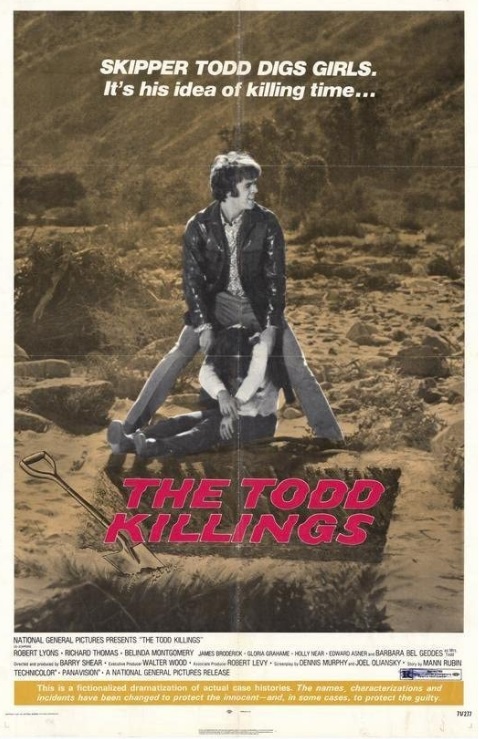
Fans of the based-in-fact teen murder tale of River’s Edge (marketed on the later VHS “slasher” reissues as Maniac; it’s why we rented it) will enjoy Sherry Miles’s second — after Cry for Poor Wally — true crime drama, this one based on the true story of ’60s thrill-killer Charles Schmid, known as “The Pied Piper of Tuscon.”
The film was inspired by a March 1966 Life magazine article about the killings, which, in turn, inspired the 1966 short anthology story “Where Are You Going, Where Have You Been?” Schmid’s exploits were also loosely adapted into the Treat Williams-starring Smooth Talk (1985), as well as the (woefully inferior) films Dead Beat (1994) and The Lost (2005).
Skipper Todd (an outstanding Robert F. Lyons, a much-seen ’60s TV actor in his fourth feature film, but first starring role) is a charismatic, 23-year old ne’er-do-well who charms his way into the lives of out-of-his-age-bracket high school kids in a small California town. The girls, of course, fall instantly for him and head out to the desert for some romantic fun — only never to return. As in the true crimes that inspired River’s Edge, Todd, aka Schmid, was assisted by his girlfriend and best friend in luring, killing, and burying the victims. Shocking for its time, Belinda J. Montgomery and Richard Thomas are frontal nude; Montgomery’s is cut from the later VHS versions.
As with Cry for Poor Wally, this is another one of those lost, underrated gems — it’s heartbreaking for all concerned, even the beyond salvation Skipper Todd — of the Drive-In era rediscovered, not during the UHF-TV ’70s, but the home video ’80s. The quality comes courtesy of its familiar cast of a just-starting-out Richard Thomas (as Skipper’s loyal hanger-on buddy), along with Edward Asner, Barbara Bel Geddes, James Broderick, Michael Conrad (remember the gruff commander on Hill Street Blues?) Gloria Grahame, and Fay Spain. Also keep your eyes open for musician-actress Holly Near in her third role; she made her debut in the critically lambasted Angel, Angel Down We Go (1969).
There’s no trailers or streams to share — well, there’s a You Tube Italian-dub to skim — but the DVDs abound in the online marketplace. This is a great film. It’s also a nihilistic, downbeat one, but still worthy of a watch.
Calliope (1971)

“Spoofs today’s sex films (i.e., porn) the way Batman spoofed Super Heroes!”
— tagline for the original, first release of Calliope
I just can’t see my dearest Sherry signing on the dotted line for a goofy, post-Russ Meyer wannabe skinflick that proclaims: “It spreads, and spreads, and spreads,” only to equate its comedy to a beloved Adam West TV series. Obviously, what was presented during negotiations to Sherry, and what was distributed to theaters, differed. Wildly. But what else should we have expected from writer-director Matt Climber, he who gave us The Black Six (1973), Pia Zadora in Butterfly (1981), and a sex-bent take on Indiana Jones with Yellow Hair and the Fortress of Gold (1984)?
Well, this movie. That’s what. And this one is truly a lost film.
So much for producing an Americanized remake of the significant and cinematically-respected La Ronde (1950), a 1900s-era, spicy-romantic, French-language comedy by German-born director Max Ophüls, which earned a 1952 “Best Screenplay” Oscar nod. He also repeated that Oscar feat with his next film, Le Plaisir (1952), which earned a 1955 nod for its Art Direction, done by Max, himself. So loved was La Ronde in its homeland, as well as across Europe, Roger Vadim (Barbarella) updated the film as Circle of Love (1964), with his soon-to-be lover, Jane Fonda. As for the Ophüls original: it took four years before U.S. film sensors approved the film, sans cuts, for theater showings in 1954.
As for the U.S. remake, originally released under the title, Calliope, what could go wrong: everything. Didn’t you hear the sound of two-time Oscar-nominated Max Ophüls turning over in his grave?
Both films are concerned with ten people “in various episodes in the endless waltz of love” (they go “round and round,” thus the titles), as they each hop from encounter to encounter . . . and that’s were it all stops. Dead.
Since Americans were still swingin’ from the free-loving, Summer of Love ’60s, and Mike Nichols answered the “sex revolution” charge with the aforementioned Carnal Knowledge (1971) (and Paul Mazursky’s 1969 effort, Bob & Carol & Ted & Alice), Allied Artists (an outgrowth of Monogram Pictures, a library now owned-split among Warner Bros., Metro-Goldwyn-Mayor, and Paramount; Warner owns Calliope) decided that, instead of the main protagonist (now a hippie musician instead of soldier-on-leave) eventually finding love with the partner he started off with (Sherry Miles, now a band groupie, instead of the original’s prostitute) . . . he receives “the gift that goes on giving”: a sexually transmitted disease, i.e., venereal disease, since this was the ’70s and not the AIDS ’80s.
Yuk Yuk.
Calliope (no theatrical one-sheets exist, at least online), needless to say, bombed. Ah, but the “Golden Age of Porn” was in full swing, so Allied Artists didn’t give up: a year later, in 1972, the reimaged Love Is Catching hit the circuit; it opened in, of all places, the home base of B&S About Movies: Pittsburgh. It bombed, again, and harder than a Richard Harrison Philippine film he was edited-into and never signed on to do.
This soft-sexploitation romp causes me to reflex on poor Gerald McRaney and Tom Selleck, each scoring their first major roles in Night of Bloody Horror and Daughters of Satan, respectively. The scripts are pretty good . . . and work is work . . . and they thesp’d up a sweat to make it all work . . . then J.N Houck, Jr., and worse, in Tom Selleck’s case, since U.S. major, United Artists, backed it, cheesed the films with exploitative ad campaigns. Just like Calliope. And Skidoo. And Myra Breckinridge.
Sherry, six films in to her career, and just missing out on a co-starring role with Jack Nicholson in one of Mike Nichols best films — a frank, adult-discussion of modern-day sexual issues — was deserving of a better, leading lady role than this STD sex farce.
Sure, it’s a well-shot picture, and the acting is pretty decent (we have great character actors Marjorie Bennett and Stan Rose, on board). And it’s not all that bad; sure, modernizing from the early 1900s to the late 1960s is inspired. And it’s not at all porny, since the sex scenes are implied, more than shown . . . but I still have this need to go back in time and kick someone . . . for having my sweet Sherry transmitting VD in a movie.
But things are looking up, nicely, with our next feature.
The Ballad of Billie Blue (1972)

From a sexploitation flick to a Christian cinema obscurity: only in Tinseltown, baby. And while his name is nixed from the one-sheet (whatever, Plekker, nice n’ cheesy paste-up work): the writer-director here is Ken Osborne, the man behind the pen and lens on the biker flick Wild Wheels (1969). He also appeared in our Uncle Al Adamson’s Blood of Dracula’s Castle (1969), Five Bloody Graves (1969), and Hell’s Bloody Devils (1970).
And there’s more!
In addition to Sherry Miles, we have Marty Allen and Eric Estrada? Ray Danton (too many ’60s to ’70s TV series to mention)? Bruce Kimball (Rollercoaster)? Where’s the VCR. Load the tape. LOAD THE TAPE!
The pedigree is the thing in this imperiled-musician-in-a-spiritual-crisis tale, not only with our director, Ken Osborne: the scribe behind this Christploitationer, Ralph Luce, also wrote Wild Wheels. Why, yes, that’s Robert Dix and William Kerwin from Satan’s Sadists, and Herschell Gordon Lewis’s Blood Feast, respectively, in the cast, as well as, again, a very youthful, pre-CHiPs Erik Estrada. And we mention Erik a second time, since this second film in his career was also his second Christploiter. The first was The Cross and the Switchblade, which starred ’60s crooner Pat Boone, as directed by Don Murray (Conquest of the Planet of the Apes).
The Ballad of Billie Blue is the tale of a drug-and-boozed out country music star — our faux-message “Jesus Christ” of the proceedings — sent to prison, aka Hell, on a bum murder rap; he finds God by way of a prison preacher and a Christ-following country music star.
Regardless of its secular, exploitative pedigree, this was Rated-G — and it ran as a “Special Church Benefit” in rural theaters, as well as in churches and tent revivals. Granted it’s no country-cautionary tale in the vein of A Star Is Born (1976) with Kris Kristofferson, but it’s not a total disaster.
You can watch this on You Tube.
Your Three Minutes Are Up (1973)

I still say the Oscar-winning dramedy Sideways (2004) starring Paul Giamatti (in the Beau Bridges role) and Thomas Haden Church (in the Rob Liebman role) stole this movie lock, stock, and wine bottle. But I digress. . . .
So . . . the ’70s and their slew of ne’er-do-well “buddy films” were entertaining times, with the likes of Midnight Cowboy (1969), starring Jon Voight and Dustin Hoffman, Busting (1974), with Elliott Gould and Robert Blake, Freebie and the Bean (1974), starring Alan Arkin and James Caan, and Let’s Do It Again (1975), with Bill Cosby and Sidney Poitier.
My old Pop loved his “buddy films,” so you didn’t have to sell us twice — especially when the buddies are Beau Bridges and Ron Liebman. And we ain’t hatin’ Janet Margolin in the frames, either. Mom and Pop dumped me at the sitter to see this back when; I watched it later, amid the ultra-high frequency haze of my pre-cable TV youth. All, of course, were rented, again, when they hit home video.
Oh, and speaking of Sideways: this isn’t just a buddy film. You know all of those Judd Apatow, gross-out “road movies” you love: this is where that road, began. Only without any of the Paul Rudd or Seth Rogen annoyance aftertaste.
Charlie (a perfectly cast Beau Bridges) is a henpecked office drone-doormat at a dead-end job, engaged to harping woman (Janet Margolin, Planet Earth). The lone spark in his life is his “idol,” Mike (an even more perfectly cast Rob Liebman), a narcissistic and misogynistic, well, dickhead, of a buddy. So, to get Charlie out from under his soon-to-be-loveless marriage — and his own, mounting debts and his recently cut-off unemployment benefits — the pair hits the roads of the California coast on Mike’s last two, usable credit cards, subsidized by a little bit of larceny. Along the way, the pick up two, nubile hippie chicks (in the expertly cast) June Fairchild (Up In Smoke) and Sherry Miles.
So, somewhere in the frames is a message about America’s newfound “liberation” forged in the ’60s (more effectively done with Beau’s brother, Jeff, in 1974’s Thunderbolt and Lightfoot), but while this warms the ol’ UHF-TV cockles of watching it with ol’ Pop all those years ago, Your Three Minutes Are Up is an erratic, rambling TV movie-flat messadventure that could have easily went the bloody-serial killer route — if not for its purposeful, comedic slant. Think Easy Rider sans the drugs and bikes, or Five Easy Pieces with Liebman as our ersatz Jack Nicholson, and you’re on the right road in this still, effectively cast and well-acted adventure.
You can watch the trailer and full film on You Tube.
Harrad Summer (1974)
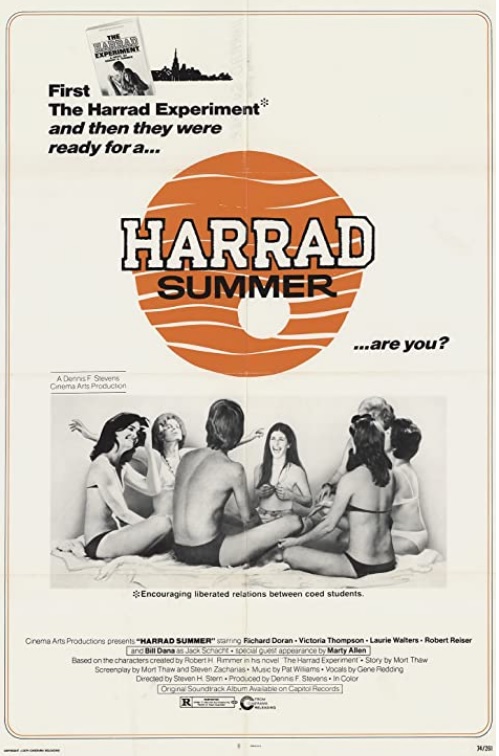
Look, Steven Hilliard Stern (The Park Is Mine) is directing . . . so what’s not to like, here?
Well, uh, not much, in this woefully dated “sex revolution” tale that sequels the box office hit, The Harrad Experiment (1973), which grossed $3 million against $400,000.
So, why did this sure-fire hit, flop?
Well, the character of James Whitmore (Brooks Hatlen in The Shawshank Redemption) doesn’t return. Tippi Hedren’s does, but is replaced by a lookalike in Emmaline Henry (Ms Amanda Bellows from TV’s I Dream of Jeannie). And Don Johnson and Bruno Kirby bowed out. Sure, Laurie Walters (Warlock Moon; later TV’s Eight Is Enough), who made her acting debut in the original, is back, and so is bit TV actress Victoria Thompson, but who is coming to see either? And we want more Sherry Miles, thank you.
Note to executives: When you loose three quarters of your cast, don’t make the sequel.
Anyway, the premise is that faux-Stanley and Harry, along with real-Sheila and Beth, are out on summer break from their first year at Harrad College: it’s time to test their new found sexual freedom in the real world. Or something. Like going back and re-watching Bob & Ted & Carol & Alice and Carnal Knowledge.
Hey, I champion Stern’s TV work just as much as my fellow fan of the VHS obscure, but this is simply yawn-inducing . . . .the total opposite of The Harrad Experiment, which has Don and Bruno — especially Bruno — going for it. Robert Reiser and Richard Doran in their places, well . . . they’re not awful: they just don’t have the same spunk to make the hippie proceedings, hep.
No streams, but the DVDs are out there; here’s the trailer.
The Pack (1977)
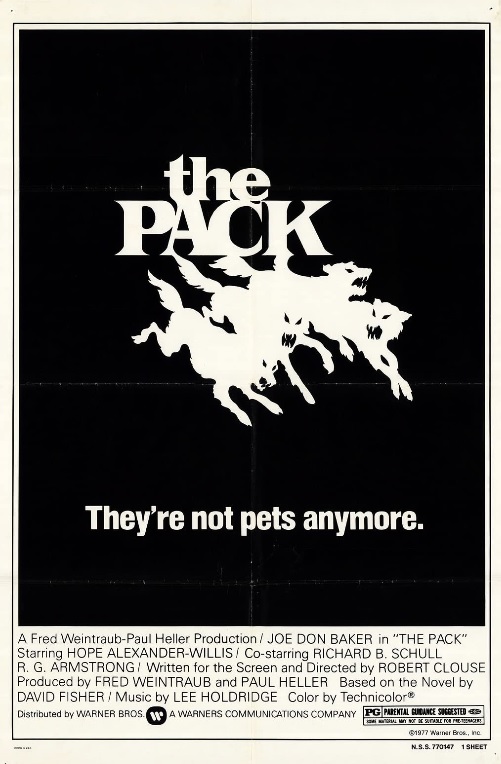
Okay. So, the heart breaker and dream maker of my wee-lad years, Sherry Miles, closes out her career by running around an island with Joe Don Baker to escape a pack of wild dogs . . . get this: under the lens of Robert Clouse of Enter the Dragon, Black Belt Jones, and Golden Needles fame?
Load. The. Tape. Now.
Sure, this beat Stephen’s King’s Cujo to theaters and was all about a literal army of dogs biting everyone on Seal Island — which has nothing on Dog Island from Humongous. So, was Robert Clouse inspired by the 1976 film starring David McCallum that you don’t want to confuse with The Pack, aka Dogs? Probably. No, not Devil Dog: Hound of Hell (1978), as that one starred Richard Crenna. Get your horror dog movies, straight, buddy! Did Clouse’s dog romp inspire Earl Owensby’s (Dark Sunday) backwater sheriff fighting off government-bred mutts in Dogs of Hell (1983)? Probably.
What else can we say: it’s a killer dog movie. Not even Sherry’s presence can save it. But horror was hot and, as an actor, you jump the trend and hope for a hit. Well, it is to us, at B&S About Movies. We’re weird that way.
There’s no freebie streams, but the PPVs are out there; here’s the trailer.
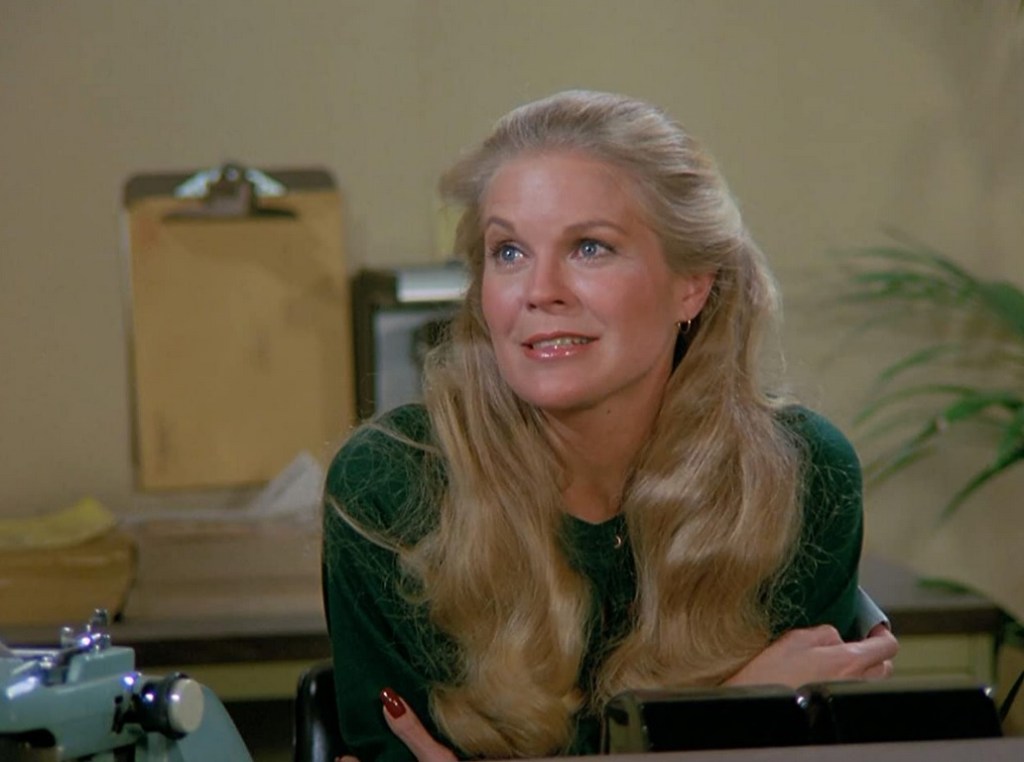
So wraps this latest “Exploring” featuring, this one on (sigh . . . skyrockets . . . rainbows . . . fields of flowers . . . hearts with angel wings) Sherry Miles. Be sure to click the “Exploring” tag below to read the full list of all of our “Exploring” features on the lost, forgotten and awesome actors and directors, as well as genres, of the Drive-In ’60s, the UHF-TV ’70s, and VHS ’80s eras.
Yeah, we’re doin’ it for the celluloid love. And because we’re just crazy that way. This is B&S About Movies, after all.
* Learn more about Hee Haw at this Alchetron.com fan site.
Some of our other actor and director career explorations include:
Exploring: Eddie Van Halen on Film
Exploring: The Movies of Don Kirshner
Exploring: The Films of (the late) Tawny Kitaen
Exploring: The Films of Ukrainian Model Maria Konstantynova
Exploring: SOV ’80s Director Jon McBride
Exploring: Elvis Presley-inspired Fantasy Flicks
Exploring: Sylvester Stallone: 45 Years After Rocky
Exploring: The 8 Films of Quentin Tarantino’s Rolling Thunder Pictures
About the Author: You can learn more about the writings of R.D Francis on Facebook. He also writes for B&S About Movies.



 B&S About Movies
You must be logged in to post a comment.