Okay, so this is more demons than Satan. Well, it’s actually evil Native American spirits, but it’s a rare obscurity and that’s what B&S About Movies is all about. So, let’s work this one into our “Satan Week” (well, three weeks, actually) anyway, shall we?
Shot outside of St. Louis, Missouri, for under $3 million and theatrically known as (I think, the better titled) Cry Blue Sky, it was poorly edited, chopped down from its original 108-minute running time to 86-minutes and retitled for its home video and pay cable version (it ran on HBO).
To sum up the plot: If Eyes of Fire were made today, it would be known as Cowboys vs. Demons and programmed alongside the Aslyum-styled mockbuster “Cowboy vs.” knockoffs Cowboys Vs. Vampires (2010; aka Dead West) and Cowboys vs. Zombies (2014).
Oh, but this film is so much better than those films.
I was actually inspired to give Eyes of Fire, the directing debut by Avery Crounse, another watch after picking up (from the public library on a whim) a copy of the supernatural period horror film, The VVitch (2015), the commendable directorial debut of Robert Eggers.
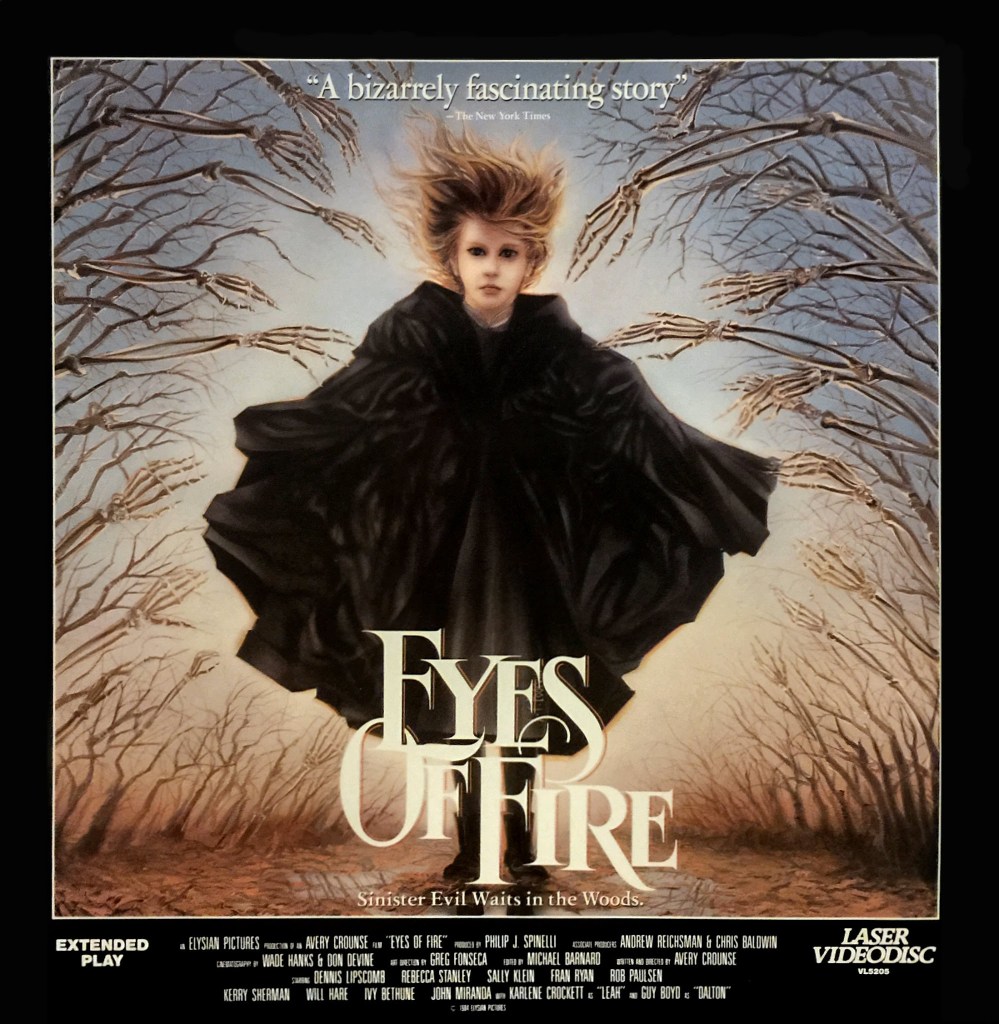
Eyes of Fire tells the story of a wicked, polygamist preacher (is there any other kind) who runs the old west (circa 1750) town of Dalton’s Ferry. When the Reverend Will Smythe (Dennis Lipscomb) is called out for his adultery among his parishioners, he and his flock are subsequently banished. Of course, God tells the Reverend to make a new life in a valley foretold in Indian legends as the “Forest of Darkness,” a wooded area with souls trapped inside trees and running amok with “mud people.”
Before you know it, all hell breaks loose in the Promised Land, Blair Witch-style, as the settlers can’t seem to find their way out of the forest and they’re picked off one by one. It’s up to a rugged frontiersman, Marion Dalton (Guy Boyd), and a crazy, woods-dwelling witch who proclaims herself the “Queen of the Forest” (Karlene Crockett) to battle the marauding Indian spirits.
Yes. In a laser videodisc format!
While Eyes of Fire is low-budget and under the radar, there’s no denying that it’s well made and features great cinematography, costuming and special effects (the tree-trapped spirits are excellent), along with solid acting from the cast of unknowns. Granted, some quarters may say it’s slow: if you watch the home video cut instead of the theatrical cut, it is a bit choppy and doesn’t make a whole lot of sense in places (it loses 22 minutes between its different cuts), but that only lends to its Phantasm-like foreboding. It’s certainly more entertaining that other films of its ilk*, such as Aramand Mastronianni’s (He Knows You’re Alone, Cameron’s Closet) The Supernaturals, which I remember as being very boring—and I ejected it from the VCR less than half way through, never to watch again.
It’s unfortunate that Crounse disappeared from the industry (maybe he went into commercial work?) after two more films: The Invisible Kid (1988) and Sister Island (1993), as he showed a lot of promise. I vaguely remember the former as a theatrical with Jay Underwood, who was “hot” at the time. I never heard of the latter—one of the many low-budget romps from the extensive resume of Karen Black (Burnt Offerings).
Foreign DVD reissue.
There’s lots of familiar TV faces afoot: Guy Boyd (pick a late ‘70s/early ‘80s TV series) was a semi-regular on Remington Steele, a co-star on 2000’s Black Scorpion, and was in Brian DePalma’s Body Double—and he’s still active today. You can play “pick a TV show” with the late Dennis Lipscomb as well, with his starring roles in Cop Rock and Wiseguy, while Karlene Crockett was a regular on Quincy M.E and Dallas. Eyes of Fire was the only feature film appearance by Rob Paulsen, as he reverted into voice work and became Pinky from Pinky and the Brain (1995) and Yakko from Animanicas (1993). Keen eyes will pick up on Kerry Sherman, who made her debut in Greydon Clark’s Satan’s Cheerleaders (1977), and Fran Ryan, who’s been in everything from TV’s Gunsmoke to Bill Murray’s Stripes (1983).
There are two pretty clean VHS rips on You Tube here and here to enjoy. Oh, and Sam the Bossman did his January 2020 take (Doh! Our reviews wires crossed, again!), as well as taking a new look at in September 2021 due to its inclusion for Fantastic Fest.
* Night of Horror (1981) with more Confederate Civil War ghosts (one of those “the cover is better than the movie” flicks and a VHS-eject), Ghostriders (1987) with western ghosts deep in the heart of Texas (well made, but boring; a VHS eject), and Stones of Death (1988) with aborigine ghosts (Aussie Indians) going “Poltergeist” (better made, but ho-hum familiar). Honorable mention: William Grefe’s (Mako: Jaws of Death) awful but fun drive-In nostalgia romp Death Curse of Tartu(1966) with its burial ground Indians.
About the Author: You can read the music and film reviews of R.D Francis on Medium and learn more about his work on Facebook. He also writes for B&S Movies.
Please take into consideration that I was huge fan of The Dukes of Hazzard (I built the AMT model kits of the General Lee and Daisy’s Jeep) and never missed one of its 147 episodes during its 1979 to 1985 run. We previously discussed the who, what, where, when, and why of how the hit CBS series came to be during our “Redneck Week” July spotlight with its cinematic precursor, the 1975 film, Moonrunners. I tell you this because I am probably saying a lot more than needs to be said about this forgotten, way-too-late entry — because of its Dukes’ connection — in the Max Mad Road Warrior races.
Max, is that you?
And here’s a factoid: Survivor isn’t the only post-apocalypse flick that traces back to those good ‘ol Duke Boys. Catherine “Daisy Duke” Bach starred alongside Sam “Flash Gordon” Jones in the 1989 Filipino Mad Max rip-off, Driving Force.
“Wait a minute, there, R.D. Now I know for a fact that Tom Wopat and John Schneider never did a post-apocalypse flick. You’re not saying that Rosco P. Coltrane or Enos did one?”
Nope. But Vance Duke did.
“Who?”
Oh, see . . . you were one of the many people who stopped watching the show during its 1982 fifth season, the year when Wopat and Schneider got into a contract dispute (over show merchandising, e.g., the model kits) and walked off the show. To replace them, the production hastily created the Duke cousins Coy and Vance, played by Bryon Cherry and Christopher “Chip” Mayer, respectively, for a 19 episode arc (they were on the shortlist for the Bo and Luke roles during auditions, but lost).
Written out of the show when Wopat and Schneider returned, Mayer bounced from series to series with guest roles on U.S. TV series, such as Simon & Simon and The Love Boat, eventually scoring a 180-episode acting gig on the U.S. daytime drama, Santa Barbara.
But before Santa Barbara, for his leading man debut in a feature film, Chip Mayer (February 21, 1954 – July 23, 2011) found himself cast alongside another fellow, U.S. television actor, Richard Moll (The Dungeonmaster), in this South African-produced Max Max knockoff that was shot in the country of Namibia and the city of Touws River (outside of Cape Town) in the South African Western Cape province. Oh, and guess who the production company is . . . Sir Lew Grade’s ITC Entertainment, the company behind Space: 1999 and Saturn 3. (What little dialog this film has, the characters mumble about Libya, Spain, and Turkey, but all Intel points to this being filmed exclusively in South Africa.)
Barely recognizable with his blonde buzzcut and matching, scruffy beard (and looking like Ace Hunter in the apoc-cheese fest, Megaforce), we meet the “astronaut with no name” courtesy of your typical, low-budget straight-to-video cheat of a voiceover-flashback punctuated by a NASA stock footage shuttle launch. We come to learn the “Survivor” left his wife and child behind for a mission on the Challenger 2 to launch an anti-missile satellite system (via stock footage) — too late. WW III broke out while he was in space.
Now a nomad, he roams the wastelands on a (cool prop) solar-powered railroad handcar. Courtesy of his “inner voice,” we learn that in past ten years he’s met thirty people. Then, when he happens upon a makeshift, rusted out water tower guarded by the first man he’s seen in a year — he’s forced to kill him in self-defense.
Now if you feel you’re ready to faint from a case of post-nuke induced Stendal syndrome, that’s because we’ve seen this post-WW III astronaut swap for a Clint Eastwood-inspired future cop — many times. In some apoc déjà vu quarters, it’s opined that Survivor is a “loose remake” of The Aftermath, actor Steve Barkett’s 1982 vanity-apoc that made the UK Section 3 video nasty list. But the post-nuke astronaut genre of the Snake Plissken-Max Rocktansky-Paco Queruak ’80s dates to the far superior, German-produced Operation Ganymed from 1977 — itself pinched (IMO) to script the 1985 Canadian apoc-romp, Def-Con 4 — which was then pinched by the South Africans for Chip Mayer’s Survivor. (I just fainted on the video store floor!)
Now, if you remember your analog audio and video duplication-production days, all those copies-of-a-copy begin to show signs of generational degradation. And those same degrades occur with screenplays. Granted, while The Aftermath, Def-Con 4, and Survivor have decent costuming and some acting, with the occasional burst of inspired budget-strapped set design, these tales tend to get bogged down to a slow, meandering boredom.
As Robert McKee opined in his screenwriting bible, Story:
“Any idiot can write voice-over narration (and put text on the screen) to explain the thoughts of a character (and set up a story). You must present the internal conflicts of your character in image, in symbol. Film is a medium of movement and image.”
And that’s the flaw with Survivor: a lack of movement and image, falling back on voiceovers and non-linear storytelling (calling this “sci-fi film noir” is a stretch, so don’t) as result of its script’s ambitions over its (lack of) budget (there’s almost no speaking on-camera). Perhaps, if there was a budget and Chip Mayer portrayed an action-driven Snake instead of a philosophical Max, Survivor could have been a low-budget hit and Chip would have ignited a theatrical career (or a direct-to-video one with a Survivor II) in lieu of retreating to U.S. daytime television to pay the rent. And that’s a shame: while the film he’s in has its expanses of tediousness — he’s excellent throughout. Given a decent film, he could have carried it with aplomb.
Now, that’s not to say that Michael Shackleton is inept as a director (his only film). It seems he made a creative choice of using atmosphere over action and opted to ditch (by 1987 it all got a bit silly, anyway) the ubiquitous punk-rock adorned biker gangs and desert rats rolling around in three-hundred year old auto wrecks fueled by bottomless gas pits and equipped with a bottomless arsenal of bullets (see the 1983 Filipino apoc-for-water romp Stryker for evidence of that hokum).
So it turns out that desert rat the Survivor killed in the beginning of the film tipped him off on the “The Immortan Joe” of these post-apoc proceedings, Kragg (Richard Moll), who rules a hidden industrial complex, i.e., a “power station,” (that rivals the repurposing of rusted out factories in the 1979’s Ravagers) which holds “the world’s” water supply. During his journey, Mayer meets the “woman with no name” (Sue Keil; Linda Blair’s Red Heat ) who holds up in a majestic, costal rusted-out ship wreck (that rivals the ship wreck repurposing in the zombie romp, Shock Waves). Then we see some soft-core make out action — complete with a gushy, ’80s synth-vocal tune. Kragg kidnaps her, natch, and the inevitable battle between the Survivor and Kragg ensues.
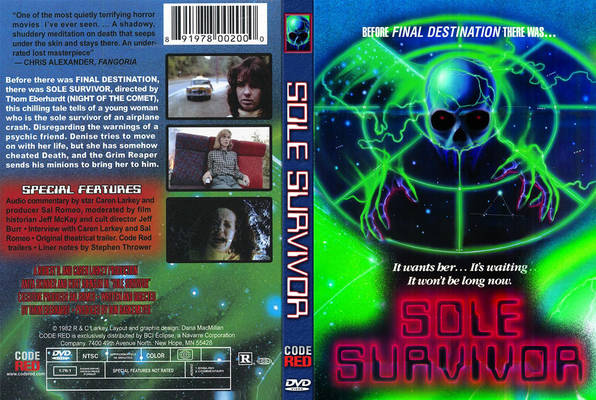
Oh, caveat emptor, ye seekers of DVDs: there is no official DVD of Survivor . . . and the U.S. grey market VHS rips-to-DVD are missing between fifteen to twenty minutes of film. The European DVDs, however, which are ripped from the Euro-laser discs, which are ripped from the VHS, kept the full film intact. (My analog Stendal is coming back!) And since Survivor has fallen into the public domain and the studio/producers don’t seem to care, you’ll have to take your chances on a finding a surviving VHS copy.
All in all, Survivor is a great place to visit — with great, barren and bleak locations and a good use of pre-existing abandoned “sets” tailor made for an apoc-universe — but you wouldn’t want to live, well, replay it again after one viewing. To enjoy Survivor online, the best we’ve got are the VHS rips of its Italian dub and Russian dub on You Tube.
And if you missed our month-long September rally of post-apoc film reviews, you can catch up with a complete listing featured in our “Atomic Dustbin” recaps, Parts 1 and Part 2.
Uh, oh . . . and what’s this, pray tell?
Holy Stendal déjà vu, Batman!
Richard Moll’s Kragg was back again . . . no, wait . . . he’s Kyla this time . . . in this 1998 Puerto Rican-produced jungle-apoc romp that we’ll get into later . . . (and you can now read that January 27-post review, here).
Not be be confused with . . .
Or with . . .
About the Author: You can read the music and film criticisms of R.D Francis on Medium and learn more about his work on Facebook. He also writes for B&S Movies.
There’s nothing quite like your backyard neighbors going off the chain on another one of their loud, drunken benders waking you from a sound sleep to watch a Jerry Jameson film.
Jerry is old school Hollywood and he’s done it all: Low-budget Drive-In fare with 1971’s Brute Corps and 1972’s The Dirt Gang, along with episodes of U.S. TV series such as The Mod Squad, The Rookies, Cannon, and The Six Million Dollar Man, going all the way back to The Andy Griffith Show and Gomer Pyle: USMC. Then there’s his prolific crop of ‘70s TV movies, such as Heatwave!, The Elevator, Hurricane, and Terror on the 40th Floor, along with one of the best TV movies of the ‘70s (the one that transitioned Kurt Russell from child to adult actor and earned him his role in Escape from New York): 1975’s The Deadly Tower.
Then Universal Studios called Jerry up to the big leagues to direct the one of the ‘70s quintessential box office “disaster” smashes: Airport ’77. Sadly, Jerry also directed one of the ‘80s biggest box office bombs, 1980’s Raise the Titanic—which sunk his theatrical career (insert cheesy trombone, here). But let’s not blame Jerry: Blame Sir Lew Grade, the head of ITC Entertainment, for Raise the Titanic. Not only did the film bankrupt the studio, it had adverse effects on the production of Kirk Douglas’s Saturn 3—which subsequently bombed and assisted in the studio’s bankruptcy.
So that is that story. . . .
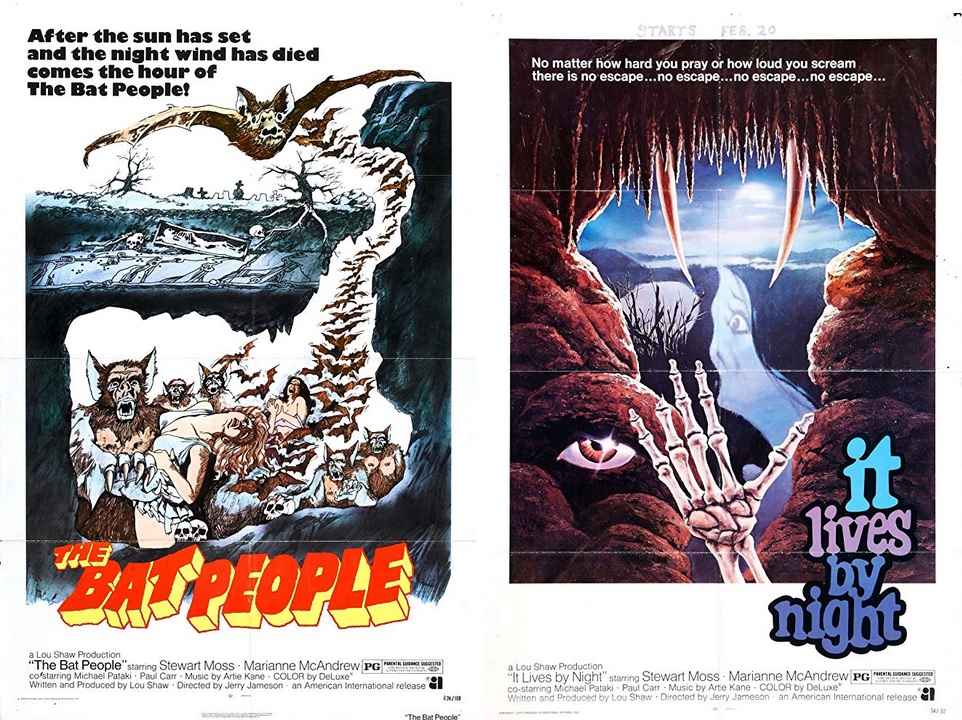
And that brings us to The Bat People, Jerry’s fourth film overall and his third Drive-In flick. For his leads he cast Stewart Moss (Star Trek: TOS, pick a U.S. TV series) and Marianne McAndrew (Hawaii Five-O; pick a U.S. TV series), two actors he knew intimately from their mutual TV series projects. And bonus: the always awesome Michael Pataki (Grave of the Vampire, Mansion of the Doomed, Rocky IV, The Baby(!) . . . oh, hell, just search his name under “About” on B&S, we just love ‘em here) is Sgt. Ward: the sleazy ‘n leering, bumbling sheriff who is more interested in boinking the local babes (don’t they all in these grindhousers) than tracking down a vampire.
Moss and McAndrew (who are husband and wife in real life) are the ‘70s swingin’ Dr. John Beck and his wife Cathy. The love birds (or is that bats) decide to take a little excursion from their ski lodge vacation to explore an underground cave. Uh, oh. Yes, of course, as when couples explore graveyards and crypts always do (in these grindhousers): the cave makes them a bit “randy” (?). Yep, ‘ol Cathy slips down a crevice (in the cave, not John’s . . . well, him into her’s, actually, you perv!). During the course of rescuing Cathy . . . yep, John’s bitten by a bat (a fruit bat, mind you) and he slowly transforms into a “batman” with an insatiable quest for blood.
Now, you’re wondering: Do we really get a “batman” in this?
Nope. Just a lot of bed-bound seizures and nightmare-babble about “killing people” from the Doc, as his wife blames the hallucinations as an after effect of the rabies vaccine she keeps pumping into him. And no: Dr. John never spouts wings and flies (if this were a David Cronenberg film, we would). And, it is just me, but does the good ‘ol Doc look more like a werewolf, hell, an ape (and a mangy one at that) from Planet of the Apes, than bat?
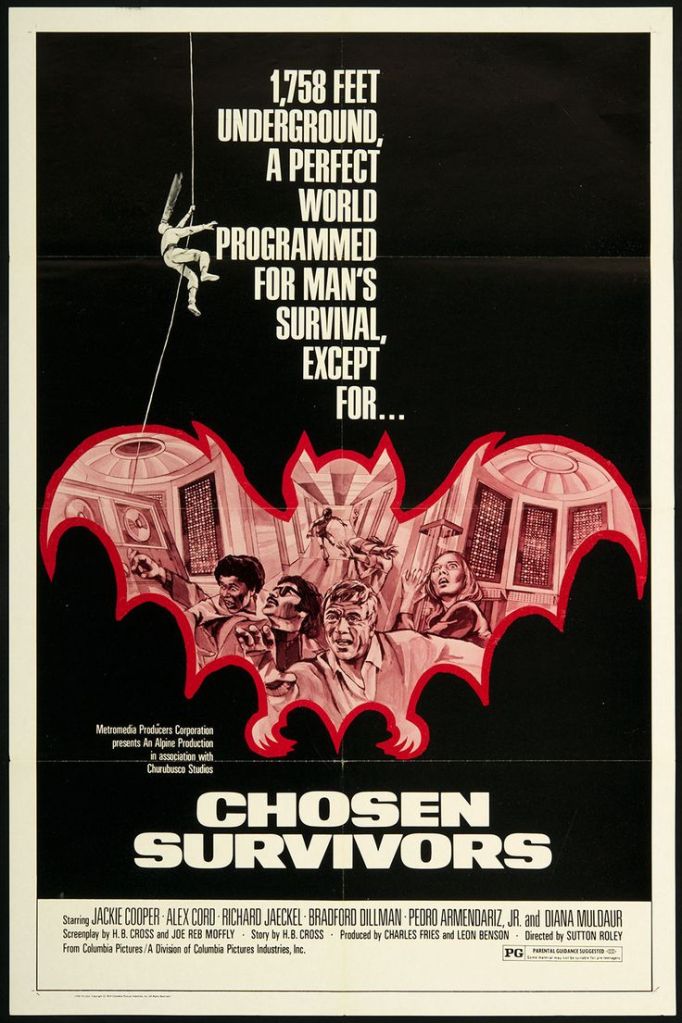
Eh, yeah. The Bat People is slow. It’s clunky. It meanders. And considering this is an A.I.P (American International Pictures) Drive-In flick from the ‘70s, it’s disappointing there’s no gore or nudity—at least not in the Comet TV cut I watched; perhaps you’ll have better luck with the MGM Midnite Movies DVD cut (and you’ll get a two-fer with The Beast Within; Oh, and heads up: the MGM Midnite Movies imprint also carries the sci-fi vampire bat romp Chosen Survivors).
In the end The Bat People is all about seeing the early baby steps from actors and filmmakers. In this case, not only with Jerry Jameson, but with special effects artist Stan Winston, as The Bat People is notable as Winston’s first feature film—on his way to becoming a five-time Oscar Winner (you know his work from Aliens and the Jurassic Parkfranchise, just to name a few). And keen eyes weened on ’70s television will notice character actor Paul Carr (Truck Stop Women) as Dr. Kipling, who worked with Jameson on numerous TV series.
As for Jerry Jameson: He’s still steppin’! Not only did he direct 18 episodes of Walker, Texas Ranger but, at 81 years old, he was still going strong, directing Kate Mara (Sue Storm in 2015’s Fantastic Four) and David Oyelowo (Rise of the Planet of the Apes) in Paramount Studios’ The Captive (2015).
Well, that’s that. Another B&S review bites the dust.
Drop me a message and I’ll pass on my neighbors’ address so you can send them a thank you card for turning you onto The Bat People. It’s playing all this month on Comet TV and you can also catch it on Amazon Prime. If you’d prefer a hard copy, you can pick up Shout! Factory’s single disc Blu-ray or their 4-Film Pack. However, if you need to save a buck, there’s a rip of the MGM DVD version on You Tube. Here’s the Shout Factory! restoration trailer.
About the Author: You can learn more about the writings of R.D Francis on Facebook.He also writes for B&S About Movies.
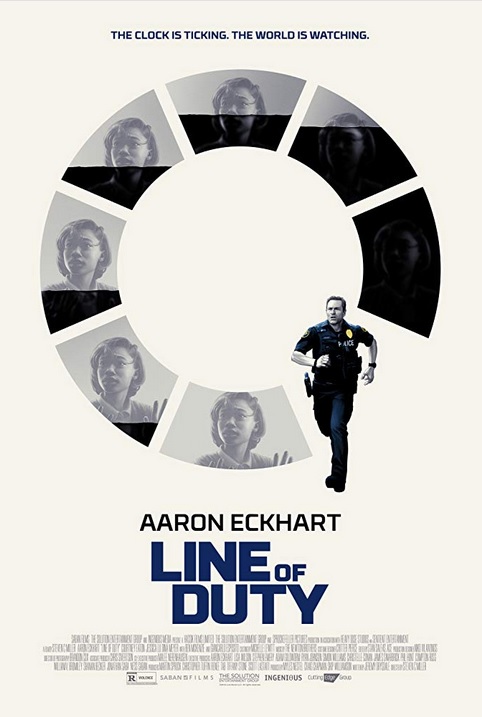
Frank Penny (Aaron Eckhart of Battle Los Angeles, The Dark Knight, Olympus and London Has Fallen) is a burnt out cop ready to become totally lost between the cracks on the floor of rock bottom after he killed a child abductor in the line of duty before the girl—his chief’s (Giancarlo Esposito of TV’s Breaking Bad) 11-year-old daughter—could be rescued. Now Penny’s in a race against time to find the girl—who’s stashed inside a glass box-tank slowly filling with water as a video camera streams her fate online. Complicating matters is the kidnapper’s accomplice and brother (Ben McKenzie of TV’s Gotham) who’s hell-bent on revenge, and a persistent social media vlogger, oh, excuse us, “internet journalist,” (Courtney Easton of Max Max: Fury Road) who dogs Penny every step of the way, streaming his every move.
I won’t sugar coat: the reviews on Line of Duty aren’t great. It does push the limits of credulity of cops as “supermen.” But what movie doesn’t? Do we not load up our copies of Die Hard, Lethal Weapon and Speed to have fun? So, screw credibility. Sit back and enjoy the Crown Vic ride as Line of Duty is a throwback to those very same ‘90s action movies where the cop just won’t stop. As always: Aaron Eckhart is perpetually likeable and reliable. You put a police uniform on him and he’s not an actor in a police uniform: he’s a real cop.
We’ve spent time with the direct-to-video action thrillers of up-and-coming writer-director Steven C. Miller before, with his films Arsenal (2017) and, Sylvester Stallone’s Escape Plan 2: Hades , the 2017 Bruce Willis-starring First Kill. Miller’s forte is action thrillers and he always entertains. For this, his latest effort, he chose a script written by Jeremy Drysdale, who made his debut with a pretty cool rock ‘n’ roll flick that explored the myth of musician Gram Parsons of the Byrds: the comedy-drama Gram Theft Parson (2003).
About the Author: You can read the music and film reviews of R.D Francis on Medium and learn more about his work on Facebook. He also writes for B&S Movies.
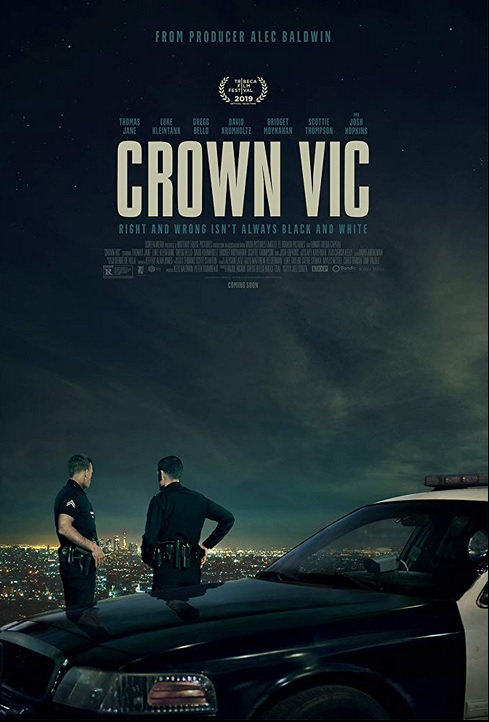
Ray Mandel (Thomas Jane; 2018’s Predator) is a jaded, rough-hewed patrol officer from LAPD’s Olympic Division assigned to train an ambitious rookie cop on the night the entire squad is on high alert to hunt down two cop killers. Also complicating their night of patrol is an unhinged cop that’s gone into law breaking-rogue mode with a vow to catch the killers at any cost.
Since they’re on patrol, we’re in the car a lot and there’s not much action as Crown Vic favors the philosophical over the action, but when the action hits, it’s gritty and violent—so we feel like we’re on a real night of patrol. These aren’t the cartoon cops of the Lethal Weapon variety with non-stop, over-the-top action. It’s not all running, fence-climbing, building jumping and gun fire in the life of a real officer, after all.
She’s a sweet ride.
Don’t let the fact that you haven’t seen Crown Vic listed on your cable system’s VOD menus, and that it’s a selection in your local supermarket’s Redbox, deter you from giving this low-budget ($3.6 million) thriller a chance. I sure didn’t see this Thomas Jane-starrer listed by my cable service provider—and I’ve watched a lot of Thomas Jane movies because of, well, Thomas Jane. He killed it in The Punisher. We dug ‘em in Deep Blue Sea (1999) and one of the best of the Stephen King adaptations, The Mist (2007). So if Crown Vic was available on-demand, I would have rented it. And I am not much for Redbox, but for Thomas Jane, I’m all in.
Crown Vic moves along at a snappy pace courtesy of solid acting from all concerned—mainstay TV actors David Krumholtz (The Good Wife, Mom, Num3ers), Bridget Moyhahan (Blue Bloods, the John Wick franchise) and Scottie Thompson (The Blacklist, NCIS, 12 Monkeys: The Series)—buoyed by dark ‘n gritty cinematography and sharp editing that measures up to its fellow, dark cop dramas Training Day (2001), the Kurt Russell starring Dark Blue (2002), and David Ayer’s End of Watch (2012).
Writer-director Joel Souza is relatively new to the scene with a short resume of six films since 2010. If Crown Vic is any indication, he’s a name to watch. You can watch his latest film on Amazon Prime, Redbox, Google Play, Vudu, and You Tube Movies.
About the Author: You can read the music and film reviews of R.D Francis on Medium and learn more about his work on Facebook. He also writes for B&S Movies.
Editor’s Note: Why are we reviewing an A-List sci-fi’er, you ask? That’s not the B&S About Movies jam! Well, we’re blowing out a week of “Nature Run Amok” films and this popped up in conversation. And I drew the short straw. Damn.
Anyway, a full list of the films we’ve reviewed this week appears at the end of the review.
You’re 20th Century Fox Studios and you’re in the throes of a business merger with the Disney Corporation.
In 2017 you completed a film (began filming in March and completed principal photography in May) that stars an actress perpetually bashed on social media for being a “bad actress” and whose star has waned since her smash teen vampire movie from a decade ago—and her starring-reboot of Charlie’s Angels became one of 2019’s biggest box office bombs. Her co-star is an actor who assaulted a pro-Trump Uber driver in 2016, got sucked into the eye of the Weinstein effect in 2017, was arrested on federal bomb threat charges on an Amtrak train in 2018, and then capped off his litany of legal issues with a Silicon Valley (HBO series) work place misconduct allegation.
So what do you do with that $80 million film (other sources say $50) starring Kristen Stewart and TJ Miller? What do you do with a film that received lukewarm responses in its test screenings and runs the risk of pro-Trump and #MeToo protests outside the theatres upon release?
You shelve that film for three years and wait for the Disney merger to finalize and for your male-lead actor’s legal issues to blow over. Then you release the film in January, one of the dreaded winter doldrums “dump months” (the others are February, August, and September) where films with lowered commercial and critical expectations go to die. The fact that your film grossed $7 million in the U.S on its opening weekend, with a worldwide opening-gross of $14 million, gives credence to Hollywood’s lack-of-faith marketing concept. It also doesn’t help that, upon release, Rotten Tomatoes rated your film at 53%, Metacritic scored it 49/100, CinemaScore graded it a “C” on an A+ to F scale, and PostTrack rated it 2/5 stars.
Ouch.
Gulp! Yes. She holds her mouth open throughout the entire film.
Hey, what the hell? James Cameron, what are you doing here, 10,000 meters down in the Pacific Rim? Yeah, I’ve been down this road, uh, Mariana Trench before. And that’s this film’s elevator pitch: James Cameron’s Aliens (1986) (and not Ridley Scott’s Alien) meets James Cameron’s The Abyss (1989).
Yep, for me—maybe not you—it’s just cinematic, aquatic déjà vu.
Now, we, the old codger video fringers of the ‘80s will load-in our cerebral-analog VHS copies of 20th Century Fox’s The Neptune Factor (1973), MGM Studios’ “snakes on a submarine” variant, Fer-de-Lance (1974), and the TV movie “prehistoric eggs on the ocean floor” variant, The Intruder Within, aka, The Lucifer Rig (1981). Then there’s the aquatic crop of The Abyss knockoffs released around 1990: Leviathan (bad Russian vodka monsters), Carolco Pictures’ DeepStar Six (giant anthropoid “sea scorpions” jarred loose-by-drilling), Roger Corman’s Lords of the Deep (psychic aliens and damaged ozone layer horseplay), Wayne Crawford’s (Jake Speed) rip The Evil Below (haunted ocean floor shipwreck baloney), and the R. Lee Emery (always awesome!) starring, The Rift, aka Endless Descent (evil underwater lab conducting DNA experiments). Hey, and let’s not forget Antonio Margheriti’s Italian cheapjack, Aliens from the Deep (1989).
Of course, the younger folks will load their DVD digital copies of Paul W.S Anderson’s 1997’s Event Horizon (yeah, we know that’s about Satan in a black hole . . . or something?), Barry Levinson’s Sphere (about an underwater black hole time-travel mission from the past or future . . . or something?), and 2000’s Walter Hill-disowned Supernova (again, yeah, we know, Satan in space . . . or something?). Then the younger yungins will recall the more recent Life (2017) starring Jake Gyllenhall (yeah, we know that was in space and not water, but work with us here).
And that brings us, well, underwater once again with this latest, grimy and dimly lit, science-fiction slasher fired from the James Cameron canons—with some small arms suppressive fire from Ridley Scott.
But wait. This isn’t the post-Alien late ‘80s. This is the 21st century.
Underwater was produced in the polluted backwash of Al Gore’s An Inconvenient Truth (2006). But Al’s an old codger, like me, and Sam, the illustrious proprietor of B&S About Movies. So Underwater wasn’t made for us, or for the Al Gore youth brigade. Underwater is for those who rally around Alexandria Ocasio-Cortez and support her Green New Deal initiative.
Thus, Underwater isn’t an irresponsible, mean big fish movie for the sake of being an irresponsible, mean big fish movie, say like, The Neptune Factor. Underwater is a responsible story; a story that drives home a “man-bad ocean-good” message. For the greedy and evil, right-wing industrious creatures known as man, with his witchery called “science,” has gone too far. The evil land dwellers above must endure the wrath of Amphitrite. All hail King Neptune!
As one of character reasons amid the mayhem, “We’ve drilled too deep. We’ve taken too much. “Now it’s [the ocean] taking back.”
What the hell? I thought I was supposed to go to movies and have fun; to escape the crap that is our world for an hour and a half. Nope. Welcome to the Greta Thunberg Show (which needs to be cancelled, posthaste), i.e., corporations are sacrificing people for profit . . . the oceans are in danger . . . it’s an earth-crisis event . . . climate change is killing us . . . we have to stop using fossil fuels. HOW DARE YOU!
The real, existential wrath created from global warming: Gretazilla.
Ugh. We get it, Bernie and Elizabeth. We need to stop fracking. And drilling. And eating cows. And driving our cars. We must ride our bikes and sit on piss-stained bus seats to get to our jobs. For man must acquiesce; we must give the world back to the alligators, the apes, the crocodiles, the leeches, the sharks, the slugs, the tarantulas, and the wolves. (It’s why we dedicated the first week of January to “Nature Run Amok” movies* at B&S About Movies.)
But alas, global warming doesn’t have a “physical body” to fear. You need a Jason, or Michael, or a Xenomorph. Weather isn’t an effective antagonist. Even the 2017 man-bad nature-good lesson that was Geostorm had to resort to weather satellite laser bombs . . . or something. So, in the tradition of Ishirō Honda (brilliantly) embodying mans’ err with nuclear power by way of the monster Godzilla, we get the global warming, man-bad nature-good created arthropods of Underwater.
Yes. The creatures of Underwater are meant to represent a pissed off Mother Nature seeking vengeance on greedy humans . . . or something.
Damn you, movie. Now I feel awful. After this movie I vow to eat one of Burger King’s cardboard veggie burgers and make a Joaquin Phoenix Joker-vow to wear the same outfit day-in-and-day-out, you know, so as to support Stella McCartney’s vision of our planet. I will Google search on how to turn my urine into drinkable water, use baking soda as a deodorant, and wash my clothes with rainwater-in-a-barrel.
Anyway, back to the movie.
Kristen Stewart is Norah Price, a cynical (is there any other character type in these “alien” films; must they all be malcontents rife with Prometheus-styled grimace-anxieties?) mechanical engineer on the Kepler 822, a deep-sea mining station. Her crewmates are excavating fossil fuels with the “controversial” Kepler Ocean Drill, seven miles under the sea for the “evil” military-industrial complex, Weyland, uh, Tian Industries.
Then the ubiquitous earthquake hits and damages the ubiquitous, dingy and claustrophobic drilling station. But wait, it’s not an earthquake. It’s that damn creature known as man and their confounded Kepler Drill. They’ve disturbed the warm and cavernous, Mariana Trench-hydrothermal pocket home of a nightmarish, Lovecraftian Cthulhu-like monster and its ravenous, parasitic and symbiotic, anthropomorphic spawns. Yep, H.R Giger-inspired “sea arthropods” with human characteristics—replete with fishy faces and webbed fingers—attacked the station.
And the station springs a leak—with Kristen Stewart tumbling in slow motion for, you know, maximum, suspenseful effect. So between the flood and the oxygen depletion, the crew, headed by Captain Lucien (Vincent Cassel of 2002’s Irreversible, 2007’s Eastern Promises, 2010’s The Black Swan, 2016’s Jason Bourne) suit up in the bulky-heavy Alien ’79-era diving suits and schleps one mile across the ocean floor to an abandoned naval station, Roebuck Station 641, to access its escape pods. That’s if they make it: a pissed-off sea creature is in Jason Vorhees-mode picking them off one-by-one. Once at the station—cue John Carpenter’s The Thing (1982)—they discover a hatchling and a corpse of a sea creature. And that Lucien was previously stationed at Roebuck. Damn you, evil corporation! Damn right they covered it all up, again. Screw the Earth. Profit is king.
Director William Eubank’s first two, under-the-radar films, the low-budget science fiction dramas Love (2011) and The Signal (2014) rightfully received worldwide critical acclaim for their ingenuity on a tight budget. So to hear 20th Century Fox gave the director reins of Underwater to Eubank was a source of excitement for science fiction fans. (Both films are excellent; do seek them out.)
Sadly, with Underwater, Eubank got dealt a bad hand. Not even a director of his ingenuity and vision can overcome corporate media mergers and two publically derided lead actors.
Granted, while Underwater feels derivatively cribbed from other underwater-alien films, and the environmental message is a bit heavy handed, there’s no denying the script co-written by Brian Duffield (Insurgent) and Adam Cozard (Jack Ryan: Shadow Recruit, The Legend of Tarzan) is smartly written. Eubank, Duffield, and Cozard know their sci-fi celluloid predecessors and they know that we, the ticket buyer, have seen at least one of those Alien-ripped antecedents (or, if you’re a film snobby dweeb like me and Sam, you’ve seen all of the aforementioned films in this review). So knowing that we are up to speed, they dispensed with the usual disaster film and monster film, half-hour set-ups of expositional character development before the catastrophe hits. Underwater gets right into the action. And that’s appreciated.
So again, while familiar, Underwater—in spite of Hollywood pariah TJ Miller’s acting-hysterics of playing the same old, smarmy cookie cutter “comic relief” sidekick he did in the Deadpoolfilms—and thanks to gifted TV actor John Gallagher, Jr. (Law and Order: SVU, 2010’s Jonah Hex, 2016’s 10 Cloverfield Lane) killing it alongside France-bred actor Vincent Cassel—is instantly engaging. Critical bashing aside, Underwater clicks along with a nice pace at a very-tight, well-edited 95-minute run time.
William Eubank is the savior of science fiction films and I look forward to what he has to offer with his next film. He’ll be on that Golden Globe and Oscar stage, soon enough.
* Here’s the full list from our January 2020 “Nature Run Amok” week:
And there’s even more “nature run amok” films with our December 2018 shark tribute week, “Bastard Pups of Jaws,” which features everything imaginable—from 1976’s Grizzlyto 1977’s Orca, from 1979’s The Great Alligator all the way out to Renny Harlin’s 1999 shark romp, Deep Blue Sea. Oh, there’s those Alien rips. . . .
These days, it’s up to more than ten!
About the Author:You can read the music and film reviews of R.D Francis on Medium and B&S Movies, and learn more about his work on Facebook.
As I descended a horror-inspired digital rabbit hole, I was shocked to hear (a little late, obviously) that former child actor Luke Halpin, best known as Sandy Ricks on TV’s Flipper from 1964 to 1968, was suffering from Stage IV head and neck cancer (reported in 2015). Then, in June 2016, Halpin beat the cancer, but then discovered, as the cancer went into remission, he was in the early stages of Alzheimer’s disease.* (I’ve dealt with both of these damned illnesses in my family of late, and trust me, it’s a rough ride for everyone concerned.)
So, it’s time for us to take a moment to lift up Luke Halpin and praise his work in one of our cherished, classic ’70s horror films (yes, I said “classic,” you scoffing gore-dog): the definitive (underwater) “Nazi Zombie” flick: Shock Waves.
We aren’t from Italy.
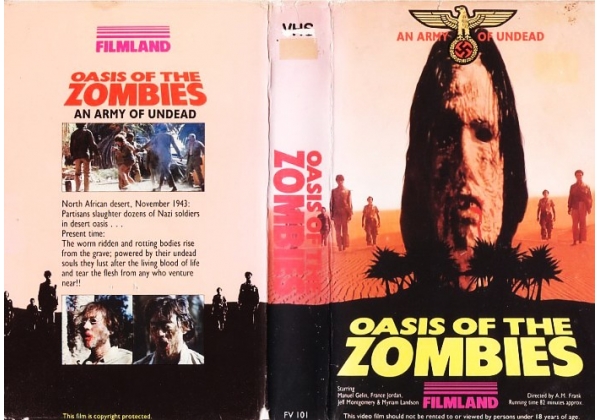
Now, considering that we are all ’80s Euro-horror video fringers here (and you are, admit it): when you say “Nazi Zombies,” the synapses of our blood-goo sloshed minds loads a copy of Jean Rollin’s Zombie Lake (1981) and Jess Franco’s counter-programming Oasis of the Zombies (1981) into our analog-cerebal VCR-cortex. But, oh, how we soon forget the three-time Academy Award-nominated The Boys from Brazil (1978) (okay, so it’s more sci-fi than horror) and the Canadian potboiler, Death Ship (1980). (Okay, so neither of these films had actual Ken Weiderhorn-inspired zoms, but still, they’re cool flicks.)
Water! We need water!
For the serious, deep video fringer: there’s the porn connected-produced (shot in the home and on the property of noted ’70s porn purveyor, Shaun Costello; come on, now: don’t lie and say you didn’t sneak home a copy of 1976’s infamous Girl Scout Cookies?)Gamma 693 (1979). Then, when the Euro-zom craze hit, it floated around the VHS shelves in 1983 under its better known title: Night of the Zombies. (I saw the retitled version at the ‘ol Twin in 1981 as Hell of the Living Dead, which has nothing to do with the Bruno Mattei-directed film of the same name.)
Then there are the rotted roots behind director Ken Weiderhorn’s Nazi-Zom vision: the first of the bunch: 1941’s King of the Zombies and its 1943 sequel, Revenge of the Zombies. Then there’s the British-made The Frozen Dead (1966) and the American TV hoke that is They Saved Hitler’s Brain (1968).
In the end the “Big Three” of the Nazi Zombie sub-genre of the ’80s zombie craze initiated by George Romero’s Dawn of the Dead are Shock Waves, and the aforementioned-linked, lesser-quality Zombie Lake and Oasis of the Zombies. (Oh, guess who did the incredible makeups on Shock Waves: Alan Ormsby of Children Shouldn’t Play with Dead Things, Deranged, and Popcorn. What’s that? Fred Olen Ray from 1992’s Evil Toons was on set as the film’s still photographer? It’s a video-finge wet dream!)
For a guy who’s been cracking the celluloid since his 1973 award-winning short, Manhattan Melody, Ken Wiederhorn’s directing resume is a short one. But, oh, the film’s he has made: After the critical and box office achievement of his feature film debut with Shock Waves, he worked with Tom Savini (The Ripper) in giving Jennifer Jason Lee (Fast Times at Ridgemont High) her film debut in another one of our video fringe favorites: Eyes of a Stranger (1981). In between, it was the Animal House-inspired curio, King Frat(1979). (Yes, we reviewed that one! How could we not! And damn you, Sam, for robbing me of that review!)
Yep. I know. I’ve gone off the chain and I’m careening down the rails, again.
“Enough with the Charmin-squeezin’ over Ken Wiederhorn and your unhealthy obsession with Nazi Euro-Zombies, already,” you say. “Let’s back to Luke Halpin.”
Luke brilliantly, yet sadly, summed up his career with this slice of wisdom: “That’s part of the problem with being a kid actor. When your show’s over, nobody informs you that your career’s over, too.”
While Halpin picked up a few post-Flipper starring roles, his career was pretty much over by the mid-’70s. Then Ken Weiderhorn smartly cast the tan and ripped, water-experienced actor (Halpin’s worked as an stunt man and marine coordinator on a slew of ’80s films: if it was shot on or in the water, Halpin was there: Island Claws, Porky’s Revenge . . . even the Sandra Bullock-starring Speed 2: Cruise Control) as his lead in Shock Waves. And he holds his own — admirably — against his marquee co-stars Peter Cushing and John Carradine.
To say that Shock Waves‘ tale of a Gilligan’s Island episode gone Twilight Zone — with a tourist yacht stranded on an uncharted Caribbean island — was a rough shoot is an understatement. South Florida’s Key Biscayne Island in Miami, and the then abandoned Biltmore Hotel in Coral Gables, doubled for the Nazi island hideaway. Wiederhorn also smartly repurposed the real life shipwreck of the American-commissioned S.S Sapona as his “nazi ship wreck,” which is a still popular Florida tourist attraction, for the film. (The Sapona, and the island of Dry Tortugas, are a sight to behold, indeed.)
Granted, the headlining stars of the acting royalty that is John Carradine and Peter Cushing only worked five days each (they don’t share any scenes) — but what a five days they worked! Halpin and Brooke Adams (be still my heart!) are champs, slopping around, diving and swimming in the salt water and the swampy quagmires, but the perpetually-cadaverous Carradine . . . and “Grand Moff Tarkin” Cushing chasing zombies through the water are a sight to see. (God bless ’em both. What champs!)
The film starts with Brooke Adams (she made her acting debut in the 1975 TV Movie Song of the Succubus, best known for Stephen King’s The Dead Zone) as Rose, adrift in small, ratty row boat being rescued by two fishermen. Then, following the plotting of — and keeping things in a horror/sci-fi perspective — 1959’s Angry Red Planet, Rose flashback-recounts her terrifying experiences at the hands of a self-exiled SS Commander who created the “Death Corps” (the film’s original title), a breed of aquatic undead soldiers for extended submarine missions. While Cushing’s old ship is a wreck . . . it also seems to cruise the waters around the island as a ghost ship that purposely strikes and strands boaters (e.g. the aforementioned-linked, later Richard Crenna and George Kennedy-starring Death Ship).
Before you know it, the Ceasar-cut uniformed hoards of welding-goggled, albino zoms are popping up out of the water at every turn — even from the island-rundown hotel’s mucked-slimed swimming pool. Then, taking a page out of Romero’s Night of the Living Dead playbook, first-mate Keith (Luke Haplin) leads the survivors to barricading themselves in an so-apropos refrigerator unit in the hotel.
The flashback then comes full circle, with Rose’s repetitive, babbling voiceover as she scribbles non-sense in a journal from a hospital bed: she’s gone insane. And no one has any clue as to the horrors that await in the waters . . . somewhere in the Caribbean.
While we all ran to the local duplex to see this in 1977 (I begged my dad to take me, and he liked it, which was shocking: Dad liking a goofy horror or sci-fi movie I liked. The only other time that happened was with 1979’s Alien.), many’s first experience with Ken Wiederhorn’s genuinely creepy (hey, for a kid in the ’70s, it was) debut was via Prism Entertainment‘s popular ’80s VHS rental. According to Blue Underground’s 2003 DVD reissue, they had to source the release from Wiederhorn’s own personal collection, as the studio lost the film’s original negative. To promote their 2014 Blu-ray, Blue Underground gave the film a limited theatrical release that November.
Sadly, it seems the majesty of Weiderhorn’s deliberately slow pace to create mystery and suspense, and his exquisite, subtle use of atmosphere — without darkness or you-can’t-see-shit shadows — over cheap (now clichéd) shock-scares punctuated by gore is lost of today’s gore hounds weaned in the post-Eli Roth and James Wan “modern horror” universe. To see blog and message board commenters referring to Weiderhorn’s masterpiece of horror as “boring” and “stupid” and deriding those “old farts” (I guess they mean moi) who regard this as “horror classic, ” is a dark, cinematic day indeed.
Must everything be guts and gore and “shock scares” to satisfy our horror needs? Can’t we all just enjoy atmosphere and suspense, for once? Then again, the friends I’ve exposed to Ugestuand Kwaidanscoffed. . . .
So, raise your glass to Ken Wiederhorn — and say a prayer for Luke Halpin and his wife, Deborah. For when it comes to Nazi zombies, this underrated effort is the best of the genre — and they’d both be da man in this horror dog’s dish.
Luckily, there’s an upload of the full movie on You Tube to enjoy.
*If you’re interested: Luke Halpin’s friends and family have created a GoFundMe page to help with Luke’s mounting medical bills.
About the Author:You can read the music and film reviews of R.D Francis on Medium and B&S Movies, and learn more about his work on Facebook.
This debut entry in the Jaws rip-off sweepstakes was directed by Hungarian-born bad-ass Cornel Wilde, the star of one of my all-time favorite TV (horror) movies: 1972’s Gargoyles, a movie that scared the stuffing out me in the day—so please take that into consideration as I come to hail Cornel Wilde, not tear him down.
Shark’s Treasure, as with his previous directing effort from five years earlier, No Blade of Grass (that took fifteen years to get made), was a long-gestating passion project that Wilde wanted to make back in 1969 but was unable to secure financing. After not getting Sharks’ Treasure produced, in conjunction with the lukewarm response to his post-apoc romp, No Blade of Grass, Wilde retreated from theatre and film—both as an actor and director—into television, which led to his gig on Gargoyles.
Then some new kid on the block by the name of Steven Spielberg created “shark fever” with some movie called Jaws.
Financing secured.
But that “new kid” got $9 million to make his movie—then grossed under $500 million. United Artists’ placed a bet of $2 million on the green felt with Wilde—and broke even.
It was Cornel Wilde’s final film as a producer, writer and director. After that, he meandered in a few TV and film roles—one was the Lee Majors-starring Viking romp, The Norseman—up until his death to leukemia in 1989, three days after his 77th birthday.
Jim Carnahan (Cornel Wilde, then 60 and doing one-arm pushups in the film) is the obligatory, hard luck sea dog who finds his dreams of a big payday in a young buck’s (David Gilliam, 1972’s Frogs* and 1976’s The Eagle Has Landed) wild story about sunken treasure off the coast of Honduras.
Now if this all sounds a lot like Antonio Margheriti’s Piranha rip-off, Killer Fish (starring, say what (?), Lee Majors!), which itself was Joe Dante’s rip-off of Jaws—then it probably is. (And it also reminds of Steward Raffill’s later High Risk**, about a filmmaker and his down-on-their-luck buddies ripping off a Honduran drug lord.)
According to Wilde, in an October 1975 interview for The Christian Science Monitor, he classified the film as a down to earth treasure hunting story with a bunch of hard-luck hustlers and ex-cons (very familiar U.S TV actors Cliff Osmond and David Canary, along with the even more familiar Yaphet Kotto) who give up everything, even their jobs, to battle pirates, sharks, and their own greed to recover treasure. In addition to his claims that the characters and incidents were based on “true accounts,” another one of his marketing points for the film was that it was “the most dangerous picture he ever worked on.”
As you can see from the film’s one-sheet, Wilde decided to attack Spielberg’s much ballyhooed mechanical shark and made sure everyone knew the shark footage in Sharks’ Treasure was 100% real and that we “will see the total shock of the most sensational shark fight ever filmed.”
Wilde was obviously going for the John Huston-directed and Humphrey Bogart-starring 1948 adventure romp, The Treasure of the Sierra Madre—only with sharks and water, instead of Mexican deserts. He ended up with an AIP or Crown International Pictures’ romp—and everyone stayed away in droves.
Inspired by B&S Movies’ formulating a revisit to last year’s “Shark Week” and my re-watching Wilde’s commendable effort all these years later, I have to admit his shark romp—the first film in the coveted “Bastard Sons of Jaws” sweepstakes—the film doesn’t have the same impact as I sat in the darken duplex all those years ago. It is, in fact, a sad end to the greatness Wilde achieved with his self-made classics Beach Red, The Naked Prey, and Storm Fear, along with his acting gig in High Sierra going toe-to-toe with Humphrey Bogart.
Yes, there’s no doubt all of the underwater photography is real—and it is spectacular (Wilde upped the Spielberg game: instead of one Great White, it’s a hoard of Tiger Sharks)—but the film wrapped around it is, well, it’s like Roger Corman secured all the sets from Jaws before Universal tore ‘em down and drained the water tanks, and pumped out a shark-clone quickie.
Yeah, there’s some nice character development (i.e., Cliff Osmond, and “The Kid” that got them into this mess, David Gilliam, are ex-prison lovers; Wilde is a virility-swaggering braggart) but, yeah, the drama is overwrought. It’s hokey. It’s all very “TV Movie,” but not as TV Movie-good as Wilde’s previous acting gig in Gargoyles.
So, while Sharks’ Treasure isn’t bad, it isn’t good. And while I have a nostalgic attachment to the film, you’d probably rather watch a trashier Italian shark flick, like Luigi Cozzi and Sergio Martino’s shark collaboration, Monster Shark (or Devil Fish, or Red Ocean, or whatever the hell the alternate title on the VHS cover says).
Sigh. Cornell Wilde deserved better. So did Michael Sopkiw.
Say what? You need more shark and “nature run amuck” films? Then check out our last December’s shark tribute week, “Bastard Pups of Jaws,” which features everything imaginable—from 1976’s Grizzly to 1977’s Orca, and 1979’s The Great Alligator all the way out to Renny Harlin’s 1999 shark romp, Deep Blue Sea. And don’t forget to pick up a copy of Drive-In Asylum’s “Summer Shark Special” issue from this past August.
*George McGowan, the director of Frogs, also directed the “Star Wars Dropping” that is The Shape of Things to Come.
**Stuart Raffill directed another “Star Wars Dropping”: The Ice Pirates.
About the Author: You can read the music and film reviews of R.D Francis on Medium and learn more about his work on Facebook. He also writes for B&S Movies.
Then, in the wake of Star Wars’ success, 20th Century Fox released a series of five telefilms in 1981, which also played as foreign theatricals, produced and cut from the CBS series: Back to the Planet of the Apes, Forgotten City of the Planet of the Apes, Treachery and Greed on the Planet of the Apes, Life, Liberty and Pursuit on the Planet of the Apes, and Farewell to the Planet of the Apes.
After wallowing in ten years of development hell, the Apes rose again with a 2001 reimaging. Unfortunately, plans to continue the film series were stymied by the lukewarm critical and box-office reception to Tim Burton’s vision. A second reboot film series commenced with 2011’s Rise of the Planet of the Apes (directed by Rupert Wyatt), which was followed by Dawn of the Planet of the Apes in 2014 and War for the Planet of the Apes in 2017 (both directed by Matt Reeves).
Shortly before the July 2017 release of War for the Planet of the Apes, 20th Century Fox issued a press release that stated director Matt Reeves was interested in continuing the storyline. Then, in April 2019, after The Walt Disney Company acquired 20th Century Fox Studios, the Fox shingle announced that they officially began development on future Apes films. Those plans were confirmed on December 3, 2019, with director Wes Ball (The Maze Runner trilogy film series) being hired to direct an untitled fourth film in the reboot series.
It is unknown if Wes Ball’s vision will serve as a follow up to Matt Reeves’s War for the Planet of the Apes or if it will serve as the first film in a third series reboot.
Stay tuned . . .
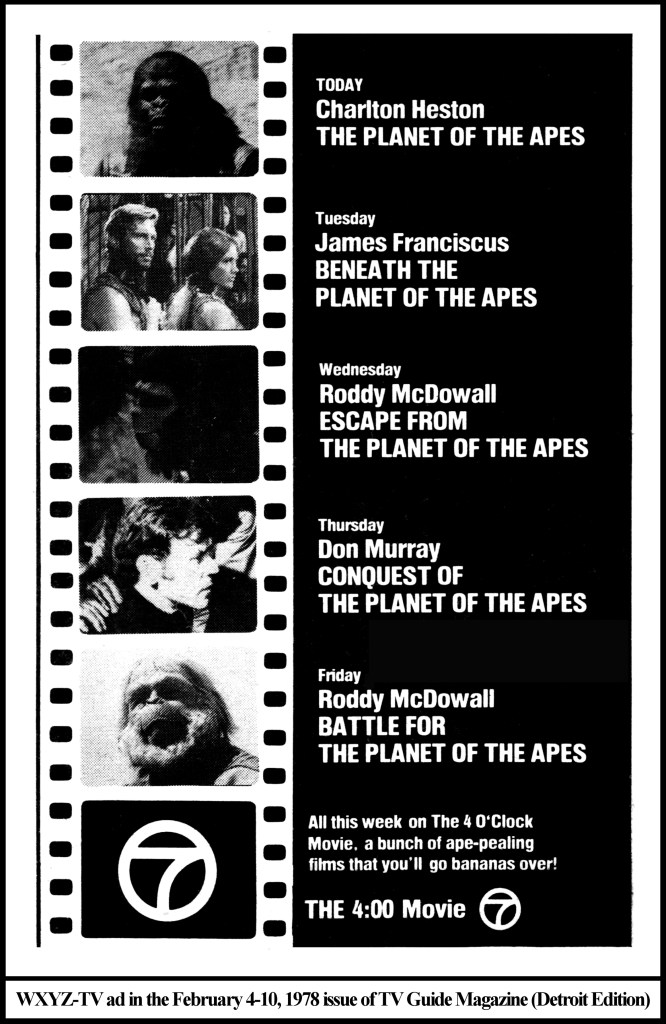
TV adverts courtesy of Vintage Toledo TV, which features even more, classic Apes TV adsfrom yesteryearto enjoy.
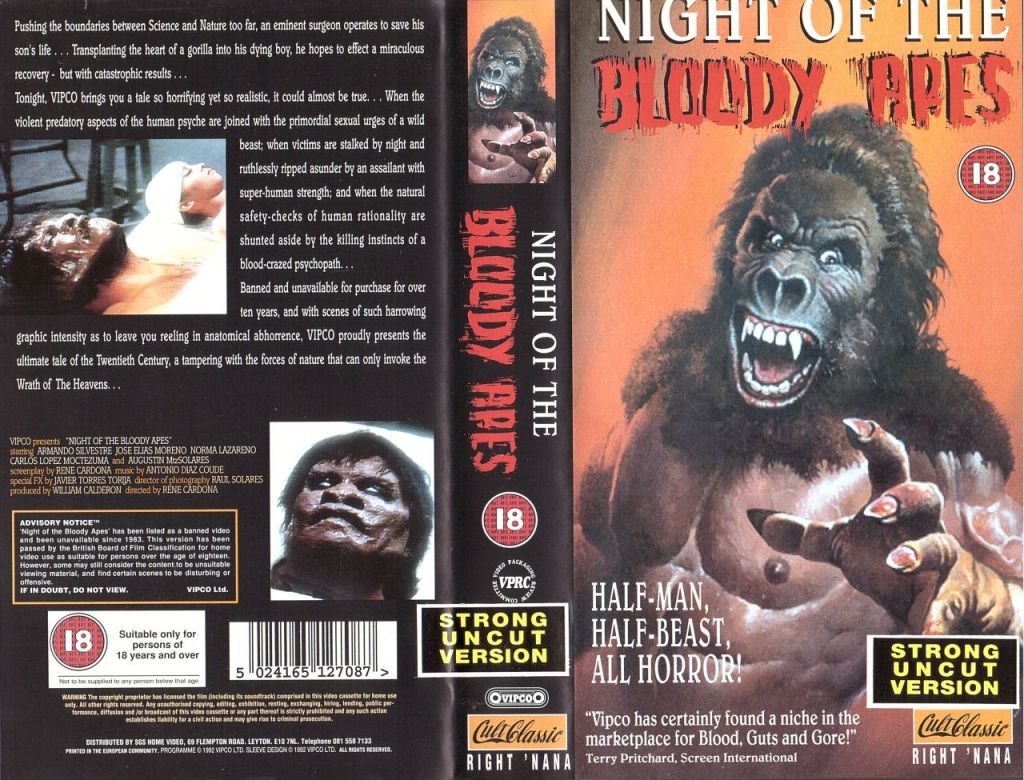
Ah,the ‘ol drive-in ’70s and ’80s home video days when forgotten drek, such as René Cardona’s 1969 epic, La Horripilante Bestia Humana, aka The Horrible Man-Beast, was redressed as an ersatz Apes sequel.
And speaking of Disney’s rebooting of the Star Wars franchise, be sure to visit with us as we explore the films that inspired Star Wars and the films that Star Wars inspired, as B&S Movies continues its Exploring series with “Exploring: Before Star Wars” and “Exploring: After Star Wars.”
Here’s our full list of Ape films reviewed this week:
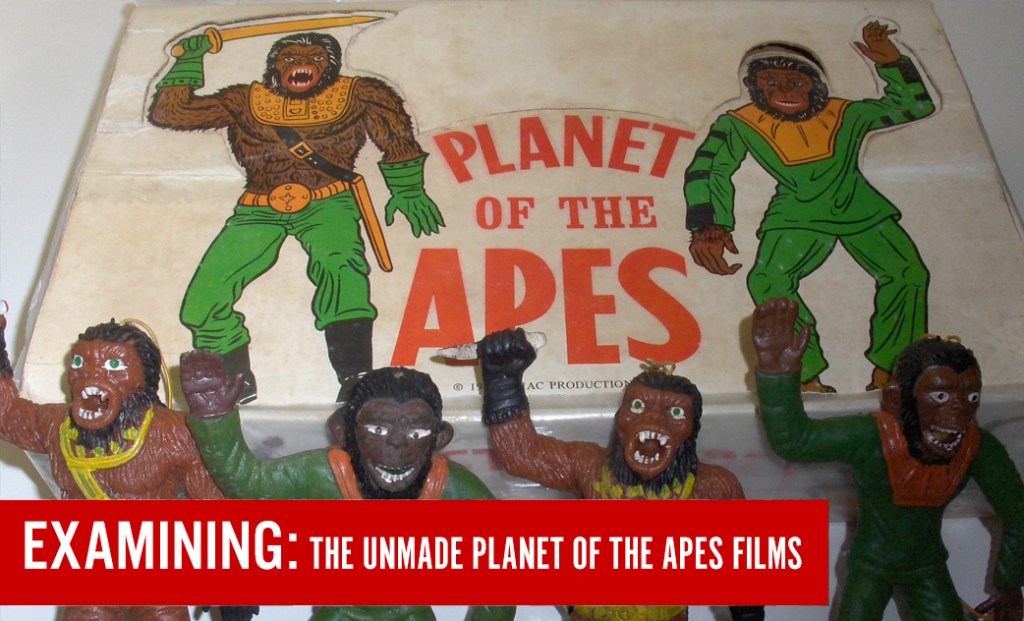
ArticleBanner: Planet of the Apes and Disney logos are the property of 20th Century Fox and The Walt Disney Corporation and are both widely available on the web. Graphic overlay courtesy of PineTools.com by R.D Francis.
*Reviews by R.D Francis
About the Author: You can read the music and film reviews of R.D Francis on Medium and learn more about his work on Facebook. He also writes for B&S Movies.
There’s nothing in the unhinged plotting of the POTA rip offs reviewed during Ape Week that compares to the 16mm-shot, LSD-induced insanity of this 1974 Japanese TV series, Saru no Gundan (Army of the Apes), produced as result of the massive success of the Apes franchise in the Lands of the Rising Sun. And if it all looks Ultraman familiar, that’s because both series were produced by Tsuburaya Productions—and there’s lots of prop and costume recycling afoot.
Retaining the plotting of the 20th Century Fox films, Army of the Apes follows the adventures of a female scientist with two annoying kids who end up cryogenically frozen (Genesis II, anyone?) and awake in a future where apes rule and they spend the rest of the one season, 26-episode run trying to return home. The only difference from the Fox films is that these apes drive jeeps and wear modern-day military-styled uniforms.
It wasn’t until 1987 that English-speaking audiences got to experience Japan’s POTA contribution—mostly through a 1991-Season 3 spoofing on Mystery Science Theater 3000. That 1987 print came courtesy of prolific U.S television producer Sandy Frank (Lassie, The Lone Ranger, the Japanese anime series Battle of the Planets) who edited the series into a 94-minute feature film known as Time of the Apes, which ran on broadcast and cable outlets (TNT’s Monster Vision shingle) in 1987 and as a VHS issue in 1988.
About the Author: You can read the music and film reviews of R.D Francis on Medium and learn more about his work on Facebook. He also writes for B&S Movies.













 B&S About Movies
You must be logged in to post a comment.