Hey, wait a minute . . . Jess Franco didn’t make this, R.D. Roberto Mauri made it!
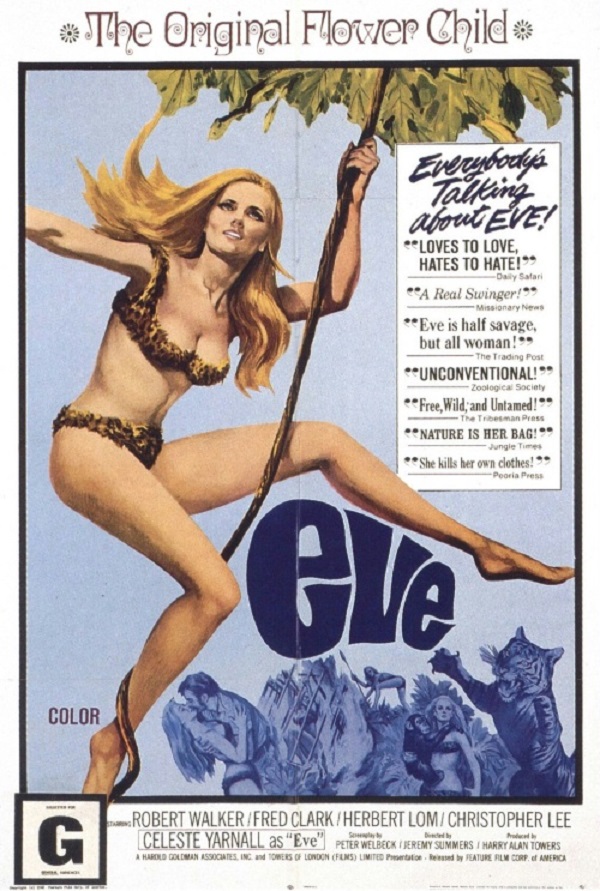
Yeah, yeah . . . slow down ye streamer. Hold off on the emails and comments, we got this. Yes, the above poster is, in fact, a Franco joint: one that aka’d in the drive-in and home video realms as Eve, Eva en la Selva (Eve in the Jungle; that English title was also used), The Face of Eve, and Diana, Daughter of the Wilderness. Need to know more? We’ve since reviewed it as part of our February 2024 “Jess Franco Month” blow out.
“No thanks. Not another Franco patch job. I’m burnt out this month,” you say. Ah, but what about when the chick with that damn apple is played by Celeste Yarnall, she The Velvet Vampire? Uh, huh. Set the rocket in the pocket for launch!
Anyway, back to the actual movie of this review. . . .
Obviously made to rip-off Planet of the Apes, this Italian-Spanish jungle adventure film with science-fiction overtones was directed by Roberto Mauri. Widely known for his knockoffs of proven genres, you’ve seen Mauri’s work on public-domain DVD sets, such as 1962’s Slaughter of the Vampire and 1964’s Curse of the Blood Ghouls (Hammer horrors), 1964’s Three Swords for Rome (Ben-Hur and Spartacus), and Vengeance Is My Forgiveness (Clint Eastwood-spaghetti westerns). Sadly, by 1980, as did most of the older Euro-directors, Mauri’s career degraded into X-rated tripe (and ended his career) with the adult-hardcore action romp, 1980’s The Porno Killers.
Be sure not to confuse this POTA rip off with the Quentin Tarantino-touted The Mighty Peking Man from 1977 (released as part of his Rolling Thunder Pictures shingle) that, in turn, should not be confused with 1987’s Time of the Apes (a film edit of the 1974 Japanese POTA rip off TV series, Saru no Gundan, aka Army of the Apes), none of which have any connection to Pierre Boulle’s Planet of the Apes or Radio Pictures’ King Kong . . . or Edgar Rice Burroughs’s Tarzan.
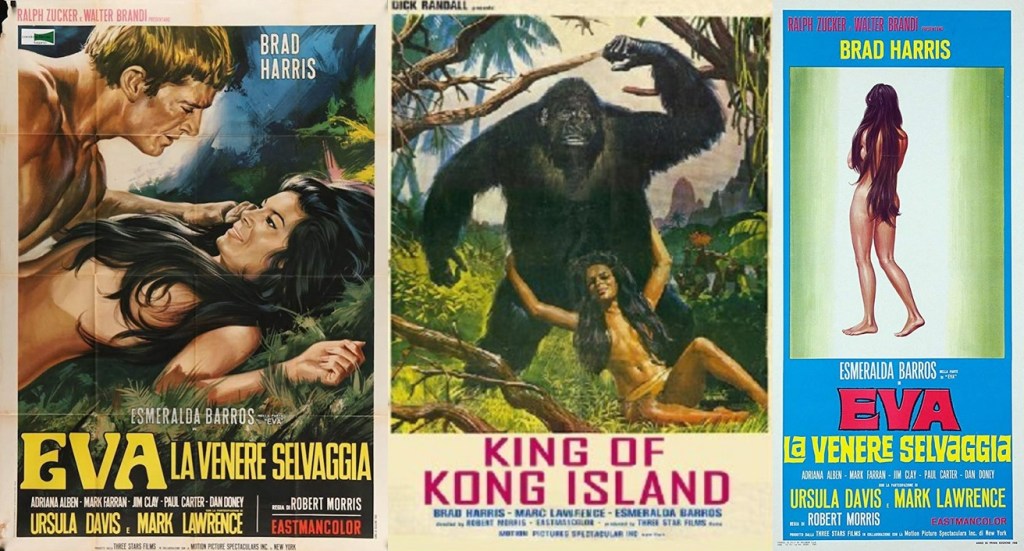
Known as Eva, the Wild Woman and Kong Island in other English-speaking parts of the world during its initial release, then as King of Kong Island in 1977 to cash in on the 1976 King Kong remake (and lost 8-minutes of “racier” scenes along the way), there’s no “island” and there’s no “Kong.” There’s not even a planet, a spaceship, or an ancient landmark to berate in frustration.
Instead of galactic time travel, we get an Island of Dr. Moreau-styled mad scientist in Kenya experimenting with radio transmitter brain implants to control a tribe of island-dwelling gorillas, so as to turn them into a take-over-the-world army. As with The Mighty Peking Man—which lends to the plot confusion—the “Eva” of the title helping in the adventure is a loin-clothed, Tarzan-like jungle girl with a pet chimpanzee who can talk with the animals. Of course, all mad scientists are horny, so those dreams of world conquest unravel when he instructs the radio-controlled apes to kidnap his dream girl, the daughter of the owner of a local Nairobi gin-joint (yes, the classic Casablanca is pinched as well). And with that, Rick Blaine, I mean, Burt Dawson (American expatriate actor Brad Harris), an Indian Jones-styled adventurer, comes to the rescue.
The Idaho-born Harris, who worked as a leading man and stunt man in over 110 European films, gained his first taste of American recognition as result of his recurring roles in the ‘80s TV series Dallas and Falcon Crest. War movie aficionados will remember his work alongside Max von Sydow and John Cassavetes in the fondly remembered Brass Target (1978).
You can have your own copy — under the Eve “original flower child” repack — as part of Mill Creek’s Sci-Fi Classics 50-film pack.
About the Author: You can read the music and film reviews of R.D Francis on Medium and learn more about his work on Facebook. He also writes for B&S Movies.
Toho Studios had Godzilla. 20th Century Fox Studios had Pierre Boulle’s apes. And the American studio was kicking the Big Green One’s ass in the Pacific Rim box office. So what does Toho Studios do? They created their own race of sentient humanoid-ape aliens to introduce into the series.
Toho Studios celebrated the Great Green One’s 20th anniversary in style with this everything-plus-the-kitchen sink monster romp featuring the return of Anguirus from Ishiro Honda’s first Godzilla sequel, 1955’s Godzilla Rides Again, a new monster in the form of the good kaiju dog-deity, King Caesar, and a James Bond-inspired Interpol superspy to defeat the aliens.
And if that wasn’t enough: they brought on the apes.
Toho’s new breed of intelligent apes, who hail from the “Third Planet from the Black Hole,” built a secret, underground high-tech base in Okinawa. And they have the ability to build robots. And they construct Mechagodzilla, a robotic doppelganger of Godzilla equipped with a wide array of weapons and flight capabilities.
Oh, yeah. And these apes enjoy their wine. And they can morph into human form.
The fun begins as an Oriental priestess has a vision of Japan’s destruction by a giant monster. Cue to a spelunker who discovers a chunk of never before seen metal in a cave. A subsequent archaeological excavation to find more of the metal unearths a chamber with a biblical-like prophecy of a forthcoming battle between huge monsters on the Earth.
Of course that errant hunk of metal is the work of The Simians and was used to construct Mechagodzilla to spearhead their conquest of Earth.
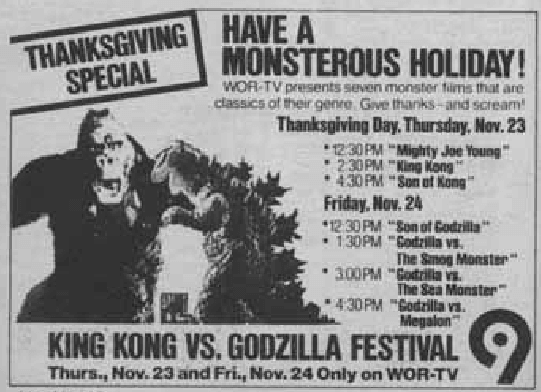
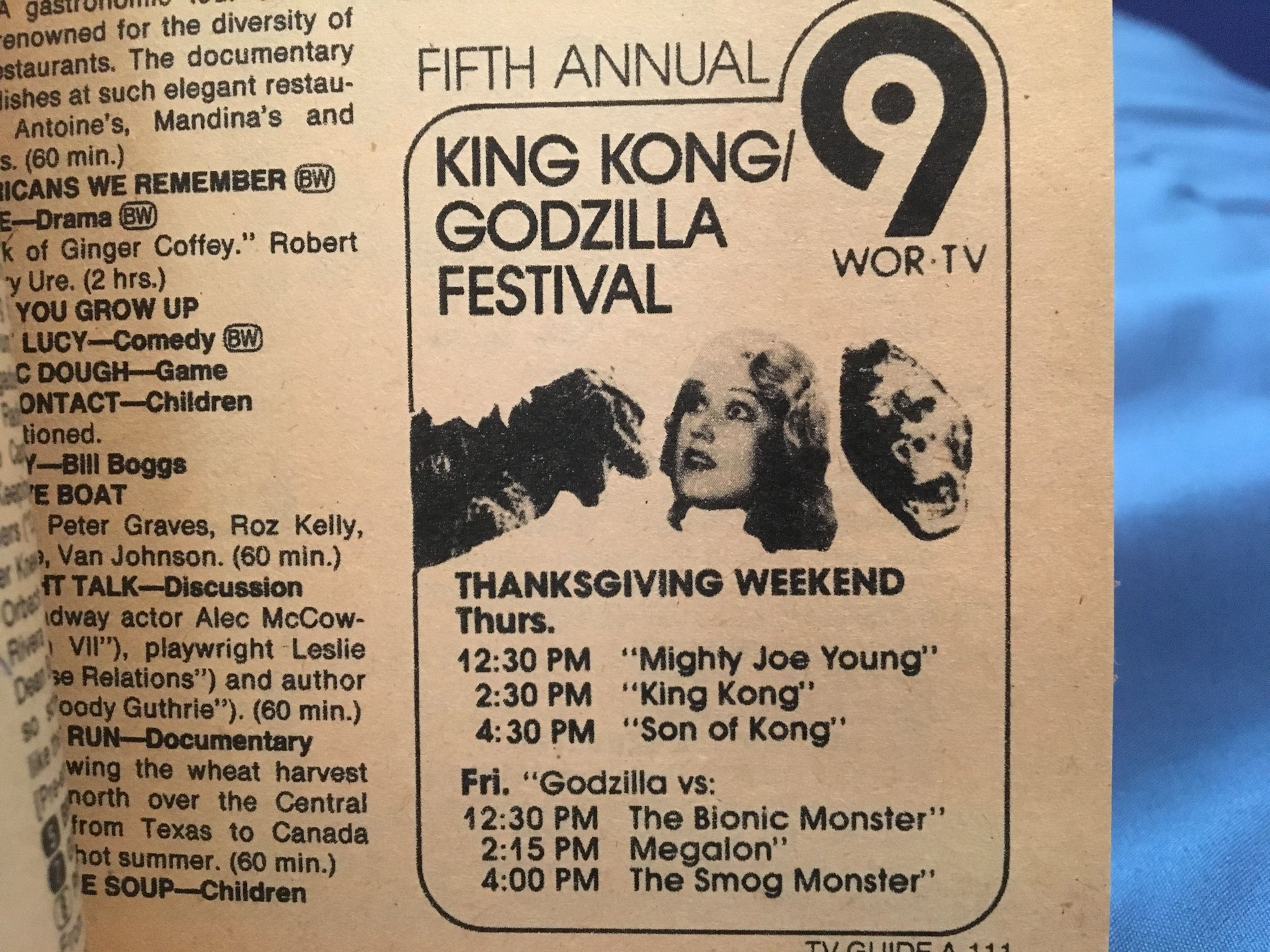
Oh, yes. The good ‘ol days of UHF-TV holiday marathons with ‘ol Kong and ‘Zilla.
As crazy as it seems, it wasn’t 20th Century Fox who sued over this—but Universal Studios. When the film was released in the U.S in March of 1977 under the title Godzilla vs. the Bionic Monster, Universal took issue over the use of the word “Bionic,” as they owned the rights to The Six Million Dollar Man and The Bionic Woman TV series. That led to the title that we U.S kiddies saw it under: Godzilla vs. The Cosmic Monster.
Keeping with their “borrowing” of the 20th Century Fox franchise, another race of Toho aliens from the third black hole planet returned in the 1975 sequel, Terror of Mechagodzilla. This time the aliens “aped” the underground disfigured mutants from Beneath the Planet of the Apes—and hid their disfigurement under rubber masks. Oh, and they brought along another, new monster-partner: the aquatic, non-mechanical Titanosaurus. The Mechagodzilla sequel would prove to be the last of the films until the Big Green One’s 30th anniversary started a new wave of Godzilla films.
If you must have Godzilla vs. Mechagodzilla in your collection, there’s the 1988 restored Japanese cut with English audio on a 1988 VHS, a 2004 DVD with both English and Japanese audio, and a 2019 Showa-era Blu-ray issued by the Criterion Collection alongside 15 other Godzilla films released from 1954 to 1975. Terror of Mechagodzilla also appears in that collection, along with its three singular DVD forms issued in 1998, 2002, and 2007.
The epic battle! This stuff rocks no matter how old you are!
About the Author: You can read the music and film reviews of R.D Francis on Medium and learn more about his work on Facebook. He also writes for B&S Movies.
Well, break out the K-Y and the Trojans as we spin through a rip in the space-time continuum to a planet—lost somewhere beyond the planet Porno—where we meet the evil apes Dr. Anus and General Jerko and the peace-loving ape Cocknelius. Where’s Flesh Gordon when you need ’em? Hell, where are Jess Franco and Jean Rollin when you need ’em?
If there are any films that make the de Ossorio hack job Revenge from Planet Ape look like an Oscar Winner, it’s these behind-the-beaded curtain ape homages.
American exploitation filmmaker and self-professed “schlockmeister,” Larry Buchanan, he the king of the day-for-night shoots of our beloved trash-classics Curse of the Swamp Creature, The Eye Creatures, It’s Alive!, Mars Needs Women, and Zontar, the Thing from Venus dreamed up this sexploitation variation on Planet of the Apes crossed with Tarzan. The story concerns a sexy anthropologist who embarks on an expedition to find her missing anthropologist husband and discovers a tribe of evolved apes who engage in sex and rape and enjoy their soft-core nudity. Even by Buchanan’s standards, this ape romp is terminally weird. Weirder than his Jim Morrison flick Down on Us, you ask? Yes!
Okay. Let’s get this over and done with: When Ang Lee received worldwide acclaim with Crouching Tiger, Hidden Dragon, the porn industry pumped out a knockoff: Crouching Penis, Hidden Vagina. Stanley Kurbrick’s Spartacus became Spurtacus. Even Steven Spielberg wasn’t immune: E.T became the E-Three: The Extra Testicle, and he got another porn makeover with Shaving Ryan’s Parts. And you can probably guess the source materials for Big Trouble in Little Vagina, Ram-ohh, Romancing the Bone, and Womb Raider. There’s even a Marvel sex-romp: XXX-Men. And who can forget Saturday Night Beaver?
Thus, with the release of Tim Burton’s 2001 Planet of the Apes-reboot, it was inevitable the adult film industry would respond with a series of sexploitation rips. As with the present-day Asylum/SyFy Channel mockbusters we know today, this first film in the “sex apes” sweepstakes takes no chances: it lifts its plot and scenes wholesale from the 1968 original—with the ubiquitous, comical-character name changes (Dr. Anus and Cocknelius) expected in a porn-parody flick.
In the interview vignettes for the DVD release of 2011’s Rise of the Planet of the Apes, James Franco angered the original film series’ fans when he made light of the groundbreaking John Chambers-makeup work and commented: “their mouths didn’t move,” as if insulting the original films was a smart way to upsell the green screen-motion capture apes of our post-Burton simian world. It’s obvious that James never saw Planet of the Babes, with its apparent, pull-over gorilla, chimpanzee, and orangutan masks. Does Planet of the Babes make Buchanan’s ape romp look good? Yes. IsPlanet of the Babes more entertaining that Rise? You better believe it.
(You Tube had a 30 minute edit of the film with all the bad stuff (GOOD STUFF!) blurred out and it has since been pulled down. So Google it at your own peril if you absolutely must.)
Playmate of the Apes (2002)
If you had a Showtime or Cinemax subscription—and suffered from insomnia—chances are you saw this New Jersey-shot sex clone written by and starring adult actress and B-Movie stalwart Debbie Rochon released a mere seven months after Tim Burton’s 2001 remake hit the big screen.
Misty Mundae, aka Sadie Lane, aka American actress Erin Brown (she’s starred in a combined 87 adult films and low-budget B-Movies since her 1997 debut), stars as Commander Gaylor, one of three female astronauts—including Debbie Rochon as Dr. Cornholeous—who crash land on a distant planet populated by talking, horny apes led by the gorilla Generals Jerko and Lade. When the starbabes meet a human-friendly lesbian ape, Dr. Kweera, and her human jungle-woman subject (read: Nova), the ensuing lesbian lust threatens ape society.
Also known as Babes in Kong Land, this shot-in-Cincinnati ape rip is actually a rip off of the Richard Hatch, Kay Lenz, and John Saxon borefest, Prisoners of the Lost Universe (1983), only with sex and apes added. A TV repairman, who sidelines as a mad scientist, tests his new invention and accidentally transports himself to a planet where Amazonian women eschew men into “The Forbidden Zone” and bed with talking apes. Keen eyes weaned on the lowest-budget of the low-budget B-Movies will recognize Julie Strain (Psycho Cop Returns, Naked Gun 33 1/3, Beverly Hills Cop II, Battle Queen 2020) and Monique Gabrielle (Jim Wynorski’s Transylvania Twist, 976-Evil II, Munchie).
You can learn more about the film’s production courtesy of our interview with the film’s director, Eric Eichelberger.
And on the lighter side of ape parodies . . .
The off-spring of ‘90s Gen-X’ers were first exposed to Planet of the Apes by way of a Season 7 episode of The Simpsons starring actor Troy McClure cast in a musical version of Planet of the Apes entitled Stop the Planet of the Apes, I Want to Get Off!. Troy sings the musical number “Dr. Zaius, Dr. Zaius” and serenades the Statue of Liberty with the lyric: “Oh my Gosh, I was wrong! It was Earth all along!” It’s the greatest ape homage, ever. Well, until Robot Chicken broke out the G.I Joes. . . .
Did you know there were three missing scenes from Planet of the Apes ‘68? Well the stop-motion sketch comedy television series Robot Chicken, which appeared as part of the adult-oriented nighttime programming block Adult Swim on the Cartoon Network, recreated that “missing footage”:
Now, if someone would come up with stop-motion G.I Joe and Barbie porn. . . .
And be sure to check out our linked-up “Ape Week” wrap-up of all the ape movies we reviewed this week with our “Ape Week Ends: Disney’s Planet of the Apes.” Oh, and this piece from Slate will hook you up with the rest of ape parodies from the like of The Muppets, the animated FOX series, The Critic, and a few others.
Many thanks to you, the loyal B&S About Movies’ readers for making this one of our most popular-visited posts! Keep those VHS decks runnin’!
“Hey, R.D., you forgot to mention Roberto Mauri’s Eva, the Savage Venus from 1968. Sometimes ‘Eve’ is used instead of Eva.”
Uh, okay. It’s really not that racy or erotic, but consider it mentioned.
About the Author: You can read the music and film reviews of R.D Francis on Medium and learn more about his work on Facebook. He also writes for B&S Movies.
The conjunction of B&S Movies’ recent “Star Wars Week,” our current “Ape Week,” and our upcoming “Shark Week” colliding with the calendar fade in this year of our Lord of 2019 leaves this writer with a morbid disappointment: the Italian-predicted post-apocalypse never happened.
(Yes. Mr. Michael Sopkiw. This is your life. One more time.)
I should be reminiscing about last year’s Rollerball World Championship Game between Houston and New York—you know, the game where the league suspended the rules to force the world’s greatest sports hero, Jonathan E., to retire. I should be running in fear from the marauding motorcycle ‘n dune buggy hoards on a quest to control the last drops of fuel and water. I should be worried about being eaten by radioactive zombies. I should be swingin’ makeshift, nail-spiked bats at cannibal warlords.
New York hasn’t fallen to the Eurac Nation. Manhattan should have been turned into a walled prison by now. There’s no Arthur C. Clark-predicted spinning-wheel space station over the Earth. I still do not have my one-piece jumpsuit and it looks like I’ll die before I catch that flight on a Pan-Am space shuttle to the Moon. We’re not consuming each other by way of soylent wafers and law enforcement doesn’t control starving rioters with human-scooping, dump truck-bulldozer hybrids.
Yes, to the chagrin of the Italian film industry: we are still alive. And to my chagrin: the Italian post-apocalypse—the single greatest sci-fi film sub-genre to dominate the drive-ins and home video stores of my youth—is over.
Sure, Hollywood offered us their big-budgeted versions of our decimated future with Waterworld (1995), Escape from L.A (1996), 28 Days Later (2002), The Road (2006), I Am Legend(2007), The Book of Eli (2010), World War Z (2013), and Mad Max: Fury Road (2016), but it was the low-budgeted indie knock-offs coming out of Europe in the 1980s—spearheaded by the Italian film industry’s insatiable quest to ripoff proven American genre flicks—that revved our post-nuke engines.
Those mainstream Hollywood films were begat from Mad Max and The Road Warrior out of Australia and John Carpenter’s Escape from New York. And how can we forget Richard Connell’s and Robert Sheckley’s writings inspiring the “human death sports” craze with the likes of Rollerball, Death Race 2000, and Deathsport, Endgame, and Rome 2072.
No nostalgic waxing of the post-apocalypse is complete without honoring the influential “Big Three” starring Moses and Ben-Hur himself: Charlton Heston. His turn in Planet of the Apes ignited the post-apocalyptic sci-fi craze within the Hollywood mainstream studio system and led to Heston’s turns in The Omega Man and Soylent Green. And Heston’s “Big Three” beget the likes of Oliver Reed in Z.P.G, Yul Brynner in The Ultimate Warrior and Sean Connery in Zardoz, James Caan in Rollerball, Michael York in Logan’s Run (1976), George Peppard in Damnation Alley, and Richard Harris and Paul Newman in Ravagers and Quintet, respectively.
And while the directors and actors of the post-apocalypse have come and gone—and been forgotten by the many—we, the survivors of the celluloid cataclysm of our teenaged years have never forgotten the genre’s biggest and baddist star. And no: it’s not Kurt Russell or Mel Gibson.
Hey, Mr. Sopkiw. You had to know you weren’t ringing in 2020 without someone bringing up the most cherished of the only four films you shot in an all-too-brief, two year acting career.
The ol’ VHS cover we know and love.
Born in the U.S state of Connecticut in 1954, Michael Sopkiw (pronounced Sop-keev) began his show business career as a successful photo/runway model-turned-actor. As with the equally Euro-revered apocalyptic-action star Mark Gregory, Sopkiw starred in several Italian-produced films that, while not earning critical praises as result of their low-production values, garnered substantial financial returns in the U.S, European, and overseas home video markets.
Before he became a beloved Euro-action star during the ’80s home video boom, Sopkiw’s lifelong love of sailing earned him a job as a merchant sailor, which led to a job laying underwater cable in England’s North Sea in the seventies. Finding other employment opportunities as a yacht broker, and as a sailor on luxury yachts and commercial ships, he returned to his homeland to attended college at the University of Miami (Florida) to study mechanical engineering. For reasons lost to the test of time: Sopkiw’s oceanic navigation activities led him into the underground world of drug smuggling. The end result: he served one year on a two and a half year prison sentence for transporting cargos of marijuana.
As result of parole guidelines that restricted his return to sea, Sopkiw needed to choose a new career. As result of knowing someone active in the New York City theatre scene, he took up acting—seriously and full-time. In an interview with David Everitt in the pages of Fangoria, Sopkiw said that acting was merely a fantasy at the back of his mind that, for many years, he never took it seriously. When he was appearing in [high] school plays, he said, “I never thought you could do this sort of thing seriously. I thought it was chosen people who became stars.” And thanks to Sopkiw’s impressive physique, developed from his years of working at sea, he was “chosen” to work as a model with the world-renowned Ford Modeling Agency—and off Sopkiw went to work on the biggest magazines and runways in Europe.
While in Rome, Sopkiw met noted Italian Giallo director Sergio Martino (All the Colors of the Dark, The Case of the Scorpion’s Tale—just to name a few) who, ready to jump on the Escape from New York and The Road Warrior-inspired, post-apocalypse bandwagon, was on a national talent search for a film regarded as the best of the Italian-made wasteland ripoffs: 2019: After the Fall of New York (1983). Martino, taking note of Sopkiw’s readymade, action-film physique—and his facial similarities to John Carpenter’s Snake Plissken character portrayed by Kurt Russell—cast him as the hero-reluctant, Parsifal (yes, based on Wolfram von Eschenbach 13th century Arthurian hero, Parzival), Sopkiw, like British actor Oliver Reed before him, scored a leading man role in his first-ever casting/acting job—and was signed to a four-picture deal.
In a 1999 interview with filmologist Fred Anderson, Sopkiw gave his thoughts on his film debut in After the Fall of New York:
“[I am glad everyone likes the film, but] I’m not sure it was supposed to be a comedy, but at least it turns out to be a redeeming feature [of the film].”
“[As for the ‘ripoff quality’ of the film, in comparison to its inspiration, John Carpenter’s Escape from New York], I think everyone should do his best work or not bother working [at all]. We call this genre of ‘ripoffs’—exploitation films. Not sexually of course, in this case, but exploiting concepts and ideas that have already been shown to attract interest—and therefore money. Generally speaking, I don’t find this a very attractive or noble motivation. If this is the best work these people can do, then I thank them for their efforts, thank them for allowing me to be a part of it, and hope they are not just into it for the money. I also hope for them that they can do better in the future.”
In a 2009 interview with the online publication Icons of Fright, when asked which film was his favorite of the four he made—he cited . . . After the Fall of New York:
“They were all [four of my films] a blast to work on. I suppose, overall, After the Fall of New York would top the list as a fave film. I think it has the most memorable lines like, ‘Cleaned up & disinfected she might be all right.’ I also think it has the best caliber of actors overall with Gigi, Vince, Romano, Gigetto, Valentine, et al. There were really some good performances there I think and some serious actors.”
In the pages of Fangoria (Issue # 44; reposted alongside a plethora of film stills, posters, video box covers, and articles about After the Fall of New York and Sopkiw’s “boss,” Almi Pictures, by the online publication, The Tell Tale Mind), Sopkiw had this to say about being a leading man in his first acting job—ever:
“[It] was a little overwhelming at first. A kind of instant, minor stardom. I can remember the first day I walked into the studio: You go through the gates set in these big concrete walls, and inside there’s one set after another, each one a different world. And then I went to my dressing room and there it was—with my name on it. It felt really great. While I was getting dressed, I opened up my window and there was eight or ten guys from the movie down below, dressed up like Darth Vader, all on white horses. And I said, ‘Jesus! I think I’m where I Iike to be.’”
After working in Rome and the U.S state of Arizona (for ATFONY’s desert car-chase-duel and his tooling across the desert on a future-cool three-wheeled cycle), Lamberto Bava, the son of famed Giallo director, Mario Bava, recruited Sopkiw for two films shot in the U.S: the Georgia-shot Blastfighter and the Florida-shot Monster Shark—the second utilized his past sea-faring skills.
In working with Lamberto Bava, Sopkiw had this to say in the Icons of Fright interview:
“Almost nothing but praises for Lamberto. He’s a very compassionate guy; pretty much to be expected being Italian. That was my experience with most Italians. But he shows it in his everyday consideration and caring for both actors and crew. And he sure knew how to make a lot with a little. He was always quite accessible and gentle but seems to have had a bit of a penchant for blood. You noticed? I would love to speak with him now to find out a little bit more of what drove him.”
As with the spaghetti-cloning of Kurt Russell’s and Mel Gibson’s apocalyptic romps with his Parsifal character in After the Fall of New York, Blastfighter borrowed from Sylvester Stallone’s vision for Sopkiw’s next film as Jake “Tiger” Sharp: a Rambo-inspired, take-no-prisoners ex-cop with a supersonic sci-fi rifle out for revenge against a gang of backwoods rednecks.
As the title of Sopkiw’s third film implies, Monster Shark (aka Devil Fish, Monster Fish, Monster from the Red Ocean, Apocalypse in the Red Ocean, Devouring Waves, and Shark: Red in the Ocean) was Italy’s (and one of many) reimaging of Steven Spielberg’s 1975 don’t-go-in-the-water classic, Jaws, in which Sopkiw starred as a dashing, sea-faring shark fighter.
And so it goes in Italian cinema: once you ripoff Spielberg, George Lucas is fair game. Thankfully, Sopkiw didn’t appear in one of Italy’s many Star Wars celluloid swindles (. . . that’s an article unto itself!*). Sopkiw did, however, appear as an Indiana Jones-inspired adventurer in Massacre in Dinosaur Valley (Prisoner of the Valley of Dinosaurs), a bizarre, little action movie that borrowed from Italy’s cannibal sub-genre of zombie films, had no dinosaurs—and mixed it with comedy!
It was while filming these four films (which completed his “contract”) and residing in Switzerland that Sopkiw, looking for a greater purpose in life beyond a career making low-budgeted ripoffs of better made films, he took up the study of metaphysics. Those disciplines and philosophies led to him developing natural healing remedies based on sun energy—which required a special glass to maintain the vitality of organic plant molecules. Through his studies in medical plant and herbal sciences, Sopkiw founded the California-based Miron Violettglas to achieve his ultimate goal: encourage people to get back to natural Earth-born remedies in an over-drugged, pharmaceutical-oriented society. The ancient Egyptian-inspired glass craft was also adapted for wine-bottle importing.
Oh, yeah. I remember this TV spot. It’s what got me into the duplex that Saturday.
When the post-apocalypse came-a-callin’, Italian Giallo purveyor Sergio Martino answered the call with a tale about a world war erupting between the African-European-Asian united Eurax (Eurac, whatever!) nation and the U.S-led Pan-American Confederacy. The Darth Vader-cum-samurai clad Eurax won the war and began experimenting on the survivors to find a cure for the post-war, now twenty-year sterility of man that’s resulted in no children being born.
But wait!
The Pan-Americans’ “supercomputer” has discovered there’s one fertile woman left on the Earth. And the (unseen; you know how it goes it non-budget land) sentient being has also determined that only one man—a disgruntled ex-Pan Am soldier by the name of Snake Pliss . . ., I mean, Parsifal—is the only man for the man for the job. Well, Parsifal and an “uncover” cyborg dude named Rachet who dispatches enemies with some Chinese meridian balls on wires he tosses around, and the robotic, claw-hand Bronx whose “mind” is a virtual map of New York.
But wait!
Parisfal is the king of the punk rock-football pad-goth wearing hoards haunting the Arizona wastelands as the champion player of some Mad Max-inspired game with cars who wants no part of what the Pan-Americans are cooking. So they kidnap him. And they offer him a deal: get the last fertile woman out of New York and they’ll give him a seat on the rocket they’re launching to Alpha Centuri to start a new world. Oh, and if he doesn’t along with the plan, he’s gonna get his ass Bob Hauk’d out of the world.
But wait!
Oh, did we forget to mention that, in addition to Escape from New York, Mad Max, and Star Wars, this delicious plate of radiated Italian post-apocalypse pasta also clips Planet of the Apes, courtesy of the always welcomed George Eastman as “Big Ape,” who leads a merry band of hairy men and helps our not-so-magnificent three in their suicide mission? Hey, nothing like the ubiquitous, post-apoc professor’s hot, egg-fresh daughter inspiring a little cooperation.
Yeah, we know, you’re saying, “This sounds like that major studio, single-shot sequence jerkfest that was 2006’s Children of Men.
Yeah, we know. That’s why the crew at B&S Movies watched Children of Men only once . . . and we’ve watched Sergio Martino’s future world with Star Wars-like repeat viewings. Clive Owen vs. Micheal Sopkiw? Really? As if there’s a “choice” in the matter?
If you do not always err to the side of Michael Sopkiw, then you need to surf for your video fringe fixes somewhere else. B&S Movies don’t be associatin’ with folk like ya’ll. Give us Michael Sopkiw or give us death!
Happy New York!, uh, New Year, Michael. We dig ya, brother! Ring in the New Year with Sergio and Mike and watch After the Fall of New York for free on You Tube.
Author’s Note: Sam previously reviewed 2019: After the Fall of New York — our all-time favorite apoc flick — as part of B&S Movies’ 2017 “Fucked Up Futures” week of apoc-films. And be sure to visit us the week of January 5 for “Shark Week” as we dive into Michael’s ’80s shark flick, Monster Shark, for a second look.
About the Author: You can read the music and film reviews of R.D Francis on Medium and learn more about his work on Facebook. He also writes for B&S Movies.
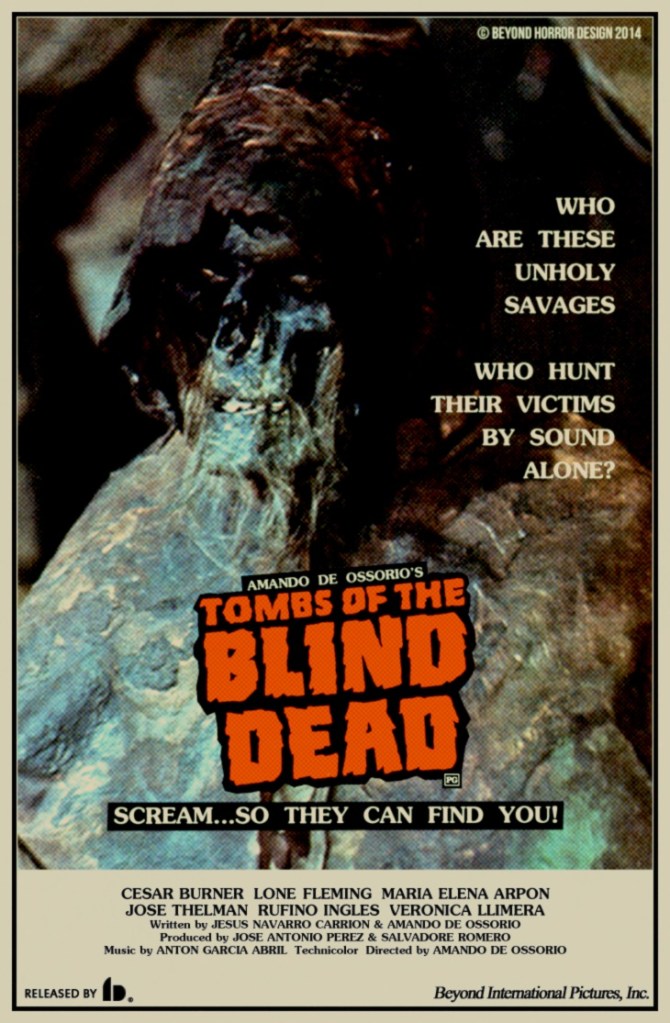
“You know, the Templars’ burnt, eyeless and noseless, sunken-skulled faces sure do look like monkeys,” cigar chomps the cheesy American film distributor. “That gives me an idea. . . .”
“Legend has it, almost 3,000 years ago, a simian civilization of super-intelligent apes struggled with man to gain control of this planet. In the end, man conquered ape after a brutal battle, which saw him destroy the ape, his culture and society. After this battle, man tortured and killed all the ape prisoners by piercing their eyes with a red-hot poker. One of the prisoners, who was also the leader of the apes, vowed they would return from the dead to avenge man’s brutality—at a point in time before man destroyed Earth himself. That time is now.”
Upon the success of Amando de Ossorio’s* first horror film, 1969’s Malenka, The Vampire’s Niece(aka, Fangs of the Living Dead; a success in spite of its intended psychological horror plot recut into a vampire flick against his wishes), de Ossorio decided to continue with the horror genre and eschew his previous, less successful attempts at spaghetti westerns (1964’s Grave of the Gunfighter and 1966/66’s Three from Colorado, aka Hudson River Massacre) and comedy (1967’s A Girl in the Yard).
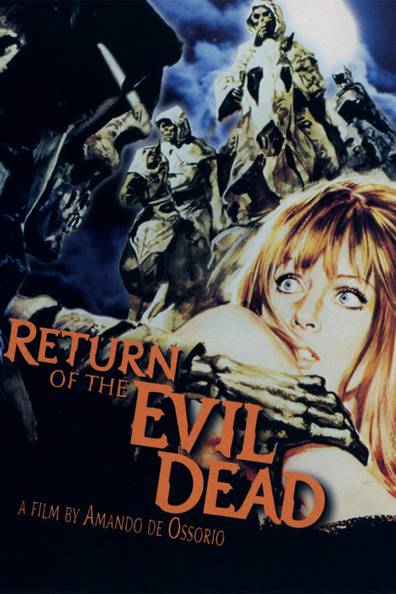
Inspired, in part, by the writings of Spain’s Gustavo Adolfo Bécquer’s Gothic horror short story “El monte de las animas” (part of his 1862 short-story collection, Soria) and George Romero’s Night of the Living Dead (1968), in 1971 de Ossorio concocted a tale about a legion of 13th Century knights, known as the Templars who, in their quest of eternal life, began committing human sacrifices and drinking human blood. In modern day Portugal, a group of tourists poking around the ruins of the Templars’ abandoned monastery revive the rotted, eyeless corpses of the Templars to reign once again.
As with the Gothic, psychological horror of Malenka hacked into a vampire feature to appeal to the American marketplace, American distributors decided to re-edit Tombs of the Blind Dead as a Planet of the Apes rip-off sequel. The opening credit sequence to their edit replaced the film’s original setting with a post-apocalyptic future in which the undead were deceased intelligent apes from the Planet of the Apes story-arc, picking up where the fifth and final apes movie, Battle of the Planet of the Apes, left off. It was all just a matter of excising Tombs’ Templars sacrifice sequence, where they tortured and drank the blood of a female victim, and expunging its sex and gore accoutrements, particularly de Ossorio’s lesbian relationship subplot and the rape-on-a-train sequence. Stir in the English-dub with the cast screaming about “apes” and . . . Poof! We have another ape “sequel” that played on U.S. East Coast Drive-Ins screens in 1978.
And that, boys and girls, is the Tales from the Spanish Planet of the Apes.
It’s a night with de Ossorio’s Templars!
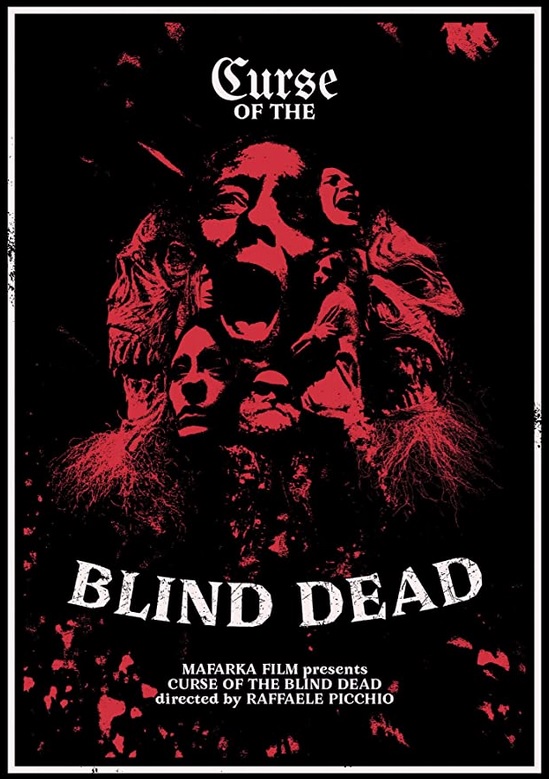
The 2021 unofficial sequel-homage!
Yep! We did ’em all . . . and the ripoffs!
* Be sure to check out all of the films from our December 2022 “Amando de Ossorio Week” of reviews.
About the Author: You can read the music and film reviews of R.D Francis on Medium and learn more about his work on Facebook. He also writes for B&S Movies.
B&S Movies’ readers are already up to speed on everything ape, with the franchise’s production minutiae readily available—if you want it.
But here are the basics that led to the post-Star Wars POTA movies: As result of the first four films’ box office returns—it was the Star Wars of its day—Arthur P. Jacobs, the producer of the films through his APJAC Productions for distributor 20th Century Fox, decided to capitalize on the theatrical success with an hour-long live action series. It was to start (and take place after the events in) after Conquest, which was believed to be the fourth and final film. Then Fox decided that, instead of a series, they wanted another movie, which became 1973’s Battle.
Sadly, Jacobs died in June 1973 before his vision of the TV series could be realized. CBS-TV then purchased the broadcast rights to the first three films: each ran as a “Movie of the Week” during the month of September 1973 to, not surprising, high ratings. And result of Jacobs’s death, Fox was in full control of the decisions regarding the franchise.
So while the ape movies were breaking TV ratings records, Gene Roddenberry developed his Star Trek follow-up, Genesis II (1973), through Warner Bros. for CBS-TV—and the movie-series pilot garnered high ratings. Plans were made to go to series, with Roddenberry scripting a 20-episode season arc.
But the ratings for the Apes reruns rivaled Genesis II, which resulted in CBS turning their focus away from other contenders (what those series were, is unknown) for a new weekly science-fiction series—including Roddenberry’s. And with that, the network ran with Apes TV series idea and added it to the schedule for their 1974 autumn programming. Fox ordered 14 episodes.
The series started from scratch, with actors Ron Harper and James Naughton as Alan Virdon and Peter Burke, two astronauts who pass through a time warp while approaching Alpha Centauri on August 19, 1980, which results in a crash on June 14, 3085. They’re rescued by a human (for the sake of adding “drama” to the series, unlike the films, the humans can speak) who takes them to a bomb shelter and opens a book containing historical text and pictures of Earth circa 2500; the space explorers are convinced they are on a future Earth. A later check of their ship’s chronometer confirms their fears: they’re on Earth 1000 years in the future.
They’re soon befriended by a friendly chimpanzee, Galen, portrayed by Roddy McDowall—the only actor to return to the franchise. Booth Coleman (the 1956 post-apoc flick World Without End; pick a ‘60s or ‘70s TV series) took over the role of the orangutan Zaius from his friend, and former Dr. Zaius, Maurice Evans. In another Star Trek connection: Mark Lenard (Spock’s father Sarek in Star Trek: TOS, TAS, TNG) starred as gorilla General Urko.
The series, which ran during the highly-coveted ratings sweet spot from 8 to 9 p.m on Fridays in September 1974, was a ratings disaster. The failure was attributed to the high production costs against the low ratings, ratings that resulted from repetitive stories (boring stories) that relied too much on human philosophical dilemmas and not enough ape action—which is what everyone came for in the first place: the apes. After 14 episodes, which ran from September 13, 1974 to December 20, 1974, the series was cancelled. (Sounds like Battlestar Galactica‘s dilemma to catch some “Star Wars” success.)
In 1981, in the wake of the Star Wars-inspired sci-fi boom on theatre screens and television (check out B&S Movies’ “Ten Star Wars Rip Offs” and “Attack of the Clones” tribute weeks as proof), Fox reedited ten of the fourteen episodes—two episodes stitched together—into five international TV movies (that also played as theatrical features in some overseas markets). To achieve continuity and flow, new prologue and epilog segments were filmed starring McDowall as an aged Galen telling the “past” tale of the Earth astronauts. Those five films were:
Back to the Planet of the Apes
Forgotten City of the Planet of the Apes
Treachery and Greed on the Planet of the Apes
Life, Liberty and Pursuit on the Planet of the Apes
Farewell to the Planet of the Apes
(In addition to the Planet of the Apes series, CBS-TV also recut episodes of The Amazing Spider-Man (Spider-Man Strikes Back and The Dragon’s Challenge) and their two ‘70s pilots for Captain America (Captain America and Death Too Soon) into overseas theatrical features (which became box-office hits) and telefilms. Other TV series recut into theatrical/telefilms in the wake of Star Wars’ success included Sylvia and Gerry Anderson’s syndicated UFO and Space: 1999, the 1973 Keir Dullea Canadian series The Starlost, and Universal’s Buck Rogers in the 25th Century for NBC-TV and Battlestar Galactica for ABC-TV (BSG’s “Commander Cain” story-arc was cut into a successful foreign theatrical: Mission Galactica: The Cylon Attack; trailer); even story-arcs of The Six Million Dollar Man (The Secret of Bigfoot) received theatrical cuts. Even the early ‘70s pilot-movies for Earth II, The Questor Tapes, and Genesis II found new life via new edits and new titles. You can learn more about those telefilms with the Medium article, “In Space No One Can Hear the Pasta Over-Boiling: The ’80s Italian Spacesploitation Invasion.”)
However, before Fox edited those ape movies, the studio teamed with NBC-TV and created Return to the Planet of the Apes, a 1975 Saturday morning animated series (as was Star Trek) produced by the team behind the popular Jonny Quest. The series went back to the beginning, once again, as three American astronauts—including Jeff Allen (voiced by Austin Stoker, who played MacDonald in Battle; John Carpenter’s Assault on Precinct 13)—time jump into Earth’s future. The storylines closely mirrored Pierre Boulle’s Monkey Planet source novel and the Vietnam War and Cold War themes of first two ape movies. In addition, the series featured characters that originated in both of the Fox films and the CBS live action series. NBC broadcast 13 episodes between September 6 and November 29, 1975. As with the live action CBS-TV series, the kids stayed away in droves, as the show’s message was too complex and heavy-handed for children. NBC cancelled the series.
In addition to Marvel Comics’ longer-running Adventures of the Planet of the Apes series published from August 1974 to February 1977, Power Records issued a 1974 comic book-audio series, Planet of the Apes (which can be enjoyed on You Tube).
And that was the end of the Apes franchise—until Tim Burton’s 2001 reboot.
Numerous episodes of CBS’s live action and NBC’s animated series are uploaded on You Tube. You can sample the first episode of the hour-long live action series (Part 1 and Part 2) and the half hour animated series. The fan-made clip, seen above, is based on deleted, lost footage shot for the opening of the third Apes theatrical film, Escape. Based on the original shooting script, the segment featured the apenauts inside the space ship, seeing the Earth destroyed, and encountering the time continuum. The scene was ultimately scrapped and the film began with the ship already crash landed on Earth.
Wanna play?
As part of our May 2023 tribute to Roger Avery and Quentin Tarantino’s weekly podcast tribute to their days at Manhattan Beach’s Video Archives, here’s the link to their take on the home video version of The Apes TV series.
The two, above paperbacks are adapted from the series episodes that comprise the third Apes telefilm — learn more with our individual review of Quentin’s favorite of the series, Treachery and Greed on the Planet of the Apes.
About the Author: You can read the music and film reviews of R.D Francis on Medium and learn more about his work on Facebook. He also writes for B&S Movies.
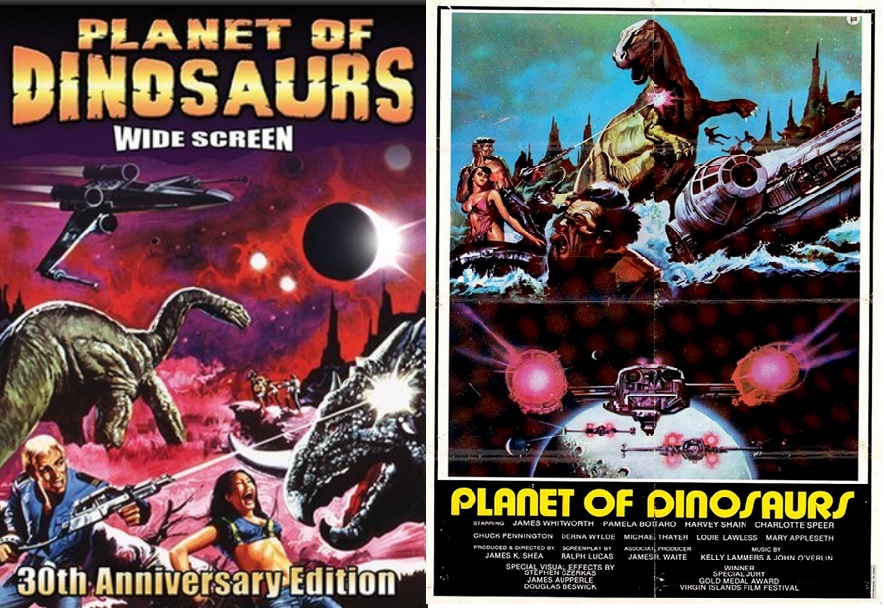
How desperate and unashamed were studios at grabbing a slice of the Star Wars pie? Well, take notice of Star Wars’ famous X-Wing Fighters and Millennium Falcon going into battle against dinosaurs—and artist Frank Frazetta—in a first-draft script that was punched out in three days.
Of course, Planet of Dinosaurs was rushed into production to capitalize on Star Wars revitalizing the space opera sub-genre of science fiction, and the studio took no chances: they lifted the plotting from 20th Century Fox’s other franchise: Planet of the Apes. So rushed was the production, actors had to audition with prepared monologues because the script still wasn’t finished prior to the start of filming.
As with the 1968 POTA original: a space ship crew—only co-ed and adorned in outdated Space: 1999 one-piece spandex, with the females conveniently packing two-piece bikinis—experiences a malfunction and makes a water crash landing. They soon find themselves stranded on a planet ruled, not by Apes, but by Jim Danforth (When Dinosaurs Ruled the Earth, 1970) and Doug Beswick (Evil Dead II) stop-motion dinosaurs.
Unfortunately, to get to Danforth and Beswick’s ingenious, up-against-a-low budget mattes and trick photography, one must endure a poorly directed story plagued by amateurish actors prancing around Vasquez Park in the California desert—a geographic area noted for its use in several episodes of Star Trek: TOS, “Arena” from the 1967 season, in particular.
Yes, Planet of Dinosaurs is an admittedly pleasant slice of childhood nostalgia for the Star Wars generation. However, those now higher-standard adults will admit this Dino-infused Apes rip-off makes Dinosaur Island (1994), Jim Wynorski and Fred Olen Ray’s joint-exploitation rip-off of Roger Corman’s Carnosaur(1993), really look like Steven Spielberg’s Jurassic Park (1993)—just as Corman intended. To say Planet of Dinosaurs makes Destination Moonbase Alpha, Invasion UFO, and The Starlost each look like Star Wars is an understatement.
That the science-fiction but-not-outer space Dinosaur Island is itself a rip-off of Untamed Women (1952; no, not Untamed Mistress, that’s a whole other movie), with homage-rips from other rickety dinosaur flicks of yore, such as Prehistoric Women (1950) and Hammer Studios’ One Million Years B.C (1966), is another B&S Movies review for another time far, far, away. We love this movie so much, Sam took another crack at it back in March of this year.
“Get your stinking, pigeon-toed quadruped off of me, you damn, dirty dinosaur!”
In an X-Mas footnote: Did you know that Fred Olen Ray is in the Christmas movie business? In recent years he’s produced, written and/or directed a series of holiday films that aired on the cable channels Hallmark, ION, Lifetime, and Up. His most recent film, A Christmas Princess, inspired by the Meghan Markle and Prince Harry romance, is currently airing on ION.
About the Author: You can read the music and film reviews of R.D Francis on Medium and learn more about his work on Facebook. He also writes for B&S Movies.
A long time ago . . . on a theatre screen far, far away . . . long before Star Wars: Episode IX – The Rise of Skywalker . . .
2001: A Space Odyssey holds the distinction—in a gullet-stifling glut of Italian rip-offs of every successful American movie known to man—to never be victimized by pasta-cloning.
So the Italian film industry stuck with the films they knew best, and could pull off with aplomb; thus came the retreads of the American films Spartacus, The Magnificent Seven, the James Bond film series, and Death Wish, etc.—the list goes on and on. If a film cleaned up at the box office in America, a pasta variant was in Euro-theatres with a year of the release of its English-language inspiration. You don’t believe this writer? How many Italian reimages of the successful American films Alien, Conan the Barbarian, Raiders of the Lost Ark, and The Road Warrior can you name in sixty seconds—GO!
There is no denying Star Wars is a story-telling and technical achievement that, almost immediately upon its March 1977 release, became the most successful movie ever made—with its two subsequent sequels achieving an estimated world-wild box office gross of a billion dollars. It can’t be denied: Lucas’s vision is the most influential movie ever produced.
However, Star Wars, when compared to 2001: A Space Odyssey, is cartoon-styled, childish goofiness. True, Lucas’s vision presented things on screen that young, impressionable film goers never seen before—and if we did, the rehashed elements were handled with such style that it had the “air” of originality. Regardless of their ingenuity and inventiveness against restrictive budgets and tight schedules, there was no way the Italian film industry could successfully execute the complex, introspective psychological insights of 2001.
Yes, Italy was the land of superior psychology-inspired storytelling courtesy of the inventive writing and directing of Federico Fellini (8 1/2 and Amarcord) and Michelangelo Antonioni (Blow Up or The Passenger), but neither of these “stars” of Italian cinema were dipping their toes into any cinematic black holes to go up against Kubrick. (It’s a shame they didn’t: that would be a hell of a sci-fi film.)
Courtesy of its Japanese The Hidden Fortress-inspired tale of epic battles rife with devil-may-care, risk-taking rogues and damsel-princess, Star Wars, unlike its Kubrickian antecedent, was easy to copy. Strip away the spaceships and lasers and Star Wars was no different than any of the American Westerns that the Italian film industry fleeced — and made American television actor Clint Eastwood into an international film star.
So . . .
Cue the John Williams-inspired orchestra.
Cue the baritone announcer: “A long time ago, in a galaxy far, far way. . . .”
Cue the Flash Gordon Conquers the Universe-inspired opening title crawl.
Break out Mama Leone’s pasta pots . . . “Let’z a-make us-sa Star Wars!”
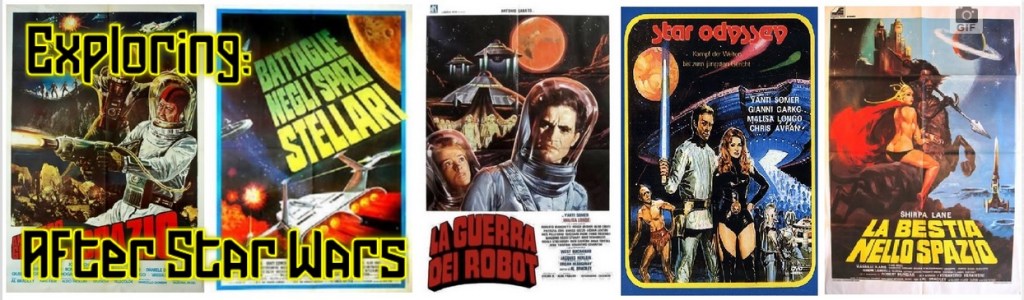
And the kitchen duties fell to Alfonso Brescia to create the first-out-of-the-gate “Spaghetti Wars.”
Under his Americanized director-nom de plume of Al Bradley, he presented 1977’s Anno Zero Guerra ello Spazio, aka Year Zero War in Space (Cosmos: War of the Planets in America) to the Italian-cuisine loving world. Many sci-fi connoisseurs believe Brescia’s “Star Wars” debut isn’t so much a rip-off of Star Wars; they opine it’s a homage to another Italian space epic, one that was produced amid all of those Antonio Margheriti-spaghetti space operas: Mario’s Bava’s Terrore nello Spazio, aka Terror in Space (known in American theatres as Planet of Vampires; then in its U.S TV syndication as Demon Planet).
And they’re right: Look at the costuming, and alien-possession subplots of Bava’s and Brescia’s films for comparison. Adding to the celluloid confusion: Cosmos had similarly-influenced—if not the very same-recycled—costumes and sets as Margheriti’s films. In addition: Cosmos was also distributed as War of the Planets—which was the title of the second film of Margheriti’s Gamma One series.
Amid Cosmos’ self-recycled stock footage and shot-through-sheets-of-sepia-paper-and-cheese-cloth special effects, Cosmos also ineptly-lifted whole scenes from 2001: A Space Odyssey (an astronaut completes an upside-down communication device repair-in-space) and Barbarella (sex via touching a “blue orb of light” between beds). The “plot” for those who fell asleep: Our heroes journey to a planet where a green-skinned race is subjugated by an evil computer . . . and the Earth’s Italian “Hal 9000”, “The Wiz,” is possessed by the evil alien computer. . . .
“Hey, this isn’t ‘Star Wars,’ this is ‘Star Dreck’,” said the scrawny, pimply-faced and horned-rimmed glassed twelve-year-old spaz in the theater’s darkness.
“Dude, this more like ‘Star S**t’,” replied his portly, mullet-haired, eleven-year-old sidekick. “Let’s use the rest of our money to go bowling next door.”
Believe it or not, with everyone tricked into believing they were seeing another “Star Wars,” Brescia’s debut-rip turned a profit. So he came back a second time with his “Empire Strikes Back” in the form of 1978’s Battaglie negli spazi stellar, aka Battle in Interstellar Space (Battle of the Stars in English-speaking countries; “sounds” suspiciously like “Battlestar Galactica”).
Unlike Cosmos, aka Italy’s “Star Wars I,” Italy’s “Star Wars II” suffered from poor theatrical distribution and a weak reissue via home video and TV syndication. Then, with all the alternate titling that plagues European films as they’re distributed to the international markets, spacesploitation buffs believed the almost-impossible-to-find Battle of the Starswas Cosmos—with a new title. It’s not. Battle of the Stars is an entirely new film that cannibalizes Cosmos for stock footage—and all the costumes and sets return. As is the case with most “sequels” (Alien vs. Aliens and Mad Max vs.The Road Warrior being the exceptions to the rule), Battle is a just remake/reimage of Cosmos—with a little script tweak: Instead of traveling to the planet-home of the evil computer, this time the rogue planet without-an-orbit comes to Earth, which . . . (so exhausting) was the plot of Margheriti’s Battle of the Planets. (See the confusion?)
Then, all of the one-piece spandex suits and pull-over headpieces were back for a third sequel in 1978’s La guerra dei robot, aka War of the Robots (Reactor in the international markets) with a society of gold-painted skin people pinch-hitting for the green folks from Cosmos. Also back: All of the stock SFX footage, costumes, and sets—and whole scenes lifted from the previous two films. The “plot,” such as it is, concerns gold Aryan robots with Dutch-boy haircuts on the brink of extinction that kidnap a couple of Earth scientists to save their planet. So a crack team of space marines (see Aliens; which wasn’t made yet!) are sent in for a rescue. What makes Reactor so utterly confusing: All of the same actors from the last two films come back — as different characters. So, it’s a “sequel” . . . then it’s not.
Mind you, George Lucas was still in production with the second Star Wars movie, The Empire Strikes Back (1980)—and Brescia is already on his 4th sequel with 1979’s “The Gold Ayran Dutch Boy Robots” (joking) . . . but they really were back in Sette Uomini d’oro nello Spazi, aka Seven Gold Men in Space which, if you’re able to keep up with the alternate-titling of Italian films, became Star Odyssey for English-speaking audiences. All the footage and props are back (Brescia’s recycling is actually worse than the cheap n’ shameless footage, prop, and costume recycling from the Battlestar Galactica–Buck Rogers U.S TV axis) in the year 2312, where the Earth is referred to by evil aliens as “Sol 3.” “Darth Vader” is some guy in a (quite impressive) lizard skin mask (but it’s topped with a Farrah Fawcett-’70s feathered hair cut) that “buys” Earth in some inter-galactic auction to cultivate Earthlings as slaves to sell on the open market.
The “Han Solo” of this mess is some guy in a shiny-silver Porsche racing jacket and a funky, disco-inspired spider web tee-shirt contracted for a The Magnificent Seven-inspired recruitment of a rescue team of rogues. . . . (“Wait, didn’t Roger Corman make a space-version of The Magnificent Seven?” you ask. Yes, he did, and that was called Battle Beyond the Stars . . . I know, it’s confusing!). So, this Star Oh-Why-Am-I-Watching-This-Crap comes complete with its own R2D2 and C3PO in the form of a bickering male/female robot couple (the female has eyelashes and red lips) dealing with “sexual dysfunction” and “relationship issues.” And there’s a scrawny n’ skinny Han Solo-replicant acrobat who backflips and summersaults into battles—and makes a living fighting in boxing rings with Rock ’em Sock ’em Robots. (“Hey, wait. That sounds like 2001’s Real Steel?” you ponder. Yep!)
Oh, my god. Is this Italian Star Wars Film Festival over? Even in written form, this is painful. You’re killing us. Please, dear god, stop!
Sorry, kids. There’s more. And it gets worse.
Do you, the sci-fi film buff, remember the infamous X-rated Flash Gordon porn-flick, Flesh Gordon (1972)? Did you ever wonder: What if Reece and Ripley (and we know they did, off-script and off camera) “got it on” in Aliens?
That was Brescia’s next opus: Porn Wars.
There’s George Lucas, killing the box office with The Empire Strikes Back, and Brescia responds with his “Star Wars V”: 1980’s La Bestia nello Spazio, aka The Beast in Space. The interesting twist to this “sequel”: it not only occurs in the same universe (courtesy of footage, costumes, props, sets, and actors recycling) continued from Star Odyssey, it’s also a “sequel” to an infamously popular Italian exploitation movie, The Beast (1975): both films star noted erotic/exploitation actress Sirpa Lane. (Because of the success of The Beast, and her other erotic/exotic films, the Euro-press christened Lane with the affectionate stage name: “The Beast.” In the early days of her career, she was marketed as the next “Brigitte Bardot.”)
Issued in a “PG,” “R” and “X”-rated format, the “plot” concerns the Earth’s search of the cosmos for a rare element: Antallum, the key ingredient for bomb construction to basically kill off everyone in the universe. But that’s just a minor-plot irritation. The real story: The crew is “horny,” with chauvinistic men and slutty women astronauts seducing each other on their way to Lorigon to plunder the planet of its Antallum honey hole. Well, the planet’s sentient super-computer isn’t having any of that nonsense. That’s his Antallum. So “Hal 9000” sidetracks the Earthlings by inciting them to indulge in their deepest, darkest sexual desires. Did I mention the gold Aryan Dutch-boy robots are back as well?
After five “Star Wars” films in short three years, Brescia turned over the keys to the Millennium Falcon. His space opera career was over. But let’s cut Uncle Al a break: he was saddled with the cheapest budgets and pressure-shoot schedules that no filmmaker should endure in their careers.
After 1980’s The Beast in Space, Brescia continued to make non-science fiction films for the remainder of his career—14 more films for the next 15 years. At the time of his retirement in 1995, he completed a career total of 51 films.
Most of Brescia’s post-1980 work was primarily restricted to Italy-only distribution. His career took a financially-positive turn in the late-‘80s with the worldwide-distributed Iron Warrior (1987; the third in the hugely successful Italian rip-off series of Conan the Barbarian) and Miami Cops (1989; violent Miami Vice-inspired buddy-cop flick starring Richard Roundtree). Sadly, even with the success of Iron Warrior and Miami Cops, Brescia was unable to secure distribution for his self-financed final film, the 1995 action-comedy, Club Vacanze.
Alfonso Brescia, the king of the Star Wars-inspired spaghetti-space opera died, ironically, in 2001. And that was the end of Italy’s “Spaghetti Wars.”
. . . And what critical and box office fate awaits Uncle Walt’s latest volley from the Star Wars canons? We wait with pasta-bated breath. Yikes! Sam just weighed in with his insights . . . uh, oh!
And that finishes our crazy, two-week intergalactic rodeo as we remembered all of the influences and pre-and-post Star Wars films and ripoffs from the ’70s and ’80s.
Be sure to surf on over to our December 16 posting where we explored the galaxy of space operas that inspired George Lucas with “Exploring: Before Star Wars.”
Here’s the complete list from our celebration of the Star Wars canons:
Star Wars: Episode IX – The Rise of Skywalker had its world premiere in Los Angeles on December 16, 2019, and was released theatrically on December 20 in the United States.
About the Author: You can read the music and film criticisms of R.D Francis on Medium and learn more about his work on Facebook. He also writes for B&S Movies.
If you go into this expecting campy, on-camera mugging by everyone involved—including familiar TV actors Robert Urich (as the Han Solo-cum-Errol Flynn swashbuckler), Mary Crosby (as the obligatory, bitchy princess), along with John Carradine (!), Angelica Houston (?!), ex-NFL star John Matuzak, and Ron Perlman (Hellboy)—you’ll have fun with this Star Wars rip. Unfortunately, it’s not campy enough—like Mel Brooke’s (later) Spaceballs (1987) campy—and it becomes forgettable after one viewing.
And just what is Robert Urich from TV’s Vegas (also of Alan Rudolph’s 1982 UFO conspiracy romp, Endangered Species), doing here? Well, MGM—yes, the studio that bankrolled the sci-fi game changer, 2001: A Space Odyssey—had Urich under a television contract and, as the rumors go, the studio insisted he be cast in the film.
The Ice Pirates began as The Water Planet, MGM Studios’ serious, $20 million-budgeted entry in the Kessel Run—based on a script by director Stuart Raffill. Then, when MGM found itself immersed in financial troubles, the budget was slashed to $8 million—and Raffill was told “to make it work.” In order to make it work: he decided—with the studio’s blessing—to revamp the script into a comedy. Ugh.
So, instead of “Han Solo” securing clean water for the galaxy, we ended up with TV’s Robert Urich leading a band of 1930’s styled, intergalactic swashbucklers (Ron Perlman, John Matuzak) after the galaxy’s most valued commodity—water—and help Crosby’s bitchy “Princess Leia” along the way.
Occasionally funny—but mostly lost somewhere between the silly and the stupid—with special effects not as a bad as Luigi Cozzi’s Starcrash—but lost somewhere in a galaxy far, far away between Roger Corman’s Battle Beyond the Stars and Battlestar Galactica—this needed Farrah Fawcett giggling around in her transparent Saturn 3 garb, along with a touch of Dorothy Stratten’s Galaxina space-softcore to make it all work.
Needless to say, the hyperdrive failed on this Kessel Run.
Raffill didn’t fare much better with his next foray into the sci-fi realm. This time, instead of ripping Star Wars, it was E.T. How bad was it? Ronald McDonald shows up, because, well, there were Happy Meals to sell to the kids. In the end: Mac and Me earned Raffill a Golden Raspberry for Worst Director. His next film, Mannequin 2: On the Move (1991), is considered as one of the worst sequels of all time.
However, Stewart directed two of my personal, youthful favorites: 1978’s The Sea Gypsies and the James Brolin-fronted action-comedy, 1981’s High Risk—so Stu is always the tops in my book. You can learn more about Stuart Raffill in the pages of Master of the Shoot ’em Ups. You can read his chapter (pages 36-43) for free on Google Books.
***
Star Wars: Episode IX – The Rise of Skywalker was released theatrically on December 20 in the United States.
About the Author: You can read the music and film reviews of R.D Francis on Medium and learn more about his work on Facebook. He also writes for B&S Movies.
Alternately known as Saturn 1999, Space 2100, Space: 1999 Moonbase Alpha, and Space 1999: 1 in various overseas markets for its TV syndication and foreign theatrical distribution, Destination Moonbase Alpha is the Star Wars-inspired feature-film created from the 1976-1977 second season, two-part story arc of Space: 1999: “The Bringers of Wonder” (Ep. 18 and 19, but Ep. 42 and 43 overall).
Space: 1999, of course, was the last in a long line of science-fiction series produced by Gerry and Sylvia Anderson, beginning in the early ‘60s with their marionette-led children’s programs, most notably, Thunderbirds, as well as their first live-action series, UFO—itself turned into a theatrical film: Invasion: UFO. Space: 1999, of course, was the last in a long line of science-fiction series produced by Gerry and Sylvia Anderson, beginning in the early ‘60s with their marionette-led children’s programs, most notably, Thunderbirds, as well as their first live-action series, UFO—itself turned into a theatrical film: Invasion: UFO.
The production design and plotting of Space: 1999 owes it debt to UFO, as the tale of the Moon being blast out-of-orbit was originally planned for the second season of UFO, which was to be known as UFO: 1999. The improved look of Space: 1999 over UFO came courtesy of the program’s special effects supervisor, Brian Johnson, who worked on Stanley Kubrick’s 2001: A Space Odyssey and, eventually, Star Wars.
As with the positive, post-Star Wars overseas theatrical reception to The Starlostand Invasion: UFO, the 1978 theatrical version of Space: 1999 was a rousing success. Encouraged, three more movies were created out of the two seasons’ 48 episodes, which aired from April 1973 to February 1975, then January 1976 to December 1976.
The second sequel, Alien Attack—also known as Space: 1999 Alien Attack, and Space: 1999 II—consisted of the first season’s episodes Ep. 1: “Breakaway” and Ep. 4: “War Games.” The next film, Journey through the Black Sun—alternately known as Black Sun: The Death Planet Intervenes and Space 1999 III, was cut from Ep.3: “Collision Course” and Ep. 10: “Black Sun.” The fourth and final film, Cosmic Princess, which concentrated on the second season’s introduction of its Mr. Spock-inspired character, the metamorph Maya (Catherine Schell), and the James T. Kirk-like Tony Verdeschi (Tony Anholt), was cut from “The Metamorph” (Ep. 1/25 overall) and “Space Warp” (Ep. 14/38 overall).
In 2012, the American arm of the British production company ITV announced a reboot of the series to be called Space: 2099. In August of last year, Brian Johnson announced the reboot was still on track.
For those of you who can’t wait for the reboot, you can watch an incredible, China-produced variation of the themes introduced in Space: 1999, with China’s third highest-grossing film of all time, the year’s eighth highest-grossing film worldwide, and the second highest-grossing non-English film to date: 2018’s The Wandering Earth.
As result of another one of our “Space Weeks” (March 2021), Sam the Bossman takes a deeper look at Cosmic Princess.
Star Wars: Episode IX – The Rise of Skywalker is currently in theatres and was released theatrically on December 20 in the United States.
About the Author: You can read the music and film criticisms of R.D Francis on Medium and learn more about his work on Facebook. He also writes for B&S Movies.












 B&S About Movies
You must be logged in to post a comment.