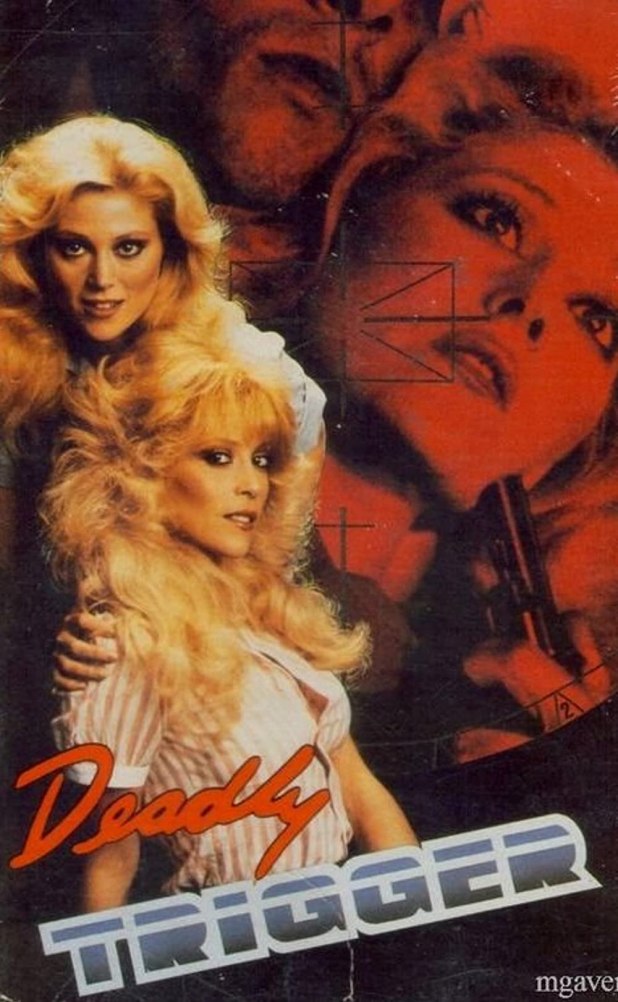
Also known as Double Exposure, Deadly Trigger, Shutter and Femme Fatales, Deadly Twins is somehow a starring video for the Landers sisters. They’re not twins — Audrey is two years older than Judy — but you’re forgiven if you believed they were.
Born in Philadelphia, Audrey was noticed first and recorded a country record for Epic Records before moving to Los Angeles and appearing on eighty-plus episodes of Dallas. Judy moved to LA and showed up in movies like Hellhole, Stewardess School and Dr. Alien.
The two made plenty of appearances together on The Love Boat and two movies produced by their mother Ruth, Circus Island and Ghost Writer. They also were on the cover of the January 1983 Playboy and did not appear nude inside.
In this movie, they play Polly and Ruth Madison, twin sisters who are booked to do a singing appearance in Germany — their last one because Ruth is with child — but they end up getting assaulted. Ruth loses the baby, her boyfriend Warner dies when he drives too quickly to the hospital and they go on the kind of endless chase that reminds one of children playing with Hot Wheels and refusing to come inside for dinner.
I have a theory that directors Joe Oaks and Joe Berger were super fans of the Landers and wanted to try and win them over by claiming to be big filmmakers. When they all got together, the two Joes got super shy and sitcom style had to back up their lies by actually making the movie. They didn’t win the ladies but they did leave behind a movie that I’ve watched more than once and several times with other people, all of whom are usually incredulous and say things like, “Why did you make me watch this?” and “Are these drag queens?”
Bill made this amazing trailer for this movie which is pretty much the best thing ever.
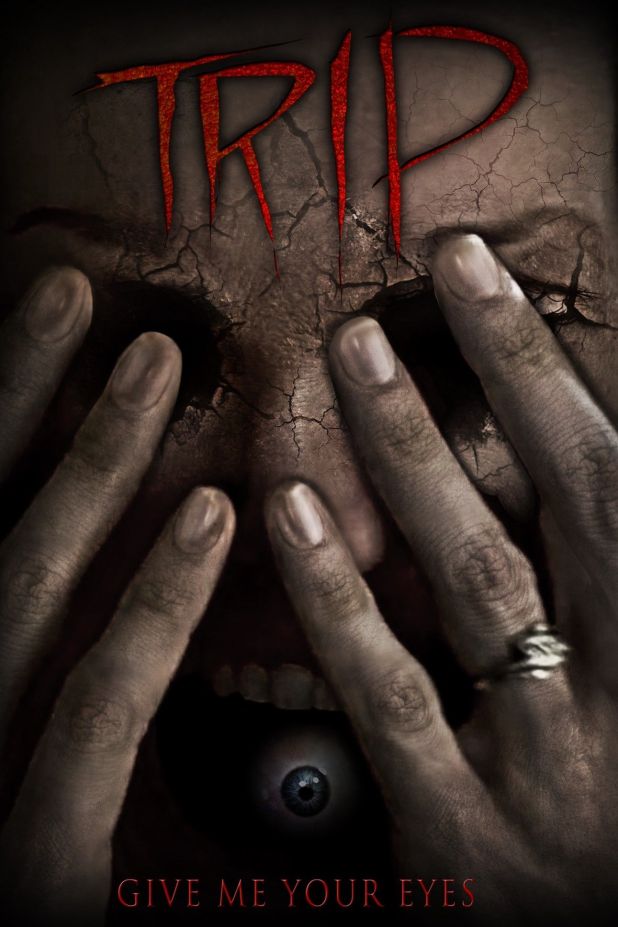
Following her daughter Samantha’s (Jill Young) suicide by gouging her eyes out, Ally (Akasha Villalobos) hasn’t left the house, trapped by agoraphobia. Help may be here, as she meets Jan (Peggy Schott), a therapist who uses a hallucinogenic tea that allows her patients to speak with the dead, which will allow her to see Samantha one more time.
There’s a catch.
Now Ally can see so much more, like a masked man outside, a child with no mouth and a rage-filled Samantha who wants her to suffer the same eye damage — Fulci would love her! — that she died from.
It gets stranger.
Now her husband Michael (Major Dodge) is seeing the same things, yet they’re even more dangerous for him, thanks to The Abuso, an African eye-stealing demon who his daughter had been drawing before her death.
Directed and written by Neil McCay, Trip is a movie that realizes that if your budget is low, your ideas must go high. It’s the first full-length movie that he’s made and it really points to a strong future for his work.
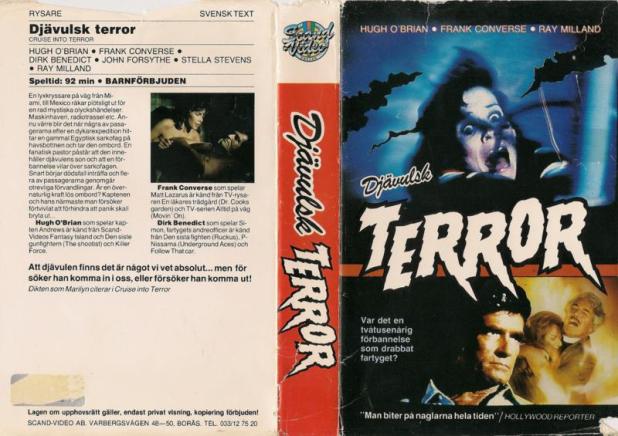
Originally airing on February 3, 1978 on ABC, this movie has quite the cast: Dirk Benedict (who would appear on the network’s Battlestar Galactica the same year), Frank Converse (who was also in 1981’s Rankin-Bass movie, which was distributed by Aquarius Releasing, The Bushido Blade opposite an all-star cast that included Sonny Chiba, James Earl Jones, Mako, Toshiro Mifune and Laura Gemser), John Forsythe (Dynasty), Christopher George (Enter the Ninja), Lynda Day George (Pieces), Lee Meriwether (The Catwoman after Earth Kitt), Ray Milland (X: The Man with the X-ray Eyes), Hugh O’Brian (Ten LittleIndians), Stella Stevens (The Manitou), Roger E. Mosley (Magnum P.I.) and Marshall Thompson (First Man Into Space).
It has what you expect on a cruise to terror: a ship brings aboard a sunken Egyptian sarcophagus that contains the son of Satan. Directed by Bruce Kessler and written by Michael Braverman, who created the show Life Goes On, this movie has Milland as an archaeologist who believes the Egyptians discovered America and Forsythe playing a religious man with a wife he’s disengaging from, leaving her all alone as he struggles with his faith.
That said, it’s also a TV movie and has a coffin that breathes, so there’s that. It also has “Dies Irae” on the soundtrack two years before The Shining.
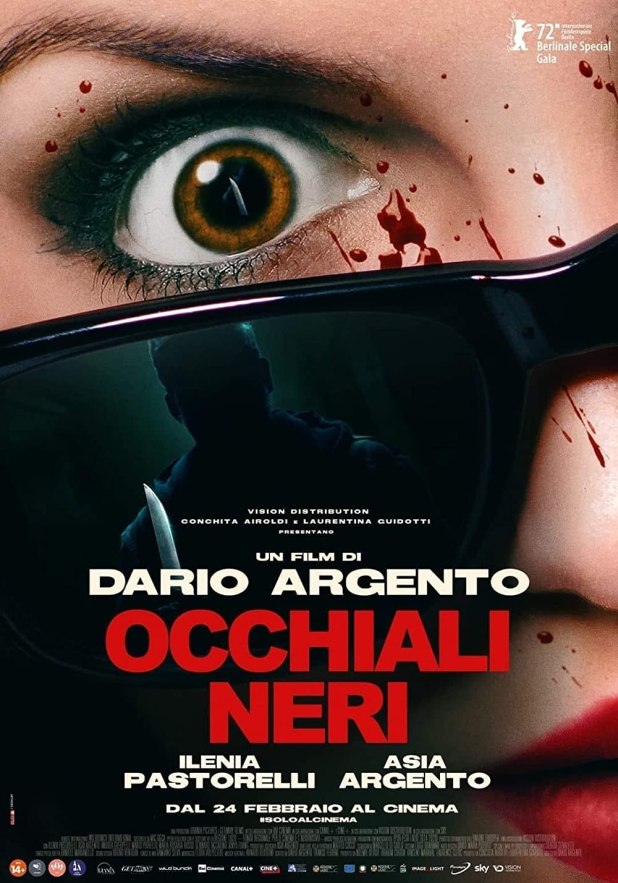
Dark Glasses is Dario Argento’s first film in a decade, since Dracula 3D, and much ink and pixels have been spilled discussing just as much when Argento peaked as the peaks themselves.
To those who don’t have a watchlist of giallo films in the hundreds, a quick reminder that while the genre didn’t start with the Italian director — you can look at them as an Italian mashup of Hitchcock films, the books of Edgar Wallace and Agatha Christie, filtered through the 60s and 70s and indebted to two Mario Bava films, The Girl Who Knew Too Muchand Blood and Black Lace— but his landmark The Bird With the Crystal Plumage was a worldwide success and created a two-year deluge of long-named and often-animal referencing films. Even from his second giallo, The Cat o’ Nine Tails(which he amazingly made a year later, the very same twelve-month period that he also made Four Flies on Grey Velvet) there was talk that Bird was a fluke. Following an attempt at leaving the form with The Five Days ofMilan, Argento created Deep Red, which is an upper-tier giallo with story beats that have been endlessly repeated by lesser hands.
Two years later, he followed that with the supernatural Suspiria, a film that took the colors and tones of Snow White and applied them to a story by Argento’s then-wife Dario Nicolodi and achieved immortality. While the sequel Inferno was not as well-received and was a personally troubled production for an ailing Argento, it features perhaps the wildest visual flourishes and moments of his resume.
The debate comes in as to when Argento lost his way.
Tenebre is, to me, an unassailable film that is the final word on the giallo form. By that, I mean that I will certainly watch any new yellow-poster referencing movie ever made, but it feels like everything that Argento wanted to say to critics and fans. Everything after that was non-supernatural just didn’t seem like it worked as well.
That’s why Phenomena works for me. Sure, it seems like it’s referencing Suspiria at times, but it also has some of the creator’s most personal revelations. I’d probably say that Opera is his last blast at relevance, as it contains some incredible visuals even if the story doesn’t always add up. Then again, if we can all admit it, the story wasn’t always what brought us to Argento’s films. Often, it was the tone, the look, the movements, the strange other worlds he built and plot holes that could be forgiven.
Since then, each film — I’m not counting Two Evil Eyes — has been touted and hoped as a return to form, from the American-sot Trauma and the art malady thriller The Stendhal Syndrome to The Phantom of the Opera, Sleepless (which starts great and then, well), The Card Player, Mother of Tears (which attempted to close off the cycle of Suspiria and Inferno), the poorly regarded Giallo and the even worse received Dracula 3D.
If you’re an Argento fan, you may think this is an oversimplification of his career (yeah, what about the films he helped guide like Dawn of the Dead, Demons, The Sect,The Churchand The Wax Mask?!?) and if you’re not, you probably want me to get to the film, right?
Dark Glasses was originally going to be made years ago, back when Vittorio Cecchi Gori was going to produce it. He went out of business and Argento put the story away until his daughter Asia found it while writing her 2021 autobiography Anatomy of a Wild Heart.
What emerges is a film that is equally a giallo, a rumination on past films and perhaps a final stamp if this is where things end, seeing as how Argento turns 82 in September.
It begins with an eclipse and as we watch everyone protect their eyes from the glare, Diana (Ilenia Pastorelli, They Call Me Jeeg) looks up and slightly damages her eyes, giving the script a moment to quote Francois de La Rochefoucauld, the French moralist who wrote: “Neither the sun nor death can be looked at with a steady eye.”
She seems not from our world, but of the night. Intriguingly, while she’s a sex worker, Argento never treats her with anything less than dignity as we see her go through her work. One of her clients even tells her that the reason he hires her is because of her strength and independence. She also handily deals with another by telling him that she doesn’t want the orgasm that he claims that he could give her or even his money. She does this explicitly for herself and for her own reasons.
However, there is violence in her life. A man named Matteo (Andrea Gherpelli) who met her in a chat room comes to her house — her maid continually looks at her with disdain and even claims what happens next is a punishment from God — smelling of the dogs he trains and she asks him to shower, which is met with a series of belittling epithets. And the very same client who promised her all those orgasms attempts to attack her at which point she sprays his eyes with mace (Fulci would have loved all the ocular violence in this movie) and runs into the night.
That’s when Diana comes into conflict with perhaps the most important character in any giallo, the killer. We’ve already seen him garrotte another call girl and leave her bloody body outside the apartment of her last client. And in this moment, we’re reminded of the fact that this is fifty years after Bird as everyone that walks near the crime scene has a phone that instantly connects them to another world. The police now use forensics and science in addition to their deductive skills. And at once, everything feels safer yet perhaps more frightening when it all falls apart.
As Diana calms herself inside her car, a man rushes as her, leading her to wildly drive into the night. It’s that very same killer we saw at the beginning and his white van pursues her past the same plazas and streets we may remember from past giallo films but now covered with scaffolds as Rome strives to rebuild and keep itself together. This pursuit pushes Diana’s car into the path of another car, instantly killing the driver, putting his wife in a coma and effectively orphaning their son Chin (Xinyu Zhang).
When Diana awakes, her life has changed. The accident damaged her Brodmann area — specifically area 17 — the part of the brain that contains the primary visual cortex. This has rendered our heroine blind. She attempts to salvage her life — one client remarks that he always found himself so ugly that her being blind was the only way that he could get up the nerve to even hire her — and is helped by Rita (Asia Argento), who introduces her to the organization, tools and methods of how to survive as a blind person. Whereas Diana was once blissfully not of our world, an independent woman who could even forget there was an eclipse, now her life has become one of dependence on a cane, on Rita and on her new dog Nerea (which means mine and you can see the dog as part of Diana reclaiming her life). She is no longer of our world yet struggles to return to normalcy, focusing on the sounds of traffic to even do something as simple as cross the street.
Meanwhile, she attempts to assuage her guilt over the deaths of Chin’s parents by meeting him. Her gift of a video game means nothing to him yet when she stops him from being bullied, they connect. Obviously, their relationship is one that looks back to Cookie and Lori from The Cat o’ Nine Tails. Despite how simplistic some of the relationships appear, Argento does succeed in not only having strong female characters but also ones that you come to care for. That means that their loss is more deeply felt, something the giallo and its inelegant American cousin the slasher have always struggled with.
The killer hasn’t forgotten Diana and his white van continues to follow her. However, she now lives in a world of darkness, so she can’t even see him coming. Her strength has returned, as she easily rids herself of two cops seeking Chin, cops who live up to the giallo standard of always featuring the most ineffective and stupid of all law enforcement officers (seriously, Chief Inspector Aleard (Mario Pirrello) is more upset about the death of the killer than how he’d endangered Diana and Chin).
As Diana retreats from the killer, losing a friend, possibly her dog and perhaps even Chin, she finds herself alone in the unfamiliar countryside facing a killer who has been planning her death since the film began.
I read a great quote about Argento from Adrian on Letterboxd: “Argento’s movies always have been ridiculous. It’s just more prevalent now that the budgets got lower.” That’s very true of this movie, as at times I felt I was watching a TV movie instead of a film by the auteur who made Suspiria. Then, out of nowhere, a water snake attack makes everything feel just right again, a wild moment in the midst of normalcy.
I kind of love that the film closes with an inversion of the opening of Suspiria as well as a dog attack that reminds one of that movie as much as it does Dickie in Fulci’s The Beyond. And there’s a lot to enjoy here. I totally loved the soundtrack by Arnaud Rebotini as it’s intense, driving and actually does what the music in a giallo should: it makes the movie even better. The kill scenes are perhaps more realistic than past Argento films and less fantastic — no one’s head goes out a window — and are filled with gore.
Yet this is a giallo if only because Argento made it. There’s no mystery who the killer is. That’s not the story. The story is about how Diana survives this ordeal and her tragedy, if only she is left all alone with only a single friend left by the end. This doesn’t have the black hands of the killer in point of view nor the surprising reveal that marked the genius of all of Argento’s best thrillers yet it improves upon his past works, shows reference for the past and hopefully gives him the opportunity to continue to make films.
I liked it — and not in that way that I feel indebted to Argento and have to say things like Sleepless is great up to the train scene — and appreciate that I cared more about its characters than any of his in some time — again recalling my love for the relationships between Cookie and Lori in Cat and Marcus and Gianni in Deep Red. So while I may miss the wild zooms and dizzying colors, I can appreciate that growth and dream of one more chance from the master.
Beyond the fumetti neri, Italian vietati ai minori (prohibited to minors) comic books go beyond the violence and sex that showed up in 80s exploitation movies. There were titles such as Vampirissimo, Jacula (a female seductress married to both a vampire and human), Maghella (a witch character who was translated into an unreleased 1974 movie by Francis Leroi starring Playboy Playmate Jennifer Liano), Lucifera (a demoness from the Middle Ages who torments men and woman alike), Biancaneve (the erotic Snow White which was made into 1976’s La principessa sul pisello, directed by Piero Regnoli (the writer of Cry of a Prostitute) that features Susanna Martinková and 1982’s Biancaneve & Co which was directed by Mario Bianchi (Satan’s Baby Doll) and starring Michela Miti), Vartan (a Native American heroine based on French singer Sylvia Vartan), Zora the Vampire (which was made into a film by the Menetti Bros) and Sukia (a female vampire based on Ornella Muti).
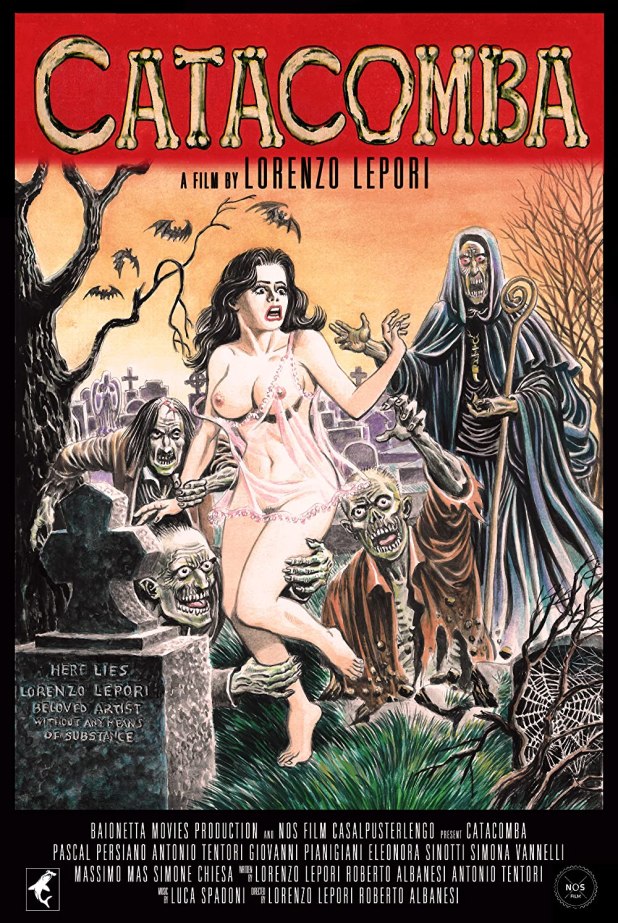
Lorenzo Lepori (Beyond the Omega) and Roberto Albanesi, who co-wrote the script with Antonio Tentori (Island of the Living Dead), have taken those horror comics and adapted them into this anthology, which is just as concerned with violence as it is with sex. It starts with a man waiting for a barber, so he sits down and starts to reach the Catcaomba comic book.
In “Evil Tree,” Tentori plays a man who meets two biker women under a tree where they take physical advantage of him before murdering him to bring Satan into our world. It’s not much of a story, but the effects by Davide Bracci (Mother of Tears) and Sergio Stivaletti (The Wax Mask, which he directed, as well Demons) make this better than average.
“Alien Lover” concerns a wife’s infidelity with a stab happy alien, a fact that her husband was not ready to confront.
“Una Messa Nera per Paganini” may bring to mind Paganini Horror, but it tells its own story about the composer and the discovery of several of his hidden scores. Perhaps the remembrance of that Cozzi film is because that movie also had Pascal Persiano in it.
“La Maschera della Morte Rossa” has assisted suicide, occult rituals, necrophobia and rebirth, so basically something for everyone in the family.
Imagine if Creepshow went harder. Trashier and bloodier, too.
Winterbeast is less of a movie and more of a film that feels like it came from another much darker version of our universe, like a VHS tape that was found in a store and someone played it and it was too much for them and it killed them, then the police found it and it caused a few of them to lose their faith in God and they’re all in a sanitarium somewhere writing all over their faces, then the government got involved and one guy snuck the tape out but his son accidentally returned it to a mom and pop rental shop that rented it out so many times that they started making bootleg copies to keep up with the demand and here we are.
Sergeant Whitman (Tim R. Morgan) and Forest Ranger Stillman (Mike Magri) have just spent the first ten minutes of this movie talking about all the mutilated bodies around the Wild Goose Lodge. Instead of the plot, this is where you’ll start to wonder why Whitman talks so close to everyone. In nearly every scene, nearly every time he talks, he’s within kissing distance of every person he speaks to, a moment topped only when three characters stand shoulder to shoulder, the camera gives a little dutch angle, they all look to the horizon and speak one at a time in a way that can’t be a conversation.
Someone has opened the Native American gate to hell — not to be confused with the traditional Italian gate to hell — and our heroes have to figure out how to put it back together. Standing in their way is Dave Sheldon (Bob Harlow), the owner of the lodge, who is given to red and plaid suits and screaming like a New England skinnier clone of Harvey Fierstein. Then, he goes wild in a scene that really I fear I don’t have the words for, slapping dead women in the face, shoving his digits into their neck wounds, dancing to strange otherworldly music and caressing other dead bodies he’s arranged around the room. It’s a big leap from someone who has been the Mayor Larry Vaughn character up until now to wildly doing some kind of vogue-like dance to “Oh Dear! What Can the Matter Be.”
It took six years, three video formats and ten grand to make this movie or so they say. I don’t think Winterbeast was made. I think it escaped. I can’t explain a movie that has multiple monsters that don’t match — demonic humans, stop motion things out of The Gate, a gigantic chicken that nearly devours Stillman, a murderous totem pole covered in skeletal bodies, a skull bursts out of a man’s chest for no reason, Sheldon wearing a mask and dancing — as well as moments where the camera lingers forever on a chicken coop or someone driving while synth just drones away.
There’s also a moment when the investigation of the box of Native American medicine man Charlie Perkins (Charlie Majka) finds not just a monster tooth, but also a dildo and not a single person mentions it.
Director and writer Christopher Thies made one movie and this is it and it’s so much more than enough. Does he have too much creativity or audacity? And how dare someone name a movie Winterbeast and it takes place in the autumn? Why would you do that? How is there so much plaid in one movie?
You know Evil Dead straight up ripped off Equinox and everyone is too polite to say something about it? This movie gets the stop motion part of those films and then says, “What if we just had a man’s head burst into flames for no reason at all?” Also, there’s a theory that the totem pole and Indian skull were ripped off from Dokken’s “Burning Like a Flame” video, which makes way too much sense.
Nothing in this movie matches. It never seems to end as in every ending there is a new beginning, which feels like a painted sign that someone puts up on their wall as if they have any idea what it means. I can come to you and say that I have no idea what Winterbeast means but also that I loved every single second of it.
It also has music by Michael Perilstein, who scored The Deadly Spawn.
Vinegar Syndrome released this on their Home Grown Horrors Volume One box set along with Fatal Examand Beyond Dream’s Door, two movies that also push your mind into places it is not ready for.
Universal-International wanted to adapt Whit Masterson’s novel Badge of Evil and hired Charlton Heston as the star, Albert Zugsmith as the producer and Paul Monash as the writer.
Heston asked that Orson Welles direct the movie. He joined the project and rewrote the script, appears in the movie and directed the film. He also asked that the actors be part of the process, with Janet Leigh saying, “We rewrote most of the dialogue, all of us, which was also unusual, and Mr. Welles always wanted our input. It was a collective effort, and there was such a surge of participation, of creativity, of energy. You could feel the pulse growing as we rehearsed. You felt you were inventing something as you went along. Mr. Welles wanted to seize every moment. He didn’t want one bland moment. He made you feel you were involved in a wonderful event that was happening before your eyes.”
Leigh’s agent initially rejected the low salary offered without even consulting the actress. Welles sent her a personal letter about how much he looked forward to working together. Leigh told her agent that being part of a movie directed by Welles was more important than any money.
Welles also added the racism in the storyline — Americans racist toward Mexicans, which as you can assume wasn’t popular — and shift in the narrative point of view. He also was very involved in the editing of the movie, working with Edward Curtiss until creative differences caused the editor to be replaced by Virgil Vogel. The film was finished by Aaron Stell with Universal locking Welles out, at which point he left to make Don Quixote. Welles was so shocked by the new cut that he wrote a memo explaining how he would edit the film.
Universal cut fifteen more minutes and ordered reshoots that would be directed by Harry Keller. Heston and Leigh were contractually obligated to be in these new scenes, including one that had a stand-in play Welles’ character. Heston said, “I have done worse work in the movies than this day’s retakes, but I don’t remember feeling worse.”
After eeing a second cut of his film, with scenes he never shot, Welles tried one more time to save the movie with a 58-page note where he outlined how he saw the film working. The studio demanded that Welles attend a dialogue re-record. He refused.
The film that was released was not the film Welles wanted. It really wasn’t the movie anyone wanted. In 1976, UCLA film studies professor Robert Epstein discovered the preview cut in the Universal archives. This 108-minute edit of the film was as close to Welles vision as had ever been seen by the public. The film was re-edited in 1998 using Welles’ 58-page memo.
What emerged with the re-edits was a movie that was way better than past contemporary reviews would suggest. That said, even the original version won the top two awards at the 1958 Brussels World Film Festival, an event Universal didn’t even want to screen the film at. The judges at that event were Jean-Luc Godard and François Truffaut, who made Breathless and The 400 Blows shortly after.
The movie begins with a time bomb killing Rudy Linnekar and his girlfriend Zita (Joi Lansing), a crime investigated by Mexican special prosecutor Miguel Vargas (Heston), who is on a honeymoon with his American wife Susie (Leigh). He’s soon joined by Captain Hank Quinlan (Welles) and Sergeant Pete Menzies (Joseph Calleia), who interrogate — and plant evidence — on a man named Sanchez. Vargas suspects that the older policemen have done this before and starts looking into their past.
This puts the two lawmen against one another, with the stress of the battle finding Quinlan starting to drink after more than a decade sober and using the very criminal he’s been investigating, Uncle Joe Grandi (Akim Tamiroff), to not only assault Susie but to make it look like she’s using drugs and killed the crime lord.
Welles pushed each actor to doing things beyond what they did before, such as having Dennis Weaver be the opposite of his Gunsmoke character, as well as bringing in friends for small parts, including Marlene Dietrich, Joseph Cotton and Mercedes McCambridge, who has the movie’s most terrifying line, as the gang surrounds the helpless Susie: “I wanna watch.”
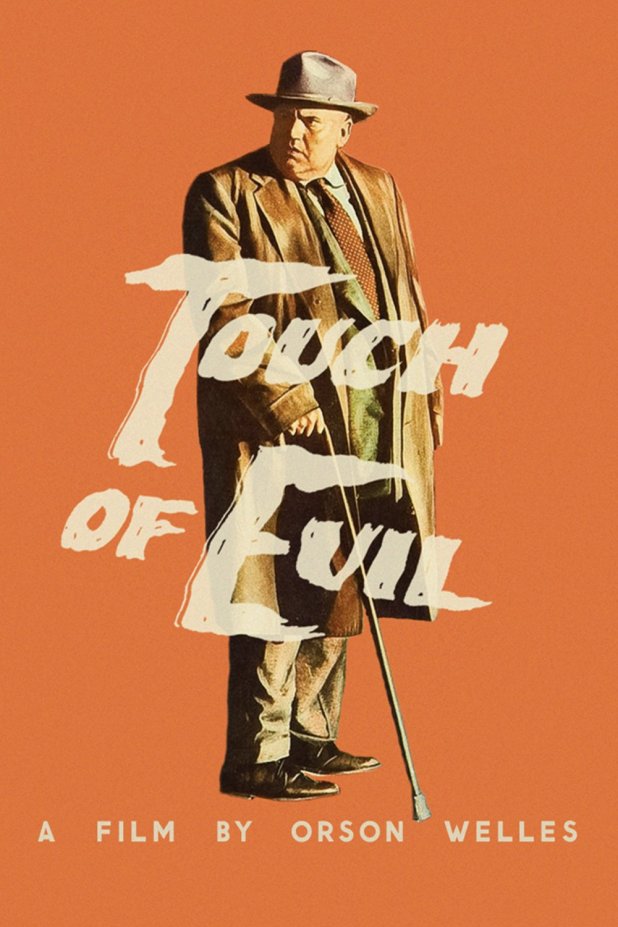
Touch of Evil may have taken years to be recognized — Welles originally hated the film’s title but eventually liked it — but now it’s a known classic.
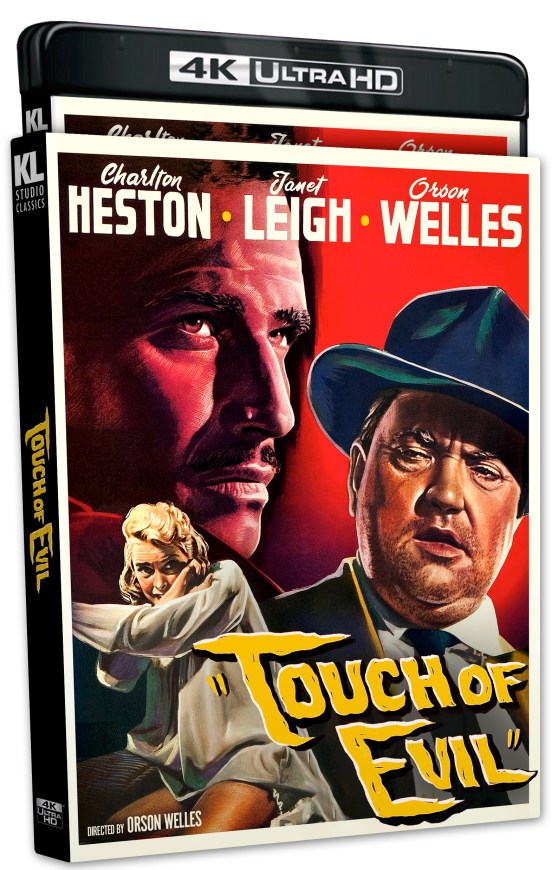
Kino Lorber’s blu ray release of Touch of Evil has brand new 4K restorations of the theatrical (with one commentary track by Tim Lucas and another by F.X. Feeney), reconstruction (with one commentary track by Imogen Sara Smith and another with Charlton Heston, Janet Leigh and reconstruction Producer Rick Schmidlin) and preview cuts (with commentary by Jonathan Rosenbaum and James Naremore) of the movie. There are also two featurettes, Evil Lost and Found and Bringing Evil to Life, plus the trailer. You can purchase it from Kino Lorber.
The UHD version has all of the same features as the blu ray as well as Dolby Vision HDR versions of the three cuts of the movie. You can also purchase it from Kino Lorber.
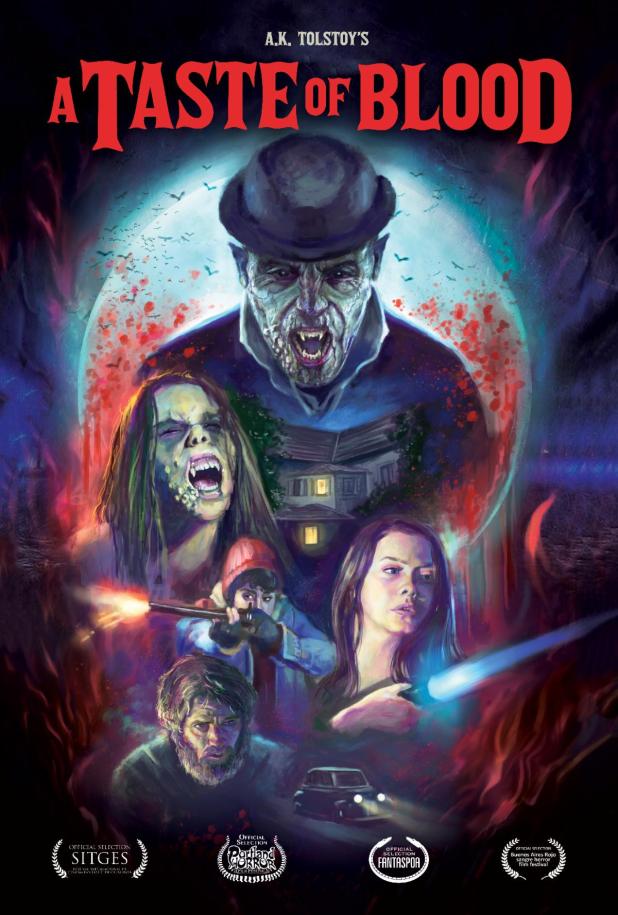
Based on Aleksey Tolstoy’s 1839 short story The Family Of The Vourdalak — you may remember that tale being made as part of Black Sabbathand the movie Viy — director and writer Santiago Fernández Calvete’s (The Exorcism of God, The Second Death) Sangre Vurdalak — retitled A Taste of Blood for U.S. audiences — this movie retells the tale of a vampire hunter named Aguirre (Germán Palacios) who has returned home in the moments between day and night to his locked-up family, unsure if he’s been turned into a vampire himself.
The family dynamics between his daughter Natalia (Alfonsina Carrocio), his son Manuel (Lautaro Bettoni), wife Eva (Naiara Awada), youngest daughter Malena (Carmela Merediz) and Natalia’s boyfriend Alexis (Tomás Carullo Luzzio) form the basis of this film, as they debate whether to let Aguirre into the home, as some are convinced that he has become a vourdalak, others believe he’s still human and we’re left to believe that outside of the supernatural, the patriarch of this family may have always been a monster.
It’s brave to try and make a story that Bava made so well, but this film moves the story to modern times, add guns and cars, yet ends up none the worse for it. It’s got some great tension and ends up standing quite well on its own.
A Taste of Blood is available on VOD and blu ray from Cleopatra Entertainment.
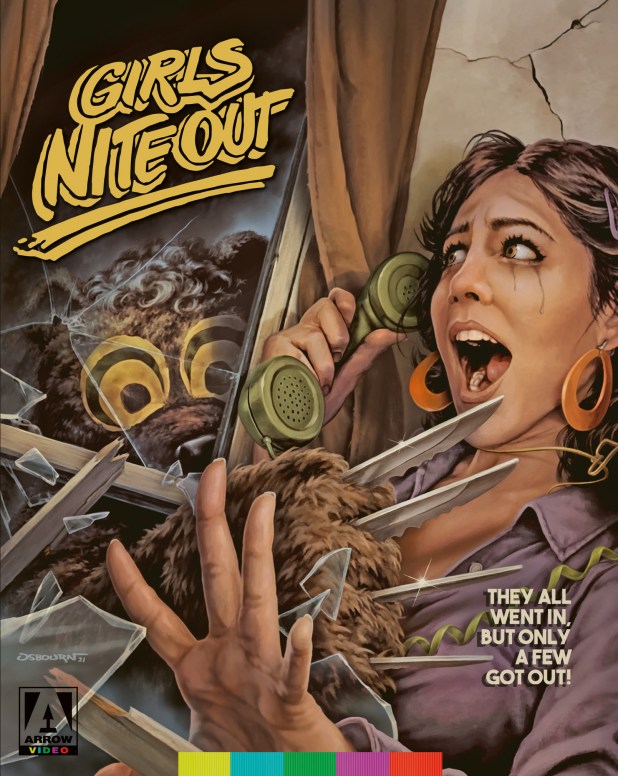
EDITOR’S NOTE: This originally was on the site on October 1, 2020 as part of one of the Slasher Months I do every year. Now, you can get the Arrow Video release of this movie. It comes complete with a brand new 2K restoration from 35mm vault elements; new audio commentary with genre film critic/author Justin Kerswell and film historian/author Amanda Reyes; new interviews with Julia Montgomery, Laura Summer, Lois Robbins, Paul Christie, Lauren-Marie Taylor and John Didrichsen, as well as an archival interview with Julia Montgomery; The Scaremaker alternate title card, original trailers, a reversible sleeve featuring original artwork and newly-commissioned artwork by Justin Osbourn and an illustrated collector’s booklet featuring new writing on the film by Michael Gingold. You can buy it from MVD.
First off, the fact that one of the posters for this film rips off Night School‘s art makes me love it before I’ve even seen one second of footage. Second, when I did watch it, it so shamelessly takes from other slashers that you’d very nearly be convinced that it was made in Italy.
Originally released as The Scaremaker, this was shot over the weekend at New Jersey’s Upsala College. That means that most of the scenes were shot in two takes or less.
After Dickie Cavanaugh kills his girlfriend in a jealous rage, gets committed and then hangs himself, all hell breaks loose. The men trying to bury him are killed and the school’s all-night scavenger hunt could not come at a worse time. Yes, I had no idea that when your college basketball team wins the big game everyone has to engage in just such a contest.
There’s a killer on the loose wearing the school’s bear costume, using serrated knives as if they were bear claws. There are lots of POV shots as if you’re being attacked by the bear and I always enjoy being the participant in a bear battle.
For a movie made on a shoestring, they got some big names. Hal Holbrook is on hand! Julia Montgomery from Revenge of the Nerds and Stewardess School (yes, she’s a star in my world)! Lauren-Marie Taylor (Vickie from the second Friday the 13th)! Page Mosely (who is something of a scream queen, with appearances in Open House, Edge of the Axe and this movie)! And most importantly Rutanya Alda, who makes this film all hers in the last few minutes, despite the fact that this movie rips off Mrs. Vorhees’ motivation, as all lower-level slashers must. I love Rutanya, who claims that she still hasn’t been paid her $5,000 fee for this movie. She should get way more than that, as the close is literally made so much better because of her commitment to more than one role.
If you’ve seen the trailers or poster for this, you may wonder, “Where are the girls in the artwork? Who is this girl in the trailer?” You are right to question these things, as the sales material was made reverse-Corman, in that it was created years after the film was complete.
EDITOR’S NOTE: This film originally appeared on our site all the way back on September 6, 2018. Now, Kino Lorber has released a blu ray of the film with a new 2K master, audio commentary by producer/director Greydon Clark, interviews with Tarah Nutter, Christopher S. Nelson, Dean Cundey, Daniel Grodnik and Greg Cannom, as well as the Mike Mendez Trailers from Hell for this movie, the original trailer and new art by Vince Evans.
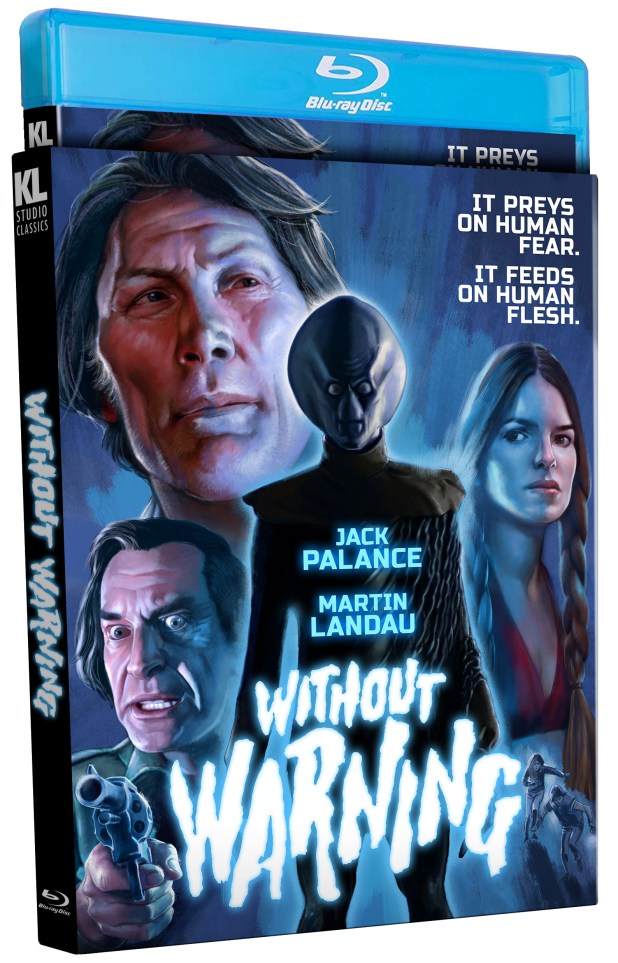
While other men hunt, an intergalactic hunter has come down from the stars to track the most dangerous game, invisibly hiding until it can kill them with its throwing star weaponry. The creature is played by Kevin Peter Hall. But this isn’t Predator! This came out seven years earlier! This is Without Warning!
The film opens with a father and his reluctant son hunting. In moments, they are killed by flying creatures that have tentacles that pierce their skin.
Meanwhile, four teens ignore the warnings of Joe Taylor (Jack Palance!) and decide to camp here. Is this a dangerous area? You bet. Not even F-Troop‘s Larry Storch can survive, as he is killed and his Cub Scout troops run into the woods.
Two of the teens die pretty much instantly and their bodies are found in a shack. As the survivors run, one of the creatures tries to attack them through the windshield. They go back to the truck stop and no one believes them except for PTSD veteran Fred “Sarge” Dobbs (Martin Landau, Ed Wood, Space: 1999).
Landau is great in this, as he descends into paranoia, sure that everyone is an alien. He’s a villain who is acting like the heroes of Invasion of the Body Snatchers or They Live.
It turns out that the shack is where the creature is keeping his trophy kills. Only Sandy survives, as Sarge goes nuttier than ever and Taylor sacrifices himself to stop the gigantic alien.
Greydon Clark directed this. You may know him from acting in films like Satan’s Sadists. Or perhaps you’ve seen one of his films, like Satan’s Cheerleaders.
Cameron Mitchell, Neville Brand and Ralph Meeker all show up to add some Old Hollywood to the proceedings. And then there’s a young David Caruso as one of the teens. Don’t blink or you’ll miss Cinemax late night icon Darby Hinton (Malibu Express)!
The majority of the film’s budget went to having Landau and Palance on board, as well as having Rick Baker design the creature’s head. And hey! Dean Cundey (Halloween) makes this movie look way better than it’s $150,000 budget would lead you to believe!



 B&S About Movies
You must be logged in to post a comment.