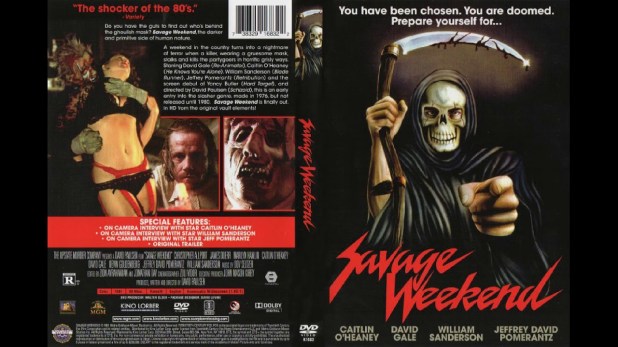
While it wasn’t released until 1979, the movie that became Savage Weekend — also The Killer Behind the Mask — started as The Upstate Murders. That means that it predates most of the commonly accepted “first” slashers like Halloween and Friday the 13th.
This is a slasher with the most ridiculous of conceits — everyone comes to upstate New York to see a new schooner — but it also has a heroic gay character (Nicky, played by Christopher Allport, who was in both Jack Frost movies and ironically killed in real life by an avalanche) and a woman escaping a bad marriage which seemingly has followed her. Also, since the aspect ratio got screwed up, the boom mic is a frequent co-star.
That said, it has a sewing needle through the head, someone accidentally killed by a bandsaw when the wrong light switch gets turned on, a hanging and an Upstate New York Chainsaw Massacre. It’s not perfect — it’s barely even worthwhile — but at least director/writer got to go on and make the much more interesting Schizoid, which has hot tub therapy sessions, scissor murders, Donna Wilkes being in love with her father Klaus Kinski and a love scene where Kinski has sex with a stripper against a hot water heater.
EDITOR’S NOTE: This is the third time we’ve posted about this movie. Sam wrote about it on and Jennifer Upton wrote a great article on November 27, 2018. Here’s her take on the film. Feel free to share yours in the comments.
Thanks to Jennifer Upton for contributing this review. An American living in London, she is a freelance writer for International publishers Story Terrace and others. In addition, she has a blog where she frequently writes about horror and sci-fi called Womanycom.
The 1970s were the pinnacle decade for Bigfoot films.
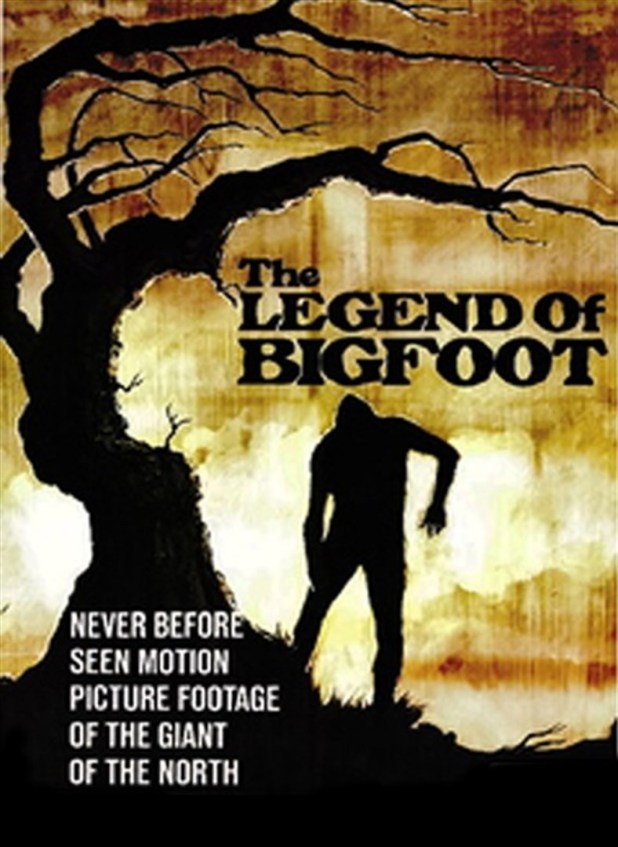
The film that kicked off the craze was Charles B. Pierce’s classic Legend of Boggy Creek, which was a huge hit on the Drive-In circuit in 1972. Derivative in style to this far superior predecessor, The Legend of Bigfootis a 1976 docudrama that follows researcher/tracker/nature photographer Ivan Marx on an expedition to find the elusive creature. Through narration of footage shot by Marx himself, he guides the audience through a series of events that may or may not prove the existence of the elusive North American ape. Where Boggy Creek succeeds in re-creating some supposedly true stories to great (and creepy) impact, Legend wastes a lot of time on lengthy digressions that focus on the other animals that live in the creature’s habitat.
In his search, Marx travels from his home in Northern California to Alaska, Oregon, Arizona and even the Arctic Circle. Along the way, we see Musk Oxen, Moose, deer and many other animals. We see them chilling out, defending their territories, eating and basically doing what animals do. Unfortunately, we are also subjected to several scenes of what today, would be considered animal cruelty. These include footage of a cougar being forcibly removed from its den and a mortally wounded ground squirrel dragging itself to its nest to die. Animal lovers beware.
The nature footage and gorgeous landscapes probably looked great in their time, but Mill Creek’s extremely poor transfer is almost unwatchable on a modern high-resolution Television. Even a basic color correction on a home editing system would go a long way towards improving the source material. At times, it’s hard to even make out what’s happening in the darker shots.
True to the Bigfoot subgenre, Legend includes a lot of close-ups of footprints and incorporates many theories of the creature’s potential lifestyle and habits. What the film is probably most famous for is the conclusion, which features what Marx claimed was actual footage of a real Sasquatch. Spoiler Alert: It’s a guy in a gorilla suit. It was just one of many hoaxes perpetrated by Mr. Marx over the years, leaving his reputation maligned within the Cryptozoology community. Nevertheless, he released two sequels. In the Shadow of Bigfoot (1977) and Alive and Well (1982) and maintained his footage was real up until his death in 1999. All but the biggest Bigfoot aficionados would do well to avoid The Legend of Bigfoot.
It’s duller than many other films of its type and at a running time of 1 hour and 16 minutes, it feels a lot longer. In the beginning Marx opines, “You’ll never know what it is to wait…until you become a tracker.” Yes, Mr. Marx, we do know what it is to wait…for something to happen in this movie.
Man, the same Nick Millard that made this made Death Nurse? Because wow, this movie is everything my scuzzy dreams are looking for, from fuzzed out sound to priests who have been dead for years and nuns who had a vision of Satan and turned their backs on the church and vampires and yeah, this is a vision of the inside of my brain.
The teeth and the blood are fake, the feel is real. I want to climb inside the darkness of this movie and take the longest, most fulfilling nap of my life, waking up to realize I still have two hours before the alarm goes off and just stretching out on a California king.
Mark comes home because his sister Nina has died, but he finds out she was making a book so vile that it still haunts a bookstore worker named Jean. Yeah, it haunts her so much that she and Mark break the narrative flow with the power of their lovemaking — where do you want to sleep, Dr. Challis indeed — but it’s 61 minutes that will make your life better, made by a man who constructed a crypt inside his garage.
“Whosoever believeth in him, shall have life everlasting in darkness. He is pleased with you, Nina. He called you daughter. Now you must complete the covenant. Every member of your family must die.”
All hail Nick Millard.
Here’s a drink for this movie.
Fall Not White Wedding
4 oz. apple cider
2 oz. salted caramel whiskey
2 oz. ginger ale
.5 oz. Fireball
Pour cider, salted caramel whiskey and fireball into a glass filled with crushed ice.
Top with ginger ale and say you love, well, you know who.
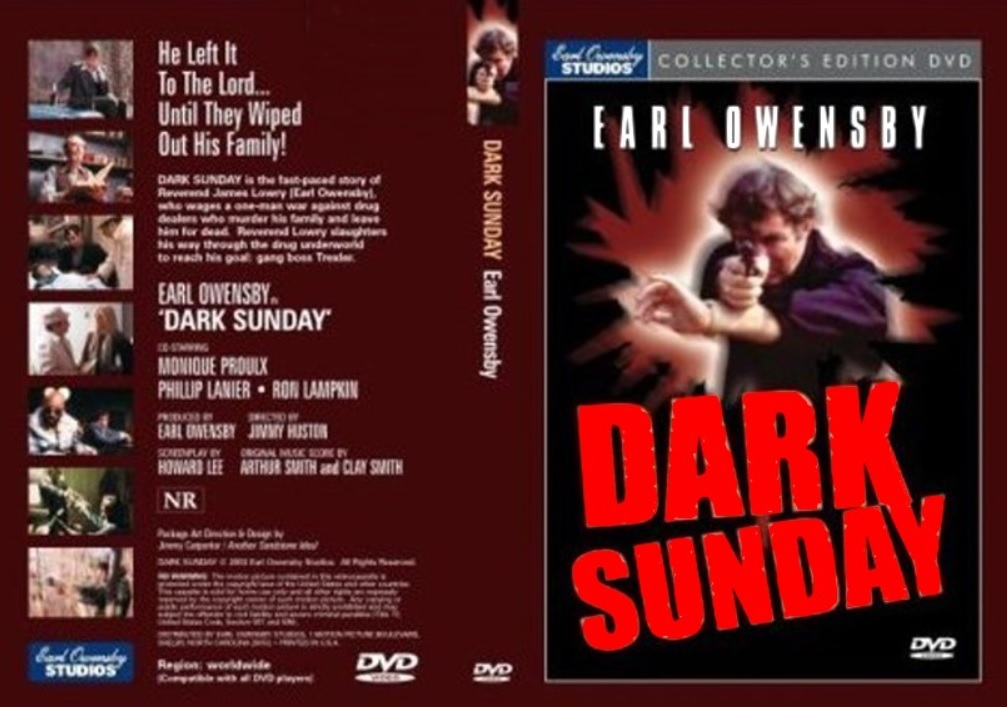
Grindhouse and drive-in purveyor Earl Owensby, who made his producing-acting debut with the 1974 one-two punch of a Walking Tall (1973) ripoff called Challenge and its sequel, The Brass Ring, tossed a clergy collar on his ersatz Buford Pusser — and changed his name to the Reverend James Lowery — for this, his third movie: a Death Wish (1974) rip off. Since the film has a priest dolling out the justice, Dark Sunday ends up as a weird, obscure sidebar on many a Christploitation, aka Godsploitation, lists.
Regardless of Dark Sunday ending up on those critical lists, Earl Owensby will always be known best for his fifth film, Buckstone County Prison (1978), a film which crossed the chain-gang classic Cool Hand Luke with the biker-karate-Indian actioner Billy Jack. There’s fourteen more films to chose from Owensby’s vanity-producing resume — of which he acted in eleven. Sure, none of them have a lick of originally between them, but Owensby is always committed to his leading man role and his films are never not entertaining. And, most importantly, they always made bank in the big city, sticky-floored in-doors and backwater drive-ins — Buckstone being the most successful of the bunch.
The Maltese Falcon? Uh. . . . Well, WRPL, aka “Ripple Radio” was a real station in Charlotte, North Carolina, so if that’s what Lloyd Rose saw,an ersatz Sam Spade, it is.
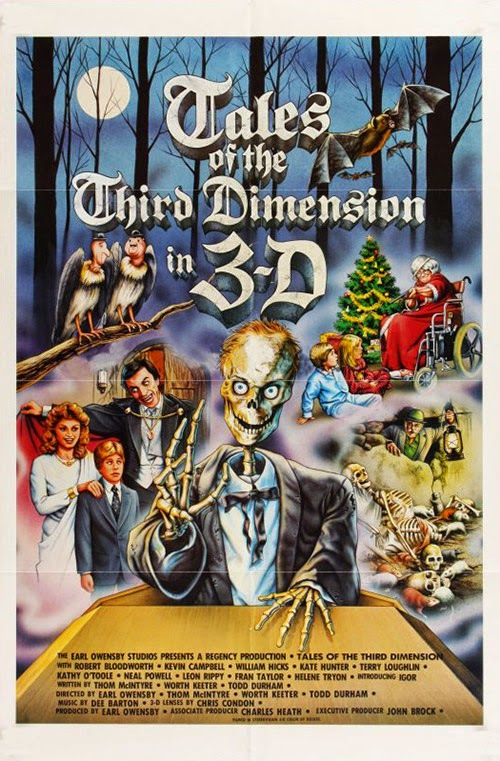
You need need a ripoff of Burt Reynolds’s Hooper when that’s missing from the rental shelf? Earl’s got one: Death Driver (1977). Smokey and the Bandit rented out? Pick up a copy of Hit the Road Running (1987). Need a wolfman flick? Check out as Earl as the cursed Colin Glasgow in Wolfman (1979; co-starring R.C. Nanney, aka North Carolina-famed disc jockey “Curly Lee,” also of 1979’s Knobby the Belwood Wampus Cat). In the mood for a killer dog flick? Check out Earl as a backwater sheriff fighting off government-bred mutts in Dogs of Hell (1983). Need another Cool Hand Luke rip to fill the void of Clint Eastwood’s Escape from Alcatraz being rented out? Grab a copy of Chain Gang (1984). Heck, Owensby has done it all: even portraying (a faux) Elvis — with a Roy Orbison vocal assist — in Living Legend: The King of Rock and Roll (1980). Yeah, Earl also jumped on the slasher bandwagons to the lands of Carpenter with Day of Judgement. You need a retro-horror omibus, well, a “3-D” bandwagoner? Earl’s got one: Tales of the Third Dimension in 3-D (and both are also very “Godsploitation” and Christ exploity).
Okay, enough with the Earl Owensby love. Let’s unpack Dark Sunday.
Reverend James Lowery is a skid row reverend helping young junkies to a better life through his homegrown flophouse and rehab center. Needless to say: a cured and Chirst-saved junkie is one less customer for “the Candyman,” a local drug dealer. So ol’ Candy sends his goons after the good minister for cutting in on his action — and they blow away the Reverend’s wife and kids at a riverside picnic. His wife and son, Eric, are dead. His son Jody, survives. And the Rev is left mute with a bullet-shattered voice box.
Let thou the seven seals of revenge be broken.
As with Death Wish (1974), as well as Dirty Harry (1971) and Magnum Force (1973), inspiring the Italian film industry with a series of gritty, brutal revenge films, aka Poliziotteschi, this Jimmy Huston-directed and Early Owensby-produced Bronson-Eastwood amalgamate — due to its way over-the-top violence — actually pinches from the Italian knockoffs. In fact, due to its ultraviolence, the revenge proceedings play as a “white” version of a blaxploitation actioner.
Yeah, sure, while well-shot and edited, everything about this against-the-budgeter from the Owensby House of Flicks is cheap and ripped off from other, better known movies. But Earl Owensby is an engaging, passionate actor on screen and he keeps you watching. And you can’t not stick around to see how much more violent this southern-baked grindhouser can get: for that “NR” rating on the DVD sleeve just ain’t whistlin’ dixie, Cletus.
After four films with Owensby — Dark Sunday being his debut, along with The Brass Ring, Death Driver and Buckstone County Prison — Jimmy Huston went off on his own. As with Owensby, Huston ripped off everyone, as well, starting with the (very) Carpenter-inspired Final Exam (1981), and the ’80s de rigueur vamp-comedy, My Best Friend Is a Vampire (1987). The last time we heard from Huston in the director’s chair was the Lou Diamond Phillips and Judge Reinhold-starrer, The Wharf Rat (1995). His greatest success was writing the Lethal Weapon variant Running Scared (1986) starring Gregory Hines and Billy Crystal.
If you love the grindhouse and drive-in cinema of old, make a point of watching at least one of Earl Owensby’s films in your travels — but more than one, if you can. You can watch Dark Sunday on You Tube. You’ll be glad you did.
You can learn more about the still-active Earl Owensby Studios (James Cameron’s The Abyss was shot there) and purchase Earl’s films direct from the studio’s website. There’s also a nicely written Wikipage on Earl’s accomplishments. In 1997, longtime Owensby associate Noel T. Manning produced a touching, feature-length documentary, Earl Owensby: The Man, the Myth, which is legally available on You Tube via Manning’s personal page.
About the Author: You can learn more about the writings of R.D Francis on Facebook.He also writes forB&S About Movies.
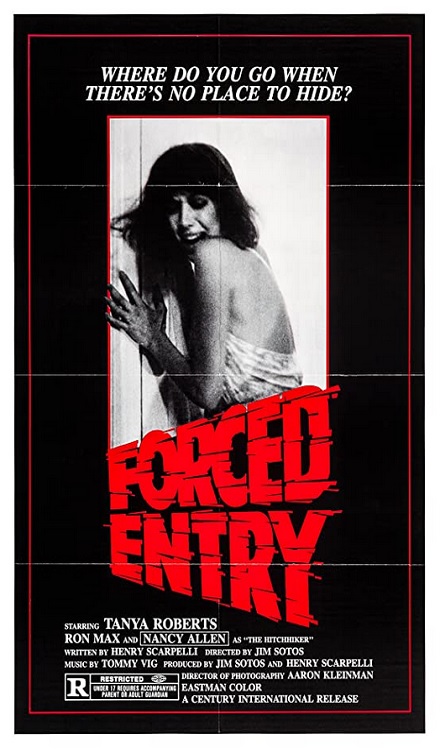
Yeah, we know this 1975 celluloid nasty isn’t officially on the U.K.’s “Video Nasties” three-part section lists that we are covering this week, but this big screen acting debut by Tanya Roberts — a commercialized, mainstream remake of the X-rated adult film/grindhouse’er Forced Entry (1973) — was none the less refused a U.K. cinema certificate in 1982.
That 1982 theatrical release — which also found a home on U.S. screens of the slowly dying drive-in era — came result of Tanya Roberts scoring the biggest roles of her career: ABC-TV’s Charlie’s Angels in 1980 and a theatrical hit with Don Coscarelli’s The Beastmaster (1982). Initially playing to drive-in audiences throughout 1976 under the title of its inspirational predecessor, Forced Entry returned to drive-ins with a post-Halloween slasher marketing make-over. The “madman” adjective in the copy under The Last Victim title was added to carry through the très chic faux-giallo/slasher connection — considering a slasher interpretation of the New York-based Cropsey urban legend, Madman (1982), rolled out on screens beginning in January.
Sadly, in a post-Charlie’s Angels world, the 93-minute original, first released in October 1975, was cut-down to 75-minutes; then to a third-time 72-minute edit in 1982 to pull a PG-rating to further capitalize on Tanya Roberts’s stardom. That cleaner theatrical cut was the result of fellow pin-up Barbie Benton experiencing box-office slasher success with Cannon Films’ Hospital Massacre (1982) released in July. The subsequent home-VHS, while nasty and rough, was “cleaned up” yet again, at 88 minutes — with Tanya’s more violence scenes truncated and Nancy “Robocop” Allen’s violent rape scene excised from all post-1975 versions.
So, who in their right mind would attempt “commercializing” a porn film into a Wes Craven’s The Last House on the Left (1972) cash-in clone?
We’ve dropped Jim Sotos a few times at B&S About Movies, by way of his directing the ’80s slasher Sweet Sixteen (1983) starring Bo Hopkins, and producing the adult film-connected hicksploitation romp Texas Lightning (1981). That “adult” connection comes by way of Adult Video News Hall of Fame filmmaker Gary Graver hired by Sotos as director. Sometime aka’ing as Robert McCallum, Graver made over 130 adult films, such as Amanda By Night, Coed Fever, and Suzie Superstar. One of his flicks, Unthinkable, won the AVN Award for “Best All-Sex Video” in 1985 (meaning it, as did most porns, had no plot).
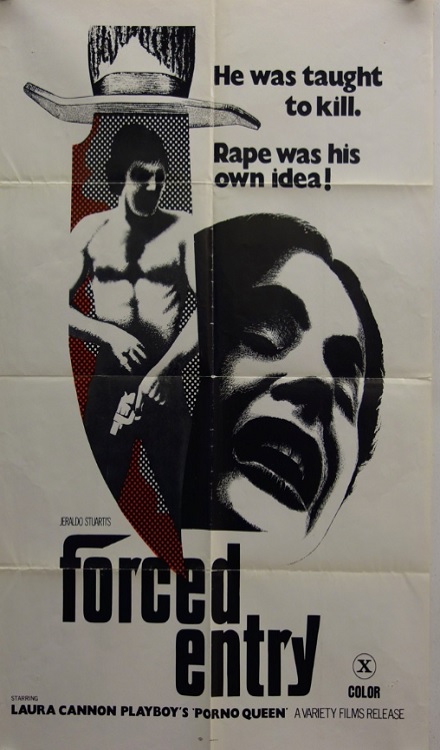
Here, Jim Sotos gives an R-rated makeover to porn purveyor Shaun Costello’s X-rated Forced Entry (1973). Starring adult film superstar Harry Reems, that film also aka’d as The Last Victim during its later behind-the-beaded curtain video shelf life in some quarters. (Costello also moved into the non-porn area and Romero zombiedom with Gamma 693.) For the remake, in place of adult actresses Laura Cannon (star of numerous Playboy loops; aka Laurel Canyon of 1972’s Wrong Way, itself a U.K. “video nasty”), Ruby Runhouse and Nina Fawcett, we get Nancy Allen — in her second film after working with Jack Nicholson in Hal Ashby’s The Last Detail (1973) — and a future Charlie’s Angel, well, not until she got past the likes of Tourist Trap (1979) and the David Winters-directed adult comedy, Racquet (1979).
The Shaun Costello original — his feature film writing and directorial debut after making porn-shorts, aka “loops” — filmed at the hippie loft of Ruby Runhouse and Nina Fawcett who allowed its use for filming as long as they could be in the film. Not only could they not act: they ended up so high on mescaline that their scene took five hours to shoot — and Costello had no choice but to work their drugged-out personas into the plot. Harry Reems — star of the “Golden Age of Porn” blockbusters Deep Throat and The Devil in Miss Jones — has said Forced Entry is the only film he regrets making.
While the Costello original is — as result of its misogynistic ultra-violence that would make even the most discriminating fan of Stanley Kubrick’s A Clockwork Orange (1971) cringe — critically derided, it’s also critically noted as one of the first films to depict a disturbed soldier returning from Vietnam — predating Martin Scorsese’s Travis Bickle in Taxi Driver (1976). It’s also regarded as a pivotal film in the later, giallo-inspired serial killer/slasher genre of the ’80s — predating John Carpenter’s Halloween (1978).
Unfortunately, the film’s pornographic activities overshadowed Costello striving to raise the story and character qualities of adult films, courtesy of his injecting a discourse on the rise of feminism and the independent woman, and the errs of war-mongering and the American military’s reluctance to address post-traumatic stress disorders in returning Vietnam veterans. To carry through his anti-war message, Costello depicted his antagonist with “flashbacks” to his days in Vietnam — via stock war footage cut with new, original footage — while he committed his acts of rape and murder.
If Jim Sotos had waited a couple of years for that post-Carpenter slasher-era to arrive, his remake of Forced Entry as The Last Victim may have been as well remembered as some of the slasher copies it predated, such as William Lustig’s similar — and far superior-made — Maniac (1980).
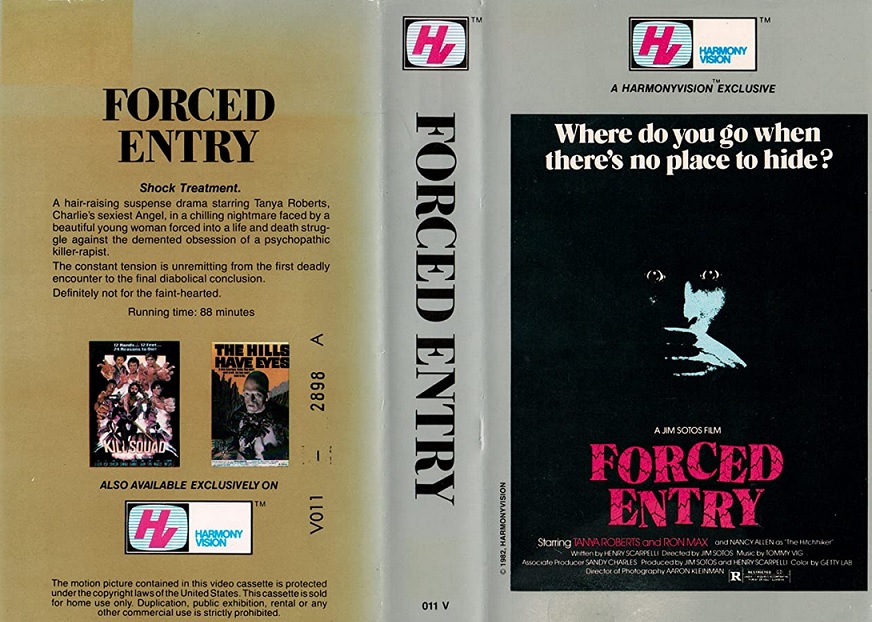
Again, as the video ’80s arrived — and Tanya Roberts star rose courtesy of her working on Charlie’s Angels in 1980 and then-hot Don Coscarelli’s first post-Phantasm movie, The Beastmaster (1982) — Harmony Vision took up the cause and released The Last Victim on VHS in the U.S. via the 88-minute version. The later Dark Force Entertainment Blu-ray released in 2019, which includes both the The Last Victim (75 minutes) and Forced Entry at (72 minutes) drive-in/theatrical-distributed versions, differs from the Harmony VHS version. The infamous wine bottle rape and Nancy Allen’s nude bondage scenes are missing from all of these prints. The 93-minute original has yet to be digitally restored and can only been seen via non-Harmony VHS-imprints.
In the Costello Forced Entry original, Harry Reems, aka Tim Long (again, to shed the porn stigma into mainstream acceptance), stars as a nameless Vietnam war vet who, like Travis Bickle after him, carries on a lonely life at a gas station where lives and works. Unlike most adult films, Costello classes the porn proceedings as he begins the story in media res — courtesy of a non-linear narrative structure indisputably influenced by the Billy Wilder’s classic film noirs Double Indemnity (1944) and Sunset Boulevard (1950): the film begins with detectives at a crime scene with a man shot in the head.
As the story unfolds, we come to learn the vet, through credit card receipts or lost travelers in need of directions, tracks down his victims, peeps at them, then later breaks in to sodomize and rape them — then murder, after he climaxes. Upon a having a psychotic break during one of the rapes (with the aforementioned, real life wigged-out Ruby Runhouse and Nina Fawcett), he commits suicide; the film then — as with the Wilder films before it — returns to the beginning with the sheet-covered body taken away by the police.
Say what you will about adult films of the singular-to-triple X ’70s, but Costello’s Forced Entry, while repugnant in the context of its graphic sex and rape portrayals, should be as highly regarded as the “Golden Age of Porn” classics of Deep Throat, The Devil in Miss Jones, and Behind the Green Door. Costello beat Justin Simmonds and John Howard’s joint post-Halloween effort Spine (1986) in logically cross-pollinating the porn and slasher genres.
(Due the the content, you can only view the trailer for Force Entry (1973) as a You Tube account sign in.)
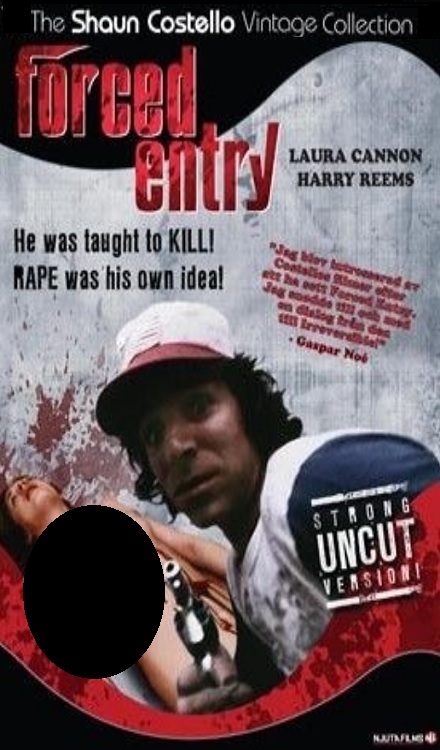
While the 16mm-shot film is rough — in terms of its overall quality, to the point of being an ’80s SOV — Costello none the less produced an effectively framed, well-made film for $6,200 in two days — and took five months to edit. And the time in the editing suite shows, which is why the film influenced — and he offered a quote to the DVD reissue — Gaspar Noé in the making of his art-house rape-revenge film Irréversible (2002).
As discussed in our review of the recent Australian rape-revenge import, Rage (2021), that film, as did Noé’s, while brutal, is on the respect-level of Takashi Ishii’s Freeze Me (2000). And for as hard as it is for some (most) to watch Gaspar Noé’s non-exploitative Irréversible, and Rage and Freeze Me are analogous in their “hard to watch” moments, Shaun Costello’s Forced Entry harbors that same respect.
Granted, Costello’s 1973 work smacks with the scuzzy aftertaste of its raison d’être in The Last House on the Left (1972), but Costello’s Forced Entry rivals Wes Craven’s effort; Costello’s film is the more powerful, message-driven originator that should be revered and remembered; Meir Zarchi’s later I Spit On Your Grave (1978) is not of that caliber; nor William Freut’s Death Weekend (1976), as both are violence and rape for the sake of exploitative shock value. While undeniably cleaner and non-sexual in nature — and certainly not an influence on filmmaker Joshua Reale’s Necropath (2021) — there’s an undeniable through line from the work of Shaun Costello to Reale’s work. Both are dark, graphic works that intelligently expunge the objective for the subjective to take us into the mind of their antagonists.
Harmony Vision’s ’80s VHS repack of The Last Victim (1976). Notice the Charlie’s Angel’s copywriting-marketing angleand 88-minute run time.Check out this clip for the “Staten Island Scene” with Nancy Allen.
The same enthusiasm can’t be expressed for The Last Victim (1976), which, why still hyper-violent in its original form, is still watered down — and dumbed-down — for gone are Costello’s feminist and post-Vietnam subtexts. So we’re left with a film that’s actually closer to the mindless, rape-revenge sleaze of The Last House on the Left (1972) that the original Forced Entry (1973) copied — but rose to the next level.
In The Last Victim, our nameless maniac war vet of the original isn’t a war vet: Carl — while still a gas station attendant/mechanic — is now the product of a mentally-unstable mother who reveled in child abuse (a plot-point used in Joy “J.N” Houck, Jr.’s sloppy drive-in rip of Alfred Hitchcock’s Psycho with 1969’s Night of Bloody Horror). And the point-of-view changes in the remake. Gone is the subjective storytelling of Costello’s film that took us inside the killer. Sure, we are seeing things from Carl’s point-of-view; however, the “POV” is just a camera angle that gives us no-insights and couldn’t be more non-giallo in style; we simply travel on the road with Carl on the hunt for his station’s female customers that tickled his fancy. His mother screwed him up; he hates women; so he hunts women for rape and murder targets. And he ho-hum chokes, and stabs, and gets creative with beer bottles. The third-act twist, this time — since we’re devoid of the mescaline-stoned hippy chicks that altered the third act of Forced Entry — is Carl falls “in love” with his latest victim, played by Tanya Roberts, who is able to channel her terror against Carl by taking advantage of his “romantic” feelings.
Shaun Costello’s film has originality on its side as it attempted to take the “Golden Age of Porn” from an underground “très chic” image to a wider, commercial respectability; his only stumble was not taking a lesson from Nicolos Roeg’s in pulling the reins on the film’s porn-sexual components. Costello was almost there. Adapting Billy Wilder’s in media res noir-storytelling was inspired; a Roeg-softer, artful touch, as deployed in Don’t Look Now (1973), his mainstream, British Giallo exploration on the psychology of grief and the effects of trauma, would have been — pardon the pun — the cherry on top. (If you’re not familiar with scene: To get past the sensors, Roeg fragmentary softened-the-shock of the then “graphic” depiction of sexual intercourse between Julie Christie and Donald Sutherland post-coitally preparing to go out to a dinner party.)
Meanwhile, Jim Sotos gives us a 15-year-old girl who stops to put air in her bike tire, only to end up as Carl’s latest bondage and rape victim (in lieu of Nancy Allen’s hitchhiker bondage-rape) — with no reason, purpose, or point. If Sotos wanted to copy Craven’s Last House-offensiveness, he succeeded. And if you’ve seen Sotos’s Sweet Sixteen, with its 15-year-old female antagonist on the cusp of 16 picking up men in bars and luring them to a Native America burial ground for a roll in the sticks . . . well, if you wondered how (boring) offensive (and what the deal is with Sotos and 15 year olds) an ’80s slasher can be, that’s your film.
In the end: The Last Victim (1976) is just a slasher flick — a scuzzy hunk of celluloid utterly devoid of any John Carpenter class that’s best forgotten; one that inspires you to seek out William Lustig’s superior Maniac (1980) starring a tour de force Joe Spinell. Sure, you may dismiss the original Forced Entry (1973) as a “porn flick,” but it was a porn flick with a purpose possessed with a sense of style.
* Look for our upcoming reviews (Hey, they’re done!) of Gamma 693 and I Spit on Your Grave as we continue to explore more ’80s “Video Nasties” at B&S About Movies. Click on the images below to read each feature at your leisure.
Update, May 8, 2021: We’ve come to learn that Dark Force Entertainment, via a Facebook press release, will reissue the R-Rated U.S. theatrical version of Forced Entry. This 86-minute version — according to their release — contains about 10 more minutes of nudity and rape than the previous two director-cut versions featured on The Last Victim release from Dark Force.
From the Dark Force release: “One of the most confusing titles ever, we finally figured out the puzzle of this awesome 1976 [1975] movie, which underwent several cuts and both R and PG ratings. We found the original 35mm camera negative to the U.S. theatrical version which, went under the title Forced Entry. It is only missing about 2 minutes that is contained in the VHS release, which was the most complete version of the movie ever released. Confused yet? Don’t be, this movie is DEFINITELY worth the fuss and this will be the best looking and most complete, Hi-Def version available on the market. This release will be dedicated to the memory of [the late] Tanya Roberts. Coming in 2021 from Dark Force.”
According to Dark Force, via this May 8 press release, there are six versions of the Tanya Roberts-version: 1) The original PG-rated THE LAST VICTIM cut (they believe this is the same as THE LAST VICTIM cut on the Dark Force Blu-ray), 2) The Harmony Vision VHS, titled FORCED ENTRY, 3) The Intervision VHS, titled THE LAST VICTIM, 4) The 1981 theatrical version, titled FORCED ENTRY, 5) The 1983 theatrical re-release, titled FORCED ENTRY, 6) The director’s cut of FORCED ENTRY, as released on Dark Force’s first Blu-ray.
Update, again: This is now out on Blu-ray! Learn more with this Dark Force Facebook post.
About the Author: You can learn more about the writings of R.D Francis on Facebook.He also writes for B&S About Movies.
Here’s the U.K. Section 3 “video nasty” in the man-against-the-wilderness genre that began with Sam Peckinpaw’s Straw Dogs (1971) from 20th Century Fox and solidified with John Boorman’s Deliverance (1972) from Warner Bros. Produced for a little over $2 million, Straw Dogs stumbled with $8 million in U.S. box office. Produced for $2 million, Deliverance raked-in over $46 million in U.S. box office: thus, we remember and credit Boorman’s work for kickstarting the genre — as well as the revenge-rape sub-genre.
The revenge-rape sub-genre quantified with Wes Craven’s The Last House on the Left (1972), which was a sloppy n’ scuzzy, grindhouse remake of Ingmar Bergman’s tasteful-superior The Virgin Spring (1960). The sub-genre only got worse with the likes of the bogus, faux “sequels” in Roger Watkin’s Last House on a Dead End Street (1977) and Francesco Prosperi’s The Last House on the Beach (1978). Then there’s Charles Kaufman’s black comedic take on the genre — courtesy of the joint thespian tour de force by the actors behind Mother and her hicksploitation-bent sons Ike and Addley — with Mother’s Day (1980). Even Aldo Lado, he of the (brutal) Dario Argento rips Short Night of Glass Dolls (1971) and Who Saw Her Die? (1972), got on board the “Last House” caboose with Last Stop on the Night Train (1975), which — amid its Hallmark Releasing title myriads for drive-in and home video — was known as The New House on The Left,Second House on The Left, and Last House Part II.
While James Dickey’s screenplay was based on his novel Deliverance — which takes the Ingmar Bergman highroad — was graphic in nature, the violence was merely a delivery system of an underlying social statement about America’s class structure asking the questions: Who is stronger in a battle of wills between primitive man vs. civilized man. How deep into one’s base instincts will a civilized man delve for self-preservation?
So when you have a film produced for a couple million bucks pulling down mid-double digit millions at the box office, you know what that means: here comes the cash-in knockoffs.
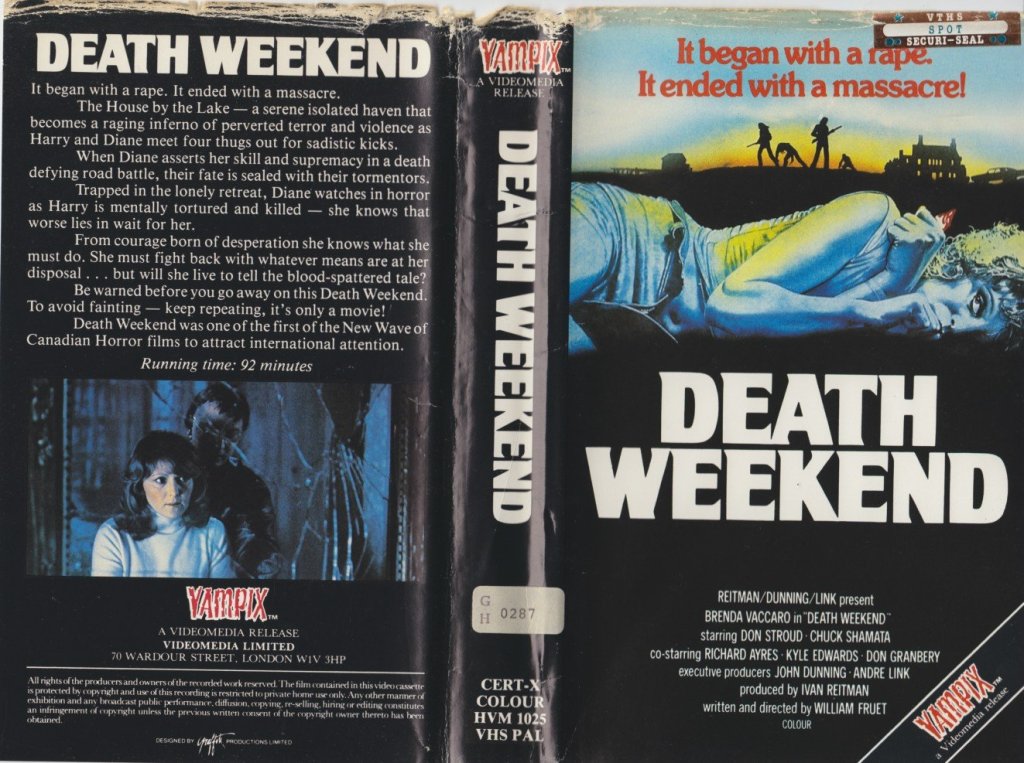
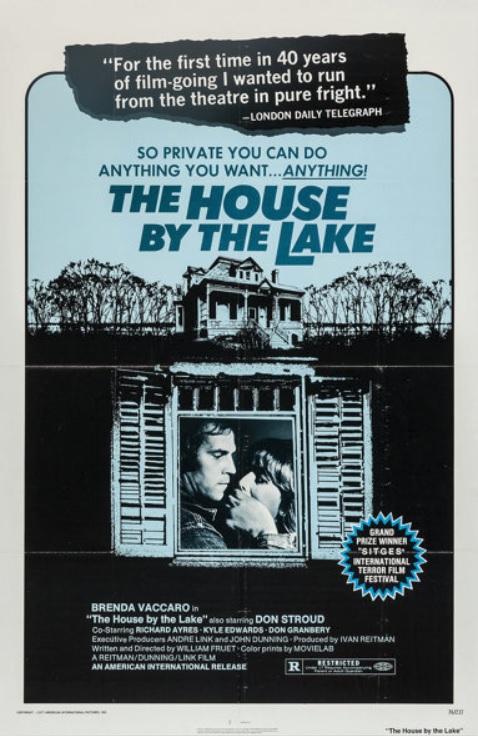
Originally released as Death Weekend in its native Canada, then released as House by the Lake during its U.S. Drive-In run, it returned to the Death Weekend title on home videovia a number of imprints, but Vestron Video in the U.S.
All of the subsequent man-against-the-wilderness tales produced in the Deliverance/Straw Dogs backwash threw away plots (that were cookie cutter boiler plates, anyway), character development and underlying themes, and amped the violence — even more so in a post-John Carpenter Halloween world of the faux-Giallo variety. Macon County Line (1974), Death Weekend (1976), Jackson County Jail (1976), Rituals (1977), Just Before Dawn (1981), and Walter Hill’s Southern Comfort (1981) each own their debt to Boorman’s backwoods-terror vision. The home invasion and rape-revenge genre went off the graphic rails with the likes of Sergio Martino’s Torso (1973), only to get cheaper and shoddier with the likes of Linda Blair’s Grotesque (1988), then more “artful” with the likes of Gaspar Noe’s Irreversible (2002) and Takashi’s Ishii’s Freeze Me (2000). The most infamously scuzzy of the bunch is Meir Zarchi’s I Spit on Your Grave (1978). And the genre continues as streaming fodder with the classy Australian change-up, Rage (2021).
Released to Drive-Ins as The House by the Lake, and then bestowed the Death Weekend title for home video, this low-grade Canadian inversion of the genre produced for a half million dollars was written and directed by William Fruet for American-International Pictures. The film caused quite the stir as result of the intensity — more so that what we watched in Straw Dogs and Deliverance — for its drudgery in violence and rape for the sake of violence and rape. While Brenda Vaccaro and Don Stroud are stellar in their roles, the “message” was tossed out to tumble down the main road and leaves us with a movie that makes us wanting to take a shower after watching. It’s no wonder the VHS was seized and confiscated in the U.K. under “Section 3” of the Obscene Publications Act of 1959 during the “Video Nasty” panic of the ’80s.
The U.S. and English-Canada VHS released by Vestron as Death Weekend is sans three scenes: an additional shot of Don Stroud’s Lep on top of Brenda Vaccaro’s Diane as he attempts to rape her, a more graphic shot of Diane slashing Richard Ayers’s Runt’s throat, and a longer shot of Don Granberry’s Stanley burning to death. However, French Canadian and Spanish home video renters were allowed to watch those scenes, intact. Death Weekend has yet to receive a domestic U.S. DVD release; it was released in Sweden as an uncut DVD in 2017 by Studio S Entertainment; in 2019, Death Weekend was released on Blu-ray in Germany. Once offered as an a U.S. VOD stream by Amazon, the film is no longer available. Diabolic DVD has copies of the Swedish all-region Blu-ray, but are currently out-of-stock (keep checking back with them for re-stocking information).
Writer and director William Fruet is a name we speak of often amid the digitized pages of B&S About Movies, as we’ve enjoyed his oft-HBO-ran works Search and Destroy (1979), Funeral Home (1980), Spasms (1983), Bedroom Eyes (1984), Killer Party (1986), and his Alien-inspired AIDS cautionary tale Blue Monkey (1987). And we particular enjoyed his long-not-seen radio DJ drama that he wrote, but did not direct, Slipstream (1973).
Fruet revisited the ‘ol fish-out-of-water backwoods shenanigans (with a unique hick-impaled-by-TV antenna scene and an unstoppable Henry Silva thespin’ it up while doused in hot tar) with Baker County, U.S.A. That film’s script came courtesy of ‘80s slasher-scribe John Beaird, who penned the entertaining My Bloody Valentine and Happy Birthday to Me. Shot for $2 million by Fruet, affectionately referred to as the “Roger Corman of Canada,” Baker County, U.S.A is basically the canuxploitation-version of the later-shot Hunter’s Blood (1986), itself a retread of John Boorman’s 1972 hicksploitation trendsetter.
While Fruet already proved his skills as a director on his first feature film, Wedding in White (1972), a film starring Donald Pleasence and Carol Kane that he also wrote, he fell out of favor with the theatrical industry to find work in television. An opportunity to get back into theatrical film work came courtesy of Ivan Retiman (later the director of Meatballs (1979), Stripes (1981) and Ghostbusters (1984)) and Don Carmody, who successfully produced David Cronenberg’s Shivers (1975) through Cinepix Films. They wanted another horror film: Fruet gave them Death Weekend. When the film was acquired by A.I.P – American International Pictures for U.S. Drive-Ins, the distributor changed the title to the House by the Lake for an all-female revenge double-bill with Wes Craven’s The Last House on the Left, which raked in the dough during its run.
Is there a statement here as to the way socially maladjusted men view women as “meat,” with Brenda Vacarro’s Diane dually serving as nothing more than an objectified outlet for Don Stroud (and his repulsive backwoods buddies) to channel his mental impotence-born violence (everything be “the bitches” fault), while her weekend-fling dentist playboy (who enjoys snapping pictures through two-way mirrors) sees women as disposable play toys? Is there a statement that, regardless of education and social standing, “men are men,” that is, pigs slopping in the same trough, when it comes down to gratifying their base desires?
No.
When Varcaro’s Diane, who accepts a “weekend at my lake house” invitation from a successful dental surgeon, are we supposed to look at her as an opportunistic “gold digger” that deserves the terror of torture and rape? When she takes the wheel of her weekend fling’s shiny Corvette and gets involved in a faux-drag-cum-road race and runs Lep (Stroud) off the road, does she deserve a comeuppance for not knowing her place?
No.
Sure, William Freut put everything together well enough, and Brenda Vaccaro and Don Stroud are, again, stellar, but personally, I can’t rank this alongside Sam Peckinpaw’s Straw Dogs and John Boorman’s Deliverance. There’s a reason why, beyond clever marketing, Freut’s home invasion-cum-rape-revenge was paired with Wes Craven’s The Last House on the Left and it found itself on the U.K.’s video nasty list. Fruet’s work possesses none of the class of Ingmar Bergman’s The Virgin Spring; it’s pure Meir Zarchi’s I Spit on Your Grave (1978) and Jim Sotos The Last Victim (1975) objectifying sleaze of the exploitation variety.
But you may like it. And if it’s your jam, stream on, my retro-analog brother. As Shirley Doe has come off the top ropes and told us may times: “films are funny that way.”
About the Author: You can learn more about the writings of R.D Francis on Facebook.He also writes for B&S About Movies.
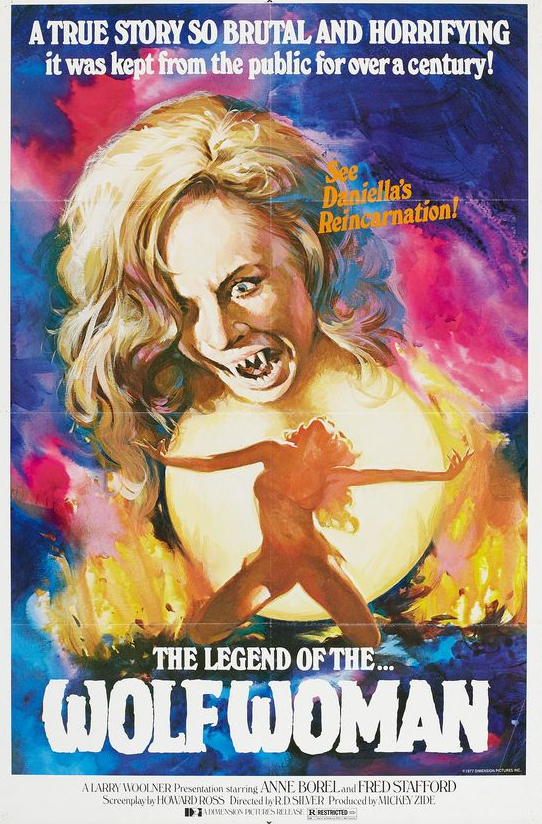
A section 3 video nasty, this movie was made by Rino Di Silvestro, who claimed that he wanted to make a serious werewolf movie. We should take the director of Deported Women of the SS Special Section at his word, I guess.
Daniella Neseri (Annik Borel, Weekend with the Babysitter, Truck Turner, Blood Orgy of the She-Devils) was assaulted when she was just a child, which has made her emotionally and sexually stunted and unable to have any relationships with men. Then she learns that she comes from a lineage of werewolf women, at which point she begins to have very involved dreams about being a wolf woman that manifest themselves when she gets all bothered watching her sister Elena (Dagmar Lassander, The House by the Cemetery, Hatchet for the Honeymoon) making sweet love to her man, so she responds by killing the dude, then throwing his body off a cliff because that’s how they did therapy in 1976.
Found near the body, Daniella is institutionalized before breaking away and continuing her murder spree before she finds love and respect — after killing a potential rapist — in the arms of Luca (Howard Ross, whose real name is Renato Rossini, and whose career stretched through nearly every genre of Italian exploitation, from Hercules Against the Mongols and The Man Called Noon to Marta, Naked Girl Killed in the Park and The Pyjama Girl Case to The New York Ripperand Warriors of the Year 2072).
Of course, this is an Italian horror movie and there’s no way that Luca and the werewolf woman can be happy just making love on the beach. Three men break in and assault her before killing him, so she hunts them all down before the cops arrest her. To ensure that no one learns any lessons, she’s institutionalized and dies, then her dad kills herself, then her sister, who has lost everything, just lives whatever life is left after all this.
Man, I don’t know if they knew what they had with this movie, a film that shows the institutions of men failing women on every level, including the male-directed movie that tells this story. That said, a movie where a woman equates sexual desire to being a werewolf and also she maybe is a werewolf and the knowledge that I’ve spent more time considering the psychosexual implications of this movie than the people who made it? That’s why I keep writing about films like this.
Also known as Daughter of a Werewolf, Naked Werewolf Woman, She-Wolf, Terror of the She-Wolf and Legend of the Wolf Woman, this film is something else. You can get it from Raro Video.
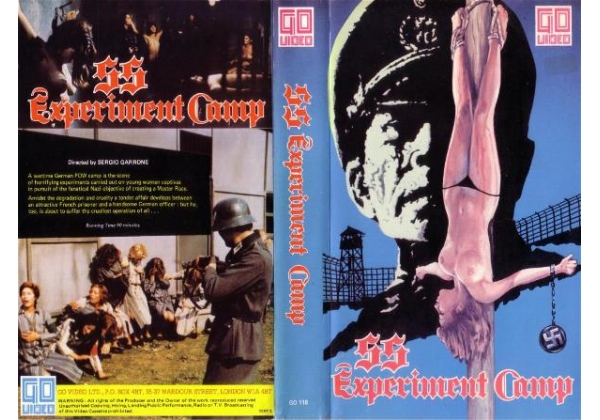
This is a film about Nazis. It’s also about a testicular transplant. It’s also known as SS Experiment Love Camp. It’s a film about prisoners of war used in experiments to perfect the Aryan race, while Colonel von Kleiben receives an oral testicle castration by a Russian girl. Its advertising campaign featured a naked woman handing upside down on a crucifix — which gave this film its infamy.
Courtesy of the cover, SS Experiment Camp easily found a slot on the U.K.’s “Section 1” list — but the British Board of Film Classification passed it with no cuts. The BBFC claimed that “. . . despite the questionable taste of basing an exploitation film in a concentration camp, the sexual activity itself was consensual and the level of potentially eroticized violence is sufficiently limited.”
Okay then, BBFC. But why didn’t you mention the film behind the VHS sleeve was boring.
Honestly, even being a Sergio Garrone fan — and aficionado of all things VHS taboo — the hoopla over this Nazisplotation film, while certainly worthy of its suffix, Garrone’s dip (one of two!) into the Nazi pool isn’t — as most “Video Nasties” — as shocking or offense as its reputation.
In addition to the boredom of it all, the production values, frankly, stink; as result, the entertainment value of the crowded jewel of the genre, Isla, She Wolf of the SS (1975), and the deeper, psychological study of — and superior scripting of — The Gestapo’s Last Orgy (1977) is utterly void from SS Experiment Camp.
It’s hard to believe Sergio Garrone made this, the writer-director who gave us spaghetti western buffs Django the Bastard (1969), Kill Django . . . First Kill (1971), and Bastard, Go and Kill (1971). Then, of course, there’s his superior work with Klaus Kinski in the pseudo-Frankenstein romp, The Hand That Feeds the Dead (1974), that we love amid the B&S About Movies’ cubicle farm.
The sleeve is more shocking that the film inside.
The “experiment camp” of this tale is just that: a medical facility experimenting in perfecting the Aryan race with German soldiers copulating with female prisoners. When one of the soldiers makes the mistake of falling in love with his prisoner-mate — he becomes Colonel von Kleiben’s testicle donor.
And that’s pretty much it, for this film is all about the genre hopping: It’s just a whole lot of lesbian wardens, sadistic guards, and softcore sex punctuated by (and not as graphic as you’d think) torture scenes (a water tank that both boils and freezes prisoners into submission), and lots of “superiority of the” Third Reich babbling. Oh, and lots of full frontal female nudity. Lots. But hey, when you’re an overweight and acne-covered kid berated for wearing a Misfits tee-shirt — and even the girl wearing a Clash tee-shirt turns you down — you get your naked girls where you can. That’s how it was in the video ’80s.
Oh, and the caveat here is that Garrone — to maximize his Lira (before the Euro) — shot this back-to-back with the even more abysmal SS Women’s Camp, aka SS Camp 5: Women’s Hell (1977) — which is not to be confused with the even more awful Women’s Camp 119 (1977) by Bruno Mattei. Both of Garrone’s Nazi romps are rife with sloppy camera work, worse acting, and dubbing that makes a Godfrey Ho flick seem in-sync. Don’t get us started on Mattei’s flick!
You can purchase a copy of SS Experiment Camp as part of the “SS Hell Pack Triple Feature” disc set, which also features SS Girls, aka Private House of the SS, by Bruno Mattei (1977), and Garrone’s SS Camp Women’s Hell (another of that film’s alt-titles) from Exploitation Digital on Amazon.
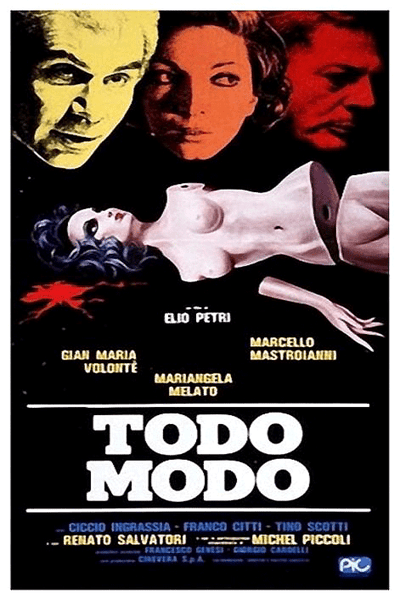
One Way or Another is a film that those of us who grew up in America may struggle to understand. By 1976, Italy felt as much in crisis as our country feels at times, but it went way beyond the issues we’ve been dealing with. During gli anni di piombo (the years of lead), political turmoil went beyond protest to become outright terrorism, with bomb attacks and left and right groups that went from idealogy to being paramilitary groups prepped for combat.
A fascist takeover felt like it may happen any day, just as the Communists taking over could also be possible. Then there was the Italian secret service infiltrating groups, creating their own and the ruling Christian Democrats infighting and falling apart. Then their leader Aldo Moro was kidnapped and executed by the Red Brigade. We never had anything like that happen lately, right?
So yeah, this movie may have a disclaimer about the fact that it’s not based in reality, but it totally is.
It’s also about a country dealing with an epidemic that no one understands or can control, so maybe it still hits a bit too close to home.
So into this strange world that is definitely our own, we find the Christian Democrats hiding out at Zafer, which could be a retreat or a hotel or a prison, a place where they go through Bohemian Grove-style exercises that are much like the Spiritual Exercises of Ignatius of Loyola, which help followers to “discern the will of God in their lives, leading to a personal commitment to follow Jesus whatever the cost.”
These exercises are to help them atone for their corruption and lack of ethics, but perhaps the most lawless of all of them is the man guiding them, Don Gaetano (Marcello Mastroianni). But as the supposed religious activities continue, a series of murders also begin.
Director Ello Petri lived the life to be able to tell this story. He was expelled for political reasons from religious school San Giuseppe di Merode and joined the youth chapter of the Italian Communist Party, which he left after the 1956 Hungarian uprising. His films, like We Still Kill the Old Way, A Quiet Place in the Country, The 10th Victim and Investigation of a Citizen Above Suspicion may flirt with the genres of crime, giallo and science fiction, but they also have something to say about the direction of Italy and its future. Sadly, he died at just 53 years old from cancer and we were robbed of more works that have so much to say.
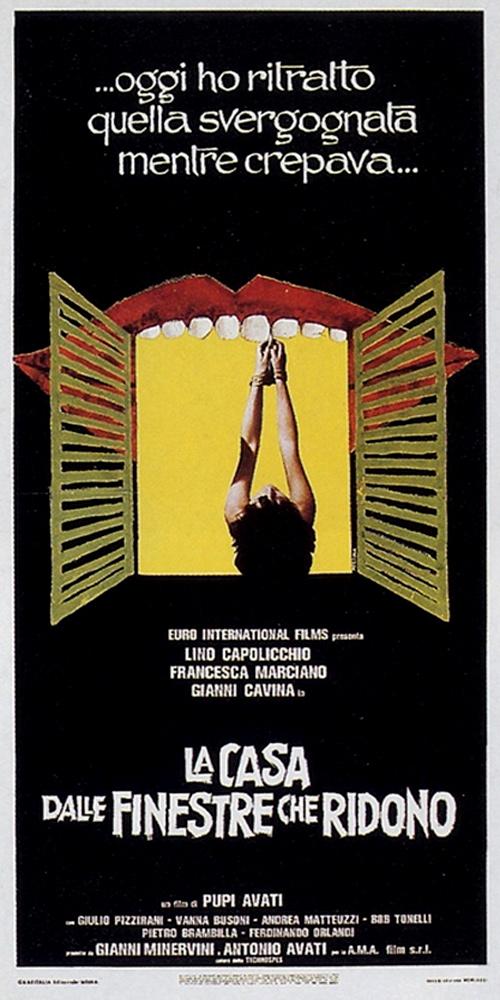
Pupi Avati made Zeder, the zombie movie that really isn’t a zombie movie, so I was excited to see his take on the giallo, basing it on a story he heard about a priest being exhumed in his childhood.
The Valli di Comacchio area has a fresco on the rotting wall of a church that may be the martyrdom of Saint Sebastian. Painted years ago by the long-dead and always mysterious Legnani, it is being restored by Stefano, who is also living in the home of the painter’s sisters. Those very same sisters — according to town legend — assisted their brother in torturing and killing people so that he would have inspiration for his artwork.
No one wants Stefano to fix this painting. People start dying and the secret behind the murders may be in the very painting that our lead is fixing.
I love when the giallo moves out of Rome and into the small cities, such as Fulci’s masterful Don’t Torture a Duckling and Antonio Bido’s The Blood Stained Shadow. Why should the metro locales have all the deep, dark secrets and horrific murders, right?
Don’t go in expecting sleaze and gore. Do expect to be surprised and delighted by the world and mood that this movie creates. This one needs to be unearthed and celebrated by way more than know it now.







 B&S About Movies
You must be logged in to post a comment.