Mind Killer (1987) and Night Vision (1987)

The “brain breaks free of the body” romp that is Mind Killer is an SOV’er that also crosses over into regional filmmaking — two video fringe genres that’s our kind of our jam (yeah, we have a lot of those) around the B&S About Movies’ cubicle farm. Local Denver filmmaker Micheal Krueger made two of them as a writer and director: the shot back-to-back Mind Killer and Night Vision (1987).

As a writer and producer, he made his third film: the rock band vs. werewolf flick — did he see Alice Cooper’s Monster Dog? — Lone Wolf (1988). In that same capacity, Krueger upped his game and shot in Panavision 35mm (but released in the same direct-to-video format as his previous three films), The Amityville Curse (1990). Sadly, the cinematic visions of Micheal Krueger’s mind ended at the age of 49 (of undisclosed causes) on August 27, 1990, in Denver, Colorado — where all of his films were produced and shot.

The copy on the VHS sleeve for Krueger’s first film proclaims it as “an intellectual horror film” — and that’s not just copywriter hornswogglin’. While obvious in its low-budget, the proceedings are far from the amateurism infecting most SOV’ers. Clocking in at a brisk 84 minutes (one hour twenty-four minutes), Micheal Krueger does his best with what he’s got to work with and takes the best of David Cronenberg’s Scanners (1987) and Ed Hunt’s (not released yet) The Brain (1988) — with a pinch of the classic (well, it is to the B&S crew) Fiend Without a Face (1958), and a little bit of Frank Henenlotter’s Basket Case (1982) and Brain Damage (1988) — and engages us with an introspective, but fun n’ sloppy romp. And the acting from the leads Joe McDonald and Christopher Wade (aka Wade Kelly) rises above the expected SOV thespin’ tedium norms.

Warren is a lonely library clerk addicted to self-help books and videos, particularly ones with advice on how to attract women — and he ineptly applies those teachings to the local singles bar scene with his even more awkward co-worker, Larry, and his buff roommate, Brad. Of course, Brad scores without books — and Warren creepily watches as he does — with the librarian he crushes (Shirley Ross, later of Night Vision).

Then, in the library bowels. Warren stumbles across a manuscript that he uses to develop psychic powers, which make him irresistible to women. Soon, his powers get out of control as his brain turns into a monster with a mind of its own — that bursts from his skull.

While this is more tightly edited — at 80 minutes — than the 100 minutes of Micheal Krueger’s follow up, Night Vision, as well as a bit more graphic-gooey than that latter film, the effects are cheesy-campy (but charming-to-inept amusing) and the thespin’ by most of the cast is from the stiff to the overwrought. The sound mix, in places, strains your ears deciphering the dialog. And, as with Night Visions, its all pretty uneventful until those last ten minutes — when our brain creature runs amuck, with slop and humor.

And does the ending remind you a bit of Re-Animator? Yes, and that’s not a bad thing.

The trailer and the conclusion of the film is on You Tube . . . fool me once, video embed elves!

And now for our second feature!
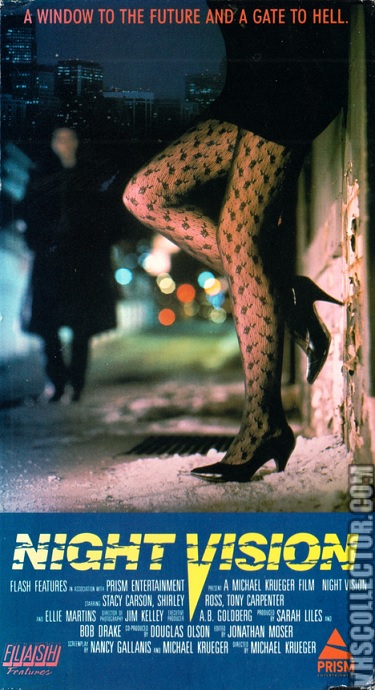
The copy on the VHS sleeve for Night Vision proclaims we will “tune into the nightmare channel and fast-forward into hell” . . . and that bit o’ copywritin’ hornswogglin’ sums up the ol’ haunted electronics plot we’ve enjoyed in the video ’80s with the likes of TerrorVision (1986; a cable satellite system), The Video Dead (1987; a portable TV set), and Remote Control (1988; possessed VHS tapes). Uh, okay. Yeah, yeah . . . and the vapid John Ritter-waster (he made so many; and you’re stuck with Pam Dawber, too) Stay Tuned (1992; a comedic, possessed cable TV hook up, or remote, or . . . I don’t care).

Unlike most SOV auteurs who vanished after one lone, in most cases, tragically inept film (that will still have its charms), Michael Krueger shows us he learned his celluloid lessons with Mind Killer. The production values on Night Vision are slicker and the acting from our leads of Stacy Carson and, as his girlfriend and fellow video store employee, Shirley Ross (from Mindkiller) are, again, above the SOV norms — but her constant gum chewing and smoking (and both at the same time) becomes annoying and ventures into a poor thespian choice (and gross); meanwhile, Carson is too old to play the naive teenager bit.

So, who’s haunted whom, here? Well, Andy Archer, a naive bumpkin from the Kansas cornfields heads into big city Denver — in lieu of his own state’s Wichita — to pursue a writing career. And the muse isn’t calling. Then he buys a stolen, portable TV and VCR from his new friend and local street hustler, Vinnie Sotto (a not bad Tony Carpenter). (Their friendship gives the film an M.C Escher meets a horror-slanted Midnight Cowboy vibe — with Carson as our naive Joe Buck and Carpenter’s Sotto as Ratzo Rizzo. There’s no evidence that was Krueger’s influence or intent, just my take on the material.)

Loaded into the VCR is a videocassette created by a group of electronic-worshiping Satanists (set up in the beginning of the film) — and the gadget — which plays back when it’s not plugged in; shocks you, pricks your finger, and oozes blood when it runs the tape (is it real or hallucination) — can also predict future murders. So our geeky Andy Archer writes short stories based on what’s on the tape — and finds success. Soon, those Satanic rituals and devil worshiping ceremonies on the tape — just as the box copy promises — fast forwards Andy into a Droste effect-type hell as murders sweep Denver — murders that Andy’s accused of, since he’s chronicled the murders in his stories and he appears on the tape as he commits the murders.

Sure, the proceedings plod along slowly, but the shots are professionally framed and the competently edited. But at one hour forty minutes, you can see an easy ten minutes trimmed. In addition, tighter writing could have easily paired Krueger’s Cronenbergian-cum-Lychian psychological thriller into a decent 80-minute film from the 100-minutes we’re watching. Again, it’s a competent effort and you’ve seen worse — far worse — from the SOV and 16mm canons. The oddity here is that Tubi offers Night Vision as an age-restricted sign-in, but there nothing here that’s the least SOV offensive-graphic (and doesn’t kick in until the last ten minutes).

A fan-created trailer and scene clip at the crappiest video store in Denver, is on You Tube . . . you’re not fooling me twice. . . .


You can watch Mind Killer on You Tube HERE and HERE, but the best upload is the free-with ads stream on Tubi. You can watch Night Vision on You Tube HERE, but there’s a better free-with-ads stream upload on Tubi. You can also learn more about both of these Micheal Krueger works, as well as all of the films produced in Colorado, at Colorado Film.com.

We’ve reviewed several Colorado-shot films, with Curse of the Blue Lights, The Jar, and Manchurian Avenger, and The Spirits of Jupiter. Other other, obscure Mile Highers we’d like to review, but there’s no copies to be had, are Savage Water (1979), Lansky’s Road (1985), and Back Street Jane (1989).

As always, our many thanks to Paul Zamarelli and his efforts to preserve the VHS artwork of these films. Visit him at VHS Collector.com and enjoy his reviews on his You Tube channel The Analog Archivist.

About the Author: You can read the music and film reviews of R.D Francis on Medium and learn more about his work on Facebook.
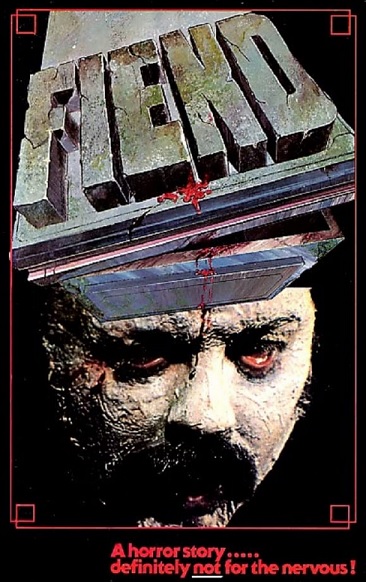
Fiend (1980)

Unlike most SOVs (frack, I know it’s shot in 16mm), this second feature film by Don Dohler — his follow up to The Alien Factor (1978) — foregoes gore or excessive, lingering nudity to give us old school, drive-in creepy atmosphere of the Amicus and Hammer variety. Since Fiend was shot on 16 mm and blown up to 35 mm, it’s actually better classified as a “regional horror,”* as it received a limited drive-in theatrical run in the Northeastern U.S. in and around Baltimore, Maryland — before the rest of us discovered Fiend as a VHS release. But truth be told: If there was a letter after the 26th letter of the alphabet, this would be ___ – grade horror. It’s also a movie — as are all of Dohler’s work — with a lot of heart.

As is the case when shooting in film stock, in this case 16mm, no-budget guys are shooting on short ends and, with the cost of said film stock, are one-take charlies: so no retakes, reverses or coverage. It’s all very Ed Woodian, but not as wooden as an Ed Wood film. To that end: Is the acting painful in places. Yes. Are the effects chuckle-enduing. Do you want to jump into the film with a flashlight to see what the frack is going on. Yep. Is it one of Dohler’s best? Yes. The story is great and it’s only held back by its no-budget.

So, did you know that evil spirits “see” in a red optical effect? Okay, it’s a misty, red cloud. But did you know a “fiend” is more than just a Funk & Wagnalls dictionary entry: it’s a supernatural entity — again, a red misty thing (that looks like a bloated red worm or fat and fucked up two-tentacled octopus) — that absorbs evil during its timeless travels. So, our red-filtered lens effect drifts into a graveyard and reanimates the corpse of (violin; if you care) music teacher Eric Longfellow (Don Leifert; of Dohler’s The Galaxy Invader and Nightbeast).

But why?

Watch the trailer.

Well, the Fiend needs to absorb the life of the living to continue its existence and needs a human vessel to harvest the life force of others. And also, so the vessel it possesses doesn’t rot away. Don’t ask where our spooky red cloud came from. Don’t ask why it picked poor Longfellow (perhaps he was the freshest corpse in the cemetery).

So, Longfellow digs himself out, well, there’s no “digging”; the Fiend just sort of “drifts-rises” out of the grave — since Longfellow is just a fleshy, transportation device for the Fiend. And taking its cues from George Romero’s Night of the Living Dead, we have a young couple in the cemetery (“They’re coming to get you, Barbara!”) for our zombie-fiend thing to feed on (and the queasy-sickly music here takes from Bach’s famed “Toccata and Fugue in D Minor BWV 565,” so cool).

And, with that, our Fiend moves to Kingsfield, Baltimore, where every day is a pleasant valley Sunday with kids on bikes and playing ball as dad mows the lawn . . . until the Fiend (now a bloated-set guy in a Walrus-mustache) comes to town and the dark storm cloud roll in. But life is pretty sunny for Longfellow: his house is fully furnished, he enjoys nice bottles of wine — and he even has Dorien, a cat. Yeah, you heard me right: the Fiend hates women, but love cats.

Like any vampire, or any vamp-chick jazzed-up on wasp juice (see your ’50s horror schlock), Fiend-Longfellow starts to rot, so he needs to suck up some spiritual juice to reverse the process. Of course, of the female persuasion. Of course, the snoopy neighbor (who rocks the mutton chops and plaid sports coats) who don’t take too kindly to da-dem dere newcumers (yep, the old “outsiders” trope of many horror films of old) — and hates Longfellow’s now seven-months of violin screeching — becomes obsessed with the strangulation murders plaguing rural Baltimore and thinks the quiet-weird violin guy, aka Longfellow, is the killer. Seriously, as stiff-as-cardboard liner-reader wife-Kender points out, in a roundabout way: Mr. Kender’s kind of a dick that itches to pick fights. The dude needs — deserves — to have his soul homo-sucked dry. And cool it with the faux-detective third degree on little kids. And berating your wife. If anything, ol’ man Kender is the real “fiend” of Baltimore. Someone red-optical effect his punk ass.

So, I am going over the razor’s edge of quality to say Fiend is the best of Don Dohler’s ’80s efforts?

As with Constantine S. Gochis’s (fantastic) The Redeemer, Fiend is so close: it’s almost there, to a John Carpenter Halloween-level, but misses the mark to be the next Bob Clark’s Deathdream (which Fiend reminds with its dead, rotting antagonist) or Alan Ormsby’s Deranged. Or Don Coscarelli’s so-awesome Phantasm. Why Dohler ditched the Hammer-Amicus creeps direction of Fiend to, essentially, remake The Alien Factor to a lesser-and-lesser effect with Nightbeast and The Galaxy Invader — then retire-vanish for a decade until bringing us Blood Massacre (1991), is an opportunity missed. Why? Because of Star Wars and Close Encounters of the Third Kind making aliens and sci-fi en vogue?

While it has its weakness — Don Leifert is actually very effective as the emotionless Fiend-Longfellow (but that cheesy ’70s mustache; yikes, only in the ’70s), and the decomposing face reanimation is equally effective on-the-cheap — all SOVs should be as well-written and shot as Fiend. (Unlike SOVs, Fiend received a drive-in and theatrical release.) Yes, I rank Fiend alongside Deathdream, Deranged, Halloween, Phantasm, and The Redeemer as one of those special, self-made nostalgic creep fests. As result of the Dohler lineage, Fiend is easily purchased on digital and hard media platforms in the online marketplace — and you can watch a free VHS rip of Fiend on You Tube.

* Sam discussed Fiend during our “Regional Horror” tribute week back in March. Look for it!

About the Author: You can learn more about the writings of R.D Francis on Facebook. He also writes for B&S About Movies.

Gamma 693 (1981), aka Night of the Zombies

Writer, director and actor Joel M. Reed wowed us on the ’80s home video fringes with his 1976 drive-in ditty Bloodsucking Freaks. Do read B&S bossman Sam Panico’s review, as he waxes nostalgic over the lost bricks-and-mortar era of video stores that afforded us, the jock-bullied, wee horror and metal lovin’ pups of its discovery — and of today’s feature film.

“Who is this whack job?” we pondered as we searched the video racks for other Joel M. Reed product.

Courtesy of the pulpy monster mags we got at the corner smoke shop or, if on a family excursion to the mall, Waldenbooks, we learned (Googling is no fun) Reed made his debut with two sexploitation flicks: Sex by Advertisement (1968) and Career Bed (1969). (Eh, buying online is no fun; mail-order catalogin’ from the back of monster rags for VHS-greys is the way to go.) Then Reed changed it up with an action flick — as only Joel M. Reed can make one — with a “Rambo” that has herpes (?) in Wit’s End, (1971). Of course, with Sly-Namexploitation in full swing in the ’80s, it was repacked as The G.I. Executioner.

So, this is the part of the film review and Reed career examination where we drop CBS-TV’s Everybody Loves Raymond into the discussion . . . because Marie Barone, aka Doris Roberts, stars . . . alongside Harve Presnell (Fargo, Saving Private Ryan; “Mr. Parker” in NBC-TV’s The Pretender) in Reed’s twist on the Amicus anthology format with Blood Bath (1975).

And that’s Joel M. Reed’s six-film career as a writer and director — a “tribute week” in one fell swoop of a review. Prior to his April 2020 passing, Reed appeared as himself (he has 15 other character-acting credits) in uber-fan Eric Eichelberger’s retro-SOV’er Ghoul Scout Zombie Massacre (2020).

Now, before we get into the movie at hand . . . let’s clear up the title confusion, as there are two movies with the title/alternate title of Gamma 693: First, there’s Joel M. Reed’s sixth and final film released onto video in 1981. Then there’s the other one starring Linda Blair and Troy Donahue from 1989 — which served as the lone directing credit by Jack A. Sunseri. Oh, you know Jack: he gave us the cheesy “puffbox” timewaster, The Dead Pit (1989) — that’s not to be confused with The Pit (1981). No, we’re talking about the one with the blinking zombie eyes on the VHS Box (You Tube clip of the box in action).

Now, I’ve personally never sought out The Chilling starring Linda and Troy. In fact, I don’t ever recall seeing it on the store shelves, even though it came out as a theatrical in 1989 and hit U.S. video shelves in 1992. It’s said The Chilling played on USA Network’s “Up All Night” and “Night Flight” weekend programming blocks, but not to my knowledge. Is Jack A. Sunseri’s flick a homage or loose faux-sequel to Reed’s film, we wonder. Alas, it’s an analogy quandary I shall delve into not, as The Chilling is so awful in its inept Return of the Living Dead (1985) ripoffery. Let’s just say Sunseri attempted to hornswoggle us Joel M. Reed freaks into renting a Sunseri boondoggle, and just leave it at that.

To add to the bad analog Intel: It is also said that Reed’s Gamma 693, aka Night of the Zombies, also carries the title alternate of The Chilling. Not only have the B&S worker bees not been able to locate any theatrical one-sheets with the Gamma 693 title, we were unable to locate any VHS or DVD reissue slipcovers with The Chilling title. So, let’s just say The Chilling alternate title is an Intel cut-n-paste snafu resulting from Sunseri’s film coping the Gamma 693 title at some point during its own video shelf life. And it wasn’t it enough to piggyback on Reed’s works; Sunseri swinehumped Wes Craven’s superior cryogenic horror, Chiller (1985), which starred Michael Beck (The Warriors, Battletruck) and Jill Schoelen (Thunder Alley) that aired as a first-run TV movie on the USA Network.

If you’re in a NaziZom* binge-mood: Other films you can check out are They Saved Hitler’s Brain (1964) and its fellow Nazi scientist-cum-world-conquest villains in She Demons (1958), The Flesh Eaters (1964), and Flesh Feast (1970). To a lesser extent, there’s the Nazi we-never-see ghosts of Death Ship (1980). Then there’s the later NaziZomsploitation sub-genres homages Outpost (2007), with its own sequels War of the Dead (2011) and Bunker of the Dead (2015; in a found footage format), and the Finland-made dark comedy of Dead Snow (2009), which has its own sequel-verse. No, while it’s cool: not Iron Sky (2012), for that has no zoms, but Nazi UFOs on the moon, even though the dark side of the moon is a cold bitch.

Now that you are a well-informed, frozen-Nazi zombie consuming streamer, on with today’s feature presentation.

Ah, the VHS slipcover art I remember, aka Gamma 693, aka Hell of the Living Dead. Don’t be fooled by the “X,” as this is not the least bit “video nasty.”

As with John Howard’s Spine — and Paul Norman’s Ice Cream Man and Tucker Johnson’s Blood Salvage — Reed’s flick is also a porn-connected produced horror flick — thus, the shot-on-video production values. It was shot in the Munich, Bavaria, Germany home and on the property of noted ’70s porn purveyor, Shaun Costello. (It had pick-ups done on the sly in the wooded environs of New York’s Central Park and a “Euro-looking area” of Greenwich Village.)

Now, come on. Don’t be shy and lie, because I’m not.

When I aged-into my behind-the-taboo-green-curtain years, I rented a VHS copy of Costello’s infamous Girl Scout Cookies (1976). So, yes . . . our 420-plus credits leading actor here, Jamie Gillis, is, in fact, a porn actor who occasionally moonlighted in low-budget “mainstream” flicks, but is best known for his work in Deep Throat II (1987). As if we forgot there was already an official Deep Throat Part II in 1974 to the 1972 film. See, even porn films do the alternate-title hornswoggle.

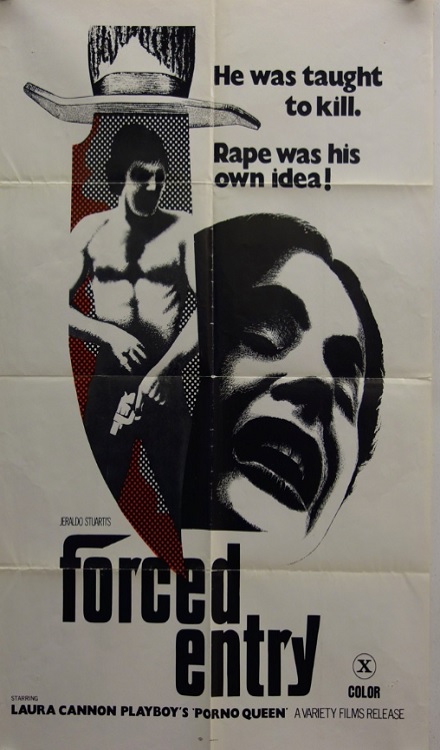
In addition to Girl Scout Cookies — and if you’re a ’70s proto-slasher fan — Shaun Costello, after achieving success with a series of adult film short, aka loops, made his feature film debut as a writer and director with the X-rated Forced Entry (1973). Remade in 1976 as The Last Victim — by Jim Sotos/Gary Graver; yep, both porn-connected — the film was marketed on the grindhouse and drive-in circuits until the early ’80s, courtesy of Tanya Roberts, later of Charlie’s Angels fame, starring.

When Dawn of the Dead (1978) inspired a Euro-zom craze that soon engulfed home video shelves, Reed’s NaziZomsploitation romp appeared on VHS in 1983 under its better known title: Night of the Zombies. If you were a fan of Eliva’s Mistress of the Dark syndicated movie blocks, you may have seen it on television under that title. Maybe you caught it — as did I — at your local twin cinema in 1981 as Hell of the Living Dead, which has nothing to do with the 1980 Bruno Mattei film of the same name. To add to the confusion: Reed’s zom-romp also carries the home video title of Night of the Zombies II, as an ersatz-sequel to Bruno Mattei’s film, which itself is also known as Night of the Zombies. Later ’90s DVD reissues carry the title of Night of the Zombies: Battalion of the Living Dead.

Just wow. That’s way to much market effort for a film that doesn’t deserve the lipstick-on-a-pig marketing effort.

Where’s Jean Rollin’s Zombie Lake (1981) and Jess Franco’s Oasis of the Zombies (1982) when we need ’em. Hell, where’s the Dana Andrews-starring frozen Nazi-heads flick The Frozen Dead (1966). I can’t believe I just said that. Yes, those three dopey zom romps — and Mattei’s for the matter — are far better than this Joel M. Reed mess that isn’t the least bit zombie goo-messy, it’ “twist ending” be damned. And, worst of all is that it takes us 40 minutes to get to the blue guacamole-smeared zombies — and that’s if you can see ’em through the worst night-photography ever committed to film.

Then there’s the government lamenting and spy-drivel pontificating — via stammering “actor” ad-lib. Then there’s the “set design” of government offices that don’t look like government office that look like the filmmakers guerilla-shot their way into a hotel conference room and got out before hotel security kicked them out: Pentagon and Fort Detrick, my ass. Then there’s the obvious, medical lab-borrowed skeletons — that are supposed to be what’s left of the zombies after melting — and the melting effects are questionable — that have a visible, linear mark across their caps. Remember Billy Eye Harper’s plastic-bone rotted remains in Rocktober Blood? Plastic skull is as plastic skull does, Forrest.

So, how did we get here: Upon the death of two scientists in the Bavarian Alps investigating the activities of a WW II U.S. Army Chemical Corps unit engaged top-secret chemical warfare with something called “Gamma 693,” the U.S. government sends Nick Monroe (our porn star Jamie Gillis), a not-James Bond CIA agent to investigate the deaths. During his investigation, Monroe learns of the rumors of a regiment of Nazi zombies roaming the countryside and uncovers a Nazi plot for world domination with an undead army. Without the chemical agent — designed as a healing agent for the war wounded — the Nazi ranks will age and decompose. So there’s only one thing left to do to stop the rot: eat human flesh. And since these are intelligent zoms: they tell their food that they don’t want to, but must.

Is there a creepy atmosphere? Is the plot a bit whacked? Is the soundtrack queasy-inducing? Sure. But it’s all too little too late. If only Eli Roth (re) made this, it would be so much better, for the story is there. So I’ll just take my VHS copy of Ken Weiderhorn’s Shock Waves to my movie room and call it a night.

If you’re a first-timer to Joel M. Reed’s Alpine snow-zoms, you may pass, as well. Then again, you may like it. Just as I enjoyed Weiderhorn’s Carribean aqua-zoms and others hate it. Everyone’s tolerance for B-movie cheapness and nostalgia miles for the past, may vary. Like Steel Town wrestler Shirley Doe says, “Films are funny that way.”

You can watch Reed’s contribution to the NaziZomsploitation genre on You Tube HERE (the Prism Video-version as Night of the Zombies II — with a trailer for Shock Waves!) and HERE (as Die Nacht Der Zombies).

* You can go deeper into the Nazisplotation genre courtesy of Naomi Holwill’s 2019 document Fascism on a Thread: The Strange Story of Nazisploitation Cinema (2020). You can also Google “Nazis in Cinema” to find more films.

About the Author: You can read the music and film reviews of R.D Francis on Medium and learn more about his work on Facebook.


Tubi Debut: Hub City, aka Compton’s Finest (2021)

I love exploring the retro-vibed, digital terrains of Tubi, as it takes me back to the simpler, analog days with a video membership card in my hand, perusing the shelves, examining the VHS sleeves for a Saturday afternoon of movie-binging.

Needless to say, in today’s digital distribution realms endlessly supplied with films by way of digital cameras (and now, smartphones), the films discovered are not so much a rough diamond, but a chunk of pyrite. As a matter of my own, personal review policy: If I discover—or am assigned—a small indie movie that fails to resonate, I won’t post a review. There’s nothing gained by calling out the shortcomings of one’s heartfelt passion project, be it action or comedy, or a hybrid of both. I have to believe in the work.

Producing an action film—in this case a dark-comedy action film—on a tight budget isn’t an easy task (usually maxing at one million in budget). So while those today digital productions aspire to become a Shane Black industry-calling card under the production eye of Joel Silver and directorial reins of Richard Donner, there are, again, more cubic zirconia than precious gem stone under the streaming loupes.

Charles Malik Whitfield stars? Consider it streamed.

When it comes to budget-tight actioners, while I was taken to snotty task by a troll or two in regards to my review, I stand by the work of writer-director Steven C. Miller with his serviceable action-thrillers, such as the Bruce Willis-starring First Kill (2017), the Nicolas Cage-starring Arsenal (2018), and the Aaron Eckhart-starring Line of Duty (2019). My same critical stance holds for the work of Prince Bagdasarian’s morally-screwed up character action romp, Abduction. I also felt noted urban music video director Nick Leisure turned in a fine set of frames with A Clear Shot and Anthony Ray Parker’s (TV’s syndicate Hercules and Xena franchises) industry calling card Lone Star Deception was another solid, against-the-budget action-thriller. Randall Emmett’s Precious Cargo giving Mark-Paul Gosselaar a starring role worked well, as well. On the comedy end, I felt Camilo Vila provided Jaleel White a solid, leading man comedy role with 5th of July, while Mehul Shah’s Nana’s Secret Recipe was an also an enjoyable watch.

So, when you’re on an entertainment budget and searching for something new and fresh, a little time and patience in the streaming-verse pays off. Of course, having those marquee names on the box—well, these days, a digital avatar—always helps entice my hitting that big red streaming button. Give me actors I know and respect for their commitments to their roles—no matter how big or small—be they on a career up-and-coming or on a downward slide—I am watching your flick.

Such a film is Hub City.

Best pitch-described as Ice Cube’s Friday meets Lethal Weapon, this effective, budget conscious (one million) action comedy stars the always watchable Charles Malik Whitfield (part of the starring-recurring casts of The Guardian, Empire, and Supernatural; stellar in one of his earliest roles as Otis Williams in the NBC-TV mini-series, The Temptations), along with the deserves-his-own-series Cisco Reyes (guest roles on TV’s CSI: Miami, Numbers, Leverage, and Rizzoli & Isles).

Originally under-the-radar released to festivals and VOD platforms in 2018 as Compton’s Finest, this fifteenth directorial effort (he’s also written sixteen films) by the prolific Dale Stelly has relaunched this September to the Tubi platform as Hub City (known as since the city is the almost-geographical center of L.A. county) to capitalize on actor Charles Malik Whitfield’s well-deserved, renewed awareness as result of his current work on NBC-TV’s hit series Chicago Med. Whitfield stars alongside Cisco Reyes as Detectives Kevin Blackman and Antonio Vargas (know your ‘70s actor homages; I know, the actor is “Fargas”) working—with comical effect—the Hub City beat on the search for Columbian drug lord Silk Delgado (the always stellar, 120-credits strong Roberto “Sanz” Sanchez of TV’s NCIS, Criminal Minds, Chicago P.D., Without a Trace, The Closer, and the Law & Order franchise) flooding the streets with a new, deadly designer drug: the cocaine-based “The Devil’s Breath”. During the course of their investigation, Blackman not only comes to discover his combative stepson is involved with Silk Delgado (“I have a ‘job’!” he screams), he endures the wrath of Silk after killing his son in a botched sting.

Actors from Chicago Med and Breaking Bad? Consider it streamed.

Rounding out the solid cast in support roles is Lavell Crawford, a pisser of a stand-up comedian who caught my eye a few years back on Comedy Central (do check out his “Grocery Store” and “Mama Was Old School” vignettes from his Can A Brother Get Some Love DVD). Crawford has since come to a find a larger, mainstream audience courtesy of his co-starring support as Huell Babineaux on AMC-TV’s hit series Breaking Bad and Better Call Saul, as well as living his dream as a cartoon character (THUNDERCATS!) on Aqua Teen Hunger Force. Here, he brings on a hilarious turn as Bubbles, the harmless ne’er-do-well friend of our put-upon detectives. Equally stellar is the-I-want-to-see-more-of Erick Nathan (in a completely different role in the soon-to-be-released horror Beyond Paranormal) as the Snoop Dogg-inspired, low-level street hustler Coldwater Pimp (who spews more comical-acronyms for the word “pimp” than I realized existed).

As is the case with any low-budget film, there’s a few minor faux-pas: A few edits, most fades, felt a bit abrupt-to-awkward. There were also a couple sound issues (a room echo that’s an easy fix in-post, but budget concerns most-likely prevented a fix). A couple performances were a bit weak, but certainly not of an unskilled, thespian-tragic level that you sometimes see in indie-streamers. All in all, for my first film exposure to Dale Stelly’s work, I find him to be a solid, competent director who knows how to work his tight budget to bring us a film with a solid set and production design as he extracts the best from his unknown-to-known actors. In the cinematography department, Brazilian-bred filmmaker Felipe Borges keeps everything well-shot, peppered with an occasional creative shot that keeps it fresh, but doesn’t overwhelm the watch with too much cleverness (one intelligent shot: the POV of an eye-patched character is ever-slightly blurred against the view of the other character; very nice, indeed).

Another Tubi-exclusive stream we’ve reviewed: Swim.

Since we’re on a budget, sure, the action isn’t to the crazed level of Lethal Weapon (eh, your critical mileage my err to side of the Bay-os strewn Bad Boys franchise) or any of its quick-to-market direct-to-DVD knockoffs, but this debut script by Tony D. Cox is a well-structured work that provides his characters plenty of solid, comedic lines that bring on the out-loud chuckles. Hopefully, this Tubi digital-relaunch—in conjunction with Charles Malik Whitfield’s rising star and Lavell Crawford bring the Breaking Bad fan base to the digital troughs—more streamers will discover Hub City and be turned on by Tony D. Cox’s writing. The next time I see his name on a film, I’m streaming that movie, as Cox is a writer to watch for. As for director Dale Stelly: I look forward to his next film and I hope he’s afforded a lager budget for his next film. This is good stuff from everyone involved. Steam it.

The ending teases a possible sequel with Kevin Blackman and Antonio Vargas—knowing they’re pulling a several month’s suspension—play with the idea of going into the private eye business. And Coldwater proclaims his pimpin’ days are over. So, a modern day Starsky and Hutch—with Coldwater as their “Huggy Bear” and Bubbles along for the ride? Hey, Bubbles cleaned up with his lawsuit after being shot in buttocks by the cops (“That’s not a gun, that’s piece of chicken!”), so he can back the new P.I. firm. Now that’s a sequel I want to see! If this streaming relaunch clicks with audiences . . . it could happen. Fingers crossed!

You can learn more about Dale Stelly’s body of work at his official website Stelly Entertainment and follow the studio on Facebook. Dale discusses his work in an extended interview with Film Courage on You Tube.

You can free-with-ads stream Hub City on Tubi.

Disclaimer: We did not receive a review request for this film. We discovered it on our own and enjoyed the film.

Our thanks to the film’s writer, Tony Cox, for the positives vibes, in the comments.

Yes, the best is yet to come for you and Dale. See you both with the next films.

About the Author: You can read the music and film reviews of R.D Francis on Medium and learn more about his work on Facebook. He also writes for B&S About Movies.

Revenge (1986) aka Blood Cult 2

Hey, there’s nothing like an “SOV Week” to inspire us to fill out the holes in B&S About Movies’ SOV database while we also polish off the unholy triumvirate of Christopher Lewis — the Julius Ceasar of the SOV domains — with Blood Cult, The Ripper, and the sequel to Blood Cult: Revenge. Ah, there’s a catch, afoot: more money means improved production values, so we’ve made the transition from video to 16mm film. But we didn’t know that back then . . . so while it’s not “technically” an SOV, it still is in our video store pumpin’ hearts.

I begged to buy this poster off the video store wall. The mint-deficient halitosis owner wouldn’t budge. Even after taking it down for a new one-sheet, he still wouldn’t sell. He told me, “I’d rather throw it out.” And probably did. Dick.

So, did you read our review of Blood Cult? Then you’re up-to-speed with the dog-worshiping cult shenanigans.

In the grand tradition of notable-successful actors hitting hard times and slumming in an SOV romp to pay the rent (and for a producer to get a marketable name on the Big Box), such as Michael J. Pollard in Sleepaway Camp III: Teenage Wasteland (1989), adult-film star Amber Lynn in Things (1989), and Janus Blythe of The Hills Have Eyes in Spine (1986), Revenge stars John Wayne’s son, Patrick — the star of the huge (in our hearts!!!!) mid-‘70s drive-in hits The People That Time Forget and Sinbad and the Eye of the Tiger.

Exhibiting still cheesy, but vastly improved technical skills in front of and behind the camera — in a script penned by actor Joe Vance (the dead Joel Hogan from the first film) — star Wayne returns home to investigate the death of his brother from the first film. And he runs afoul of our dog-god cult with a body-part fetish overseen by cadaverous horror icon John Carradine, who, even with the dreck he’s been in (see Cirio H. Santiago’s Vampire Hookers), deserves better than ending his career with an SOV appearance (ugh, I know, 16 mm, but you get the point).

While we still have the slasher element from Blood Cult, things are a bit more supernatural-cum-mystery — no Halloween homages this time, as with the first film — with our cult members using ESP to dispatch their victims with a little cerebral cortex rupturing. It’s not exactly Michael Ironside Scanners explosive, but it’s messy . . . and SOVs (okay, frack, 16mm) have to be Karo food coloring-messy.

A couple of months after the end of the Blood Cult timeline, Patrick Wayne’s Micheal Hogan, the brother of dog-cult victim Joel Hogan, returns to town and comes to help Gracie Moore (a returning Bennie Lee McGowan) now terrorized by the dog cult that murdered her husband and wants her farmland to conduct a sacrifice. Also back are David Stice as our Deputy and Peter Hart as Dr. White. In a QAnon twist: John Carradine’s Senator is the head of the Lord Caninus sect (funny, Ted Cruz strikes me more as the dog cult demigod-type). And more of the same body part collecting to resurrect ol’ Canny, ensues . . . and the “ensuing” includes a head-hatching, leg-removal by bear trap, a Jacuzzi slice n’ dice-cum-decap, and the ESP kicks in for a fleshy BBQ.

You can pick up Revenge, paired with Blood Cult and The Ripper, on a nifty catch-all The Ripper Blood Pack DVD from Amazon. You can also watch a VHS-era rip on You Tube. And speaking of “revenge” . . . bang the head that doesn’t bang with a little Slayer, Exodus, and Venom, for, as you know, metal and horror films are a bloody Reese cup from hell.

About the Author: You can learn more about the writings of R.D Francis on Facebook. He also writes for B&S About Movies.

Cards of Death (1986)

I had several video store memberships back in the day — both with the chains (Blockbuster and Hollywood Video) an array of mom n’ pops — not counting the ones where I wasn’t a member that I’d road trip for a cut-out bin divin’ weekend (if I couldn’t find it as a rental, I’d buy the cutout version) — and my local comic bookstore.

Yes. At the comic book store.

As my neighborhood video store knocked a hole in their wall and the owner dumped all of his warehoused vinyl into the bay next door to not only sell, but rent records like video tapes (of which I recorded many to cassettes), my local comic book store also punched a hole in their wall and opened a dinky video store. Another comic shop — which was bit more of a drive — cleared out a corner and started shelving rental videos, as well. (For a fee, that comic shop would high-speed a copy; used vinyl record stores, before and during the early days of the compact disc, when everything wasn’t yet on disc, copied albums: first to cassettes, and then, eventually CDs.)

The U.S. reissue from the fine folks at Bleeding Skull. Hi, Hog. Dig the shirt.

What my cherish comic honey holes shelved is many of the films we’ve reviewed during our “Regional Horror Week” back in March, our “Hong Kong Week” back in May, and last month’s “SOV Week” and “Video Nasties Week” tribute . . . then there’s our “Japan Week” coming the beginning of next year (cut and paste those “weeks” into our search box to populate those reviews). For when your local comic book store decides to compete in the home video market, you know that they’re going deeper than the mom ‘n pop outlets where your dad is renting The Godfather, mom (mine’s an action whore) wants First Blood — and you’re renting a Wizard “Big Box” “video nasty” to the tune of Headless Eyes. (And let’s not forget our beloved pre-Internet catalog grey-market retailer VSOM – Video Search of Miami and our trusty Starlight Video bootleg catalogs helping us discover the deep corners of the VHS-doms. I miss that: I’d rather the ol’ catalogs and mail-order than the web. I know: shut up, nostalgic old bastard.)

Such a “deep” film is Cards of Death: the feature film debut — and lone film — by actor Will MacMillan. Born in Stuebenville, Ohio, he came to work at the Lovelace Marionette Theatre in Pittsburgh (the hometown of the online publication you’re reading right now). Oh, you know MacMillan. He starred in George Romero’s The Crazies and co-starred alongside Clint Eastwood in The Enforcer. Then there’s a dozen-plus network TV series, as well as Oliver Stone’s Salvador. Then more TV series and a couple of TV movies.

Did my common regional roots to MacMillan, along with the Romero connection, mean anything to me at the time when I rented the grey-version of Cards of Death from my ol’ comic hole? Nope. No more than the Hollywood and rock music lineage of Christopher Lewis inspired me to rent Blood Cult. All I know is that I saw a weird-and-wonderful, never before seen oddity imported and grey’d from Japan and I wanted it. And, as it turns out: it wasn’t an Asian cinema set-piece, but an American (SOV) flick masquerading as Asian cinema. And I think MacMillan inspired all of that later, Asian-VHS insanity from Japan and Hong Kong. I have a feeling, if you read reviews and interviews of the fans and makers of those films: MacMillan is name-dropped, often.

Yep. That’s the one. Originally issued on Japan Sony’s “Exciting Video” label. Only the “U.S.” cover was a fuzzy, laser-printed copy tucked into a clamshell sleeve and dubbed on a TDK-VHS tape.

Anyway, MacMillan wanted to move behind the camera. And with the home video revolution and the new accessibility of commercial video cameras — with the shot-on-video and direct-to-video successes of the likes of the influential SOV game changers Boardinghouse and Blood Cult, MacMillan realized he had a cost-effective way to prove his skills as a writer and director. And, from what I’ve read: to tell Hollywood to “f-off,” as he had grown disenchanted with the business. (I wonder why: he worked consistently; perhaps he lost out on auditions for a couple mainstream roles?)

And, with that, the crime-horror Cards of Death was born.

However, unlike the SOV’ers Boardinghouse and Blood Cult, Cards of Death couldn’t obtain (widespread) U.S. distribution — so no one saw it. Why? With its gratuitous nudity, lesbianism, sex scenes smeared in blood, and on-screen kills — more so than Spine, an SOV also released in 1986 — MacMillan’s vision was a perfect programmer for porn purveyors 4-Play Video, Inc. and producer Xeon, Ltd.’s joint, “commercial” SS – Sterling Silver imprint; the label was created for that porn-slasher hybrid’s marketing into the brick-and-mortar marketplace. Cards of Death would have made for a great, second release for the label — instead of having Sterling Silver go under after the release of Spine. Sure, MacMillan had years of mainstream Hollywood experience behind him. Surely, he had the industry connections. But a scuzzy porn-leaning horror film snipping inspiration from ’50s and ’60s French New Wave existentialism? It’s easy to see why MacMillan was left to his own devices to market and distribute his admittedly unconventional film. (Why do you think Alejandro Jodorowsky (Santa Sangre; 1989) never got his version of Dune made?)

So, in a business deal with details lost to the analogs of time, MacMillan got the film into the Asian home video market via Sony’s “Exciting Video” VHS imprint. That’s when Cards of Death — like Cheap Trick’s Japan-only released Live at Budokan breakthrough album before it — found its way back the greylands of the good ol’ U.S.A. to be nestled onto my local comic book store’s underground-video nasties shelf. Those shelves also held imported copies of Toshiharu Ikeda’s Evil Dead Trap and the grey-market rips of Kinji Fukasaku’s Battle Royale (which took ten years to officially appear in the U.S.) and the Guinea Pig and Tomie franchises.

If only MacMillan turned the directorial reins over to Takashi Miike of Dead or Alive fame; for Cards of Death is under the same Sapporo Dome as Gozu (2003), Miike’s bizarre, low-budget direct-to-video horror with its mix of mobsters and ghosts and breast milk and cow-headed men. (Yeah, a Miike remake of Cards of Death is a film I’d pay to stream.) The violence of Cards of Death, while it has its moments, isn’t Evil Dead Trap-brutal — and is certainly not as expertly-crafted as a Miike joint — but it does foretell torture porn before there was an Eli Roth (his game-inspired Hostel, in particular). And that gore comes courtesy of another SFX artist (see our review of Night Feeder) who moved onto bigger and better things: Bryan Moore ended up doing the effects for one of Charles Band’s better Empire budgeters, Dolls (1987), by Stuart Gordon (Re-Animator), and Underworld: Evolution. But let’s not forget Moore’s makeups on the oft-run USA Network’s Chopper Chicks in Zombietown and the much HBO-played C.H.U.D. II: Bud the Chud.

The you-want-to-shower-after vibe of Cards of Death comes in the form of graphic sex scenes: one features a nude, punk-rock makeup lesbian f**king Hog next to a corpse she just offed and drained into their wine goblets — and smear the bloody over their bodies. And if that’s not enough: a chair-cuffed cop (MacMillan as Captain Twain on the case) has his fingers, ears, and nose sliced off — then mailed to the police station. One gamer gets an axe to the chest and a crown of barbed wire around the face and throat — all in-camera. And there’s a (admittedly clumsy) human crushing by a pneumatic walled-device, aka “The Crush Room.” There’s an impaling on a wrought iron fence (because of cost, we don’t see the fall, just the aftermath). Then there’s rape. And strangulation. And sadism. And a chainsaw. And cheese graders used on dairy products and epidermal products. And bullets. And the coke flows. And there’s no mystery — and that seems to be MacMillan’s “narrative choice” — as we know our killers, and since everyone is killing, there’s no Giallo-done-to-death Voorhees POVs typical of the slasher genre for us to “guess” what’s what. MacMillan is about the existential weirdness, with what can be described as a slasher-porn inversion of Ingmar Bergman’s medieval masterpiece The Seventh Seal (1957). Is Hog a representation of death, while the felted-table of tarot card death is MacMillan’s version of Bergman’s errant knight and death perched over a chess board?

But what we do know: The “cards of death” is an underground card game (in a black-plastic draped and burning-neon, new wave room tucked inside a dilapidated warehouse) with its cult-following players fronted by the mysterious Hog — complete with a crudely-drawn spider on his forehead. The game’s stakes are one’s life. To up the weirdness — and which is why Sony Japan snapped it up for Pacific Rim distribution — our male players wear rubber masks (of clowns, skulls; interpret the subtext to your liking) while the females slaughter in full Nazi dominatrix regalia (your subtext guess is as good as ours) as they play a Poker-inspired game, only with Tarot cards. The rules are simple: If you’re left holding the death card in your hand, you die — with a violent Grand Guignol death set-in-wait for you. If you hold a winning hand, you win the pot, but you’ll lose the pot — and you’re own life — if you fail to kill the loser within 24 hours. The game is held every Wednesday. On Thursday, the loser’s body is dumped in the city. And the cops are stumped. And the financial windfall is so substantial, a priest with gambling debts is willing to play the game (he’s the guy that ended up fence-impaled).

So, why does the game exists? What’s the “end game” of the game? Why, after all of the seriousness of the film, do we have black comedy end credits — complete with goofy music, rolling? What’s our “message” take away? Well, what I do know: Cards of Death is grainy. It’s sadistic. It’s repugnant. It should not exist, but it does. Cards of Death is an SOV dream of a simpler, analog membership card time as we searched for the off-beat. And I love it.

But that’s not to say Cards of Death is not awkward and clumsy. While the scenes in the warehouse game room are entertaining and has its directing, thespian, and scripting weirdness-moments, the game’s over when the story returns to the jittery, flat camera work of awkward framing with the (awful acting) cops and their investigation. As with the (even more) awkward police investigation plot-jinxing of fellow SOV’er Spine ditching the bondage-murder antics of Lawrence Ashton — the grime that everyone came for — Cards of Death draaaags when the fuzz show up. We want the new wave weirdness and murderous lesbians. In comparison, the influential Blood Cult, with its admitted share of flaws, is clearly the better-shot film. And Cards of Death is, in turn, better shot than Spine. Got that?

MacMillan appeared in two more SOV-made films: Dark Romances Vol. 1 (1990) and Schemes (1994), so you can search for those to kill the cat. Sadly, we lost Mac in December 2015. You can read his obituary at Hollywood Reporter, People, and Variety magazine (notice how Cards of Death isn’t mentioned; and one obit is more detailed than the other).

And would you believe that some of the actors from Cards of Death not only moved onto other works, but are still in the business?

Ron Kologie, who stars as MacMillan’s son, Billy, appears in two, recent Lifetime holiday movies: Random Acts of Christmas and A Cheerful Christmas. (You know us and cable Christmas movies around here; denied: Fred Olen Ray or David DeCoteau didn’t make Kologie’s good cheer’ers. Oh, well.) Greg Lawrence, here as Ross, one of our intrepid cops, continued to work in indie features and shorts, including the works of Dennis Devine (Get the Girl). Joel Hoffman, as wrought-iron’d Father Morris, turned up in Slaughterhouse, Slumber Party Massacre II, and the much-loved Stan Winston-directed Pumpkinhead (Hoffman’s since retired; he’s a high school English and Spanish teacher).

You can purchase appropriate retro-VHS reissues — with the U.S. artwork — via Bleeding Skull and Mondo’s joint efforts. Oh, yes! The You Tube gods have delivered a streaming copy. If there is one SOV’er you decide watching this week, make it Cards of Death: even with its flaws, it’s a Dan Curtis, tape-shot ’70s TV movie on acid with a speedball chaser, a dominatrix with an axe, and a coil of razor wire.

About the Author: You can learn more about the writings of R.D Francis on Facebook. He also writes for B&S About Movies.

Achtung! The Desert Tigers (1977)

Okay, we are cheating with this review.

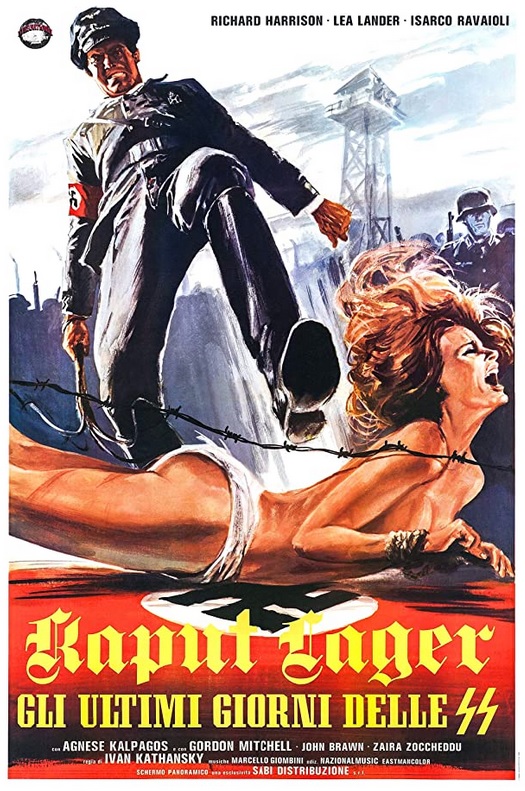
This Nazisploitation entry isn’t — officially — on the U.K.’s “Video Nasties” list that we’ve been reviewing all this week, but after showing the B&S love for expatriate American actors Richard Harrison and Gordon Mitchell in our review of Three Men on Fire (1986) — along with this theme week’s “official nasties” reviews of Lee Frost’s Love Camp 7 (1969), Sergio Garrone’s SS Experiment Camp (1976; whose artwork this film pinches in its VHS reissues), and Cesare Canevari’s Gestapo’s Last Orgy (1977) — you can’t overlook this Luigi Batzella warm up for his notable nazisploitation’er The Beast in Heat, aka SS Hell Camp, aka S.S. Experiment Camp 2 (1977).

Batzella’s resume is a slight one: Out of the 15 films he wrote, he directed 10 — sometimes under the celluloid de plume of Yvan, aka Ivan, Kathansky. Of those — most of which are stock footage mash-ups — we care about two: the Gothic horror Nude for Satan (1974) (that, for my money, screams “Bill Van Ryn must review this for the site!”) and the aforementioned The Beast in Heat. (Okay, three: The Devil’s Wedding Night, his 1973 Gothic take on the Lady Dracula legend.) And as for Richard Harrison: I’m just happy to see him in a film without “Ninja” in the title (he did 19 of them, thanks to the Philippines film industry, if you’re counting).

The movie isn’t as shocking as the theatrical one-sheet

So, if you’re a fan of The Beast in Heat — and expecting your rocket to leave the pocket, stow that flesh torpedo, my friend. For the caveat emptor, here, is that Batzella pulls back the reins on this Nazi warm-up, loosening ever so slightly to see just how far he can push the bad taste. (Then, if you know his next Nazi ditty, he lets the reins go for full-on sleaze.) So, this time, don’t be duped by the “shocking” theatrical one-sheet or the “Nazisplotation” genre description, for this is just another World War II flick, one that’s heavily influenced by John Sturges’s The Great Escape (1963) — via about 20 minutes of (well-shot, well, sort of) stock footage (from who knows where) of a North Africa war campaign on a German Tank division and the sabotage of a desert fuel depot.

Then the proceedings take a hard left turn into the “women in prison” genre, because well, by this cinematic point: when we see Nazis, we’re home video-conditioned to expect sexploitation — with heaping helpings of gratuitous nudity (breasts and triangles of death), brutal whippings, and yes, as always, at least one castration (after the fact) and the old urine-is-whiskey gag.

While you wouldn’t know it from the stock footage, Richard Harrison’s U.S. Major Lexman was in charge of that desert raid of blazing flame throwers. Now Lexman’s thrust into the middle of a coed POW camp run by Gordon Mitchell’s Kommandant von Stolzen. Of course, any good camp commandant must have a lesbian sidekick with a medical degree . . . and Dr. Lessing, of course (Lea Lander, of Mario Bava’s Blood and Black Lace and Rabid Dogs, the Italian Exorcist rip The Tempter), loves her leather strips to whip out the pain upon Jewish and Arab women with sadistic equality. Oh, and Lesser enjoys a bit of the ol’ whip across her own flesh from time to time by way of her sexy, Jewish nurse. Oh, and we can’t forget about Lessing’s obsessions with the “hygiene” of her charges via a nice, hard scrubbing on what is best described as a “shower stockade,” or something. And yada, yada, yada . . . Major Lexman teams up with the camp’s Brits to take Lessing as their hostage and make their “Great Escape,” with the German’s hot on their trail.

Oh, do we care about the romantic subplot of Lessing’s nurse cheating on her with an American G.I. (expatriate American actor Mike Monty of my beloved Philippines junk flicks!) in on the escape . . . that gets Lessing hot and bothered in a tongue-wagging and breast fondling delight?

Nope. I’m bored.

So, amid the 80-minutes stock and dubbing and mismatched scenes, we get about 20 minutes of the sleazy Nazizploitation we came for vs. the 60 minutes of World War II war beeboppin’ and scattin’ that we didn’t come for — perhaps if it was original footage shot for the film and not by stock footage . . . nah, this is a Luigi Batzella production and he is Italy’s “Godfrey Ho” in my cinematic eyeball; he’d never pull off any original war footage.

And the music . . . well, I’ll be 12-barred déjà vu’d . . . this movie is now truly complete, as that’s Marcello Giombini’s soundtrack from my ol’ Uncle Alfonzo Brescia’s Star Odyssey!

One of the most infamous Nazi baddies!

So, you need to complete your Richard Harrison and Gordon Mitchell two-fer fix? In addition to Three Men on Fire and Achtung! The Desert Tigers, look for the Turkish-made (back by Italian money) Four for All (1974), the German-made Natascha: Death Greetings from Moscow (1977), and again with Luigi Batzella in Strategy for the Death Mission, aka Black Gold (1979). And for you Fred Olen Ray fans — and aren’t we all — the duo cameos in Evil Spawn (1987). Yes, Olen Ray with Harrison and Gordon. And the brain whirling dervishes in a junk cinema delight.

You can watch Achtung! The Desert Tigers as an age-restricted freebie on You Tube (whateva . . . it’s not that “nasty,” kiddies). Don’t forget that there’s more Nazisploitation to be had with the genre documentary Fascism on a Thread: The Strange Story of Nazisploitation Cinema (2020).

About the Author: You can learn more about the writings of R.D Francis on Facebook. He also writes for B&S About Movies.

Frozen Scream (1980)

Zombies get frozen and unfrozen — in a fever dream of bizarre ADR-dubbing, hypodermic needles to eyeballs, and laughable gore effects — before they kill people in this not-so-well known zom-effort. And what notoriety this zom-romp received came courtesy of the puritanical purveyors of England placing Frozen Scream on the U.K.’s “Video Nasties” Section 2 list.

Nothing like a stuffy Brit inspiring you to watch a movie. You know how it is: tell me it’s taboo — I only want it more. Heck, shoot it on film in a start-stop-start production, screw it all up, have no one see in the the drive-ins, then make it “look” like we’re getting a piece of the SOV ’80s (click through to our SOV category for more films) by sticking it on hungry-for-product home video store shelves alongside “real” camcordered SOVs — I only want it more.

Two scientists, Lil Stanhope (producer Renee Harmon) and Sven Johnson (Lee James, a makeup artist who worked on Al Adamson’s late ’60s ditties Blood of Ghastly Horror and Brain of Blood; let that serve as a quality caveat, here) are, as all scientists of the VHS variety, on a maniacal quest to unlock the secrets of immorality. To that end, the “secret” is that the subjects are kidnap and murder victims (medical students who get too nosy for their own good) revived by the way of electronic neurosurgery. (Uh-oh, Ulli Lommel’s BrainWaves!)

Only the neck-installed device (looks like a radio audio connector, and probably is; the wonders of spirit gum and a vial of rigid collodion) has a side effect: it turns subjects into homicidal zombies that must be stored in freezers. When Tom Girard, one of the project’s scientists (Wolf Muser in his debut; still in the business with a resume rife with U.S. TV credits, he recently portrayed Adolf Hitler in the stellar streaming series The Man in the High Castle), refuses to be part of the experiments any longer, he’s murdered by a gang of zombie-hooded monks (all sporting bushy, ’70s porn-style staches). Now his wife Ann (Lynne Kocol, later of the production-connected Nomad Riders), who witnessed the murder, is under Stanhope’s care — and brainwashing Ann into believing it was all a hallucination.

As with George Romero’s Night of the Living Dead (1968) and Ken Wiederhorn’s superior Shock Waves (1977): Ann, along with Stanhope and her ex-hubby detective (Thomas McGowan; 20-some films, none notable; he serves as the voice-over thread for the film) are on the case — and face a zombie siege at a house during a (cliché) Halloween Party — complete with screaming kids, natch — and a final mad scientist showdown in Stanhope’s lab of terror.

Since this film is an across-the-years start-stop production on a shoestring budget, the zero-production values hamper the somewhat decent plot (that sort of reminds of Stuart Gordon’s later-amazing Re-Animator), and the hampering goes deeper with the strained voice-overs to thread the film’s vignettes into a coherent plot. The non-cinematography, the audio (the voice-overs are placed over the actor’s dialogs; in fact, the entire film was ADR’d in post) is beyond muddy, and the painful thespin’ throughout — especially from star Renee Harmon in a bad German accent, probably to give us a Nazi subtext (but it’s never explored beyond the accents from her and Lee James) — and makes Don Dohler’s efforts look like award winners. Only Frozen Scream has none of that rooting-for-the-underdog-filmmaker charm of a Dohler effort. Perhaps if Dohler made this, I’d dig it as much as I do Fiend (1980), which is an admittedly weak cup of tea, but . . . I don’t know why, I just love that Dohler film.

All in all, Frozen Scream is a great idea, but one woefully in need of a) a budget, b) a consistent, fluent shooting schedule that doesn’t leave it looking like an Al Adamson chop-shop joint, c) a guy like Ken Wiederhorn to pull it off, and d) a pacing and logic that doesn’t leave a renter (well, today, a streamer) needing to take five attempts to make it through the entire film with their sanity intact (yes, it took me a week to even start to write this review, as result).

Overall, it’s a hard watch of poorly-framed shots where you want to jump through the screen to operate the camera: the static wide shots that offer no mediums or close-ups, the over-the-shoulder shots with no reverse angles, and lighting so dark and muddy, that you want to break out a couple of flashlights are frustrating as hell. But when you’re shooting on 35 mm short ends, that’s par for the course. And it still looks like a shot-on-video delight via post-U-Matic camera. And I care way too much about this film than it deserves.

Frozen Scream is a film that traveled a long, strange road . . . a (production) trip that began in 1975 and took five years to complete. By the time the film was finished, the drive-ins for which it was intended, were defunct — and no distributor wanted the film, anyway. Luckily, the VHS home video boom was in full effect, and Frozen Scream finally made its debut on VHS in 1983, and then was reissued on the format in 1985 — amid the flurry of shot-on-video and direct-to-video films inspired by the success of Blood Cult and Spine (thus my SOV-critical lumping). As is the case with low-budget productions always looking to maximize their dollar, Renee Harmon did the Roger Corman-sensible thing and recycled footage from Frozen Scream into the films Night of Terror (1986) and Run Coyote Run (1987), both produced, written by, and starring Renee Harmon. (The former concerns a sadistic doctor and his family kidnapping subjects for brain experiments; the latter is a crime thriller about a psychic searching for her dead sister’s killers.)

Harmon’s director, Frank Roach, made his second and final film — both as a writer and director — with Nomad Riders (1987), a Stallone-esque cop-out-for-revenge thriller regarding a rogue who, after the brutal murder of his wife and daughter by a gang of vicious bikers, exacts revenge on the bikers and the mobsters behind the bikers. (No, that’s Nomads (1985) you’re thinking of that stars Pierce Brosnan and Lesley Ann Warren under the eye of John “Die Hard” McTiernan.)

Of Frozen Scream‘s co-writing team, Doug Ferrin, never wrote another film.

The same can’t be said for writer Michael Sonye. He later wrote Star Slammer (1986) and Commando Squad (1987) for Fred Olen Ray, the Brad David and Sharon Stone thriller Cold Steel (1987), and the always-welcomed Robert Ginty-starrer Out on Bail (1989). But Sonye’s best known film to video fringe horror fans is the hugely popular horror-comedy VHS-renter, Blood Diner (1987). Across his 28 acting credits, you’ve seen Sonye appear in Star Slammer (as Krago), and the U.S. by way of Japan SOV’er Cards of Death (1986), as well as the ’80s USA Network’ers Surf Nazis Must Die, Sorority Babes in the Slimeball Bowl-O-Rama, and Hollywood Chainsaw Hookers.

If the soundtrack — to you fellow junk video hounds — sounds a wee-bit familiar to the ears, that’s because composer H. Kingsley Thurber recycled his work on Frozen Scream on another inept backyard’er, Don’t Go Into the Woods (1981) (and that film is really bad. Really bad).

You’ve also seen actress Rene Harmon in the vansploitation romp Van Nuys Blvd. (1979), the women-in-jepaordy-seeks-revenge thriller in a ghost town, Hell Riders (1984), and the aforementioned horror flick, Night of Terror (1986), across her scant 11 acting credits — eight of which she wrote. Her final film before her 2008 death was Revenge of Lady Street Fighter (1990), while her final film overall, Jungle Trap (2016) was completed posthumously. In between her acting and writer gigs, she taught screenwriting at the College of the Sequoias Community College in Visalia, California. (Heads up, Adam West fans, for he stars in Hell Riders alongside Tina “Ginger of Gilligan’s Island” Louise; hell, yeah, that’s on our watch list.)


You can watch Frozen Scream on Tubi and You Tube. Movie Trailer Graveyard You Tube offers the age-restricted sign-in trailer.

You can purchase the DVD of the original 1986 VHS two-fer with The Executioner 2 from Vinegar Syndrome, both of which starred Rene Harmon. There are also grey-market looking DVDs that pair Frozen Scream with Tobe Hooper’s mad alligator romp, Eaten Alive. Then there’s a double-sided, uncut Region 2 DVD that features the German version (Blautrausch Der Zombies) of Leon Klimovsky and Paul Naschy’s Vengeance of the Zombies (1973) on the other side. Yet another version is a single-disc grey impress. So, outside of the Vin Syn version, shop smart.

Renee Harmon, amid a flurry of a dozen or so self-published educational books on acting, filmmaking and screenwriting (see ThriftBooks and Good Reads), adapted Frozen Scream into a novel — issued under the title Evil Covenant (2001) — and used copies can be found on Amazon and eBay. Her other educational work, Hollywood Mysteries (2001), complies two of her studies, “The Hunting Party” and “Let the Dice Roll,” subtitled as “Book One,” as an insight on creating suspense-genre films. The book is of particular interest as it features the complete script from Frozen Scream, including production notes that she later used to complete the whole of Hollywood Mysteries. Sadly, Harmon passed away in 2008 before writing additional volumes to the series.

Say what you will about her films, but Renee Harmon was, as Doris Wishman, a true renaissance woman who should have her name spoken more often in the realms of indie film, alongside the fandom of Al Adamson, Larry Buchanan, Don Dohler, and countless other up-against-the-budget underbelly dreamers and schemers of the celluloid side streets and back alleys of Tinseltown. Most of her books — based on reviews — seem to be rife with typographical and layout errors. However, I read her non-self published book How to Audition for Movies and TV (1992) via a public library copy (issued by a larger publisher, natch, with a quality assurance queue to minimize errors) and found it to be a well-written, insightful book that I utilized in my own adventures “in the room” as an actor. Renee knew her stuff and then some, so she did me a solid.

About the Author: You can read the music and film reviews of R.D Francis on Medium and learn more about his work on Facebook.

The Man from Deep River, aka Deep River Savages (1972)

This is really the whole gooey enchilada, ain’t it: for this is where all of those cannibal hybrids of the George Romero-rebooted zombie genre originated.

What makes this film a film that I have never gone back to: three-plus minutes of this Umberto Lenzi puke fest has moments of real animal murder (not cool). Of course, this being our “Video Nasties Week,” the puritanical purveyors of the all-things-holy U.K. cut those scenes from the British release ever since it was first kept out of British theaters in 1975.

Yes. Sometimes you’ll find it out there as Sacrifice!

The plot, such as it is, is a blatant ripoff of the Richard Harris-starring A Man Called Horse (1970). That film’s positive critical reviews and box office success spawned two sequels in The Return of a Man Called Horse (1976) and Triumphs of a Man Called Horse (1983), each also equally acclaimed critical and box office hits.

Then there’s this U.K. Section 2 “Video Nasty” that made the rounds on the U.S. “Midnight Movie” circuit and earned a re-renting when it hit home video stores. Some of the titles you know the film under are l Paese del Sesso Selvaggio, aka The Country of Savage Sex, as well as Deep River Savages. The best known and distributed title is Sacrifice!, and that cut can be purchased from Raro Video.

Both films deal with a civilized man incorporated into a tribe that originally held him captive. Here, British photographer John Bradley (Ivan Rassimov) heads off to the rain forests of Thailand for a wildlife photograph wildlife assignment. After a bar fight with a local, Bradley, in self-defense, kills the man; Bradley flees the scene and heads down river to not only complete his assignment, but to escape arrest.

He’s soon captured by natives and put through a series of the tortures — as you’d expect from a cannibal film — only the tongue removals, along with everything else — was done here, first.

The highlights of the film — which is still not enough to get us past the animal cruelty — are the always welcomed Ivan Rassimov; he does the cannibal thing again in Jungle Holocaust and Eaten Alive!. Also starring here — and in both of those films, again, with Rassimov, is the Queen of Cannibal Cinema: Me Me Lai.

Then Ruggero Deodato released Jungle Holocaust in 1977. That film, alongside George Romero’s Dawn of the Dead (1979), was the one-two punch that ignited the cannibal sub-genre of zombie films. Then Deodato gave us Cannibal Holocaust (1980). Lenzi was presented the opportunity to direct Jungle Holocaust, but the job ultimately went to Deodato. Lenzi would follow up his own Eaten Alive! (1980), with his third cannibal romp, Cannibal Ferox (1981). In between, Sergio Martino chimed in with The Mountain of the Cannibal God (1978).

You can learn more about Lai’s career — the star of The Man from Deep River (Deep River Savages), Jungle Holocaust, and Eaten Alive! — and the cannibal sub-genre of zombie films, in whole, in a documentary we recently reviewed, Me Me Lai Bites Back (2021). You can purchase restored DVDs and Blu-rays of The Man from Deep River from 88 Films, which also includes Lai’s documentary as a supplement.

We run down most of these cannibal films with our February 2018 “Mangiati Vivi Week” tribute, which serves as a great catch-all reference list. And what’s not on that list is being reviewed during our “Video Nasties Week” tribute, this week.

As always, we appreciated you surfing to B&S About Movies and using us as your one-stop source for discovering and rediscovering classic films from the Drive-In, UHF-TV, and home video eras.

About the Author: You can read the music and film reviews of R.D Francis on Medium and learn more about his work on Facebook.

Delirium (1979)

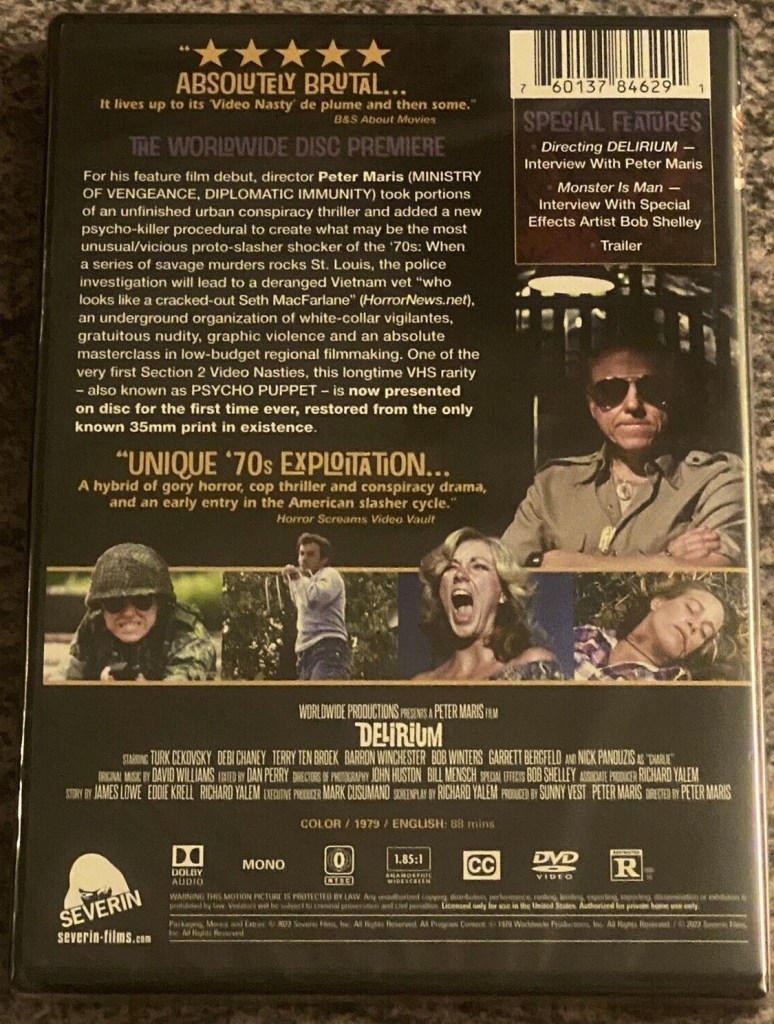
EDITOR’S NOTE, January 2022: We’re excited to share Severin has used a quote from R.D. Francis’s review on the back of the limited-edition slipcase version for their new Blu-ray release of Delirium. They since used the quote for the rear cover on their mass-marketed DVD.

At the time of composing this September 2021 review, we were simply crossing-off another film from our ongoing goal of reviewing all of the British “Video Nasties” of the ’80s (we’ve linked that three-part series at the end of this review). We were unaware that, first, Severin, then 88 Films in the U.K. — who didn’t make their respective, reissue announcements until November and December 2021 — were releasing the upgraded film in January 2022. . . .

So, yes . . . another obscure, mostly forgotten, even unknown in most quarters, 40-year-old film (see our recent — and now, updated — reviews for The Spirits of Jupiter and UFO: Target Earth) crawls out of the analog snows, aka woodwork, and bites us in the ‘ol arse!


DVD image courtesy of dcjsalesofficial/eBay.

Okay, so it goes without saying, but we’ll say it, anyway: This isn’t Lamberto Bava’s 1987 film of the same name — at least not in the celluloid confusing lands of the alternate-title U.S. In other parts of the world, that film was known as Le foto di Gioia, aka The Photos of Giola, starring the heart-melting Serena Grandi (Antropophagus), Dame Daria Nicolodi (Shock), and George “Big Ape” Eastman (who we’ve “Explored“).

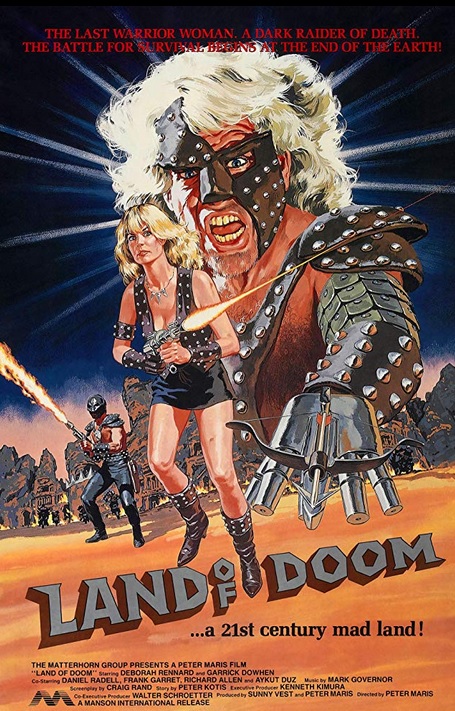
No, this Delirium is the U.K. “Section 2” Video Nasty (see, we are finally getting around to polishing off those reviews, in full*) that served as the feature film debut by producer, writer and director Peter Maris, he who later gave us the cheesy-fun The Road Warrior rip Land of Doom (1985), and the god awful (sorry, Pete, it just is), one-two punch CGI’d ripoff of not only Independence Day, but Species, with the oft-Mill Creek box set-programmed Alien Species (1996). Maris, however, unlike most auteurs whom appeared on “Video Nasty” and bloody “SOV” lists, carved himself a rather prolific, low-budget resume of directing a film roughly once a year, for a total of fifteen films until 2007. As a producer, he also gave us four more: True Blood (1989), Ballistic (1995), the Christian apoc-rocker Raging Angels (1995)(!), and a pretty good neo-cable-noir with The Murder in China Basin (1999).

Okay, so back to the “Video Nasty” that is Delirium.

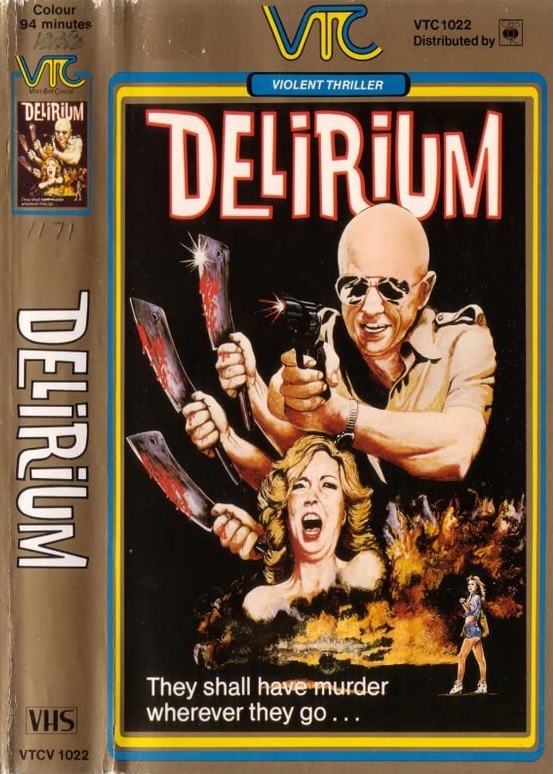
Ah, the VHS I remember. It feels like home. It also aka’d as the cooly-titled Psycho Puppet throughout Europe.

Charlie is your garden variety, Giallo-influnced-by-way-of-John Carpenter psycho trapped in a graphic foreshadowing of the Micheal Douglas-vehicle The Star Chamber (1983). In that film, Douglas becomes part of a secret society of judges who hire hitmen to assassinate criminals who slip through the system. Perhaps your nostalgia miles may recall the James Glickenhaus** written and directed The Exterminator (1980), with Robert Ginty’s war vet barbecue’in criminals with a flame thrower (we’ve since reviewed Part II as part of our “Cannon Month” of reviews). However, as with The Star Chamber, Peter Mavis, was — brilliantly — first.

In a Mavis low-fi world, we have a secret society of community leaders who’ve formed a “vigilante counsel.” Taking the law into their own hands, the committee’s kangaroo court convicts in absentia and murders the convicted. To run their court — and handle the “assassinations” — they hire Charlie: an ex-solider. At first, Chuck mops the streets with efficiency and plausible deniability on part of the counsel. However, as any emotionally damaged Vietnam vet (of the celluloid variety) should: Chuck freaks out and just friggin’ kills everyone — including squeezing in the butchering of innocent, young women: for he side hustles between “assignments” with his serial killer gig.

Delirium — as result of its foreshadowing two, better known, more popular movies, and its crazed, hybrid-amalgamating of Dario Argento with the later action-thrills of John Carpenter (see his earlier Assault on Precinct 13 vs. Halloween) — is an oddly-styled, unusual film that, again, also foreshadows Sylvester Stallone’s own, later Giallo-action hybrids in Cobra, and his less-successful attempt with D-Tox. We can even go as far as mentioning Charles Bronson’s graphic, but not as gruesome as Delirium, Italian Poliziotteschi-Giallo hybrid with 10 to Midnight.

However, unlike the films we’ve mentioned in comparison: Delirium is absolutely brutal in its misogyny (and Stallone had women hanging as hogtied-meat slabs in D-Tox). This movie — not Mavis, mind you — hates women: even more so than Joe Spinell’s head-scalping Frank Zito in William Lustig’s — again, more popular, better known; but Mavis was first — Maniac (1980). Look at the cover: this movie lives up to the “video nasty” de plume and then some, as it decides jamming a pitchfork through a woman’s throat (Pastor Estus Pirkle jammed sharpened bamboo rods into kids’ ear canals, so why not; you’ve never seen If Footmen Tire You, What Will Horses Do?, well, you should*˟) and nail-gunning women to doors is the way to go — then justifies it all with the ol’ “Vietnam flashback” gag (the Gooks made me do it). The vet-flashback gag didn’t work in the earlier (I can’t not believe Peter Mavis wasn’t influenced by it), porn-industry backed The Last Victim/Forced Entry from 1973/1975. Only Mavis’s film is the more skillful of the two. (I keep flashing back — or is that forward — to Will MacMillan’s serial-killer oddball Cards of Death (1986); however cool that SOV’er is, Mavis made the better-quality film).

So, if you have a hankering for a “heavy metal” experience of an uber-weird n’ scuzzy amalgamate of John Carpenter’s Halloween and Sean. S Cunningham’s Friday the 13th — with a soupçon of Death Wish — load ‘er up. And while Cunningham is credited as being more bloody than Carpenter, Mavis out-bloodies Cunningham — by several gallons of Karo n’ food coloring — in this splatter-cum-cop flick.

Two thumbs up and five stars — as far as I am concerned. But what do I know: I’m the guy who likes Cards of Death.

Upon the Blu’s release, Eric Cotenas of DVD Compare dives deep on Delirium — and offers up some insights from Peter Mavis’s commentary and its two vignette supplements: “Directing Delirium” and “Monster Is Man,” the latter offers more insights from Effects Artist Bob Shelley (Moonrunners). Movies and Mania dives even deeper into the Blu, digging up a couple newspaper reviews from 1979, newsprint ads, and alternate VHS covers. Both are great reads for those D.I.Y ’80s fans of yore. Need more technical aspects on the release: Blu-ray.com has you covered.

* Click the images and enjoy all three parts of our “Video Nasties” series.

** Glickenhaus produced Maniac Cop, Frankenhooker, and the Basket Case franchise. He made his writing and directing debut with the Christploitation’er, The Astrologer, aka Suicide Cult.

*˟ We round up the “Christian Gore” of Pastor Pirkle — as well as director Ron Ormond’s lighter, Christian wares — with our review of The Second Coming.

We take a second look at Delirium as part of our May 2023 tribute to Roger Avery and Quentin Tarantino’s weekly podcast tribute to their days at Manhattan Beach’s Video Archives.

About the Author: You can learn more about the writings of R.D Francis on Facebook. He also writes for B&S About Movies.