SALEM HORROR FEST: Woodlands Dark and Days Bewitched: A History of Folk Horror(2021)

EDITOR’S NOTE: This movie was watched as part of Salem Horror Fest. You can still get a weekend pass for weekend two. Single tickets are also available. Here’s the program of what’s playing.

If you have even a passing interest in the world of folk horror, Kier-La Janisse’s exhaustive exploration — which clocks in at 3 hours and 14 minutes and could have been a thousand more if I had my way — is the film of a lifetime. The ‘unholy trinity’ that launched this trend on to screens — Michael Reeves’ Witchfinder General, Piers Haggard’s Blood on Satan’s Claw and Robin Hardy’s The Wicker Man — are not just names, but significant milestones in the history of folk horror. This movie is quite literally the last word in what folk horror is, what it means and how it’s still part of the world of cinema today, perhaps more than ever before.

With more than fifty significant names in the world of horror and horror writing — everyone from Amanda Reyes, Piers Haggard, Adam Scovell, Jeremy Dyson Samm Deighan, Kat Ellinger, Robert Eggars, Ian Oglivy, Kevin Kölsch, Dennis Widmyer and around forty more voices appear with great insights — there’s never been a more well-rounded approach to tackling a movie genre within a genre. This feels like the kind of film that I’ll be coming back to again and again.

Beyond the expected anchors of the genre, I was so excited to see lesser-known films get their due, like Alison’s Birthday (which is on the gigantic All the Haunts Be Ours box set that Severin is releasing), beDevilDark AugustEyes of Fire (also being released by Severin), Grim Prarie TalesLemora (which seemingly has footage from the mysterious blu ray of the film that never materialized) and Zeder.

This is the kind of material you want to pause, write down, make notes on, and keep updating your Letterboxd while watching it. This isn’t just a movie about films. This is a true celebration of the magical wonder hidden within the flickering image, an exploration of a genre of all the dark old things and a journey through how each country documents the unknown through their media.

There aren’t enough stars in the firmament out of ten to rate this one. You can preorder this film from Severin now or watch it on Shudder. You can also visit the film’s official site.

Thanks to the fantastic Letterboxd list Films mentioned in “Woodlands Dark and Days Bewitched: A History of Folk Horror by Jon Ursenbach, here’s a list of the films as well as links to reviews of them that we’ve done on our site.

SALEM HORROR FEST: The Blood On Satan’s Claw (1971)

EDITOR’S NOTE: This movie was watched as part of Salem Horror Fest. You can still get a weekend pass for weekend two. Single tickets are also available. Here’s the program of what’s playing.

In his BBC documentary series A History of Horror, Mark Gatiss referred to this film, along with Witchfinder General and The Wicker Man, as the prime example of a short-lived subgenre he called folk horror.

It’s directed by Piers Haggard, who also was behind The Quatermass ConclusionThe Fiendish Plot of Dr. Fu Manchu and Venom. He’s also the great-great-nephew of H. Rider Haggard, the creator of Allan Quartermain.

Robert Wynne-Simmons was hired to write the story, which was inspired by the modern-day Manson Family and Mary Bell child murders.

In the early 18th century, Ralph Gower (Barry Andrews, Dracula Has Risen from His Grave) uncovers a one-eyed skill covered with fur while plowing his fields. He asks the judge (Patrick Wymark, Dr. Syn, Alias the Scarecrow) to look at it, but it’s gone missing, and his fears are ridiculous.

Peter Edmonton brings his fiancee, Rosalind Barton (Tamara Ustinov, Blood from the Mummy’s Tomb), to meet his aunt, Mistress Banham. Banham disapproves of the coupling and demands that Rosalind sleep in an attic room. After screaming throughout the night, she soon gets ill, and the judge commits her. As she’s led away, Peter discovers she has a claw instead of a hand.

Claws show up all over this — hidden in fields to be found by children and attacking Peter inside the cursed room, causing him to sever his hand. The judge leaves behind the town for London but promises to return. He places Squire Middleton (James Hayter, The 39 Steps) in charge.

One of the children who found the claw, Mark, is lured out by his classmates and killed in a ritual game by the leader of a new cult, Angel Blake (Linda Hayden, MadhouseQueen Kong). She even tries to seduce Fallowfield (Anthony Ainley, the Master from Dr. Who) and tells him that Mark had the devil inside him, which needed to be cut out. Her group also has a Black Mass inside a ruined church where they attack Mark’s sister Cathy (Wendy Padbury, companion Zoe on Dr. Who). They ritualistically assault and murder her before tearing the fur from her skin.

Of course, it’s not long before all hell quite literally breaks loose, with insane children raising Satan himself from the Great Beyond and Ralph growing fur on his leg, marking him for death. This movie is…well, there’s nothing else quite like it. I can see why it had a limited audience for years; it’s so dark and unforgiving.

“It never made much money,” said Haggard. “It wasn’t a hit. From the very beginning, it had a minority appeal. A few people absolutely loved it, but the audiences didn’t turn out for it.”

While Satan’s Skin was the original title, you must give it to American International Pictures’ Samuel Z. Arkoff, who created the film’s title.

APRIL MOVIE THON 2: The Venus of Ille (1981)

April 25: Bava Forever — Bava died on this day 43 years ago. Let’s watch his movies.

In 1981, RAI-TV in Italy showed six hour-long films based on stories by 19th century horror/fantasy authors that were directed by several Italian genre talents, including Marcello Aliprand (the writer of L’arma, l’ora, il movent), Giulio Questi (Django Kill…If You Live, Shoot!Death Laid an EggArcana), Giovanna Gagliardo, Piero Nelli, Tomaso Sherman and, most essentially to this article, Mario Bava.

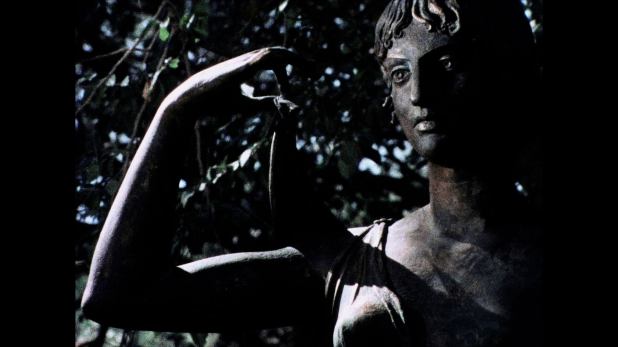
“La Venere Dille” (“The Venus of Ille”) would be the final filmed work that Bava would create and it was written and co-directed by his son Lamberto. Adapted from Prosper Merimee’s story, it starts when a bronze statue of Venus is uncovered. Originally a source of celebration and wonder to the rich and powerful, the workers of the small village see the female carved form as a cursed objet d’art that can move on its own and take on the form of others. Certainly, that’s what happens when Clara’s (Dario Nicolodi, who was also in Bava’s Shock amongst her many, many contributions to cinema) fiancee Alfonso (Fausto Di Bella) places her ring upon its finger while drunk one rainy night.

Meanwhile, an antiques expert and artist named Matthew (Marc Porel, The Sister of Ursula) has been summoned by Alfonso’s father Mr. de Peyrehorade (Fausto Di Bella) to assess the value of the statue. He’s been sketching it for some days before he realizes that he’s been drawing Clara. Or is the statue becoming her?

Shot in 1979 and not aired until after Bava’s death in 1981 (and after Lamberto started making his own movies, including Macabre), this was shot on film and therefore seems of much higher quality than just a TV series. It serves as both a fitting close to Mario’s career and a wonderful gift to his son, as well as an opportunity for the two to work together on a piece of art.

The whole affair looks gorgeous with one moment of rain across the face of the statue and another where Matthew is drawing near it but obviously already obsessed with Clara, the soon-to-be wife of a friend who doesn’t seem to be all that great of a person. The story doesn’t suffer at all from being a TV episode, as at a bit over seventy minutes it has time to stretch out and engage you.

You can get the entire series from Severin.

EDIT: Thanks to Scott for catching a horrible typo. Much appreciated.

April Ghouls Drive-In Monster-Rama Primer: Sorority House Massacre (1986)

April Ghouls Drive-In Monster-Rama is back at The Riverside Drive-In Theatre in Vandergrift, PA on April 28 and 29, 2022.

The features for Friday, April 28 are Silent Night, Deadly NightChopping MallSlumber Party Massacre 2 and Sorority House Massacre.

Saturday, April 29 has ManiacManiac CopThe Toolbox Murders and Silent Madness.

Admission is still only $15 per person each night (children 12 and under free with adult) and overnight camping is available (breakfast included) for an additional $15 per person. You can buy tickets at the show or use these links:

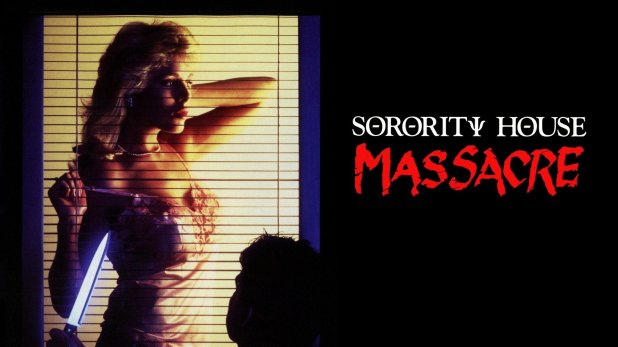
Sorority House Massacre (1986): The trailer for this film had appeared in a few compilations and every time Becca and I saw it, we thought, “That movie looks so much better than the title.” Well, we were sort of right.

Sorority House Massacre is the only film Carol Frank ever directed. Before this, she was the Assistant Director on 1982’s The Slumber Party Massacre. Both films are incredibly similar, with young women partying all alone in a house until their boyfriends — and an anonymous male killer — show up. They even barricade a door with a dressed in both films. The influence goes so deep that the characters in Sorority are watching Slumber Party as the film within the film.

Where this film really becomes a carbon copy is its near worship of Halloween and Halloween 2, down to our heroine, Beth, being stalked by her brother, Bobby. There’s an attempt at style here, with match shots and cuts between the two of them to show how they are linked. There’s a definite Elm Street vibe here, as 1986 was late for the slasher genre. But without the awesome look of The Shape, it’s boring. I was half waiting for the scene where Bobby is knocked out the window for them to look outside and his body to be gone with a music stinger.

If you like 80s fashion, then by all means, seek out this film. There’s a great scene where the richest girl leaves the house and everyone tries on her clothes. It’s a moment that gives the film some nudity for the producers, some horrible library music for those that love 80s schmaltz and plenty of sweet, sweet shoulderpads and pantsuits for those that like that sort of thing (Becca).

I felt like there was a movie in here yearning to break free, to reject the urge to copy and become a strange American giallo of its own. It gets close, but if you have the same wish as me, prepare to be frustrated. My theory is that there are two budgets in life: money and time. You can get this movie relatively inexpensively, but you’d be better off watching any number of better constructed slashers.

Here’s a drink recipe to go with this movie:

Sorority Girl

  • 4 oz. Hawaiian Punch
  • 2 oz. pineapple juice
  • 1 oz. grain alcohol
  • 1 oz. Malibu rum
  1. Mix everything in a glass with ice and stir.
  2. Drink until frat boys — or sorority girls — look good.

APRIL MOVIE THON 2: The Wonders of Aladdin (1961)

April 25: Bava Forever — Bava died on this day 43 years ago. Let’s watch his movies.

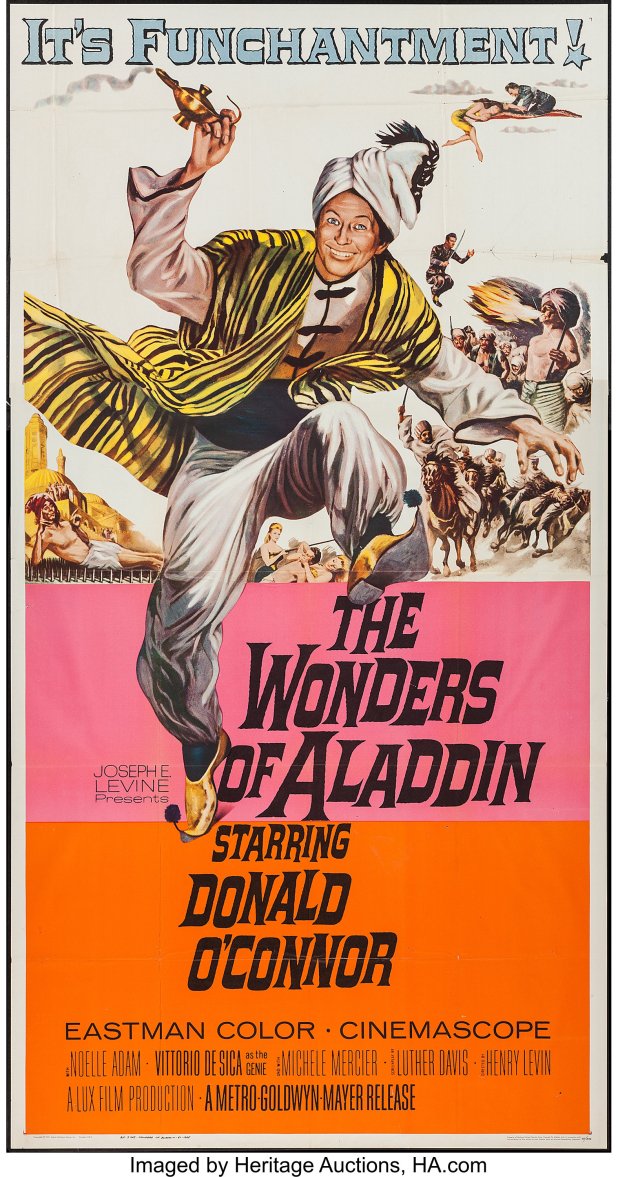
According to camera operator Marcello Gatti, Henry Levin (That Man BoltKiss the Girls and Make Them Die) directed 80% of this movie, while Mario Bava did the second unit direction and supervised the special effects. Because Bava was also in charge of post-production and dubbing in Italy, Italian and French prints have the credit “A film by Henry Levin, directed by Mario Bava” while English language prints only credit Levin with direction.

The making of this movie was not without incident.

Star Donald O’Connor suffered a blood hemorrhage on his throat and had to be rushed to hospital at one point. He also was joined by director Levin and writer Henry Motofsky in crossing the Tunisian border into Algeria while scouting locations and being arrested for three hours. But the worst incident — according to the commentary track from Tim Lucas on the Kino Lorber blu ray — was that the use of a mosque as a shooting location caused a violent revolt which led to five deaths and the killing of a security guard at the American embassy that was cleared the location. Bava had literally spears pointed at his head and said that it was the most frightening moment of his life.

In the middle of all that insanity, this movie was made at the same time as two Steve Reeves films: Morgan, the Pirate and The Thief of Baghdad. The same crew — producer Joseph E. Levine, set designer Flavio Mogherini, cinematographer Tonino Delli Colli and Bava on effects — worked on all of the movies one after another.

The script is credited to Luther Davis (The Old Man Who Cried Wolf) from a story by Stefano Strucchi and Duccio Tessari, who was three years away from writing A Fistful of Dollars. The adaptation is credited to Silvano Reina, Pierre Véry and Franco Prosperi, who one day would make The Last House on the Beach, The Throne of FireThe Green Inferno and White Cannibal Queen. He also wrote another film for Bava, Hercules In the Haunted World. He also did second unit directing for that movie, as well as Bava’s Erik the Conquerer and The Girl Who Knew Too Much.

Based on Antoine Galland’s adapted version of Aladdin and the Magic Lamp, this film combines the feel of peplum with the tales of Arabian adventure. Aladdin must go up against the Grand Vizier (Fausto Tozzi) with the help of a genie (Vittorio De Sica, who would go on to direct films of his own such as Marriage Italian StyleWoman Times Seven, a sex comedy anthology starring Shirley MacLaine, and a segment in Le streghe). There’s also Prince Moluk in this, played by Mario Girotti. Six years later, you’d start to know him much better by his Americanized stage name, Terrence Hill.

While the actual movie is pretty simple and not all that exciting, the effects and ability to stretch the budget that Bava always showed are reasons enough to see this movie.

April Ghouls Drive-In Monster-Rama Primer: Slumber Party Massacre II (1987)

April Ghouls Drive-In Monster-Rama is back at The Riverside Drive-In Theatre in Vandergrift, PA on April 28 and 29, 2022.

The features for Friday, April 28 are Silent Night, Deadly NightChopping MallSlumber Party Massacre 2 and Sorority House Massacre.

Saturday, April 29 has ManiacManiac CopThe Toolbox Murders and Silent Madness.

Admission is still only $15 per person each night (children 12 and under free with adult) and overnight camping is available (breakfast included) for an additional $15 per person. You can buy tickets at the show or use these links:

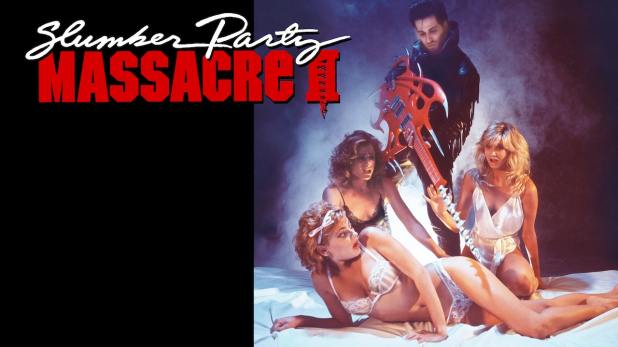
Slumber Party Massacre II (1987): You can pish posh this movie by its title or the fact that it rips off A Nightmare on Elm Street or that it’s ridiculous that it has a slasher who has a Warlock guitar with a giant drill at the end. Or you can just do what I did: utterly enjoy every single minute of it. Also, of note, this is the only slasher series to be completely directed by women.

I never saw the original film and I’m here to tell you that I don’t think that matters at all. All you need to know is that Courtney Bates (Crystal Bernard from Wings) survived, teaming with her sister to kill the dreaded Driller Killer (and no, not the one from the Abel Ferrara film.

Now that she’s in high school, Courtney is dealing with nightmares from the ordeal from the first film. She’s also made friends with Amy (Kimberly McArthur, Playboy Playmate January 1982), Sheila (Juliette Cummins from Friday the 13th: A New Beginning, the scummiest of the entire series) and Sally (Heidi Kozak, Friday the 13th Part VII: The New Blood, who noticed during filming that her jean shorts got shorter every day, due to a costumer literally doing that each night, continuity be damned), who have all started an unnamed band (although the songs are performed by the very Go-Go’s-sounding group Wednesday Week). The girls decide to go away for the weekend so they can work on songs, but they end up watching Rock ‘n Roll High School (director Deborah Brock would go on to direct the sequel to that movie) which leads to a pillow fight and Sheila ripping off her bra, because women can make exploitation movies too.

Surprise! Bros Jeff and T.J. sneak up and spy on the girls before busting in and frightening them. The house is a mess as a result. This image sums up everything there is to know about this movie:

If it seems strange that this movie often focuses on name brand sodas. Mostly Pepsi, but also New York Seltzer. Yet I know that there’s also no way that any of those brands want to be associated with this film.

Later that night, Courtney and Valerie fall asleep in the same bed and our heroine has a dream that the killer murders her friend, then she wakes up in the kitchen floor. Her visions get more and more intense, but the arrival of potential boyfriend Matt makes her happy.

I say that and then within moments, she sees Sally’s zits burst her entire head open. No one can find Sally, so the cops get called. Officers Krueger and Vorhees show up — this is also a film that refers to the last movie’s house as the Cravens and Courtney’s last name is Bates — but assume the teens are all on drugs when Sally shows up alive. Oh yeah — Sally has the last name Burns to pay homage to Sally Hardesty in The Texas Chainsaw Massacre, who was played by Marilyn Burns.

Everyone else goes to town for dinner, leaving Courtney alone with Matt. He surprises her with a cake, like he’s the Jake Ryan to her Samantha Baker, and they start to have sex. Keep in mind that she never blows out the candles and we keep cutting to the cake, blazing away. The killer appears and impales Matt, throwing one of his bloody appendages onto the burning candles. He chases Courtney downstairs right into her friends, who call 911. Of course, the cops blow them off, so they’re on their own against a 1950s rockabilly greaser with a total 1980s guitar, trapped in a neon-hued house with Patrick Nagel prints on the walls.

Just as Sally argues with the cops, we see the drill come through the backside of the wall, covered in her blood. Sheila and T.J. get injured and almost get away, but the killer catches them after an angry neighbor (producer Don Daniel as Mr. Damnkids) tells them to get off his driveway and T.J. bites the big drill.

Meanwhile, Courtney, Amy and Jeff try to leave in a car, but the killer drills right through Jeff. The girls run into the house and barricade themselves inside, which means that they don’t come to the aid of Sheila, who gets killed after the killer breaks the fourth wall, saying “Now it’s time for the fun part,” and sings a song called “Let’s Buzz.”

Should every slasher have musical numbers? Nope. But at this point of the movie, I was inclined to follow this wherever it led.

Amy falls to her death as the girls run away through a construction site, while Courtney uses a propane tank to light the killer up. In the morning, the police come and we think it’s all over. No, this movie has more endings than a Tolkien film. First, Amy comes back to life and laughs in the killer’s voice. Then, Courtney wakes up in Matt’s arms, who ends up being the killer. Finally, she is in a mental asylum and the killer’s drill appears near her bed.

Originally called Don’t Let Go, this is probably one of the strangest slashers I’ve seen that doesn’t have Bigfoot kill someone with an oven (Night of the Demon, please stand up). There’s also a scene where a dead and frozen chicken leaps from a refrigerator ala the zombie head in probably Fulci’s only contribution to Zombi 3, then proceeds to leak chocolate sauce/blood all over our protagonist.

Slumber Party Massacre is 77 minutes of your life that you’ll be glad you wasted. From catchy 80’s singalongs to softcore dreams that descend into graphic violence and a killer who owns every scene of the film — and has nothing to do with the first or third movies in this trilogy — this is why I stay up all night and watch movies.

PS – Don’t steal anything from this movie. The notice at the end reads: Any unauthorized exhibition, distribution or copying of this film or any part thereof [including soundtrack] is an infringement of the relevant copyright and will subject the infringer to severe civil and criminal prosecution as well as a midnight call from the Driller-Killer.

APRIL MOVIE THON 2: Four Times That Night (1971)

April 25: Bava Forever — Bava died on this day 43 years ago. Let’s watch his movies.

Often, we put Italian genre directors into buckets. Fulci was only the godfather of gore, which ignores his contributions to giallo, westerns and decades of comedy films in favor of the last fifteen years of his life. Similarly, Bava is often thought of for his contributtons to horror film when the truth is he did everything from peplum and Eurospy films to crime and science fiction movies.

By 1971, Bava had been through his successful mid 60s run of having American-International Pictures bring his movies to America, as well as his attempt at making a western, Roy Colt & Winchester Jack, and was a year from pretty much kickstarting so many of the themes of the slasher in A Bay of Blood and then having a small career resurgenace and reaching America again with Baron Blood.

Bava had a lack of confidence and when that was combined with his shyness, he rarely took advantage of opportunities which would have made his name more internationally known, including working in Hollywood. In interviews — which appear in Troy Howarth’s The Haunted World of Mario Bava — he comes across as pretty rough on himself, saying things like “I accept anything they give to me. I am too willing to accomodate any difficulty. This is not the way one creates masterpieces. Also, I’m too cheerful and the producers don’t like that: they want people who take things very seriously, and above all who take them seriously. But how can I?” and “I think of myself as one who manages to get along. I don’t care about being successful, I just want to go on and on.”

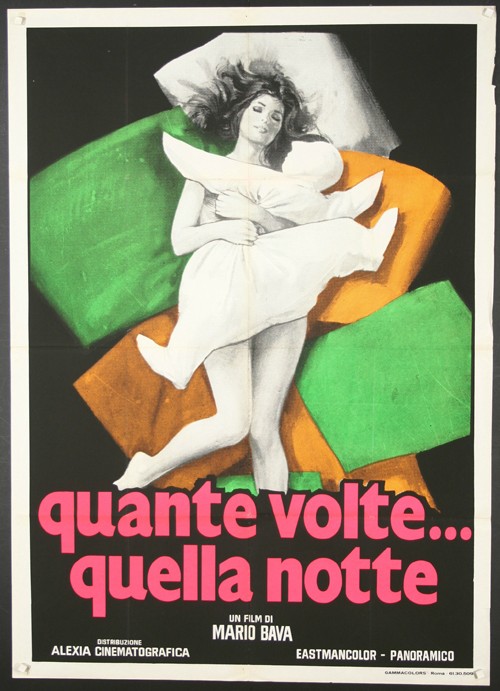
So when Bava needed another movie to make, this commedia sexy all’italiana was what it would be, the first of three collaborations between Bava and American producer Alfredo Leone. Instead of the simple titilation and dated jokes you expect from the form, instead Bava creates a racy Rashomon of a date gone wrong, which we learn has led to Tina Bryant (Daniela Giordano, Your Vice Is a Locked Room and Only I Have the Key) having her dress torn and John Price (Brett Halsey, The Devil’s Honey) with a cut on his forehead.

The first version of the story is Tina telling her mother (Valeria Sabel) that she was like Joan of Arc and John was the devil. After dancing at a disco, she went into his jet set swinger’s flat and when he offered to change into something more comfortable, he came out nearly nude and tried to assault her. She barely escaped and her expensive dress paid the price.

Or maybe John is right. He’s an innocent man who was trapped in the spider’s web, a woman who was more sexually voracious than him, someone who literally lives up to the film’s title, demanding four rounds of sexual congress and still being unsatisfied to the point that she injured him. For an Italian man, this is quite an admission.

But the real story? The perverted doorman (Dick Randall, who may be living up to his role; he made so many exploitation movies that he was involved in are to be worshipped including The Wild, Wild World of Jayne MansfieldThe French Sex MurdersPieces and Slaughter High) thinks that the couple who keeps showing up in these stories — George (Robert H. Oliver) and Esmerelda (Pascale Petit) — are both gay and that John has been dating George and needs to bring a woman home to satisfy Esmerelda, who drugs poor Tina and takes advantage of her and then John does the same. This story is written through binoculars, as if someone was writing their own fan fiction of this movie and is shown to not be true.

What may be is what the scientist sees. John and Tina have fallen in love and decide to wait to sleep together. He tries to take her home but the front gate of his apartment building is stuck. The doorman is drunk and looking at a dirty magazine, so when John tries to lift his date over the gate, her dress is torn and she accidentally scratches him. He tells her to tell her mom that he tried to attack her so that she doesn’t get in trouble for ruining the dress. She tells him to tell his friends that she was insatiable. The scientist says that the truth is in there somewhere, but he does know that before John took her home, they went and watched the sun rise together.

For someone known for horror and murder, the truth is that nobody shoots a gorgeous woman quite like Mario Bava. He is approaching them not as objects or things to be exploited, but instead from his place of shyness. They are perfect creations to be placed upon a pedestal and fawned over, explored and shown to others for their glory. Giordano, Petit and Brigette Skay (Zeta OneIsabella, Duchess of the Devil) have never looked more irrestiable.

He’s also less interested in the sexy parts of this movie — not that they’re skipped, mind you — and more the foibles of modern society and how women and men are supposed to play the games of love and sex. Every man wants a Tina who is a lady in the street and a tigress in the sheets, but every man is also worried that when the fantasy arrives that they have been roleplaying their whole lives in solo acts that they will be able to measure up. And when the woman wants more than them — four times that night — it can hurt them more than any words or physical attack could.

There’s also a different look at the characters and nearly a different film in each segment. Tina’s is chaste and John’s is slightly saucy, while the doorman is pretty much a Dick Randall movie, which makes him playing the character an intriguing bit of meta commentary.

Written by Charles Ross (Caught In the Act!Nympho: A Woman’s Urge) and Mario Moroni, this would be a lesser film in anyone else’s hands. But when you see the way that Bava frames the scenes, how the colors threaten to explode out of the screen and even the minor moment when Esmerelda uses a swing to attempt to seduce Tina — and the camera gets closer and closer to her through the scene itself and a repeating POV shot — that makes you realize that you’re getting what is a master class in how to really make a sex comedy.

Bava probably shrugged, realized he did too much and wasn’t paid enough, and started looking for his next job.

APRIL MOVIE THON 2: Caltiki – The Immortal Monster (1959)

April 25: Bava Forever — Bava died on this day 43 years ago. Let’s watch his movies.

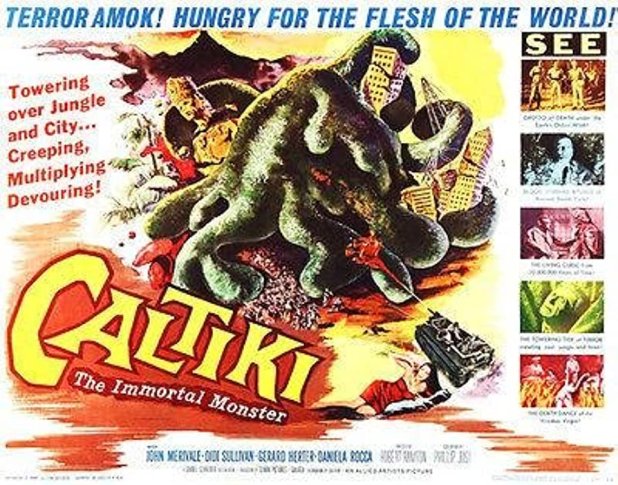
After the success of Hercules, Galatea Film began production on films made for the international market. They hired Riccardo Freda to make this movie, but he left before it was done, supposed to allow Mario Bava — the cinematographer and special effects artist on this — the opportunity to direct and earn more money. This same situation — Freda leaving and Bava finishing the movie — also happened during I Vampiri (The Devil’s Commandment)

There are different stories over who did what. Freda told Luigi Cozzi that he “left it when there were just two days of shooting left. I did shoot it yes, but it’s Bava’s type of film. I don’t enclose it in my body of work. The only thing I remember with pleasure about it are the statues that decorated the sets: I sculpted them myself,” while Bava referred to this as his first film and claimeed that Freda left the movie”because everything was falling to pieces. I managed to carry it out, patching it up here and there.”

Cozzi would come back to this interview thirty years later, setting the record straight by stating that “the director of Calitiki il mostro immortale is Riccardo Freda, full stop. Mario Bava did take care of the cinematography, the special effects and directed the scenes with the miniatures (that is, mostly the tanks….) and in addition to that he filmed some shots of soldiers with flame throwers. That’s all, and of course it cannot be enough to say that Bava directed that movie.” That said, in the last two or three weeks of filming, Bava directed and shot over 100 special effects shots.

Honestly, the answer depends on who you ask and when you ask them.

A group of archarologists discover a large statue of Caltiki, a supposed Mayan goddess who demanded human sacrifices. When one of them descends into a pool, he finds skeletons covered in gold and jewels. He keeps going back for more before he’s melted into a skeleton himself.

Now, Caltiki is a made up deity. But man, who cares, because soon a blob like creature emerges and tries to devour everyone. The monster was created from cloth and tripe, which is the stomach of a cow. It made a horrific smell, so no one wanted to be around it.

Anyhow, the blob-like organism attaches itself to one man’s arm and, of course, replicates and feeds on radiation. It’s about to have a buffet, because a radioactive comet that last appeared in our orbit during the time of the Mayans is about to come back and every little blob will become gigantic unless the smart brains in this can figure something out. How do you destroy a blob in the world of this movie? Flamethrowers. It’s that simple.

You can watch this on Tubi.

SALEM HORROR FEST: Morgiana (1972)

EDITOR’S NOTE: This movie was watched as part of Salem Horror Fest. You can still get a weekend pass for weekend two. Single tickets are also available. Here’s the program of what’s playing.

Juraj Herz is most often associated with the Czechoslovak New Wave and his 1969 film The Cremator. A Holocaust survivor who had sixty of his family die in the camps, he was a self-taught director who gravitated toward horror while also keeping his eye toward fairy tales. He commented once that dark humor was a form of expression and he believed that even serious films should be laughed at.

Based on Alexander Grin’s Jessie and Morgiana, this film explores the hatred between two sisters, Klara and Viktoria, both played by Iva Janžurová. Yes, their father may have given all of his fortune to Klara, but Viktoria is left with a small castle of her own. But the final push toward the overwhelming resentment  Viktoria feels is when her sister falls for the man she loves, Lieutenant Marek.

That’s when she begins to work alongside Otylie, a gypsy sorceress, to create a poison that no one will ever discover has killed her sister. As Klara grows ill, Otylie takes advantage and begins to blackmail Viktoria, who responds by literally casting her into the sea.

And while Klara is always clad in white and seemingly the damsel in distress, her sister is forever in black but worse, unable to escape not only the guilt and shame, but even the ghost of Otylie who will never leave her even in death.

So who is Morgiana? Why, she’s the cat. A cat so essential that she has her own point of view shots throughout the film.

The write-up for this film promises that the poison given to Klara open her mind to “kaleidoscopic hallucinations” and that is, if anything, less hyperbole than it should be. This movie practically explodes and delivers a cosmic freakout filled with ancient Tarot cards, distorted lenses and a deluge of only the fanciest of clothes (the hat budget on this movie had to be excessive), the most extravagant of makeup and filled with sonic fury, delivered by Lubos Fiser, who also composed the music for Valerie and Her Week of Wonders.

This movie is drugs and I want to overdose.

SALEM HORROR FEST: The Ninth Heart (1979)

EDITOR’S NOTE: This movie was watched as part of Salem Horror Fest. You can still get a weekend pass for weekend two. Single tickets are also available. Here’s the program of what’s playing.

Deváté srdce is about a student named Martin who has volunteered to seek out the cure for Princess Adriana, who has been knocked down and out by a mysterious illness. But the truth is that it’s no sickness. Instead, the magician Andlobrandini has enchanted her as part of his plan which involves creating a magic potion to return his youth from the blood of nine children’s hearts.

Directed by Juraj Herz, who wrote the story with Josef Hanzlík, everything in this feels handmade, down to the poster by surrealist painter, writer and ceramicist Eva Švankmajerová. This was shot at the same time as Herz’s Beauty and the Beast in an attempt to save on costs and is a fairy tale created in modern times that in no way feels unlike the tales we were told at bedtime.

By literally capturing the young hearts of the young men who have come to save Adrianna, Andlobrandini  seeks to take their vitality and become hale and hearty anew. Unlike them, Martin has no love for the princess. Instead, the Grand Duke (Premysi Koci) allows him to take on this mission instead of sending him and the street circus people he has fallen in with to jail, most especially Toncka (Anna Malova), the daughter of a puppeteer.

Joined by the Grand Duke’s jester (František Filipovský) and wearing a cloak of invisibility, the two men go across the River Styx to the Grand Duke’s former alchemist’s — yes, Andlobrandini — dark and foreboding castle, a place filled with corpses, innumerable candles, a swinging sun and danger around every turn. It’s gorgeous and perhaps the greatest love within this film is for the art of moviemaking itself.