Cinematic Void January Giallo 2024: Torso (1973)

EDITOR’S NOTE: Cinematic Void will be playing this on January 19 at 11:59 CT at The Belcourt Theatre in Nashville, TN (tickets here), January 20 at 7 PM PT at the Egyptian Theatre in Los Angeles with The Strange Vice of Mrs. Wardh and Sergio Martino in person and January 22 at 7 PM CT the Music Box Theatre in Chicago with Sergio Martino in person (tickets here). For more information, visit Cinematic Void.

Torso is such a simple title. I’d rather call this film by its Italian name: I Corpi Presentano Tracce di Violenza Carnale, or The Bodies Bear Traces of Carnal Violence. Either way, it was directed by Sergio Martino and features none of the cast that he had come to use in his past films like George Hilton, Ivan Rassimov or Edwige Fenech.

It does, however, star Brtish actress Suzy Kendall, who played the lead role of Julia in Dario Argento’s seminal The Bird with the Crystal Plumage. She’s so associated with giallo that she appeared as the main character’s mother in 2012’s ode to the genre, Berberian Sound Studio.

This is a film that wastes no time being strange. Or salacious. A photographer is shooting a soft focus lovemaking session between three women amongst creepy, eyeless baby dolls. By the time we register what is happening, we’re now in a classroom, where swooping pans and zooms refer us to the main cast of the film as we overhear a lecture and later a discussion about Pietro Perugino’s painting of Saint Sebastian. Did he believe in God? Or was he just trying to sell sentimentality? Could an atheist find himself able to translate religion to those with faith?

We cut to a couple making out in a car as a figure stalks them through the eye of the camera, making us complicit in the act of the killer. Quick cuts reveal the white-masked face of this maniac. The man runs after him while the girl doesn’t even care that they had a voyeur watching. As she waits for him to return to the car, but grows impatient. The headlights of the car cast her shadow large across the columns of a bridge. And their light is quickly extinguished by black-gloved hands. The camerawork here is really striking, keeping us watching for the killer, as we’re no longer behind his eyes. His attack is swift and ruthless, juxtaposed against the images of fingers penetrating the eyes of a doll.

The art professor (John Richardson, Black Sunday, The Church) and Jane (Kendall) meet by chance at a church where she challenges him to change his views on Perugino. As she returns from their somewhat romantic afternoon, Jane spies her friend Carol arguing in the car with a man who she believes is married.

Meanwhile, ladies of the evening walk the street, ending up with Stefano, a student who has been stalking Julie. He has trouble performing and the prostitute he’s with tells him that all the men with hang-ups always come her way. That said — even if he’s queer, he better pay the money. He flips out and attacks her, but she makes her escape.

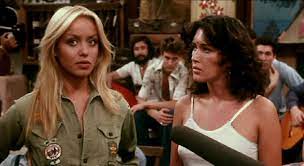
We’re then taken to a hippy party that looks like it’s taking place inside Edward Lionheart’s Theater of Blood. There’s weed, there are acoustic guitars, there are bongos, there are dudes with neckerchiefs, there are motorcycles. Truly, there’s something for everyone. But after leading on two men, Carol just walks out into the mud. They try and chase her, but she makes her escape into the foggy night. We hear her footsteps through the swamp as she walks, exhausted and covered in mud. What better time for our white-masked killer to return? We see glimpses of him through the fog and then he is gone. Whereas in past films Martino ignored the murder scenes instead of story, here the violence is extended, placing the killer and his actions in full view. After killing the girl, he rubs mud all over her body before stabbing her eyes — again intercut with the baby doll imagery. Her blood leaks into the mud as the score dies down.

This scene really feels like what the first two Friday the 13th movies were trying to achieve, but of course several years before they were made.

A police detective is in front of the art class, showing images not of art, but of the crime scene. A piece of cloth has been found under the fingernails of one of the murdered students, Flo. And that same scarf was found on Carol’s body. It’s their duty to report seeing anyone who wore this scarf to the police, who want to cooperate with the students who normally riot and throw rocks at them.

Two of the men in the class — Peter and George — were the last two people to be seen with Carol, the ones who she turned down at the party. Meanwhile, Stefano continues to stalk Jane. The music in this film is so forward-leaning — tones play when the killer shows or during moments of tension.

A man calls Daniela and tells her that if she ever tells where she saw the red and black scarf, she’s dead. Fearing for her life, she tells her uncle, who lends his country home to her and her friends so that they can get away from the city while the killer is at large.

Oh yeah — I forgot the pervy scarf salesman, who the police are leaning on. Right after talking to the police inspector, he calls someone and asks for money to buy his silence. Whoever it is, they bought the scarf from him and wouldn’t want anyone else to know. They’ll also get out of town and head to the country. Coincidence? I think not!

Stefano is all over Dani, telling her that he needs her. She wants nothing to do with him. When she stares at him, she remembers seeing him wear the red scarf. She escapes — slamming the door in his face. She tells Jane that she remembers seeing him wear the scarf — and never again — the day Flo died. The whole time, the creepy uncle is watching the two girls. Jane offers to speak to Stefano, then meet the girls at the vacation home.

The street vendor is flush with cash, creeping along in the dark. A car starts to follow him. We see the black-gloved hands again as the car hits its victim again and again, bright red gore pouring all over the screen.

Jane goes to speak to Stefano, finding only strange baby dolls and letters to Dani asking her to love him and remember the promise that she made as a little girl. Jane is surprised by Stefano’s grandmother, who tells her that he left town.

The other girls are asleep on the train as someone watches them. A strange man enters their train car and sits down.

The camerawork in this movie feels as predatory as the perverts and killers that exist within it. Speaking of pervs, when the girls arrive in the countryside, the local men pretty much lose their minds, particularly over Ursula (Carla Brait, the man wrestling dancer from The Case of the Bloody Iris). She and Katia make out as a peeping tom watches, only for the killer to show up and off the leering man. There’s an amazing scene of the killer dumping the pervert into a well, shot underwater and staring upward as the body falls toward the lens.

Man, every man in this movie is scum. They’re either frightened boys or perverts wanting one chance to knock up a woman or scarred from past sexual encounters. None of them are positive, as even the uncle who gives Dani the villa seems way too interested in her. Every man is a predator at worst and a leering pervert at best.

Jane hurts her ankle when she gets overly excited about breakfast. A doctor arrives — the mysterious man from the train — and he gives her a pill, which knocks her out.

The girls go sunbathing while Jane recovers. Dani thinks she sees Stefano — complete with the red scarf — watching them. They return home and drink champagne, which Jane uses to wash down her sleeping pills.

A few minutes later, the door rings. It’s Stefano — the girls all scream — but he’s dead — the girls scream again — and the killer is behind him, holding the red scarf — now scream even louder! Instead of showing us the murders, Martino switches form, cutting to a ringing bell and Stefano being buried.

Jane wakes up, asking where her breakfast is. She’s obviously slept late as a result of the pills. She walks around the apartment, looking for Dani, Ursula and Katia, only to find a mess. Tossed chairs, bottles of beer and every single one of her friends murdered. Suzy Kendall is amazing in this scene, caught between fear and nausea. Unlike so many wooden giallo performances, she’s actually believable.

She hides as the killer comes back, forced to stay quiet and watch as he saws her friends into pieces. Even the ordinary world routine of the milkman arriving cannot stop the butchering of her friends, with her trapped just feet away.

This final act is completely unexpected, as up until now, the film had played by the rules of the giallo, the large number of victims versus a large number of red herrings.

In fact, this film is so packed with red herrings, even the cast had no idea who the killer was. Martino wouldn’t tell them who it was, so each of the actresses had her own theory as to who the killer was. And in the original script, the killer survived.

Now, instead of that traditional giallo structure as I mentioned above, it is the last survivor — a near prototype for the final girl — against a killer. Throw in that Julie can’t move well due to her leg and Martino has set up quite the suspenseful coda.

Trapped in the house, Julie tries to signal with a mirror, using Morse code. But it totally misses the heroic doctor’s sight. He places a call, but it doesn’t seem like it’s to Julie. She looks out the window and sees the killer coming back.

It turns out that the killer was the professor, who saw a childhood friend die trying to reach for a doll. He compares the other kills to dolls, with only Julie as a flesh and blood person. Everyone else was a bitch or played games with him or blackmailed him. He hacked Ursula and Katia to pieces like dolls as a result. Dani saw him. Carol may have seen him. And he killed Stefano when he saw him in the village. Death, he says, is the best keeper of secrets and then he sees Julie as a doll and tries to hang her. She’s saved at the last second by the doctor.

They battle into a farmhouse, across the yard and to a similar rock where we saw the younger professor watch his friend die. We hear a screen and have no idea who has been killed — but luckily for Jane, the doctor survives.  He discusses whether fate or providence had kept him in town, where he could save her. Perhaps it was written in the stars. Julie replies that Franz, the professor, would have been a realist and called it a necessity. Franz is dead and the dreamers live on.

The more times that I’ve watched this film, the more that I appreciate it and how it flips the genre conventions on their head and moves toward more of a slasher, with many of the giallo elements feeling tacked on somewhat to stay within the expected pieces of the form. A real clue that it’s really a slasher? The killings are more important than who the killer is.

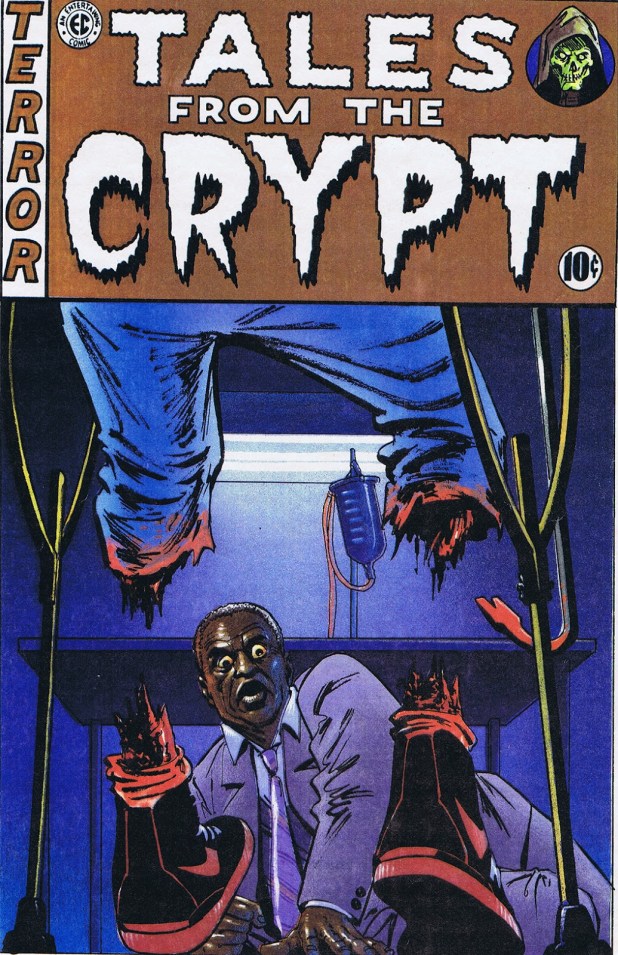
Tales from the Crypt S2 E8: For Cryin’ Out Loud (1990)

“I always wanted to play guitar but I could never quite master the fingering. So I won’t be a rock star. I’ll just have to settle for being a shock star. My groupies. Tonight’s little riff is rife with sex, death and rock and roll. Now, that’s entertainment! You’ll meet a putrefied promoter of pop with an ear for a hit. I don’t want to kill it for you. Let’s just say we come into the story just when his career is getting real hot!”

Directed by Jeffrey Price (the writer of Who Framed Roger Rabbit?; this was his only directorial job), who wrote this episode along with Peter S. Seaman (who wrote Wild Wild West, Shrek The Third and How the Grinch Stole Christmas with Price) and Steven Dodd, this is the tale of Marty Slash (Lee Arenberg), a promoter who runs off with all the money from a charity concert only to be blackmailed by a banker by the name of Ms. Kilbasser (Katey Segal) while fighting the voice in his head (Sam Kinison).

It also has Iggy Pop in it, which is fun. I wonder if Katey Segal wondered if she would be in any more projects with Sam after doing Married With Children with him just five months before filming this.

This is based on the story of the same name from Shock SuspenStories #15. It was written by Al Feldstein and William Gaines and drawn by Reed Crandall. That story has no rock promoter but everything else is similar.

Cinematic Void January Giallo 2024: The Eyes of Laura Mars (1978)

EDITOR’S NOTE: Cinematic Void will be playing this movie on January 20 at 7:00 PM MT at Sie FilmCenter in Denver, CO. For more information, visit Cinematic Void.

Never say never, but I think this will be the only movie we ever feature on this site that has a love theme by Barbara Streisand in it. I could be wrong, but I just get the feeling that there aren’t going to be many more crossovers quite like this one.

Eyes of Laura Mars was adapted from a spec script titled Eyes, written by John Carpenter; making this Carpenter’s first major studio film. Producer Jon Peters, the beau of Barbra Streisand in this era, bought the screenplay as a vehicle for her, but Babs felt that it was too “kinky” and passed. However, she felt that “Prisoner,” the song that she lent to the film, would be a great single. She wasn’t wrong — it peaked at #21 on the Billboard Hot 100.

Instead of Ms. Streisand, we get Faye Dunaway, who had just won an Oscar for Network and had not yet become Mommie Dearest. She plays Laura Mars, a fashion photographer whose Chris Von Wangenheim by way of Helmut Newton-style photos (Newton and Rebecca Blake supplied the actual photos for the film) glamorize violence. As she’s due to release the first coffee table collection of her work, she begins seeing the murders of her friends and co-workers through the eyes of the killer. I love how until now, she’s only been detached and seen things through the eye of a camera.

John Neville (Tommy Lee Jones) is the cop in charge. After she rushes to a murder scene exclaiming that she saw who did it blocks away, the cops keep her in custody, showing her numerous unpublished crime scene photos that match her new fashion photos perfectly. Throughout the film, Larua and Neville fall in love as her visions — and the murders — increase in intensity and violence.

This is a great example of an American giallo filled with the twists, turns and red herrings of the genre. It’s done with a much higher budget and way better locations than you’re used to. And it gets closer to the psychosexual elements, but as great a director as Irvin Kershner is, he isn’t a maniac like Argento and his ilk. It’s also packed with talent, like Raul Julia, Battle Beyond the Stars Darlanne Fluegel, Rene Auberjonois and Chucky himself, Brad Dourif.

The Eyes of Laura Mars would be parodied as The Eyes of Lurid Mess in MAD Magazine #206, with art by Angelo Torres. As was often the case with R rated movies when I was six years old, I first experienced this movie through the black and white ink lens of MAD.

When seen through the lens of the giallo form, The Eyes of Laura Mars reminds me of post-Deep Red era Argento — taking the basics of the detective form and grafting on one supernatural element. Here, it’s the fact that Laura Mars (Faye Dunaway), a high glam fashion photographer, can see the violent deaths of people as she takes photos. The images that they inspire lead her to great success and controversy, creating an intriguing narrative of the violent and at times bloody battle of inspiration for artists. I’m also struck by how detached Mars is from the art and fashion world in which she lives, until she’s in the midst of shooting. Then, she finally opens not just herself up, but her posture. She spreads low to the ground, sexualizing herself when she’s often covered by clothing throughout the film that hides her body from the world.

Going from an independent picture produced by Jack H. Harris to big studio affair by Jon Peters (who dreamed of then-girlfriend Barbara Streisand in the lead), The Eyes of Laura Mars struggled with a new writer being brought in to adjust John Carpenter’s script (the auteur said “The original script was very good, I thought. But it got shat upon.”) and the production lasted 7 long months, including a 4 day shoot in the middle of New York City to capture a major fashion shoot with models, wrecked cars and fire everywhere.

It has assured direction by Irvin Kershner, which led to him being hired for The Empire Strikes Back. After watching so much giallo, I’ve noticed that the America versions of the form are very much like Laura Mars herself: detached, cold and not all that interested in the murder as art that native Italian creators like the aforementioned Argento immerse themselves in. This film is made in hues of black and white when their world is neon and always the most red possible.

Upon a new view of this film, I was also struck by just how great the cast is. Tommy Lee Jones is perfectly cast, with his final speech near-perfect. In truth, he wrote that ending monologue, but credited it to Tommy Lee Jones actually wrote his own monologue, crediting it to Kershner, unbeknownst to the Writers’ Guild. Brad Dourif is routinely amazing in movies and his small role here is still a stand-out, as is the acting of Rene Auberjonois and Raul Julia.

This movie also features one of my favorite settings: New York City at the end of the 1970’s, which I feel is the closest place to Hell on Earth that has ever existed. As a child, I watched WOR Channel 9 news from the safety of being a few hundred miles away in Pittsburgh and wondered who would ever want to live in this city. You can almost smell the garbage and desperation in the air here, which is in sharp contrast to the cold, metallic and not so real world of fashion and art.

Cinematic Void January Giallo 2024: Footprints (1975)

EDITOR’S NOTE: Cinematic Void will be playing this film on January 20 at 11:59 PM CT at The Belcourt Theatre in Nashville, TN. You can get tickets here. For more information, visit Cinematic Void.

Alice Cespi (Florinda Bolkan, A Lizard in a Woman’s Skin) watched a strange film in her childhood called “Footprints on the Moon,” where astronauts were stranded on the moon’s surface. Now, as an adult, the only sleep she gets is from tranquilizers and she starts missing days of her life. Get ready for a giallo that skips the fashion and outlandish murders while going straight for pure weirdness.

After losing her job as a translator, Alice find a torn postcard for a resort area called Garma. That’s where she meets a little girl named Paula (Nicoletta Elmi, DemonsA Bay of Blood) who claims that Alice looks exactly like another woman she met named Nicole, who is also at the resort. Slowly but surely, our heroine starts to believe that a huge conspiracy is against her.

This is the last theatrical film of Luigi Bazzoni (he has directed some documentaries and wrote a few films since), who also directed The Fifth Cord. There are only two murders, but don’t let that hold you back. There are also abrupt shifts in color and a slow doomy mood to the entire proceedings. It’s unlike any other giallo I’ve seen and I mean that as a compliment.

Klaus Kinski also shows up as Blackman, the doctor who was behind the experiment that Alice saw as a child. He’s only in the film for a minute or so, but he makes the most of his time, chewing up the scenery as only he can. And cinematographer Vittorio Storaro, beyond working on The Bird with the Crystal Plumage, also was the DP on films like Apocalypse Now, RedsLast Tango in Paris and Dick Tracy.

This isn’t like any of the films that came in the wake of The Bird with the Crystal Plumage and it’s a shame that its director didn’t make more films in the genre.

Here’s are two drinks to enjoy with Footprints.

To the Moon

  • .25 oz. Kaluha
  • .25 oz. Bailey’s Irish Cream
  • .25 oz. amaretto
  • .25 oz. high proof rum
  1. Stir with ice and strain into a chilled shot glass.

Footprints On the Amber Moon

  • 3 oz. whiskey
  • Raw egg
  • Dash of Tobasco
  1. Pour whiskey into a glass, then crack a raw egg and drop into the glass. Don’t break the yoke or the ghost of Klaus Kinski will haunt you.
  2. Add some Tobasco, do a count down and ignite the engines.

Crimine a due (1964)

A Game of Crime comes from the time before Argento and at the nascent time of giallo on film, following The Girl Who Knew Too Much by just a year. Directed by Romano Ferrara, who also wrote and directed Planets Around UsIntrigo a Los Angeles and Gungala the Virgin of the Jungle, as well as writing Spy In Your EyePaolo e Francesca and Gungala the Black Panther. This was written Ferrara and Marcello Coscia, who also wrote forty films including Yeti Giant of the 20th Century and Red Rings of Fear, and Sandro Continenza (School of Death).

Paolo Morandi (John Drew Barrymore, Death On the FourposterWar of the Zombies) is a gambler in the middle of a run of the worst luck, which means he owes big money to an organized crime boss at the same time that his girlfriend Christine (Ombretta Colli, Snow Devils) has gotten pregnant. He’s also sleeping with Anna (Luisa Rivelli), the wife of his boss Davide (Jean Claudio), who he plans to rip off to pay for an abortion and get ahead of his debts.

Just when Davide suspects that his lover is cheating him and Paolo has taken his cash, he has a heart attack, which places him in the care of Elisabeth Buckner (Lisa Gastoni, War of the Planets). It’s simple for Paolo to kill the man now and all the money goes to Anna, who now has to take care of her husband’s brother Cario, who has been left an invalid after an accident. None of this adds up to Commissario Perrotti (Umberto D’Orsi), who is on the case.

At one point, the characters discuss books and one says that they like anything but giallo, as they are too far fetched. How meta!

You can watch this on YouTube.

Cinematic Void January Giallo 2024: The Killer Is Still Among Us (1986)

EDITOR’S NOTE: Cinematic Void will be playing this movie on January 15 at 7:00 PM PT at Los Feliz 3 in Los Angeles. For more information, visit Cinematic Void.

Also known as Florence! The Killer is Still Among Us and The Killer Has Returned, you have to admire the chutzpah — or the gall — of a film to have the disclaimer “This film was made as a warning to young people and with the hope that it will be of use to law enforcement to bring these ferocious killers to justice,” after you’ve just watched 83 minutes of a killer graphically mutilating women and their most intimate of parts, as if this were some bid to outdo Giallo  In Venice or The New York Ripper.

Based on the true story of the Florence serial killer “The Monster of Florence,” this was written by Ernesto Gastaldi (The Whip and the BodyAll the Colors of the DarkMy Name Is Nobody) and Giuliano Carnimeo (who directed four of the Sartana films under the alias Anthony Ascott, as well as The Case of the Bloody Iris, Exterminators of the Year 3000 and Ratman).

Directing this movie — and helping with the script — would be Camillio Teti, who produced The Dead Are Alive and Gualtiero Jacopetti and Franco Prosperi’s attempt at a non-mondo, the ironically named Mondo Candido.

Much like a scene out of Maniac, a couple on lover’s lane is blown away mid-aardvark by a gloved killer. What separates the uomini from the ragazzi is that the killer then uses a knife and a tree branch to do things that made me turn my head from the screen for an extended period of time.

Christiana Marelli has been studying the killer in criminology class to the displeasure of her boyfriend, the cops and her teachers. This leads to her being stalked via phone and in person by the killer. Of course, seeing as how Alex, that formerly mentioned boyfriend, is never around during these killings, you can see why she starts thinking he could be Il Mostro.

The film moves from the giallo into the supernatural as our heroine attends a seance where the medium has a vision of the killer decimating a camping couple, soon developing the same wound that the victims just received.

What does Christina do? Run to the theater to see if Alex is there or not, proving that while he is waiting for her, he certainly could still be the killer. If I were her professor, I’d have given her a zero out of thirty.

After all this, she just sits down to watch a movie with him and it ends up being the same film we’ve just been watching. That’s either a huge cop out or just how you expect a giallo to end.

Cinematic Void January Giallo 2024: The Strangler (1970)

EDITOR’S NOTE: Cinematic Void will be playing this movie on January 15 at 7:00 PM CT at Music Box Theatre in Chicago, IL. You can get tickets here. For more information, visit Cinematic Void.

Émile (Jacques Perrin) has an interesting reason for being a killer. He sees what he does as a public service, taking unhappy women away from this world with his white scarf.  Inspector Simon Dangret (Julien Guiomar) is on the case but the ways that he goes after the killer are just as morally suspect. There’s also Anna (Eva Simonet), a gorgeous woman who feels that she’s the next victim. Maybe she even wants to be that person. And then there’s the thief (Paul Barge) who lurks at each scene and takes what cash and trinkets are left from each dead woman.

Directed and written by Paul Vecchiali, this giallo comes from the same year as Argento’s The Bird With the Crystal Plumage. It may not have the same visual madness as that film but it does have a villain who looks like a hero, a child of a man damaged by seeing a murder when he was young using the same knit white scarf that he uses to snuff out lives today. The women that he murders would have just killed themselves regardless, he reasons on the phone to Dangret, so he was saving them. The breakup that Anne has just emerged from has left her feeling that life is worthless; she volunteers to Dangret to be the lure.

Unlike most giallo, we know who the killer is from the start. Yet each kill is so planned, so precise, such a murder set piece as the women give themselves to Émile. He isn’t getting any sexual thrill from killing these women, unlike so many black gloved killers. These are mercy killings. It seems like the person he really wants is the cop.

You can also get this from Altered Innocence, a partner of Vinegar Syndrome.

Cinematic Void January Giallo 2024: The Red Queen Kills Seven Times (1972)

EDITOR’S NOTE: Cinematic Void will be playing this movie on January 12 at 7:30 PM ET at The Little Theatre in Rochester, NY. You can get tickets here. For more information, visit Cinematic Void.

Emilio P. Miraglia followed up The Night Evelyn Came Out of Her Grave with this giallo freakout — starring the magnificent Barbara Bouchet (Don’t Torture a Duckling) — that combines gothic horror with the high fashion we’ve come to expect from early 70’s Italian horror.

A curse haunts the Wildenbrück family once every 100 years — two sisters have always become the Red and Black Queen, feuding until one of them dies. Then, the survivor is haunted by sixth deaths, with the final death — the seventh death, referenced in the title, being the surviving sister. Kitty (Bouchet) and Evelyn are the next two sisters to be so cursed, battling even in childhood, stabbing each other’s dolls with daggers.

These catfights have continued for years, ending when Kitty, now a fashion designer, accidentally takes it too far when she battles Evelyn. Third sister Franziska (Marina Malfatti, The Night Evelyn Came Out of Her GraveAll the Colors of the Dark) and her husband hide Evelyn’s body while Kitty pretends that her sister has gone to America.

All is well and good until the Red Queen rises, wearing a red cape and white mask, killing all of Kitty’s co-workers at Springes Fashions with the same dagger that was once used to slice up baby dolls. But is it really Evelyn, back from the dead (Emilio P. Miraglia sure liked Evelyn’s that rose from the dead)? Or something much more down to earth?

Miraglia only directed six films, with this being his last one. There are some moments in here that aspire toward art, like the Red Queen chasing Kitty through her dreams, ending in a long hallway run and her superimposed form attacking like a ghost. And the film flirts between the gothic castle era of Italian horror and the fashionista giallo look — all while containing plenty of deep red gore and plenty of skin, courtesy of a 20-year-old Sybil Danning (Howling II, Battle Beyond the Stars, Young Lady Chatterley 2). It’s not always art, but sometimes, it totally is. There are the requisite twists and turns of the genre, along with some really regrettable moments — like when a character goes from rapist to rescuer across two scenes and an ending where the hero and heroine both need saving.

VINEGAR SYNDROME BLU RAY RELEASE: Forgotten Gialli: Volume Six

Vinegar Syndrome has released five Forgotten Gialli sets. You can check out my articles on the others here:

This box set has the following movies:

Death Carries a Cane (1973): If death carries a cane, isn’t it weak? With that thinking, aren’t the alternate titles — Dance Steps on the Edge of a RazorManiac At Large, The Night of the Rolling Heads and Devil Blade — so much cooler?

Well, that’s because whoever the killer is, he or she has a limp. That’s what Kitty (Nieves Navarro, billed here under her boring Americanized nom de plume Susan Scott) sees when she watches a murder through a coin-operated telescope. That’s just the first of many killings and it just might be her boyfriend Alberto, who has the misfortune of having a limp and a cane when that’s what’s being profiled. I’ve said it before and I’ve said it again, defund the giallo police.

Navarro also made two other similarly titled movies, Death Walks at Midnight and Death Walks On High Heels, so if you’re confused, well, this doesn’t have Nieves Navarro in it.

Director Maurizio Pradeaux also made another Grim Reaper referencing giallo, Death Steps in the Dark, which has a scene where the protagonist has to wear drag to escape the police.

Naked You Die (1968): Naked…You Die (AKA The Young, the Evil and the Savage) is a pretty fun early giallo with good direction by Antonio Margheriti.

Yet it was very nearly was a Mario Bava movie.

According to Tim Lucas’ Mario Bava: All the Colors of the Dark, Bava was hired by Lawrence Woolner — the distributor of Hercules in the Haunted World and Blood and Black Lace in America — to direct a movie about a killer stalking a school. Cry Nightmare was going to be the title and Bava wrote the script with Brian Degas and Tudor Gates (BarbarellaDanger: Diabolik).

Lamberto Bava told Lucas that “Just a short time before the filming was to begin, Mario Bava had an argument with the producers and he abandoned the film.” As for Margheriti, who met Woolner when he distributed Castle of Blood, he said “I think Mario was busy at that time, working on Diabolik or something.”

Either way, locations were already secured, cast and crew had been hired and a theme song had already been recorded.

The drowned body of a woman is placed in a truck going to St. Hilda College. There, only seven students, two teachers — Mrs. Clay (Ludmilla Lvova) and Mr. Barrett (Mark Damon — Headmistress Transfield (Vivian Stapleton) and gardener La Foret (Luciano Pigozzi) are present.

Soon, the killing begins with Betty Ann being strangled and found by Lucille (Eleonora Brown in her last film until coming out of retirement in 2018), who is having an affair with Barrett. When she tells him to come see the body, it’s already gone, so they decide to leave the school.

The killings kick into gear with Cynthia (Malisa Longo, Ricco the Mean Machine) being killed in front of the gardener, who is soon killed as well and Denise (Patrizia Valturri) too. There’s also amateur detective Gillie (Sally Smith) on the case and Inspector Durand (Michael Renne from The Day the Earth Stood Still) trying to stop the killings.

All the girls wear similar uniforms — and outfits that change scene by scene — and nobody wonders why an older teacher can play Big Bad Wolf with Little Red Riding Hood and get away with it.

The aforementioned theme song “Nightmare” by Powell and Savina (Don Powell, who played Emanuelle’s father in Black Emanuelle 2 and did that film’s soundtrack, along with Carlo Savina, who composed the music for The Killer Reserved Nine SeatsLisa and the DevilFangs of the Living Dead and so many more) and performed by Rose Brennan owes royalties to Neal Hefti.

Perhaps even wilder is the fact that the movie informs us that Gillie may be the daughter of James Bond.

Giallo would change in a few years to be bloody, sleazier and stranger. That said, this is a great example of an early version of this style of movie.

The Bloodstained Shadow (1978): One of my favorite things about giallo are the alternate titles. As if The Bloodstained Shadow isn’t a great name, this movie also goes by Solamente Nero (Only Blackness), which is a way better title. The other thing I love about this genre is that just when I think I’ve seen every good one, I find another to enjoy.

This is the kind of movie that tells you exactly where it stands in the first minutes, as a killer strangles a girl in a field before the credits even start. That murder has never been solved. Years later, a college professor named Stefano has a nervous breakdown. To recover, he comes home to visit his brother Don Paolo, who has become a priest that hates all of the immorality in their small town.

Oh what immorality — there’s a gambler, a psychic, a combination atheist/pedophile and an illegal abortionist with a mentally challenged son who lives in a shack top the list, along with your typical sex and drinking that happens in any town.

Meanwhile, murders have been piling up and whoever is behind it, they’re leaving notes to the priest, warning him that if he reveals who the killer is, he’ll be next. That’s because on Stefano’s first night back home, Don Paolo saw the killer murder the town psychic in the courtyard.

Stefania Casini (Suspiria) also appears as the love interest, Sandra, who helps Stefano come back to normalcy. Well, as normal as a town filled with murder can be. I’m kind of amazed that she wears a belly chain all day. When you get to the love scene, you’ll know what I mean.

There’s also some amazing religious imagery in this one, like a skinned and bloody animal that has been placed in the sacristy to warn the priest that he’s getting too close, or the communion scene that reveals who the real killer is.

Finally, Goblin plays some great music in here, created by composer Stelvio Cipriani. It’s really a great package, thanks to director Antonio Bido, who directed one other giallo, Watch Me When I Kill. I love how the past childhood trauma that the brothers endured continues to permeate their lives as they try to grow up. This is a very adult giallo and by that, I mean that it doesn’t need nudity and gore to tell its tale.

You can get this set from Vinegar Syndrome.