June 2: Junesploitation’s topic of the day — as suggested by F This Movie — is Westerns! We’re excited to tackle a different genre every day, so check back and see what’s next.
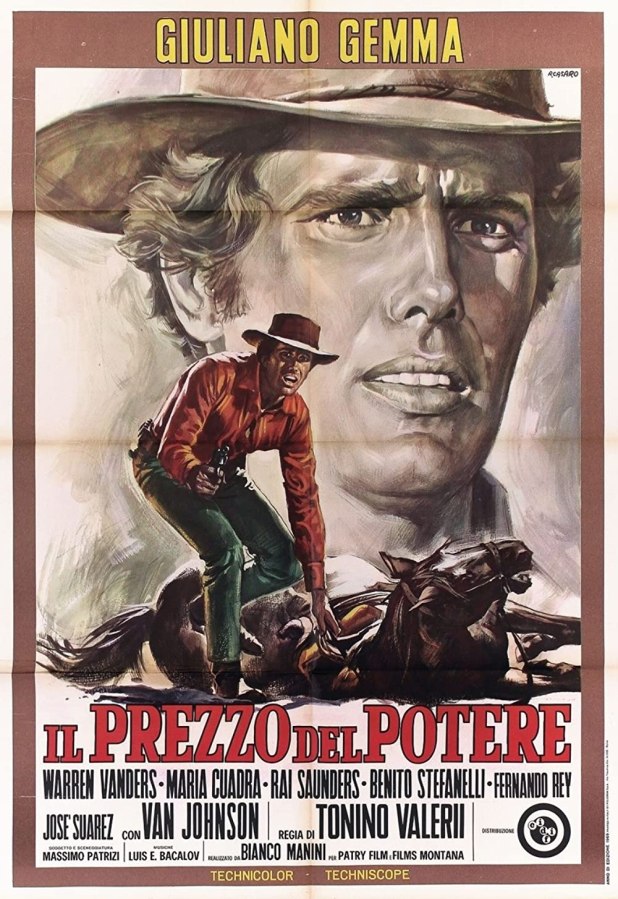
The Price of Power (AKA A Bullet for the President) is an absolutely deranged idea for a movie. It uses the attempted assassination of President James A. Garfield in 1881 to work out the feelings of the death of President John F. Kennedy just six years earlier.
Bill Willer (Giuliano Gemma, a true star of the Italian west thanks to turns as Ringo and Arizona Colt) is trying to get revenge for the death of his father while trying to save the life of Garfield from the Pinkerton agency.
The Pinkertons may be heroes elsewhere, but in Pittsburgh, you can drive past the two adjoining cemeteries of St. Mary’s and Homestead where remains of six of the seven Carnegie Steel Company workers killed are buried, the bloody aftermath of the Battle of Homestead on July 6, 1892, when Henry Frick tried to use the agency to break strikers with violence.
Van Johnson plays the idealistic Garfield, who is coming to Texas to speak to people who have no interest in hearing what he has to say, yet he believes in the goodness in everyone. Of course, he’s killed and the Lee Harvey Oswald figure is Jack Donovan (Ray Saunders), a black man, which adds even more of a connection to the way the world of 1969 was looking, what with Robert Kennedy and Martin Luther King being killed and the start of the Years of Lead in Italy. And I’m not certain that the scars in America’s psyche had yet healed, so I doubt anyone was ready for a movie they surely saw as escapism having María Cuadra play Jackie Kennedy and follow her exact movements in Dallas. She’s even given red roses, just like the President’s widow was.
The joy of the Italian west is in finding movies that explore not only the way that film depicts a time and place we can never go to — indeed, many of the filmmakers had not even been to America — and even find that an alternate version of history can tell us so many things about the world we live in today.
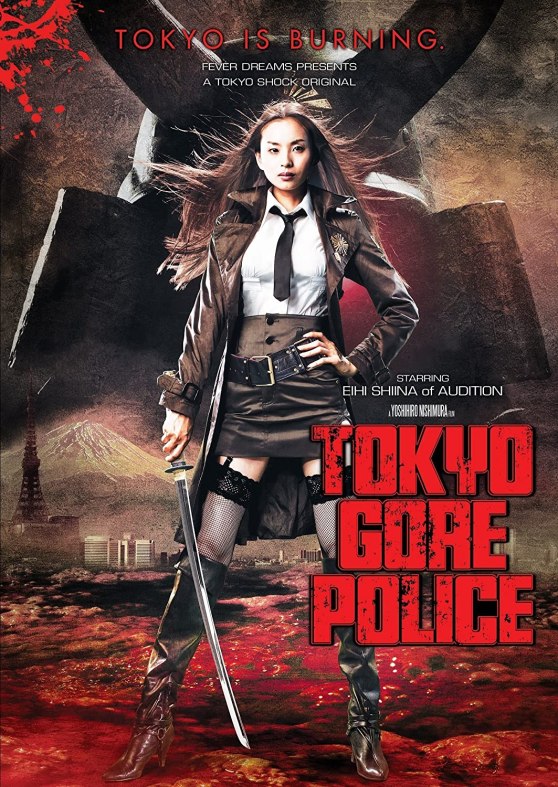
Bring an umbrella, don’t eat before and watch your eyeballs: this movie is literally under blood there’s so much gore. I mean, it’s the film’s middle name! Eihi Shiina is most gorgeous person you’ve ever seen with a giant lobster claw hand and glowing cybernetic eye and if she has to chop up every monster in Japan, she’s going to get it done.
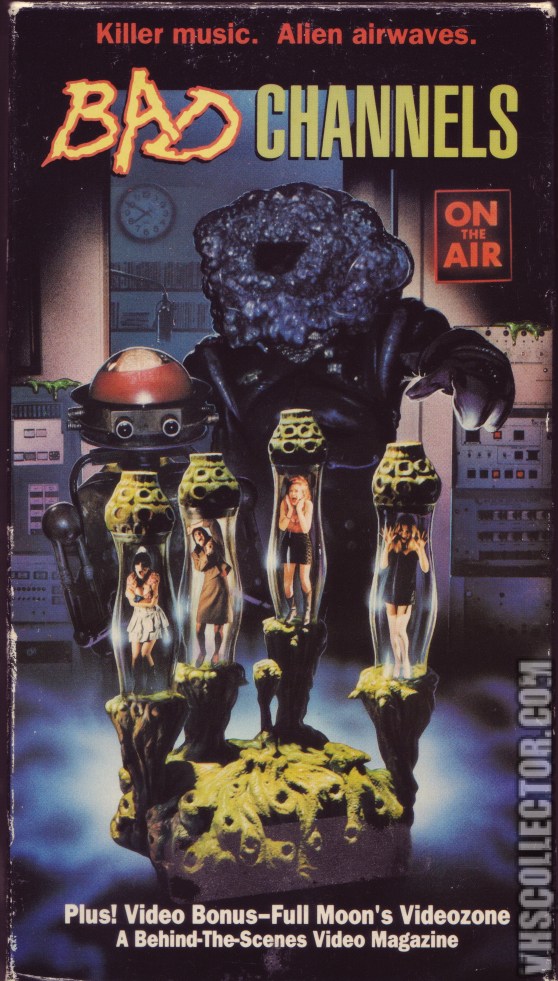
Full Moon didn’t used to make bad movies. They once made deranged movies about aliens, all night polka marathons, miniaturized people and music videos. Bonus for letting Blue Oyster Cult do most of the music. Becca says, “It’s wonderfully weird.”
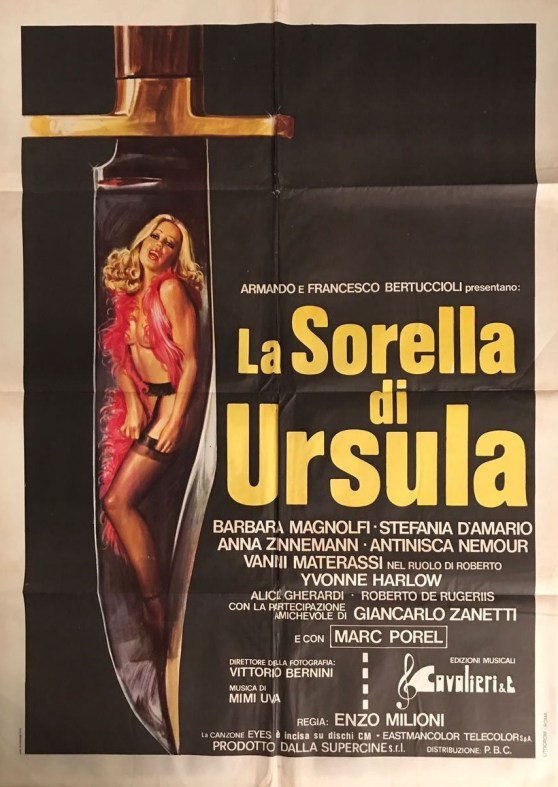
Ursula (Barbara Magnolfi, Suspiria) and Dagmar (Stefania D’Amario, Zombie) decide to escape to the seaside resort town Amalfi which is filked with the wrong guys, the wrong girls, the wrong couples and a killer who tears people apart with the biggest member this side of Incubus.
Jillian Kesner from Raw Forcebattles and beds Darby Hintor from Malibu Expressin a movie where people watch battles to the death as dinner theater. It’s made by Cirio H. Santiago, it’s a video nasty and it’s incredible.
Jack Beauregard (Henry Fonda) is a gunslinger who wants to retire. Nobody (Terence Hill) dreams of being better than Beauregard and plans on taking out all 150 members of Geoffrey Lewis’ gang. This is one of my favorite Italian westerns and a great introduction to Hill if you’ve never seen him before.
How did this get to be five weeks of a continued article on this site and I didn’t bring up this movie? Oh man. I’m not warning you. Just get ready to get destroyed by this one.
Prepare yourself for a slasher world that we haven’t seen nearly ever: a campy, gay-positive glitter, makeup neon and booze and gore-filled saga that never lets up.
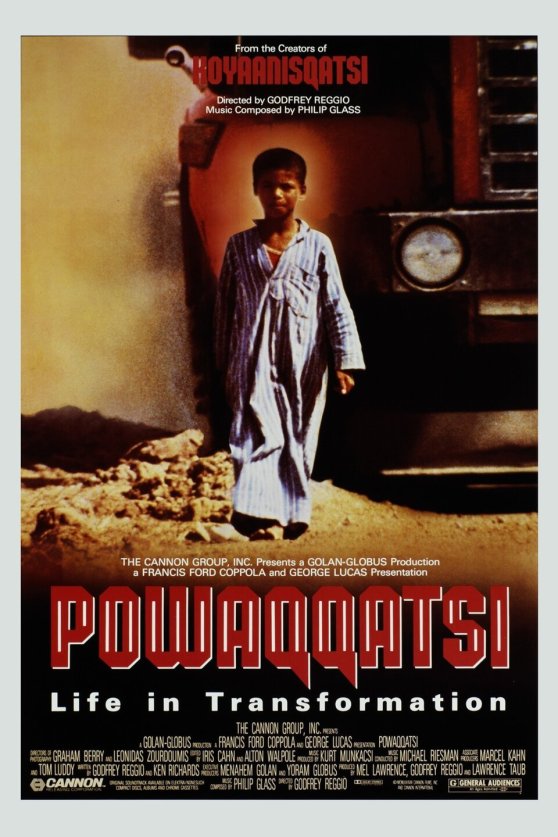
Directed by Godfrey Reggio, Powaqqatsi is the sequel to Reggio’s Koyaanisqatsi and the second film in the Qatsi trilogy. This is one of the few, if only, Cannon movies in the Criterion Collection. It’s also the only Golan and Globus released film with a Phillip Glass soundtrack.
Dennis Hopper directed this movie but let it get the Alan Smithee name because he wasn’t happy with it, but let me tell you, it’s seriously out there in the way that only he could make it. I tend to give Hopper way more credit than most but it also has Vincent Price and a subplot about installation art and advertising.
Satanic axe murderer gets reborn and wipes out a whole bunch of kids and makes me go nuts every time I watch this movie, because it’s like Ruben Galindo Jr. watched five hundred Mexican movies while mainlining some kid’s hyperactivity pills and then forced all of his friends to make whatever was inside his head. It’s even better than that.
If you’re looking for more movies on Tubi, click on our Letterboxd list. You can also send us your picks and we’ll share on the site.
Have you ever started watching a movie and realized that it was exactly what you needed, when you needed it and then started delivering even more of what you wanted?
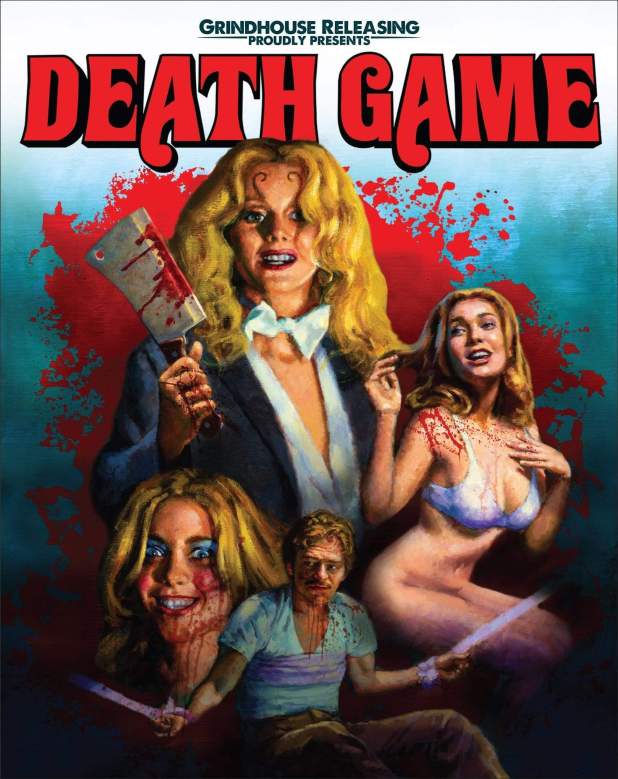
Life’s never that good but for some reason, Death Game — also known by the even better title The Seducers — did that for me. It’s a blast of seventies sleaze that somehow doesn’t forget to give all the power to its female leads and instead gives them free agency to absolutely decimate a man foolish enough to give in to their fantasy power play.
In short, sometimes the worst thing you can get is everything you ever dreamed about.
California real-estate financier Pete Traynor started making movies in the early 70s in the same way that people used to finance strip malls. That might seem strange — perhaps unethical — but whatever got this movie in my hands, I endorse it.
He chose this as his first film after founding Centaur Films with director-producer Mark Lester to produce Steel Arena and Truck Stop Women. He only directed one other movie, the also deranged Evil Town which rose from the ashes of another film Dr. Shagetz and also one that was remade by its co-director Mardi Rustam as the even more delightful Evils of the Night.
It was a smart and contained idea for a film, as it mostly takes place inside a large Los Angeles home. That was the plan — shoot for a few weeks in 1974 and release it the next summer. It just took a few years to come out thanks to disputes between Traynor and the cast. And then there was that whole federal investigation into the way that it was financed.
The script — originally called Mrs. Manning’s Weekend — came from Jo Heims, who wrote Play Misty for Me and the story for Dirty Harry, which she received no credit for. She also adapted the screenplay for the Patty Duke movie You’ll Like My Mother and wrote two great TV movies, the John Llewellyn Moxey-directed Nightmare in Badham County and Gordon Hessler’s Secrets of Three Hungry Wives. Sadly, she died from breast cancer at the way too young age of 48 in 1978.
Another film that Heims wrote for Eastwood was 1973’s Breezy, a movie that he only acted in instead of starring, as he felt he was too young for the role that was played by William Holden. As for the much younger female lead, Eastwood had intended for that part to go to Jo Ann Harris, but Heims felt she was wrong for the part. Instead, she suggested her friend Sondra Locke, even though Locke was twelve years older than the character. This would be the first time Locke would meet Eastwood and would end up spending much of the 70s and 80s together.
There isn’t enough room to get into here as to the relationship between Eastwood and Locke, but it really has colored the way that I view him. Sometimes, we can separate the art from the artist, but when an artist goes out of his way to ruin another artist’s career and life, well…it’s difficult to ever respect them.
Back to Death Game.
Kay Lenz ultimately played the lead in Breezy, as she was young enough for the part, even if Locke always played younger than she really was. So when Locke became interested in this film — she’d never played a bad girl before — the fact that she was twice the age of the character in the script wasn’t a big deal.
The other part of the film’s seductive duo was to be played by Colleen Camp, who had only done TV roles and commercials. As for the man they destroy, George Manning, Al Lettieri (The Godfather, The Don Is Dead) was to star before Seymour Cassel came on board.
Cassel was mainly known for his roles in the films of John Cassavetes, as well as numerous other independent films. Perhaps less known is the fact that he gave a young Saul Hudson the name the world knows him as — Slash.
The actual shoot for the film was, charitably, chaos.
The original script kept getting humor and exploitation added to it, while Locke claimed that Traynor really had no idea what he wanted the movie to be or what he was doing, often only directing the actresses to break things. Locke and Cassel then basically took over their roles and began directing themselves and Camp.
Tensions flared, as during one scene where the girl dumped food repeatedly on him, Cassel nearly hit Traynor and refused to loop any of his dialogue. David Worth, the film’s cinematographer, at least was able to work with everyone — he wasn’t the first person hired for the role, as his predecessor was fired — but he was able to give the film its unique look in the face of all this madness (and he’s the one who looped Cassel’s voice). He went on to direct Poor Pretty Eddie, Kickboxer and Warrior of the Lost World, as well as run camera on The Jesus Trip and work as the director of photography on Remo Williams, Innerspace and Never Too Young to Die.
Worth also stuck it out as the film went through a messy post-production, as it was held up due to the U.S. Securities and Exchange Commission investigating Traynor’s financing. After that was settled, Metro-Goldwyn-Mayer gave Traynor $100,000 to finish editing the film, working with Worth 15 hours a day, seven days a week.
And then, well, it played theaters and kind of went away. It earned the kind of reviews that you expect Leonard Maltin to give good trash, who said it was an “unpleasant (and ultimately ludicrous) film about two maniac lesbians who — for no apparent reason — tease, titillate, and torture a man in his own house.”
But it found an audience.
I mean, it found me.
Any movie that starts with the “based on a true story” always gets me just right.
George Manning (Kassel) has just left home for work, getting a weekend alone as his wife has an emergency to attend to. That night, while alone in his large house, a thunderstorm rages outside and he hears a knock on the door. It’s Jackson (Locke) and Donna (Camp), two girls who can’t find the party they were supposed to attend and simply need to use the phone.
Often, it’s one decision that changes a life. This would be one of those.
The three chat while waiting for a car to pick up the girls, but that conversation leads to George’s sauna and a threesome that’s shot in near acid trip style, giving George that male power fantasy that nearly every post-sexual revolution American male has had: sex with two young blondes.
The problem with fantasy is that it’s not something that we ever work through. For most men, the fantasy ends with ejaculation. There’s not the emotional side or the way that your life is changed once you step outside your marriage. No one fantasizes about guilt. Or wonders what happens when two young women simply won’t leave your house and start accusing you of statutory rape and threatening to ruin everything that is your life.
It’s a powerful journey for a movie to make, much less one made nearly fifty years ago. And it pushes that story further and further. And while of all the versions of this story — it’s been filmed four other times — Kassel’s take is the most innocent, the moment he steps from reality to fantasy is as if to give himself over to what is assuredly deadlier than the male.
My only gripe is that I wish the film ended with the girls laughing and running away. What occurs feels too much like a square up real, too much like a square up reel when we can simply accept that their power has won and that they are alive and seeking someone else foolish enough to make that mistake. It’s the one thing that Eli Roth gets right in his shiny and way too clean remake.
Death Game is a strange movie that was forged from a chaotic production, the pressures of which one assumes shaped it and molded it into something unique, a film that I’m still thinking about days after I watched it despite the sensory overload that I put myself through on a daily basis.
In short, you need to see this.
You can buy it for yourself from Grindhouse Releasing. It’s got a brand new 4K restoration created from the original camera negative, interviews with Colleen Camp and director Peter Traynor conducted by Eli Roth, plus interviews with Sondra Locke,producer Larry Spiegel, cinematographer/editor David Worth and screenwriter Michael Ronald Ross. Then you get two sets of commentary with Camp and Roth as well as Spiegel and Worth, plus still galleries, an embossed slipcover and a 24-page full-color booklet with rare photos and liner notes. It might even have a secret movie included! It’s currently sold out but keep an eye out for it, because this is one of the best releases of this year.
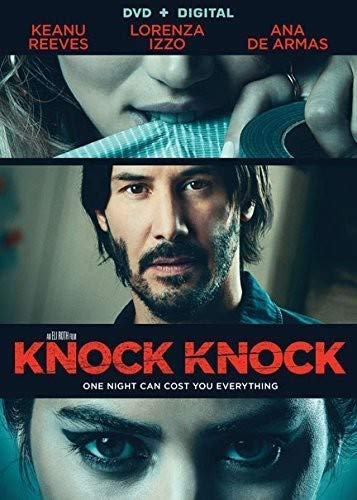
I’m really not sure how I feel about Eli Roth. I’ve never fully enjoyed a movie he’s done and that was before he basically started remaking movies or doing his own versions of them like The Green Inferno, Death Wish and this remake of Death Game that was retitled Knock Knock. And then when I hear him on a podcast or watch his doc shows, I hear that he’s an intelligent person who is pretty well-versed in horror and I want that same person to make his movies. I think the version of Roth that writes liner notes and can speak to so many great moments in film would be a great person to hang out with but like when your friend has a substandard band, you just don’t want to talk about their last show, you know?
I don’t know who Knock Knock is for, to be honest. We already have four other versions of Death Game and while this adds a social media element, there’s so much of the movie that feels like anything but a $10 million dollar film — literally the same amount of cash if you added all four of the other movie’s costs together.
The set-up is the same: Evan Webber (Keanu Reeves) has the house to himself and his dog Monkey while he works over Father’s Day and his wife and kids go to the beach. All he has to do is ensure that her new sculpture gets to the gallery.
Then Genesis (Lorenza Izzo, Roth’s wife at the time) and Bel (Ana de Armas) show up in a rainstorm and basically destroy his life, slowly seducing the older man into a threesome and never seeming to leave, despite his pleas of having them never come back. They’re underage and start to torment him with threats and he’s gradually reduced to a tied-up, belittled and battered husk by the end of the film, buried up to his neck in the back garden.
The weird thing is that while the tone for this story has already been set, this take on it has no idea if it’s a comedy, a tragedy, a telenovela or just some strange take on a film that doesn’t seem to put its own stamp on the film. The one positive that I can say is that — spoiler warning — it doesn’t seek to punish Genesis and Bel for their crimes like Death Game did Donna and Agatha or Viciosas al Desnudo had happen to Hippie 1 and 2.
It’s nice to see Sondra Locke and Colleen Camp’s names in the credits as executive producers and even better to see Camp show up in a cameo. I just wish they had a better movie to put their names on — Death Game is such a striking film and yes, I realize that all remakes have to succeed on their own merits, but when the innovations are social media and profanity-laced walls, not to mention an opening that feels as poorly acted as an episode on ABC TGIF in the early 90s, well…
Maybe you’ll enjoy hearing Keanu say filthy stuff and you know, we’ve all watched movies for less.
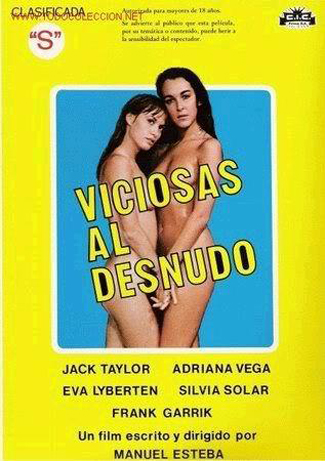
Just like the first two films that inspired this movie — Death Game and Little Miss Innocent — this all changes when he picks up two young women that ruin his life. Here, however, the film is inspired by both Charles Manson and Dr. Seuss as they’re called Hippie 1 and 2 (Adriana Vega and Eva Lyberten). Even wilder is this movie takes the nihilistic ending of Death Game and ups it to challenge Thelma and Louise by eleven years.
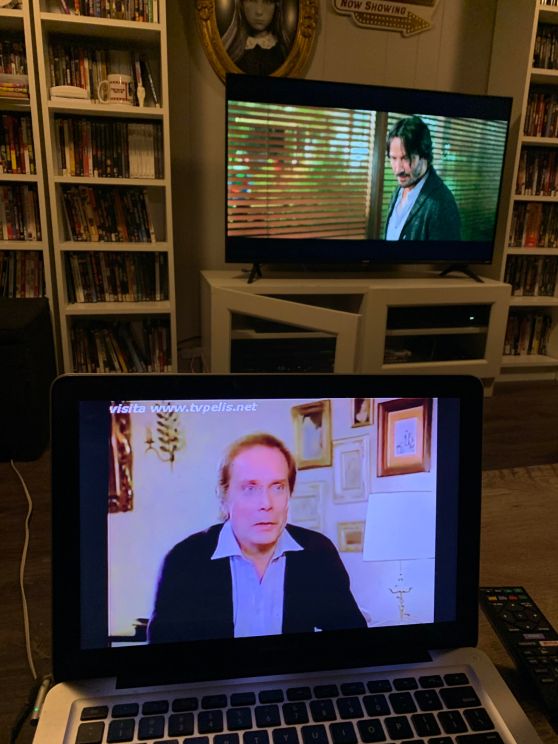
I also further broke my brain by synching this movie up with Eli Roth’s Knock Knock remake as Cathy from Cathy’s Curse looked on with scorn.
Director and writer Manuel Esteba made mostly adult and horror films — surprise, he’s on our site — like Horror Story, the gravity disaster film Spectrum (Beyond the World’s End), Bloody Sex and El E.T.E.y el Oto, which IMDB claims is about an alien meeting Spain’s youngest psychopath.
I feel that Death Game is an essential film and while this one isn’t in the same class, I always find it so wonderful to explore how another part of the world interprets the same story. Here’s hoping you feel the same.
We’ll get to Death Game later today, but what’s amazing is that that film has been made so many times, including this movie, which came out years before Death Game itself.
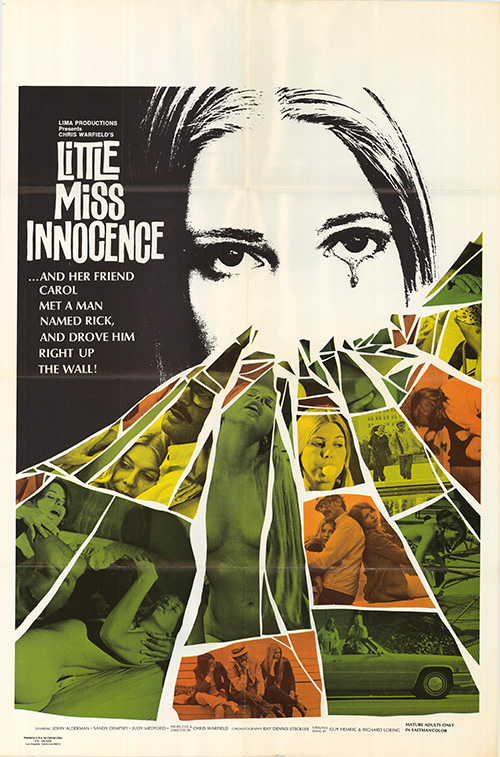
Little Miss Innocent (1973): Directed by Pittsburgh native Chris Warfield and written by E.E. Patchen — potentially from a draft of Death Game that was making the rounds at that time — Little Miss Innocent begins when Carol (Sandy Dempsey, who appeared in more than sixty adult films and used just as many names; there’s a theory that she died in a boating accident at the age of 26 that has never been proved correct) and Judy (Terri Johnson, who was also inFlesh Gordon) are picked up by record producer Rick (John Alderman, Superstition) in his fancy convertible.
Judy is a virgin, a fact that Rick didn’t know. Seconds after he takes her, Carol shows up and makes love to him. It’s nearly any straight man’s fantasy, except that the girls are insatiable and while that may make a great title for a Marilyn Chambers movie, it’s another thing for a man in his late 40s to live up to.
Rick expects the girls to leave but they end up moving right in, which seems fine if strange at first, but Carol also has a mean streak that starts showing up. All Rick wants to do is sleep on the couch, his Penthouse Forum letter seemingly out of control as the biological humor of men being out of their prime as they age being displayed throughout. The girls’ carnal needs have sapped him of his ability to work and even stay awake, almost vampiric in their need for continual gratification.
With camera work by Ray Dennis Steckler and second unit direction by George “Buck” Flower, this is a curiosity that goes beyond just being IMDB trivia fodder. Despite the girls blackmailing him and claiming to be underaged, Rick is suffering under the male delusion that he is the alpha in this situation, continually bedding two attractive women. Yet again, what should be a dream is shown to be a nightmare, as that very alpha nature is sapped. Every orgasm needs a refractory period that takes longer and longer for him, an issue the girls never need to deal with. Performing under the pressure of being arrested can’t be good for the libido either.
Warfield didn’t fall out of love with this story. In 1987, he’d remake the film under the same title, keep the same song and much of the script, only going all out with the hardcore — and then some for some straight and uptight men — with Eric Edwards playing Rick, Summer Rose as Judy and Sheri St. Claire as Carol.
Originally released by Vinegar Syndrome, Little Miss Innocent is also available as an extra feature on the new release of Death Game from Grindhouse Releasing.
Little Miss Innocent (1987): Writer Chris Warfield believed in his pre-Death Game remake — yes, somehow that’s possible, theories abound that he knew of that film’s synopsis and made his first — that he made a second version of it, this time an all-out adult version with actual sex.
Judy (Summer Rose, who was active from 1984 to 1994 under the names Vicki Drake, Heather Martin, Heather Dawn and Goldie) is a runaway new to Los Angeles that meets up with Carol (Sheri St. Claire, an AVN Hall of Famer who now grooms dogs) to visit the home of Rick (Eric Edwards, a graduate of the American Academy of Dramatic Arts in New York who was handed his degree by Helen Hayes; he acted in adult from the 60s through the 90s starting in stag loops and making his way through the VHS era), a musician who lives in the Hollywood Hills. After one night of passion during which Rick deflowers Judy, then makes love to Carol, then both and then, just like in the original Little Miss Innocence, he loses the battle of the sexes.
Where the original film only hinted at the debauchery the girls put him through — Carol says to Judy that they have already gone through all the things that men and women can do with one another — this goes so far to have Carol peg Rick, an act that many in the mid 80s — even today — would see as emasculating and sissifying. It certainly takes the domination the two girls unleash upon him to another level.
This was directed by David DeCoteau the same year he made Creepozoids and Dreamaniaca year before he’d almost exclusively move from adult to mainstream horror. Unlike so many adult remakes, this is not played for laughs or simply sex — although all three performers are quite adept — but instead it tackles the very same themes as the source film and uses the langauge of pornography to further establish the exhaustion and destruction of its male character.
June 1: Junesploitation’s topic of the day — as suggested by F This Movie — is science fiction! We’re excited to tackle a different genre every day, so check back and see what’s next.
One of the greatest memories of my life is a vacation to Washington D.C. when I was 12. I can’t remember it as being perfect. We didn’t have much money, we had to sleep in our van at least one night, we almost got caught in a flood and it was blistering hot. But that stuff never mattered. And sure, I’d come home to my first days of awkward middle school and wondering if I’d ever fit in. But for one blissful night, I sat under the stars somewhere in Virginia and saw a drive-in double feature while eating snuck in sandwiches we made from ham salad and bread we bought cheap at a local grocery store.
PSA: Don’t sneak food into drive-ins. There are so few in the U.S. and many of them survive based on their food sales. Spend a lot on food. Get a Chilly Dilly, the personality pickle.
The first movie we saw was Indiana Jones and the Temple of Doom, a mind-blasting onslaught of adventure, non-stop shreiking, monkey brains being eaten right out of their skulls and chest tearing gore. Years later, that film’s writers, Willard Huyck and Gloria Katz, would do the same thing to me all over again with their classic Messiah of Evil, a movie I was in no way prepared for at a pre-pubescent age.
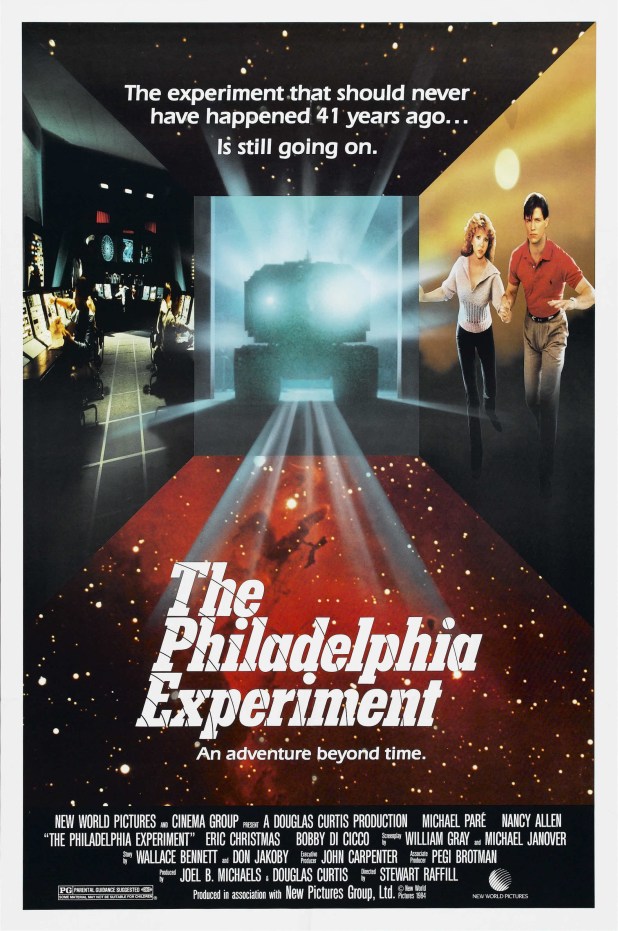
The second film — which we knew nothing about — was The Philadelphia Experiment.
Based on the book The Philadelphia Experiment: Project Invisibility by Charles Berlitz (yes, the very same Berlitz that was part of the family that is The Berlitz School of Languages, as well as a military intelligence officer accused of inventing mysteries and fabricating evidence, which we now call disinformation) and William L. Moore (who circulated the Majestic-12 document that later in my teenage years would overload my Commodre 64 and convince a seventeen-year-old possibly on drugs me that government troops were coming out of the woods to silence me and kill my family; I woke everyone up and ran into the yard screaming, I was a handful; Moore is also a disinfo agent), the original script for this movie was written by John Carpenter, who couldn’t figure out how it should end, never mind that it was based on a true story.
On that real story: An ex-merchant marine named Carl M. Allen sent an anonymous package marked “Happy Easter” that was Morris K. Jessup’s book The Case for the UFO: Unidentified Flying Objects filled with notes in three blue inks to the U.S. Office of Naval Research. These notes discuss how UFOs fly, discuss alien races and show that aliens are worried that the book knows too much and refer to the Philedelphia Experiment.
Allen then started writing to Jessup as himself and Carlos Miguel Allende warning him to stop studying flying saucers. He claimed that he was serving aboard the SS Andrew Furuseth and saw the actual event as the ship teleported from Philedelphia to Norfolk, Virginia and then back, during which he saw crewmembers go insane, become intangible and frozen within time. Jessup asked for info which Allen never really proved.
So this is where it gets weird. Well, weirder. Jessup was invited to the Office of Naval Research where he was shown that annotated book and realized that it had the same handwriting as Allen. Why?
Can it get weirder? Sure.
Commander George W. Hoover, one of the members of the Office of Naval Research, showed the annotations to a contractor named Austin N. Stanton, who was the president of Varo Manufacturing Corporation. Stanton got so obsessed that he used his office’s mimeography machine to print multiple copies of the letters and the annotated book. Keep in mind that this was super expensive in the late 50s and also went against so many laws and levels of security clearance.
So what happened to Jessup? No one wanted to read his books, he lost his agent and he eventually committed suicide. As others tried to find Allen, his family would only say that he was a master leg puller. He was also from New Kensington, Pennsylvania — so close to Pittsburgh. They gave researchers tons more of his handwritten notes on the subject.
Whew — yes I will get to the movie — the Varo annotations were used in several conspiracy and UFO books, finally gaining some interest thanks to Berlitz and Moore. Then the movie got made. And then, another sailor named Alfred Bielek claimed he was also on the ship and that the movie was totally accurate. That’s funny because the book ripped off another book, George E. Simpson and Neal R. Burger’s Thin Air.
Let me stop for a second and tell you that this movie has even crazier DNA.
That’s because it was directed by Stewart Raffill.
By the time he got to this movie, the script had been written nine times. Despite Michael Janover (who wrote the horrifying Hardly Working), William Gray (Humongous, Prom Night) and Wallace C. Bennett (The Silent Scream, Welcome to Arrow Beach) being in the credits for the script, Raffill says that he dictated the script and had someone type it.
As for the story, United States Navy sailors David Herdeg (Michael Pare) and Jim Parker (Bobby Di Cicco in 1943 and Ralph Manza in 1984) are on the USS Eldridge in 1943 as Doctor James Longstreet (Miles McNamara in the past, Eric Christmas — who was Mr. Carter in Porky’s — in 1984) makes the ship invicible to radar, but as things go wrong, David and Jim jump overboard and end up in the future — or our past are you confused? — and kidnap Allison Hayes (Nancy Allen) and get into military related hijinks before Jim gets zapped back in time.
There’s some wild science in here as David eventually has to go into a vortex and smash stuff with a fire axe to free the ship, which ends up with burned sailors and men being fused into the ship.
A sequel came out in 1993 with Brad Johnson from Nam Angels as David going up against Gerrit Graham as well as 2012 SyFy reimagining that Pare shows up for. Man, Michael Pare also made Streets of Fire the very same year and really should have been better considered.
This movie went from theaters to video stores faster than any movie had before. Maybe people thought that they had already seen it as The Final Countdown.
None of that is important to me. I have a wonderful memory of sitting in movie theater seats — outside no less — and getting to see two wild movies that I’ve thought of so many times since. We should all have a vacation so wonderful.







 B&S About Movies
You must be logged in to post a comment.