Admission is still only $10 per person each night (children 12 and under free with adult) and overnight camping is available (breakfast included) for an additional $10 per person.You can buy tickets at the show or use these links:
There is also a limited edition shirt available at the event.
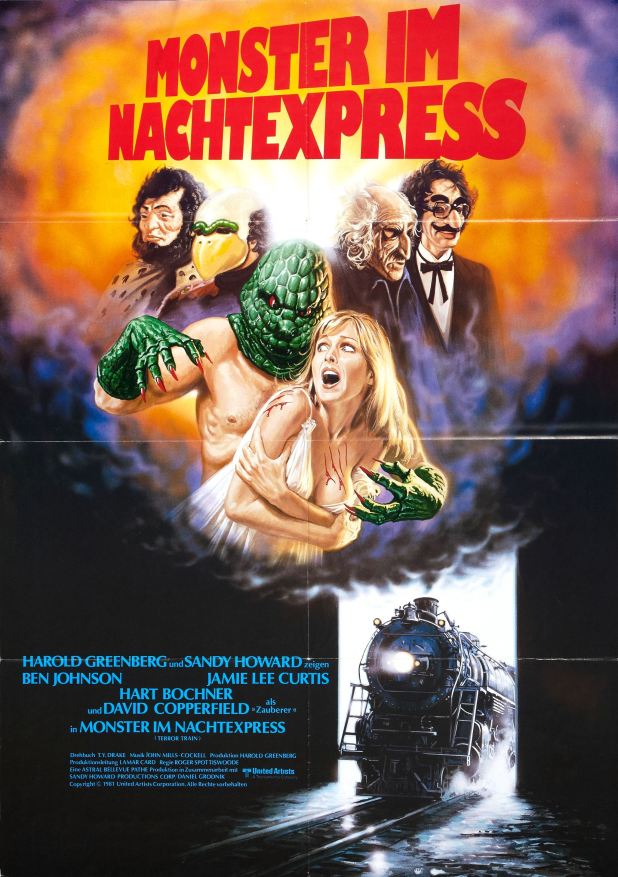
Jamie Lee Curtis. A train. A murderous slasher. And David Copperfield. Yes, Terror Train is unlike any other slasher that ever came before or since.
Directed by Roger Spottiswoode, who was also in the chair for Stop! Or My Mom Will Shoot, this movie was totally conceived as Halloween on a train. Jamie Lee had just finished filming Prom Night, so she jumped back on the slasher, err, train one more time.
Much like Slaughter High, a prank puts all of this in motion, as Alana (Jamie Lee) is coerced into pulling a joke on frat pledge Kenny Hampson that uses a female corpse, because you know, humor. Kenny doesn’t get the joke, goes nuts, gets put in a mental asylum and then, of course, breaks out and kills nearly everyone.
But what about David Copperfield, you may ask. Well, he’s all over this movie, both doing illusions and being a red herring. His scenes with Jamie Lee make the screen smolder with pure sex. I’m totally lying to see if you’re paying attention.
Ben Johnson, Captain Morales from the original The Town That Dreaded Sundownshows up as a train conduction. And hey! There’s Vanity (credited as D.D. Winters) years before she’d meet up with Prince, star in Action Jacksonand Tanya’s Island, then got heavy into drugs and dating Rick James, Adam Ant (who wrote the song “Vanity” about her on the Strip album), Nikki Sixx and Billy Idol. After that, she went into renal failure, found God and later died because her body had endured a lifetime of drug abuse.
I really like the killer’s gimmick of continually switching masks. It’s pretty effective and leads you to wonder who really is behind things, even if the opening totally gives the identity away.
Here’s a drink to enjoy while you watch this movie:
Admission is still only $10 per person each night (children 12 and under free with adult) and overnight camping is available (breakfast included) for an additional $10 per person.
You can buy tickets at the show or use these links:
There is also a limited edition shirt available at the event.
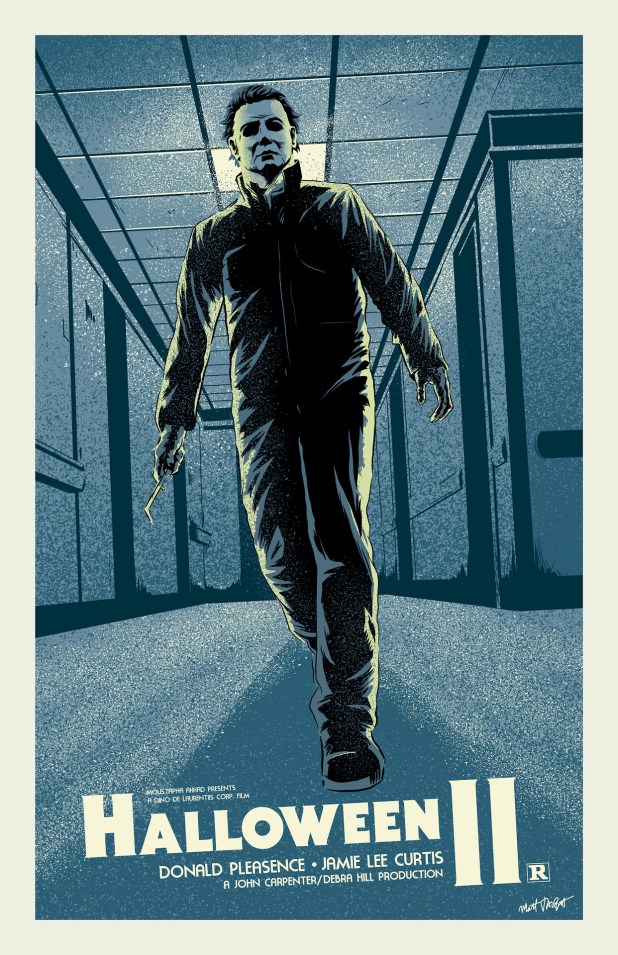
As slashers increased in ferocity, Halloween 2 matches and exceeds them. It’s a brutal affair where even the good side — Dr. Loomis in particular — are just as crazed as their evil counterparts. It’s also a film that wastes no time. It starts immediately where we left off and The Shape never stops coming and never pauses for remorse. The only downside is that the more you explain his motivations, the less interesting it becomes. But as the series has progressed, this installment has only grown in my eyes.
John Carpenter and Debra Hill co-wrote the screenplay, but he refused to direct, instead selecting Rick Rosenthal. That said, he’d go back and reshoot large chunks of the movie as he was making the TV friendly scenes for the original film. The decision to include more gore and nudity was not Rosenthal’s idea. Carpenter saw the original cut, declared it as scary as an episode of Quincy and went back to directing.
For a movie that no one was all excited about making — except producer Irwin Yablans — I really love this movie and one of the major reasons why I dislike the new generation of sequels is that it no longer exists. It also feels like a giallo in parts, like the basement sequence that echoes moments of The Strange Vice of Mrs. Wardh.
While the movie also veers into absolute insanity with the death of Ben Tramer — that fireball! — I adore that part of it. This is a crowd-pleasing movie perfect for the drive-in, one that people should be loudly cheering and yelling during the stalk and slash moments. It also has characters that are endlessly quotable, like Budd Scarlotti (Leo Rossi) and a nice dynamic between Jimmy (Lance Guest) and Laurie (the returning Jamie Lee Curtis).
I understand the issues many have with this movie. It places Laurie out of the action for most of the story. But for sheer slasher magic, for the incredible image of The Shape with blood pouring down his face, for more of the music and Dean Cundy’s cinematography and just the chance to live in Haddonfield for another few moments, it’s a gift.
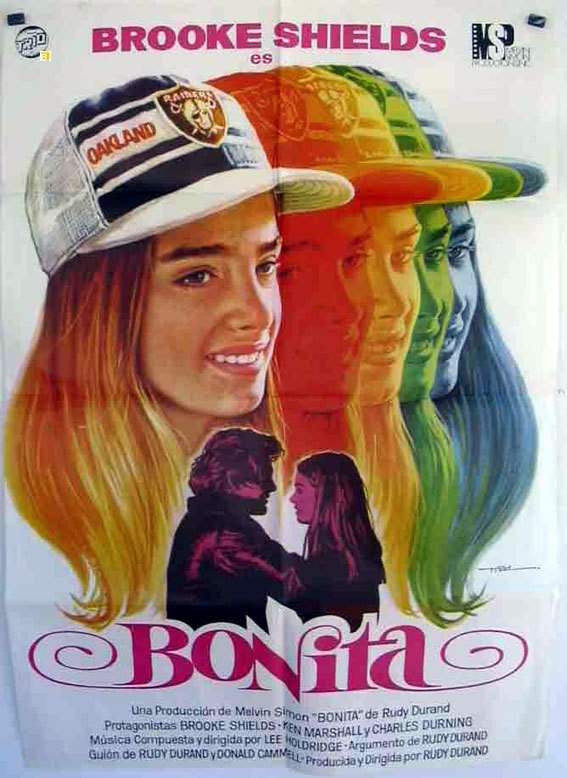
Neil Gallagher (Ken Marshall, Prince Colwyn from Krull) wants to get back at Harold “The Whale” Remmens (Charles Durning), who just might be the best pinball player in the world. After he’s busting cheating, he leaves town and soon discovers 14-year-old pinball player Brenda “Tilt” Davenport (Brooke Shields), who comes from a bad home and has mostly turned to a bartender Mickey (John Crawford) as her father figure. She thinks she’s using her pinball skills to hustle players to fund Neil’s singing career, but it’s all about coming back home to win that big bet and get revenge.
With Lorenzo Lamas, Don Stark and Geoffrey Lewis, who is in a wild scene with Shields where she offends him by telling him that she wants to make love to his life — Shields was 13 at the time this was filmed, the 70s were insanity — this is a movie that makes us think that the economy of 1979 America was based on pinball.
I was wondering why this movie seems so deranged and then I saw the credits. It was co-written by Donald Cammell, who made Performance and it all makes sense. This was directed by Randy Durand, who only made this one film. Cammell left the movie when they wouldn’t hire Jodie Foster as the lead. Durand was the director, a co-writer, the producer, musical director, and in the sound department, was responsible for the pinball machine musical sound effects. He’d wanted to hire Orson Welles to be Durning’s role, but even though he couldn’t do it, he mentioned the movie on The Tonight Show, which helped Durand get some funding.
Even wilder, there was a Sahara Love pinball machine based on the Cannon film Sahara that Brooke made years later.
April 25: Fads — Lambada. Disco. Garbage Pail Kids. What’s your favorite fad-related movie? Click the image for our full list of reviews for the month!
So, the day of April 25 on the B&S About Movies’ announcement for the April Movie Thon so proclaimed today as “Fads” day: Lambada. Disco. Garbage Pail Kids. You could toss superhero movies on the VHS stack. Elvis movies*. Buddy Cop flicks. Gangster movies. Movies starring Melissa McCarthy and Tim Allen.
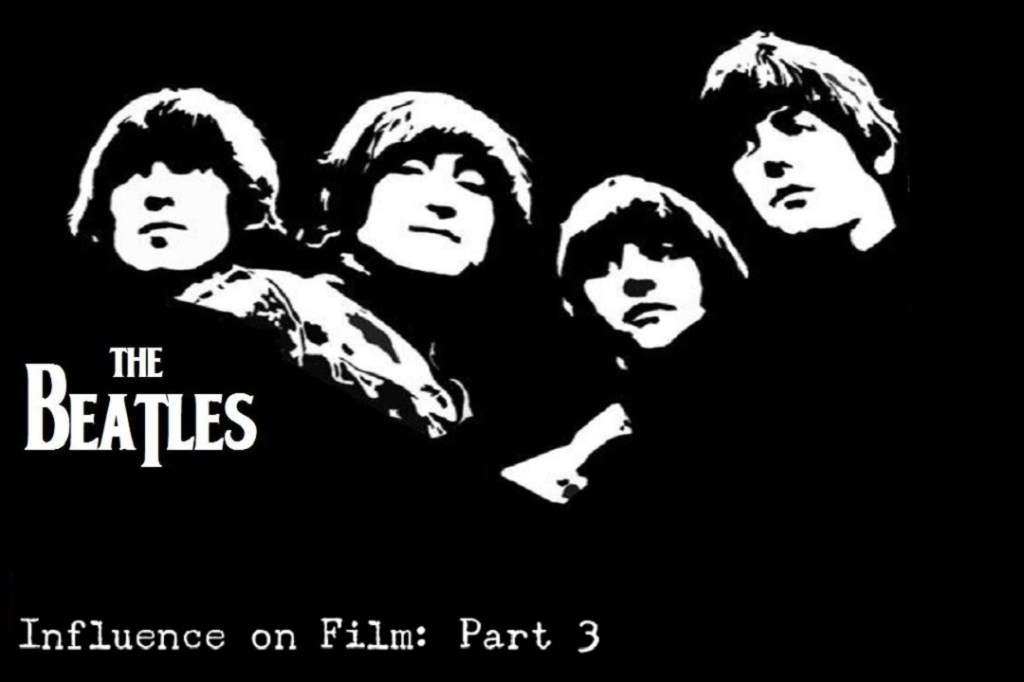
Oh, but how could we forget including “The Fab Four” — who, through no fault of their own — became “The Fad Four” — across 30-plus films since the late ’60s**. Yes, we are name-dropping the “fad films” Breakin’, Can’t Stop the Music, The Garbage Pail Kids, and Roller Boogie in the same breath as one of the most — if not the most — influential bands of all time.
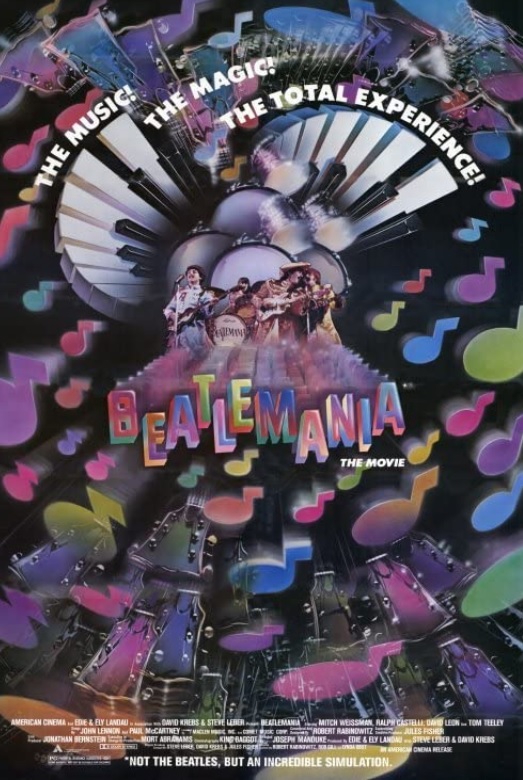
This “film” — a concept that Ringo went on record as saying he “hated” — is one of those fad flicks of our dismay. And deservingly so, since it is the most blatant marketing cash-in of all Beatles flicks.
A smash Broadway musical-rockumentary advertised as “Not the Beatles, but an incredible simulation” that ran for 1,006 performances from May 1977 to October 1979 is a sure bet for a theatrical film adaptation.
No, it’s not.
The show — a multimedia production consisting of backdrops and projected images of art and video footage from the Beatles-era, as well as numerous clips of the Beatles — consisted of 29, chronologically-played songs, complete with costume changes.
So — with a Broadway hit on their hands — the managerial impresarios behind the production, Steve Lever and David Krebs (known for their handling of the Rolling Stones, Joan Jett, to a lesser extent, Canadian metalers Anvil; chornicled in their document, Anvil! The Story of Anvil, and Aerosmith; remember “Boston’s Bad Boys” appeared in Sgt. Pepper’s Lonely Hearts Club Band), decided that — Apple Corps. lawsuits, be damned — it was time to take on the album charts and the silver screen.
The original cast of Joe Pecorino (rhythm guitar, John), Mitch Weissman (bass guitar, Paul), Les Fradkin (lead guitar, George), and Justin McNeill (drums, Ringo), and the second cast of Randy Clark as John, Reed Kailing as Paul, P.M. Howard as George, and Bobby Taylor as Ringo, headed into the studio for a 1978 Arista Beatlemania: The Album release — which bombed with record buyers as it scrapped into the lowest regions of the Billboard 200.
Seriously? Who wants to buy a Pickwick (Discogs) budget sound-alike of Beatles tunes?
Okay . . . well, maybe a movie would work, better.
Production began in late 1980 — shortly before John Lennon’s December 8 murder — under the tutelage of TV director Joseph Manduke (Harry O, Hawaii Five-O, Barnaby Jones). The cast featured a mix of musicians from the Broadway production and Arista album, with Mitch Weissman back a third time as Paul, David Leon as John, Tom Teeley as George, and Ralph Castelli as Ringo.
Released in the summer of 1981, Beatlemania: The Movie quickly became a critical and box office bomb. Apple Corps, who launched their first legal volleys regarding publicity rights and trademarks in 1979, finally won in damages in 1986.
You can learn more on the making of Beatlemania (the Broadway show) with this Chicago news station-produced TV documentary on You Tube.
** Editor’s Note: This review previous appeared in August 2021, as part of a three-part “The Beatles: Influence on Film” series.
About the Author: You can read the music and film reviews of R.D Francis on Medium and learn more about his work on Facebook. He also writes for B&S About Movies(links to a truncated teaser-listing of his reviews).
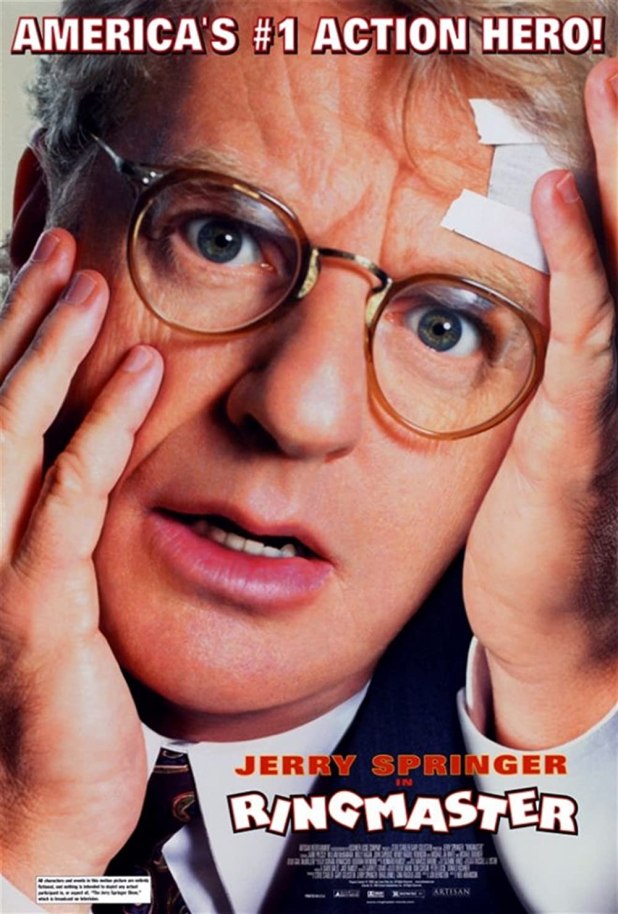
Despite what that VICE Dark Side of the 90s would have you believe, Jerry Springer didn’t invent his show format. Morton Downey Jr., Geraldo Rivera, Phil Donahue (who he was a clone of at first) and Wally George had all been there and done that, but Springer ended up hitting the cultural zeitgeist at the right time and knew early on that he needed to hire pro-wrestling-connected talent bookers to keep bringing in worked storylines to keep the machine moving.
For some reason, Springer isn’t himself but Jerry Farrelly. Was he embarrassed? After all, this is the one-time mayor of Cincinnati who paid for sexual favors with a personal check. Regardless, his show has three different storylines:
You Did WHAT With Your Stepdaddy?: Angel Zorzak (Jaime Pressly, who deserved and got better) is sleeping with her mother Connie’s (Molly Hagan, Code of Silence, The Dentist, Sometimes They Come Back… Again) husband Rusty (Michael Dudikoff, so deserves so much more, so go watch American Ninjaor Avenging Force and think kind thoughts for him) while she’s sleeping with Angel’s boyfriend Willie.
My TraitorGirlfriends: Demond (Michael Jai White, Spawn) is cheating on Starletta (Wendy Raquel Robinson) with her friends Vonda (Tangie Ambrose) and Leshawnette (Nicki Micheaux).
The third is Jerry himself, who much like Chuck Barris in The Gong Show Movie, is afraid of the career and life that he has made.
Director Neil Abramson and writer Jon Bernstein have a major issue to deal with: any sort of fake real episode of Springer’s show is more interesting than what they could invent. Roger Ebert shared that he heard Springer once said, “I know I’m going to go to hell for doing this show.” I don’t think he will for this movie. It’s too boring for eternal damnation.
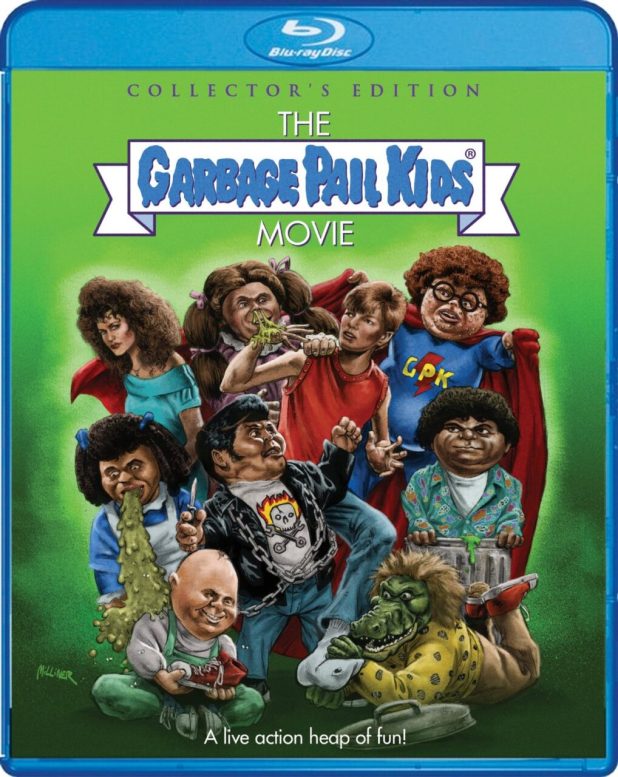
The Garbage Pail Kids came out in 1985 from Topps and were created by Art Spiegelman. Yes, the same cartoonist who made Maus. He and Mark Newgarden worked together as the editors and art directors of the project, with Len Brown — the same person who Wally Wood named T.H.U.N.D.E.R. Agent Dynamo after and one of the creators of Wacky Packages and Mars Attacks — as the manager and art by John Poundart for the first series, then Jay Lynch, Tom Bunk, James Warhola — the nephew of Andy Warhol — and more.
These cards were a huge success and sold worldwide (they’re called Mr. Creepy in Japan, Totally Broken Kids in Germany, The Filthies in France, Snotlings in Italy and The Garbage Gang elsewhere). They were quite controversial and banned in many schools. And then Original Appalachian Artworks — the same Xavier Roberts who stole the look of Martha Nelson Thomas’ soft sculptured dolls that came with a birth certificate — sued and they had to change the logo. But by 1988, the kids were gone. yet they came back in 2003 and never went away. You can even get blockchain backed high-end versions of them now.
Look, I’m someone who doesn’t believe that there’s “so bad it’s good” and has found the light in the darkness within so many so-called bad films. This one challenged my will to live, but there are times during it when the overwhelming badness of the film approaches surrealist art and I laughed so hard that my head began to throb and I was sure this was the stroke that would wipe out my lifelong hard-earned knowledge of Mattei, D’Amato and lesser scumbag directors.
Dodger (Mackenzie Astin) works in the junk store of magician Captain Manzini (Anthony Newley) and is also the target of a gang of toughs led by Juice (Ron MacLachlan) while loving that bad dude’s girl Tangerine (Katie Barberi) from afar.
To break up all that preteen angst, a garbage can falls from the sky containing green ooze and the Garbage Pail Kids: the always snotty Messy Tessie; the Hawaiian shirt-wearing flatulent Windy Winston; the throw up on command Valerie Vomit (played by Debbie Lee Carrington, memorable as the small-statured Martian rebel in Total Recall); the whining baby Foul Phil; the acne-scarred superhero Nat Nerd and the toe eating reptilian hybrid nightmare called Ali Gator. None of these characters are in any way endearing or cute ugly. They’re borderline upsetting and the more I think about it, the more I love this movie for being so dead and vacant.
After having our protagonist covered with sewage and abused by the gang, only to be saved by the Kids, it still has Dodger in love with Tangerine, who wants to be a fashion designer and puts the GPK into service as pretty much slaves. The kids steal a Pepsi truck — I can’t imagine Pepsi would have loved how they’re presented in this — and then go to a Three Stooges festival which makes them so insane that they drink beer with bikers and Ali Gator gets to eat some toes. Despite being babies and children, the GPK get drunk on beer, which is encouraged by the film, and sing songs so inane that I again started to laugh the kind of frenzied guffaws that only happen when I endure serious physical pain.
Despite the kids being put into the State Home for the Ugly, a place where Gandhi and Santa Claus are executed because this is a movie for children, they escape, ruin a fashion show and refuse to go away, not even following the rules of Mr. Mxyzptlk.
If it seems like Dodger and Tangerine seem on again, off again and ill-matched, well — Astin and Barberi dated and broke up mid-movie. That wasn’t Austin’s only issue. He got the movie without telling his father, John Astin, who tried to get his son out of this film.
Rod Amateau directed and co-wrote this and his career was, well, something. He started his career doing stunts in movies like Rebel Without a Cause and Mighty Joe Young (he was also a stunt driver for Butcher, Baker, Nightmare Maker and Thunder Run after this directing career took off) and then wrote and directed episodes of The Many Loves of Dobie Gillis, produced and directed 78 episodes of The George Burns and Gracie Allen Show, produced and directed The New Phil Silvers Show, directed nearly every episode of My Mother the Car and also made The Statue, one of the few movies Roger Ebert ever walked out on, as well as High School U.S.A., the movie that convinced Joel Robinson to leave Hollywood, Son of Hitler, a Peter Cushing movie that never played outside of Germany and wrote Sunset, one of the many Blake Edwards films — and mistakes — that a nascent Bruce Willis would make.
The Garbage Pail Kids Movie made just $661,512 during its opening weekend and eventually $1.6 million on a million dollar budget, but was still seen as a major disappointment. Astin told Mental Floss, “The heroes of the entire experience are the seven little people actors in costumes every day in triple-digit heat in the San Fernando Valley. They couldn’t see or hear. There was only so much time they could have the heads on before they ran out of oxygen.”
Effects artist William Butler went even further: “I think it was a stupid idea of a stupid screenplay, with stupid designs, that made for a cacophony of stupidity.”
For the twenty-fifth day of the B&S About Movies April Movie Thon, it’s all movies that are based on short lived big deals.
April 25: Fads — Lambada. Disco. Garbage Pail Kids. What’s your favorite fad-related movie?
All April long, we’ll have thirty themes as writing prompts. If you’d like to be part of it, you can just send us an article for that day to bandsaboutmovies@gmail.com or post it on your site and share it out with the hashtag #BSAprilMovieThon.
Here are a few movies to watch today:
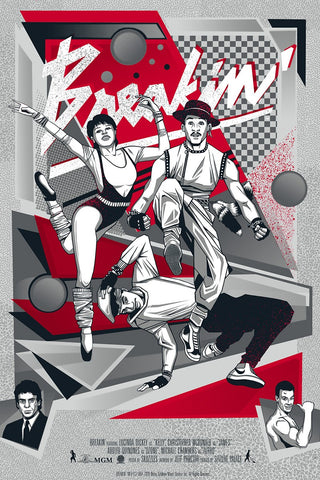
Breakin’ (1984): Cannon usually chased trends. With this movie — and the even stranger Breakin’ 2: Electric Boogaloo — they were ahead of what was hot. When Cannon would break apart, there would be a battle for another dance craze between The Forbidden Dance and Lambada.
Roller Boogie (1979): I really should start a Letterboxd list of all the roller skate movies that I love, including Skatetown U.S.A., Kansas Bomber, Xanadu, Unholy Rollers, Rollerball, Roller Blade(and all of its sequels and Rollergator), Solarbabies, Airbourne, Whip It and Prayer of the Rollerboys.
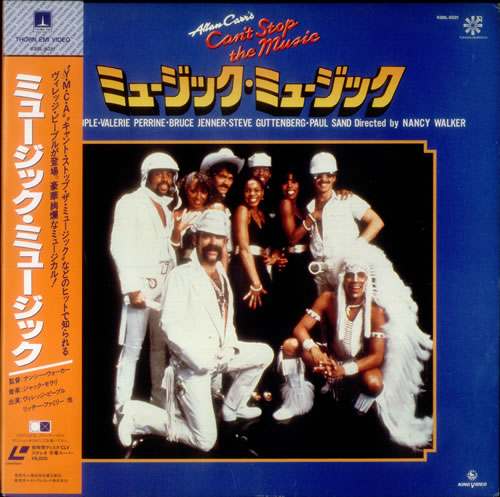
Can’t Stop the Music(1980): There are a lot of disco movies I could mention — Can’t Stop the Music, Disco Fever, The Wiz — but only one was made this late and is also about the fad that was the Village People.
Alexander Fu Sheng was another in the line of martial arts actors who could have been the next Bruce Lee, yet he died unexpectedly in a car accident during the making of this movie.
As this was one of Shaw Brothers’ final all-star martial arts epics before they ceased filmmaking altogether, The 8 Diagram Pole Fighter may be recognized as Lau’s masterpiece, yet he made so many, it can be hard to select just one.
The Yang family patriarch and all of his children — except for Yeung Dak (Gordon Liu), Yeung Chiu (Fu Sheng) and Yeung Kei (Kara Hui) — have been murdered. Yeung Dak has given up the ways of violence and is studying at a monastery. When he learns that his sister has been taken by the same people who murdered his father, he must renounce the Buddhist way of life, taking notice once more of the physical world, and use the spear training to invent the 8 Diagram Pole Fighting style, which he can still practice inside the walls of the holy place.
If you value your teeth, this may be a tough watch. I’ve never seen more molars and incisors knocked out in a movie than this one. It’s awesome, however, with stylish fights and big drama. It’s sad that Fu Sheng is gone and would not be the hero of this film, but Gordon Liu has that certain something, an intangible quality that makes you notice him and say, “This is a star.”
The 8 Diagram Pole Fighter has a brand new 2K restoration from the original camera negative by Arrow Films with the original lossless Cantonese, Mandarin and English mono audio as well as optional English subtitles and hard-of-hearing subtitles for the English dub. It also has brand new commentary by Jonathan Clements, author of A Brief History of China; a newly filmed appreciation by film critic and historian Tony Rayns; interviews with Gordon Liu, Lily Li and Yeung Ching-ching; A Tribute to Fu Sheng, a short film commemorating the late actor that played before early screenings of The 8 Diagram Pole Fighter; The Invincible Pole Fighters alternate opening; the trailer, an image gallery, a reversible sleeve featuring original and newly commissioned artwork by Marc Aspinall and an illustrated collector’s booklet featuring new writing on the film by Terrence J. Brady. You can get this from MVD.
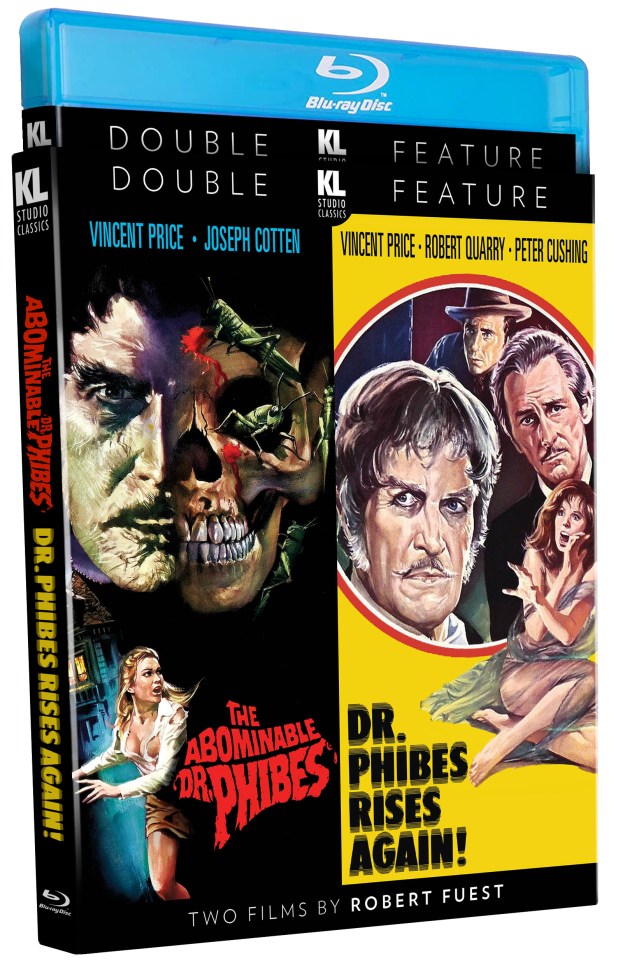
EDITOR’S NOTE: These articles originally were on the site on March 31, 2019 and April 1, 2019. These are two of my favorite movies and I’m so excited that Kino Lorber has released them on a double blu ray along with commentary tracks by director Robert Fuest, The Dr. Phibes Companion author Justin Humphreys and film historian Tim Lucas, as well as radio ads and trailers. You can get it from Kino Lorber. Honestly, this is a must buy.
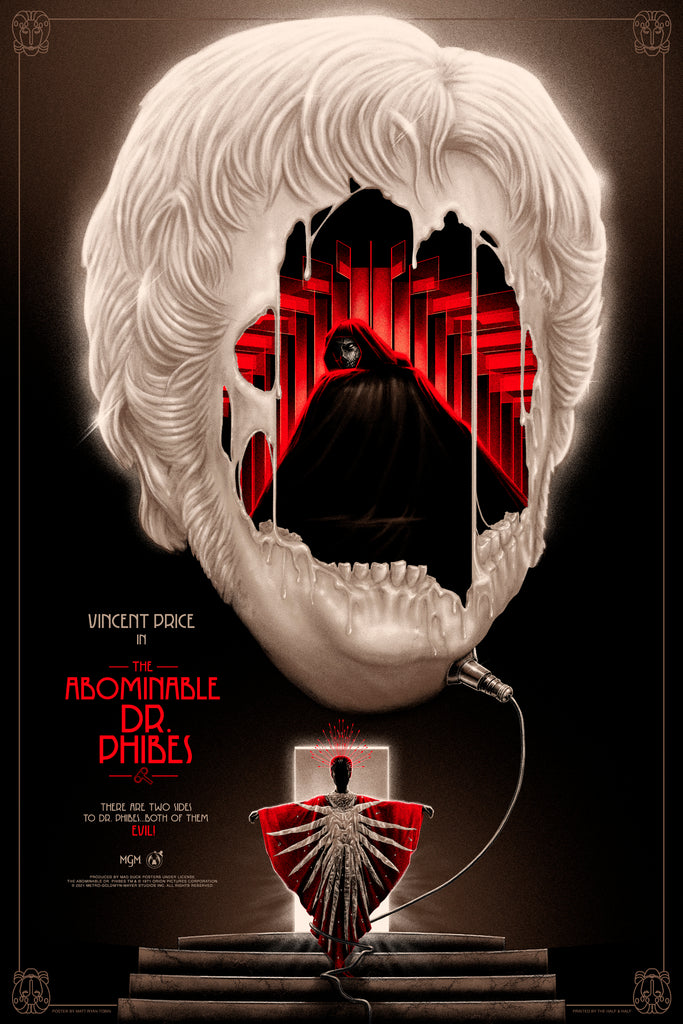
The Abdominable Dr. Phibes (1971): Church of Satan founder Anton Szandor LaVey claimed that the main character in this Vincent Price film was based on him. Well, his name is Dr. Anton Phibes and he’s an organist, researcher, medical doctor, biblical scholar and ex-vaudevillian who has created a clockwork band of robot musicians to play old standards at his whim. Seeing as how nearly all of these things match up with LaVey, I can kind of see his point.
Director Robert Fuest started by designing sets. While working on the TV show The Avengers, he got excited about directing and ended up working on seven episodes of the original series and two of The New Avengers. Soon, he’d be working in film more and more, starting with 1967’s Just Like a Woman. Between the two Phibes films, And Soon the Darkness, The Final Programme and The Devil’s Rain!, he became known for dark-humored fantasy and inventive sets, several of which he designed himself.
This movie is one I can’t be quiet about. It’s one of the strangest and most delightful films I’ve ever seen.
Dr. Anton Phibes died in Switzerland, racing back home upon hearing the news that his beloved bridge Victoria (an uncredited Caroline Munro) had died during surgery. The truth is that Phibes has survived, scarred beyond belief and unable to speak, but alive. He uses all of the skills that he’s mastered to rebuild his face and approximate a human voice. Also, he may or may not be insane.
Phibes believes that the doctors who operated on his wife were incompetent and therefore must pay for their insolence. So he does what anyone else would do: visit the Biblical ten plagues of Egypt on every single one of them.
Phibes is, of course, played by Vincent Price. No one else could handle this role. Or this movie. There’s hardly any dialogue for the first ten minutes of the movie. Instead, there are long musical numbers of Phibes and his clockwork band playing old standards. In fact, Phibes doesn’t speak for the first 32 minutes of the movie. Anyone who asks questions like “Why?” and says things like “This movie makes no sense” will be dealt with accordingly.
After the first few murders, Inspector Trout gets on the case. He becomes Phibes’ main antagonist for this and the following film, trying to prove that all of these murders — the doctors and nurse who had been on the team of Dr. Vesalius (Joseph Cotten!) — are connected. Phibes then stays one step ahead of the police, murdering everyone with bees, snow, a unicorn statue, locusts and rats, sometimes even right next to where the cops have staked him out.
Dr. Phibes is assisted by the lovely Vulnavia. We’re never informed that she’s a robot, but in my opinion, she totally is. Both she and the doctor are the most fashion-forward of all revenge killers I’ve seen outside of Meiko Kaji and Christina Lindberg.
Writer William Goldstein wrote Vulnavia as another clockwork robot with a wind-up key in her neck. Fuest thought that Phibes demanded a more mobile assistant, so he made her human, yet one with a blank face and mechanical body movements. I still like to think that she’s a machine, particularly because she returns in the next film after her demise here. Also — Fuest rewrote nearly the entire script.
After killing off everyone else — sorry Terry-Thomas! — Phibes kidnaps Dr. Vesalius’ son and implants a key inside his heart that will unlock the boy. However, if the doctor doesn’t finish the surgery on his son in six minutes — the same amount of time he had spent trying to save Phibes’ wife — acid will rain down and kill both he and his boy.
Against all odds, Vesalius is successful. Vulnavia, in the middle of destroying Phibes’ clockwork orchestra, is sprayed by the acid and killed while the doctor himself replaces his blood with a special fluid and lies down to eternal sleep with his wife, happy that he has had his revenge.
If you’re interested, the ten plagues Phibes unleashes are:
1. Blood: He drains all of Dr. Longstreet’s blood
2. Frogs: He uses a mechanical frog mask to kill Dr. Hargreaves at a costume party
3. Bats: A more cinematic plague than lice from the Biblical plagues, Phibes uses these airborne rodents to kill Dr. Dunwoody
4. Rats: Again, better than flies, rats overwhelm Dr. Kitaj and cause his plane to crash
5. Pestilence: This one is a leap, but the unicorn head that kills Dr. Whitcombe qualifies
6: Boils: Professor Thornton is stung to death by bees
7. Hail: Dr. Hedgepath is frozen by an ice machine
8. Locusts: The nurse is devoured by them thanks to an ingenious trap
9. Darkness: Phibes joins his wife in eternal rest during a solar eclipse
10. Death of the firstborn: Phibes kidnaps and the son of Dr. Vesalius
I love that this movie appears lost in time. While set in the 1920’s, many of the songs weren’t released until the 1940’s. Also, Phibes has working robots and high technology, despite the era the film is set in.
There’s nothing quite like this movie. I encourage you to take the rest of the day off and savor it.
How does Phibes live up to being a Satanic film? In my opinion, Phibes embodies one of the nine Satanic statements to its utmost: Satan represents vengeance instead of turning the other cheek. The men and woman whose negligence led to the loss of Phibes’ wife were never punished. Phibes had to become their judge, jury and yes, destroyer.
On the other hand — or hoof, as it were — Phibes is the exact antithesis of the ninth Satanic sin, Lack of Aesthetics, which states that “an eye for beauty, for balance, is an essential Satanic tool and must be applied for greatest magical effectiveness. It’s not what’s supposed to be pleasing—it’s what is. Aesthetics is a personal thing, reflective of one’s own nature, but there are universally pleasing and harmonious configurations that should not be denied.” So much of what makes this film is that Phibes’ musical art is just as essential as his demented nature and abilities. Music is the core of his soul, not just revenge.
Another point of view comes from Draconis Blackthorne of the Sinister Screen: “This is an aesthetically-beauteous film, replete with Satanic architecture as well as ideology. Those who know will recognize these subtle and sometimes rather blatant displays. Obviously, to those familiar with the life of our Founder, there are several parallels between the Dr. Anton Phibes character and that of Dr. Anton LaVey – they even share the same first name, and certain propensities.”
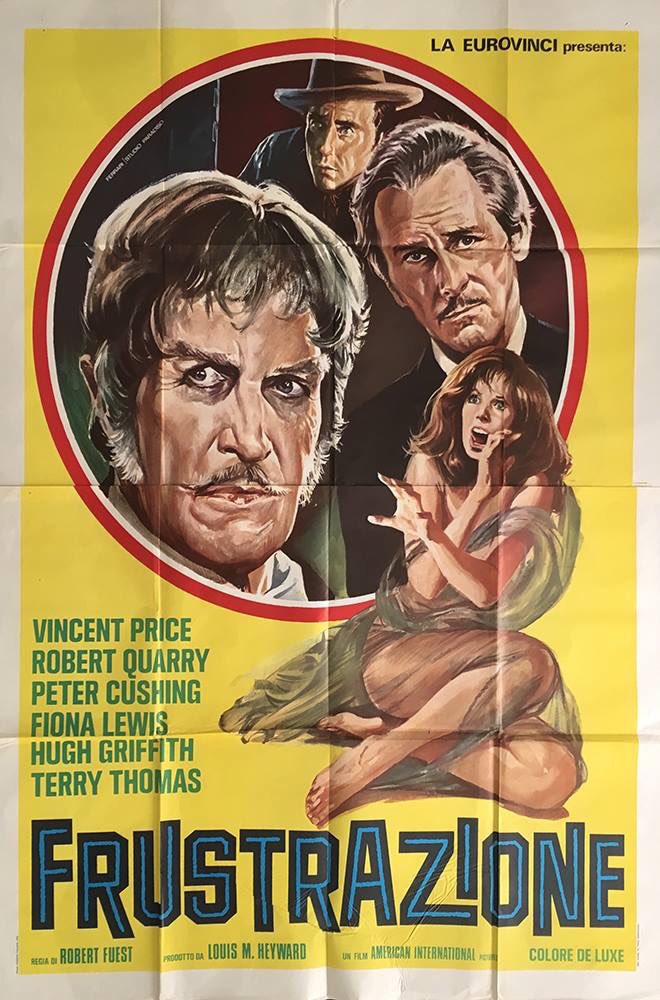
Dr. Phibes Rises Again! (1972): The fact that this movie exists gives me hope. There are moments when life gets me down, when I wonder about my place in this world and if humanity is essentially horrible. Then I remember that great films like this exist and it makes me feel a lot better. You should do the same thing if you’re ever in an existential crisis.
Dr. Phibes is back, three years after he laid down in the darkness next to the corpse of his beloved wife. Now, however, he has learned that the secret of eternal life — held by a centuries-old man — is in Egypt. I don’t care why he’s back. I’d watch Dr. Phibes go grocery shopping!
Dr. Anton Phibes (Vincent Price) has in suspended animation in a sarcophagus alongside his wife Victoria Regina Phibes (Caroline Munro). When the moon aligns with the planets in a way not seen for two millennia, he returns, summoning the silent Vulnavia (thus confirming to me, at least, that she’s really one of his robots as she died in the last film; furthermore, she’s played by Valli Kemp, who took over for the pregnant Virginia North) to his side.
Phibes plans on taking his wife’s body with him to Egypt, where the River of Life promises her resurrection. As he emerges from his tomb, his house has been demolished and the safe that contained the map to the river lies empty. That’s because the map has been stolen by Darius Biederbeck, a man who is hundreds of years old thanks to a special elixir. He may also be every bit Phibes’ equal.
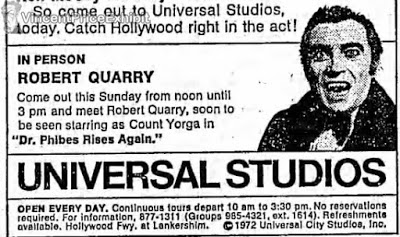
Darius is played by Robert Quarry, who American International Pictures was grooming to be Price’s replacement. There were tensions between the two on set, including a moment where Quarry was singing in his dressing room and challenged Price by saying, “You didn’t know I could sing did you?” Ever the wit, Vincent Price replied, “Well, I knew you couldn’t act.” Quarry would had already played Count Yorga in two films for AIP and would go on to be in The Deathmaster, where he played hippie vampire Khorda, but the AIP style had already fallen out of style. He’s also in tons of Fred Olen Ray films, like Evil Toons where he’s the uncredited voice of the demon.
Biederbeck wants eternal life for himself and his lover Diana (Fiona Lewis, Tintorera…Tiger Shark). Phibes and Vulnavia are on his trail, immediately entering his home, murdering his butler and stealing back the map. Everyone connected with Biederbeck comes to an ill end — Phibes places one inside a giant bottle and throws him overboard. That murder brings Inspector Trout back on the case, as he instantly recognizes that only one man could do something like that.
The rest of the film’s murders are based on Egyptian mythology versus Biblical plagues. Hawks and scorpions become his weapons, along with gusts of wind and bursts of sand. Phibes has also brought an army of clockwork men with him the desert to do his bidding.
Phibes finally exchanges Diana’s life for the key to the River of Life. As he floats the coffin containing his wife down the water, he beckons Vulnavia to join them. As his lover tries to comfort him, Biederbeck begs Phibes to take him with them. He begins to rapidly age and dies as Phibes loudly sings “Over the Rainbow,” which might be the best ending of any movie ever made.
There were plans for a whole bunch more of these films and the fact that they were never made saddens me to this day. I’ve heard that a third film would Phibes fighting Nazis. I’ve also heard that it’d be about the key to Olympus. Or Phibes going up against Dr. Vesalius’ son. Or Victoria Phibes herself coming back, just as sinister as her husband. There have been titles thrown around like Phibes Resurrectus, The Seven Fates of Dr. Phibes and The Brides of Dr. Phibes. There was even thought of Count Yorga facing off with Dr. Phibes, a fact which delights me to no end.
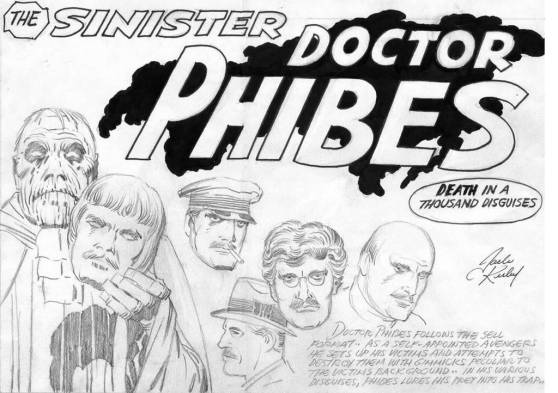
There was also a pitch for a TV series and what looked like an animated version, with Jack Kirby himself providing the pitch artwork!
Other ideas included Dr. Phibes in the Holy Land, The Son of Dr. Phibes (which would have pitted the doctor and his son against ecological terrorists), Phibes Resurrectus (which would have David Carradine as Phibes battling against Paul Williams, Orson Welles, Roddy McDowall, John Carradine and Donald Pleasence. The mind boggles at the thought, let me tell you!), a 1981 Dr. Phibes film where the WormwooInstitutete would have destroyed his wife’s body and then their strange members, including transvestite twins obsessed with economics and nuclear weaponry, fail to match wits with Phibes) and finally, Phibes was almost a role for Peter Sellers in a Pink Panther film where hed also play Clouseau and Fu Manchu. You can learn more about these at the Vincent Price Exhibit site.
There was also a story in 2013 that Johnny Depp was going to star in a Tim Burton directed remake. That obviously didn’t happen.
So much of this film fits into the same Satanic themes as the original. However, you can add in a few new wrinkles. One of the Eleven Satanic Rules of the Earth states “When walking in open territory, bother no one. If someone bothers you, ask him to stop. If he does not stop, destroy him.” All Phibes wished to do was take his wife to Egypt and bring her back to life. Once Biederbeck stole from him, his fate was sealed.
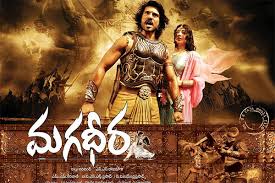
Director and writer S. S. Rajamouli had a wonderful inspiration for this movie. He told Idlebrain: “My father Vijayendra Prasad prepared a story for a film titled Jagadeka Veerudu with Krishna as hero in the direction of Sagar. They didn’t like that concept and it was turned down. I was working as an assistant to my father at that time. I always wanted to do that story and it required huge budget.
When I was granted big budget from Allu Arvind for Charan’s movie, I picked this subject up. I watched DVDs of Alfred Hitchcock’s TV series before making Magadheera. What intrigued me is that he reveals the entire plot in the beginning and still be able to maintain the suspense by showing how the protagonist does it. It became an eye opener for me. That is the reason why I revealed the story of the movie right on the film’s launch.”
The reincarnation theme is about four people:
Kala Bhairava (Ram Charan), a valiant warrior and bodyguard for the royal family who is reborn as motorcyclist Harsha.
Princess Mithravinda Devi (Kajal Aggarwal), who is in love with Kala, who refuses to admit it, and returns as Indira.
Ranadev Billa (Dev Gill), the leader of the army who lusts for both power and the princess, reborn as Rajasthani monarch Raghuveer.
Emperor Sher Khan (Srihari), who wants to conquer the kingdom, and the fisherman Solomon.
The film may start in 2009, as Harsha meets and falls in love with Indira. Meanwhile, Raghuveer has also become enraptured by her and is the first to realize that all of their fates are intertwined. It takes a near-death experience — and the murder of his father at the hands of Raghuveer — for Harsha to relive his past, including an epic chariot race and a battle to defeat a hundred of Khan’s soldiers that ends in tragedy before we come back to the present, a place where no one’s fate is set.
Just like Karz, reincarnation is central to this movie. It’s also a film packed with CGI and big ideas. It was so popular that it became the first Telugu film in India to have a blu ray release. Even in the U.S., on just three screens in New Jersey, it made $150,000. It may also feel a lot like Gladiator and 300, but the idea that it’s pushing to look as grandiose as those films left me exhilarated. The battle against the one hundred soldiers is just incredible and must be seen.






 B&S About Movies
You must be logged in to post a comment.