Tubi Debut: Hub City, aka Compton’s Finest (2021)

I love exploring the retro-vibed, digital terrains of Tubi, as it takes me back to the simpler, analog days with a video membership card in my hand, perusing the shelves, examining the VHS sleeves for a Saturday afternoon of movie-binging.

Needless to say, in today’s digital distribution realms endlessly supplied with films by way of digital cameras (and now, smartphones), the films discovered are not so much a rough diamond, but a chunk of pyrite. As a matter of my own, personal review policy: If I discover—or am assigned—a small indie movie that fails to resonate, I won’t post a review. There’s nothing gained by calling out the shortcomings of one’s heartfelt passion project, be it action or comedy, or a hybrid of both. I have to believe in the work.

Producing an action film—in this case a dark-comedy action film—on a tight budget isn’t an easy task (usually maxing at one million in budget). So while those today digital productions aspire to become a Shane Black industry-calling card under the production eye of Joel Silver and directorial reins of Richard Donner, there are, again, more cubic zirconia than precious gem stone under the streaming loupes.

Charles Malik Whitfield stars? Consider it streamed.

When it comes to budget-tight actioners, while I was taken to snotty task by a troll or two in regards to my review, I stand by the work of writer-director Steven C. Miller with his serviceable action-thrillers, such as the Bruce Willis-starring First Kill (2017), the Nicolas Cage-starring Arsenal (2018), and the Aaron Eckhart-starring Line of Duty (2019). My same critical stance holds for the work of Prince Bagdasarian’s morally-screwed up character action romp, Abduction. I also felt noted urban music video director Nick Leisure turned in a fine set of frames with A Clear Shot and Anthony Ray Parker’s (TV’s syndicate Hercules and Xena franchises) industry calling card Lone Star Deception was another solid, against-the-budget action-thriller. Randall Emmett’s Precious Cargo giving Mark-Paul Gosselaar a starring role worked well, as well. On the comedy end, I felt Camilo Vila provided Jaleel White a solid, leading man comedy role with 5th of July, while Mehul Shah’s Nana’s Secret Recipe was an also an enjoyable watch.

So, when you’re on an entertainment budget and searching for something new and fresh, a little time and patience in the streaming-verse pays off. Of course, having those marquee names on the box—well, these days, a digital avatar—always helps entice my hitting that big red streaming button. Give me actors I know and respect for their commitments to their roles—no matter how big or small—be they on a career up-and-coming or on a downward slide—I am watching your flick.

Such a film is Hub City.

Best pitch-described as Ice Cube’s Friday meets Lethal Weapon, this effective, budget conscious (one million) action comedy stars the always watchable Charles Malik Whitfield (part of the starring-recurring casts of The Guardian, Empire, and Supernatural; stellar in one of his earliest roles as Otis Williams in the NBC-TV mini-series, The Temptations), along with the deserves-his-own-series Cisco Reyes (guest roles on TV’s CSI: Miami, Numbers, Leverage, and Rizzoli & Isles).

Originally under-the-radar released to festivals and VOD platforms in 2018 as Compton’s Finest, this fifteenth directorial effort (he’s also written sixteen films) by the prolific Dale Stelly has relaunched this September to the Tubi platform as Hub City (known as since the city is the almost-geographical center of L.A. county) to capitalize on actor Charles Malik Whitfield’s well-deserved, renewed awareness as result of his current work on NBC-TV’s hit series Chicago Med. Whitfield stars alongside Cisco Reyes as Detectives Kevin Blackman and Antonio Vargas (know your ‘70s actor homages; I know, the actor is “Fargas”) working—with comical effect—the Hub City beat on the search for Columbian drug lord Silk Delgado (the always stellar, 120-credits strong Roberto “Sanz” Sanchez of TV’s NCIS, Criminal Minds, Chicago P.D., Without a Trace, The Closer, and the Law & Order franchise) flooding the streets with a new, deadly designer drug: the cocaine-based “The Devil’s Breath”. During the course of their investigation, Blackman not only comes to discover his combative stepson is involved with Silk Delgado (“I have a ‘job’!” he screams), he endures the wrath of Silk after killing his son in a botched sting.

Actors from Chicago Med and Breaking Bad? Consider it streamed.

Rounding out the solid cast in support roles is Lavell Crawford, a pisser of a stand-up comedian who caught my eye a few years back on Comedy Central (do check out his “Grocery Store” and “Mama Was Old School” vignettes from his Can A Brother Get Some Love DVD). Crawford has since come to a find a larger, mainstream audience courtesy of his co-starring support as Huell Babineaux on AMC-TV’s hit series Breaking Bad and Better Call Saul, as well as living his dream as a cartoon character (THUNDERCATS!) on Aqua Teen Hunger Force. Here, he brings on a hilarious turn as Bubbles, the harmless ne’er-do-well friend of our put-upon detectives. Equally stellar is the-I-want-to-see-more-of Erick Nathan (in a completely different role in the soon-to-be-released horror Beyond Paranormal) as the Snoop Dogg-inspired, low-level street hustler Coldwater Pimp (who spews more comical-acronyms for the word “pimp” than I realized existed).

As is the case with any low-budget film, there’s a few minor faux-pas: A few edits, most fades, felt a bit abrupt-to-awkward. There were also a couple sound issues (a room echo that’s an easy fix in-post, but budget concerns most-likely prevented a fix). A couple performances were a bit weak, but certainly not of an unskilled, thespian-tragic level that you sometimes see in indie-streamers. All in all, for my first film exposure to Dale Stelly’s work, I find him to be a solid, competent director who knows how to work his tight budget to bring us a film with a solid set and production design as he extracts the best from his unknown-to-known actors. In the cinematography department, Brazilian-bred filmmaker Felipe Borges keeps everything well-shot, peppered with an occasional creative shot that keeps it fresh, but doesn’t overwhelm the watch with too much cleverness (one intelligent shot: the POV of an eye-patched character is ever-slightly blurred against the view of the other character; very nice, indeed).

Another Tubi-exclusive stream we’ve reviewed: Swim.

Since we’re on a budget, sure, the action isn’t to the crazed level of Lethal Weapon (eh, your critical mileage my err to side of the Bay-os strewn Bad Boys franchise) or any of its quick-to-market direct-to-DVD knockoffs, but this debut script by Tony D. Cox is a well-structured work that provides his characters plenty of solid, comedic lines that bring on the out-loud chuckles. Hopefully, this Tubi digital-relaunch—in conjunction with Charles Malik Whitfield’s rising star and Lavell Crawford bring the Breaking Bad fan base to the digital troughs—more streamers will discover Hub City and be turned on by Tony D. Cox’s writing. The next time I see his name on a film, I’m streaming that movie, as Cox is a writer to watch for. As for director Dale Stelly: I look forward to his next film and I hope he’s afforded a lager budget for his next film. This is good stuff from everyone involved. Steam it.

The ending teases a possible sequel with Kevin Blackman and Antonio Vargas—knowing they’re pulling a several month’s suspension—play with the idea of going into the private eye business. And Coldwater proclaims his pimpin’ days are over. So, a modern day Starsky and Hutch—with Coldwater as their “Huggy Bear” and Bubbles along for the ride? Hey, Bubbles cleaned up with his lawsuit after being shot in buttocks by the cops (“That’s not a gun, that’s piece of chicken!”), so he can back the new P.I. firm. Now that’s a sequel I want to see! If this streaming relaunch clicks with audiences . . . it could happen. Fingers crossed!

You can learn more about Dale Stelly’s body of work at his official website Stelly Entertainment and follow the studio on Facebook. Dale discusses his work in an extended interview with Film Courage on You Tube.

You can free-with-ads stream Hub City on Tubi.

Disclaimer: We did not receive a review request for this film. We discovered it on our own and enjoyed the film.

Our thanks to the film’s writer, Tony Cox, for the positives vibes, in the comments.

Yes, the best is yet to come for you and Dale. See you both with the next films.

About the Author: You can read the music and film reviews of R.D Francis on Medium and learn more about his work on Facebook. He also writes for B&S About Movies.

Revenge (1986) aka Blood Cult 2

Hey, there’s nothing like an “SOV Week” to inspire us to fill out the holes in B&S About Movies’ SOV database while we also polish off the unholy triumvirate of Christopher Lewis — the Julius Ceasar of the SOV domains — with Blood Cult, The Ripper, and the sequel to Blood Cult: Revenge. Ah, there’s a catch, afoot: more money means improved production values, so we’ve made the transition from video to 16mm film. But we didn’t know that back then . . . so while it’s not “technically” an SOV, it still is in our video store pumpin’ hearts.

I begged to buy this poster off the video store wall. The mint-deficient halitosis owner wouldn’t budge. Even after taking it down for a new one-sheet, he still wouldn’t sell. He told me, “I’d rather throw it out.” And probably did. Dick.

So, did you read our review of Blood Cult? Then you’re up-to-speed with the dog-worshiping cult shenanigans.

In the grand tradition of notable-successful actors hitting hard times and slumming in an SOV romp to pay the rent (and for a producer to get a marketable name on the Big Box), such as Michael J. Pollard in Sleepaway Camp III: Teenage Wasteland (1989), adult-film star Amber Lynn in Things (1989), and Janus Blythe of The Hills Have Eyes in Spine (1986), Revenge stars John Wayne’s son, Patrick — the star of the huge (in our hearts!!!!) mid-‘70s drive-in hits The People That Time Forget and Sinbad and the Eye of the Tiger.

Exhibiting still cheesy, but vastly improved technical skills in front of and behind the camera — in a script penned by actor Joe Vance (the dead Joel Hogan from the first film) — star Wayne returns home to investigate the death of his brother from the first film. And he runs afoul of our dog-god cult with a body-part fetish overseen by cadaverous horror icon John Carradine, who, even with the dreck he’s been in (see Cirio H. Santiago’s Vampire Hookers), deserves better than ending his career with an SOV appearance (ugh, I know, 16 mm, but you get the point).

While we still have the slasher element from Blood Cult, things are a bit more supernatural-cum-mystery — no Halloween homages this time, as with the first film — with our cult members using ESP to dispatch their victims with a little cerebral cortex rupturing. It’s not exactly Michael Ironside Scanners explosive, but it’s messy . . . and SOVs (okay, frack, 16mm) have to be Karo food coloring-messy.

A couple of months after the end of the Blood Cult timeline, Patrick Wayne’s Micheal Hogan, the brother of dog-cult victim Joel Hogan, returns to town and comes to help Gracie Moore (a returning Bennie Lee McGowan) now terrorized by the dog cult that murdered her husband and wants her farmland to conduct a sacrifice. Also back are David Stice as our Deputy and Peter Hart as Dr. White. In a QAnon twist: John Carradine’s Senator is the head of the Lord Caninus sect (funny, Ted Cruz strikes me more as the dog cult demigod-type). And more of the same body part collecting to resurrect ol’ Canny, ensues . . . and the “ensuing” includes a head-hatching, leg-removal by bear trap, a Jacuzzi slice n’ dice-cum-decap, and the ESP kicks in for a fleshy BBQ.

You can pick up Revenge, paired with Blood Cult and The Ripper, on a nifty catch-all The Ripper Blood Pack DVD from Amazon. You can also watch a VHS-era rip on You Tube. And speaking of “revenge” . . . bang the head that doesn’t bang with a little Slayer, Exodus, and Venom, for, as you know, metal and horror films are a bloody Reese cup from hell.

About the Author: You can learn more about the writings of R.D Francis on Facebook. He also writes for B&S About Movies.

Cards of Death (1986)

I had several video store memberships back in the day — both with the chains (Blockbuster and Hollywood Video) an array of mom n’ pops — not counting the ones where I wasn’t a member that I’d road trip for a cut-out bin divin’ weekend (if I couldn’t find it as a rental, I’d buy the cutout version) — and my local comic bookstore.

Yes. At the comic book store.

As my neighborhood video store knocked a hole in their wall and the owner dumped all of his warehoused vinyl into the bay next door to not only sell, but rent records like video tapes (of which I recorded many to cassettes), my local comic book store also punched a hole in their wall and opened a dinky video store. Another comic shop — which was bit more of a drive — cleared out a corner and started shelving rental videos, as well. (For a fee, that comic shop would high-speed a copy; used vinyl record stores, before and during the early days of the compact disc, when everything wasn’t yet on disc, copied albums: first to cassettes, and then, eventually CDs.)

The U.S. reissue from the fine folks at Bleeding Skull. Hi, Hog. Dig the shirt.

What my cherish comic honey holes shelved is many of the films we’ve reviewed during our “Regional Horror Week” back in March, our “Hong Kong Week” back in May, and last month’s “SOV Week” and “Video Nasties Week” tribute . . . then there’s our “Japan Week” coming the beginning of next year (cut and paste those “weeks” into our search box to populate those reviews). For when your local comic book store decides to compete in the home video market, you know that they’re going deeper than the mom ‘n pop outlets where your dad is renting The Godfather, mom (mine’s an action whore) wants First Blood — and you’re renting a Wizard “Big Box” “video nasty” to the tune of Headless Eyes. (And let’s not forget our beloved pre-Internet catalog grey-market retailer VSOM – Video Search of Miami and our trusty Starlight Video bootleg catalogs helping us discover the deep corners of the VHS-doms. I miss that: I’d rather the ol’ catalogs and mail-order than the web. I know: shut up, nostalgic old bastard.)

Such a “deep” film is Cards of Death: the feature film debut — and lone film — by actor Will MacMillan. Born in Stuebenville, Ohio, he came to work at the Lovelace Marionette Theatre in Pittsburgh (the hometown of the online publication you’re reading right now). Oh, you know MacMillan. He starred in George Romero’s The Crazies and co-starred alongside Clint Eastwood in The Enforcer. Then there’s a dozen-plus network TV series, as well as Oliver Stone’s Salvador. Then more TV series and a couple of TV movies.

Did my common regional roots to MacMillan, along with the Romero connection, mean anything to me at the time when I rented the grey-version of Cards of Death from my ol’ comic hole? Nope. No more than the Hollywood and rock music lineage of Christopher Lewis inspired me to rent Blood Cult. All I know is that I saw a weird-and-wonderful, never before seen oddity imported and grey’d from Japan and I wanted it. And, as it turns out: it wasn’t an Asian cinema set-piece, but an American (SOV) flick masquerading as Asian cinema. And I think MacMillan inspired all of that later, Asian-VHS insanity from Japan and Hong Kong. I have a feeling, if you read reviews and interviews of the fans and makers of those films: MacMillan is name-dropped, often.

Yep. That’s the one. Originally issued on Japan Sony’s “Exciting Video” label. Only the “U.S.” cover was a fuzzy, laser-printed copy tucked into a clamshell sleeve and dubbed on a TDK-VHS tape.

Anyway, MacMillan wanted to move behind the camera. And with the home video revolution and the new accessibility of commercial video cameras — with the shot-on-video and direct-to-video successes of the likes of the influential SOV game changers Boardinghouse and Blood Cult, MacMillan realized he had a cost-effective way to prove his skills as a writer and director. And, from what I’ve read: to tell Hollywood to “f-off,” as he had grown disenchanted with the business. (I wonder why: he worked consistently; perhaps he lost out on auditions for a couple mainstream roles?)

And, with that, the crime-horror Cards of Death was born.

However, unlike the SOV’ers Boardinghouse and Blood Cult, Cards of Death couldn’t obtain (widespread) U.S. distribution — so no one saw it. Why? With its gratuitous nudity, lesbianism, sex scenes smeared in blood, and on-screen kills — more so than Spine, an SOV also released in 1986 — MacMillan’s vision was a perfect programmer for porn purveyors 4-Play Video, Inc. and producer Xeon, Ltd.’s joint, “commercial” SS – Sterling Silver imprint; the label was created for that porn-slasher hybrid’s marketing into the brick-and-mortar marketplace. Cards of Death would have made for a great, second release for the label — instead of having Sterling Silver go under after the release of Spine. Sure, MacMillan had years of mainstream Hollywood experience behind him. Surely, he had the industry connections. But a scuzzy porn-leaning horror film snipping inspiration from ’50s and ’60s French New Wave existentialism? It’s easy to see why MacMillan was left to his own devices to market and distribute his admittedly unconventional film. (Why do you think Alejandro Jodorowsky (Santa Sangre; 1989) never got his version of Dune made?)

So, in a business deal with details lost to the analogs of time, MacMillan got the film into the Asian home video market via Sony’s “Exciting Video” VHS imprint. That’s when Cards of Death — like Cheap Trick’s Japan-only released Live at Budokan breakthrough album before it — found its way back the greylands of the good ol’ U.S.A. to be nestled onto my local comic book store’s underground-video nasties shelf. Those shelves also held imported copies of Toshiharu Ikeda’s Evil Dead Trap and the grey-market rips of Kinji Fukasaku’s Battle Royale (which took ten years to officially appear in the U.S.) and the Guinea Pig and Tomie franchises.

If only MacMillan turned the directorial reins over to Takashi Miike of Dead or Alive fame; for Cards of Death is under the same Sapporo Dome as Gozu (2003), Miike’s bizarre, low-budget direct-to-video horror with its mix of mobsters and ghosts and breast milk and cow-headed men. (Yeah, a Miike remake of Cards of Death is a film I’d pay to stream.) The violence of Cards of Death, while it has its moments, isn’t Evil Dead Trap-brutal — and is certainly not as expertly-crafted as a Miike joint — but it does foretell torture porn before there was an Eli Roth (his game-inspired Hostel, in particular). And that gore comes courtesy of another SFX artist (see our review of Night Feeder) who moved onto bigger and better things: Bryan Moore ended up doing the effects for one of Charles Band’s better Empire budgeters, Dolls (1987), by Stuart Gordon (Re-Animator), and Underworld: Evolution. But let’s not forget Moore’s makeups on the oft-run USA Network’s Chopper Chicks in Zombietown and the much HBO-played C.H.U.D. II: Bud the Chud.

The you-want-to-shower-after vibe of Cards of Death comes in the form of graphic sex scenes: one features a nude, punk-rock makeup lesbian f**king Hog next to a corpse she just offed and drained into their wine goblets — and smear the bloody over their bodies. And if that’s not enough: a chair-cuffed cop (MacMillan as Captain Twain on the case) has his fingers, ears, and nose sliced off — then mailed to the police station. One gamer gets an axe to the chest and a crown of barbed wire around the face and throat — all in-camera. And there’s a (admittedly clumsy) human crushing by a pneumatic walled-device, aka “The Crush Room.” There’s an impaling on a wrought iron fence (because of cost, we don’t see the fall, just the aftermath). Then there’s rape. And strangulation. And sadism. And a chainsaw. And cheese graders used on dairy products and epidermal products. And bullets. And the coke flows. And there’s no mystery — and that seems to be MacMillan’s “narrative choice” — as we know our killers, and since everyone is killing, there’s no Giallo-done-to-death Voorhees POVs typical of the slasher genre for us to “guess” what’s what. MacMillan is about the existential weirdness, with what can be described as a slasher-porn inversion of Ingmar Bergman’s medieval masterpiece The Seventh Seal (1957). Is Hog a representation of death, while the felted-table of tarot card death is MacMillan’s version of Bergman’s errant knight and death perched over a chess board?

But what we do know: The “cards of death” is an underground card game (in a black-plastic draped and burning-neon, new wave room tucked inside a dilapidated warehouse) with its cult-following players fronted by the mysterious Hog — complete with a crudely-drawn spider on his forehead. The game’s stakes are one’s life. To up the weirdness — and which is why Sony Japan snapped it up for Pacific Rim distribution — our male players wear rubber masks (of clowns, skulls; interpret the subtext to your liking) while the females slaughter in full Nazi dominatrix regalia (your subtext guess is as good as ours) as they play a Poker-inspired game, only with Tarot cards. The rules are simple: If you’re left holding the death card in your hand, you die — with a violent Grand Guignol death set-in-wait for you. If you hold a winning hand, you win the pot, but you’ll lose the pot — and you’re own life — if you fail to kill the loser within 24 hours. The game is held every Wednesday. On Thursday, the loser’s body is dumped in the city. And the cops are stumped. And the financial windfall is so substantial, a priest with gambling debts is willing to play the game (he’s the guy that ended up fence-impaled).

So, why does the game exists? What’s the “end game” of the game? Why, after all of the seriousness of the film, do we have black comedy end credits — complete with goofy music, rolling? What’s our “message” take away? Well, what I do know: Cards of Death is grainy. It’s sadistic. It’s repugnant. It should not exist, but it does. Cards of Death is an SOV dream of a simpler, analog membership card time as we searched for the off-beat. And I love it.

But that’s not to say Cards of Death is not awkward and clumsy. While the scenes in the warehouse game room are entertaining and has its directing, thespian, and scripting weirdness-moments, the game’s over when the story returns to the jittery, flat camera work of awkward framing with the (awful acting) cops and their investigation. As with the (even more) awkward police investigation plot-jinxing of fellow SOV’er Spine ditching the bondage-murder antics of Lawrence Ashton — the grime that everyone came for — Cards of Death draaaags when the fuzz show up. We want the new wave weirdness and murderous lesbians. In comparison, the influential Blood Cult, with its admitted share of flaws, is clearly the better-shot film. And Cards of Death is, in turn, better shot than Spine. Got that?

MacMillan appeared in two more SOV-made films: Dark Romances Vol. 1 (1990) and Schemes (1994), so you can search for those to kill the cat. Sadly, we lost Mac in December 2015. You can read his obituary at Hollywood Reporter, People, and Variety magazine (notice how Cards of Death isn’t mentioned; and one obit is more detailed than the other).

And would you believe that some of the actors from Cards of Death not only moved onto other works, but are still in the business?

Ron Kologie, who stars as MacMillan’s son, Billy, appears in two, recent Lifetime holiday movies: Random Acts of Christmas and A Cheerful Christmas. (You know us and cable Christmas movies around here; denied: Fred Olen Ray or David DeCoteau didn’t make Kologie’s good cheer’ers. Oh, well.) Greg Lawrence, here as Ross, one of our intrepid cops, continued to work in indie features and shorts, including the works of Dennis Devine (Get the Girl). Joel Hoffman, as wrought-iron’d Father Morris, turned up in Slaughterhouse, Slumber Party Massacre II, and the much-loved Stan Winston-directed Pumpkinhead (Hoffman’s since retired; he’s a high school English and Spanish teacher).

You can purchase appropriate retro-VHS reissues — with the U.S. artwork — via Bleeding Skull and Mondo’s joint efforts. Oh, yes! The You Tube gods have delivered a streaming copy. If there is one SOV’er you decide watching this week, make it Cards of Death: even with its flaws, it’s a Dan Curtis, tape-shot ’70s TV movie on acid with a speedball chaser, a dominatrix with an axe, and a coil of razor wire.

About the Author: You can learn more about the writings of R.D Francis on Facebook. He also writes for B&S About Movies.
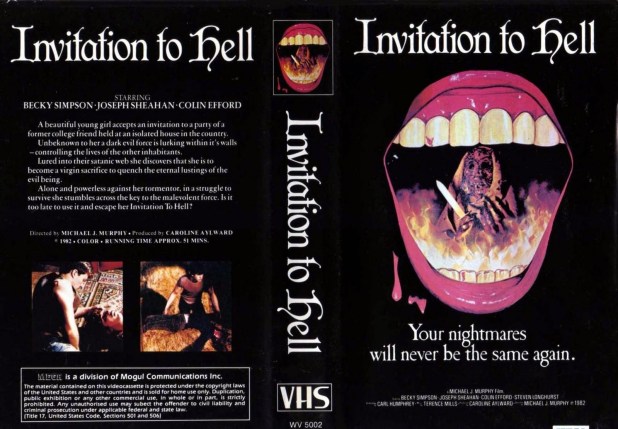
Invitation to Hell (1982)

No, not the 1984 Wes Craven-directed, Susan Lucci-starring Invitation to Hell — which is great — but instead the British 1982 SOV movie!

Jackie has been invited to her high school reunion — which for some reason is a costume party, which I guess must be a British thing, UK readers please inform us — but because she’s a virgin, she’s selected as a sacrifice for the spring by the druids amongst her classmates.

Some dude tries to do our heroine the favor of taking away her virginity so that she survives, but then a latex-masked demon shows up and his eyes glow and he crucifies one character against a wall of Page 3 girls and then gorily pulls out his insides and hey — isn’t that why we watch movies? I mean, maybe isn’t that why I watch movies?

The same dude also wore an old-school paper Hulk mask for much of the early part of the movie, so copyrights — and the video nasty controversy which was going on at the time — be damned.


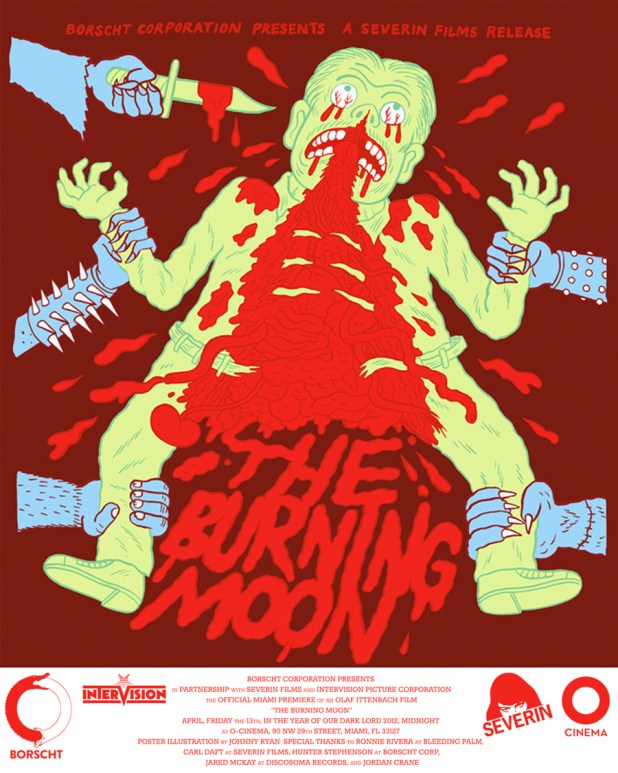
The Burning Moon (1992)

Writer/director/FX artist Olaf Ittenbach must have been thinking, “No one has any idea what a SOV horror movie from Germany could do to peoples’ brains. Let’s change that.” He pushed things so far that this movie was banned for twenty years from the very nation that it came from, which is pretty astounding — and a testament to how offensive it is — if you think about it.

Ittenbach plays Peter, a junkie whose parents somehow trust enough to babysit his sister, so he reacts as any of us would be shooting up and then telling her some stories that no child — or adult really — should ever hear.

In “Julia’s Love,” Julia has a date with the perfect man. The perfect man who is also a serial killer who is going to follow her home and decimate her entire family. And then in “The Purity,” a series of murders and assaults rocks a 1950s town and the wrong man is accused; unfortunately, he’s being protected by the real killer. And then, as things happen, everything literally goes to hell.

And then Peter kills his sister and himself.

It’s a feel good movie packed with gore, depravity and — depending on how many times you watched your VHS tape — bad tracking. I mean, it does have a priest drinking blood, worshipping Satan and then torn in half while in Hell, so it immediately gets 6 stars.

This is exactly the kind of movie that people that worry about kids watching horror movies think that they are watching. So don’t let those closed-minded jerks down!

You can get this from Severin.

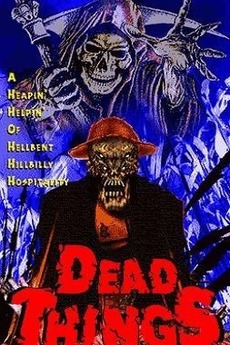
Dead Things (1987)

Todd Sheets, who made ClownadoDreaming Purple Neon and Ouija Death Trap, amongst many other movies, made this video short very early in his career. It tells the story of a bunch of drug dealers who escape into the woods, only to find that they’ve ended up dealing with a Satantic cult who has way worse plans for them than jail.

This was remade in 2009 by the director, but this grainy cheapy has plenty of energy and an ending that made me stand up and cheer. I mean, when Satan himself gets conjured and brings some zombies with him, that’s really something for me.

In a weird way — as you’ll learn all week long — I cut Shot On Video breaks that I would never give to streaming video horror that gets released today. Maybe I’m just longing for the scuzzier look of camcorders. I don’t have any answers for you.

That said — I haven’t seen the remake, but here’s betting that I’d like this one a lot more, particularly because it’s like 25 minutes long.

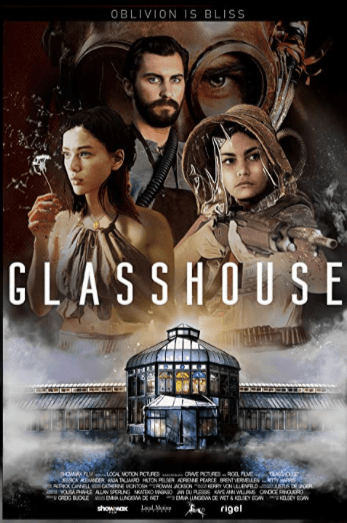
FANTASTIC FEST: Glasshouse (2021)

You think the pandemic we’ve had has been strange? Well, in the world of Glasshouse, an airborne dementia known as The Shred has left humanity adrift with no memories left inside their brains, unable to even remember who they are. Meanwhile, a family has remained inside their airtight glasshouse until a stranger arrives who changes — and maybe ruins — everything they’ve worked so hard to build.

Director Kelsey Egan said, “I’ve been working towards directing features since I made my first short back in 2008, so to end up directing my first film in 2020 of all years feels like some form of dramatic irony. To shoot this intimate post-apocalyptic fable during the pandemic was a surreal experience.”

Even the location for this movie is strange and eerie. The Pearson Conservatory is a Victorian glasshouse marooned in the Eastern Cape of South Africa since 1881.

The occupants of this glasshouse are  Mother, her three daughters and one son. Their days are spent tilling the garden that keeps them fed, protecting one another from the outside world, conducting story rituals and creating stained glass windows to remind them of the past. But when one of the daughters, Bee, takes in an injured man, his manipulative ways may spell the end of this idyll.

Yet the girls are not without the ability to protect their family, as we see them murder an interloper and use the body to fertilize their crops. And their brother has begun to lose control, as exposure to The Shred has destroyed his mind.

At once post-apocalyptic, folk horror and even a riff on The Beguiled, there hasn’t been a film quite like Glasshouse ever. It’s a future without the need to show massive effects or change. Instead, it traps us inside the walls of the home as those very walls close in around its characters.

Glasshouse is playing during Fantastic Fest this week. We’ll update this post with information on how to see it for yourself when it goes into wide release.

FANTASTIC FEST: Baby Assassins (2021)

What do hired killers do on their days off? I’ve always wondered that and hey — here’s a film ready to fill in the gaps. Chisato and Mahiro are teenagers who pull of a double life worthy of Donna Wilkes or Betsy Russell, as they’re high school graduates with menial jobs by day and killing machines battling the yakuza by night, which arises when a battle breaks out at the theme maid cafe that they work at and gets worse from there.

Martial artist and stunt person Saori Izawa — whose stunts were amongst the few highlights in Snake Eyes — plays the caustic Mahiro, with the laid-back Chisato played by Akari Takaishi. The team has great odd couple chemistry as well as the ability to move from moments of humor to action setpieces. The action moments take their time to get on screen, but when they do, they are more than worth the time we’ve spent with our lead characters.

Known as Baby Walkure in its native Japan, this is the first — but by no means the last — film that we’ll see exported to our shores by creative force Yûgo Sakamoto.

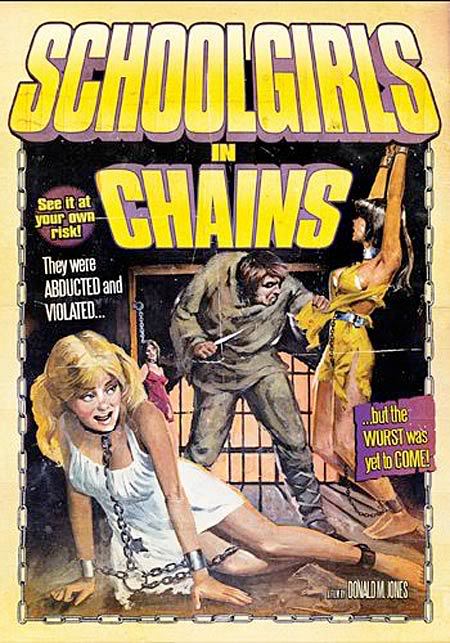
Schoolgirls In Chains (1973)

Also known as Abducted, Come Play with Us, Girls in Chains, Let’s Play Dead and The Abduction, this movie predates Mother’s Day to feature two crazed brothers — living under the wizened thumb of their mother — who kidnap women and force them to play increasingly depraved games that end up in death.

Inspired by an actual incident in which a missing woman’s car was discovered on the side of the road — but the woman was never found — this proves that 1973 was a very nasty — pardon the pun — time to be alive.

Shockingly, this is a well-acted affair, with Gary Kent (who appeared in many an Al Adamson film as well as having an entire film, Danger God, made about him) and John Parker as the Barrows brothers and Cheryl Waters (Macon County Line), Suzanne Lund and Merrie Lynn Ross (who appeared in Class of 1999, White House Madness and Bobbi Joe and the Outlaw) as their potential victims.

Don Jones would also direct Sweater GirlsThe Love ButcherWho Killed Cock Robin?Lethal Pursuit and, of course, the absolutely deranged The Forest, which also had Kent in a lead role. This was shot by Ron Garcia, who would go on to work on films like Twin Peaks: Fire Walk With Me and direct The Toy Box, which is another video nasty that we’ll be covering.

A section 3 video nasty, this is one of the many early 70s films that I wonder who was begging for in the UK before all the controversy began.

Achtung! The Desert Tigers (1977)

Okay, we are cheating with this review.

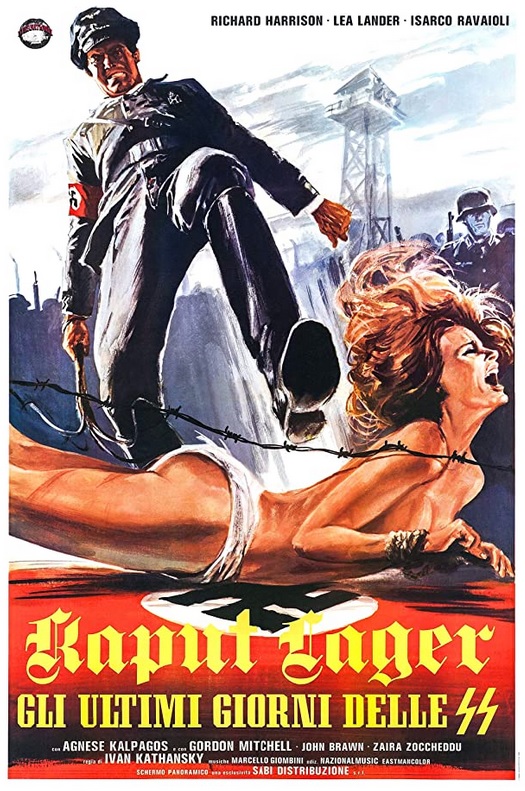
This Nazisploitation entry isn’t — officially — on the U.K.’s “Video Nasties” list that we’ve been reviewing all this week, but after showing the B&S love for expatriate American actors Richard Harrison and Gordon Mitchell in our review of Three Men on Fire (1986) — along with this theme week’s “official nasties” reviews of Lee Frost’s Love Camp 7 (1969), Sergio Garrone’s SS Experiment Camp (1976; whose artwork this film pinches in its VHS reissues), and Cesare Canevari’s Gestapo’s Last Orgy (1977) — you can’t overlook this Luigi Batzella warm up for his notable nazisploitation’er The Beast in Heat, aka SS Hell Camp, aka S.S. Experiment Camp 2 (1977).

Batzella’s resume is a slight one: Out of the 15 films he wrote, he directed 10 — sometimes under the celluloid de plume of Yvan, aka Ivan, Kathansky. Of those — most of which are stock footage mash-ups — we care about two: the Gothic horror Nude for Satan (1974) (that, for my money, screams “Bill Van Ryn must review this for the site!”) and the aforementioned The Beast in Heat. (Okay, three: The Devil’s Wedding Night, his 1973 Gothic take on the Lady Dracula legend.) And as for Richard Harrison: I’m just happy to see him in a film without “Ninja” in the title (he did 19 of them, thanks to the Philippines film industry, if you’re counting).

The movie isn’t as shocking as the theatrical one-sheet

So, if you’re a fan of The Beast in Heat — and expecting your rocket to leave the pocket, stow that flesh torpedo, my friend. For the caveat emptor, here, is that Batzella pulls back the reins on this Nazi warm-up, loosening ever so slightly to see just how far he can push the bad taste. (Then, if you know his next Nazi ditty, he lets the reins go for full-on sleaze.) So, this time, don’t be duped by the “shocking” theatrical one-sheet or the “Nazisplotation” genre description, for this is just another World War II flick, one that’s heavily influenced by John Sturges’s The Great Escape (1963) — via about 20 minutes of (well-shot, well, sort of) stock footage (from who knows where) of a North Africa war campaign on a German Tank division and the sabotage of a desert fuel depot.

Then the proceedings take a hard left turn into the “women in prison” genre, because well, by this cinematic point: when we see Nazis, we’re home video-conditioned to expect sexploitation — with heaping helpings of gratuitous nudity (breasts and triangles of death), brutal whippings, and yes, as always, at least one castration (after the fact) and the old urine-is-whiskey gag.

While you wouldn’t know it from the stock footage, Richard Harrison’s U.S. Major Lexman was in charge of that desert raid of blazing flame throwers. Now Lexman’s thrust into the middle of a coed POW camp run by Gordon Mitchell’s Kommandant von Stolzen. Of course, any good camp commandant must have a lesbian sidekick with a medical degree . . . and Dr. Lessing, of course (Lea Lander, of Mario Bava’s Blood and Black Lace and Rabid Dogs, the Italian Exorcist rip The Tempter), loves her leather strips to whip out the pain upon Jewish and Arab women with sadistic equality. Oh, and Lesser enjoys a bit of the ol’ whip across her own flesh from time to time by way of her sexy, Jewish nurse. Oh, and we can’t forget about Lessing’s obsessions with the “hygiene” of her charges via a nice, hard scrubbing on what is best described as a “shower stockade,” or something. And yada, yada, yada . . . Major Lexman teams up with the camp’s Brits to take Lessing as their hostage and make their “Great Escape,” with the German’s hot on their trail.

Oh, do we care about the romantic subplot of Lessing’s nurse cheating on her with an American G.I. (expatriate American actor Mike Monty of my beloved Philippines junk flicks!) in on the escape . . . that gets Lessing hot and bothered in a tongue-wagging and breast fondling delight?

Nope. I’m bored.

So, amid the 80-minutes stock and dubbing and mismatched scenes, we get about 20 minutes of the sleazy Nazizploitation we came for vs. the 60 minutes of World War II war beeboppin’ and scattin’ that we didn’t come for — perhaps if it was original footage shot for the film and not by stock footage . . . nah, this is a Luigi Batzella production and he is Italy’s “Godfrey Ho” in my cinematic eyeball; he’d never pull off any original war footage.

And the music . . . well, I’ll be 12-barred déjà vu’d . . . this movie is now truly complete, as that’s Marcello Giombini’s soundtrack from my ol’ Uncle Alfonzo Brescia’s Star Odyssey!

One of the most infamous Nazi baddies!

So, you need to complete your Richard Harrison and Gordon Mitchell two-fer fix? In addition to Three Men on Fire and Achtung! The Desert Tigers, look for the Turkish-made (back by Italian money) Four for All (1974), the German-made Natascha: Death Greetings from Moscow (1977), and again with Luigi Batzella in Strategy for the Death Mission, aka Black Gold (1979). And for you Fred Olen Ray fans — and aren’t we all — the duo cameos in Evil Spawn (1987). Yes, Olen Ray with Harrison and Gordon. And the brain whirling dervishes in a junk cinema delight.

You can watch Achtung! The Desert Tigers as an age-restricted freebie on You Tube (whateva . . . it’s not that “nasty,” kiddies). Don’t forget that there’s more Nazisploitation to be had with the genre documentary Fascism on a Thread: The Strange Story of Nazisploitation Cinema (2020).

About the Author: You can learn more about the writings of R.D Francis on Facebook. He also writes for B&S About Movies.