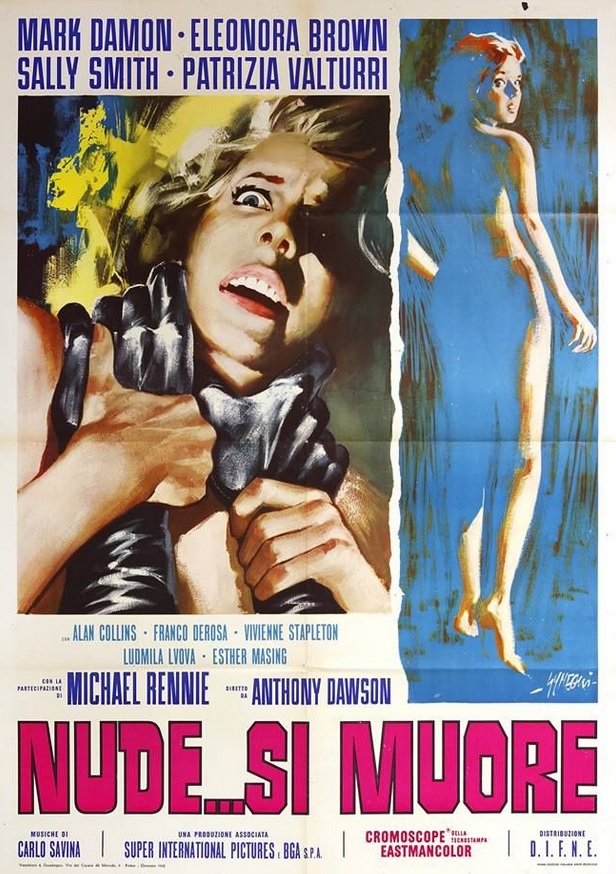
This Antonio Margheriti-directed and Mario Bava-penned giallo started out as Cry Nightmare . . . then became Nude . . . si muore, aka Naked . . . You Die. Then there’s The Young, the Evil, and the Savage (which stinks; sounds like a Rock Hudson jungle-romance flick). Then, when it hit the U.S. market and got some chops to the celluloid, it became Nude, She Dies, and the really sleazy and offensive, Schoolgirl Killer (but it’s not as sleazy as the title implies).
Antonio Margheriti did it all: Biblical Sand & Sandal flicks, horror flicks (Castle of Blood and The Long Hair of Death), Clint Eastwood western rips, James Bond rips (Lightning Bolt), Charles Bronson bad-ass cop rips (Death Rage), Indiana Jones rips (The Ark of the Sun God), and space opera rips (Yor, the Hunter from the Future). He even ripped off George Romero with Cannibal Apocalypse. And he did giallo flicks: this, Web of the Spider, and Seven Deaths in the Cat’s Eye.
This whatever-title-you-want-to-use “who done it” wastes no time in breaking out the black-gloved killer with a POV strangulation of a woman in a bubble bath—and those hands stuff her body in a large trunk for disposal. But, through a series of circumstances, the trunk ends up at St. Hilda’s College (thus, the Schoolgirl Killer moniker), an exclusive and remote (these schools, clinics, chateaus, etc. must be remote) finishing school. Closed down for the holidays, seven girls (the favored number of giallo films) remain; one stumbles into the killer in the school’s basement when he attempts to retrieve the trunk.
When Michael Rennie’s (The Day the Earth Stood Still) Inspector Durand shows up to investigate this “disappearance,” the suspicions and accusations fly among the students, staff and teachers—e.g., the ubiquitous creepy gardener, the horny swim instructor, Mrs. Clay, the new French summer school teacher, a nutty professor who collects birds (all giallo flicks must even the slightest animal angle), and the always-ready-to-hop-in-the-sack hot teacher played by Mark Damon of Hannah, Queen of the Vampires.
You can watch the Nude, She Dies version of the trailer on You Tube.
If you want this on DVD, it’s readily available, but caveat those run times: you want the Italian version which runs at 98 minutes.
You can watch the full movie for free on You Tube.
About the Author: You can read the music and film reviews of R.D Francis on Medium and learn more about his work on Facebook. He also writes for B&S About Movies.
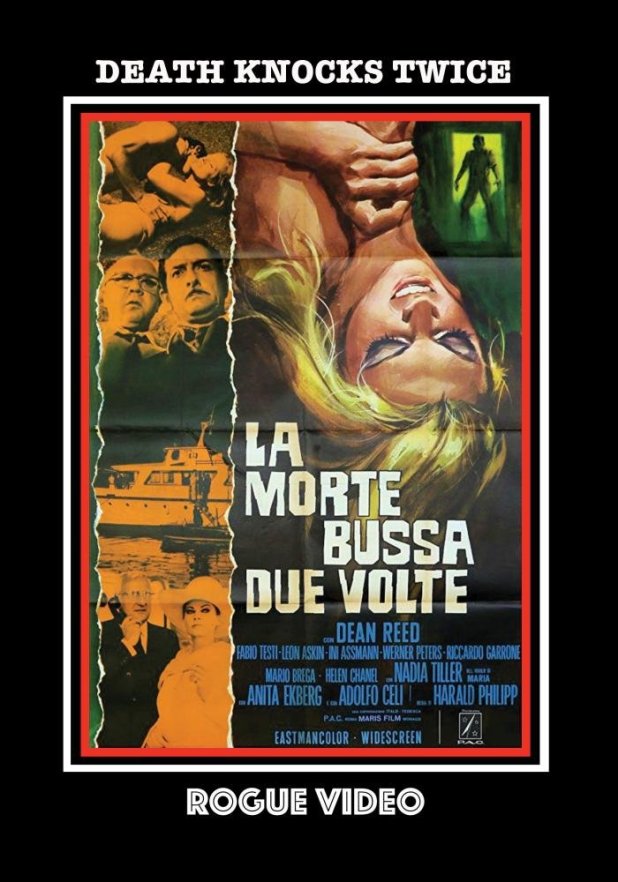
Also known as Blonde Bait for the Murderer and The Blonde Connection, I have to come clean and tell you that I only watched this movie because of Anita Ekberg. Here, she plays a rich man’s wife who falls for Francisco (Fabio Testi), who decides to strangle her while they make love because this is a giallo and these things occur.
Of course, as also happens in these movies, two criminals saw that happen and start blackmailing his wife (Nadja Tiller, The Dead Are Alive). As if that wasn’t enough, two cops are trying to prove that Francisco is the killer and use one of their daughters as bait.
Giallo is different before Argento gets involved, closer to noir, but this is still worth checking out. You can watch this on Amazon Prime or on the YouTube link below.
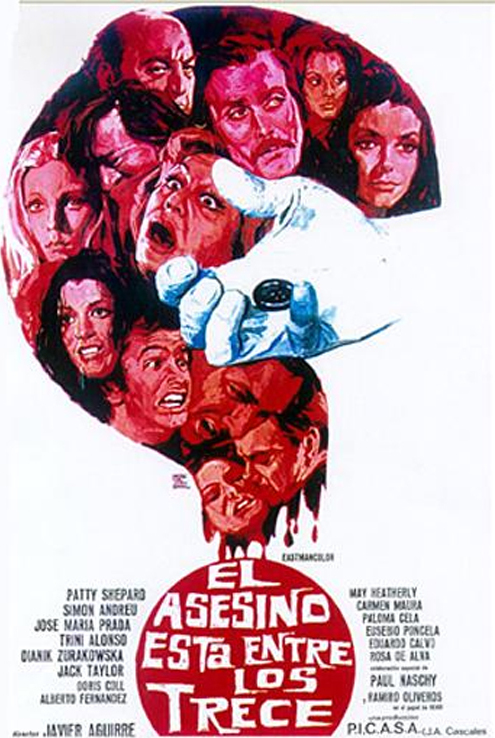
Not a lot of nudity and little blood, this giallo is closer to Agatha Christie than Edward Wallace. That said, it does have Paul Naschy in it and it’s directed by Javier Aguirre, who made Count Dracula’s Great Love.
Patty Shepherd (Edge of the Axe) stars as Lisa, who has gathered twelve of her husband’s closest friends and informs them that she believes that one of them is the killer. That said, there are really seventeen suspects when you add in the butler, chauffeur, maid and gardener.
All the phone lines get cut, people start getting killed off and secrets are revealed. There aren’t many Spanish giallo that I can think of, other than Clockwork Terror, The House That Screamed, Blue Eyes of the Broken Doll, The Corruption of Chris Millerand A Dragonfly for Each Corpse. Come to think of it, I know way more of these movies than I thought I did.
You can get this on the new Vinegar SyndromeForgotten Gialli box set.
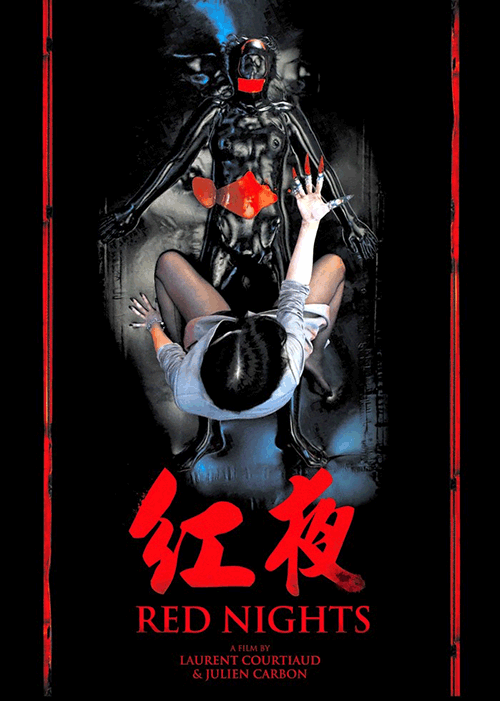
I’ve seen giallo from all over the world, but this would be the first Hong Kong version I’ve ever seen. It was created by Julien Carbon and Laurent Courtiaud, whose Black Mask 2: City of Masks I had seen, but had not prepared me for this delicious offering.
It features Hong Kong starlet Carrie Ng (Naked Killer, Sex and Zen), who practically smolders the screen as Carrie Chan, a woman devoted to the sexual release of death and using her jade talons to render flesh into works of art.
During the reign of Qin Shi Huang, the first emperor of China, a torturer invented a special drug that paralyzed muscles yet increased the sensitivity of nerve endings. Sometimes he used this for erotic pleasures, but mostly it was used to extract pain from his victims. Yet he always wondered what the drug would be like for his own use, so he killed himself under its influence.
Now, the jade skull that contains this rare substance has been found by Catherine Trinquier (Frederique Bel, The Extraordinary Adventures of Adele Blanc-Sec) and she sees it as a way to gain a fortune after murdering a lover to acquire this treasure.
Meanwhile, the demonic Carrie is staging a play all about the famed executioner while conducting her own psycho-sexual experimentations of pain and pleasure.
Known as Red Nights in the Western world, this movie has no slavish devotion to the 1970’s giallo style while somehow feeling that it could rightly take its place within it, uniting the world of the exploitation anti-heroines like Olga and Ilsa while at the same time dipping a green clawed digit into the respective private parts of the best parts of the works of Martino and Franco, pausing for a moment to be bathed in the lights of Argento and basking in the sounds of a Morricone.
There are moments when I was worried that this film would descend into the depths of torture porn, but it righted itself many times. This is why I watch films, to discover new and delirious highs. Consider this a must-watch.
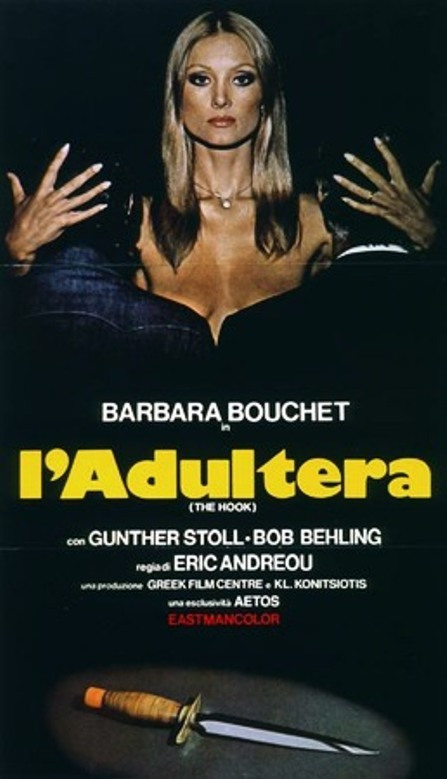
Thanks to Mondo Macabro, I’ve been getting into Greek exploitation a bit lately, which brings me to this Erricos Andreou-directed film that I would have passed up if it weren’t for that most radiant of all giallo queens, Barbara Bouchet. She plays Iro Maras, a rich woman who is sleeping around on her sailboat obsessed husband (Gunther Stoll, What Have You Done to Solange?) with a young playboy named Nikos (Robert Behling, Island of Death).
There’s the old man to kill him during a yacht regatta, but just like the plot of a Carol Baker giallo you may have already seen, the wrong person goes in the drink. Yet that’s not the end, as always, and nobody gets out unscarred.
Jessica Dublin, who as also in Island of Death, makes an appearance. She also shows up in a bunch of Troma fare, like Troma’s War and the second and third Toxic Avenger movies.
So yeah. Greek giallo. I guess you can consider Blind Date, Medusa, Death Kiss and Tango 2001 on that list. Man, just read this description of that last one: “Joachim is an impotent man who who secretly films his friend Stathis having sex with girls from the Tango Club. When Stathis kills the lesbian that he catches with his girlfriend, the death is caught on film. Necrophilia soon follows.” If you don’t think I’m not furiously tracking that down after posting this, you don’t know me at all.
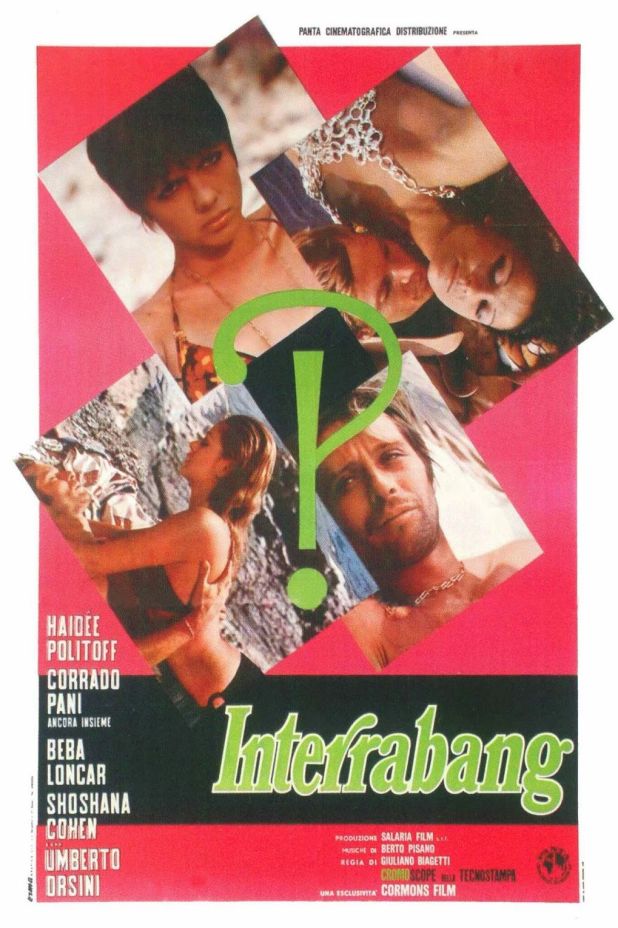
This post-Bava pre-Argento giallo is named for the punctuation that combines a question mark and an exclamation mark, which is the necklace worn by the character Valeria. It was directed by Giuliano Biagetti, whose career was mostly in comedy and erotic films.
Fashion photographer Fabrizio (Umberto Orsini, The Damned) has set sail with his business partner wife Anna (Beba Loncar, Some Girls Do), her sister Valeria (Haydee Politoff, Count Dracula’s Great Love) and a model named Margarit. They soon learn that a murderer is on the lamb after killing a cop just in time for their boat to run out of fuel. Meanwhile, the women explore the island and meet the mysterious poet Marco (Corrado Pani, Watch Me When I Kill). Then they find the body of that dead cop.
Of course, Marco is about to seduce all three of the women. You know how giallo goes. And you know that no one is getting out of this unscarred.
Interrabang isn’t an easy movie to find, only coming out on DVD in Italy as of 2012. That said, you can watch it on YouTube.
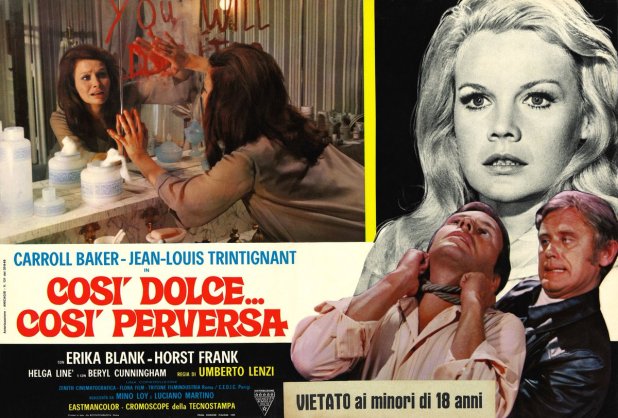
Umberto Lenzi’s early giallo — before the Argento influenced Seven Blood Stained Orchids — feel more like film noir than the standard films of the genre. Speaking of that same movie, it would also use the J. Vincent Edward song “Why.” And while we’re discussing influences, this movie is definitely feeling all sorts of Les Diaboliques.
Jean (Jean-Louis Trintignant, Amour) is a rich socialite who has come to the aid of Nicole (Carroll Baker!), a gorgeous woman mixed up with Klaus (Horst Frank, The Dead Are Alive). Sure, Jean is married, but that doesn’t stop him from falling for her, even when he learns that she’s been paid to kill him. Of course, his wife Danielle (Erika Blanc!) is mixed up in this, but Nicole is smarter than she seems. Beryl Cunningham (The Salamanders) is also in this as a dancer and Helga Line (Nightmare Castle) is on hand as well.
This is coming out in the huge The Complete Lenzi/Baker Giallo Collection set from Severin, which has plenty of other great films like Orgasmo, A Quiet Place to Kill and Knife of Ice. I know that I’ll be buying it!
Hey, wait a minute? They stole the artwork from Rocktober Blood! Bogus!
Nope, this isn’t the case of Top Line, Hands of Steel, and Cy Warrior — three different movies — all using the same artwork, because . . .
This is still the Rocktober Blood you know and love . . . just with a slap of the ol’ Dutch Boy “Giallo Yellow” for its Italian theatrical and home video distribution.
Forget the fact that there’s no mention of “seven notes” in the film, or “seven” of anything. No seven keys or locks to solve a bloody noir mystery. And that Head Mistress only had six members and a lot more than seven people died. And there were no insects, or animals, or velvet, or scorpions, or cats, rats, or bats. But there were “eyes,” per se.
But why was Billy Harper nicknamed “eye” in film? Did he remove or collect eyes? Nope. Why not redub the film as Seven Eyes of Terror/Sette occhi di terror. Or Seven Bloody Irises/sette sanguinose iridi?
Yes, I am well aware there’s seven notes in a scale. But there’s also twelve notes in an octave. Why not redub the film Ottava di terror. Or Terrore in 12 note. And it wasn’t Billy, it was John who did the killings, so why not title it Gemello della morte?
Dude, this is Spine all over again. Your overthinking films is annoying.
Yeah, I know. And yeah, I know we know we go and on about this metalsploitation classic — three times, in fact, as Sam(review) and myself (review) both chronicled the exploits of Billy Eye Harper. We even reviewed the never-made sequel, Rocktober Blood 2: Billy’s Revenge. Then we waxed over it again, as part of our “Drive-In Friday: Heavy Metal Horror Night” featurette. Then we named dropped it again in our review of AC/DC: Let There Be Rock.
Huh? What does this all have to do with AC/DC?
Oh, you didn’t know that Billy Eye Harper, aka actor Trey Loren, aka Tracy Sebastian, is responsible for helping break the Aussie rockers in America? True story. So, while Billy Eye duped us all with bogus, grey market-level DVD and Blu reissues and a bogus Rocktober Blood sequel, he did his part in unleashing AC/DC in America and, for that, we thank him. And forgive him.
Best part of the movie and only reason to watch #1 . . .
Of course, thedirect-to-video “boobs and blades” shenanigans cooked up Ferd and Beverly Sebastian in California — while beloved by us, the once wee denizens of the ‘80s video fringe — is no “homage” to the likes of the masterworks of Dario Argento, Lucio Fulci, Emilio Paolo Miraglia, Umberto Lenzi, and Antonio Margheriti by any stretch of all the colors of the dark. And let’s face it: Billy Eye ain’t no Jason Vorhees or Freddie Kruger, either.
Ah, but the “New Wave of British Heavy Metal” (NWOBHM), featuring the violent, religious mania and bloody lyrics composed by the likes of Venom and Iron Maiden, complete with the requisite Satanic imagery on the album covers, was in full swing. And the dumbed-down American Slasher-cum-giallo-ripoff flicks colliding with heavy metal was the next logical match made in hell, as the music coming out of England was, in fact, Giallo musicals . . . but we ended up calling it “metalsploitation” here in the critically puritanical states.
Best part of the movie and only reason to watch #2 . . .
And let’s not forget where that musical sub-genre’s roots began: Dario Argento was the first to mix the hard rock peanut butter into the chocolate giallo with 1971’s Four Flies on Grey Velvet, which follows a musician (Michael Brandon of FM) that gets tangled in a murderous web. And how can we forget the late-in-the-giallo cycle Paganini Horror, with Luigi Cozzi’s Bon Jovi wannabes unleashing a curse from an ancient composition? And that Argento cranks up the Goblin to make our ear drums pulse in fear?
But before those films, there was Brian DePalma’s tribute to the likes of Alice Cooper and Kiss in the frames of his 1975 rock opera, Phantom of the Paradise. And there’s no denying that the exploits of Winslow “The Phantom” Leech and Gerrit “Beef” Graham influenced the frames of Black Roses, Shock ’em Dead, Terror on Tour, Rock ’n’ Roll Nightmare, and Rock ’n’ Roll Zombies, and Trick or Treat, along with the non-classic Turbulence 3: Heavy Metal, in which a reviled Marilyn Manson-like gothstar becomes an international hero after saving a jet liner from a terrorist takeover (a film that needed a whole lotta Ray Liotta and maybe a little Danzig). Then there’s Don Kirshner’s rip on DePalma with his ABC-TV “Movie of the Week” two-fer with Song of the Succubus and its sequel, Rock-a-Die, Baby.
Ah, yes. Satan’s music is still bloodying up our films. And we hail our Dark Lord . . . to the tune of seven red notes. Let the Acid Witch bless your soul!
We dig into the failed attempt at getting a sequel off the ground. True story, for reals!
Ferd Sebastian July 25, 1933 — March 27, 2022 Obituary
About the Author: You can read the music and film reviews of R.D Francis on Medium and learn more about his work on Facebook.He also writes forB&S About Movies.
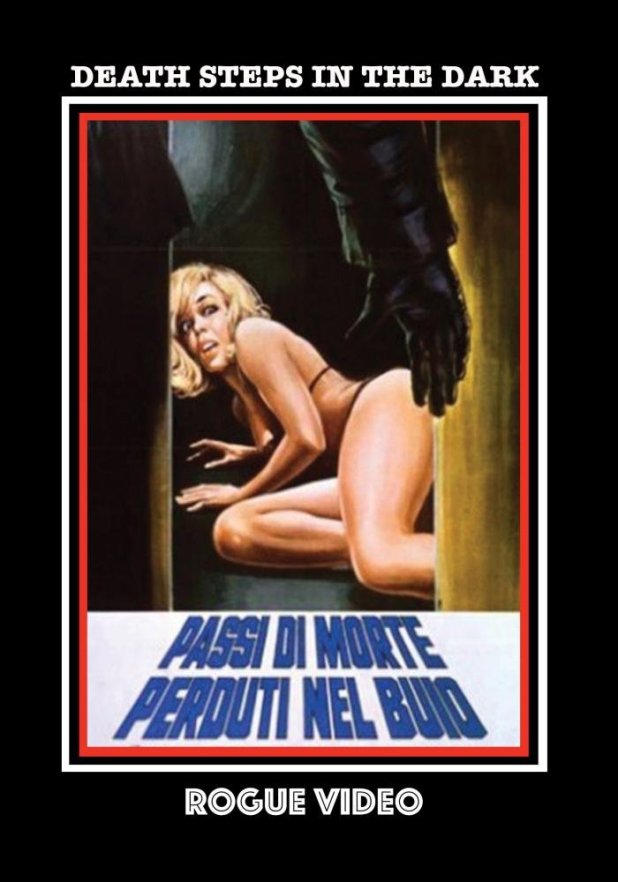
Maurizio Pradeaux only directed one other giallo, Death Carries a Cane. The translation for this is off, as Passi di Morte Perduti nel Buio really should be Death Steps Lost in the Dark. It has a bigger name American actor, Robert Webber (The Silencers) in it.
Leonard Mann, who was in The Humanoid and Night Schoolbefore retiring to work in prison reform, plays Luciano, a reporter whose train trip to Greece is interrupted when a woman is killed with his letter opener. Working with his Swedish girlfriend (Vera Kruska, Assignment Skybolt), he must solve the murders and clear his name. There’s also another couple who find the murderer’s glove and try to blackmail him or her.
Oh yes — our hero also has to hide out in drag.
This isn’t my favorite giallo, due to too much comedy and not enough fashion or pure craziness. That said, you can watch it on Amazon Prime.
EDITOR’S NOTE: I met Mitchell L. Hillman on the Gialloholics Facebook group and loved reading his review of movies. I’m so excited that he’s joining us for Giallo Week!
ABOUT THE AUTHOR: Mitchell Hillman is a freelance writer who has spent most of his time in print writing about music, movies, art, and pop culture. He is also a professional artist, occasional pop-up chef, and suffers an addiction to curiosity and discovery. Over the last year he has watched over 300 Giallo and Giallo related movies, finding that they influence not only how he thinks about film, but also art.
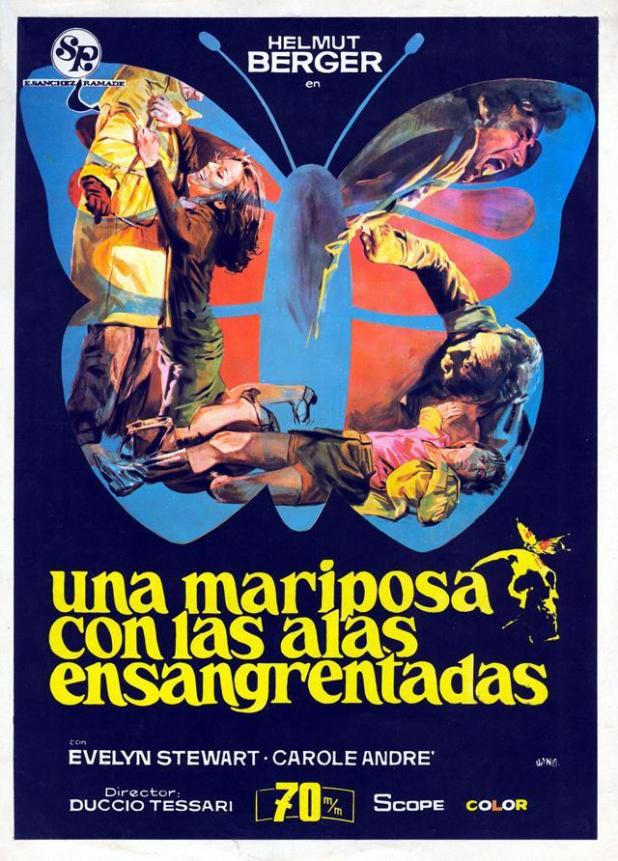
The Bloodstained Butterfly (1971)
‘Una farfalla con le ali insanguinate’
Directed by Duccio Tessari
Long before I became a raving fan of Giallo, I was awestruck by Italian auteurs like Michelangelo Antonioni and Federico Fellini, and long before I found that kind of art-house bliss, I was enamored with “Spaghetti Westerns” since I was a child. While I’m fairly late to the game in appreciating the Giallo genre, I have always held Italian films in the highest esteem, but for me it all began with those Westerns where everyone had great outfits and the violence was a bit outrageous by typical American standards.
Duccio Tessari wrote and directed two of my favorite Spaghetti Westerns, two back to back explosions of brilliance starring Giuliano Gemma, A Pistol For Ringo (1965) and the comparable if not better sequel The Return of Ringo (1965). When I started watching Gialli obsessively, I was thrilled to discover he had directed three of these of peculiar murder mysteries. Arguably, his second The Bloodstained Butterfly (1971) is not only the best of the bunch, but it may be the finest movie of his entire career.I first watched it shortly after going down the Gialli rabbit hole, after a quick education in Argento, Martino, Fulci, Bava, Lenzi, Ercoli and a few more. This movie stood up to those high standards and in some cases surpassed them, because The Bloodstained Butterfly isn’t just a great Giallo, it’s a great film in its own right beyond the context of the genre.
Most Gialli come in three discernible acts, but Tessari more or less presents The Bloodstained Butterfly in four. The first act starts by introducing each character after the credits roll with title cards as they go about their lives. This is notable and important as we see Marta, an alcoholic party girl who pours the first glass of J&B in the first three minutes of the movie; two schoolgirls Françoise and Sarah, Sarah’s mother Maria, her father Alessandro a TV sportscaster, their lawyer Giulio, a young pianist named Giorgio, and his mother and father. It’s an odd start, but as the movie unfolds you realize this movie is less about the violent acts that take place and more how these individuals’ lives are entwined.
The first act builds through the off-camera murder of Françoise in the park, presumably by a man in a beige overcoat with a houndstooth fedora, seen by several witnesses fleeing the scene, who we watch escape the clutches of the police in the pouring rain. Tessari immediately lets you know that he’s going to start messing with your head when we see Inspector Berardi at the murder scene wearing an identical outfit. The police procedural that follows shows off the fairly advanced forensic science of the early 1970s as they build evidence that put’s Sarah’s father on trial for the murder of her friend Françoise.It’s a tension-filled start that doesn’t let up until Maria admits to the police that she had to send Alessandro’s beige overcoat to the dry cleaners since it was covered in mud.
Act Two is a wild courtroom drama that is filled with flashbacks and re-enactments of the crime. The evidence seems almost too perfect against Alessandro and everyone seems suspicious at this point, if you’ve watched enough Gialli or mystery films in general, Tessari gives you serious “wrong man” vibe as the defendant is tried and sentenced to life. In the meantime, Giorgio has taken to dating Sarah, with more than a few hints that he was previously dating Françoise. He also seems to become more and more unhinged as the film continues.
The third act, almost seems like a bridge in a song, but it is an act unto itself in which Tessari makes you suspicious of nearly everyone, all the while assuring you that Alessandro is innocent. Another murder takes place and you suspect the lawyer Giulio, a third murder takes place and Giorgio is in the right place to be suspected.For a Giallo there is very little gore, and only aftermath, but it doesn’t make it less chilling. The horror is psychological as you question who is responsible for the murders since Alessandro is in prison.He is finally released when Marta, revealed to be his mistress, confirms his alibi.
The finale is one of my favorites and I’m not about to spoil it for anyone, it’s beautiful, a bit heart wrenching, and we understand the title in the last few moments. By the time the last act arrives you have no idea who the murderer is and you have reasons to be suspicious of everyone. Tessari’s direction is wonderful, the score by Gianni Ferrio is brilliant, and while it’s not the bloodiest or most colorful Giallo around, it’s one of the more intellectually and psychologically satisfying entries in the genre. Tessari’s “doorway transitions” are amazing and he even adds some humor with Inspector Berardi’s routine with being continually dissatisfied with every cup of coffee handed to him. I’d say it’s criminally underrated but, I’ve heard nothing but applause from fellow Giallo aficionados on this one. Even outside of the genre, the way Tessari plays with memory, space, time and perception makes for a great cinematic experience.


 B&S About Movies
You must be logged in to post a comment.