Ten Post-Apocalyptic Vehicles


Are you ready for the end of the world? Well, you better choose the right vehicle to survive it! This list is in no particular order, just an overview of what I believe are the finest post-apocalyptic cars, trucks, buggies and battlewagons out there.

 

1. The Landmaster from Damnation AlleyIf you drive past Gene Winfield’s Custom Shop on Sierra Highway between Rosamond and Mojave, California, you just might catch a glimpse of this beast, a 12-wheeled amphibious articulated vehicle that was originally constructed by Dean Jeffries at Jeffries Automotive in Universal City, California. Only one was ever built at a cost of $350,000 in 1976 ($1.6 million today). No wonder they keep showing it over and over (and over) in the film!

The Landmaster vehicle is very real and uses as many standard truck parts as possible so that any junkyard would have whatever was needed for repairs after the end of the world.

This ten-ton vehicle is powered by a 390-cubic-inch Ford industrial engine, an Allison automatic truck transmission and has the rear-ends of two commercial trucks. Even the tri-star wheel arrangement really works, allowing this vehicle to climb over boulders and all 12 wheels are driven (although only 8 hit the ground at all times).

Unlike other vehicles on this list, The Landmaster has appeared in other movies and shows, such as an Amoco commercial, Quiet Riot’s video for “The Wild and the Young” and episodes of Highway to Heaven and Get A Life, where it memorably battled Chris Elliot in “Paperboy 2000.”

It also shows up in Mike Jittlov’s The Wizard of Speed and Time, A.P.E.X.Hybrid and influenced the Japanese video games Phantasy StarStarfoxShin Megami Tensei: Strange Journey and the manga Battle Angel Alita: Last Order.

2. Ark II from the 1976 CBS live-action Saturday morning TV show Ark IINot to be confused with The Landmaster, but the Ark II — a mobile storehouse of scientific knowledge, manned by a highly trained crew of young people — brought hope to the people of the 25th century.

This 44-foot-long, six-wheeled combination RV and mobile laboratory was created by the Brubaker Group. It was made with a fiberglass body on a 1971 Ford C-Series (C-700) cabover.

If you ever watched later Filmation shows like Space Academy and Jason of Star Command (which is worth it just to see Sid Haig play Dragos), the front of the Ark II is the Seeker spaceship.

There was also another vehicle called the Ark Roamer, which was a smaller, 4-wheeled all-terrain vehicle built from a modified Brubaker Box, a kit car that uses a Volkswagen Beetle chassis. Keep an eye out for Brubaker Boxes in the Andrew Stevens’ film Grid Runners and Soylent Green.
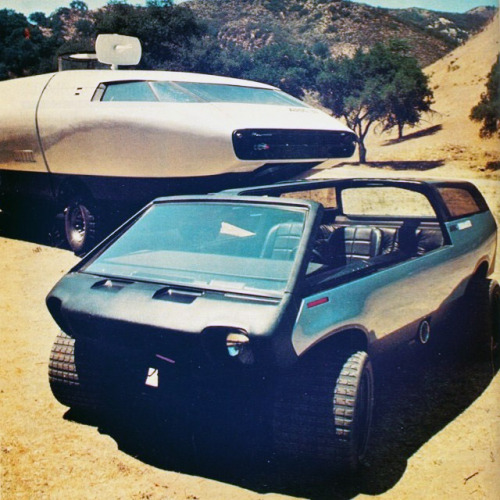
 

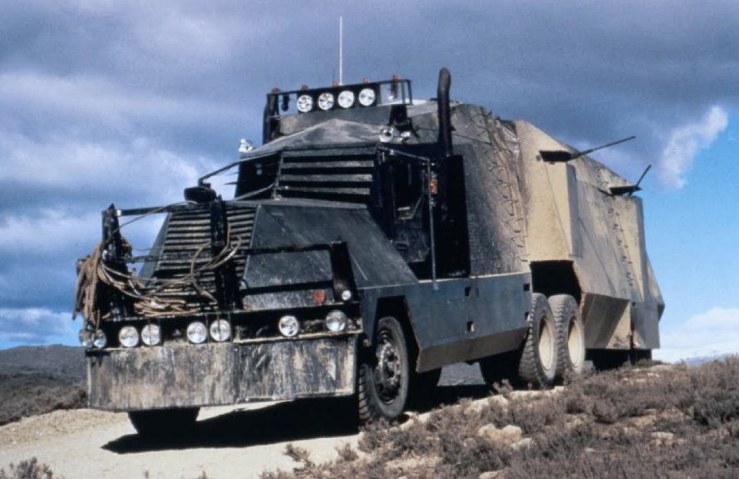
3. The Battletruck from, well, BattletruckIf you’re gonna give this movie this name, it’s vehicle better live up to the nom de plume. Obviously taking its cue from the vehicles of Mad Max, the Battletruck is so beloved by its driver that he gives his life rather than allow Straker to destroy it. But I mean, just look at that thing. You’d love it if you could drive it, too.

4. The spinners from Blade RunnerThis vertical take-off and landing vehicle, also known as a VTOL, was conceived and designed by Syd Mead. When you think of this film, often your first thought is the look of these vehicles. However, the spinner also shows up in plenty of other films, such as Trancers, Back to the Future IISolar Crisis and Soldier.

Mead thought of the car as an aerodyne, which used air directed downward to create lift, although the producers claimed that the vehicle ran on three engines: “conventional internal combustion, jet and anti-gravity.”
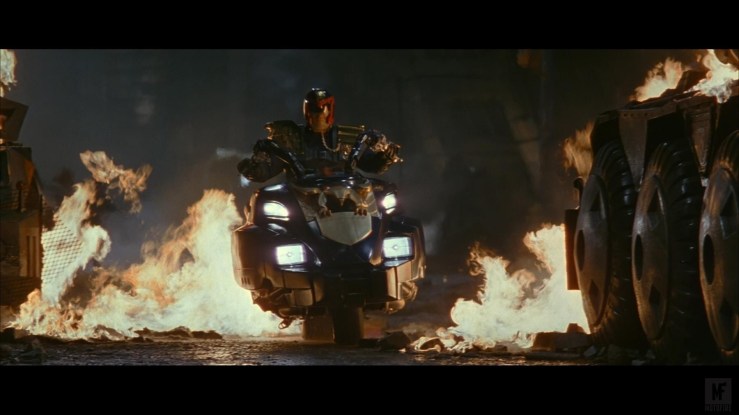
5. The Lawmaster from Judge DreddThe Lawmaster is Judge Dredd’s vehicle of choice when it comes to patrolling the mean streets of Mega City One. For this 1995 Sylvester Stallone movie, an exact replica of the comic Lawmaster was made by vehicle designer David Allday, but it proved way too awkward to steer. Built with an unknown 650cc engine with a rolling chassis that features mismatching wheels, it was auctioned off in 2018 for $21,400. I just spent that much money fixing up my house and I think that having this bike to drive to work would have been a much better investment.

For the superior in every way 2012 Dredd, the Lawmaster was built on Suzuki GSX 750s with an extended chassis. I really need to get around to covering that soon.
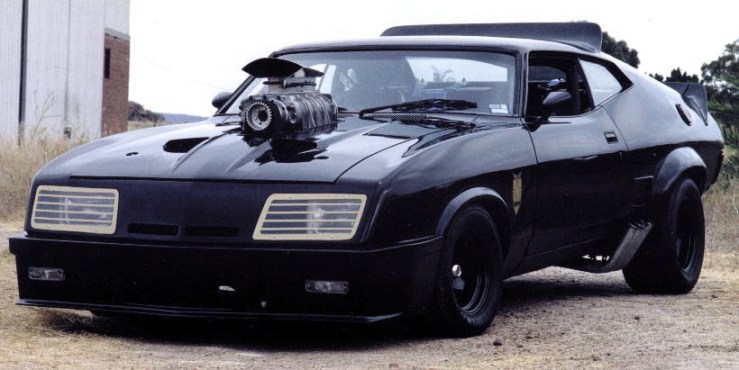
6. The Pursuit Special from the Mad Max movies: Also referred to as the “Last of the V8 Interceptors,” this heavily modified, Australian built 1973 Ford Falcon XB GT Hardtop was designed by art director Jon Dowding and built by Melbourne-based car customizers Graf-X International.

The main modifications are the spoilers, wheel arch flares, front nose cone and Concorde style air-dam designed by Arcadipane. Plus, eight side exhausts — only two function — and a purely cosmetic Weiand 6-71 supercharger were added.

After the first film was completed, the producers couldn’t pay everyone, so the car was put up for sale. After no one took it, it was given to part-time actor and head mechanic of the film Murray Smith as his payment for his work on the film.

For the second film — The Road Warrior — the car was bought back from Smith and painted a matte black. It now had two large cylindrical fuel tanks added to the back. Another Pursuit Special was made and destroyed in the film’s climax, but the original vehicle found its way to a junkyard in Broken Hill before it was rescued by Bob Fursenko, who restored it and showed it throughout Australia.

It was sold to the Cars of the Stars Motor Museum in England, where it stayed until 2011, before it was relocated to the Dezer Car Museum, which is currently being relocated from Miami to Orlando.

While the Pursuit Special doesn’t show up in Mad Max Beyond Thunderdome, it returned for the spiritual sequel Mad Max: Fury Road. Max only has the car for a moment until he’s kidnapped and the car is taken by Immortan Joe’s War Boys. Repainted a chrome silver color and renamed the Razor Cola, it is destroyed in the final battle.

Finally, in the 2015 video game, Immortan Joe’s son Scabrous Scrotus steals Max’s car. After an odyssey across the Plains of Silence in his new car, the Magnum Opus, Max finally conquers his nightmarish memories, takes out Scrotus and reclaims his beloved vehicle. At the end of the game, he places the photo of his family back on the dashboard and drives out into the desert.

Honestly, I could fill this article with every other vehicle from the Mad Max series. It is the wellspring from which most post-Armageddon films flow forth, after all. There’s even a site, Mad Max Cars, that can help you make your own car just like the movie!

7. The cars and tricycles in the films of Willy Milan: If you haven’t partaken of the films of this Filipino director yet, let me tell you to stop reading and start watching. Beyond featuring a cybernetic bad guy who is convinced that he’s a werewolf and forces his men to watch him sleep with their wives, Mad Warrior is packed with all manner of completely berserk vehicles. W Is War is also pretty much the same thing, as if the comic book Love and Rockets and the cartoon Wacky Races went off and did a ton of psychedelics and emerged with a twisted future child.

One of my dreams of doing this site is to expand people’s minds toward films I love. Do me a favor: Grab W Is Warwith the Mad Max of Asia driving a big block Camero to get his bloody revenge after being castrated, or Mad Warrior, which has a lightsaber duel that comes out of nowhere at the links I’ve provided at Cult Action.

8. The vehicles of Warriors of the Wasteland/The New Barbarians: If you’re the kind of person who has thought to yourself, that ’67 Firebird needs a giant bubble on it and a skull for a hood ornament, good news. This is the movie for you. And even better, One’s gang of Templars rides the wastelands in what looks like murderous golf carts. Cheapy fun from Enzo G. Castellari!

Seriously, if someone asks me to pick one post-apocalyptic movie, this would be the one I would tell them to watch. It’s packed with mayhem, murder, Fred Williamson kicking ass and Giovanni Frezza (Bob from House by the Cemetery) showing up a child mechanic.
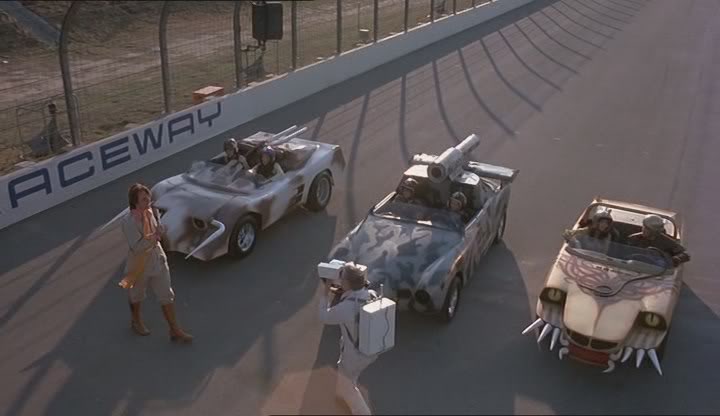
9. All of the cars in Death Race 2000If you’re looking for post-apocalyptic movie packed with cars, look no further. Everyone has a car attuned to their dynamic personality, like some demented WWE of the future. Frankenstein’s Alligator car and the Machine Gun Joe’s car were re-bodied Volkswagens. Matilda the Hun’s Buzz Bomb was a VW Karmann-Ghia, Calamity Jane’s Bull was a Corvair and Nero the Hero’s Roman Lion was built on a Fiat 850 Spider chassis. They’re all used to maim and murder pedestrians and one another throughout this black comedy.

According to producer Roger Corman, the custom cars featured in the movie were later sold to car museums for considerably more than it cost to build them. In fact, Volo Auto Sales in Illinois recently sold both Frankenstein and Calamity Jane’s cars.

Remember — don’t stay off the streets. It’s your duty and honor to help the Death Racers score points!

10. The vehicles of Megaforce: While not strictly an end of the world film, the aesthetics of Megaforce permeated all the films that were to follow.

Bill Frederick, builder of the LSR Budweiser Rocket and other jet and rocket-powered vehicles, created 10 Megadestroyer Buggies. Only two survived the film and one even showed up on eBay for $10,000!

The influence of the cars, vans and trucks of this film go way beyond Hollywood (and Italy and the Phillipines, too). After filming was complete, the U.S. military asked director Hal Needham for the plans for the Megaforce vehicles. He happily handed them over and claimed that most of what the army used in Desert Storm came from those blueprints.

Honorable Mentions

The 6000 SUX from RoboCopNot a great car, but a great commercial, thanks to the animation work of the Chiodo Brothers, who would go on to create Critters and Killer Klowns from Outer Space.

Courtesy of Sam Simon from the Italian blog Vengono fuori dalle fottute pareti: The Dead Reckoning from George Romero’s Land of the Dead, and The Snowpiercer from Snowpiercer.


Dead Reconing Land of the Dead

Snowpiercer apoc vehicles

Our own R. D Francis chimes in with Stryker’s Mad Maxian Ford Mustang from Cirio H. Santiago’s Stryker.

styker mustang

And Will Smith’s Mustang Cobra from I Am Legend.
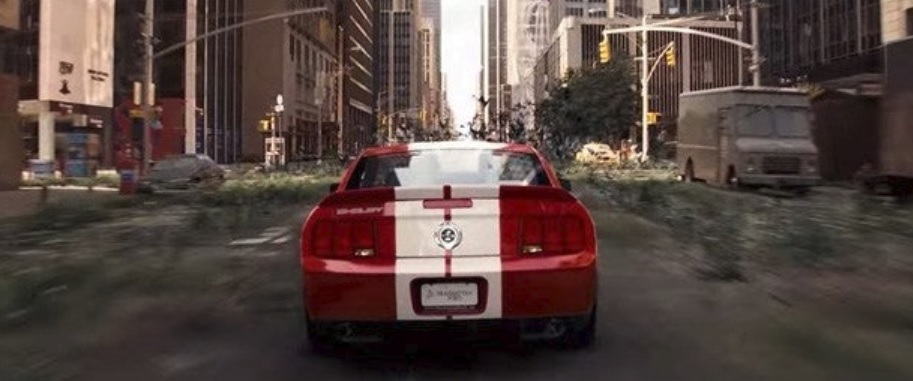
Will Smith Mustang

Then there’s Lee Major’s forgotten Porsche 917-Chaparral hybrid in The Last Chase — which gets the breakdown courtesy of The Truth About Cars, in their own review of the film.

No, it’s not from Megaforce, or any other movie, but should be in a movie: The Sherp ATV was actually built to drive in Siberia under the most extreme off-road conditions — looks totally “apoc” to us.

Sherp 10 Apoc Vehicles

While it’s not a post-apoc world, but a post-alien invasion Earth, there’s Ed Straker’s car and the S.H.A.D.O Land Rovers from Gerry Anderson’s British-made, early ’70s series, Invasion: UFO.

Ed Straker's Car UFO

SHADO ATV UFO

Due to its soft-core adult shenanigans, Things to Come (1976) — a drive-in regional, San Antonio, Texas-shot rip of Star Trek meets Logan’s Run — is a difficult recommend due to its hard R-rated content (“X” in some quarters). Then these Rollerball meets Roger Corman’s Death Race 2000 deathcycles — complete with wedge cutting blades —  appear in a subplot about a death sport game held in “The Pleasuredome” to entertain the masses — as the bikers hunt Westworld-styled, female-android/pleasure bots being put to pasture. Yes, the “murder bikes” are as cardboardish as they seem. Yes, the game is a little like Lucio Fulci’s “Kill Bike” in his later Warriors of the Year 2072. Did Corman rip off these bikes for his later apoc’er, Deathsport? Probably.

Things to Come Motormike

The Cyclone from Fred Olin Ray’s Cyclone (1987) is lost somewhere between Roger Corman’s laser-spewin’ Death Machines from Deathsport and the later Lawmaster from Judge Dredd. The Heather Thomas-seated bike that crosses NBC TV’s Knight Rider with ABC-TV’s Street Hawk is believed to be a refitted Honda XR350/XL350. In addition to those three-sided rocket launchers on the back: there’s lasers! And the bike gets really impressive in its Green New Deal-ness: it comes equipped with a “transformer” that allows the Cyclone to run on hydrogen pulled from the atmosphere. If only the bikes in Rollerball had rocket launchers . . . plus, it puts Fulci’s “Kill Bikes” from Rome 2072 to shame. And Heather wishes The Fall Guy wasn’t cancelled. And Willy Milan and Enzo G. Castellari wished they had one in their respective apoc flicks.

cyclone

As we were finishing our July 2021 updating . . . Mike Delbusso of Splatt Gallery, Michigan’s premiere rock art gallery, posted this absolutely ’80s post-apoc ad for the Scorpion’s new, 1979 album, Love Drive, released prior to their first, real U.S. break through with Animal Magnetism. How come Cirio H. Santigo or Willy Milan never thought of an apoc war wagon with a stinger-tail?

Scorpions Ten Apoc Vehicles feature

Did we miss one of your favorite end of the world vehicles? Don’t be shy! Let us know in the comments. And drive safe out there!

Want more post-apocalyptic fun? We’ve been covering these kind of movies all month long and our Letterboxd list will help you keep track. And for a quick overview of the best of the best, turn to our handy “Ten End of the World Movies We Love” list. Also heck out our Atomic Dust Bin, Part 1 and Part 2 for more films.

You can find movie movie cars at the IMCDB – The Internet Movie Car Database (thanks for the Stryker Mustang image).

Family (2018)

Kate Stone (Taylor Schilling, Orange Is the New Black) is career-focused. That’s it. Nothing else. But she’s become an outcast and lost from what’s left of her family. When she’s asked to babysit her niece Maddie, her life quite literally must change. Family isn’t the expected family comedy/drama and that’s probably why we enjoyed it so much.

Laura Steinel is a writer, actress and director who brought this film together. It’s the only coming of age Juggalo film that I can think of. However, it treats that subject with way more respect than you’d think.

This film is helped by a great supporting cast, including Brian Tyree Henry as a sensei, Bryn Vale as young Maddie, Matt Walsh (one of those character actors who brings up every comedy he’s in) as a co-worker, Kate McKinnon as a neighbor, Natasha Lyonne under heavy makeup as an Insane Clown Posse fan and Peter Horton as Kate’s father.

We usually end up watching a lot of these family growth films and this one felt real. That’s more than I can say for most of them. Also, as someone who perhaps has been sprayed with Faygo before, I kind of loved the scene where ICP stopped their show and tenderly searched for a missing girl.

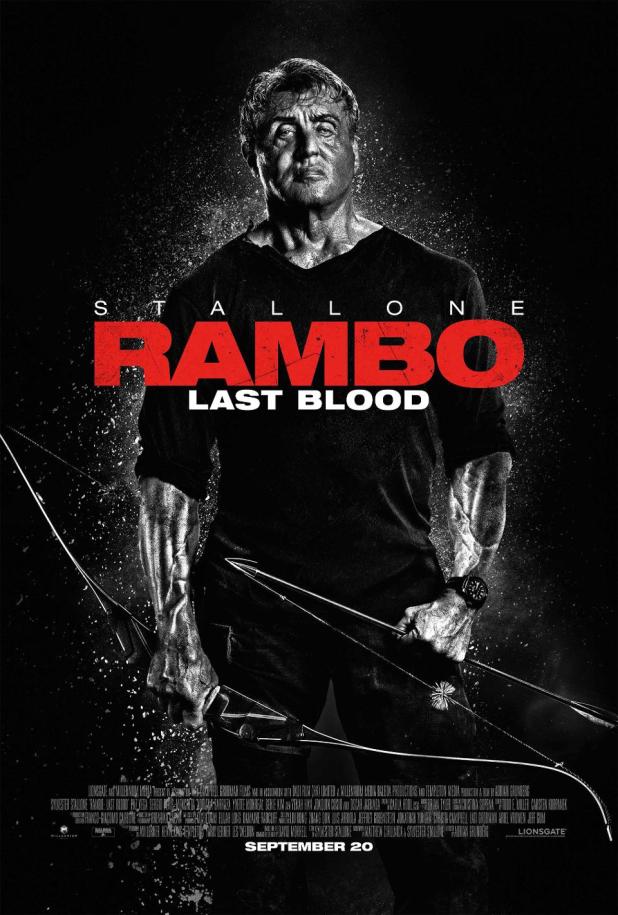
Rambo: Last Blood (2019)

Ever since 2008’s Rambo, there have been plans of a fifth film in this franchise. At one point, John Rambo was going to lead a team of commandos against a genetically altered creature in a movie that would have been called Rambo V: The Savage Hunt.

By November 2009, it was reported that the plot would be about Rambo crossing the Mexican border to rescue a girl who had been kidnapped. However, Stallone claimed that he was done with the character, stating, “I don’t think there’ll be any more. I’m about 99% sure, I was going to do it… but I feel that with Rocky Balboa, that character came complete circle. He went home. But for Rambo to go on another adventure might be, I think, misinterpreted as a mercenary gesture and not necessary. I don’t want that to happen.”

At Cannes the very next year, Millennium Films was already advertising Rambo V and planned to make the film with or without Stallone. Luckily, that didn’t happen.

Say what you will about Sylvester Stallone and his films, but he’s one of the few actors who has played multiple characters across multiple films. Don’t believe me? We went so far as to make a list all about this fact.

Now, Rambo has finally returned, with Adrian Grunberg (Get the Gringo) directing. Of course, this film has already been met with critical derision in regards to its script, stereotypes and violence. Yet Stallone’s career is one paved with negative ink. His audience — take it from someone who has watched nearly fifty of his films in thirty days — always comes back.

Eleven years after the last time we saw John Rambo, he’s moved on to live in his father’s ranch in Bowie, Arizona (actually Bulgaria). Along with Maria Beltran and her granddaughter Gabrielle, he has a horse farm and has seemed to settle into his old age. Yet his past life constantly threatens to re-emerge — he’s taking numerous pills, he has flashbacks and he’s built an elaborate series of tunnels under his home.

Gabrielle wants to see the father who abandoned her and goes to Mexico to attempt to connect. It goes horribly, leading to her visiting her friend Jezel and going barhopping. Truly, only Paul Kersey has a worse life than John Rambo, as within minutes she’s been roofied and enslaved by a Mexican cartel.

Our hero allows his need to protect her to take over his common sense and he’s quickly beaten into a near-coma by the gang, including Hugo and Victor Martinez. They take his driver’s license and a photo of Gabrielle, promising that now they’ll make her life a living hell — slicing both her face and Rambo’s with a bloody V.

Rambo is rescued by Carmen, a freelance journalist who lost her sister to the cartel. After healing, he rescues Gabrielle just in time for her to die as they cross the border back into the United States.

What follows is Rambo becoming Jason Vorhees, leading the gang into an elaborate trap ala Home Alone, but with more grand guignol than slapstick. If the ending melee in 2008’s Rambo upset you with its intensity and wanton bloodshed, well…better stay home.

Critics have loudly complained about the levels of blood and guts that the film displays, comparing it to a slasher film. If you’ve read any of the articles about the films that I truly adore, you know that this didn’t upset me in the least.

Of course, the xenophobic nature of Rambo as white savior in Mexico can be somewhat troubling. But honestly, I wasn’t heading into a Stallone blockbuster expecting it to be woke. There are an equal amount of positive Latino characters in this film, but the sheer rage of Rambo losing the last bit of beauty in his world is what this movie is really all about.

Sylvester Stallone is like a smart rock band from your teen years. He knows what works and what doesn’t. He’s coming to town every few months and he’s only going to play the hits. All killer, no filler, as they say. He isn’t going to make you listen to his artsy new single or play all night — the film clocks in at a spartan (John Spartan!) 89 minutes (although there is also a 101 minute foreign version).

Let’s face it — you’re coming to the theater to watch Rambo cut a man’s heart out and show it to him before he dies. This film is ready to deliver. If you’re expecting anything else — subtle nuance, political commentary or shades of grey — you’re in the wrong theater.

The Aftermath (1982)

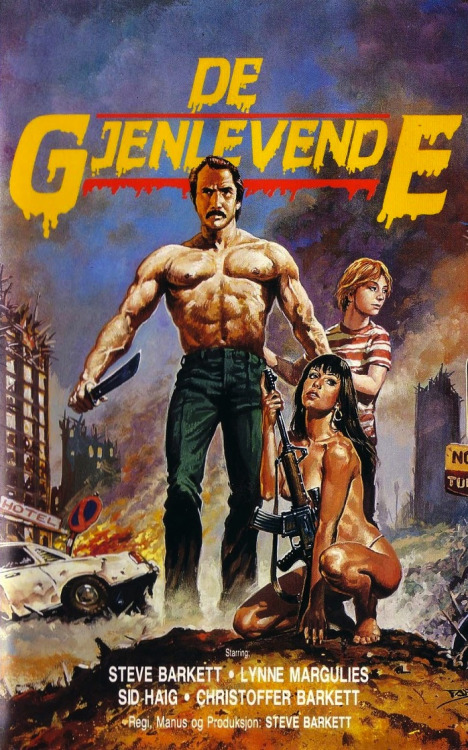
Writer/producer/director/lead actor Steve Barkett only would create one other movie — 1990’s Empire of the Dark, in which a private detective battles a Satanic cult, monsters and ninjas — but he lent his auteur spirit to this post-apocalyptic bit of strangeness.

Barkett was such an artist that while he originally filmed this in 1978, he wasn’t happy and re-shot most of the footage with different actors.

Just like Def Con 4 — or more to the point Planet of the Apes, as the film was shot in many of the same locations — Newman (Barkett) watches the world end from space and comes back to try and survive in the end times. Of course, he does that by undergoing a montage where he tidies up a mansion, so you’ll have that. Incidentally, that mansion belonged to Ted V. Mikels. It was literally the castle that he referred to when he kept a harem of women he called his “Castle Girls.”

Newman looks like every stepfather in the late 70’s and early 80’s, the kind of guy that takes you fishing even though you don’t really want to go and says stuff like, “I really care about your mother” and “You don’t have to call me dad, unless you want to” while at nights you ball your fists up and sob hot, wet tears while he and your beloved mother act out the next ten pages in Dr. Alex Comfort’s The Joy of Sex.

Yeah, Newman is no Snake Plissken. Or Max Rocktansky. Or even Paco Queruak. He is our bastard step-fathers of old.

Stop motion animator Jim Danforth plays a fellow astronaut and Forrest J. Ackerman — wearing the prop rings from Universal’s The Mummy and Dracula — shows up as a museum curator dying from radiation (he even plays Newman a tape with Dick Miller’s voice on it). And Sarah is played by Lynn Margulies. You may recognize her for her romantic involvement with comedian Andy Kaufman. However, the real star of the show is Sid Haig, who plays Cutter, the leader of a gang of cannibalistic mutants who kill all the men and children, only keeping the wives. All of the meanness and brutality of this whole sordid mess can directly be traced back to Cutter. For some reason, our hero is so stupid that he allows Cutter to escape — so Cutter can come back and kill everyone to get back at Newman.

Oh, and there’s also a laser gun that gets made in this movie and we’re just supposed to say, “Yeah, lasers exist.”

If you read our Section 3 video nasties article, you already know that this film was seized and confiscated, but not prosecuted for obscenity. And did former fill-in Duke boy Chip Mayer remake all this — with Richard Moll in the Sid Haig role — as Survivor in 1987? Yeah, pretty much. And if this all wasn’t weird enough: Aftermath was co-written by Stanley Livingston — Chip Douglas from My Three Sons — who also played Jeff in Paul Bartel’s astounding Private Parts, Russ in Smokey and the Hotwire Gang, and, somehow, ended up as a sidekick to Dolph Lundgren in Masters of the Universe, so as to diddle with the “cosmic key.”

Neon City (1991)

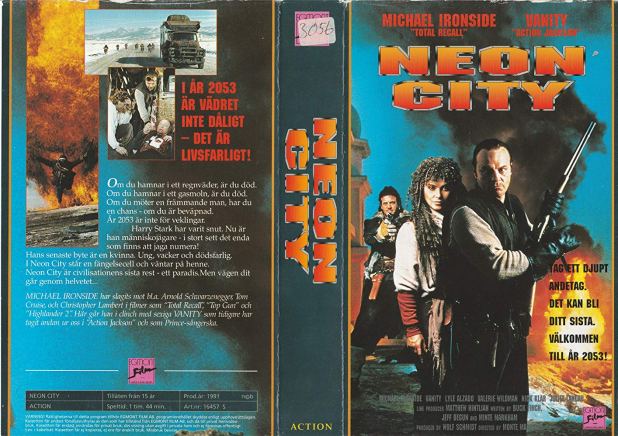
By 2053, extensive ecological damage has resulted in lawless lands that are controlled by mutants. That’s the world that Harry Stark (Michael Ironside) lives in, working as a bounty hunter after being a cop. One of his bounties, a woman named Reno (Vanity), ends up being the reason he travels to Neon City on a giant truck.

I mean, I’ve seen worse setups for a movie.

Everyone on the trip has some kind of secret. There’s Bulk (a clean-shaven Lyle Alzado), a former friend of Starks who he once arrested. A serial killer who is acting like a doctor. The clown Dickie Divine (Richard Sanders, Les Nessman from WKRP In Cincinnati), a rich girl named Twink (Juliet Landau, Drusilla from Buffy the Vampire Slayer), Stark’s ex-wife Sandy and an old man named Wing.

The train battles through radioactive Xander Clouds, mutant attacks and even visits a diner staffed by mutants. Slowly, Stark and Reno come together while evading the killer on the train and making their way to Neon City.

Television writer Ann Lewis Hamilton wrote this as an update to John Ford’s Stagecoach. As she’d dealt with sexism in her career, she used the male name Buck Finch as her pen name. Unsurprisingly, despite her writing the lead as a woman, producers instead cast the male Ironside as Stark.

This movie looks like a high-end TV movie, because well, it is. I’d recommend it only if you love Vanity, Michael Ironside and post-apocalyptic cinema. Seeing as how I’m cursed by all three of those afflictions, I was caught in its spell against my will.

You can watch this on Tubi.

Midsommar (2019)

All summer long, I’ve had people breathlessly tell me, “You need to see this movie.”

I’ve been down this road before. It was called Hereditary, Ari Aster’s last film.

I debated never watching this film, but then I reasoned that as much as I detested It Follows, I loved Under the Silver Lake.

Maybe Aster would hit paydirt in this one. After all, I love folk horror films like The Wicker Man and Blood On Satan’s Claw. How bad could it be?

Woah boy.

Dani Ardor is dealing with a lot. Her sister has killed her parents and then herself. This has also pushed her already failing relationship with her boyfriend Christian. Somehow, they stay together the whole way to summer, when she learns that his Swedish friend Pelle is going home to his commune family for a once in every ninety years ritual and is taking Christian and his friends Mark and Josh.

Christian had no intention of telling her about the trip. In fact, his friends want them to break up. But then she’s there in Halsingland along with them as they trip out and settle in. Hours later, two of the elders leap off a rock to their deaths, but when the male doesn’t die, the others smash his head with a rock.

The elder Siv explains that this is how life goes here in Harga, with every member dying in the same way at the age of 72. This would also be the point where anyone sane would get out.

Two other guests, Simon and Connie, try to leave but miscommunication separates them. And to top things off, Christian decides to steal Josh’s thesis on the Harga. That’s when we learn that the commune’ runic religion is based on an oracle who is conceived every few years via incest.

Oh, where do we go from here? Mark pees on a tree and gets skinned alive. Josh tries to take photos and gets hit with a mallet. Dani takes more drugs and dances around a maypole whole her boyfriend eats pubic hair before impregnating another girl while the rest of the females all watch and push his butt in deeper. Yes, it may have taken Quentin Tarantino a few films before we all realized he has a foot fetish, but Ari Aster took all of one film and a bit of this one to show us that his go-to horror is obese and aged nudity.

After finding Christian and Maja having sex, Dani has started screaming and all of the women turn it into a song. I laughed the kind of mad guffaw that Max Cady only reserved for classics like Problem Child. Somehow, this film, much like the last one that Aster essayed, has descended from horror into comedy through no fault of its own.

If I told you that the cult members all disembowel a bear and shove Christian into it — get it, his name is Christian and he’s being sacrificed? — would you believe me? Well, you better, because that’s exactly the kind of ridiculous ending this movie has. Can you believe that some people were upset by this and how intense it supposedly got? Then why was I holding my sides and struggling to breathe as I chuckled with the kind of volume that I had once only thought possible in my wildest dreams?

This film is a joke, told with false significance and no small fury, all screaming and yelling and singing and wishing and praying and hoping that someone finds it significant and important and worthy of notice. In short, it is everything that is 2019 — a country that asks for prayers on social media one day and shoots one another in the face the next. A sad moron screaming, “Notice me.”

Somehow, thirty minutes of footage was cut from this movie before release. I have no idea how this is possible, as it felt so ponderous that I fear that it’s being over is just a surprise ending and the truth is I will soon wake up and still have forty minutes left to watch. It’s the kind of movie that The Lord of the Rings films would tell to wrap it up.

There are no surprises. I mean, the opening mural literally tells you everything that will happen in the film. And another piece of art shows a woman falling in love with a man, placing flowers under his pillow and then hiding her pubic hair in his food. This is exactly what Maja does with Christian.

There is all the subtlety of a sledgehammer in this film. Every single story beat is so hammered home — yes, that’s a horrible pun but this movie in no way makes me want to try — that you become wistful for the simple days of Toni Collette flying around without her head.

The funniest thing about this movie is that it sees the Nicholas Cage The Wicker Man as more of an inspiration than the original. That might be all you need to know about this utter turd in the punchbowl.

Omega Cop (1990) and Karate Cop (1991)

The bolo tie-wearing Prescott (Adam West) runs a “Special Police” force in the year 1999 from a one-room set (that he never leaves) via a couple of Commodore 64s and some 60s-era blinking props to protect the post-apocalyptic wastelands of Southern California. Keeping Adam West company in the washed-up actor’s camp are Troy Donahue (the metal epic Shock ‘em Dead) and Stewart Whitman (Guyana: Cult of the Damned, Demonoid, and Bermuda Triangle). Helping out on the stunts and working as one of the “wasteland scavengers” is the always reliable and entertaining Sean P. Donahue (of the awesome Ground Rules).

And how did we get here, you ask? Well you’ll have to listen to West’s voice over narration (that he wrote himself!) at the beginning of the film as he educates you on the ozone layer, the greenhouse effect, the rain forests, and the solar flares that plagued the world (“. . . half the world just didn’t give a shit. . . .”).

Anyway, when West catches wind of an illegal slave auction of women run by some “bad-ass” named Wraith (clad in a predictable Nazi SS uniform), he sends in the resident “Mad Max”: John Travis (Ron Marchini of the 1976 kung-fu classic and popular video rental, Death Machines). During the course of breaking up the slave ring — with his high-tech, multi-barrel shotgun — his team is killed: Travis is the last police officer on the force! So, with his high-tech ‘80s-era jeep, Travis takes the two surviving slave women to a utopia of clean air and water in Montana . . . and kicks some ass along the way. (Travis may have been double-crossed by Adam West, who really ran the slave ring . . . does it really matter?)

If you’re a post-apocalypse completest — or an Adam West fan that needs to slide a copy of Omega Cop next to Zombie Nightmare (with Jon-Mikl Thor!) and One Dark Night on your shelf — then this film is for you.

Say what you will about its production quality and shortcomings in catching some Mad Max-inspired post-apoc love, but Omega Cop isn’t boring and was popular enough on the video store circuit that Ron Marchini and writer Denny Grayson returned with a 1991 sequel: Karate Cop — costarring David Carradine (Future Force, Death Race 2000) in place of Adam West — which has something to do with people forced into gladiator-arenas by street-terrorist gangs. But get this: the director is sexploitation purveyor Alan Roberts of Young Lady Chatterley (1977) and The Happy Hooker Goes to Hollywood (1980). But don’t let his soft-porn presence deter your watch: as with any Marchini flick, Karate Cop is a fun watch.

Director Paul Kyriazi, who made his debut with the aforementioned Death Machines and vanished from the film world after Omega Cop, which served as his fifth and final film, has returned to the writing and director’s chair with the 2018 sci-fi movie, Forbidden Power. You can learn more about Kyriazi’s return and his new film courtesy of a favorable review at HorrorGeekLife.

You can watch the VHS rips of Omega Cop and Karate Cop on You Tube.

About the Author: You can read the music and film reviews of R.D Francis on Medium and learn more about his work on Facebook. He also writes for B&S Movies.

Damnation Alley (1977)

To the chagrin of the Italian film industry: we are still alive. And to my chagrin: the Italian post-apocalypse — the single greatest sci-fi film sub-genre to dominate the drive-ins and home video stores of my youth — is over.

Sure, Hollywood offered us their big-budgeted versions of our decimated future with Waterworld (1995), Escape from L.A (1996), 28 Days Later (2002), The Road (2006), I Am Legend (2007), The Book of Eli (2010), World War Z (2013), and Mad Max: Fury Road (2016) — all were honorable, but sometimes misfired, efforts. But it was the lowbrow, low-budgeted indie knock-offs coming out of Eurasia in the 1980s — spearheaded by the Italian film industry’s insatiable quest to rip-off proven American genre flicks — that revved our post-nuke engines (just as B&S Movies’ “Fucked Up Futures” and “Deadly Game Show” weeks prove).

However, prior to the Australians, Italians and Filipinos (we love you, Ciro H. Santiago!) dishing their starchy-apocalypses, there was the “Big Three” by Moses and Ben-Hur himself: Charlton Heston. Chuck’s turn in Planet of the Apes (1968) ignited the post-apocalyptic sci-fi craze within the Hollywood mainstream studio system and led to Heston’s turns in The Omega Man (1971) and Soylent Green (1973).

Once sour on the low-budget “image” of sci-fi films of the ’50s and ’60s, major studios and A-List actors quickly committed to the apocalypse genre — with Oliver Reed in Z.P.G (1971), Bruce Dern in Silent Running (1972), Yul Brynner in The Ultimate Warrior, Sean Connery in Zardoz, and Jackie Cooper in Chosen Survivors, (all 1974), James Caan in Rollerball (1975), Michael York in Logan’s Run (1976), George Peppard in Damnation Alley (1977), and Richard Harris and Paul Newman in Ravagers and Quintet (both 1979), respectively.

So while the Hollywood apoc-mainstream gave us some pretty incredible movies from 1968 to 1979, only one of those films had a bad ass apocalypse truck piloted by our favorite ‘80s TV bad-asses: Col. John “Hannibal” Smith from The A-Team and Stringfellow Hawke from Airwolf.

Sadly, Damnation Alley isn’t as bad-ass as the ‘80s Italian post-apoc flicks left in its wake. If you want a film with George Peppard going into battle with real life (unconvincing) “giant” scorpions and cockroaches blue screen-composited (pasted) into live action sequences, then this is film is for you. Just make sure the papier mâché scorpion claws don’t bite you in the ass.

Damnation Alley started out promising enough: as a popular 1967 sci-fi novella written by Roger Zelanzy. In light Pierre Boulle’s success with the 1968 Planet of the Apes adaptation of his 1964 novel La planète des singes (aka Monkey Planet), Zelanzy was urged to expand the novella into a 1969 novel to make the story more viable for a movie deal. And he got the deal. And it took eight years to develop. And what made it to the silver screen—under the direction of Jack Smight, who scored consecutive box office hits with the disaster flick Airport 1975 and the war movie Midway (1976) — barely resembled the source material.

Check out this awesome synopsis of the book:

The story opens in a post-apocalyptic Southern California, in a hellish world shattered by nuclear war decades before. Several police states have emerged in place of the former United States. Hurricane-force winds above five hundred feet prevent any sort of air travel from one state to the next, and sudden, violent and unpredictable storms make day-to-day life a mini-hell. Hell Tanner, an imprisoned killer, is offered a full pardon in exchange for taking on a suicide mission — a drive through “Damnation Alley” across a ruined America from Los Angeles to Boston — in one of three Landmaster vehicles attempting to deliver an urgently needed plague vaccine.

Police states? A Snake Plissken-like criminal? Did John Carpenter read this book? So what in the hell happened to that movie?

The first pass at the novel, which mirrored the novel-source material, was penned by Lukas Heller, himself with consecutive screenwriting hits with the war-action films The Flight of the Phoenix (1965) and The Dirty Dozen (1967). Zelanzy loved Heller’s script.

Then, for whatever reasons . . . as studios do . . . the studio executives made their “notes,” then hired Alan Sharp, who had hits with the Burt Lancaster action-western Ulzana’s Raid (1972) and the Gene Hackman police-mystery Night Moves (1975), to do a rewrite — which expunged all the elements that made Zelanzy’s book a best seller in the first place. Bye-bye, Hell Tanner, you bad-ass. Poof goes the Escape from New York-esque police states. Hello, campy storytelling. Goodbye serious-dark plotting and characters.

Sigh. Will the studios ever learn?

So, while Steven Spielberg battled perpetually-failing mechanical sharks on the set of Jaws, Jack Smight’s proposed “epic” Landmaster-motorcycle battle against full-scale 8-foot scorpions was a disaster. The giant cockroaches fared worse. However, the 12-wheeled, seven-ton Landmaster built by Dean Jeffries (also responsible for the vehicles in the apoc-satire Death Race 2000) at a cost of $350,000 (one was built; “two” appear in the film as result of photo trickery) worked better than expected. So the studio requested more shots of the Landmaster appear in the film — which is not a good sign. (And Allan Arkush being instructed to “blow up more motorcycles” in Deathsport didn’t work out either. And so it goes.)

So, 20th Century Fox labored over the film in post-production for 10 months, trying to “save” the picture by superimposing “radioactive skies,” scorpions and cockroaches. At one point, as this old Starlog article from September 1977 shows, the studio even decided to ditch the book’s unique title and retitled the film with the vanilla . . . Survival Run (which became the title of a 1979 Peter Graves hillbilly-bent The Hills Have Eyes rip-off). Meanwhile, George Lucas was toiling away on his Flash Gordon homage, and released, Star Wars. And the studio believed Damnation Alley would be the “blockbuster” . . . and Star Wars would be the flop.

And we know how that worked out.

The post-production snafus over Damnation Alley became so heated that the studio wrestled control of the film from Jack Smight and re-edited the film a second time — dumping what little plot and character development was left . . . for more of the Landmaster . . . and all that was left of Roger Zelanzy’s book was the Landmaster. At least the studio got the picture they wanted.

So, was it worth it?

This You Tube video shows the Landmaster going through its paces in the film — all seven minutes of it — for your viewing pleasure. Hey, it’s why we love the movie in the first place: Hannibal and Stringfellow driving a post-apocalyptic, amphibious heavy metal scorpion crusher is why we bought our tickets.

Thus, five months after the $20 million-budgeted Star Wars was released on May 25, 1977, the $8 million budgeted — that ballooned to $17 million — Damnation Alley finally saw the light of day on a date no one remembers: October 21, 1977. A critical failure, its box-office stalled at less than $5 million in sales. The film was eventually recut for television and premiered as a high-rated NBC Sunday Night Movie on June 12, 1983, and featured alternate and additional scenes that offered more character and plot development — but that TV cut was lost and never released on video. In fact, George Peppard has gone on record as being unhappy with the 1977 theatrical cut. Zelanzy wanted his name taken off the movie; the studio (for whatever legal snafus) refused.

Oh, so you want to know what the movie is about.

Sorry, this is one of those films where the backstory (like Stallone’s D-Tox and Cobra, for example) is better than the actual movie. Let’s put it this way: Damnation Alley is almost the same as Def Con 4 in plot . . . but even with its shortcomings, Damnation Alley is the far superior film. And for $17 million, it should be.

First Lieutenant Jake Tanner (Jan-Michael Vincent, White Line Fever) and Major Eugene “Sam” Denton (George Peppard, Battle Beyond the Stars) are on duty at an Air Force ICBM missile silo in the California desert when the Soviet Union launches a nuclear strike (film clip). Regardless of their retaliatory strike, Tanner and Denton only managed to intercept 40% of the Soviet missiles.

Two years pass. The Earth has titled off its axis, radiation has mutated what life is left, and the planet is wracked by massive aurora borealis-like hurricanes and windstorms. Then, one day, they pick up a radio transmission from Albany, New York. There are survivors! So they hop into their giant, 12-wheeled Landmasters to travel across “Damnation Alley,” with stops along the way in the Omega Man-devastated cities of Salt Lake City, Utah, Las Vegas, Nevada, and Detroit, Michigan—and pick up Jackie Earle Haley (Kelly Leak from the Bad News Bears, Rorschach in Watchmen, and Freddy Krueger in the remake of A Nightmare on Elm Street) along the way.

You can watch the movie for free on You Tube and enjoy Dean Jeffries’s fascinating discussion on the development and construction of the Landmaster on You Tube. Can you imagine if this film had been a blockbuster? We would have played with a bad-ass Landmaster and giant scorpions with moveable claws chompin’ on our George Peppard and Jan-Michael Vincent action figures. Would our Landmasters have laid waste to the Millennium Falcon and kicked Steve Austin’s one-armed plastic-engine lifting ass? You bet!

As for 20th Century Fox: They fared better with their next venture into the science fiction realm with a script making the office rounds under the title of “Star Beast.” Rushed into production to capitalize on the success of Star Wars, the film became an influential smash that inspired a series of gooey Italian space romps: 1979’s Alien (as B&S Movies’ “Ten Movies that Rip-off Alien” and “A Whole Bunch of Alien Rip-offs All at Once,” investigates; we also blow out a bunch of apocs with our two-part “Atomic Dustbin” feature).

Regardless of its shortcomings, we post-apoc rats love Damnation Alley. How loyal is our love? The members of progressive space rockers Hawkwind wrote a song about the movie! How many movies can make that claim?

Oh, and contrary to popular opinion: The Ark vehicle from Filmation’s Ark II television series that aired on CBS-TV in 1976/1977 was not the repainted and modified Landmaster from Damnation Alley, as this article from Space 1970 clarifies. Is the Ark II as bad-ass as the Landmaster? Oh, hell yeah.

We talk more about the Landmaster, the Ark II and other apoc rides!

Update: Be sure to check out McSmith’s The Books That Time Forgot blog and his review of Roger Zelazny’s Damnation Alley.

About the Author: You can read the music and film reviews of R.D Francis on Medium and learn more about his work on Facebook. He also writes for B&S Movies.

The Fanatic (2019)

My brother went to the Toronto Fan Expo a few weeks ago and I was kind of shocked to learn that John Travolta would be there. Since he appeared in Saturday Night Fever, Travolta has been a fixture on the A list. What would he be doing deigning himself to appear at a comiccon, signing autographs and meeting the little people?

This movie was why.

Moose (Travolta) is said to be autistic in the things I’ve read about the film, but he’s played here as an incredibly slow man who only finds joy in autograph hunting. This may hit too close to home for some of my friends who are taking the long trek to conventions like the one in Toronto and who often are aware of the celebrity happenings in my city to a degree that I am certain that may cross the line from fandom to outright need for legal action.

Now Moose has the opportunity to meet his favorite actor, Hunter Dunbar (Devon Sawa, Idle Hands). At the last minute, as Moose waits in line, Dunbar’s ex-wife appears and he loses his chance to get an autograph. Worse, his hero treats him like a complete jerk.

Moose’s friend, paparazzi photographer Leah, tries to make up for this by getting him invited to a celebrity party and then showing him an app that publishes the addresses of stars. Instead of just mailing a letter, Moose brings it in person and again, Dunbar reacts violently. Not getting the hint, our protagonist scales the fence around the actor’s house and walks right in. On the way in Moose accidentally kills the housekeeper, but again, Dunbar threatens and abuses Moose.

Finally, our man has had enough. He returns that night dressed as Jason Vorhees and ties Dunbar up and stabs him with a prop knife that does no damage before faking his own death. Dunbar then turns the tables and asks to be his friend, so Moose unties him. The actor goes wild, shooting off Moose’s hand and stabbing him in the eye before letting him leave. He wanders the streets of Hollywood where tourists think he’s in costume before Leah saves him. Then, Dunbar is arrested for killing his housekeeper.

Interestingly enough, Devon Sawa has gone on from playing an obsessed fan in Eminem’s “Stan” video to dealing with an obsessed fan, while Travolta had his pussy finger broken in Saturday Night Fever and now has his entire hand blown clean off. He also gets to utter timeless lines such as, “I can’t talk too long. I gotta poo.” and “Watch out. Here’s Moosey!” Seriously — he really should have followed Kirk Lazarus’ advice in Tropic Thunder before he took this role.

I lay the blame for this amazing turd of a film squarely at the feet of one Fred Durst. Not secure with merely transforming the peace and love of Woodstock into the 1999 debacle that was a nightmarish world of broken bones, open flames and sexual assault. But hey — according to a Variety article, he has no regrets. “It’s easy to point the finger and blame [us], but they hired us for what we do — and all we did is what we do,” said Dusrt. “I would turn the finger and point it back to the people that hired us.” What else would you expect from the man who did it all for the nookie, the what, the nookie? Certainly not a good film. It’s as if his epic work for Match.com commercials was an ill preparation for the subtle nuance of the story of a mentally troubled man navigating the difference between Hollywood fact and fiction. This film has all of the subtle tones and hints of genius that one would expect from the auteur who gifted us with “Break Stuff.”

Actually, Durst doesn’t deserve all the blame, despite including a scene where Sawa’s character literally talks at length to his son about how much he loves Limp Bizkit.

Travolta should know better.

Every single decision he makes as an actor in this film is wrong.

This is beyond a bad performance in a bad movie.

This is the type of film that I will return to time and again, pointing it out to say, “Truly this is as bad as it gets and all films from here on out will be measured against this movie.” I really don’t want to ruin how bad it is for you any longer, but the scene where he says, “Poppycock!” repeatedly while looking into a mirror as he wears as a English policeman costime must be experienced.

I mean, it gets so bad that the same opening credits that start the film are repeated at the end. The same exact credits. Who does this? How does this happen? Did not one single person responsible for this film stop and say, “This whole thing just feels off?”

Nope. That’s why Travolta was in Toronto.

In a year full of some films that I can point to as amongst the worst I’ve ever seen, isn’t it somewhat comforting to know that something came out that sucks worse than Serenity?

Aftershock (1990)

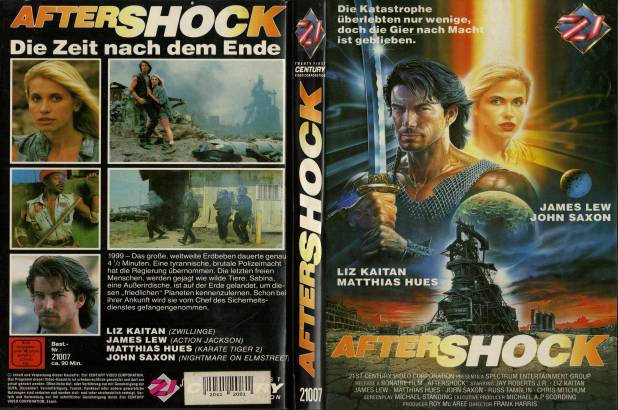
Anti-intellectual paramilitary forces rule the post-World War 3 landscape, which is directed by Frank Harris, who was behind Killpoint and The Patriot (not the Mel Gibson movie) and Lockdown (not the Sylvester Stallone movie).

Into this world arrives an alien named Sabine, played by Elizabeth Kaitan. Oh Elizabeth, you’ve been in so many movies that I’ve savored. You watched Lance Henriksen battle bikers in Savage Dawn. You dated Ricky Caldwell in Silent Night, Deadly Night Part 2. You were Candy in four Vice Academy movies and showed up in Beretta’s Island, an attempt to transform Arnold Schwarzenegger’s friend, the recently deceased Franco Columbu, into an action star. I mean, Ken Kercheval even showed up. But the rest of the world — well, the part that watches slashers — knows you as Robin in Friday the 13th Part VII: The New Blood. You know her — the one who calls Tina Marilyn Munster before heading upstairs to get killed.

Sabine upsets the balance of power and the forces that have worked so hard to consolidate said power now need to keep her controlled. Such is the world of Aftershock.

The rebels want to protect Sabine and get her back to the portal that will bring her home. And the baddies, well, they want to dissect her.

This is the kind of movie where the supporting cast is the entire reason to watch the film. I mean, there’s a black rebel played by Chuck Jeffreys that 100% is doing an Eddie Murphy impression for the entire movie. Then there’s Deanna Oliver, who was the voice of The Brave Little Toaster, one of the most frightening and strange movies I’ve ever encountered despite its outer trappings as a kid-friendly movie. Russ Tamblyn and Chris Mitchum are here! And Matthias Hues, Talek from Dark Angel (what’s up with this post-Mandela Effect world where I only knew this movie as I Come In Peace?), is a gang member along with everyone’s go-to mutant, Michael Berryman.

The main reason I liked this movie — let’s be honest and say the only reason — is that John Saxon and Richard Lynch play the leaders of the bad guys. To be fair, Lynch is barely in the movie in his role as Commander Eastern. He shows up in one major scene, where he orders around Saxon, holds a small dog and has a missing eye. Trust me, this scene alone boosted this movie up at least 40%.

This was written by Michael Standing, who memorably blew a van to smithereens in The Italian Job. He also plays Gruber in the film. It’s not the best end of the world movie, but with a cast like this, there was no way that I could miss it.

You can watch this for free on Amazon Prime and Tubi.