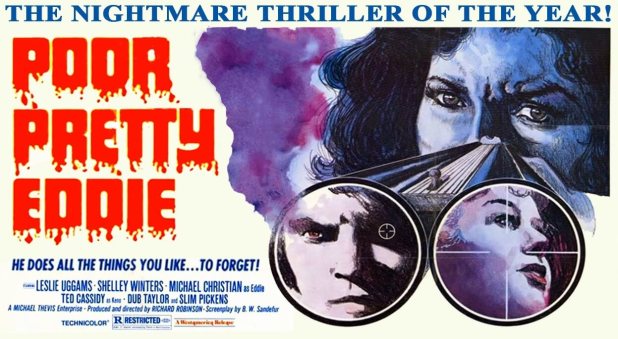
Poor Pretty Eddie (1975)

It’s rare that I watch a movie that gets on the very verge of upsetting me. Poor Pretty Eddie is that rare film that pushed me pretty far and made me feel somewhat upset for watching it, which ended up making me keep going and enjoying the end results. It’s not an easy watch, but it’s amazing that this movie even exists.

Most of the makers of this film were employed in the world of adult films, with Poor Pretty Eddie representing their chance to go straight. Backing came from Michael Thevis, the notorious Atlanta-based “King of Pornography,” who owned a record company named GRC, a chain of sex shops and a company that manufactured peep show booths. In fact, the rock band Flood recorded the soundtrack for the martial arts movie Blood of the Dragon in his Sound Pit Studio on Atlanta’s Simpson Street, which also saw country singer Moe Bandy, dance sensation Loleatta Holloway and country songwriter and the author of the three million record selling “Chevy Van” Sammy Johns — as well as R&B acts like Ripple, the Rhodes Kids, King Hannibal and Sam Dees — all record there. He also published a series of pornographic novels that were written by Ed Wood under the name Donna D. Dildo.

Producing a legit movie allowed Thevis to launder money that he had made through shadier dealings, which brought the FBI in. Shortly after the film was released, he was jailed on a variety of charges and then escaped prison in 1978, ending up on the FBI’s most-wanted list. He had already put a contract out on the life of the man who had given the police all the info they needed to put him away. While on the lam, he tracked down that man — Roger Dean Underhill — and killed him and another associate. He bragged about it in prison and fellow prisoners ratted him out.

In 1980, Michael Thevis, the so-called “Scarface of Porn,” who once owned nearly half of the industry and made $100 million a year ($311 million today when adjusted for inflation) was sentenced to spend 28 years to life in the Oak Park Heights Correctional Facility, an underground penitentiary outside of Minneapolis and eventually United States Penitentiary in Atlanta. His palatial home was sold eventually to Whitney Houston. In 2013, he died of heart and respiratory failure. This Daily Beast article on his life is required reading.

Poor Pretty Eddie was written B. W. Sandefur, who is mostly known for his TV writing and producing. In fact, he was behind one of the oddest series of the early 1980’s, NBC’s Cliffhangers, which featured three different stories that all began in the middle of their stories. Stop Susan WilliamsThe Phantom Empire and The Curse of Dracula were all eventually turned into theatrical releases — along with extra material added — in Europe.

Loosely based on the Jean Genet play The Balcony and directed by David Worth (Kickboxer) and Richard Robinson (who has films like Is There Sex After Marriage and Adultery for Fun & Profit on his resume), this film is shocking even today.

The Turner Classic Movies article on the film hits it right on the head. They describe Eddie as such: “A sleazy exploitation thriller with artistic pretensions, the film manages to be offensive, crude and inept in equal measure while still succeeding as a compulsive viewing experience for connoisseurs of fringe cinema who think they’ve seen everything.”

We start at the University of Georgia as Liz Wetherly (Leslie Uggams, who older readers will know from Roots and younger ones will know from the Deadpool movies), a famous singer, is performing the national anthem. There’s a cut to her car driving down a country road and we hear her say, “Look, I have two weeks before my next concert. Now I’m going to get in my car and drive until I find a nice, quiet hole to crawl into.”

Be careful what you wish for.

After he car breaks down, Liz rents a cabin for the night — so she thinks — while the gigantic handyman Keno (Ted Cassidy, who was Lurch on The Addams Family, as well as the second actor to play Bigfoot on The Six-Million Dollar Man after Andre the Giant. He was also the narrator for The Incredible Hulk and provided the voices for Godzilla, Frankenstein Jr., The Thing, Moltar, Metallus, Black Manta and Brainiac for various Hanna-Barbera cartoons.)

Somehow, she ends up stuck for days thanks to the machinations of Eddie (Michael Christian, TV’s Peyton Place), a lothario who has already ensnared motel owner Bertha (Shelley Winters, who was in so many movies where she ran a house of ill repute, at least in my imagination, as well as the killer mother of an alien child in a role that doesn’t add up in another astonishingly bonkers Atlanta-based movie, The Visitor). Strangely enough, in the filmed version of the aforementioned Genet play, WInters played nearly the same role. Yet here, she plays it as a once gorgeous showgirl stuck remembering the past through the haze of alcohol, trying in vain to hold on to her man. Of note, Winters was paid in cash for her role and nearly died when her private plane almost crashed upon landing in Atlanta.

Not only does Eddie want Liz for carnal reasons, he also thinks she can help him in his career as a country singer. He spends much of the film dressed in Elvis jumpsuits and warbling his way through ballads. And oh yeah — he eventually assaults our heroine and then subjects her to further torture like forcing her to please a traveling salesman and eating Keno’s dog.

Liz finally gets the courage to turn in Eddie, which leads to Sheriff Orville (Slim Pickens!)  asking her “Did he bite ya on the tittie?” and making her submit to a public trial in a crowded VFW/bar as locals gasp that a black woman is in their midst. Drunken proprietor Floyd (Dub Taylor, a cowboy star and former Clemson Tide football player, who is in all manner of redneck films like Thunderbolt and Lightfoot…tick…tick…tick…, Evel KnievelGatorCreature from Black LakeThe Great Smokey Roadblock and Moonshine County Express) then conducts a trial in front of an assembled crowd of drunken locals, many of whom appear disturbingly disturbed, that ends with Liz stripped nude and crying.

The film’s montage sequences are some of the most disturbing I’ve sat through, including Eddie assaulting Liz to the sounds of a country love song intercut with two dogs humping, as well as a scene where she takes photos of him near a waterfall, imagining her camera is a shotgun and that he is covered in blood and gore.

It all climaxes with a wedding where Eddie and Liz are to be wed, which ends up in a slow motion Sam Peckinpah gun battle, as Keno blasts his way in wanting revenge for his dog and everyone gets caught in the crossfire. The film ends with Liz, her life ruined and not enhanced by this escape from her busy life, raising a shotgun to murder Bertha.
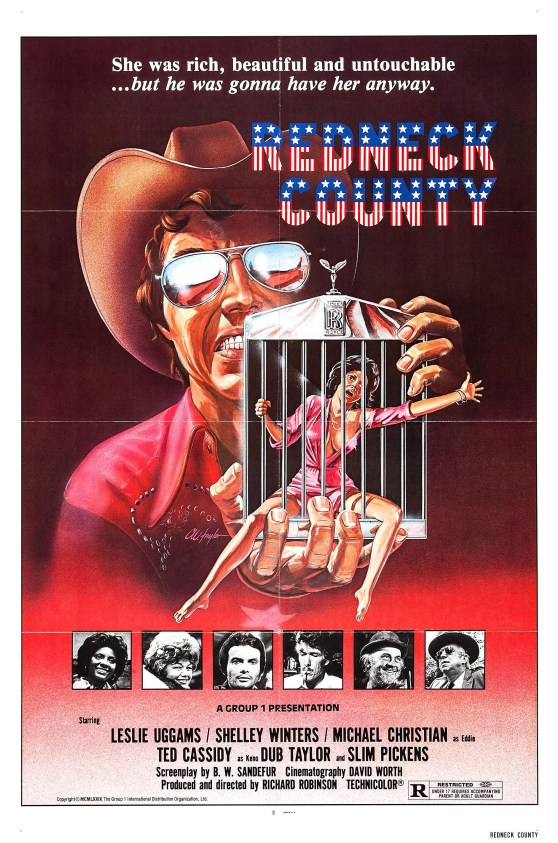
Also known as Black Vengeance, The Victim, Heartbreak Motel and Redneck County Rape, the film played drive-ins and grindhouses for nearly a decade. The Heartbreak Motel version features plenty of differences, as Eddie narrates the movie and action scenes have been cut out and replaced with length soliloquies that don’t appear in any other version of the film. Instead of ending with the gun battle, Heartbreak Motel closes with Eddie leaving Georgia for Nashville and a recording contract. There are less scenes of Eddie attacking Liz, but strangely enough, there is a scene where Eddie and Bertha make, umm, third input love to the haunting strains of a bluegrass ballad.

To say that critics — especially in Atlanta — disliked this film is an understatement.

The 1970s were packed with films that you are kind of, sort of horror movies, yet feature no supernatural elements. They just made you feel like you needed to take an entire day’s worth of showers to clean off the scum after watching them. This is one hell of an addition to those movies. It’s not for everyone, but for those who want to see how low exploitation can go, it’s ready to attack your sensibilities.

You can watch this on Tubi and Amazon Prime.
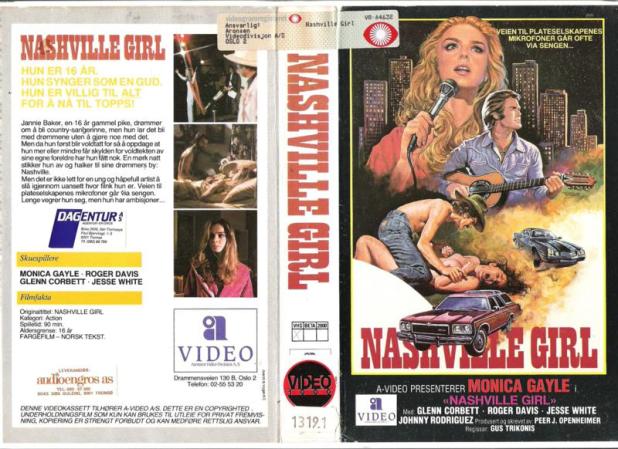
Nashville Girl (1976)

I discovered this movie thanks to Joe Bob Briggs’ How Rednecks Saved Hollywood presentation. The clips he showed were absolutely astounding and there was no way that the actual movie could live up to his speech about the film, right? Nope. This is one sordid piece of scummy moviemaking that does all that and more.

Director Gus Trikonis started his career as a dancer in West Side Story, playing Indio, a member of the Sharks. His directing work for Roger Corman’s New World Pictures led to Corman claiming he was one of the best young directors that he had worked with. His films run the gamut of hicksploitation, from The Side Hackers to The Swinging BarmaidsSupercockThe EvilMoonshine County Express and the movie based on the Johnny Paycheck sung and David Allen Coe written song Take This Job and Shove It. He was also married to Goldie Hawn for awhile.

Monica Gayle (The StewardessesSwitchblade Sisters) stars as Jamie, the Nashville Girl of the title (the film also played under the titles New Girl In Town and Country Music Daughter in an attempt to convince people it something to do with the Loretta Lynn bio Coal Miner’s Daughter). She’ll do anything to make it in Nashville after leaving town when she’s assaulted by a boyfriend and abused by her father. It doesn’t get any better in music city, trust me.

Somehow this movie goes from jailbait in trouble to massage parlor receptionist to women in prison to young girl getting pawed by every man in town in very short order, ending with her under the thrall and ownership of big time country star Jeb (Glenn Corbett of TV’s Route 66) and enduring the attentions of Kelly (Roger Davis, TV’s Dark Shadows, as well as Ruby and Killer Bees).

Judith Roberts shows up as Jeb’s long-suffering wife. She’d go on to star in things like Orange Is the New Black, but we know her best as Mary Shaw in Dead Silence.

Singer Johnny Rodriguez and songwriters Rory Bourke, Gene Dobbins, and John Wills all show up here and contribute music. None of this makes Nashville look like a great city to live in or be a rising female artist. There are more #metoo moments in five minutes of this movie than in pretty much everything Hollywood will release this year. It gets to the point that you honestly worry about Monica Gayle’s personal mental health. She might change her name to Melody Mason and get a whole new life story, but she can never escape the past that got her here.

Somehow, there’s a novel version of this movie that has even more sex in it. It’s written by Gary Friedrich, who co-created Ghost Rider. So there’s that.

You can watch this on Tubi and Amazon Prime. Or go all out and grab the Scorpion Releasing blu ray from Ronin Flix.
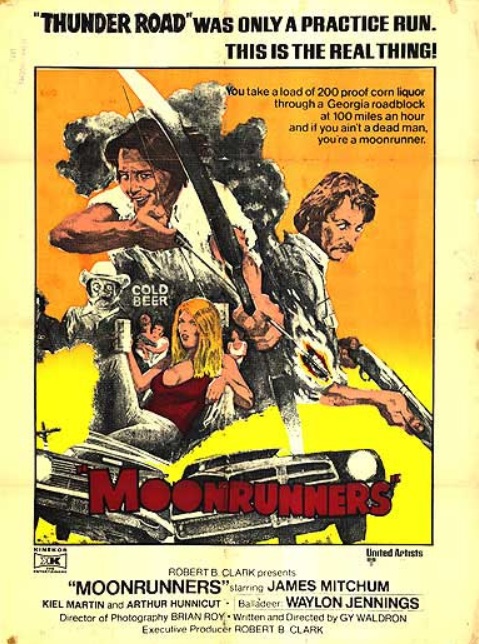
Moonrunners (1975)

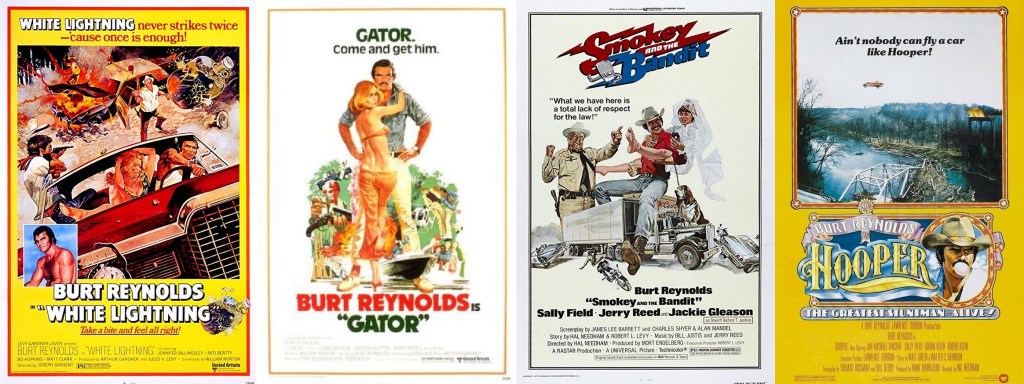
Moonrunners is one of the earliest celluloid responses to the massive box office generated by Burt Reynolds’s White Lightning (1973)—and was filmed in 1973 in the wake of that film. Over the years, Reynolds applauded White Lightning as being one of the best of his career and reasoned White Lightning’s success was the result of it being the first film that celebrated Southerners and didn’t degrade their culture and lifestyle: it was a film made about and for those folks living south of the Mason-Dixie. Burt Reynolds’s Deliverance (1972) and White Lightning—and obviously Gator (1976) and Smokey and the Bandit (1977)—set those stills o’ bubblin’ for every Southern tale thereafter.

Watch the trailer.

So, if you never heard of Moonrunners, but you enjoyed White Lightning or Burt Reynolds’ post-Smokey and the Bandit, “good ol’ boy” films of Stoker Ace and Hooper, then you’re up-to-speed to enjoy the down-home, pre-Dukes of Hazzard action that is Moonshiners—as well as Roger Corman’s copies, Moving Violations (1976) and Thunder and Lightning (1977), both made to catch that Burt Reynolds-lightning in a bottle.

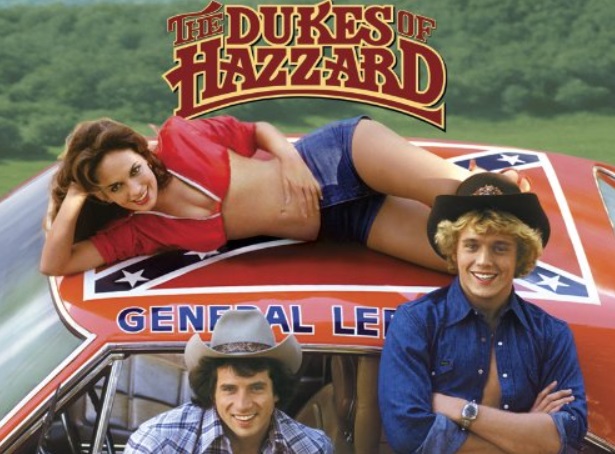
And you’ll recognize the plot and characters of Moonrunners right away: you’ve seen it before—on the successful TV series, The Dukes of Hazzard (1979-1985). While M.A.S.H receives an acknowledgment as the most successful film-to-TV adaptation, with the transition of Alice Doesn’t Live Here Anymore as Alice as a close second, critics have forgotten Moonrunners successfully transitioned to television. More critics “remember” The Super Cops (1974) transitioning to the small screen as Starsky and Hutch and FM (1978) “became” WKRP in Cincinnati; while both drew from analogous source materials, they’re not movie-to-TV projects.

The action-comedy Moonrunners was the feature-film writing and directing debut for ‘60s television scribe Gy Waldron; he convinced the CBS Network to green light The Dukes of Hazzard as result of his writing success on the CBS sitcom, One Day at a Time. The movie and subsequent series is based on real-life bootlegger Jerry Rushing, known for tearin’ up southern roads with his souped-up, 1958 Chrysler 300 D that he affectionately referred to as “The Traveller,” nicknamed after General Robert E. Lee’s favorite horse; the car served as the model for the Duke’s “General Lee”; Rushing was the blueprint for “Bo Duke,” and “Uncle Jesse” was modeled after Rushing’s Uncle Worley.

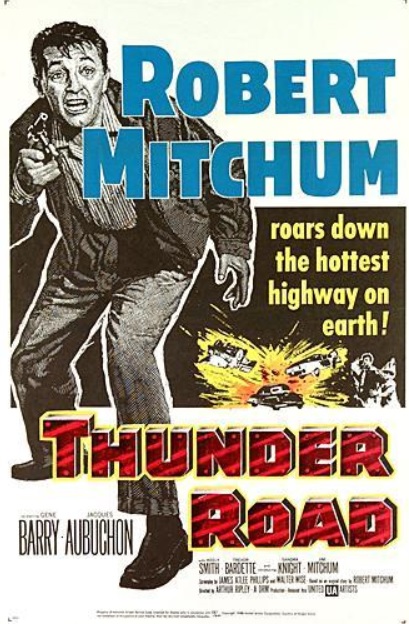
Backed by a requisite Outlaw Country-soundtrack adopted by other films in its wake, Moonrunners stars James Mitchum as a bootlegger behind the wheel of “Traveller”—blazoned with the #54 (in lieu of a #01)—outrunning federal agents on the southern backroads; he co-starred with his father, Robert Mitchum, in the similarly-themed Thunder Road (1958).

As with its TV clone, Waylon Jennings narrates as The Balladeer to move along the story of Grady and Bobby Lee Hagg (read: Bo and Luke Duke) who run moonshine for their Uncle Jesse in the mythical Georgia county of Shiloh (the real city of Shiloh is in Harris (read: Hazzard) County, Georgia). Between running ‘shine, the two hang out at The Boar’s Nest (also featured in the TV namesake) and race stock cars with their buddy, Cooter (another Dukes’ character). Uncle Jesse is at odds with his ol’ bootleggin’ partner, Jake Rainey (read: Boss Hogg) who’s in cahoots with Sheriff Roscoe P. Coltrane to “git them Duke Boys” and put Uncle Jesse’s ‘shine stills out of business. Along the way the Hagg brothers help a daisy-duke wearin’ damsel, Beth Ann Eubanks (read: Daisy Duke).

Of course, as with the adaptational softening of M.A.S.H and Alice Doesn’t Live Here Anymore, the moonshining action was softened to a more family-friend storyline. The “good ol’ boy” style of the series was so successful that Waldron spun off the character of Deputy Enos Strate into a short-lived series, Enos. Waldron also completed a film-to-TV adaptation of Kenny Rogers’s kid-friendly, stock car racing comedy, Six Pack (1983), starring Don Johnson, which failed to be picked up as a series. Jerry Reed of Smokey and the Bandit also tried to get some of that Duke Boys-flavor—as a character named “Traveller”—co-starring with fellow musician-actor Lane Caudell in a failed TV movie pilot, The Good Ol’ Boys (1978). Exploitation guru Roger Corman also attempted to git ‘em some of that Duke Boys-action with his failed TV movie pilot, The Georgia Peaches (1980), starring Dirk “Starbuck” Benedict (of the hicksploitation film Ruckus).

You need more redneck cinema? Then surf on over to our “Hicksploitation: The Top 70 Good Ol’ Boys Film List: 1972 to 1986” feature.

About the Author: You can read the music and film reviews of R.D Francis on Medium and learn more about his work on Facebook. He also writes for B&S Movies.

Hunter’s Blood (1986)

In the post-Halloween slasher universe, dentists and podiatrists who wanted to become “film producers” realized all you needed to make a movie was a patch of woods, well-endowed amateur females with a good set of pipes for screaming (and racks for gawkin’), and some guys with ironically bad dental work and gnarly bare feet with a penchant for some good ‘ol fashioned, down home rapin’ n’ killin’. Ya’ll don’t be needin’ no stinkin’ script or character development ‘round ‘ere. Cum on, Uncle Jed. We’s be headin’ to the hills to make us Jethro BoDean into a bonerfide movin’ pickture star.

Looking back on the rednecksploitation (you can call it backwoodsploitation or hicksploitation if you like) era that ignited with John Boorman’s Deliverance (1972; based on the James Dickey novel), you begin to realize it was Deliverance—and not Halloween—that served as the jump-off point for Sean S. Cunningham’s Friday the 13th. Outside of F13’s Michael Myers-clone in Jason Voorhees and the accoutrements of Italian Giallo-inspired gore, it’s Boorman’s Deliverance that served as the true antecedent to most of the product from the ‘80s slasher cycle—for the true terror lurks in the woods.

However, while Deliverance has an underlying social statement about America’s class structure and questions who is stronger in a battle of wills between primitive man vs. civilized man (a message also found in Sam Peckinpaw’s Straw Dogs; 1971), all the films produced in its backwash threw away plots (that were cookie cutter n’ boilerplated anyway), character development and underlying themes, and amped the violence—even more so in a post-John Carpenter world. Macon County Line (1974), Death Weekend (1976), Rituals (1977), Just Before Dawn (George Kennedy, The Uninvited) and Walter Hill’s Southern Comfort (both 1981) each own their debt to Boorman’s backwoods-terror vision. In fact, in some overseas markets, Rituals was marketed as Deliverance 2.

Watch the trailer.

At their core, most redneck flicks are just darker versions of the ‘ol fish-out-of-water masterplot where the protagonists—in this case, an obligatory group of four or five dick-swinging intellectuals, with at least one testosterone-jacked jock in tow—look and act differently that the surrounding protagonists—i.e., inbred redneck poachers—and don’t understand their foreign-backwoods environs as well as their citified arrogance leads them to believe. Of course, the additional twist: When the city-fishies are out of water in a thriller-cum-suspense horror environ: they must piss off the locals. Oh, and there has to be at least one stupid woman that wasn’t invited on the woodland adventure who decides to “surprise” her husband, because, well, Cletus and Bocephus ain’t bin wid no whimin’ fer a lerng, lerng time.


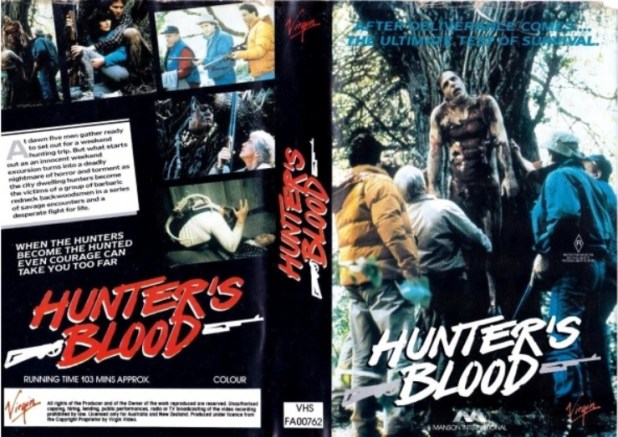
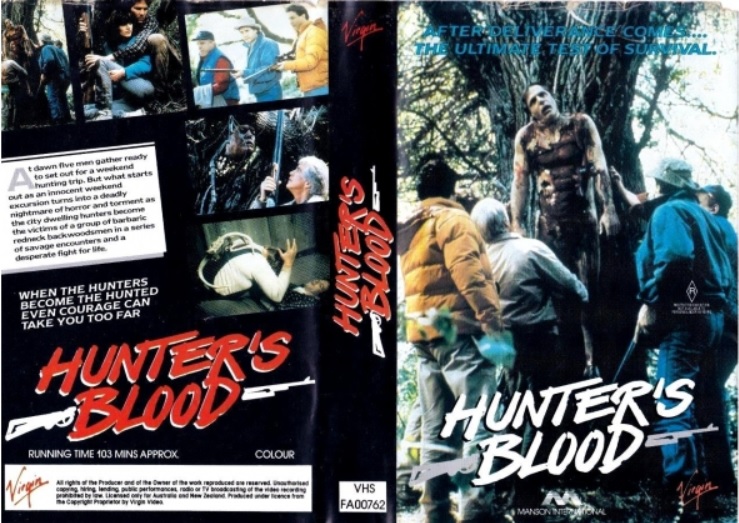
And that’s the plot of Robert C. Hughes’ Hunter’s Blood: Five city slickers go-a deer huntin’ and meet up with Redneck Local Rotary 666 and, well, anyone with a G.E.D would get the fuck out of the woods, go back to suburbia, bang Kim Delaney, and then fire up their copy of Arcadia’s Deer Hunter Skeet Shoot projection video game. And if you got no one to do the shimmy-sham: find yourself a nice, citified wings n’ ribs grill with Big Buck Hunter in the corner by the restrooms, pop a quarter, and call it day. Nope. Not in Hunter’s Blood country.

“Hey, Pop. How come we didn’t buy beer and stock our coolers in the city before we left for inbred country,” ask David (Sam Bottoms, Up from the Depths by the guru of redneck cinema, Charles B. Griffith).

“Shut up, you’re ruining the plot, son,” head smacks Mason (Clu Gulager, Burt from Return of the Living Dead!!!). “Now pull into that general store so we can buy beer and I can kick some redneck ass and unleash their wrath before Kim Delaney shows up to be raped.”

“Tobe’s Gas Stop? Hey, that’s funny. They named it after Tobe Hooper, the director of The Texas Chainsaw Massacre,” says Marty (John Travolta’s less-talented brother, Joey).

“Shut up and quit trying to act, Joey. Just sit over there and wait to be killed,” yells Al (Ken Swofford of Black Roses and a snake-bag load of American TV series). “Look at my IMDb resume, I know what I’m talking about. Now go get a real estate license and quit irritating me, kid.”

All joking aside: What makes Hunter’s Blood the type of hicksploitation classic we love here at B&S Movies is its who’s who of B-movie badassery backing up Clu and Ken (both appear in Terror at London Bridge): You have Lee De Broux as “Red Beard” (Salvage 1 and Robocop), Charles Cyphers as “Woody” (Carpenter mainstay; Assault on Precinct 13), Billy Drago as “Snake” (Invasion U.S.A), and Bruce Glover as “One Eye” (Yep, Crispin’s dad!) . . . and Mickey Jones (!) as “Wash Pot” (Slingblade, Total Recall, National Lampoon’s Vacation . . . the dude was Bob Dylan’s and Kenny Rogers’s drummer and earned 17 gold records!).

And wid-a cast like that, ya’ll don’t be needin’ no stinkin’ script or character development. Bend over and squeal like a pig, and enjoy it, son.

Need more Robert C. Hughes-backwoods terror? He returned with Memorial Valley Massacre (1989). The unrated, pseudo-Eurotrash cut of the film, Son of Sleepaway Camp, marketed as a bogus sequel to 1983’s Sleepaway Camp, goes all “Jess Franco” with hardcore sex and amped gore scenes inserted.

About the Author: You can read the music and film reviews of R.D Francis on Medium and learn more about his work on Facebook.

Sweet Georgia (1972)

Marsha Jordan (Count YorgaThe Toy Box) is Sweet Georgia, the sexed up wife of rancher Big T (Gene Drew, Truck Stop WomenBobbie Jo and the Outlaw), an abusive drunk who she denies carnal pleasure, instead finding it in the arms of ranchhand Cal and even the arms of her stepdaughter Virginia (Barbara Mills, who also used the stage names Leona Tyler and Barbara Caron for movies like Executive Wives and Fire In Her Bed).

The final straw is when Georgia sleeps with the slow switted Leroy, which leads to her getting trampled by a horse and the farmhand getting stabbed with a pitchform before Cal and Virginia cattle prod the oyster ditch, so to speak. Then, of course, Cal is killed by Big T and we cut to Virginia enjoying herself in a room that is so red lit that it must have been in Mario Bava’s house. In case you think that the once virginal Virginia isn’t going to dance the forbidden polka with her old man, then you haven’t seen a Harry Novak film. Is there a square up reel? Of course there is.

This is another Harry Novak affair. Yes, the producer of such stalwart offerings as Suburban PagansCountry CuzzinsWham! Bam! Thank You, Spaceman!; The Child and   Tanya, perhaps the only sexploitation comedy romp about Patty Hearst. If you think I’m not hunting down that last one right now, you don’t know me all that well.

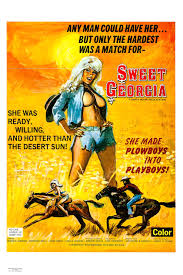
Should you watch this? Honestly, other than the song that plays throughout the film, there’s not much I can recommend. You’d probaby get more out of it just looking at the poster for an hour.

Smokey and the Good Time Outlaws (1978)

Imagine if Jimmy McNichol’s Roscoe Wilton from Smokey Bites the Dust was a musician in search of a recording contract. . . . Wait, even better. How about Burt Reynolds’s Bo “Bandit” Darville from Smokey and the Bandit having aspirations to make it as a singer on the stage of the Grand Ol’ Opry?

Yuuuuup! Yer now up to speed on this deep-hicksploitation obscurity that’s worth watching solely for Slim Pickens’s hilarious turn as the obligatory Sheriff Buford T. Justice-clone in this octane-fueled BBQ’d adventure. Somewhat reminiscent of Jerry Reed’s later written-produced-directed-acted country music comedy, What Comes Around (1985), ‘60s country singer Jesse Lee Turner serves as the executive producer and screenwriter, composer and star of this entry in the hicksploitation canons concerned with pitfalls and pratfalls of the country music industry—with a few car chases and crashes added for good measure.

Watch the original trailer and restored trailer.

Turner, who made it into the Top 20 on the Billboard Hot 100 chart with his 1959 debut single, “Little Space Girl b/w Shake, Baby Shake” (the B-Side is pure Elvis-rockabilly awesomeness), was unable to repeat that initial success with subsequent singles for various labels throughout the remainder of the ‘60s; he finalized his career with a 1975 singles-deal with MCA Records. Turner then incorporated a successful crop-dusting business (he was a long-time certified pilot) and came to own restaurants, a cattle ranch, a small community airport, and a few oil wells.

It was after Robert Altman released his comedic satire on the country music industry, Nashville (1975), that Turner decided to start a new business: a film production company, General Audience Films, to counter the negative light many in the country and gospel music communities felt Altman’s film cast on the industry. In addition to writing the script, Turner wrote four of the eight songs he performs in the film (the rest are written by respected country songsmiths Larry Hart and Ben Peters), including “Make It on My Own, “I’d Like to Be in Nashville,” “Road to Nashville,” and “Made It to Nashville.”

To direct his country-road comedy, Turner hired Alex Grasshoff (of the papier-mâché dinosaur romp—complete with Richard Boone manning a drilling mini-sub!—The Last Dinosaur). As a sidekick to his J.D character, Turner cast veteran television character actor and B-Movie stalwart Dennis Fimple (TV’s B.J and the Bear; the films The Bootleggers, The Creature from Black Lake, Stay Hungry, Truck Stop Women, White House Madness . . . yes, we love Dennis!) as the Salt Flat Kid (which proved to be Fimple’s only leading man role in a feature film). The musician-duo, who end up spending the night in jail after a gig, meet a flim-flamin’ impresario (country-comedian Archie Campbell of TV’s Hee Haw) who claims he can take them all the way to Nashville. Let’s go, boys!

You have to keep stokin’ that Bandit BBQ-smoky flavor, so we have another Sally “Frog” Field bailing out of a wedding to hook up with J.D’s “Bandit,” courtesy of Nashville singer Dianne Sherrill (who appeared in Nashville 99, a short-lived 1977 TV series starring Jerry Reed and Claude Atkins). And you know the rest of the story: Gailard Sartain (a southern-fried comedic actor best known as the put-a-upon police office in The Hollywood Knights and The Big Bopper in The Buddy Holly Story) is the jilted bridegroom who calls his Texas-hating uncle, Tennessee Sheriff Ledy (Slim Pickens), into action to bring back his lady love. 

Hey, there’s Clara Edwards (Hope Summers) from The Andy Griffith Show and Mayberry R.F.D . . . and country music legend Mickey Gilley as a stock car racer . . . and Epic Recording Artist Johnny Paycheck . . . and Polydor’s Johnny Russell . . . and the legendary George Jones showing up for a few tunes. Hey, that’s music agent Eddie Gibbs (Sully Boyar) from The Jazz Singer (1978), and Dog Day Afternoon (1975) and Car Wash (1978).

Yep, this good ol’ boy comedy is a BBQ treat brimming with all the B-Movie and exploitation character actors I love. It’s awesome to see Dennis “Grandpa Hugo” Fimple from Rob Zombie’s House of 1000 Corpses in a leading-man role.

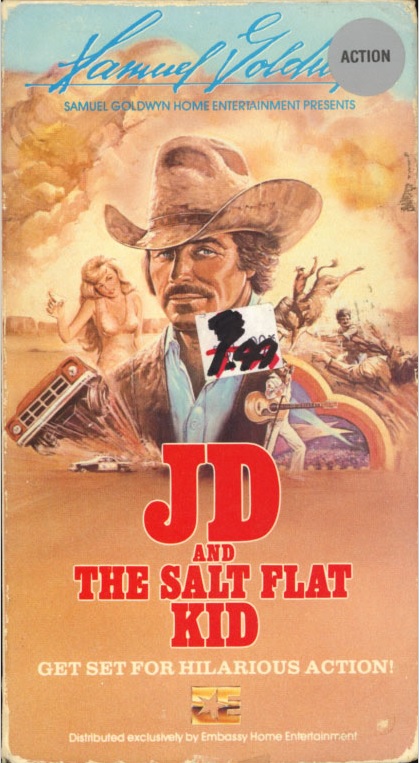
You’ll notice the artwork on the VHS box (below) utilizes the film’s original title: J.D and the Salt Flat Kid. That artwork, as well as the theatrical one-sheets, went to great lengths to illustrate Burt Reynolds and Jerry Reed-styled characters bearing zero resemblance to Jesse Lee Turner and Dennis Fimple.

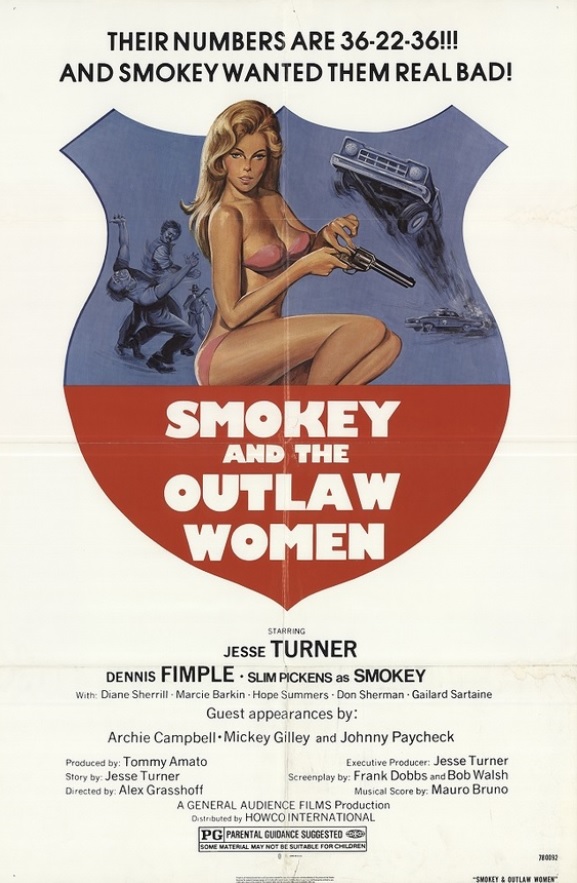
The clever exploitation marketing featuring a pseudo-nude chick loading a gun under the Smokey and the Outlaw Women banner comes courtesy of producer-distributor J.N Houck, Jr., the Drive-In huckster-guru of Howco International Pictures. Howco was the driving force behind numerous exploiters from the ‘50s through ‘70s, including Night of Bloody Horror (reviewed as part of our October unpack of the Mill Creek Pure Terror 50-film box set) and the previously-linked Creature from Black Lake, starring Dennis Fimple alongside Jack Elam and Bill Thurman (‘Gator Bait).

In addition to becoming an ordained evangelist with a Christian-rock music ministry, Jesse Turner worked as a set designer and as a camera and electrical grip in film and television productions.

The in-depth Medium article “Jesse Lee Turner: A Life in Music and Film” offers more background on Jesse’s career, along with links to his music.

Be sure to check out our Exploring: Hicksploitation feature with links to over 70 films.

About the Author: You can read the music and film reviews of R.D Francis on Medium and learn more about his work on Facebook. He also writes for B&S About Movies.

Hicksploitation: The Top 70 Good Ol’ Boys Film List – A collection of down-home films produced from 1972 to 1986

As the reviews begin to roll out for B&S Movies’ “Redneck Week” July spotlight, you’ll notice there’s a lot of fun being made at the expense of a rich, colorful culture that exists south of the Mason-Dixie line—not just by the filmmakers, but by the reviewers as well, especially me: the smarmy, he-thinks-he’s-so-funny, R.D Francis. On the surface, it seems this is a celebration of the racial profiling of Southerners.

The concept of hicksploitation (that is, rednecksploitation and backwoodsploitation) is insane: Everyone south of the Mason-Dixie are uneducated, inbred moonshine running religious zealots (see the Deliverance-inspired subgenre)—and sometimes cannibals (The Texas Chainsaw Massacre subgenre)—who defy authority and society and strand Yankee motorists for car parts—and other “parts”—with a glee in their eye? All of the Sheriffs are incompetent and corrupt with dumb sons and dumber deputies (see Smokey and the Bandit)?  It’s ludicrous.

Imagine a film that, for 90 minutes, rolled out one slanderous, stereotype after another on any other racial heritage or culture. It would be offensive. You’d defy the hate. You wouldn’t celebrate the ignorance displayed in those films and there’s not one excuse about your affection for the “video fringe” that would justify the merriment.

The reality for the many of those Southern denizens of the backwoods and deep mountains south of the Mason-Dixie spoofed in the Drive-In exploitation canons of the ‘70s and ‘80s is a life of poverty and hunger that rivals the worst of third-world countries. It’s worse than any reality you and I live in—flesh or celluloid. As my educated, film-reviewing adult self looks back on my clueless, Drive-In attending and video-renting younger self, I type this humbled and ashamed. I wouldn’t make a joke at the expense of those suffering the realities of third-world poverty or inner-city urban hardships. . . .

Then why is it acceptable for Southerners to be cast as the butt of jokes, pigeonholing, and stereotyping in films?

The truth is that we don’t buy into the “reality” of the hicksploitation genre—be it comedy, action, or horror—no more than we buy into the “reality” of the ‘80s endless drove of Die Hard knockoffs. When Dwayne Johnson jumps architectural chasms 1500 hundred feet in the air—on a prosthetic leg, no less—and grips a Skyscraper girder by the fingertips, we cheer.

Why?

Because we live in a non-TV reality “reality” and that reality not only bites, it sucks the very fibers of our being. We don’t want reality in our films. If I want an introspective, politically correct, Tinsel Town drama with award-winning cinematography and Oscar hopes that reminds me of the pain and anguish in this world, I’ll go sit in a dark, air-conditioned cavern for two hours. If you want to spelunk for your celluloid fix and nosh on over-priced popcorn, go for it.

Not me.

I’m exploring the forgotten video fringes and exploitation crevices introduced to me during my UHF-TV and Drive-In upbringing. In the video-store ‘80s of my youth, if I was blowing one of my 5 Videos-5 Days-5 Bucks selections on a film, that film best shatter my realities into dust with an over-the-top hyper reality. I wanted to be shocked. I wanted to flinch. I wanted my brain to be pushed to the point where the only logical response to the analog upload was to laugh out loud or groan out loud at the blatant absurdity of it all.

At their core, film reviews—especially of the long forgotten titles and genres of the past that this writer champions—are historical documents. When you log onto B&S Movies or crack the pages of a hardcover film encyclopedia or any other blog, message board, or vanity site, you’re opening a history book about the craft—good, bad, or indifferent—of filmmaking.

So, with that, this article is a celebration of our ill-informed, 1.0 teenaged version and the films of that past. This historical documentation is meant to chronicle the sheer audacity of exploitation filmmakers and the outrageousness of their Deep South storytelling. . . . 

“Shoot, boy. Git to the film list already before I skin yer hide and boil ya’s in possum fat,” Otis points his double-barrel. “Cum on, now. Git to it! Or you wanna taste sum buckshot?”

Gulp!

Here’s the Top 70 Good Ol’ Boys List. The films are organized by year, then alphabetically. Happy viewing! Oh, by the way, it’s a little more than 70 these days, as we’ve been adding more to the list as result of our “Fast and Furious Week“(s) of reviews.

1972/1973

  • Deliverance 1972—Burt Reynolds thriller; influential
  • The Hitchhikers 1972—from the makers of ‘Gator Bait
  • Corky 1973Redneck racin’ with Robert Blake
  • Country Blue 1973Jack Conrad of The Howling fame
  • Gator Bait 1973—Claudia Jennings does White Lightning
  • The Last American Hero 1973Jeff Bridges goes stock car
  • Steel Arena 1973—director Mark L. Lester of Truck Stop Women
  • White Lightning 1973—Burt Reynolds is Gator McKlusky; influential

1974

1975

1976

1977

1978/1979

  • Convoy 1978—Ernest Borgnine is the Sheriff
  • Every Which Way but Loose 1978—Clint Eastwood; has sequel
  • High Ballin’ 1978—Peter Fonda and Jerry Reed in action
  • Hooper 1978—The Bandit is a stuntman; influential
  • Smokey and the Good Time Outlaws 1978—”The Bandit” sings
  • Flat Bed Annie and Sweetie Pie 1979—Annie Potts is a trucker babe
  • Good Ol’ Boys 1979—Jerry Reed and Lane Caudell goes Dukes
  • Smokey and the Hotwire Gang 1979—Alvy Moore is the Sheriff
  • Texas Detour 1978—Howard Avedis of Mortuary fame goes Bandit!

1980

  • Bronco Billy—Eastwood is a modern day, old west cowboy
  • Carnal Highways—Naughty trucker chicks
  • Coast to Coast—Robert Blake/Dyan Cannon Bandit-style
  • The Georgia Peaches—Dirk Benedict is the Bandit/failed TV movie-to-series pilot
  • Hard Country—Jan Michael Vincent is the Urban Cowboy
  • Ruckus—Dirk Benedict/The Bandit draws First Blood
  • Smokey and the Judge—Rory Calhoun in a smokey goes disco tale
  • Urban Cowboy—John Travolta’s southern Saturday Night Fever

1981—1986

About the Author: You can read the music and film reviews of R.D Francis on Medium and learn more about his work on Facebook.

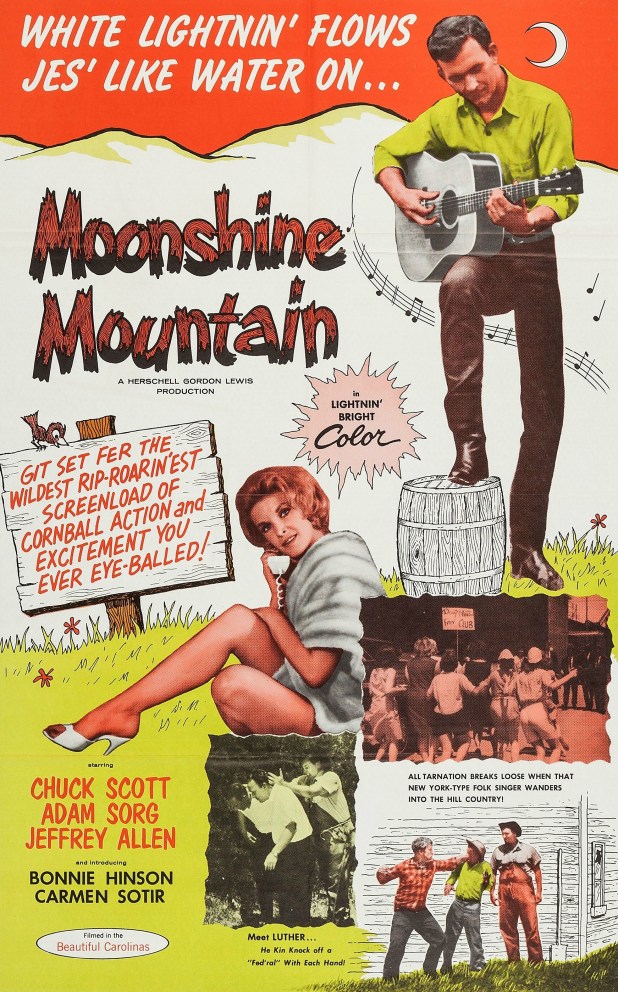
Moonshine Mountain (1964)

After the success of his gore epics, Blood Feast and Two Thousand Maniacs!, Herschell Gordon Lewis made this, the first of several country fried films. But just because this is supposed to be a sexy comedy romp doesn’t mean that Lewis won’t hit us with plenty of strangeness and lots of the red stuff.

Charles Glore, working here as Chuck Scott, is a country western star who heads back to the hills of the Carolines where within days, he’s in the middle of a feud between the government and the moonshiners. Glore also was the musical director for Two Thousand Maniacs! and wrote this movie.

The title card says “directed by Herchell Gordon Lewis, who ought to know better, but don’t.” Lewis just can’t help himself, as in the midst of the country fun, a psycho named Asa Potter is refused sex from the singer’s girlfriend and then kills her. Keep in mind that he’s also the town’s sheriff and also assaults multiple women in the film, including one mentally challenged girl that eventually fells him with an axe, which is how it works in the universe of Lewis.

This leads to the sheriff shooting people off a watertower, Charles Starkweather-style. Keep in mind this movie was made only six years after that shocking event.

Lewis also wrote and sings the main theme, “White Lightning.” As much as he would live up to the quote “I see filmmaking as a business and pity anyone who regards it as an art form,” you can tell when the man is having a good time. Moonshine Mountain isn’t a good film, but it sure is interesting in parts and it’s pretty short. More films should aspire to both points.

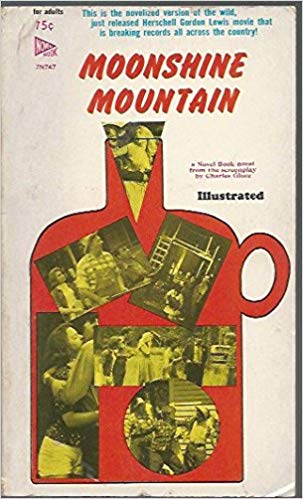
There was also a novelization of the film, which blows my mind. It’s a collector’s item today. I miss the time when every movie had a book that would go with it. Somehow, having this movie written into a novel legitimizes it.

You can watch Moonshine Mountain on Amazon Prime. I’d advise some grain alcohol to speed up the slow parts.

So we got inspired by How Rednecks Saved Hollywood…

Since getting inspired by Joe Bob Briggs’ How Rednecks Saved Hollywood live show, I’ve been trying to cover as many of the movies that he showed — as well as others that fit the genre — on the site. We’ll be continuing with at least another week of Southern fried drive-in films, but I wanted to take a moment, pause and share this Letterboxd list of where we are up until now.

Trust me, we have plenty more of these movies to get to, but if there are any you’d like to see us tackle, speak up! And while you’re at it, see if Joe Bob is coming to your neck of the woods!

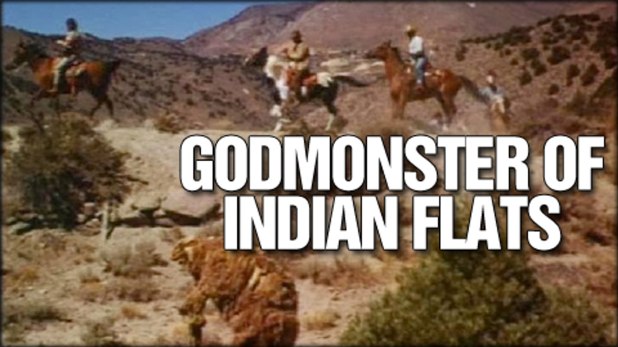
Godmonster of Indian Flats (1973)

Before he made his first movie — Troika — in 1969, Frederic Hobbs was an artist who went from the traditional to a whole way of presenting art, creating parade sculptures that took art from the museum to the people. That’s when he figured it out — to get the people to see something as art, you should hide it in a film. He also created the films Roseland and Alabama’s Ghost before this one. And honestly, nothing can prepare you for this.

Imagine if David Lynch made a 1950’s nuclear warning monster film. But before you go see it, you get in a car crash and suffer a really bad concussion. Cool. Then, someone spikes your Icee with a dose of LSD that would cripple Owsley “Bear” Stanley. You now have a very, very small idea of just how crazy things are about to get.

There are two stories happeninghere: a scientist is trying to crack the code on a mysterious sheep-like creature while a conservative landowner fights being bought out by prospectors. All in Virginia City, Nevada, which was once the richest city in America after the silver and gold rush. The mines went dry, the people went away and the only people left are tourists staring at a dead husk.

I have to tell you, you’ve never quite seen a creature quite like the Godmonster. At once it appears to be the most real and yet fakest creature ever seen on the silver screen. It very well could be one of Lovecraft’s ancient ones for all I know, as it saunters and stumbles and falters across the frame, scaring children at birthday parties and blowing up gas stations.

There’s also a subplot with a fake dog funeral. Don’t ask me how any of this ties together, because all of it has blown my mind sky high, like a Jigsaw song from 1975.

Imagine a movie where the creature doesn’t do a single thing until more than one hour into the run time of a movie under ninety minutes, all while the nonprofessional actors can’t act and the professional ones chew scenery like they’re the godmonsters of the fringe festival.

I get real down sometimes when I think the world could be a better place than it is. The Godmonster of Indian Flats proves to me that somewhere out there, at some time, in some corner of the cosmos — let’s say a drive-in that smells like skunk weed and MD40 — some brave souls had no idea what the actual fuck they were getting into when it started playing. That fact makes me happy, imagining people driving away before the movie even ends, telling their friends and family that they suffered their way through a movie where a lamb emitted smoke and gave his life so that an entire town could die. There aren’t enough stars in the galaxy and every reality ever to properly review this movie. I’ll have to go back to college to invent some kind of formula so that my fragile mind can try and quantify it.

You can get this on blu ray from the amazing and astound folks at Something Weird and the AGFA. It’s also on Amazon Prime, if you’re brave. Or stupid. But probably you should be both.