Blue Murder (1985)

It is “films” such as Blue Murder that give our beloved SOV ’80s a bad reputation because, as with the lesson in apoc-tedium that is Survival: 1990 (yes, made by Emmeritus Productions, the Canadian studio that also made this; as well as the computer-takes-over-a-skyscraper romp, The Tower), this inert John Carpenter knock off is just another mismarketed Canadian TV movie, a chunk of celluloid with the unmitigated, analog gall to dovetail its fast-forwarding poo-stank alongside our cherished, rightful SOV classics of Boardinghouse (1982), Blődaren (1983), Copperhead (1983), Black Devil Doll from Hell (1984), Sledgehammer (1983), Truth or Dare (1985), and Spine (1986). Now, as we ramble n’ praddle our SOV love, there’s a caveat: Not all were shot-on-video. Some of these VHS oddities (such as Truth or Dare) critically lumped in the SOV category were shot on 16 mm and released on video — and if it’s released in a direct-to-video format for exclusive, off-the-beaten Blockbuster Video path distribution at mom ‘n pop video stores, then it’s an SOV. Got it?
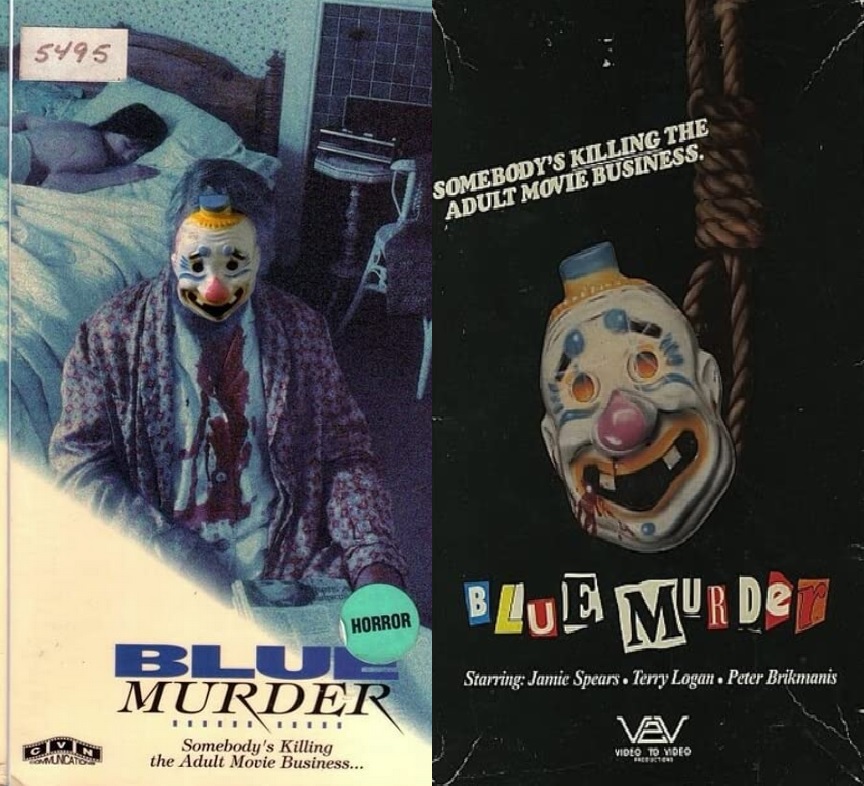
Two covers, twice the Underoos stinkeroos.

You’ve been caveated, ye dear reader, for there is nothing worse than a shot-on-video Canadian TV movie (that gives those old Dan Curtis shot-on-video ’70s TV movies a bad name) masquerading as a legitimate “made for the home video market” slasher of the superior Christopher Lewis Blood Cult (1985) variety. So let’s unpack this loaded baby diaper. And don’t let the emptor hit you in the ass on the way out when you see this grindhouse aka’ing in the VHS marketplace as The Porn Murders. And if you’re wondering what the “Blue Murder” title means, well, Google “blue movies” to find that bit of marketing brilliance.

Don’t be Trans World Entertainment duped: The Clown Murders is another stinkeroo from 1976 reissued in the video ’80s (not) starring John Candy, as directed by Martyn Burke of The Last Chase fame. Oh, yeah . . . John also made an early appearance in 1978’s The Silent Partner.

Now, you’d think with a movie with a killer adorned in a dime store, plastic-elastic Clown mask hacking up porn filmmakers and actresses — leaving them with a clown-mask calling card on their faces — we’d end up with some serious shower-after-watching sleaze n’ gore. Well, we could have — if the “Roger Corman of Canadian,” William Fruet of Death Weekend (1976) fame, was at the bow of the U.S.S Argento. Or Shaun Costello of Forced Entry (1973) fame was second mate. Or Jim Sotos of that film’s remake The Last Victim (1975) was swabbin’ the decks, ye matey. Maybe if real-life porn makers Justin Simonds and John Howard of Spine fame were in the galley.

Be we digress, again.

So, to solve the crimes, the old “hard-nose homicide cop” and “intrepid crime reporter” trope (neither are hard-nosed nor intrepid, natch) spools from the master to slave sprocket as we see our killer clown fire a gun . . . then cut to the body falling to the floor. And this goes on for eight more bloodless killings — nary a boob in sight via POV Italian black-leather gloved hands clutching a silencer. Remember how Billy Eye Harper killed all of those people in Rocktober Blood (1984) — off camera? Yeah, it’s like that. Only there’s no Sorcery tunes aka’in as Head Mistress rockers to ease the boredom.

“Sexy, slick and bloodthristy — with an amazing surprise ending.”
— CVN Communications copywriter hornswogglin’

Oh, speaking of music: There’s an opening credits-glam rock theme, “Blue Murder,” but it’s not by the band of the same name Carmine Appice put together with John Sykes of Whitesnake and Tony Franklin of the Firm because, well, Carmine was too busy with King Kobra tunes masquerading as Damien-written tunes for Black Roses (1988) rockers. There’s another sappy-as-sentimental-ass love song “Madly in Like with You,” that’s not by Girlschool — and both songs should have been ditched for Kim McAuliffe and company’s “Screaming Blue Murder” and “Don’t Call it Love.”

“Okay, R.D. Enough with the ’80s heavy metal memories. Get back to the movie.”

Okay, well, the real band in the movie is known as One Life to Live. And don’t bother, as we already researched those never-was Cannuck non-rockers and there’s nary a QWERTY-character of web-Intel. But we do know that they’re not one of “Canada’s Top 20 Greatest Bands” . . . but Nickelback and Bare Naked Ladies? Oh, Canada, what the hell. Thank god Four Non-Blondes aren’t from the Great White North . . . but April Wine, is.

Hey, maybe if our killer dressed like a kitchen worker and had a beef with Entenmann’s and killed pastry chefs and left Jelly Roll calling cards. Then add in a couple Girlschool tunes — and (real life) porn actresses in schoolgirl outfits instead of friggin’ one-piece bathing suits with feather boas — and we’d be onto a sticky-sweet something.

I know, back to the movie . . . with the only online clip available . . . from Turkish TV. Yes, this made it across the ocean into Turkey.

So, eh . . . “The Porno Killer” is on the loose and attempts to harangue Dan Blake, our resourceful crime reporter, into covering his exploits . . . or more will die. So Dan consults with Lt. Rossey, his homoerotic-implied buddy-boy (e.g., the sitting-on-the-toilet-while-I-take-bubble-bath conversation) to sift through the so-not-giallo red herrings of mobster-cum-porn producers battling for each other’s 3/4-inch tape territory and corrupt cops on-the-porn take. Then there’s the one-eyed henchman and houseboys in the mansions and on the yachts of the porn producers. And don’t forget the Catholic Priest with a psychology degree explaining why someone would don a clown mask and hot-wire bombs to beds and wine bottles. (No joke: there’s bomb-wired libations.) There’s not even one of the 24th letters of the alphabet here, let alone three; but there’s a whole lot of Zzzzzz that take us to that “amazing” twist ending. . . .

Alas, the only “twist” we care about: Is the Jamie Spears starring here — in his only acting role as our intrepid reporter Dan Blake — really the father of Britney and Jamie Lynn Spears? The Magic 8-Balls of the web say, “YES” — but there’s nothing amid the web-myriad of Spears digital ephemera that states that fact. And I’m looking at both Jamie-stills and I’m not seeing the resemblance between the actor and the dad. If it is Brit’s pop — eh, is it — no wonder this was his only movie and he leeched off his daughters, aka he’s awful at acting. Really awful. And wouldn’t it have been funnier — and this film needed a dash of comedy, if anything — if the football jersey Danny-boy perpetually wears throughout the film was number “69” (yuk-yuk) instead of 66? Ah, but “66” is the numeric code for spooning . . . which makes Danny’s downward stare and Lt. Rossey’s leg hike in the tub even more distributing . . . jokes about sexually denied spherical objects in one of the three primary colors between violet and green, be damned.

“Oops, I’m lookin’ again.”

The name of Charles Wiener — considering the material — is no joke: he’s a real person who, after this writing and directing debut — wrote a Canadian not-Police Academy ripoff Recruits (1986) that only has the presence of Jon-Mikl Thor (Zombie Nightmare) to recommend it, as well as writing and directing the-Police Academy-set-inside-a-fire station-ripoff Fireballs (1989). Did you see Wiener’s Animal House-cum-Porky’s inversion, Screwball Hotel (1988)? Neither did we . . . DOH! We did? But if you’re a martial arts completionist and need a Canadian not-starring Jean-Claude Van Damme rip, there’s Wiener’s third and final directing effort, Dragon Hunt (1990), for your shelf. (No, I will not review the dogger that is Dragon Hunt, for I’ve choked down enough wieners for one day.)

Hmmmm. This sounds like another B&S About Movies gauntlet drop. But Sam never answered the Robert Clouse Gymkata (1985) challenge, so my Dragon Hunt throw down to complete the Wiener catalogin’ at B&S is for naught.

Okay, time for a nice cup of Green Tea and a slice of Entenmann’s Pound Cake, hold the crappy-ass Van Hagar not-a-pastry ode. Excuse me, could you pass a spoon? You’re lookin’ mighty fine in that numero “66” jersey, big fella.

Fork me, R.D. out.

About the Author: You can read the music and film reviews of R.D Francis on Medium and learn more about his work on Facebook.

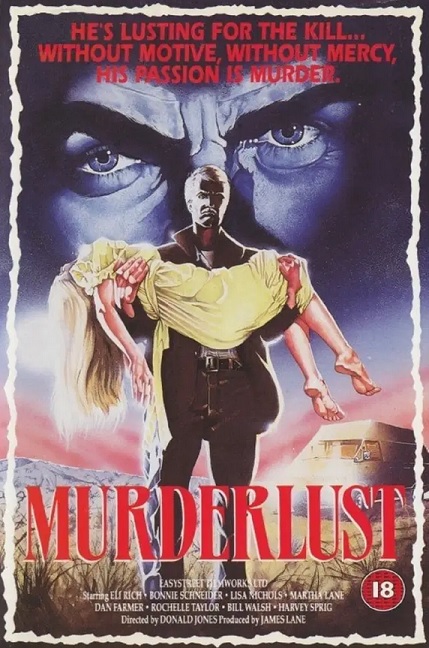
Murderlust (1985)

Indiana poet James Whitcomb Riley was long gone by the time of 16mm and SOV backyard filmmaking. But his rule regarding quacking ducks applies: If it looks like an SOV and quacks like an SOV . . . well, I’ll call that 16mm bird an SOV duck.

So, yeah. Technically speaking, Murderlust isn’t a shot-on-video water fowl that falls under the “SOV Week” theme week we’re rolling at B&S About Movies, as it was shot on 16mm film in the 1:33:1 aspect ratio and released in a direct-to-video format by Prism Entertainment — the home of the (annoying) side-opening VHS box (give me clam-shells, give me a “Big Box” with the crinkle-plastic tray, or bottom-loading sleeves, but not side flaps).

As with the work of Don Dohler — who also shot on 16mm (and seen theatrical releases with his films; see The Alien Factor), but is name-dropped often in discussions regarding SOV filmmaking — Donald M. Jones shot in 16mm (but seen only direct-to-video releases), but all of his film — from their VHS images on the tape to the artwork encasing the tape — ooze the same SOV sleaze of films shot on 3/4-inch U-Matic tape via broadcast ENG and Ikegami cameras. Courtesy of that video-tape technology, Boardinghouse* (1982) became the first shot-on-video feature-length horror film. Shot direct-to-video tape, Boardinghouse was transferred to 16mm, then blown-up to 35mm for limited theatrical exhibition. David A. Prior — who’s a pretty big deal to us Allegheny County cubicle farmers on the celluloid pastures — shot his debut feature film, Sledgehammer* (1983), on video and released direct-to-videotape.

The grainy, 16mm documentary vibe of Murderlust that we watched on VHS didn’t receive its less-than-stellar, grainy “atmosphere” from being “road showed” via Drive-In reels emulsion-scratched to hell and back again, and again (or from cinematic incompetence; it’s actually well-shot and edited). It was because of that cover — and the subsequent write-ups in our pulpy horror movie mags, Murderlust (like Blood Cult and Spine issued in 1985 and 1986), received its celluloid battle scars courtesy of its incessant rental-replays on the ‘80s home video market beating it to hell and back again, and again. Murderlust was a movie, with one, singular-stocked store copy: always rented out, damn it — the in-the-plastic sleeve-cased box perpetually perched on the shelf with no VHS tape tucked behind it. As with Romero’s The Night of the Living Dead, the “to hell and back again” consumer processing (first via drive-ins, then UHF-TV, then VHS for Romero’s zom’er), lent, more so, to the documentary-grainy quality of Murderlust — and left it looking oh so SOV-ish . . . even through, er, that bird ain’t a duck.

Paul Zamarelli of VHS Collector comes through with the clean image of the original cover.

It was the hazy, grey days of filmmaking, adrift somewhere between 16mm giving away to video tape technologies, while drive-ins felt the financial pinch of the burgeoning home video market — with its confounded contraption called a “VCR” that played something called a “VHS tape” — that provided a more cost-effective and marketing-effective format. The new format was so effective that Christopher Lewis wowed us VHS dogs when he shot his debut film, Blood Cult, on video for exclusive direct-to-video distribution — a pioneering first. Films such as Cliff Twemlow’s GBH and Justin Simonds’s Spine were marketed on “mainstream” imprints backed by porn producers to get in on the home video horror game, as well.

Unlike most SOV filmmakers, director Donald M. Jones managed to make more than just one self-financed backyard film. “Backyard,” if that term is new to you, is a pre-SOV term — one that also came to encompass shot-on-video films — reserved for films shot on Super 8 or 16mm that were produced on shoestrings with friends, relatives, and neighbors — each lacking in their own levels of disciplinary professionalism — that were literally shot in the backyards of the filmmaker and whomever was shanghaied into the film. In the case of Murderlust: the “backyard” was California’s Mojave Desert, while scenes in the church and bar were shot in and around metro-Los Angeles — on the sly sans permits, which is a part of the “backyard” modus operandi.

Jones got his start with Deadly Sunday (1982)**, then followed up Murderlust — his best known and distributed film — with Project Nightmare (1987), and Housewife from Hell (1993) — then vanished from the home video tundras until the direct-to-video release of Evil Acts (2015). Unfortunately, as with John Carpenter, Don Coscarelli, and Sam Raimi before him — and stymied by the direct-to-video marketplace — Jones’s slasher ’80s-era films failed to achieve a Halloween, Phantasm, and The Evil Dead-styled connection with horror audiences (the fate that cursed the really fine The Redeemer issued around the same time). Only fans of the most obscure low-budget horrors remember Jones with the same celluloid-cum-analog vigor as David A. Prior, who’s noted for the aforementioned Sledgehammer, or John Wintergate’s Boardinghouse and Christopher Lewis’s Blood Cult.

Overseas VHS issue. Nah, too giallo for a film that’s not a giallo and looks like a past-his-prime Fulci or Martino romp. Give me the ol’ U.S. sleeve.

Murderlust is a movie that takes this QWERTY warrior back to days of those cardboard-musky vinyl repositories of old, aka, record stores, when we purchased record albums — primarily metal albums — strictly for their cover art, with nary a clue as to the band’s lineage and backstory. And we rented — or aftermarket purchased — VHS tapes on the same principles. And sometimes the music under the artwork (such as buying the New Jersey-indie After the Bomb by Hammers Rule) was just as “meh” as the movies inside the VHS case.

Such is Murderlust: the cover is great, but the movie is a hard slice of dry, white toast with no butter and hold the grape jelly packet. For a cover that shows a woman violently strangled, there’s very little strangling afoot, here — and none of the sleazy n’ scuzzy, over-the-top SOV splattering after taste of the Snuff Kill variety. Our resident murderluster is no Mancunian cutting a GBH swath across London, well the Mojave, in this case. Instead, we get two strangles, with the rest of the kills off screen and bloodless (our killer buys a newspaper with the headline: “9 bodies found in the desert”). Instead of John Carpenter giallo-suspense (Halloween) or Sam Raimi graphic-to-dark comedy (the first The Evil Dead, not the meh remake-sequel), we get a character study. To pinch Alice Cooper, “the man behind the mask,” as we “study,” is a psycho who doesn’t enjoy, but struggles with, his “murderlust” of kidnapping, raping, and desert-dumping women — while he maintains a (crappy) job and even begins a “normal” heterosexual relationship.

And that’s the sole strength of Murderlust: Steve Belmont, our church-attending security guard who serves as a Sunday School teacher and elder tortured by his psycho-sexual impulses, isn’t just some mindless, supernatural hockey-masked maniac who cuts a Krueger swath across the Mojave. Screenwriter James C. Lane — who penned all five of Donald M. Jones’s films — intelligently ditched the slasher-blueprint to give us one of the slasher ’80s best-arced, non-trope characters. Belmont is a man who Jekyll and Hydes as he’s denied sex by his dates (he’s a nice guy, but a security guard at a guard gate — “. . . you’re cool and so is your job, but you’re just a DJ,” they’d preamble their R.D-dump), he’s plagued by financial issues, his cousin’s criticisms grind him down some more, his boss enjoys writing him up, and he’s accused of sexual misconduct by a misguided teen at his church when he’s promoted to a counselor’s position.

For whatever reasons, Jones made an artistic choice not go nude or graphic, as is the case with American slashers and giallo-imports in the ’80s — be them SOV or 16 mm backyard. (While graphic, not “going nude” — considering its porn-linage — is what scuttled Spine; going “nude” and “uber-graphic” is what made Blood Cult a hit.) While that artistic choice makes for a pseudo-boring film, it also leads to an authentic, grimy film. But grime is not goo and strangling is not slashing (unless it’s Don Dohler’s red cloud-infected, strangulation killer in Fiend) and, without the goo and the slash, we’re in a damsel-in-distress “final girl” finding-her-inner strength flick that, today (under the eyes of Fred Olen Ray and David DeCoteau!), are pumped out at ad nauseam program-replays on Lifetime (David D.’s most recent is The Wrong Valentine). And since those telefilms are void of grime and never go “goo,” well, you know how a Lifetime flick goes: yawning from unknown Canux actors (sometimes in vanity projects, pushin’ themselves, if not their Kardashian-sytled brats) frolicking about Toronto masquerading as Anywhere, U.S.A., ensues (such as the channel’s 2021 “Shocktober” entry, Seduced by a Killer).

In the end, while actor Eli Rich is head and shoulders above most backyard and SOV-era actors to sell the inner struggles — and everything is decently scripted and well-shot — Steve Belmont is no Frank Zito cutting his own mannequin-murderlust swath in the best of the Carpenter-inspired slashers: William Lustig’s Maniac (1980). If Murderlust went for that Maniac-styled depravity, we could have had a precursor to John McNaughton’s truly chilling Henry: Portrait of a Serial Killer (1986). That based-in-reality film bastardly-birthed out of the exploits of Henry Lee Lucas; Murderlust chillingly predicts the backstory of Dennis Lynn Rader, a church elder and common working man (ironically: home security systems) who lead a secret life as the B.T.K Killer between 1974 to 1991. (Gregg Henry of The Patriot and Hot Rod chilled us with his portrayal of Rader in a 2005 CBS-TV movie.)

The VHS of Murderlust was highly edited (and I never found an uncut version, if there even was one) — which degraded Steve Belmont’s secret life to a serial killer cut loose in a TV movie (even a police procedural TV series; thus our Lifetime comparison). The Severin restoration reissues the film with those scenes intact. I’ve haven’t the pleasure to see this “as intended” version, so perhaps those restored scenes may pique your interest to add Murderlust to your DVD/Blu collection. Plus, you’ll learn more about the film courtesy of writer James C. Lane’s commentary track.

You can view the Serverin Films’ age-restricted trailer and 1985 VHS trailer on You Tube. You can stream a VHS rip of the 1985 version of the film, also on You Tube. There’s also an upload on Tubi (which runs non-aged restricted) — with the Severin rebooted artwork as the upload avatar. However, the You Tube and Tubi uploads are both fuzzy and washed-out and of the same running time — and the same ’80s VHS cut of film.

* Those whole enchiladas of Boardinghouse and Sledgehammer are on the way, so look for ’em! Put in the effort and use that search box, buddy. (See, we did ’em! No searchin’ no more. Click the links!)

** Not be confused with the revenge-seeking pastor romp that is Dark Sunday (1976).

About the Author: You can learn more about the writings of R.D Francis on Facebook. He also writes for B&S About Movies.

Bits and Pieces (1985)

If Leland Thomas, an ex-army combat photographer in his lone writing and directing effort, wanted to blow out all other SOV horror films released in the wake of Boardinghouse (1982; that review is coming!) — the first home video-era shot film — then he succeeded. (Blood Cult was the first SOV video store-only distributed film; Boardinghouse, while making it to the stores, began as a mail-order only release.) This is graphic, gruesome, crude, rude, and scuzzy. While Bits and Pieces is remembered as an SOV — and quacks like an SOV — it wasn’t shot-on-video, but on 16mm film in the summer of 1985 in and around Los Angeles — Burbank and the San Fernando Valley, in particular. But, no matter. Bits and Pieces is still an SOV’er forever in our VHS-pumpin’ hearts.

The overseas VHS of Bits and Pieces: a gagged, beheaded woman? Punch the membership card. We’re weird that way.

The set up is pretty simple: someone is killing the patrons of a male strip review, cutting them up into “bits and pieces,” as we are advised by the most unlikely news reporter to ever hit the field. Bits and Pieces is either incompetent or — in a Tommy “The Room” Wiseau twist — intended to be “bad” to push the funny to soften the graphic X-rated gore. And this film is gore and a bag o’ chips. Is this a pseudo-porn, like Spine? No, but there is bondage, as was in Spine. But the cheesy porn-esque music is “wah-wah’in” everywhere. But this is less Spine-bondagey and more Dead Girls-slashy. Oh, and our killer hears “wind chimes” in his head, we think; unless that was an artistic choice by the soundtrack composer (who’s connected to Spine; more on that later). Yeah, that’s it. This movie isn’t that “high” on the art to go “subjective” into the killer’s head.

So the “someone” is Arthur, and he has Norman Bates not-an-average-guy issues with his mommy — and he lives just down the street from head scalpin’ Frank Zito who plops hairpieces onto his mannequin collection — which leads Artie to carry conversations with an armless mannequin adorned in a red wig. Of course — in his mind — the mannequin talks back, berating him that he’ll never find a girl as pretty as her.

Man, does this film have the padding — no pun intended. There is a LOT of male stripping in this film. And lots of beat-up looking babes hootin’ and a tootin’ it up. That’s where we meet Tanya — the psych undergrad, natch (Sheila Lussier) — and her friend Rosie (Suzanna Smith) as they leave the “2001” strip club (a homage to 2001 Odyssey, the club in Saturday Night Fever, perhaps). So, one blow to the head later, and Tanya’s kidnapped. And our red-headed mannequin tells little Artie “how” to inflict the pain in his homespun Grand Guignol.

So Tanya ends up in a dumpster and makes the papers. Rosie goes to the cops. And we get our required, dry-as-toast inept cop in Lt. Carter. And we have another girlfriend, Jennifer (Tally Chanel), and it looks like Arthur has got some more kidnappin’ for faux-mommy mannequin to attend. And there’s a lot of “ensuing” in this film: Jennifer screaming and flailing through the woods. And while murders are afoot, Rosie goes on beach dates. And there’s hot tube interludes. And male strippers. And glasses of wine. And nary a one worried about a strip club-stalking serial killer. Yikes, and I thought the people in Stallone’s D-Tox were dumb, always putting their eyes up to peepholes at every door knock and door bell — with a serial-killing peephole-driller on the loose.

Lovely.

Well, this sure ain’t Bill Lustig’s Maniac (1980), because Bits and Pieces doesn’t have that film’s unsettling “creep” factor. And it sure as hell ain’t Alfred Hitchcock’s Psycho and doesn’t have anything from that film. If only our dippy Lt. Carter was Charles Bronson’s Leo Kessler and S.E Zygmont (Arthur, our serial) was Warren Stacey from J. Lee Thompson’s 10 to Midnight (1983).

But you know what: I love this movie: Leland Thomas is Wiseau-committed to giving us a deep psychological study into his poor, hapless killer f’d up by an abandoning dad and floozy mom. To that end, through flashbacks — because this ain’t no Jason Vorhees-cum-Micheal Myers just-kills-for-killing slasher romp — we learn the whole mannequin snafu with the wig n’ lipstick thang is because, as a form of punishment for spying on her and interrupting her boozin’ it up, she forced Artie to wear a wig and make up. Oh and the salami scene. Mommy taunts little Artie with summer sausage meats. And she turns into a bloody skull in a wig screaming at him. Yeah, NOW, I can’t help but think of Wesley Stuart, portrayed by Gerald “Simon & Simon” McRaney inflicting his own Night of Bloody Horror over his mommy issues. And that J.N Houck cardboard horror is bad, but is looking a lot better to me now — especially in the acting department — after my sitting in our Arthur’s flashback counseling sessions. And, like Wessy-pissy pants in that film, Artie kills mommy. The rest will be plot spoiling. . . .

So, is there life after Bits and Pieces?

Remember the Spine soundtrack Easter Egg we dropped? Don Chilcott, the musician responsible for Spine’s scuzzy, slasher-appropriate synth-soundtrack, also scored Bits and Pieces. Don never stopped rocking: he became a successful studio musician and a respected guitarist and lead vocalist for several California-based blues bands.

Remember, in our review of Peter Carpenter’s Point of Terror, when we discussed that everyone — even in Hollywood — has to start somewhere, and Oscar-winning editor Verna Fields, who worked for Pete on the film, later earned an Academy Award for her work on Spielberg’s Jaws (1975) and edited American Graffiti (1973) for George Lucas? Well, producer Richard Bansbach also worked on that influential shark fest’s second-unit for the film’s land-based shots; he also directed the Jaws-rip, Claws (1977). (Nope, not Islands Claws. That was in 1980 and a different, but sorta-the-same, movie. Well, the first was a bear, the second is a crab . . . oh, never mind!)

The BIG KAHUNA of the cast and crew is Thomas L. Callaway. He worked as the cinematographer on the USA Network favs Creepozoids and Slumber Party Massacre II (both 1987), as well as Friday the 13th Part VII: The New Blood (1989). And Callaway is still at it — 120-credits strong — with a lot of Lifetime movies, and is David DeCoteau’s go-to camera man for the likes of A Husband for Christmas (2016) and A Christmas Cruise (2017). (Yes, we have a Lifetime and Hallmark and Up Channel X-Mas flick fetish goin’ on at B&S.)

Did you see Chuck Vincent’s Warrior Queen (1987)? Well, that was Suzanna Smith’s only other role; Tally Chanel, who did a few of Chuck’s movies, was in that, as well. (Chuck’s done 55 T&A soft-porn flicks that ended up on Showtime or the USA Network in the ’80s; you’ve seem a couple of them, such as Bedroom Eyes II.)

Now, Sandy Brooke, who plays Ms. Talbot, Rosie’s (Suzanna Smith) tweaked mom . . . oh, do we ever know her around the B&S About Movies’ cubicle farm! She was an SOV warhorse, as she also appeared in David A. Prior’s SOV debut film, Sledgehammer*, as the lead, Taura. (Visit our week-long tribute to him; just search his name on our site and you’ll find all of his films.) Sandy was also in Fred Olen Ray’s Star Wars-dropping Star Slammer (1986), Ron Marchini’s directing sidekick Paul Kyriazi’s One Way Out (1987) (Join us for our two-day Ron Marchini tribute with this career wrap up), Terror on Alcatraz (1987; with Aldo Ray as Frank Morris!), and she ended her career with (YES!) David DeCoteau in Nightmare Sisters (1988; with Linnea Quigley, Brinke Stevens, and Michelle Bauer!).

Denied. No trailer to share, but wow! VoicesInMyHead does it again, as you can watch Bits and Pieces — uncut — on their awesome You Tube page. Spend some time there, as they have LOTS of great ’80s VHS oldies to enjoy.

* That review on the BIG KAHUNA of SOVs that is Sledgehammer, is coming. Oh, you know it. Search for it. Oh, already linked it!

About the Author: You can learn more about the writings of R.D Francis on Facebook. He also writes for B&S About Movies.

Formula for a Murder (1985)

Also known as 7. Hyden Park – La casa maledetta (7 Hyde Park – The Cursed House), this movie comes to us from Alberto De Martino, the man who made The AntichristStrange Shadows in an Empty Room, Miami Golem and Holocaust 2000.

David Warbeck plays Craig, who has recently married Joanna, a woman crippled by mental and physical issues. Well, she’s in a wheelchair, but still comes to him to learn fencing and archery, so she’s trying to stay active.

That said, there’s something horrible that’s happened in her past, but guess what? Something horrible is happening now too. That’s because after Craig gets that ring, he plans on killing her for her riches.

That horrifying event, by the way, was when a faceless priest tried to give our heroine a doll and then decided to take things a little too far. As he chased her, she fell down the steps and broke her back, which is why she’s in a wheelchair now. And as for the priest, he may be dead or he may be the person who is dressed in vestments and carrying the doll from her childhood.

Also: there’s a good chance that if Craig churns some butter with her, she’ll have a heart attack when her body relives the abuse. I can promise you that there was no mental health counselor or expert on this film to verify this diagnosis.

If the house that is so cursed looks familiar, that’s because Phantom of Death and Body Puzzle were both shot there. Also, if your ears hear something they have before, that’s because Francesco De Masi decided to reuse some of his theme for The New York Ripper and thought that no one would notice.

Silip Daughters of Eve (1985)

On the beautiful and remote beaches of Ilocos Norte, three women struggle to come to terms with their own carnal nature while coming up against religious repression and male brutality in this movie that more resembles a Japanese Pinky violence movie than something from the Philippines.

Tonya (Maria Isabel Lopez, a former Miss Universe Philippines) and Selda (Sarsi Emmanuelle) are sisters, but they are diametrically opposed to one another. Tonya is repressed while Selda has already bedded an American lover and is now after Simon, the man that Tonya loves and keeps turning down.

I have no idea how this film escaped the Marcos regime and no clue how it is somehow both a powerful examination of the way that religion can destroy and also one of the sleaziest movies I’ve seen. Also, for those of you who are disturbed by real animal violence, I would fast forward the movie about five minutes from the start and just catch up.

The Mondo Macabro blu ray release is the worldwide HD debut of this movie. It comes complete with commentary from Filipino film expert Andrew Leavold, a new interview with Sarsi Emmanuelle and interviews with Maria Isabel Lopez, director Elwood Perez and the film’s art director Gerry Pascual from the previous Mondo Macabro DVD version of this motion picture.

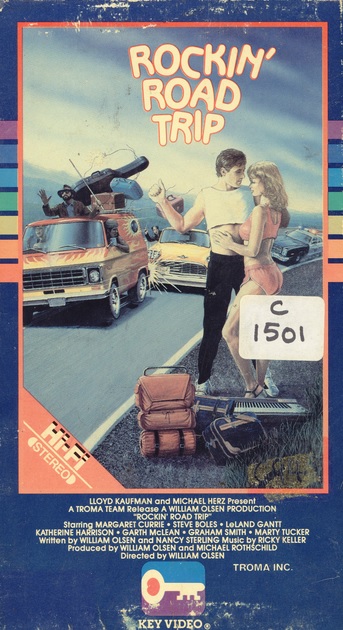
Rockin’ Road Trip (1985)

Between the years of 1983 and 1997, writer/director William Olsen gave us four films: Getting It On (1983; creepy, sex-starved T&A teens partaking of video technologies; originally known as American Voyeur), Rockin’ Road Trip (1985), After School (1988; a Sam Bottoms-starring, forbidden teacher-student mess that took four screenwriter to get made), and the final film, Southern Belles (1997; that looks like a Cinemax soft-porn romp, and probably is).

We will probably never review — because we never searched them out (then or now) — the remainder of Olsen’s resume, and are only here due to Sam the Bossman inspiring a little celluloid archeology as result of devising another “Rock n’ Roll” theme week. And that we relish scrapping barrel bottoms. And the fact that Leon Rippy co-stars.

A Key Video/20th Century Fox joint backed by Troma? Watch the trailer and promo clip.

So, have you ever spoken the phrase, “The soundtrack is better than the movie?” Well, that’s the case, here, as props are to be given to Olsen for at least pulling together an ’80s college rock soundtrack dream — courtesy of Landslide Records, the distributor of college rock stalwarts, dB Records — with R.E.M’s fellow Athens-based bands Guadalcanal Diary (who also stars, here), Love Tractor, Pylon, The Heartfixers (featuring noted blues guitarist Tinsley Ellis; managed by Michael Rothchild, president of Landslide Records), Marianna Pace, and . . . the Cheryl Wilson Band (?) (handled by Michael Rothchild via his Frozen Inca Music-imprint).

Since we have a real band in Guadalcanal Diary doin’ the cameo thing, we need to bring up our “Ten Band Cameos in Movies” featurette.

Hey, forget about the soundtrack! Did you say “Leon Rippy”?

We did.

Yes, this lost VHS’er — also known as Summertime Blues (nixed after Warner Music objected to the use of the old Eddie Cochran tune as a title; yeah, the same tune covered by Blue Cheer and Hendrix; the version butchered by the Cheryl Wilson Band is an original and not a cover) — stars the very same Leon Rippy who starred in seven Roland Emmerich movies: Moon 44 (1990), Eye of the Storm (1991), Universal Soldier (1992), Stargate (1994), The Thirteenth Floor (1999), The Patriot (2000), and Eight Legged Freaks (2002). Not only did Rippy begin his career with Rockin’ Road Trip (his 9th role — and biggest part, to date), he also had support roles in King Kong Lives (1986) and Young Guns II (1990). Why yes, that is the Rip starring as Tom Nuttal in HBO’s Deadwood. Hey, all actors gotta start, somewhere — remember Oscar-nodded John Hawkes starting out in the apoc-slop that is Future-Kill?

Oh, and for some reason: this film has a freaky connection to Stephen King.

Not only was one of Rippy’s earliest character-support roles in Stephen King’s Firestarter (as “Blinded Agent”), (the late) Steve Boles, who stars, here, also got his start in Firestarter (as “Mailman”), while actor Graham Smith, who stars as Ivan the Angry Punk, followed up with a role as “Porter Zinneman” in Silver Bullet, and actor Martin Tucker, here as Lenny, was a featured background actor in Maximum Overdrive. (The rest of the actors in the film are done-and-gone.)

Now, let’s see if we can sort out this confusing plot of rock bands, psycho boyfriends, blind street preachers, we-think-we-murdered-him runaways, mistaken-identity jewel thieves, stolen $5000 cash-stashes, and you have-to-come-home-because-dad-is-sick hijinks. And we say “hijinks,” because, even with the plot points of murder, larceny and terminal illness, this is still, yes, a comedy — bankrolled by Lloyd Kaufman’s Troma shingle.

We have another rock n’ roll tale of (the later) The Runnin’ Kind (1989) variety, with Martin: a lonely n’ horny college era ne’er-do-well who, this time, travels from Boston to (another) a college rock hotspot in (Chapel Hill) North Carolina (yes, and bands are from Athens) all for love of Nicole, the lead singer of his favorite band, Cherry Suicide. In his attempt to meet Nicole, Martin, instead, hooks up with Nicole’s sister, Samantha (with one sister, but pining for the other; been there, done that) and gets wrapped up in their personal drama (been there, done that, too).

If you need more fake rock bands, we discuss them in our “Ten Bands Made Up for Movies” featurette.

And Martin runs afoul of the trope-laden hot Nicole’s Ivan, her trope-laden crazy-ass-frack boyfriend (with bad haircut to match the bad thespin’). Nickie and little sis get the drop on Ivan the Hammy during one of his abusive-psycho rages, gives him a good whack on the noggin’, and steal his ill-gotten stash of five grand. So, now, the sisters need to split town — and recruit Martin to head on down to North Carolina.

But why North Carolina, of all places?

Well, turns out the sisters’ dad is terminally ill, so they’ll just bring their murder-robbery drama (Ivan’s not dead, after all) into their mom and dad’s home. You gotta love the family-love.

Oh, and Martin brings along his blind, street preacher buddy, Wally, because, well, a gang is loose on the streets randomly beating up street beggars in a crazed search for a valuable ring — one that ended up in the panhandling cup of a beggar: Wally’s cup. (Oh, Leon Rippy runs the seedy, Virginia hotel that Cherry Suicide and friends checks-in; the new wave caterwauls of the Cheryl Wilson Band doubles as Cherry Suicide.)

You got that?

Yeah, as you can see, this film — sans a somewhat cool soundtrack (the Cheryl Wilson stuff is utterly awful; couldn’t you get Josie Cotton from Valley Girl, at least) that was never officially released — is a hot mess (with plenty of comedic musical montage fillers to pad that run time, as if the rock band scenes weren’t enough). Yeah, this ain’t no Cotton Candy. Where’s the deliciously dickish Torbin Bequette — in place of Ivan the Crappy Actor — when we need him?

Dude, this movie needs some Torbin Bequette and Rapid Fire! And some George Smalley and Cotton Candy in place of Cheryl the Terrible.

What’s not a (Troma) mess is the cinematography and sound; this is a well-shot film, courtesy of Austin McKinney — winding down his long career begun in the early ’50s. In addition to working on a few films with Jack Hill (Fear Chamber, House of Evil, Pit Stop, Isle of the Snake People, Alien Terror, Sorceress), McKinney designed the visual effects in Escape from New York and The Terminator, and worked in the sound department on A Nightmare on Elm Street and Hellraiser III. You’ve also seen his camerawork in work in Galaxy of Terror, Jaws 3-D, and (radio station romp) Redneck Miller. McKinney also shot Olsen’s Getting It On and After School (so maybe they’ll be worth digging up, after all).

You can pick up copies of Rockin’ Road Trip on DVD by VCI, which features a stills gallery from William Olsen’s personal collection (with his voice over), as well as a 20-minute interview vignette with Olsen, who tells us the film was planned as a larger scale project — with Ellen Barkin as the rocker chick and Peter Riegert as the love-struck artist. Considering Barkin was in Eddie and the Cruisers and Riegert was in Animal House (this film’s dual, raison d’être ______ “meets” ______ pitch) that would have been something to see. But financing issues stymied their castings . . . and we ended up with a bunch of never-heard-of-or-seen-again North Carolina theatre actors.

So, with $20,000 bucks in his pocket, Olsen gave us this rock ‘n’ not-roll excuse for a T&A sex comedy — one that so wants to be Porky’s, but can’t make the grades to get into Faber. But hey, Rockin’ Road Trip ended up as a USA’s Up All Night weekend-overnight programmer, and that’s not bad return on the investment of two Salmon P. Chase greenbacks.

Yeah, thanks to The USA Network, it was something to do on a dateless Saturday Night — once you had your fill of Riki Rachtman frackin’ up MTV’s Headbangers Ball (dick). But as with the abysmal Hail Ceasar and Splitz, both which we reviewed this week, Rockin’ Road Trip is another not-rockin’ flick you watched once (well, twice, if you have to write a review for it) and you never go back home again. But, hey, you can stream for a retro $2.00 rental on Amazon Prime — and get the DVDs (with crappy art work) at Walmart (for the VHS sadist in you). (Oddly enough, back when my local public library carried VHS tapes, a copy Rockin’ Road Trip — probably a patron donation — was on the shelf.)

You say you need more ’80s college rock of the Georgia peach variety? Then check out Love Tractor — and many others — in the documentary (and released soundtrack) Athens, Ga. Inside/Out (1987; there’s bits n’ pieces of it on You Tube). If you need another errant college-cum-new wave band showing up in a film (with a band that had an actual commercial radio hit), check out the Plimsouls doing “A Million Miles Away” in Valley Girl. Hey, almost forgot! If you want to see another (superior) North Carolina band rockin’ it up in a movie, check out Fetchin’ Bones with “Love Crushing in (the radio romp) A Matter of Degrees. (Yeah, if only we had John Doe of X and Hope Nichols of Fetchin’ Bones in the roles originally meant for Ellen Barkin and Peter Riegert . . . oh, well.)

If you need more Teen Sex Comedies — and don’t we all — be sure check out our “Drive-In Friday: Teen Sex Comedies” featurette.

Oh, when college rock began . . . the sweet sounds of youth. Real life sucks . . . as these clips from R.E.M’s first TV appearance from 1983 and these clips of Guadalcanal Diary on the film’s set and the film’s finished scene, prove.

About the Author: You can learn more about the writings of R.D Francis on Facebook. He also writes for B&S About Movies.

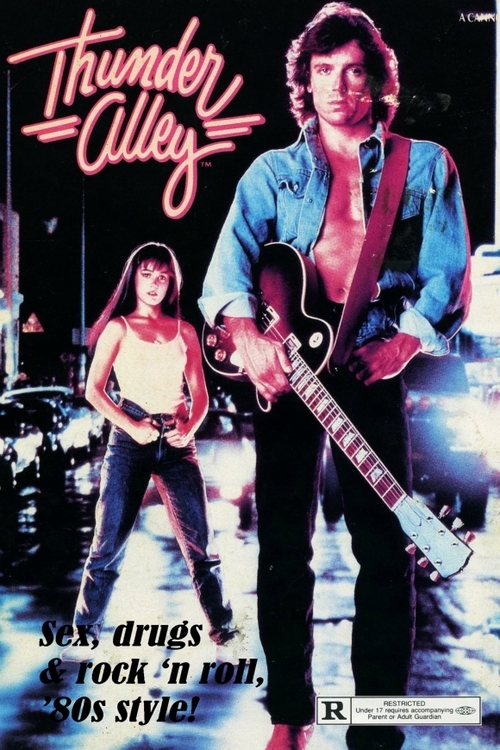
Thunder Alley (1985)

Roger Wilson, the star of this movie, lost his parents at a young age and inherited several million. He graduated Woodberry Forest School in 1975 with Marvin Bush, the brother of the former President, and had a pretty astounding life, marrying Estée Lauder model Shaun Casey before dating Christy Turlington and Elizabeth Berkley, which was the reason why a member of Leonardo DiCaprio’s circle of friends punched Wilson in the throat and damaged his larynx so badly that he never sang again. You can read more about that in a past review of this film.

Anyways, Roger is Richie in this movie, the working class kid who becomes the guitarist and singer of the band Magic and also the boyfriend of Beth (Jill Schoelen). You know, if you’re a touring musician and dating Jill Schoelen, you should just settle down and not do too much more. You’re already so far ahead of the rest of all humanity.

Richie has taken the lead role from Skip (Leif Garrett, who knows a thing or two about rock and roll and drugs). Donnie, the keyboard player, is the one who gets into the drugs so badly that he just doesn’t make it. But it’s not all rough. I mean, the band has Clancy Brown — the Kurgan — as their road manager!

Director J. S. Cardone also made The Slayer, a movie that makes no sense so much that I love it, and the direct to video sequel to 8mm. He also directed ShadowzoneA Climate for Killing; Black DayBlue NightOutside Ozona; True Blue and Wicked Little Things.

Shot in Tucson, Arizona — using some of the same locations as The Wraith and Harley Davidson and the Marlboro Man — with local band Surgical Steel* showing up to play, Thunder Alley isn’t the best rock and roll movie there is. But you know, you could microwave up some food and have your own rib fest while you watch it.

*Their singer, Jeff Martin, sang in Racer X and played drums for Badlands after Eric Singer left. He’s also worked with Paul Gilbert and Michael Schenker quite often.

Shadey (1985)

What do you get when you put writer Snoo Wilson and director Phillip Saville (Crash: The Mystery of Flight 1501), two Shakespearean-trained and BBC-TV nurtured chaps, into a room to create a project for an always worth the price-of-admission Patick Macnee? You get an obscurity that had its last television showing in its native U.K. on Channel Four in April 1998; in Australia in 1996. As with the recently reviewed Mill Creek The Excellent Eighties box set programmer, Blunt, the Fourth Man (1987), Shadey was part of Channel Four’s efforts in making movies for television and theatrical release.

So, with a touch of David Cronenberg’s Scanners (1981) and a pinch of Videodrome (1983), and a soupçon of Brian De Palma The Fury (1978), and, why not, a dash of Douglas Trumbull’s Brainstorm (1983), we get Oliver Shadey: a sexually-frustrated, lonely car mechanic-owner of a bankrupt garage who decides to cash-in on his ESP abilities.

Our man Shadey (Antony Sher, from Monty Python’s Erik the Viking to Joe Johnson’s The Wolfman) isn’t your run-of-the-mill clairvoyant: he can visualize anything happening in the world — as well as see into the future — and transfer those images to film. So Shadey makes a deal with Sir Cyril Landau (Patrick Macnee), a wealthy British industrialist — who subsequently sells him out to British Intelligence for his own person gain. Oh, and it’s not just personal and business bankruptcy that drives Shadey’s greed: he needs the money for a sex change operation.

Oh, by the way: this is a comedy.

We know this is a comedy, not because of the sex change operation angle, but because Shadey runs around with a camera strapped to the side of his head. And because the film opens with aerobics porn. And there’s a goth-punk band video shoot with shapely women swingin’ hoola-hoops — while adorned in gas masks. And Sir Landau may be in an incestuous relationship with his daughter. And Shady cross-dresses and dates an older man. And the film co-stars noted U.S television actress Katherine Helmond (Soap, Who’s the Boss, and Everybody Loves Raymond), who’s not exactly know for her work in serious, dramatic roles.

So, what’s with the camera and how did Shadey and Sir Landau get into business? Well, by way of his abilities, Shadey’s discovered a new, Russian diamond field excavation in the heart of Siberia. And Shadey “knows” how much Sir Landau loves his diamonds. Once the word is out on Shadey’s gift, he’s on the run with the MI5 the CIA hot pursuit — evil government psychologist Doctor Cloud (Billie Whitelaw, 1976’s The Omen to 2007’s Hot Fuzz), in particular — as we are left questioning what is real and what is hallucination in our reluctant-spy’s mind. Helping Shadey are Macnee’s agoraphobic-looney wife (Helmond) and materialistic model daughter (Leslie Ash, The Who’s Quadrophenia and Curse of the Pink Panther).

Since we are dealing with a movie created by two classically-trained BBC filmmakers, the proceedings are assembled well-enough, there’s a couple laughs amid the seriousness, and the acting from all quarters is solid — that’s played straight against the comedy.

You know what?

Forget the comedic Cronenberg inference: this is sounding all a wee-bit like a John Carpenter joint. Celluloid project with me: Instead of British actor Antony Sher: Chevy Chase stars as Shadey and Daryl Hannah stars as our evil operative instead of Billie Whitelaw, as we foreshadow the sci-fi black comedy bomb that was Memoirs of an Invisible Man (1992). “North by Northwest meets Starman,” indeed, John. Indeed.

Since those late ’90s TV airings, Shadey has since turned up on DVD (DVD Planet Store and DVD Lady are two outlets), but caveat your regions and emptor your grey-market DVR discs, dear readers. Shop smart. You can also find copies of Shadey on Amazon Prime UK (again, region and grey alerts).

You can watch Shadey online via a with-ads stream on You Tube as a sign-in view courtesy of FilmRise Features (there’s a lot of eclectic uploads on their page, so check ’em out) or as a (very clean) VOD on Amazon Prime US.

Hey, Mill Creek! Give us Shadey on a DVD — even on a box set. Hey, Shout! Factory, do for Shadey what you did for that Chevy Chase stinkeroo. We, the denizens of the video fringe, demand it.

About the Author: You can learn more about the writings of R.D Francis on Facebook. He also writes for B&S About Movies.

Hellhole (1985)

“People always ask me if it’s difficult for me at my age to keep up with trends. What they don’t understand is that I’m not older today. I was already older before,” said Samuel Arkoff, formerly of American-International Pictures and now the head of Arkoff International Pictures. After selling AIP to Filmways and seeing them pretty much immediately screw it up, he started making the kinds of movies he made all along like Q The Winged SerpentThe Final Terror and this film.

Susan’s (Judy Landers) mom gets killed and she forgets who she is after the murderer pushes her through a window, which means she gets sent to the Hellhole, which does not sound like the kind of hospital that someone goes to when they’re mentally ill, but who are we to place out 2021 values on to an exploitation movie from 1985?

Actually, it’s the Ashland Sanitarium for Women and the killer — Silk (Ray Sharkey) — now works there, watching over Susan in case she gets her memory back. He’s not the worst maniac in this movie. That would be Dr. Fletcher (Mary Woronov forever!), who loves performing lobotomy experiments.

Talk about a cast! This has Marjoe Gortner, Edy Williams, Robert Z’Dar, Frogs star Lynn Borden, Mighty Joe Young actress Terry Moore, Carol Ita White from Savage Streets and Dyanne Thorne in it and you know, that’s way more star power than several movies usually get. Aaron Butler, who was one of the writers of this, also wrote Chained Heat, so that should tell you what you’re getting into.

Pierre De Moro only made two other movies, Savannah Smiles and Christmas Mountain, and this feels like the kind of work made by a man who is sick of making children and families happy.

You can watch this on Tubi.

Fright Show (1985)

Man, it’s a real letdown learning that other than the first Fangoria Tom Savini documentary that everything that Starlog and Fangoria video is absolutely horrible.

Take this Damon Santostefano-directed* piece of garbage. Santosefano also directed the classic Scream Greats, Vol. 1 “Tom Savini, Master of Horror Effects” and inversely in no way classic Scream Greats, Vol. 2 “Satanism and Witchcraft.” He also directed Severed Ties, which has Johnny Legend, Oliver Reed, Garreyy Morris and Elke Sommer in the cast, so I have to find that one.

At least this movie is only an hour long, even if the Alien comedy segment feels like it goes on forever. It was also known as Cinemagic, which does not make it any better than it is.

*Actually, he only directed the beyond bad film critic wraparound. The other directors were Jeffrey Baker for “Illegal Alien, Frank Kerr for “Nightfright,” Jonathan Mostow making “Dr. Dobermind” and Richard Taylor for “The Thing in the Basement.” Of these directors, Mostow has had the most success, directing Terminator 3: Rise of the Machines and Surrogates.